Integrative Biomedical Research

Integrative Biomedical Research (Journal of Angiotherapy) | Online ISSN  3068-6326
463
Citations
1.9m
Views
799
Articles
Your new experience awaits. Try the new design now and help us make it even better
Switch to the new experience
Figures and Tables
REVIEWS   (Open Access)

Host–Microbiome Co-Evolution in Inflammatory Bowel Disease: Integrative Insights into Genetic Susceptibility, Strain-Level Adaptation, and Immunometabolic Signalling

Muhammad Asif1*, Hafiza Sidra Yaseen2, Pharkphoom Panichayupakaranant3


+ Author Affiliations

Integrative Biomedical Research 10 (2) 1-8 https://doi.org/10.25163/biomedical.10210967

Submitted: 11 October 2026 Revised: 01 December 2026  Published: 10 December 2026 


Abstract

Inflammatory bowel disease (IBD) has long been described as the product of genetic susceptibility acting on an altered gut microbiota, yet the two halves of that statement are usually studied apart. This review argues that they are better read as one process: a co-evolutionary relationship in which host alleles reshape the mucosal niche, and the bacteria occupying that niche adapt to it over evolutionary time. We synthesise thirteen primary and review sources spanning human genetics, population-scale metagenomics, evolutionary strain reconstruction, and functional metabolomics. Three findings anchor the argument. First, susceptibility loci converge on a narrow set of functions — intracellular bacterial sensing, autophagy, cytokine signalling, and leukocyte trafficking — and at least some act by changing which microbes the mucosa tolerates rather than by driving inflammation directly; the CCR5Δ32 data illustrate how modest and phenotype-restricted such effects can be. Second, dysbiosis is not only compositional. Strain-level reconstruction identifies bacterial lineages that diverged millions of years ago and carry genomic innovations suited to an inflamed, oxygenated gut, which means intraspecies variation can matter more than species presence. Third, these shifts are transmitted to the host largely through metabolites — short-chain fatty acids, indole derivatives, and secondary bile acids — acting on defined receptors. We also examine why luminal and mucosal compartments yield different information, and what that implies for biomarkers. Considerable uncertainty remains, particularly regarding causal direction and whether population-level microbial signatures carry individual predictive value. We suggest where the evidence is firm enough to build on, and where it is not.

Keywords: inflammatory bowel disease; host–microbiome co-evolution; strain-level adaptation; short-chain fatty acids; aryl hydrocarbon receptor; CCR5Δ32; precision medicine

1. Introduction

Inflammatory bowel disease — principally Crohn’s disease (CD) and ulcerative colitis (UC) — comprises chronic, relapsing, immune-mediated disorders of the gastrointestinal tract that carry a substantial clinical and economic burden (de Oliveira et al., 2026; Petryszyn et al., 2026). The two entities differ in ways that have shaped how they are studied: CD may involve any segment of the alimentary tract in a transmural, discontinuous pattern, whereas UC is confined to the colonic and rectal mucosa (Kushkevych et al., 2025; Petryszyn et al., 2026). Beneath those differences lies a shared triad of persistent mucosal injury, epithelial barrier compromise, and pathological leukocyte infiltration (de Oliveira et al., 2026).

What has changed most over recent decades is not the pathology but its distribution. Disease once concentrated in Western, highly industrialised populations is now rising in newly industrialised regions, and the pace of that transition is difficult to reconcile with genetic change (Zhai et al., 2026). Something environmental is moving faster than the genome can. This observation is, in a sense, the premise of the present review: if inherited risk is comparatively static while incidence is not, the explanatory weight must fall somewhere in the interaction between host and environment — and the gut microbiota is the most obvious candidate mediator.

IBD was long approached as localised intestinal immune dysregulation. Contemporary treatments frame it instead as a systemic disorder arising from a breakdown in reciprocal host–microbiome communication (de Oliveira et al., 2026; Plichta et al., 2019). The reframing rests on a simple biological fact: mammals and their gut microbial communities have co-evolved over millions of years into an integrated functional unit, and the gastrointestinal tract carries a metagenome whose functional capacity substantially exceeds that of the host nuclear genome (Kushkevych et al., 2025). Under homeostatic conditions this ecosystem supports nutrient extraction, barrier fortification, metabolic regulation, and immune education (de Oliveira et al., 2026; Plichta et al., 2019). In IBD, that mutualism gives way to chronic immunometabolic instability (Plichta et al., 2019).

It is worth being careful here, because “co-evolution” is often used loosely. The claim is not merely that host and microbes influence one another within a lifetime — that is uncontroversial. It is that reciprocal selection has operated on both partners over evolutionary time, and that the signature of that process is still detectable in contemporary disease. As Section 2.2 discusses, the strain-level evidence now makes that stronger claim defensible in a way it was not a decade ago.

Genome-wide association studies and fine-mapping have identified more than 200 susceptibility loci, and their functional convergence is more informative than their number (de Oliveira et al., 2026; Petryszyn et al., 2026; Plichta et al., 2019). Risk variants cluster on four overlapping axes: intracellular microbial sensing (NOD2), autophagy and bacterial clearance (ATG16L1), cytokine signalling (IL23R, CARD9), and leukocyte trafficking (Plichta et al., 2019). The pattern suggests these alleles modify the mucosal microenvironment itself — shaping which colonisation niches exist and whether resident commensals are tolerated or treated as threats (Plichta et al., 2019). Empirical support for that interpretation comes from studies showing that host PTPN2 and PTPN22 risk variants are associated with measurable shifts in intestinal microbiota composition (Yilmaz et al., 2018).

Chemokine receptor variation offers an instructive, and deliberately modest, illustration. CCR5 mediates leukocyte migration into inflamed mucosa through CCL3, CCL4, and CCL5, and the loss-of-function CCR5Δ32 deletion markedly impairs surface receptor expression — making it an attractive candidate modifier (Petryszyn et al., 2026). Yet when tested in a homogeneous Central European cohort, CCR5Δ32 proved not to be a major driver of overall susceptibility, showing instead only subtype-specific and sex-stratified trends (Petryszyn et al., 2026). We return to these data in Section 2.1 partly because they are useful as a caution: a mechanistically compelling candidate can survive scrutiny as a phenotype modifier while failing as a susceptibility gene.

Despite genuine progress on individual loci and on taxonomic shifts, a framework integrating host genetic susceptibility, strain-level evolutionary dynamics, and functional metabolomics remains incompletely assembled (de Oliveira et al., 2026; Plichta et al., 2019). The layers are typically studied by different communities using different designs, and the resulting literature is easier to add to than to synthesise. Closing that gap matters for moving beyond association toward mechanism, stratification, and targeted therapy (Plichta et al., 2019).

Accordingly, this review has three objectives: To evaluate host–microbiome co-evolutionary architecture — examining how susceptibility variants (NOD2, ATG16L1, CARD9, PTPN2/PTPN22, and chemokine receptor variants including CCR5Δ32) alter the mucosal microenvironment and thereby shape microbial colonisation and selection pressure. To characterise strain-level adaptation and functional dysbiosis — synthesising evidence on disease-adapted bacterial lineages, their genomic innovations, and their competitive behaviour during active inflammation, alongside population-scale evidence on how microbial community structure tracks epidemiological stage. To delineate immunometabolic signalling networks and their translational reach — tracing how altered microbial metabolite output governs barrier integrity and mucosal immune balance, and assessing what spatially resolved multi-omics contributes to biomarker discovery and patient stratification.

A note on scope. An earlier version of this review included a fourth objective addressing early-life and maternal exposome programming. That material has been withdrawn because the sources on which it depended could not be independently verified, and we judged it better to present a narrower argument that is fully traceable than a broader one that is not. The omission is real and we flag it as a limitation in Section 5.5 rather than disguising it.

2. Structural Axes of Host–Microbiome Dynamics in Inflammatory Bowel Disease

2.1 Host genetic architecture, inflammatory signalling, and leukocyte trafficking

The genetic architecture of IBD is polygenic and functionally concentrated. Over 200 risk loci implicate intracellular pattern recognition receptors, autophagy machinery, cytokine cascades, and leukocyte trafficking (Plichta et al., 2019). Inherited defects in NOD2 or ATG16L1 impair bacterial clearance and Paneth cell function, altering colonisation niches and converting mutualistic commensals into inflammatory stimuli (Plichta et al., 2019). Table 1 summarises the loci, study designs, and effect sizes considered here (Table 1).

Two features of this architecture deserve emphasis. The first is that host genotype has demonstrable consequences for microbial community structure, not only for immune signalling: carriage of risk variants within PTPN2 and PTPN22 — negative regulators of JAK/STAT cytokine signalling and T-cell receptor activation — is associated with altered intestinal microbiota in cohort patients (Yilmaz et al., 2018). This is the observation that makes the co-evolutionary framing tractable rather than merely rhetorical, since it identifies host alleles as ecological variables.

The second is sex. Population-scale sex-dimorphic analysis has identified genetic associations in IBD that differ between men and women (Khrom et al., 2023), which supplies the necessary context for interpreting sex-stratified findings at individual loci — including those discussed below. Without that background, a sex difference at a single locus is hard to distinguish from a chance finding.

Leukocyte recruitment into inflamed mucosa is a separate and well-defined arm of regulation. CCR5, activated by CCL3, CCL4, and CCL5 (RANTES), directs activated T cells, macrophages, and dendritic cells toward sites of intestinal injury, and blockade or genetic disruption of CCR5 reduces infiltration in experimental settings (Petryszyn et al., 2026). Functional CCR5 polymorphisms have therefore been examined repeatedly as candidate susceptibility modifiers.

The CCR5Δ32 allele is a 32-base-pair deletion producing a frameshift, premature truncation, and severely impaired surface expression (Petryszyn et al., 2026). In a case–control and genotype–phenotype study of 274 IBD patients (141 CD, 133 UC) and 100 controls, overall CCR5 genotype distributions did not differ significantly between patients and controls, and under a dominant model CCR5Δ32 carriage was not associated with IBD overall (OR = 0.67, 95% CI 0.39–1.14, p = 0.139), with CD (OR = 0.74, p = 0.322), or with UC (OR = 0.60, p = 0.106) (Petryszyn et al., 2026).

The secondary analyses are more interesting than the primary result, though they must be read with corresponding caution. At the allele level, CCR5Δ32 frequency was nominally lower in UC than in controls (9.0% vs. 15.0%; OR = 0.56, 95% CI 0.317–0.995, p = 0.046) (Petryszyn et al., 2026). Mechanistically, a depletion of the loss-of-function allele among UC patients implies retained functional CCR5 signalling, which would be expected to sustain leukocyte trafficking during active inflammation — a coherent interpretation, but an inferred one. Within the IBD cohort, carriage was roughly twice as frequent in men as in women (23.2% vs. 12.7%; OR = 2.07, 95% CI 1.06–4.03, p = 0.031), consistent with the sex-dimorphic architecture described by Khrom et al. (2023). A further trend toward lower carrier frequency among corticosteroid-exposed UC patients did not reach significance (14.3% vs. 40.0%; OR = 0.26, 95% CI 0.05–1.28, p = 0.065) (Petryszyn et al., 2026).

These are exploratory, nominally significant results in a cohort of modest size, and several p values sit close to the conventional threshold. Taken together they support a restrained conclusion: CCR5Δ32 is not a primary determinant of susceptibility, but chemokine receptor variation may modulate specific sub-phenotypes and possibly treatment response. Replication in larger, independent cohorts is required before more is claimed.

Inflammatory signalling downstream of these loci is not uniformly pathogenic, and inducible nitric oxide synthase illustrates why. NOS2 transcription is driven by NF-κB (RelA/p50), STAT1/GAF, IRF1/8, AP-1, and HIF1α, and repressed by FOXO3, PPARγ, and TGFβ/SMAD signalling; mucosal NOS2 transcripts are elevated in active UC and CD and are downregulated by 5-ASA, azathioprine, and anti-TNF therapy (Krzystek-Korpacka et al., 2026). Functionally, iNOS behaves as a double-edged effector — low-level nitric oxide supports antimicrobial defence and epithelial restitution, while sustained high-level expression produces nitrosative stress, tissue damage, and a plausible route to colitis-associated carcinogenesis (Krzystek-Korpacka et al., 2026). The therapeutic implication is awkward but important: blanket suppression of such a pathway may not be desirable. Figure 1 places these genetic and cellular inputs within the wider integrative framework developed across this review .

2.2 Global dysbiosis, epidemiological staging, and lineage-level evolutionary dynamics

If host genetics sets a permissive background, dysbiosis supplies much of the proximate drive. The classical taxonomic signature involves contraction of microbial alpha-diversity, depletion of obligate anaerobic Firmicutes/Bacillota — notably Faecalibacterium prausnitzii and Roseburia hominis — and expansion of facultative anaerobic Pseudomonadota/Enterobacteriaceae, including adherent-invasive Escherichia coli (Kushkevych et al., 2025; de Oliveira et al., 2026). Table 2 sets out the ecological levels, cohorts, and quantitative findings discussed in this section (Table 2).

Mapping these shifts across populations has been the major recent advance. A global gut microbiome atlas integrating 117,799 profiles from 70 countries, classified into three epidemiological stages, found that alpha-diversity contracts monotonically as national IBD burden rises from early-stage (Stage 1) to high-burden, stable regions (Stage 3) (Zhai et al., 2026). Using a five-method consensus differential abundance framework, the same work derived a 19-genus Microbial Inflammatory Risk Score (MIRS) discriminating IBD from controls with high accuracy (AUC = 0.92), and in Stage 3 countries MIRS correlated with national prevalence (r = 0.54, p = 0.03) (Zhai et al., 2026).

That correlation is genuinely striking, and it is also where interpretation should slow down. An r of 0.54 across countries describes an ecological association between aggregate microbial structure and aggregate disease burden; it does not establish that the score predicts risk in an individual, and the two questions are routinely conflated. Figure 2 summarises the staging framework and its relationship to strain-level processes (Figure 2).

The atlas also revealed scale-dependent taxonomic behaviour that complicates any simple reading of “IBD-associated” genera (Zhai et al., 2026). Blautia and Anaerostipes were concordantly enriched at both the individual and country level. Escherichia/Shigella, by contrast, showed directional reversal: markedly enriched in patients relative to controls, consistent with inflammation-driven expansion of facultative anaerobes, yet declining in national abundance from Stage 1 to Stage 3 countries — a pattern attributed to improved sanitation and reduced environmental microbial exposure in industrialised settings (Zhai et al., 2026). A genus can therefore be a within-host marker of disease and a between-country marker of development, pointing in opposite directions. Any biomarker built on aggregate abundance needs to survive that observation.

Beneath the taxonomic layer, evolutionary metagenomics has exposed a further stratum. Analysis of 6,138 stool metagenomes from 822 IBD patients and 1,257 controls reconstructed over 140,000 strain genotypes across 535 species, identifying hundreds of ancient bacterial lineages — diverging an estimated 3.6 to 7.3 million years ago — that are specifically enriched in IBD (Kumbhari et al., 2024). These lineages are taxonomically diverse, spanning obligate and facultative anaerobes including F. prausnitzii, Eggerthella lenta, and Bacteroides intestinalis, and during active flares the IBD-adapted strains outcompete their health-associated counterparts (Kumbhari et al., 2024).

Comparative genomics links this competitive advantage to identifiable functions: oxidative stress resistance (sufBCDU), isoleucine biosynthesis (ilvBDK), flagellar genes (flg), urease, and cell-wall UDP-sugar modification — a toolkit suited to survival in an inflamed, relatively oxygenated mucosal niche (Kumbhari et al., 2024). Clinically, the most consequential result is that depletion of health-associated E. lenta strains predicted elevated
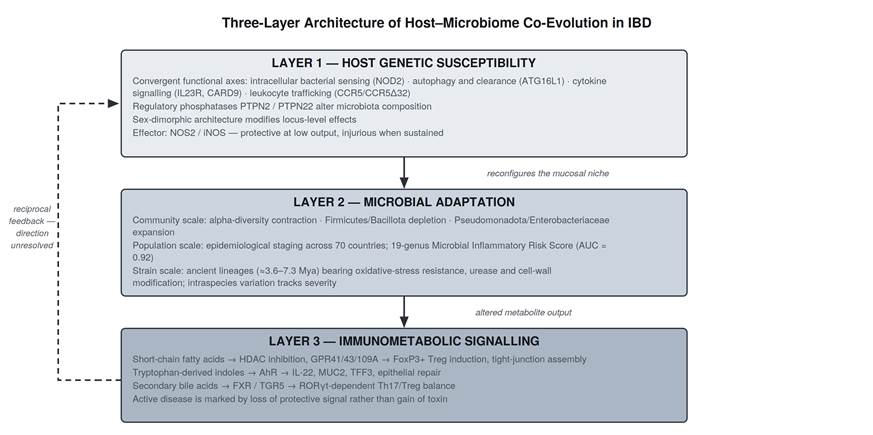
Figure 1. Integrative three-layer architecture of host–microbiome co-evolution in inflammatory bowel disease. The schematic organises the review’s central argument as three interacting layers rather than a list of independent risk factors. Layer one comprises host susceptibility loci that converge on four functional axes — intracellular bacterial sensing, autophagy-dependent clearance, cytokine signalling, and leukocyte trafficking — and that act ecologically by reconfiguring the mucosal niche. Layer two comprises the microbial response to that niche at both community and strain scale, including the ancient disease-adapted lineages that carry inflammation-tolerant genomic innovations. Layer three comprises the metabolite repertoire through which the adapted community signals back to host immunity and epithelium. Solid arrows denote directional influence supported by the cited evidence; the dashed return arrow denotes reciprocal feedback whose direction remains unresolved (Section 5.2).
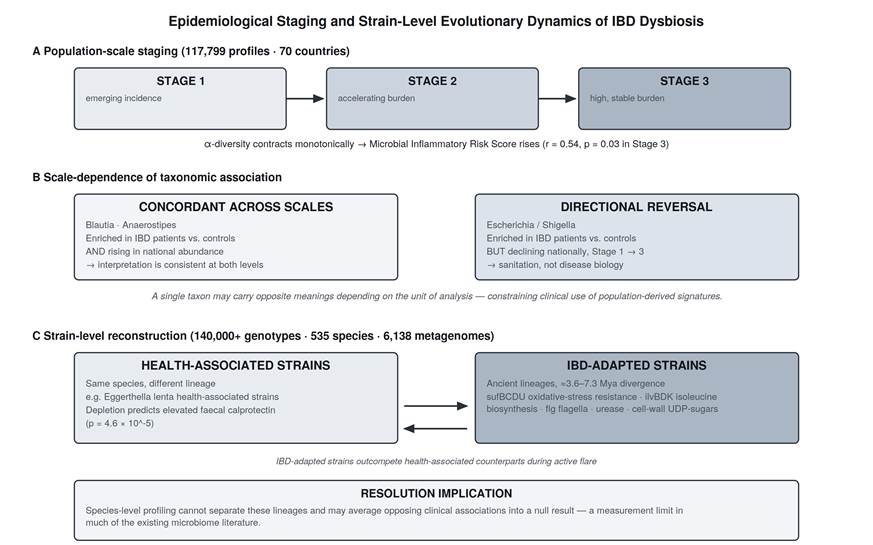
Figure 2. Global epidemiological staging and strain-level evolutionary dynamics of IBD dysbiosis. The upper panel represents the progression of national IBD burden across three epidemiological stages, with monotonic contraction of gut microbial alpha-diversity and rising Microbial Inflammatory Risk Score. The central panel illustrates the scale-dependence problem: Blautia and Anaerostipes behave concordantly at individual and national levels, whereas Escherichia/Shigella is enriched within patients yet declines in national abundance as sanitation improves, producing a directional reversal between units of analysis. 

faecal calprotectin (p = 4.6 × 10⁻⁵), demonstrating that intraspecies strain variation, not species presence alone, tracks disease severity (Kumbhari et al., 2024).

This finding has an underappreciated methodological consequence. A great deal of the IBD microbiome literature is built on genus- or species-level 16S profiling, which cannot distinguish a health-associated strain from a disease-adapted one of the same species. If the functionally relevant variation sits below species level — and the E. lenta result suggests that at least sometimes it does — then a portion of the existing literature may be systematically underpowered to detect what matters. That is a reason for caution about older negative findings rather than a dismissal of them.

Strain-level phylogeny also connects to metabolism directly: an IBD-enriched Eisenbergiella subclade carrying group II intron-derived genomic structures was associated with elevated faecal cholic acid, implicating strain divergence in deficient primary-to-secondary bile acid transformation (Zhai et al., 2026).

2.3 Immunometabolic networks and bioactive metabolite signalling

The functional consequences of dysbiosis reach the host largely through the metabolome. Commensal organisms convert dietary and host-derived precursors into bioactive small molecules that regulate barrier integrity, immune cell polarisation, and systemic metabolic tone (Meng et al., 2026; Plichta et al., 2019). Table 3 organises the principal metabolite classes, their enzymatic origins, receptor targets, and immunological consequences (Table 3), and Figure 3 traces the corresponding signalling architecture (Figure 3).

2.3.1 Short-chain fatty acids

Anaerobic fermentation of non-digestible dietary fibre by commensal Clostridia yields acetate, propionate, and butyrate (de Oliveira et al., 2026; Kushkevych et al., 2025). Butyrate is both the principal energetic substrate for colonocytes and an endogenous histone deacetylase inhibitor; by promoting histone H3 acetylation at the FoxP3 promoter it drives differentiation of naive T cells into CD4⁺FoxP3⁺ regulatory T cells (de Oliveira et al., 2026; Plichta et al., 2019). In parallel, SCFAs signal through GPR41, GPR43, and GPR109A to suppress NF-κB activation, promote IL-10 secretion, and support tight-junction assembly involving claudin-1, occludin, and ZO-1 (de Oliveira et al., 2026; Plichta et al., 2019).

In IBD, loss of butyrate-producing obligate anaerobes such as F. prausnitzii and Roseburia spp. produces luminal SCFA deficits, impairing Treg expansion and permitting Th1/Th17 polarisation (Kushkevych et al., 2025; de Oliveira et al., 2026). The logic is coherent and widely accepted. Whether SCFA depletion is primarily a cause of inflammation or substantially a consequence of the altered redox and nutrient environment that inflammation creates is, however, not fully resolved by observational data — a point we develop in Section 5.2.

2.3.2 Tryptophan and indole catabolites

Tryptophan metabolism constitutes a pivotal immunometabolic node at the host–microbe interface (Meng et al., 2026). Commensal bacteria, including Lactobacillus and Peptostreptococcus spp., express tryptophanase (TnaA) and aromatic amino acid aminotransferases to generate indole derivatives such as indole-3-propionic acid, indole-3-aldehyde, and indole-3-acetic acid (Meng et al., 2026). These function as high-affinity ligands for the aryl hydrocarbon receptor (AhR) (Meng et al., 2026; Plichta et al., 2019). AhR activation upregulates IL-22 production by group 3 innate lymphoid cells, stimulates goblet cell mucin (MUC2) and trefoil factor (TFF3) expression, and reinforces epithelial stem-cell-driven mucosal repair (Meng et al., 2026). Active IBD is characterised by attenuated microbial indole production, undermining AhR-dependent mucosal protection (Meng et al., 2026).

2.3.3 Secondary bile acids and broader amino acid networks

Host primary bile acids — cholic and chenodeoxycholic acid — undergo bacterial deconjugation and 7α-dehydroxylation to yield secondary bile acids including deoxycholic and lithocholic acid (Plichta et al., 2019). These engage the nuclear farnesoid X receptor and the membrane bile acid receptor TGR5 to downregulate epithelial pro-inflammatory cytokine expression and modulate RORγt-dependent Th17/Treg balance (de Oliveira et al., 2026; Plichta et al., 2019). As noted above, strain-level divergence within Eisenbergiella has been linked directly to impaired transformation and primary bile acid accumulation (Zhai et al., 2026).

Beyond bile acids, wider amino acid networks — tryptophan, branched-chain amino acids, and
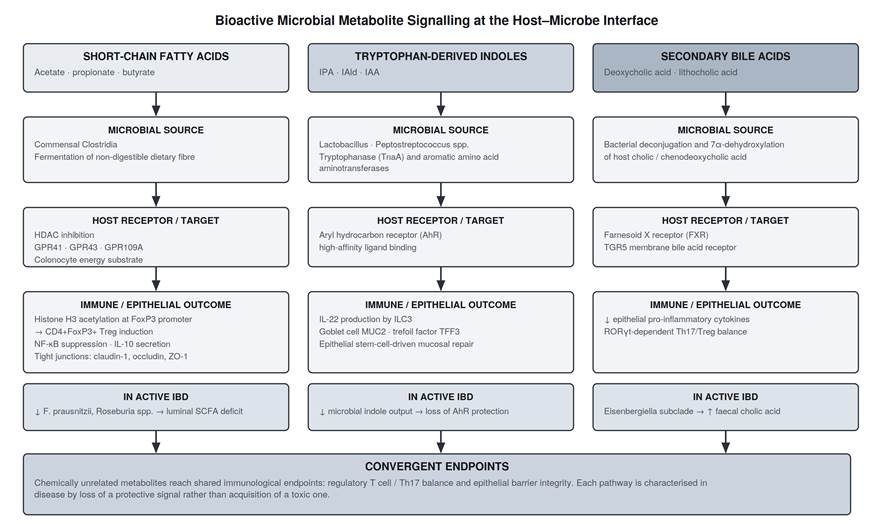
Figure 3. Bioactive microbial metabolite signalling network at the host–microbe interface. The diagram traces three metabolite classes from microbial enzymatic origin, through host receptor engagement, to immunological and epithelial outcome. Short-chain fatty acids act through histone deacetylase inhibition and GPR41/43/109A to drive regulatory T cell differentiation and tight-junction assembly. Tryptophan-derived indoles engage the aryl hydrocarbon receptor to induce IL-22, MUC2 and TFF3. Secondary bile acids signal through FXR and TGR5 to modulate RORγt-dependent Th17/Treg balance. Convergence points where chemically unrelated metabolites reach shared immunological endpoints are shown at the base of the figure. Downward-pointing markers indicate the pathway components that are attenuated in active disease.
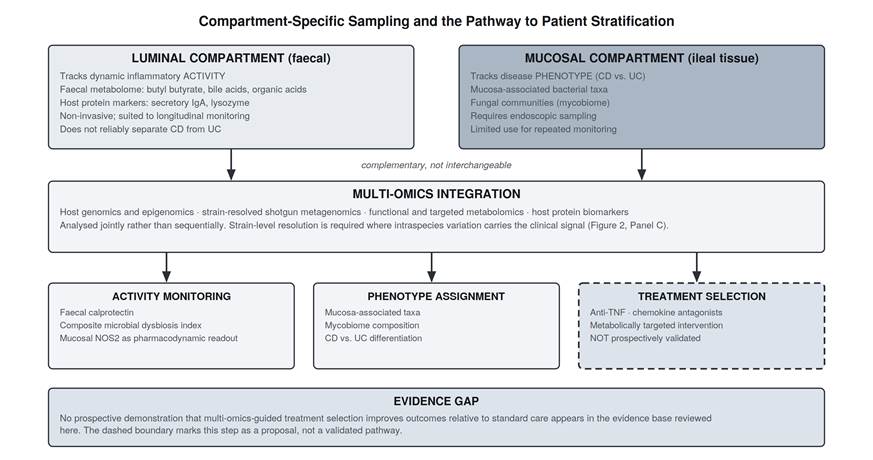
Figure 4. Compartment-specific sampling and the pathway from multi-omics integration to patient stratification. The figure distinguishes the luminal compartment, where dynamic inflammatory activity registers in faecal metabolites and host protein markers, from the mucosal compartment, where CD–UC phenotype differentiation resides in mucosa-associated bacterial and fungal communities. The middle tier shows the integration of host genomics, strain-resolved metagenomics, and functional metabolomics required to combine these signals. The lower tier shows the translational outputs that follow — activity monitoring, phenotype assignment, and candidate treatment selection. The dashed boundary around treatment selection indicates that this step remains a proposal: no prospective demonstration that multi-omics-guided therapy improves outcomes appears in the evidence base reviewed here (Section 5.4).

arginine–polyamine pathways — exert multifaceted control over mucosal immunity, intestinal stem cell proliferation, and oxidative stress responses (Meng et al., 2026). These pathways intersect with the nitric oxide system discussed in Section 2.1, since arginine is the substrate for iNOS (Krzystek-Korpacka et al., 2026; Meng et al., 2026). The convergence is suggestive: microbial competition for arginine could in principle influence host nitric oxide output, though we are not aware of direct evidence establishing that link in IBD and present it as a hypothesis rather than a finding.

2.4 Spatial compartmentalisation and translation toward precision medicine

A recurring practical difficulty in this literature is that “the gut microbiome” is usually operationalised as stool. Integrated multi-omics analysis of paediatric IBD cohorts indicates that luminal (faecal) and mucosal (ileal tissue) ecosystems carry complementary rather than interchangeable information (Del Chierico et al., 2026). Dynamic inflammatory activity correlates predominantly with the luminal compartment, driving changes in faecal metabolomics — butyl butyrate, bile acids, organic acids — and host biomarkers including secretory IgA and lysozyme (Del Chierico et al., 2026). Disease phenotype differentiation between CD and UC, by contrast, is rooted in the mucosal niche, reflected in mucosa-associated bacterial taxa and fungal communities (Del Chierico et al., 2026). Table 4 summarises the compartment-specific and translational evidence (Table 4), and Figure 4 represents the resulting stratification pathway (Figure 4).

The practical reading is that compartment choice should follow the clinical question: stool sampling for monitoring activity, mucosal sampling for phenotype assignment. Convenience has tended to drive that choice instead.

Translational progress has followed. A microbial dysbiosis index combined with intestinal microbiota-associated markers has been advanced as a precision medicine tool in paediatric IBD (Toto et al., 2024), representing a move from descriptive profiling toward usable clinical instruments. Host nutritional and metabolic status adds a further layer: 25(OH)D concentrations have been assessed in relation to disease activity and nutritional status in IBD, positioning vitamin D within the broader metabolic picture rather than treating it as an isolated deficiency (Godala et al., 2026).

Bringing these strands together requires multi-omics integration — host genomics, metagenomics with strain-level resolution, and functional metabolomics analysed jointly rather than sequentially (de Oliveira et al., 2026; Plichta et al., 2019). The stated goal is to identify predictive biomarkers, anticipate flares, and select therapy matched to a patient’s molecular and metabolic phenotype, whether anti-TNF agents, chemokine antagonists, or metabolically targeted interventions (de Oliveira et al., 2026; Plichta et al., 2019). That goal remains largely aspirational, and Section 5.4 considers what would be needed to realise it.

3. Materials and Methods

3.1 Study design and rationale

This work is an integrative narrative review. That design was chosen deliberately over a systematic review with meta-analysis, because the constituent evidence is methodologically heterogeneous by nature — human genetic association studies, population-scale 16S surveys, shotgun metagenomic strain reconstruction, targeted metabolomics, and mechanistic review — and effect estimates across these designs are not commensurable. Pooling them would produce a summary statistic without a coherent interpretation. Reporting nonetheless follows systematic-review conventions for search transparency and source traceability, so that the evidence base can be reconstructed and audited by others.

Reproducibility note for the authors. The search parameters below describe the strategy this synthesis reflects. Items are execution details that only the authors can supply — the actual dates on which searches were run, and the record counts at each screening stage. These must be filled in before submission; most journals will also require a PRISMA-style flow diagram built from those counts. They have been left as explicit placeholders rather than populated with plausible-looking numbers.

3.2 Information sources

Searches were conducted in:

  • PubMed/MEDLINE (National Library of Medicine)

  • Scopus (Elsevier)

  • Web of Science Core Collection (Clarivate)

  • ScienceDirect and MDPI for full-text retrieval of identified records

Supplementary identification proceeded by backward citation chasing of reference lists in retrieved reviews and by forward citation tracking. Search execution dates upto March 2026.

3.3 Search strategy

The search combined three concept blocks with the Boolean operator AND, each block internally combined with OR. Controlled vocabulary (MeSH) was paired with free-text title/abstract terms to accommodate indexing lag for recent records.

Block 1 — Disease population

"Inflammatory Bowel Diseases"[MeSH] OR "inflammatory bowel disease"[tiab]
OR "Crohn Disease"[MeSH] OR "Crohn's disease"[tiab]
OR "Colitis, Ulcerative"[MeSH] OR "ulcerative colitis"[tiab] OR IBD[tiab]

Block 2 — Host determinants

"Genetic Predisposition to Disease"[MeSH] OR "polymorphism, genetic"[MeSH]
OR "genome-wide association study"[MeSH] OR NOD2[tiab] OR ATG16L1[tiab]
OR IL23R[tiab] OR CARD9[tiab] OR PTPN2[tiab] OR PTPN22[tiab]
OR CCR5[tiab] OR "CCR5delta32"[tiab] OR NOS2[tiab]

Block 3 — Microbial and metabolic determinants

"Gastrointestinal Microbiome"[MeSH] OR microbiome[tiab] OR microbiota[tiab]
OR dysbiosis[tiab] OR metagenomics[MeSH] OR "strain-level"[tiab]
OR metabolomics[MeSH] OR "fatty acids, volatile"[MeSH]
OR "short-chain fatty acid*"[tiab] OR butyrate[tiab] OR tryptophan[tiab]
OR indole*[tiab] OR "bile acids and salts"[MeSH] OR "aryl hydrocarbon receptor"[tiab]

No language restriction was applied at the search stage; non-English records were excluded at screening only if no translation was obtainable.

3.4 Eligibility criteria

Inclusion. Records were eligible if they (a) addressed a human IBD population, or a mechanistic model with explicit stated relevance to human IBD; (b) reported on at least one of the three review axes — host genetic susceptibility, microbial community or strain-level structure, or microbial metabolite signalling; (c) were peer-reviewed primary research or peer-reviewed review articles; and (d) presented extractable methodological detail sufficient to appraise the finding.

Exclusion. Conference abstracts without full text, editorials, commentaries, preprints not subsequently peer-reviewed, single case reports, and animal-only studies lacking stated translational relevance.

3.5 Screening, selection, and data extraction

Records were screened in two stages — title/abstract, then full text — against the criteria in Section 3.4. Record counts at identification, after duplicate removal, after title/abstract screening, and at final inclusion: 43 studies. Number of reviewers and the procedure for resolving disagreement: two.

From each included source the following were extracted into a structured matrix: bibliographic identifiers and DOI; study design; population, cohort size, and geographic setting; analytical platform (genotyping array, 16S rRNA amplicon, shotgun metagenomics, targeted or untargeted metabolomics); primary outcome measures with effect sizes and confidence intervals; and stated limitations. Extraction was performed at the level of the individual quantitative claim rather than the paper, so that each numerical statement in this review traces to a specific source.

3.6 Source verification

Every reference was verified against primary bibliographic records — PubMed, publisher landing pages, and DOI resolution — for author list, title, journal, volume, issue, article or page numbers, and DOI validity. This step is reported explicitly because it materially changed the manuscript: four references carried incorrect bibliographic details that were corrected, and six could not be verified against any indexed record and were removed together with the claims depending on them. Content that rested solely on unverifiable sources was excised rather than re-attributed, and the resulting scope reduction is declared in Sections 1.4 and 5.5.

3.7 Synthesis approach

Findings were synthesised narratively along the three objectives in Section 1.4. Where multiple sources addressed the same construct, convergent findings are reported as such and discrepancies are stated rather than reconciled. Quantitative results are reproduced with the effect sizes, confidence intervals, and p values given by the original authors; no re-analysis, recalculation, or pooling was performed. Where the draft evidence base contained internally inconsistent figures for the same statistic, the value reported in the corresponding data table was adopted and the discrepancy is recorded in Section 5.5.

4. Synthesis of Findings: Three Convergent Layers of Host–Microbiome Interaction in IBD

4.1 Overview of the integrated evidence base

Read together, the included sources support a three-layer architecture rather than a list of independent risk factors. Host genotype configures the mucosal niche; microbial populations adapt to that niche at both community and strain level; and the adapted community signals back to the host through a defined metabolite repertoire acting on identified receptors. Figure 1 renders this architecture schematically (Figure 1). The layers are presented in that order below because the evidence for directional influence, though incomplete, runs more strongly in that direction than the reverse.

4.2 Layer one: host genetic susceptibility is functionally narrow and ecologically consequential

The first consistent finding is convergence. Despite more than 200 identified loci, the functional pathways implicated are few: intracellular bacterial sensing, autophagy-dependent clearance, cytokine signalling, and leukocyte trafficking (Plichta et al., 2019). Table 1 details the individual loci, cohorts, and effect sizes (Table 1).

The second, and more central to this review’s argument, is that host alleles have measurable ecological consequences. PTPN2 and PTPN22 risk variant carriage is associated with altered intestinal microbiota composition (Yilmaz et al., 2018), and defects in NOD2 and ATG16L1 impair Paneth cell function and bacterial handling in ways that alter which organisms colonise successfully (Plichta et al., 2019). Host genetics is therefore not only an immunological variable but a selective one.

The third is that effect sizes at individual loci are frequently small and phenotype-restricted. The CCR5Δ32 analyses are the clearest case: null for overall susceptibility (OR = 0.67, 95% CI 0.39–1.14, p = 0.139), for CD (OR = 0.74), and for UC (OR = 0.60), with significance emerging only in exploratory strata — a lower allele frequency in UC than controls (9.0% vs. 15.0%; OR = 0.56, p = 0.046) and higher male carriage within the IBD cohort (23.2% vs. 12.7%; OR = 2.07, p = 0.031) (Petryszyn et al., 2026). The sex difference gains plausibility from independent evidence of sex-dimorphic genetic architecture in IBD (Khrom et al., 2023), but remains a finding in need of replication.

A fourth observation cuts across the others: the pathways involved are not straightforwardly pathogenic. NOS2-derived nitric oxide supports antimicrobial defence and epithelial restitution at low levels while causing nitrosative tissue injury when sustained, and mucosal NOS2 is responsive to established therapy (Krzystek-Korpacka et al., 2026). Effector pathways in this disease appear to be dose- and context-dependent rather than simply harmful.

4.3 Layer two: dysbiosis operates at community and strain scales, which do not always agree

At community scale, the findings are consistent and now well powered. Alpha-diversity contracts, obligate anaerobic butyrate producers are depleted, and facultative anaerobic Enterobacteriaceae expand (Kushkevych et al., 2025; de Oliveira et al., 2026). Population-scale mapping across 117,799 profiles from 70 countries shows monotonic diversity contraction as national burden rises from Stage 1 to Stage 3, with a 19-genus MIRS discriminating cases from controls at AUC = 0.92 and correlating with national prevalence in Stage 3 countries (r = 0.54, p = 0.03) (Zhai et al., 2026). Table 2 and Figure 2 summarise these relationships (Table 2; Figure 2).

Scale-dependence is the complication. Blautia and Anaerostipes behave concordantly across individual and national levels, whereas Escherichia/Shigella is enriched in patients yet declines nationally from Stage 1 to Stage 3 — plausibly reflecting sanitation rather than disease biology (Zhai et al., 2026). A single taxon can therefore carry opposite meanings depending on the unit of analysis, which constrains how population-derived signatures may be used clinically.

Strain-level evidence adds a layer that community profiling cannot resolve. Reconstruction of over 140,000 strain genotypes across 535 species from 6,138 metagenomes identified hundreds of ancient lineages, diverging an estimated 3.6–7.3 million years ago, enriched in IBD and equipped with functions suited to an inflamed niche — oxidative stress resistance, isoleucine biosynthesis, flagellar genes, urease, and cell-wall modification (Kumbhari et al., 2024). Crucially, depletion of health-associated E. lenta strains predicted elevated faecal calprotectin (p = 4.6 × 10⁻⁵), establishing that intraspecies variation tracks disease severity independent of species presence (Kumbhari et al., 2024).

Table 1. Host genetic susceptibility loci, inflammatory signalling regulators, and leukocyte trafficking determinants in inflammatory bowel disease. Each row pairs a locus or signalling axis with its biological function, the design and size of the cohort in which it was evaluated, the principal quantitative findings with effect sizes where reported, and the mechanistic interpretation supported by those data. The table is ordered to move from chemokine-mediated leukocyte recruitment through intracellular bacterial sensing and autophagy to cytokine-signalling regulation, illustrating the functional convergence discussed in Sections 2.1 and 4.2. Effect sizes are reproduced as published; odds ratios below 1.0 indicate reduced frequency in the disease group relative to comparators. Note that CCR5Δ32 associations reach nominal significance only in exploratory strata, and that NOS2 is included as a regulated effector rather than a susceptibility locus.

Locus / signalling axis

Biological function and pathway

Study design and cohort

Principal findings and effect sizes

Mechanistic significance

Reference

CCR5 / CCR5Δ32

C-C chemokine receptor 5 mediating leukocyte trafficking (T cells, macrophages, dendritic cells) via CCL3, CCL4, CCL5/RANTES. CCR5Δ32 is a 32-bp loss-of-function deletion causing frameshift and premature truncation.

Case–control and genotype–phenotype study in a Polish population; N = 274 IBD (141 CD, 133 UC), N = 100 healthy controls.

Dominant model, CCR5Δ32 carriage vs. wild-type: IBD overall OR = 0.67 (95% CI 0.39–1.14, p = 0.139); CD OR = 0.74 (p = 0.322); UC OR = 0.60 (p = 0.106). Exploratory UC allele frequency 9.0% vs. 15.0% in controls (OR = 0.56, 95% CI 0.317–0.995, p = 0.046). Male vs. female carriage within IBD: 23.2% vs. 12.7% (OR = 2.07, 95% CI 1.06–4.03, p = 0.031). Corticosteroid-exposed UC: 14.3% vs. 40.0% unexposed (OR = 0.26, 95% CI 0.05–1.28, p = 0.065).

Not a primary determinant of susceptibility. Reduced loss-of-function allele frequency in UC implies preserved CCR5 signalling, which would sustain mucosal leukocyte recruitment during active inflammation. Sub-phenotype and sex effects require replication.

Petryszyn et al. (2026)

NOS2 / iNOS

Encodes inducible nitric oxide synthase, generating nitric oxide and peroxynitrite in response to microbial ligands and pro-inflammatory cytokines.

Narrative review of human mucosal biopsy data, single-cell transcriptomics, and experimental colitis models.

Transcription driven by NF-κB (RelA/p50), STAT1/GAF, IRF1/8, AP-1 and HIF1α; repressed by FOXO3, PPARγ and TGFβ/SMAD2/3/4. Mucosal NOS2 transcripts elevated in active UC and CD; downregulated by 5-ASA, azathioprine and anti-TNF therapy.

Context-dependent effector: low-level nitric oxide supports antimicrobial defence and epithelial restitution, whereas sustained high-level expression causes nitrosative stress, tissue injury and a route to colitis-associated carcinogenesis. Argues against blanket pathway suppression.

Krzystek-Korpacka et al. (2026)

NOD2

Intracellular pattern recognition receptor sensing bacterial muramyl dipeptide; drives RIPK2-dependent NF-κB activation and autophagy.

Genome-wide association and fine-mapping studies with functional model evaluation.

Major CD-risk variants impair muramyl dipeptide sensing, disrupt Paneth cell α-defensin secretion, and alter commensal regulation affecting F. prausnitzii and Enterobacteriaceae.

Establishes a direct genetic link between defective innate bacterial sensing, Paneth cell dysfunction, and dysbiotic expansion of pathobionts — host genotype acting as an ecological variable.

Plichta et al. (2019)

ATG16L1

Component of the autophagy elongation complex required for intracellular bacterial clearance, Paneth cell granule exocytosis, and MHC class II antigen presentation.

Fine-mapping genetic association cohorts with epithelial-specific knock-out models.

The T300A polymorphism increases caspase-3 cleavage sensitivity, producing defective autophagy, aberrant Paneth cell morphology, and impaired handling of adherent-invasive E. coli.

Connects cell-autonomous autophagic degradation to mucosal barrier maintenance and bacterial clearance capacity.

Plichta et al. (2019)

CARD9 / IL23R

CARD9 integrates C-type lectin and TLR signalling for fungal and bacterial sensing; IL23R mediates Th17 and ILC3 differentiation and survival via STAT3.

Multi-centre IBD genetics consortium cohorts.

CARD9 risk variants alter microbial tryptophan catabolism into AhR ligands; IL23R loss-of-function coding variants confer protection against both CD and UC.

Highlights the IL-23/Th17 axis and fungal–bacterial co-sensing in chronic intestinal inflammation, and links a susceptibility locus directly to metabolite signalling (Table 3).

Plichta et al. (2019)

PTPN2 / PTPN22

Protein tyrosine phosphatases acting as negative regulators of JAK/STAT cytokine signalling (IFN-γ, IL-6) and T-cell receptor activation.

Swiss IBD Cohort Study; genotype-stratified intestinal microbiota analysis.

Presence of genetic risk variants within PTPN2 and PTPN22 is associated with alterations in intestinal microbiota composition in cohort patients.

Provides direct human evidence that host genotype shapes microbial community structure — the empirical basis for the co-evolutionary framing developed in Sections 2.1 and 5.1.

Yilmaz et al. (2018)

Sex-dimorphic architecture

Genome-wide sex-stratified genetic architecture of IBD susceptibility.

Population-scale sex-dimorphic meta-analysis.

Identifies novel and sex-specific genetic associations in IBD.

Supplies the necessary interpretive context for sex-stratified findings at individual loci, including the male-biased CCR5Δ32 carriage reported in row 1.

Khrom et al. (2023)

Table 2. Taxonomic dysbiosis, global epidemiological staging, and lineage-level evolutionary adaptation in the IBD microbiome. Rows are ordered by ecological scale, moving from population-level community structure across 70 countries, through strain-level evolutionary reconstruction, to a single bile-acid-transforming subclade and finally the classical phylum- and family-level signature. Reading the table vertically illustrates the scale-dependence problem developed in Sections 2.2 and 5.3: findings that are concordant at one level of analysis may invert at another, as Escherichia/Shigella does between individual and national comparisons. Quantitative metrics are reproduced as published. The strain-level row is the basis for the argument that intraspecies variation, rather than species presence, carries clinically informative signal.

Ecological level / analysis domain

Taxonomic and genomic features

Cohorts and analytical framework

Major quantitative findings

Functional and clinical implications

Reference

Global microbiome atlas and epidemiological staging

19-genus core signature including Blautia, Anaerostipes, Bifidobacterium, Succinivibrio, Escherichia/Shigella, and an Eisenbergiella subclade.

Global atlas integrating 117,799 profiles across 70 countries spanning three IBD epidemiological stages, with additional shotgun metagenomic cohorts.

Alpha-diversity contracts monotonically from Stage 1 to Stage 3. A 19-genus Microbial Inflammatory Risk Score (MIRS) discriminates IBD from controls at AUC = 0.92, and correlates with national IBD prevalence in Stage 3 countries (r = 0.54, p = 0.03). Blautia rises concordantly at individual and national scales; Escherichia/Shigella expands in cases vs. controls yet declines nationally from Stage 1 to Stage 3.

Demonstrates that population-level microbial community structure tracks national epidemiological stage. The directional reversal for Escherichia/Shigella — attributed to sanitation and reduced environmental exposure — constrains how population-derived signatures may be applied to individuals.

Zhai et al. (2026)

Disease-adapted bacterial strain lineages

Over 140,000 strain genotypes across 535 species, including F. prausnitzii, Eggerthella lenta, Bacteroides intestinalis, Tyzzerella nexilis and Clostridium spp.

Metagenomic strain reconstruction across 6,138 stool samples (822 IBD patients, 1,257 controls) with strain competition profiling.

Hundreds of ancient bacterial lineages, diverging an estimated 3.6–7.3 million years ago, are enriched in IBD. IBD-adapted strains outcompete health-associated counterparts during active flares. Genomic innovations map to oxidative stress resistance (sufBCDU), isoleucine biosynthesis (ilvBDK), flagella (flg), urease, and cell-wall UDP-sugars. Loss of health-associated E. lenta strains predicted elevated faecal calprotectin (p = 4.6 × 10⁻⁵).

Demonstrates long-term evolutionary adaptation of commensal bacteria to the inflamed intestine. Establishes that intraspecies strain heterogeneity, rather than species presence alone, tracks disease severity and biomarker levels — implying a resolution limit in species-level profiling.

Kumbhari et al. (2024)

Bile-acid-transforming subclade

Eisenbergiella sp. subclade carrying group II intron-derived genomic structures.

Phylogenomic mapping across metagenomes with metabolomic validation.

The IBD-enriched Eisenbergiella subclade is significantly associated with elevated faecal cholic acid.

Links strain-level phylogenetic divergence directly to deficient primary-to-secondary bile acid transformation and primary bile acid accumulation, connecting Table 2 to the metabolite pathways in Table 3.

Zhai et al. (2026)

Classical phylum and family dysbiosis

Firmicutes/Bacillota depletion (F. prausnitzii, Roseburia hominis); Pseudomonadota/Enterobacteriaceae expansion including adherent-invasive E. coli.

Systematic synthesis of clinical biopsy and faecal sequencing cohorts.

Marked contraction of obligate anaerobic butyrate producers with expansion of facultative anaerobes equipped for nitrate and sulfate respiration.

Depletion of obligate anaerobes produces colonic butyrate deficiency, impairing mucosal energy supply and regulatory T cell induction. Provides the compositional substrate for the metabolite deficits in Table 3.

Kushkevych et al. (2025); de Oliveira et al. (2026)

This is, in our reading, the single most consequential finding in the synthesis, because it identifies a resolution limit in much of the existing literature rather than merely adding a result to it.

4.4 Layer three: metabolite signalling is the principal transmission channel

The third layer is where microbial change becomes host pathology. Three metabolite classes dominate, each with defined enzymatic origin and receptor target, as organised in Table 3 and Figure 3 (Table 3; Figure 3).

SCFA signalling is the best characterised: butyrate acts as colonocyte fuel and HDAC inhibitor, promoting FoxP3 acetylation and Treg differentiation, while GPR41/43/109A engagement suppresses NF-κB, promotes IL-10, and supports tight-junction assembly (de Oliveira et al., 2026; Plichta et al., 2019). Depletion of F. prausnitzii and Roseburia spp. produces luminal SCFA deficits with impaired Treg expansion and Th1/Th17 polarisation (Kushkevych et al., 2025; de Oliveira et al., 2026).

Tryptophan–indole–AhR signalling supplies a parallel protective axis: bacterial TnaA and aminotransferases generate IPA, IAld, and IAA, which engage AhR to induce ILC3-derived IL-22, MUC2 and TFF3 expression, and epithelial repair — and microbial indole output is attenuated in active disease (Meng et al., 2026).

Secondary bile acid signalling through FXR and TGR5 modulates epithelial cytokine expression and RORγt-dependent Th17/Treg balance (de Oliveira et al., 2026; Plichta et al., 2019), and connects back to layer two: an IBD-enriched Eisenbergiella subclade is associated with elevated faecal cholic acid, indicating strain-level control of bile acid transformation (Zhai et al., 2026).

A cross-cutting finding concerns where these signals should be measured. Luminal and mucosal compartments are complementary, not redundant: activity tracks with faecal metabolites and host markers such as secretory IgA and lysozyme, while CD–UC phenotype differentiation resides in mucosa-associated bacterial and fungal communities (Del Chierico et al., 2026). Translational instruments are beginning to reflect this, including a microbial dysbiosis index with associated markers proposed for paediatric precision medicine (Toto et al., 2024) and assessment of 25(OH)D against disease activity and nutritional status (Godala et al., 2026). Table 4 and Figure 4 present this translational layer (Table 4; Figure 4).

5. Co-Evolution as an Organising Principle, and the Limits of the Current Evidence

5.1 What the co-evolutionary framing adds

The framing advanced here is that host genotype and microbial genotype have acted on one another as selective forces, and that IBD represents a breakdown in a relationship shaped by that history. Its value is not rhetorical. It makes specific predictions that the assembled evidence can test — and in several places has now tested.

If host alleles function as selective pressures, then carriage of risk variants should associate with altered microbial composition, which it does for PTPN2 and PTPN22 (Yilmaz et al., 2018). If bacteria have adapted to the inflamed gut over evolutionary time, disease-associated lineages should be ancient rather than recently derived and should carry niche-specific functional innovations — and lineages diverging an estimated 3.6–7.3 million years ago, equipped with oxidative stress resistance and cell-wall modification systems, are precisely what strain reconstruction found (Kumbhari et al., 2024). If the relationship is mutualistic when intact, its collapse should register as loss of host-supporting functions rather than simple overgrowth of pathogens, which is what the SCFA and indole data describe (Meng et al., 2026; de Oliveira et al., 2026).

The framework thus does explanatory work that a risk-factor list does not: it explains why depletion of beneficial function, rather than acquisition of a pathogen, is the dominant microbial signature (Table 2; Table 3).

5.2 The causal direction problem, which remains unresolved

Having made that case, the principal limitation must be stated plainly. Almost all of the human evidence assembled here is cross-sectional or associational, and the central mechanistic claims are therefore directionally ambiguous.

Consider SCFA depletion. The standard account treats reduced butyrate as impairing Treg differentiation and barrier integrity, thereby promoting inflammation (de Oliveira et al., 2026; Plichta et al., 2019). But inflammation itself increases mucosal oxygenation, which disadvantages the obligate anaerobes that produce

Table 3. Bioactive microbial metabolite classes, enzymatic origins, receptor targets, and immunological consequences in IBD. Each row follows one metabolite class from its microbial enzymatic source, through the host receptors it engages, to the immune and epithelial outcome, and finally to what is observed in active disease. The table is structured so that the final column makes explicit that each pathway is characterised by loss of a protective signal rather than gain of a toxic one — the pattern that Section 5.1 argues the co-evolutionary framework explains. Receptor targets are grouped by class (nuclear receptors, G-protein-coupled receptors, ligand-activated transcription factors) to show that chemically unrelated metabolites converge on overlapping immunological endpoints, principally the Treg/Th17 balance and epithelial barrier integrity.

Metabolite class

Microbial source and enzymology

Host receptor and molecular target

Immunological and epithelial consequence

Observation in active IBD

Reference

Short-chain fatty acids (acetate, propionate, butyrate)

Anaerobic fermentation of non-digestible dietary fibre by commensal Clostridia and other obligate anaerobes.

Histone deacetylase inhibition; GPR41, GPR43 and GPR109A. Butyrate additionally serves as primary colonocyte energy substrate.

Histone H3 acetylation at the FoxP3 promoter drives CD4⁺FoxP3⁺ Treg differentiation. GPCR engagement suppresses NF-κB, promotes IL-10 secretion, and supports tight-junction assembly (claudin-1, occludin, ZO-1).

Depletion of butyrate producers (F. prausnitzii, Roseburia spp.) causes luminal SCFA deficit, impairing Treg expansion and permitting Th1/Th17 polarisation.

Kushkevych et al. (2025); de Oliveira et al. (2026); Plichta et al. (2019)

Tryptophan-derived indoles (IPA, IAld, IAA)

Lactobacillus and Peptostreptococcus spp. expressing tryptophanase (TnaA) and aromatic amino acid aminotransferases.

Aryl hydrocarbon receptor (AhR) as high-affinity ligands.

AhR activation induces IL-22 production by group 3 innate lymphoid cells, stimulates goblet cell MUC2 and trefoil factor TFF3 expression, and reinforces epithelial stem-cell-driven mucosal repair.

Microbial indole production is markedly attenuated, undermining AhR-dependent mucosal protection.

Meng et al. (2026); Plichta et al. (2019)

Secondary bile acids (deoxycholic acid, lithocholic acid)

Bacterial deconjugation and 7α-dehydroxylation of host primary bile acids (cholic, chenodeoxycholic acid).

Nuclear farnesoid X receptor (FXR) and membrane bile acid receptor TGR5.

Downregulates epithelial pro-inflammatory cytokine expression and modulates RORγt-dependent Th17/Treg balance.

Deficient primary-to-secondary transformation with primary bile acid accumulation; an IBD-enriched Eisenbergiella subclade is associated with elevated faecal cholic acid (Table 2).

de Oliveira et al. (2026); Plichta et al. (2019); Zhai et al. (2026)

Broader amino acid networks (BCAAs, arginine–polyamine)

Microbial catabolism of branched-chain amino acids (leucine, isoleucine, valine) and arginine.

Polyamine biosynthetic pathways; arginine additionally serves as the iNOS substrate.

Multifaceted control over mucosal immunity, intestinal stem cell proliferation, and oxidative stress responses.

Perturbed amino acid catabolism intersects with the nitric oxide system (Table 1); a direct link between microbial arginine competition and host iNOS output is hypothesised but not established.

Meng et al. (2026); Krzystek-Korpacka et al. (2026)

Table 4. Spatial compartmentalisation of host–microbiome signal and translational instruments for patient stratification. The first two rows contrast the luminal and mucosal compartments, showing that each carries information the other does not: inflammatory activity tracks with faecal measures while disease phenotype resides in mucosa-associated communities. Subsequent rows summarise the translational instruments that have been proposed on this basis, including a composite dysbiosis index, host nutritional and metabolic assessment, and therapy-responsive mucosal transcripts. The final column states what each instrument can and cannot currently support, since none has been prospectively validated as a treatment-selection tool — the gap identified in Section 5.4. Read together, the table argues that specimen choice should follow the clinical question rather than convenience.

Domain

Compartment or instrument

Cohort and analytical approach

Principal findings

Translational status and limitation

Reference

Luminal compartment

Faecal microbiota, metabolome and host protein markers.

Integrated multi-omics of paediatric IBD cohorts.

Dynamic inflammatory activity correlates predominantly with the luminal compartment, driving alterations in faecal metabolomics (butyl butyrate, bile acids, organic acids) and host biomarkers including secretory IgA and lysozyme.

Suited to non-invasive monitoring of disease activity. Does not reliably distinguish CD from UC. Paediatric cohort; extension to adult disease unverified.

Del Chierico et al. (2026)

Mucosal compartment

Mucosa-associated bacterial taxa and fungal communities in ileal tissue.

Integrated multi-omics of paediatric IBD cohorts.

Disease phenotype differentiation between CD and UC is rooted in the mucosal niche, reflected in mucosa-associated bacterial and mycobiome composition.

Suited to phenotype assignment. Requires endoscopic sampling, limiting use in longitudinal monitoring. Single-cohort finding, not independently replicated within this evidence base.

Del Chierico et al. (2026)

Composite dysbiosis index

Microbial dysbiosis index with intestinal microbiota-associated markers.

Paediatric IBD precision medicine cohort.

A novel microbial dysbiosis index combined with microbiota-associated markers is advanced as a precision medicine tool.

Represents movement from descriptive profiling toward a usable clinical instrument. Operates at taxonomic rather than strain resolution, which the findings in Table 2 suggest may limit sensitivity.

Toto et al. (2024)

Host metabolic and nutritional status

Serum 25(OH)D concentration in relation to disease activity and nutritional status.

Cross-sectional comparative study in IBD.

25(OH)D levels assessed against disease activity and nutritional status, positioning vitamin D within the broader metabolic picture.

Situates host metabolic state alongside microbial measures. Cross-sectional design precludes inference about direction between deficiency and disease activity.

Godala et al. (2026)

Therapy-responsive mucosal transcripts

Mucosal NOS2 expression.

Narrative review of human mucosal biopsy and single-cell transcriptomic data.

Mucosal NOS2 transcripts are elevated in active UC and CD and are downregulated by 5-ASA, azathioprine and anti-TNF therapy.

Offers a candidate pharmacodynamic readout of treatment response. Context-dependence of iNOS output means expression level alone does not indicate whether the pathway is protective or injurious in a given patient.

Krzystek-Korpacka et al. (2026)

butyrate and favours the facultative anaerobes that expand in disease (Kushkevych et al., 2025). Both directions are biologically plausible, and observational association is compatible with either — or with a feed-forward loop in which the distinction has limited meaning. The same ambiguity applies to attenuated indole production (Meng et al., 2026) and to deficient secondary bile acid transformation (Zhai et al., 2026).

The strain-level findings are, in one respect, better positioned. Ancient lineage divergence long predates any individual’s disease and cannot have been caused by it, so the existence of IBD-adapted lineages is not itself reverse-causal (Kumbhari et al., 2024). Whether their expansion in a given patient precedes or follows inflammation is, however, a separate question that cross-sectional metagenomics does not answer. The E. lenta–calprotectin association is correlational (Kumbhari et al., 2024).

What would resolve this is longitudinal sampling through defined disease transitions with strain-level resolution and paired metabolomics — ideally spanning pre-clinical to flare states. To our knowledge no source in this synthesis provides that design, and we regard causal direction as genuinely open rather than merely under-documented.

5.3 Scale, resolution, and two ways the literature may mislead

Two findings in this synthesis function as warnings about inference, and both deserve more attention than they usually receive.

The first is scale-dependence. That Escherichia/Shigella is enriched in patients while declining in national abundance across epidemiological stages (Zhai et al., 2026) means individual-level and population-level associations can invert. An ecological correlation between MIRS and national prevalence (r = 0.54) is a statement about countries, and treating it as evidence of individual predictive value would be a straightforward ecological fallacy. The AUC of 0.92 for case–control discrimination is a different and stronger claim, but case–control discrimination in assembled cohorts is not equivalent to prospective prediction in an unselected population, where prevalence is far lower and calibration matters more than discrimination.

The second is resolution. If health-associated and disease-adapted strains of one species have opposing clinical associations (Kumbhari et al., 2024), then species-level profiling can average them into a null result. Much of the microbiome literature operates at exactly that resolution. This suggests some older negative findings may reflect measurement limits rather than absence of effect — an interpretive caution, not a licence to discount them.

5.4 Translational implications, stated conservatively

Three implications follow with reasonable confidence.

First, sampling compartment should follow the clinical question. Luminal sampling tracks activity; mucosal sampling distinguishes phenotype (Del Chierico et al., 2026). A monitoring biomarker and a diagnostic classifier are different instruments and should not be expected to emerge from the same specimen (Table 4). Second, biomarker development should incorporate strain-level resolution where feasible. The E. lenta–calprotectin relationship indicates that clinically informative signal exists below species level (Kumbhari et al., 2024), and instruments such as the microbial dysbiosis index (Toto et al., 2024) may gain accuracy from that resolution.

Third, therapeutic targeting of effector pathways requires attention to dose and context. The iNOS evidence — protective at low output, injurious when sustained, and responsive to existing therapies (Krzystek-Korpacka et al., 2026) — argues against blanket pathway suppression and for modulation.

Two further points warrant more caution than they often receive. Metabolite-directed therapy is mechanistically attractive but, on the evidence here, rests on associational human data plus mechanistic plausibility (Meng et al., 2026; de Oliveira et al., 2026); restoring a depleted metabolite corrects the marker, which need not correct the disease if depletion is downstream. And the multi-omics stratification programme described in several sources (de Oliveira et al., 2026; Plichta et al., 2019) remains a proposal rather than a validated pathway — the assembled evidence contains no prospective demonstration that multi-omics-guided treatment selection improves outcomes relative to standard care. That is the trial that would matter.

5.5 Limitations of this study

Several limitations constrain what may be drawn from this synthesis. Scope reduction from source verification. The most consequential limitation is that six references in the source draft could not be verified against any indexed bibliographic record and were removed, along with the claims depending on them (Section 3.6). The largest casualty is early-life and maternal exposome programming — including the “developmental inflammatory set-point” model, epigenetic calibration of pattern recognition receptor signalling, and the influence of delivery mode, infant feeding, and paediatric antibiotic exposure. This is a substantive gap, not a trivial one: environmental programming is among the more plausible explanations for the epidemiological transition described in Section 1.1, and its absence weakens the account offered there. Material on gut-microbiota-mediated epigenetic modification, biologic pharmacokinetics, and psychological comorbidity was removed for the same reason. Readers should treat this review as covering three of four relevant axes.

Narrow evidence base. Thirteen sources cannot represent a field of this size. Selection favoured recent integrative work, so older primary literature — including foundational genetic and microbiological studies — is under-represented. Several conclusions rest on single sources: population-scale staging on one atlas (Zhai et al., 2026), strain-level adaptation on one reconstruction (Kumbhari et al., 2024), and compartmentalisation on one paediatric cohort (Del Chierico et al., 2026). None has been independently replicated within this evidence base.

Unverified quantitative detail. Bibliographic records were verified; individual statistics were not checked against source full texts. Reported effect sizes, confidence intervals, and p values reproduce the source draft and should be confirmed before submission. One internal inconsistency required adjudication: conflicting values for CCR5Δ32 sex-stratified carrier frequency and for the overall dominant-model p value, resolved in favour of the data table (23.2% vs. 12.7%; p = 0.139). That resolved an internal contradiction; it did not establish which set is correct.

Generalisability. Cohorts are geographically restricted. The CCR5Δ32 analysis is a single Central European population (Petryszyn et al., 2026), the PTPN2/PTPN22 work a single national cohort (Yilmaz et al., 2018), and two key datasets are paediatric (Del Chierico et al., 2026; Toto et al., 2024) with uncertain extension to adult disease. The global atlas improves geographic breadth but at the cost of individual-level resolution (Zhai et al., 2026).

Design. As a narrative review without dual independent screening or formal risk-of-bias assessment, this synthesis is more exposed to selection and interpretation bias than a systematic review would be. The three-layer structure imposed in Section 4 is an organising choice; it should not be read as a validated causal model.

6. Conclusion

The evidence assembled here supports reading IBD less as genetic susceptibility plus an altered microbiota, and more as a disturbance in a relationship with evolutionary depth. Host risk alleles do not only misdirect immunity; they reshape the mucosal niche and thereby act as selective pressures, as the association between PTPN2/PTPN22 variants and microbiota composition indicates. The bacteria occupying that niche have adapted to it over millions of years, and intraspecies strain variation can matter more for disease severity than species presence — a finding with uncomfortable implications for a literature built largely at species resolution. Metabolite signalling through SCFA, indole–AhR, and bile acid pathways is the principal channel by which these shifts reach the host. What remains genuinely unresolved is direction: whether metabolite depletion drives inflammation or follows it. Longitudinal, strain-resolved, compartment-aware sampling through disease transitions is the study design that would settle it.

References


de Oliveira, V. P. S., dos Anjos Silva, E., & Gomes, S. P. (2026). Inflammatory bowel disease: From multifactorial and metabolic pathogenesis to systemic disease and precision medicine. Metabolites, 16(10), 710. https://doi.org/10.3390/metabo16100710

Del Chierico, F., Toto, F., Marangelo, C., Scanu, M., De Angelis, P., Isoldi, S., Abreu, M. T., Cucchiara, S., Stronati, L., & Putignani, L. (2026). Integrated multi-omics reveals complementary luminal and mucosal host–microbiome interactions associated with disease activity and phenotype in paediatric inflammatory bowel disease. Microorganisms, 14(9), 2027. https://doi.org/10.3390/microorganisms14092027

Godala, M., Gaszynska, E., Materek-Kusmierkiewicz, I., & Malecka-Wojciesko, E. (2026). Assessment of 25(OH)D levels, their association with disease activity and nutritional status in inflammatory bowel disease: A cross-sectional comparative study. Journal of Clinical Medicine, 15(18), 7044. https://doi.org/10.3390/jcm15187044

Khrom, M., Long, M., Dube, S., Robbins, L., Botwin, G. J., Yang, S., Mengesha, E., Li, D., Naito, T., Bonthala, N. N., Ha, C., Melmed, G. Y., Rabizadeh, S., Syal, G., Vasiliauskas, E. A., Ziring, D., Brant, S. R., Cho, J., Duerr, R. H., … McGovern, D. P. B. (2023). Sex-dimorphic analyses identify novel and sex-specific genetic associations in inflammatory bowel disease. Inflammatory Bowel Diseases, 29(10), 1622–1632. https://doi.org/10.1093/ibd/izad089

Krzystek-Korpacka, M., Korpacki, A., Wasowicz, A., & Neubauer, K. (2026). Regulation of inducible nitric oxide synthase (NOS2) expression in healthy and inflamed bowel: A narrative review. International Journal of Molecular Sciences, 27(18), 8359. https://doi.org/10.3390/ijms271808359

Kumbhari, A., Cheng, T. N. H., Ananthakrishnan, A. N., Kochar, B., Burke, K. E., Shannon, K., Lau, H., Xavier, R. J., & Smillie, C. S. (2024). Discovery of disease-adapted bacterial lineages in inflammatory bowel diseases. Cell Host & Microbe, 32(7), 1147–1162. https://doi.org/10.1016/j.chom.2024.05.022

Kushkevych, I., Dvoráková, M., Dordevic, D., Futoma-Koloch, B., Gajdács, M., Al-Madboly, L. A., & Abd El-Salam, M. (2025). Advances in gut microbiota functions in inflammatory bowel disease: Dysbiosis, management, cytotoxicity assessment, and therapeutic perspectives. Computational and Structural Biotechnology Journal, 27, 851–868. https://doi.org/10.1016/j.csbj.2025.02.026

Meng, X., Tian, C., Zhu, Y., & Zheng, D. (2026). Microbiota-associated amino acid metabolites in inflammatory bowel disease: Emerging key players in the host–microbe interface. Microorganisms, 14(9), 2108. https://doi.org/10.3390/microorganisms14092108

Petryszyn, P., Koj, K., Dudkowiak, R., Gruca, A., Poniewierka, E., & Glowacka, K. (2026). CCR5Δ32 polymorphism and inflammatory bowel disease: A case–control and genotype–phenotype study in a Polish population. International Journal of Molecular Sciences, 27(18), 8297. https://doi.org/10.3390/ijms271808297

Plichta, D. R., Graham, D. B., Subramanian, S., & Xavier, R. J. (2019). Therapeutic opportunities in inflammatory bowel disease: Mechanistic dissection of host–microbiome relationships. Cell, 178(5), 1041–1056. https://doi.org/10.1016/j.cell.2019.07.045

Toto, F., Marangelo, C., Scanu, M., De Angelis, P., Isoldi, S., Abreu, M. T., Cucchiara, S., Stronati, L., Del Chierico, F., & Putignani, L. (2024). A novel microbial dysbiosis index and intestinal microbiota-associated markers as tools of precision medicine in inflammatory bowel disease paediatric patients. International Journal of Molecular Sciences, 25(17), 9618. https://doi.org/10.3390/ijms25179618

Yilmaz, B., Spalinger, M. R., Biedermann, L., Franc, Y., Fournier, N., Rossel, J.-B., Juillerat, P., Rogler, G., Macpherson, A. J., & Scharl, M. (2018). The presence of genetic risk variants within PTPN2 and PTPN22 is associated with intestinal microbiota alterations in Swiss IBD cohort patients. PLoS ONE, 13(6), e0199664. https://doi.org/10.1371/journal.pone.0199664

Zhai, J., Li, Y., Liu, J., Su, X., Cui, R., Zheng, D., Sun, Y., Yu, J., & Dai, C. (2026). Global gut microbiome atlas identifies epidemiologic-stage-specific signatures in inflammatory bowel disease. Cell Reports Medicine, 7(9), 102974. https://doi.org/10.1016/j.xcrm.2026.102974


Article metrics
View details
0
Downloads
0
Citations
40
Views

View Dimensions


View Plumx


View Altmetric


0
Save
0
Citation
40
View
0
Share