2.1 Drawing the Line: Why Sex and Gender Are Not the Same Variable
It is worth pausing, before going further, on a distinction that sounds almost too basic to need stating but that clinical medicine has, in practice, blurred for decades: the standardized "one-size-fits-all" model implicitly treats the average male body as the human baseline (Gualtierotti, 2025; Lucena et al., 2025). This has quietly obscured one of the most fundamental dimensions of human health — the biological and sociocultural differences that separate men, women, and gender-diverse individuals (Dattolo et al., 2026; Lee et al., 2023). In an era that markets itself on precision, integrating these variables is not simply the ethically correct thing to do; it has become, arguably, a scientific necessity for optimizing both safety and efficacy (Dattolo et al., 2026; Gualtierotti, 2025).
Getting this right means establishing a rigorous, non-interchangeable boundary between the two terms (Dattolo et al., 2026; Lucena et al., 2025). Sex is biological — chromosomes (XX versus XY), sex hormones (estrogens, progesterone, androgens), gene expression, and anatomy (Dattolo et al., 2026; Gualtierotti, 2025). Gender is sociocultural — roles, behaviors, expressions, identities, and the institutional distribution of power and resources that surrounds a person (Lee et al., 2023; Shankar & Shah, 2025). In practice, of course, sex and gender interact continuously in any living patient, which is precisely why disentangling their independent and combined contributions to health outcomes is both difficult and, we would argue, unavoidable (Tran & Eder, 2026).
The cost of neglecting this distinction has been concrete rather than theoretical. Between 1997 and 2000, ten FDA-approved prescription drugs were withdrawn from the U.S. market owing to serious adverse effects; eight of these carried disproportionately higher risk for women, a safety gap that went undetected during early trials that had relied predominantly on male cohorts (Kraševec, 2022). Reading health through both a biological and a sociocultural lens, then, is less a matter of political correctness than a route toward genuinely personalized — rather than merely generalized — therapeutic guidance (Ginaldi & De Martinis, 2022; Gualtierotti, 2025).
2.2 The Biological Scaffold: Sex-Based Pharmacokinetics and Pharmacodynamics
Biological sex shapes, often quite substantially, both how a drug moves through the body (pharmacokinetics) and how it acts once it gets where it is going (pharmacodynamics) (Lucena et al., 2025; Rakshith et al., 2023). These differences unfold across the whole absorption-distribution-metabolism-excretion (ADME) sequence (Ginaldi & De Martinis, 2022; Lucena et al., 2025), which is illustrated schematically in Figure 1.
Dosing conventions built on body surface area or total body weight, it turns out, do not really capture any of this (Rakshith et al., 2023). Women generally carry a higher percentage of body fat, operate at a lower glomerular filtration rate (GFR), empty the stomach more slowly, and maintain different plasma carrier-protein concentrations (Lucena et al., 2025). Lipophilic drugs such as diazepam consequently persist longer in women given larger adipose reservoirs, while renally cleared drugs may linger owing to the lower GFR (Lucena et al., 2025).
At the metabolic level, sex-specific cytochrome P450 (CYP450) activity is a recurring and fairly robust finding: women display higher baseline CYP3A4 activity, accelerating clearance of substrates like cyclosporine and erythromycin, while men run higher on CYP1A2, clearing compounds such as caffeine more rapidly (Lucena et al., 2025). These pathways appear to be evolutionarily conserved to a surprising degree — when freshwater bivalves (Dreissena polymorpha) were exposed to the SSRI sertraline, researchers observed sex-specific patterns of cytochrome P450 recruitment and bioaccumulation that mirrored mammalian, endocrine-modulated metabolic profiles (Lumor et al., 2026), a finding that, whatever one makes of its clinical relevance, at least underscores how deeply conserved these mechanisms are.
2.3 Specialized Therapeutic Domains: Oncology, Rheumatology, and Psychiatry
2.3.1 Cytotoxic and Targeted OncologySex differences in clearance matter most, arguably, where the therapeutic index is narrow — and oncology is a prime example (Rakshith et al., 2023). Women treated with 5-fluorouracil (5-FU), the chemotherapy backbone for colorectal cancer, experience significantly higher rates of severe hematological and gastrointestinal toxicity, including grade 3/4 neutropenia, leukopenia, diarrhea, and stomatitis (Baraibar et al., 2023; Rakshith et al., 2023). The mechanism here is fairly well characterized: an average 15% reduction in dihydropyrimidine dehydrogenase (DPD) activity in women, which slows plasma clearance and prolongs drug retention (Rakshith
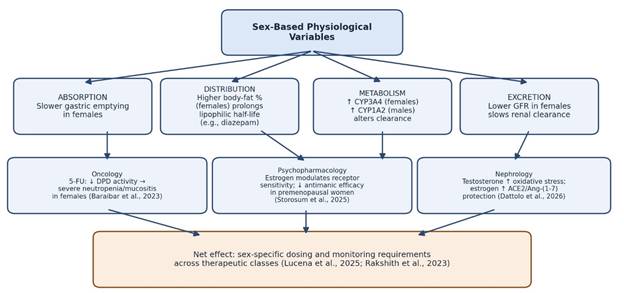
Figure 1. Sex-based pharmacokinetic and pharmacodynamic pathway model, illustrating how female- and male-associated differences in absorption, distribution, metabolism, and excretion translate into distinct clinical consequences across oncology, psychopharmacology, and nephrology (Dattolo et al., 2026; Lucena et al., 2025; Rakshith et al., 2023).
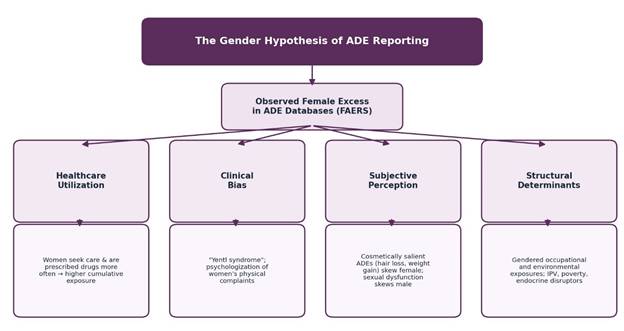
Figure 2. Conceptual model of the four gendered pathways proposed by the Gender Hypothesis — healthcare utilization, clinical bias, subjective perception, and structural determinants — through which sociocultural gender shapes the observed female excess in adverse drug event databases (Lee et al., 2023).
et al., 2023).
A similar story plays out with paclitaxel, which women eliminate roughly 20% more slowly than men, reaching peripheral-compartment saturation at lower plasma concentrations (Rakshith et al., 2023). Doxorubicin clearance, too, runs lower in women — a vulnerability that becomes especially concerning in young girls treated for pediatric leukemia, who face elevated early cardiotoxicity risk, compounded by lower cardiac P-glycoprotein expression, the transporter that would otherwise pump the drug back out of cardiac cells (Rakshith et al., 2023).
Newer modalities are not exempt. Among patients treated with developmental antibody-drug conjugates (ADCs) for advanced non-small-cell lung cancer, a Gustave Roussy cohort study (2018–2023) of 132 patients found women experienced substantially higher rates of grade ≥2 treatment-related adverse events (82.8% versus 69.1%) and metabolic toxicities — anorexia, weight loss, lipid disturbances — leading to nearly double the rate of dose reductions (37.5% versus 19.1%) relative to men (Gustave Roussy Cohort, 2018–2023).
2.3.2 Advanced Biologics in Rheumatology and Neurology
In psoriatic arthritis, women consistently report poorer outcomes and discontinue advanced biologic therapy — TNF inhibitors, IL-17 inhibitors, IL-23 inhibitors — more often than men (Tran & Eder, 2026). The reasons appear layered rather than singular: differences in baseline body composition (fat-free mass versus adiposity), central pain sensitization, and immunogenicity all seem to play a part (Tran & Eder, 2026). Because women tend to mount more vigorous innate and adaptive immune responses, they are also more prone to developing anti-drug antibodies (ADAs) that neutralize biologic agents outright, contributing to therapeutic failure (Tran & Eder, 2026).
Multiple sclerosis tells a somewhat different story. Register-based studies suggest that long-term response rates to disease-modifying therapies show comparatively little difference by sex, yet women face a significantly higher risk of discontinuing glatiramer acetate because of adverse events — a reminder that efficacy and safety do not always move in the same direction, and that sex-specific issues can hide inside a seemingly neutral efficacy signal (Baimonte et al., 2025).
2.3.3 Psychopharmacology and the Estrogen Hypothesis
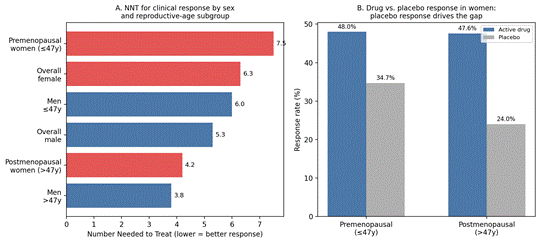
In neuropsychopharmacology, the fluctuating tides of reproductive hormones appear to modulate neurotransmitter receptor sensitivity, receptor density, and — ultimately — drug efficacy itself (Storosum et al., 2025). A large individual patient data (IPD) meta-analysis of acute bipolar I mania trials found a modest but statistically significant sex effect on treatment response, with antipsychotics and mood stabilizers showing lower efficacy and smaller symptom reduction in women than in men (Storosum et al., 2025).
What makes this finding more than a curiosity is what happened when age was used as a proxy for menopausal status. Premenopausal women (47 years or younger) showed a markedly lower response rate and a higher Number Needed to Treat (NNT = 7.5) relative to postmenopausal women (NNT = 4.2) and men (Storosum et al., 2025) — a pattern consistent with the "estrogen hypothesis," which proposes that high circulating estrogen in premenopausal women may exert a negative moderating effect on antimanic and antipsychotic drug efficacy (Storosum et al., 2025).
2.4 Sociocultural Pathways: The Gender Hypothesis of Adverse Drug Events
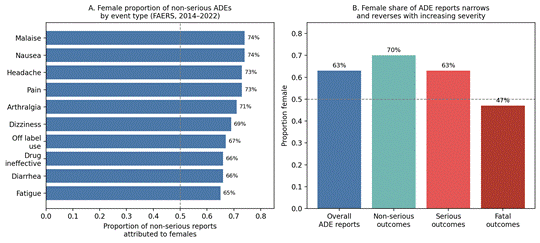
Biological sex explains cellular and physiological mechanisms reasonably well, but it does not, on its own, explain why national pharmacovigilance databases such as the FDA's FAERS consistently record so many more adverse drug events (ADEs) in women than in men. To account for that gap, researchers have proposed what is now called the Gender Hypothesis (Lee et al., 2023), which identifies four interconnected gendered pathways shaping drug-safety data — summarized visually in Figure 2.
First, healthcare utilization: women engage in health-seeking behavior and interface with clinicians at considerably higher rates than men, which mechanically raises cumulative prescription exposure and, with it, baseline risk of experiencing (and reporting) an adverse event (Lee et al., 2023). Traditional masculine norms cut the other way, discouraging men from seeking primary care until concerns have progressed further — which may explain why men are underrepresented in non-serious ADE reports yet overrepresented in severe outcomes such as hospitalization or death (Lee et al., 2023).
Second, clinical bias. Gender stereotypes shape how symptoms get interpreted at the point of care. The historic "Yentl Syndrome" describes how women's cardiovascular complaints are too often minimized or misread as anxiety, resulting in fewer referrals and prescribing that misses the underlying problem (Gualtierotti, 2025; Lee et al., 2023). A related pattern shows up in pain management, where women's physical pain is disproportionately treated with antidepressants rather than adequate analgesia (Lee et al., 2023).
Third, subjective perception. Societal expectations shape which side effects even register as worth reporting. "Cosmetically salient" events — hair loss, weight gain — skew heavily female in safety databases, plausibly reflecting internalized pressure around appearance (Lee et al., 2023), whereas sexual dysfunction is reported disproportionately by men, likely because masculinity scripts link sexual performance closely to identity, making drug-induced sexual side effects more salient and more reportable (Lee et al., 2023).
Fourth, and perhaps least visible, upstream structural determinants. Gendered divisions of labor and differing economic circumstances translate into differential environmental exposures — women, for instance, accumulate higher exposure to endocrine-disrupting phthalates through cosmetic and menstrual hygiene products (Lee et al., 2023). Women are also more likely to experience intimate partner violence, workplace harassment, and poverty, all of which establish chronic vulnerabilities that raise the risk of developing complex health conditions in the first place (Lee et al., 2023).
2.5 Systemic Inequities at the Intersections
2.5.1 Nephrology and Transplantation
The intersection of biological sex and gender roles produces distinct disease trajectories in nephrology as well (Dattolo et al., 2026). In acute kidney injury (AKI), experimental models suggest males are substantially more vulnerable to ischemic and toxin-induced injury, since testosterone appears to promote renal damage by amplifying oxidative stress, while estrogen upregulates protective vascular and antioxidant pathways (Dattolo et al., 2026; Soranno et al., 2025). Clinical epidemiological studies, though, remain fairly inconsistent — largely, it seems, because they often skip sex-stratified analysis altogether or fail to account for hormonal shifts across puberty, menopause, and andropause (Dattolo et al., 2026; Soranno et al., 2025).
Kidney transplantation surfaces a related but distinct inequity: women constitute over 75% of living donors — a figure that likely reflects caregiving expectations and familial role pressure — yet represent only 38% of waitlisted transplant candidates (Shankar & Shah, 2025). This gap appears driven by a combination of factors: providers less often initiating transplant discussions with women, socioeconomic barriers, and pregnancy-induced HLA sensitization, which lengthens wait times and complicates matching (Shankar & Shah, 2025).
2.5.2 Substance Use, Housing, and Gender-Based Violence
In more marginalized populations, gender and social determinants shape physical safety and violence risk in ways that deserve more attention than they typically get (Swaich et al., 2026). A longitudinal study of people who use drugs in Vancouver, Canada, examined whether stable housing protected against physical and sexualized violence amid rising benzodiazepine contamination in the unregulated drug supply (Swaich et al., 2026). What the researchers found was a striking asymmetry: stable housing was associated with significantly lower odds of violence among men (AOR = 0.61), yet this protective effect essentially vanished for women (AOR = 0.82) (Swaich et al., 2026) — a finding that speaks to how deeply violence against marginalized women is embedded in daily life, perpetrated often by people (partners, acquaintances, neighbors) who retain access to the home regardless of its stability (Swaich et al., 2026).
Gendered patterns extend to where drugs get used, too (Latkin et al., 2026). In a large community sample of people who use opioids in Baltimore, Maryland, women had significantly lower odds than men of using drugs in public or semi-public settings — streets (aOR = 0.49), alleys (aOR = 0.50), parks (aOR = 0.57), abandoned buildings (aOR = 0.53), cars (aOR = 0.55) (Latkin et al., 2026). This avoidance seems driven by intense stigma, particularly around motherhood, alongside fear of interpersonal violence and Child Protective Services involvement (Latkin et al., 2026). The consequence, unfortunately, is that women more often use drugs alone indoors, which strips away the safety net of bystander naloxone and other harm-reduction resources, raising the risk of fatal solitary overdose (Latkin et al., 2026).
This vulnerability compounds further at the level of intersectionality: sexual minority women across different racial and ethnic groups show consistently elevated rates of substance use disorders (SUDs) and cannabis use disorder (Schilt-Solberg et al., 2025). Minoritized lesbian, gay, and bisexual women face what researchers describe as a "triple jeopardy" of heterosexism, racism, and misogyny — a convergence of pressures that amplifies minority stress and, plausibly, drives higher rates of self-medication as a coping strategy for trauma and economic hardship (Schilt-Solberg et al., 2025).
2.6 Toward Gender-Sensitive Precision Medicine
Pulling all of this together, the field needs to move past the "one-size-fits-all" model if it genuinely wants health equity and pharmacological precision (Dattolo et al., 2026; Gualtierotti, 2025). That means systematically incorporating sex and gender as core variables at every stage of research, not as an optional subgroup analysis tacked on at the end (Gualtierotti, 2025). Practical steps include adopting the Sex and Gender Equity in Research (SAGER) guidelines for study design and reporting, ensuring representative enrollment of women and gender-diverse participants in trials, and routinely performing sex-disaggregated and sex-stratified analyses to surface disparities in safety, tolerability, and response that would otherwise stay hidden (Gualtierotti, 2025; Lucena et al., 2025). Embedding these principles into medical curricula and clinical guidelines is, we would suggest, how healthcare systems eventually move from treating a generalized "average" patient to delivering care that is genuinely personalized (Dattolo et al., 2026; Gualtierotti, 2025).