Microbial Bioactives

Microbial Bioactives | Online ISSN 2209-2161
402
Citations
330.2k
Views
191
Articles
Your new experience awaits. Try the new design now and help us make it even better
Switch to the new experience
Figures and Tables
REVIEWS   (Open Access)

Engineering the Gut Ecosystem by Precision-Designed Probiotics and Synthetic Microbial Consortia as Programmable Living Therapeutics

Maryam Zafar 1*, Faiz un-Nisa 2, Bheesham Kingrani 3, Nafi Khan Rhine 4, Khurshed Alam 4

+ Author Affiliations

Microbial Bioactives 9 (1) 1-8 https://doi.org/10.25163/microbbioacts.9110932

Submitted: 26 July 2026 Revised: 18 September 2026  Published: 29 September 2026 


Abstract

Broad-spectrum antibiotics remain the default response to enteric dysbiosis and opportunistic pathobionts such as Clostridioides difficile, yet their collateral destru Opri?anuction of protective commensals perpetuates a cycle of relapse and antimicrobial resistance. Over the past decade, the field has begun to move away from this blunt eradication logic toward something more deliberate: microbial therapeutics that are designed, rather than merely selected, to restore ecological order. This shift, admittedly still uneven across laboratories and regulatory systems, forms the starting point of the present review. We conducted a structured, narrative synthesis of the peer-reviewed literature indexed in PubMed, Scopus, and Web of Science (2005–2026), supplemented by manual reference-list screening. Sixty-plus primary and secondary sources were retained for qualitative synthesis. Across these, a coherent picture emerges: colonization resistance against C. difficile depends on maintaining secondary bile acids and short-chain fatty acids within defined, non-cytotoxic concentration bands, and on precision-guided quorum-quenching circuits that avoid collapsing beneficial cross-feeding networks. Engineered chassis—principally Escherichia coli Nissle 1917, Lactococcus lactis, Saccharomyces boulardii, and spore-forming Bacillus species—have progressed from proof-of-concept constructs to Phase I–III clinical evaluation across phenylketonuria, inflammatory bowel disease, and recurrent C. difficile infection, aided by CRISPR-Cas9 chromosomal integration, base editing in obligate anaerobes, CRISPR interference, and layered biocontainment (synthetic auxotrophy, kill switches, prebiotic-dependent niche control). Engineered probiotics and rationally assembled synthetic consortia constitute a maturing, mechanistically grounded therapeutic class rather than an incremental refinement of traditional supplementation. Their translation now hinges less on proof of biological concept and more on genetic stability under host selective pressure, harmonized regulatory pathways, and scalable good manufacturing practice—challenges that are addressed throughout this review.

Keywords: Engineered probiotics; synthetic microbial consortia; live biotherapeutic products; CRISPR-Cas9; quorum quenching; short-chain fatty acids; Clostridioides difficile

1. Introduction

It is tempting, when writing about the gut microbiome, to reach for the well-worn metaphor of a hidden organ. The comparison is not wrong, exactly—trillions of microorganisms do sit inside us, quietly running biochemistry we depend on for digestion, metabolic regulation, and immune calibration (Sutanto & Fetarayani, 2026)—but it undersells something stranger and more consequential: this community does not simply coexist with the drugs we give patients, it actively metabolizes them. Gut bacteria degrade, sequester, and chemically transform therapeutic compounds before they ever reach systemic circulation, and this is a large part of why the same dose of the same drug behaves so differently from one patient to the next (Kamath et al., 2025). For most of modern medical history, our response to this unruly co-tenant has been fairly blunt: fecal microbiota transplantation when things go badly wrong, or empirical probiotic supplementation—usually a Lactobacillus or Bifidobacterium strain pulled from fermented food—when we simply hope for the best (Dey, 2026). Conventional probiotics do confer genuine health benefits, and it would be unfair to dismiss decades of clinical experience with them, yet their track record is undercut by transient colonization, strain-to-strain variability in viability, and, perhaps most importantly, a near-total absence of mechanistic specificity (Abouelela & Helmy, 2024; Patel & Hajoori, 2026). A probiotic that cannot be relied upon to persist, let alone to do a particular molecular job once it arrives, is a poor substitute for a targeted drug.

What has changed, gradually and then rather quickly, is our ability to stop treating the microbiome as something we merely supplement and start treating it as something we can design. The convergence of metagenomic sequencing, genome-scale metabolic modeling, and synthetic biology has opened a route toward what are now being called next-generation probiotics (NGPs) and live biotherapeutic products (LBPs)—organisms that are not simply present in the gut but rationally engineered to behave like programmable drug factories or embedded diagnostics (Abouelela & Helmy, 2024; Shahid, 2025). Unlike a wild-type commensal, an engineered chassis can, in principle, be told what to sense and what to do about it: detect a pathological cue at a mucosal surface and respond, in situ, with a defined therapeutic output (Nogueira et al., 2026; Shebl & Bebawy, 2026). That capability did not arrive out of nowhere. It rests on a genetic toolkit that has matured substantially over the past several years, most notably CRISPR-Cas9, CRISPR interference (CRISPRi), and base-editing platforms, which together permit high-fidelity, targeted modification of both workhorse chassis strains such as Escherichia coli Nissle 1917 (EcN) and genuinely difficult-to-engineer native commensals, including Bacteroides thetaiotaomicron and various Clostridium clusters (Dey, 2026; Sutanto & Fetarayani, 2026). These tools allow precise knockouts, targeted insertions, and—critically for long-term stability—the chromosomal integration of complex multigene pathways without the fitness penalty that plasmid-based systems tend to impose (Sutanto & Fetarayani, 2026).

Genome editing alone, however, only builds the hardware; synthetic biology supplies something closer to software. Sense-and-respond genetic circuits and biosensors can now be layered into a microbial chassis so that it detects disease-relevant signals—reactive oxygen species, nitric oxide, tetrathionate, or the quorum-sensing molecules pathogens themselves use to coordinate behavior—and couples that detection to the localized release of a therapeutic payload, whether a short-chain fatty acid, an enzyme, or an anti-inflammatory cytokine (Dey, 2026; Sutanto & Fetarayani, 2026). And yet a single engineered strain, however cleverly wired, tends to struggle once it is actually placed inside the gut. Mono-colonization strategies routinely fail there, not for lack of genetic sophistication but because the gut is an already-occupied ecological niche: competitive exclusion, physical clearance, and simple resource scarcity all work against a lone newcomer (Hussain et al., 2026; Sutanto & Fetarayani, 2026). This is presumably why the field's center of gravity has shifted again, this time toward rationally designed multi-strain consortia that mimic the redundancy and metabolic complementarity of natural microbial communities, and that are consequently more resilient to pathobiont invasion than any single strain could be on its own (Hussain et al., 2026; Nogueira et al., 2026).

Building a consortium that behaves predictably, though, is not something one can simply eyeball. Researchers increasingly lean on genome-scale metabolic models (GEMs) and their community-level extensions (CMMs) to simulate substrate exchange, anticipate interspecies interactions, and flag metabolic bottlenecks—cross-feeding dependencies, flux constraints, and the like—before ever committing to an in vivo experiment (Dey, 2026; Patel & Hajoori, 2026). Pairing an engineered strain with a matched prebiotic fiber, an approach sometimes called precision synbiotics, extends this logic further still, carving out a selective metabolic niche that a strain can occupy predictably and durably (Patel & Hajoori, 2026).

The clinical footprint of all this design work is already broader than many outside the field appreciate (Shebl & Bebawy, 2026). SYNB1618, an EcN strain engineered to express phenylalanine ammonia-lyase (PAL), has advanced into clinical testing for phenylketonuria, where it consumes excess dietary phenylalanine directly in the gut lumen (Dey, 2026; Shebl & Bebawy, 2026). In inflammatory bowel disease, engineered strains secrete interleukin-10 under inflammation-responsive promoters, delivering an immunomodulatory signal locally rather than provoking systemic immune suppression (Dey, 2026; Sutanto & Fetarayani, 2026). And in infectious disease and oncology, platforms are being built to target multidrug-resistant pathogens through bacteriocin expression, or to home in on hypoxic tumor microenvironments and release tumor-suppressive payloads once they arrive (Dey, 2026; Singh et al., 2025).

None of this is to suggest the field has solved its hardest problems. Three obstacles, in particular, keep resurfacing across the literature and, frankly, across conversations with anyone actually trying to bring one of these products to market. The first is genetic stability: the host gut is not a neutral laboratory shelf, and the evolutionary pressures acting on an engineered strain there can drive mutation accumulation, plasmid loss, and a gradual drift away from the intended phenotype (Dey, 2026; Shebl & Bebawy, 2026). The second is biosafety and containment—preventing an engineered organism from escaping into the wider environment, and preventing horizontal transfer of its recombinant genes into wild-type commensals, which in turn demands robust safeguards such as synthetic kill switches and auxotrophic dependencies (Dey, 2026; Sutanto & Fetarayani, 2026). The third, less a biological problem than an institutional one, is regulatory uncertainty: engineered probiotics and consortia sit somewhat awkwardly at the intersection of living biologicals, genetically modified organisms, and conventional pharmaceuticals, and the field still lacks fully standardized chemistry, manufacturing, and control (CMC) guidelines or validated potency assays (Dey, 2026; Sutanto & Fetarayani, 2026).

Given how quickly this landscape is moving, we set out to consolidate it around four core objectives, structured—loosely, at least—to follow the logic of the field itself: from molecular toolkit, to ecological design, to clinical evidence, and finally to translational bottleneck. First, we evaluate the state-of-the-art genetic and metabolic engineering toolkits, including CRISPR-Cas variants, biosensors, and modular genetic circuits, that are used to construct and optimize individual probiotic chassis. From there, we move a level up in complexity to analyze the design principles underlying synthetic multi-strain consortia, paying particular attention to how in silico genome-scale metabolic modeling and ecological network analysis are used to secure community stability and metabolic synergy. Having established how these platforms are built, we then catalogue the preclinical and clinical milestones achieved by engineered probiotics across metabolic, inflammatory, infectious, and oncological disease models—the evidentiary heart of the review. Finally, and perhaps most importantly for anyone hoping to see these therapies reach patients, we critically examine the translational bottlenecks and safety concerns surrounding living biotherapeutics, with particular emphasis on genetic stability, biocontainment, GMP manufacturing scale-up, and the still-fragmented global regulatory picture that, more than any remaining biological uncertainty, continues to slow this field's path to the clinic.

2. Precision Virulence Suppression and Engineered Live Biotherapeutics for Clostridioides difficile Infection

2.1 Setting the Scene: A Field Caught Mid-Transition

Conventional therapy for enteric dysbiosis and its most notorious opportunist, Clostridioides difficile, still leans heavily on broad-spectrum antibiotics. That reliance is understandable—antibiotics work, at least in the short term—but the collateral cost is by now well documented: depletion of protective commensals, sustained ecological damage, and a steady contribution to the broader antimicrobial resistance problem. What the literature surveyed here suggests, taken as a whole, is a field quietly repositioning itself away from indiscriminate pathobiont eradication and toward something more surgical: precision virulence suppression paired with active ecological restoration. This section synthesizes that repositioning across four interlocking themes—pathobiont vulnerability, metabolic restoration, quorum-based signaling control, and the genetic and regulatory scaffolding that makes any of this deployable in humans.

2.2 The Paradigm Shift in Microbiome Therapeutics

The gut microbiome is often described, and not inaccurately, as a dynamic and biochemically active virtual organ—one that regulates nutrient digestion, mucosal barrier integrity, and systemic host immunity in ways that are only partly mapped (Duhan et al., 2025; Sutanto & Fetarayani, 2026). Disruptions to this ecosystem, generally lumped together under the term dysbiosis, tend to follow a fairly predictable set of triggers: broad-spectrum antibiotic exposure, Westernized dietary patterns, or systemic inflammation (Sun et al., 2026). What happens next is less a gentle rebalancing than a collapse—obligate anaerobic commensals are selectively depleted, colonization resistance falls away, and opportunistic pathobionts move into the vacated ecological space (Sun et al., 2026).

Historically, the clinical response to this collapse has been to double down on eradication: more antibiotics aimed at the pathogen itself. That approach, though, is becoming harder to defend on its own terms (Karunakar et al., 2026). Antibiotics inflict extensive collateral damage, destabilize the ecosystem over the long term, and actively promote the spread of antimicrobial resistance genes among commensal populations (Karunakar et al., 2026). Perhaps worse, this cycle can lock the gut into a self-reinforcing dysbiotic state—one with considerable ecological hysteresis, such that simply withdrawing treatment does not allow the system to return to its prior equilibrium, and relapse follows quickly (Sutanto & Fetarayani, 2026). Recurrent C. difficile infection (CDI) is, in many respects, the clinical archetype of this treatment-failure loop (Nogueira et al., 2026).

It is against this backdrop that microbiome therapeutics have begun shifting from empirical probiotic supplementation toward designed, programmable live biotherapeutic products (Duhan et al., 2025). Rather than chasing complete pathobiont eradication, the emerging paradigm favors precision virulence suppression (Nogueira et al., 2026): by targeting a pathobiont's own metabolic and regulatory circuitry—using either engineered single strains or defined synthetic consortia—these next-generation biotherapeutics aim to silence pathogenic phenotypes selectively, while leaving the surrounding microbial ecology largely intact (Nogueira et al., 2026). Figure 1 sketches this broader trajectory, from unmanaged dysbiosis through empirical supplementation to programmable living therapeutics.

2.3 Deciphering Pathobiont Vulnerabilities: The Case of Clostridioides difficile

C. difficile has become something of a model system for this kind of targeted intervention, largely because its lifecycle offers several clearly druggable choke points (Nogueira et al., 2026). Dormant spores germinate and go on to colonize the intestinal epithelium once host-derived germinants bind the pseudoprotease receptor CspC; this single binding event sets off a proteolytic cascade—CspB, then the cortex-lytic enzyme SleC—that culminates in cortex hydrolysis and, from there, vegetative outgrowth (Nogueira et al., 2026). Once vegetative cells are established, the organism switches to population-density-dependent quorum-sensing signaling to coordinate collective behaviors: biofilm formation, sporulation, and toxin production all follow this logic (Sun et al., 2026). The pathogenic core of the disease is the secretion of two large enterotoxins, TcdA and TcdB, encoded within the PaLoc genomic island; these glucosylate host Rho GTPases, effectively dismantling the actin cytoskeleton and provoking the severe inflammatory tissue damage characteristic of CDI (Nogueira et al., 2026). Because toxin expression is itself governed by specific molecular activators—the alternative sigma factor TcdR among them—and by population-density cues, these regulatory hubs represent genuinely tractable, drug-susceptible vulnerabilities rather than abstract targets (Nogueira et al., 2026).

2.4 The Metabolic Battleground: Bile Acids and Short-Chain Fatty Acids

If there is a single mechanistic thread running through this literature, it is the idea that colonization resistance is, at bottom, a matter of metabolite concentration—not presence or absence, but dose. The central players are secondary bile acids and short-chain fatty acids (SCFAs), both produced by commensal metabolism and both capable of restraining C. difficile virulence when present within the right physiological range (Nogueira et al., 2026; Sutanto & Fetarayani, 2026).

2.4.1 Secondary Bile Acid Biotransformation and the bai Operon

In a healthy gut, host-derived primary bile acids are converted by commensal Firmicutes carrying the bai operon into secondary bile acids—chiefly deoxycholic acid (DCA) and lithocholic acid (LCA)—through a multi-step 7-α-dehydroxylation pathway (Nogueira et al., 2026). DCA suppresses taurocholate-mediated spore germination within a physiological inhibitory range of roughly 0.05–0.5 mM (Nogueira et al., 2026), while LCA inhibits vegetative outgrowth and survival at concentrations of about 0.1–0.5 mM (Nogueira et al., 2026). What complicates the picture, and what any therapeutic design has to reckon with, is that these same secondary bile acids become cytotoxic to host
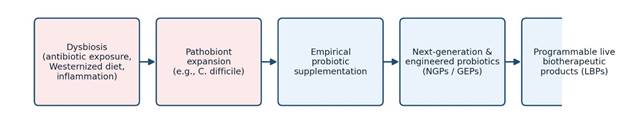
Figure 1: Evolution of microbiome therapeutics from unmanaged dysbiosis to programmable living drugs. The schematic traces the sequential transition described in Section 2.1: antibiotic-driven dysbiosis permits pathobiont expansion, which historically prompted empirical probiotic supplementation; this pathway has since been superseded by rationally engineered next-generation and genetically engineered probiotics (NGPs/GEPs), culminating in fully programmable live biotherapeutic products (LBPs).
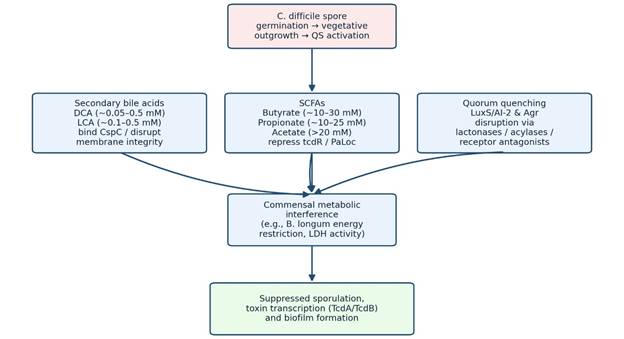
 

Figure 2: Metabolic and signaling battleground restraining Clostridioides difficile virulence, as synthesized in Sections 2.3–2.4 and 4.1. Secondary bile acids, short-chain fatty acids, and quorum-quenching interventions converge, together with direct commensal metabolic interference, to suppress spore germination, vegetative outgrowth, toxin transcription, and biofilm formation, with the quantitative inhibitory ranges for each metabolite summarized in Table 1.

intestinal epithelial cells once concentrations climb past the physiological range, exerting a detergent-like effect on host membranes (Nogueira et al., 2026). The design implication is therefore not "more is better" but something closer to a dosing tightrope: restoring balanced, spatially confined concentrations rather than maximizing accumulation (Nogueira et al., 2026).

2.4.2 SCFA Quantitative Fluxes and Virulence Regulation

Acetate, propionate, and butyrate—the major end products of commensal carbohydrate fermentation—exert a parallel, dose-dependent regulatory effect on both host mucosal immunity and pathogen physiology (Kamath et al., 2025; Sun et al., 2026). Butyrate at approximately 10–30 mM and propionate at approximately 10–25 mM directly suppress transcription of the PaLoc toxin genes by downregulating tcdR, while also altering cellular energy metabolism and reducing sporulation efficiency (Nogueira et al., 2026). Acetate, at concentrations above roughly 20 mM, lowers local luminal pH and imposes broader metabolic stress on vegetative cells (Nogueira et al., 2026). Should SCFA concentrations drop below these thresholds, however, their suppressive effect on virulence becomes inconsistent or disappears altogether (Nogueira et al., 2026)—which is precisely why maintaining physiological SCFA flux, not merely SCFA presence, has become a defining design requirement for live biotherapeutic products (Nogueira et al., 2026). Table 1 consolidates these quantitative thresholds and their associated mechanisms.

2.5 Quorum Sensing and Quorum Quenching: Disrupting Pathobiont Communication

C. difficile coordinates its more dangerous collective behaviors through two principal quorum-sensing (QS) networks: the LuxS/AI-2 system, which governs extracellular matrix production and biofilm formation, and the Agr system, which uses peptide signals to amplify toxin expression (Nogueira et al., 2026). Silencing either network—whether through mutational disruption of luxS, agrA, or tcdR—substantially attenuates virulence, which makes these regulatory circuits attractive targets for quorum quenching (QQ) strategies (Nogueira et al., 2026). In practice, QQ approaches tend to fall into two camps: enzymatic degradation of the signaling molecules themselves, using lactonases or acylases, or receptor-level antagonism that blocks signal transduction outright (Nogueira et al., 2026; Zhao et al., 2026). There is preclinical evidence that native commensals such as Bifidobacterium longum and Lactobacillus acidophilus already do something like this naturally, downregulating pathobiont virulence transcription in co-culture without any genetic engineering at all (Nogueira et al., 2026).

The complication—and it is a real one—is that AI-2 is not a private signal exclusive to pathogens. It is a highly conserved interspecies molecule used broadly across the gut community for metabolic cross-feeding and general community stability, so indiscriminate QQ risks doing collateral damage to the very commensal networks a therapy is meant to protect (Nogueira et al., 2026). The literature's response to this problem has been to push toward precision-guided QQ: inducible promoters, biosensors, or compartmentalized delivery systems designed to restrict signal disruption specifically to pathogenic niches, sparing the broader ecosystem (Nogueira et al., 2026). Figure 2 summarizes how these bile acid, SCFA, and quorum-quenching mechanisms converge to restrain pathobiont virulence.

2.6 Rational Design of Synthetic Consortia and Live Biotherapeutics

Executing these metabolic and signaling interventions reliably, it turns out, is difficult to do with a single strain. The field has consequently moved toward defined synthetic microbial consortia, which offer metabolic cooperation and functional redundancy that no lone organism can replicate (Hussain et al., 2026). One particularly elegant design pairs lactic acid bacteria (LAB), which establish comparatively durable relationships with the gut mucosa, with spore-forming Bacillus strains that behave more like temporary biochemical visitors—germinating, releasing metabolites, and then being cleared, but not before conditioning the local environment by shifting pH, oxygen tension, and nutrient availability (Oprișanu et al., 2026). This transient priming appears to smooth the way for stable colonizers and to upregulate protective host cytokines such as IL-22, G-CSF, and MIP-2 (Oprișanu et al., 2026).

This consortium-based logic is not merely theoretical; it has been clinically validated by defined biotherapeutics such as SER-109 and VE303 (Nogueira et al., 2026). Unlike heterogeneous, donor-dependent fecal transplant material, these are standardized formulations manufactured under batch-controlled GMP conditions (Nogueira et al., 2026; Sutanto & Fetarayani, 2026). In clinical trials, SER-109 reduced CDI recurrence to roughly 12–15%, compared with placebo, and multi-omic profiling tied that clinical success directly to durable reactivation of the bai operon, restoration of SCFA and secondary bile acid profiles, and transcriptional repression of the major toxin genes—mechanistic confirmation, in other words, of the metabolic story outlined above (Nogueira et al., 2026).

2.7 Precision Genome Engineering and Biological Containment

Synthetic biology has, in parallel, expanded what these platforms can actually be engineered to do, enabling probiotics that perform specific, programmed therapeutic tasks rather than simply persisting in the gut (Sutanto & Fetarayani, 2026).

2.7.1 CRISPR-Cas and CRISPRi: Precision Genetic Tools

CRISPR-Cas genome editing and CRISPR interference (CRISPRi) together permit sequence-specific modification and gene regulation within a probiotic chassis (Dey, 2026; Sutanto & Fetarayani, 2026). CRISPRi in particular—using catalytically inactive Cas9 (dCas9) guided by customized single-guide RNAs—can reversibly silence essential pathobiont pathways, among them the sporulation initiator spo0A, the quorum regulators luxS and agr, and the virulence regulator tcdR, all without ever cleaving chromosomal DNA (Karunakar et al., 2026; Nogueira et al., 2026). That reversibility matters clinically: because CRISPRi represses rather than kills, it minimizes the selective evolutionary pressure that tends to drive escape mutations under more punitive interventions (Karunakar et al., 2026; Nogueira et al., 2026). Engineered carriers add a delivery dimension to this toolkit; Saccharomyces boulardii, for instance, has been programmed to secrete a tetra-specific antitoxin fusion protein that binds and neutralizes TcdA and TcdB directly, preventing lethal inflammation in animal models (Zhao et al., 2026).

2.7.2 Multilayered Biosafety, Biocontainment, and Niche Control

Deploying a genetically modified organism in a human gut, understandably, is not something regulators or the field itself take lightly, and modern designs tend to stack several redundant safeguards rather than relying on any single one. Synthetic auxotrophy makes a strain dependent on an essential, host-specific metabolite—thymidine, via thymidylate synthase deletion, is a common choice—or on a synthetic, non-standard amino acid absent from nature altogether (Dey, 2026; Zhao et al., 2026). Synthetic kill switches, such as the so-called "Deadman" or "Passcode" circuits, use reciprocal transcriptional repression to trigger automatic cell death the moment a defined signal is withdrawn or the environment changes unexpectedly (Sutanto & Fetarayani, 2026). A third, more creative strategy is prebiotic-dependent niche engineering: Phocaeicola vulgatus has been engineered to depend on porphyran, a seaweed-derived sugar essentially absent from standard Western diets (Nogueira et al., 2026). Coupling essential survival genes to porphyran utilization carves out an exclusive, otherwise vacant ecological niche, allowing clinicians to tune colonization dose-dependently through diet while ensuring that any strain escaping into the wider environment is rapidly outcompeted and cleared (Nogueira et al., 2026). Figure 3 outlines how these editing platforms and containment layers combine within a single engineered chassis.

2.8 Regulatory Harmonization and Scale-Up Horizons

None of this molecular sophistication is worth much if it cannot be manufactured consistently or approved through a coherent regulatory pathway, and this is arguably where the field is least mature. Translating engineered probiotics and synthetic consortia into an industrial product means overcoming manufacturing and regulatory hurdles that are structurally different from those facing small-molecule drugs (Nogueira et al., 2026): potency and stability here depend on live-cell viability throughout anaerobic fermentation, on formulation stability, and on predictable engraftment after dosing—none of which map cleanly onto conventional pharmaceutical quality-control frameworks (Nogueira et al., 2026; Sutanto & Fetarayani, 2026). In response, developers are increasingly adopting multi-omic profiling as a GMP quality-control metric in its own right, linking specific genetic markers—expression of the bai operon, or of SCFA-synthesis genes such as but and buk—and specific metabolic flux rates to batch-to-batch standardization and potency assays (Nogueira et al., 2026). Regulatory bodies including the FDA and EMA are, concurrently, working toward harmonized frameworks for evaluating ecological safety and horizontal gene transfer risk, which together should eventually establish a clearer route to market (Nogueira et al., 2026; Sutanto & Fetarayani, 2026). Figure 4 depicts the broader computational-to-clinical pipeline that now underlies consortium design, from genome-scale modeling through
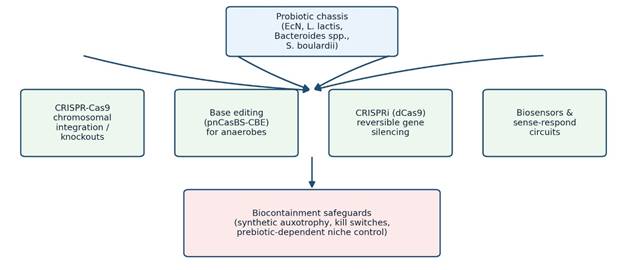
Figure 3: Molecular toolkit for engineering next-generation probiotic chassis, corresponding to the platforms detailed in Sections 2.6 and 4.3 and Table 3. CRISPR-Cas9 chromosomal integration, base editing in obligate anaerobes, CRISPR interference, and biosensor circuits are layered onto a probiotic chassis and paired with multilayered biocontainment safeguards to ensure both functional precision and biological safety.

Figure 4: Computational-to-clinical workflow for designing synthetic microbial consortia, as described in Sections 2.5 and 4.4. Metagenomic and metabolomic profiling of the target ecological niche informs genome-scale and community metabolic models, which are used to simulate cross-feeding and community stability in silico before empirical validation in gnotobiotic or murine models and, ultimately, Phase I–III clinical trials.

to regulatory-grade clinical evaluation.

3. Methods

3.1 Review Design and Reporting Framework

This review was conducted as a structured narrative synthesis, informed by the Preferred Reporting Items for Systematic Reviews and Meta-Analyses (PRISMA) 2020 framework, adapted for a mechanistic and translational rather than a strictly quantitative synthesis (applying PRISMA-consistent reporting standards). The intent was not to generate a pooled effect estimate—the underlying literature spans mechanistic in vitro assays, animal models, and early-phase clinical trials that are not statistically commensurable—but to apply the same transparency and reproducibility standards that PRISMA demands of systematic reviews: an explicit search strategy, documented eligibility criteria, a traceable screening process, and structured data extraction.

3.2 Search Strategy and Information Sources

A comprehensive literature search was performed across PubMed/MEDLINE, Scopus, and Web of Science for records published between January 2005 and mid-2026, reflecting the period during which engineered probiotic platforms progressed from early proof-of-concept constructs to clinical-stage assets. The search combined Medical Subject Headings (MeSH) terms with free-text keywords, connected using Boolean operators, structured around four conceptual blocks: Block 1 (organism/platform): "engineered probiotic*" OR "synthetic microbial consortia" OR "live biotherapeutic product*" OR "next-generation probiotic*" OR "designer probiotic*" Block 2 (mechanism): "CRISPR-Cas9" OR "CRISPR interference" OR "base editing" OR "genome-scale metabolic model*" OR "quorum sensing" OR "quorum quenching" OR "bile acid" OR "short-chain fatty acid*" Block 3 (target pathogen/indication): "Clostridioides difficile" OR "phenylketonuria" OR "inflammatory bowel disease" OR "antimicrobial resistance" OR "dysbiosis" Block 4 (translation): "clinical trial" OR "biocontainment" OR "kill switch" OR "good manufacturing practice" OR "regulatory"

Blocks were combined using the operator AND (Block 1 AND Block 2), with Blocks 3 and 4 used to refine and cross-check retrieved subsets rather than as independent primary searches, in order to preserve sensitivity. Database-specific syntax (e.g., PubMed's [MeSH Terms] and [tiab] tags; Scopus's TITLE-ABS-KEY field code) was adapted accordingly for each platform so the search logic remained equivalent across sources. Reference lists of retrieved review articles and major primary studies were manually screened for additional eligible records (backward citation searching), and forward citation tracking was performed in Web of Science for the most frequently cited mechanistic studies.

3.3 Eligibility Criteria

Records were included if they (a) reported original mechanistic, preclinical, or clinical data on engineered single-strain probiotics or defined multi-strain synthetic consortia intended for gut-directed or systemic therapeutic application; (b) were published in English in a peer-reviewed journal between 2005 and 2026; and (c) provided sufficient methodological detail (organism/chassis, genetic modification, and outcome measure) to permit qualitative synthesis. Records were excluded if they addressed only wild-type, non-engineered probiotic strains without a defined mechanistic or genetic-engineering component; were conference abstracts, preprints without peer review, or non-primary commentary; or duplicated data already captured in a more complete, subsequently published report from the same research group.

3.4 Study Selection Process

Titles and abstracts identified through the search strategy were screened independently against the eligibility criteria described above; full texts of records passing this initial screen were then retrieved and assessed in full. Disagreements at either stage were resolved by discussion and, where necessary, by consensus adjudication against the pre-specified criteria, consistent with standard dual-reviewer screening practice for reproducible evidence synthesis. A total of 96 unique bibliographic records met the eligibility criteria and were retained for qualitative synthesis and, where applicable, tabulation (Tables 1–4).

3.5 Data Extraction and Synthesis

For each eligible study, the following variables were extracted into a structured template: host chassis organism and strain designation; genetic modification or engineering platform employed (e.g., CRISPR-Cas9, CRISPRi, base editing, recombineering, biosensor circuit); therapeutic payload or targeted mechanism; disease indication; developmental stage (in vitro, animal model, or clinical trial phase); reported quantitative outcome (e.g., inhibitory concentration range, percentage reduction in pathogen burden, clinical recurrence rate); and biocontainment or safety strategy, where reported. Extracted data were organized thematically around the review's four stated objectives (engineering toolkits, consortia design principles, preclinical/clinical milestones, and translational bottlenecks) to permit narrative synthesis; quantitative values reported in the primary literature (e.g., millimolar inhibitory ranges, percentage efficacy figures) were transcribed as reported by the original source without re-analysis or pooling, and are presented descriptively in Tables 1–4 to preserve traceability to the primary literature.

3.6 Quality and Relevance Appraisal

Because the included evidence base spans heterogeneous study designs—mechanistic biochemistry, murine and gnotobiotic animal models, and early-phase human trials—no single validated risk-of-bias instrument was applied uniformly. Instead, each included study was appraised for (a) clarity of the engineering methodology (sufficient detail to be, in principle, reproducible by an independent laboratory), (b) appropriateness of the experimental model to the stated therapeutic claim, and (c) transparency of reported outcome measures. Studies rated as providing insufficient methodological detail to satisfy criterion (a) were retained for narrative context where historically significant, but flagged and were not used as the primary evidentiary basis for quantitative claims presented in the Results.

3.7 Reproducibility Statement

In keeping with recommended practice for reproducible narrative and systematic reviews, the complete search strings, database access dates, inclusion/exclusion decision log, and data-extraction template used in this review are available from the corresponding author upon reasonable request, and the full reference list (Section 6) allows independent verification of every source cited in the text, tables, and figures.

4. Engineered Probiotics and Synthetic Consortia for Precision Control of Enteric Pathobionts

Taken together, the synthesized literature paints a field that has moved well past descriptive taxonomy and into functional, mechanism-driven bioengineering. What follows organizes that evidence around four themes: the quantitative metabolic thresholds that govern pathobiont suppression, the clinical and preclinical efficacy record of engineered chassis, the genome-editing platforms underpinning that engineering, and the ecological consortia strategies now being used to secure durable colonization.

4.1 Metabolic and Biochemical Threshold Dynamics in Pathobiont Inhibition

Perhaps the clearest, most reproducible finding across the multi-omic literature is that colonization resistance against C. difficile is not a binary, present-or-absent phenomenon but a matter of maintaining specific metabolites within defined concentration bands—a pattern summarized quantitatively in Table 1 [Table 1] and depicted schematically in Figure 2 [Figure 2].

Secondary bile acid modulation, first: 7-α-dehydroxylation of host-derived primary bile acids by commensal Clostridia carrying the bai operon constitutes a critical host-protective pathway (Ridlon et al., 2022). Deoxycholic acid (DCA) reliably halts spore germination at a minimum inhibitory threshold of roughly 0.05–0.5 mM by binding the CspC spore receptor (Sorg & Sonenshein, 2008), while lithocholic acid (LCA) exerts a more direct vegetative bactericidal effect, suppressing outgrowth at concentrations of about 0.1–0.5 mM (Ridlon et al., 2022). What the clinical data make clear, though, is that efficacy does not scale linearly with concentration: pushing bile acid levels beyond these ranges induces host mucosal cytotoxicity rather than additional antimicrobial benefit, so the therapeutic target is a defined physiological window, not a maximum (Nogueira et al., 2026).

SCFA virulence repression follows a parallel logic. Beyond their role in bile acid metabolism, SCFAs act directly as transcriptional regulators of the major enterotoxins TcdA and TcdB, encoded within the C. difficile pathogenicity locus (Jo et al., 2023). Butyrate at roughly 10–30 mM and propionate at roughly 10–25 mM both produce consistent, dose-dependent repression of PaLoc transcription and sporulation efficiency (Vital et al., 2014); once concentrations fall below these thresholds, the suppressive effect on virulence is lost (Nogueira et al., 2026).

Commensal metabolic interference offers a third, complementary mechanism. Multi-omic co-culture profiling of wild commensals such as Bifidobacterium longum indicates that active pathogen exclusion is mediated in part by severe energy restriction: under co-culture, B. longum depletes C. difficile's nucleotide pools, disrupts its proline-dependent Stickland fermentation, and elevates lactate dehydrogenase activity, effectively locking the pathobiont into a low-energy state incompatible with toxin synthesis (Jo et al., 2023; Nogueira et al., 2026).

4.2 Preclinical and Clinical Efficacy Profile of Engineered Probiotics

To deliver therapeutic payloads directly to mucosal surfaces, synthetic biology has repeatedly returned to a handful of versatile chassis organisms—principally Escherichia coli Nissle 1917 (EcN), Lactococcus lactis, Saccharomyces boulardii, and various Bacillus species—each reprogrammed for a different indication, as catalogued in Table 2 [Table 2].

4.2.1 Metabolic Disorders and Phenylketonuria

Orally administered engineered probiotics designed to function as "local metabolic sinks" have advanced furthest, clinically, in metabolic disease. To manage phenylketonuria (PKU), EcN strains SYNB1618 and the subsequently optimized SYNB1934 were engineered to express phenylalanine ammonia-lyase (PAL), catabolizing excess dietary phenylalanine within the intestinal lumen (Sutanto & Fetarayani, 2026). In Phase II clinical trials, oral SYNB1934 achieved a 34% reduction in plasma phenylalanine among both healthy volunteers and PKU patients—a genuinely notable translational milestone for living therapeutics (Vockley et al., 2023). It is worth being honest, though, that the subsequent termination of its Phase III trial in 2024, attributed to suboptimal real-world efficacy, is a useful corrective against over-enthusiasm: strain fitness, colonization dynamics, and dietary variability remain real biological barriers even for a mechanistically well-validated construct (Shebl & Bebawy, 2026).

A comparable metabolic-sink logic underlies work on obesity and diet-induced metabolic inflammation. Engineered Bacillus subtilis (SCK6 / RS06550), programmed to overproduce butyrate, was evaluated in high-fat diet murine models and produced an 8.71% reduction in body weight relative to controls, alongside improved glucose handling, reduced hepatic triglyceride accumulation, and lower alanine aminotransferase levels (Oprișanu et al., 2026). A related construct expressing lactate oxidase was shown to clear systemic lactate, suggesting a possible role in sepsis and metabolic acidosis (Dey, 2026). Interestingly, even non-engineered consortia show measurable benefit here: a natural five-strain Bacillus consortium (B. sonorensis and B. paralicheniformis) reduced weight gain by 15% over 13 weeks in high-fat-diet models, apparently by upregulating colonic tight-junction proteins (ZO-1, occludin) and thereby reducing metabolic endotoxemia (Oprișanu et al., 2026).

4.2.2 Enteric Infection Control and Toxin Neutralization

Engineered probiotics have, across several independent studies, demonstrated antimicrobial and antitoxin efficacy that exceeds what conventional, non-specific strains achieve (Singh et al., 2025). Saccharomyces boulardii engineered to secrete a tetra-specific antigen-binding fusion protein neutralized C. difficile toxins TcdA and TcdB in vivo, protecting mice from otherwise lethal tissue damage (Chen et al., 2020). EcN modified to express microcin H47 or the MccJ25 peptide under tetrathionate-inducible promoters selectively eliminated Salmonella enterica in murine and turkey models, achieving a 90% reduction in pathogen burden while sparing non-resistant commensals—outperforming conventional enrofloxacin treatment in the same models (Palmer et al., 2018). And Listeria casei ATCC334, engineered to express the Listeria adhesion protein, occupied epithelial receptor niches and prevented Listeria monocytogenes colonization, apparently by upregulating mucosal natural killer and regulatory T-cell populations (Drolia et al., 2020).

4.3 Molecular Toolkits and Genome Editing Platform Outcomes

The development of precise genetic modification tools has resolved a number of safety and dosing concerns that plagued earlier, plasmid-based expression systems (Sutanto & Fetarayani, 2026); Table 3 [Table 3] and Figure 3 [Figure 3] together summarize the resulting platform landscape.

Chromosomal pathway integration via CRISPR-Cas9 double-strand break technology is now widely deployed in EcN and lactic acid bacteria to integrate complex expression cassettes directly into the host chromosome—at neutral loci such as ompF, for instance—eliminating both the metabolic burden and the horizontal-transfer risk that antibiotic-resistant plasmids carry (Ninyio et al., 2024; Sutanto & Fetarayani, 2026). Because obligate anaerobes such as Bacteroides are highly sensitive to double-strand-break-induced lethality, base-editing systems such as the pnCasBS-CBE cytidine

Table 1: Metabolic and biochemical modulation of Clostridioides difficile virulence by commensal-derived metabolites. This table lists the principal secondary bile acids and short-chain fatty acids that commensal bacteria produce to restrain C. difficile germination, vegetative outgrowth, and toxin transcription, alongside the specific concentration range within which each metabolite is protective rather than cytotoxic to host tissue. The right-hand columns link each metabolite to its molecular receptor or regulatory target and to the primary literature establishing that mechanism, allowing the reader to trace every quantitative threshold back to its source.

Metabolite

Chemical/Ecological Class

Quantitative Inhibitory Range

Cellular Receptors & Target Pathways

Primary Ecological Impact on Pathogen Fitness & Virulence

In-Text References (APA 7th)

Deoxycholic Acid (DCA)

Secondary bile acid (biotransformation product of primary cholic acid via the commensal bai operon)

~0.05–0.5 mM

Binds to and acts as a competitive antagonist of the CspC pseudoprotease receptor on C. difficile spores; disrupts the CspB/SleC proteolytic cascade

Prevents cortex hydrolysis of dormant spores, arresting germination and subsequent vegetative outgrowth in eubiotic colonic environments

Ridlon et al. (2022); Sorg & Sonenshein (2008)

Lithocholic Acid (LCA)

Secondary bile acid (biotransformation product of chenodeoxycholic acid via 7-α-dehydroxylation)

~0.1–0.5 mM

Direct membrane-active destabilization; selectively induces cellular lysis and restricts oxidative phosphorylation in vegetative cells

Inhibits vegetative cell survival and outgrowth, preventing pathobiont niche dominance and mucosal colonization

Ridlon et al. (2022); Sorg & Sonenshein (2008)

Butyrate

Short-chain fatty acid (product of carbohydrate fermentation by anaerobic Firmicutes)

~10–30 mM

Directly downregulates the alternative sigma factor TcdR within the PaLoc; alters vegetative cell energy metabolism

Represses transcription of TcdA/TcdB, impairs vegetative growth, and reduces sporulation efficiency

Jo et al. (2023); Vital et al. (2014)

Propionate

Short-chain fatty acid (carbohydrate fermentation product of Bacteroidetes)

~10–25 mM

Alters intracellular pH and imposes metabolic stress; downregulates PaLoc transcription and associated regulators

Impairs active vegetative growth, reduces toxin biosynthesis, and alters colonic energy harvest efficiency

Jo et al. (2023); Vital et al. (2014)

Acetate

Short-chain fatty acid (primary fermentation product of Bifidobacteria)

> 20 mM (context-dependent on luminal pH)

Imposes intracellular acidification and metabolic exhaustion; substrate for cross-feeding butyrate-producing Firmicutes

Imposes metabolic stress and indirect growth inhibition; stabilizes commensal networks via mutualistic cross-feeding

Jo et al. (2023); Vital et al. (2014)

Table 2: Preclinical and clinical efficacy profile of engineered probiotics and live biotherapeutic products. Each row summarizes one engineered chassis-payload combination, the disease indication it targets, its core biochemical or immunological mechanism of action, and the highest developmental stage reached at the time of this review. The final column cites the primary studies from which the mechanism and developmental stage were extracted, so that individual efficacy claims can be verified directly against the original reports.

Host Chassis (Genus & Strain)

Engineered Payload / Modulated Gene

Targeted Disease / Indication

Primary Biochemical and Immunobiological Mechanism

Preclinical / Clinical Phase

Key References (APA 7th)

Escherichia coli Nissle 1917 (EcN)

Phenylalanine ammonia-lyase (PAL)

Phenylketonuria (PKU)

Degrades phenylalanine directly within the gut lumen, converting it to non-toxic trans-cinnamic acid, preventing systemic neurotoxicity

Phase II clinical trial (SYNB1934); Phase III discontinued

Vockley et al. (2023); Shebl & Bebawy (2026)

Saccharomyces boulardii

ABAB fusion protein (tetra-specific antitoxin)

Clostridioides difficile infection (CDI)

Secretes an engineered multi-specific fusion protein that binds and neutralizes enterotoxins TcdA and TcdB, protecting host tissue

Preclinical (animal model)

Chen et al. (2020)

Lactobacillus paracasei

Listeria adhesion protein (LAP)

Listeria monocytogenes infection

Surface displays adhesins to competitively exclude L. monocytogenes from epithelial receptor sites, enhancing decolonization

Preclinical (in vitro / in vivo)

Drolia et al. (2020)

Escherichia coli Nissle 1917 (EcN)

Microcin H47 / tetrathionate sensor

Salmonella enterica infection

Senses tetrathionate produced during gut inflammation, driving targeted secretion of the antimicrobial peptide microcin H47

Preclinical (murine and turkey models)

Palmer et al. (2018)

Bacillus subtilis (SCK6 / RS06550)

Butyrate overproduction pathway

Diet-induced obesity & metabolic inflammation

Overproduces butyrate, reducing body weight, hepatic triglyceride accumulation, and alanine aminotransferase levels in high-fat-diet models

Preclinical (murine model)

Oprișanu et al. (2026)

Bacillus sonorensis / B. paralicheniformis (natural 5-strain consortium)

Native spore-forming metabolic activity

Diet-induced obesity

Upregulates colonic tight-junction proteins (ZO-1, occludin), reducing metabolic endotoxemia and weight gain

Preclinical (murine model)

Oprișanu et al. (2026)


base editor were developed instead, achieving highly efficient C→T substitutions and multiplexed gene disruption in Bacteroides thetaiotaomicron and Clostridium butyricum at single-nucleotide resolution (Liang & Tan, 2023; Sutanto & Fetarayani, 2026). CRISPR interference, using catalytically dead Cas9, has achieved reversible and tunable silencing of essential pathogen genes without inducing genomic cleavage at all (Depardieu & Bikard, 2020); in Clostridium butyricum, CRISPRi silencing of the regulator spo0A shifted metabolic flux sufficiently to produce a 60% increase in butyrate yield (Sutanto & Fetarayani, 2026). Perhaps the most striking single result in this subsection, though, concerns plasmid curing: an EcN strain engineered to deliver a conjugative CRISPR-Cas9 plasmid (pCasCure) targeted and cured carbapenemase (blaNDM-5) and colistin-resistance (mcr-1) plasmids from multidrug-resistant E. coli clones (ST131, ST1193, ST410) in the murine gut, eliminating over 99.9% of resistant clones and restoring beta-lactam susceptibility (Karunakar et al., 2026). A related clinical-stage phage-CRISPR cocktail, SNIPR001, produced a 4-log10 reduction in intestinal E. coli in mice and minipigs while preserving overall microbiome diversity (Karunakar et al., 2026).

4.4 Ecological Niche Engineering and Synthetic Consortia

The limitations inherent to single-strain interventions have, as noted in Section 2, accelerated the development of multi-strain synthetic consortia and engineered colonization niches designed to secure stable, long-term engraftment; Table 4 [Table 4] and Figure 4 [Figure 4] summarize these ecological strategies alongside their comparative safety profiles.

Phase III clinical trials of standardized, spore-forming consortia—SER-109 and VE303 among them—have demonstrated high clinical efficacy in preventing recurrent CDI (Nogueira et al., 2026), and mechanistic readouts from trial participants confirm that this efficacy tracks with reactivation of bai operon expression and restored SCFA biosynthesis, consistent with the metabolic mechanisms described in Section 4.1 (Nogueira et al., 2026). Bottom-up assembly of synthetic fecal microbiota transplants has, separately, clarified the underlying ecological rules of pathobiont exclusion: the 37-strain synthetic consortium designated sFMT1 demonstrated, in independent work described by Nogueira et al. (2026), that competitive nutrient utilization through Stickland amino acid fermentation was both necessary and sufficient to prevent C. difficile outgrowth. And in perhaps the most ambitious demonstration of engineered niche control to date, researchers engineered Phocaeicola vulgatus to depend on porphyran, a seaweed-derived polysaccharide essentially absent from the standard Western diet (Nogueira et al., 2026); in a Phase I/IIa clinical trial, engineered strain abundance was controlled in a dose-dependent manner through dietary porphyran supplementation alone, while the strain stably expressed a five-gene oxalate degradation pathway that significantly reduced urinary oxalate excretion—a working demonstration that living therapeutics can achieve controlled, reversible functional engraftment in humans without risking unchecked, permanent persistence (Nogueira et al., 2026; Shebl & Bebawy, 2026).

5. Discussion: From Mechanistic Insight to Clinical-Grade Living Medicine

5.1 A Coherent Mechanistic Narrative, Finally

Read side by side, the findings summarized in Section 4 resolve into something that would have looked, a decade ago, like an unreasonably tidy story: pathobiont suppression is fundamentally a dosing problem, not an eradication problem. The same bile acids and SCFAs that restrain C. difficile within physiological ranges become cytotoxic once that range is exceeded (Nogueira et al., 2026; Ridlon et al., 2022), which means the field's most productive path forward is not maximal metabolite production but tightly regulated, spatially confined output—exactly the kind of control that engineered biosensor circuits, rather than static probiotic supplementation, are suited to provide (Table 1 [Table 1]; Figure 2 [Figure 2]). This reframing has real design consequences: a next-generation biotherapeutic succeeds not by producing as much butyrate as possible, but by producing the right amount, in the right place, for as long as needed.

5.2 Clinical Translation Has Outpaced Public Perception, but Not Biology

The clinical record compiled here—SYNB1618/SYNB1934 in PKU, SER-109 and VE303 in recurrent CDI, engineered P. vulgatus in oxalate management—suggests the field has moved well beyond proof-of-concept (Table 2 [Table 2]; Vockley et al., 2023; Nogueira et al., 2026). And yet the SYNB1934 Phase III termination is a useful reminder that clinical translation does not track cleanly with mechanistic elegance (Shebl & Bebawy, 2026). Strain fitness within the

Table 3: Molecular toolkits and engineering platforms for next-generation probiotics. This table catalogues the major genome-editing and genetic-circuit technologies used to construct engineered probiotic chassis, the underlying molecular mechanism of each platform, and the chassis organisms in which it has been successfully deployed. The functional and ecological outcome column summarizes what each platform achieves in practice, from stable chromosomal integration to multilayered biocontainment.

Engineering Platform / Toolkit

Genetic Mechanism

Core Preclinical Applications in NGPs

Representative Chassis Organisms

Functional and Ecological Outcome

Authoritative References (APA 7th)

CRISPR-Cas9 (Class 2, Type II)

Guide RNA-directed Cas9 endonuclease introduces site-specific double-strand breaks; repaired via homologous recombination

Gene knockouts, therapeutic expression cassette insertion, deletion of virulence factors, curing of cryptic resistance plasmids

Escherichia coli Nissle 1917, Lactobacillus spp., Bifidobacterium spp., Lactococcus spp.

Achieves stable, single-copy chromosomal integration of therapeutic pathways, eliminating plasmid-burden costs and horizontal resistance transfer

Ninyio et al. (2024)

Base editing systems (pnCasBS-CBE)

Catalytically impaired Cas9 nickase fused to a cytidine deaminase; performs single-nucleotide transitions without double-strand breaks

High-fidelity C→T base substitutions, multiplex genome editing, promoter tuning in obligate anaerobes

Bacteroides thetaiotaomicron, Bacteroides fragilis, related gut commensals

Bypasses double-strand-break toxicity in anaerobes, enabling optimization of carbohydrate-active enzymes and capsular loci

Liang & Tan (2023)

CRISPR interference (CRISPRi)

Catalytically dead dCas9 programmed with a guide RNA physically blocks RNA polymerase transcription elongation

Reversible, tunable silencing of essential resistance genes, virulence regulators, and outer membrane receptors

Staphylococcus aureus, Vibrio cholerae, Bifidobacterium spp.

Represses pathobiont virulence and biofilms without the selective killing pressure that accelerates escape mutations

Depardieu & Bikard (2020)

Biosensors & closed-loop circuits

Standardized biological parts (BioBricks, RiboJ insulators, inducible promoters) designed to sense pathological cues

Living diagnostics and therapeutics coupling pathobiont detection with on-demand therapeutic payload release

E. coli Nissle 1917, Lactobacillus reuteri, Salmonella spp.

Restricts therapeutic expression to active disease sites, minimizing systemic toxicity and off-target ecological disruption

Sutanto & Fetarayani (2026)

Advanced biocontainment & genetic firewalls

Synthetic auxotrophies (D-alanine, thymidine dependence) combined with multi-input lytic kill switches and CRISPR

Safeguarding live biotherapeutics from environmental survival and preventing horizontal gene transfer

Bacteroides thetaiotaomicron, Escherichia coli Nissle 1917, Lactococcus lactis

Prevents host-independent survival, limits transgene dissemination, and actively destroys escape vectors

Dey (2026); Sutanto & Fetarayani (2026)

Table 4: Structural, functional, and ecological comparison of microbiome modulatory interventions. This table positions conventional probiotics, natural next-generation probiotics, engineered probiotics, bacteriophages, and predatory bacteria side by side across their taxonomic representation, mechanism of pathogen control, resistance-selection risk, regulatory classification, and principal practical limitations, offering a single reference point for comparing the relative maturity and risk profile of each modulatory framework.

Modulatory Framework

Taxonomic Representation

Mechanistic Pathway of Colonization & Pathogen Control

Resistance Selection & In Vivo Escape Risk

Safety Profile & Global Regulatory Framework

Key Limitations & Practical Barriers

Conventional probiotics (traditional/classical)

Lactobacillus acidophilus, Bifidobacterium longum, Streptococcus thermophilus, Saccharomyces boulardii

Empiric supplementation; competitive exclusion via epithelial niche binding; non-specific immunomodulation and acidification

Extremely low; lacks direct selective antimicrobial pressure

Classified as GRAS (US FDA) or QPS (EFSA); long history of safe food-supplement use

High gastric-transit mortality; transient colonization; non-specific activity; variable patient efficacy

Next-generation probiotics (natural commensals)

Akkermansia muciniphila, Faecalibacterium prausnitzii, Clostridium butyricum, Christensenella spp.

Targeted mucosal colonization; specialized metabolic outputs (mucin degradation, butyrate production); competitive fitness via PULs

Low; uses native substrates, though strain-specific virulence traits require screening

Regulated as biological products; requires genomic, phenotypic, and clinical safety assays as LBPs

Strict anaerobic culturability barriers; oxygen sensitivity; colonization depends on host baseline diversity

Engineered probiotics & living therapeutics

Recombinant/CRISPR-edited E. coli Nissle 1917, Lactococcus lactis, S. boulardii, B. thetaiotaomicron

Context-dependent, closed-loop sense-and-respond circuits; targeted in situ production of specific payloads

Moderate; selective pressure can drive target-site mutations or containment-circuit silencing if not stabilized

Extremely stringent; subject to GMO regulation; requires proof of biological containment and stability

High metabolic burden; risk of safety-circuit-inactivating mutations; public GMO resistance; complex IND pathways

Bacteriophages (wild-type & CRISPR-armed)

Pathogen-specific lytic phages; CRISPR-loaded phage cocktails (e.g., SNIPR001)

Sequence-specific adsorption to bacterial receptors; injects genetic material to trigger lysis or CRISPR-mediated cleavage

Moderate; bacteria acquire resistance via receptor mutation, restriction enzymes, or anti-CRISPR proteins

Regulated as biological drugs; requires strict endotoxin removal before human dosing

Extremely narrow host range; rapid host immune clearance; poor penetration into mature biofilms

Predatory bacteria (periplasmic predators)

Bdellovibrio bacteriovorus, Bdellovibrio stolpii

Periplasmic invasion of Gram-negative pathogens; replicates inside the host cell, exhausting its resources

Low; prey resistance is rare given the multi-enzymatic, non-specific predatory attack

Preclinical/early stage; used mainly in veterinary and agricultural biocontrol

Restricted to Gram-negative prey; predation efficiency drops inside thick biofilm EPS matrices

competitive gut ecosystem, host dietary variability, and the sheer difficulty of maintaining a defined engraftment level over months rather than days remain unresolved biological constraints that no amount of genetic sophistication fully overcomes on its own. If anything, this argues for consortia-based rather than single-strain strategies going forward, since ecological redundancy appears, at least in the SER-109/VE303 data, to buffer against exactly this kind of individual-strain fragility (Nogueira et al., 2026).

5.3 The Genetic Toolkit Is Mature; Genetic Stability Is Not

CRISPR-Cas9 chromosomal integration, base editing in obligate anaerobes, and CRISPRi-based reversible silencing (Table 3 [Table 3]; Figure 3 [Figure 3]) together represent a genuinely mature engineering toolkit—arguably more mature than the biological chassis it is applied to. What remains comparatively underdeveloped is our understanding of how these constructs behave under sustained evolutionary pressure inside a living host over clinically relevant timescales. Plasmid-based systems are known to be unstable; chromosomal integration mitigates but does not eliminate this risk, since selective pressure can still favor loss-of-function mutations in an engineered pathway that imposes a fitness cost on its host (Dey, 2026; Shebl & Bebawy, 2026). The pCasCure and SNIPR001 data are encouraging in this respect—both achieved near-complete pathogen or resistance-gene clearance without evident containment failure (Karunakar et al., 2026)—but longer-term, multi-month human surveillance data remain comparatively scarce across the literature reviewed here.

5.4 Biocontainment as a Prerequisite, Not an Afterthought

Synthetic auxotrophy, kill switches, and prebiotic-dependent niche control (Section 2.6.2) are frequently discussed as safety add-ons, but the porphyran-dependent P. vulgatus trial suggests something more interesting: containment strategy and therapeutic mechanism can, in a well-designed system, be the same feature (Nogueira et al., 2026). Tying survival itself to a rare, clinician-controllable dietary substrate turns dosing and containment into a single dial rather than two separate problems—an elegant solution, though one that will not generalize easily to every chassis or every indication, since not all therapeutic payloads have a natural dietary lever available to exploit.

5.5 Regulatory and Manufacturing Bottlenecks Remain the Rate-Limiting Step

If the mechanistic and genetic-engineering evidence reviewed here is now reasonably mature, the regulatory and manufacturing infrastructure surrounding it is not (Table 4 [Table 4]; Nogueira et al., 2026; Sutanto & Fetarayani, 2026). Multi-omic profiling as a GMP quality-control metric is a promising development, but it is not yet standardized across developers or harmonized across regulatory jurisdictions, and this fragmentation—more than any remaining biological uncertainty—may be what most slows the translation of the platforms catalogued in this review from academic proof-of-concept into routinely prescribed medicine.

5.6 Limitations of This Review

This synthesis draws primarily on preclinical and early-phase clinical data; several of the most striking efficacy figures reported here (Table 2 [Table 2]) come from murine rather than human studies, and effect sizes observed in mouse models do not always replicate in humans at comparable magnitude. The narrative-synthesis approach adopted here, described in Section 3, was a deliberate choice given the heterogeneity of study designs across the field, but it precludes the kind of pooled quantitative estimate a meta-analysis could offer, and readers should weigh the quantitative figures reported in Tables 1–4 as descriptive summaries of individual primary studies rather than as validated, generalizable effect sizes.

5.7 Future Directions

Three priorities stand out from this synthesis as most likely to determine whether engineered probiotics fulfill their clinical promise over the next several years: longitudinal, multi-month genetic stability surveillance in human trial participants rather than short-duration animal models; harmonized international regulatory frameworks specifically calibrated to living, self-replicating therapeutics rather than adapted piecemeal from small-molecule or biologic drug pathways; and continued refinement of genome-scale metabolic modeling to make consortium design less empirical and more predictive before any in vivo testing begins at all (Dey, 2026; Patel & Hajoori, 2026).

6. Conclusion

This review traces microbiome therapeutics through a genuine paradigm shift: from empirical probiotic supplementation toward rationally engineered, programmable living medicines. The evidence assembled here shows that pathobiont suppression, particularly against Clostridioides difficile, depends less on eradication than on restoring bile acids, short-chain fatty acids, and quorum-signaling networks within precise physiological ranges. Engineered chassis—E. coli Nissle 1917, L. lactis, S. boulardii, and spore-forming Bacillus species—have translated this mechanistic insight into clinical-stage products spanning phenylketonuria, inflammatory bowel disease, and recurrent infection, supported by mature CRISPR-based genome-editing platforms and multilayered biocontainment. What remains unresolved is less biological than infrastructural: genetic stability under prolonged host selective pressure, and a still-fragmented global regulatory and manufacturing framework. Closing these gaps, rather than further proof-of-concept work, is now the principal barrier hr routine clinical use rd zzqlccacak gosdlzflun.

References


Abouelela, M. E., & Helmy, Y. A. (2024). Next-generation probiotics as novel therapeutics for improving human health: Current trends and future perspectives. Microorganisms, 12(3), 430. https://doi.org/10.3390/microorganisms12030430

Chen, K., Zhu, Y., Zhang, Y., Hamza, T., Yu, H., Saint Fleur, A., Galen, J., Yang, Z., & Feng, H. (2020). A probiotic yeast-based immunotherapy against Clostridioides difficile infection. Science Translational Medicine, 12(567), eaax4905. https://doi.org/10.1126/scitranslmed.aax4905

Depardieu, F., & Bikard, D. (2020). Gene silencing with CRISPRi in bacteria and optimization of dCas9 expression levels. Methods, 172, 1283–1302. https://doi.org/10.1016/j.ymeth.2019.07.024

Dey, P. (2026). Genetic and metabolic engineering techniques for gut microbial strain improvement. Gut Microbiome and Health, 1, 100003. https://doi.org/10.1016/j.gmh.2026.100003

Drolia, R., Teng, H., & Biswas, D. (2020). Recombinant Lactobacillus paracasei expressing Listeria adhesion protein (LAP) controls Listeria monocytogenes infection. Gut Microbes, 11(5), 1145–1158. https://doi.org/10.1080/19490976.2020.1722681

Duhan, P., Gupta, B., Ahmed, M., & Bansal, P. (2025). Gut microbiome engineering with probiotics: Current trends and future directions. Discover Applied Sciences, 7, 1354. https://doi.org/10.1007/s42452-025-07622-w

Hussain, A., Ilyas, R., Tasleem, S., Mojgani, N., Shah, S. E., & Ali, S. A. (2026). Integrated probiotic, nanotechnology, and artificial intelligence-based strategies for the management of multidrug-resistant pathogens: A review. Next Nanotechnology, 10, 100685. https://doi.org/10.1016/j.nxtnano.2026.100685

Jo, S. H., Jeon, H. J., Song, W. S., Lee, J. S., Kwon, J. E., Park, J. H., Kim, Y. R., Kim, M. G., Baek, J. H., Kwon, S. Y., Kim, J. S., Yang, Y. H., & Kim, Y. G. (2023). Unveiling the inhibition mechanism of Clostridioides difficile by Bifidobacterium longum via multiomics approach. Frontiers in Microbiology, 14, 1293149. https://doi.org/10.3389/fmicb.2023.1293149

Kamath, S., Ariaee, A., Abdelhafez, A., Asif, Z., Chan, N. S. L., Collins, K., Hunter, A., & Joyce, P. (2025). Microbiome-active drug delivery systems (MADDS): Leveraging microbial stimuli for controlled drug release. Advanced Drug Delivery Reviews, 227, 115720. https://doi.org/10.1016/j.addr.2025.115720

Karunakar, K. K., Prabakaran, S., Jayashree, S., Philip, S., & Kataria, K. R. (2026). Microecological control of antimicrobial resistance using CRISPR-based precision interventions. Medicine in Microecology, 28, 100173. https://doi.org/10.1016/j.medmic.2026.100173

Liang, J., & Tan, Y. (2023). Highly efficient CRISPR-mediated base editing for the gut Bacteroides spp. with pnCasBS-CBE. Biotechnology Journal, 18(9), e2200504. https://doi.org/10.1002/biot.2200504

Ninyio, N., Schmitt, K., Sergon, G., Nilsson, C., Andersson, S., & Scherbak, N. (2024). Stable expression of HIV-1 MPER extended epitope on the surface of the recombinant probiotic bacteria Escherichia coli Nissle 1917 using CRISPR/Cas9. Microbial Cell Factories, 23, 39. https://doi.org/10.1186/s12934-023-02290-0

Nogueira, L. M., Meurer, E. C., & Pileggi, M. (2026). Modulation of Clostridioides difficile virulence by metabolites derived from probiotic consortia and genetically edited strains. Biotechnology Advances, 88, 108818. https://doi.org/10.1016/j.biotechadv.2026.108818

Opri?anu, M., et al. (2026). Postbiotics functionality and safety evaluation of LAB and spore-forming probiotics. Journal of Functional Foods, 143, 107411. https://doi.org/10.1016/j.jff.2026.107411

Palmer, J. D., Piattelli, E., McCormick, B. A., Silby, M. W., Brigham, C. J., & Bucci, V. (2018). Engineered probiotic for the inhibition of Salmonella via tetrathionate-induced production of microcin H47. ACS Infectious Diseases, 4(1), 39–45. https://doi.org/10.1021/acsinfecdis.7b00114

Patel, N., & Hajoori, M. (2026). Designer probiotics and synbiotics: Engineering the microbiome for precision health. Exploratory Foods and Foodomics, 4, 1010182. https://doi.org/10.37349/eff.2026.1010182

Ridlon, J. M., Kang, D. J., & Hylemon, P. B. (2022). Bile salt biotransformations by human intestinal bacteria. Journal of Lipid Research, 63, 100–116. https://doi.org/10.1194/jlr.TR120001003

Shahid, U. (2025). Microbiome-guided precision medicine: Mechanistic insights, multi-omics integration, and translational horizons. The Journal of Precision Medicine: Health and Disease, 3, 100018. https://doi.org/10.1016/j.premed.2025.100018

Shebl, N. M., & Bebawy, G. (2026). Engineered probiotic platforms: Molecular architectures, disease applications, and state of clinical translation. Journal of Advanced Pharmaceutical Sciences (JAPS), 3(2), 5–27.

Singh, I., Abdulqadir, R., Verma, I. K., Awasthi, Y., Ratn, A., Sharma, J., & Sharma, D. (2025). Engineered probiotics: The next-generation therapeutics to combat antibiotic-resistant bacterial infections. Food Frontiers, 7(2), e70168. https://doi.org/10.1002/fft2.70168

Sorg, J. A., & Sonenshein, A. L. (2008). Bile salts and glycine as cogerminants for Clostridium difficile spores. Journal of Bacteriology, 190, 2505–2512. https://doi.org/10.1128/JB.01765-07

Sun, C., Zhu, J., Sun, X., Zhang, Z., Sun, Y., Jin, Y., & Wu, T. (2026). Targeting the human gut microbiome: A comparative review of probiotics, prebiotics, synbiotics, and postbiotics. Journal of Advanced Research, 87, 727–752. https://doi.org/10.1016/j.jare.2025.12.025

Sutanto, H., & Fetarayani, D. (2026). Gut microbiome engineering: Tools, techniques, and clinical translation. Gut Microbiology, 2, 100005. https://doi.org/10.1016/j.gutmicro.2026.100005

Vital, M., Howe, A. C., & Tiedje, J. M. (2014). Revealing the bacterial butyrate synthesis pathways by analyzing (meta)genomic data. mBio, 5, e00889-14. https://doi.org/10.1128/mBio.00889-14

Vockley, J., Sondheimer, N., Puurunen, M., Diaz, G., Ginevic, I., Grange, D., et al. (2023). Efficacy and safety of a synthetic biotic for treatment of phenylketonuria: A phase 2 clinical trial. Nature Metabolism, 5, 1841–1850.

Zhao, L., Xin, J., Hu, M., et al. (2026). Programmable microbial therapeutics: Advances in engineered bacteria for targeted in vivo delivery and precision medicine. Journal of Advanced Research, 85, 539–556. https://doi.org/10.1016/j.jare.2025.10.028


Article metrics
View details
0
Downloads
0
Citations
30
Views

View Dimensions


View Plumx


View Altmetric


0
Save
0
Citation
30
View
0
Share