Integrative Biomedical Research

Integrative Biomedical Research (Journal of Angiotherapy) | Online ISSN  3068-6326
463
Citations
1.8m
Views
757
Articles
Your new experience awaits. Try the new design now and help us make it even better
Switch to the new experience
Figures and Tables
REVIEWS   (Open Access)

Emerging CRISPR-Cas, Antibody, and Nanomedicine Strategies Against Antimicrobial Resistance in Critical Care

Ramji Gupta 1*, Vijay Jagdish Upadhye 2, Mitul Bhuptani 3

+ Author Affiliations

Integrative Biomedical Research 10 (1) 1-8 https://doi.org/10.25163/biomedical.10110908

Submitted: 12 February 2026 Revised: 06 April 2026  Published: 15 April 2026 


Abstract

Antimicrobial resistance (AMR) has become one of the defining threats to survival in intensive and neonatal intensive care units, where vulnerable hosts, invasive devices, and heavy empirical antibiotic exposure converge to select for multidrug- and extensively drug-resistant ESKAPE and non-aeruginosa Pseudomonas pathogens. We conducted a narrative-scoping synthesis of the peer-reviewed literature identified through targeted searches and, restricted to English-language articles addressing AMR mechanisms and next-generation, non-traditional therapeutics in critical care; reference lists were hand-searched, and findings were organized thematically rather than statistically pooled. Four convergent, non-traditional pillars emerged — programmable CRISPR-Cas and CRISPRi genomic tools, monoclonal antibodies and bioconjugates, antimicrobial and anticancer peptides (notably proline-rich peptides), and stimuli-responsive nanozymes and exosomal carriers — each capable of bypassing classical resistance mechanisms while, at least in preclinical models, sparing commensal microbiota. Persistent translational barriers include bedside diagnostic blindness to biofilm-embedded organisms, an unresolved neonatal and pediatric pharmacokinetic/pharmacodynamic void, and stewardship frameworks that still largely ignore the human resistome. Bridging bench-to-bedside gaps will require standardized biofilm models, dedicated pediatric PK/PD trials, artificial-intelligence-assisted therapeutic design, and microbiome-conscious stewardship, particularly given resource disparities across low- and middle-income settings.

Keywords: antimicrobial resistance; critical care; CRISPR-Cas antimicrobials; monoclonal antibodies; antimicrobial peptides; nanozymes; antimicrobial stewardship

1. Introduction

It is tempting, when confronting a number as large as 1.27 million, to let it slide past as an abstraction — but that figure, the estimated toll of bacterial antimicrobial resistance (AMR) in 2019 alone, represents a death roughly every twenty-five seconds attributable to organisms that modern medicine was, in theory, supposed to have already conquered (Murray et al., 2022; Idakwoji et al., 2026). Nearly five million deaths that same year were associated with resistant infections in some capacity, a distinction that matters less to the clinician standing at the bedside than the plain fact that the drugs are not working the way they used to (Murray et al., 2022; Idakwoji et al., 2026). And the picture has not meaningfully brightened since: by 2021, bacterial AMR was still directly responsible for 1.14 million deaths, with 4.71 million deaths occurring in its vicinity (Naghavi et al., 2024). Left on its current trajectory — and this is perhaps the more unsettling projection — AMR could claim 10 million lives annually by 2050, a mortality burden that would eclipse cancer as the world’s leading killer (O’Neill, 2016; Khosrojerdi et al., 2026; Idakwoji et al., 2026).

Nowhere does this crisis concentrate more intensely, or more consequentially, than within intensive care units (ICUs) and neonatal intensive care units (NICUs). These spaces function, almost by design, as high-intensity selective epicenters for resistant organisms (Papanikolaou et al., 2026; Idakwoji et al., 2026). Consider what an ICU actually is: a dense cluster of immunocompromised or physiologically fragile patients, tethered to catheters, ventilators, and central lines, receiving broad-spectrum empirical antibiotics often before a culture has had time to grow (Papanikolaou et al., 2026; Idakwoji et al., 2026). Each of those factors, taken alone, would exert some selective pressure on the local microbial ecology; taken together, they create something closer to an evolutionary pressure cooker — one that reliably produces multidrug-resistant (MDR) and extensively drug-resistant (XDR) organisms, chief among them the so-called ESKAPE pathogens (Enterococcus faecium, Staphylococcus aureus, Klebsiella pneumoniae, Acinetobacter baumannii, Pseudomonas aeruginosa, and Enterobacter species) (De Oliveira et al., 2020; Papanikolaou et al., 2026). More recently, and somewhat less predictably, clinicians have begun to encounter non-aeruginosa Pseudomonas (NAP) species — organisms such as Pseudomonas fluorescens, Pseudomonas putida, and members of the stutzeri/Stutzerimonas complex — emerging as genuine opportunistic pathogens in critical care and dialysis populations, several of which carry plasmid-borne metallo-β-lactamase genes that were, until fairly recently, considered a curiosity rather than a threat (Marino et al., 2026).

Why, mechanistically, are last-resort antibiotics failing so often in this setting? The honest answer is that resistance rarely relies on a single trick; it tends to layer three mutually reinforcing strategies — enzymatic destruction of the drug, remodeling of the drug’s target, and active efflux or reduced membrane permeability — so that even if one defense is overcome, another is usually waiting (Feng et al., 2025). Carbapenemases such as KPC, NDM, and VIM, alongside extended-spectrum β-lactamases, simply chew through carbapenems and cephalosporins before the drug ever reaches its target (Feng et al., 2025; Papanikolaou et al., 2026). Elsewhere, the acquisition of mecA in methicillin-resistant S. aureus (MRSA) or the van operon family in vancomycin-resistant enterococci (VRE) quietly reshapes the binding site itself, dropping drug affinity by orders of magnitude rather than blocking the drug outright (Feng et al., 2025; Papanikolaou et al., 2026; Papageorgiou & Akinosoglou, 2026). And when neither destruction nor remodeling suffices, tripartite efflux systems — MexAB-OprM in Pseudomonas, AdeABC in Acinetobacter, AcrAB-TolC in Enterobacteriaceae — together with porin loss, simply keep hydrophilic drugs from accumulating inside the cell in the first place (Feng et al., 2025; Marino et al., 2026).

The cumulative effect is that the conventional “lock-and-key” model of antibiotic design — one drug, one target, predictable kill — is beginning to fail in a way that feels structural rather than incidental, and even glycopeptides like vancomycin, long treated as a dependable last line, are increasingly compromised (Feng et al., 2025; Papageorgiou & Akinosoglou, 2026). Vancomycin was never an especially elegant molecule to begin with: it is large, slow to kill, poor at penetrating lung tissue, narrow in its therapeutic window, and carries a real risk of acute kidney injury (Abdullah et al., 2026; Papageorgiou & Akinosoglou, 2026). Decades of reliance on it have, unsurprisingly, selected for VISA, VRSA, and heterogeneous VISA (hVISA) phenotypes, all of which correlate strongly with treatment failure and relapse among the sickest patients (Papageorgiou & Akinosoglou, 2026).

Faced with this, the field has begun — not abruptly, but steadily — to pivot away from blunt microbial eradication toward something more deliberate: precision, host-directed, and context-responsive interventions (Feng et al., 2025; Lucero-Prisno III et al., 2025). Programmable CRISPR-Cas antimicrobials sit near the front of this movement (Khosrojerdi et al., 2026; Lucero-Prisno III et al., 2025). By pairing sequence-specific guide RNAs with DNA-cleaving effectors like Cas9 or RNA-targeting effectors like Cas13, these systems can, at least in principle, selectively excise resistance genes — blaNDM, blaKPC-2, mecA, and others — or cure the plasmids that carry them, restoring susceptibility to older, cheaper antibiotics without collaterally damaging the rest of the host’s microflora (Khosrojerdi et al., 2026; Lucero-Prisno III et al., 2025). CRISPR interference (CRISPRi) extends this logic further, offering tunable, reversible gene silencing that never actually cuts the genome (Khosrojerdi et al., 2026), while newer architectures such as the ATTACK-CreTA system pair a toxin-antitoxin module with conjugative delivery so that any cell losing the CRISPR plasmid is killed post-segregationally, closing off one of the more obvious routes of resistance escape (Khosrojerdi et al., 2026).

Monoclonal antibodies (mAbs) occupy a parallel but distinct niche. Rather than entering the cell, they act extracellularly — binding virulence antigens such as PcrV on the Pseudomonas aeruginosa Type 3 Secretion System, or S. aureus alpha-toxin — to neutralize toxicity and recruit opsonophagocytic clearance, all while avoiding the broad selective sweep that antibiotics inevitably impose (Ridelfi et al., 2026). Bioconjugate variants, including antibody-drug conjugates and antibody-antimicrobial peptide fusions, push this specificity further, aiming to deliver a bactericidal payload only once the antibody has physically located its target (Ridelfi et al., 2026).

A third, materials-driven front addresses the perennial problem of getting any of these therapeutics to where the infection actually is. Exosome-based carriers, harvested from immune or stem cell sources, can encapsulate glycopeptides to improve intracellular delivery and reduce off-target toxicity (Abdullah et al., 2026), while more exotic platforms — bimetallic BiPt nanozymes wrapped in platelet-bacteria hybrid membranes (BiPt@HMVs), for instance — home to infection sites and use ultrasound to trigger a burst of lethal reactive oxygen species (Feng et al., 2025). Pathology-responsive nanocarriers add a further layer of intelligence: pH-sensitive platforms reverse their surface charge in acidic biofilm microenvironments to improve penetration; enzyme-responsive systems are cleaved on demand by bacterial hyaluronidases or lipases; and redox-responsive carriers exploit the unusually high intracellular glutathione levels of bacteria, disassembling while simultaneously stripping the organism of its own antioxidant defenses (Lin et al., 2026). Bacteriophage therapy and antimicrobial peptides round out this emerging arsenal, with lytic phages producing depolymerases that dissolve the biofilm’s protective matrix (Linham et al., 2026) and proline-rich antimicrobial peptides (PrAMPs) bypassing membrane lysis altogether, instead slipping through dedicated transporters such as SbmA and YgdD to jam the ribosomal exit tunnel from within (Patel et al., 2024).

And yet — this is really the crux of the matter — none of this laboratory ingenuity has translated cleanly into critical-care practice (Linham et al., 2026). A meaningful part of the problem is diagnostic: bedside testing still cannot reliably distinguish planktonic from biofilm-embedded bacteria, even though the latter can tolerate antibiotics at concentrations 100- to 800-fold higher, so clinicians are left relying on susceptibility data that simply does not predict what will happen inside a biofilm (Idakwoji et al., 2026; Maghiar et al., 2026; Linham et al., 2026). A second gap concerns the youngest and most fragile patients: immature organ function, expanded volumes of distribution, and erratic renal clearance make adult pharmacokinetic models essentially unusable in neonates, and dedicated pediatric trials for newer β-lactam/β-lactamase inhibitor combinations remain scarce even as clinicians struggle to balance therapeutic drug monitoring against aminoglycoside- and colistin-associated nephrotoxicity (Papanikolaou et al., 2026; Linham et al., 2026). A third, more conceptual gap concerns the microbiome itself: stewardship programs still tend to treat resistance as a pathogen-by-pathogen problem, when in fact the gut, skin, and respiratory microbiomes function as reservoirs — a resistome — that broad-spectrum therapy destabilizes, promoting horizontal gene transfer and the expansion of nosocomial organisms (Idakwoji et al., 2026). Strategies such as fecal microbiota transplantation and live biotherapeutic products remain promising but commercially and regulatorily underdeveloped (Idakwoji et al., 2026). Finally, none of this occurs on a level global playing field: diagnostic capacity and regulatory enforcement diverge sharply between well-resourced and low- and middle-income settings, where over-the-counter antibiotic access remains widespread (Elbehiry & Marzouk, 2026; Lucero-Prisno III et al., 2025; Ntais & Chatziprodromidou, 2026).

This review therefore asks, first, how emerging precision and responsive platforms — CRISPR-Cas systems, bimetallic nanozymes, and related technologies — might be safely integrated into the volatile pharmacokinetic environment of the ICU without provoking compensatory resistance, anti-CRISPR immunity, or off-target toxicity in already-vulnerable patients; and second, how far current stewardship frameworks fall short of addressing the spatial and ecological dynamics of biofilms and the microbiome, and what role real-time biomarker-guided personalization might play in closing that gap. Building on these questions, three objectives structure the remainder of this paper: to synthesize the mechanisms, delivery vectors, and clinical readiness of non-traditional therapeutics against ESKAPE pathogens across adult and pediatric critical care; to evaluate the ecological consequences of broad-spectrum antibiotics on the human microbiome and the feasibility of microbiome-preserving stewardship; and to identify the translational, pharmacokinetic, and diagnostic gaps that continue to slow the adoption of personalized, susceptibility-guided therapy in critically ill patients of every age.
2. Precision Antimicrobial Strategies for Critical Care

2.1 The Limits of Blunt-Force Eradication

There is a certain irony in how antibiotics and, separately, cancer chemotherapeutics arrived at the same structural dead end, despite treating entirely different diseases. For nearly a century, both fields have relied on agents that hit broadly conserved cellular machinery — cell wall synthesis, protein translation, nucleic acid replication — because these pathways are reliably present across the target population (Murray et al., 2022; De Oliveira et al., 2020). The trouble is that “reliably present” cuts both ways: the same pathways are often shared with healthy human tissue or commensal bacteria, so broad-spectrum action comes at an ecological and physiological cost. In infectious disease, prolonged broad-spectrum therapy erodes beneficial microbiota, drives dysbiosis, and — perhaps most damagingly — accelerates the spread of MDR organisms across hospital wards (Idakwoji et al., 2026). Oncology faces a structurally similar problem: without meaningful tumor selectivity, chemotherapy produces systemic organ toxicity and a narrow therapeutic window that limits how aggressively disease can be treated (Feng et al., 2025). It is this shared failure — not a coincidence of timing — that has pushed both fields toward precision, sequence- or antigen-specific strategies capable of dismantling a target while sparing everything around it (Feng et al., 2025; Lucero-Prisno III et al., 2025).

2.2 Programmable Genomic Warfare: CRISPR-Cas Systems

Originally nothing more than a bacterial adaptive immune mechanism, CRISPR-Cas machinery has been repurposed into what is arguably the most precise antimicrobial tool currently in development (Khosrojerdi et al., 2026; Lucero-Prisno III et al., 2025). Unlike a conventional antibiotic, which cannot distinguish a resistance gene from any other stretch of DNA, a CRISPR system guided by a sequence-specific crRNA can, at least conceptually, single out blaKPC, blaNDM, blaOXA-48, or mecA and eliminate only that target — curing the resistance plasmid without touching the rest of the bacterial genome or the surrounding commensal flora (Khosrojerdi et al., 2026).

The practical utility of any given CRISPR platform, however, depends heavily on which Cas effector is doing the work, and the differences here are not trivial. Cas9 (Type II-A), guided by a single-guide RNA, introduces a straightforward double-strand break; because most bacteria lack an efficient non-homologous end-joining repair pathway, an unrepaired break of this kind is usually lethal, or at minimum sufficient to cure the plasmid carrying the target gene (Jinek et al., 2012; Khosrojerdi et al., 2026). Cas3 (Type I-E) works rather differently — as part of a multi-protein Cascade complex, it processively degrades DNA in one direction, which allows it to excise entire resistance islands rather than making a single clean cut, reducing the odds that a single point mutation could let the bacterium escape (Sinkunas et al., 2011; Khosrojerdi et al., 2026). Cas12a (Type V) brings a more practical advantage for combination therapy: because it processes its own guide-RNA array, a single construct can carry up to six distinct guides, enabling simultaneous multiplexed targeting of several resistance genes at once (Khosrojerdi et al., 2026; Zetsche et al., 2015). Cas13 (Type VI), somewhat unusually, ignores DNA altogether and targets single-stranded RNA instead, offering transient, reversible knockdown of resistance transcripts such as aac or erm without ever cutting the genome — a feature that may reduce the selective pressure toward mutational escape (Kiga et al., 2020; Khosrojerdi et al., 2026). Finally, CRISPR interference (CRISPRi), built on catalytically inactive dCas fused to a repressor domain, offers tunable and fully reversible silencing — useful when a clinician wants to suppress, say, the mexB efflux pump or the blaCMY-2 promoter only for the duration of concurrent antibiotic therapy, rather than eliminating the gene outright (Qi et al., 2013; Khosrojerdi et al., 2026) (Table 1).

Getting any of this machinery into the right cell, though, remains the harder problem. Engineered phagemids exploit natural bacteriophage host specificity to inject CRISPR cassettes directly, achieving substantial in vivo pathogen reduction, but their narrow host range and vulnerability to receptor-mutation resistance limit how broadly they can be deployed

Table 1. Cas effectors for precision antimicrobial and diagnostic applications. This table compares the functional class, target nucleic acid, cleavage mechanism, principal clinical advantage, and off-target or immunogenicity limitations of nine Cas endonucleases and transcriptional regulators currently repurposed against antimicrobial resistance, alongside representative resistance-gene targets and their supporting primary references. It is intended to guide platform selection according to the specific resistance mechanism and delivery constraints of a given clinical scenario.

Cas Effector

Class & Type

Target Molecule

Cleavage / Activity Type

Key Advantage for AMR / Oncology

Off-Target / Limitation Profile

Representative Target Genes

Key References (APA Style)

SpCas9

Class 2, Type II-A

Double-stranded DNA (dsDNA)

Blunt double-strand break (DSB) mediated by HNH and RuvC domains

High editing efficiency; induces fatal chromosomal breaks in bacteria lacking NHEJ

Pre-existing immunity in 30–60% of humans; requires strict NGG PAM

blaKPC, blaNDM, mecA

Jinek et al. (2012); Khosrojerdi et al. (2026); Kuo et al. (2026)

SaCas9

Class 2, Type II-C

Double-stranded DNA (dsDNA)

Blunt double-strand break (DSB)

Small gene size (~3.2 kb) fits easily within size-restricted phagemid vectors

High pre-existing human antibody seroprevalence; requires NNGRRT PAM

blaCTX-M-15, ermB

Khosrojerdi et al. (2026); Kiro et al. (2014); Oechslin (2018)

Cas3

Class 1, Type I-E

Double-stranded DNA (dsDNA)

Unidirectional, processive 3'-to-5' degradation of target DNA

Physically excises large genomic regions or entire resistance islands

Multi-protein Cascade complex is structurally complex to pack into single vectors

blaCTX-M-15 (on 150-kb plasmid)

Hamilton et al. (2019); Khosrojerdi et al. (2026); Sinkunas et al. (2011)

Cas12a (Cpf1)

Class 2, Type V

Double-stranded DNA (dsDNA) & ssDNA

Staggered, cohesive double-strand break (DSB) with 5'-overhang

Processes its own crRNA arrays, allowing simple multiplexed multi-gene targeting

T-rich (TTTV) PAM restriction; non-specific collateral trans-cleavage of ssDNA

blaNDM, tet(A), qnr

Chen et al. (2018); Khosrojerdi et al. (2026); Zetsche et al. (2015)

Cas13a (C2c2)

Class 2, Type VI-A

Single-stranded RNA (ssRNA)

Site-specific ribonuclease cleavage

Suppresses target gene expression transiently without permanent genomic cuts

Collateral non-specific RNA trans-cleavage limits direct in vivo cell utility

ermB, aac(6')-Ib transcript

Abudayyeh et al. (2016); Khosrojerdi et al. (2026); Kiga et al. (2020)

Cas13b

Class 2, Type VI-B

Single-stranded RNA (ssRNA)

Dual-catalytic RNA endonuclease cleavage

Tunable gene knockdown; valuable for diagnostic RNA detection

Highly dependent on secondary RNA structures; complex guide design

mcr-1 transcripts, ribosomal RNA

Agha et al. (2025); Khosrojerdi et al. (2026)

Cas13d

Class 2, Type VI-D

Single-stranded RNA (ssRNA)

Targeted endoribonuclease cleavage

Highly compact structure; exhibits excellent tissue-specific delivery

Susceptible to rapid intracellular ribonuclease degradation

blaNDM-1, mecA transcript

Khosrojerdi et al. (2026); Pursey & Gaze (2022)

Cas14a (mini-Cas)

Class 2, Type V-F

Single-stranded DNA (ssDNA)

Non-specific collateral ssDNA cleavage upon target binding

Ultra-small size (<500 amino acids); enables ultra-sensitive diagnostics

Direct in vivo therapeutic application remains purely exploratory

Detection of mcr-1, blaKPC

Aquino-Jarquin (2019); Harrington et al. (2018); Khosrojerdi et al. (2026)

dCas9-KRAB

Class 2 engineered

Double-stranded DNA (dsDNA)

Non-cleaving; transcriptional repression (CRISPRi)

Reversible, non-lethal silencing of AMR promoters; minimizes escape mutations

Requires continuous presence of dCas9-effector to sustain suppression

mexB, CzcR, blaCMY-2

Chen et al. (2023); Khosrojerdi et al. (2026); Qi et al. (2013)

dCas9-VP64

Class 2 engineered

Double-stranded DNA (dsDNA)

Non-cleaving; transcriptional activation (CRISPRa)

Up-regulates endogenous host defense elements or pro-apoptotic genes

Risk of off-target chromatin remodeling in mammalian tissues

Host-defense AMP genes, p53

Allemailem (2024); Khosrojerdi et al. (2026)

Table 2. Delivery platforms for CRISPR-Cas and macromolecular precision therapeutics. This table summarizes the vector class, translocation mechanism, payload capacity, host/tissue specificity, immunogenicity profile, and principal clinical advantages or safety concerns of ten delivery systems — spanning engineered phagemids, conjugative plasmids, lipid nanoparticles, PLGA nanoparticles, outer membrane vesicles, bacterial ghosts, exosomes, cationic liposomes, supramolecular hydrogels, and polymeric dendrimers — evaluated for macromolecular gene-editing and immunotherapeutic delivery in critical care.

Delivery Platform

Vector Class

Translocation / Entry Mechanism

Representative Payload Capacity

Host / Tissue Target Specificity

Immunogenicity Profile

Core Advantages for Critical Care

Key Limitations / Safety Concerns

Engineered Phagemids

Viral-derived nanoparticle

Receptor-mediated injection of DNA

~5–10 kb

Extremely narrow (strain- or species-specific)

High; induces neutralizing capsid antibodies

Highly precise targeting; completely spares commensal microbiotas

Rapid emergence of phage-resistant bacterial mutants

Conjugative Plasmids

Mobilizable plasmid

Bacterial conjugation (Type IV secretion)

~10–20 kb

Broad (transfers across families/genera)

Extremely low

Spreads "anti-resistance" systems through dense biofilms

Risk of uncontrolled horizontal transfer of plasmid markers

Lipid Nanoparticles

Synthetic lipid vesicle

Endocytosis & membrane fusion

Large (>20 kb)

Broad (systemic distribution; liver/spleen homing)

Low to moderate

Protects labile mRNA payloads; non-replicating transient therapy

Lower loading and delivery efficiency in Gram-positive cells

PLGA Nanoparticles

Synthetic polymer

Passive endocytosis / adsorption

Moderate (~10–15 kb)

Tunable via surface functionalization

Low

Biodegradable; FDA-approved; provides sustained drug release

Intricate multi-step formulation; potential acid-byproduct toxicity

Outer Membrane Vesicles

Biogenic vesicle

Outer membrane fusion / endocytosis

~2–5 kb

Moderate (Gram-negative specific)

Low (biocompatible)

Inherent biofilm-penetration and immune-evasion profiles

Low purification yield; risk of co-purifying endotoxins

Bacterial Ghosts

Hollow cell envelope

Receptor-mediated membrane binding

High (>30 kb)

Species-specific

High; elicits innate immune cascades

Enormous payload capacity; serves as natural adjuvant

Complex manufacturing processes; difficult to standardize

Exosomes

Cell-derived extracellular vesicle

Receptor-mediated endocytosis

High (>20 kb)

High (homing to inflamed or infected tissues)

Minimal (highly biocompatible)

Crosses blood-brain and epithelial barriers; shields cargo

Severe heterogeneity; scale-up and batch consistency barriers

Cationic Liposomes

Synthetic lipid vesicle

Electrostatic adsorption / fusion

High (>25 kb)

Broad (binds negatively charged surfaces)

Moderate

Enhances local concentration; stabilizes hydrophilic drugs

Risk of dose-dependent epithelial toxicity and cell lysis

Supramolecular Hydrogels

Polymeric network

Localized, diffusion-controlled release

Unlimited (matrix entrapment)

Highly localized (site-specific injection)

Low

Conforms to irregular wounds; sustains high local drug levels

Restricted to topical or surgically accessible cavities

Polymeric Dendrimers

Synthetic branched macromolecule

Membrane translocation / endocytosis

Moderate

Tunable via surface ligands

Moderate

Highly defined branched architecture; high drug-loading ratio

Complex, expensive synthesis; potential systemic cytotoxicity

(Bikard et al., 2014; Khosrojerdi et al., 2026). Non-viral carriers — cationic lipid nanoparticles, outer membrane vesicles, bacterial ghosts — offer better payload capacity and lower immunogenicity, though efficient delivery across the thicker Gram-positive cell envelope remains an open engineering challenge (Gholamian et al., 2025). To close off horizontal escape routes altogether, the ATTACK-CreTA system pairs a plasmid-stabilizing toxin-antitoxin module with conjugative delivery, so that any recipient cell losing the CRISPR plasmid is killed post-segregationally — a design that reportedly achieves a 99.99% reduction in plasmid transfer within mixed-species biofilms (Khosrojerdi et al., 2026) (Table 2).

2.3 Molecular Snipers: Monoclonal Antibodies and Bioconjugates

Where CRISPR systems modify or destroy genetic material, monoclonal antibodies work entirely outside the cell, relying on high-affinity antigen recognition to neutralize toxins, block adhesion, and recruit host immune clearance — all without ever entering the bacterium (Ridelfi et al., 2026). Antibacterial mAbs are directed against a fairly wide range of surface and secreted structures: lipopolysaccharides, capsular polysaccharides, outer membrane proteins, and cellular appendages such as pili or Type 3 Secretion System components (Ridelfi et al., 2026). Bezlotoxumab, targeting Clostridioides difficile toxin, is perhaps the clearest clinical proof of concept for direct toxin blockade, while antibodies against the PcrV needle-tip protein of the Pseudomonas aeruginosa T3SS prevent the injection of cytotoxic effectors into host cells before damage occurs (Ridelfi et al., 2026). Beyond direct blockade, antibody Fc domains recruit neutrophils and macrophages for opsonophagocytic clearance and can trigger complement-dependent cytotoxicity through C1q recruitment (Ridelfi et al., 2026). More recent engineering has produced antibody-drug conjugates, which pair a targeting antibody with a bactericidal payload released only after phagocytic uptake and intracellular lysosomal cleavage, and mRNA-based platforms capable of directing local mucosal expression of dimeric IgA antibodies against pathogens like Salmonella enterica and P. aeruginosa (Ridelfi et al., 2026).

2.4 The Double-Edged Sword: Antimicrobial and Anticancer Peptides

Antimicrobial peptides occupy a strange dual position in the literature — ancient, evolutionarily conserved defense molecules that are, at the same time, capable of promoting the very diseases they might otherwise fight (Błażejczyk et al., 2026; Maghiar et al., 2026). As short, cationic, amphipathic molecules, they typically act by binding electrostatically to negatively charged bacterial or cancer-cell membranes and then inserting a hydrophobic face to destabilize the lipid bilayer (Błażejczyk et al., 2026). In certain tissue contexts, however, that same activity turns protumorigenic: human β-defensin-3 is frequently overexpressed in HPV-positive cervical cancers, where it downregulates p53, accelerates the G1/S transition, and recruits immunosuppressive tumor-associated macrophages through CCR2 signaling (Błażejczyk et al., 2026), while S100A7 (psoriasin) activates ERK signaling via RAGE to drive epithelial-mesenchymal transition and metastasis (Błażejczyk et al., 2026). Conversely, other peptides act as genuinely selective anticancer agents — Scolopin-2-NH2, derived from centipede venom, triggers mitochondrial caspase-dependent apoptosis, and the marine-derived peptide pardaxin exerts anti-angiogenic effects by downregulating VEGF (Błażejczyk et al., 2026) (Table 3).

2.5 Structural Mechanics of Proline-Rich Antimicrobial Peptides

Proline-rich antimicrobial peptides (PrAMPs) offer, arguably, the cleanest translational path among peptide-based therapeutics, largely because they avoid membrane lysis altogether. Their unusual polyproline II helical structure allows them to cross the inner bacterial membrane through dedicated transporters such as SbmA, MdtM, and YgdD, after which they act on the ribosome rather than the envelope (Patel et al., 2024). Class I PrAMPs, including Bac5 and Oncocin, bind the ribosomal exit tunnel to block translation elongation, while Class II peptides such as Api137 and Drosocin instead trap release factors to prevent translation termination; a subset of PrAMPs additionally binds the chaperone DnaK, triggering systemic protein misfolding (Patel et al., 2024). Because this mechanism sidesteps the membrane-disruption pathway exploited by most classical AMPs, PrAMPs are generally associated with lower off-target hemolytic toxicity, though rapid enzymatic degradation in vivo remains a persistent limitation (Patel et al., 2024).

2.6 Biomimetic Catalysts and Smart Carriers: Nanozymes and Exosomes

Nanozymes — nanomaterials engineered to mimic peroxidase, catalase, or superoxide dismutase activity — represent a fundamentally different mode of bacterial killing: rather than binding one specific molecular target, they generate reactive oxygen species that damage bacterial membranes, proteins, and DNA simultaneously, a multi-site attack that is considerably harder for bacteria to evolve resistance against (Feng et al., 2025). Several of these platforms are engineered to activate only within the infected microenvironment. pH-responsive hydrogels reverse their surface charge in the acidic conditions typical of biofilms (pH 4.5–6.5), improving electrostatic penetration into the extracellular polymeric substance matrix (Feng et al., 2025). Self-cycling cascade systems couple glucose oxidase with metal nanozymes, consuming local glucose to generate hydrogen peroxide that then fuels peroxidase-like catalytic activity, producing hydroxyl radicals directly at the infection site (Feng et al., 2025). Redox-responsive nanocarriers, meanwhile, are held together by disulfide bonds that disassemble selectively in the presence of elevated intracellular glutathione, releasing their payload while simultaneously depleting the bacterium’s own antioxidant defenses (Feng et al., 2025) (Table 4). Exosomal carriers add a complementary “Trojan horse” strategy, particularly for large, hydrophilic drugs like vancomycin that otherwise struggle to cross eukaryotic membranes; encapsulation within an exosomal lipid bilayer has been reported to increase intracellular drug accumulation two- to five-fold while protecting the payload from enzymatic proteolysis (Abdullah et al., 2026).

2.7 The Translational Chasm and Future Directions

For all of this preclinical promise, a persistent gap separates laboratory efficacy from clinical readiness (Linham et al., 2026). CRISPR components and monoclonal antibodies both face complex delivery logistics, high manufacturing costs, and — in the case of Cas proteins derived from common bacterial species — pre-existing immunity in a substantial fraction of the human population. Peptide therapeutics remain vulnerable to rapid enzymatic clearance, and nanomaterials continue to face unresolved questions around long-term biocompatibility and regulatory classification. Closing this gap will likely require, at minimum, standardized and clinically representative polymicrobial biofilm models, dedicated pediatric and adult PK/PD profiling for each platform, and increasing reliance on artificial-intelligence-assisted design to co-optimize efficacy, delivery, and safety before these therapies can move meaningfully toward the bedside (Lucero-Prisno III et al., 2025).

3. Methods

3.1 Study Design

Given the breadth and heterogeneity of the emerging literature on non-traditional antimicrobial strategies, this review was designed as a narrative-scoping synthesis rather than a formal systematic review with meta-analysis; this design was chosen deliberately, since the underlying evidence base spans mechanistic laboratory science, preclinical animal models, and early-phase translational reports that are not readily amenable to quantitative pooling (Lucero-Prisno III et al., 2025). Even so, the search, screening, and synthesis steps below were structured to remain as transparent and reproducible as possible, broadly following PubMed/MEDLINE indexing conventions and the reporting logic of the extension for scoping reviews.

3.2 Eligibility Criteria

Articles were considered eligible if they (a) were published in English between January 2020 and mid-2026, with an emphasis — though not an absolute restriction — on literature from 2025–2026 given the rapid pace of change in this field; (b) addressed the mechanisms of antimicrobial resistance among ESKAPE pathogens, non-aeruginosa Pseudomonas species, or related MDR/XDR organisms relevant to critical care, neonatal, or pediatric populations; and (c) described at least one non-traditional or precision therapeutic modality, defined for this review as CRISPR-Cas or CRISPRi genomic systems, monoclonal antibodies and bioconjugates, antimicrobial or anticancer peptides, nanozymes, exosomal or vesicle-based carriers, bacteriophage therapy, or microbiome-directed stewardship interventions such as fecal microbiota transplantation. Foundational mechanistic and methodological references describing the discovery or biochemical characterization of CRISPR-Cas components (e.g., Jinek et al., 2012; Zetsche et al., 2015; Abudayyeh et al., 2016) were retained even where publication dates preceded 2020, given their continued relevance as the technical basis for more recent applied work. Editorials, conference abstracts without accompanying full text, and non-peer-reviewed preprints were excluded unless no peer-reviewed equivalent existed at the time of search.

3.3 Information Sources and Search Strategy

A structured search was conducted across

Table 3. Dual-role host defense, non-human, and synthetic peptides in antimicrobial and anticancer applications. This table documents the biological origin, charge and hydrophobicity profile, secondary structure, primary mechanism of action, targeted pathogens or cancers, developmental phase, and principal toxicity limitations of eleven natural and engineered peptides, illustrating the mechanistic overlap and divergence between antibacterial and anticancer peptide activity.

Peptide Name

Origin / Source Group

Charge & Hydrophobicity

Secondary Structure / Class

Primary Mechanism of Action

Targeted Pathogens or Cancers

Preclinical / Clinical Phase

Primary Limitations & Toxicity

LL-37

Human (endogenous cathelicidin)

Net charge: +6; Hydrophobicity: moderate

α-helical conformation

Disrupts lipid bilayers; serves as vector for gene therapy

HPV-positive cells; Gram-negative pathogens

Preclinical in vivo; Clinical trials

Protumorigenic in lung/ovarian cancers; serum instability

hBD3

Human (endogenous defensin)

Net charge: +11; Hydrophobicity: high

β-sheet (3 disulfide bonds)

Activates EGFR/JAK2; recruits myeloid cells; membrane lysis

HeLa, CaSki lines; S. aureus, P. aeruginosa

Preclinical; early translational

Promotes G1/S transition; upregulates NF-κB in cancer

HD5

Human (endogenous defensin)

Net charge: +4; Hydrophobicity: moderate

β-sheet (3 disulfide bonds)

Stabilizes viral capsids; diverts virions to lysosomes

High-risk HPV (16, 18); Gram-positive flora

Preclinical in vitro & ex vivo

Vulnerable to proteolytic cleavage by wound elastases

HNP-2

Human (neutrophil-derived)

Net charge: +3; Hydrophobicity: moderate

β-sheet

Recruits dendritic cells; restores antitumor immunity

HPV-transformed keratinocytes; Gram ± bacteria

Preclinical in vivo

Highly sensitive to physiological salt concentrations

RTD-1

Animal (rhesus monkey)

Net charge: +5 (arginine-rich)

Cyclic θ-defensin

Clusters viral capsids; blocks receptor binding

High-risk HPV (16, 18, 31); MRSA

Preclinical in vitro

Complex, high-cost chemical synthesis (macrocyclization)

Scolopin-2-NH2

Centipede venom (animal-derived)

Net charge: positive; Hydrophobicity: high

α-helical (amidated C-terminal)

Targets mitochondria; triggers caspase-3/9 apoptosis

HeLa cervical cancer; ESKAPE pathogens

Preclinical in vivo (BALB/c mice)

Potential off-target hemolytic activity at high doses

Pardaxin

Marine fish (Pardachirus marmoratus)

Net charge: cationic; Hydrophobicity: high

α-helical amphipathic

Downregulates VEGF; activates AP-1; induces apoptosis

Oral squamous cell carcinoma; HeLa cells

Preclinical in vivo

Narrow therapeutic window; high systemic toxicity

Chrysophisin-1

Red sea bream (Chrysophrys major)

Net charge: highly cationic

α-helical

Downregulates P-gp/MRP efflux; synergizes epirubicin

Multidrug-resistant HeLa cells

Preclinical in vitro

High production costs; potential membrane cytotoxicity

G3

Synthetic engineered peptide

Net charge: +6; Hydrophobicity: balanced (IIKK motif)

Amphipathic α-helix

Permeabilizes membranes; triggers Fas/FasL apoptosis

HeLa cervix cancer; Gram-negative bacilli

Preclinical (zebrafish embryo)

Dose-dependent embryonic toxicity in zebrafish

UM-6

Synthetic melittin analog

Cationic; engineered hydrophobic face

α-helical peptide fusion

Activates Hippo pathway; suppresses YAP oncoprotein

HeLa, CaSki cervical cells; breast cancer

Preclinical in vivo (xenograft mice)

Requires targeted delivery to avoid systemic hemolysis

Table 4. Smart responsive nanozymes and biomimetic nanoplatforms for site-specific therapy. This table categorizes ten next-generation nanomaterials and biologically derived carrier systems by material composition, mimetic enzyme activity, responsive trigger, targeting modification, pathological model, therapeutic outcome, and key translational barriers, emphasizing how pH, glucose, reactive-oxygen-species, and enzymatic microenvironmental cues are exploited for on-demand antimicrobial activation.

Nanoplatform System

Material Composition

Mimetic Enzyme Activity

Responsive Trigger

Targeting / Modification

Pathological Environment / Model

Core Therapeutic / Antibiofilm Outcome

Key Limitations / Translation Barriers

FNEs

Fe3+-doped ZIF-8 core

Peroxidase (POD)-like activity

Infection-associated acidic pH

Polyethyleneimine (PEI) coating

Bacterial keratitis (S. aureus in mice)

Catalyzes local H2O2 into toxic •OH; clears infection in 6 h

In vivo safety of zinc accumulation is poorly characterized

APGH Capsules

Pt nanozyme & GOx inside HA

Cascade: GOx & POD-like

Hyaluronidase & glucose

Pathogen-specific aptamer

Diabetic wound infection model

Depletes glucose; generates H2O2 and •OH on-demand

Multi-step assembly; batch-to-batch structural variability

OBG@CG Hydrogel

OHA/Borax gel + Cu2-xSe-BSA-GOx

Cascade: GOx & POD-like

Hyperglycemia & low pH

Electrostatic tissue adhesion

Diabetic foot ulcer models

Consumes glucose; localizes H2O2; promotes angiogenesis

Complex synthesis; hydrogel mechanical instability

TSeL Liposozyme

Selenium-based lipid vesicles

Glutathione peroxidase-like

Light (photosensitizer) & GSH

Janus asymmetric structure

Infected diabetic wound

Photosensitized ROS burst; repolarizes macrophages

Low stability of lipid bilayer; high storage leakage

MCeC@MΦ Decoy

Mesoporous Silica + CeO2 + Ce6

Cascade: POD & CAT-like

Light & bacterial endotoxins

Macrophage membrane camouflage

Multidrug-resistant sepsis (E. coli)

Scavenges excess ROS; neutralizes inflammatory cytokines

High manufacturing cost; difficult to sterilize

DEC Nanobiozyme

Dextran-coated cerium core

Antioxidant mimicry

Elevated ROS levels

Mimics urinary protein UMOD

Urinary tract infection (UTI/CAUTI)

Blocks bacterial FimH; inhibits inflammatory cascades

Rapid renal clearance; narrow pharmacokinetic window

CEC-OxbCD Prodrug

CecropinXJ + β-CD with PBAP

Non-enzymatic peptide release

Elevated ROS levels

Phenylboronic acid pinacol ester

Cervical cancer & ESKAPE biofilms

Disassembles to release peptide; minimizes host toxicity

High formulation complexity; regulatory ambiguity

CuS/PAF-26 MNs

CuS nanozyme + peptide PAF-26

Peroxidase (POD)-like activity

Endogenous H2O2 & moisture

Hyaluronic acid microneedles

Deep cutaneous fungal infections

Dissolves to co-release CuS and membrane-active peptide

Microneedle fragility; restricted to skin applications

OMCzyme System

Organic molecular cage + Fe/Ag

Peroxidase (POD)-like activity

Infection microenvironment

Penetrating ion organic cages

Keratomycosis (Fusarium solani)

Generates local ROS; silver ions disrupt membrane potential

High chemical complexity; nanotoxicity concerns

BiPt@HMVs

Bimetallic BiPt core

Peroxidase & Oxidase-like

Ultrasound irradiation

Platelet-bacteria hybrid membrane

MDR pneumonia & osteomyelitis

Ultrasound-boosted catalytic activity; targets CRE/MRSA

Requires external ultrasound device; complex scaling


PubMed/MEDLINE, Scopus, and Google Scholar, supplemented by manual screening of the reference lists of key narrative reviews (notably Khosrojerdi et al., 2026; Lucero-Prisno III et al., 2025; Idakwoji et al., 2026; Feng et al., 2025) to capture additional primary sources not directly indexed under the initial search terms — a snowballing step that is, admittedly, somewhat more common in narrative than systematic reviews, but one that substantially improved coverage of mechanistic primary literature. Search terms combined controlled vocabulary and free-text keywords using Boolean operators, structured broadly as: (“antimicrobial resistance” OR “multidrug resistant” OR “ESKAPE pathogens”) AND (“critical care” OR “intensive care unit” OR “neonatal sepsis”) AND (“CRISPR-Cas” OR “monoclonal antibod” OR ”antimicrobial peptide” OR “nanozyme” OR ”exosome” OR “bacteriophage therapy” OR “antimicrobial stewardship”). Searches were re-run iteratively as the review progressed to capture newly indexed 2026 publications.

3.4 Study Selection and Data Extraction

Titles and abstracts were screened for topical relevance against the eligibility criteria above, followed by full-text review of retained articles. For each included source, the following data were extracted where reported: pathogen or resistance mechanism addressed, therapeutic platform and its mechanism of action, delivery vector (where applicable), preclinical or clinical development stage, and any quantitative efficacy or toxicity metrics (e.g., fold-change in intracellular drug accumulation, percentage reduction in plasmid transfer). Extracted data were organized thematically into four pillars — genomic (CRISPR-based), immunological (antibody-based), peptide-based, and materials-based (nanozyme/exosomal) — corresponding to the structure of Sections 2 and 4 of this review, and cross-tabulated in Tables 1–4.

3.5 Synthesis Approach

Because the included evidence base was mechanistically and methodologically heterogeneous — spanning in vitro biochemistry, murine infection models, and a small number of early clinical or translational reports — findings were synthesized narratively rather than through formal quantitative meta-analysis, consistent with recommended practice for scoping-style reviews of rapidly evolving, mechanistically diverse fields (Lucero-Prisno III et al., 2025). Where multiple sources reported convergent findings on a given mechanism or platform, this convergence is noted explicitly in the text; where evidence for a given platform derived from a single preclinical study, this limitation is flagged rather than generalized. No formal risk-of-bias or GRADE-style certainty assessment was applied, consistent with the narrative-scoping design; this represents an acknowledged methodological limitation rather than an oversight, and readers should weigh the preclinical, often single-study nature of several of the reported quantitative outcomes accordingly.

4. Targeted Molecular and Biomimetic Strategies for Overcoming Antimicrobial Resistance

4.1 Overview of the Evidence Landscape

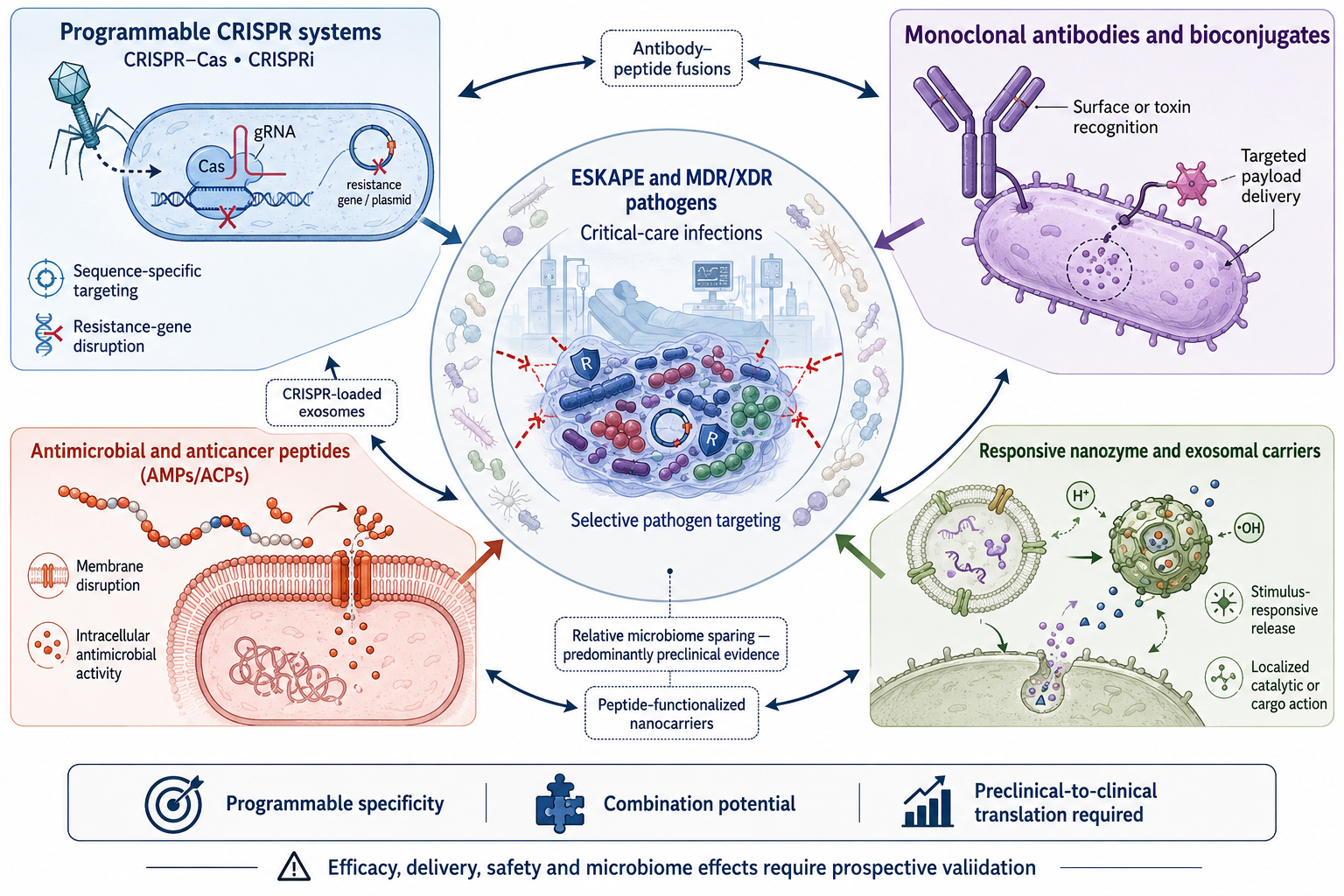
Taken together, the literature identified through this search converges, somewhat strikingly, on a shared directional shift: away from broad-spectrum, non-selective chemical eradication and toward targeted, context-responsive molecular strategies (Feng et al., 2025; Khosrojerdi et al., 2026). This shift is not confined to a single technology; it spans genomic editing, immunology, peptide biochemistry, and materials science in parallel, suggesting a field-wide reorientation rather than an isolated trend (Figure 1).

4.2 Programmable Genomic Dismantling: Efficiency and Specificity of Cas Nucleases

Across the reviewed sources, the clinical utility of CRISPR-Cas platforms was consistently reported to depend on the structural class of the Cas effector employed (Khosrojerdi et al., 2026). SpCas9 (Class 2, Type II-A), owing to its single-component architecture, was the most frequently cited effector for high-efficiency editing of plasmid-borne resistance determinants such as blaNDM-1 and mecA, producing lethal double-strand breaks in bacteria that generally lack robust non-homologous end-joining repair (Jinek et al., 2012; Khosrojerdi et al., 2026; Kuo et al., 2026). By contrast, Cas3 (Class 1, Type I-E) was reported to excise entire resistance islands through processive 3′-to-5′ degradation rather than a single discrete cut, an approach associated with a lower theoretical probability of single-point mutational escape (Sinkunas et al., 2011; Csörgő et al., 2020). Cas12a’s capacity for self-processing multiplexed guide arrays was highlighted repeatedly as advantageous for simultaneous multigene targeting (Zetsche et al., 2015; Khosrojerdi et al., 2026), while Cas13a’s RNA-only targeting mechanism was associated with transient, reversible suppression of resistance transcripts without permanent genomic modification (Abudayyeh et al., 2016; Kiga et al., 2020). CRISPRi platforms using dCas9-KRAB fusions were reported to achieve tunable, non-lethal silencing of resistance-associated promoters, including mexB and blaCMY-2 (Qi et al., 2013; Chen et al., 2023) (see Table 1 for a comparative summary of Cas effector classes, target specificity, and off-target limitations).

4.3 Overcoming Biofilm and Cellular Delivery Barriers

A recurring theme across the included studies was the trade-off between biological and synthetic delivery platforms (Allemailem, 2024; Gholamian et al., 2025). Engineered phagemids offered the highest reported target specificity but were consistently limited by narrow host range and phage-resistant mutant emergence (Bikard et al., 2014; Oechslin, 2018), while conjugative plasmids achieved broader transfer across biofilm-embedded bacterial communities at the cost of a theoretical risk of uncontrolled horizontal gene spread (Hadi et al., 2023; Kuo et al., 2026). Synthetic vectors, including lipid nanoparticles and PLGA nanoparticles, were reported to offer more favorable immunogenicity and manufacturing scalability profiles, though Gram-positive delivery efficiency remained a consistently cited limitation (Gholamian et al., 2025). Exosomal carriers, in particular, were associated with quantitatively reported benefits: a two- to five-fold increase in intracellular glycopeptide accumulation and up to a one-log reduction in minimum inhibitory concentration against resistant S. aureus in preclinical models (Abdullah et al., 2026; Yang et al., 2018) (Table 2).

4.4 Peptide-Based Platforms: Efficacy Balanced Against Selectivity

Among peptide-based approaches, a clear tension emerged between the therapeutic promise of endogenous human antimicrobial peptides and their occasionally protumorigenic behavior in specific tissue contexts (Błażejczyk et al., 2026). hBD3 overexpression in cervical carcinogenesis was among the most consistently reported protumorigenic associations (Xu et al., 2016), while non-human and synthetic analogues — Dermaseptin-A4 variants, engineered melittin analogues such as UM-6 — were reported to substantially improve the selectivity index between bactericidal or oncolytic activity and mammalian cell toxicity (Li et al., 2026; Wang et al., 2021). Proline-rich antimicrobial peptides emerged as a mechanistically distinct, non-lytic subclass with a comparatively favorable translational profile, owing to their ribosome-targeted rather than membrane-lytic mechanism of action (Patel et al., 2024) (Table 3).

4.5 Stimuli-Responsive Nanozymes and Biomimetic Carriers

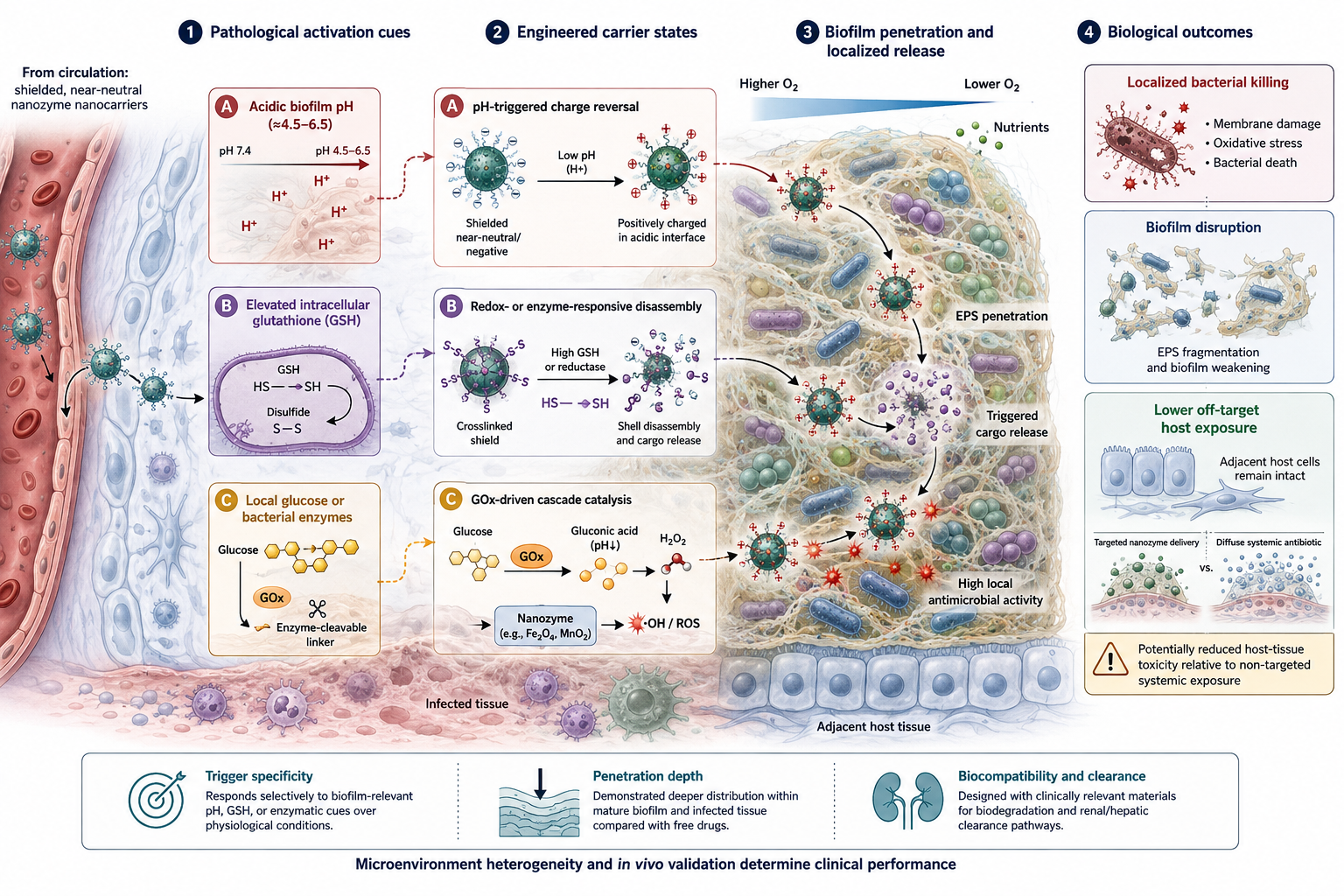
Nanozyme platforms activated by pathological microenvironmental triggers — acidic pH, elevated glucose, elevated glutathione — were reported across multiple infection models, including bacterial keratitis, diabetic wound infection, and multidrug-resistant sepsis (Feng et al., 2025) (Figure 2; Table 4). pH-responsive charge-reversal systems penetrated deeply into the acidic biofilm extracellular matrix, while glucose-oxidase-coupled cascade systems simultaneously depleted local glucose and generated bactericidal hydroxyl radicals in diabetic wound models (Feng et al., 2025). Redox-responsive disulfide-linked carriers were reported to disassemble selectively under elevated glutathione conditions, releasing payload while depleting the pathogen’s antioxidant reserves (Feng et al., 2025). Collectively, these platforms illustrate a consistent design logic across the reviewed literature: transforming a pathological microenvironmental feature into the trigger for therapeutic activation, rather than relying on constant systemic drug exposure.

5. Discussion

5.1 A Field-Wide Shift From Eradication to Precision

The clearest signal to emerge from this synthesis — and it is a fairly consistent one across genomic, immunological, peptide, and materials-based literatures alike — is that the field is no longer treating “kill everything, broadly and quickly” as an adequate design philosophy (Feng et al., 2025; Khosrojerdi et al., 2026). Whether that shift proves durable in clinical practice, rather than remaining a laboratory preference, is a separate question, and one this review cannot fully answer given the largely preclinical evidence base summarized in Table 1 through Table 4 and depicted schematically in Figure 1.

5.2 Precision Genomics: Promise Tempered by Immunological and Delivery Realities

CRISPR-based antimicrobials offer, on paper, close to the ideal of sequence-specific killing — but the literature is equally clear that pre-existing anti-Cas immunity in a substantial fraction of the human population, alongside

Figure 1. Four convergent pillars of precision, non-traditional antimicrobial strategies converging on ESKAPE and MDR/XDR pathogens in critical care. This schematic illustrates how programmable CRISPR-Cas/CRISPRi genomic systems, monoclonal antibodies and bioconjugates, antimicrobial and anticancer peptides, and responsive nanozyme/exosomal carriers each independently target multidrug- and extensively drug-resistant organisms while, in preclinical models, largely sparing commensal microbiota. The bidirectional arrows indicate that these pillars are increasingly combined (e.g., antibody-peptide fusions, CRISPR-loaded exosomes) rather than deployed as isolated modalities.

Figure 2. Schematic of pathology-responsive nanocarrier activation within the infected critical-care microenvironment. Acidic biofilm pH, elevated intracellular glutathione, and local hyperglycemia or bacterial enzyme activity each independently trigger structural changes in engineered nanozymes or nanocarriers — including surface charge reversal, glucose-oxidase-driven cascade catalysis, and redox-responsive disassembly — culminating in deep biofilm penetration, localized reactive-oxygen-species-mediated bacterial killing, and reduced off-target host tissue toxicity relative to systemically administered conventional antibiotics.

unresolved delivery efficiency in Gram-positive organisms, represents a real and not merely theoretical obstacle (Gholamian et al., 2025; Khosrojerdi et al., 2026). The comparative advantages of Cas9, Cas3, Cas12a, and Cas13 summarized in Table 1 suggest that no single effector class is likely to dominate; rather, the choice of platform will probably depend on the specific resistance mechanism, target organism, and delivery vector available for a given clinical scenario. This is, admittedly, a less tidy conclusion than one might hope for, but it likely reflects the genuine mechanistic diversity of the resistance problem itself rather than any deficiency in the underlying technology.

5.3 Antibodies and Peptides: Selectivity as Both Strength and Vulnerability

Monoclonal antibodies achieve their selectivity by staying outside the cell altogether, which sidesteps many of the resistance mechanisms bacteria have evolved against intracellular drugs, but this same extracellular restriction limits their utility against organisms with less accessible virulence factors (Ridelfi et al., 2026). Antimicrobial and anticancer peptides present a more paradoxical picture: the same electrostatic, membrane-targeting logic that makes them broadly effective against bacteria and cancer cells is also, in certain host-tissue contexts, implicated in carcinogenesis, as seen with hBD3 and S100A7 (Błażejczyk et al., 2026). This duality is not a minor caveat — it is arguably the central translational obstacle for endogenous AMP-based therapeutics, and it is part of why the field has increasingly turned toward non-human or synthetically engineered analogues, and toward non-lytic proline-rich peptides in particular, as summarized in Table 3 (Patel et al., 2024; Li et al., 2026).

5.4 Responsive Nanomedicine and the Biofilm Diagnostic Gap

Perhaps the most conceptually elegant advances reviewed here are the stimuli-responsive nanozyme platforms depicted in Figure 2, which convert a pathological feature of the infection microenvironment — acidity, hyperglycemia, elevated glutathione — into the very trigger that activates the therapy (Feng et al., 2025). Yet this elegance runs directly into one of the field’s most stubborn clinical limitations: current bedside diagnostics still cannot reliably distinguish planktonic from biofilm-embedded bacterial populations, meaning that even a perfectly designed responsive nanocarrier is being deployed somewhat blind to the actual in situ biofilm burden it is meant to target (Idakwoji et al., 2026; Maghiar et al., 2026). Closing this diagnostic gap arguably matters as much as further refining the nanomaterials themselves.

5.5 Neonatal and Pediatric Pharmacokinetic Blind Spots

None of the platforms reviewed here have been meaningfully validated in neonatal or pediatric populations, despite the fact that NICUs represent one of the settings most affected by AMR (Papanikolaou et al., 2026). Adult PK/PD models simply do not transfer to neonates given immature organ function and highly variable renal clearance, and this gap is, if anything, more pronounced for novel platforms like CRISPR-based or nanozyme therapeutics than it is for conventional antibiotics, where at least some pediatric dosing data already exist (Linham et al., 2026). This represents a genuine equity concern within the broader AMR crisis, since the patients most vulnerable to resistant infection are also the ones least represented in the translational pipeline for these next-generation therapies.

5.6 Toward Microbiome-Conscious, Globally Equitable Stewardship

Finally, it is worth stating plainly that none of these precision technologies will substitute for stewardship reform. The human resistome — the reservoir of resistance genes carried across the gut, skin, and respiratory microbiomes — is disrupted by broad-spectrum therapy regardless of how sophisticated the initiating antibiotic choice was, and microbiome-preserving strategies such as fecal microbiota transplantation remain commercially and regulatorily underdeveloped (Idakwoji et al., 2026). This challenge is compounded by global inequality in diagnostic capacity and antibiotic regulation, particularly in low- and middle-income countries where over-the-counter antibiotic access remains common (Elbehiry & Marzouk, 2026; Ntais & Chatziprodromidou, 2026). Any realistic path forward, in other words, will need to combine the precision technologies summarized in Tables 1–4 with structural, ecological, and equity-oriented stewardship reform — not one or the other.

5.7 Limitations

This review’s principal limitation is inherent to its narrative-scoping design: the absence of formal risk-of-bias assessment and quantitative pooling means that the reported efficacy figures (e.g., the two- to five-fold increase in exosomal drug accumulation, or the 99.99% reduction in plasmid transfer) should be interpreted as preclinical, often single-study findings rather than validated clinical estimates (Abdullah et al., 2026; Khosrojerdi et al., 2026). The literature base itself also skews heavily toward in vitro and murine models, with genuinely little clinical-phase evidence for most platforms discussed, a limitation that mirrors the translational chasm this review sets out to describe rather than one that could be resolved by broader searching alone.

6. Conclusion

Across genomic, immunological, peptide-based, and materials-driven platforms, the literature converges on a single trajectory: antimicrobial therapeutics are moving from indiscriminate eradication toward sequence-specific, host-compatible, and microenvironment-responsive precision. CRISPR-Cas systems, monoclonal antibodies, proline-rich peptides, and stimuli-responsive nanozymes each offer genuine mechanistic advantages over conventional antibiotics against ESKAPE and emerging non-aeruginosa Pseudomonas pathogens in critical care. Yet these advances remain largely preclinical, and their translation is blocked less by biological implausibility than by unresolved delivery, immunogenicity, and diagnostic barriers — particularly the bedside inability to detect biofilm-embedded infection and the near-total absence of neonatal and pediatric pharmacokinetic data. Progress will require standardized biofilm models, dedicated pediatric trials, AI-assisted therapeutic design, and stewardship frameworks that finally treat the human microbiome, rather than only the pathogen, as the object of protection.

Author Contributions

R.G. contributed to the conception and design of the review, literature search, analysis and synthesis of the relevant evidence, and drafting of the manuscript. V.J.U. contributed to the literature search, interpretation of the evidence on CRISPR-Cas systems, antimicrobial resistance mechanisms, and emerging therapeutic strategies, and critically revised the manuscript. M.B. contributed to the analysis and interpretation of the microbiological, antibody, peptide, and nanomedicine literature and critically revised the manuscript for important intellectual content. All authors reviewed and approved the final version of the manuscript and agreed to be accountable for all aspects of the work.

Acknowledgements

The authors would like to acknowledge the Department of Pharmacology, R.V. Northland Institute, Greater Noida, India, and the Department of Microbiology, Parul Institute of Applied Sciences and Research and Development Cell, Parul University, Vadodara, India, for their academic and institutional support. The authors also acknowledge the researchers whose published studies contributed to the scientific foundation of this review.

References


Abdullah, S., Thiab, S., Omar, A., Barakat, M., & Abdulhameed, A. S. (2026). Nano-enabled glycopeptide strategies against antimicrobial resistance: Immunological interfaces, exosomal delivery, and analytical frontiers. Food Hydrocolloids for Health, 9, Article 100290. https://doi.org/10.1016/j.fhfh.2026.100290              

Abudayyeh, O. O., Gootenberg, J. S., Konermann, S., Joung, J., Slaymaker, I. M., Cox, D. B., & Zhang, F. (2016). C2c2 is a single-component programmable RNA-guided RNA-targeting CRISPR effector. Science, 353(6299), aaf5573. https://doi.org/10.1126/science.aaf5573               

Agha, A. S. A., Al-Samydai, A., & Aburjai, T. (2025). New frontiers in CRISPR: Addressing antimicrobial resistance with Cas9, Cas12, Cas13, and Cas14. Heliyon, 11(2), e41392. https://doi.org/10.1016/j.heliyon.2025.e41392            

Allemailem, K. S. (2024). Recent advances in understanding the molecular mechanisms of multidrug resistance and novel approaches of CRISPR/Cas9-based genome-editing to combat this health emergency. International Journal of Nanomedicine, 19, 1125–1143. https://doi.org/10.2147/IJN.S441111          

Aquino-Jarquin, G. (2019). CRISPR-Cas14 is now part of the artillery for gene editing and molecular diagnostic. Nanomedicine: Nanotechnology, Biology and Medicine, 18, 428–431. https://doi.org/10.1016/j.nano.2019.03.003

Aresta, A. M., Signorile, G. S., Clemente, A., De Vietro, N., & Zambonin, C. (2026). Oral cavity antibacterial discovery pipeline driven by advanced analytical techniques. Molecules, 31(10), Article 02804. https://doi.org/10.3390/molecules31102804     

Bikard, D., Euler, C. W., Jiang, W., Nussenzweig, P. M., Goldberg, G. W., Duportet, X., Fischetti, V. A., & Marraffini, L. A. (2014). Exploiting CRISPR-Cas nucleases to produce sequence-specific antimicrobials. Nature Biotechnology, 32(11), 1146–1150. https://doi.org/10.1038/nbt.3043

Blazejczyk, I., Daniluk, T., Toczylowski, K., Gorbacz-Kononczuk, J., Wnorowska, U., Bucki, R., & Piktel, E. (2026). Antimicrobial peptides in cervical carcinogenesis: Dual roles in tumor progression and emerging therapeutic strategies. Biomedicine & Pharmacotherapy, 194, Article 118928. https://doi.org/10.1016/j.biopha.2025.118928 

Chen, J. S., Ma, E., Harrington, L. B., Da Costa, M., Tian, X., Palefsky, J. M., & Doudna, J. A. (2018). CRISPR-Cas12a target binding unleashes indiscriminate single-stranded DNase activity. Science, 360(6387), 436–439. https://doi.org/10.1126/science.aar6245               

Chen, L., Xing, Y., Lei, Q., Chen, Z., Zou, K., Quan, Z., Qing, J., Liu, R., & Yang, R. (2021). A glucose-powered activatable nanozyme breaking pH and H2O2 limitations for treating diabetic infections. Angewandte Chemie International Edition, 60(44), 23534–23539. https://doi.org/10.1002/anie.202107712   

Chen, S., Cao, H., Xu, Z., Huang, J., Liu, Z., Li, T., & Zhang, Y. (2023). A type IF CRISPRi system unveils the novel role of CzcR in modulating multidrug resistance of Pseudomonas aeruginosa. Microbiology Spectrum, 11(5), e01123-23. https://doi.org/10.1128/spectrum.01123-23             

Citorik, R. J., Mimee, M., & Lu, T. K. (2014). Sequence-specific antimicrobials using efficiently delivered RNA-guided nucleases. Nature Biotechnology, 32(11), 1141–1145. https://doi.org/10.1038/nbt.3043

Csörgo, B., León, L. M., Chau-Ly, I. J., Vasquez-Rifo, A., Berry, J. D., Mahendra, C., Crawford, E. D., Lewis, J. D., & Bondy-Denomy, J. (2020). A compact Cascade–Cas3 system for targeted genome engineering. Nature Methods, 17(12), 1183–1190. https://doi.org/10.1038/s41598-020-73796-5          

De Oliveira, D. M., Forde, B. M., Kidd, T. J., Harris, P. N., Schembri, M. A., Beatson, S. A., Paterson, D. L., & Walker, M. J. (2020). Antimicrobial resistance in ESKAPE pathogens. Clinical Microbiology Reviews, 33(3), e00181-19. https://doi.org/10.1128/CMR.00181-19     

Elbehiry, A., & Marzouk, E. (2026a). Helicobacter pylori eradication in the era of antibiotic resistance: From universal regimens to precision-guided management. Antibiotics, 15, Article 00673. 

Elbehiry, A., & Marzouk, E. (2026b). Beyond resistance genes: Pseudomonas aeruginosa as a complex adaptive system driving persistence, evolution, and antimicrobial resistance. Life, 16, Article 01163.       

Feng, S., Wang, Z., Wang, Y., Mei, L., & Wang, Z. (2025). Harnessing nanozymes as next-generation antimicrobial agents: From mechanisms to therapeutic strategies. Materials Today Bio, 35, Article 102499. https://doi.org/10.1016/j.mtbio.2025.102499               

Feng, S., Wang, Z., Zhang, Y., Mei, L., & Wang, Z. (2026). Corrigendum to “Harnessing nanozymes as next-generation antimicrobial agents.” Materials Today Bio, 37, Article 102812.

Gholamian, S., Baghaee, P., & Doroudian, M. (2025). Nanotechnology in gene editing: Pioneering CRISPR-Cas delivery systems to tackle antibiotic resistance. Advanced Therapeutics, 8(3), Article 2400412. https://doi.org/10.1002/adtp.2400412 

Gholizadeh, P., Köse, S., Dao, S., Ganbarov, K., Tanomand, A., Dal, T., Aghazadeh, M., Ganbarov, K., & Kafil, H. S. (2020). How CRISPR-Cas system could be used to combat antimicrobial resistance. Infectious Drug Resistance, 13, 1111–1121. https://doi.org/10.2147/IDR.S247271         

Hadi, J., Rapp, D., Dhawan, S., Gupta, S. K., Gupta, T. B., & Brightwell, G. (2023). Molecular detection and characterization of foodborne bacteria: Recent progresses and remaining challenges. Comprehensive Reviews in Food Science and Food Safety, 22(3), 2433–2464. https://doi.org/10.1111/1541-4337.13147

Hamilton, T. A., Pellegrino, G. M., Therrien, J. A., Ham, D. T., Bartlett, P. C., Karas, B. J., & Csörgo, B. (2019). Efficient inter-species conjugative transfer of a CRISPR nuclease for targeted bacterial killing. Nature Communications, 10(1), 4544. https://doi.org/10.1038/s41467-019-12444-y          

Harrington, L. B., Burstein, D., Chen, J. S., Paez-Espino, D., Ma, E., Witte, I. P., Cofsky, J. C., Kyrpides, N. C., Banfield, J. F., & Doudna, J. A. (2018). Programmed DNA destruction by miniature CRISPR-Cas14 enzymes. Science, 362(6416), 839–842. https://doi.org/10.1126/science.aav9710

Hubert, P., Herman, L., Maillard, J. H., Caberg, A., Nikkels, G., Pierard, P., & Delvenne, P. (2007). Defensins induce the recruitment of dendritic cells in cervical human papillomavirus-associated (pre)neoplastic lesions formed in vitro and transplanted in vivo. The FASEB Journal, 21(11), 2765–2775. https://doi.org/10.1096/fj.06-8152fjs         

Hubert, P., Herman, L., Roncarati, C., Maillard, V., Renoux, S., Demoulin, M., & Herfs, M. (2014). Altered α-defensin 5 expression in cervical squamocolumnar junction: Implication in the formation of a viral/tumour-permissive microenvironment. The Journal of Pathology, 234(4), 464–477. https://doi.org/10.1002/path.4414          

Idakwoji, P. A., Fadipe, D. E., Aliyu, A. O., Banwo, F. M., Nwafor, I. P., Isiah, Z., & Umari, M. M. (2026). Human microbiome-driven antimicrobial resistance: Biological mechanisms, pharmacological considerations and next-generation therapeutic prospects. Letters in Drug Design & Discovery, 23, Article 100420.           

Jiang, S., Xie, D., Hu, Z., Song, H., Tang, P., Jin, Y., & Fu, Q. (2024). Enhanced diabetic wound healing with injectable hydrogel containing self-assembling nanozymes. Journal of Controlled Release, 372, 265–280. https://doi.org/10.1016/j.jconrel.2024.06.040       

Jinek, M., Chylinski, K., Fonfara, I., Hauer, M., Doudna, J. A., & Charpentier, E. (2012). A programmable dual-RNA–guided DNA endonuclease in adaptive bacterial immunity. Science, 337(6096), 816–821. https://doi.org/10.1126/science.1225829         

Khosrojerdi, M., Hashemi, S. A., Besharati, R., Haghbin, A., & Azimian, A. (2026). CRISPR-Cas systems as precision antimicrobials: Reversing the tide of antimicrobial resistance. Virus Research, 371, Article 199782. https://doi.org/10.1016/j.virusres.2026.199782               

Kiga, K., Tan, X.-E., Ibarra-Chávez, R., Watanabe, S., Aiba, Y., Sato’o, Y., & Hayashi, T. (2020). Development of CRISPR-Cas13a-based antimicrobials capable of sequence-specific killing of target bacteria. Nature Communications, 11(1), 2934. https://doi.org/10.1038/s41467-020-16731-6          

Kiro, R., Shitrit, D., & Qimron, U. (2014). Efficient engineering of a bacteriophage genome using the type IE CRISPR-Cas system. RNA Biology, 11(1), 42–44. https://doi.org/10.4161/rna.27714     

Krizsan, A., Volke, D., Weinert, S., Sträter, N., Knappe, D., & Hoffmann, R. (2014). Insect-derived proline-rich antimicrobial peptides kill bacteria by inhibiting bacterial protein translation at the 70S ribosome. Angewandte Chemie International Edition, 53, 12236–12239. https://doi.org/10.1002/anie.201407145      

Kuo, S.-F., Huang, T.-Y., Lee, C.-Y., Chen, F.-J., & Lee, C.-H. (2026). CRISPR-Cas9-mediated elimination of plasmid-borne carbapenemase genes restores ertapenem susceptibility in clinical Klebsiella pneumoniae isolates. Biomedical Journal, Article 100966. https://doi.org/10.1016/j.bj.2026.100966  

Li, W., Wang, W., Chen, B., Sun, M., Ma, X., Wang, L., & Zhou, M. (2026). Balancing cationicity and hydrophobicity in Dermaseptin-A4 generates a selective antimicrobial peptide with enhanced therapeutic potential. Antibiotics, 15, Article 00784. https://doi.org/10.3390/antibiotics15080784          

Lin, Z., You, Q., Zhu, H., Lao, Z., Lao, J., Li, X., & Nie, M. (2026). Strategies to enhance the efficacy and clinical translation of antimicrobial photodynamic therapy. Antibiotics, 15, Article 00748. https://doi.org/10.3390/antibiotics15080748          

Lucero-Prisno III, D. E., Okesanya, O. J., Agboola, A. O., Adebayo, U. O., Adigun, O. A., Ahmed, M. M., & Olawade, D. B. (2025). Emerging technologies and innovative approaches to combat antimicrobial resistance: A narrative review of next-generation therapeutic strategies. Next Bioengineering, 1, Article 100003. https://doi.org/10.1016/j.nxbio.2025.100003

Maghiar, L., Maghiar, P. B., Pop, O., Mitran, A. M., Muresan, M. M., Neam?u, A. A., & Dehelean, C. A. (2026). A comprehensive review of antimicrobial peptides and smart biomaterials in chronic wound therapy: Overcoming biofilms, resistance, and translational barriers. International Journal of Molecular Sciences, 27, Article 05955. https://doi.org/10.3390/ijms27115955      

Mangano, K., Klepacki, D., Ohanmu, I., Baliga, C., Huang, W., Brakel, A., & Mankin, A. (2023). Inhibition of translation termination by the antimicrobial peptide Drosocin. Nature Chemical Biology, 19, 1082–1090. https://doi.org/10.1038/s41589-023-01300-x

Marino, A., Stracquadanio, S., Cosentino, F., Coco, M., La Via, L., Franzò, A., & Maniaci, A. (2026). Beyond the usual suspects: Emerging Pseudomonas species in clinical and environmental niches. International Journal of Molecular Sciences, 27, Article 06210.

Mattiuzzo, M., Bandiera, A., Gennaro, R., Benincasa, M., Pacor, S., Antcheva, N., & Scocchi, M. (2007). Role of the Escherichia coli SbmA in the antimicrobial activity of proline-rich peptides. Molecular Microbiology, 66, 151–163. https://doi.org/10.1111/j.1365-2958.2007.05903.x            

Murray, C. J., Ikuta, K. S., Sharara, F., Swetschinski, L., Robles Aguilar, G., Gray, A., et al. (2022). Global burden of bacterial antimicrobial resistance in 2019: A systematic analysis. The Lancet, 399(10325), 629–655. https://doi.org/10.1016/S0140-6736(21)02724-0               

Naghavi, M., Vollset, S. E., Ikuta, K. S., Swetschinski, L. R., Gray, A. P., Wool, E. E., et al. (2024). Global burden of bacterial antimicrobial resistance 1990–2021: A systematic analysis with forecasts to 2050. The Lancet, 404(10459), 1199–1226. https://doi.org/10.1016/S0140-6736(24)01867-1   

Noble, C., Olejarz, J., Esvelt, K. M., Church, G. M., & Nowak, M. A. (2017). Evolutionary dynamics of CRISPR gene drives. Science Advances, 3(4), e1601964. https://doi.org/10.1126/sciadv.1601964   

Ntais, C., & Chatziprodromidou, I. P. (2026). Antimicrobial resistance as a global public health challenge: Epidemiological burden, bioethical dimensions and emerging therapeutic strategies. Infectious Disease Reports, 18, Article 00070.

Oechslin, F. (2018). Resistance development to bacteriophages occurring during bacteriophage therapy. Viruses, 10(7), 351. https://doi.org/10.3390/v10070351            

O’Neill, J. (2016). Tackling drug-resistant infections globally: Final report and recommendations. Review on Antimicrobial Resistance.

Papageorgiou, D., & Akinosoglou, K. (2026). Antimicrobial resistance in major Gram-positive pathogens: Beyond the vancomycin border. Antibiotics, 15, Article 00780.

Papanikolaou, N. G., Giapros, V., Papaioannou, E., Nikolaou, A. I., Baltogianni, M., Balomenou, F., & Dermitzaki, N. (2026). Evolution of antimicrobial resistance in neonatal sepsis: A narrative review. Antibiotics, 15, Article 00682.

Patel, W., Tailhades, J., O’Brien-Simpson, N. M., Separovic, F., Otvos Jr, L., Hossain, M. A., & Wade, J. D. (2026). Proline-rich antimicrobial peptides: Structural and functional characteristics of Next Generation Therapeutics. Current Opinion in Chemical Biology, 93, Article 102699. https://doi.org/10.1016/j.cbpa.2026.102699          

Pintilei, P. S., Binaymotlagh, R., Haghighi, F. H., Chronopoulou, L., & Palocci, C. (2026). Functional liposomal nanocarriers for the treatment of antimicrobial-resistant and biofilm-associated ocular infections. Macromolecular Materials and Engineering, 6, Article 00056. https://doi.org/10.1002/mame.202600056  

Pursey, E., & Gaze, W. H. (2022). CRISPR-Cas antimicrobials: Challenges and future prospects. Nature Reviews Microbiology, 20(7), 383–397. https://doi.org/10.1038/s41579-022-00705-0        

Qi, L. S., Larson, M. H., Gilbert, L. A., Doudna, J. A., Weissman, J. S., Arkin, A. P., & Lim, W. A. (2013). Repurposing CRISPR as an RNA-guided platform for sequence-specific control of gene expression. Cell, 152(5), 1173–1183. https://doi.org/10.1016/j.cell.2013.02.022

Ridelfi, M., Fonseca, V. Z. G., Sala, C., & Rappuoli, R. (2026). Human antibodies as emerging drugs for antimicrobial resistance. Trends in Immunology, 24, 1–15.

Saffari Natanzi, A., Poudineh, M., Karimi, E., Khaledi, A., & Haddad Kashani, H. (2025). Innovative approaches to combat antibiotic resistance: Integrating CRISPR/Cas9 and nanoparticles against biofilm-driven infections. BMC Medicine, 23(1), 486. https://doi.org/10.1186/s12916-025-04323-4          

Sheng, H., Wu, S., Xue, Y., Zhao, W., Caplan, A. B., Hovde, C. J., & Qimron, U. (2023). Engineering conjugative CRISPR-Cas9 systems for the targeted control of enteric pathogens and antibiotic resistance. PLoS One, 18(9), e0291520. https://doi.org/10.1371/journal.pone.0291520        

Sinkunas, T., Gasiunas, G., Fremaux, C., Barrangou, R., Horvath, P., & Siksnys, V. (2011). Cas3 is a single-stranded DNA nuclease and ATP-dependent helicase in the CRISPR/Cas immune system. EMBO Journal, 30(7), 1335–1342. https://doi.org/10.1038/emboj.2011.41     

Su, Y., Ding, M., Dong, H., Dong, Y., Hu, Y., Yang, D., & Shao, J. (2022). Recent advances in nanozymes for combating bacterial infection. Materials Chemistry Frontiers, 6(18), 2596–2609. https://doi.org/10.1039/D2QM00511E             

Thery, C., Witwer, K. W., & Aikawa, E. (2022). Minimal information for studies of extracellular vesicles 2022 (MISEV2022). Journal of Extracellular Vesicles, 11(8), e12217. https://doi.org/10.1002/jev2.12217         

Tian, T., Li, X., Hua, Z., Ma, J., Wu, X., Liu, Z., & Cui, Z. (2017). S100A7 promotes the migration, invasion and metastasis of human cervical cancer cells through epithelial–mesenchymal transition. Oncotarget, 8(15), 24964–24978. https://doi.org/10.18632/oncotarget.15641              

Umumararungu, T., Gahamanyi, N., Mukiza, J., Habarurema, G., Katandula, J., Rugamba, A., & Otvos, L. (2024). Proline, a unique amino acid whose polymer, polyproline II helix, and its analogues are involved in many biological processes: A review. Amino Acids, 56, 50. https://doi.org/10.1007/s00726-024-03410-9          

Wan, F., Draz, M. S., Gu, M., Yu, W., Ruan, Z., & Luo, Q. (2021). Novel strategy to combat antibiotic resistance: A sight into the combination of CRISPR/Cas9 and nanoparticles. Pharmaceutics, 13(3), 352. https://doi.org/10.3390/pharmaceutics13030352               

Wang, D., He, J., Dong, J., Wu, S., Liu, S., He, T., & Xu, T. (2021). UM-6 induces autophagy and apoptosis via the Hippo-YAP signaling pathway in cervical cancer. Cancer Letters, 519, 2–19. https://doi.org/10.1016/j.canlet.2021.06.012           

Wei, T., Pan, T., Peng, X., Zhang, M., Guo, R., Guo, Y., & Zhang, S. (2024). Janus liposozyme for the modulation of redox and immune homeostasis in infected diabetic wounds. Nature Nanotechnology, 19(8), 1178–1189. https://doi.org/10.1038/s41565-024-01660-y             

Xu, D., Zhang, B., Liao, C., Zhang, W., Wang, W., Chang, Y., & Shao, Y. (2016). Human beta-defensin 3 contributes to the carcinogenesis of cervical cancer via activation of NF-κB signaling. Oncotarget, 7(46), 75902–75913. https://doi.org/10.18632/oncotarget.12215               

Yang, X., Shi, G., Guo, J., Wang, C., & He, Y. (2018). Exosome-encapsulated antibiotic against intracellular infections of methicillin-resistant Staphylococcus aureus. International Journal of Nanomedicine, 13, 8095–8104. https://doi.org/10.2147/IJN.S180954               

Zetsche, B., Gootenberg, J. S., Abudayyeh, O. O., Slaymaker, I. M., Makarova, K. S., Essletzbichler, P., & Zhang, F. (2015). Cpf1 is a single RNA-guided endonuclease of a class 2 CRISPR-Cas system. Cell, 163(3), 759–771. https://doi.org/10.1016/j.cell.2015.09.038