2.1 The Molecular Evolution of a Neglected Chemical Space
For most of the modern pharmaceutical era, drug discovery operated with a curiously binary view of chemical space. On one side sat synthetic small molecules; on the other, macromolecular biologics. The space in between was not so much rejected as regarded as unworkable, largely because of the pharmacokinetic liabilities discussed below (Otvos & Wade, 2023; Wang et al., 2022). That this space has since produced some of the most commercially and clinically significant drugs of the decade is a reminder that "undruggable" is often a statement about available methods rather than about molecules.
The case for small molecules was never in doubt: low cost of goods, established manufacturing, oral bioavailability, and the ability to reach intracellular targets (de la Torre & Albericio, 2022; Liu et al., 2025). The limitation is geometric. A ligand of 300 to 1,000 square angstroms of contact surface cannot productively engage a protein-protein interface requiring 1,500 to 3,000, and the shallow, extended orthosteric sites of class B GPCRs fall squarely in the latter category (Liu et al., 2025; Otvos & Wade, 2023). Biologics invert every one of these properties. They bind with exquisite selectivity, persist for weeks through FcRn-mediated recycling, and are essentially restricted to extracellular targets, mammalian expression and parenteral delivery (Ye et al., 2025; Zhang et al., 2025).
Peptides and macrocycles bridge the divide, and do so in a way that appears, in retrospect, almost obvious (Figure 2). They inherit the selectivity and the amino-acid-based safety profile of biologics while retaining the synthetic tractability of small molecules, and because they mimic endogenous hormones they engage their receptors with potencies in the nanomolar to picomolar range (Bergamaschi et al., 2026; Xiao et al., 2026). The safety argument deserves emphasis because it is sometimes understated: catabolism to natural amino acids means there is generally no reactive metabolite to worry about, which removes a failure mode that has terminated many small-molecule programmes late in development (Wang et al., 2022; Zhang et al., 2025).
What stood in the way was stability. An unmodified linear peptide is a substrate for every protease it encounters and, once below the approximately 60 kDa glomerular threshold, is cleared renally within minutes (Liu et al., 2025; Zhang et al., 2025). The literature of the past two decades is, to a considerable extent, a record of chemists learning to defend a peptide backbone without destroying the receptor engagement that makes it useful. Macrocyclisation, whether head-to-tail, side-chain lactam or disulfide-mediated, eliminates the free termini that exopeptidases recognise and pre-organises the molecule into its bioactive conformation, which lowers the entropic

Figure 1. Evidence identification, appraisal and synthesis workflow for this narrative review. The five-stage workflow applied in this review, from a priori question framing through database and supplementary retrieval, eligibility appraisal, structured extraction with primary-source verification, and finally thematic synthesis into Tables 1 to 4 and Figures 2 to 5. Searching combined four Boolean concept blocks covering modality, receptor pharmacology, indication, and translation or manufacture, executed across PubMed/MEDLINE, Scopus, Web of Science, trial registries and regulatory repositories to June 2026, and was supplemented by backward and forward citation chasing. No meta-analysis was performed, because the four domains report incommensurable outcomes that no pooled estimate could meaningfully combine.
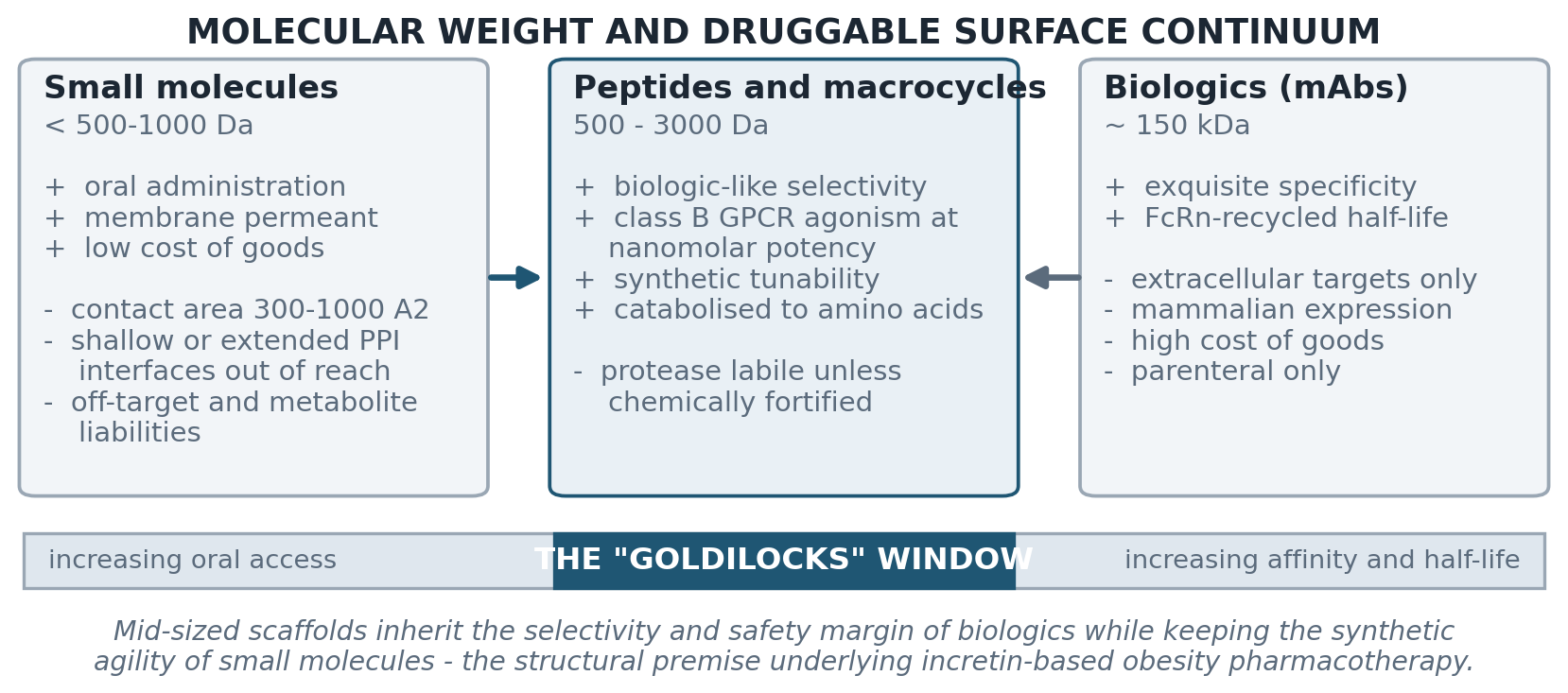
Figure 2. The mid-sized “Goldilocks” window between small molecules and biologics. Small molecules below roughly 500–1,000 Da offer oral access, membrane permeability and low cost of goods, but present contact surfaces of only 300–1,000 Ų, insufficient for the extended, shallow interfaces of class B G-protein-coupled receptors that typically demand 1,500–3,000 Ų. Monoclonal antibodies of about 150 kDa achieve exquisite selectivity and FcRn-recycled half-lives, but are restricted to extracellular targets, mammalian expression and parenteral administration. Peptides and macrocycles of 500–3,000 Da occupy the intermediate window, inheriting biologic-like selectivity and amino-acid catabolism while retaining synthetic tunability; their one serious inherited weakness, proteolytic lability, is the problem the chemistry of Figure 3 was developed to solve.
cost of binding (Bergamaschi et al., 2026; Liu et al., 2025). Hydrocarbon stapling, introduced through ruthenium-catalysed ring-closing metathesis across one or two turns of a helix, rigidifies the secondary structure and simultaneously improves proteolytic resistance and passive permeability (Walensky & Bird, 2014). Non-proteinogenic residues, D-amino acids, alpha,alpha- disubstituted amino acids and backbone N-methylation, disrupt the hydrogen-bonding networks and lower the polar surface area that otherwise prevent membrane crossing (Bergamaschi et al., 2026; Zhang et al., 2025). These strategies and their measured consequences are set out in Table 1.
It is worth resisting the impression that these are interchangeable options from a menu. They are not. Stapling suits helical epitopes and intracellular protein-protein interactions; macrocyclisation suits compact ligands where the bioactive conformation is known; N-methylation buys permeability at some risk to affinity. The art, and it does remain something of an art, lies in choosing which constraint a given scaffold can tolerate.
2.2 Protraction Chemistry: How a Two-Minute Peptide Became a Weekly Drug
If one had to identify the single chemical advance that made incretin pharmacotherapy commercially and clinically viable, it would be protraction. Native GLP-1 is cleaved by DPP-4 between alanine-8 and glutamate-9 within roughly two minutes of secretion, and even a protease-resistant analogue is filtered at the glomerulus unless something enlarges it (Knudsen & Lau, 2019; Lau et al., 2015). Two problems, then, requiring two distinct solutions (Figure 3).
The first was addressed by substitution at position 2 of the mature sequence. Replacing the endogenous alanine with alpha-aminoisobutyric acid (Aib) or with glycine introduces steric bulk that DPP-4 cannot accommodate, and does so without materially disturbing the receptor-binding geometry, since the modification sits at the periphery of the pharmacophore (Lau et al., 2015; Østergaard, 2025). Semaglutide carries Aib8; tirzepatide carries Aib at both positions 8 and 19; albiglutide used glycine (Coskun et al., 2018; Lau et al., 2015). The elegance of the solution is that it costs almost nothing in potency (Table 1).
The second problem required something more inventive. Human serum albumin is the most abundant protein in plasma and has an endogenous half-life of roughly 19 days, sustained by the same FcRn recycling pathway that protects immunoglobulins (Zhang et al., 2025). A peptide that binds albumin reversibly acquires, in effect, a circulating reservoir: the bound fraction is shielded from proteases, exceeds the renal filtration threshold by virtue of the complex's hydrodynamic radius, and releases free drug gradually as equilibrium dictates (Lau et al., 2015; Østergaard, 2025). Liraglutide demonstrated the principle with a single C16 palmitic acid attached to lysine-26 through a gamma-glutamyl spacer, achieving a half-life of about 13 hours and once-daily dosing (Knudsen & Lau, 2019).
The second generation refined the chemistry considerably. Replacing the monoacid with a dicarboxylic fatty acid, and interposing hydrophilic oligoethylene glycol (OEG) spacers between the peptide and the lipid, produced a substantially stronger and more specific albumin interaction: the distal carboxylate engages a defined pocket on the albumin surface through combined electrostatic and hydrophobic contacts (Lau et al., 2015; Østergaard, 2025). Semaglutide employs a C18 diacid at lysine-26; tirzepatide and retatrutide employ C20 eicosanedioic acid, at lysine-20 and lysine-17 respectively (Coskun et al., 2018; Jastreboff et al., 2023; Østergaard, 2025). Human half-lives of five to seven days followed, and with them once-weekly subcutaneous administration (Table 1; Table 2).
One consequence of protraction is easy to overlook. A long half-life does not only reduce injection frequency; it flattens the plasma concentration profile, and since the gastrointestinal adverse effects of GLP-1R agonism track peak exposure more closely than average exposure, the smoother curve is itself part of the tolerability story (Østergaard, 2025). This is one of several places where a pharmacokinetic decision turns out to have been, quietly, a pharmacodynamic one.
2.3 Unimolecular Poly-Pharmacology and the Question of Biased SignallingSelective GLP-1R agonism established the modern benchmark. Semaglutide at 2.4 mg weekly produced mean weight loss of approximately 15% at 68 weeks in STEP 1, alongside glycaemic control and reductions in cardiovascular risk (Wilding et al., 2021; Davies et al., 2021). Impressive as that was, a ceiling became apparent: further dose escalation was limited less by receptor biology than by nausea, vomiting and early satiety severe
Table 1. Chemical Modification Strategies for Structural Fortification and Pharmacokinetic Optimisation of Therapeutic Peptides and Macrocycles. Five recurring chemical strategies are compared across the mechanism by which each modifies the peptide, its conformational and biophysical consequence, its effect on metabolic stability and systemic exposure, and the marketed or investigational agents in which it appears. The first two rows describe the protraction chemistry that dominates the injectable incretin agents, converting a plasma half-life of under two minutes into one of five to seven days; the remaining rows describe the conformational constraints that dominate the exploratory macrocycle literature, where passive membrane permeability rather than circulating half-life is the limiting problem. Strategies are complementary rather than interchangeable, and the choice among them is dictated by the scaffold, the target compartment and the intended route of administration.
|
Modification strategy and chemical mechanism
|
Conformational and biophysical impact
|
Pharmacokinetic and metabolic impact
|
Representative agents and applications
|
Key references
|
|
Position-2 non-proteinogenic substitution. Replacement of the endogenous Ala2 of the mature GLP-1 sequence with α-aminoisobutyric acid (Aib) or glycine.
|
Peripheral to the pharmacophore, so class B GPCR binding geometry is essentially preserved; local backbone steric bulk is increased.
|
Sterically blocks dipeptidyl peptidase-4 cleavage between residues 8 and 9, removing the dominant route of rapid inactivation (t½ < 2 min).
|
Semaglutide (Aib8); tirzepatide (Aib8, Aib19); albiglutide (Gly8).
|
Lau et al. (2015); Coskun et al. (2018); Østergaard (2025)
|
|
Fatty acid acylation and fatty diacid lipidation. Covalent attachment of a C16 monoacid or a C18/C20 dicarboxylic acid to a lysine side chain through γ-Glu and oligoethylene glycol spacers.
|
Promotes strong reversible, non-covalent association with human serum albumin without compromising receptor binding affinity; distal carboxylate engages a defined albumin pocket.
|
Creates a circulating albumin-bound depot that shields the peptide from proteolysis and raises hydrodynamic radius above the renal filtration threshold; half-life extended to 5–7 days.
|
Liraglutide (C16, t½ ≈ 13 h); semaglutide (C18 diacid, t½ ≈ 1 week); tirzepatide and retatrutide (C20 diacid, t½ ≈ 5–6 days).
|
Lau et al. (2015); Knudsen & Lau (2019); Østergaard (2025)
|
|
Head-to-tail and lactam macrocyclisation. Intramolecular ring closure by N-to-C amide bond formation, side-chain lactam bridging or disulfide constraint.
|
Enforces a partially pre-organised structure, restricting conformational freedom and lowering the entropic penalty incurred on receptor engagement.
|
Eliminates free N- and C-termini and so denies exopeptidases their recognition motif; plasma integrity maintained beyond 24 hours for several scaffolds.
|
Cyclosporin A; octreotide; DOTATATE (Lutathera); setmelanotide.
|
Bergamaschi et al. (2026); Liu et al. (2025); Zhang et al. (2025)
|
|
Hydrocarbon stapling by ring-closing metathesis. Ruthenium-catalysed cross-linking of α,α-disubstituted olefinic residues across i,i+4 or i,i+7 helical turns.
|
Locks the backbone into a rigid α-helix, maintaining the extended contact geometry required for protein–protein interfaces.
|
Protects backbone amides from endopeptidases, masks polar amide bonds and enhances passive transcellular penetration.
|
Stapled BH3 domain peptides; p53/MDM2 stapled inhibitors; SP9 mucus accumulation inhibitor.
|
Walensky & Bird (2014); Zhang et al. (2025)
|
|
Backbone N-methylation and amide masking. Selective replacement of backbone amide hydrogens with methyl groups, or incorporation of N-alkylated building blocks.
|
Disrupts unfavourable intramolecular hydrogen-bonding networks, alters backbone dihedral angles and reduces polar surface area.
|
Reduces proteolytic cleavage at tertiary amides and raises passive transcellular permeability, the principal chemical lever on oral absorption.
|
Cyclosporin A; macrocyclic cyclin inhibitors; orally bioavailable macrocycle programmes.
|
Bergamaschi et al. (2026); Zhang et al. (2025); Liu et al. (2025)
|
Table 2. Comparative Pharmacology, Protractor Chemistry and Clinical Efficacy of Incretin and Non-Incretin Multi-Receptor Agonists in Obesity and Type 2 Diabetes. Agents are ordered by receptor coverage rather than chronology, from selective GLP-1 receptor agonism through dual and triple incretin agonism to non-incretin amylin co-agonism and to ultra-long-acting and oral modalities. For each agent the table records receptor targets and signalling mode, backbone and protractor chemistry, highest development stage and indication, and the principal efficacy endpoint with its dose and timepoint. Efficacy figures derive from separate trials with differing populations, titration schedules and handling of discontinuation, and only a minority are head-to-head comparisons; the gradient they describe should therefore be read as indicative rather than as direct evidence of superiority.
|
Agent
|
Receptor targets and signalling mode
|
Backbone and protractor chemistry
|
Development stage and indication
|
Key efficacy outcomes (dose, timepoint)
|
|
Semaglutide (Ozempic, Wegovy, Rybelsus)
|
Selective GLP-1R mono-agonist.
|
Human GLP-1 backbone with Aib8; Lys26 derivatised with γ-Glu-2×OEG linker and C18 octadecanedioic diacid.
|
Approved (FDA 2017/2021/2024) for T2DM, obesity and cardiovascular risk reduction.
|
−15.0% body weight at 68 weeks, 2.4 mg weekly (STEP 1); high-dose oral 25/50 mg up to −16.6%. Cardiovascular and renal benefit in outcome trials.
|
|
Tirzepatide (Mounjaro, Zepbound)
|
GLP-1R/GIPR dual agonist; imbalanced, with lower GLP-1R potency, G-protein biased and reduced β-arrestin recruitment.
|
39-residue synthetic peptide on a GIP scaffold; Aib8 and Aib19; C-terminal amide; Lys20 with γ-Glu-2×OEG and C20 eicosanedioic diacid.
|
Approved (FDA 2022/2023) for T2DM and chronic weight management.
|
−20.9% to −22.5% body weight at 72 weeks (SURMOUNT-1); superior HbA1c reduction versus GLP-1-selective comparators.
|
|
Survodutide (BI 456906)
|
GLP-1R/GcgR dual co-agonist, balancing appetite suppression against glucagon-driven energy expenditure.
|
Synthetic acylated peptide co-agonist engineered for balanced potency at both receptors.
|
Phase 3 for obesity; phase 2 for MASH/MASLD.
|
−19.0% body weight at 46 weeks; significant hepatic fat reduction and improvement in MASH fibrosis endpoints.
|
|
Retatrutide (LY3437943)
|
GLP-1R/GIPR/GcgR unimolecular triple agonist (tri-agonist).
|
Single peptide backbone derivatised at Lys17 with a C20 fatty diacid; t½ ≈ 6 days.
|
Phase 3 (TRIUMPH programme) for obesity, T2DM, MASLD and osteoarthritis.
|
−24.2% body weight at 48 weeks, 12 mg (phase 2); >80% relative liver fat reduction in MASLD; dose-response not plateaued at study end.
|
|
Cagrilintide and cagrilintide–semaglutide (CagriSema)
|
AmyR/CtR long-acting amylin analogue, alone or co-formulated with a GLP-1R agonist.
|
Amylin analogue derivatised at the N-terminus with a C20 fatty diacid.
|
Phase 3 for obesity and T2DM.
|
−11.8% body weight as monotherapy; −22.7% to −24.3% in combination with semaglutide 2.4 mg.
|
|
Zenagamtide (amycretin)
|
GLP-1R together with amylin and calcitonin receptors; first-in-class unimolecular incretin–amylin agonist.
|
Approximately 8 kDa peptide derivatised with a C18 fatty diacid; t½ ≈ 4 days.
|
Phase 1b/2a, subcutaneous and oral SNAC formulations.
|
−24.3% body weight at 36 weeks, 60 mg subcutaneous, without efficacy plateau; oral SNAC tablet 10–13% over 12 weeks.
|
|
Maridebart cafraglutide (AMG133, MariTide)
|
Antibody–peptide conjugate: GIPR-antagonist monoclonal antibody bearing two GLP-1R agonist peptides.
|
Monoclonal antibody scaffold with conjugated agonist peptides; FcRn recycling gives t½ ≈ 21 days.
|
Phase 2 for obesity and T2DM; once-monthly dosing.
|
−16.2% body weight at 52 weeks, 420 mg monthly, with weight largely maintained after treatment cessation in reported follow-up.
|
|
Orforglipron (GSBR-1290)
|
Non-peptide small-molecule GLP-1R partial agonist binding a transmembrane pocket.
|
Synthetic small molecule; no peptide backbone and therefore no protractor chemistry required.
|
Phase 3 for obesity and T2DM; once-daily oral.
|
−12.4% to −14.7% body weight at 26–36 weeks, 36 mg; oral bioavailability 21–28%; no food or water restriction.
|
enough to cause discontinuation (Müller et al., 2022; Østergaard, 2025). If more efficacy was to be extracted, it would have to come from somewhere other than more GLP-1R occupancy.
The answer the field arrived at, drawing on earlier proof-of-concept work in rodents and primates, was unimolecular poly-pharmacology: a single peptide backbone engineered to activate several nutrient-sensing receptors simultaneously, rather than a combination of separate drugs (Finan et al., 2013; Finan et al., 2015). The pharmacokinetic argument for a single molecule is straightforward, since two agonists with different half-lives cannot maintain a fixed ratio of receptor engagement over a weekly dosing interval. The pharmacological argument is subtler and concerns synergy (Figure 4).
Tirzepatide was the first such agent to reach approval. It is a 39-amino-acid synthetic peptide built on the GIP sequence, carrying Aib at positions 8 and 19, a C-terminal amide, and a C20 diacid at lysine-20 through a gamma-Glu-2xOEG linker (Coskun et al., 2018; Sun et al., 2022). Its pharmacology is deliberately asymmetric. Tirzepatide binds GIPR with affinity comparable to native GIP but engages GLP-1R with markedly lower potency than native GLP-1, and it recruits beta-arrestin poorly, which limits receptor desensitisation and internalisation (Willard et al., 2020; Sun et al., 2022). Whether this imbalance is the reason for its efficacy, or merely a property it happens to possess, has not been settled; the honest position is that the structure-activity story is more suggestive than proven. Clinically, weight loss of 20.9 to 22.5% at 72 weeks in SURMOUNT-1 comfortably exceeded GLP-1 mono-agonist benchmarks (Jastreboff et al., 2022; Table 2). Mechanistic work indicates that GIPR engagement acts on adipocyte nutrient handling and lipid storage, operating in parallel with rather than downstream of central GLP-1R satiety signalling (Regmi et al., 2024).
A second dual strategy pairs GLP-1R with the glucagon receptor. Survodutide, mazdutide and pemvidutide combine GLP-1-mediated appetite suppression with glucagon-driven lipolysis, hepatic fatty-acid oxidation and increased energy expenditure (le Roux et al., 2024; Østergaard, 2025). The design tension here is obvious, since glucagon is a counter-regulatory, diabetogenic hormone, and the resolution is that concurrent GLP-1R activation offsets the glycaemic penalty while the hepatic benefit is retained. Survodutide produced 19.0% weight loss at 46 weeks with meaningful reductions in liver fat and improvement in MASH fibrosis endpoints (le Roux et al., 2024; Table 2).
Triple agonism extends the logic once more. Retatrutide (LY3437943) engages GLP-1R, GIPR and GcgR from a single backbone lipidated at lysine-17 with a C20 diacid, and structural analysis indicates that the peptide can accommodate the binding pockets of all three class B receptors (Jastreboff et al., 2023; Østergaard, 2025). In phase 2 it achieved mean weight loss of 24.2% at 48 weeks at the 12 mg dose, with liver fat reduction exceeding 80% in participants with MASLD (Jastreboff et al., 2023; Sanyal et al., 2024). Notably, the dose-response curve had not flattened at 48 weeks, which raises the question of what the true ceiling is and whether we would want to reach it.
Non-incretin co-agonism has advanced in parallel and may prove equally important. Cagrilintide, a long-acting amylin and calcitonin receptor agonist lipidated with a C20 diacid, produced 11.8% weight loss as monotherapy and 22.7 to 24.3% when co-formulated with semaglutide as CagriSema (Kruse et al., 2021; Davies et al., 2025). Zenagamtide, also known as amycretin, is a first-in-class single peptide activating GLP-1R alongside amylin receptors, and delivered 24.3% weight loss at 36 weeks in phase 1b/2a without reaching a plateau (Dahl et al., 2025; Gasiorek et al., 2025). Selective amylin receptor agonists such as eloralintide are following (Briere et al., 2025). The division of physiological labour across these receptor arms is summarised in Figure 4 and tabulated in Table 2.
Molecular architecture has also been pushed in a different direction: not more receptors, but longer duration. Maridebart cafraglutide (AMG133) conjugates a GIPR-antagonist monoclonal antibody to two GLP-1R agonist peptides, exploiting FcRn recycling to reach a half-life of approximately 21 days and once-monthly dosing, with 16.2% weight loss at 52 weeks (Véniant et al., 2024; Jastreboff et al., 2025; Ye et al., 2025). That a GIPR antagonist and a GIPR agonist both produce weight loss is one of the more genuinely puzzling observations in the field, and no explanation currently commands consensus.
2.4 Oral Delivery: Three Partial Solutions to One Hard ProblemPatients on chronic therapy prefer tablets, and adherence data generally bear that preference out. The gastrointestinal tract, however, is an environment
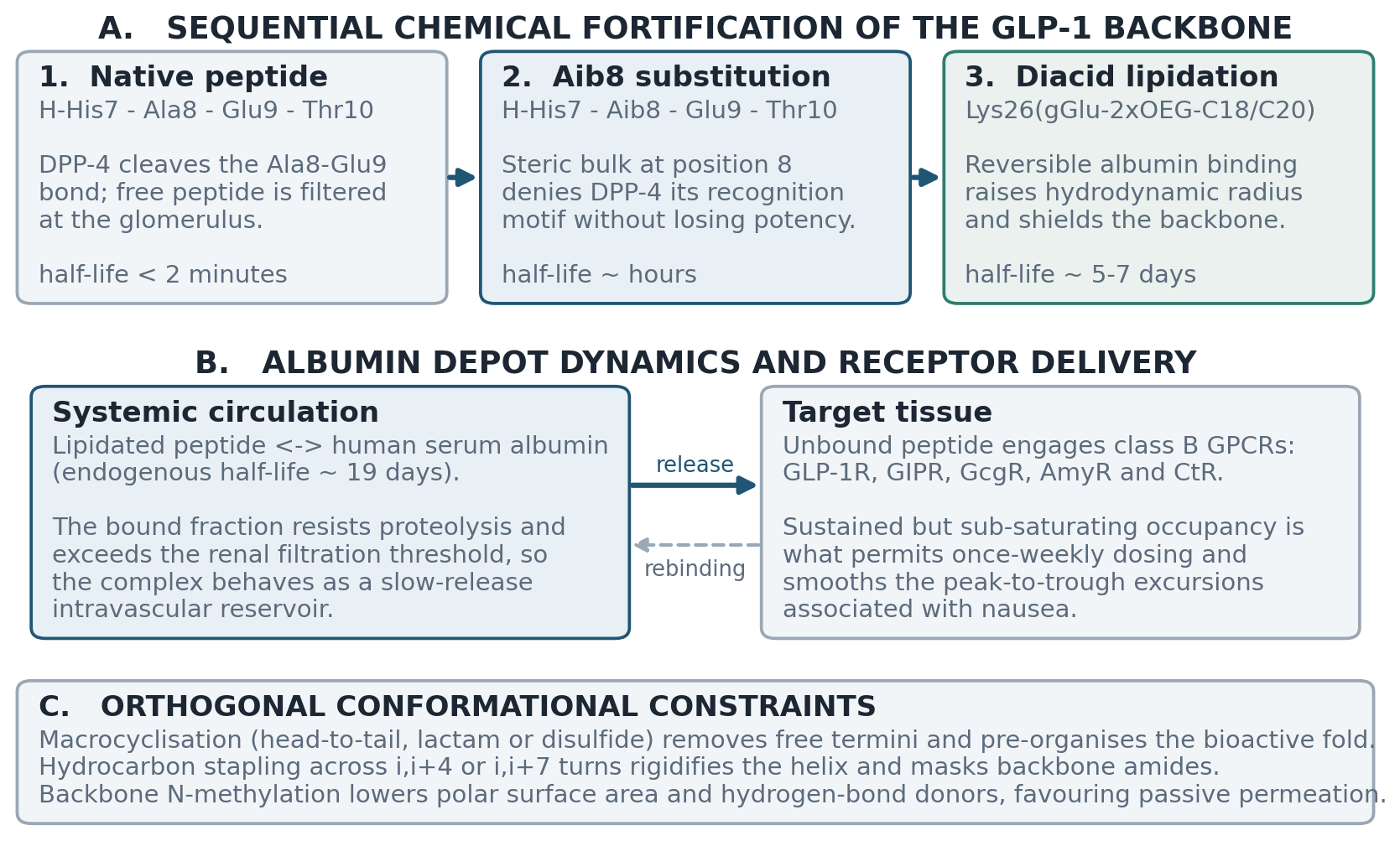
Figure 3. Sequential chemical fortification of the GLP-1 backbone and the albumin depot mechanism. Panel A traces the two-step transformation of a fragile hormone into a weekly medicine: native GLP-1 is cleaved by dipeptidyl peptidase-4 between Ala8 and Glu9 and cleared renally within minutes; substitution of position 2 with α-aminoisobutyric acid denies the protease its recognition motif at negligible cost to potency; and acylation of Lys26 with a C18 or C20 fatty diacid through γ-Glu and oligoethylene glycol spacers extends half-life to five to seven days. Panel B shows the resulting equilibrium, in which reversibly albumin-bound drug forms a protected intravascular reservoir that releases free peptide to engage class B receptors, flattening the plasma profile in a way that matters for tolerability as well as dosing interval. Panel C summarises the orthogonal conformational constraints applied where permeability rather than protraction is limiting.
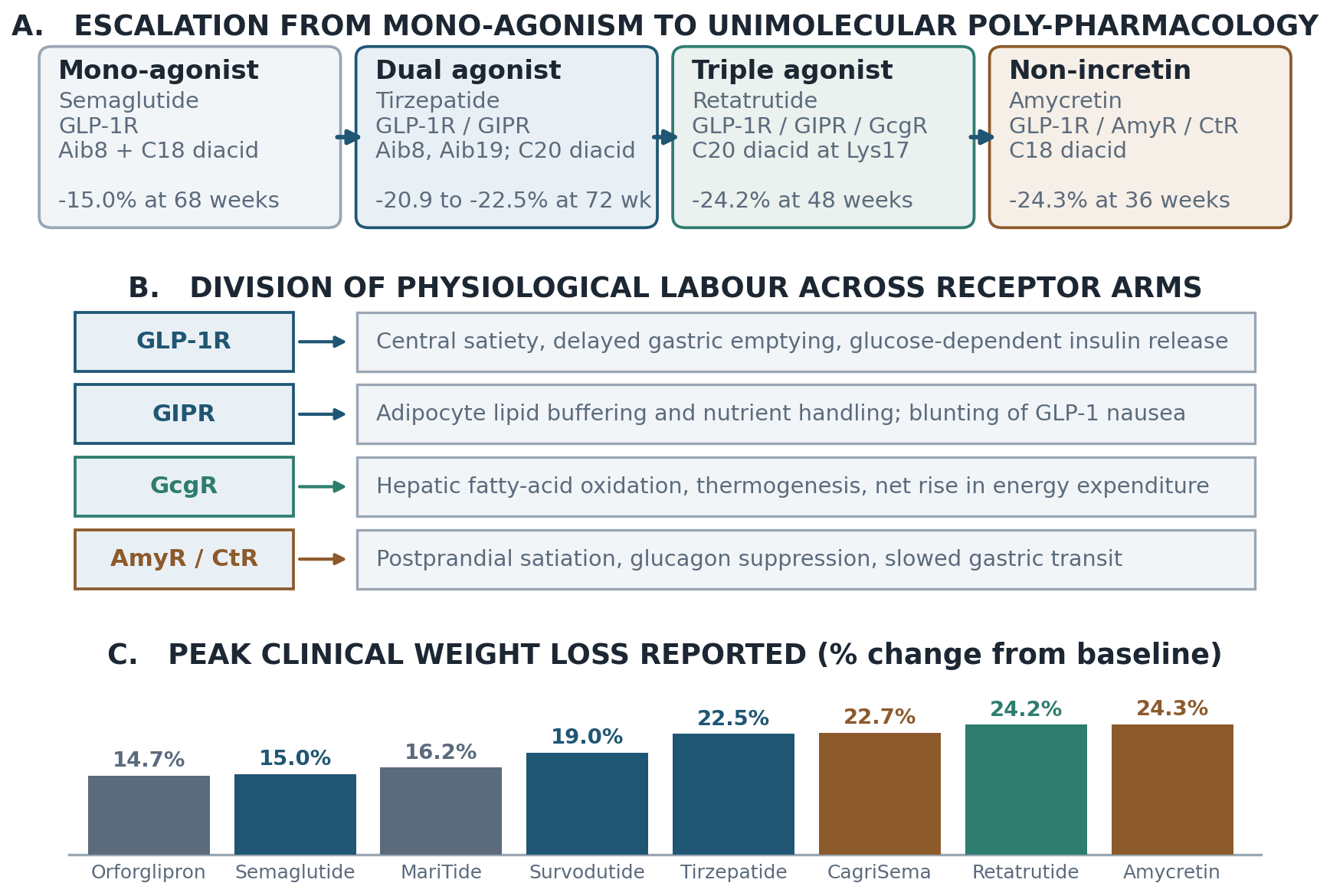
Figure 4. Receptor poly-pharmacology: escalation, division of physiological labour and clinical efficacy. Panel A traces the progression from selective GLP-1 receptor agonism through dual GLP-1R/GIPR agonism to unimolecular triple agonism and to non-incretin GLP-1R/amylin co-agonism, with the protractor chemistry and headline efficacy of a representative agent in each class. Panel B assigns the principal physiological contribution of each receptor arm, showing that the receptors are complementary rather than redundant: satiety and insulinotropy, adipocyte lipid handling, hepatic oxidation and thermogenesis, and postprandial satiation respectively. Panel C ranks peak reported weight loss across the class. Note that amycretin matches the tri-agonist with two receptor arms and a shorter exposure, indicating that which physiological axes are engaged matters more than how many receptors are listed. Values derive from separate trials and are indicative rather than head-to-head.
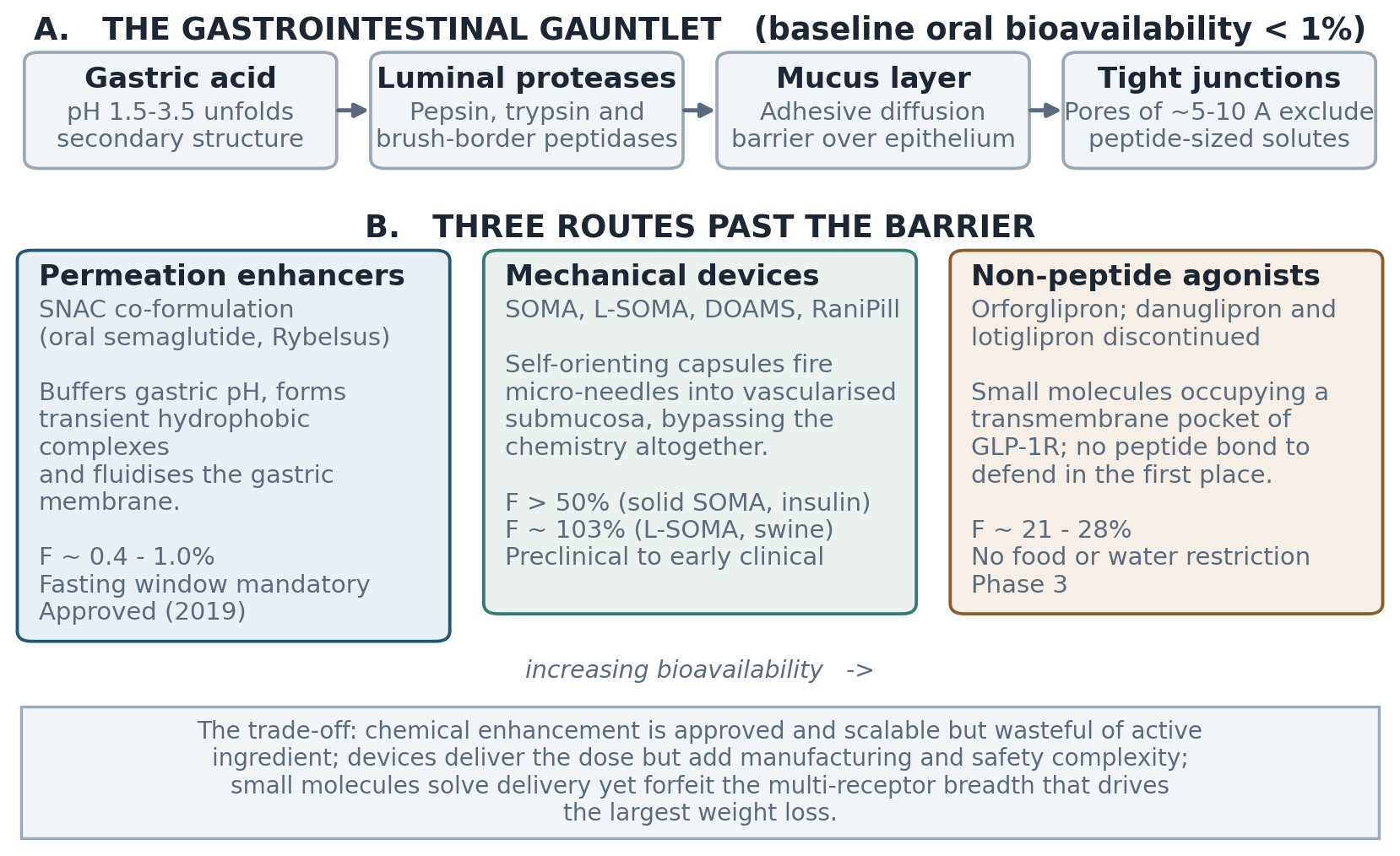
Figure 5. Gastrointestinal barriers to oral peptide absorption and the three strategies deployed against them. Panel A sets out the sequential obstacles that hold baseline oral bioavailability for an unprotected therapeutic peptide below 1%: acid-mediated unfolding, luminal and brush-border proteolysis, the adhesive mucus layer, and epithelial tight junctions whose paracellular pores exclude peptide-sized solutes. Panel B compares the three routes past that barrier, with reported bioavailability, dosing constraints and developmental status for each. The comparison exposes a genuine trilemma rather than a ranking: chemical permeation enhancement is approved and scalable yet wastes over 99% of the administered peptide; mechanical micro-devices deliver the dose efficiently but make every tablet a precision-engineered machine; and non-peptide agonists solve delivery convincingly while forfeiting the multi-receptor breadth that produces the largest weight loss.
specifically adapted to dismantling peptides: gastric acid unfolds them, pepsin and pancreatic and brush-border proteases cleave them, mucus impedes diffusion, and epithelial tight junctions exclude anything much larger than a small molecule (Liu et al., 2025; Xiao et al., 2026). Baseline oral bioavailability for an unprotected therapeutic peptide sits below 1% (Figure 5).
The first route past this barrier is chemical. Oral semaglutide (Rybelsus) co-formulates the peptide with sodium N-(8-[2-hydroxybenzoyl]amino)caprylate (SNAC), which dissolves in the stomach, raises local pH sufficiently to protect the peptide from pepsin, and forms transient non-covalent complexes that fluidise the gastric membrane and promote transcellular absorption in a localised region of the gastric mucosa (Buckley et al., 2018). The approach works, in the sense that it produced an approved oral GLP-1R agonist, but the economics are uncomfortable: bioavailability of 0.4 to 1.0% means the overwhelming majority of a milligram-scale dose is never absorbed, and administration requires a fasting window of 30 minutes before food or drink (Buckley et al., 2018; Østergaard, 2025). Related transient permeation enhancer systems using medium-chain fatty acids and bile salts underpin oral octreotide and experimental bis-lipidated GLP-1 analogues (Zhang et al., 2025; Table 3).
The second route is mechanical, and frankly ingenious. Self-orienting millimetre-scale applicators (SOMA) are ingestible capsules weighted so that they reliably right themselves against the gastric wall, then fire a micro-needle of compacted drug into the submucosa using a spring released by gastric fluid; the liquid-injecting variant (L-SOMA) delivers a solution instead (Abramson et al., 2019; Abramson et al., 2022). Reported systemic bioavailabilities are startling by comparison with chemical enhancement, exceeding 50% for solid insulin and reaching 103% plus or minus 42% for GLP-1 analogues in swine. Dynamic omnidirectional adhesive microneedle systems and balloon-actuated capsules such as RaniPill apply similar logic in the intestine, roughly doubling plasma exposure relative to standard tablets (Chen et al., 2022; Table 3). Receptor-mediated approaches, including conjugation to bile acid derivatives that exploit the apical sodium-dependent bile acid transporter, represent a third and more biological variation on the same theme (Zeng et al., 2025).
The third route abandons the peptide altogether. Rational design has produced non-peptide small molecules that bind an allosteric or transmembrane pocket on GLP-1R and activate it without any peptide bond to defend. Danuglipron and lotiglipron established proof of concept but were curtailed by short half-life and hepatic signals respectively (Østergaard, 2025). Orforglipron, a high-potency partial agonist, achieves oral bioavailability of 21 to 28%, supports once-daily dosing without food or water restriction, and produced 12.4 to 14.7% weight loss in phase 2 and 3 trials (Wharton et al., 2023; Table 3). That figure sits below the multi-agonist peptides, which is precisely the trade-off: convenience is bought at some cost in efficacy, at least for now. The oral small-molecule approach is being extended to other indications as well, including oral peptide-mimetic agents in immunology (Habib et al., 2026).
2.5 Manufacturing at Population Scale and the Environmental Reckoning
A drug that several hundred million people might reasonably take is a manufacturing problem before it is anything else, and this is where the peptide field's success has generated its most uncomfortable literature (Østergaard, 2025). Therapeutic peptides are produced by solid-phase synthesis (SPPS), liquid-phase synthesis (LPPS), recombinant expression, or hybrids of these. Recombinant expression in yeast or Escherichia coli is scalable and comparatively clean, but non-proteinogenic residues, site-specific lipidation and macrocyclic architectures generally cannot be installed biologically, which forces a synthetic or semi-recombinant route for exactly the molecules of interest here (Østergaard, 2025; Table 4).
Fmoc-based SPPS remains the workhorse. Its stepwise resin-bound assembly is flexible and reliable, and its atom economy is poor: large excesses of protected amino acids and coupling reagents, extensive washing between cycles, and cleavage with trifluoroacetic acid (Al Musaimi et al., 2020; Ferrazzano et al., 2022). The field quantifies the consequence using process mass intensity (PMI), the total mass of raw materials, reagents and solvents consumed per kilogram of active pharmaceutical ingredient. For phase 1 synthetic peptides, PMI averages approximately 33,000, meaning 33 tonnes of input per kilogram of product, of which more than 80% is hazardous organic solvent: dimethylformamide, N-methyl-2-pyrrolidone and trifluoroacetic acid (Kekessie et al., 2024). Small molecules sit between 168 and 308; monoclonal antibodies average around 7,700, and most of that is water (Kekessie et al., 2024). Extrapolating to multi-tonne annual demand produces solvent figures that are difficult to state without sounding alarmist (Table 4).
Regulatory pressure has converged with this arithmetic. European restrictions on reprotoxic DMF and on per- and polyfluoroalkyl substances, a category that encompasses TFA, mean that the current process is not merely wasteful but increasingly unlawful (Østergaard, 2025; Ashley et al., 2025). Three responses have gained traction. Solvent replacement substitutes bio-derived alternatives such as N-butylpyrrolidone, gamma-valerolactone, Cyrene and triethyl phosphate, generally coupled with closed-loop recovery (Al Musaimi et al., 2020; Ferrazzano et al., 2022). Convergent hybrid SPPS/LPPS assembles short fragments separately and couples them in solution, a strategy used for kilogram-scale GMP manufacture of tirzepatide from four fragments and reported to lower commercial PMI per amino acid from roughly 1,463 to 874 (Frederick et al., 2021; Østergaard, 2025). Chemo-enzymatic peptide synthesis (CEPS) goes further, ligating fragments in aqueous media using engineered ligases such as omniligase-1, eliminating organic solvent from the condensation step entirely and demonstrated at multi-gram to kilogram scale for exenatide and liraglutide (Toplak et al., 2019; Zhang et al., 2025). Table 4 compares these routes on process characteristics, waste metrics and scale-up readiness.