Integrative Biomedical Research

Integrative Biomedical Research (Journal of Angiotherapy) | Online ISSN  3068-6326
463
Citations
1.9m
Views
799
Articles
Your new experience awaits. Try the new design now and help us make it even better
Switch to the new experience
Figures and Tables
REVIEWS   (Open Access)

The exposome and genomic susceptibility in childhood acute lymphoblastic leukaemia

Naif Saad Alsuwayti 1, Meshari Farzal Ashwi Alshammari 2, Rasoul Pourhakimrezaei 3, Mohammad Javad Mousavi 4, Widia Sari 5 


+ Author Affiliations

Integrative Biomedical Research 10 (2) 1-8 https://doi.org/10.25163/biomedical.10210966

Submitted: 01 May 2026 Revised: 20 June 2026  Published: 02 July 2026 


Abstract

Childhood leukaemia is the commonest cancer of childhood, yet for most children who develop it we still cannot say why. Established, non-modifiable factors account for fewer than one in ten cases, and incidence appears to be edging upward, which points, however indirectly, at the environment. This review asks what the exposome framework, set against modern cancer genomics, can add. We synthesised recent epidemiological, toxicological and whole-genome sequencing evidence on acute lymphoblastic leukaemia (ALL), organising it around the two-hit developmental model in which a prenatal initiating lesion is followed by postnatal secondary hits. Backtracking studies place the first hit firmly in utero: the ETV6::RUNX1 fusion can be recovered from banked cord blood, mostly in CD34? B-cell progenitors, although only a small fraction of these clones ever become clinical disease. The external exposome supplies plausible triggers for the second hit. Neonatal concentrations of the PFAS derivatives MeFOSAA and EtFOSAA, residential proximity to vineyards and barley, fine particulate matter (a hazard ratio near 1.40 per 5 µg/m³), proximity to power lines, gestational heat and a late-summer diagnostic peak have each been linked to risk, though effect sizes are modest and confidence intervals often wide. On the internal side, germline variants at CDKN2A/2B, IKZF1, ARID5B and CEBPE interact epistatically, and somatic mutational signatures, APOBEC, oxidative SBS18 and RAG-mediated SV7, read almost like forensic traces of specific exposures. Integrating these layers may eventually support prevention and early interception, but the evidence, while suggestive, is not yet strong enough to guide policy on its own.

Keywords: childhood leukaemia; acute lymphoblastic leukaemia; exposome; environmental exposures; germline susceptibility; mutational signatures; cancer prevention

1. Introduction

Childhood leukaemia is the most common malignancy of childhood, making up roughly 25–30% of all paediatric cancer diagnoses worldwide (Choi et al., 2026; de Smith, Zhou, et al., 2025; Lejman et al., 2025). Acute lymphoblastic leukaemia (ALL) dominates the burden. It arises from B-cell precursors (BCP-ALL, about 85% of cases) or, less often, T-cell precursors (T-ALL, around 15%), and shows a characteristic peak between one and six years of age (Bychkov et al., 2026; de Smith, Zhou, et al., 2025; Salmon et al., 2026). Treatment has become one of oncology's success stories: over five decades, risk-adapted multi-agent chemotherapy and stratification schemes such as the National Cancer Institute criteria, based on age and presenting white cell count, have pushed overall survival past 90% in high-income settings (Lejman et al., 2025; Oh et al., 2025; Salmon et al., 2026). That figure, impressive as it is, hides two problems. Relapse still occurs in 10–20% of children and remains a leading cause of cancer death in this age group (Bychkov et al., 2026; de Smith, Zhou, et al., 2025; Lejman et al., 2025), and long-term survivors carry lifelong therapy-related morbidity, including anthracycline cardiotoxicity, secondary neoplasms, endocrine deficits and neurocognitive impairment (de Smith, Zhou, et al., 2025; Lejman et al., 2025).

So the natural question shifts from cure to cause, and here the picture is far less settled. Incidence has been rising across several international cohorts, which hints at an environmental contribution, yet the established, non-modifiable risk factors, high birth weight, male sex, and rare congenital syndromes such as Down syndrome or Fanconi anaemia, together explain less than 10% of ALL (de Smith, Zhou, et al., 2025; Godoy-Casasbuenas et al., 2024; Salmon et al., 2026). That leaves a large aetiological gap. To address it, paediatric oncology has increasingly turned to the exposome, defined as the cumulative measure of life-course environmental exposures (the external exposome) and the endogenous biological perturbations they produce (the internal exposome), interacting with host genomic susceptibility (de Smith, Zhou, et al., 2025; Handakas et al., 2024).

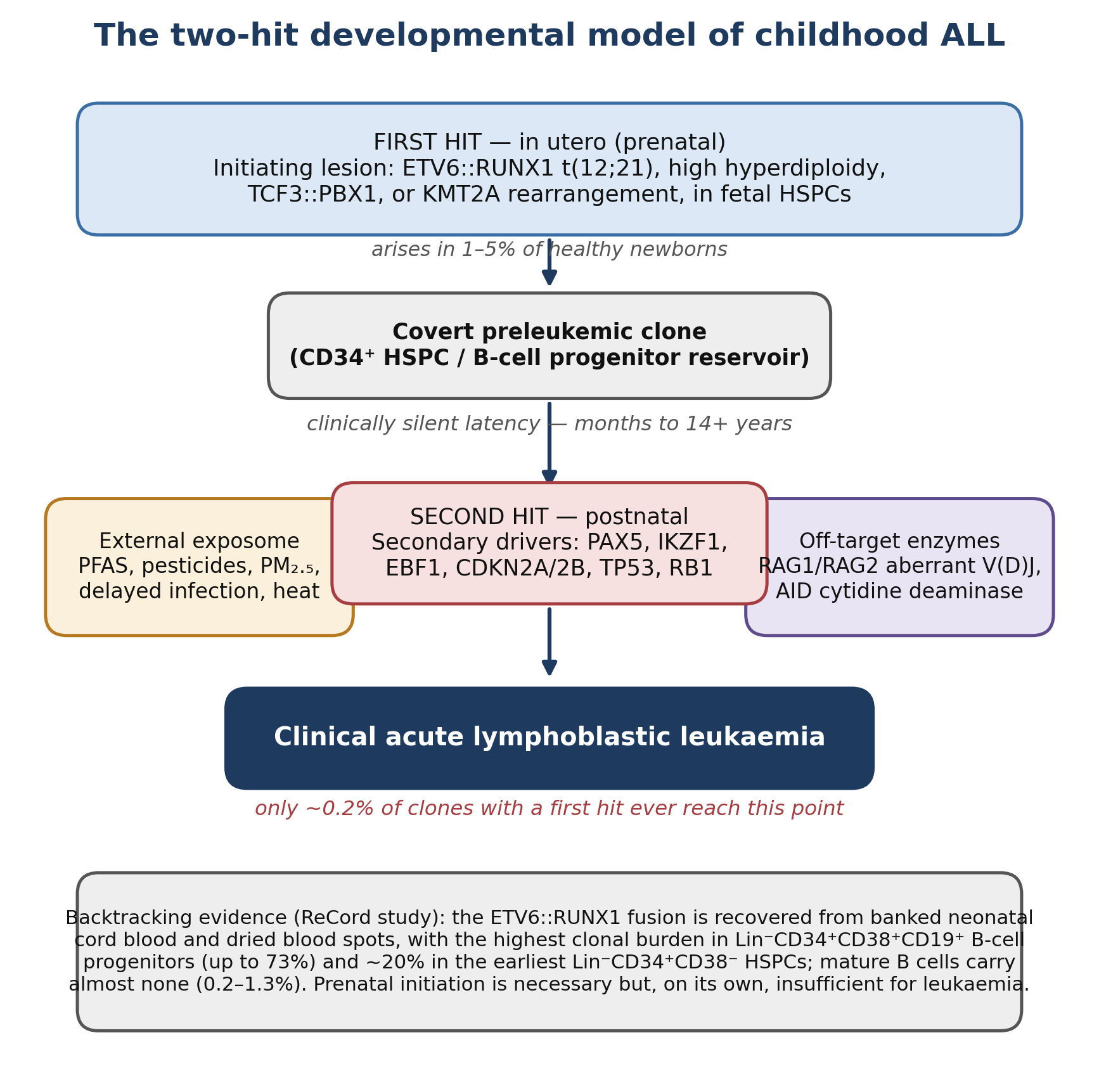
Underpinning most of what follows is a model that has held up remarkably well: the two-hit hypothesis, in which leukaemia is set in motion before birth (de Smith, Zhou, et al., 2025; Greaves, 2018) (Figure 1). The first, initiating event is typically a chromosomal translocation, most often the t(12;21)(p13;q22) ETV6::RUNX1 fusion, or a numerical gain such as high hyperdiploidy (51–67 chromosomes) (Bychkov et al., 2026; de Smith, Zhou, et al., 2025; Oh et al., 2025). Backtracking studies, notably the international ReCord study, have recovered these initiating rearrangements from banked neonatal cord blood and dried blood spots, showing that ETV6::RUNX1 preleukemic clones arise during prenatal haematopoiesis within hematopoietic stem and progenitor cell (HSPC) compartments, including CD34⁺CD38⁻ stem cells and B-cell progenitors (de Smith, Elliott, et al., 2025; Greaves, 2018). The striking part is the arithmetic. Such fusions are found in 1–5% of healthy newborns, but only about 0.2% go on to overt leukaemia (Bychkov et al., 2026; de Smith, Zhou, et al., 2025). Prenatal initiation, in other words, is necessary but nowhere near sufficient.

What converts a covert clone into clinical disease is the acquisition of secondary somatic alterations during early childhood (Bychkov et al., 2026; de Smith, Zhou, et al., 2025; Lejman et al., 2025). These postnatal "second hits" tend to target transcriptional regulators of B-cell commitment (PAX5, IKZF1, EBF1) or cell-cycle checkpoints (CDKN2A/2B, TP53, RB1), frequently through the off-target activity of recombination-activating genes (RAG1/RAG2) or activation-induced cytidine deaminase (AID) (de Smith, Zhou, et al., 2025; Lejman et al., 2025). Working out which environmental triggers drive these postnatal deletions and mutations is, we would argue, the crux of primary prevention (de Smith, Zhou, et al., 2025).

Epidemiological and toxicological work has tied a range of exogenous stressors to leukaemia risk. Per- and polyfluoroalkyl substances (PFAS), persistent synthetic chemicals used in stain-resistant textiles and industrial coatings, cross the placenta (Morimoto et al., 2025); high-resolution mass spectrometry in paired maternal serum and neonatal blood spots has linked elevated neonatal MeFOSAA and EtFOSAA to childhood ALL, especially in children diagnosed at or before age two, with fetal immune dysregulation offered as the likely mechanism (de Smith, Zhou, et al., 2025; Morimoto et al., 2025). Agricultural pesticides, whether from residential crop proximity, indoor use or parental occupation, are also implicated: French GEOCAP spatial modelling found viticulture and barley density within 1,000 m of home associated with ALL (Mancini et al., 2026). Traffic-related air pollution adds fine particulate matter (PM₂.₅), NO₂, black carbon and benzene to the list; a South Korean cohort reported a hazard ratio of 1.40 (95% CI 1.04–1.90) per 5 µg/m³ of PM₂.₅, strongest in the youngest children (Choi et al., 2026), and GEOCAP linked NO₂, PM₂.₅, black carbon and road density to acute myeloid leukaemia (AML) (Salmon et al., 2026). Proximity to high-voltage power lines and transformer stations has been examined across European cohorts with mixed results (Crespi et al., 2024; Malagoli et al., 2023; Malavolti et al., 2024). Finally, first-trimester heat exposure and a recurring late-summer diagnostic peak in Sweden point to gestational and infectious triggers (Bychkov et al., 2026; Rogne et al., 2024).

The internal exposome captures the interplay of germline susceptibility and somatic change (de Smith, Zhou, et al., 2025). Genome-wide association studies have flagged germline variants at CDKN2A/2B (9p21.3, including the rs3731249 A148T variant, which roughly triples risk), IKZF1 (7p12.2), ARID5B (10q21.2), CEBPE (14q11.2) and GATA3 (10p14) (Aghasipour et al., 2024; Cao et al., 2025; de Smith, Zhou, et al., 2025), and network analyses show epistatic hubs among IKZF1, ARID5B and CEBPE that amplify risk beyond their individual effects (Cao et al., 2025). Carcinogens also leave molecular footprints. Whole-genome sequencing of ALL has resolved single base substitution (SBS) signatures, SBS2/SBS13 (APOBEC activity, enriched in ETV6::RUNX1 ALL), SBS18 (oxidative damage), SBS7 (ultraviolet radiation), and the structural variant signature SV7 (aberrant RAG-mediated recombination) (de Smith, Zhou, et al., 2025). Prenatal exposures, in turn, reshape DNA methylation, altering roughly 10% of CpG sites between normal pre-B cells and leukaemic blasts (de Smith, Zhou, et al., 2025).

This review sets out to connect environmental health, molecular epidemiology and paediatric oncology across four aims. First, to evaluate the role of prenatal and early-life external exposome factors, PFAS, pesticide crop proximity, traffic-related air pollution, non-ionizing radiation, climate extremes and infectious triggers, in leukaemia aetiology. Second, to map the host genomic landscape, from initiating prenatal lesions (ETV6::RUNX1, high hyperdiploidy, TCF3 rearrangements) to postnatal drivers (CDKN2A/2B, PAX5, IKZF1, EBF1) and inherited susceptibility loci. Third, to outline how mutational and epigenetic profiling links specific carcinogens to distinct molecular subtypes. Fourth, to propose an evidence-based public health framework for prevention and early detection, including cord blood screening and targeted protection of vulnerable children.

2. The Developmental Exposome in Pediatric Leukemia: Environmental, Genetic, and Epigenetic Interactions

2.1 Rethinking leukaemogenesis: from fixed risk factors to a developmental exposome

2.1.1 A disease of development

Paediatric leukaemia remains the most common childhood malignancy worldwide, at roughly 25–30% of paediatric cancers (Choi et al., 2026; Godoy-Casasbuenas et al., 2024). ALL, comprising BCP-ALL and T-ALL, makes up some 80–85% of cases and peaks diagnostically between two and six years (Bychkov et al., 2026; Oh et al., 2025). Survival now exceeds 90% in well-resourced systems, yet relapse remains a leading cause of childhood cancer mortality, and survivors face serious late effects such as anthracycline cardiomyopathy and secondary neoplasms (de Smith, Zhou, et al., 2025; Lejman et al., 2025). Because congenital syndromes and inherited predisposition together explain fewer than 10% of cases, attention has shifted to the exposome, a model that treats disease as the product of lifetime environmental exposures, endogenous responses and host genomic architecture acting together (Handakas et al., 2024).

2.1.2 Prenatal haematopoiesis, early clones and the two-hit paradigm

The organising idea in this field is a multi-step, two-hit origin beginning in utero (Greaves, 2018) (Figure 1). Initiating lesions are usually chromosomal translocations, above all t(12;21)(p13;q22) ETV6::RUNX1, or numerical gains such as high hyperdiploidy (Oh et al., 2025). Molecular backtracking using archived neonatal blood spots and cord blood has confirmed a fetal origin (de Smith, Elliott, et al., 2025; Greaves, 2018). In the multi-centre ReCord study, ETV6::RUNX1 fusions were isolated directly from banked cord blood of children who later developed ALL, and traced across stem and progenitor compartments (de Smith, Elliott, et al., 2025). The highest clonal frequencies sat within Lin⁻CD34⁺CD38⁺CD19⁺ B-cell progenitors (up to 73%) and the earliest Lin⁻CD34⁺CD38⁻ HSPCs (de Smith, Elliott, et al., 2025). Since such fusions occur in about 1–5% of healthy births but only ~0.2% progress to leukaemia, prenatal initiation is necessary but not sufficient (Greaves, 2018).

Progression to overt disease requires secondary somatic alterations in early childhood (Lejman et al., 2025). These second hits commonly disrupt B-cell developmental regulators (PAX5, IKZF1, EBF1) or cell-cycle checkpoints (CDKN2A/2B, TP53, RB1), frequently through off-target RAG-mediated recombination or AID activity (de Smith, Zhou, et al., 2025). Identifying the external exposures that promote these deletions is, therefore, central to any prevention strategy (de Smith, Zhou, et al., 2025).

2.2 The chemical exposome: PFAS and agricultural pesticides

2.2.1 Per- and polyfluoroalkyl substances

The chemical exposome includes persistent compounds able to cross the placenta during critical windows of lineage commitment (Handakas et al., 2024). PFAS have drawn particular scrutiny, given their environmental ubiquity, long half-lives and immunotoxicity (de Smith, Zhou, et al., 2025). High-resolution mass spectrometry in paired maternal serum and neonatal blood spots found that elevated neonatal MeFOSAA, a long-chain PFAS derivative, was independently associated with ALL, most clearly in children diagnosed at or before two years (Morimoto et al., 2025). Parallel analyses of settled household dust implicated the related EtFOSAA, supporting the idea that early-life PFAS exposure disrupts developing immune networks, promotes oxidative stress and perturbs fetal marrow haematopoiesis (Metayer et al., 2025; Morimoto et al., 2025) (Table 2). The mechanism is plausible rather than proven, and reverse causation from differential fetal growth cannot be fully excluded.

2.2.2 Pesticides and crop proximity

Toxicological studies have long linked agricultural pesticide exposure to childhood haematological malignancy (Karalexi et al., 2021; Van Maele-Fabry et al., 2019). Nationwide spatial analysis in France (GEOCAP) found that high crop density and residential proximity (<1,000 m) to viticulture and barley were significantly associated with ALL (Mancini et al., 2026). Meta-analyses of home pesticide use reinforce this, reporting raised leukaemia risk from indoor insecticides, professional treatments and parental occupational handling, attributed to genotoxicity, reactive oxygen species and haematopoietic cell damage (Bailey et al., 2015; Karalexi et al., 2021; Van Maele-Fabry et al., 2019). Spatial exposure assessment of this kind is prone to misclassification, so the consistency across independent designs is reassuring, if not conclusive.

2.3 The physical and outdoor exposome: traffic, radiation and climate

2.3.1 Traffic-related air pollution

The physical exposome spans air pollution, non-ionizing radiation and thermal extremes (Rogne et al., 2024). Motor traffic emits NO₂, PM₂.₅, black carbon and volatile organics such as benzene (Choi et al., 2026; Salmon et al., 2026). In a Korean cohort of 384,606 children followed for 19 years, long-term PM₂.₅ carried a hazard ratio of 1.40 (95% CI 1.04–1.90) per 5 µg/m³, strongest in children aged 0–11 (Choi et al., 2026). GEOCAP case-control analyses identified subtype-specific effects, with continuous NO₂, PM₂.₅, black carbon and nearby road density raising AML risk (Salmon et al., 2026). Inhaled particulates and traffic toxics are thought to induce systemic inflammation, oxidative DNA breaks and marrow remodelling (Salmon et al., 2026) (Table 2).

2.3.2 Electromagnetic fields

Extremely low frequency magnetic fields (ELF-MF) from power infrastructure remain among the most studied, and most contested, physical exposures (Malagoli et al., 2023). Case-control studies in Northern Italy found children living within 100 m of high-voltage lines had an adjusted odds ratio of 2.0 (95% CI 0.8–5.0) for overall leukaemia and 2.2 (0.8–6.0) for ALL relative to those beyond 400 m, with an inverse dose-response by distance (Malagoli et al., 2023). Studies of indoor transformer stations reported mostly modest or non-significant overall effects, though raised estimates persisted in older children (≥5 years), plausibly reflecting cumulative exposure (Crespi et al., 2024; Malavolti et al., 2024). Notably, a large French GEOCAP analysis found no association between calculated ELF-MF (≥0.3 µT) and ALL, a discrepancy that probably owes as much to exposure misclassification as to true heterogeneity (Mancini et al., 2025).

2.3.3 Climate and infection

Climate and infectious triggers round out the physical exposome (Rogne et al., 2024). Maternal exposure to high ambient temperature in the first trimester has been linked to increased ALL risk, suggesting gestational heat stress during early fetal lymphopoiesis (Rogne et al., 2024). Bayesian GARIMAX time-series modelling in Sweden found a consistent seasonal peak in ALL diagnoses between June and October (peaking in August), with no such pattern for AML or brain tumours (Bychkov et al., 2026). These peaks are usually read in support of Greaves' delayed-infection hypothesis, in which late first exposure to common pathogens provokes a dysregulated immune response that drives transformation of pre-existing clones (Greaves, 2018).

2.4 Host genomic architecture, mutational signatures and epigenetic integration

2.4.1 Germline susceptibility loci

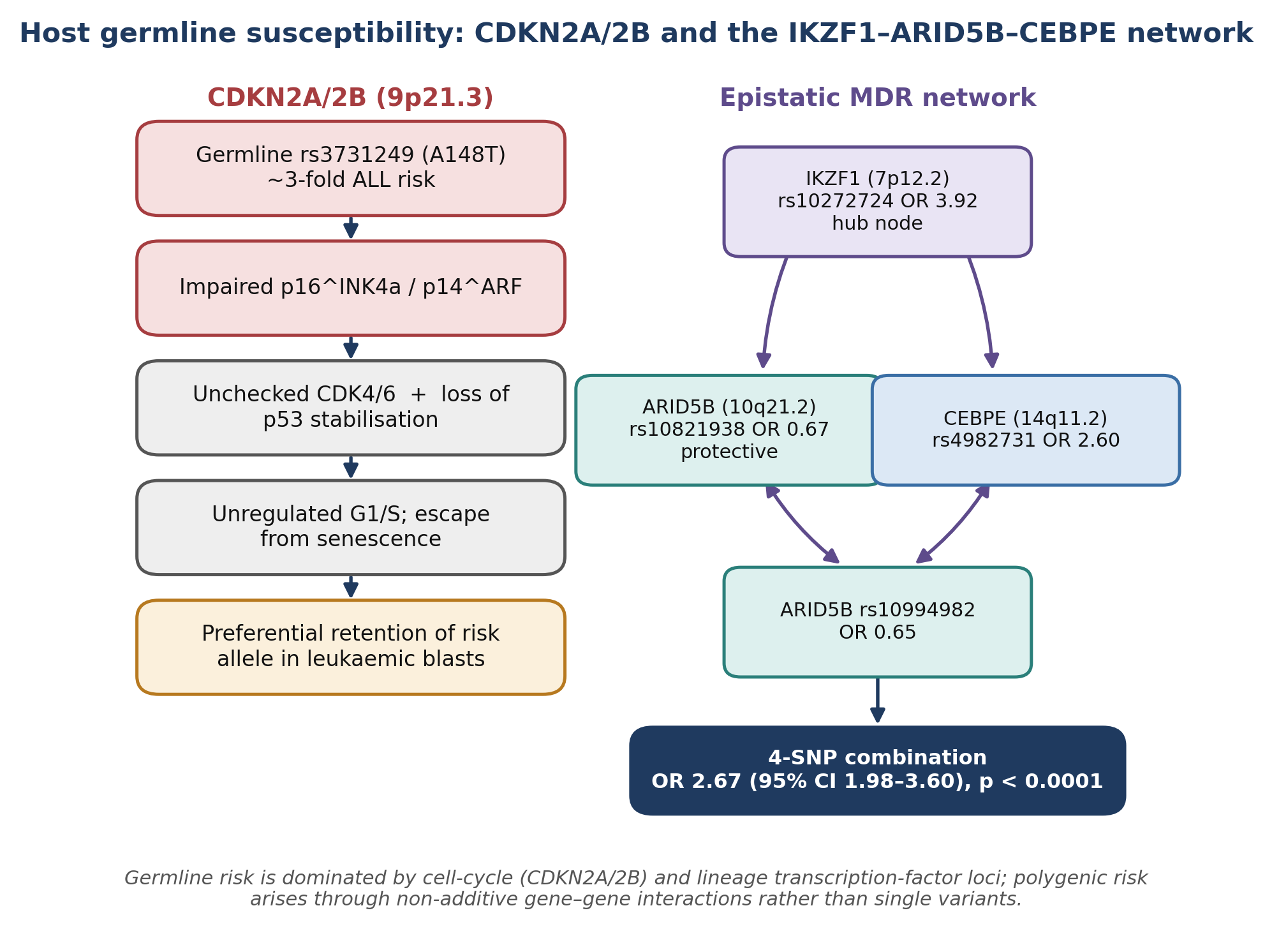
The internal exposome reflects the interaction of inherited susceptibility and somatic change (de Smith, Zhou, et al., 2025). GWAS have identified recurrent germline SNPs at transcription-factor and cell-cycle loci, including CDKN2A/2B (9p21.3), IKZF1 (7p12.2), ARID5B (10q21.2), CEBPE (14q11.2) and GATA3 (10p14) (Aghasipour et al., 2024; Cao et al., 2025). Meta-analysis of the CDKN2A missense variant rs3731249 (A148T) shows a roughly three-fold increased risk in European and Hispanic

Figure 1. The two-hit developmental model of childhood acute lymphoblastic leukaemia. An initiating first hit (a chromosomal translocation such as ETV6::RUNX1, high hyperdiploidy, TCF3::PBX1 or a KMT2A rearrangement) occurs in utero within fetal hematopoietic stem and progenitor cells and is present in 1–5% of healthy newborns, creating a covert preleukemic clone. After a clinically silent latency of months to years, external exposome factors and off-target enzymatic activity (RAG1/RAG2, AID) promote a postnatal second hit in genes such as PAX5, IKZF1, EBF1, CDKN2A/2B, TP53 and RB1, converting the clone into overt disease. Only about 0.2% of clones with a first hit ever progress, underscoring the decisive postnatal bottleneck at which prevention could act. The lower panel summarises the ReCord cord-blood backtracking evidence. Synthesised from de Smith, Elliott, et al. (2025), de Smith, Zhou, et al. (2025), Greaves (2018) and Lejman et al. (2025).

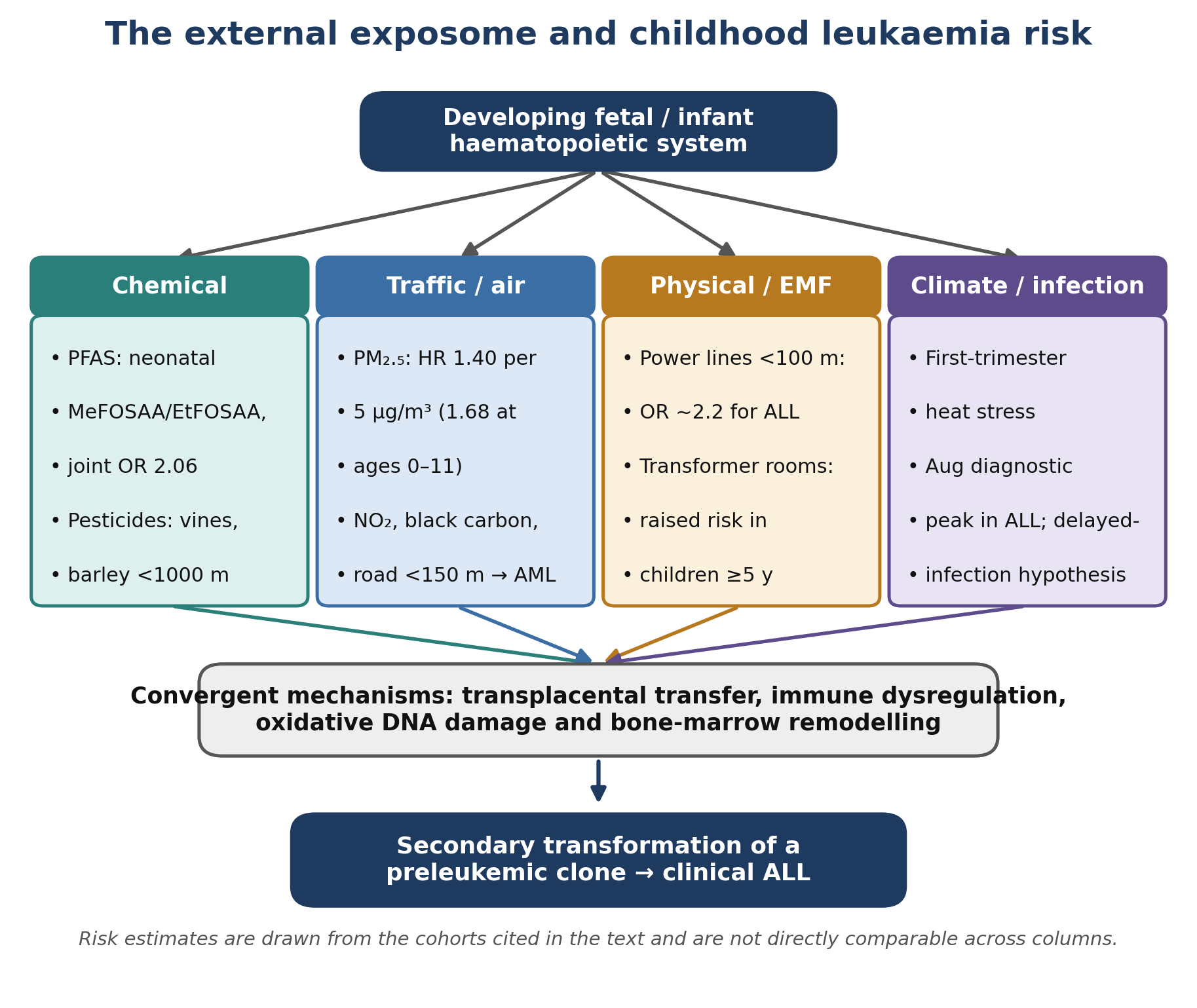
Figure 2. The external exposome and childhood leukaemia risk: convergent chemical, physical and climatic drivers. Four domains of the external exposome act on the developing fetal and infant haematopoietic system. Chemical exposures include PFAS (neonatal MeFOSAA/EtFOSAA, joint OR 2.06) and pesticide cropland proximity; traffic and air exposures include PM₂.₅ (HR 1.40 per 5 µg/m³, 1.68 at ages 0–11), NO₂, black carbon and road density (linked to AML); physical exposures include high-voltage power lines (OR ~2.2 for ALL) and transformer rooms (raised in children ≥5 years); and climatic and infectious factors include first-trimester heat stress and an August diagnostic peak consistent with the delayed-infection hypothesis. These act through convergent mechanisms, transplacental transfer, immune dysregulation, oxidative DNA damage and marrow remodelling, to promote secondary transformation of a preleukemic clone. Estimates are from separate cohorts and are not directly comparable. Synthesised from Bychkov et al. (2026), Choi et al. (2026), Malagoli et al. (2023), Mancini et al. (2026), Morimoto et al. (2025), Rogne et al. (2024) and Salmon et al. (2026).

children, with leukaemic blasts preferentially retaining the risk allele during clonal evolution (Aghasipour et al., 2024) (Figure 3). Multifactor dimensionality reduction (MDR) models in Chinese cohorts add epistatic detail, showing that a four-SNP combination across IKZF1, ARID5B and CEBPE amplifies risk well beyond individual main effects (Cao et al., 2025) (Table 3).

2.4.2 Somatic mutational signatures

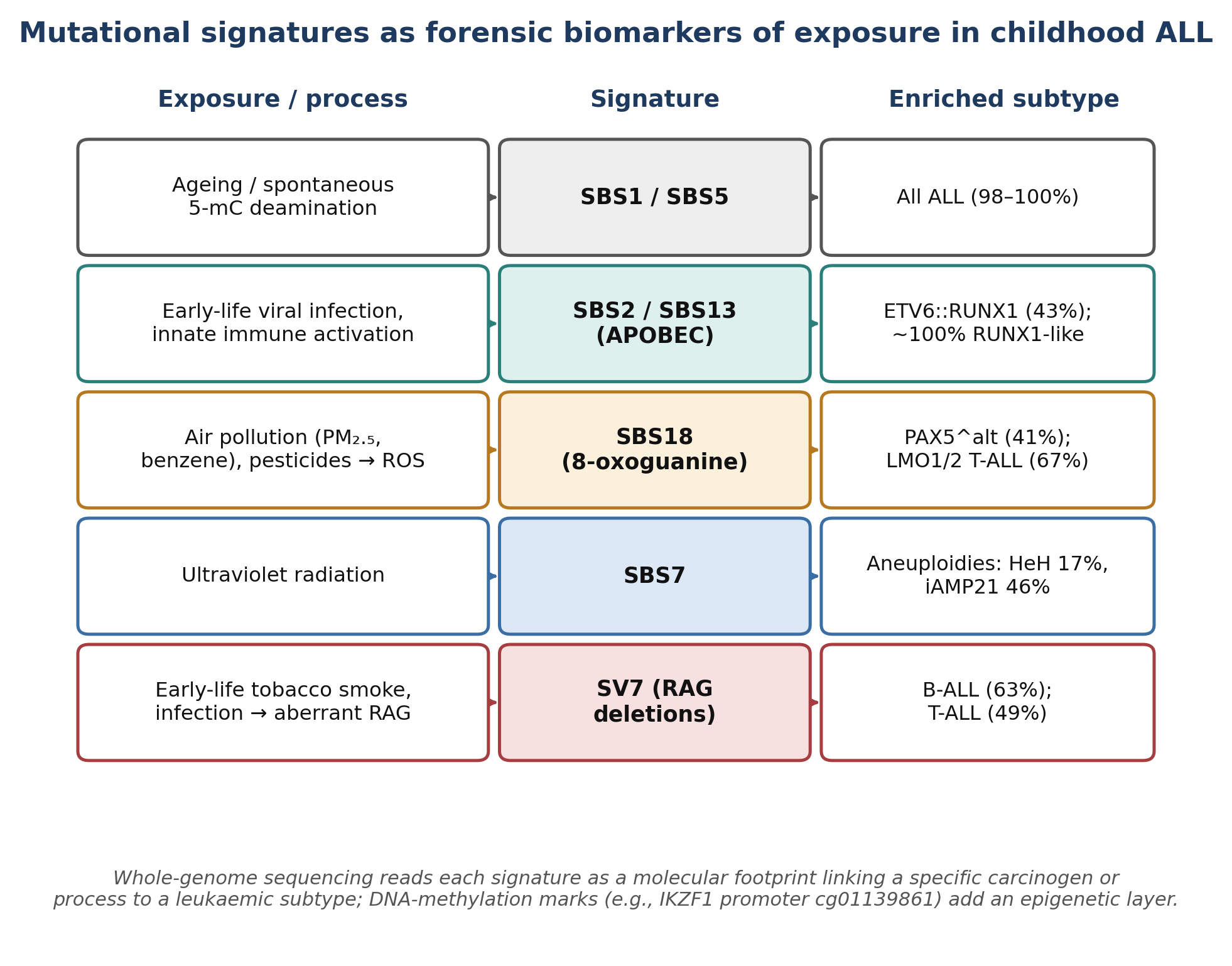
Somatic mutational epidemiology provides a molecular bridge between carcinogens and tumour genomes (de Smith, Zhou, et al., 2025). Whole-genome sequencing has resolved distinct SBS and structural variant signatures in ALL blasts (Figure 4; Table 4). SBS2/SBS13 (C→T and C→G changes) reflect APOBEC cytidine deaminase activity and are enriched in ETV6::RUNX1 BCP-ALL; SBS18 (C→A) arises from 8-oxoguanine accumulation under reactive oxygen species; SBS7 marks ultraviolet damage; and SV7 comprises non-clustered deletions from aberrant RAG-1/RAG-2 recombination (de Smith, Zhou, et al., 2025). The RAG link is more than descriptive: early-life tobacco exposure appears causally implicated in genome-wide off-target RAG deletions (Liu et al., 2024).

2.4.3 Epigenetic integration

Finally, epigenetic profiling shows that environmental stressors and germline variants converge on DNA methylation at regulatory CpG sites (de Smith, Zhou, et al., 2025). Differential methylation at cg01139861 in the IKZF1 promoter, for instance, mediates the risk conferred by the germline SNP rs78396808, a neat illustration of how the epigenome integrates external exposure and internal susceptibility (Timms et al., 2019; Xu, Li, et al., 2022). It is this integration, rather than any single exposure or variant, that the exposome framework is meant to capture.

3. Methods

3.1 Design and rationale

We approached this as a structured narrative review rather than a systematic review with meta-analysis. The decision reflects the shape of the evidence more than any lack of ambition. Studies of the childhood leukaemia exposome span molecular backtracking, spatial environmental epidemiology, GWAS, whole-genome sequencing and mechanistic toxicology, with outcomes, exposure metrics and analytic units that do not lend themselves to statistical pooling (de Smith, Zhou, et al., 2025; Handakas et al., 2024). We nonetheless adopted the transparency features of systematic reviewing, a pre-specified question, an explicit search, stated eligibility criteria, duplicate screening and structured extraction, and report in line with the applicable items of the PRISMA 2020 statement for a narrative synthesis. No protocol was registered. Because the review used only published data, ethical approval was not required.

The guiding question, framed loosely in population–exposure–outcome terms, was: in children (population), how do external environmental exposures and host genomic and epigenomic features (exposure) relate to the initiation, progression and molecular subtype of acute leukaemia (outcomes)? ALL and AML were defined by standard WHO/ICD haematopathological criteria as used in the source studies.

3.2 Information sources and search strategy

We searched PubMed/MEDLINE, Embase, Scopus and Web of Science Core Collection for records published between 1 January 2015 and [final search date, 2026]. The start year was chosen to capture the modern exposome and mutational-signature literature while retaining key earlier meta-analyses of pesticide exposure (Bailey et al., 2015; Van Maele-Fabry et al., 2019). Google Scholar was used only to trace citations and locate articles in press, and the reference lists of major reviews (de Smith, Zhou, et al., 2025; Greaves, 2018; Lejman et al., 2025) were hand-searched. Because part of the evidence base is very recent, a preprint (Greenhalgh et al., 2025) was included with an explicit note of its non-peer-reviewed status.

Search terms combined three concept blocks with AND, and synonyms within each block with OR. The first captured the disease ("childhood leukaemia" OR "paediatric leukemia" OR "acute lymphoblastic leukemia" OR ALL OR "acute myeloid leukemia" OR AML). The second captured the exposome and genomics ("exposome" OR PFAS OR "perfluoroalkyl" OR pesticide OR "air pollution" OR "particulate matter" OR PM2.5 OR "magnetic field" OR "ambient temperature" OR "cord blood" OR backtracking OR GWAS OR "germline variant" OR "mutational signature" OR "DNA methylation" OR epigenetic). The third captured mechanism and outcome ("ETV6-RUNX1" OR hyperdiploidy OR CDKN2A OR IKZF1 OR ARID5B OR "second hit" OR preleukemi OR risk OR incidence). In PubMed the corresponding MeSH

Figure 3. Host germline susceptibility: the CDKN2A/2B mechanism and the IKZF1–ARID5B–CEBPE epistatic network. the germline CDKN2A missense variant rs3731249 (A148T) impairs p16^INK4a/p14^ARF function, releasing CDK4/6 activity and destabilising p53, which drives unregulated G1/S transition and escape from senescence; leukaemic blasts preferentially retain the risk allele during clonal evolution. Right: multifactor dimensionality reduction modelling identifies IKZF1 rs10272724 as a central interaction hub connected to ARID5B and CEBPE; a four-SNP combination confers an odds ratio of 2.67 (95% CI 1.98–3.60, p < 0.0001), showing that polygenic risk emerges through non-additive gene–gene interactions rather than single variants. Double-headed arrows denote epistatic interactions. Synthesised from Aghasipour et al. (2024) and Cao et al. (2025).

Figure 4. Somatic mutational signatures as forensic biomarkers of exposure in childhood ALL. Whole-genome sequencing resolves single base substitution (SBS) and structural variant signatures that act as molecular footprints of specific processes. Clock-like SBS1/SBS5 reflect ageing; APOBEC-driven SBS2/SBS13 are enriched in ETV6::RUNX1 disease and linked to early infection; SBS18 records oxidative damage from air pollution and pesticides; SBS7 marks ultraviolet exposure; and SV7 comprises RAG-mediated deletions linked causally to early-life tobacco smoke. Each row pairs an exposure or process with its signature and the subtype in which it is enriched; DNA-methylation marks (e.g., IKZF1 promoter cg01139861) add an epigenetic layer connecting germline risk to environment. Subtype percentages are as reported in the source studies. Synthesised from de Smith, Zhou, et al. (2025) and Liu et al. (2024).

headings (Leukemia; Precursor Cell Lymphoblastic Leukemia-Lymphoma; Environmental Exposure; Fluorocarbons; Pesticides; Air Pollutants; Electromagnetic Fields; Genetic Predisposition to Disease; Mutation) were added to free-text terms. The full strategy is available from the authors on request; readers should adapt rather than copy it, since indexing of exposome and signature terms is still uneven.

3.3 Eligibility criteria

Studies were eligible if they (a) concerned childhood or adolescent leukaemia, or a directly relevant preleukemic or model system; (b) assessed at least one external environmental exposure, a host germline or somatic genomic feature, an epigenetic feature, or a cellular backtracking analysis; and (c) reported an outcome related to leukaemia risk, incidence, molecular subtype, clonal origin or mutational process. Epidemiological cohorts and case-control studies, GWAS and meta-analyses, whole-genome and single-cell sequencing studies, and mechanistic laboratory studies were all eligible. We excluded conference abstracts without a full report (with the exception of the ReCord backtracking abstract, retained for its unique cord-blood data; de Smith, Elliott, et al., 2025), editorials and non-English articles. Reviews were read for context and reference-mining but not treated as primary evidence.

3.4 Study selection and data extraction

Records were exported to a reference manager and de-duplicated. Two reviewers independently screened titles and abstracts, then full texts, resolving disagreements by discussion or a third reviewer; a PRISMA flow diagram with counts ([n] identified; [n] screened; [n] full texts; [n] included) should accompany the final submission. Using a piloted form, we extracted for each study: authorship and year; country and setting; design and sample size; population or model; exposure or genomic feature and its measurement (for example LC-HRMS for PFAS, land-use spatial modelling for pesticides and traffic, calculated fields for ELF-MF, GWAS genotyping, whole-genome sequencing, methylation arrays); leukaemia subtype; analytic method; and effect estimates (odds ratios, hazard ratios, allelic risks, signature prevalences) with confidence intervals. Values are reported as published; we did not recalculate them.

3.5 Appraisal and synthesis

Given the heterogeneity of designs, we did not assign a single quality score. Instead each study was appraised on domains suited to exposome and genomic research: exposure or genotyping accuracy and potential misclassification; control of confounding, including socioeconomic status and co-exposures; sample size relative to the number of features tested; and whether findings were replicated or externally validated (Aghasipour et al., 2024; Cao et al., 2025; de Smith, Zhou, et al., 2025). These judgements weighted the narrative rather than excluding studies, and weaker evidence is flagged explicitly. Evidence was then synthesised thematically along the two-hit developmental axis: prenatal origins, the external (chemical, physical, climatic) exposome, host germline architecture, and somatic mutational and epigenetic signatures. The synthesis is summarised in four author-drawn schematic figures (Figures 1–4), prepared in Python (matplotlib) from the extracted evidence, and four evidence tables (Tables 1–4). The figures are conceptual and display no pooled estimates.

4. An Integrated Exposomic and Genomic Portrait of Childhood Leukaemogenesis

Read together, the epidemiological, backtracking, genomic and mutational-signature studies converge on a coherent, if still provisional, account of how childhood leukaemia arises. We present the synthesis in four linked domains: prenatal clonal origins, the external exposome, host germline architecture, and somatic mutational footprints (Figure 1).

4.1 Prenatal clonal architecture and cellular origins

High-sensitivity backtracking confirms that the common subtypes begin during fetal haematopoiesis in utero (de Smith, Elliott, et al., 2025; Greaves, 2018; Lejman et al., 2025). Droplet digital PCR within the ReCord study isolated patient-specific breakpoints from banked cord blood and mapped preleukemic clones across the stem and progenitor hierarchy (de Smith, Elliott, et al., 2025) (Table 1). In children with ETV6::RUNX1 BCP-ALL, the clones were distributed unevenly: highest in Lin⁻CD34⁺CD38⁺CD19⁺ B-cell progenitors, reaching up to 73% of sorted cells; around 20% in the earliest Lin⁻CD34⁺CD38⁻ HSPCs; roughly 9% in non-B progenitors; and only 0.2–1.3% in mature B cells (de Smith, Elliott, et al., 2025). The gradient itself is informative, pointing to fetal stem and early progenitor populations as the cells of origin (Figure 1).

Across cytogenetic subtypes, latency differs in ways that matter clinically (Lejman et al., 2025; Oh et al., 2025). High hyperdiploidy, from non-disjunctional gains of 51–67 chromosomes, arises in early lymphoid progenitors and shows a protracted latency peaking at 2–5 years (Oh et al., 2025). TCF3::PBX1, formed prenatally in pre-B progenitors, progresses faster and acquires frequent secondary deletions in PAX5 (6.9–37.7%) and CDKN2A/2B (18.9–40.0%), with circular RNAs regulated by NUDT21 as a subtype-specific marker (Lejman et al., 2025). The rare TCF3::HLF subtype arises in primitive multipotent cells and behaves aggressively, with chemoresistance, co-occurring NR3C1 loss or TP53 mutation, and dismal event-free survival (Lejman et al., 2025; Oh et al., 2025). KMT2A rearrangements arise in mid-gestation and give rise to infant ALL with the shortest latency and minimal need for secondary mutations, reflecting the potency of fusion-driven epigenetic dysregulation (de Smith, Elliott, et al., 2025; Oh et al., 2025).

4.2 Exogenous drivers across the external exposome

Epidemiological evidence links chemical, traffic, physical and climatic factors to risk (Figure 2; Table 2).

4.2.1 Chemical exposome: PFAS and pesticide cropland proximity

LC-HRMS profiling of paired maternal serum and neonatal blood spots in the California Linkage Study showed that elevated neonatal MeFOSAA was independently associated with ALL, particularly at or before age two (Morimoto et al., 2025). Joint-exposure models found that high maternal serum combined with high neonatal blood-spot concentrations conferred the strongest effect (OR 2.06, 95% CI 0.89–4.77), consistent with household-dust analyses in which EtFOSAA independently raised ALL odds (Metayer et al., 2025; Morimoto et al., 2025). The wide interval crossing unity is worth noting: the direction is consistent, the precision is not. In agricultural toxicology, GEOCAP spatial modelling associated proximity (<1,000 m) to viticulture (OR 1.06, 95% CI 0.99–1.13 per 10% density) and barley (OR 1.05, 95% CI 1.00–1.10 per 3% density) with ALL, with higher risks in specific crop profiles such as "vines, large areas" (OR 1.35, 95% CI 1.03–1.78) and "wheat with diverse crops" (OR 1.28, 95% CI 1.10–1.49) (Mancini et al., 2026).

4.2.2 Traffic emissions and subtype heterogeneity

In the Korean cohort of 384,606 children, time-varying Cox models gave a hazard ratio of 1.40 (95% CI 1.04–1.90) per 5 µg/m³ of PM₂.₅, rising to 1.68 in children aged 0–11 (Choi et al., 2026). GEOCAP case-control analyses showed subtype specificity: continuous NO₂ (OR 1.09 per 10 µg/m³), PM₂.₅ (OR 1.09 per 5 µg/m³), black carbon (OR 1.09) and major road length within 150 m (OR 1.13) each raised AML risk (Salmon et al., 2026). Inhaled particulates and benzene are thought to drive oxidative stress, double-strand breaks and marrow remodelling (Choi et al., 2026; Salmon et al., 2026).

4.2.3 Radiation, climate and infectious periodicity

Northern Italian studies found children within 100 m of high-voltage lines had an adjusted OR of 2.2 (95% CI 0.8–6.0) for ALL, with risk declining with distance (Malagoli et al., 2023). For indoor transformer stations, overall estimates were neutral across pooled cohorts, but modest elevations (OR 1.3–1.7) appeared in children ≥5 years (Crespi et al., 2024; Malavolti et al., 2024); a French analysis found no ALL association with calculated fields (Mancini et al., 2025). First-trimester heat exposure was associated with raised ALL risk (Rogne et al., 2024), and Swedish GARIMAX modelling showed a recurrent August diagnostic peak in ALL, but not AML or brain tumours, supporting an infectious secondary trigger (Bychkov et al., 2026).

4.3 Host germline architecture and epistatic risk networks

GWAS and meta-analyses establish that germline variation accounts for a substantial share of inherited susceptibility (Aghasipour et al., 2024; Cao et al., 2025) (Figure 3; Table 3).

4.3.1 The CDKN2A/2B locus

A meta-analysis of 10,203 cases and 36,424 controls across 22 studies confirmed that 9p21.3 CDKN2A/2B variants govern risk (Aghasipour et al., 2024). The rs3731249 (A148T) minor allele conferred a ~3-fold increased risk (OR 2.24–2.26, p < 0.001) in European and Hispanic children, with leukaemic blasts preferentially retaining the risk allele while deleting or silencing the protective one during clonal expansion (Aghasipour et al., 2024; de Smith, Zhou, et al., 2025). The rs3731217 C allele, by contrast, was protective (OR 0.735, 95% CI 0.683–0.790, p < 0.001) (Aghasipour et al., 2024). Mechanistically, impaired p16^INK4a/p14^ARF function

Table 1. Prenatal origins, cellular compartments and molecular backtracking across childhood preleukemic subtypes. The table maps the in utero initiation of the major childhood leukaemia subtypes, showing the initiating lesion, the evidence that it arises before birth, the stem or progenitor compartments in which the preleukemic clone is found, the postnatal secondary events required for progression, and the methods used to detect them. Clonal-frequency values (e.g., 73% in B-cell progenitors) are from the ReCord backtracking study and refer to the proportion of sorted cells within a compartment carrying the fusion, not population prevalence. Subtypes are ordered from the commonest (ETV6::RUNX1) to rarer, more aggressive lesions. Abbreviations: CB, cord blood; DBS, dried blood spots; HSPC, hematopoietic stem and progenitor cell; Lin⁻, lineage-negative; ddPCR, droplet digital PCR; WGS, whole-genome sequencing; FISH, fluorescence in situ hybridisation; DI, DNA index; circRNA, circular RNA; MPseq, mate-pair sequencing; MRD, minimal residual disease; HeH, high hyperdiploidy; EFS, event-free survival; MPAL, mixed-phenotype acute leukaemia.

Subtype / cytogenetic lesion

Prenatal origin and backtracking evidence

Cellular compartments and clonal frequency

Postnatal secondary-hit dynamics and latency

Methods and biomarkers

Key references

t(12;21)(p13;q22) ETV6::RUNX1

Backtracked in archived neonatal DBS and banked CB, confirming fetal origin; found in 1–5% of newborns, ~0.2% progress

ReCord study: highest clonal frequency in Lin⁻CD34⁺CD38⁺CD19⁺ B-cell progenitors (up to 73%), earliest HSPCs (Lin⁻CD34⁺CD38⁻, ~20%), non-B progenitors (~9%), mature B cells 0.2–1.3%

Variable latency (1 to 14+ years); requires secondary deletions in PAX5, CDKN2A/2B, ETV6 (wild-type allele) or EBF1, largely via off-target RAG-1/RAG-2

Patient-specific breakpoint WGS/RNA-seq, ddPCR, FACS sorting, TARGET-seq single-cell multiomics

de Smith, Elliott, et al. (2025); de Smith, Zhou, et al. (2025); Greaves (2018); Lejman et al. (2025)

High hyperdiploidy (HeH, 51–67 chromosomes)

Non-disjunctional chromosome gains (trisomies 4, 10, 17, 21, X) occur in utero; backtracked to neonatal blood spots in twins and cohorts

Early prenatal lymphoid-committed HSPCs; clonal expansions in neonatal circulation before secondary mutation

Prolonged latency, peak onset 2–5 years; secondary FLT3, NRAS/KRAS and ARID5B promoter hypermethylation

Cytogenetics, interphase FISH, DNA index (DI ≥ 1.16), flow cytometry, SNP arrays

Bychkov et al. (2026); de Smith, Zhou, et al. (2025); Lejman et al. (2025); Oh et al. (2025)

t(1;19)(q23;p13.3) TCF3::PBX1

Translocation formed during fetal development; faster postnatal progression than ETV6::RUNX1

Prenatal pre-B progenitors; high subtype-specific circRNA expression regulated by NUDT21

Rapid progression to pre-B ALL; frequent secondary PAX5 (6.9–37.7%), CDKN2A/2B (18.9–40.0%), RB1 (15.4–31.1%) and SETDB2 silencing of CDKN2C

RT-PCR fusion detection, FISH, array CGH, circRNA profiling

Cao et al. (2025); Lejman et al. (2025); Oh et al. (2025)

t(17;19)(q22;p13.3) TCF3::HLF

Extremely rare (<1%), highly aggressive; arises prenatally or in early infancy with profound chemoresistance

Primitive multipotent HSPCs or early lymphoid progenitors

Rapid transformation, dismal 5-year EFS (~25%); co-occurring NR3C1 loss, TP53 mutation, RB1 deletion, NOTCH1 duplication

Multiplex RT-PCR, mate-pair sequencing (MPseq), WGS

Lejman et al. (2025); Oh et al. (2025)

Rearranged KMT2A (KMT2A-r, e.g., t(4;11))

KMT2A rearrangements arise overwhelmingly in utero during mid-gestation, giving rise to infant ALL (<1 year)

Early fetal CD34⁺ HSPCs with multi-lineage (B/myeloid MPAL) potential

Shortest latency (<12 months); minimal secondary mutation needed owing to potent fusion-driven epigenetic dysregulation

Transplacental chemical tracking, WGS, RNA-seq, MRD flow cytometry

Andrade et al. (2026); de Smith, Zhou, et al. (2025); Oh et al. (2025)

Table 2. The external environmental exposome: chemical, physical and atmospheric risk factors for childhood leukaemia. The table summarises the principal external exposures linked to childhood leukaemia, giving the specific toxicant or metric assessed, the study cohort and design, the reported risk estimate with confidence interval, and the proposed biological mechanism. Estimates are drawn from different cohorts and exposure metrics and are not directly comparable; several confidence intervals cross unity, indicating imprecise or borderline associations that should be read cautiously. Abbreviations: PFAS, per- and polyfluoroalkyl substances; MeFOSAA/EtFOSAA, N-methyl/N-ethyl perfluorooctanesulfonamidoacetic acid; NBS, neonatal blood spot; PNS, pregnancy serum; LC-HRMS, liquid chromatography–high-resolution mass spectrometry; OR, odds ratio; HR, hazard ratio; PM₂.₅, fine particulate matter; NO₂, nitrogen dioxide; BC, black carbon; ELF-MF, extremely low frequency magnetic fields; ALL, acute lymphoblastic leukaemia; AML, acute myeloid leukaemia; GARIMAX, generalised autoregressive integrated moving-average with exogenous variables.

Exposome domain

Toxicant / metric measured

Cohort and design

Risk estimate (95% CI)

Proposed mechanism

Key references

PFAS

Neonatal blood-spot MeFOSAA and EtFOSAA; paired maternal serum

California Linkage Study (CCRLP); paired PNS and NBS via LC-HRMS

High NBS + high PNS MeFOSAA joint OR 2.06 (0.89–4.77); FOSAA OR 2.16 (0.97–4.77); strongest at ≤2 years

Transplacental transfer during fetal haematopoiesis; disruption of marrow cytokine signalling, immunosuppression, oxidative stress

de Smith, Zhou, et al. (2025); Metayer et al. (2025); Morimoto et al. (2025)

Agricultural pesticides and crop proximity

Municipal crop density and residential proximity (<1,000 m) to viticulture and barley

French GEOCAP case-control (4,117 acute leukaemia cases, 44,838 controls)

Significant positive association between viticulture/barley density within 1,000 m and ALL; “vines, large areas” OR 1.35 (1.03–1.78)

Direct genotoxicity, single/double-strand DNA breaks, reactive oxygen species, disrupted lymphocyte maturation

Bailey et al. (2015); Karalexi et al. (2021); Mancini et al. (2026); Van Maele-Fabry et al. (2019)

Traffic-related air pollution

Long-term ambient PM₂.₅ concentration

South Korean National Health Insurance cohort (n = 384,606; 19-year follow-up)

HR 1.40 (1.04–1.90) per 5 µg/m³; strongest at ages 0–11 (HR 1.68)

Inhaled particulates cross into marrow; systemic inflammation, oxidative DNA damage, microenvironment remodelling

Choi et al. (2026)

Outdoor air toxics and road density

NO₂, PM₂.₅, black carbon, major road length (<150 m)

French GEOCAP case-control (4,611 ALL, 830 AML cases, 60,189 controls)

AML-specific: NO₂ OR 1.09 (1.03–1.15); PM₂.₅ OR 1.09 (1.01–1.18); BC OR 1.09 (1.03–1.16); road length OR 1.13 (1.03–1.25)

Benzene and combustion toxics damage chromosomes in early myeloid progenitors; marrow toxicity

Salmon et al. (2026)

Extremely low frequency magnetic fields

Residential distance (<100 m) to high-voltage overhead power lines (≥132 kV)

Northern Italian registry case-control (182 cases, 726 matched controls)

OR 2.0 (0.8–5.0) overall leukaemia; OR 2.2 (0.8–6.0) ALL; inverse spline with distance; null in French GEOCAP (≥0.3 µT)

Possible magnetic field–induced radical-pair mechanisms, prolonged cell survival, or co-carcinogenicity with chemical mutagens

Malagoli et al. (2023); Mancini et al. (2025)

Indoor electrical transformer rooms

Residential proximity (<15 m / <25 m) to indoor transformer stations

Italian and international (TransExpo) pooled case-control

Overall risk neutral (OR ≈ 1.0); elevated in children ≥5 years (OR 1.3–1.7)

Localised low-frequency fields; residual exposure misclassification

Crespi et al. (2024); Malavolti et al. (2024)

Ambient temperature and seasonal triggers

First-trimester heat exposure; late-summer/autumn diagnostic seasonality

California Linkage Study (heat); Swedish national registries GARIMAX time-series (n = 1,504 ALL)

Raised ALL risk with first-trimester heat; significant August diagnostic peak in ALL; no seasonality in AML or brain tumours

First-trimester heat stress disrupts fetal immune development; seasonal peaks align with delayed common-infection triggers

Bychkov et al. (2026); Greaves (2018); Rogne et al. (2024)

releases CDK4/6 and destabilises p53, driving unchecked G1/S transition and escape from senescence (Figure 3).

4.3.2 Epistatic interactions across IKZF1, ARID5B and CEBPE

MDR modelling in paediatric cohorts revealed non-additive interactions among master transcription-factor loci (Cao et al., 2025). IKZF1 risk SNPs rs11980379 (OR 2.86), rs4132601 (OR 2.73) and rs10272724 (OR 3.92) impair IKAROS binding and NuRD/SWI-SNF chromatin remodelling; ARID5B rs10994982 (OR 0.65) and rs10821938 (OR 0.67) were protective in East Asian populations; and CEBPE rs4982731-C raised risk (OR 2.60) while rs2144827-A was protective (OR 0.72) (Cao et al., 2025). Interaction mapping identified rs10272724 (IKZF1) as a central hub, and a four-SNP model (rs10994982, rs2144827, rs10272724, rs10821938) gave an overall OR of 2.67 (95% CI 1.98–3.60, p < 0.0001), indicating that polygenic risk emerges through cross-pathway interactions rather than isolated variants (Cao et al., 2025) (Figure 3).

4.4 Somatic mutational footprints and forensic epidemiology

Whole-genome sequencing resolves SBS and structural variant signatures that behave like molecular footprints of specific processes (de Smith, Zhou, et al., 2025) (Figure 4; Table 4).

The clock-like SBS1 and SBS5, from spontaneous 5-methylcytosine deamination, are present in 98–100% of ALL and reflect background mutagenesis during fetal and postnatal division (de Smith, Zhou, et al., 2025). APOBEC-driven SBS2/SBS13 (C→T and C→G at TpC motifs) occur in about 7% of B-ALL overall but are enriched in ETV6::RUNX1 B-ALL (43%) and reach 100% in ETV6::RUNX1-like disease, likely reflecting innate immune editing during early infection (de Smith, Zhou, et al., 2025). The oxidative signature SBS18, from 8-oxoguanine accumulation, appears in 13% of B-ALL and 24% of T-ALL, with marked enrichment in PAX5^alt B-ALL (41%) and LMO1/2 T-ALL (67%), and offers a direct molecular link to air toxics (PM₂.₅, benzene) and pesticides (de Smith, Zhou, et al., 2025). SBS7, the ultraviolet dipyrimidine signature, is enriched in aneuploidies, including high hyperdiploidy (17%), near-haploidy (35%) and iAMP21 (46%) (de Smith, Zhou, et al., 2025). The structural signature SV7, from illegitimate RAG-1/RAG-2 activity, occurs in 63% of B-ALL and 49% of T-ALL; crucially, early-life parental tobacco smoke has been shown to increase genome-wide off-target RAG deletions, driving secondary loss of PAX5, CDKN2A, IKZF1 and EBF1 (de Smith, Zhou, et al., 2025; Liu et al., 2024). Layered on top of these, epigenetic imprinting, differential CpG methylation such as IKZF1 cg01139861, links germline risk to environmental exposure and completes the picture (Timms et al., 2019; Xu, Li, et al., 2022).

5. Reading the Exposome as a Route to Prevention in Childhood Leukaemia

5.1 Principal findings

The central message of this synthesis is that childhood leukaemia is best understood developmentally, as a two-stage process in which a prenatal initiating lesion, well documented by backtracking (de Smith, Elliott, et al., 2025; Greaves, 2018), is followed by environmentally influenced postnatal hits (de Smith, Zhou, et al., 2025) (Figure 1). What the exposome adds is a way of naming the second stage. Several external exposures, PFAS, pesticide proximity, PM₂.₅, ELF-MF, gestational heat and seasonal infection, plausibly promote transformation (Figure 2; Table 2), while host germline architecture sets the threshold (Figure 3; Table 3), and somatic signatures record which processes were at work (Figure 4; Table 4). The pieces fit. What is largely missing is proof that they fit causally in individual children.

5.2 The strength, and the limits, of the two-hit frame

The backtracking data are, in our view, the firmest part of the story. Recovering ETV6::RUNX1 from cord blood, predominantly in CD34⁺ B-cell progenitors, and showing that only ~0.2% of clones ever become leukaemia (de Smith, Elliott, et al., 2025), establishes both a fetal origin and a decisive postnatal bottleneck. That bottleneck is exactly where prevention could act. But the frame also has limits. Latency varies enormously by subtype, from under a year for KMT2A-rearranged infant ALL to several years for high hyperdiploidy (Lejman et al., 2025; Oh et al., 2025), which means no single exposure window will fit all subtypes. Any preventive strategy will have to be subtype-aware.

5.3 How convincing is the external exposome evidence?

Here we would counsel some caution. The individual associations are mostly modest and several confidence intervals cross unity, the PFAS joint-exposure OR of 2.06 (0.89–4.77) being a clear example (Morimoto et al., 2025).

Table 3. Host germline susceptibility architecture, secondary driver alterations and their prognostic implications. The table lists the principal germline susceptibility loci and secondary somatic drivers in childhood ALL, giving the variant or alteration, its functional effect on lymphopoiesis or cell-cycle control, the epidemiological risk estimate or clinical outcome, and the epistatic interactions in which it participates. Odds ratios are reproduced from the cited case-control studies and meta-analyses; protective alleles have odds ratios below 1. Abbreviations: SNP, single-nucleotide polymorphism; OR, odds ratio; AOR, adjusted odds ratio; EFS, event-free survival; WBC, white blood cell count; MRD, minimal residual disease; MDR, multifactor dimensionality reduction; bZIP, basic leucine zipper; NuRD, nucleosome remodelling and deacetylase; CpG, cytosine-phosphate-guanine.

Locus / gene

Variant / somatic alteration

Functional impact

Risk estimate / clinical outcome

Gene–gene interaction

Key references

CDKN2A/2B (9p21.3)

Germline missense rs3731249 (A148T); protective rs3731217; somatic 9p21 deletions

Encodes p16^INK4a and p14^ARF; loss disables CDK4/6 inhibition and p53 stabilisation, promoting unchecked G1/S transition

rs3731249 ~3-fold risk (OR 2.24–3.0) in European and Hispanic children; somatic 9p21 deletion linked to shorter EFS, high WBC, chemoresistance

Preferential somatic retention of rs3731249 risk allele; synergy with PAX5 deletion and SETDB2 overexpression

Aghasipour et al. (2024); Walsh et al. (2015); Xu, Zhang, et al. (2015); Zhou et al. (2018); Lejman et al. (2025)

IKZF1 (7p12.2)

Germline rs11980379, rs4132601, rs10272724; somatic deletions (IKZF1^plus)

Encodes IKAROS master regulator of B-cell commitment and chromatin remodelling (NuRD/SWI-SNF); loss impairs differentiation

Germline SNPs raise risk (AOR 2.73–3.92); somatic deletion an independent adverse prognostic factor (high MRD, rapid relapse)

Promoter SNP rs78396808 effect mediated via methylation at cg01139861; core hub with ARID5B and CEBPE

Cao et al. (2025); Churchman et al. (2018); Lejman et al. (2025); Oh et al. (2025)

ARID5B (10q21.2)

Germline rs10994982, rs10821938

ARID-family chromatin remodeller forming histone-demethylase complexes with PHF2; regulates early B-cell development

rs10994982 (AOR 0.65) and rs10821938 (AOR 0.67) protective in Chinese and East Asian populations

Four-SNP MDR model demonstrates non-additive epistatic amplification (OR 2.67–3.51)

Cao et al. (2025); Treviño et al. (2009); Xu, Cheng, et al. (2012); Zhao et al. (2022)

CEBPE (14q11.2)

Germline rs4982731 (risk), rs2144827 (protective)

bZIP transcription factor regulating terminal granulocyte and macrophage differentiation

rs4982731-C raises risk (AOR 2.60); rs2144827-A protective (AOR 0.73)

rs2239630-A augments promoter activity; cross-pathway synergy with ARID5B hubs in MDR models

Cao et al. (2025); Papaemmanuil et al. (2009); Studd et al. (2019)

PAX5 (9p13.2)

Somatic deletions (6.9–37.7% in TCF3::PBX1); rare germline mutations

Master transcription factor maintaining B-cell identity; deletion arrests development at pro-B/pre-B stage

Major secondary “second hit” in BCP-ALL; PAX5::SPECC1 with TCF3::PBX1 indicates poor prognosis

Frequently co-occurs with 9p21 (CDKN2A/2B) deletion; spectrum influenced by tobacco smoke and off-target RAG

de Smith, Zhou, et al. (2025); Gu et al. (2019); Lejman et al. (2025); Shah et al. (2013)

SETDB2 (3p21)

Epigenetic overexpression in TCF3::PBX1 ALL

Lysine methyltransferase causing H3K9 trimethylation and silencing of CDKN2C

Identified in ~6.9% of TCF3::PBX1 ALL; promotes blast proliferation; potential epigenetic therapy target

Silences CDKN2C in parallel with BMI1-dependent silencing of CDKN2A

Lejman et al. (2025); Lin et al. (2018)

Table 4. Somatic mutational signatures, epigenetic alterations and their environmental aetiologies in childhood ALL. The table catalogues the COSMIC single base substitution (SBS) and structural variant (SV) signatures, and the epigenetic changes, detected by whole-genome sequencing of childhood ALL, giving each signature's mutational pattern and proposed cause, its prevalence and the subtypes in which it is enriched, the associated environmental or endogenous factor, and its mechanistic role. Signatures act as molecular footprints: their enrichment in a subtype is suggestive of, but does not by itself prove, exposure to the named factor. Abbreviations: SBS, single base substitution; SV, structural variant; NpCpG/TpCpA, sequence motifs; ROS, reactive oxygen species; UV, ultraviolet; RAG, recombination-activating gene; RSS, recombination signal sequence; CpG, cytosine-phosphate-guanine; 5-mC, 5-methylcytosine; HeH, high hyperdiploidy; iAMP21, intrachromosomal amplification of chromosome 21.

Signature / epigenetic feature

Mutational pattern and proposed aetiology

Prevalence and enriched subtypes

Associated environmental / endogenous factor

Mechanistic role

Key references

SBS1 & SBS5

C→T transitions at NpCpG dinucleotides; clock-like spontaneous deamination of 5-mC

98–100% of all B-ALL and T-ALL regardless of subtype

Endogenous cell division and ageing

Universal background mutational clock accumulating during fetal and postnatal division

Brady et al. (2022); de Smith, Zhou, et al. (2025); Ma et al. (2018)

SBS2 & SBS13

C→T and C→G at TpCpA/TpCpT motifs; APOBEC cytidine deaminase editing

7% of overall B-ALL; 43% in ETV6::RUNX1; ~100% in ETV6::RUNX1-like

Early-life viral infection, innate immune activation, chronic inflammation

Infection-triggered APOBEC editing induces point mutations and secondary drivers in ETV6::RUNX1 clones

de Smith, Zhou, et al. (2025); Ma et al. (2018); Thatikonda et al. (2023)

SBS18

C→A transversions from 8-oxoguanine accumulation under ROS

13% in B-ALL; 24% in T-ALL; 41% in PAX5^alt; 67% in LMO1/2 T-ALL

Environmental toxicants: traffic air pollution (PM₂.₅, benzene) and pesticides

Oxidative DNA damage induces single-base substitutions and double-strand breaks in dividing pre-B cells

Brady et al. (2022); de Smith, Zhou, et al. (2025); Thatikonda et al. (2023)

SBS7

C→T dipyrimidine mutations from ultraviolet radiation

Enriched in aneuploidies: HeH 17%, near-haploid 35%, iAMP21 46%

Solar UV radiation exposure

UV-induced pyrimidine dimer formation during vulnerable windows of division in early childhood

Brady et al. (2022); de Smith, Zhou, et al. (2025); Ma et al. (2018)

SV7 and off-target RAG deletions

Non-clustered structural deletions from illegitimate RAG-1/RAG-2 activity at cryptic RSS sites

B-ALL (63%) and T-ALL (49%); highly enriched in ETV6::RUNX1 ALL

Prenatal and early-life tobacco smoke; early-life infectious exposures

RAG misrecognises cryptic RSS motifs, generating secondary focal deletions in PAX5, CDKN2A, IKZF1 and EBF1

de Smith, Zhou, et al. (2025); Greenhalgh et al. (2025); Liu et al. (2024); Papaemmanuil et al. (2014)

DNA methylation epimutations

Aberrant CpG island hyper- or hypomethylation (e.g., IKZF1 promoter cg01139861)

Widespread across B-ALL (~10% of CpG sites differentially methylated vs. normal pre-B cells)

Maternal smoking, prenatal air pollution, PFAS exposure, maternal diet

Epimutations mediate inherited germline risk, silence tumour suppressors and alter cell-cycle checkpoints

de Smith, Zhou, et al. (2025); Lin et al. (2018); Timms et al. (2019); Xu, Li, et al. (2022)

Spatial exposure metrics for pesticides and traffic are prone to misclassification (Mancini et al., 2026; Salmon et al., 2026), and the ELF-MF literature is openly contradictory, with positive Italian estimates (Malagoli et al., 2023) sitting beside a null French analysis (Mancini et al., 2025). What lends the overall picture credibility is not any single study but the convergence: independent designs, in different countries, pointing the same way, and, importantly, biological mechanisms, immunotoxicity, oxidative stress, RAG dysregulation, that align with the mutational signatures (de Smith, Zhou, et al., 2025). Convergence is not causation, but it is more than coincidence.

5.4 Signatures as a bridge between environment and genome

The most exciting development, we think, is mutational-signature epidemiology. Signatures such as SBS18 (oxidative) and SV7 (RAG-mediated) offer something the exposure literature usually lacks: a molecular record of the process, written in the tumour genome (de Smith, Zhou, et al., 2025) (Figure 4). The causal demonstration that early-life tobacco smoke increases off-target RAG deletions (Liu et al., 2024) is a template for what this approach can achieve, turning a statistical association into a mechanistic chain from exposure to secondary driver deletion. Extending this to PFAS, pesticides and air pollution, by testing whether exposed children carry more SBS18 or specific deletions, would be a natural and powerful next step. The caveat is that signature attribution is itself uncertain, and enrichment in a subtype does not prove that a named exposure caused it.

5.5 Gene–environment interaction and susceptible subgroups

The germline data make clear that risk is not uniform. Epistatic interaction among IKZF1, ARID5B and CEBPE (Cao et al., 2025), and the preferential somatic retention of the CDKN2A rs3731249 risk allele (Aghasipour et al., 2024), suggest that some children are primed to convert an exposure into a driver lesion. Epigenetic mediation, as at IKZF1 cg01139861 (Xu, Li, et al., 2022), shows one mechanism by which germline and environment can act on the same target. This raises the prospect, still distant, of identifying genetically susceptible children for whom exposure reduction would matter most. It also raises an equity concern: much of the germline evidence comes from European, Hispanic and East Asian cohorts, and generalisation elsewhere is unproven.

5.6 Toward prevention and interception

If the exposome model is right, childhood leukaemia is, in part, preventable, which is a strong claim and worth stating plainly. The levers are familiar public-health ones: regulatory limits on PFAS and traffic pollutants, buffer distances between homes and intensive agriculture or high-voltage lines, and reduced early-life tobacco exposure (Liu et al., 2024; Malagoli et al., 2023; Morimoto et al., 2025). Cord blood preleukemic screening (backtracking) offers a route to early interception, at least in principle (de Smith, Elliott, et al., 2025). But screening for a clone that becomes cancer in only ~0.2% of carriers would generate overwhelming false positives and anxiety, and is not remotely ready for the clinic. Population-level exposure reduction is the more defensible near-term goal.

5.7 Strengths and limitations

This review integrates environmental and genomic evidence across the full developmental arc, which is less common than single-exposure or single-locus reviews. Its limitations are real. It is a narrative synthesis, so selection is more open to judgement than in a systematic review. Much of the evidence is observational and susceptible to confounding and exposure misclassification, several key studies share cohorts (GEOCAP, the California Linkage Study), and one source is a preprint (Greenhalgh et al., 2025). Publication bias toward positive associations is likely, and the recency of the 2026 literature means some findings may not yet be replicated. We took reported estimates at face value and did not adjust for multiple testing across the field.

5.8 Future directions

Three priorities stand out. First, prospective birth-cohort studies that measure the exposome directly, in maternal and neonatal biosamples, and link it to backtracked clonal and later genomic data, rather than inferring exposure from residence. Second, wider use of mutational-signature and methylation readouts as objective biomarkers of specific exposures, following the tobacco–RAG template (Liu et al., 2024). Third, gene–environment interaction studies in diverse, non-European populations, so that susceptibility findings generalise. Achieving these will need harmonised exposure assessment and international data sharing (Handakas et al., 2024).

6. Conclusion

Childhood leukaemia appears to be a developmental disease in which a prenatal initiating lesion, laid down in fetal haematopoietic cells, is converted into overt disease by postnatal events that the environment helps to shape. Backtracking studies anchor the fetal origin and reveal a decisive bottleneck: most preleukemic clones never progress. Across the external exposome, PFAS, pesticides, traffic-related air pollution, magnetic fields, heat and seasonal infection show modest but convergent associations, while host germline architecture sets susceptibility and somatic mutational signatures record the processes involved, sometimes, as with tobacco and RAG-mediated deletions, with genuine causal weight. The integration is compelling as a framework, yet most individual links remain associative and unreplicated. If confirmed, they point toward prevention through exposure reduction rather than screening. Turning this promising synthesis into policy will require prospective, mechanism-anchored and demographically diverse studies that measure exposure directly rather than by proxy.

References


Aghasipour, M., Asadian, F., Dastgheib, S. A., Alijanpour, A., Masoudi, A., Barahman, M., Golshan-Tafti, M., Bahrami, R., Shiri, A., Aarafi, H., Aghili, K., & Neamatzadeh, H. (2024). A comprehensive consolidation of data on the connection between CDKN2A polymorphisms and the susceptibility to childhood acute lymphoblastic leukemia. Hematology, Transfusion and Cell Therapy, 46(Suppl. 6), S332–S345. https://doi.org/10.1016/j.htct.2024.05.017

Andrade, C. O., Marques, L. V. C., Noronha, E. P., & Pombo-de-Oliveira, M. S. (2026). Expression and clinical relevance of PD-1 in childhood B-cell precursor acute lymphoblastic leukemia. Human Immunology, 87, Article 111740. https://doi.org/10.1016/j.humimm.2026.111740

Bailey, H. D., Infante-Rivard, C., Metayer, C., Clavel, J., Lightfoot, T., Kaatsch, P., Schüz, J., Greenop, K. R., Milne, E., Dockerty, J. D., & Petridou, E. T. (2015). Home pesticide exposures and risk of childhood leukemia: Findings from the Childhood Leukemia International Consortium. International Journal of Cancer, 137(11), 2644–2663. https://doi.org/10.1002/ijc.29631

Brady, S. W., Roberts, K. G., Gu, Z., Shi, L., Pounds, S., Pei, D., Cheng, C., Dai, Y., Devidas, M., Qu, C., Hill, A. N., Rosenberg, S. A., & Mullighan, C. G. (2022). The genomic landscape of pediatric acute lymphoblastic leukemia. Nature Genetics, 54(9), 1376–1389. https://doi.org/10.1038/s41588-022-01159-z

Bychkov, G., Bang, B., Engsner, N., Tettamanti, G., Heyman, M. M., Skarin Nordenvall, A., Herold, N., Taylan, F., Pontén, E., Albert, J., Jörnsten, R., Strannegård, C., & Nordgren, A. (2026). Seasonal variation in childhood acute lymphoblastic leukemia, but not in acute myeloid leukemia, or brain tumors—A Swedish population-based study. Cancer Epidemiology, 102, Article 103069. https://doi.org/10.1016/j.canep.2026.103069

Cao, X., Wang, Y., Kang, Y., Abubakar, M. U., Yang, Y., Fang, D., & He, B. (2025). Genetic susceptibility of IKZF1, ARID5B, and CEBPE polymorphisms to childhood acute lymphoblastic leukemia in Chinese populations: A case-control study. Global Medical Genetics, 12(1), Article 100084. https://doi.org/10.1016/j.gmg.2025.100084

Choi, Y. D., Kim, H., Lee, W., Lee, J. W., Kim, H. S., Yoo, E. S., & Ha, E. (2026). Long-term PM2.5 exposure and leukemia risk from childhood to early adulthood: A nationwide longitudinal cohort study with time-varying exposure analysis. Environmental Research, 308, Article 125497. https://doi.org/10.1016/j.envres.2026.125497

Churchman, M. L., Qian, M., te Kronnie, G., Zhang, R., Yang, W., Zhang, H., Evans, W. E., & Mullighan, C. G. (2018). Germline genetic IKZF1 variation and predisposition to childhood acute lymphoblastic leukemia. Cancer Cell, 33(5), 937–948.e8. https://doi.org/10.1016/j.ccell.2018.03.021

Crespi, C. M., Sudan, M., Juutilainen, J., Roivainen, P., Hareuveny, R., Huss, A., Kandel, S., Karim-Kos, H. E., Thuróczy, G., Jakab, Z., Spycher, B. D., Flueckiger, B., Vermeulen, R., Vergara, X., & Kheifets, L. (2024). International study of childhood leukemia in residences near electrical transformer rooms. Environmental Research, 249, Article 118459. https://doi.org/10.1016/j.envres.2024.118459

de Smith, A. J., Elliott, N., Tucker, A., Liu, T., Ahsan, N., Mead, A., Roberts, I., Wiemels, J., Roesler, M., Spector, L., & Roy, A. (2025). Backtracking the cellular origins of ETV6::RUNX1 childhood acute lymphoblastic leukemia in cord blood (ReCord study). Blood, 146(Suppl. 1), 3368–3369. https://doi.org/10.1182/blood-2025-1586

de Smith, A. J., Zhou, N., Li, Y., Liu, T., Patrus, N., & Wiemels, J. L. (2025). Investigating the causes of childhood acute lymphoblastic leukemia through mutational epidemiology. Current Problems in Pediatric and Adolescent Health Care, 55(9), Article 101818. https://doi.org/10.1016/j.cppeds.2025.101818

Godoy-Casasbuenas, N., Rincón, C. J., Gil, F., Arias, N., Uribe Pérez, C., Yépez, M. C., & de Vries, E. (2024). Age-period-cohort effects on incidence trends of childhood leukemia from four population-based cancer registries in Colombia. Cancer Epidemiology, 89, Article 102548. https://doi.org/10.1016/j.canep.2024.102548

Greaves, M. (2018). A causal mechanism for childhood acute lymphoblastic leukaemia. Nature Reviews Cancer, 18(8), 471–484. https://doi.org/10.1038/s41568-018-0015-6

Greenhalgh, R., Yang, W., Brady, S. W., Roberts, K. G., Gu, Z., Mullighan, C. G., & Zhang, J. (2025). The landscape of structural variation in pediatric cancer [Preprint]. bioRxiv. https://doi.org/10.1101/2025.04.24.650284

Gu, Z., Churchman, M. L., Roberts, K. G., Moore, I., Zhou, X., Nakitandwe, J., Hagiwara, K., Pelletier, S., Gingras, S., Berns, H., & Mullighan, C. G. (2019). PAX5-driven subtypes of B-progenitor acute lymphoblastic leukemia. Nature Genetics, 51(2), 296–307. https://doi.org/10.1038/s41588-018-0315-5

Handakas, E., Giles, L. V., Sbihi, H., & Carlsten, C. (2024). The exposome approach to study children's health. Current Opinion in Environmental Science & Health, 37, Article 100523. https://doi.org/10.1016/j.coesh.2023.100523

Karalexi, M. A., Tagkas, C. F., Markozannes, G., Tseretopoulou, X., Hernández, A. F., Schüz, J., Halldorsson, T. I., Psaltopoulou, T., Petridou, E. T., Tzoulaki, I., & Ntzani, E. E. (2021). Exposure to pesticides and childhood leukemia risk: A systematic review and meta-analysis. Environmental Pollution, 285, Article 117376. https://doi.org/10.1016/j.envpol.2021.117376

Lejman, M., Chalupnik, A., Chilimoniuk, Z., Dobosz, M., & Mlynarski, W. (2025). Genetic biomarkers, secondary hits, and clinical implications in pediatric B-cell precursor acute lymphoblastic leukemia. Translational Oncology, 61, Article 102505. https://doi.org/10.1016/j.tranon.2025.102505

Lin, C. H., Wong, S. H. K., Kurzer, J. H., Schneidawind, C., Wei, M. C., Duque-Afonso, J., Jeng, E. E., Bassik, M. C., & Cleary, M. L. (2018). SETDB2 links E2A-PBX1 to cell-cycle dysregulation in acute leukemia through CDKN2C repression. Cell Reports, 23(4), 1166–1177. https://doi.org/10.1016/j.celrep.2018.03.118

Liu, T., Xu, K., Pardeshi, A., Li, S., Whitehead, T. P., Metayer, C., Wiemels, J. L., & de Smith, A. J. (2024). Early-life tobacco exposure is causally implicated in aberrant RAG-mediated recombination in childhood acute lymphoblastic leukemia. Leukemia, 38(11), 2492–2496. https://doi.org/10.1038/s41375-024-02382-9

Ma, X., Liu, Y., Liu, Y., Alexandrov, L. B., Edmonson, M. N., Gawad, C., Zhou, X., Li, Y., Rusch, M. C., Easton, J., & Zhang, J. (2018). Pan-cancer genome and transcriptome analyses of 1,699 paediatric leukaemias and solid tumours. Nature, 555(7696), 371–376. https://doi.org/10.1038/nature25480

Malagoli, C., Malavolti, M., Wise, L. A., Balboni, E., Fabbi, S., Teggi, S., Palazzi, G., Cellini, M., Poli, M., Zanichelli, P., Notari, B., Cherubini, A., Vinceti, M., & Filippini, T. (2023). Residential exposure to magnetic fields from high-voltage power lines and risk of childhood leukemia. Environmental Research, 232, Article 116320. https://doi.org/10.1016/j.envres.2023.116320

Malavolti, M., Malagoli, C., Wise, L. A., Poli, M., Notari, B., Taddei, I., Fabbi, S., Teggi, S., Balboni, E., Pancaldi, A., Palazzi, G., Vinceti, M., & Filippini, T. (2024). Residential exposure to magnetic fields from transformer stations and risk of childhood leukemia. Environmental Research, 245, Article 118043. https://doi.org/10.1016/j.envres.2023.118043

Mancini, M., Hémon, D., de Crouy-Chanel, P., Guldner, L., Faure, L., & Clavel, J. (2026). Residential proximity to agricultural crop types and risk of childhood acute leukemia in France: The GEOCAP study. International Journal of Hygiene and Environmental Health, 272, Article 114737. https://doi.org/10.1016/j.ijheh.2025.114737

Mancini, M., Hémon, D., Faure, L., Clavel, J., & Goujon, S. (2025). Residential exposure to magnetic field due to high-voltage power lines and childhood leukemia risk in mainland France—GEOCAP case-control study, 2002–2010. Environmental Research, 278, Article 121638. https://doi.org/10.1016/j.envres.2025.121638

Metayer, C., Morimoto, L. M., Vieira, V. M., Petrick, L. M., Wiemels, J. L., & Ma, X. (2025). Exposure to per- and polyfluoroalkyl substances in residential settled dust and risk of childhood acute lymphoblastic leukemia. International Journal of Cancer, 157(1), 103–115. https://doi.org/10.1002/ijc.35370

Morimoto, L. M., Metayer, C., Dolios, G., Wiemels, J. L., Ma, X., Guan, H., Maroli, A., & Petrick, L. M. (2025). Per- and polyfluoroalkyl substance concentrations during pregnancy and at birth and risk of childhood acute lymphoblastic leukemia. Environmental Research, 285, Article 122436. https://doi.org/10.1016/j.envres.2025.122436

Oh, B. L., Lee, S. H. R., Chin, W. H. N., Lu, Y., & Yeoh, A. E. J. (2025). Reconciling risk stratification and genetic subtypes in pediatric B-cell lymphoblastic leukemia. EJC Paediatric Oncology, 5, Article 100222. https://doi.org/10.1016/j.ejcped.2025.100222

Papaemmanuil, E., Hosking, F. J., Vijayakrishnan, J., Price, A., Olver, B., Sheridan, E., Kinsey, S. E., Lightfoot, T., Roman, E., Irving, J. A. E., Allan, J. M., Tomlinson, I. P., Taylor, M., Greaves, M., & Houlston, R. S. (2009). Loci on 7p12.2, 10q21.2 and 14q11.2 are associated with risk of childhood acute lymphoblastic leukemia. Nature Genetics, 41(9), 1006–1010. https://doi.org/10.1038/ng.430

Papaemmanuil, E., Rapado, I., Li, Y., Potter, N. E., Wedge, D. C., Tubio, J., Alexandrov, L. B., Van Loo, P., Cooke, S. L., Marshall, J., Martincorena, I., Greaves, M., & Campbell, P. J. (2014). RAG-mediated recombination is the predominant driver of oncogenic rearrangement in ETV6-RUNX1 acute lymphoblastic leukemia. Nature Genetics, 46(2), 116–125. https://doi.org/10.1038/ng.2874

Rogne, T., Wang, R., Wang, P., Deziel, N. C., Metayer, C., Wiemels, J. L., Warren, J. L., & Ma, X. (2024). High ambient temperature in pregnancy and risk of childhood acute lymphoblastic leukaemia: An observational study. The Lancet Planetary Health, 8(7), e506–e514. https://doi.org/10.1016/S2542-5196(24)00121-9

Salmon, C., Danjou, A. M. N., Lafontaine, A., Jacquemin, B., Vienneau, D., de Hoogh, K., Faure, L., Goujon, S., & Clavel, J. (2026). Residential exposure to outdoor air pollution and risk of childhood acute leukemia: The GEOCAP case-control study. Environmental Research, 288, Article 123303. https://doi.org/10.1016/j.envres.2026.123303

Shah, S., Schrader, K. A., Waanders, E., Timms, A. E., Vijai, J., Miething, C., Wechsler, J., Yang, J., Hayes, J., Klein, R. J., Zhang, J., Wei, L., Wu, G., Rusch, M., Nagahawatte, P., Ma, J., Chen, S.-C., Song, G., Cheng, J., . . . Offit, K. (2013). A recurrent germline PAX5 mutation confers susceptibility to pre-B cell acute lymphoblastic leukemia. Nature Genetics, 45(10), 1226–1231. https://doi.org/10.1038/ng.2754

Studd, J. B., Yang, M., Li, Z., Vijayakrishnan, J., Lu, Y., Yeoh, A. E. J., Paulsson, K., & Houlston, R. S. (2019). Genetic predisposition to B-cell acute lymphoblastic leukemia at 14q11.2 is mediated by a CEBPE promoter polymorphism. Leukemia, 33(1), 1–14. https://doi.org/10.1038/s41375-018-0184-z

Thatikonda, V., Islam, S. M. A., Autry, R. J., Jones, B. G., Gröbner, S. N., Warsow, G., Hutter, B., Werner, T., Aichmüller, C., Jäger, N., Hübschmann, D., Alexandrov, L. B., & Pfister, S. M. (2023). Comprehensive analysis of mutational signatures reveals distinct patterns and molecular processes across 27 pediatric cancers. Nature Cancer, 4(2), 276–289. https://doi.org/10.1038/s43018-022-00509-4

Timms, J. A., Relton, C. L., Sharp, G. C., Rankin, J., Strathdee, G., & McKay, J. A. (2019). Exploring a potential mechanistic role of DNA methylation in the relationship between in utero and post-natal environmental exposures and risk of childhood acute lymphoblastic leukaemia. International Journal of Cancer, 145(11), 2933–2943. https://doi.org/10.1002/ijc.32386

Treviño, L. R., Yang, W., French, D., Hunger, S. P., Carroll, W. L., Devidas, M., Willman, C., Neale, G., Downing, J., Raimondi, S. C., Pui, C.-H., Evans, W. E., & Relling, M. V. (2009). Germline genomic variants associated with childhood acute lymphoblastic leukemia. Nature Genetics, 41(9), 1001–1005. https://doi.org/10.1038/ng.432

Van Maele-Fabry, G., Gamet-Payrastre, L., & Lison, D. (2019). Household exposure to pesticides and risk of leukemia in children and adolescents: Updated systematic review and meta-analysis. International Journal of Hygiene and Environmental Health, 222(1), 49–67. https://doi.org/10.1016/j.ijheh.2018.08.004

Walsh, K. M., de Smith, A. J., Hansen, H. M., Smirnov, I. V., Gondalia, R., Kunkle, B. W., Endicott, A. A., Metayer, C., Buffler, P. A., Wrensch, M. R., & Wiemels, J. L. (2015). A heritable missense polymorphism in CDKN2A confers strong risk of childhood acute lymphoblastic leukemia and is preferentially selected during clonal evolution. Cancer Research, 75(22), 4884–4894. https://doi.org/10.1158/0008-5472.CAN-15-1105

Xu, H., Cheng, C., Devidas, M., Pei, D., Fan, Y., Yang, W., Neale, G., Scheet, P., Burchard, E. G., Torgerson, D. G., Eng, C., Dean, M., Antillon, F., Winick, N. J., Martin, P. L., Willman, C. L., Camitta, B. M., Reaman, G. H., Carroll, W. L., . . . Yang, J. J. (2012). ARID5B genetic polymorphisms contribute to racial disparities in the incidence and treatment outcome of childhood acute lymphoblastic leukemia. Journal of Clinical Oncology, 30(7), 751–757. https://doi.org/10.1200/JCO.2011.38.0345

Xu, H., Zhang, H., Yang, W., Yadav, R., Morrison, A. C., Qian, M., Devidas, M., Liu, Y., Perez-Andreu, V., Zhao, X., Gastier-Foster, J. M., Lupo, P. J., Neale, G., Raetz, E., Larsen, E., Bowman, W. P., Carroll, W. L., Winick, N., Williams, R., . . . Yang, J. J. (2015). Inherited coding variants at the CDKN2A locus influence susceptibility to acute lymphoblastic leukaemia in children. Nature Communications, 6, Article 7553. https://doi.org/10.1038/ncomms8553

Xu, K., Li, S., Pandey, P., Kang, A. Y., Morimoto, L. M., Mancuso, N., Metayer, C., Wiemels, J. L., Walsh, K. M., & de Smith, A. J. (2022). Investigating DNA methylation as a mediator of genetic risk in childhood acute lymphoblastic leukemia. Human Molecular Genetics, 31(21), 3741–3756. https://doi.org/10.1093/hmg/ddac137

Zhao, X., Qian, M., Goodings, C., Zhang, Y., Yang, W., Wang, P., Li, B., Devidas, M., Hunger, S. P., Loh, M. L., Mullighan, C. G., Raetz, E. A., Chen, S.-C., Wu, G., Pui, C.-H., Relling, M. V., Cheng, C., & Yang, J. J. (2022). Molecular mechanisms of ARID5B-mediated genetic susceptibility to acute lymphoblastic leukemia. Journal of the National Cancer Institute, 114(9), 1287–1295. https://doi.org/10.1093/jnci/djac101

Zhou, X., Liao, F., Zhang, J., Qin, Y., Xu, H., Ding, Z., Zhang, Y., Wang, F., & Li, C. (2018). Association of the independent polymorphisms in CDKN2A with susceptibility of acute lymphoblastic leukemia. Bioscience Reports, 38(3), Article BSR20180331. https://doi.org/10.1042/BSR20180331