
1. Introduction
There is quietly unbearable about a birth that ends in silence. Somewhere between the last contraction and the moment a family expects to hear a first cry, hundreds of thousands of pregnancies each year simply end—not in celebration, but in loss. Perhaps it is telling that this kind of death still lacks a fully agreed-upon name across health systems; some records call it stillbirth, others intrapartum death, and still others fold it quietly into "adverse perinatal outcome," as though naming it precisely might make the numbers harder to look away from. Whatever term is used, the scale is difficult to comprehend: more than 2.6 million stillbirths occur globally each year, and close to 98% of them are concentrated in low- and middle-income countries (LMICs) (Blencowe et al., 2016). Sub-Saharan Africa and South Asia, in particular, carry a disproportionate share of this burden—more than three-quarters of the global total, by most estimates (Lawn et al., 2016).
Global health governance has not ignored this. The Sustainable Development Goals and Every Newborn Action Plan (ENAP) both set a target of 12 or fewer stillbirths and neonatal deaths per 1,000 births by 2030 (Lawn et al., 2016). It is an ambitious number, and to its credit, progress has been made in some regions. And yet—this is the uncomfortable part—the pace of decline has been uneven, and in several of the highest-burden countries, frustratingly slow (Blencowe et al., 2016). One has to ask why, given decades of investment in facility-based delivery, the reduction in mortality has not tracked as closely as expected with the rise in hospital births.
Definitions matter here, if only because they shape what gets measured and, eventually, what gets funded. The World Health Organization defines stillbirth, for purposes of international comparison, as fetal death occurring at or after 28 completed weeks of gestation with a birth weight of at least 1,000 grams (Stanton et al., 2006). Perinatal mortality, a broader category, also includes early neonatal deaths—those occurring within the first seven days of life. Clinicians further distinguish antepartum stillbirths, which occur before labor begins, from intrapartum stillbirths, which occur during labor or delivery itself. The intrapartum category deserves particular attention: more than one million stillbirths each year happen during labor, a period during which, in principle, a functioning health system ought to be able to intervene (Lawn et al., 2016). That so many deaths cluster here—rather than earlier in pregnancy, when intervention options are more limited—points toward something researchers have long suspected but perhaps not emphasized enough: that the quality of hospital-based care, not merely its availability, may be the single most modifiable driver of these outcomes.
This is, in a sense, the paradox at the center of modern obstetric care in many LMICs. Facility-based delivery rates have climbed substantially over the past two decades, encouraged by national policies and international funding alike. Yet mortality has not fallen in step. Something is missing in the space between a woman arriving at a hospital and receiving care that actually meets the moment. Several explanations have been proposed—understaffing, delayed referral, inconsistent monitoring during labor—but taken together, they gesture toward a single underlying problem: institutional quality gaps, particularly during obstetric emergencies. In response, health systems have experimented with a range of service models, from standardized clinical checklists to structured perinatal audit systems, each attempting, in its own way, to close that gap.
Quality indicators, then, are not simply an academic exercise; they are the mechanism by which these efforts can be evaluated and improved. There is reasonably strong evidence, for instance, that antenatal care (ANC)—even a single visit with a skilled provider—meaningfully reduces the risk of neonatal mortality and stillbirth, largely by enabling earlier detection of complications such as hypertension, anemia, and infection (Alebel et al., 2018; Tekelab et al., 2019). Intrapartum monitoring, access to emergency obstetric care, and neonatal resuscitation training (NRT) for birth attendants round out the list of interventions with demonstrated survival benefit. Meta-analytic evidence on NRT programs is particularly striking, showing reductions in perinatal mortality of roughly 37% and in overall stillbirth risk of around 21% (Patel et al., 2017)—numbers substantial enough that one wonders why such training is not yet universal.
And yet knowing an intervention works is evidently not the same as implementing it consistently. Many hospitals still lack a systematic approach to what happens after a perinatal death occurs—not just the clinical steps taken during delivery, but the audit and bereavement support that should, in theory, follow. Perinatal audit systems exist precisely to identify "avoidable factors" in care and translate them into policy or practice change (Gondwe et al., 2022). When they work, they work well. But they are frequently undermined by inadequate training, thin financial resources, and what several authors have described, somewhat bluntly, as a "culture of blame" that discourages honest reporting (Gondwe et al., 2022).
There is also an ongoing, not fully resolved debate about service model design itself—midwife-led versus obstetrician-led care for low-risk pregnancies being perhaps the most persistent example. Midwife-led units appear to reduce unnecessary intervention while preserving favorable outcomes, though their success depends heavily on having a functional referral system behind them, one capable of escalating complications to a higher level of care when needed (Walker et al., 2014).
Taken together, these threads—mortality burden, definitional nuance, the intrapartum paradox, quality indicators, and the fragility of audit systems—suggest that the field needs a more integrated synthesis than currently exists. As the 2030 deadline approaches, there is a genuine urgency to understanding which hospital-based service models and which quality indicators most reliably reduce perinatal mortality, and which most meaningfully improve the experience of bereaved families. This review attempts exactly that: to bring together contemporary evidence on hospital-based strategies following stillbirth and neonatal death, and to identify, as clearly as the evidence allows, what constitutes high-quality care in this context.
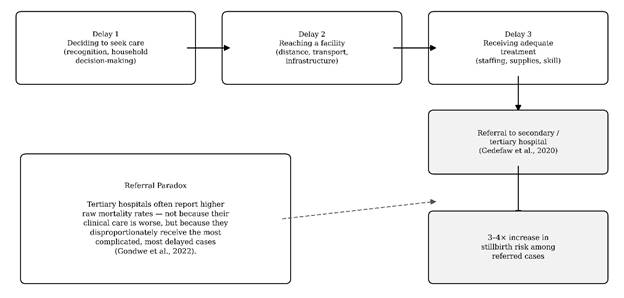 Figure 1: The Three Delays Framework and the Referral Paradox in LMIC Hospital-Based Obstetric Care. Delayed care-seeking, delayed facility access, and delayed treatment (the "three delays") compound to drive referral of complicated cases from primary to secondary/tertiary hospitals, where stillbirth risk rises three- to four-fold