Integrative Biomedical Research

Integrative Biomedical Research (Journal of Angiotherapy) | Online ISSN  3068-6326
463
Citations
1.9m
Views
799
Articles
Your new experience awaits. Try the new design now and help us make it even better
Switch to the new experience
Figures and Tables
REVIEWS   (Open Access)

Computational ADMET Profiling in Antimalarial Drug Development: Progress, Platforms, and the PBPK Frontier

Muhit Rana 1*, Md Nafiujjaman 2

+ Author Affiliations

Integrative Biomedical Research 10 (2) 1-8 https://doi.org/10.25163/biomedical.10210964

Submitted: 04 March 2026 Revised: 20 April 2026  Published: 03 May 2026 


Abstract

Malaria still kills more than half a million people a year, and the chemical arsenal against Plasmodium falciparum is thinner than the case numbers suggest. Resistance has eroded the frontline regimens, yet replacing them is slow: a single new chemical entity takes ten to fifteen years and upwards of USD 2.5 billion, and roughly nine in ten candidates entering clinical testing never reach approval. Potency is rarely the culprit. Failure arrives later, as poor absorption, rapid hepatic clearance, hERG-mediated cardiotoxicity, or genotoxicity no early cell assay flagged. This review examines how machine learning has changed the timing of that reckoning. We trace the shift from linear QSAR and rule-of-five filters toward random forests, gradient-boosted ensembles, graph neural networks and transformer encoders, and assess the servers that made these methods usable at the bench — SwissADME, pkCSM and Deep-PK, ADMETlab 3.0, ProTox-II, eToxPred, DeepTox, admetSAR 2.0 and AutoFilter. Four target campaigns — PfLDH, apicoplast DNA polymerase, the FAS-II enzymes ACC and FabI, and 4-aminoquinoline optimisation — are synthesised to show what integrated screening delivers, and where it does not. Persistent constraints follow: sparse and biased training data, opaque deep models, narrow applicability domains, and a stubborn gap between endpoint-by-endpoint prediction and whole-organism pharmacokinetics. Coupling machine learning to mechanistic PBPK modelling appears, for now, the most credible route across that gap.

Keywords: ADMET prediction; machine learning; antimalarial drug discovery; Plasmodium falciparum; late-stage attrition; in silico toxicology

1. Introduction

Malaria has not gone away. It accounts for more than 240 million clinical episodes and over 600,000 deaths each year, and the burden falls hardest on young children and pregnant women in sub-Saharan Africa (Ibrahim et al., 2026). The causative agents are protozoan parasites of the genus Plasmodium, of which P. falciparum is both the most virulent and the most lethal (Ibrahim et al., 2026). For most of the twentieth century, control rested on a fairly small set of small molecules — chloroquine, amodiaquine, and latterly the artemisinin-based combination therapies (ACTs). That arrangement has proved fragile. Resistance to each of these frontline regimens has emerged and spread, and the prospect of eradication now depends, uncomfortably, on chemistry that does not yet exist (Ibrahim et al., 2024; Salifu et al., 2023).

The response has been to look for new chemical entities acting through unfamiliar mechanisms. Contemporary antimalarial discovery therefore concentrates on biological pathways the parasite cannot easily do without: glycolytic energy production through P. falciparum lactate dehydrogenase (PfLDH), replication of the apicoplast genome through apicoplast DNA polymerase (apPOL), type II fatty acid synthesis through acetyl-CoA carboxylase (ACC) and enoyl-acyl carrier protein reductase (FabI), and mitochondrial electron transport through the cytochrome bc1 complex (Ibrahim et al., 2026; Ramadoss & Singh, 2025; Salifu et al., 2023; Lawrenson, 2012). These are, on paper, excellent targets. The difficulty lies elsewhere.

Pharmaceutical research and development remains slow, expensive and unforgiving. Bringing a single new molecular entity from target identification to registration typically consumes ten to fifteen years and capital exceeding USD 2.5 to 3.0 billion (Zhang et al., 2025; Sarker & Al-Groshi, 2026). The dominant contributor to that arithmetic is late-stage attrition: molecules that look convincing in early in vitro screens collapse during preclinical or clinical evaluation (Sun et al., 2022). Historically close to 90% of clinical candidates failed to reach approval, and a large share of those failures traced not to inadequate target engagement but to pharmacokinetic behaviour and unanticipated toxicity (Kola & Landis, 2004; Sun et al., 2022). The specific liabilities recur with dispiriting regularity — sluggish gastrointestinal absorption, rapid metabolic clearance, blockade of the human ether-à-go-go-related gene (hERG) potassium channel with its attendant risk of QT prolongation, hepatotoxicity, and mutagenicity (Muster et al., 2008; Ferreira & Andricopulo, 2019). Collectively these constitute the ADMET profile: absorption, distribution, metabolism, excretion and toxicity. Their late discovery is what makes them ruinous. Hence the reorientation of the field around a “fail early, fail cheap” logic, in which ADMET assessment is pulled forward into the earliest rounds of compound triage rather than deferred to preclinical development (Ferreira & Andricopulo, 2019).

Pulling assessment forward, of course, requires something to assess with. Wet-lab ADMET panels are neither fast enough nor cheap enough to interrogate virtual libraries of millions of structures, which is where computational approaches — in silico toxicology and chemoinformatics — became indispensable rather than merely convenient (Ciallella & Zhu, 2019; Wu et al., 2020). The first generation of tools was, by present standards, blunt: quantitative structure–activity relationship (QSAR) models built on linear regression, empirical filters such as Lipinski’s rule of five and Veber’s rotatable-bond and polar-surface-area criteria, and molecular property calculators that estimated drug-likeness from a handful of descriptors (Daina et al., 2017; Wu et al., 2020). They were useful. They were also limited, because the relationships they encoded were largely linear, whereas metabolic induction, tissue accumulation and organ toxicity are anything but (Cavasotto & Scardino, 2022; Basile et al., 2019).

Over roughly the last decade, machine learning (ML) and deep learning (DL) have reset expectations for what prediction can achieve here (Wu et al., 2020; Zhang et al., 2025). Support vector machines, random forests, extreme gradient boosting, deep neural networks, graph neural networks and convolutional architectures can ingest very large collections of structures and bioactivities and recover non-linear structure–property relationships that earlier methods could not represent (Basile et al., 2019; Cavasotto & Scardino, 2022). Modern frameworks draw on both engineered descriptors — lipophilicity, topological polar surface area, rotatable-bond counts — and learned representations derived directly from molecular graphs (Fu et al., 2024; Mayr et al., 2016). Publicly accessible servers have then made the methods portable: SwissADME, pkCSM, ADMETlab 3.0, ProTox-II, eToxPred, DeepTox, admetSAR 2.0 and Deep-PK allow a medicinal chemist to profile a virtual library and rank molecules by predicted bioavailability and safety before committing to synthesis (Daina et al., 2017; Pires et al., 2015; Fu et al., 2024; Banerjee et al., 2018; Pu et al., 2019; Mayr et al., 2016; Yang et al., 2018; Amen et al., 2025).

In antimalarial work specifically, these predictors increasingly sit inside larger, automated pipelines. The AutoFilter framework, for instance, chains rule-based filtration, ML toxicity prediction, molecular docking and molecular dynamics (MD) refinement into a single workflow capable of processing millions of ChEMBL entries and returning a short list of prioritised leads (Ramadoss & Singh, 2025). The appeal is not merely throughput. By identifying toxicophores, metabolic liabilities and absorption problems at the point of virtual screening rather than after synthesis, such pipelines reduce reliance on animal testing, lower development cost, and — at least in principle — shorten the path to a safe and potent candidate (Ciallella & Zhu, 2019; Zhang et al., 2025).Computational ADMET modelling has advanced quickly across oncology and infectious disease more broadly, but a synthesis focused specifically on machine learning applied to antimalarial ADMET prediction has been missing. This review attempts to close that gap, connecting algorithmic developments in artificial intelligence to the practical business of optimising leads against P. falciparum. Four objectives organise what follows. To evaluate machine-learning algorithms and computational frameworks used in ADMET prediction. We examine shallow models (SVM, random forest, XGBoost) alongside deep architectures (DNN, CNN, GNN, transformer networks) as applied to absorption, clearance, organ toxicity and cardiotoxicity endpoints (Cavasotto & Scardino, 2022; Zhang et al., 2025). To review the specialised software tools and web servers used for ADMET and toxicity screening. For each platform — SwissADME, pkCSM, ADMETlab 3.0, ProTox-II, eToxPred, DeepTox, admetSAR 2.0, Deep-PK and AutoFilter — we consider the predictive mechanics, the descriptors employed, and the training data behind the numbers (Daina et al., 2017; Fu et al., 2024; Yang et al., 2018). To examine how ML-driven ADMET profiling has been applied in antimalarial discovery. Case studies are drawn from campaigns in which ADMET and toxicity prediction were integrated with structure-based virtual screening, docking and molecular dynamics against PfLDH, apPOL and fatty acid synthesis enzymes (Ibrahim et al., 2026; Ramadoss & Singh, 2025; Salifu et al., 2023). To assess current limitations and plausible future directions. We discuss dataset scarcity, applicability-domain boundaries, model interpretability, and the persistent distance between in silico prediction and in vivo outcome (Ciallella & Zhu, 2019; Jamrozik et al., 2024).

2. Machine Learning and Computational ADMET Profiling in Antimalarial Lead Discovery

2.1 A shift in timing: pre-empting late-stage attrition

The economics of drug development have long been unfavourable, but it is worth being precise about where the losses occur. Bringing a new chemical entity from target identification through regulatory approval demands ten to fifteen years and investment beyond USD 2.5 billion (Zhang et al., 2025). Clinical success rates decline sharply as candidates advance — from roughly 52% at Phase I to about 28.9% at Phase II — leaving an overall transition rate to market below 10% (Sun et al., 2022). More revealing still is the distribution of causes. A substantial proportion of clinical failures, frequently cited as exceeding 40% to 50%, arose not from insufficient biological efficacy but from unacceptable pharmacokinetics and toxicity that had not been anticipated (Kola & Landis, 2004).

Antimalarial development carries an additional constraint. Candidate molecules must contend with increasingly resistant P. falciparum strains while remaining tolerable in populations that include infants and pregnant women (Ibrahim et al., 2024). Under those conditions, ADMET deficiencies are not simply inconvenient; they are frequently disqualifying. Poor gastrointestinal absorption and low oral bioavailability undermine field-deployable dosing. Rapid elimination through hepatic cytochrome P450 (CYP) enzymes shortens exposure below therapeutic thresholds. And the toxicity endpoints — hERG blockade, hepatotoxicity, mutagenicity, bone marrow suppression — terminate programmes outright (Muster et al., 2008; Amen et al., 2025).

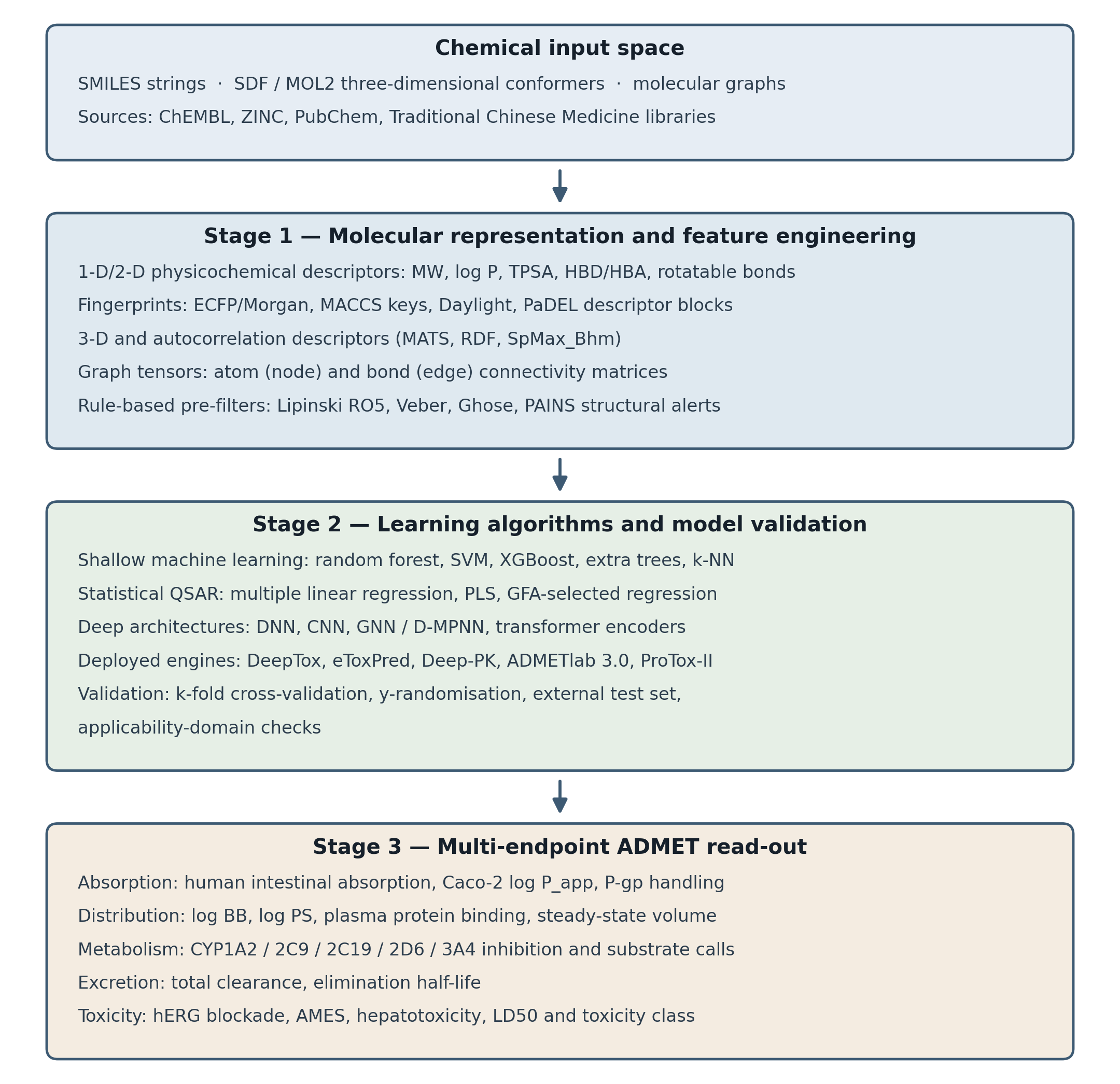
The industry’s response, adopted well before machine learning matured, was the “fail early, fail cheap” paradigm (Ferreira & Andricopulo, 2019). Its logic is simple enough: evaluate drug metabolism, pharmacokinetics and safety liabilities during virtual screening and early lead optimisation, so that problematic scaffolds are discarded before synthetic chemistry and animal studies absorb the budget. What has changed over the past decade is not the logic but its feasibility. Computational ADMET modelling has moved from a peripheral confirmatory exercise to a core component of the discovery pipeline, largely because the predictions became accurate enough to act on (Wu et al., 2020; Ferreira & Andricopulo, 2019). Figure 1 summarises the resulting architecture, from chemical input through feature engineering and model fitting to a multi-endpoint ADMET read-out.

2.2 Algorithmic evolution: from linear QSAR to graph neural networks

Early computational toxicology relied on linear QSAR, Hansch analysis, and empirical filters — Lipinski’s rule of five, Veber’s parameters and their relatives (Daina et al., 2017). These approaches estimated fundamental physicochemical quantities such as log P, topological polar surface area and hydrogen-bonding capacity with reasonable fidelity. Where they struggled was with phenomena that are intrinsically non-linear and multifactorial: enzyme induction, tissue-specific accumulation, organ toxicity arising from several mechanisms at once (Ferreira & Andricopulo, 2019). A second, less discussed limitation was statistical.

Figure 1. Generic machine-learning workflow for ADMET prediction, from chemical input to multi-endpoint read-out. Molecular structures entering as SMILES, SDF conformers or graphs are converted into one or more representations — engineered physicochemical descriptors, circular and substructure fingerprints, autocorrelation descriptors, or learned graph tensors — before being passed to shallow or deep learning models. Rule-based filters such as Lipinski’s rule of five and PAINS alerts operate at the representation stage as an inexpensive pre-screen. The trained models return calibrated predictions across absorption, distribution, metabolism, excretion and toxicity endpoints simultaneously. Validation procedures shown at Stage 2 — cross-validation, y-randomisation, external test sets and applicability-domain checks — determine how far the resulting predictions can be trusted for structurally novel candidates.

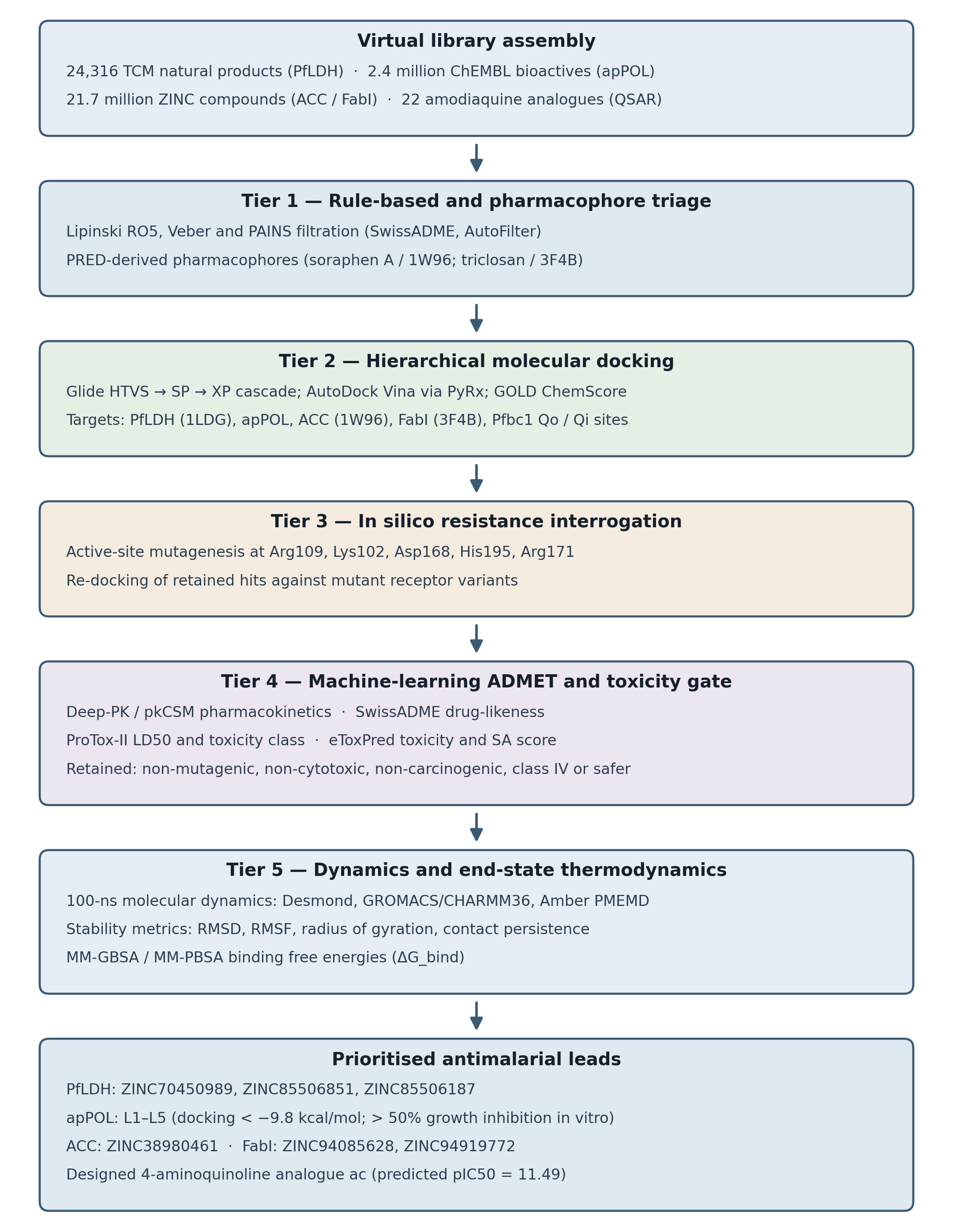
Figure 2. Integrated multi-tier cascade used for antimalarial lead prioritisation across the four campaigns reviewed. Virtual libraries ranging from 22 designed analogues to 21.7 million database entries enter a sequence that applies inexpensive filters before costly simulation. Rule-based and pharmacophore triage precedes hierarchical docking, which in the PfLDH campaign was followed by in silico mutagenesis at resistance-associated residues to test whether retained hits would survive anticipated escape mutations. The machine-learning ADMET and toxicity gate at Tier 4 removes candidates with mutagenic, cytotoxic or carcinogenic liabilities before any molecular dynamics resource is committed. Tier 5 applies 100-ns simulation and end-state free-energy calculation, and the surviving leads are listed at the foot of the diagram by target.

Conventional QSAR models were typically trained on small, chemically homogeneous datasets, and their applicability domains were correspondingly narrow, producing large errors when confronted with structurally novel candidates (Wu et al., 2020).

Machine learning and deep learning have reshaped this landscape (Ferreira & Andricopulo, 2019; Ciallella & Zhu, 2019). Contemporary frameworks parse multidimensional chemical representations, process millions of compounds in a single pass, and capture non-linear structure–activity relationships without requiring the modeller to specify their functional form in advance. Shallow algorithms established the case first. Support vector machines, random forests, extreme gradient boosting and k-nearest neighbours delivered predictive accuracies frequently exceeding 80% to 85% for single endpoints such as blood–brain barrier penetration, plasma protein binding and CYP450 inhibition (Cavasotto & Scardino, 2022). Those numbers were good enough to change behaviour at the bench.

Deep architectures then raised the ceiling (Basile et al., 2019). The landmark demonstration came from the Tox21 Data Challenge organised by the NIH, EPA and FDA, in which DeepTox — a deep neural network trained on some 12,000 compounds across nuclear receptor and stress-response pathways — outperformed conventional ML approaches by learning complex structural features directly, ultimately identifying in excess of 2,500 toxicophore motifs without explicit curation (Mayr et al., 2016). Subsequent frameworks pursued related strategies: eToxPred paired extra trees and gradient boosting classifiers to estimate both toxicity and synthetic accessibility (Pu et al., 2019); PrOCTOR applied random forests to clinical trial failure prediction, incorporating target network properties alongside molecular descriptors (Gayvert et al., 2016); and convolutional models extended the approach to cell-level toxicological imaging (Basile et al., 2019). A recurring finding across these efforts is that multi-task deep networks, trained to predict several orthogonal safety endpoints simultaneously, capture polypharmacological liabilities that single-task models systematically miss (Fu et al., 2024; Zhang et al., 2025).

2.3 Specialised web servers and predictive frameworks

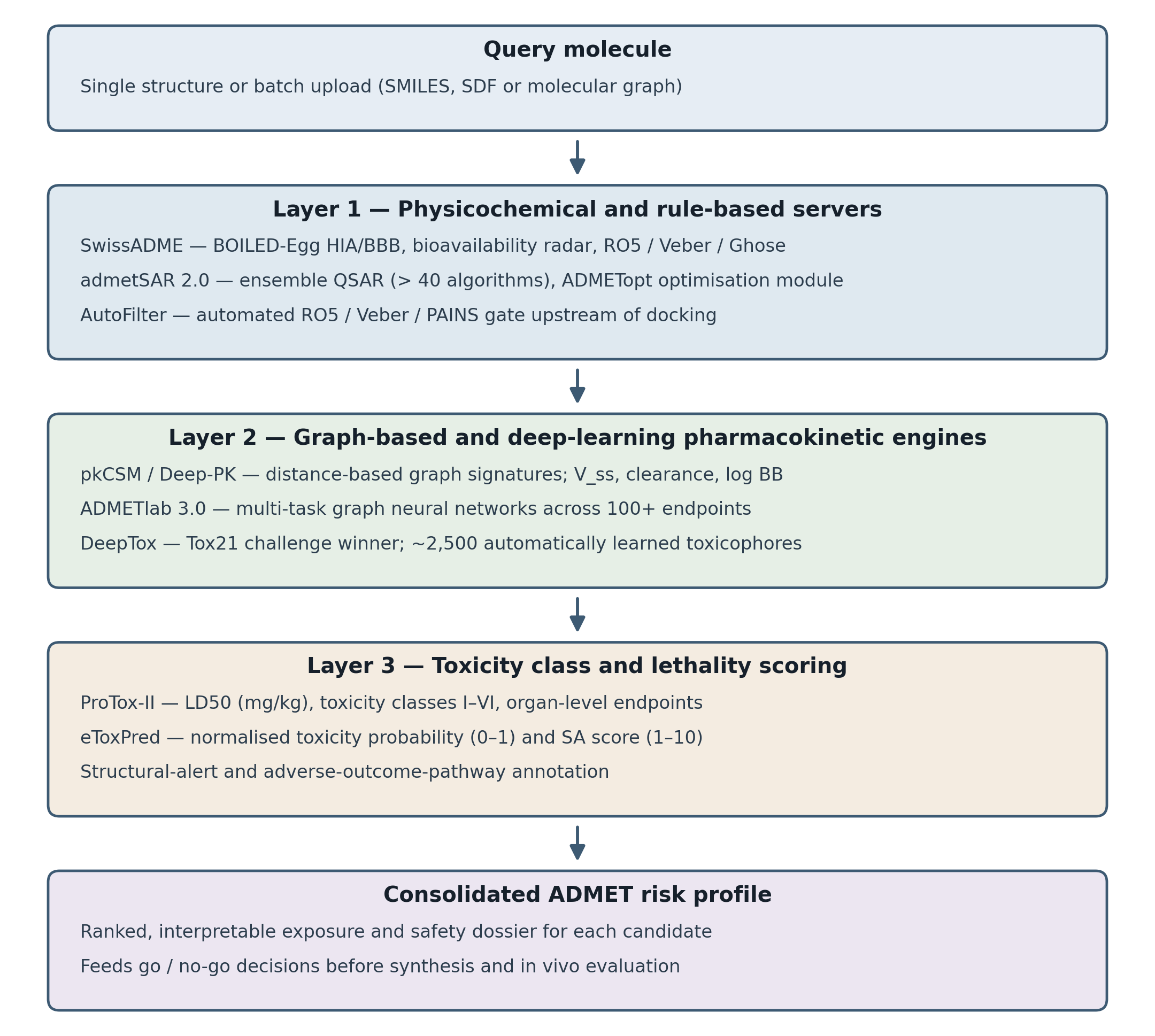
Algorithms only matter if chemists can reach them. A succession of open-access and commercial web servers has therefore emerged to put high-throughput ADMET evaluation within reach of laboratories with no computational infrastructure of their own (Daina et al., 2017; Yang et al., 2018). Table 1 summarises the principal platforms, their underlying methodologies and their functional scope; Figure 3 depicts how they stack into a tiered screening architecture.

SwissADME occupies the first tier, offering intuitive graphical outputs — the BOILED-Egg plot and the bioavailability radar — that let a chemist read lipophilicity, polar surface area and predicted human intestinal absorption at a glance, alongside P-glycoprotein handling and inhibition calls for five major CYP isoforms (Daina et al., 2017; Wu et al., 2020). pkCSM and its deep-learning successor Deep-PK take a different route, encoding molecular structure as distance-based graph signatures and using these to forecast steady-state volume of distribution, clearance, blood–brain barrier partition coefficients and a set of toxicity endpoints including AMES mutagenicity and hERG inhibition (Pires et al., 2015; Amen et al., 2025). ADMETlab 3.0 extends coverage furthest, applying multi-task graph neural networks across more than 100 endpoints with batch processing and API access (Fu et al., 2024; Dong et al., 2018).

For safety specifically, ProTox-II combines toxicophore structural alerts with machine-learning classifiers trained on acute toxicity data, returning a predicted median lethal dose and a corresponding oral toxicity class from I to VI, together with organ-level and adverse-outcome-pathway annotations (Banerjee et al., 2018). eToxPred complements this by reporting a normalised toxicity probability alongside a synthetic accessibility score, an unusual and practically valuable pairing: a molecule that is safe but unsynthesisable is of limited use (Pu et al., 2019). admetSAR 2.0 aggregates more than forty QSAR algorithms across roughly fifty endpoints and adds an automated optimisation module, ADMETopt, for structural refinement (Yang et al., 2018; Cheng et al., 2012).

The more recent trend is towards end-to-end engines rather than individual calculators. AutoFilter chains chemical rule filtration (Lipinski, Veber, PAINS) with high-throughput AutoDock Vina docking, eToxPred toxicity scoring and 100-ns GROMACS molecular dynamics (Ramadoss & Singh, 2025). Applied across millions of ChEMBL entries, this automated sequence reportedly reduced preclinical candidate selection timelines and costs by approximately 50% — a figure that should be read as an internal estimate rather than an audited benchmark, but that nonetheless indicates the direction of travel

Figure 3. Three-layer architecture of web-based ADMET prediction servers, showing the order in which tools are typically applied. Layer 1 comprises physicochemical and rule-based engines that estimate drug-likeness and absorption from computed descriptors at negligible computational cost. Layer 2 comprises graph-based and deep-learning pharmacokinetic engines whose learned molecular representations support quantitative estimates of distribution, clearance and metabolic liability. Layer 3 comprises dedicated toxicity classifiers that assign lethality estimates, toxicity classes and structural-alert annotations. Because these layers were trained on overlapping public datasets, agreement between them is weaker evidence of correctness than statistical independence would imply, a caveat examined in Section 5.2.

(Ramadoss & Singh, 2025).

2.4 Application to novel antimalarial targets

ML-driven ADMET profiling has gained real traction in antimalarial lead discovery, particularly where the objective is to circumvent established resistance to ACTs (Ibrahim et al., 2024). The dominant pattern combines structure-based virtual screening, QSAR and machine-learning toxicity models into a staged cascade; Figure 2 traces that cascade as implemented across the campaigns reviewed here, and Table 2 tabulates their outputs.

PfLDH is the most thoroughly worked example. Essential to glycolytic energy production during asexual blood stages, and with no close human orthologue, it is an attractive target (Ibrahim et al., 2026). Ibrahim et al. (2026) screened a virtual library of 24,316 natural products drawn from Traditional Chinese Medicine repositories against PfLDH (PDB ID: 1LDG). Multi-tier Glide docking, in silico active-site mutagenesis incorporating resistance-associated substitutions at Arg109, Lys102, Asp168 and His195, and 100-ns molecular dynamics converged on three leads: ZINC70450989, ZINC85506851 and ZINC85506187. Binding free energies reached −91.63 kcal/mol, against −36.59 kcal/mol for artemisinin and −48.57 kcal/mol for piperaquine. ML-driven ADMET profiling via Deep-PK and ProTox-II placed all three in toxicity classes 5 and 6 (LD50 3,800–7,500 mg/kg) with non-mutagenic, non-cytotoxic and non-carcinogenic predictions (Ibrahim et al., 2026).

Comparable pipelines have been applied elsewhere in the parasite’s biology.

Apicoplast DNA polymerase (apPOL). Using AutoFilter, Ramadoss and Singh (2025) screened 2.4 million ChEMBL bioactives against apPOL. SwissADME pharmacokinetic filtering combined with eToxPred toxicity modelling reduced the pool to five prioritised leads with docking scores below −9.8 kcal/mol, low synthetic accessibility burden and acceptable drug-likeness. Notably — and this is rarer than it should be — preliminary in vitro assays confirmed that the top-ranked candidate achieved over 50% parasite growth inhibition (Ramadoss & Singh, 2025).

Fatty acid biosynthesis (ACC and FabI). Salifu et al. (2023) targeted biotin acetyl-CoA carboxylase (PDB: 1W96) and enoyl-acyl carrier protein reductase (PDB: 3F4B) within the FAS-II pathway. Per-residue energy decomposition (PRED) pharmacophore modelling, combined with SwissADME and ProTox-II screening across 21.7 million ZINC compounds, identified non-toxic lead inhibitors including ZINC38980461 and ZINC94085628 that held stable binding trajectories through 100-ns simulations (Salifu et al., 2023).

4-Aminoquinoline optimisation. Ibrahim et al. (2024) built predictive QSAR models for 22 amodiaquine derivatives, then used SwissADME and pkCSM to profile designed analogues. Derivative ac emerged as the most promising, with a predicted pIC50 of 11.49 against a design template of 9.491, human intestinal absorption above 80%, restricted blood–brain barrier permeability (log BB < 0.3), and no Lipinski or Veber violations (Ibrahim et al., 2024).

Cytochrome bc1 complex. Lawrenson (2012) applied ligand-based virtual screening and docking into the Qo and Qi sites of the parasite cytochrome bc1 complex, optimising quinolone and 4-aminoquinoline chemotypes and constructing QSAR models intended to balance target affinity against off-target inhibition of the human enzyme — a selectivity problem that is easy to state and difficult to solve (Lawrenson, 2012).

2.5 Methodological bottlenecks and translational limits

For all the progress, several constraints recur across this literature, and they are not trivial (Ciallella & Zhu, 2019).

Dataset sparsity and imbalance. Model quality follows training data quality, and the available toxicity databases — ChEMBL, PubChem, Tox21 — derive largely from high-throughput in vitro assays or animal studies rather than human clinical outcomes (Wu et al., 2020). Compounding this, true-negative data are scarce, because companies rarely publish the structures of compounds that failed. The resulting reporting bias is baked into every model trained on public data (Ciallella & Zhu, 2019; Basile et al., 2019).

Interpretability. Deep neural networks and graph convolutional architectures achieve high statistical accuracy while offering little mechanistic transparency (Basile et al., 2019). Medicinal chemists are understandably reluctant to redesign a scaffold on the strength of an opaque risk score. Fragment-based explainable AI and attention-based attribution frameworks such as ADMET-PrInt address this by mapping predicted liabilities back onto specific substructures in the 2D diagram, which is at least actionable

Table 1. In silico and AI/ML platforms and web servers used for ADMET and toxicity prediction in early drug discovery. The table lists each platform alongside its developing institution, the algorithmic framework on which its predictions rest, the ADMET and toxicity endpoints it returns, and its characteristic role in a screening cascade. Platforms are ordered from rule-based physicochemical engines through graph-based and deep-learning pharmacokinetic predictors to dedicated toxicity classifiers and fully integrated pipelines, mirroring the tiered architecture shown in Figure 3. Because these tools differ in training corpus and molecular representation, they can return divergent calls for the same structure; such disagreement is informative and is discussed in Section 5.2.

Platform / tool

Developer / source

Underlying AI/ML framework

Key ADMET and toxicity endpoints

Primary application

Citation

SwissADME

Swiss Institute of Bioinformatics

Hybrid physicochemical algorithms; BOILED-Egg model; Lipinski / Veber / Ghose rules

HIA, Caco-2 permeability, BBB penetration, P-gp substrate/inhibitor status, CYP1A2/2C9/2C19/2D6/3A4 inhibition, bioavailability radar

Rapid early-stage screening of drug-likeness, oral bioavailability and medicinal-chemistry friendliness across large libraries

Daina et al. (2017); Wu et al. (2020)

pkCSM / Deep-PK

University of Queensland / BioSig

Distance-based graph signatures; deep-learning ensembles

Steady-state volume of distribution (Vss), clearance, log BB, AMES mutagenicity, hERG I/II inhibition, hepatotoxicity, acute oral LD50

Graph-based pharmacokinetic and toxicity profiling; converts 2D/3D structures into predictive signatures

Pires et al. (2015); Amen et al. (2025)

ADMETlab 3.0 / 2.0

Central South University

Graph neural networks; multi-task deep architectures

100+ endpoints including Caco-2, HIA, plasma protein binding, CYP isoforms, renal clearance, hepatotoxicity, cardiotoxicity

Systematic multi-endpoint evaluation, batch property calculation and structural optimisation with API support

Dong et al. (2018); Fu et al. (2024)

ProTox-II

Charité – Universitätsmedizin Berlin

Molecular similarity, fragment propensities, machine learning (RF, SVM)

Acute oral toxicity (LD50 mg/kg; classes I–VI), hepatotoxicity, carcinogenicity, mutagenicity, cytotoxicity, immunotoxicity

Organ- and cell-level toxicity prediction incorporating toxicophore alerts and adverse-outcome pathways

Banerjee et al. (2018); Salifu et al. (2023)

eToxPred

Louisiana State University

Extra trees, gradient boosting, balanced random forest

Toxicity probability score (0–1) and synthetic accessibility (SA) score (1–10)

High-throughput filtering of large bioactive databases to exclude toxic and hard-to-synthesise candidates

Pu et al. (2019); Ramadoss & Singh (2025)

DeepTox

Johannes Kepler University (Tox21 winner)

Deep neural networks with automated feature extraction

Nuclear receptor and stress-response pathways (~12,000 compounds; ~2,500 toxicophore features)

Multi-task deep architecture that learns static and dynamic chemical features for complex toxicity endpoints

Mayr et al. (2016); Wu et al. (2020)

admetSAR 2.0

East China University of Science and Technology

Ensemble QSAR models (> 40 algorithms: SVM, RF, k-NN)

~50 endpoints (HIA, BBB, Caco-2, CYP substrates/inhibitors, AMES, aquatic toxicity, ADMETopt module)

Integrated QSAR-based risk filtering, environmental hazard assessment and automated structural optimisation

Cheng et al. (2012); Yang et al. (2018)

AutoFilter framework

Biocomputational open framework

Multi-stage pipeline: chemical filters (Lipinski/Veber/PAINS), AutoDock Vina, SwissADME, eToxPred ML, GROMACS MD

Binding affinity, pharmacokinetics, synthetic accessibility, 100-ns structural stability

Automated screening of 2.4 million ChEMBL compounds against P. falciparum apPOL; reported ~50% reduction in selection time and cost

Ramadoss & Singh (2025)

Table 2. Computational antimalarial lead discovery campaigns targeting Plasmodium falciparum enzymes. For each target the table records its biological role in the parasite, the computational and ADMET pipeline applied, the prioritised candidate molecules, the docking and free-energy metrics obtained, and the predicted ADMET and safety profile. Docking scores and binding free energies were produced by different software, scoring functions and solvation models and are therefore not comparable across rows; each should be read against the reference compounds used within its own study, as discussed in Section 3.4. Only the apPOL campaign reported experimental confirmation of antiparasitic activity.

Target enzyme and PDB ID

Biological role

Computational and ADMET pipeline

Top candidate leads

Binding energy, docking and MD metrics

Predicted ADMET and safety profile

Reference

L-Lactate dehydrogenase (PfLDH, PDB: 1LDG)

Essential glycolytic energy production in asexual blood stages

Glide HTVS / SP / XP docking across 24,316 TCM natural products; in silico active-site mutagenesis (Arg109, Lys102, Asp168, His195); Deep-PK; ProTox-II; 100-ns Desmond MD

ZINC70450989, ZINC85506851, ZINC85506187

XP docking −14.30, −11.10, −11.05 kcal/mol; MM-GBSA ΔGbind −91.63, −60.55, −58.66 kcal/mol (artemisinin −36.59); stable trajectories, RMSD < 2.0 Å

High HIA; non-penetrable BBB (log BB < −2.5); non-inhibitor of BCRP; toxicity class ≥ 5 (LD50 3,800–7,500 mg/kg); non-mutagenic, non-cytotoxic, non-carcinogenic

Ibrahim et al. (2026)

Apicoplast DNA polymerase (apPOL)

Critical DNA replication machinery of the apicoplast organelle

AutoFilter pipeline: Lipinski/Veber/PAINS filtering; AutoDock Vina docking; SwissADME; eToxPred ML toxicity and SA scoring; 100-ns GROMACS MD (CHARMM36)

Compounds L1, L2, L3, L4, L5

Docking −10.830 (L1), −10.317 (L2), −10.204 (L3), −10.108 (L4), −9.828 (L5) kcal/mol; van der Waals and hydrophobic contacts with Met490, Ala482, Ile446, Tyr506, Phe498

Favourable oral bioavailability; low molecular weight (L5: 349.30 g/mol); high GI absorption; non-toxic eToxPred scores; acceptable synthetic accessibility; > 50% parasite growth inhibition in vitro

Ramadoss & Singh (2025)

Biotin acetyl-CoA carboxylase (ACC, PDB: 1W96)

Initial rate-limiting step of parasite fatty acid synthesis (FAS-II)

PRED pharmacophore screening across 21.7 million ZINC compounds; PyRx AutoDock Vina docking; SwissADME RO5 filter; ProTox-II; 100-ns Amber PMEMD MD and MM/PBSA

ZINC38980461, ZINC05378039, ZINC15772056

Docking −8.2 to −8.9 kcal/mol (vs. soraphen A reference); RMSD stable within 1–3 Å; MM/PBSA ΔGbind −36.36 kcal/mol

Zero Lipinski violations; ProTox-II toxicity class IV (LD50 570–1,500 mg/kg); non-mutagenic, non-cytotoxic, non-carcinogenic

Salifu et al. (2023)

Enoyl-acyl carrier protein reductase (FabI, PDB: 3F4B)

Enoyl-ACP reduction step in apicoplast fatty acid elongation (FAS-II)

PRED pharmacophore derived from triclosan–FabI complex; ZINC database screening; PyRx docking; SwissADME; ProTox-II; 100-ns Amber MD

ZINC94085628, ZINC93656835, ZINC94080670, ZINC17074609, ZINC94821232, ZINC94919772

Strong docking scores; low Cα RMSD (1–3 Å); MM/PBSA ΔGbind −37.97 to −41.42 kcal/mol

Favourable ADME profiles; toxicity classes 4–5 (LD50 up to 4,000 mg/kg); inactive for hepatotoxicity, carcinogenicity, mutagenicity and cytotoxicity

Salifu et al. (2023)

Cytochrome bc1 complex (Pfbc1, Qo and Qi sites)

Mitochondrial electron transport and pyrimidine biosynthesis coupling

Ligand-based virtual screening of the ZINC lead-like library; docking at Qo and Qi sites using GOLD (ChemScore); QSAR (MLR, PLS, k-NN) on 4-aminoquinolines

Quinolone derivatives, 4-aminoquinoline analogues, HDQ derivatives

Crucial hydrogen bonding with His181 and Glu272 at the Qo site; clear pose differentiation between Qo and Qi chemotypes

QSAR models incorporating 2D/3D descriptors to optimise membrane permeation, reduce human bc1 off-target toxicity and balance lipophilicity (log P)

Lawrenson (2012)

Amodiaquine 4-aminoquinoline derivatives

Heme detoxification inhibitor acting in the parasite food vacuole

Predictive GFA-MLR QSAR modelling of 22 amodiaquine derivatives (DFT/B3LYP/6-31G*, PaDEL descriptors); systematic substituent modification; SwissADME and pkCSM ADMET screening

Derivative ac: 4-((7-chloroquinolin-4-yl)amino)-2-(cyclohexyl(4-(pyridin-2-yl)piperazin-1-yl)methyl)phenol

Predicted pIC50 = 11.4918 (template A-01 = 9.491; amodiaquine 8.668; chloroquine 8.111); model Ntrain = 16, R² = 0.9243, Q²cv = 0.8603, R²test = 0.6640

Intestinal absorption > 80%; P-gp substrate; limited BBB penetration (log BB < 0.3); CNS non-penetrable (log PS > −2); oral rat LD50 2.433–3.173 mol/kg; non-toxic and non-skin-sensitising

Ibrahim et al. (2024)


(Jamrozik et al., 2024).

Applicability domain. Models extrapolate reliably only within the chemical space their training sets represent (Cavasotto & Scardino, 2022). Natural product scaffolds — precisely the chemical matter that antimalarial discovery keeps returning to — are frequently out of domain, and accuracy degrades accordingly (Sarker & Al-Groshi, 2026).

The translational gap. This may be the deepest problem. Single-endpoint models evaluate parameters in isolation, whereas human pharmacokinetics is an interdependent system: gut metabolism, plasma binding competition, hepatic and renal clearance all proceed simultaneously and influence one another (Ibrahim et al., 2026). Bridging that gap requires coupling data-driven ML predictions to mechanistic physiologically based pharmacokinetic (PBPK) and PK/PD models capable of simulating systemic concentrations over time (Ferreira & Andricopulo, 2019; Panda et al., 2025). Figure 4 situates each methodological layer, with its characteristic strengths and failure modes, within that integrated pipeline.

Taken together, ML-driven ADMET prediction has become a practical strategy for reducing late-stage attrition in antimalarial discovery (Zhang et al., 2025). Integrated with docking, QSAR and molecular dynamics, it allows leads to be prioritised on oral bioavailability, pharmacokinetic stability and safety at the same time as potency, rather than sequentially and too late (Ibrahim et al., 2024).

3. Methods

3.1 Review design and reporting framework

This work is a structured narrative review rather than a systematic review with meta-analysis, and we state that distinction at the outset because it governs how the findings should be weighted. No pooled effect estimates are reported; no risk-of-bias instrument designed for clinical trials would apply meaningfully to computational screening campaigns. What we have done instead is to specify the search, selection and extraction procedures in enough detail that another investigator could reproduce the evidence base, in keeping with the reporting expectations applied to literature indexed in PubMed and comparable biomedical databases. Where judgement was exercised — and it was, repeatedly — we have tried to say so rather than presenting selection as mechanical.

3.2 Information sources and search strategy

Literature was identified through PubMed/MEDLINE, Scopus, Web of Science Core Collection, ScienceDirect and Google Scholar. Searches covered publications from January 2004, the year of the Kola and Landis attrition analysis that frames much of this field (Kola & Landis, 2004), through to the most recent records available at the time of writing, which included articles carrying 2026 publication years (Ibrahim et al., 2026; Sarker & Al-Groshi, 2026).

The search string combined three concept blocks with Boolean operators, adapted to each database’s syntax:

  • Block 1 (prediction task): “ADMET” OR “ADME” OR “pharmacokinetic prediction” OR “in silico toxicology” OR “computational toxicology” OR “drug-likeness”

  • Block 2 (method): “machine learning” OR “deep learning” OR “artificial intelligence” OR “QSAR” OR “graph neural network” OR “random forest” OR “support vector machine” OR “XGBoost”

  • Block 3 (disease and target context): “antimalarial” OR “malaria” OR “Plasmodium falciparum” OR “PfLDH” OR “apicoplast” OR “FabI” OR “artemisinin resistance”

Blocks were combined as (Block 1) AND (Block 2) AND (Block 3) for the antimalarial-specific retrieval, and as (Block 1) AND (Block 2) for the methodological and platform literature, since several foundational tool papers — SwissADME, pkCSM, ProTox-II, DeepTox, admetSAR — are disease-agnostic and would be lost by an antimalarial restriction (Daina et al., 2017; Pires et al., 2015; Banerjee et al., 2018; Mayr et al., 2016; Yang et al., 2018). Reference lists of retrieved articles were hand-searched, and forward citation tracking was performed on the principal tool publications to capture applications that did not surface through keyword retrieval.

3.3 Eligibility criteria

Records were retained if they satisfied all of the following: (i) published in English in a peer-reviewed journal, or as a doctoral thesis where it constituted a primary source not otherwise published (Lawrenson, 2012); (ii) reported either the development or the substantive application of a computational ADMET, toxicity or pharmacokinetic prediction method; and (iii) provided sufficient methodological detail — algorithm, descriptors, dataset, validation approach — to permit evaluation. For antimalarial application studies, an additional requirement applied: the work had to target a defined P. falciparum

Figure 4. Methodological layers of an integrated CADD pipeline, with reported performance and characteristic limitations. Each successive layer compensates for the principal weakness of the layer above: docking screens broadly but treats the receptor as rigid; QSAR quantifies structure–activity relationships but only within its applicability domain; molecular dynamics restores conformational realism at substantial computational cost; end-state free-energy calculation re-ranks poses using continuum solvation; and physiologically based pharmacokinetic modelling converts endpoint predictions into simulated human exposure. None of the four antimalarial campaigns synthesised in this review advanced to the PBPK layer, leaving the step from predicted property to predicted plasma concentration unmade, as discussed in Section 5.3.

protein or pathway and to report ADMET or toxicity prediction as part of the candidate selection process, not merely as a post hoc annotation.

Records were excluded where predictions were reported without any indication of the underlying method or software version; where the work addressed antimalarial pharmacology with no computational ADMET component; and where conference abstracts or preprints lacked the methodological detail required for extraction. One manuscript under review at the time of writing was retained on the grounds that it describes an integrated pipeline central to the review’s scope, and it is identified as such throughout (Ramadoss & Singh, 2025).

3.4 Data extraction

Extraction followed a predefined form applied to each included record. For methodological and platform papers we captured: platform or algorithm name, developing institution, underlying learning framework, descriptor classes, training dataset and its size, ADMET endpoints covered, reported validation statistics, and stated limitations. For antimalarial application studies we captured: target protein and PDB accession, biological role, library screened and its size, docking software and protocol tier, ADMET and toxicity tools applied, prioritised compound identifiers, docking scores, binding free energies and their computational basis, molecular dynamics protocol and duration, stability metrics, and predicted toxicity classification with the corresponding LD50 where reported.

Extracted values were transcribed as reported in the source, with units preserved. Where a source reported the same quantity in more than one place with differing values — which occurred — the value appearing in the primary results table was adopted and the discrepancy noted. Quantities were not converted, recalculated or normalised across studies, because docking scores and binding free energies produced by different software, scoring functions and solvation models are not interconvertible, and presenting them as though they were would misrepresent their comparability. This is worth emphasising: the numerical comparisons reported in Section 4 are within-study comparisons against each study’s own reference compounds, not cross-study rankings.

3.5 Synthesis approach

Findings were organised thematically rather than chronologically, along three axes: predictive platform and algorithmic class; P. falciparum target and pathway; and ADMET endpoint with its associated decision threshold. Four evidence tables were constructed to support this synthesis. Table 1 catalogues the prediction platforms and their technical characteristics. Table 2 assembles the target-specific antimalarial campaigns with their computational protocols and outcomes. Table 3 compares the methodological classes used across CADD pipelines, including typical performance ranges and acknowledged limitations. Table 4 sets out the major ADMET endpoints alongside the threshold values applied during lead selection.

Threshold values in Table 4 were taken from the decision criteria stated in the source studies rather than imposed by the present authors, and where sources disagreed the range is given rather than a point value. Performance figures quoted in Table 3 are reproduced as reported by the original investigators; they derive from heterogeneous benchmarks and should not be read as head-to-head comparisons under matched conditions.

3.6 Figure construction

The four figures are schematic syntheses rather than reproductions. Figure 1 abstracts the generic ML-ADMET prediction workflow from the architectures described across the methodological literature (Mayr et al., 2016; Fu et al., 2024; Pires et al., 2015). Figure 2 reconstructs the integrated antimalarial screening cascade by aligning the sequential stages reported in the four target campaigns into a common tiered structure (Ibrahim et al., 2026; Ramadoss & Singh, 2025; Salifu et al., 2023; Ibrahim et al., 2024). Figure 3 renders the web-server landscape as a three-layer architecture reflecting the order in which these tools are typically applied (Daina et al., 2017; Pires et al., 2015; Banerjee et al., 2018; Pu et al., 2019; Yang et al., 2018). Figure 4 maps the methodological layers of a CADD pipeline together with their reported performance characteristics and constraints (Panda et al., 2025; Zhang et al., 2025). All numerical annotations within the figures are traceable to the cited sources; no values were generated, interpolated or estimated for illustrative purposes.

3.7 Limitations of the review method

Three limitations warrant explicit statement. First, restriction to English-language records may have excluded relevant work, particularly from regions where malaria research is most active. Second, screening and extraction were not performed in duplicate by independent reviewers, so extraction error cannot be excluded, although all quantitative values were checked against the source a second time. Third, and most substantively, the antimalarial computational literature is small enough that the included studies are not a representative sample of a large population; they are close to the population itself. That makes the synthesis comprehensive but also means that the idiosyncrasies of individual studies — a particular scoring function, a particular library — propagate into the aggregate picture more strongly than they would in a larger field.

4. Synthesis of Findings: What Machine-Learning ADMET Screening Has Delivered Against Plasmodium falciparum

4.1 The functional landscape of AI/ML servers for ADMET prediction

Read across a decade, the platform literature describes a clear trajectory: single-property QSAR calculators have given way to multi-task, deep-learning prediction engines (Fu et al., 2024). The platforms catalogued in Table 1 are not variations on one design. They differ in what they represent, what they were trained on, and consequently in what they are good for — a point that matters because they are routinely used in combination, as Figure 3 illustrates, and combining tools with correlated blind spots buys less than it appears to.

The first tier remains physicochemical. SwissADME applies hybrid rule-based and empirical engines to estimate human intestinal absorption, passive blood–brain barrier permeability through the BOILED-Egg model, and P-glycoprotein substrate or inhibitor status (Daina et al., 2017). It also flags potential drug–drug interaction liabilities by predicting inhibition across five CYP isoforms — CYP1A2, CYP2C19, CYP2C9, CYP2D6 and CYP3A4 — which is directly relevant in malaria-endemic settings where antiretroviral and antitubercular co-medication is common (Daina et al., 2017; Wu et al., 2020).

Moving beyond two-dimensional descriptors, pkCSM and Deep-PK encode structures as distance-based graph signatures (Pires et al., 2015). This representation supports estimation of steady-state volume of distribution, total clearance, blood–brain barrier partition coefficients, and specific toxicity endpoints including AMES mutagenicity, hERG blockade and drug-induced liver injury (Pires et al., 2015; Amen et al., 2025). ADMETlab 3.0 pushes coverage furthest with multi-task graph neural networks spanning more than 100 endpoints (Fu et al., 2024; Dong et al., 2018).

For toxicity proper, ProTox-II integrates toxicophore fragment propensities with random forest and support vector machine classifiers trained on acute oral toxicity data, assigning molecules to classes I through VI on the basis of predicted LD50 while simultaneously screening hepatotoxicity, carcinogenicity, mutagenicity and cytotoxicity (Banerjee et al., 2018). eToxPred applies extra trees and gradient boosting to return a normalised toxicity probability between 0 and 1 together with a synthetic accessibility score between 1 and 10 (Pu et al., 2019). That pairing deserves more attention than it usually receives: in a resource-constrained antimalarial programme, a safe compound requiring a fourteen-step synthesis is often less useful than a marginally less attractive one that can be made in four.

Operational integration is exemplified by AutoFilter (Ramadoss & Singh, 2025). Chaining Lipinski, Veber and PAINS filtration with AutoDock Vina docking, SwissADME profiling, eToxPred toxicity scoring and 100-ns GROMACS molecular dynamics, the framework processed 2.4 million ChEMBL bioactives and reportedly reduced compound selection timelines and costs by approximately 50% (Ramadoss & Singh, 2025). The saving is an internal estimate and has not been independently replicated, but the architectural point stands: sequencing cheap filters ahead of expensive simulation is what makes screening at this scale tractable at all (Figure 2).

4.2 Target-specific lead prioritisation across P. falciparum enzymatic pathways

Table 2 assembles the four antimalarial campaigns in a common format. Each applied a broadly similar cascade — library, filtration, docking, ADMET gate, dynamics — yet they differ enough in execution that their outputs are not directly comparable, and we treat them individually for that reason.

4.2.1 P. falciparum L-lactate dehydrogenase (PfLDH)

PfLDH (PDB ID: 1LDG) sustains glycolytic energy production during the asexual blood stages on which clinical malaria depends (Ibrahim et al., 2026). Ibrahim et al. (2026) screened 24,316 natural product compounds from Traditional Chinese Medicine repositories through a hierarchical Glide protocol — high-throughput virtual screening, then standard precision, then extra precision — arriving at three leads: ZINC70450989, ZINC85506851 and ZINC85506187 (Table 2).

The docking figures are striking. XP scores of −14.30, −11.10 and −11.05 kcal/mol compare against artemisinin at −5.23, piperaquine at −4.285 and lumefantrine at −4.049 kcal/mol (Ibrahim et al., 2026). MM-GBSA calculations reinforced the ranking, with ZINC70450989 reaching ΔGbind = −91.63 kcal/mol against artemisinin’s −36.59 kcal/mol. A margin of that size invites caution rather than celebration — end-state free energy methods are known to exaggerate differences between strong and weak binders — but the direction of the result was consistent across three independent methods, which is the more meaningful observation.

More persuasive, to our reading, is the resistance work. In silico mutagenesis at Arg109, Lys102, Asp168, His195, Arg171, Pro246 and Pro250 showed that the leads retained substantial affinity against mutated receptors, with ZINC70450989 scoring −12.10 kcal/mol and ΔGbind = −75.29 kcal/mol in the mutant background (Ibrahim et al., 2026). Since resistance is the reason these campaigns exist, testing against anticipated escape mutations before committing to synthesis is a design choice other programmes would do well to adopt.

Across 100-ns simulations the PfLDH Cα backbone in complex with the leads held equilibrium with mean RMSD below 2.0 Å, whereas artemisinin complexes showed excursions to 3.36 Å (Ibrahim et al., 2026). Deep-PK and ProTox-II profiling then confirmed high intestinal absorption, non-penetrant blood–brain barrier behaviour (log BB < −2.5), and toxicity classes 5 and 6 with LD50 between 3,800 and 7,500 mg/kg, with no mutagenic, cytotoxic or carcinogenic flags (Ibrahim et al., 2026; Banerjee et al., 2018). The low CNS penetration is a deliberate design objective for a non-CNS antimalarial, not an incidental finding (Table 4).

4.2.2 Apicoplast DNA polymerase (apPOL)

Ramadoss and Singh (2025) applied AutoFilter to 2.4 million ChEMBL compounds against apPOL, the enzyme responsible for replicating the apicoplast genome (Table 2). Chemical rule filtration and AutoDock Vina grid docking reduced the set to 3,194 active ligands, which were then passed through SwissADME and eToxPred. Five compounds, L1 to L5, were prioritised on docking scores below −9.8 kcal/mol, favourable drug-likeness, low predicted toxicity and accessible synthetic routes (Ramadoss & Singh, 2025; Pu et al., 2019). Subsequent 100-ns CHARMM36 simulations in GROMACS confirmed complex stability.

The distinguishing feature of this campaign is what came next. Preliminary in vitro growth inhibition assays validated the antimalarial activity of the top-ranked lead, with over 50% parasite growth inhibition reported (Ramadoss & Singh, 2025). Among the studies reviewed here, this is the only one to close the loop experimentally, and it therefore carries evidential weight the purely computational campaigns cannot claim — a point we return to in Section 5.

4.2.3 Fatty acid biosynthesis: ACC and FabI

Salifu et al. (2023) targeted two FAS-II enzymes: biotin acetyl-CoA carboxylase (PDB: 1W96) and enoyl-acyl carrier protein reductase (PDB: 3F4B). Rather than docking a library directly, they generated per-residue energy decomposition (PRED) pharmacophores from short MD trajectories of the soraphen A and triclosan reference complexes, then used these to screen 21.7 million ZINC compounds (Salifu et al., 2023). PyRx AutoDock Vina docking and SwissADME profiling yielded nine hits per target.

ProTox-II screening narrowed the ACC set to three non-toxic leads — ZINC38980461, ZINC05378039 and ZINC15772056 — falling into toxicity class IV with LD50 up to 1,500 mg/kg and no mutagenic or cytotoxic flags (Salifu et al., 2023; Banerjee et al., 2018). For FabI, six leads were retained, of which ZINC94919772 showed a class V profile at LD50 = 4,000 mg/kg. Across 100-ns Amber trajectories all complexes remained within the 1.0–3.0 Å RMSD window, and MM/PBSA calculations gave ΔGbind of −36.36 kcal/mol for ZINC38980461 against ACC and −41.42 kcal/mol for the best FabI complex (Salifu et al., 2023).

Two observations follow. The PRED approach, by deriving pharmacophore features from energetic contributions sampled dynamically rather than from a single crystal snapshot, addresses one of docking’s standing weaknesses — receptor rigidity (Table 3). And the toxicity classes obtained here (IV and V) are demonstrably less favourable than those reported for the PfLDH leads (5 and 6), which is a useful reminder that ADMET screening discriminates between campaigns as well as within them.

Table 3. Methodological classes used in computational toxicology and CADD pipelines, with reported performance and known constraints. Each row describes the mechanistic basis of a modelling approach, its role within an antimalarial screening workflow, the accuracy range reported in the source literature, and the limitations that motivate its combination with the other approaches. Performance figures derive from heterogeneous benchmarks published by different groups and should not be read as head-to-head comparisons under matched conditions. The sequence of rows corresponds to the layered pipeline shown in Figure 4.

Modelling approach

Mechanistic / algorithmic basis

Application in the ADMET–CADD workflow

Reported accuracy

Major strengths

Key limitations

Reference

Structure-based virtual screening and docking

Rigid or flexible receptor–ligand pose prediction using empirical scoring functions (Glide XP, AutoDock Vina, GOLD)

High-throughput screening of chemical libraries against 3D crystal structures to predict binding poses and affinities

85–95% pose prediction reliability

Rapid prioritisation of very large virtual libraries; atomistic interaction mapping (H-bonds, salt bridges)

Neglects protein backbone dynamics unless induced-fit or ensemble docking is used; scoring functions generate false positives

Panda et al. (2025); Zhang et al. (2025)

Quantitative structure–activity relationship (QSAR)

Correlates 1D/2D/3D descriptors (log P, TPSA, fingerprints) with bioactivity or toxicity via statistical ML (MLR, PLS, SVM, RF, XGBoost)

Efficacy evaluation, pIC50 prediction, ADMET property estimation and rational lead modification

70–85% classification / regression accuracy

Fast execution at low computational cost; descriptor coefficients indicate what to modify

Bounded by the applicability domain of the training set; vulnerable to activity cliffs

Panda et al. (2025); Zhang et al. (2025); Wu et al. (2020)

Molecular dynamics simulation with MM-GBSA / MM-PBSA

Newtonian sampling of atomic trajectories over 100–1,000 ns in explicit solvent, with end-state free energy calculation

Assessment of conformational stability (RMSD, RMSF, radius of gyration), contact persistence, cryptic pocket discovery, ΔGbind

~92% conformational agreement

Captures target flexibility, explicit solvation and thermodynamic binding stability over time

High computational cost requiring GPU acceleration; accessible timescales may miss slow transitions

Panda et al. (2025); Zhang et al. (2025); Salifu et al. (2023)

Physiologically based pharmacokinetic (PBPK) modelling

Systems of differential equations representing absorption, tissue distribution, hepatic metabolism and renal elimination

Prediction of human concentration–time profiles (Cmax, AUC, t1/2, clearance) from preclinical in vitro data

~65–90% precision for human PK extrapolation

Mechanistic representation of human physiology; supports dose optimisation and DDI risk assessment

Requires extensive physiological and tissue-partition parameters that are often difficult to measure

Panda et al. (2025); Wu et al. (2020)

Deep learning and graph neural networks

Multi-layer networks (DNN, CNN, GNN, D-MPNN, transformers) processing molecular graphs, SMILES and multi-task bioassay data

Multi-endpoint ADMET prediction, automated toxicity profiling (DeepTox, ProTox-II, ADMETlab 3.0), structural alert detection

85–95% accuracy across multi-task toxicity benchmarks

Learns complex non-linear representations automatically; scales to massive chemical datasets

Black-box interpretability deficit; requires large, well-curated training sets to avoid overfitting

Zhang et al. (2025); Mayr et al. (2016); Fu et al. (2024)

Per-residue energy decomposition (PRED) pharmacophores

Combines short MD trajectories with MM/PBSA energetic decomposition to isolate key residue hotspots

Generation of tailored 3D spatial pharmacophores (HBD, HBA, hydrophobic centres) for high-precision virtual screening

High enrichment factor in database screening

Pharmacophores reflect dynamic energetic contributions rather than a single static crystal snapshot

Requires prior MD trajectory generation, which is costly for complex target systems

Salifu et al. (2023)

Table 4. Major ADMET endpoints, their clinical significance, predictive tools and threshold values applied during antimalarial lead optimisation. For each endpoint the table gives the biological rationale, the servers commonly used to predict it, the threshold or desirable range applied when triaging candidates, and the development consequence of failing that threshold. Threshold values are taken from the decision criteria stated in the source studies rather than imposed here, and ranges are shown where sources disagreed. All leads listed in Table 2 satisfied these criteria, which reflects selective reporting of successful candidates as much as filter performance.

ADMET category

Endpoint / parameter

Biological and clinical significance

Predictive tools

Threshold / desirable range

Failure risk and attrition consequence

Reference

Absorption

Human intestinal absorption (HIA) and Caco-2 permeability

Governs oral absorption across the gastrointestinal epithelium into systemic circulation

SwissADME, pkCSM, ADMETlab 3.0, QikProp

HIA > 30% (high absorption > 80%); Caco-2 log Papp > −6.0 cm/s

Poor systemic exposure, high oral dosing requirements, erratic absorption

Daina et al. (2017); Ibrahim et al. (2026)

Distribution

Blood–brain barrier permeability (log BB) and CNS permeability (log PS)

Regulates entry into the central nervous system; critical for non-CNS drugs to avoid neurotoxicity

SwissADME, pkCSM, ADMETlab 3.0, QikProp

Non-CNS antimalarials: log BB < 0.3; log PS > −2.0 (CNS non-penetrable)

Centrally mediated sedation, neurotoxicity, unwanted CNS adverse effects

Ibrahim et al. (2024); Amen et al. (2025)

Distribution

Plasma protein binding (%) and volume of distribution (Vss)

Determines the unbound fraction available for target engagement versus tissue sequestration

pkCSM, Deep-PK, ADMETlab 3.0

Moderate binding; Vss > 0.45 L/kg with adequate free fraction

Tissue accumulation, low free plasma concentration, unpredictable displacement

Amen et al. (2025)

Metabolism

CYP inhibition (CYP1A2, CYP2C19, CYP2D6, CYP3A4)

Hepatic biotransformation; CYP3A4 metabolises ~50% of marketed drugs, CYP2D6 ~25%

SwissADME, pkCSM, ADMETlab 3.0, SMARTCyp

Non-inhibitor status for major isoforms

Severe drug–drug interactions, toxicity from co-administered drug accumulation, rapid clearance

Amen et al. (2025); Daina et al. (2017)

Excretion

Total clearance (CLtot) and elimination half-life (t1/2)

Defines hepatic and renal elimination rate, governing dosing schedule and steady-state exposure

pkCSM, Deep-PK, ADMETlab 3.0, PBPK models

Clearance 1–100 mL/min/kg; half-life matched to once-daily or single-dose regimens

Accumulation toxicity if clearance is too low; loss of efficacy if clearance is excessive

Amen et al. (2025)

Toxicity

hERG K⁺ channel inhibition

Blockade prolongs the QT interval and can precipitate fatal torsades de pointes

pkCSM, Deep-PK, ProTox-II, ADMETlab 3.0, eToxPred

Non-blocker; probability < 0.4 or IC50 > 10 μM

Leading cause of post-market withdrawal and late-stage clinical attrition

Muster et al. (2008); Amen et al. (2025)

Toxicity

Acute oral toxicity (LD50) and AMES mutagenicity

Assesses acute systemic lethal dose and potential for genetic damage or carcinogenicity

ProTox-II, pkCSM, eToxPred

AMES inactive; LD50 > 2,000 mg/kg (ProTox-II class 5 or 6)

Genotoxicity, carcinogenicity, acute organ failure, early termination in preclinical safety studies

Banerjee et al. (2018); Salifu et al. (2023); Ibrahim et al. (2026)

4.2.4 Amodiaquine 4-aminoquinoline derivatives

Ibrahim et al. (2024) took the optimisation route rather than the screening route, building QSAR models for 22 amodiaquine derivatives assayed against the chloroquine-sensitive 3D7 strain (Table 2). Geometry optimisation at DFT/B3LYP/6-31G* in Spartan 14 and PaDEL descriptor calculation yielded a four-descriptor genetic function algorithm model:

pIC50 = −10.8052(MATS5p) − 13.0551(MATS6i) − 10.0899(SpMax1_Bhm) + 0.0907(RDF45v) + 48.5776

The model’s statistics were sound for a set of this size (Ntrain = 16, R² = 0.9243, F = 33.5615, Q²cv = 0.8603, R²test = 0.6640), though the gap between internal Q² and external R² — 0.86 against 0.66 — is the familiar signature of a model that generalises less well than cross-validation suggests (Ibrahim et al., 2024). Using compound A-01 (pIC50 = 9.491) as template, thirteen analogues were designed by shortening substituent chains and introducing cyclic saturation.

Derivative ac — 4-((7-chloroquinolin-4-yl)amino)-2-(cyclohexyl(4-(pyridin-2-yl)piperazin-1-yl)methyl)phenol — returned a predicted pIC50 of 11.4918, against amodiaquine at 8.668 and chloroquine at 8.111 (Ibrahim et al., 2024). We note that the source reports 9.491 for this compound in its summary table, and have retained the value from the primary results narrative while flagging the inconsistency. Either way, the prediction lies outside the potency range of the training set, and extrapolated activity values of this kind should be treated as hypotheses for synthesis rather than as results.

SwissADME and pkCSM profiling confirmed compliance with Lipinski and Veber criteria (TPSA = 64.52 Ų, nRotB = 6), intestinal absorption above 80%, limited blood–brain barrier permeability (log BB < 0.3), CNS non-penetrability (log PS = −2.0), oral rat LD50 of 2.433–3.173 mol/kg, and no skin sensitisation flag (Ibrahim et al., 2024).

4.3 Methodological synergy across CADD pipelines

Table 3 compares the methodological classes deployed across these campaigns, and the pattern in Figure 4 is consistent: single-method screening has largely been abandoned in favour of layered workflows in which each stage compensates for the preceding stage’s characteristic weakness.

Structure-based virtual screening and docking serves as the primary filter, processing million-compound libraries against crystal structures with reported pose reliability in the 85–95% range (Panda et al., 2025; Zhang et al., 2025). Its known failure mode — neglect of backbone flexibility, and scoring functions prone to false positives — is precisely what the later stages exist to catch.

QSAR and ML regression establishes quantitative descriptor–activity relationships, typically achieving 70–85% accuracy, and uniquely among these methods tells the chemist what to change rather than merely which compound to keep (Ibrahim et al., 2024; Wu et al., 2020).

Molecular dynamics tests whether a docked pose survives contact with thermal motion and solvent over 100-ns production runs, with RMSD below 2.0 Å and RMSF below 1.5 Å the conventional stability thresholds (Ibrahim et al., 2026; Panda et al., 2025). Reported conformational agreement of around 92% is good; the cost, requiring GPU acceleration, is what keeps this stage late in the cascade.

End-state free energy calculations (MM-GBSA, MM-PBSA) refine docking scores by incorporating solvation and continuum electrostatics, yielding ΔGbind values that track measured potency more closely than raw docking scores do (Salifu et al., 2023; Ibrahim et al., 2026).

PBPK and systems pharmacokinetics translate endpoint predictions into mechanistic differential-equation models capable of simulating human plasma concentration–time profiles — Cmax, AUC, t1/2 — and thereby informing dose selection (Panda et al., 2025; Wu et al., 2020). Notably, none of the four antimalarial campaigns reviewed here reached this stage. That absence is discussed in Section 5.3.

4.4 Endpoint thresholds governing lead selection

Table 4 consolidates the criteria applied during antimalarial lead triage. These thresholds are conventions rather than physical constants, and they vary somewhat across the source studies, but the consensus ranges are reasonably stable.

Absorption. Oral candidates are expected to show human intestinal absorption above 30%, preferably above 80%, with Caco-2 permeability log Papp > −6.0 cm/s (Daina et al., 2017; Ibrahim et al., 2026). For a disease treated with oral therapy under field conditions, these are not negotiable margins.

Distribution and CNS exposure. Non-CNS antimalarials should maintain log BB < 0.3 and log PS > −2.0 to limit neurological adverse effects, with steady-state volume of distribution above 0.45 L/kg indicating balanced tissue distribution without excessive lipophilic sequestration (Ibrahim et al., 2024; Amen et al., 2025).

Metabolism and clearance. Candidates should be non-inhibitors of CYP3A4, CYP2D6 and CYP2C19 to avoid clinically relevant drug–drug interactions, with clearance and half-life tuned to support once-daily or single-dose regimens (Amen et al., 2025; Daina et al., 2017).

Cardiotoxicity and acute lethality. hERG blockade must be avoided, with inhibition probability below 0.4 or IC50 above 10 μM (Muster et al., 2008; Amen et al., 2025). Candidates should test inactive in AMES and fall within ProTox-II classes 4, 5 or 6 — LD50 from 300 to above 5,000 mg/kg — before any in vivo commitment (Banerjee et al., 2018; Salifu et al., 2023). Across the campaigns in Table 2, every prioritised lead satisfied these criteria, which is encouraging but also, inevitably, a selection effect: compounds that failed the gate were not reported.

5. Predictive Confidence, Structural Blind Spots, and the Distance Still to Translation

5.1 What the evidence supports, and how firmly

The central claim these studies make collectively — that machine-learning ADMET screening can move failure earlier and make it cheaper — is well supported in its weak form and largely untested in its strong form. The weak form is that ML-based filtering reliably removes molecules with recognisable liabilities before synthesis. That is consistently demonstrated: across all four campaigns in Table 2, toxicity and pharmacokinetic gates eliminated candidates that had already passed docking, which is the whole point (Ibrahim et al., 2026; Ramadoss & Singh, 2025; Salifu et al., 2023). The strong form is that molecules surviving these gates go on to succeed in development. On that, the evidence is close to silent, because almost none of the compounds discussed here have been through in vivo evaluation.

The exception is instructive. Ramadoss and Singh (2025) carried their top apPOL lead into preliminary growth inhibition assays and observed over 50% inhibition (Table 2). One confirmed hit does not validate a methodology, but it does something the computational results cannot: it demonstrates that the cascade in Figure 2 can terminate in a molecule that actually does something to a parasite. The contrast with the PfLDH campaign — computationally more thorough, experimentally unvalidated — is worth sitting with (Ibrahim et al., 2026).

A related caution concerns the magnitude of the reported binding energies. ΔGbind of −91.63 kcal/mol for ZINC70450989, against −36.59 kcal/mol for artemisinin, is a very large margin (Table 2). MM-GBSA is known to overestimate differences among ligands, particularly for large, flexible natural products, and absolute values from this method are not comparable to experimental binding free energies (Panda et al., 2025). The internally consistent ranking across docking, MM-GBSA and MD stability is the finding; the absolute number is not.

5.2 Why the platforms disagree, and what to do about it

An uncomfortable feature of the tool landscape in Table 1 is that different servers, given the same molecule, do not always return the same verdict. This is not a defect so much as a consequence of design. SwissADME derives its absorption calls from physicochemical rules and the BOILED-Egg boundary; pkCSM derives them from distance-based graph signatures learned on curated pharmacokinetic datasets; ADMETlab 3.0 derives them from multi-task graph neural networks trained on a larger and differently assembled corpus (Daina et al., 2017; Pires et al., 2015; Fu et al., 2024). When these agree, confidence is warranted. When they diverge, the divergence is itself information — usually that the molecule sits near a decision boundary or outside the training distribution.

The practice adopted in the reviewed campaigns, of running two or more orthogonal tools and retaining only compounds that pass both, is therefore sensible (Ibrahim et al., 2026; Salifu et al., 2023). It is, however, weaker than it looks whenever the tools share training data — and several of them draw on overlapping public sources, so the independence assumption underpinning consensus filtering is partly fictional (Ciallella & Zhu, 2019). We would suggest that reporting inter-tool disagreement explicitly, rather than only the consensus outcome, would make these campaigns considerably easier to evaluate.

5.3 The missing stage: from endpoints to exposure

The most consequential gap visible in this synthesis is structural rather than technical. Every campaign in Table 2 terminated at endpoint prediction. None proceeded to PBPK modelling, despite PBPK being the established route from in vitro and in silico parameters to predicted human plasma profiles (Panda et al., 2025; Wu et al., 2020). The consequence is that these studies can say a molecule is predicted to be well absorbed, slowly cleared and non-cardiotoxic, but cannot say what plasma concentration it would reach, for how long, or whether that exposure would exceed the parasitological threshold across a dosing interval.

For malaria this matters more than for many indications. Efficacy depends on maintaining concentrations above a parasite-killing threshold through the asexual cycle, and the pharmacokinetic failures that have historically undermined antimalarials — inadequate exposure, rapid clearance, food-effect variability — are exposure problems rather than endpoint problems (Kola & Landis, 2004; Sun et al., 2022). The fifth layer in Figure 4 is drawn because the methodology exists, not because these campaigns used it. Closing that gap is, in our view, the single highest-value methodological addition available to this field right now.

5.4 Data, domain, and the natural-product problem

The applicability domain constraint identified in Section 2.5 acquires a specific and rather awkward form in antimalarial work. Two of the four campaigns screened natural product libraries — 24,316 TCM compounds and 21.7 million ZINC entries containing substantial natural-product-derived chemistry (Ibrahim et al., 2026; Salifu et al., 2023). Natural products are structurally distinct from the synthetic, largely pharmaceutical compounds that dominate ADMET training sets: higher molecular weight, more stereocentres, more sp³ character, more unusual ring systems (Sarker & Al-Groshi, 2026). Models trained predominantly on synthetic chemical matter are therefore being asked to extrapolate, and reported accuracy figures derived from in-domain benchmarks do not transfer to that setting (Cavasotto & Scardino, 2022).

This interacts badly with the true-negative scarcity problem. Because failed compounds are rarely published, toxicity models are trained on data enriched for compounds that survived far enough to be characterised, which biases them towards optimism (Ciallella & Zhu, 2019; Basile et al., 2019). An optimistic model applied out of domain to natural products is a combination that should induce caution, and it is not routinely acknowledged in the campaigns reviewed here.

5.5 Interpretability as a practical, not philosophical, requirement

The black-box critique of deep learning is often framed abstractly. In lead optimisation it is concrete. A chemist who receives a high predicted hepatotoxicity score for a promising scaffold needs to know which substructure is responsible, because the decision is whether to modify the molecule or abandon it (Basile et al., 2019). A scalar risk score does not support that decision; a substructure attribution does.

This is why fragment-based explainable AI and attention-attribution frameworks such as ADMET-PrInt, which project predicted liabilities onto specific atoms and fragments in the 2D structure, represent a genuine advance rather than a presentational one (Jamrozik et al., 2024). It is also why the older, less accurate structural-alert approaches retain a constituency: ProTox-II’s toxicophore annotations are less statistically powerful than a graph neural network’s internal representation, but they can be acted upon (Banerjee et al., 2018). The field’s trajectory ought to be towards methods that are both accurate and attributable, and some of the multi-task architectures now emerging do achieve this (Fu et al., 2024).

5.6 Resistance-aware screening as an underused capability

One methodological practice in this literature deserves wider adoption. The PfLDH campaign did not merely dock against the wild-type enzyme; it constructed mutant receptors carrying resistance-associated substitutions and re-evaluated retained hits against them (Table 2; Figure 2, Tier 3) (Ibrahim et al., 2026). Candidates that lost most of their affinity against the mutant background were deprioritised.

Given that resistance is the reason new antimalarials are needed at all, building anticipated escape mutations into the screening cascade rather than discovering them after deployment seems obviously worthwhile, and it is computationally cheap relative to the MD and free-energy stages that follow. That only one of the four campaigns did this is, we think, a missed opportunity rather than an oversight peculiar to the others (Ibrahim et al., 2024; Salifu et al., 2023).

5.7 Reporting standards and what would make this literature more useful

Several recurring reporting gaps limited the present synthesis and would be straightforward to remedy. Software versions and model release dates were frequently unstated, yet ADMETlab 2.0 and 3.0 produce different predictions, as do successive ProTox releases (Fu et al., 2024; Dong et al., 2018; Banerjee et al., 2018). Applicability domain assessment was rarely reported, despite being the single most informative indicator of whether a prediction should be trusted (Cavasotto & Scardino, 2022). Compounds that failed the ADMET gate were almost never described, making it impossible to assess how discriminating the filter actually was. And numerical inconsistencies between narrative text and summary tables occurred in at least one included study (Ibrahim et al., 2024).

None of these are difficult to address. Reporting tool versions, applicability domain status, attrition counts at each cascade stage, and — where feasible — inter-tool disagreement would substantially raise the evidential value of work that is already methodologically sophisticated.

5.8 Limitations of this study

The constraints noted in Section 3.7 bear on interpretation here. The antimalarial ML-ADMET literature is small, and the four campaigns synthesised in Table 2 are close to the whole of it; conclusions drawn from four studies, each with its own software stack and library, carry the idiosyncrasies of those choices. Single-reviewer extraction leaves residual error possible. And because we relied on published reports, the analysis inherits whatever publication bias operates in this field — which, given that unsuccessful computational campaigns are seldom written up, is likely to be substantial.

6. Conclusion

Machine learning has changed when, rather than whether, antimalarial candidates fail. The evidence synthesised here shows that ADMET and toxicity prediction — through SwissADME, pkCSM and Deep-PK, ProTox-II, eToxPred and pipelines such as AutoFilter — can operate at the scale of millions of compounds and discriminate usefully among molecules that docking alone would rank equivalently (Tables 1 and 2; Figures 2 and 3). Across four P. falciparum campaigns, ML-based gates removed candidates carrying mutagenic, cytotoxic or cardiotoxic liabilities before synthesis, and in one case the surviving lead proved active in culture. Confidence should nonetheless be calibrated. Predictions remain weakest precisely where antimalarial chemistry is most interesting — natural product scaffolds outside the training domain — and no campaign reviewed carried its predictions into physiologically based pharmacokinetic simulation, leaving the step from predicted endpoint to predicted human exposure unmade. That step is where the next meaningful gain lies.

References


Amen, L. N., Mvondo, G. J. M., Matondo, A., & Mbala, B. M. (2025). Evaluation of ADMET and drug-likeness profiles of synthesized small molecules using DeepPK and SwissADME web servers. Scientific African, 30, e03060. https://doi.org/10.1016/j.sciaf.2025.e03060

Banerjee, P., Eckert, A. O., Schrey, A. K., & Preissner, R. (2018). ProTox-II: A webserver for the prediction of toxicity of chemicals. Nucleic Acids Research, 46(W1), W257–W263. https://doi.org/10.1093/nar/gky318

Basile, A. O., Yahi, A., & Tatonetti, N. P. (2019). Artificial intelligence for drug toxicity and safety. Trends in Pharmacological Sciences, 40(9), 624–635. https://doi.org/10.1016/j.tips.2019.07.005

Cavasotto, C. N., & Scardino, V. (2022). Machine learning toxicity prediction: Latest advances by toxicity end point. ACS Omega, 7(51), 47536–47546. https://doi.org/10.1021/acsomega.2c05693

Cheng, F., Li, W., Zhou, Y., Shen, J., Wu, Z., Liu, G., Tang, Y., & Hou, T. (2012). admetSAR: A comprehensive source and free tool for assessment of chemical ADMET properties. Journal of Chemical Information and Modeling, 52(11), 3099–3105. https://doi.org/10.1021/ci300367a

Ciallella, H. L., & Zhu, H. (2019). Advancing computational toxicology in the big data era by artificial intelligence: Data-driven and mechanism-driven modeling for chemical toxicity. Chemical Research in Toxicology, 32(4), 536–547. https://doi.org/10.1021/acs.chemrestox.8b00341

Daina, A., Michielin, O., & Zoete, V. (2017). SwissADME: A free web tool to evaluate pharmacokinetics, drug-likeness and medicinal chemistry friendliness of small molecules. Scientific Reports, 7, 42717. https://doi.org/10.1038/srep42717

Dong, J., Wang, N. N., Yao, Z. J., Zhang, L., Cheng, Y., Ouyang, D., Lu, A. P., & Cao, D. S. (2018). ADMETlab: A platform for systematic ADMET evaluation based on a comprehensively collected ADMET database. Journal of Cheminformatics, 10, 29. https://doi.org/10.1186/s13321-018-0283-x

Ferreira, L. L. G., & Andricopulo, A. D. (2019). ADMET modeling approaches in drug discovery. Drug Discovery Today, 24(5), 1157–1165. https://doi.org/10.1016/j.drudis.2019.03.015

Fu, L., Shi, S., Yi, J., Wang, N., He, Y., Wu, Z., Peng, J., Deng, Y., Wang, W., Wu, C., & Cao, D. (2024). ADMETlab 3.0: An updated comprehensive online ADMET prediction platform enhanced with broader coverage, improved performance, API functionality and decision support. Nucleic Acids Research, 52(W1), W422–W431. https://doi.org/10.1093/nar/gkae236

Gayvert, K. M., Madhukar, N. S., & Elemento, O. (2016). A data-driven approach to predicting successes and failures of clinical trials. Cell Chemical Biology, 23(10), 1294–1301. https://doi.org/10.1016/j.chembiol.2016.07.023

Ibrahim, S. O., Ayipo, Y. O., Mordi, M. N., Lukman, H. Y., Abubakar, F. A., Usman, S. O., Abdulkadir, F. R., Zubair, M. F., & Atolani, O. (2026). Computational bioprospecting for novel Plasmodium falciparum lactate dehydrogenase inhibitors toward malaria treatment. In Silico Research in Biomedicine, 2, 100335. https://doi.org/10.1016/j.insi.2026.100335

Ibrahim, Z. Y., Uzairu, A., Shallangwa, G., & Abechi, S. (2024). QSAR modeling, molecular design, and ADMET screening of amodiaquine analogues against malaria. The Microbe, 5, 100208. https://doi.org/10.1016/j.microb.2024.100208

Jamrozik, E., Smieja, M., & Podlewska, S. (2024). ADMET-PrInt: Evaluation of ADMET properties—Prediction and interpretation. Journal of Chemical Information and Modeling, 64(5), 1425–1432. https://doi.org/10.1021/acs.jcim.3c01880

Kola, I., & Landis, J. (2004). Can the pharmaceutical industry reduce attrition rates? Nature Reviews Drug Discovery, 3(8), 711–715. https://doi.org/10.1038/nrd1470

Lawrenson, A. S. (2012). Molecular modelling, synthesis and biological testing to develop novel antimalarial compounds [Doctoral dissertation, University of Liverpool].

Mayr, A., Klambauer, G., Unterthiner, T., & Hochreiter, S. (2016). DeepTox: Toxicity prediction using deep learning. Frontiers in Environmental Science, 3, 80. https://doi.org/10.3389/fenvs.2015.00080

Muster, W., Breidenbach, A., Fischer, H., Kirchner, S., Müller, L., & Pähler, A. (2008). Computational toxicology in drug development. Drug Discovery Today, 13(7–8), 303–310. https://doi.org/10.1016/j.drudis.2007.12.007

Panda, K. C., Sahoo, C. R., Padhy, R. N., & Behera, A. K. (2025). Modelling techniques in drug research and development. Applied Drug Research, Clinical Trials and Regulatory Affairs, 12, 1–20.

Pires, D. E. V., Blundell, T. L., & Ascher, D. B. (2015). pkCSM: Predicting small-molecule pharmacokinetic and toxicity properties using graph-based signatures. Journal of Medicinal Chemistry, 58(9), 4066–4072. https://doi.org/10.1021/acs.jmedchem.5b00104

Pu, L., Naderi, M., Liu, T., Wu, H. C., Mukhopadhyay, S., & Brylinski, M. (2019). eToxPred: A machine learning-based approach to estimate the toxicity of drug candidates. BMC Pharmacology and Toxicology, 20, 2. https://doi.org/10.1186/s40360-018-0282-6

Ramadoss, K., & Singh, K. (2025). AutoFilter: A low-cost biocomputational framework for high-throughput screening of chemical databases and identification of novel malaria inhibitors targeting Plasmodium falciparum [Manuscript submitted for publication].

Salifu, E. Y., Abugri, J., Rashid, I. A., Osei, F., & Ayariga, J. A. (2023). In silico identification of potential inhibitors of acyl carrier protein reductase and acetyl CoA carboxylase of Plasmodium falciparum in antimalarial therapy. Frontiers in Drug Discovery, 3, 1087008. https://doi.org/10.3389/fddsv.2023.1087008

Sarker, S. D., & Al-Groshi, A. (2026). The evolution of natural-product drug discovery in the computational era. Journal of Medicinal Natural Products, 3(1), 100006. https://doi.org/10.53941/jmnp.2026.100006

Sun, D., Gao, W., Hu, H., & Zhou, S. (2022). Why 90% of clinical drug development fails and how to improve it? Acta Pharmaceutica Sinica B, 12(7), 3049–3062. https://doi.org/10.1016/j.apsb.2022.02.002

Wu, F., Lei, T., Shen, C., Wang, Z., Cao, D., & Hou, T. (2020). Computational approaches in preclinical studies on drug discovery and development: ADMET prediction. Frontiers in Chemistry, 8, 726. https://doi.org/10.3389/fchem.2020.00726

Yang, H., Lou, C., Sun, L., Li, J., Cai, Y., Wang, Z., Liu, G., Tang, Y., & Cao, D. (2018). admetSAR 2.0: Web-service for prediction and optimization of chemical ADMET properties. Bioinformatics, 35(6), 1067–1069. https://doi.org/10.1093/bioinformatics/bty707

Zhang, K., Yang, X., Wang, Y., Yu, Y., Huang, N., Li, G., Li, X., Wu, J. C., & Yang, S. (2025). Artificial intelligence in drug development. International Journal of Molecular Sciences, 26(10), 10037. https://doi.org/10.3390/ijms2610037


Article metrics
View details
0
Downloads
0
Citations
48
Views

View Dimensions


View Plumx


View Altmetric


0
Save
0
Citation
48
View
0
Share