3.1 Obesity as a Converging Global Crisis
Obesity, in many respects, has evolved beyond its earlier framing as a lifestyle-associated condition into something far more structurally embedded and biologically intricate. It is now widely regarded—not without reason—as a defining public health challenge of the 21st century. The scale alone is striking. Global prevalence has risen dramatically over recent decades, with estimates suggesting that more than one billion individuals are currently affected, a figure that continues to trend upward despite widespread awareness campaigns and clinical interventions (Kumar et al., 2022; Mamun et al., 2024). Yet, what perhaps warrants closer reflection is not merely its prevalence, but the manner in which obesity operates as a central node in a broader network of metabolic dysfunction. As illustrated in Figure 1, obesity acts as a central node linking metabolic syndrome components and systemic vulnerability
Indeed, obesity is rarely an isolated condition. Rather, it forms the physiological and pathological basis of metabolic syndrome (MetS), a constellation of abnormalities that includes hypertension, dyslipidemia, and impaired glucose metabolism (Shataer et al., 2025). These interconnected disturbances, though often discussed separately, tend to reinforce one another, creating a self-perpetuating cycle of metabolic instability. It is in this sense that obesity has been described—somewhat starkly—as a “slow-motion disaster,” unfolding gradually but with far-reaching consequences (Ramírez-Moreno et al., 2022).
The COVID-19 pandemic, if anything, made this reality more visible. Individuals with obesity were disproportionately affected by severe disease outcomes, including hospitalization and mortality. While the mechanisms are still being unpacked, shared inflammatory and immunometabolic pathways appear to underlie this vulnerability, suggesting that obesity not only predisposes individuals to chronic disease but also amplifies susceptibility to acute systemic stressors (Sun et al., 2021; Saad, 2023b). In this light, obesity might be better understood not as a singular disease entity, but as a condition that destabilizes multiple physiological systems simultaneously.
3.2 Rethinking Therapeutic Pathways: Limitations of Conventional Approaches
Given the complexity of obesity, it is perhaps unsurprising that conventional therapeutic strategies have yielded only partial success. Lifestyle modification—encompassing dietary regulation and increased physical activity—remains the cornerstone of intervention. However, sustaining these changes over the long term proves challenging for many individuals, often due to a combination of behavioral, environmental, and physiological factors. Metabolic adaptation, for instance, can attenuate weight loss over time, creating a frustrating plateau effect that undermines adherence.
Pharmacological treatments, while offering additional support, introduce their own set of complications. Drugs such as orlistat and other anti-obesity agents are designed to target specific metabolic pathways, yet their use is frequently accompanied by adverse effects ranging from gastrointestinal disturbances to more systemic concerns, including hepatic or renal complications (Kumar et al., 2022). Moreover, these medications typically act on singular targets, which may be insufficient given the multifactorial nature of obesity.
It is within this context—where existing strategies seem necessary but not entirely sufficient—that plant-derived nutraceuticals have begun to attract increasing attention. These compounds, encompassing polyphenols, flavonoids, alkaloids, and xanthones, offer a fundamentally different therapeutic paradigm. Rather than focusing on isolated pathways, they appear to engage multiple biological systems simultaneously, potentially aligning more closely with the complexity of metabolic disease (Mamun et al., 2024). Still, it is important to approach this shift with measured optimism; while promising, the evidence base remains uneven in places. As illustrated in Figure 2, plant-derived nutraceuticals offer a multi-target therapeutic paradigm compared with conventional strategies
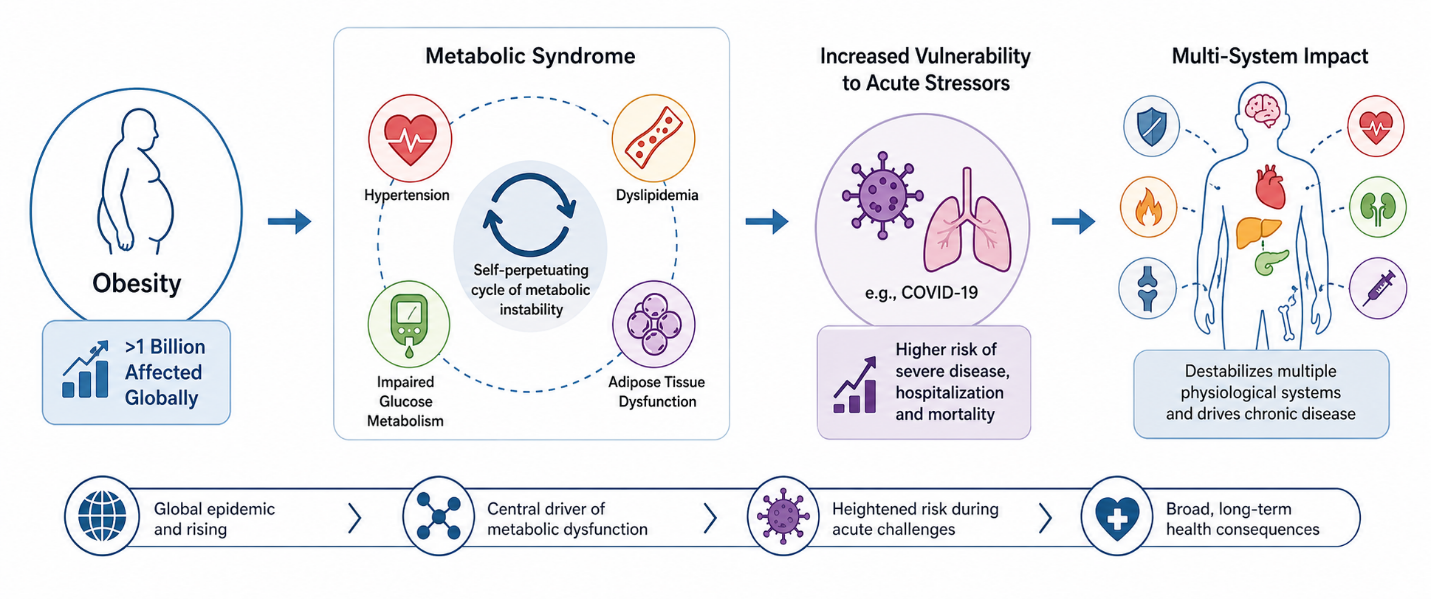
Figure 1: Obesity as a Central Driver of Metabolic Syndrome and Systemic Health Vulnerability. Obesity functions as a core metabolic hub, linking hypertension, dyslipidemia, and impaired glucose regulation into a self-reinforcing cycle. This interconnected dysfunction increases susceptibility to acute stressors and drives long-term multi-system disease burden.
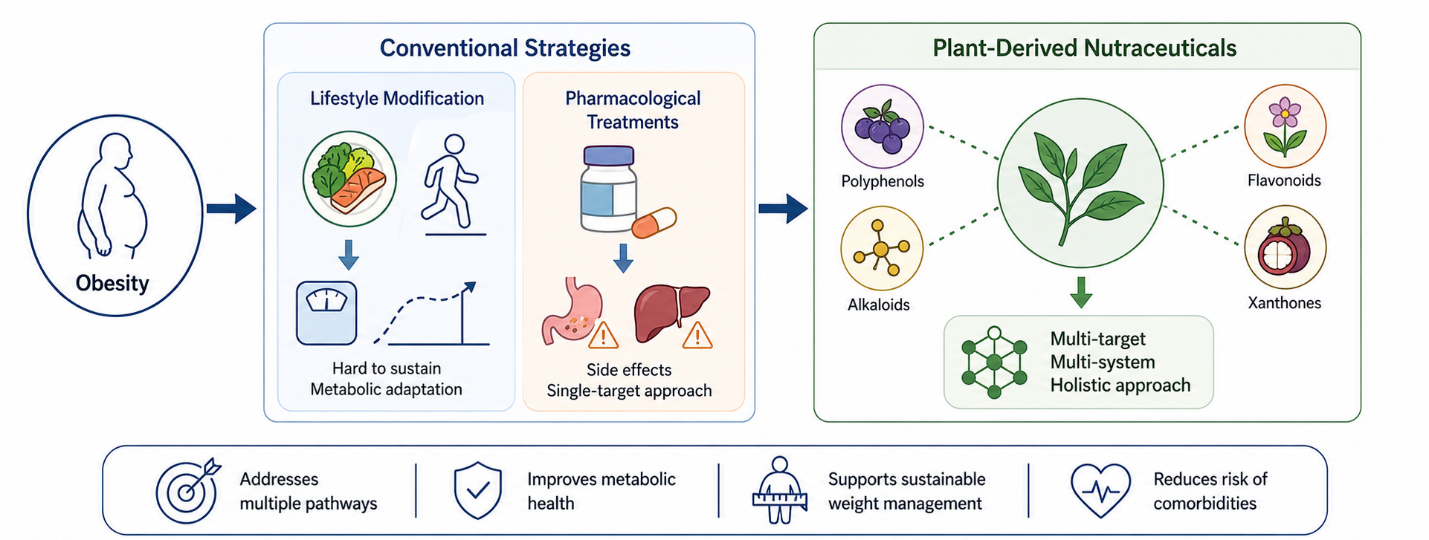
Figure 2: Beyond Conventional Therapies: Multi-Target Nutraceutical Strategies in Obesity Management. Conventional approaches—including lifestyle modification and pharmacotherapy—offer benefits but are often limited by adherence challenges, metabolic adaptation, and side effects. Plant-derived nutraceuticals provide a multi-target, systems-level approach that may better align with the complex biology of obesity.
3.3 Mechanistic Insights: How Polyphenols Influence Metabolic Regulation
One of the more compelling aspects of plant-derived nutraceuticals lies in their diverse and, at times, overlapping mechanisms of action. At the most immediate level, certain compounds exert effects within the gastrointestinal tract by inhibiting pancreatic lipase, a key enzyme responsible for the breakdown and absorption of dietary fats. By limiting lipid digestion, extracts from plants such as Camellia sinensis (green tea), rosemary, and pomegranate effectively reduce caloric uptake, thereby contributing to weight management (Saad, 2023a; Zielinska-Blizniewska et al., 2019).
Beyond these localized effects, polyphenols also influence systemic metabolic processes. Adipogenesis—the differentiation of precursor cells into mature adipocytes—represents a critical point of intervention. Several bioactive compounds, including quercetin and resveratrol, have been shown to downregulate transcription factors such as peroxisome proliferator-activated receptor gamma (PPARγ) and CCAAT/enhancer-binding proteins (C/EBP), both of which are central to adipocyte formation (Inpan et al., 2024; Ramírez-Moreno et al., 2022). By modulating these “master regulators,” polyphenols may effectively limit the expansion of adipose tissue.
Equally noteworthy is the role of nutraceuticals in promoting thermogenesis. This process, involving the generation of heat through metabolic activity, is largely mediated by brown adipose tissue (BAT). Certain phytochemicals—capsaicin and epigallocatechin gallate (EGCG), for example—appear to stimulate BAT activity while also inducing the “browning” of white adipose tissue (WAT). This transformation is associated with increased expression of markers such as uncoupling protein 1 (UCP1) and sirtuin 1 (SIRT1), both of which enhance mitochondrial activity and energy expenditure (Mamun et al., 2024; Saad, 2023b).
Taken together, these mechanisms suggest that polyphenols do not merely reduce fat accumulation but actively reprogram metabolic pathways toward increased energy utilization. Whether these effects are sufficient, in isolation, to produce clinically meaningful weight loss remains an open question—but their multi-targeted nature is, at the very least, conceptually appealing.
3.4 Neuro-Metabolic Intersections: Addressing Cognitive Consequences of Obesity
Perhaps one of the more unexpected, yet increasingly well-documented, dimensions of obesity is its relationship with cognitive health. Accumulating evidence indicates that obesity, particularly during mid-life, is associated with an elevated risk of neurodegenerative conditions such as Alzheimer’s disease. This association appears to be mediated by chronic low-grade inflammation, oxidative stress, and disruptions in insulin signaling within the central nervous system (de la Peña et al., 2023).
This convergence of metabolic and neurological dysfunction has given rise to what might be described as a “neuro-metabolic” framework—one that recognizes the bidirectional relationship between systemic metabolism and brain health. Within this framework, plant-derived compounds again emerge as potentially valuable agents. Certain nutraceuticals, including curcumin and Withania somnifera (Ashwagandha), have demonstrated neuroprotective properties in preclinical studies. These effects are thought to involve the attenuation of neuroinflammation, reduction of oxidative damage, and enhancement of synaptic plasticity (de la Peña et al., 2023).
Animal studies provide further, albeit preliminary, support. Extracts from plants such as hardy kiwi and mulberry root bark have been shown to suppress apoptotic signaling pathways in neural tissue and improve cognitive performance in models of obesity-induced impairment (de la Peña et al., 2023). While these findings are encouraging, their translation to human populations remains to be fully established. Nonetheless, they suggest that the benefits of nutraceuticals may extend beyond metabolic regulation to encompass broader aspects of physiological resilience.
3.5 Xanthones and Emerging Functional Compounds
Among the various classes of bioactive compounds, xanthones have begun to attract particular interest. Found predominantly in fruits such as mangosteen (Garcinia mangostana), these molecules exhibit a range of biological activities relevant to metabolic health. Compounds such as α-mangostin and mangiferin have been shown to inhibit fatty acid synthesis while simultaneously improving endothelial function—effects that are especially pertinent in the context of obesity-related cardiovascular risk (Shataer et al., 2025).
Mangiferin, in particular, appears to exert its effects through activation of the AMP-activated protein kinase (AMPK) pathway, a central regulator of cellular energy homeostasis. Activation of AMPK promotes lipid oxidation, enhances insulin sensitivity, and may mitigate the progression of non-alcoholic fatty liver disease (NAFLD), a common comorbidity of obesity (Shataer et al., 2025). These findings position xanthones not merely as adjunctive agents but as potential contributors to a broader class of functional foods designed to modulate metabolic pathways at multiple levels.
3.6 Concluding Perspective: Toward Integrated Nutraceutical Therapeutics
Taken together, the evidence reviewed here suggests that plant-derived nutraceuticals occupy a promising—if still evolving—space within obesity management. Their multi-targeted mechanisms, relative safety profile, and accessibility make them attractive candidates for integration into both preventive and therapeutic frameworks. At the same time, it would be premature to view them as standalone solutions.
Several challenges remain. Variability in bioavailability, inconsistencies in extract composition, and the absence of standardized dosing protocols complicate both research and clinical application (Saad, 2023b; Shataer et al., 2025). Moreover, while preclinical data are abundant and often compelling, robust human clinical trials are comparatively limited. Without such evidence, translating mechanistic insights into clinical recommendations remains difficult. Still, there is a certain cautious optimism here. If nothing else, nutraceuticals encourage a shift in perspective—from targeting isolated symptoms to addressing the broader, interconnected nature of metabolic disease. In doing so, they may help move the field toward a more integrated model of care—one that recognizes obesity not simply as excess weight, but as a systemic imbalance requiring equally multifaceted solutions.
3.7 Integrative Perspectives: Immuno-Metabolic Resilience and Herbal Therapeutics
If obesity is, in part, a disorder of chronic inflammation and metabolic dysregulation, then it seems almost inevitable to consider how immune resilience and systemic balance intersect within this framework. Increasingly, the literature suggests that obesity cannot be disentangled from immune function; rather, it represents a state in which metabolic and inflammatory pathways are persistently—and perhaps maladaptively—activated. Adipose tissue, through its secretion of adipocytokines, contributes to a sustained inflammatory environment that not only promotes insulin resistance but also compromises immune responsiveness (Tilg & Moschen, 2006). This may help explain why individuals with obesity exhibit heightened vulnerability to infectious diseases, including SARS-CoV-2, where overlapping inflammatory pathways exacerbate disease severity (Michalakis & Ilias, 2020).
From a cardiovascular perspective, these interactions are equally consequential. Obesity-associated inflammation, endothelial dysfunction, and altered lipid metabolism collectively drive cardiovascular risk, reinforcing earlier observations that the relationship between obesity and heart disease is both complex and, at times, paradoxical (Lavie & Milani, 2003; Poirier et al., 2006). In this sense, addressing obesity requires not only metabolic correction but also restoration of broader physiological equilibrium.
It is within this context that traditional herbal medicine begins to re-emerge—not as a replacement for modern therapeutics, but as a complementary system with potential immuno-modulatory and metabolic benefits. Herbal formulations have historically been used to manage stress, anxiety, and immune disturbances, factors that indirectly influence metabolic health (Shahrajabian et al., 2020a). During the COVID-19 pandemic, such approaches gained renewed attention, particularly in relation to their potential supportive role in immune defense and symptom mitigation (Shahrajabian et al., 2020b; Shahrajabian et al., 2021a).
Specific plant-derived compounds, including asafoetida and Peganum harmala, have been explored for their bioactive properties, ranging from antioxidant effects to potential metabolic regulation (Shahrajabian et al., 2021b; Shahrajabian et al., 2021c). However, it is important to acknowledge that not all plant-based agents are inherently benign; certain species possess toxicological risks that necessitate careful evaluation and standardization (Marmitt & Shahrajabian, 2021). This duality—therapeutic potential alongside possible toxicity—underscores the need for rigorous scientific validation. Emerging strategies also extend beyond phytochemicals to include modulation of the gut microbiome. Probiotics and prebiotics, for instance, have shown promise in influencing metabolic pathways, suggesting that microbial ecology may play a meaningful role in obesity management (Włodarczyk & Śliżewska, 2021). Meanwhile, advances in molecular detection techniques continue to refine our understanding of infectious and metabolic interactions, potentially enabling more targeted interventions (Shahrajabian et al., 2021d).
Taken together, these perspectives point toward a more integrative model of care—one that recognizes obesity as a condition shaped by the interplay of metabolism, immunity, and environmental influences, and one that may benefit from the thoughtful incorporation of both traditional and modern therapeutic approaches.