2.1 The paradigmatic shift: from passive accumulation to chemo-biochemical convergence
For decades, cancer nanomedicine leaned heavily on the Enhanced Permeability and Retention (EPR) effect to carry nanoscale therapeutics into solid tumours (Marriam & Khalid, 2026). The concept was appealing in its simplicity: leaky, disordered tumour vasculature combined with impaired lymphatic drainage should let nanoparticles enter and stay, giving a universal gateway for delivery (Akwo et al., 2026; Payam & Lionadi, 2026). Experience has complicated that picture. Clinical data and quantitative meta-analyses show that the EPR effect varies markedly between patients and across regions of the same tumour (Chowdhury et al., 2026; Payam & Lionadi, 2026). Elevated interstitial fluid pressure of roughly 10-40 mmHg, dense extracellular matrix and uneven perfusion all restrict extravasation, so that the dose actually reaching the tissue is often below 1-8% of what was injected per gram (Akwo et al., 2026; Payam & Lionadi, 2026).
Confronted with those anatomical limits, the field reoriented toward chemo-biochemical convergence, an engineering philosophy that fuses synthetic design with biological recognition (Marriam & Khalid, 2026). Rather than relying on long circulation alone, modern platforms carry surface-grafted ligands, such as monoclonal antibodies, targeting peptides and nucleic acid aptamers, that bind selectively to overexpressed receptors (Marriam & Khalid, 2026; Payam & Lionadi, 2026). Convergence also encompasses stimulus-responsive design (Marriam & Khalid, 2026). By building in labile chemistry, for example hydrazone, imine or disulfide bonds, or phase-changing polymers, a carrier can stay sterically stable in the circulation yet cleave rapidly when it meets an acidic endosome, a high glutathione (GSH) concentration or a specific enzyme (Laddha et al., 2026; Marriam & Khalid, 2026). Pairing active recognition with spatially controlled release in this way reduces off-target toxicity while concentrating drug where it is needed (Marriam & Khalid, 2026). Table 1 summarises how these targeting and release strategies have evolved and the engineering
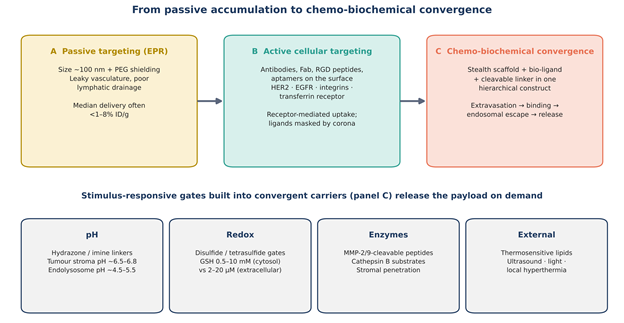
Figure 1. The paradigm shift from passive accumulation to chemo-biochemical convergence in nanomedicine. Schematic contrasting three generations of tumour-targeting strategy. (A) Passive targeting relies on the Enhanced Permeability and Retention effect, in which size-optimised, PEGylated carriers accumulate through leaky vasculature and poor lymphatic drainage, typically delivering less than 1-8% of the injected dose per gram of tissue. (B) Active cellular targeting adds surface ligands (antibodies, Fab fragments, RGD peptides, aptamers) that bind overexpressed receptors such as HER2, EGFR, integrins and the transferrin receptor, improving internalisation but remaining vulnerable to protein-corona masking. (C) Chemo-biochemical convergence integrates a stealth scaffold, biological ligand and cleavable linker in one hierarchical construct that negotiates successive biological barriers. The lower panels show the stimulus-responsive gates (pH, redox, enzymatic and external triggers) built into convergent carriers to release payload on demand, raising the therapeutic index at the cost of synthetic and manufacturing complexity.
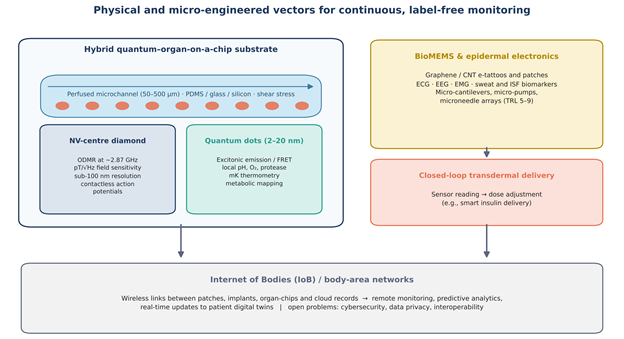
Figure 2. Physical and micro-engineered vectors for continuous, label-free biomedical monitoring. Integrated view of the hardware that links tissue- and body-level physiology to digital health data. On the left, a hybrid quantum-organ-on-a-chip substrate combines a perfused microchannel (50-500 micrometres) with two quantum sensing modalities: nitrogen-vacancy diamond magnetometry, operating by optically detected magnetic resonance near 2.87 GHz to record action potentials contactlessly at picotesla sensitivity and sub-100 nm resolution, and semiconductor quantum dots (2-20 nm) that map local pH, oxygen and millikelvin thermal gradients by excitonic emission and FRET. On the right, BioMEMS and epidermal electronics capture ECG, EEG, EMG and sweat or interstitial-fluid biomarkers and drive closed-loop transdermal delivery. Both domains feed a shared Internet of Bodies data layer that supports remote monitoring, predictive analytics and digital-twin updating, while raising cybersecurity and privacy concerns.
trade-offs each entails, and Figure 1 depicts the overall progression.
2.2 Micro-engineered and physical vectors: quantum biosensing, organ-on-a-chip and BioMEMS
A parallel current of work concerns measurement, and here micro- and nano-engineering are reshaping diagnostics, disease modelling and physiological tracking (Marinescu et al., 2025; Preetam, 2026). Endpoint biochemical assays and fluorescence microscopy, the traditional tools, are destructive, prone to photobleaching and blind to transient dynamics (Preetam, 2026). Microfluidic organ-on-a-chip (OoC) platforms were conceived to do better, recreating functional tissue interfaces, three-dimensional cell-matrix interactions and biomimetic perfusion under controlled shear (Preetam, 2026).
Embedding quantum biosensors in those chips supplies a continuous, label-free read-out (Preetam, 2026). Sensors of this class, including nitrogen-vacancy (NV) centres in diamond, semiconductor quantum dots and atom-based magnetometers, exploit quantum coherence, spin states and excitonic confinement to register biological signals at sub-cellular resolution (Preetam, 2026). NV-centre magnetometry, operating through optically detected magnetic resonance (ODMR) near 2.87 GHz, can pick up picotesla-scale magnetic fluctuations from action potentials in cardiac or neural microtissue without any electrode contact or change in impedance (Preetam, 2026). Quantum dots dispersed in the matrix, meanwhile, report local pH, redox state and millikelvin thermal gradients through shifts in excitonic emission, mapping metabolic heterogeneity across tumour-on-chip models (Preetam, 2026).
Beyond the chip, Micro-Electro-Mechanical Systems (MEMS) and BioMEMS act as the physical link between a patient's physiology and digital monitoring, under what has been called the Internet of Bodies (IoB) (Marinescu et al., 2025; Reddy et al., 2024). Flexible, skin-conformal bioelectronics, including graphene- and carbon-nanotube-based electronic tattoos, continuously capture electroencephalogram (EEG), electromyogram (EMG) and metabolic data from sweat or interstitial fluid (Akwo et al., 2026; Marinescu et al., 2025). Coupled to MEMS micro-pumps and microneedle arrays, these devices can close the loop, adjusting transdermal dosing in response to the signals they record (Marinescu et al., 2025; Reddy et al., 2024). Figure 2 and Table 2 set out the architecture, sensing capabilities and translational readiness of these physical vectors.
2.3 Computational paradigms: multi-omics, artificial intelligence and digital twins
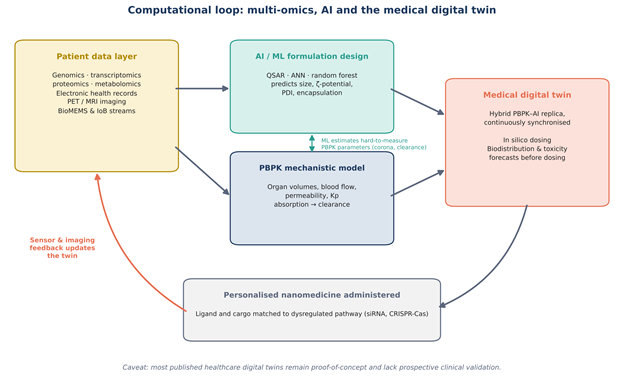
If the first two currents are chemical and physical, the third is computational, and it is what ties the physical carriers to systems biology (Akwo et al., 2026; Chowdhury et al., 2026). Multi-omics profiling across genomics, transcriptomics, proteomics and metabolomics builds a molecular map of the alterations that define a disease (Akwo et al., 2026). Proteomic data on overexpressed receptors guide ligand choice, while transcriptomic signatures inform RNA-responsive carriers that release siRNA or CRISPR-Cas cargo only when they recognise a specific oncogenic transcript (Akwo et al., 2026; Bhukta et al., 2026).
On top of this, AI and ML are displacing trial-and-error from formulation work (Deshmukh & Yadav, 2025). Models trained on large libraries predict hydrodynamic diameter, zeta potential, encapsulation efficiency and ligand orientation, and they describe non-linear release kinetics and particle-membrane interactions well enough to narrow preclinical screening considerably (Deshmukh & Yadav, 2025; Laddha et al., 2026). Digital Twin (DT) technology then builds on those predictions (Chowdhury et al., 2026; Deshmukh & Yadav, 2025). A medical digital twin is a continuously updated virtual replica of a patient, assembled from longitudinal records, genomic data, imaging and live BioMEMS streams (Chowdhury et al., 2026). By coupling physiologically based pharmacokinetic (PBPK) models with hybrid ML, a twin can simulate nanoparticle transport, extravasation, biodistribution and clearance, letting clinicians test dosing regimens and toxicity in silico before anything is administered (Chowdhury et al., 2026). These computational frameworks, with their strengths and limitations, are compared in Table 3 and illustrated in Figure 3.
2.4 Disease-specific applications: precision oncology and central nervous system therapeutics
The value of all this converged technology is clearest where it is applied, and two domains stand out: oncology and central nervous system (CNS) disease (Bhukta et al., 2026; Labhade & Pihulkar, 2026; Mazahir, 2026). In oncology, multifunctional carriers embody theranostics, carrying a therapeutic agent and an imaging agent,
Table 1. Evolution of targeting strategies and stimulus-responsive release mechanisms in nanomedicine. The table traces the progression from passive EPR-based accumulation through active cellular targeting to fully convergent, stimulus-responsive platforms. For each paradigm it summarises the chemical and structural engineering involved, the biological target or physiological trigger exploited, the principal efficacy and safety advantages, and the key limitations together with the engineering solutions proposed to overcome them. Primary supporting sources are listed in the final column.
|
Paradigm / mechanism
|
Chemical & structural engineering
|
Biochemical / physiological target & trigger
|
Efficacy, safety & performance advantages
|
Key limitations & engineering solutions
|
Primary sources
|
|
Passive targeting (EPR effect)
|
Nanocarrier size optimisation (~100 nm) with steric PEGylation.
|
Leaky tumour microvasculature and impaired lymphatic drainage in solid tumours.
|
Prolongs circulation, evades rapid renal filtration and reduces systemic toxicity such as cardiotoxicity.
|
High inter-patient and intra-tumoral heterogeneity in vascular leakiness; low overall accumulation; mitigated by active, multi-stage platforms.
|
Akwo et al. (2026); Marriam & Khalid (2026); Payam & Lionadi (2026)
|
|
Active cellular targeting
|
Surface functionalisation with biological ligands (antibodies, Fab fragments, RGD peptides, RNA/DNA aptamers).
|
Receptors overexpressed on diseased cells (HER2, integrins, EGFR, transferrin receptor).
|
Promotes receptor-mediated endocytosis, internalisation and cell-type specificity.
|
Protein-corona masking of ligands in vivo and receptor saturation; addressed by zwitterionic coatings or pre-formed corona engineering.
|
Akwo et al. (2026); Marriam & Khalid (2026); Payam & Lionadi (2026)
|
|
pH-responsive release
|
Acid-labile linkers (hydrazone, imine) or ionisable polymeric amine scaffolds.
|
Acidic tumour stroma (pH ~6.5-6.8) and endolysosomes (pH ~4.5-5.5).
|
Enables on-demand intracellular disassembly; minimises premature leakage at physiological pH 7.4.
|
Non-specific leakage during prolonged transit; mitigated by combining pH triggers with steric caps or dual-stimuli gates.
|
AlSuhaimi et al. (2026); Marriam & Khalid (2026)
|
|
Redox-responsive release
|
Gated frameworks with disulfide or tetrasulfide cleavage linkers.
|
Intracellular glutathione gradient (0.5-10 mM cytosolic vs 2-20 micromolar extracellular).
|
Acts as a second-order gatekeeper, confining release to the cytosol.
|
Requires intracellular entry before activation; overcome by coupling redox linkers to receptor-mediated endocytosis ligands.
|
AlSuhaimi et al. (2026); Marriam & Khalid (2026)
|
|
Enzymatic & exogenous triggers
|
Enzyme-cleavable peptide substrates (MMP-2/9) or thermosensitive lipid/polymer phase transitions.
|
Dysregulated disease enzymes (MMPs, cathepsin B) or external hyperthermia, ultrasound and light.
|
Provides fine spatiotemporal control over payload liberation at the target site.
|
Imprecise in vivo thermal control and non-specific activation during febrile episodes.
|
Akwo et al. (2026); Marriam & Khalid (2026)
|
|
Chemo-biochemical convergence
|
Hierarchical integration of synthetic scaffolds, stimulus-responsive linkers and active bio-ligands.
|
Sequential biological barriers (vascular extravasation, cell binding, endosomal escape).
|
Maximises therapeutic index, lowers dose and mitigates multidrug resistance.
|
Synthetic and manufacturing complexity at scale-up; addressed by continuous microfluidic assembly.
|
Akwo et al. (2026); Marriam & Khalid (2026)
|
Table 2. Physical and bio-engineering vectors: microfluidics, quantum biosensors, BioMEMS and the Internet of Bodies. The table compares the main hardware platforms that enable real-time, label-free biomedical monitoring. For each platform it describes the physical working principle and architecture, the primary sensing or operational capabilities, the biomedical application domain, and the comparative advantages and approximate technology-readiness level (TRL). Primary supporting sources appear in the final column.
|
Technology platform
|
Physical working principle & architecture
|
Primary sensing / operational capability
|
Biomedical application domain
|
Comparative advantages & readiness (TRL)
|
Primary sources
|
|
Organ-on-a-chip (OoC) substrates
|
Microfabricated perfused microchannels (50-500 micrometres) in PDMS, glass or silicon with dynamic flow.
|
Recapitulates 3D tissue interfaces, fluid shear stress, organoids and metabolic gradients.
|
In vitro disease modelling, drug-toxicity screening and personalised therapeutic assessment.
|
Reduces animal-model species mismatch; replaces static endpoint assays (TRL 6-8).
|
Chowdhury et al. (2026); Preetam (2026)
|
|
NV-centre diamond magnetometry
|
Spin-1 electron states read by optically detected magnetic resonance (ODMR) at the ~2.87 GHz zero-field splitting.
|
Picotesla magnetic-field detection with sub-100 nm spatial resolution.
|
Contactless electrophysiological monitoring of cardiac and neural action potentials.
|
Non-invasive, contact-free sensing without altering membrane impedance or inducing inflammation.
|
Preetam (2026)
|
|
Quantum-dot (QD) nanosensors
|
Excitonic quantum confinement in semiconductor nanocrystals (2-20 nm).
|
Single-molecule fluorescence, FRET-based protease detection and millikelvin thermometry.
|
Real-time tracking of local pH, oxygen gradients and enzymatic turnover in tumour organoids.
|
High photostability and brightness versus organic dyes; susceptible to photoluminescence blinking.
|
Akwo et al. (2026); Preetam (2026)
|
|
BioMEMS & epidermal electronics
|
Biocompatible silicon/flexible-polymer micro-cantilevers, micro-pumps and microneedles.
|
Continuous biopotential tracking (ECG, EEG, EMG) and sweat-metabolite sensing.
|
Point-of-care testing, chronic-disease management and transdermal drug delivery.
|
Miniaturised and low-power; continuous tracking replacing clinic visits (TRL 5-9).
|
Marinescu et al. (2025); Reddy et al. (2024)
|
|
Internet of Bodies (IoB) / IoNT
|
Wireless interconnection of body-area networks, smart patches and cloud databases.
|
Closed-loop automated sensing and therapeutic administration (e.g., smart insulin delivery).
|
Remote patient monitoring, predictive analytics and digital-twin updating.
|
Turns individual physiology into a real-time data node; faces cybersecurity and privacy hurdles.
|
Chowdhury et al. (2026); Marinescu et al. (2025)
|
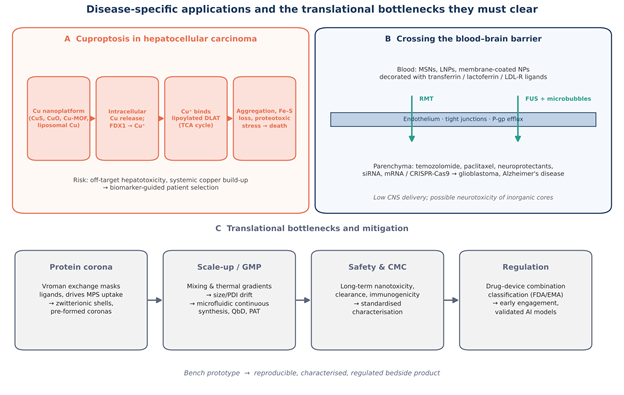
perhaps superparamagnetic iron oxide for MRI, a radionuclide for PET or a fluorophore for optical imaging, in a single construct (Bhukta et al., 2026; Marriam & Khalid, 2026). Nanomedicine is also opening metabolic death pathways that cytotoxic drugs do not reach, cuproptosis among them, a copper-dependent, non-apoptotic form of cell death (Labhade & Pihulkar, 2026). In hepatocellular carcinoma (HCC), where cells show altered copper handling and heavy mitochondrial dependence, copper-based nanoplatforms such as copper sulfide, copper oxide and metal-organic frameworks deliver a targeted copper overload (Labhade & Pihulkar, 2026). Once released intracellularly, copper ions bind the lipoylated proteins of the tricarboxylic acid (TCA) cycle, particularly DLAT, provoking proteotoxic stress, loss of iron-sulfur cluster proteins and selective mitochondrial collapse (Labhade & Pihulkar, 2026).
In glioblastoma multiforme (GBM) and Alzheimer's disease, the limiting step is almost always the blood-brain barrier (Bhukta et al., 2026; Mazahir, 2026). Surface-engineered carriers, including MSNs, cationic LNPs and biomimetic membrane-coated constructs, cross it by receptor-mediated transcytosis aimed at transferrin, lactoferrin or low-density lipoprotein receptors (Mazahir, 2026). Through that route they can place chemotherapeutics such as temozolomide, neuroprotective compounds or mRNA-based gene-editing tools directly in the parenchyma, improving survival in preclinical models (Mazahir, 2026). Figure 4 and Table 4 summarise these applications together with the bottlenecks that still separate them from the clinic.
2.5 Translational bottlenecks: protein corona dynamics, manufacturing scale-up and regulation
For all the preclinical momentum, translation remains hard, and the obstacles are technical, biological and regulatory at once (Akwo et al., 2026; Marriam & Khalid, 2026). As soon as a particle enters the bloodstream, plasma proteins adsorb onto it to form a dynamic protein corona (Akwo et al., 2026; Chowdhury et al., 2026). That corona reshapes the particle's effective identity, hides its targeting ligands, invites premature clearance by the mononuclear phagocyte system (MPS) and alters where it ends up, which is why corona formation really ought to be assessed in each patient's own plasma (Akwo et al., 2026; AlSuhaimi et al., 2026).
Manufacturing is a second, less glamorous barrier. Moving from microgram bench quantities to kilogram-scale Good Manufacturing Practice (GMP) production is far from trivial (Akwo et al., 2026; AlSuhaimi et al., 2026; Marriam & Khalid, 2026). Scaling introduces gradients in mixing, temperature and pH, and these translate into batch-to-batch variation in size, charge, ligand density and drug loading (Akwo et al., 2026; AlSuhaimi et al., 2026). Because small structural differences can swing toxicity and efficacy, tight Chemistry, Manufacturing and Controls (CMC) are essential (Kanipandian et al., 2026; Payam & Lionadi, 2026).
Regulation, finally, remains genuinely unsettled (Bhukta et al., 2026; Tiwari et al., 2026). Multifunctional nanomedicines that combine targeted delivery, responsive triggers and imaging probes are often treated as drug-device combination products (Bhukta et al., 2026). Agencies such as the US FDA and the European EMA must then evaluate them across separate drug and device pathways, demanding extensive safety, clearance and immunogenicity data (Kanipandian et al., 2026; Tiwari et al., 2026). Standardised characterisation, continuous microfluidic manufacturing and early regulatory engagement are widely seen as the levers most likely to speed translation (Akwo et al., 2026; Marriam & Khalid, 2026).