Biosensors and Nanotheranostics

Bionanotechnology, Drug Delivery, Therapeutics | online ISSN 3064-7789
175
Citations
115.8k
Views
76
Articles
Your new experience awaits. Try the new design now and help us make it even better
Switch to the new experience
Figures and Tables
REVIEWS   (Open Access)

Bridging the Translational Gap in Nanomedicine: From Biological Barriers to Regulatory Approval

Annachiara Bazzoni 1, Devyani Dogra 1, Chahat Antil 1, Natasha Phelps 1, Mustafa Rehmatulla Batliwala 1, Saina Depas 1, Gnanasekaran Ashok 2*


+ Author Affiliations

Biosensors and Nanotheranostics 5 (1) 1-8 https://doi.org/10.25163/biosensors.5110982

Submitted: 19 February 2026 Revised: 05 April 2026  Published: 17 April 2026 


Abstract

Nanomedicine has moved, slowly and unevenly, from laboratory curiosity to a recognised pillar of modern therapeutics. Liposomal doxorubicin, albumin-bound paclitaxel, the small interfering RNA therapy patisiran and, most visibly, the mRNA-lipid nanoparticle COVID-19 vaccines show what nanoscale carriers achieve when design, manufacturing and regulation align. These successes, however, sit beside a far larger body of candidates that never reach patients, and this review asks why. Peer-reviewed reviews, quantitative meta-analyses, survey and qualitative studies, and regulatory assessments published between 2012 and 2026 were synthesised and organised along the translational continuum running from bench discovery to market authorisation. Roughly 50 to 100 nanomedicines have been approved, dominated by lipid-based platforms and oncology indications, while more than 500 candidates remain in clinical testing. The barriers separating those two numbers are interconnected rather than isolated. In vivo, the protein corona rewrites a particle's synthetic identity, the mononuclear phagocyte system removes most of an injected dose, and the enhanced permeability and retention effect proves far more heterogeneous in patients than in rodents; a median of only 0.7% of administered nanoparticles reaches solid tumours. During scale-up, modest shifts in process parameters disturb critical quality attributes, which places Quality-by-Design, process analytical technology and microfluidic manufacture at the centre of pharmaceutical development. Clinically, success falls from about 94% in Phase I to 14% in Phase III, reflecting weak preclinical models, immunotoxicity and inadequate patient stratification, while fragmented regulatory definitions add further uncertainty. Structured frameworks such as DELIVER, combined with companion diagnostics, standardised reporting and early regulatory dialogue, offer the most credible route to narrowing this gap.

Keywords: nanomedicine; clinical translation; protein corona; enhanced permeability and retention effect; Quality-by-Design; nanotoxicology; regulatory science; DELIVER framework

1. Introduction

Over the past several decades, nanomedicine, understood broadly as the application of nanotechnology to the prevention, diagnosis and treatment of disease, has reshaped how pharmaceutical scientists think about drug delivery (Agrahari & Agrahari, 2018; Zhang et al., 2020). Working at the nanoscale, typically between 1 and 100 nm, confers properties that bulk formulations do not possess: a high surface-area-to-volume ratio, tunable surface charge and morphology, substantial drug-loading capacity and adjustable release kinetics (Ellakwa & Ellakwa, 2026; Hua et al., 2018). These features allow liposomes, polymeric nanoparticles, inorganic nanostructures, lipid nanoparticles (LNPs), nanogels and protein conjugates to address long-standing pharmacokinetic and pharmacodynamic weaknesses of conventional small molecules, among them poor aqueous solubility, rapid systemic clearance, dose-limiting toxicity and a lack of tissue specificity (Đorđević et al., 2021; Metselaar & Lammers, 2020; Modi & Modi, 2023).

The clinical record, although modest in absolute terms, is genuine. Approximately 50 to 100 nanomedicine formulations have now been authorised by agencies such as the United States Food and Drug Administration (FDA) and the European Medicines Agency (EMA) (Shan et al., 2022; Thapa & Kim, 2023; Zhang et al., 2020). First-generation platforms established the precedent. PEGylated liposomal doxorubicin (Doxil®/Caelyx®) demonstrated that encapsulation could reduce cardiotoxicity while prolonging circulation (Barenholz, 2012), and albumin-bound paclitaxel (Abraxane®) removed the need for toxic solubilising excipients in breast and pancreatic malignancy (Foulkes et al., 2020; Thapa & Kim, 2023). More recent milestones have been more consequential still. Patisiran (Onpattro®), an LNP-formulated small interfering RNA, became the first approved RNA-interference therapy, and the mRNA-LNP COVID-19 vaccines (Comirnaty® and Spikevax®), delivered as billions of doses worldwide, demonstrated the public-health potential of nanocarriers at a scale few had anticipated (Đorđević et al., 2021; Joyce et al., 2024; Milane & Amiji, 2021).

Even so, the rate at which preclinical innovation becomes approved medicine remains low. Publication output in the field has grown enormously, yet only a small fraction of candidate formulations complete human testing (Satalkar et al., 2016; Sindhwani & Chan, 2021). A widely cited quantitative analysis reported that a median of only 0.7% of an intravenously administered nanoparticle dose reaches solid tumours (Wilhelm et al., 2016). In oncology, candidate nanomedicines clear Phase I with a success rate of roughly 94%, but the figure falls to 48% in Phase II and to approximately 14% in Phase III (Đorđević et al., 2021; He et al., 2019). This bench-to-bedside bottleneck has no single cause; it arises from the interaction of biological barriers, manufacturing constraints, toxicological uncertainty and fragmented regulation (Agrahari & Agrahari, 2018; Metselaar & Lammers, 2020).

Biological complexity is the first obstacle. Almost as soon as nanocarriers enter the bloodstream, they adsorb plasma proteins and acquire a dynamic biomolecular, or protein, corona (Hadjidemetriou & Kostarelos, 2017). This coating substitutes a biological identity for the engineered one, conceals targeting ligands, promotes opsonisation and directs the carrier towards the mononuclear phagocyte system (MPS) of the liver and spleen (Mahmoudi, 2018; Soares et al., 2018). Tissue-level barriers impose further restrictions: the non-fenestrated endothelium of the blood-brain barrier (BBB), a dense extracellular matrix (ECM) and elevated interstitial fluid pressure (IFP) within tumours all limit extravasation and deep penetration (Blanco et al., 2015; Teng et al., 2025). Even the enhanced permeability and retention (EPR) effect, long treated as the foundation of passive tumour targeting, has proved highly variable across patients, tumour types and disease stages (Sindhwani & Chan, 2021; Teng et al., 2025).

Pharmaceutical development imposes a second set of constraints. Moving from small laboratory batches to industrial production under Good Manufacturing Practice (GMP) frequently introduces batch-to-batch variation in critical quality attributes (CQAs) such as hydrodynamic size, polydispersity index (PDI), surface charge, encapsulation efficiency and stability (Dri et al., 2022; Đorđević et al., 2021). Complex multi-step formulations are particularly vulnerable to scale-up failure and escalating cost, and the absence of standardised analytical tools and reliable in vitro-in vivo correlations (IVIVC) makes safety and efficacy difficult to anticipate before first-in-human studies (Agrahari & Agrahari, 2018; Colombo et al., 2018; Hua et al., 2018).

Regulation forms the third constraint. Most approval pathways still rest on frameworks devised for small molecules or biologics, which do not fully capture size-dependent pharmacology, tissue accumulation or long-term biocompatibility (Foulkes et al., 2020; Mühlebach, 2018). Definitions of a nanomaterial differ between jurisdictions, and uncertainty over whether a product is a medicine, a device or a combination creates legal and financial risk for developers (Allan et al., 2021; Dri et al., 2022). Addressing these intertwined problems will require a shift towards rational, safe-by-design engineering, standardised characterisation cascades, Quality-by-Design (QbD) manufacturing and sustained collaboration among academia, industry, clinicians and regulators (Joyce et al., 2024; Satalkar et al., 2016).

Against this background, the present review provides an evidence-based roadmap for overcoming translational bottlenecks in nanotherapeutics. It aims, first, to evaluate the current clinical and market landscape of approved and late-stage nanomedicines across oncology, infectious disease, neurology and gene therapy; second, to analyse the biological barriers and nano-bio interactions that govern nanoparticle fate in vivo, including the protein corona, MPS clearance, tissue barriers and EPR heterogeneity; third, to assess chemistry, manufacturing and controls (CMC) challenges, with particular attention to QbD, microfluidic synthesis and process analytical technology (PAT); fourth, to examine nanotoxicology, immunotoxicity and the regulatory gaps that complicate approval; and fifth, to propose integrated translational strategies, including standardised reporting, companion diagnostics and the DELIVER framework, capable of accelerating delivery of next-generation nanomedicines to patients (Conde et al., 2020; Joyce et al., 2024; Leong et al., 2019).

2. Biological, Manufacturing, and Regulatory Barriers to Clinical Translation of Nanomedicine and the DELIVER Framework

2.1 Evolution of the Field and the Persistence of the Translational Gap

Across roughly three decades, nanomedicine has matured into a distinct paradigm in drug delivery, one intended to widen the therapeutic index of agents that are otherwise difficult to administer safely (Agrahari & Agrahari, 2018; Zhang et al., 2020). Engineering carriers at the sub-micrometre scale improves aqueous solubility, increases payload capacity, prolongs circulation and permits stimulus-responsive release (Ellakwa & Ellakwa, 2026; Hua et al., 2018). Liposomes, polymeric micelles, LNPs, inorganic nanostructures and nanogels were each developed, at least in part, to compensate for the pharmacokinetic and pharmacodynamic shortcomings of small-molecule therapeutics (Đorđević et al., 2021; Metselaar & Lammers, 2020; Modi & Modi, 2023).

Commercial success of landmark products, including Doxil®/Caelyx®, Abraxane® and the mRNA-LNP vaccines, has sustained enthusiasm for the field (Barenholz, 2012; Milane & Amiji, 2021), and the regulatory histories of these and other authorised products are summarised in Table 1 (Table 1). The broader rate of clinical translation nonetheless remains constrained (Foulkes et al., 2020; Sindhwani & Chan, 2021). Thousands of nanocarriers have been described at the bench, yet only a small subset has obtained authorisation (Joyce et al., 2024; Satalkar et al., 2016). The literature increasingly frames this gap as the product of an interconnected chain of biological, technological, preclinical and regulatory hurdles rather than as a set of independent failures (Agrahari & Agrahari, 2018; Đorđević et al., 2021). Figure 1 summarises this continuum, from bench discovery through bio-nano barriers and CMC to clinical evaluation and regulatory review (Figure 1).

2.2 Biological Barriers and the Bio-Nano Interface

The first major obstacle to targeted delivery is the complex and highly dynamic biological environment that nanocarriers encounter after systemic administration (Blanco et al., 2015; Mahmoudi, 2018). Circulating nanoparticles do not meet target cells as pristine synthetic constructs; they are rapidly and fundamentally altered at the nano-bio interface (Ellakwa & Ellakwa, 2026; Sindhwani & Chan, 2021). The principal barriers, their underlying mechanisms and the engineering strategies proposed to mitigate them are collated in Table 2 (Table 2).

2.2.1 The Biomolecular Protein Corona

On entering plasma, nanocarriers adsorb a diverse array of endogenous proteins, lipids and other biomolecules, forming what is termed the protein corona (Ellakwa & Ellakwa, 2026; Hadjidemetriou & Kostarelos, 2017; Teng et al., 2025). Adsorption begins within seconds as a weakly bound soft corona and evolves over hours into a more stably attached hard corona whose composition reflects protein abundance, surface curvature and binding affinity (Hadjidemetriou & Kostarelos, 2017). In effect, the corona replaces the particle's synthetic identity with a biological one (Mahmoudi, 2018). It can alter hydrodynamic size and surface charge, mask engineered targeting ligands and redirect cellular uptake pathways (Ellakwa & Ellakwa, 2026; Teng et al., 2025; Zhang et al., 2020). Corona composition also differs between animal species, between patients of differing health status and disease stage, and even with plasma collection conditions, which introduces considerable variability into preclinical and clinical outcomes alike (Mahmoudi, 2018; Teng et al., 2025). These events, and their cumulative effect on the injected dose, are depicted schematically in Figure 2 (Figure 2).
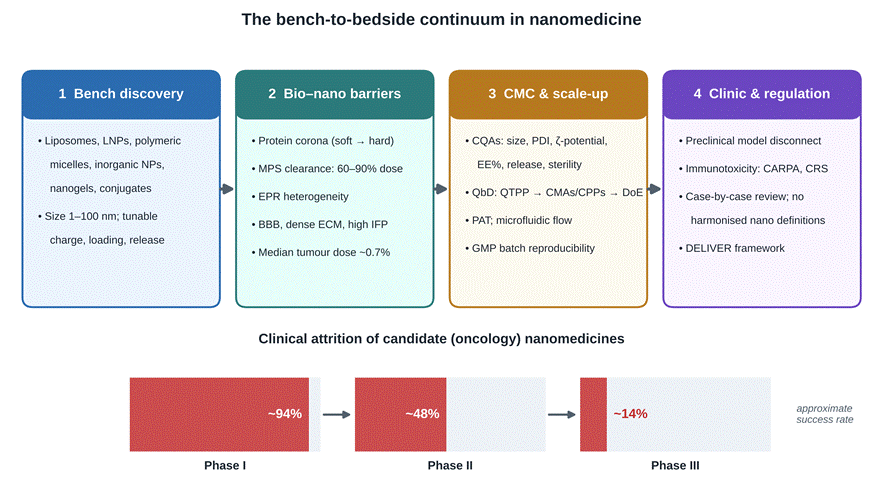
Figure 1. The bench-to-bedside continuum in nanomedicine and the clinical attrition it produces. The upper panel divides nanomedicine development into four sequential stages, each of which introduces a distinct class of translational obstacle: bench discovery, where nanocarrier architecture and physicochemical properties are defined; the bio-nano interface, where corona formation, clearance by the mononuclear phagocyte system and heterogeneous enhanced permeability and retention limit target-tissue delivery; chemistry, manufacturing and controls, where critical quality attributes must be held constant during scale-up under Good Manufacturing Practice; and clinical and regulatory evaluation, where preclinical model limitations, immunotoxicity and fragmented regulation determine approval. The lower panel shows the approximate phase-wise success rates reported for oncology nanomedicines, with bar length proportional to the proportion of candidates progressing. Drawn from the evidence synthesised in Sections 2 and 4.
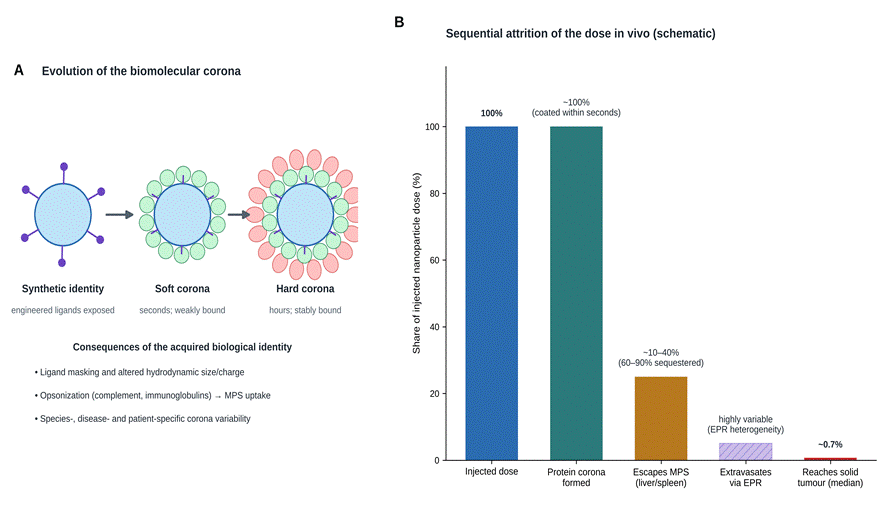
Figure 2. Protein corona evolution and the sequential attrition of an injected nanoparticle dose. Panel A depicts the transition from a nanoparticle's engineered synthetic identity, with targeting ligands exposed, through the weakly bound soft corona that forms within seconds of plasma contact, to the stably adsorbed hard corona established over subsequent hours; the listed consequences include ligand masking, altered hydrodynamic size and charge, opsonisation and species- or patient-dependent variability in corona composition. Panel B presents a schematic quantification of dose attrition in vivo, showing that essentially the entire injected dose acquires a corona, that hepatic and splenic macrophages sequester 60% to 90% of it, and that a median of only 0.7% ultimately reaches solid tumour tissue. The hatched bar denotes a step whose magnitude varies widely between patients and tumour types.

2.2.2 Mononuclear Phagocyte System Clearance and the Limits of Stealth Design

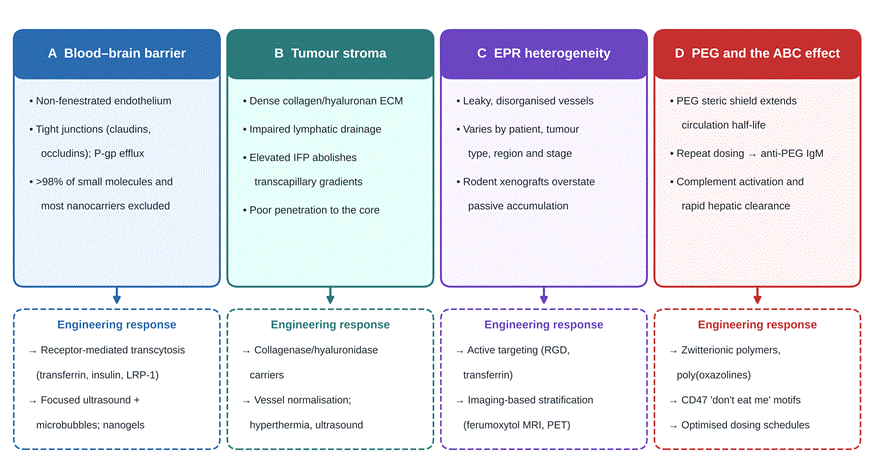
Opsonins within the corona, notably complement factors and immunoglobulins, trigger recognition and sequestration by macrophages of the MPS, chiefly hepatic Kupffer cells and splenic red-pulp macrophages (Agrahari & Agrahari, 2018; Ellakwa & Ellakwa, 2026; Soares et al., 2018). Unmodified nanocarriers may be cleared within minutes, and Kupffer cells alone can sequester 60% to 90% of an injected dose (Ellakwa & Ellakwa, 2026; Table 2). Surface grafting of hydrophilic polymers, above all polyethylene glycol (PEG), has long served as the standard stealth strategy, since the hydrated steric layer repels opsonins and prolongs circulation (Soares et al., 2018). Widespread clinical use of PEGylated products has nonetheless exposed an important vulnerability, the accelerated blood clearance (ABC) phenomenon (Ma et al., 2025). Repeated dosing stimulates anti-PEG immunoglobulin M antibodies, which sharply increase immune recognition and hepatic clearance on subsequent administration (Ellakwa & Ellakwa, 2026; Ma et al., 2025). Alternative stealth chemistries, among them zwitterionic polymers and poly(oxazolines), together with CD47-derived "don't eat me" motifs, are under active investigation (Ma et al., 2025; Tavano et al., 2018; Figure 3).

2.2.3 Tissue Barriers and the EPR Paradox

Even nanocarriers that evade systemic immune clearance encounter localised physiological barricades that restrict deep tissue penetration (Blanco et al., 2015; Teng et al., 2025). In neuro-oncology and cerebrovascular disease, the non-fenestrated capillary endothelium of the BBB, reinforced by tight junctions and efflux transporters, severely limits convective extravasation (Blanco et al., 2015; Modi & Modi, 2023; de La Taille et al., 2025). Within solid tumours, dense collagen-rich ECM networks combine with elevated IFP arising from impaired lymphatic drainage to abolish transcapillary pressure gradients and block diffusion into the tumour core (Teng et al., 2025).

Historically, cancer nanomedicine design relied almost exclusively on the EPR effect, that is, passive accumulation through leaky tumour vasculature (Sindhwani & Chan, 2021; Teng et al., 2025). Extensive clinical experience has since revealed that EPR is heterogeneous across patient populations, tumour types, microenvironmental regions and stages of progression (Teng et al., 2025). Quantitative biodistribution analyses confirm that a median of only 0.7% of an intravenously administered dose reaches solid tumour targets (Mahmoudi, 2018; Wilhelm et al., 2016). This low delivery efficiency underlines the inadequacy of passive accumulation as a stand-alone strategy (Ma et al., 2025; Sindhwani & Chan, 2021). The four dominant tissue-level barriers and their corresponding engineering responses are compared in Figure 3 (Figure 3).

2.3 Chemistry, Manufacturing and Controls and Industrial Scale-Up

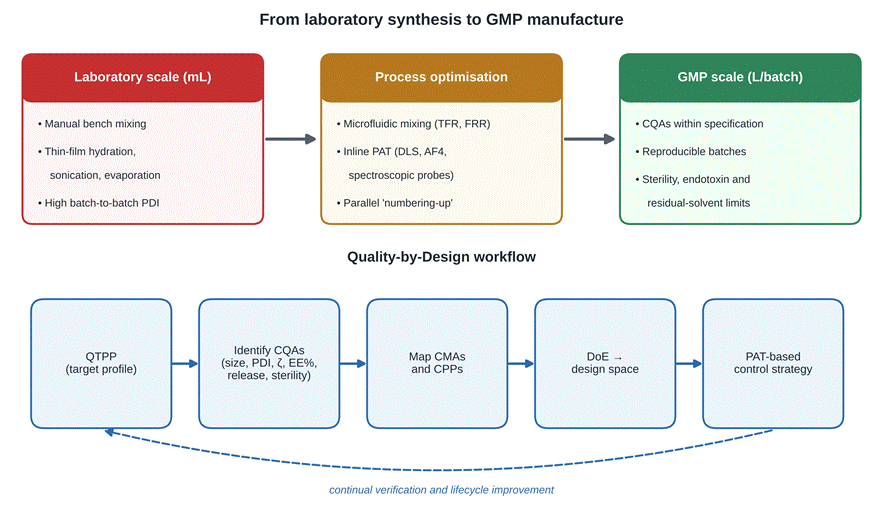
Transferring a nanomedicine formulation from low-volume laboratory synthesis to industrial production is among the most formidable hurdles in pharmaceutical development (Agrahari & Agrahari, 2018; Đorđević et al., 2021; Hua et al., 2018). The parameters, attributes and analytical tools that govern this transition are set out in Table 3 (Table 3), and the overall workflow is illustrated in Figure 4 (Figure 4).

2.3.1 Critical Quality Attributes and Scale-Up Dynamics

Laboratory-scale preparations commonly rely on benchtop techniques such as solvent evaporation, probe sonication or thin-film hydration, none of which scale linearly (Agrahari & Agrahari, 2018; Đorđević et al., 2021). Operating at larger batch volumes under GMP requires tight control of multi-step chemical and physical processes, because modest fluctuations in shear rate, mixing velocity, temperature gradient or solvent evaporation rate can profoundly alter the product's CQAs (Colombo et al., 2018; Đorđević et al., 2021). The attributes that most directly dictate biological activity and safety include average hydrodynamic size and PDI (Dri et al., 2022; Thapa & Kim, 2023); surface charge, expressed as zeta potential, together with surface morphology (Dri et al., 2022; Đorđević et al., 2021); encapsulation efficiency and total drug loading of the active pharmaceutical ingredient (Dri et al., 2022; Đorđević et al., 2021); in vitro release kinetics and physicochemical stability (Đorđević et al., 2021); and residual organic solvent, sterility and endotoxin levels (Agrahari & Agrahari, 2018; Đorđević et al., 2021). Unintended drift in these attributes between batches can alter biodistribution, clearance kinetics, toxicity and efficacy, and may precipitate regulatory rejection or suspension of a clinical trial (Hua et al., 2018; Joyce et al., 2024; Table 3).

2.3.2 Quality-by-Design and Process Analytical Technology

Table 1. Globally approved commercial nanomedicines, nanoplatforms, indications and regulatory milestones. The table lists representative nanotherapeutics that have obtained marketing authorisation from the US Food and Drug Administration (FDA) and/or the European Medicines Agency (EMA), together with the carrier class and approximate particle size, the licensed indication, and the delivery mechanism that confers clinical advantage over the corresponding free drug. Entries span first-generation liposomal and albumin-bound platforms, ratiometric combination liposomes, inorganic radioenhancers and nucleic-acid-carrying lipid nanoparticles, illustrating the progressive broadening of the field from toxicity reduction towards genetic medicine. Approval years are given for each agency where both have authorised the product. References indicate the sources from which platform, indication and regulatory details were extracted.

Trade name & active agent

Nanoplatform & size / composition

Therapeutic indication(s)

Delivery mechanism & biological advantage

Regulatory body & approval year

References

Doxil® / Caelyx® (Doxorubicin HCl)

PEGylated liposome (~100 nm)

Ovarian cancer, metastatic breast cancer, Kaposi's sarcoma, multiple myeloma

Stealth PEG coating reduces cardiotoxicity compared to free doxorubicin; extends plasma half-life and exploits passive tumour accumulation.

FDA (1995), EMA (1997)

Barenholz (2012); Hua et al. (2018); Zhang et al. (2020)

Abraxane® (Paclitaxel)

Albumin-bound nanoparticle (~130 nm)

Metastatic breast cancer, advanced non-small cell lung cancer (NSCLC), pancreatic adenocarcinoma

Solubilises hydrophobic paclitaxel without toxic solvents (e.g., Kolliphor EL); eliminates solvent hypersensitivity and enhances endothelial transcytosis via gp60 receptors.

FDA (2005), EMA (2008)

Foulkes et al. (2020); Thapa & Kim (2023); Zhang et al. (2020)

Onpattro® (Patisiran)

Lipid nanoparticle (LNP) containing siRNA

Transthyretin (TTR)-mediated hereditary amyloidosis

Delivers siRNA specifically to hepatocytes to silence mutant and wild-type TTR protein expression; first FDA-approved RNAi nanomedicine.

FDA (2018), EMA (2018)

Đorđević et al. (2021); Foulkes et al. (2020); Thapa & Kim (2023)

Vyxeos® (Cytarabine & Daunorubicin)

Bilamellar PEGylated liposome

Secondary acute myeloid leukaemia (t-AML and AML-MRC)

Maintains a fixed 5:1 molar synergistic ratio of two chemotherapeutic drugs in vivo; significantly improves median overall survival in Phase III trials compared to free drug combination.

FDA (2017), EMA (2018)

Foulkes et al. (2020); Hua et al. (2018); Sindhwani & Chan (2021)

Onivyde® (Irinotecan HCl)

PEGylated liposome (~110 nm)

Metastatic pancreatic adenocarcinoma

Prolongs systemic circulation, protects irinotecan from premature conversion, and enhances intratumoural conversion to its active metabolite (SN-38).

FDA (2015), EMA (2016)

Đorđević et al. (2021); Hua et al. (2018); Thapa & Kim (2023)

Comirnaty® / Spikevax® (Tozinameran / mRNA-1273)

Lipid nanoparticle (LNP) with ionizable and PEG-lipids

Prevention of COVID-19 (SARS-CoV-2)

Protects mRNA from enzymatic degradation, facilitates endosomal escape, and directs expression of full-length spike protein in host cells.

FDA (2020), EMA (2021)

Đorđević et al. (2021); Joyce et al. (2024); Milane & Amiji (2021)

Hensify® / NBTXR3 (Hafnium oxide)

Inorganic hafnium oxide nanoparticle

Advanced soft tissue sarcoma

Acts as an intratumoural radiotherapy sensitiser; absorbs high-energy X-rays to deposit high localised ionising radiation doses inside tumour cells.

EMA (2019)

Đorđević et al. (2021); Foulkes et al. (2020); Zhang et al. (2020)

AmBisome® (Amphotericin B)

Liposomal formulation (60–70 nm)

Systemic fungal infections, visceral leishmaniasis

Encapsulation significantly reduces acute nephrotoxicity compared to conventional amphotericin B deoxycholate while maintaining antifungal potency.

FDA (1997), EMA (1990)

Agrahari & Agrahari (2018); Foulkes et al. (2020); Hua et al. (2018)

Table 2. Biological barriers, bio-nano interfaces and the in vivo fate of nanotherapeutics. Each row summarises one physiological obstacle encountered by intravenously administered nanocarriers, the cellular and molecular components responsible for it, and the quantitative or qualitative consequence for nanoparticle transport and therapeutic efficacy. Barriers are presented in the approximate order in which a circulating particle encounters them, beginning with protein corona formation and clearance by the mononuclear phagocyte system and continuing through tumour- and tissue-level transport restrictions. The fourth column collates engineering strategies currently proposed or under investigation to mitigate each barrier, including surface chemistry modification, matrix-degrading carriers and alternative stealth polymers. Abbreviations: ECM, extracellular matrix; EPR, enhanced permeability and retention; IFP, interstitial fluid pressure; MPS, mononuclear phagocyte system; PEG, polyethylene glycol.

Biological barrier / interface

Physiological mechanisms & components

Impact on nanoparticle transport & efficacy

Engineering mitigation strategies

References

Biomolecular protein corona

Rapid adsorption of blood plasma proteins (albumins, immunoglobulins, complement factors, apolipoproteins).

Replaces synthetic surface identity with a biological identity; masks active targeting ligands, alters particle size, and redirects clearance pathways.

Surface zwitterionisation, dysopsonin pre-coating, optimised PEG graft density, biomimetic cell membrane camouflage.

Ellakwa & Ellakwa (2026); Hadjidemetriou & Kostarelos (2017); Mahmoudi (2018); Teng et al. (2025)

Mononuclear phagocyte system (MPS) clearance

Hepatic Kupffer cells, splenic red pulp macrophages, endothelial filtration in sinusoids.

Sequesters 60%–90% of intravenously injected doses within minutes, leading to rapid systemic clearance and off-target liver accumulation.

Polyethylene glycol (PEGylation) steric shielding, CD47 "don't eat me" peptide functionalisation, temporary macrophage blockade.

Agrahari & Agrahari (2018); Ellakwa & Ellakwa (2026); Soares et al. (2018)

EPR effect heterogeneity

Disrupted endothelial lining, microvascular fenestrations, impaired tumour lymphatic drainage.

High inter- and intra-patient variability; clinical median tumour delivery efficiency remains low (~0.7% of injected dose).

Active receptor-mediated targeting (e.g., RGD, transferrin), microvascular normalisation, stimuli-responsive extravasation.

Blanco et al. (2015); Mahmoudi (2018); Sindhwani & Chan (2021); Wilhelm et al. (2016)

Elevated interstitial fluid pressure (IFP) & dense ECM

Hyper-permeable microvessels, lack of functional lymphatics, dense collagen/hyaluronan stroma.

Eliminates transcapillary fluid pressure gradients, blocking convective transport and deep nanoparticle diffusion into core tumour regions.

Matrix-degrading enzymatic nanocarriers (collagenase/hyaluronidase), hyperthermia/ultrasound vessel normalisation.

Blanco et al. (2015); Teng et al. (2025)

Blood–brain barrier (BBB)

Non-fenestrated cerebral capillary endothelial cells, tight junctions (claudins, occludins), P-gp efflux pumps.

Denies entry to >98% of small-molecule therapeutics and virtually all large macromolecular nanocarriers into central nervous system parenchyma.

Receptor-mediated transcytosis (targeting transferrin, insulin, or LRP-1 receptors), focused ultrasound with microbubbles (sonopermeation).

Blanco et al. (2015); de La Taille et al. (2025); Modi & Modi (2023); Soares et al. (2018)

Accelerated blood clearance (ABC) phenomenon

Generation of anti-PEG IgM antibodies following initial administration of PEGylated nanocarriers.

Triggers rapid complement activation and hepatic sequestration upon repeat administrations, drastically reducing circulation half-life.

Alternative stealth biopolymers (e.g., poly(zwitterions), poly(oxazolines), zwitterionic lipids), optimised dosing schedules.

Ellakwa & Ellakwa (2026); Ma et al. (2025)

To limit batch-to-batch heterogeneity, both the FDA and the EMA advocate implementing a QbD framework early in formulation development (Agrahari & Agrahari, 2018; Đorđević et al., 2021). Rather than relying on end-product testing alone, QbD establishes a quality target product profile (QTPP), identifies critical material attributes (CMAs) and critical process parameters (CPPs), and defines an operational design space using statistical design of experiments (Colombo et al., 2018; Đorđević et al., 2021). Complementing this, PAT embeds real-time, non-destructive sensors, including dynamic light scattering (DLS), asymmetric flow field-flow fractionation (AF4) and spectroscopic probes, directly into production skids (Agrahari & Agrahari, 2018; Joyce et al., 2024).

In parallel, microfluidic-assisted continuous-flow synthesis has emerged as a state-of-the-art manufacturing platform (Colombo et al., 2018; Microfluidic-enabled nanomedicine, 2023). Rapid, precisely controlled mixing within micro-channels yields highly monodisperse nanocarriers with excellent batch reproducibility (Microfluidic-enabled nanomedicine, 2023). Scaling such systems to industrial volumes nevertheless requires parallelisation, or numbering-up, of micro-chips, which brings its own engineering difficulties relating to fluid distribution and channel clogging (Agrahari & Agrahari, 2018; Microfluidic-enabled nanomedicine, 2023; Figure 4).

2.4 Preclinical Predictability, Nanotoxicology and Clinical Attrition

A central contributor to translational failure is the disconnect between preclinical experimental models and human clinical reality (Hua et al., 2018; Metselaar & Lammers, 2020; Satalkar et al., 2016). The relevant models, failure modes and predictive frameworks are summarised in Table 4 (Table 4).

2.4.1 Model Disconnect and Phase-Wise Attrition

Preclinical evaluation depends heavily on two-dimensional cell culture and subcutaneous tumour xenografts in young, immunodeficient mice (Hua et al., 2018; Metselaar & Lammers, 2020). Such simplified systems do not recapitulate the vascular architecture, intact immune surveillance, dense stroma or pathological heterogeneity of human disease (Metselaar & Lammers, 2020; Satalkar et al., 2016). Candidates showing dramatic antitumour efficacy in rodents therefore frequently fail to deliver meaningful benefit in patients (Metselaar & Lammers, 2020; Satalkar et al., 2016). The consequence is severe attrition during human testing: success rates of approximately 94% in Phase I fall to 48% in Phase II and to roughly 14% in Phase III (Đorđević et al., 2021; He et al., 2019; Table 4). Failures are driven predominantly by unexpected organ toxicity, absence of therapeutic superiority over standard of care, and recruitment strategies that fail to account for biological heterogeneity (He et al., 2019; Thapa & Kim, 2023).

2.4.2 Nanotoxicology and Immunotoxicity Profiling

Safety assessment for nanotherapeutics must extend beyond the intrinsic toxicity of the encapsulated drug to size-dependent interactions with blood constituents and innate immune cascades (Đorđević et al., 2021; Teng et al., 2025). Critical immunotoxicological risks include complement activation-related pseudoallergy (CARPA), which produces acute non-IgE-mediated hypersensitivity (Soares et al., 2018; Tavano et al., 2018); cytokine release syndrome (CRS) driven by macrophage activation and release of tumour necrosis factor alpha and interleukin 6 (Đorđević et al., 2021; Teng et al., 2025); haemolysis, platelet aggregation and disruption of coagulation cascades (Đorđević et al., 2021); and long-term accumulation with delayed toxicity in liver, spleen and kidney (Ellakwa & Ellakwa, 2026; Foulkes et al., 2020). To improve prediction before human exposure, investigators increasingly integrate quantitative structure-activity relationship and quasi-QSAR modelling, machine-learning algorithms, and the standardised characterisation cascades developed by the US National Cancer Institute's Nanotechnology Characterization Laboratory and its European counterpart (Đorđević et al., 2021; Joyce et al., 2024; Sindhwani & Chan, 2021).

2.5 Regulatory Challenges and the DELIVER Translational Framework

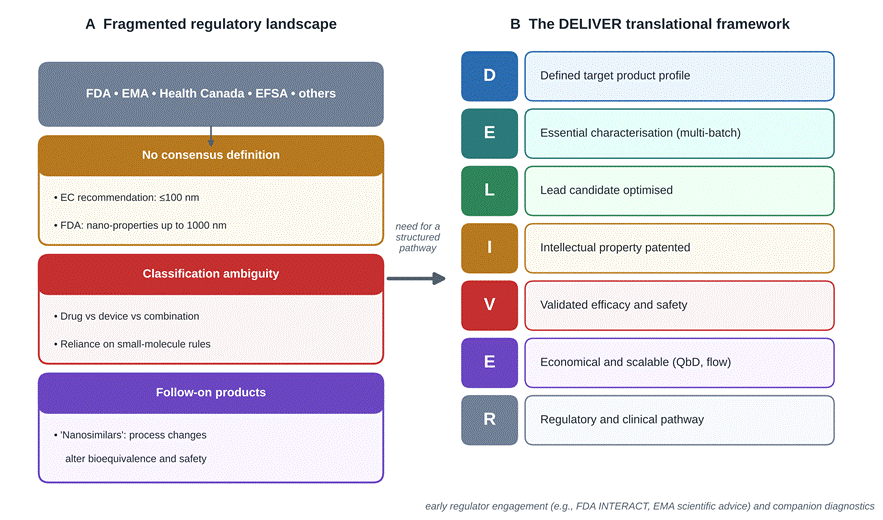
Commercialisation remains constrained by an ambiguous and poorly harmonised global regulatory landscape (Allan et al., 2021; Dri et al., 2022; Foulkes et al., 2020). Figure 6 contrasts the principal regulatory gaps with the structured pathway proposed to address them (Figure 6).

2.5.1 Regulatory Ambiguity and the Absence of Global Harmonisation

The FDA and EMA currently evaluate nanomedicines case by case within legal frameworks designed for small-molecule pharmaceuticals or biological products (Allan et al., 2021; Đorđević et al., 2021; Foulkes et al., 2020). Three

Table 3. Chemistry, manufacturing and controls (CMC), scale-up parameters and critical quality attributes of nanomedicine production. The table maps five manufacturing domains to the critical process parameters and material attributes that must be controlled within each, the resulting critical quality attributes (CQAs) that determine biological performance and safety, and the analytical techniques used to verify them. Together these entries define the control strategy required for reproducible Good Manufacturing Practice production, and they indicate why small deviations in processing conditions can alter biodistribution, clearance and toxicity. Analytical tools span particle sizing, surface characterisation, payload quantification, continuous-flow process technology and sterility testing. Abbreviations: AF4, asymmetric flow field-flow fractionation; EE%, encapsulation efficiency; FRR, flow rate ratio; PDI, polydispersity index; TFR, total flow rate.

Manufacturing & CMC domain

Critical process parameters (CPPs) & material attributes

Critical quality attributes (CQAs) & impact

Characterisation & analytical tool

References

Particle dimensions & monodispersity

Mixing speed, flow rate ratio (FRR), lipid/polymer concentration, solvent evaporation rate.

Hydrodynamic diameter and polydispersity index (PDI); dictates extravasation, renal filtration (<5 nm), and MPS clearance (>100–200 nm).

Dynamic light scattering (DLS), nanoparticle tracking analysis (NTA), AF4, TEM/cryo-TEM.

Agrahari & Agrahari (2018); Đorđević et al. (2021); Dri et al. (2022); Joyce et al. (2024)

Surface chemistry & charge

Zeta potential, surface ligand density, polymer molecular weight, conjugation chemistry.

Surface charge and functionalisation; controls colloidal aggregation stability, protein corona profile, and membrane interactions.

Zetasizer (electrophoretic light scattering), ATR-FTIR, XPS, NMR spectroscopy.

Đorđević et al. (2021); Dri et al. (2022); Joyce et al. (2024)

Payload encapsulation & drug release

Drug-to-lipid/polymer ratio, pH gradients, organic-to-aqueous phase ratios.

Total drug loading (TDL), encapsulation efficiency (EE%), free vs. bound drug ratio, and burst/sustained release kinetics.

High-performance liquid chromatography (HPLC-UV/Vis), LC-MS/MS, in situ ultrafiltration assay.

Đorđević et al. (2021); Dri et al. (2022); Thapa & Kim (2023)

Industrial scale-up & process technology

Impeller shear speed, microfluidic total flow rate (TFR), temperature control, channel dimensions.

Batch-to-batch reproducibility, structural integrity, continuous self-assembly yield, and prevention of batch heterogeneity.

Microfluidic continuous-flow mixing chips, Quality-by-Design (QbD), process analytical technology (PAT).

Agrahari & Agrahari (2018); Colombo et al. (2018); Microfluidic-enabled nanomedicine (2023)

Impurities, sterility & bioburden

Removal of residual organic solvents (chloroform ≤60 ppm, DMF ≤880 ppm), endotoxin contamination.

Apyrogenicity, sterility, and chemical purity; prevents acute pyrogenic shock, severe systemic inflammatory reactions, and toxicity.

Limulus amebocyte lysate (LAL) assay, 1H-NMR, GC-MS, NCL STE-1 to STE-4 protocols.

Agrahari & Agrahari (2018); Đorđević et al. (2021); Joyce et al. (2024)

Table 4. Preclinical models, nanotoxicology, immunotoxicity and mechanisms of clinical attrition. Each row identifies one determinant of late-stage translational failure, the underlying pathophysiological or methodological mechanism, and the clinical failure mode through which it manifests during human testing. The table links the limitations of conventional preclinical models to the steep decline in success rates observed between Phase I and Phase III, and it distinguishes efficacy-related attrition from immunotoxicological hazards such as complement activation-related pseudoallergy and cytokine release syndrome. The fourth column lists the predictive assessment frameworks, assays and model systems proposed to detect each risk before clinical exposure. Abbreviations: CARPA, complement activation-related pseudoallergy; CRS, cytokine release syndrome; IVIVC, in vitro-in vivo correlation; QSAR, quantitative structure-activity relationship; ROS, reactive oxygen species.

Toxicological / clinical domain

Underlying pathophysiological mechanism

Clinical failure mode & limitations

Predictive assessment frameworks

References

Preclinical model disconnect

Subcutaneous xenografts in immunodeficient mice vs. complex, heterogeneous human tumours.

Animal models overestimate passive EPR delivery and fail to replicate human stroma density, vascularity, and immune surveillance.

Genetically engineered mouse models (GEMM), patient-derived xenografts (PDX), microfluidic organ-on-chip models.

Đorđević et al. (2021); Hua et al. (2018); Metselaar & Lammers (2020); Satalkar et al. (2016)

Clinical attrition across phases

High Phase I success (~94%) dropping sharply in Phase II (~48%) and Phase III (~14%).

Inability to demonstrate superior efficacy over standard-of-care, unpredicted late-stage organ toxicities, lack of patient stratification.

DELIVER framework, companion imaging diagnostics for EPR screening, robust IVIVC validation.

Đorđević et al. (2021); He et al. (2019); Joyce et al. (2024)

Complement activation-related pseudoallergy (CARPA)

C1q/C3 opsonisation of anionic or PEGylated nanocarriers triggering anaphylatoxin generation (C3a, C5a).

Induces non-IgE-mediated acute hypersensitivity, chest tightness, hypotension, facial flushing, and potential anaphylaxis.

NCL immunotoxicity assay protocols, porcine/canine in vitro complement assays, neutral biopolymer substitution.

Đorđević et al. (2021); Soares et al. (2018); Tavano et al. (2018)

Cytokine release syndrome (CRS)

Pro-inflammatory macrophage activation (release of TNF-α, IL-6, IL-1β) by metallic or cationic nanocarriers.

Triggering of systemic hyper-inflammation, vascular leak, severe organ damage, and early clinical trial termination (e.g., MRX34).

Multiplex cytokine ELISA/bead assays, quasi-QSAR predictive machine learning hazard screening.

Đorđević et al. (2021); Teng et al. (2025); Zhang et al. (2020)

Non-target organ accumulation & delayed toxicity

Sequestration of non-biodegradable or metallic nanostructures in liver Kupffer cells, spleen, and kidney tubules.

Chronic ROS generation, oxidative stress, lipid peroxidation, DNA strand breaks, and delayed tissue inflammation/fibrosis.

Non-destructive PAT monitoring, safe-by-design principles (NANoREG/ProSafe), renal-clearable ultrasmall nanocarriers (<5 nm).

Agrahari & Agrahari (2018); Ellakwa & Ellakwa (2026); Foulkes et al. (2020)


gaps recur in the literature. First, consensus definitions are lacking: European Commission recommendations set an upper size limit of 100 nm, whereas the FDA considers functional nano-properties up to 1000 nm (Dri et al., 2022). Second, classification is ambiguous, since multi-component constructs combining therapeutic, targeting and diagnostic moieties blur the boundary between medicinal products, devices and combination products (Foulkes et al., 2020; Soares et al., 2018). Third, guidance for follow-on products, so-called nanosimilars, remains contested, because subtle manufacturing differences between innovator and generic products can materially affect bioequivalence and safety (Mühlebach, 2018; Satalkar et al., 2016).

2.5.2 The DELIVER Framework

To address these systemic barriers, Joyce et al. (2024) proposed the DELIVER framework, a structured set of principles guiding investigators from lead discovery through trial design to registration. Its elements are a defined target product profile, establishing therapeutic goals, target populations, routes of administration and clinical benchmarks early; essential characterisation, meaning comprehensive orthogonal assessment of physicochemical properties, CMAs and stability across multiple production batches; an optimised lead candidate, refined in composition, loading and surface features through screening in disease-relevant models; patented intellectual property, with freedom to operate and a demonstrable advantage over standard of care; validated efficacy and safety, verified using predictive biomarkers and disease-relevant models; economical and scalable manufacture, designed within an industrial framework such as QbD or continuous microfluidics; and a defined regulatory and clinical pathway, supported by early agency engagement through mechanisms such as FDA INTERACT or EMA scientific advice and by companion diagnostics for patient stratification (Joyce et al., 2024).

Adoption of structured frameworks of this kind, together with transparent reporting standards and multi-stakeholder collaboration among academic researchers, industrial developers, clinicians and regulators, is widely regarded as essential if disruptive nanotherapeutics are to move from bench discovery into clinical reality (Conde et al., 2020; Đorđević et al., 2021; Joyce et al., 2024; Leong et al., 2019).

3. Methods

3.1 Study Design and Reporting Approach

This work was designed as a structured narrative review with a systematic, documented search component, an approach appropriate when the objective is to integrate mechanistic, pharmaceutical and regulatory evidence that is too heterogeneous for quantitative pooling (Metselaar & Lammers, 2020; Satalkar et al., 2016). Because the included literature comprises reviews, perspectives, quantitative meta-analyses, qualitative interview studies and regulatory analyses rather than comparable interventional trials, no meta-analysis was attempted and no pooled effect estimate is reported. Reporting follows the structure recommended for narrative syntheses, and the search strategy, eligibility criteria and data-extraction procedure are described below in sufficient detail to permit independent replication. The guiding question was formulated as follows: among nanotherapeutic platforms evaluated preclinically or clinically, which biological, pharmaceutical-manufacturing, toxicological and regulatory factors determine progression to regulatory approval, and which mitigation strategies are supported by current evidence?

3.2 Information Sources and Search Period

Four electronic databases were interrogated: PubMed/MEDLINE, Scopus, Web of Science Core Collection and ScienceDirect. Searches covered records published between 1 January 2012 and 30 June 2026, the opening date chosen to coincide with the retrospective analysis of Doxil® that established the modern framework for evaluating approved nanomedicines (Barenholz, 2012). These were supplemented by targeted interrogation of regulatory and institutional sources, specifically the FDA and EMA public guidance repositories and the documentation of the Nanotechnology Characterization Laboratory, and by the ClinicalTrials.gov registry, which was used to contextualise the number and distribution of interventional nanomedicine studies (Allan et al., 2021; Dri et al., 2022; Shan et al., 2022). The final search was executed in June 2026, and no language filter other than English was applied.

3.3 Search Strategy

A Boolean strategy combining controlled vocabulary with free-text terms was constructed for PubMed and then adapted syntactically for each remaining database. The core string was: ("nanomedicine"[MeSH] OR "nanoparticles"[MeSH] OR nanocarrier* OR liposom* OR "lipid nanoparticle*" OR "polymeric micelle*" OR nanogel*) AND ("clinical translation" OR "translational research" OR "bench to bedside" OR "clinical trial*" OR "regulatory approval") AND ("protein corona" OR "mononuclear phagocyte system" OR "enhanced permeability and retention" OR "biological barrier*" OR "scale-up" OR "good manufacturing practice" OR "quality by design" OR "critical quality attribute*" OR nanotoxicolog* OR immunotoxicit* OR "regulatory framework*"). Reference lists of all included articles were hand-searched, a backward citation procedure that identified several seminal sources not retrieved electronically, including the quantitative biodistribution analysis of Wilhelm et al. (2016) and the reporting-standard proposals of Conde et al. (2020) and Leong et al. (2019).

3.4 Eligibility Criteria

Records were eligible if they were peer-reviewed articles published in English within the specified window and addressed at least one of five predefined domains: the clinical or commercial landscape of approved nanomedicines; nano-bio interfacial phenomena and physiological barriers; CMC, scale-up or manufacturing technology; nanotoxicology, immunotoxicity or preclinical predictive modelling; or regulatory science and translational frameworks. Both primary studies and authoritative syntheses were admitted, given the mechanistic breadth of the question. Records were excluded if they concerned purely non-biomedical nanotechnology, such as nanoplastics in environmental matrices, except where regulatory classification was directly relevant (Allan et al., 2021); if they reported materials characterisation with no therapeutic or translational context; if they were conference abstracts, editorials or preprints lacking peer review; or if they duplicated data already captured in an included source.

3.5 Study Selection and Data Extraction

Titles and abstracts retrieved by the search were screened against the eligibility criteria, after which full texts of potentially relevant records were assessed. Duplicates across databases were removed before screening. For each included record, data were extracted into a predefined matrix capturing bibliographic details; nanoplatform class and composition; therapeutic indication; the translational domain addressed; reported quantitative parameters, including delivery efficiency, phase-wise success rates, clearance fractions and size or charge specifications; stated barriers to translation; and proposed mitigation strategies. Extracted quantitative values were traced to their primary source wherever a review cited them secondarily; the 0.7% median tumour delivery figure, for example, was verified against the original analysis rather than accepted from downstream citation (Wilhelm et al., 2016).

3.6 Evidence Synthesis

Extracted data were synthesised thematically. Findings were first coded against the five domains defined in Section 3.4, then organised along the translational continuum shown in Figure 1, so that each barrier could be located at the stage of development at which it first becomes limiting (Figure 1). Where independent sources reported concordant quantitative values, for instance the phase-wise attrition pattern described by both Đorđević et al. (2021) and He et al. (2019), the convergence was treated as strengthening confidence in the estimate. Where estimates diverged, as in the reported range of approved nanomedicines, the range rather than a point value is presented (Shan et al., 2022; Thapa & Kim, 2023; Zhang et al., 2020). Consolidated evidence was tabulated across four structured matrices covering approved products (Table 1), biological barriers (Table 2), CMC parameters (Table 3) and preclinical and toxicological determinants of attrition (Table 4), and the principal mechanistic relationships were rendered as six schematic and quantitative figures (Figures 1-6).

3.7 Methodological Limitations

Three limitations warrant explicit statement. First, reliance on published literature means that negative or unpublished translational failures are systematically under-represented, which probably biases the evidence base towards reported successes (Leong et al., 2019; Satalkar et al., 2016). Second, because a substantial proportion of included sources are themselves reviews, some quantitative claims propagate through the literature from a small number of primary analyses; this was mitigated, though not eliminated, by source tracing as described in Section 3.5. Third, no formal risk-of-bias instrument was applied, since no validated tool exists for the mixed evidence types synthesised here; study quality was instead appraised qualitatively on the basis of methodological transparency, sample provenance and consistency with independent reports.

4. Clinical Performance, Bio-Nano Barriers, Manufacturing Dynamics and Translational Bottlenecks

Taken together, the included literature describes a field that is neither failing nor flourishing, but unevenly successful. Nanotechnology has delivered genuine clinical value in particular niches, yet the pipeline as a whole is marked by steep attrition, intricate biological interactions and demanding manufacturing requirements. What follows organises the evidence by domain rather than by source, and notes where the picture is clearer than the numbers suggest, and where it is murkier.

4.1 The Current Clinical and Market Landscape

4.1.1 Distribution by Carrier Class

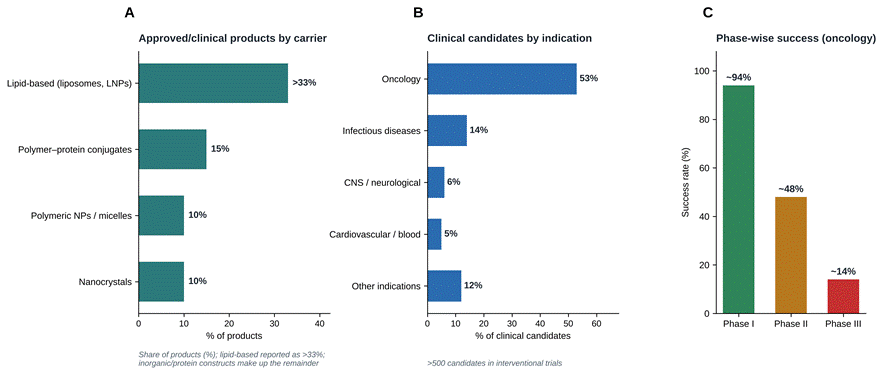
Globally authorised formulations number somewhere between 50 and 100, depending on how one counts; the imprecision is itself informative, since it reflects the absence of a harmonised definition of what qualifies as a nanomedicine (Đorđević et al., 2021; Shan et al., 2022; Zhang et al., 2020). Lipid-based platforms, principally PEGylated liposomes and LNPs, dominate, accounting for more than a third of approved and clinical-stage products (Farjadian et al., 2019; Thapa & Kim, 2023; Figure 5A). Polymer-protein conjugates contribute roughly 15%, polymeric nanoparticles and micelles and nanocrystals approximately 10% each, with inorganic and protein-based constructs making up the remainder (Agrahari & Agrahari, 2018; Shan et al., 2022; Figure 5A). The pattern is not accidental. First-generation products such as Doxil® and Abraxane® earned approval largely by reducing off-target toxicity rather than by improving tumour kill, a proof of concept that favoured chemically simple, reproducibly manufacturable carriers (Barenholz, 2012; Hua et al., 2018; Table 1). More recently, LNP platforms have extended the clinical scope into gene silencing and mRNA immunisation, exemplified by patisiran and by the COVID-19 vaccines (Đorđević et al., 2021; Joyce et al., 2024; Milane & Amiji, 2021; Table 1).

4.1.2 Indication Distribution and the Attrition Curve

Analysis of ongoing interventional studies identifies more than 500 active candidate nanomedicines at various stages (Shan et al., 2022; Thapa & Kim, 2023). Oncology accounts for roughly 53% of these, followed by infectious disease at 14%, central nervous system disorders at 6% and cardiovascular conditions at 5%, with the balance distributed across other indications (Shan et al., 2022; Thapa & Kim, 2023; Figure 5B). Progression through the phases, however, follows a steep and well-documented decline. Approximately 94% of candidates clear Phase I; 48% survive Phase II; and only about 14% succeed in Phase III (Đorđević et al., 2021; He et al., 2019; Figure 5C; Table 4). It is worth being precise about what this pattern implies. High Phase I success indicates that nanocarriers are, on the whole, tolerably safe at the doses tested. The collapse thereafter is therefore not principally a toxicity problem but an efficacy problem, or more exactly a problem of demonstrating superiority over an existing standard of care (He et al., 2019; Metselaar & Lammers, 2020).

4.2 Quantitative Assessment of the Bio-Nano Interface

4.2.1 Delivery Efficiency and EPR Heterogeneity

The single most cited quantitative finding in the field is also its most sobering: across a wide spectrum of synthetic nanocarriers, a median of only 0.7% of the injected dose accumulates in solid tumours (Wilhelm et al., 2016; Figure 2B). Several authors have questioned whether a median drawn from heterogeneous studies is the right summary statistic, and that caution is reasonable; nevertheless, no analysis has produced a materially more encouraging figure (Mahmoudi, 2018; Sindhwani & Chan, 2021). The practical implication is that passive accumulation through the EPR effect cannot, on its own, carry a therapeutic programme (Sindhwani & Chan, 2021; Teng et al., 2025). Clinical observation reinforces the point: EPR varies markedly between patients, between anatomical sites and across disease stages (Teng et al., 2025; Table 2). Additional features of the tumour microenvironment compound the problem, since dense ECM collagen networks and elevated IFP arising from dysfunctional lymphatics eliminate the transcapillary pressure gradients on which convective transport depends (Blanco et al., 2015; Teng et al., 2025; Figure 3B).

4.2.2 Corona Formation and Immune Clearance

Immediately on contact with plasma, nanocarriers acquire a layer of endogenous proteins, including albumins, immunoglobulins and complement factors, which constitutes the biomolecular corona (Hadjidemetriou & Kostarelos, 2017; Teng et al., 2025; Figure 2A). This coating alters the carrier's synthetic identity, routinely masking engineered targeting ligands such as antibodies or peptides, and promoting opsonisation (Ellakwa & Ellakwa, 2026; Mahmoudi, 2018). Hepatic Kupffer cells

Figure 3. Tissue-level barriers to nanocarrier delivery and the engineering responses proposed for each. The four upper panels summarise, respectively, the blood-brain barrier, the tumour stroma, heterogeneity of the enhanced permeability and retention effect, and the accelerated blood clearance phenomenon associated with repeated administration of PEGylated carriers. For each barrier the principal anatomical or immunological mechanism is listed together with its consequence for nanoparticle transport. The corresponding dashed panel beneath each barrier sets out the mitigation strategies currently under investigation, ranging from receptor-mediated transcytosis and focused ultrasound to matrix-degrading carriers, imaging-based patient stratification and alternative stealth chemistries. Abbreviations: ABC, accelerated blood clearance; ECM, extracellular matrix; EPR, enhanced permeability and retention; IFP, interstitial fluid pressure; IgM, immunoglobulin M

Figure 4. From laboratory synthesis to Good Manufacturing Practice manufacture under a Quality-by-Design control strategy. The upper row traces the three stages of pharmaceutical scale-up: small-volume laboratory preparation using manual benchtop techniques, which typically yields high batch-to-batch variability; process optimisation, in which microfluidic continuous-flow mixing and inline process analytical technology replace batch methods; and Good Manufacturing Practice production at litre scale with critical quality attributes held within specification. The lower row depicts the Quality-by-Design workflow applied across this transition, beginning with definition of the quality target product profile and proceeding through identification of critical quality attributes, mapping of critical material attributes and process parameters, statistical design of experiments and implementation of a process-analytics-based control strategy. The dashed return arrow indicates continual verification across the product lifecycle.

and splenic macrophages consequently sequester between 60% and 90% of the circulating dose within minutes to hours (Agrahari & Agrahari, 2018; Ellakwa & Ellakwa, 2026; Table 2). PEGylation extends plasma half-life, but repeated administration frequently provokes the ABC phenomenon through anti-PEG IgM generation, with rapid immune elimination on subsequent doses (Ellakwa & Ellakwa, 2026; Ma et al., 2025; Figure 3D). Two observations follow. First, the corona is not merely an obstacle to be shielded against; it is a variable that differs by species and by patient, and that difference may well account for part of the preclinical-to-clinical discrepancy (Mahmoudi, 2018; Teng et al., 2025). Second, stealth chemistry has limits that only became visible after sustained clinical use, which is a cautionary precedent for newer platforms (Ma et al., 2025).

4.3 Industrial Scale-Up, Critical Quality Attributes and Process Control

4.3.1 Attributes Governing Safety and Efficacy

Translating laboratory preparations into GMP-compliant commercial manufacture remains a primary technological hurdle (Agrahari & Agrahari, 2018; Đorđević et al., 2021; Figure 4). Minor fluctuations in shear velocity, solvent evaporation rate or temperature produce substantial shifts in CQAs (Colombo et al., 2018; Đorđević et al., 2021; Table 3). Five attributes recur as mandatory across the synthesised literature. Hydrodynamic diameter and PDI determine fate at both extremes of the size distribution, since particles above roughly 200 nm trigger complement activation and MPS entrapment while those below 5 nm undergo rapid renal filtration (Dri et al., 2022; Thapa & Kim, 2023). Surface zeta potential governs colloidal stability and resistance to premature aggregation in protein-rich media (Dri et al., 2022). Encapsulation efficiency and drug loading dictate the therapeutic payload delivered per carrier (Agrahari & Agrahari, 2018; Dri et al., 2022). Release kinetics determine whether the payload survives circulation intact or is lost to a premature burst (Đorđević et al., 2021). Finally, sterility and endotoxin levels must be rigorously controlled to avoid acute pyrogenic reactions (Agrahari & Agrahari, 2018; Joyce et al., 2024; Table 3).

4.3.2 Manufacturing Platforms and Inline Analytics

To achieve batch-to-batch reproducibility, traditional top-down methods such as sonication and high-pressure homogenisation are progressively being displaced by continuous-flow microfluidic mixing (Colombo et al., 2018; Microfluidic-enabled nanomedicine, 2023). Controlling fluid interaction at laminar scales yields highly uniform nanostructures with tightly constrained PDI (Microfluidic-enabled nanomedicine, 2023). Coupling QbD principles with inline PAT, including DLS and spectroscopic sensors, permits real-time monitoring of CQAs during continuous production and reduces the risk of batch rejection (Agrahari & Agrahari, 2018; Đorđević et al., 2021; Joyce et al., 2024; Figure 4). Whether microfluidic parallelisation scales economically to commercial volumes is, at present, unresolved (Microfluidic-enabled nanomedicine, 2023).

4.4 Preclinical Predictability, Toxicological Safety and Mechanisms of Attrition

4.4.1 The Preclinical Model Disconnect

Preclinical evaluation continues to rely on two-dimensional monolayer culture and subcutaneous xenografts in immunodeficient mice (Hua et al., 2018; Metselaar & Lammers, 2020; Table 4). These models do not replicate human vascular architecture, dense stromal barriers, intact immune surveillance or inter-patient heterogeneity (Metselaar & Lammers, 2020; Satalkar et al., 2016). Candidates showing robust antitumour activity in rodents therefore often fail to demonstrate superiority over standard of care in Phase II or III (Đorđević et al., 2021; He et al., 2019). One might expect this gap to have narrowed as the field matured; the attrition data suggest it has not, at least not yet (He et al., 2019).

4.4.2 Immunotoxicity and Risk Mitigation

Systemic administration of complex nanostructures can trigger immunotoxicological pathways that basic animal screens capture poorly (Đorđević et al., 2021; Soares et al., 2018; Table 4). CARPA, a non-IgE-mediated hypersensitivity driven by C3a and C5a anaphylatoxins, and CRS, capable of inducing vascular leak and systemic hyper-inflammation, are the two best-characterised hazards (Đorđević et al., 2021; Tavano et al., 2018). Against these roadblocks, the synthesised evidence converges on three mitigations: adoption of structured development frameworks, notably DELIVER (Joyce et al., 2024; Figure 6B); integration of biomimetic three-dimensional screening, including patient-derived organ-on-chip systems and multicellular tumour spheroids (Đorđević et al., 2021; Table 4); and companion diagnostic imaging, such as ferumoxytol-enhanced magnetic resonance or radiolabelled positron emission tomography, to stratify patients by actual EPR permeability before enrolment (Joyce et al., 2024; Teng et al., 2025). None of these is yet standard practice, which is perhaps the most consequential finding of this synthesis.

5. Reconciling Nanoscale Promise with Clinical Performance

5.1 Principal Observations

Three findings dominate this synthesis, and they are not independent of one another. The field has produced a modest but genuine set of approved products, concentrated in lipid-based platforms and oncology (Shan et al., 2022; Thapa & Kim, 2023; Table 1; Figure 5A). Delivery to target tissue is far less efficient than the early literature implied, with a median tumour accumulation of 0.7% of the injected dose (Wilhelm et al., 2016; Figure 2B). And clinical attrition is concentrated after Phase I, which locates the central problem in efficacy and comparative benefit rather than in acute safety (Đorđević et al., 2021; He et al., 2019; Figure 5C). Read together, these suggest that the limiting factor is not whether nanocarriers can be made, but whether what they do in a patient can be predicted before a Phase III trial is committed.

5.2 Why Biological Barriers Remain the Rate-Limiting Step

The most persuasive explanation for the efficacy gap lies at the nano-bio interface. A nanoparticle that has been carefully functionalised with targeting ligands may, within seconds of injection, present an entirely different surface to the body (Hadjidemetriou & Kostarelos, 2017; Mahmoudi, 2018; Figure 2A). If the corona masks those ligands, then active targeting as conventionally conceived is partly illusory, which would help explain why ligand-decorated constructs have so rarely outperformed their untargeted counterparts in patients (Ellakwa & Ellakwa, 2026; Teng et al., 2025; Table 2). This is not a settled conclusion. Corona composition can in principle be exploited rather than merely resisted, through dysopsonin pre-coating or biomimetic membrane camouflage, and several groups have argued precisely this (Mahmoudi, 2018; Table 2). Still, the practical record to date favours caution.

The EPR effect presents a related difficulty. Its status shifted, over roughly a decade, from design principle to contested assumption (Sindhwani & Chan, 2021; Teng et al., 2025). What makes the shift awkward is that a generation of preclinical data was generated in models that systematically overstate it (Metselaar & Lammers, 2020; Figure 3C). If murine subcutaneous xenografts exaggerate passive accumulation, then efficacy estimates carried forward from those studies are inflated at the point where they matter most, namely the decision to proceed to late-phase testing (He et al., 2019; Table 4). Tissue-specific barriers compound this further: the BBB excludes the overwhelming majority of macromolecular carriers, and elevated IFP within tumours abolishes the very pressure gradient on which convective delivery depends (Blanco et al., 2015; de La Taille et al., 2025; Modi & Modi, 2023; Figure 3A, 3B).

5.3 Manufacturing as a Translational Determinant, Not a Downstream Detail

It would be easy to treat CMC as an engineering afterthought. The evidence does not support that reading. Because biological behaviour is governed by size, charge, loading and release, and because these attributes drift with modest changes in processing conditions, manufacturing variability translates directly into pharmacological variability (Colombo et al., 2018; Đorđević et al., 2021; Table 3). A formulation that cannot be produced reproducibly cannot be evaluated reliably, whatever its mechanism. This is the strongest argument for front-loading QbD rather than relying on end-product testing, and for embedding PAT within continuous production (Agrahari & Agrahari, 2018; Joyce et al., 2024; Figure 4). Microfluidic continuous-flow synthesis offers the most credible route to monodisperse, reproducible output, though the question of whether numbering-up scales economically to commercial volumes remains genuinely open (Microfluidic-enabled nanomedicine, 2023).

5.4 Regulatory Fragmentation and Its Development Costs

Regulatory uncertainty functions as a multiplier on the technical difficulties already described. Divergent size definitions, with the European Commission recommending an upper limit of 100 nm while the FDA considers nano-properties up to 1000 nm, mean that an identical product may be classified differently in different jurisdictions (Allan et al., 2021; Dri et al., 2022; Figure 6A). Ambiguity over whether a multifunctional construct is a medicine, a device or a combination product compounds the problem for developers planning a global programme (Foulkes et al., 2020; Soares et al., 2018). The nanosimilar question is perhaps the most consequential of all, because the

Figure 5. Quantitative landscape of approved and clinical-stage nanomedicines. Panel A shows the distribution of approved and clinical-stage products by carrier class, with lipid-based platforms, principally PEGylated liposomes and lipid nanoparticles, accounting for more than a third of the total and the balance divided among polymer-protein conjugates, polymeric nanoparticles and micelles, nanocrystals and inorganic or protein-based constructs. Panel B shows the distribution of more than 500 active clinical candidates by therapeutic indication, in which oncology remains dominant. Panel C shows the approximate phase-wise success rates reported for oncology nanomedicines, illustrating that attrition is concentrated after Phase I and therefore reflects difficulty in demonstrating comparative efficacy rather than acute safety failure. Values are as reported in the synthesised literature and are approximate.

Figure 6. Regulatory fragmentation and the DELIVER translational framework. Panel A summarises the three recurrent gaps in the current regulatory landscape: the absence of a consensus definition of a nanomaterial, with the European Commission recommending an upper limit of 100 nm while the US Food and Drug Administration considers functional nano-properties up to 1000 nm; classification ambiguity between medicinal products, devices and combination products; and the lack of accepted criteria for follow-on nanosimilar products whose manufacturing differences may affect bioequivalence. Panel B sets out the seven elements of the DELIVER framework, which specifies the sequence in which target product definition, characterisation, lead optimisation, intellectual property, validation, manufacturability and regulatory strategy should be addressed during development. Early agency engagement and companion diagnostics underpin the final element.

absence of accepted bioequivalence criteria limits the price competition that ordinarily follows patent expiry (Mühlebach, 2018). Case-by-case evaluation is defensible given the diversity of the products involved, but it imposes costs that fall disproportionately on smaller developers and academic spin-outs (Satalkar et al., 2016).

5.5 What a Credible Path Forward Looks Like

Structured frameworks such as DELIVER are valuable less for any individual element than for enforcing the sequence in which decisions are made, and specifically for requiring that characterisation, scalability and regulatory strategy be addressed before rather than after a lead is selected (Joyce et al., 2024; Figure 6B). Several complementary measures emerge from this synthesis. Patient stratification using companion imaging, for instance ferumoxytol-enhanced MRI, would allow enrolment of patients whose tumours actually exhibit the permeability a given design assumes, rather than treating EPR as uniformly present (Teng et al., 2025; Table 4). Disease-relevant preclinical models, including genetically engineered mouse models, patient-derived xenografts and organ-on-chip systems, would reduce the inflation introduced by simplified xenografts (Hua et al., 2018; Metselaar & Lammers, 2020). Standardised minimum-information reporting would improve reproducibility across the bio-nano literature and make cross-study comparison meaningful (Conde et al., 2020; Leong et al., 2019). And safe-by-design principles applied from the outset, coupled with validated immunotoxicity cascades, would address CARPA and CRS risks before rather than during clinical testing (Đorđević et al., 2021; Tavano et al., 2018; Table 4).

5.6 Limitations of the Present Synthesis

Several caveats qualify these conclusions. The literature reviewed is weighted towards oncology, so inferences about infectious disease, neurological or cardiovascular applications rest on a thinner evidential base (Shan et al., 2022; Figure 5B). Publication bias almost certainly under-represents translational failure, which means the attrition figures reported here, discouraging as they are, may still be optimistic (Leong et al., 2019; Satalkar et al., 2016). Frequently cited quantitative values derive from a limited number of primary analyses and have been propagated widely, so apparent consensus may partly reflect repetition rather than independent confirmation (Wilhelm et al., 2016). Finally, the field is moving quickly; platforms such as micro- and nanomotors and next-generation stealth chemistries have not yet accumulated the clinical record needed for the kind of assessment offered here (Ma et al., 2025).

6. Conclusion

Nanomedicine has demonstrated, convincingly and at scale, that nanoscale carriers can change clinical practice, yet the distance between laboratory promise and routine patient benefit remains wide. This review locates that distance in four interacting domains. Biologically, the protein corona, MPS clearance and heterogeneous EPR confine tumour delivery to a median of 0.7% of the injected dose. Pharmaceutically, scale-up under GMP introduces variability in the very attributes that govern in vivo behaviour. Clinically, attrition concentrated after Phase I reveals a failure of predictive modelling rather than of acute safety. Regulatorily, fragmented definitions and ambiguous classification raise development cost and risk. Progress will therefore depend less on novel chemistry than on disciplined integration: safe-by-design engineering, Quality-by-Design manufacture with inline process analytics, disease-relevant preclinical models, companion diagnostics for patient stratification, transparent reporting standards and early regulatory engagement, coordinated through structured frameworks such as DELIVER. Closing the translational gap is an organisational challenge as much as a scientific one.

References


Agrahari, V., & Agrahari, V. (2018). Facilitating the translation of nanomedicines to a clinical product: challenges and opportunities. Drug Discovery Today, 23(5), 974–991. https://doi.org/10.1016/j.drudis.2018.01.047

Allan, J., Belz, S., Hoeveler, A., Hugas, M., Okuda, H., Patri, A., Silva, P., Slikker, W., Sokull-Kluettgen, B., Tong, W., & Anklam, E. (2021). Regulatory landscape of nanotechnology and nanoplastics from a global perspective. Regulatory Toxicology and Pharmacology, 122, 104885. https://doi.org/10.1016/j.yrtph.2021.104885

Barenholz, Y. (2012). Doxil®—the first FDA-approved nano-drug: lessons learned. Journal of Controlled Release, 160(2), 117–134. https://doi.org/10.1016/j.jconrel.2012.03.020

Blanco, E., Shen, H., & Ferrari, M. (2015). Principles of nanoparticle design for overcoming biological barriers to drug delivery. Nature Biotechnology, 33(9), 941–951. https://doi.org/10.1038/nbt.3330

Colombo, S., Beck-Broichsitter, M., Bøtker, J. P., Malmsten, M., Rantanen, J., & Bohr, A. (2018). Transforming nanomedicine manufacturing toward quality by design and microfluidics. Advanced Drug Delivery Reviews, 128, 115–131. https://doi.org/10.1016/j.addr.2018.04.004

Conde, J., Shae, D., & Wang, A. Z. (2020). Minimum information reporting in bio-nano experimental literature: narrowing the translational gap. ACS Nano, 14(11), 14283–14288. https://doi.org/10.1021/acsnano.0c08234

de La Taille, T., Doukhi, D., Mazighi, M., & Chauvierre, C. (2025). Ischemic strokes: exploring the challenges of translating nanomedicine into clinical practice. Journal of Nanoparticle Research, 27, 88. https://doi.org/10.1007/s11051-025-06282-6

Ðordevic, S., Gonzalez, M. M., Conejos-Sánchez, I., Carreira, B., Pozzi, S., Acúrcio, R. C., Satchi-Fainaro, R., Florindo, H. F., & Vicent, M. J. (2021). Current hurdles to the translation of nanomedicines from bench to the clinic. Drug Delivery and Translational Research, 12(3), 500–525. https://doi.org/10.1007/s13346-021-01024-2

Dri, D. A., Rinaldi, F., Carafa, M., & Marianecci, C. (2022). Nanomedicines and nanocarriers in clinical trials: surfing through regulatory requirements and physico-chemical critical quality attributes. Drug Delivery and Translational Research, 13, 757–769. https://doi.org/10.1007/s13346-022-01262-y

Ellakwa, E.-S., & Ellakwa, A. (2026). Biocompatible nanoparticles in medicine: from design to clinical translation. Discover Materials, 6(1), 28. https://doi.org/10.1007/s43939-026-00028-w

Farjadian, F., Ghasemi, A., Gohari, O., Roointan, A., Karimi, M., & Hamblin, M. R. (2019). Nanopharmaceuticals and nanomedicines currently on the market: challenges and opportunities. Nanomedicine, 14(1), 93–126. https://doi.org/10.2217/nnm-2018-0120

Foulkes, R., Man, E., Thind, J., Yeung, S., Joy, A., & Hoskins, C. (2020). The regulation of nanomaterials and nanomedicines for clinical application: current and future perspectives. Biomaterials Science, 8(17), 4653–4664. https://doi.org/10.1039/D0BM00558D

Hadjidemetriou, M., & Kostarelos, K. (2017). Nanomedicine: evolution of the nanoparticle corona. Nature Nanotechnology, 12(4), 288–290. https://doi.org/10.1038/nnano.2017.61

He, H., Liu, L., Morin, E. E., Liu, M., & Schwendeman, A. (2019). Survey of clinical translation of cancer nanomedicines—lessons learned from successes and failures. Accounts of Chemical Research, 52(9), 2445–2461. https://doi.org/10.1021/acs.accounts.9b00228

Hua, S., de Matos, M. B. C., Metselaar, J. M., & Storm, G. (2018). Current trends and challenges in the clinical translation of nanoparticulate nanomedicines: pathways for translational development and commercialization. Frontiers in Pharmacology, 9, 790. https://doi.org/10.3389/fphar.2018.00790

Joyce, P., D'Amico, C., Fontana, F., Cheng, R., & Santos, H. A. (2024). A translational framework to DELIVER nanomedicines to the clinic. Nature Nanotechnology, 19, 1–15. https://doi.org/10.1038/s41565-024-01758-1

Leong, H. S., Butler, K. S., Brinker, C. J., Azzawi, M., Conlan, S., Dufès, C., et al. (2019). On the issue of transparency and reproducibility in nanomedicine. Nature Nanotechnology, 14(9), 811–812. https://doi.org/10.1038/s41565-019-0523-x

Ma, H., Yu, R.-F., & Yu, Z.-L. (2025). Micro/nanomotors in targeted drug delivery: Advances, challenges, and future directions. International Journal of Pharmaceutics, 674, 125471. https://doi.org/10.1016/j.ijpharm.2025.125471

Mahmoudi, M. (2018). Debugging nano–bio interfaces: path to translational success. Trends in Biotechnology, 36(11), 1088–1091. https://doi.org/10.1016/j.tibtech.2018.02.014

Metselaar, J. M., & Lammers, T. (2020). Challenges in nanomedicine clinical translation. Drug Delivery and Translational Research, 10(3), 721–725. https://doi.org/10.1007/s13346-020-00721-8

Microfluidic-enabled nanomedicine: a comprehensive review of recent advances. (2023). Drug Delivery and Translational Research, 13(10), 2450–2485.

Milane, L., & Amiji, M. (2021). Clinical approval of nanotechnology-based SARS-CoV-2 mRNA vaccines: impact on translational nanomedicine. Drug Delivery and Translational Research, 11(4), 1309–1315.

Modi, D. M., & Modi, A. D. (2023). A perspective on next generation nanomedicine: Nanogels for therapeutic drug delivery across biological barriers. Brain Disorders, 11, 100089. https://doi.org/10.1016/j.dscrb.2023.100089

Mühlebach, S. (2018). Regulatory challenges of nanomedicines and their follow-on versions: a generic or similar approach? Advanced Drug Delivery Reviews, 131, 122–131. https://doi.org/10.1016/j.addr.2018.06.024

Satalkar, P., Elger, B. S., Hunziker, P., & Shaw, D. (2016). Challenges of clinical translation in nanomedicine: A qualitative study. Nanomedicine: Nanotechnology, Biology and Medicine, 12(5), 1383–1392. https://doi.org/10.1016/j.nano.2015.12.376

Shan, X., Gong, X., Li, J., Wen, J., Li, Y., & Zhang, Z. (2022). Current approaches of nanomedicines in the market and various stage of clinical translation. Acta Pharmaceutica Sinica B, 12(7), 3028–3048. https://doi.org/10.1016/j.apsb.2022.02.025

Sindhwani, S., & Chan, W. C. W. (2021). Nanotechnology for modern medicine: next step towards clinical translation. Journal of Internal Medicine, 290(3), 486–498. https://doi.org/10.1111/joim.13258

Soares, S., Sousa, J., Pais, A., & Vitorino, C. (2018). Nanomedicine: principles, properties, and regulatory issues. Frontiers in Chemistry, 6, 360. https://doi.org/10.3389/fchem.2018.00360

Tavano, R., Gabrielli, L., Lubian, E., Fedeli, C., Visentin, S., Polverino De Laureto, P., et al. (2018). C1q-mediated complement activation and C3 opsonization trigger recognition of stealth poly(2-methyl-2-oxazoline)-coated silica nanoparticles by human phagocytes. ACS Nano, 12(6), 5834–5847. https://doi.org/10.1021/acsnano.8b01806

Teng, L., Bi, Y., Xing, X., et al. (2025). Nano-oncology revisited: Insights on precise therapeutic advances and biological barriers. Fundamental Research, 5(6), 1845–1859. https://doi.org/10.1016/j.fmre.2024.01.002

Thapa, R. K., & Kim, J. O. (2023). Nanomedicine-based commercial formulations: current developments and future prospects. Journal of Pharmaceutical Investigation, 53(1), 19–33. https://doi.org/10.1007/s40005-022-00607-0

Wilhelm, S., Tavares, A. J., Dai, Q., Ohta, S., Audet, J., Dvorak, H. F., & Chan, W. C. W. (2016). Analysis of nanoparticle delivery to tumours. Nature Reviews Materials, 1(5), 16014. https://doi.org/10.1038/natrevmats.2016.14

Zhang, C., Yan, L., Wang, X., et al. (2020). Clinical translation of nanomedicine: progress, challenges, and prospects. Nano Today, 35, 101008. https://doi.org/10.1016/j.nantod.2020.101008


Article metrics
View details
0
Downloads
0
Citations
22
Views

View Dimensions


View Plumx


View Altmetric


0
Save
0
Citation
22
View
0
Share