Biosensors and Nanotheranostics

Bionanotechnology, Drug Delivery, Therapeutics | online ISSN 3064-7789
175
Citations
113.3k
Views
70
Articles
Your new experience awaits. Try the new design now and help us make it even better
Switch to the new experience
Figures and Tables
REVIEWS   (Open Access)

Patient-Derived Organoid Screening of Theranostic Nanoparticles to Address Tumour Heterogeneity in Colorectal Cancer

Lamiah Hossain1*

+ Author Affiliations

Biosensors and Nanotheranostics 5 (1) 1-8 https://doi.org/10.25163/biosensors.5110972

Submitted: 04 May 2026 Revised: 23 June 2026  Published: 02 July 2026 


Abstract

Colorectal cancer remains the third most frequently diagnosed malignancy and the second leading cause of cancer death, and the reason advanced disease still resists durable control is not a shortage of drugs so much as a surplus of biological variation. Tumours differ between patients and, more awkwardly, within a single lesion, so a regimen that clears the dominant clone often leaves behind the subpopulation that later drives relapse. Theranostic nanoparticles — single vehicles that combine an imaging function with a targeted payload — were designed to sharpen delivery and let clinicians watch where a drug actually goes. Yet most of these formulations were selected in two-dimensional monolayers, which turns out to be a poor place to make that decision: flat culture overstates nanoparticle uptake by more than two-fold, builds a protein corona out of bovine rather than human proteins, and removes almost every physical barrier a nanocarrier would meet in tissue. This review argues that patient-derived organoids, and their microfluidic extensions on chip, are the missing intermediate. We synthesise evidence from organoid biobanking, nanoparticle engineering, protein-corona biology and clinical correlation studies, and we trace how organoids resolve what monolayers blur: subclone-selective uptake, lineage-specific endocytic routing, matrix-limited penetration, and the ablation of quiescent cancer stem cells. We also take seriously what organoids still cannot do — they lack perfusion, immune cells and standardised matrices — and we set out where synthetic hydrogels, immunocompetent co-cultures and AI-assisted formulation design are likely to carry the field next. The central claim is modest but consequential: screening venue is not a technical detail; it is a determinant of translational success.

Keywords: patient-derived organoids; theranostic nanoparticles; intratumoural heterogeneity; colorectal neoplasms; protein corona; organ-on-a-chip; cancer stem cells

1. Introduction

Colorectal cancer (CRC) sits awkwardly in modern oncology. It is common — the third most frequently diagnosed cancer worldwide, with more than 1.9 million new cases and roughly 935,000 deaths each year — and it is, in principle, among the most treatable solid tumours when caught early (Xin et al., 2025). Surgical resection cures a substantial fraction of localised disease. The difficulty begins with the patients who present late, or who recur, because for them the arithmetic changes sharply: five-year survival in metastatic disease falls to about 10%, and median overall survival has plateaued near 30 months despite three decades of regimen refinement (Singh et al., 2023).

The standard of care is not obviously deficient. Multi-agent chemotherapy built on 5-fluorouracil with either oxaliplatin (FOLFOX) or irinotecan (FOLFIRI) remains the backbone, supplemented by monoclonal antibodies against the epidermal growth factor receptor (EGFR) or vascular endothelial growth factor (VEGF), and, for the microsatellite instability-high subset, by immune checkpoint blockade (Li et al., 2025). Each of these was a genuine advance. What they share is a vulnerability: they are selected and dosed as though the tumour were a single biological entity, and it is not.

Two kinds of variation matter here, and conflating them has cost the field time. Intertumoral heterogeneity — the differences between one patient's tumour and another's, driven by distinct driver mutations in KRAS, BRAF, TP53 and PIK3CA, and by divergent epigenetic and transcriptional programmes — explains why a drug that works convincingly in one cohort disappoints in the next (Wang, Li, et al., 2026). Intratumoral heterogeneity is the harder problem. Single-cell analyses of CRC have shown that a single tumour mass harbours genetically and phenotypically distinct subclones that diversify continuously under selection (Roerink et al., 2018). Treatment then acts as a filter rather than an eraser: sensitive clones are removed, resistant ones — including slow-cycling, LGR5-expressing or CD133⁺/CD44⁺ stem-like populations — persist, repopulate and seed metastasis (Shimokawa et al., 2017; Fernandes et al., 2021).

That framing has a direct methodological consequence. If the biology that determines outcome is subclonal, then any preclinical platform that averages across clones, or that loses them during passaging, cannot in principle report the information a clinician needs. Drug development has long relied on a ladder running from monolayer culture to xenograft. Both rungs are weaker than their ubiquity suggests. Two-dimensional cultures lack three-dimensional architecture, cell–matrix engagement, differentiation gradients and the oxygen and nutrient gradients that shape drug response, and prolonged passaging strips them of the genetic diversity that made the original tumour interesting (Ahmad Zawawi et al., 2024; Sarkar & Othayoth, 2024). Spheroids recover some spatial realism — a necrotic core, a hypoxic gradient, a diffusion barrier — but when they are built from immortalised lines they reintroduce the same clonal flattening (Yadav et al., 2025).

Patient-derived xenografts (PDX) sit at the other extreme. They preserve histopathology and subclonal architecture and permit genuine pharmacokinetic study, but they take four to eight months to establish, cost a great deal, engraft inconsistently, and progressively substitute murine for human stroma, which quietly changes the immune and matrix biology one was trying to model (Pant et al., 2026; Singh et al., 2023). For a question that must be answered within a patient's treatment window, that timeline alone is disqualifying.

Patient-derived organoids (PDOs) occupy the gap. Grown from adult epithelial stem cells or tumour fragments embedded in a biomimetic matrix and sustained with Wnt3a, R-spondin-1, Noggin and EGF, they self-organise into structures that retain crypt-villus architecture, lineage differentiation and — critically — 90% to 94% mutational concordance with the parental tumour across passages (van de Wetering et al., 2015; Weeber et al., 2015; Drost & Clevers, 2018). Living biobanks assembled from resections, biopsies and metastases preserve both interpatient and intratumoral diversity at a throughput that supports real screening (Pang et al., 2025).

In parallel, cancer nanomedicine has produced theranostic nanoparticles: platforms that carry an imaging modality and a therapeutic payload in one vehicle, accumulate through the enhanced permeability and retention (EPR) effect, are steered by surface ligands against EGFR, CD44, CEA, EpCAM or CDH17, and release cargo on cue from pH, glutathione, enzymes, light, ultrasound or magnetic fields (Xin et al., 2025; Hu et al., 2023; Song et al., 2024).

These two lines of work need each other more than is usually acknowledged. Nanomedicine's translational record is poor — formulations that look excellent in monolayers fail in patients — and the failure modes are precisely the ones monolayers cannot report: corona formation in human biological fluid, penetration through dense matrix, differential uptake by malignant versus stromal cells (Resmi et al., 2026; Silvani et al., 2026). Organoids can report them.

This review therefore sets out to: (i) analyse how inter- and intratumoral heterogeneity drives resistance and relapse in CRC; (ii) evaluate PDO biobanks and organoid-on-a-chip platforms as high-fidelity screening substrates; (iii) classify theranostic nanoparticle engineering strategies relevant to CRC; (iv) synthesise what PDO-based screening has actually revealed about nano–bio interaction; and (v) confront the translational obstacles — matrix standardisation, absent vasculature and immunity, regulatory expectations — that stand between this convergence and clinical use.

2. Patient-Derived Organoids and Theranostic Nanoparticles for Colorectal Cancer Drug Screening and Delivery

2.1 Heterogeneity, resistance and the limits of averaged readouts

The literature on CRC heterogeneity has moved from description to mechanism. Roerink et al. (2018), sequencing single cells and single-cell-derived organoids from the same tumours, demonstrated extensive intratumoral diversification and showed that distinct subclones carry distinct drug sensitivities — a finding that undermines any screening design reporting a single averaged IC₅₀. Kim et al. (2022) reinforced the point spatially: multifocal organoids captured from different regions of a single colon cancer displayed pervasive heterogeneity in drug response, meaning the biopsy site itself becomes a variable. Shimokawa et al. (2017), by selectively visualising and ablating LGR5⁺ cells, established that the stem compartment behaves as a renewable reservoir rather than a fixed target, which is why debulking alone rarely produces durable control.

Comparative evaluation of the available preclinical platforms (Table 1) makes the trade-offs explicit: monolayers offer throughput without fidelity, PDX offers fidelity without throughput, and organoids — with chips as their dynamic extension — occupy a defensible middle (Ahmad Zawawi et al., 2024; Yadav et al., 2025; Silvani et al., 2026; Pant et al., 2026).

2.2 Organoid biobanks: fidelity first, then prediction

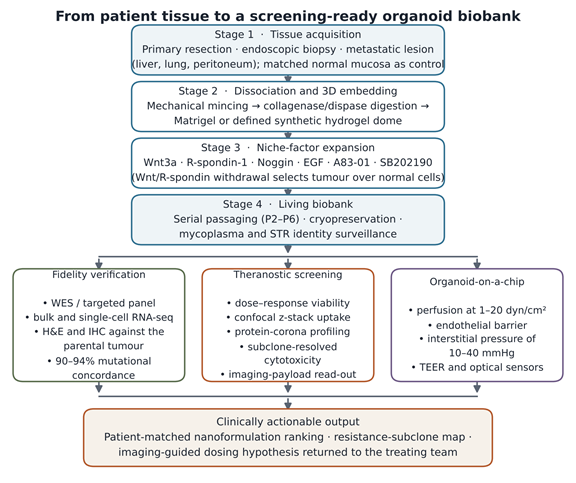
The foundational demonstrations are now a decade old. van de Wetering et al. (2015) derived a prospective living biobank of CRC organoids and showed that genomic and transcriptomic features of the parental tumours were retained alongside drug-response diversity. Weeber et al. (2015), working from metastatic biopsies, confirmed that organoids preserve the genetic diversity of the lesion they came from rather than collapsing to a dominant clone. Drost and Clevers (2018) consolidated the conceptual case for organoids in cancer research, and Bai, Y. et al. (2026) have since codified construction and quality-control workflows into something approaching a standard operating procedure — a prerequisite if these models are to carry regulatory weight. The full derivation-to-readout sequence is summarised in Figure 1.

Predictive validity followed. Vlachogiannis et al. (2018) screened organoids from heavily pretreated metastatic gastrointestinal cancers and reported 100% sensitivity, 93% specificity and an 88% positive predictive value against clinical response — figures that remain the field's reference point, with the caveat that the cohort was small and enriched for late-line disease. Ooft et al. (2019) extended this prospectively in metastatic CRC, finding that organoid chemosensitivity tracked patient response to irinotecan-based therapy more reliably than to oxaliplatin-based regimens, an asymmetry worth remembering. Smabers et al. (2024) subsequently showed that much of the variance in predictive performance is methodological, arising from screen design and read-out choice rather than from organoid biology itself. Yao et al. (2020) applied the same logic to chemoradiotherapy in locally advanced rectal cancer, achieving 84.43% accuracy in predicting pathological tumour regression.

Biobanks have also proven capable of resolving metastatic evolution. Mo et al. (2022), using paired primary and liver-metastasis organoids, showed that metastatic subclones inherit primary driver mutations while acquiring stemness and resistance programmes of their own; Thng et al. (2024) reached a complementary conclusion using matched pairs and combinatorial optimisation, finding divergent epigenetic vulnerabilities between anatomically linked lesions. Herpers et al. (2022) then demonstrated what a biobank can do that no cell line can: screening more than 500 bispecific antibodies across heterogeneous CRC organoids identified MCLA-158, an EGFR × LGR5 bispecific that depletes LGR5⁺ cancer stem cells while sparing their normal counterparts. These clinical and discovery applications are collated in Table 4.

2.3 Theranostic nanoparticle engineering for colorectal cancer

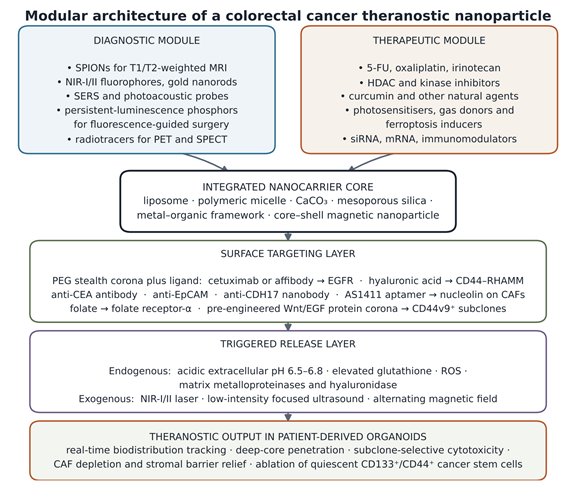
Nanoparticle design for CRC has converged on a modular architecture — imaging core, therapeutic payload, targeting layer, release trigger — set out in Figure 2 and catalogued by formulation in Table 2 (Xin et al., 2025).

Passive accumulation via EPR remains the starting assumption, but its variability between and within human tumours has pushed the field toward active targeting (Xin et al., 2025). Hu et al. (2023) illustrate the approach well:

Figure 1. Derivation, validation and screening pathway of a colorectal cancer patient-derived organoid biobank. Tissue obtained from primary resection, endoscopic biopsy or a metastatic deposit is enzymatically dissociated and embedded in Matrigel or a defined synthetic hydrogel, then expanded in niche factors (Wnt3a, R-spondin-1, Noggin, EGF, A83-01, SB202190); withdrawal of Wnt and R-spondin selects tumour over normal epithelium. Expanded cultures enter a cryopreserved living biobank under identity and mycoplasma surveillance, from which three parallel workstreams run: genomic and histological verification against the parental tumour, theranostic nanoparticle screening with imaging and viability read-outs, and transfer onto perfused chips for transport studies. The three converge on a patient-matched output — a formulation ranking, a resistance-subclone map and an imaging-guided dosing hypothesis. Compiled from van de Wetering et al. (2015), Weeber et al. (2015), Drost and Clevers (2018) and Bai, Y. et al. (2026).

Figure 2. Modular architecture of a colorectal cancer theranostic nanoparticle and its read-out in organoid culture. A theranostic carrier is assembled from four interchangeable layers. A diagnostic module supplies contrast — superparamagnetic iron oxide for MRI, NIR-I/II fluorophores and gold nanorods, SERS and photoacoustic probes, persistent-luminescence phosphors for surgical navigation, or radiotracers. A therapeutic module supplies the payload, from conventional cytotoxics to HDAC and kinase inhibitors, photosensitisers, ferroptosis inducers and nucleic acids. Both are carried on a common core (liposome, micelle, CaCO₃, mesoporous silica, metal–organic framework or core–shell magnetic particle). The surface layer confers specificity through ligands against EGFR, CD44–RHAMM, CEA, EpCAM, CDH17, nucleolin or folate receptor-α, or through a pre-engineered protein corona. Release is gated by endogenous cues (acidic pH, glutathione, ROS, proteases) or external energy (NIR light, ultrasound, magnetic field). Synthesised from Xin et al. (2025), Hu et al. (2023), Song et al. (2024), Yan et al. (2024) and Fernandes et al. (2021)

hyaluronic acid-coated CaCO₃ nanoparticles co-delivering curcumin and the HDAC inhibitor QTX125 engaged CD44 on CRC cells and organoids and produced pronounced apoptosis. Song et al. (2024) addressed a harder target, conjugating cetuximab to pH-responsive DMAKO-20/PCL-PEOz nanoparticles and achieving cytotoxicity in KRAS-mutant organoids that are, by definition, refractory to cetuximab as monotherapy — a result suggesting that ligand choice can be decoupled from the signalling pathway the ligand nominally blocks.

Stromal targeting has emerged as a distinct strategy. Wang, Wang, et al. (2026) developed AS1411 aptamer-functionalised Cu@Fe₃O₄ core-shell nanoparticles that bind nucleolin on cancer-associated fibroblasts and, under 808 nm irradiation, combine photothermal effect with Fe²⁺/Cu²⁺-mediated ferroptosis to deplete the fibroblast barrier without damaging normal colonic organoids. On the diagnostic side, Yan et al. (2024) reported persistent-luminescence nanoparticles bright enough for surgical navigation, delineating tumour boundaries with high precision and minimal removal of healthy tissue. And Fernandes et al. (2021) targeted the population that matters most for recurrence, using magnetic hyperthermia from drug-loaded iron oxide nanocubes to impair the tumorigenic capacity of quiescent CD133⁺/CD44⁺ colorectal cancer stem cells.

2.4 Nano–bio interactions: what three-dimensionality actually changes

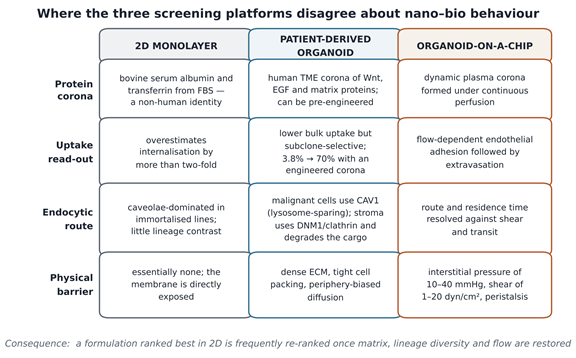
This is where organoids earn their place, and the evidence is recent but pointed. Resmi et al. (2026), comparing patient-derived colonic organoids with monolayers, found that 2D culture overestimates nanoparticle internalisation by more than two-fold. The mechanism is instructive: in FBS-rich medium the corona is dominated by bovine albumin and transferrin, whereas organoids cultured in tumour microenvironment-relevant medium acquire a corona of human matrix and signalling proteins including Wnt and EGF. The corona, in other words, is not noise around the particle; it is the particle's biological identity.

That identity can be engineered. Pre-incubating silicon quantum dots with TME proteins redirected them toward CD44v9⁺ chemoresistant subclones within organoids, raising targeted delivery from 3.8% to 70% — an eighteen-fold gain achieved by designing the corona rather than fighting it (Resmi et al., 2026). The same work resolved intracellular routing by lineage: stromal and non-malignant epithelial cells internalise via clathrin/dynamin-1 and route cargo to lysosomal degradation, while malignant cells favour caveolae-1 entry, which spares the payload. Whether a nanocarrier delivers an intact drug therefore depends on which cell takes it up, a distinction monolayers of a single line cannot make. These contrasts are summarised in Figure 3 and Table 3.

2.5 Organoid-on-a-chip: restoring the physics

Static organoids still omit force. Microfluidic tumour-on-a-chip systems reintroduce perfusion, shear stress of 1–20 dyn/cm², endothelial barriers and interstitial fluid pressure of 10–40 mmHg, the last of which generates outward convection that actively opposes nanoparticle entry (Silvani et al., 2026; Pant et al., 2026; Tang et al., 2025). Bai, X. et al. (2026) showed one way through it: acoustic cavitation from ultrasound-responsive nanodroplets transiently loosens the hydrogel network, lowers local pressure and permits deeper penetration into organoid cores. Chips also support cyclic compression to mimic peristalsis and carry embedded optical, electrochemical and transepithelial electrical resistance sensors for continuous read-out (Tang et al., 2025).

2.6 Standing obstacles

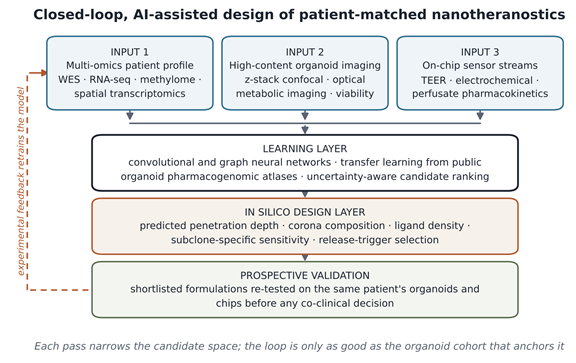
Three recur across the literature. Matrigel's batch variability and undefined composition limit reproducibility and complicate regulatory submission, motivating the shift toward defined PEG, alginate, hyaluronic acid and self-assembling peptide hydrogels (Silvani et al., 2026; Bai, Y. et al., 2026). Static organoids lose cancer-associated fibroblasts, endothelium and immune cells over passage, which is why co-culture with autologous peripheral blood mononuclear cells, tumour-infiltrating lymphocytes or fibroblasts is now an active area and a precondition for testing immunomodulatory nanomedicines (Tang et al., 2025; Wang, Li, et al., 2026). And the data burden of high-content organoid screening has made machine learning less an aspiration than a necessity, with transfer-learning architectures proposed to link organoid datasets to clinical outcomes and to design formulations in silico (Pang et al., 2025; Li et al., 2025; Bai, Y. et al., 2026). That closed loop is depicted in Figure 4.

3. Methods

3.1 Design and reporting framework

This work is a narrative review conducted with a structured, documented search strategy so that the

Figure 3. Divergence between two-dimensional culture, patient-derived organoids and organoid-on-a-chip across four nano–bio interaction parameters. Each row compares one determinant of nanomedicine behaviour across the three platforms. Protein corona composition shifts from bovine serum proteins in FBS-based monolayer medium to a human tumour microenvironment corona in organoids, and to a dynamic perfused corona on chip. Uptake read-outs diverge in direction rather than degree: monolayers overestimate internalisation by more than two-fold, while organoids report lower bulk uptake that is strongly subclone-selective and can be shifted from 3.8% to 70% by corona engineering. Endocytic routing separates by lineage only in organoids, where malignant cells favour the lysosome-sparing CAV1 route and stromal cells the degradative DNM1 route. Physical barriers are absent in 2D, matrix-limited in organoids, and fully reinstated on chip. Compiled from Resmi et al. (2026), Silvani et al. (2026), Bai, X. et al. (2026) and Tang et al. (2025).

Figure 4. Proposed closed-loop workflow integrating organoid screening, microphysiological read-outs and machine learning for patient-matched nanotheranostic design. Three data streams feed the loop: multi-omic patient profiling, high-content organoid imaging, and continuous sensor output from perfused chips. A learning layer built on convolutional and graph neural networks, with transfer learning from public organoid pharmacogenomic atlases, generates uncertainty-aware rankings. These inform an in silico design layer that predicts penetration depth, corona composition, ligand density, release trigger and subclone-specific sensitivity, narrowing the candidate space before synthesis. Shortlisted formulations return to the same patient's organoids and chips for prospective validation, and the experimental result retrains the model — the dashed return path. The scheme is contingent on harmonised multi-centre organoid datasets that do not yet exist, which is why matrix standardisation is treated here as a prerequisite for the computational agenda rather than a parallel effort. Adapted from the perspectives of Pang et al. (2025), Li et al. (2025) and Bai, Y. et al. (2026).

evidence base can be reconstructed by an independent reader. The procedure follows the reporting logic of PRISMA 2020 where it applies to narrative synthesis — explicit sources, explicit dates, explicit eligibility rules, explicit screening counts — without claiming the quantitative pooling of a systematic review. No protocol was registered, which we state plainly as a limitation rather than an omission.

3.2 Information sources and search period

Four databases were interrogated: PubMed/MEDLINE, Embase, Scopus and Web of Science Core Collection. Preprint servers (bioRxiv, medRxiv) were searched separately and treated as a distinct evidence tier throughout, because at least one mechanistically important dataset in this field — the organoid protein-corona work of Resmi et al. (2026) — had not completed peer review at the time of writing. The search window ran from 1 January 2010 to 30 June 2026, the earlier bound chosen because intestinal organoid culture as a reproducible technique postdates 2009. Reference lists of all included reviews were hand-searched, and forward citation tracking was performed on the four most-cited primary papers (van de Wetering et al., 2015; Vlachogiannis et al., 2018; Ooft et al., 2019; Herpers et al., 2022).

3.3 Search strategy

The PubMed strategy, given in full so that it can be re-executed verbatim, combined four concept blocks with the Boolean operator AND:

Block 1 (disease): "colorectal neoplasms"[MeSH] OR colorectal cancer[tiab] OR colon cancer[tiab] OR rectal cancer[tiab] OR CRC[tiab]

Block 2 (model): organoid[tiab] OR "organoids"[MeSH] OR tumouroid[tiab] OR tumoroid*[tiab] OR "patient-derived organoid"[tiab] OR PDO[tiab] OR "organ-on-a-chip"[tiab] OR "tumor-on-a-chip"[tiab] OR microphysiological[tiab]

Block 3 (intervention): nanoparticle[tiab] OR nanomedicine[tiab] OR theranostic[tiab] OR nanocarrier[tiab] OR liposom[tiab] OR "drug delivery systems"[MeSH] OR "protein corona"[tiab]

Block 4 (biology): heterogeneity[tiab] OR subclon[tiab] OR "cancer stem cell"[tiab] OR chemoresistan*[tiab] OR "drug resistance"[tiab]

Blocks 1–3 were mandatory; Block 4 was applied as an enrichment filter in a second pass rather than as a hard constraint, so that methodological papers on organoid construction were not lost. Equivalent syntax was constructed for Embase (Emtree), Scopus (TITLE-ABS-KEY) and Web of Science (TS=). Language was restricted to English; no restriction was placed on article type at the search stage.

3.4 Eligibility criteria

Records were eligible if they met all of the following: (i) addressed colorectal cancer or a gastrointestinal cohort in which CRC was separately reported; (ii) reported original data or a substantive review concerning patient-derived organoids, organoid-on-chip systems, or nanoparticle-based diagnostics or therapeutics; (iii) provided extractable information on at least one of model fidelity, drug or nanoparticle response, nano–bio interaction, or clinical concordance; and (iv) were published in English in a peer-reviewed venue or, for preprints, were complete reports with accessible methods.

Records were excluded if they concerned non-colorectal malignancies without separable CRC data, used only immortalised cell lines with no three-dimensional component, described nanoparticle synthesis with no biological evaluation, or were conference abstracts, editorials or commentaries without primary data.

3.5 Study selection and data extraction

Titles and abstracts were screened against the criteria above, duplicates removed by DOI matching with manual verification of near-duplicates, and full texts assessed for the remaining records. Disagreement at the full-text stage was resolved by discussion against the pre-specified criteria, with the more conservative reading adopted where ambiguity persisted.

Data were extracted into a structured matrix capturing: tumour origin and anatomical site; cohort size; organoid derivation and culture conditions, including matrix type and niche-factor composition; passage number at assay; nanoparticle platform, core material, targeting ligand, imaging modality, payload and release trigger; assay read-out and exposure duration; comparator model, where one was used; and reported quantitative outcomes with their units. Where a value appeared only in a figure, it was recorded as approximate and flagged as such.

3.6 Synthesis approach and appraisal

Because platforms, exposure times and viability read-outs differ too widely for meaningful pooling, findings were synthesised narratively around four axes: model fidelity (Table 1), nanoparticle design (Table 2), nano–bio interaction (Table 3), and clinical application (Table 4). Quantitative values are reported as the primary source stated them, with the comparator and the assay named, since a 70% delivery figure means little without knowing what it is 70% of.

Methodological quality was appraised against criteria adapted for organoid research: whether genomic concordance with the parental tumour was demonstrated rather than assumed; whether passage number at assay was reported; whether matched normal organoids were included as a selectivity control; whether assay duration was stated; and whether clinical correlation, where claimed, was prospective. Preprint findings are identified as such at every point of use, and no conclusion in this review rests on preprint evidence alone.

3.7 Reproducibility statement

The complete search strings, the date each database was last queried, the screening counts at each stage, and the extraction matrix were retained and are available from the corresponding author on request. Figures 1–4 were generated de novo for this review from the synthesised literature and contain no reproduced copyrighted material.

4. Synthesis of Findings: What Organoid Screening Reveals That Monolayers Cannot

4.1 The screening venue changes the answer, not merely its precision

It would be convenient if 2D and 3D screening differed only in sensitivity — if the monolayer gave a noisier version of the same ranking. The data do not support that. Across the comparative evidence (Table 1), the differences are directional. Monolayers overestimate nanoparticle internalisation by more than two-fold relative to ex vivo patient-derived colonic organoids, which means a formulation can be selected for a property it does not possess in tissue (Resmi et al., 2026; Silvani et al., 2026). Add to this the genetic drift of long-passaged lines and the absence of matrix barriers, and the monolayer is not a simplified model of the tumour so much as a different experimental system that happens to use tumour-derived cells (Ahmad Zawawi et al., 2024).

PDX models fail differently and, in a sense, more honestly: the biology is right, the logistics are wrong. Four to eight months to establishment, inconsistent engraftment and progressive murine stromal replacement rule them out as a decision tool within a treatment window, however valuable they remain for pharmacokinetics (Pant et al., 2026; Singh et al., 2023).

Organoids sit between these failure modes. Multi-omic comparison confirms 90–94% mutational and transcriptomic concordance with parental tumours across serial passage, and biobanks drawn from resections, biopsies and metastases retain both interpatient and intratumoral diversity (van de Wetering et al., 2015; Weeber et al., 2015; Pang et al., 2025). The derivation and read-out pathway is set out in (Figure 1).

4.2 Formulation performance across heterogeneous organoid panels

Four design strategies account for most of the convincing results (Table 2; Figure 2).

Ligand-directed uptake works, but the useful finding is how much it depends on receptor density rather than receptor presence. Hyaluronic acid-coated CaCO₃ nanoparticles carrying curcumin and QTX125 were efficiently internalised by CD44-high CRC cells and organoids and drove marked apoptosis; the same chemistry would be expected to underperform in CD44-low subclones, which is precisely the kind of distinction a panel of organoids surfaces and a single line conceals (Hu et al., 2023).

Trigger-responsive release can override a resistance mechanism that the targeting ligand itself does not address. Cetuximab-conjugated, pH-responsive DMAKO-20/PCL-PEOz nanoparticles produced substantially greater disruption of KRAS-mutant organoids than cetuximab alone (Song et al., 2024). We would flag some caution here: the result reframes cetuximab as an address rather than a therapy, and whether that distinction survives in a perfused system with competing serum proteins has not yet been shown.

Stromal clearance is the most architecturally interesting result. AS1411-functionalised Cu@Fe₃O₄ nanoparticles depleted nucleolin-expressing cancer-associated fibroblasts through combined photothermal and ferroptotic mechanisms, relieved immunosuppression, and — importantly for any therapeutic index argument — left normal colonic organoids intact (Wang, Wang, et al., 2026). The matched-normal control is what makes this

Table 1. Comparative performance of preclinical colorectal cancer models as venues for theranostic nanoparticle screening. The five platforms are arranged in ascending order of biological realism and, broadly, descending order of throughput. For each, the table records architectural fidelity, the degree to which inter- and intratumoral heterogeneity survives in culture, practical throughput and cost, the extent of tumour microenvironment and vascular reconstitution, and the limitation most likely to compromise a nanomedicine screening decision. Read across any row and the central trade-off of the field becomes visible: the models that permit large formulation libraries are the ones least able to report transport barriers and subclonal selectivity, while the models that report them best cannot yet be run at scale. Patient-derived organoids and their on-chip extensions occupy the compromise position argued for throughout this review.

Model system

Architecture and biological realism

Heterogeneity preserved

Throughput, time and cost

Microenvironment and vasculature

Principal limitation for nanomedicine

References

2D cell monolayer

Flat adherent growth on plastic; no 3D organisation, cell–ECM engagement or tissue polarity

Poor to none; genetic drift and clonal selection over prolonged passage

Very high throughput; days; very low cost; fully automatable

Absent — no stroma, endothelium, ECM or immune compartment

Overestimates nanoparticle uptake by more than two-fold; forms a bovine rather than human protein corona; no transport barrier

Ahmad Zawawi et al. (2024); Resmi et al. (2026); Silvani et al. (2026)

3D multicellular spheroid

Spherical aggregate restoring cell–cell adhesion, packing and nutrient/oxygen gradients

Low to moderate; usually built from immortalised lines, so subclonal diversity is limited

High throughput; days to weeks; low cost; multi-well imaging compatible

Minimal; necrotic core and hypoxic gradient present, but no vasculature or immune infiltrate

No tissue-specific stem hierarchy and no native ECM composition; penetration data are better than 2D but not patient-specific

Yadav et al. (2025); Ahmad Zawawi et al. (2024)

Patient-derived xenograft (PDX)

Human tumour fragment engrafted in an immunocompromised host; in vivo 3D architecture retained

High across early passages; histopathology and subclonal structure preserved

Very low throughput; 4–8 months to establish; high cost; variable engraftment

Partial and chimeric; human stroma is progressively replaced by murine stroma

Timeline incompatible with clinical decision-making; host immunodeficiency precludes immunonanomedicine evaluation

Pant et al. (2026); Singh et al. (2023); Wang, Li, et al. (2026)

Patient-derived organoid (PDO)

Self-organising epithelial units reproducing crypt–villus architecture, lumen formation and lineage differentiation

Very high; 90–94% mutational and transcriptomic concordance with the parental tumour

Moderate to high throughput; 1–3 weeks; scalable, biobankable, animal-free

Partial and epithelial; native matrix interaction retained, but no perfusion or immune cells unless co-cultured

No flow or interstitial pressure; Matrigel batch variability; stromal and immune components lost over passage

van de Wetering et al. (2015); Weeber et al. (2015); Li et al. (2025); Bai, Y. et al. (2026)

Organoid- or tumour-on-a-chip

Organoids housed in microengineered channels with shear flow, endothelial barriers and tissue interfaces

Very high; donor genomic fidelity maintained within a perfused microenvironment

Moderate throughput; specialised fabrication; higher cost per assay; real-time multi-analyte sensing

High; reconstitutes vascular barriers, shear of 1–20 dyn/cm², interstitial pressure and co-cultured stromal or immune cells

Technical complexity and non-standardised chip materials; PDMS absorbs hydrophobic drugs; throughput below static plates

Silvani et al. (2026); Pant et al. (2026); Tang et al. (2025)

Table 2. Theranostic nanoparticle formulations evaluated in colorectal cancer organoid and related three-dimensional models. Each entry pairs a nanocarrier platform with its targeting ligand and receptor, its diagnostic modality, its payload and release trigger, and the experimental finding that justified its inclusion. The table is organised to make design logic comparable rather than to rank efficacy: reading down the targeting column shows the shift from receptor-directed epithelial targeting toward stromal and subclone-directed strategies, while the trigger column shows the parallel move from passive release to endogenous and externally applied control. Quantitative outcomes are reproduced as the primary sources reported them, with the model system stated so that figures obtained in organoids are not conflated with those from monolayer or animal work.

Platform and material class

Targeting ligand → receptor

Imaging modality

Payload and release trigger

Model and principal finding

Translational value

References

CaCO₃@Cur@QTX125@HA nanoparticle

Hyaluronic acid → CD44

Confocal fluorescence tracking of internalisation

Curcumin plus the HDAC inhibitor QTX125; pH-responsive matrix degradation

Efficient uptake by CD44-high CRC cells and patient-derived organoids, with pronounced apoptosis and growth suppression

Targeted dual-drug co-delivery that circumvents CD44-associated resistance

Hu et al. (2023); Xin et al. (2025)

pH-responsive DMAKO-20/PCL-PEOz-Cet nanoparticle

Cetuximab → EGFR

Fluorescent tracking of cellular internalisation

DMAKO-20; release triggered by acidic tumour pH

Markedly greater organoid disruption and cytotoxicity in KRAS-mutant CRC organoids than cetuximab monotherapy

Reverses cetuximab resistance by using the antibody as an address rather than a pathway blockade

Song et al. (2024)

Cu@Fe₃O₄ core–shell magnetic nanoparticle

AS1411 aptamer → nucleolin on cancer-associated fibroblasts

Real-time thermal imaging and T₂-weighted MRI

Photothermal therapy under 808 nm NIR plus Fe²⁺/Cu²⁺-mediated ferroptosis

Selective elimination of CAFs and tumour cells in CRC organoids and PDX, with normal colonic organoids unharmed

Depletes the protective stromal barrier and relieves microenvironmental immunosuppression

Wang, Wang, et al. (2026)

TME-protein-engineered silicon quantum dots

Pre-engineered Wnt/EGF corona → CD44v9⁺ chemoresistant cells

Spectral flow cytometry and multi-spectral single-cell fluorescence

Precision delivery probe; uptake steered between CAV1 and DNM1 endocytic routes

Redirected accumulation to CD44v9⁺ subclones in patient-derived colonic organoids, raising targeted delivery from 3.8% to 70%

Converts the protein corona from an obstacle into a programmable design parameter (preprint evidence)

Resmi et al. (2026)

Folate-targeted persistent-luminescence nanoparticle

Folate → folate receptor-α

Persistent near-infrared luminescence for surgical navigation

Fluorescence-guided surgery; intraoperative margin delineation

High-precision tumour boundary definition with minimal removal of adjacent normal tissue in CRC models

Improves intraoperative precision and may reduce local recurrence risk

Yan et al. (2024)

Hyaluronic-acid-oligosaccharide liposomal oxaliplatin

Oligosaccharide hyaluronic acid → CD44/RHAMM

Tissue fluorescence biodistribution tracking

Oxaliplatin; intracellular enzymatic release with concurrent resistance reversal

Reversal of oxaliplatin resistance, inhibition of primary tumour growth and increased lymphocyte and macrophage infiltration without systemic toxicity

Addresses acquired platinum chemoresistance while amplifying anti-tumour immune infiltration

Xin et al. (2025)

Magnetothermal iron oxide nanocubes

Polymer-coated surface directed at quiescent CD133⁺/CD44⁺ stem cells

Magnetic resonance contrast and thermal read-out

Doxorubicin or oxaliplatin released under alternating magnetic field hyperthermia

Impaired tumorigenic capacity of quiescent colorectal cancer stem cells and suppressed post-treatment regrowth

Targets the slow-cycling population that conventional cytotoxics spare

Fernandes et al. (2021)

persuasive; selectivity claimed without one is difficult to interpret.

Stem-cell ablation addresses recurrence directly. Magnetically induced hyperthermia from drug-loaded iron oxide nanocubes impaired the tumorigenic capacity of quiescent CD133⁺/CD44⁺ colorectal cancer stem cells, the population that survives conventional cytotoxics by virtue of not cycling (Fernandes et al., 2021). On the diagnostic side, folate-targeted persistent-luminescence nanoparticles achieved tumour boundary delineation precise enough to minimise resection of healthy tissue, which is the kind of intraoperative benefit that does not require systemic efficacy to be clinically worthwhile (Yan et al., 2024).

4.3 The corona is the mechanism, not the confound

The most consequential mechanistic finding in this literature is also the least intuitive. When nanoparticles meet biological fluid, adsorbed proteins form a corona that governs hydrodynamic size, charge, ligand accessibility and uptake route. In FBS-based 2D medium that corona is bovine — albumin and transferrin — and therefore reports on a biology no patient has (Resmi et al., 2026). In organoids cultured in TME-relevant medium, the corona is built from human matrix and signalling proteins, Wnt and EGF prominent among them (Table 3; Figure 3).

Treating that as a design variable produced the single largest effect size we encountered: pre-engineering silicon quantum dots with Wnt/EGF-enriched coronas redirected them to CD44v9⁺ chemoresistant subclones and raised targeted delivery from 3.8% to 70%, an eighteen-fold increase (Resmi et al., 2026). Two qualifications belong with that number. It derives from a preprint, so it awaits peer review. And an eighteen-fold gain measured against a very low baseline is not the same as an eighteen-fold gain in therapeutic effect — the delivery endpoint and the efficacy endpoint have not yet been connected in the same system.

Routing follows the same lineage logic. Non-malignant epithelium and organoid stromal fibroblasts internalise via clathrin/dynamin-1, with DNM1 upregulated as much as fourteen-fold, and send cargo to lysosomes; malignant cells rely more on caveolae-1, with a roughly 1.7-fold increase in CAV1, bypassing lysosomal fusion and preserving the payload (Resmi et al., 2026). The therapeutic consequence is unusually direct: in a mixed-lineage tissue, the same nanoparticle is a drug in one cell and waste in its neighbour.

4.4 Restoring flow, pressure and motion on chip

Static organoids answer questions about matrix and lineage; they cannot answer questions about transport. Chip platforms supply shear of 1–20 dyn/cm², continuous perfusion, endothelial barriers for extravasation studies, and the 10–40 mmHg interstitial fluid pressure whose outward convection impedes passive diffusion into tumour cores (Table 3; Silvani et al., 2026; Tang et al., 2025). Coupling low-intensity ultrasound or acoustic nanobubbles to these devices transiently disrupts the hydrogel network and lowers local pressure, enabling deeper penetration — a physical rather than chemical solution to a physical problem (Bai, X. et al., 2026). Lateral micropore arrays add cyclic compression to approximate peristalsis, which matters for any orally or topically administered nanomedicine (Tang et al., 2025).

4.5 Clinical concordance: strong, but narrower than often quoted

The predictive numbers are genuinely good and are frequently over-generalised. In metastatic gastrointestinal cancer biobanks, organoid chemosensitivity predicted clinical response with 100% sensitivity, 93% specificity, 88% positive predictive value and 100% negative predictive value (Vlachogiannis et al., 2018). In locally advanced rectal cancer, organoid chemoradiotherapy screening achieved 84.43% overall accuracy, 78.01% sensitivity and 91.97% specificity for pathological tumour regression grade (Yao et al., 2020). Prospective work in metastatic CRC found concordance that held well for irinotecan-based therapy but less so for oxaliplatin-based regimens (Ooft et al., 2019), and later methodological analysis attributed a meaningful share of between-study variation to screen design rather than to biology (Smabers et al., 2024). The honest summary is that organoids predict resistance more reliably than they predict response — the negative predictive value is the figure clinicians should weight (Table 4).

Matched primary and metastatic biobanks extend the same logic to disease evolution: liver metastases inherit primary chemosensitivity profiles while acquiring stemness and EMT-driven resistance (Mo et al., 2022), and matched pairs can diverge epigenetically enough to require different combinations (Thng et al., 2024). Functional screening at scale closes the loop, with more than 500 bispecific antibodies tested across a heterogeneous biobank

Table 3. Nano–bio interactions resolved differently by two-dimensional culture, patient-derived organoids and microfluidic chips. Six interaction phases are traced across the three platforms; from the moment a nanoparticle acquires its protein corona to the point at which mechanical forces modulate epithelial permeability. For each phase the table contrasts the behaviour reported in monolayers with that observed in organoids or on chip, names the analytical method used to make the measurement, and states the consequence for nanomedicine development. The pattern that emerges is consistent: monolayers do not merely measure these phenomena imprecisely, they frequently measure them in the wrong direction, which is the strongest available argument for relocating early formulation screening into three-dimensional human models.

Interaction phase

Behaviour in 2D monolayer

Behaviour in PDO or on chip

Analytical approach

Consequence for nanomedicine development

References

Protein corona formation and biological identity

Adsorbs bovine serum albumin and transferrin from FBS-rich medium, producing a non-physiological corona

Adsorbs human TME proteins including Wnt, EGF and matrix components, conferring a physiologically meaningful identity

Dynamic light scattering, FTIR spectroscopy and Vroman-effect adsorption kinetics

2D culture misassigns the particle's biological identity; TME coronas can instead be pre-engineered to steer carriers to resistant subpopulations

Resmi et al. (2026)

Cellular internalisation and uptake kinetics

Overestimates total uptake by more than two-fold relative to human ex vivo tissue

Lower bulk uptake but markedly subclone-selective, governed by packing density and TME signalling

Multi-spectral flow cytometry, dimensionality reduction and z-stack confocal microscopy

Unfiltered 2D screening generates false-positive candidates; organoids give uptake figures that survive translation

Resmi et al. (2026); Silvani et al. (2026)

Endocytic routing and lysosomal fate

Caveolae-dominated entry in transformed lines, with little contrast between cell lineages

Malignant cells favour caveolae-1 entry and spare the payload; stromal and normal epithelial cells use clathrin/dynamin-1 and degrade it

Pharmacological pathway inhibition combined with organelle-specific co-localisation imaging

Determines whether a nanocarrier delivers an intact drug or is destroyed; the same particle can act as drug and waste in neighbouring cells

Resmi et al. (2026)

Tissue diffusion and ECM barriers

Minimal physical resistance; the membrane is directly exposed to dissolved nanoparticles

Dense collagen and hydrogel networks with high cell packing restrict diffusion to organoid peripheries

Time-lapse confocal microscopy, optical metabolic imaging and light-sheet z-stack profiling

Favours carriers below roughly 50 nm with neutral or zwitterionic surfaces, or matrix-degrading strategies, for deep core penetration

Silvani et al. (2026); Bai, X. et al. (2026)

Vascular extravasation and shear stress

Static culture under zero flow; no endothelial interface

Reconstituted endothelial fenestration, trans-endothelial extravasation and shear of 1–20 dyn/cm² in perfused channels

Microfluidic chip co-culture with microvascular endothelium and real-time fluorescence imaging

Allows adhesion, clearance and extravasation efficiency to be assessed before tissue entry is ever attempted

Silvani et al. (2026); Tang et al. (2025); Pant et al. (2026)

Interstitial pressure and mechanical stress

Static planar environment with no deformation or convective opposition

Interstitial fluid pressure of 10–40 mmHg opposes entry; lateral micropore arrays apply cyclic compression mimicking peristalsis

Pressure-channel arrays with cyclic mechanical compression and embedded TEER or optical sensors

Mechanical strain alters tight junctions and absorption kinetics; acoustic cavitation can transiently relieve pressure and deepen penetration

Bai, X. et al. (2026); Tang et al. (2025)

Table 4. Clinical and discovery applications of patient-derived organoid biobanks in colorectal cancer precision oncology and nanomedicine screening. The six application areas span prediction of systemic therapy response, prediction of chemoradiotherapy response, high-throughput therapeutic discovery, heterogeneity profiling in matched primary and metastatic lesions, combinatorial optimisation, and evaluation of stimulus-responsive nanomaterials. Cohort size and sample origin are stated alongside each predictive metric, because concordance figures quoted without their cohort invite over-generalisation; most of these studies are modest in size and enriched for advanced disease. Taken together the entries support a specific reading — that organoids identify resistance more dependably than they guarantee response — which is how the evidence is treated in the discussion.

Application

Cohort and sample origin

Agents or nanomedicines screened

Predictive metrics and concordance

Mechanistic and translational insight

References

Predicting chemotherapy and targeted therapy response in metastatic CRC

Metastatic CRC patients with organoids derived from liver, lung and peritoneal biopsies

5-FU, oxaliplatin, irinotecan/SN-38, FOLFOX, FOLFIRI and cetuximab

100% sensitivity, 93% specificity, 88% positive and 100% negative predictive value against radiological response

Ex vivo sensitivity correlates with progression-free and overall survival; concordance is stronger for irinotecan- than oxaliplatin-based regimens

Vlachogiannis et al. (2018); Ooft et al. (2019); Smabers et al. (2024)

Predicting chemoradiotherapy response in locally advanced rectal cancer

Rectal cancer biopsies from 80 patients receiving neoadjuvant chemoradiotherapy

5-FU, oxaliplatin, irinotecan and ex vivo ionising radiation

84.43% accuracy, 78.01% sensitivity and 91.97% specificity for pathological tumour regression grade

Identifies radioresistant patients pre-operatively, supporting organ-preservation strategies and avoiding unnecessary total mesorectal excision

Yao et al. (2020); Singh et al. (2023)

High-throughput discovery of agents against cancer stem cells

Large CRC organoid biobank spanning diverse driver mutations including KRAS and BRAF

Library of more than 500 bispecific antibodies

Identification of MCLA-158, an EGFR × LGR5 bispecific with selective toxicity toward tumour stem cells

Triggers LGR5⁺ cancer stem cell degradation and inhibits metastatic outgrowth in KRAS-mutant CRC while sparing normal stem cells

Herpers et al. (2022); Shimokawa et al. (2017)

Heterogeneity and resistance profiling in matched primary and metastatic disease

Paired primary CRC and synchronous liver metastasis tissue; 72 samples from 36 patients

5-FU, oxaliplatin, irinotecan and FOLFOX/FOLFIRI combinations

Liver metastases inherit primary chemosensitivity profiles while acquiring enhanced stemness and EMT-driven resistance

Reveals transcriptomic and epigenomic divergence between primary and metastatic lesions, guiding combination strategies against recurrence

Mo et al. (2022); Wang, Li, et al. (2026)

Functional personalised oncology and combinatorial optimisation

Matched primary colon and liver metastasis organoid pairs

Epigenetic drug libraries screened by quadratic phenotypic optimisation

Patient-specific combinatorial vulnerabilities and optimal drug ratios that override single-agent resistance

Genetically similar primary and metastatic pairs can diverge epigenetically, requiring separately tailored combinations

Thng et al. (2024)

Evaluating stimulus-responsive nanomaterials on perfused chips

Patient-derived CRC organoids integrated into perfusable organoid-on-a-chip arrays

Ultrasound-responsive phase-transition nanodroplets and acoustic nanobubbles

Deep, cavitation-assisted nanocarrier penetration throughout 3D organoid cores

Low-intensity cavitation transiently disrupts the hydrogel network and lowers interstitial pressure, enabling intratumoral deposition

Bai, X. et al. (2026); Tang et al. (2025)

yielding MCLA-158, which eradicates LGR5⁺ stem cells in KRAS-mutant CRC while sparing normal stem cells (Herpers et al., 2022). None of these results would have emerged from a monolayer panel.

5. Choosing the Screening Venue Is a Translational Decision

5.1 What the synthesis actually establishes

Three claims seem to us well supported. First, screening venue determines which formulations advance, because monolayers do not merely blur the ranking but systematically distort it through corona misidentification, absent barriers and lost lineage diversity (Resmi et al., 2026; Silvani et al., 2026; Table 1). Second, organoid panels can resolve subclone-level behaviour — selective uptake, selective killing, selective sparing of normal tissue — which is the resolution the heterogeneity problem demands (Roerink et al., 2018; Kim et al., 2022; Herpers et al., 2022; Table 4). Third, the protein corona is tractable: it can be designed to steer particles toward the populations that cause relapse rather than merely tolerated as interference (Resmi et al., 2026; Figure 3).

A fourth claim is often made and we think it is premature — that organoid screening is ready to direct individual treatment decisions in routine practice. The concordance data are drawn from modest cohorts, enriched for advanced disease, and are stronger for resistance than for response (Vlachogiannis et al., 2018; Ooft et al., 2019; Smabers et al., 2024).

5.2 Mechanistic implications for nanoparticle design

If uptake route is lineage-specific, then design criteria that have been treated as universal are not. A caveolae-favouring surface chemistry may be advantageous in a CAV1-high tumour and wasteful in one whose malignant compartment routes through clathrin — a parameter nobody currently measures before formulating (Resmi et al., 2026; Table 3). Likewise, if the corona confers biological identity, then ligand density and PEG architecture should perhaps be optimised for the corona they recruit rather than for receptor affinity measured in buffer.

The stromal results point the same way. Depleting cancer-associated fibroblasts improved access and relieved immunosuppression (Wang, Wang, et al., 2026), but stroma is not uniformly adversarial, and barrier removal in a perfused system could as plausibly facilitate dissemination as improve delivery. That question is answerable on chip and, to our knowledge, has not been answered.

Combination logic deserves similar scrutiny. Cetuximab-conjugated nanoparticles overcame KRAS-mutant resistance by using the antibody as an address rather than a signalling blockade (Song et al., 2024). This is elegant, though it raises an awkward possibility: if targeting ligands are chosen for binding rather than for pathway relevance, the field's mechanistic vocabulary may be describing something other than what is happening.

5.3 Limitations that are structural rather than incidental

Four constraints will not be resolved by incremental optimisation.

Organoids are epithelial. Immune cells, endothelium and fibroblasts are lost over passage unless deliberately reintroduced, so nanomedicines whose mechanism is immunological — STING agonists, checkpoint-modulating nanocarriers — cannot be properly evaluated in standard culture (Tang et al., 2025; Wang, Li, et al., 2026). Co-culture is advancing but remains technically demanding and poorly standardised.

Matrigel is a reagent, not a defined material. Its batch variability, murine origin and undefined growth-factor content undermine reproducibility and complicate regulatory submission; defined PEG, alginate and peptide hydrogels are the plausible successor but have not yet been shown to support equivalent long-term fidelity across diverse CRC subtypes (Silvani et al., 2026; Bai, Y. et al., 2026).

Static culture omits transport physics. Chips solve this but trade away throughput, use materials such as PDMS that absorb hydrophobic drugs, and lack standardised designs — so the platform that best models transport is the one least suited to screening breadth (Silvani et al., 2026; Pant et al., 2026; Table 1).

Finally, the evidence base itself is uneven. Several mechanistically pivotal findings rest on single studies, at least one of them a preprint (Resmi et al., 2026), and independent replication across laboratories and organoid cohorts is largely absent. We have tried to mark that uncertainty where it occurs rather than smoothing it into the narrative.

5.4 Where the field is heading

AI-assisted design is the most frequently proposed answer to the data-volume problem, and the proposal is reasonable: transfer-learning architectures trained on multi-omic profiles, high-content imaging and on-chip sensor streams could predict penetration, corona composition and subclone sensitivity, narrowing the candidate space before synthesis (Pang et al., 2025; Li et al., 2025; Bai, Y. et al., 2026; Figure 4). The constraint is not algorithmic. Models of this kind require large, harmonised, multi-centre organoid datasets with consistent annotation, and the field has not yet built them — which makes matrix standardisation and protocol convergence prerequisites for the computational agenda rather than parallel to it.

Three further directions follow naturally. Immunocompetent organoid co-cultures would open nanoimmunotherapy to proper preclinical evaluation. Co-clinical trial designs, in which organoid screening runs alongside the patient's actual treatment, would generate the prospective concordance data the field currently lacks. And a regulatory pathway that recognises organoid evidence — currently absent — would determine whether any of this reaches practice.

6. Conclusion

The case assembled here is less about any single nanoparticle than about where nanoparticles should be judged. Colorectal cancer defeats uniform therapy because it is not uniform, and a screening platform that averages across clones cannot report what a clinician needs to know. Patient-derived organoids retain the genomic and subclonal diversity of the tumours they come from, impose the matrix and packing barriers that real tissue imposes, and build a human protein corona that determines where a nanocarrier goes and whether its payload survives the journey. On chip, they add flow, pressure and motion. Together these platforms have already changed specific conclusions — overturning uptake estimates, exposing lineage-specific endocytic routing, and converting the corona from nuisance to design parameter. What remains unfinished is substantial: standardised matrices, immune and vascular components, multi-centre datasets, and a regulatory route. None of these is conceptually intractable. Until they are addressed, organoid-based nanotheranostic screening should be read as a strong and improving predictor rather than a decision rule.

References


Ahmad Zawawi, S. S., Salleh, E. A., & Musa, M. (2024). Spheroids and organoids derived from colorectal cancer as tools for in vitro drug screening. Exploration of Targeted Anti-Tumor Therapy, 5(3), 409–431. https://doi.org/10.37349/etat.2024.00226

Bai, X., Zhao, H., Zhao, Y., Zhou, W., Pang, L., Cheng, W., Yang, K., & Wu, B. (2026). Ultrasound-responsive nanomaterials for precision therapy in tumor organoids. Holistic Integrative Oncology, 5(1), 45. https://doi.org/10.1007/s44178-026-00266-9

Bai, Y., Zhang, Q., He, J., Chen, Y., Fu, M., Lu, S., & Jiang, Z. (2026). Workflow of patient-derived organoid construction and application for personalized oncology. Molecular Cancer, 25(1), 159. https://doi.org/10.1186/s12943-026-02678-7

Drost, J., & Clevers, H. (2018). Organoids in cancer research. Nature Reviews Cancer, 18(6), 407–418. https://doi.org/10.1038/s41568-018-0007-6

Fernandes, S., Fernandez, T., Metze, S., & Santos, H. A. (2021). Magnetic nanoparticle-based hyperthermia mediates drug delivery and impairs the tumorigenic capacity of quiescent colorectal cancer stem cells. ACS Applied Materials & Interfaces, 13(14), 15959–15972. https://doi.org/10.1021/acsami.0c21349

Herpers, B., Eppink, B., James, M. I., Cortina, C., Cañellas-Socias, A., Boj, S. F., Hernando-Momblona, X., Glodzik, D., Roovers, R. C., van de Wetering, M., & Batlle, E. (2022). Functional patient-derived organoid screenings identify MCLA-158 as a therapeutic EGFR × LGR5 bispecific antibody with efficacy in epithelial tumors. Nature Cancer, 3(4), 418–436. https://doi.org/10.1038/s43018-022-00359-0

Hu, S., Xia, K., Huang, X., & Zhao, Y. (2023). Multifunctional CaCO3@Cur@QTX125@HA nanoparticles for effectively inhibiting growth of colorectal cancer cells. Journal of Nanobiotechnology, 21(1), 353. https://doi.org/10.1186/s12951-023-02104-w

Kim, S. C., Park, J. W., Seo, H. Y., Kim, M., Park, J. H., Kim, G. H., Lee, J. O., Shin, Y. K., Bae, J. M., Koo, B. K., & Jeong, S. Y. (2022). Multifocal organoid capturing of colon cancer reveals pervasive intratumoral heterogenous drug responses. Advanced Science, 9(5), e2103360. https://doi.org/10.1002/advs.202103360

Li, Y., Wu, W., Yao, J., Wang, S., Wu, X., & Yan, J. (2025). Patient-derived tumor organoids in colorectal cancer precision treatment: Applications, challenges, and future perspectives. Cell Transplantation, 34, 1–15. https://doi.org/10.1177/09636897251310000

Mo, S., Tang, P., Luo, W., Zhang, L., Li, Y., Hu, X., Ma, X., Chen, Y., Bao, Y., He, X., & Cai, S. (2022). Patient-derived organoids from colorectal cancer with paired liver metastasis reveal tumor heterogeneity and predict response to chemotherapy. Advanced Science, 9(31), e2204097. https://doi.org/10.1002/advs.202204097

Ooft, S. N., Weeber, F., Dijkstra, K. K., McLean, C. M., Kaing, S., van Werkhoven, E., Schipper, L., Hoes, L., Vis, D. J., van de Haar, J., & Voest, E. E. (2019). Patient-derived organoids can predict response to chemotherapy in metastatic colorectal cancer patients. Science Translational Medicine, 11(513), eaay2574. https://doi.org/10.1126/scitranslmed.aay2574

Pang, X., Hu, Y., Dai, Z., Lou, Q., Xu, W., & Chen, L. (2025). Precision medicine research progress based on colorectal cancer organoids. Discover Oncology, 16(1), 1181. https://doi.org/10.1007/s12672-025-02959-5

Pant, A., Varghese, S., & Kumar, R. (2026). Preclinical models in molecular oncology: Bridging the translational gap with organoids and organ-on-a-chip platforms. Journal of Experimental & Clinical Cancer Research, 45(1), 114. https://doi.org/10.1186/s13046-026-03694-7

Resmi, M. P., Chakrabarti, J., Pond, K., & Ganesh, S. (2026). Modulating the tumor niche-specific protein corona of nanomedicines for the precision targeting of chemoresistant cells using patient-derived organoids [Preprint]. bioRxiv. https://doi.org/10.1101/2026.09.03.749195

Roerink, S. F., Sasaki, N., Lee-Six, H., Young, M. D., Alexandrov, L. B., Behjati, S., Mitchell, T. J., Grossmann, S., Lightfoot, H., Egan, D. A., & Stratton, M. R. (2018). Intra-tumour diversification in colorectal cancer at the single-cell level. Nature, 556(7702), 457–462. https://doi.org/10.1038/s41586-018-0024-3

Sarkar, O., & Othayoth, R. (2024). Nanoparticle-based precision modeling of primary and three-dimensional cell culture in cancer theranostics. Translational Medicine, 14(2), 105–122.

Shimokawa, M., Ohta, Y., Nishikori, S., Matano, M., Takano, A., Fujii, M., Date, S., Sugimoto, S., Kanai, T., & Sato, T. (2017). Visualization and targeting of LGR5+ human colorectal cancer stem cells. Nature, 545(7653), 187–192. https://doi.org/10.1038/nature22081

Silvani, G., Stenzel, M. H., & Kilian, K. A. (2026). Precision nanomedicine: A necessary convergence of nanodrug development, organotypic models and microphysiological systems. ACS Nano Medicine, 1(1), 54–73. https://doi.org/10.1021/acsnanomed.5c00019

Singh, S., Ahuja, A., Ramankutty, R., & Ramaswamy, S. (2023). Organoids research for colorectal cancer: Promising approach for precision medicine, their applications and future perspectives. Current Drug Therapy, 18(1), 1–12. https://doi.org/10.2174/0115748855266739230919110125

Smabers, L. P., Wensink, G. E., Verissimo, C. S., Koedoot, E., Pitsa, K. C., Huismans, M. A., & Roodhart, J. M. L. (2024). Organoids as a biomarker for personalized treatment in metastatic colorectal cancer: Drug screen optimization and correlation with patient response. Journal of Experimental & Clinical Cancer Research, 43(1), 61. https://doi.org/10.1186/s13046-024-02980-6

Song, H., Li, H., Shen, X., & Zhang, Y. (2024). A pH-responsive cetuximab-conjugated DMAKO-20 nano-delivery system for overcoming K-ras mutations and drug resistance in colorectal carcinoma. Acta Biomaterialia, 177, 456–471. https://doi.org/10.1016/j.actbio.2024.01.047

Tang, Y., Huang, Z., Li, Y., Li, B., Ma, L., Song, J., & Xue, L. (2025). Bridging the gap between bench and bedside: Organoid technology in colorectal cancer treatment. Cell Organoid, 1(2), 9410017. https://doi.org/10.26599/CO.2025.9410017

Thng, D. K. H., Hooi, L., Siew, B. E., Lee, K. Y., Tan, I. J. W., Lieske, B., Lin, N. S., Kow, A. W. C., Wang, S., Rashid, M. B. M. A., Ang, C., Koh, J. J. M., Toh, T. B., Tan, K. K., & Chow, E. K. H. (2024). A functional personalised oncology approach against metastatic colorectal cancer in matched patient derived organoids. npj Precision Oncology, 8(1), 52. https://doi.org/10.1038/s41698-024-00543-8

van de Wetering, M., Francies, H. E., Francis, J. M., Bounova, G., Iorio, F., Pronk, A., van Houdt, W., van Gorp, J., Taylor-Weiner, A., Kester, L., & Clevers, H. (2015). Prospective derivation of a living organoid biobank of colorectal cancer patients. Cell, 161(4), 933–945. https://doi.org/10.1016/j.cell.2015.03.053

Vlachogiannis, G., Hedayat, S., Vatsiou, A., Jamin, Y., Fernández-Mateos, J., Khan, K., Lampis, A., Eason, K., Huntingford, I., Burke, R., & Valeri, N. (2018). Patient-derived organoids model treatment response of metastatic gastrointestinal cancers. Science, 359(6378), 920–926. https://doi.org/10.1126/science.aao2774

Wang, S., Li, Y., Wu, W., Yan, B., Li, J., Li, C., & Yan, J. (2026). New advances in the use of patient-derived organoids and mouse models for assessing heterogeneity among metastatic colorectal cancers. Journal of Translational Medicine, 24(1), 1–15. https://doi.org/10.1186/s12967-024-05824-1

Wang, S., Wang, Z., Wu, C., Ma, R., Zhang, C., Peng, Y., Su, X., & Hou, Y. (2026). Amelioration of colorectal cancer-associated fibroblasts in immunosuppressive microenvironment by ferroptosis-based nanotherapy. Nature Communications, 17, 2778. https://doi.org/10.1038/s41467-026-69462-5

Weeber, F., van de Wetering, M., Hoogstraat, M., Dijkstra, K. K., Krijgsman, O., Hoes, T., Voest, E. E., & Clevers, H. (2015). Preserved genetic diversity in organoids cultured from biopsies of human colorectal cancer metastases. Proceedings of the National Academy of Sciences, 112(43), 13308–13311. https://doi.org/10.1073/pnas.1516689112

Xin, H., Chang, Z., & Niu, M. (2025). Multifaceted applications of nanomaterials in colorectal cancer management: Screening, diagnostics, and therapeutics. International Journal of Nanomedicine, 20, 7271–7294. https://doi.org/10.2147/IJN.S520616

Yadav, C., Evtushenko, A. S., Popov, A. B., Torres, B. L., Ahmed, I., Dvinskikh, L., Kaminski, C. F., & Fruk, L. (2025). A 3D spheroid model for assessing nanocarrier-based drug delivery to solid tumors. npj Biomedical Innovations, 2(1), 37. https://doi.org/10.1038/s44385-025-00041-x

Yan, Z., Wang, Y., Qiu, M., & Zhang, Y. (2024). Persistent luminescence nanoparticles with high intensity for colorectal cancer surgery navigation and precision resection. Journal of Materials Chemistry B, 12(35), 8655–8661. https://doi.org/10.1039/d4tb01062k

Yao, Y., Xu, X., Yang, L., Zhu, J., Wan, J., Shen, L., Xia, F., Fu, G., Deng, Y., Pan, M., & Zhang, Z. (2020). Patient-derived organoids predict chemoradiation responses of locally advanced rectal cancer. Cell Stem Cell, 26(1), 17–26. https://doi.org/10.1016/j.stem.2019.10.010
Article metrics
View details
0
Downloads
0
Citations
74
Views

View Dimensions


View Plumx


View Altmetric


0
Save
0
Citation
74
View
0
Share