Biosensors and Nanotheranostics

Bionanotechnology, Drug Delivery, Therapeutics | online ISSN 3064-7789
175
Citations
114.4k
Views
70
Articles
Your new experience awaits. Try the new design now and help us make it even better
Switch to the new experience
Figures and Tables
REVIEWS   (Open Access)

Closed-Loop Nanotheranostic Systems: Biosensor-Triggered Insulin Release from Glucose-Responsive Nanogels

Sarah Stephenie John Sandanaraj 1*, Devyani Dogra 2, Chahat Antil 2

+ Author Affiliations

Biosensors and Nanotheranostics 5 (1) 1-8 https://doi.org/10.25163/biosensors.5110975

Submitted: 19 May 2026 Revised: 07 July 2026  Published: 17 July 2026 


Abstract

Insulin therapy has transformed diabetes from a fatal diagnosis into a manageable chronic condition, yet the way we deliver it has barely kept pace with how the disease actually behaves. Multiple daily injections and open-loop pump still ask patients to do, by hand and guesswork, what a healthy pancreas does continuously and without thought: match insulin output to a moving glucose target. The result is familiar—glycemic swings, injection fatigue, and the ever-present fear of hypoglycemia. This review examines an alternative that has matured rapidly over the past decade: closed-loop nanotheranostic systems in which glucose-responsive nanogels sense interstitial glucose and release insulin in proportion to it, with no human in the loop. We first dissect the three molecular recognition strategies that make such feedback possible—enzymatic oxidation by glucose oxidase, dynamic covalent binding by phenylboronic acid derivatives, and competitive displacement through lectins or glucose transporters—weighing each on kinetics, selectivity, and stability. We then trace how these chemistries are built into core–shell, dendrimer, and dual-crosslinked nanogel architectures, and how those materials are, in turn, embedded in microneedle patches and wearable biosensors to close the loop at the skin. Preclinical data are encouraging: single applications sustain normoglycemia for hours to days and resist glucose challenges without the rebound seen after bolus injection. What remains unresolved is translation—enzyme stability, boronate selectivity against competing diols, GMP-scale reproducibility, and the regulatory ambiguity of true drug–device combinations. The field, in short, has proven the concept and now faces the harder engineering.

Keywords: glucose-responsive nanogel; closed-loop insulin delivery; phenylboronic acid; glucose oxidase; microneedle patch; nanotheranostics; artificial pancreas

1. Introduction

Diabetes mellitus is, at its core, a failure of feedback. In health, the pancreatic β-cell reads blood glucose continuously and titrates insulin against it on a timescale of minutes; in diabetes, that loop is broken—either because the β-cells have been destroyed (type 1) or because insulin signaling has become progressively inadequate (type 2) (Balasubramaniyam et al., 2025; Lakharwal et al., 2026). The scale of the problem is hard to overstate. More than 580 million people now live with the disease, and the burden—measured in cardiovascular events, renal failure, blindness, and amputations, as well as in direct cost—continues to climb (Babinski et al., 2026; Hosseini Sharifabad et al., 2026).

The therapeutic mainstay for insulin-dependent disease has not changed in its essentials for decades: exogenous insulin, delivered by multiple daily subcutaneous injections or by continuous open-loop infusion (Babinski et al., 2026; Martínez-Navarrete et al., 2024). These regimens keep people alive, and modern analogues and pumps have made them far safer than they once were. But they remain open-loop in the control-engineering sense—the patient, not the physiology, closes the gap between glucose and dose (Lakharwal et al., 2026). Every meal becomes an estimation problem; every correction, a small wager. Manual dosing cannot reproduce the instantaneous, proportional coupling of secretion to glucose that native islets achieve effortlessly (Balasubramaniyam et al., 2025; Martínez-Navarrete et al., 2024).

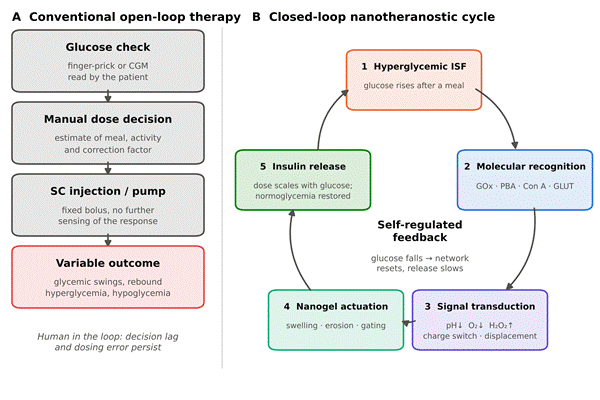
The clinical consequences follow directly from that mismatch. Patients contend with glycemic variability, episodes of iatrogenic hypoglycemia that can be acutely dangerous, lipodystrophy at injection sites, injection-related pain, and—unsurprisingly—imperfect adherence (Balasubramaniyam et al., 2025; Martínez-Navarrete et al., 2024; Sedighi et al., 2023). The logical endpoint of this line of reasoning is to rebuild the missing loop in materials: a closed-loop nanotheranostic system that senses interstitial glucose and releases insulin in proportion, restoring normoglycemia without asking the patient to intervene (Lakharwal et al., 2026; Martínez-Navarrete et al., 2024). Figure 1 contrasts the two paradigms.

Building that loop requires a material that can do two jobs at once—report on glucose and act on insulin—within a single object. This is the premise of smart nanotheranostics, which fuse real-time diagnosis and precision therapy into one self-regulating platform (Balasubramaniyam et al., 2025; Lakharwal et al., 2026). Of the many nanocarriers that have been tried—liposomes, polymeric nanoparticles, mesoporous silica, dendrimers—glucose-responsive nanogels have proven unusually well suited to the task (Balasubramaniyam et al., 2025; Hosseini Sharifabad et al., 2026; Sedighi et al., 2023).

A nanogel is, physically, a crosslinked hydrophilic polymer network shrunk to the nanoscale. That geometry is what makes it valuable: it keeps the high water content, softness, and tissue-like character of a bulk hydrogel while gaining the rapid diffusion, prolonged circulation, and barrier penetration of a nanoparticle (Abdullahi et al., 2026; Ma et al., 2025; Sedighi et al., 2023). The decisive advantage, though, is chemical tunability. Glucose-sensing moieties can be built directly into the backbone or the crosslinks, so that recognition and response are not two separate components but one continuous material (Ma et al., 2025; Sedighi et al., 2023; Blagojevic & Kamaly, 2025). When glucose rises, those embedded sensors undergo chemical, enzymatic, or conformational change, and the network answers—swelling, deswelling, inverting its charge, opening a gate, or degrading outright—to let insulin out on demand (Abdullahi et al., 2026; Lakharwal et al., 2026; Martínez-Navarrete et al., 2024). Between meals, the same network shields its peptide cargo from proteases and holds back basal leakage, with reversible kinetics that echo the pancreas itself (Hosseini Sharifabad et al., 2026; Sedighi et al., 2023).

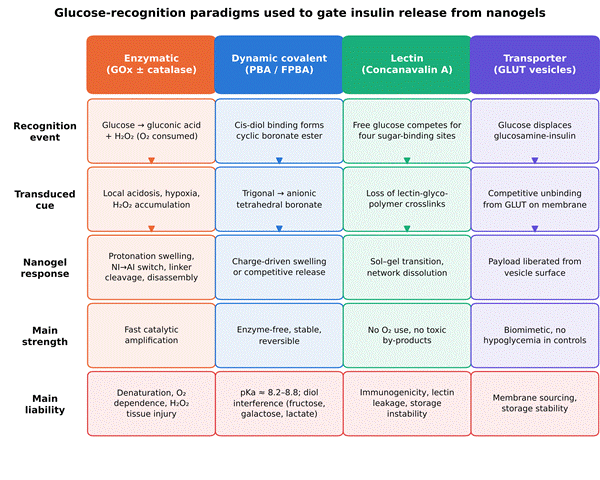
Everything downstream depends on how reliably the system recognizes glucose in the first place—on the selectivity, speed, and durability of the sensing element (Martínez-Navarrete et al., 2024; Lakharwal et al., 2026). Three recognition chemistries dominate the literature, and they are different enough in character that the choice between them shapes the whole device (Figure 2).

The enzymatic route uses glucose oxidase (GOx), which oxidizes glucose to gluconic acid and hydrogen peroxide (H2O2) and, in doing so, consumes local oxygen (Martínez-Navarrete et al., 2024; Lakharwal et al., 2026). Hyperglycemia drives the reaction harder, producing three usable cues—a drop in pH, local hypoxia, and accumulating H2O2—any of which can be wired to a release event through pH-sensitive polyamines, hypoxia-labile 2-nitroimidazole groups, or H2O2-cleavable boronate linkers (Abdullahi et al., 2026; Martínez-Navarrete et al., 2024; Lakharwal et al., 2026). Because the peroxide is itself tissue-toxic, catalase or inorganic nanozymes such as MnO2 and CeO2 are often co-loaded to mop it up (Martínez-Navarrete et al., 2024; Lakharwal et al., 2026).

The synthetic route replaces the enzyme with phenylboronic acid (PBA), which binds the cis-diols of glucose through reversible dynamic covalent chemistry (Hosseini Sharifabad et al., 2026; Martínez-Navarrete et al., 2024). PBA sits in equilibrium between an uncharged trigonal form and a charged tetrahedral boronate; glucose binding pushes it toward the charged state, raising fixed

Figure 1. Open-loop versus closed-loop insulin delivery. (A) Conventional therapy operates as an open loop in which the patient manually measures glucose, estimates a dose, and injects a fixed bolus, leaving decision lag and dosing error uncorrected and producing glycemic swings, rebound hyperglycemia, and hypoglycemia. (B) The closed-loop nanotheranostic cycle removes the human from the loop: hyperglycemic interstitial fluid is read by a molecular sensor (GOx, PBA, Con A, or GLUT), transduced into a local cue (pH↓, O2↓, H2O2↑, charge switch, or displacement), and converted by nanogel actuation into proportional insulin release, after which falling glucose resets the network and slows release.

Figure 2. Comparison of the three glucose-recognition paradigms. Each column traces one sensing family—enzymatic (glucose oxidase ± catalase/nanozyme), synthetic dynamic covalent (phenylboronic acid and its fluorinated derivatives), lectin (concanavalin A), and glucose-transporter (GLUT) vesicles—from the molecular recognition event through the transduced cue to the resulting nanogel response. The final two rows contrast each paradigm's principal strength against its principal liability (red), making explicit the kinetic, selectivity, and stability trade-offs that govern mechanism choice for a given delivery route.

negative charge in the network and driving the swelling or displacement that releases insulin (Hosseini Sharifabad et al., 2026; Lakharwal et al., 2026). Its chief limitation is that native PBA responds poorly at physiological pH, a problem addressed by lowering its pKa with electron-withdrawing or amino substituents (Hosseini Sharifabad et al., 2026; Martínez-Navarrete et al., 2024).

The third route is competitive binding. Concanavalin A (Con A), a lectin with four sugar-binding sites, crosslinks glycosylated polymers until free glucose competes those bonds apart, dissolving the network (Ma et al., 2025; Lakharwal et al., 2026). Engineered vesicles bearing glucose transporter (GLUT) proteins exploit the same displacement logic to release glucosamine-modified insulin (Martínez-Navarrete et al., 2024; Lakharwal et al., 2026).

A responsive material is only half a device; it has to reach the glucose it is meant to read. Increasingly, nanogels are built into transdermal microneedle (MN) arrays, wearable bioelectronics, and microfluidic platforms that bring the chemistry to the interstitial fluid (Balasubramaniyam et al., 2025; Martínez-Navarrete et al., 2024; Lakharwal et al., 2026). Microneedles cross the stratum corneum painlessly to reach dermal ISF, where glucose tracks blood glucose closely enough to serve as a proxy (Martínez-Navarrete et al., 2024). Loaded into dissolving, swelling, or electro-modulated arrays—and paired with optical, fluorescent, or electrochemical readouts—they begin to approximate a true artificial pancreas, sensing continuously and dosing autonomously through postprandial spikes (Balasubramaniyam et al., 2025; Lee et al., 2016; Luo et al., 2022).

The preclinical record is genuinely impressive, and yet the gap to the clinic is real (Babinski et al., 2026; Martínez-Navarrete et al., 2024; Lakharwal et al., 2026). Enzymes denature; lectins provoke immune responses; boronates can be fooled by fructose and galactose; GMP-scale manufacturing is unforgiving; and the regulatory path for a drug–device–biologic hybrid is anything but settled (Hosseini Sharifabad et al., 2026; Bhairam et al., 2026; Moreno-Borrallo et al., 2026). A clear-eyed synthesis is needed to separate what has been demonstrated from what has merely been promised—which is the purpose of this review.

Against that background, this review sets out to (i) compare the molecular biosensing mechanisms—GOx, PBA and derivatives, Con A, and GLUT—on binding kinetics, pH sensitivity, selectivity, and stability (Martínez-Navarrete et al., 2024; Lakharwal et al., 2026); (ii) survey the nanogel architectures and trigger modalities that convert recognition into release (Hosseini Sharifabad et al., 2026; Sedighi et al., 2023); (iii) synthesize the integrated and wearable platforms that unite diagnosis with therapy (Balasubramaniyam et al., 2025; Lee et al., 2016); (iv) benchmark in vivo pharmacodynamics and hypoglycemia safety across rodent and swine models (Martínez-Navarrete et al., 2024; Yang et al., 2022); and (v) delineate the translational bottlenecks and future directions that stand between proof-of-concept and personalized clinical care (Babinski et al., 2026; Bhairam et al., 2026).

2. Glucose-Responsive Nanogels and Wearable Closed-Loop Platforms for Self-Regulated Insulin Delivery

2.1 Historical evolution: from replacement to regulation

The arc of insulin therapy is a story of steadily tightening control. Crude extracts gave way to recombinant human insulin, then to rapid- and long-acting analogues, and finally to continuous subcutaneous infusion—each step narrowing the gap between dose and need (Babinski et al., 2026; Lakharwal et al., 2026). But every one of these advances left the control loop open: the patient still had to measure, decide, and act (Balasubramaniyam et al., 2025; Martínez-Navarrete et al., 2024). The conceptual leap of the past decade has been to treat delivery not as a scheduling problem but as a feedback problem—to ask the material itself to sense and respond (Lakharwal et al., 2026; Martínez-Navarrete et al., 2024). This “sense-and-treat” framing, consolidating continuous biosensing and self-regulated release in one matrix, is what defines the closed-loop nanotheranostic system and organizes the platforms compiled in Tables 1 and 2 (Balasubramaniyam et al., 2025; Lakharwal et al., 2026).

2.2 Nanogel architectures and network chemistry

Among the nanocarriers evaluated for diabetes—liposomes, solid lipid nanoparticles, mesoporous silica, polymeric micelles—glucose-responsive nanogels stand out for their combination of softness, water content, and chemical programmability (Balasubramaniyam et al., 2025; Sedighi et al., 2023; Blagojevic & Kamaly, 2025). Their synthetic versatility is the real story. Controlled polymerizations—thiol-ene click

Table 1. Glucose-responsive nanogels and smart nanocarrier systems for closed-loop insulin delivery. In this table Representative glucose-responsive nanogel and nanocarrier systems for closed-loop insulin delivery, organized by carrier architecture. For each system the table summarizes matrix chemistry, the molecular sensing mechanism and its physiological trigger, quantitative in vitro and in vivo performance (encapsulation efficiency, glucose-dependent swelling, release fraction, and glycemic duration), and the principal efficacy and safety findings. Together the entries span the enzymatic, synthetic-covalent, and competitive-binding paradigms compared in Figure 2.

Formulation / carrier

Matrix & chemistry

Sensing mechanism & trigger

In vitro / in vivo performance

Key findings & safety

Reference

Dendrimer-grafted cellulose nanocrystals (CPGx-CPB)

Nanocrystalline cellulose core grafted with 3rd/4th-generation poly(propylene imine) dendrimers, functionalized with 4-carboxyphenylboronic acid

Synthetic dynamic covalent boronate ester formation; internal PPI amines lower boronic-acid pKa to physiological pH

EE 85.8%, LC 21.7% (4th gen); hydrodynamic size 129→374 nm (0→4 mg/mL glucose); ~10% release at pH 1.2, 65–68% at pH 7.4 + 4 mg/mL glucose

Reversible glucose-induced swelling/deswelling; >90% viability at 100 μg/mL; doubles as an optical/fluorescent glucose biosensor

Hosseini Sharifabad et al. (2026)

Hypoxia-sensitive HA vesicles in microneedles (GRV(E+I))

Hyaluronic acid modified with 2-nitroimidazole, co-encapsulating insulin and glucose oxidase

Enzymatic oxidation (GOx) consumes O2 under hyperglycemia, creating hypoxia that reduces hydrophobic 2-nitroimidazole to hydrophilic 2-aminoimidazole

Rapid vesicle disassembly and burst release at 400 mg/dL; lowered BGL in STZ-diabetic mice from ~400 to <200 mg/dL within 30 min

Normoglycemia for up to 4 h; elevated plasma insulin over 24 h; minimal local skin inflammation

Lakharwal et al. (2026); Martínez-Navarrete et al. (2024)

Core–shell PVA microneedle with catalase shell

Poly(vinyl alcohol) core crosslinked by H2O2-cleavable phenylboronate esters; shell of acrylated catalase nanogels

GOx-generated H2O2 hydrolyzes carbamate linkers and PVA crosslinks; catalase shell scavenges local H2O2

Onset ~30 min to normoglycemia in diabetic mice; BGL <200 mg/dL sustained for 3.5 h at 50 mg/kg insulin dose

Spatial catalase separation prevents premature enzyme-induced H2O2 depletion while mitigating oxidative inflammation

Martínez-Navarrete et al. (2024)

Dynamically capped porous alumina microneedles

Macroporous alumina core capped with mesoporous silica, gated by GOx/catalase-loaded chitosan hydrogel

Hyperglycemia-driven enzymatic acidification protonates chitosan, causing electrostatic swelling that opens mesopore caps

High loading (0.8 mg); pulsatile on/off release over normo-/hyperglycemic cycles; normoglycemia for 5 h in vivo

Rechargeable from external reservoir; cap stays closed under normoglycemia, eliminating iatrogenic hypoglycemia risk

Gholami et al. (2021); Martínez-Navarrete et al. (2024)

Dual-responsive glycopolypeptide nanogels

PAAPBA homopolymer and glycopolypeptide PEG-b-P(Asp-co-AGA) crosslinked via dynamic boronate esters

Dual glucose and H2O2 responsiveness; competitive sugar displacement plus H2O2 oxidation disassemble cycloborate complexes

Hydrodynamic radius 84→110 nm at 3.0 mg/mL glucose; sustained self-regulated release in diabetic rats

Superior hypoglycemic control vs. single-responsive carriers; excellent cytocompatibility and non-hemolytic profile

Sedighi et al. (2023); Li et al. (2019)

Biomineralized CaP nanoparticle microneedles (BINPs)

N-2-hydroxypropyl trimethyl ammonium chloride chitosan, HA, and β-glycerophosphate with CaP-biomineralized insulin

GOx-catalyzed oxidation generates gluconic acid, lowering microenvironmental pH and dissolving the CaP shell

50% release at pH 6.5 and 90% at pH 6.0 over 72 h; minimal leakage at pH 7.4

>90% viability in HepG2/3T3 cells; strong hemocompatibility to 1 mg/mL; controlled pH-dependent kinetics

Lakharwal et al. (2026)

Oral fucoidan–Con A nanosystems (VB12-FU-ConA@Ins)

Vitamin B12- and fucoidan-functionalized nanoparticles crosslinked with concanavalin A

Competitive displacement of Con A by free glucose; VB12 targets intrinsic-factor receptors for gut uptake

Only 35.9% insulin degradation after 2 h in simulated intestinal fluid; BGL to 8.1 mmol/L within 8 h (~3× free insulin)

Fucoidan mitigates Con A hepatotoxicity; lowers systemic TNF-α and IL-6 during extended dosing

Lakharwal et al. (2026)

Dually crosslinked nanogels (DC-NG@insulin)

Polymeric network combining reversible PBA ester bonds and UV-cured covalent crosslinks

Hyperglycemia breaks boronate esters to release insulin; UV-crosslinked scaffold prevents matrix collapse and GOx leakage

Normoglycemia for 8 h in diabetic rodents without burst-induced hypoglycemia

Suppressed TNF-α and IL-1β; no organ pathology or injection-site irritation over 14 days

Lakharwal et al. (2026)

Table 2. Stimuli-responsive nanocarriers and microneedle platforms in diabetes complications and targeted delivery.  Stimuli-responsive nanocarrier and microneedle platforms applied beyond basal insulin delivery, spanning closed-loop glycemic management, dual-hormone control, diabetic wound healing, oral peptide delivery, and periodontal complications. Each row links the clinical application to its platform architecture, the stimulus and molecular trigger that governs release, the encapsulated payload, and the reported physiological outcome, illustrating how the sensing chemistries of Table 1 are redeployed across the wider landscape of diabetes complications.

Therapeutic application

Delivery platform / architecture

Stimulus & trigger

Encapsulated payload

Physiological outcome & efficacy

Reference

Transdermal closed-loop glycemic management

Soft, wireless graphene-based wearable patch with thermo-responsive microneedles

Integrated electrochemical sweat glucose biosensor triggers resistive heater coils to induce thermal phase transition

Insulin / metformin

Real-time continuous glucose monitoring synchronized with thermal-pulse transdermal insulin bolus delivery in diabetic mice

Lee et al. (2016); Martínez-Navarrete et al. (2024)

Closed-loop dual-hormone delivery

Hybrid microneedle patch with insulin- and glucagon-loaded copolymer arrays

Charge-switch mechanism: PBA-grafted amphiphilic polymer changes net charge on glucose binding, releasing insulin in hyperglycemia and glucagon in hypoglycemia

Insulin & glucagon analogue

Bidirectional glucose regulation in mice and minipigs for up to 22 h; eliminates hypoglycemia during delayed meals

Martínez-Navarrete et al. (2024); Yang et al. (2022)

Diabetic wound healing & infection control

Injectable self-healing coordination hydrogel crosslinked by pH/ROS-labile dynamic boronate esters

Acidic pH and elevated ROS in infected wound beds cleave dynamic linkages, triggering drug release

Mangiferin & diclofenac sodium

Accelerated wound closure, antibacterial biofilm eradication, ROS neutralization, enhanced angiogenesis and collagen deposition

Das et al. (2025); Sedighi et al. (2023)

Glucose/MMP-9 dual-responsive wound dressings

Self-adaptive hydrogel with MMP-9-cleavable peptide substrates and PBA moieties

High glucose and overexpressed MMP-9 in chronic ulcers degrade hydrogel crosslinks

VEGF & insulin

Promoted M1-to-M2 macrophage polarization, granulation tissue formation, and improved microcirculation in diabetic foot ulcers

Das et al. (2025); Ma et al. (2025)

Photothermal diabetic ulcer therapy

Chitosan methacrylate/silk fibroin hydrogel embedded with gold nanoparticles

NIR light absorption by AuNPs induces local hyperthermia, promoting polymer chain mobility and drug diffusion

Silk fibroin & gold nanoparticles

Spatiotemporal release control; reduced inflammatory infiltrate, enhanced re-epithelialization and tissue remodeling

Kumar et al. (2026)

Oral peptide & insulin administration

Enteric-coated chitosan-capped PLGA nanoparticles emulsified with TPGS

pH-triggered dissolution in neutral/alkaline intestinal fluid (pH 6.8–7.4) with mucoadhesive adherence

Insulin / GLP-1 analogue (exendin-4)

Protected cargo from gastric degradation; prolonged circulation; oral bioactivity comparable to subcutaneous injection

Abdullahi et al. (2026); Balasubramaniyam et al. (2025)

Microvascular & periodontal complications

Gelatin-based nanogels integrated with EGCG and ROS-scavenging nanozymes

Dual ROS and glucose sensitivity; scavenges radicals and releases EGCG

EGCG & CeO2 nanozymes

Neutralized oxidative stress, suppressed periodontal bone loss, reduced pro-inflammatory cytokines, restored tissue homeostasis

Su et al. (2025)

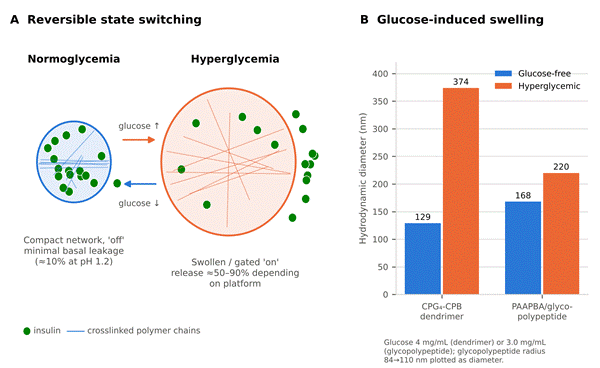
chemistry, RAFT—allow sensing moieties, cleavable crosslinkers, and protective shells to be placed with precision (Abdullahi et al., 2026; Sedighi et al., 2023; Zhao et al., 2013). Core–shell designs, for instance, pair a hydrophobic drug-loading core with a hydrophilic PEG shell for colloidal stability, encapsulating insulin in swollen aqueous domains that resist enzymatic attack and basal leakage until glucose arrives (Sedighi et al., 2023; Hosseini Sharifabad et al., 2026). The representative systems and their chemistries are collated in Table 1, with multi-stimuli and 3D/4D-printed variants in Table 3. On exposure to glucose, the embedded sensor drives a conformational change—swelling, charge conversion, gating, or network breakdown—that opens the material to release (Hosseini Sharifabad et al., 2026; Martínez-Navarrete et al., 2024; Sedighi et al., 2023). Figure 3 depicts this reversible “off/on” switch and the measured swelling that accompanies it.

2.3 Molecular biosensing mechanisms

The performance of any closed-loop nanogel ultimately rests on its sensor, and the literature sorts these into three families whose trade-offs are summarized in Figure 2 and, with representative data, in Table 1 (Lakharwal et al., 2026; Martínez-Navarrete et al., 2024; Dmour et al., 2026).

2.3.1 Enzymatic cascades: glucose oxidase and nanozyme partners

GOx—a flavin-dependent dimeric glycoprotein—converts glucose to gluconic acid and H2O2 while consuming oxygen, and under hyperglycemia this cascade reshapes the local microenvironment: pH falls, oxygen is depleted, and reactive oxygen species build up (Lakharwal et al., 2026; Martínez-Navarrete et al., 2024). Each of those shifts can be made to trigger release through pH-responsive polymers, hypoxia-labile linkages, or H2O2-cleavable boronates (Lakharwal et al., 2026; Martínez-Navarrete et al., 2024; Sedighi et al., 2023). The landmark demonstration remains the hypoxia-sensitive vesicle: Yu et al. (2015) built hyaluronic acid nanovesicles carrying 2-nitroimidazole, GOx, and insulin, in which glucose-driven oxygen depletion reduced the hydrophobic nitroimidazole to a hydrophilic amine, dissolving the vesicle and restoring normoglycemia within about 30 minutes in diabetic mice (Yu et al., 2015). Peroxide-triggered variants followed the same logic along a different cue (Hu et al., 2017). The enzymatic approach is fast and self-amplifying, but it is not free—GOx can denature, its rate depends on oxygen that ischemic tissue may lack, and accumulating H2O2 damages tissue (Lakharwal et al., 2026; Martínez-Navarrete et al., 2024). Co-loading catalase or nanozymes (MnO2, CeO2, tannic acid–iron) recycles the peroxide back to water and oxygen, protecting tissue and sustaining catalysis (Lakharwal et al., 2026; Martínez-Navarrete et al., 2024)—a strategy also embodied in the catalase-shell and biomineralized systems of Table 1.

2.3.2 Synthetic dynamic covalent networks: phenylboronic acid derivatives

To sidestep the fragility and immunogenicity of enzymes, PBA offers a fully synthetic alternative that binds glucose through reversible boronate ester bonds (Hosseini Sharifabad et al., 2026; Lakharwal et al., 2026; Martínez-Navarrete et al., 2024). The chemistry is elegant: PBA toggles between trigonal and tetrahedral states, glucose binding favors the charged tetrahedral boronate, and the resulting increase in fixed negative charge drives electrostatic swelling and release (Hosseini Sharifabad et al., 2026; Lakharwal et al., 2026; Martínez-Navarrete et al., 2024). The practical obstacle is pKa—native PBA (≈8.2–8.8) is too sluggish at pH 7.4—so electron-withdrawing fluorination (as in 4-carboxy-3-fluorophenylboronic acid) or adjacent amines that form intramolecular B–N bonds are used to pull it down to physiological range (Hosseini Sharifabad et al., 2026; Martínez-Navarrete et al., 2024). Hosseini Sharifabad et al. (2026) illustrate the approach well, grafting 4-carboxyphenylboronic acid onto cellulose-nanocrystal-cored dendrimers whose internal amines lower the effective pKa, yielding glucose-triggered swelling (129 → 374 nm) and pH 7.4 release (Hosseini Sharifabad et al., 2026). Crucially, the binding is reversible, so these networks swell in hyperglycemia and contract again as glucose falls, limiting unwanted leakage (Hosseini Sharifabad et al., 2026; Lakharwal et al., 2026)—the behavior tabulated for the dendrimer and glycopolypeptide systems in Table 1.

2.3.3 Lectin- and transporter-mediated competitive displacement

The third family trades chemistry for biology. Con A, with its four carbohydrate-binding sites, crosslinks glycopolymers into a gel that free glucose can competitively dismantle (Ma et al., 2025; Lakharwal et al., 2026; Dmour et al., 2026). The oral VB12–fucoidan–Con A

Table 3. Multi-stimuli and advanced smart polymeric networks (3D/4D printing and bioorthogonal platforms). Advanced multi-stimuli and additively manufactured polymeric networks relevant to next-generation closed-loop delivery. The entries catalogue 3D/4D-printed microneedles, bilayer actuators, plasmonic and bioorthogonal hydrogels, and quantum-engineered networks, specifying for each the material composition, the combination of stimuli that governs actuation, the fabrication route, and the resulting dynamic response. The table situates glucose-responsive nanogels within the broader engineering toolkit expected to improve reproducibility, geometry control, and orthogonal triggering.

Platform architecture

Material composition

Multi-stimuli triggers

Fabrication method

Dynamic response & kinetics

Reference

4D thermo-responsive microneedle array

Hydroxybutyl methacrylated chitosan (HBCMA) hydrogel network

Dual photo-curing and temperature responsiveness (body temperature 37 °C)

Digital Light Processing (DLP) 3D printing

Thermo-induced chain rearrangement sharpens needle tips, raising insertion strength to 51.8 mN at 37 °C; 72.8% sustained release over 168 h

Dmour et al. (2026); Suvarna et al. (2026)

LCST/UCST bilayer 4D hydrogel actuators

Poly(N-isopropylacrylamide) (PNIPAAm, LCST) with sulfobetaine methacrylate (SBMA, UCST)

Temperature fluctuations (complementary thermal swelling/contraction)

Extrusion-based 4D printing guided by finite element modeling

PNIPAAm swells at 4 °C and contracts at 70 °C; 1:1 bilayers generate reversible curvature switching (>±150°) within 10 min

Suvarna et al. (2026)

Plasmonic 4D photothermal nanocomposites

Poly(ethylene glycol) diacrylate (PEGDA 250/400) with gold nanospheres or nanorods

NIR irradiation (532 nm for AuNSs vs. 1064 nm for AuNRs)

Vat photopolymerization 3D printing

Wavelength-selective photothermal conversion melts local polymer domains for rapid, light-activated on-demand release

Dmour et al. (2026)

Bioorthogonal click-crosslinked hydrogels

Tetrazine-modified gelatin and norbornene polymers; cyclooctyne-modified alginate

Bioorthogonal iEDDA click chemistry with SPAAC, paired with pH/enzymatic triggers

Microfluidic droplet generation & strain-promoted cycloaddition

High crosslink density without toxic radicals or UV; MMP hydrolysis promotes cell infiltration and sustained diffusion

Ahmad et al. (2026); Dmour et al. (2026)

Multi-stimuli thermo/pH/redox nanogels

Oligo(ethylene glycol) acrylate (OEGA), ortho-ester DMDEA, disulfide crosslinker BADS

Tri-stimuli: temperature, acidic pH (4.0–6.0), and redox (GSH/DTT)

Solution polymerization and nanoprecipitation

Nanogel contracts (17–35 nm) on heating; acidic pH hydrolyzes ortho-esters and GSH cleaves disulfides for burst release

Ahmad et al. (2026)

3D-printed triple-responsive nanocomposite MNs

Poly(acrylic acid), thermo-responsive polymers, magnetic Fe3O4 nanoparticles

Tri-responsive: magnetic field, temperature, and acidic microenvironmental pH

Direct Ink Writing (DIW) 3D printing

Magnetically guided localization; photothermal heat under NIR/AMF opens pores for accelerated pH-dependent release

Dmour et al. (2026)

Light/thermo-responsive shape-memory polyurethanes

Thermoplastic polyurethane (TPU), polylactic acid (PLA), polyaniline (PANI) blends

Dual light (NIR photothermal) and thermal stimulation

Fused Deposition Modeling (FDM) / 4D printing

NIR absorption by PANI exceeds polymer Tg, triggering rapid shape-memory actuation and burst payload release

Suvarna et al. (2026)

Quantum-engineered polymeric cargo networks

Electronic-structure-modulated polymers with supramolecular host–guest motifs

Multi-stimuli: electric field, redox potential, metabolite recognition

Additive manufacturing with quantum-chemical DFT design

Predictive energy-landscape tuning controls host–guest affinity for fatigue-resistant, selective capture/release cycles

Satapathy et al. (2026)

Table 4. Key translational challenges, biocompatibility constraints, and the regulatory landscape for responsive nanocarriers. Translational obstacles standing between preclinical success and clinical deployment of responsive insulin-delivery nanocarriers, grouped by domain. For each bottleneck the table identifies the specific technical or biological challenge, its root cause, candidate engineering and quality-control mitigations, and the relevant regulatory standards spanning ISO, FDA, and EMA frameworks. It consolidates the barriers discussed in Sections 2.5 and 5.4 into an actionable agenda for clinical translation.

Domain / bottleneck

Specific challenge

Root causes & mechanisms

Engineering & QC strategies

Regulatory context

Reference

Biocompatibility & off-target toxicity

Complement activation-related pseudoallergy (CARPA), cytokine storms, acute hypersensitivity

>30% of nano-formulations trigger C3a/C5a bursts; surface charge and opsonin binding drive rapid immune recognition

Zwitterionic coatings; cleavable PEG shields; “safe-by-design” surface tuning; ex vivo micro-dosing in human serum

ISO 10993 testing; FDA/EMA immunotoxicology risk-assessment frameworks

Abdoh et al. (2026); Balasubramaniyam et al. (2025); Bhairam et al. (2026)

Chronic tissue accumulation

Long-term organ retention causing inflammation and fibrosis

Non-biodegradable carbon-backbone polymers and inorganic carriers (SiO2, AuNPs >10 nm) accumulate in liver and spleen

Cleavable disulfide/ester linkages; sub-6 nm renal-clearable carriers; biodegradable polysaccharide backbones

ICP-MS organ-accumulation tracing; EMA long-term biodistribution requirements

Balasubramaniyam et al. (2025); Bhairam et al. (2026); Suvarna et al. (2026)

Scalability & industrial manufacturing

Batch-to-batch variability in size, encapsulation, and response threshold

Complex multi-step synthesis (dendrimer generation, polyelectrolyte complexation) is sensitive to pH, mixing, and temperature

Continuous microfluidic synthesis; machine-vision quality control; standardized Quality-by-Design frameworks

FDA 21 CFR Part 820 Quality System Regulation; EMA 3-batch pilot validation

Bhairam et al. (2026); Kumar et al. (2026); Su et al. (2025)

Enzyme & sensor instability

Loss of enzymatic activity, denaturation, reduced selectivity over time

GOx and Con A denature under heat, mechanical stress, or extreme pH; PBA lacks selectivity against fructose/galactose

Chemical modification of PBA to pKa ~7.2; nanozyme co-immobilization; hydrogel-cage encapsulation to prevent leaching

FDA Stability Testing Guidelines (ICH Q1A/Q1B); raw-material characterization frameworks

Hosseini Sharifabad et al. (2026); Lakharwal et al. (2026); Martínez-Navarrete et al. (2024)

Mechanical & operational stability of microneedles

Needle bending/fracture during insertion; moisture sensitivity

Water-soluble polymers (HA, PVA, CMC) absorb humidity, lowering modulus below the 1–5 MPa insertion threshold

Hybrid composites (PCL/alginate, gelatin-methacrylate); finite element optimization of needle geometry

Mechanical insertion validation (ISO 11608 series); skin penetration depth profiling

Dmour et al. (2026)

Complex regulatory classification

Ambiguous pathways for multi-component theranostic platforms

Smart microneedles and wearable patches combine drugs, biologics, and external energy emitters

Early pre-submission inter-center consultation; clear Critical Quality Attributes for combined modes of action

FDA Combination Product Framework (21 CFR Part 3); EU MDR 2017/745, Article 47

Abdoh et al. (2026); Bhairam et al. (2026); Moreno-Borrallo et al. (2026)

system in Table 1 shows how this can be stabilized for the gut; biomimetic vesicles presenting GLUT proteins apply the same displacement principle to glucosamine-insulin (Martínez-Navarrete et al., 2024; Lakharwal et al., 2026). These systems neither consume oxygen nor generate toxic by-products—a real advantage over GOx—but they carry their own liabilities: lectin immunogenicity, leakage, and thermal instability on storage (Lakharwal et al., 2026; Dmour et al., 2026).

2.4 Integration into transdermal and wearable platforms

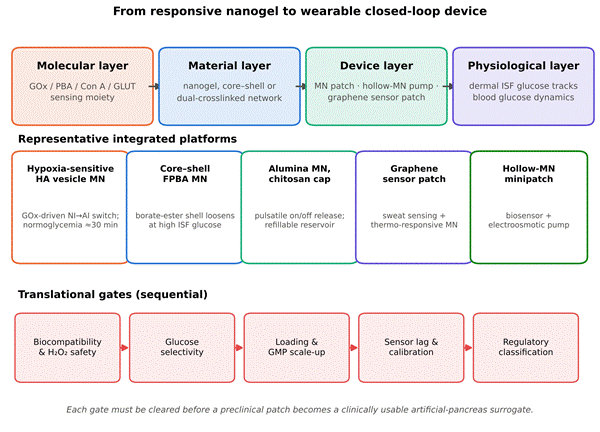
Translating these chemistries into usable devices has meant embedding them at the skin, where ISF glucose is accessible and tracks blood glucose faithfully (Balasubramaniyam et al., 2025; Lakharwal et al., 2026; Martínez-Navarrete et al., 2024). Figure 4 traces the layering from sensing moiety to material to device to physiology. Several designs recur. Chen et al. (2023) built core–shell microneedles with an insulin-loaded PVA core inside an FPBA-crosslinked shell whose density loosens as ISF glucose rises, letting insulin diffuse out and lowering glucose in diabetic rats (Chen et al., 2023). Gholami et al. (2021) took a different tack—porous alumina needles capped with a GOx/catalase-loaded chitosan hydrogel that swells on local acidification to open mesopores for pulsatile delivery, refillable from an external reservoir (Gholami et al., 2021). Fu et al. (2022) pursued the same no-hypoglycemia goal through an on-demand transdermal system for type 1 disease (Fu et al., 2022). On the wearable side, Lee et al. (2016) combined graphene-based electrochemical sweat sensing with thermoresponsive microneedles, while Luo et al. (2022) paired a hollow-microneedle biosensor with an electroosmotic pump to regulate infusion from live readings (Lee et al., 2016; Luo et al., 2022). Table 2 compiles these and related complication-directed platforms.

2.5 In vivo performance and translational barriers

Across streptozotocin-diabetic mice, rats, and minipigs, these systems repeatedly outperform bolus injection, holding glucose below 200 mg/dL for anywhere from four hours to over a day after a single application rather than driving the sharp drop-and-rebound of a fixed dose (Lakharwal et al., 2026; Martínez-Navarrete et al., 2024). Glucose tolerance tests confirm the loop actually closes—release accelerates on a challenge and then eases back toward basal (Hosseini Sharifabad et al., 2026; Lakharwal et al., 2026; Martínez-Navarrete et al., 2024). The dual-hormone patch of Yang et al. (2022), co-delivering insulin and glucagon by charge switching, pushed regulation to 22 hours in minipigs while abolishing hypoglycemia (Yang et al., 2022). The barriers that remain are collated in Table 4 and summarized here: biocompatibility and H2O2 management (Balasubramaniyam et al., 2025; Lakharwal et al., 2026); glucose selectivity against fructose, galactose, and lactate (Hosseini Sharifabad et al., 2026; Martínez-Navarrete et al., 2024); loading capacity and GMP-scale reproducibility (Hosseini Sharifabad et al., 2026; Bhairam et al., 2026); sensor latency and calibration (Luo et al., 2022; Martínez-Navarrete et al., 2024); and the regulatory classification of multi-component products (Abdoh et al., 2026; Moreno-Borrallo et al., 2026). Clearing them will take genuinely interdisciplinary work across polymer chemistry, bioelectronics, and endocrinology (Balasubramaniyam et al., 2025; Lakharwal et al., 2026).

3. Methods

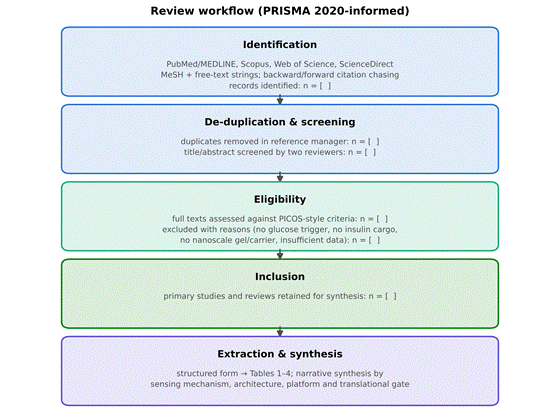
This work is a structured narrative review, assembled and reported in a manner consistent with PRISMA 2020 guidance so that the search and synthesis can be reproduced. Figure 5 shows the workflow.

3.1 Research question and eligibility criteria

The review was framed around a single question: in experimental models of diabetes, how do glucose-responsive nanogel and allied nanocarrier systems sense glucose and release insulin, and how close are they to clinical use? Eligibility followed a PICOS-style scheme. Population: in vitro, ex vivo, and in vivo diabetic models (streptozotocin- or alloxan-induced rodents and swine). Intervention: a nanoscale, crosslinked, glucose-responsive polymeric carrier (nanogel, core–shell nanoparticle, responsive vesicle, or microneedle incorporating such a carrier) loaded with insulin or an insulin analogue. Comparator, where present: conventional subcutaneous insulin, a non-responsive carrier, or a normoglycemic control. Outcomes: encapsulation efficiency and loading capacity, glucose-triggered swelling or release, in vivo glycemic duration, hypoglycemia safety, and biocompatibility. Study designs: primary experimental studies and, for context, authoritative review and methodological articles. Records were excluded if they lacked a defined glucose-sensing trigger, delivered no insulin, used no nanoscale gel or carrier, or reported insufficient extractable data.

3.2 Information sources and search strategy

Four databases were searched—PubMed/MEDLINE, Scopus, Web of Science Core Collection, and ScienceDirect—for records up to the review date, with no lower date limit so that foundational studies were retained. The strategy combined controlled vocabulary (MeSH, where available) with free-text terms across three concept blocks joined by the Boolean operator AND, with synonyms within each block joined by OR: (i) “glucose-responsive” OR “glucose-sensitive” OR “glucose-triggered” OR “closed-loop”; (ii) “nanogel” OR “hydrogel” OR “nanoparticle” OR “microneedle” OR “vesicle” OR “nanocarrier”; and (iii) “insulin” OR “diabetes” OR “glycemic.” Mechanism terms (“phenylboronic acid,” “glucose oxidase,” “concanavalin A,” “glucose transporter”) were used to focus retrieval. The full PubMed string was adapted syntactically for each database. Backward and forward citation chasing on key reviews (Martínez-Navarrete et al., 2024; Lakharwal et al., 2026; Sedighi et al., 2023) supplemented the database searches.

3.3 Study selection

Records were exported to a reference manager and de-duplicated. Two reviewers independently screened titles and abstracts against the eligibility criteria, then assessed full texts of potentially relevant records; disagreements were resolved by discussion. The flow of records through identification, screening, eligibility, and inclusion is reported in Figure 5, with counts to be completed on finalization of the search.

3.4 Data extraction

A standardized extraction form captured, for each included study: carrier system and matrix chemistry; sensing mechanism and trigger; encapsulation efficiency and loading capacity; characterization methods (e.g., dynamic light scattering for hydrodynamic size, electron microscopy for morphology); in vitro release conditions and kinetic model fits; animal model, dose, and route; glycemic outcomes (onset, duration, nadir) and challenge-test behavior; and biocompatibility assays (MTT viability, hemolysis, histopathology, serum chemistry, cytokines). One reviewer extracted and a second verified. Reported release profiles were, where the source permitted, interpreted against Higuchi and Korsmeyer–Peppas models to classify the dominant transport mechanism (Hosseini Sharifabad et al., 2026).

3.5 Synthesis

Because designs, models, and endpoints were too heterogeneous for meta-analysis, findings were synthesized narratively and tabulated. Studies were grouped by sensing mechanism (enzymatic, synthetic covalent, competitive), by architecture (core–shell, dendrimer, dual-crosslinked, printed), by integration platform (microneedle, wearable, oral), and by translational domain. The resulting structured comparisons are presented in Tables 1–4, and conceptual relationships are rendered in Figures 1–5. No formal risk-of-bias instrument was applied, as validated tools for preclinical nanomaterial studies remain limited; instead, reporting completeness of loading, release, and safety data informed the weight given to each study.

4. Synthesis of Findings: What Glucose-Responsive Nanogels Actually Deliver

4.1 Physicochemical behavior, loading, and swelling kinetics

Start with the materials themselves, because the downstream performance is largely written into them. Nanogels are, by design, structurally adaptable—high water uptake, tunable surfaces—and that is precisely what makes them good at carrying peptides (Blagojevic & Kamaly, 2025; Sedighi et al., 2023). What the collected data show, fairly consistently, is that embedding a glucose sensor turns a change in the chemical environment into a change in the physical network (Table 1) (Hosseini Sharifabad et al., 2026; Lakharwal et al., 2026).

The dendrimer system is the clearest worked example. Functionalizing cellulose-nanocrystal-cored poly(propylene imine) dendrimers with 4-carboxyphenylboronic acid produced loading that scaled with generation—fourth-generation nanogels reached 85.8% ± 3.1% encapsulation efficiency and 21.7% ± 1.3% loading capacity, against 73.6% ± 2.4% and 17.8% ± 1.6% for the third generation—which makes sense, given the extra binding sites on the larger dendron (Hosseini Sharifabad et al., 2026). Under hyperglycemia (4 mg/mL glucose, pH 7.4) the hydrodynamic diameter roughly tripled, 129 to 374 nm (Figure 3) (Hosseini Sharifabad et al., 2026). Release tracked the environment as intended: tight at gastric pH (~10%), opening up at intestinal and physiological pH to about 68% at 4 mg/mL glucose

Figure 3. Reversible nanogel state switching and glucose-induced swelling. (A) Under normoglycemia the crosslinked network stays compact and “off,” limiting basal leakage (≈10% at pH 1.2); rising glucose drives the reversible transition to a swollen or gated “on” state that releases roughly 50–90% of cargo depending on platform, and the network re-contracts as glucose falls. (B) Measured hydrodynamic sizes confirm the switch: the CPG4-CPB dendrimer expands from 129 to 374 nm and the glycopolypeptide system from 84 to 110 nm (plotted as diameter) on exposure to hyperglycemic glucose. Values are drawn from the representative systems in Table 1.

Figure 4. From responsive nanogel to wearable closed-loop device. The top band shows the four-layer integration logic—molecular sensing moiety, responsive material, device format, and the physiological interface where dermal interstitial-fluid glucose tracks blood glucose. The middle band lists representative integrated platforms (hypoxia-sensitive vesicle microneedles, core–shell FPBA microneedles, dynamically capped alumina microneedles, graphene sensor patches, and hollow-microneedle minipatches). The lower band presents the sequential translational gates—biocompatibility and H2O2 safety, glucose selectivity, loading and GMP scale-up, sensor lag and calibration, and regulatory classification—each of which must be cleared for clinical use (Table 4).

Figure 5. PRISMA 2020-informed review workflow. The flow diagram summarizes the structured review process described in Section 3: identification of records across PubMed/MEDLINE, Scopus, Web of Science, and ScienceDirect using combined MeSH and free-text strings with citation chasing; de-duplication and dual-reviewer title/abstract screening; full-text eligibility assessment against PICOS-style criteria with documented exclusion reasons; inclusion of primary studies and key reviews; and structured data extraction feeding the narrative synthesis and Tables 1–4. Bracketed record counts are completed on finalization of the search.

(Hosseini Sharifabad et al., 2026). Fitting those profiles, the data sat best with Higuchi (R2 > 0.98) and Korsmeyer–Peppas (n = 0.51–0.65) models—which, read literally, points to anomalous, swelling-coupled diffusion rather than simple Fickian release (Hosseini Sharifabad et al., 2026).

The glycopolypeptide systems behave similarly, if more modestly—a reversible radius increase from 84 to 110 nm at 3.0 mg/mL glucose (Figure 3) (Sedighi et al., 2023). And the dual-responsive thiol-Michael nanogels are worth dwelling on, because they show the enzymatic and synthetic logics working together: GOx-generated H2O2 cleaves the boronate crosslinks that PBA formed, so glucose is sensed twice over and release is accelerated accordingly (Li et al., 2019; Zhao et al., 2013).

4.2 Comparing the trigger mechanisms

Laid side by side, the three mechanisms separate on onset, duration, and safety margin rather than on whether they work at all—each works (Table 1) (Lakharwal et al., 2026; Martínez-Navarrete et al., 2024).

Enzymatic systems are the quickest off the mark. The hypoxia-sensitive HA vesicle microneedle reached normoglycemia within about half an hour in STZ-diabetic mice and held glucose below 200 mg/dL for roughly 3.5–4 hours (Lakharwal et al., 2026; Martínez-Navarrete et al., 2024; Yu et al., 2015). The catch, as always with GOx, is the peroxide; but co-immobilized catalase or nanozyme shells scavenged a reported 77.8% of it and stretched normoglycemia out to seven days in rodents without hepatic or renal injury (Lakharwal et al., 2026).

Synthetic PBA systems trade a little speed for stability and reach. Tuning the pKa into physiological range gave charge-switch patches that regulated glucose for 9 hours in diabetic mice and—more tellingly—20 hours in Göttingen minipigs, a model far closer to human skin (Martínez-Navarrete et al., 2024). Competitive PBA–diol designs ran to about 24 hours in mice (Martínez-Navarrete et al., 2024). The competitive-binding systems occupy their own niche: the oral VB12–fucoidan–Con A construct brought glucose to 8.1 mmol/L within 8 hours in diabetic rats, roughly threefold better than free oral insulin, while shielding the peptide through the gut (Lakharwal et al., 2026), and GLUT-presenting vesicles held normoglycemia for about 4.5 hours without inducing hypoglycemia in healthy controls—which is, arguably, the more important number (Martínez-Navarrete et al., 2024).

4.3 In vivo glycemic control and hypoglycemia safety

The in vivo picture is where the case for closed-loop delivery is strongest, and it rests on a single contrast. A subcutaneous bolus drives glucose down sharply, often into dangerous territory (<60 mg/dL), then overshoots into rebound hyperglycemia within two or three hours (Lakharwal et al., 2026; Martínez-Navarrete et al., 2024). The closed-loop nanogels, by contrast, produce flat, extended profiles—the shape you would want (Lakharwal et al., 2026; Martínez-Navarrete et al., 2024). Under IPGTT and OGTT challenges the systems did what the mechanism predicts: swelling or gating accelerated to clear the spike, then relaxed back before over-dosing (Hosseini Sharifabad et al., 2026; Lakharwal et al., 2026; Martínez-Navarrete et al., 2024). The dual-hormone patch makes the safety argument most forcefully—insulin released on negative-charge conversion during hyperglycemia, glucagon preferentially released on contraction during simulated meal delay, bidirectional control for 22 hours in minipigs, and hypoglycemia essentially designed out (Martínez-Navarrete et al., 2024; Yang et al., 2022).

4.4 Multi-stimuli integration, 4D printing, and theranostics

Beyond glucose alone, a good deal of recent effort has gone into multi-stimuli and manufacturable architectures (Table 3) (Ahmad et al., 2026; Dmour et al., 2026; Lakharwal et al., 2026). Digital Light Processing of methacrylated chitosan produced microneedles that sharpen at body temperature—insertion force rising to 51.8 mN—with drug release sustained over 168 hours, while plasmonic PEGDA/gold-nanorod composites added near-infrared (1064 nm) light as an orthogonal trigger (Dmour et al., 2026; Suvarna et al., 2026; Satapathy et al., 2026). On the diagnostic side, hybrid nanogels with a fluorescent silver core and a p(VPBA-DMAEA) shell reported glucose optically across 0–30 mM while releasing insulin (50–90% within 30 min), and wearable minipatches tied hollow-microneedle biosensing to electroosmotic dosing (Lakharwal et al., 2026; Luo et al., 2022). The same responsive chemistries, redirected, also close diabetic wounds—pH/ROS-labile hydrogels cut wound area to 3% by day 14 (Das et al., 2025; Ma et al., 2025).

4.5 Biocompatibility and remaining barriers

On safety, the preclinical signal is reassuring as far as it goes. MTT assays returned >90% viability for fibroblasts, MIN6 β-cells, and HepG2 hepatocytes against dendrimer nanogels up to 100–200 μg/mL, and—worth noting—grafting the boronic acid actually blunted the dendrimer's intrinsic amine cytotoxicity (Hosseini Sharifabad et al., 2026). Hemolysis stayed under 5% at 1 mg/mL, and 14- to 28-day histopathology of liver, kidney, spleen, and skin showed no inflammation, no pathology, and no rise in ALT, AST, TNF-α, or IL-6 (Hosseini Sharifabad et al., 2026; Lakharwal et al., 2026). That said, the barriers catalogued in Table 4 are not minor: batch-to-batch consistency at scale (Bhairam et al., 2026); boronate selectivity against competing diols in real blood (Hosseini Sharifabad et al., 2026; Martínez-Navarrete et al., 2024); and the absence of harmonized testing standards for multi-component theranostics, which leaves them awkwardly straddling FDA 21 CFR Part 3 and EU MDR 2017/745 (Abdoh et al., 2026; Bhairam et al., 2026; Moreno-Borrallo et al., 2026).

5. Discussion: From Proof-of-Concept Toward a Material Pancreas

5.1 Principal findings in context

Read as a whole, the literature supports a fairly specific claim—not that any one chemistry has won, but that the closed-loop premise itself is sound. Across three mechanistically distinct recognition strategies and a dozen architectures, glucose-responsive nanogels do convert a glucose signal into proportional insulin release, and they do it, in animals, with flatter profiles and fewer hypoglycemic excursions than bolus dosing (Lakharwal et al., 2026; Martínez-Navarrete et al., 2024). That convergence is the strongest result here. When enzymatic, synthetic, and competitive systems—with almost nothing in common at the molecular level—all reproduce feedback behavior, the behavior is likely a property of the design principle rather than of any single clever molecule (Hosseini Sharifabad et al., 2026; Yu et al., 2015; Yang et al., 2022).

5.2 Choosing a mechanism: there is no free lunch

Still, the mechanisms are not interchangeable, and it would be a mistake to pretend otherwise (Figure 2). GOx buys speed and amplification at the cost of oxygen dependence and peroxide toxicity—manageable with catalase or nanozymes, but only by adding components, and every added component is another thing to manufacture, stabilize, and get past a regulator (Lakharwal et al., 2026; Martínez-Navarrete et al., 2024). PBA removes the enzyme and its fragility, which is a real gain, but inherits a selectivity problem: the cis-diols of fructose and galactose look a lot like glucose to a boronate, and whether pKa-tuned derivatives hold their specificity in whole human blood is, honestly, not yet settled (Hosseini Sharifabad et al., 2026; Martínez-Navarrete et al., 2024). Con A and GLUT systems avoid both the oxygen and the toxicity problems, yet lean on proteins that may be immunogenic and are not famous for storage stability (Lakharwal et al., 2026; Dmour et al., 2026). The sensible reading is that the “best” mechanism is route-dependent—transdermal, oral, and implantable applications will likely favor different chemistries—and that the most robust future systems may be hybrids, as the dual-responsive nanogels already hint (Li et al., 2019; Sedighi et al., 2023).

5.3 Why the large-animal and dual-hormone data matter

Two results deserve more weight than their frequency in the literature would suggest. The first is the minipig data: 20 hours of regulation in Göttingen minipigs is a different kind of evidence from 4 hours in a mouse, because porcine skin and glucose handling are much closer to human, and skin is exactly where a transdermal device lives or dies (Martínez-Navarrete et al., 2024). The second is the dual-hormone patch (Yang et al., 2022). Most closed-loop designs treat hypoglycemia as something to be avoided; this one treats it as something to be actively corrected, releasing glucagon when glucose runs low (Martínez-Navarrete et al., 2024; Yang et al., 2022). That is a conceptual shift—from a one-sided brake to genuine bidirectional control—and it addresses the single fear that most limits aggressive glycemic management in practice.

5.4 Translational bottlenecks and how they might yield

The gap to the clinic, summarized in Table 4, is less about biology than about engineering and process (Bhairam et al., 2026). Manufacturing is probably the underrated barrier: multi-step syntheses of dendrimers or dual-crosslinked networks are exquisitely sensitive to pH, mixing, and temperature, and “works in the lab” is a long way from reproducible GMP output—continuous microfluidic synthesis and Quality-by-Design frameworks are the plausible path, but they are not yet routine for these materials (Bhairam et al., 2026; Satapathy et al., 2026). Selectivity will likely need either better-engineered boronates or a return to enzymatic recognition where specificity is intrinsic (Martínez-Navarrete et al., 2024). Sensor latency—the lag between blood and interstitial glucose—sets a floor on how tight postprandial control can be and will have to be handled with faster chemistries or predictive calibration (Luo et al., 2022; Martínez-Navarrete et al., 2024). And the regulatory question may be the thorniest of all: a smart microneedle that combines a drug, a biologic enzyme, and an electronic emitter does not fit cleanly into any single existing pathway, which argues for early pre-submission engagement rather than hoping the category sorts itself out (Abdoh et al., 2026; Moreno-Borrallo et al., 2026).

5.5 Limitations of the evidence base

It is worth being candid about what this synthesis cannot do. The underlying studies are heterogeneous in model, dose, and endpoint, which rules out meta-analysis and leaves narrative comparison doing the work—useful, but softer (Lakharwal et al., 2026). Reporting is uneven; loading and short-term release are described far more consistently than long-term biodegradation or immunogenicity, so the safety picture is almost certainly rosier in the literature than it will prove in extended use (Balasubramaniyam et al., 2025; Bhairam et al., 2026). Publication bias toward positive preclinical results compounds that. And validated risk-of-bias tools for nanomaterial studies simply do not exist yet, so the weighting here rests on reporting completeness rather than a formal instrument. None of this undercuts the central finding, but it should temper any claim that the clinic is imminent.

5.6 Future directions

The most promising directions follow directly from the barriers. Hybrid multi-stimuli systems that combine complementary triggers should buy both robustness and selectivity (Ahmad et al., 2026; Li et al., 2019). Additive manufacturing—3D/4D printing with computational design—offers a route to patient-specific geometries and, potentially, to the reproducibility that batch synthesis struggles with (Dmour et al., 2026; Suvarna et al., 2026). Integrating optical or electrochemical readout gives the “diagnostic” half of theranostics real teeth, turning a blind delivery device into one that can be monitored and, eventually, closed-loop-tuned by algorithm (Lakharwal et al., 2026; Luo et al., 2022). And AI-assisted design of both the materials and the dosing response is the plausible long-term bridge to personalized care (Babinski et al., 2026; Satapathy et al., 2026). The destination is clear enough; what remains is the unglamorous work of getting there.

6. Conclusion

Glucose-responsive nanogels have moved the ambition of a material artificial pancreas from metaphor to measurable performance. Three recognition chemistries—enzymatic, synthetic covalent, and competitive—each translate hyperglycemia into proportional insulin release, and when built into microneedle and wearable platforms they deliver flat, extended normoglycemia in rodents and minipigs while largely designing out the hypoglycemia that haunts conventional dosing. The convergence of so many distinct designs on the same feedback behavior is itself the strongest evidence that the closed-loop principle is sound. What stands between this record and the clinic is no longer mainly conceptual; it is the harder, slower work of selectivity, GMP-scale reproducibility, long-term safety, and regulatory definition. Those are solvable problems, and solving them is where the field's next decade belongs.

References


Abdoh, A., Imran, M., Al-Smadi, K., Kaur, H., Ali, M., Kumeria, T., & Mohammed, Y. (2026). Stimuli-responsive smart nanocarriers for skin drug delivery. International Journal of Pharmaceutics, 691, 126534. https://doi.org/10.1016/j.ijpharm.2025.126534

Abdullahi, A. D., Ibrahim, M. A., & Serem, J. C. (2026). Peptide delivery in the management of diabetes: Exploring bioinspired nanoarchitectures using stimuli-responsive materials and supramolecular depots. International Journal of Pharmaceutics, 701, 127169. https://doi.org/10.1016/j.ijpharm.2026.127169

Ahmad, Q., Mehdi, S., Shaukat, B., Siddique, R., Asif, M. T., Malik, A., Khan, S., Siddiqui, R., Khan, N. A., & Mehmood, M. H. (2026). Multi-stimuli responsive nanoparticles: Next-generation platforms for smart drug delivery. OpenNano, 29, 100296. https://doi.org/10.1016/j.onano.2026.100296

Babinski, T. P., Peczek, S. H., Zago, A., Lorenzett, A. K., Ramos de Almeida, I., de Lima, V. A., & Mainardes, R. M. (2026). Global research trends and conceptual evolution in nanoparticle-based insulin delivery: A scientometric analysis (2015–2024). Journal of Drug Delivery Science and Technology, 124, 108624. https://doi.org/10.1016/j.jddst.2026.108624

Balasubramaniyam, S., Rathinam, T., Srinivasan, M., & Jayarani, S. (2025). Nanocarrier-based insulin delivery: A leap towards a needle-free future. Nano TransMed, 4, 100093. https://doi.org/10.1016/j.ntm.2025.100093

Bhairam, M., Shukla, S. S., Pandey, R. K., & Gidwani, B. (2026). Emerging frontiers of responsive nanomaterials in drug delivery systems: From design to clinical translation. OpenNano, 29, 100299. https://doi.org/10.1016/j.onano.2026.100299

Blagojevic, L., & Kamaly, N. (2025). Nanogels: A chemically versatile drug delivery platform. Nano Today, 61, 102645. https://doi.org/10.1016/j.nantod.2025.102645

Chen, X., Yu, H., Wang, L., Shen, D., & Hong, Y. (2023). Glucose-responsive microneedle patch with variable crosslinking density and flexible core–shell structure for insulin delivery. Advanced Materials Technologies, 8(10), 2202124. https://doi.org/10.1002/admt.202202124

Das, T., Dey, A., Singh, R., & Ghosh, S. (2025). Stimuli-responsive nanogels in wound care: A comprehensive review. Next Nanotechnology, 8, 100260. https://doi.org/10.1016/j.nxnano.2025.100260

Dmour, I., Muti, H., Al-Remawi, M., & Taha, M. O. (2026). Stimuli-responsive nanoparticles in 3D–4D printing for drug delivery: Practical considerations and challenges in clinical translation. OpenNano, 31, 100318. https://doi.org/10.1016/j.onano.2026.100318

Fu, Y., Liu, P., Chen, M., Jin, T., Wu, H., Hei, M., Wang, C., Xu, Y., Qian, X., & Zhu, W. (2022). On-demand transdermal insulin delivery system for type 1 diabetes therapy with no hypoglycemia risks. Journal of Colloid and Interface Science, 605, 582–591. https://doi.org/10.1016/j.jcis.2021.07.126

Gholami, S., Zarkesh, I., Ghanian, M.-H., Hajizadeh-Saffar, E., Hassan-Aghaei, F., Mohebi, M.-M., & Baharvand, H. (2021). Dynamically capped hierarchically porous microneedles enable post-fabrication loading and self-regulated transdermal delivery of insulin. Chemical Engineering Journal, 421, 127823. https://doi.org/10.1016/j.cej.2020.127823

Hosseini Sharifabad, A., Behzad, T., & Salami-Kalajahi, M. (2026). Boronic acid-modified cellulose nanocrystal-cored poly(propylene imine) dendrimers as biocompatible glucose-responsive nanocarriers for intelligent insulin delivery and sensing. Advanced Sensor and Energy Materials, 5, 100179. https://doi.org/10.1016/j.asem.2026.100179

Hu, X., Yu, J., Qian, C., Lu, Y., Kahkoska, A. R., Xie, Z., Jing, X., Buse, J. B., & Gu, Z. (2017). H2O2-responsive vesicles integrated with transcutaneous patches for glucose-mediated insulin delivery. ACS Nano, 11(1), 613–620. https://doi.org/10.1021/acsnano.6b06892

Kumar, G., Verma, N., Pathak, A., & Bhatia, D. (2026). Chitosan-based advanced biomaterials in diabetic ulcers: Healing mechanism, limitations, and future prospective. Carbohydrate Polymers, 379, 125005. https://doi.org/10.1016/j.carbpol.2026.125005

Lakharwal, P., Sharma, A., Gupta, R., & Mehta, S. (2026). Smart nanomaterial-based therapeutics for the management of diabetes and its complications. Materials & Design, 264, 115805. https://doi.org/10.1016/j.matdes.2026.115805

Lee, H., Choi, T. K., Lee, Y. B., Cho, H. R., Ghaffari, R., Wang, L., Choi, H. J., Chung, T. D., Lu, N., Hyeon, T., Choi, S. H., & Kim, D. H. (2016). A graphene-based electrochemical device with thermoresponsive microneedles for diabetes monitoring and therapy. Nature Nanotechnology, 11(6), 566–572. https://doi.org/10.1038/nnano.2016.38

Li, C., Liu, X., Liu, Y., Huang, F., Wu, G., Liu, Y., Zhang, Z., Ding, Y., Lv, J., Ma, R., An, Y., & Shi, L. (2019). Glucose and H2O2 dual-sensitive nanogels for enhanced glucose-responsive insulin delivery. Nanoscale, 11(18), 9163–9175. https://doi.org/10.1039/c9nr01103f

Luo, X., Yu, Q., Liu, Y., Gai, W., Ye, L., Yang, L., Cui, Y., & Yang, L. (2022). Closed-loop diabetes minipatch based on a biosensor and an electroosmotic pump on hollow biodegradable microneedles. ACS Sensors, 7(5), 1347–1360. https://doi.org/10.1021/acssensors.1c02337

Ma, J., Feng, J., Zhang, X., Zou, Z., Li, Q., Lei, L., Dong, Z. Z., & Lin, Z. (2025). Beyond static scaffolds: Glucose-responsive hydrogels as dynamic intelligent platform for tissue engineering. Materials & Design, 258, 114635. https://doi.org/10.1016/j.matdes.2025.114635

Martínez-Navarrete, M., Pérez-López, A., Guillot, A. J., Cordeiro, A. S., Melero, A., & Aparicio-Blanco, J. (2024). Latest advances in glucose-responsive microneedle-based systems for transdermal insulin delivery. International Journal of Biological Macromolecules, 263, 130301. https://doi.org/10.1016/j.ijbiomac.2024.130301

Moreno-Borrallo, A., Jiménez-Mancilla, N., Santos-Rebollo, C., & García-Salinas, S. (2026). Stimuli-responsive polymeric nanoparticles and nanocomposites for targeted glioblastoma therapy and diagnosis: Recent preclinical progress and translational challenges. Materials Today Advances, 31, 100885. https://doi.org/10.1016/j.mtadv.2026.100885

Satapathy, T., Chandrakar, O., Satapathy, A., Sahu, P., Sahu, K., Patel, G., & Satapathy, A. (2026). Stimuli-responsive quantum-engineered polymeric networks: From molecular design and scalable manufacturing to high performance cargo loading systems. iPharma, 1, 100003. https://doi.org/10.1016/j.iphar.2026.100003

Sedighi, M., Shrestha, N., Mahmoudi, Z., Khademi, F., & Ghasemi, A. (2023). Glycopolypeptides in stimuli-responsive drug delivery. Journal of Controlled Release, 354, 128–145. https://doi.org/10.1016/j.jconrel.2022.12.043

Su, G.-L., Wang, Y., Chen, L., & Zhou, H. (2025). Recent advances in stimuli-responsive nanocarriers for periodontitis and chronic wound healing. Materials Today Bio, 32, 101863. https://doi.org/10.1016/j.mtbio.2025.101863

Suvarna, P., Kumar, A., Rao, S., & Menon, D. (2026). Computational approaches and 4D thermoresponsive materials for hydrogel design. Materials & Design, 266, 115973. https://doi.org/10.1016/j.matdes.2026.115973

Yang, C., Sheng, T., Hou, W., Zhang, J., Cheng, L., Wang, H., Liu, W., Wang, S., Yu, X., Zhang, Y., Yu, J., & Gu, Z. (2022). Glucose-responsive microneedle patch for closed-loop dual-hormone delivery in mice and pigs. Science Advances, 8(43), eadd3197. https://doi.org/10.1126/sciadv.add3197

Yu, J., Zhang, Y., Ye, Y., DiSanto, R., Sun, W., Ranson, D., Ligler, F. S., Buse, J. B., & Gu, Z. (2015). Microneedle-array patches loaded with hypoxia-sensitive vesicles provide fast glucose-responsive insulin delivery. Proceedings of the National Academy of Sciences, 112(27), 8260–8265. https://doi.org/10.1073/pnas.1505405112

Zhao, L., Xiao, C., Ding, J., He, P., Tang, Z., Pang, X., Zhuang, X., & Chen, X. (2013). Facile one-pot synthesis of glucose-sensitive nanogel via thiol-ene click chemistry for self-regulated drug delivery. Acta Biomaterialia, 9(5), 6535–6543. https://doi.org/10.1016/j.actbio.2013.01.040

Article metrics
View details
0
Downloads
0
Citations
33
Views

View Dimensions


View Plumx


View Altmetric


0
Save
0
Citation
33
View
0
Share