
Integrative Biomedical Research

Integrative Biomedical Research (Journal of Angiotherapy) | Online ISSN  3068-6326
463
Citations
1.9m
Views
799
Articles
Your new experience awaits. Try the new design now and help us make it even better
Switch to the new experience
Figures and Tables
REVIEWS   (Open Access)

Phenotypic screening for antibiotic discovery against multidrug-resistant Neisseria gonorrhoeae

Zahraa Redha Shamsee 1*, Aida Hussain Ibrahim 1, Muntaha R. Ibraheem 2, Abla Hannachi-Hecini 3, Aya Mekimah 4, Soundous Gharbi 4


+ Author Affiliations

Integrative Biomedical Research 10 (2) 1-8 https://doi.org/10.25163/biomedical.10210957

Submitted: 11 July 2026 Revised: 05 September 2026  Published: 14 September 2026 


Abstract

Neisseria gonorrhoeae has outlived every antimicrobial class deployed against it since the 1930s, and the margin left to clinicians is now uncomfortably thin. Between 80 and 106 million infections occur each year, no licensed vaccine exists, and control therefore rests almost entirely on chemotherapy that the organism keeps dismantling. This review asks why the discovery pipeline has failed to keep pace, and argues that a substantial part of the answer lies in how candidate molecules are selected in the first place. For roughly three decades the field favoured target-based screening: purified enzymes, crystallographic structures, docking scores. That approach yielded elegant biochemistry and remarkably few usable antibiotics, largely because it evaluates binding in conditions that bear little resemblance to the gonococcal cell. Restricted porin influx through PorB1b, constitutive MtrCDE efflux, mosaic penA and QRDR alterations, and host-conditioned physiology are all invisible to an assay containing one protein in buffer. We synthesise evidence from resistance genetics, comparative assay design, and recent whole-cell screening campaigns to make the case for phenotype-first discovery. Zoliflodacin, gepotidacin, MBX-4132, synthetic nitroquinolines, and repurposed gold thiols such as auranofin all emerged from, or were validated by, assays performed on intact bacteria, and each carries a resistance profile that single-target chemistry has struggled to match. We also examine where phenotypic screening is weakest, particularly target deconvolution and throughput, and propose an integrated framework in which whole-cell activity is the entry criterion and proteomics, metabolic modelling, and surveillance data supply the mechanistic interpretation that follows. Keywords: Neisseria gonorrhoeae; phenotypic screening; antimicrobial resistance; whole-cell assay; drug repurposing; zoliflodacin; auranofin; efflux pumps

1. Introduction

Gonorrhoea rarely makes headlines in the way that tuberculosis or malaria do, yet the numbers are not modest. Somewhere between 80 and 106 million new infections with Neisseria gonorrhoeae occur annually, an obligate human Gram-negative diplococcus that colonises urogenital, pharyngeal, and rectal mucosae with unnerving efficiency (Shaskolskiy et al., 2024; Unemo & Shafer, 2014). Untreated or inadequately treated infection is not a benign inconvenience. In women it ascends, producing pelvic inflammatory disease, ectopic pregnancy, and tubal factor infertility; in neonates it causes ophthalmia neonatorum; across populations it amplifies HIV acquisition and onward transmission (Goodarzi et al., 2023; Semchenko et al., 2019). What makes this particular pathogen strategically dangerous, though, is not its virulence so much as the narrowness of the response available to us. Natural infection confers no durable protective immunity, repeat episodes are commonplace, and despite serious effort no vaccine has reached licensure (Goodarzi et al., 2023; Vincent & Jerse, 2019). Control therefore depends almost entirely on antimicrobial chemotherapy, which places the entire clinical burden on a single point of failure.

That point has been failing, steadily, for eight decades. N. gonorrhoeae is naturally competent for transformation throughout its growth cycle, sustains elevated mutation frequencies, and readily imports DNA from commensal Neisseria species sharing the oropharyngeal niche (Shaskolskiy et al., 2024; Unemo & Shafer, 2014). The consequence is a genome that behaves less like a fixed blueprint than like a continuously edited document. Sulfonamides, penicillins, tetracyclines, spectinomycin, macrolides, fluoroquinolones: each was introduced as reliable empirical monotherapy, and each was abandoned in turn after resistance rendered it useless (Unemo & Nicholas, 2012; Unemo & Shafer, 2014). The retreat to extended-spectrum cephalosporins, ceftriaxone parenterally and cefixime orally, usually paired with azithromycin in the hope that dual pressure would slow escape, bought time rather than a solution (Low & Unemo, 2016; Vincent & Jerse, 2019). Benchmark lineages carrying mosaic penA alleles, among them the WHO X, H041, and FC428 clones, now combine reduced cephalosporin susceptibility with azithromycin co-resistance, and verified dual-therapy failures have been documented (El-Rami et al., 2018; Unemo, 2015). Both the World Health Organization and the United States Centers for Disease Control and Prevention classify drug-resistant gonococci as an urgent priority threat, and the phrase ‘untreatable gonorrhoea’ has moved from rhetorical warning to plausible forecast (Kern et al., 2015; Unemo & Nicholas, 2012). The layered mechanisms underlying this trajectory are summarised in (Table 1) and depicted schematically in (Figure 2).

Faced with this trajectory, the obvious response would be a steady supply of new antigonococcal agents. That supply has not materialised, and the reasons are worth examining honestly rather than attributing the shortfall solely to weak commercial incentives. From roughly the mid-1990s onward, antibacterial discovery reorganised itself around target-based logic: sequence a genome, nominate essential gene products, express and purify them, screen for high-affinity binders, and optimise against a structure (Goodarzi et al., 2023; Unemo & Shafer, 2014). Applied to gonococci, this produced campaigns against penicillin-binding proteins, folate pathway enzymes, and replication machinery, supported increasingly by in silico docking (Goodarzi et al., 2023; Potter et al., 2023). The structural insight generated was real. The clinical yield, for Gram-negative pathogens generally and for N. gonorrhoeae particularly, was close to negligible (Khalil et al., 2024; Unemo & Nicholas, 2012).

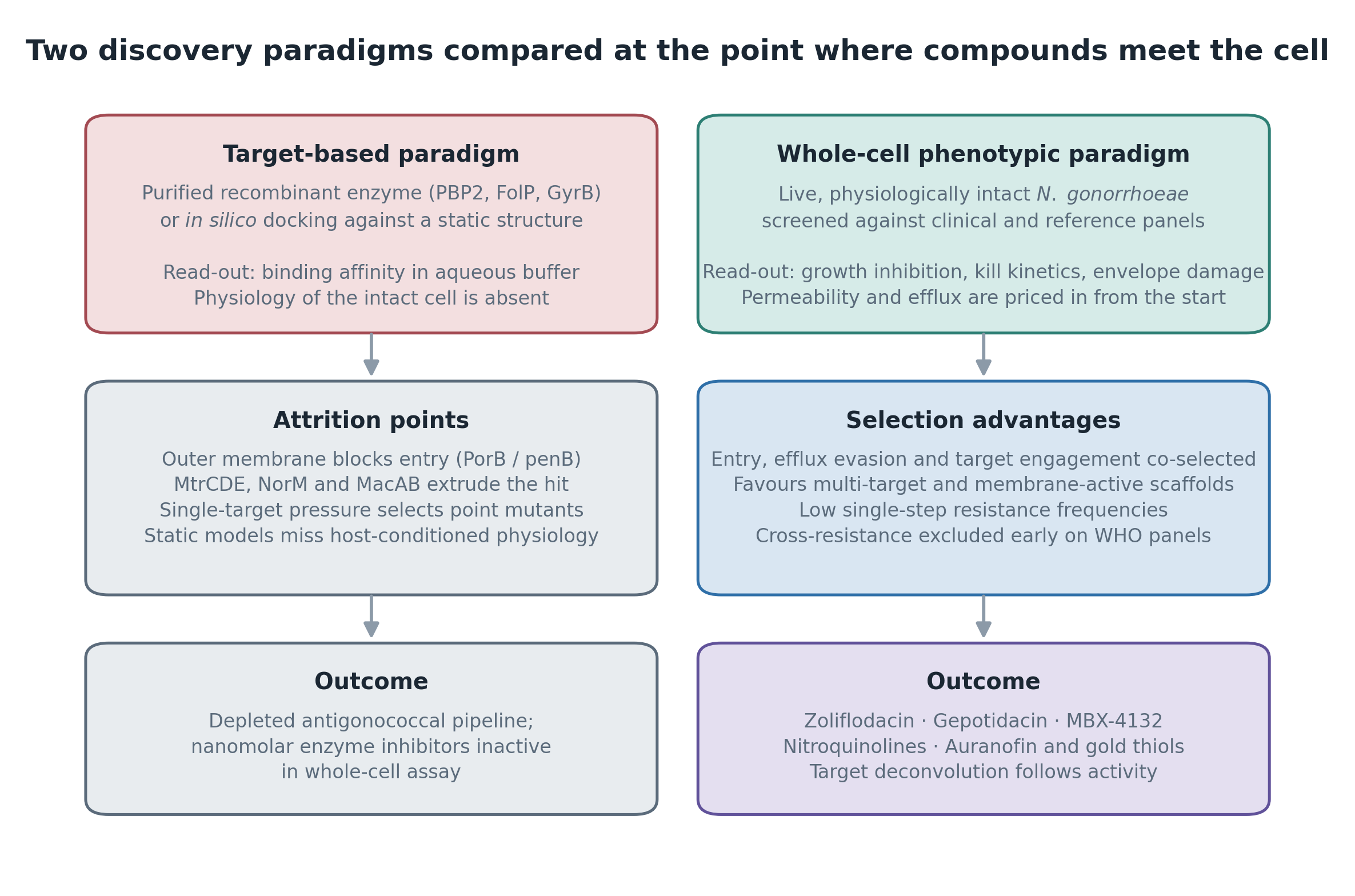
The failure is, we would argue, mechanistic rather than incidental. An enzyme assay reports what a molecule does to a protein in buffer; it says nothing about whether the molecule can reach that protein inside a living diplococcus. Gonococci restrict hydrophilic influx through porins such as PorB1b and extrude structurally unrelated compounds through the MtrC-MtrD-MtrE tripartite pump, with NorM and MacAB providing additional capacity (Chitsaz et al., 2019; Unemo & Nicholas, 2012). Nanomolar potency against an isolated target routinely evaporates in whole-cell culture because the compound never accumulates (Chitsaz et al., 2019; Unemo & Shafer, 2014). There is a second problem, subtler but arguably more consequential: a molecule engineered for exquisite selectivity against one site applies precisely the kind of narrow selective pressure that a naturally transformable, mutation-tolerant organism escapes in a single step, whether by QRDR substitution in gyrA and parC or by importing a mosaic allele wholesale (Low & Unemo, 2016; Vegvari et al., 2020). Selectivity, prized as a safety feature, turns out to be a liability in evolutionary terms. The contrast between the two paradigms is set out in (Table 2) and (Figure 3).

Phenotypic screening is not new. It is, in fact, how most of the antibiotics still in clinical use were found, before the field decided that rational design ought to work better. Its logic is almost stubbornly simple: expose live, physiologically intact bacteria to a compound and record what happens to them (Elkashif & Seleem, 2020; Khalil et al., 2024). Growth inhibition, kill kinetics, and envelope damage are integrated read-outs. A compound that scores well has already demonstrated that it enters the cell, survives efflux, remains stable in the medium, and engages something the bacterium cannot afford to lose (Chitsaz et al., 2019; Khalil et al., 2024). None of those properties needs to be predicted, because all of them are
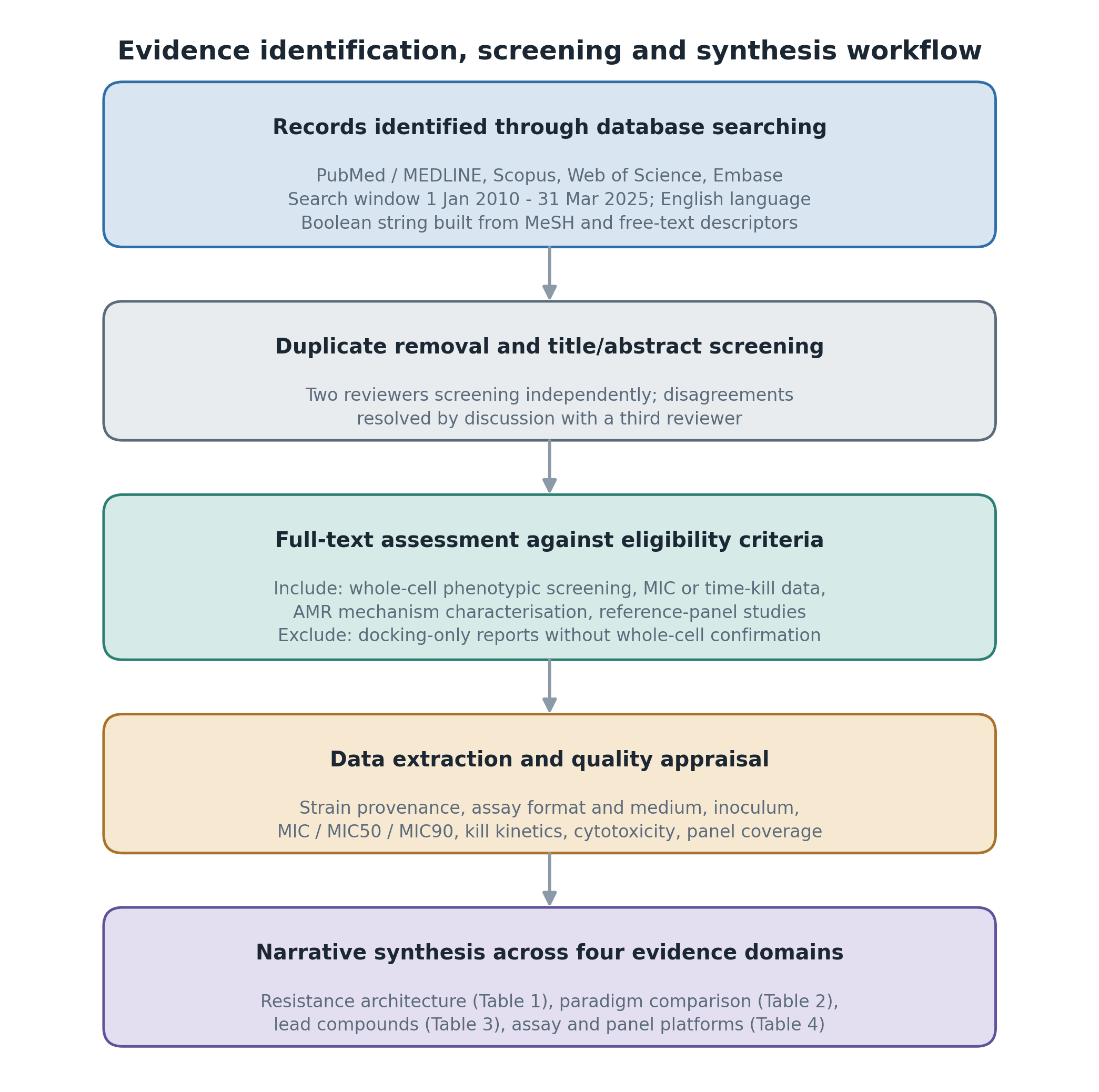
Figure 1. Evidence identification, screening and synthesis workflow used in this review. This picture traces records from database identification through to narrative synthesis, naming at each stage the decisions that determine which evidence entered the review. Searches covered PubMed/MEDLINE, Scopus, Web of Science and Embase for the period 1 January 2010 to 31 March 2025, using a Boolean string built from MeSH headings and free-text descriptors and restricted to English-language records. Screening and full-text assessment were performed independently by two reviewers with a third adjudicating disagreements, and eligibility deliberately excluded docking-only reports lacking whole-cell confirmation. Extracted data were grouped into the four evidence domains that correspond to Tables 1 to 4.
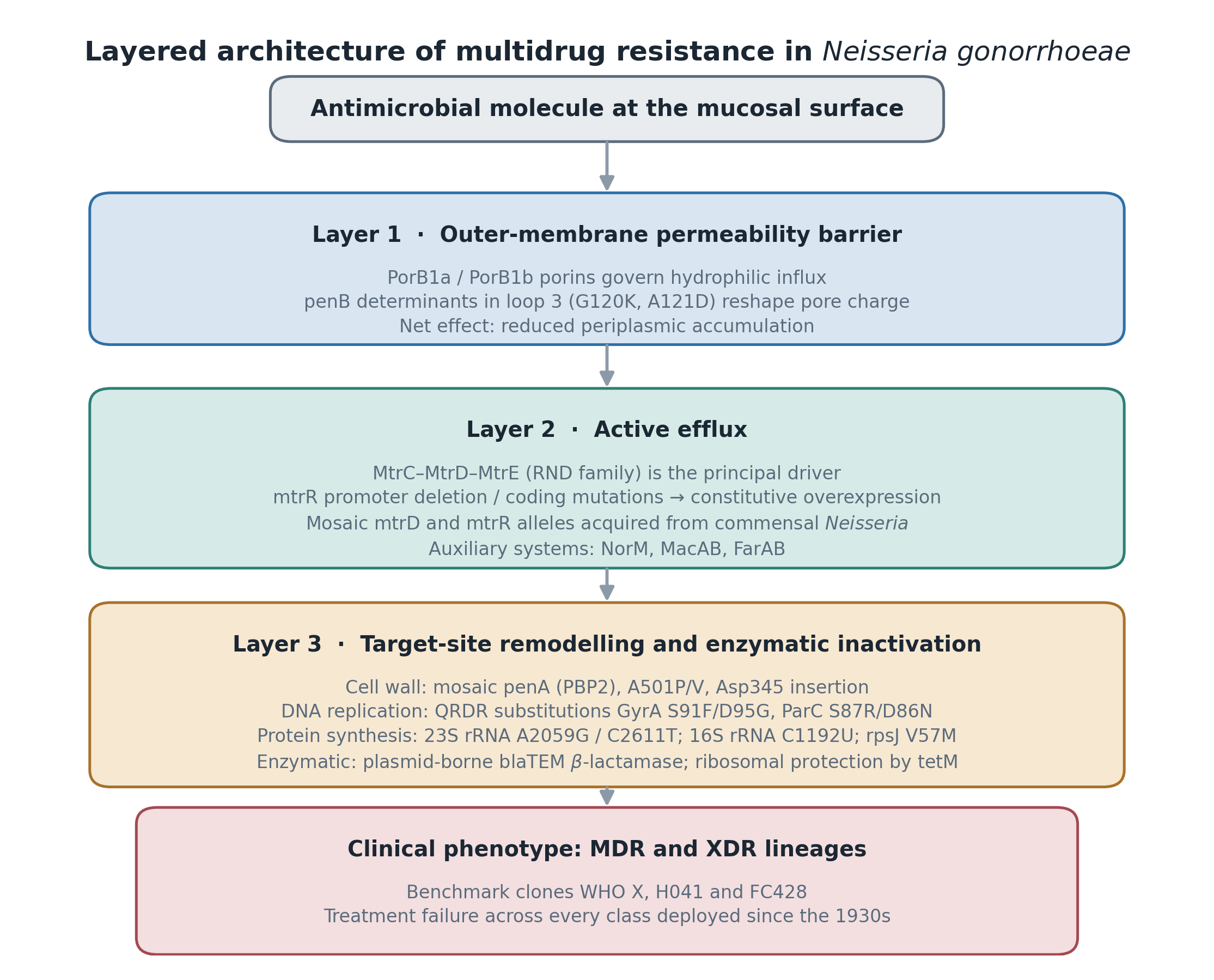
Figure 2. Layered architecture of multidrug resistance in Neisseria gonorrhoeae. Resistance is represented as three sequential barriers rather than a list of independent mutations, because a candidate antimicrobial must negotiate all of them in turn. Layer 1 restricts influx through PorB1a and PorB1b porins, with penB substitutions at Gly120 and Ala121 reshaping pore charge and reducing periplasmic accumulation. Layer 2 removes what does enter, principally through the MtrC–MtrD–MtrE tripartite pump under derepressed mtrR control, supplemented by NorM, MacAB and FarAB and broadened by mosaic alleles acquired from commensal Neisseria. Layer 3 alters the targets themselves. The multiplicative effect of these layers produces the MDR and XDR lineages listed at the foot of the figure, and explains why single-target chemistry fails so consistently.

being measured at once.

Two further advantages deserve emphasis. First, whole-cell screening is agnostic about mechanism, which means it can surface polypharmacological and membrane-active scaffolds that target-based programmes would never have nominated, and such scaffolds tend to select resistance far more slowly (Elkashif & Seleem, 2020; Unemo, 2015). Second, the approach pairs naturally with standardised resistance panels. Screening early hits against the 2016 WHO N. gonorrhoeae reference strains, which between them capture essentially the full global spectrum of documented AMR phenotypes, allows cross-resistant chemotypes to be discarded before medicinal chemistry resources are committed (El-Rami et al., 2018; Unemo et al., 2016; Unemo & Shafer, 2014). Recent campaigns bear this out. Spiropyrimidinetriones such as zoliflodacin inhibit type II topoisomerases through a GyrB pocket distinct from the quinolone site and show no fluoroquinolone cross-resistance (Kern et al., 2015; Unemo, 2015); gepotidacin engages a novel site on GyrA (Scangarella-Oman et al., 2018; Vegvari et al., 2020); synthetic nitroquinolines destroy the envelope outright (Khalil et al., 2024); and auranofin, an anti-rheumatic gold compound repurposed from the shelf, kills rapidly with a spontaneous resistance frequency below 2.4 x 10⁻¹⁰ (Elkashif & Seleem, 2020). These leads are compiled in (Table 3), and the assay platforms that produced them in (Table 4).

We should be careful not to overstate the case. Phenotypic screening has genuine weaknesses: throughput is lower than automated biochemical screening, mechanism must be reconstructed after the fact, and nuisance chemotypes such as detergents and redox cyclers are perennial contaminants of hit lists. The argument advanced here is not that target-based discovery should be abandoned, but that the sequence has been inverted, and that whole-cell activity is better used as an entry criterion than as a late confirmatory step.

This review examines phenotypic screening as the organising principle for antigonococcal discovery, drawing together epidemiological, mechanistic, and pharmacological evidence into a strategic framework rather than a catalogue. Specifically, we set out to (i) characterise the molecular architecture of resistance in N. gonorrhoeae, including envelope permeability barriers, efflux systems, and horizontally acquired target modifications; (ii) compare target-based and whole-cell paradigms and account for the divergence in their translational records; (iii) survey chemical classes and repurposed agents recovered through phenotypic campaigns; (iv) evaluate the assay technologies that support such campaigns, from resazurin microdilution to nanoscale envelope imaging and host-tissue models; and (v) propose an integrated discovery framework in which phenotypic activity is coupled to proteomic, metabolic, and surveillance data (Figure 5). Throughout, we have tried to mark where the evidence is firm, where it rests on a small number of studies, and where confident conclusions are not yet available.
2. From Resistance Architecture to Screening Strategy

2.1. The molecular architecture of multidrug resistance

The resistance phenotype of N. gonorrhoeae is frequently described as though it were a list of mutations. It is more usefully understood as an architecture, in which several semi-independent layers act in series and multiply one another's effects (Shaskolskiy et al., 2024; Unemo & Shafer, 2014). This layering matters for drug discovery because it means no single countermeasure is sufficient: a compound must negotiate every layer, and failure at any one of them is fatal to its prospects (Low & Unemo, 2016; Unemo & Nicholas, 2012). The full complement of determinants, organised by antimicrobial class, appears in (Table 1); (Figure 2) renders the same information as a sequential barrier.

The first layer is the outer membrane. Hydrophilic agents, including beta-lactams, tetracyclines, and fluoroquinolones, depend on transmembrane porins, chiefly PorB1a and PorB1b, for entry (Unemo & Shafer, 2014). Substitutions within loop 3 of PorB1b, designated collectively as penB and typically involving Gly120 and Ala121, alter the electrostatic character and effective diameter of the channel, reducing periplasmic accumulation (El-Rami et al., 2018; Unemo & Shafer, 2014). Taken alone, penB produces modest MIC shifts. Its importance lies in what it does in combination, which is the recurring theme of gonococcal resistance.

The second layer is active extrusion. Five efflux systems have been described, but the Resistance-Nodulation-Division tripartite complex MtrCDE dominates the clinical picture (Chitsaz et al., 2019; El-Rami et al., 2018). The inner membrane transporter MtrD binds substrates at access and deep pockets and uses proton-motive force to deliver them through MtrE, handling hydrophobic drugs, macrolides, detergents, bile salts, and host antimicrobial peptides with striking promiscuity (Chitsaz et al., 2019). Regulation is the vulnerable point: loss of the repressor MtrR, whether through coding mutations or the well-described single adenine deletion in the 13-bp inverted repeat of the promoter, yields constitutive overexpression and clinically meaningful resistance to penicillins, macrolides, and cephalosporins (Chitsaz et al., 2019; Unemo & Shafer, 2014). Horizontal acquisition compounds this. Mosaic mtrCDE and mtrR alleles imported from N. lactamica and N. cinerea broaden substrate range and raise MICs in isolates worldwide (Shaskolskiy et al., 2024; Unemo & Shafer, 2014). It is worth pausing on the implication: the commensal flora of the human throat functions as a reservoir of resistance determinants that gonococci can draw on more or less at will.

The third layer is the target itself. Cephalosporin resistance is driven principally by mosaic penA alleles encoding extensively altered PBP2, carrying up to seventy amino acid substitutions of commensal origin that impede beta-lactam acylation while preserving enough transpeptidase function for viability (Shaskolskiy et al., 2024; Unemo & Nicholas, 2012; Zapun et al., 2016). Non-mosaic changes matter too: A501P, A501V, and the Asp345 insertion reorganise the region around the active-site KTG motif and underpin high-level ceftriaxone resistance in the WHO X and H041 lineages (El-Rami et al., 2018; Unemo & Nicholas, 2012). Fluoroquinolone resistance follows the familiar QRDR pattern, gyrA S91F and D95G with secondary parC S87R or D86N, which together disrupt the water-metal ion bridge required for drug binding (P. L. Chen et al., 2010; Vegvari et al., 2020). Azithromycin resistance arises from 23S rRNA peptidyltransferase loop mutations across the four rRNA operons, A2059G conferring high-level and C2611T moderate resistance, with allele dosage determining the phenotype (Low & Unemo, 2016; Unemo & Shafer, 2014). Enzymatic mechanisms complete the picture, notably plasmid-borne blaTEM beta-lactamase and ribosomal protection by tetM acquired from streptococci (Shaskolskiy et al., 2024; Unemo & Shafer, 2014).

What emerges is not a set of independent obstacles but a coupled system. Reduced influx and enhanced efflux together determine intracellular exposure; target alteration then determines what that exposure accomplishes. A discovery platform that models only the last of these is, by construction, evaluating the least limiting step.

2.2. The reductionist trap: why target-based screening underdelivered

Target-based discovery was adopted for defensible reasons. It is fast, scalable, mechanistically interpretable, and it succeeded spectacularly in oncology and virology (Goodarzi et al., 2023; Unemo & Shafer, 2014). Applied to antibacterials, and especially to Gram-negative antibacterials, it has underdelivered to a degree that now seems structural rather than accidental (Khalil et al., 2024). Purified PBP2, FolP, and metabolic kinases have all been screened; high-affinity binders have been identified; strikingly few have reached whole-cell activity (Goodarzi et al., 2023). The comparison summarised in (Table 2) and illustrated in (Figure 3) locates the losses fairly precisely.

The core difficulty is that the assay omits the variable that matters most. Binding affinity measured in aqueous buffer contains no information about dual-membrane permeation or efflux kinetics (Chitsaz et al., 2019; Unemo & Shafer, 2014). A molecule may inhibit its purified target at nanomolar concentrations and be wholly inactive against intact gonococci because it cannot cross the outer membrane, or because MtrCDE recognises and removes it faster than it accumulates (Chitsaz et al., 2019; Unemo & Nicholas, 2012). Medicinal chemistry campaigns then optimise the wrong parameter, improving affinity that was never limiting while permeability, which was, stays unaddressed. Isogenic efflux data make the point concretely: deleting mtrD in a derepressed background restores susceptibility across unrelated classes, which tells us how much of the observed resistance phenotype is a transport phenomenon rather than a target phenomenon (Chitsaz et al., 2019).

A second difficulty concerns evolutionary durability. Single-target inhibitors define a one-dimensional escape landscape, and N. gonorrhoeae traverses such landscapes with particular ease given its transformation competence and error-prone replication (Shaskolskiy et al., 2024; Unemo & Shafer, 2014). One substitution in a binding pocket, or one imported mosaic segment, can be sufficient. A third, less often acknowledged, concerns the models themselves. Docking against static crystallographic structures neglects conformational dynamics, allostery, periplasmic pH shifts, and the iron-restricted, nutrient-limited conditions that reshape gene


Figure 3. Target-based and whole-cell phenotypic paradigms compared at the point where compounds meet the bacterial cell. The two columns follow a candidate molecule from assay design through to programme outcome. On the left, purified enzymes and static docking models report binding affinity in aqueous buffer, leaving permeability, efflux and host-conditioned physiology unmeasured until late attrition exposes them. On the right, live gonococci screened against clinical and reference panels integrate entry, efflux evasion, metabolic stability and target engagement into a single read-out. The figure is intended to locate attrition precisely rather than to dismiss target-based methods, which remain valuable for optimisation once whole-cell activity has been established.

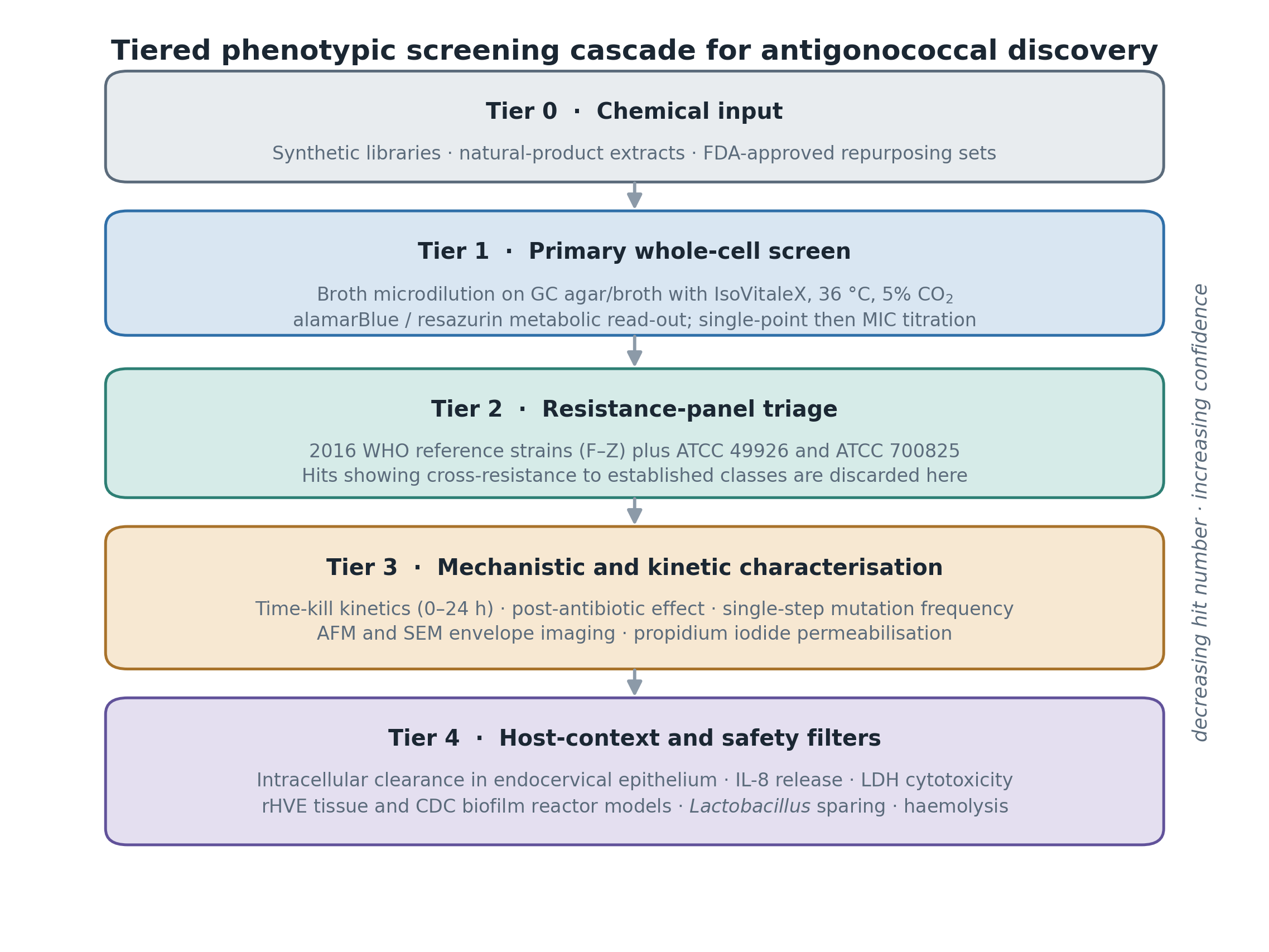
Figure 4. Tiered phenotypic screening cascade for antigonococcal discovery. The cascade proceeds from chemical input through four filters of increasing stringency, with hit numbers falling and confidence rising at each step. Tier 1 applies broth microdilution on supplemented GC medium at 36 degrees Celsius under 5% carbon dioxide with a resazurin-based viability read-out; Tier 2 triages surviving hits against the 2016 WHO reference panel and ATCC control strains so that cross-resistant chemotypes are discarded before chemistry investment. Tiers 3 and 4 characterise mechanism and kinetics and then impose host-context and safety filters, including intracellular clearance, tissue and biofilm models, Lactobacillus sparing and haemolysis. The reference conditions shown correspond to those specified in Section 3.5.

expression and envelope composition during actual infection (Potter et al., 2023; Unemo & Shafer, 2014). Transcriptome-guided metabolic modelling of gonococci under neutrophil attack shows that essentiality is itself conditional, so a target validated in rich broth may simply not be a target in vivo (Potter et al., 2023). The cumulative effect is a pipeline rich in structural insight and poor in candidates (Elkashif & Seleem, 2020; Khalil et al., 2024).

2.3. Phenotypic whole-cell screening: restoring physiological context

Phenotypic screening addresses these failures not by solving them but by declining to separate them from the assay in the first place (Elkashif & Seleem, 2020; Khalil et al., 2024). Measuring growth inhibition, metabolic arrest, kill rate, or envelope disruption in live cultures means that entry, efflux evasion, stability, and target engagement are assessed simultaneously and inseparably (Chitsaz et al., 2019; Khalil et al., 2024). The hit that survives has already passed the filters that eliminate target-based leads later and more expensively. A practical tiering of this cascade is shown in (Figure 4), with platform details in (Table 4).

Contemporary campaigns rely on standardised microdilution in 96- or 384-well format, most commonly with alamarBlue or resazurin reduction as the viability read-out, applied to synthetic libraries, natural product extracts, and approved-drug repurposing collections (Elkashif & Seleem, 2020; Khalil et al., 2024; Schmitt et al., 2016). Resazurin chemistry suits gonococci reasonably well, being sensitive at low biomass and compatible with the fastidious growth requirements of the organism, although investigators should remain alert to compounds that reduce the dye directly and thereby generate artefacts. Biomimetic media and host-conditioned culture formats have been proposed to narrow the gap between screening conditions and mucosal reality, and appear promising, though the comparative data remain thinner than one would like (Peter et al., 2021).

Panel selection is where phenotypic screening earns much of its advantage. The 2016 WHO reference collection comprises fourteen strains, genome-characterised and phenotypically defined, spanning ceftriaxone-resistant WHO X, high-level azithromycin resistance, and MtrCDE-overexpressing variants (Unemo et al., 2016). Running primary hits against this panel at an early stage, rather than confirming activity on a single laboratory strain and discovering cross-resistance years later, removes doomed chemotypes cheaply (El-Rami et al., 2018). Quantitative proteomic characterisation of the same panel adds a further dimension, mapping envelope protein expression against resistance phenotype (El-Rami et al., 2018).

Mechanism can then be approached through biophysics rather than genetics. Atomic force microscopy and scanning electron microscopy resolve envelope integrity at nanoscale, capturing corrugation, flaccidity, blebbing, perforation, and cytoplasmic spillage without requiring the target to be known (Khalil et al., 2024). Propidium iodide exclusion quantifies membrane permeabilisation, and time-kill kinetics separate rapid bactericidal agents from bacteriostatic ones, a distinction with direct bearing on whether a compound can clear intracellular gonococci within mucosal epithelium (Elkashif & Seleem, 2020; Khalil et al., 2024).

2.4. Chemical classes and repurposed agents recovered by phenotypic screening

The most persuasive argument for phenotype-first discovery is the compounds it has actually produced. Those discussed below are compiled with potencies and development stages in (Table 3).

2.4.1. Spiropyrimidinetriones

Zoliflodacin, also known as AZD0914 or ETX0914, is the clearest success. It inhibits bacterial type II topoisomerases, but engages a pocket on the GyrB subunit that quinolones do not occupy, which is why QRDR mutations in gyrA and parC leave its activity intact (Kern et al., 2015; Unemo, 2015). Whole-cell MICs cluster between 0.032 and 0.25 micrograms per millilitre across MDR and XDR isolates (Kern et al., 2015; Shaskolskiy et al., 2024). Phase 2 and Phase 3 evaluation of single oral doses produced high microbiological cure rates in urogenital infection, making zoliflodacin the leading candidate to succeed failing dual therapy (Taylor et al., 2018; Unemo et al., 2021).

2.4.2. Triazaacenaphthylenes and fluoroketolides

Gepotidacin binds a distinct site on GyrA, blocking double-strand cleavage without quinolone cross-resistance, and retains activity against ciprofloxacin-resistant strains with MIC90 values at or below 0.5 micrograms per millilitre (Scangarella-Oman et al., 2018; Vegvari et al., 2020). The fluoroketolide solithromycin illustrates a related principle from the ribosomal side: by engaging three binding sites rather than two, it raises the genetic barrier to escape in macrolide-resistant backgrounds (Unemo, 2015), although its Phase 3 experience also shows that in vitro superiority does not guarantee a straightforward development path (M. Y. Chen et al., 2019). MBX-4132, recovered from a phenotypic screen for trans-translation inhibitors, binds a previously unexploited ribosomal site and cleared MDR gonococcal infection in mice after a single oral dose (Aron et al., 2021).

2.4.3. Synthetic nitroquinolines

Functionalised nitroquinolines emerged from straightforward whole-cell screening against both susceptible ATCC 49926 and multidrug-resistant ATCC 700825 (Khalil et al., 2024). Compounds 5 and 8 inhibited growth at 99.99 and 49.99 micrograms per millilitre respectively, which on a molar basis outperforms ceftriaxone in the resistant background. AFM and SEM showed why: the mechanism is frank envelope destruction, with rupture, flaccidity, bubble-like deformities, and cytoplasmic leakage. Neither derivative was cytotoxic to 3T3 fibroblasts or haemolytic to human erythrocytes at active concentrations (Khalil et al., 2024). The absolute potencies are modest, and it would be premature to call these clinical candidates; as scaffolds for optimisation, however, they are informative, particularly since electron-withdrawing fluorine and trifluoromethyl substituents improved activity in a manner consistent with enhanced membrane penetration.

2.4.4. Repurposed gold thiol compounds

Auranofin, licensed decades ago for rheumatoid arthritis, was identified as a potent antigonococcal agent through phenotypic repurposing (Elkashif & Seleem, 2020). Across 48 clinical isolates and WHO reference strains it produced MIC50 of 0.06 and MIC90 of 0.125 micrograms per millilitre, unaffected by MDR or azithromycin-resistant status. Kill was rapid and complete within four hours; intracellular burden in infected human endocervical cells fell by more than 99 per cent, where ceftriaxone did not; the post-antibiotic effect exceeded ten hours; IL-8 secretion was suppressed; and spontaneous resistance frequency was below 2.4 x 10⁻¹⁰ (Elkashif & Seleem, 2020). Its analogues aurothiomalate and aurothioglucose were less potent but spared vaginal Lactobacillus species, which matters more than it might appear given the consequences of microbiome disruption at that site. The proposed mechanism, thioredoxin reductase inhibition with downstream oxidative stress, is multi-target by nature, which plausibly explains the low escape frequency.

2.5. Toward integration: phenomics, multi-omics, and systems biology

Phenotypic screening finds active molecules; it does not, by itself, explain them. The productive response is integration rather than reversion (El-Rami et al., 2018; Potter et al., 2023). Quantitative tandem mass tag proteomics, RNA-seq, and genome-scale metabolic reconstruction can each be applied downstream of a confirmed phenotypic hit to recover the mechanistic detail that target-based programmes obtain upfront, but now for a molecule already known to work on intact cells (El-Rami et al., 2018; Potter et al., 2023).

Proteomic profiling across the WHO panel has mapped envelope and surface protein expression against resistance phenotype, yielding conserved antigens and candidate biomarkers (El-Rami et al., 2018). Metabolic modelling during neutrophil co-culture has identified conditionally essential reactions and carbon flux rearrangements required for survival under immune attack, a class of target invisible to standard essentiality screens (Potter et al., 2023). Overlaying phenotypic hits onto these networks allows modes of action to be deconvolved, multi-target behaviour to be recognised, and compensatory fitness paths to be anticipated before they appear clinically. Surveillance closes the loop: WHO global monitoring and point-of-care resistance testing indicate which mechanisms are spreading and therefore which chemotypes deserve investment (Seña et al., 2021; Unemo et al., 2021; Vegvari et al., 2020). The framework we propose on this basis is summarised in (Figure 5).

3. Methods

3.1. Study design and reporting framework

This work is a structured narrative review of phenotypic approaches to antigonococcal drug discovery. We did not attempt a meta-analysis, and we want to be explicit about why: the primary literature combines mechanistic microbiology, medicinal chemistry, imaging, and clinical trial data, with assay formats and strain panels that differ enough to make pooled effect estimates misleading rather than informative. Instead, evidence was identified systematically and then synthesised narratively, with the search and selection procedure reported in sufficient detail for another group to reproduce it. The screening and synthesis pathway is shown in (Figure 1). Reporting follows the PRISMA 2020 checklist where applicable to narrative syntheses; no protocol was registered, which we note as a limitation rather than a design choice.

3.2. Information sources and search strategy

Four bibliographic databases were interrogated: PubMed/MEDLINE, Scopus, Web of Science Core Collection, and Embase. The search window ran from 1 January 2010 to 31 March 2025, with older landmark publications on resistance mechanisms and treatment history admitted through citation tracking where they were required for mechanistic completeness. The search was restricted to English-language records.

The PubMed strategy combined Medical Subject Headings with free-text descriptors in title and abstract fields, and was translated into the syntax of the other databases without changing its logic. The executable string was: ("Neisseria gonorrhoeae"[MeSH Terms] OR "Neisseria gonorrhoeae"[tiab] OR gonococc*[tiab] OR gonorrhoea[tiab] OR gonorrhea[tiab]) AND ("Drug Resistance, Multiple, Bacterial"[MeSH Terms] OR "antimicrobial resistance"[tiab] OR "multidrug resistant"[tiab] OR "extensively drug resistant"[tiab] OR efflux[tiab] OR penA[tiab] OR mtrR[tiab] OR QRDR[tiab]) AND ("Drug Evaluation, Preclinical"[MeSH Terms] OR "phenotypic screening"[tiab] OR "whole cell screening"[tiab] OR "high-throughput screening"[tiab] OR "drug repurposing"[MeSH Terms] OR "minimum inhibitory concentration"[tiab] OR "time-kill"[tiab] OR alamarBlue[tiab] OR resazurin[tiab]). Reference lists of all included full texts were hand-searched, and forward citation checking was performed in Google Scholar for the five most frequently cited sources.

3.3. Eligibility criteria

Records were eligible if they reported one or more of the following: whole-cell antibacterial evaluation against N. gonorrhoeae with quantitative MIC, MIC50, MIC90, or kill-kinetic data; mechanistic characterisation of gonococcal resistance determinants at the level of the envelope, efflux systems, or drug targets; development, validation, or application of reference strain panels and phenotypic assay platforms; or clinical evaluation of agents that originated in whole-cell screening. Records were excluded when they reported computational docking or target-based binding data without any whole-cell confirmation, when they concerned other Neisseria species without gonococcal data, and when they were conference abstracts, editorials, or preprints that had not undergone peer review.

3.4. Selection process and data extraction

Records were deduplicated and screened by title and abstract, then assessed in full text against the criteria above. Screening was performed independently by two reviewers, with disagreements resolved by discussion and, where consensus was not reached, by a third reviewer. Data were extracted into a standardised spreadsheet capturing: bibliographic details; strain identity and provenance, including ATCC and WHO panel designations; growth medium and supplementation; inoculum density; assay format and read-out; incubation temperature, atmosphere, and duration; potency values with units as originally reported; kill kinetics; spontaneous resistance frequency; cytotoxicity and haemolysis data; and development stage.

3.5. Reference conditions for reproducibility

Because assay conditions determine whether antigonococcal data are comparable at all, we recorded them explicitly and reproduce the consensus conditions here. Susceptibility testing was performed on GC agar base supplemented with 1% IsoVitaleX or defined equivalent growth supplement, or in GC broth for microdilution formats, at 36 to 37 degrees Celsius under 5% carbon dioxide in a humidified atmosphere, with readings at 20 to 24 hours. Inocula were prepared from overnight growth to a density of approximately 1 to 5 x 10⁵ CFU per millilitre for broth microdilution and 10⁴ CFU per spot for agar dilution. MIC was defined as the lowest concentration producing no visible growth, or, for resazurin and alamarBlue formats, the lowest concentration preventing conversion of the dye to its reduced fluorescent product. Quality control used ATCC 49226 alongside WHO reference strains F through Z, with each determination performed in at least biological triplicate. Time-kill experiments sampled at 0, 2, 4, 8, and 24 hours at multiples of the MIC, with bactericidal activity defined as a reduction of at least 3 log10 CFU per millilitre from the starting inoculum. Where studies departed from these conditions, the deviation was recorded and taken into account during synthesis. Assay platforms and panels are catalogued in (Table 4).

3.6. Quality appraisal and synthesis

Methodological quality was appraised against a pragmatic checklist derived from the items above: whether strains were adequately characterised, whether quality control organisms were included, whether replication was reported, whether cytotoxicity was assessed alongside antibacterial activity, and whether the strain panel spanned relevant resistance phenotypes. Studies meeting fewer than three of these criteria were retained where their mechanistic content was unique but are identified as such in the text. Findings were then grouped into four evidence domains, corresponding to (Table 1) through (Table 4), and synthesised narratively. We have tried throughout to distinguish results replicated across independent groups from those resting on a single report.

4. Synthesis of Findings: What Whole-Cell Evidence Reveals About the Current Pipeline

4.1. Susceptibility landscape across global strain panels

Pooling phenotypic data across clinical collections and standardised benchmark strains gives a picture that is, frankly, worse than the class-by-class narrative suggests (El-Rami et al., 2018; Goodarzi et al., 2023). Legacy agents are effectively finished. Ciprofloxacin resistance ranges from roughly 77% to 100% in resistant strain sets, penicillin resistance reaches about 71%, and tetracycline resistance exceeds 60% (P. L. Chen et al., 2010; Goodarzi et al., 2023). High-level ciprofloxacin resistance, with MICs at or above 32 micrograms per millilitre, tracks consistently with paired gyrA S91F and D95G substitutions plus secondary parC changes at S87 or D86 (P. L. Chen et al., 2010; Vegvari et al., 2020). The determinants behind these phenotypes are set out in (Table 1).

More concerning is the erosion of the agents still in use. Azithromycin MICs span three orders of magnitude, from 0.125 to 0.25 micrograms per millilitre in susceptible isolates to above 256 micrograms per millilitre where 23S rRNA A2059G or mosaic mtr loci are present (P. L. Chen et al., 2010; Elkashif & Seleem, 2020; Shaskolskiy et al., 2024). For extended-spectrum cephalosporins the XDR benchmark WHO X, carrying penA-60.001, shows ceftriaxone MICs of 0.25 to 0.5 and cefixime MICs of 1 to 2 micrograms per millilitre (El-Rami et al., 2018; Unemo et al., 2016). These are not isolated laboratory curiosities; global surveillance indicates that decreased susceptibility is distributed widely rather than confined to a few settings (Unemo et al., 2021).

The most instructive finding for discovery purposes concerns synergy between transport mechanisms (Chitsaz et al., 2019; Unemo & Shafer, 2014). Derepression of MtrCDE alone raises MICs two- to eight-fold across structurally unrelated classes (Chitsaz et al., 2019; Low & Unemo, 2016). Isogenic deletion experiments in the KH15 background make the contribution unambiguous: removing mtrD restores susceptibility, dropping azithromycin MICs from 2.0 to 0.03 and ceftriaxone MICs from 0.001 to 0.0005 micrograms per millilitre (Chitsaz et al., 2019). When overexpressed efflux is combined with porB1b loop 3 penB alterations, restricted entry and maximised extrusion operate together, and the resulting barrier is what defeats intracellularly-acting single-target candidates (El-Rami et al., 2018; Unemo & Nicholas, 2012). This barrier is depicted in (Figure 2), and its implications for assay choice in (Table 2) and (Figure 3).

4.2. Potency and spectrum of leads recovered by phenotypic screening

Against that background, the compounds recovered from whole-cell campaigns perform notably well, and their profiles share features that target-based leads have generally lacked (Elkashif & Seleem, 2020; Khalil et al., 2024; Unemo, 2015). Potencies and development stages are tabulated in (Table 3).

4.2.1. Topoisomerase inhibitors with novel binding modes

Zoliflodacin showed MICs of 0.032 to 0.25 micrograms per millilitre against clinical isolates, retaining full activity against strains resistant to ciprofloxacin, ceftriaxone, and azithromycin (Kern et al., 2015; Shaskolskiy et al., 2024; Unemo, 2015). Mechanistic work established that it stabilises the cleaved gyrase-DNA complex through a GyrB pocket that does not overlap the quinolone site on GyrA or ParC, which accounts for the absence of cross-resistance (Kern et al., 2015). Single oral doses of 2 g or 3 g produced microbiological cure in 96% to 99.5% of urogenital cases in Phase 2 and Phase 3 evaluation (Taylor et al., 2018; Unemo et al., 2021). Gepotidacin, engaging a distinct GyrA site, achieved MIC90 at or below 0.5 micrograms per millilitre against ciprofloxacin-resistant strains (Scangarella-Oman et al., 2018; Vegvari et al., 2020). MBX-4132 extended the principle to trans-translation, clearing MDR infection in vivo after one oral dose (Aron et al., 2021).

4.2.2. Repurposed gold-containing therapeutics

Table 1. Genetic determinants and physiological mechanisms of antimicrobial resistance in Neisseria gonorrhoeae, organised by antimicrobial class. This table maps each historical and current antimicrobial class onto its bacterial target, the genetic loci that carry resistance determinants, the specific mutations or structural alterations described in clinical isolates, and the physiological consequence for drug accumulation and minimum inhibitory concentration. It is intended to show that gonococcal resistance is combinatorial rather than class-specific: influx restriction through penB, MtrCDE-mediated efflux, and target-site remodelling recur across unrelated drug classes and act multiplicatively. Determinants acquired horizontally from commensal Neisseria species are indicated where relevant, since these account for much of the observed genetic novelty.

Antimicrobial class

Primary target and pathway

Genetic locus or determinant

Representative mutations or alterations

Physiological mechanism and impact on MIC

Key references

Penicillins (penicillin G, ampicillin)

PBP2 transpeptidase activity; PBP1

penA, ponA, blaTEM, mtrR, porB

Asp345 insertion in PBP2; mosaic penA alleles with up to 70 substitutions; ponA1 (L421P); plasmid blaTEM-1 / blaTEM-135

Acylation rate of PBP2 falls 6- to 8-fold; plasmid-encoded β-lactamase hydrolyses the drug; reduced outer-membrane permeation combines with increased efflux

Shaskolskiy et al. (2024); Unemo & Shafer (2014); Zapun et al. (2016)

Extended-spectrum cephalosporins (ceftriaxone, cefixime)

PBP2; peptidoglycan cross-linking

penA (mosaic and non-mosaic), mtrR, porB1b (penB)

Mosaic penA-60.001; non-mosaic A501P/V, A311V, T316P, T483S; penB G120K and A121D in loop 3 of PorB1b

Steric hindrance of β-lactam acylation near the active-site KTG motif; reduced porin influx acting together with MtrCDE up-regulation

El-Rami et al. (2018); Low & Unemo (2016); Unemo (2015); Unemo & Shafer (2014)

Macrolides (azithromycin, erythromycin)

50S subunit; peptidyltransferase loop V of 23S rRNA

23S rRNA (four operons), mtrR, mtrD, ermA/B/C/F

23S rRNA A2059G (high-level) and C2611T (moderate); single adenine deletion in the mtrR promoter inverted repeat; mosaic mtrD

Reduced macrolide affinity at the peptidyltransferase centre; constitutive MtrCDE overexpression; methylase-mediated target modification. MICs range from 0.125 to >256 µg/mL

P. L. Chen et al. (2010); Chitsaz et al. (2019); Low & Unemo (2016); Unemo & Shafer (2014)

Fluoroquinolones (ciprofloxacin, ofloxacin)

DNA gyrase (GyrA) and topoisomerase IV (ParC)

Quinolone resistance-determining regions of gyrA and parC

gyrA S91F, D95G/A/N; parC S87R/N, D86N, E91K

Disruption of the water–metal ion bridge required for drug–target binding; paired mutations give high-level resistance at MIC ≥ 32 µg/mL

P. L. Chen et al. (2010); Kern et al. (2015); Low & Unemo (2016); Vegvari et al. (2020)

Tetracyclines (tetracycline, doxycycline)

30S subunit; A-site tRNA binding

rpsJ, conjugative tetM plasmid, mtrR, porB

rpsJ V57M; acquisition of streptococcal-derived tetM plasmid

TetM provides ribosomal protection; V57M lowers tetracycline affinity; entry restriction via penB and MtrCDE efflux act synergistically

Low & Unemo (2016); Shaskolskiy et al. (2024); Unemo & Shafer (2014)

Aminocyclitols (spectinomycin)

30S subunit; helix 34 of 16S rRNA

16S rRNA, rpsE

16S rRNA C1192U; rpsE T24P and deletions of V25 or K26

Binding to the ribosomal decoding centre is prevented, producing high-level resistance with little fitness cost

Low & Unemo (2016); Shaskolskiy et al. (2024); Unemo & Shafer (2014)

Sulfonamides

Dihydropteroate synthase (FolP); folate biosynthesis

folP

folP R228S; mosaic folP imported from commensal Neisseria

Reduced inhibitor affinity for dihydropteroate synthase; competitive inhibition further overcome by p-aminobenzoic acid overproduction

Shaskolskiy et al. (2024); Unemo & Shafer (2014)

Table 2. Target-based versus whole-cell phenotypic screening paradigms in antigonococcal drug discovery, compared across seven evaluation criteria. This table contrasts the two dominant discovery paradigms on the dimensions that determine whether an active molecule survives translation into a clinical candidate. For each criterion the table states what the target-based approach measures, what the whole-cell approach measures, and the consequence for antigonococcal programmes specifically. The comparison is deliberately not a verdict on either method in the abstract; it is intended to show where in the cascade attrition occurs, and why permeability, efflux evasion and multi-target behaviour are captured by one paradigm and invisible to the other. Cross-references to the compounds and platforms concerned appear in Tables 3 and 4.

Evaluation criterion

Target-based paradigm

Whole-cell phenotypic paradigm

Translational consequence

Key references

Biological model screened

Isolated recombinant enzyme (PBP2, FolP, FabI) or in silico docking against a static structure

Live, physiologically intact N. gonorrhoeae, including clinical and WHO reference panels

Whole-cell assay screens inside an intact envelope, eliminating false positives that cannot cross the double membrane

Elkashif & Seleem (2020); Goodarzi et al. (2023); Shaskolskiy et al. (2024)

Outer-membrane permeability

Absent; binding is evaluated in aqueous buffer

Inherently integrated; compounds must traverse PorB porins to register activity

Prevents advancement of high-affinity hits that are excluded by the permeability barrier

Chitsaz et al. (2019); Unemo & Nicholas (2012)

Efflux evasion (MtrCDE, NorM, MacAB)

Ignored at hit identification; leads fail later in whole-cell testing

Directly selected for; hits must resist active extrusion to appear at all

Chemical scaffolds that evade multidrug efflux are selected from the outset

Chitsaz et al. (2019); Unemo & Nicholas (2012)

Risk of resistance evolution

High; single-target inhibitors select single-step point mutants

Reduced; favours multi-target, polypharmacological or membrane-disrupting scaffolds

Phenotypic leads such as zoliflodacin and auranofin show low spontaneous resistance frequencies (< 2.4 x 10⁻¹⁰ for auranofin)

Elkashif & Seleem (2020); Kern et al. (2015); Unemo & Shafer (2014)

Mechanism identification

Known upfront; binding mode defined immediately

Requires post-screen deconvolution by proteomics, transcriptomics or resistant-mutant sequencing

Permits discovery of genuinely novel targets and modes of action at the cost of later mechanistic work

El-Rami et al. (2018); Potter et al. (2023); Shaskolskiy et al. (2024)

Physiological relevance to the host niche

Static; does not reflect nutrient limitation or immune pressure

Adaptable; assays can simulate iron depletion, biofilm growth and neutrophil co-culture

Identifies conditionally essential targets that are active only during infection

Pan et al. (2025); Peter et al. (2021); Potter et al. (2023)

Throughput and cost

Very high throughput; low cost per well in automated recombinant assays

Moderate to high throughput using microdilution with alamarBlue or fluorometric read-outs

Phenotypic screening raises early cost per compound but lowers downstream attrition and total development expenditure

Elkashif & Seleem (2020); Goodarzi et al. (2023); Khalil et al. (2024)


Auranofin and its analogues were recovered by screening an approved-drug collection against intact gonococci (Elkashif & Seleem, 2020). Broth microdilution with agar dilution confirmation across 48 clinical isolates and WHO strains gave MIC50 of 0.06 and MIC90 of 0.125 micrograms per millilitre. Kill kinetics were rapid and concentration-dependent: at three times MIC, complete eradication with greater than 5 log10 CFU reduction occurred within four hours, compared with eight hours for azithromycin. In END1/E6E7 endocervical cells, auranofin at six times MIC reduced intracellular burden by more than 99%, whereas ceftriaxone failed to clear intracellular bacteria at all. The post-antibiotic effect exceeded ten hours, IL-8 secretion from infected epithelium was reduced, and spontaneous single-step resistance frequency at ten times MIC was below 2.4 x 10⁻¹⁰ (Elkashif & Seleem, 2020). Aurothiomalate and aurothioglucose were weaker, with MIC90 of 1 and 8 micrograms per millilitre respectively, but spared commensal Lactobacillus species. The intracellular clearance result deserves particular attention, since it bears on persistence and treatment failure in ways that planktonic MIC values do not capture.

4.2.3. Synthetic scaffolds with membrane-directed activity

Nitroquinoline derivatives 5 and 8 inhibited both ATCC 49926 and multidrug-resistant ATCC 700825, with compound 8 active at 49.99 micrograms per millilitre (193.23 micromolar) and compound 5 at 99.99 micrograms per millilitre (302.80 micromolar), both lower on a molar basis than ceftriaxone at 450.79 micromolar in the same resistant background (Khalil et al., 2024). Structure-activity analysis indicated that electron-withdrawing fluorine and trifluoromethyl substitutions at meta and para positions improved activity, consistent with better outer-membrane penetration. Safety profiling found neither cytotoxicity toward 3T3 fibroblast monolayers nor haemolysis of human erythrocytes at active concentrations (Khalil et al., 2024). We would read these as promising scaffolds rather than near-term candidates; the micromolar range leaves substantial optimisation ahead.

4.3. Ultrastructural and biophysical evidence of mechanism

One of the more satisfying features of phenotypic workflows is that mechanism can often be visualised directly (Khalil et al., 2024; Pan et al., 2025). Atomic force microscopy in non-contact ACAFM mode showed untreated gonococci as smooth, symmetrical diplococci with uniform height distribution. After 24 hours of exposure to nitroquinoline derivatives 5, 8, and 10 at 50 micrograms per millilitre, resistant ATCC 700825 cells displayed severe surface corrugation, cell wall flaccidity, membrane rupture, bubble-like deformities, fractured fragments, and dense cytoplasmic material spilled onto the mica support (Khalil et al., 2024).

Scanning electron microscopy corroborated this at higher magnification: intact walls and smooth surfaces in controls, against marked lysis, surface erosion, deep perforation, and loss of structural integrity after treatment (Khalil et al., 2024). Control experiments matter here, and were performed: gentamicin and azithromycin left ATCC 700825 envelopes intact, confirming that the damage was compound-specific rather than a preparation artefact. Propidium iodide exclusion supplied the quantitative counterpart, with widespread fluorophore influx and sharply reduced cell counts after exposure to compounds 5, 8, 10, and 14 (Khalil et al., 2024). Read together, these three orthogonal read-outs support envelope disruption as the primary mechanism, which is exactly the kind of conclusion that would have been difficult to reach from a target-based starting point. The position of these assays within the screening cascade is shown in (Figure 4) and (Table 4).

4.4. Host-context and biofilm behaviour

Planktonic susceptibility is a starting point, not an endpoint, and several groups have begun evaluating leads in conditions closer to the mucosal niche (Pan et al., 2025; Potter et al., 2023). Work on extracellular DNA dynamics has been particularly informative. In CDC Biofilm Reactors under continuous shear, wild-type N. gonorrhoeae MS11 uses the secreted ligase LigE, counterbalanced by the thermonuclease Nuc, to repair breaks in free exDNA and build a high-molecular-weight matrix that holds microcolonies together (Pan et al., 2025).

On three-dimensional reconstructed human vaginal epithelium, confocal microscopy showed that wild-type and ligE-overexpressing strains invade deep tissue layers, perforate the epithelium, and trigger substantial lactate dehydrogenase release. Deletion of ligE produced loose, dispersed microcolonies occupying under 10 square micrometres compared with roughly 175 square micrometres for wild-type, and the mutant remained confined to the upper epithelial surface with minimal invasion and low LDH release (Pan et al., 2025). Host

Table 3. Lead compounds, repurposed therapeutics and synthetic scaffolds with antigonococcal activity identified or validated through whole-cell phenotypic screening. This table compiles the chemical classes discussed in Sections 2.4 and 4.2, recording for each the discovery route, proposed molecular mechanism, measured potency against susceptible and resistant strains, and current development stage together with the pharmacological features that distinguish it. Potency values are reproduced as originally reported and should be compared with caution, because assay medium, inoculum and strain panel differ between studies. The table is arranged to make one pattern visible: agents that engage more than one target, or that act on the envelope directly, consistently show lower spontaneous resistance frequencies than single-target chemistry.

Compound or class

Discovery route

Proposed mechanism

Antigonococcal potency

Development stage and notable features

Key references

Zoliflodacin (AZD0914 / ETX0914), a spiropyrimidinetrione

Whole-cell phenotypic screening of synthetic chemistry

Stabilises the cleaved gyrase–DNA complex through a GyrB pocket distinct from the quinolone site

MIC 0.032–0.25 µg/mL across MDR and XDR isolates

Phase 3 complete; single oral dose (2 g or 3 g); no cross-resistance with fluoroquinolones

Kern et al. (2015); Shaskolskiy et al. (2024); Taylor et al. (2018); Unemo (2015)

Gepotidacin (GSK2140944), a triazaacenaphthylene

Whole-cell phenotypic screening of synthetic chemistry

Binds a novel site on GyrA, blocking double-strand DNA cleavage

MIC₉₀ ≤ 0.5 µg/mL, including ciprofloxacin-resistant strains

Phase 2/3 complete; oral administration; binding mode avoids QRDR cross-resistance

Scangarella-Oman et al. (2018); Vegvari et al. (2020)

Auranofin, a gold thiol

Phenotypic repurposing of an approved antirheumatic drug

Thioredoxin reductase inhibition with downstream intracellular reactive oxygen species

MIC₅₀ 0.06 µg/mL; MIC₉₀ 0.125 µg/mL across 48 clinical isolates

Preclinical; complete kill within 4 h; > 99% intracellular clearance in endocervical cells; PAE > 10 h; resistance frequency < 2.4 x 10⁻¹⁰

Elkashif & Seleem (2020)

Sodium aurothiomalate and aurothioglucose

Phenotypic repurposing of gold-containing antirheumatic drugs

Bacterial thioredoxin system and thiol-dependent enzymes

MIC₉₀ 1 µg/mL (aurothiomalate) and 8 µg/mL (aurothioglucose)

Preclinical; bacteriostatic; spares protective vaginal Lactobacillus species

Elkashif & Seleem (2020)

Nitroquinoline derivatives (compounds 5 and 8)

Phenotypic screening of functionalised synthetic nitroquinolines

Rapid cell-envelope disintegration with membrane flaccidity and cytoplasmic leakage

Compound 8, MIC 49.99 µg/mL (193.23 µM); compound 5, MIC 99.99 µg/mL (302.80 µM) against ATCC 700825

Preclinical hits; non-cytotoxic to 3T3 fibroblasts; non-haemolytic; lower molar MIC than ceftriaxone in the resistant background

Khalil et al. (2024)

MBX-4132

Phenotypic screen for trans-translation inhibitors

Selective inhibition of ribosomal trans-translation at a previously unexploited site

Sub-micromolar activity against MDR N. gonorrhoeae

Preclinical; single oral dose cleared MDR gonococcal infection in a murine model

Aron et al. (2021)

Solithromycin, a fluoroketolide

Macrolide scaffold optimisation with whole-cell validation

50S subunit engagement at three distinct ribosomal sites rather than two

Active against azithromycin-resistant strains in vitro

Phase 3 complete (SOLITAIRE-U); orally bioavailable; development complicated by tolerability considerations

M. Y. Chen et al. (2019); Shaskolskiy et al. (2024); Unemo (2015)

Table 4. Reference strain panels, high-throughput phenotypic assays and biophysical imaging platforms used in antigonococcal discovery. This table summarises the experimental infrastructure on which phenotypic antigonococcal discovery depends, giving for each platform its technical basis and read-out, the genetic or phenotypic property it interrogates, and its position in the screening cascade illustrated in Figure 4. Panels and assays are listed in the order in which they are normally deployed, from primary microdilution through resistance-panel triage to mechanistic imaging and host-context models. Together they define the minimum evidence set we would consider necessary before describing a compound as an antigonococcal lead rather than a screening hit.

Platform or panel

Technical basis and read-out

Property interrogated

Role in the discovery cascade

Key references

2016 WHO N. gonorrhoeae reference strain panel (strains F–Z)

Broth microdilution and agar dilution; quantitative TMT–LC-MS/MS proteomics; whole-genome sequencing

Full documented spectrum of global AMR signatures, including ceftriaxone-resistant WHO X and high-level azithromycin resistance

Standardised early validation of primary hits and exclusion of cross-resistant chemotypes

El-Rami et al. (2018); Unemo et al. (2016)

alamarBlue / resazurin microdilution

Fluorometric or colorimetric microplate assay measuring reduction of resazurin to resorufin

Whole-cell viability and growth inhibition; MIC determination

Primary high-throughput screening of synthetic libraries, natural extracts and repurposing collections

Khalil et al. (2024); Schmitt et al. (2016)

Time-kill kinetic assays

Serial CFU/mL quantification over 0–24 h at multiples of the MIC

Rapid bactericidal activity versus bacteriostatic growth inhibition

Establishes kill rate, bactericidal threshold and dosing frequency for confirmed hits

Elkashif & Seleem (2020)

Atomic force microscopy

Nanoscale surface topographical imaging in non-contact ACAFM mode

Envelope roughness, cell-wall collapse, flaccidity, membrane rupture and cytoplasmic spillage

Physical characterisation of bactericidal mechanism without prior target knowledge

Khalil et al. (2024)

Scanning electron microscopy

High-magnification three-dimensional imaging after critical-point drying and metal coating

Diplococcal morphology, outer-membrane blebbing, surface corrugation and cell rupture

Confirmation of envelope disintegration, with drug-treated controls to exclude artefact

Khalil et al. (2024); Pan et al. (2025)

Propidium iodide viability staining

Fluorescence microscopy using a membrane-impermeable fluorophore

Irreversible membrane permeabilisation and loss of viable cell counts

Quantitative confirmation of membrane-directed mechanisms identified by imaging

Khalil et al. (2024)

CDC biofilm reactors with confocal laser scanning microscopy

Fluorophore-tagged biofilms under constant fluid shear; confocal sectioning

Biofilm architecture, exDNA matrix integrity and structural disruption

Evaluation of efficacy against adherent communities rather than planktonic cells

Pan et al. (2025)

Endocervical cell and reconstructed tissue models

Invasion assays in END1/E6E7 cells and 3D reconstructed human vaginal epithelium; ELISA for IL-8; LDH release

Intracellular bacterial survival, tissue invasion depth and host inflammatory response

Host-context filter assessing intracellular clearance and immunomodulatory properties

Elkashif & Seleem (2020); Pan et al. (2025); Semchenko et al. (2019)

Biomimetic and host-conditioned culture media

Growth media formulated to approximate mucosal nutrient and iron availability

Conditional gene expression and envelope composition under infection-like conditions

Improves physiological relevance of primary screening, though comparative validation remains limited

Peter et al. (2021); Potter et al. (2023)

glycan interactions provide a parallel adherence axis that may prove similarly tractable (Semchenko et al., 2019), and metabolic modelling during neutrophil co-culture identifies conditionally essential reactions that only exist under immune pressure (Potter et al., 2023). Collectively these observations argue that envelope integrity, exDNA matrix remodelling, and adherence machinery each offer a dual benefit, clearing planktonic organisms while undermining the biofilm and invasion behaviour that sustain mucosal infection.

5. Reordering the Discovery Cascade for a Pathogen That Adapts Faster Than We Design

5.1. The central argument, and its limits

The evidence assembled here supports a reasonably clear proposition: for N. gonorrhoeae, whole-cell activity should be the entry criterion for a discovery programme rather than a late checkpoint. Every agent currently positioned to replace failing therapy, zoliflodacin, gepotidacin, MBX-4132, auranofin, emerged from or was defined by assays performed on intact bacteria (Aron et al., 2021; Elkashif & Seleem, 2020; Kern et al., 2015; Scangarella-Oman et al., 2018). Meanwhile three decades of target-based effort against gonococcal enzymes have not produced a marketed antibiotic (Goodarzi et al., 2023; Khalil et al., 2024). That asymmetry is hard to explain as coincidence.

It would nonetheless be a mistake to read this as a wholesale rejection of target-based methods. Structural knowledge remains essential for optimisation; the GyrB pocket that makes zoliflodacin useful was characterised biochemically (Kern et al., 2015). The failure was one of sequencing rather than of tools. Nominating a target before establishing that anything can reach it inside a gonococcus means that permeability and efflux, the variables that actually govern outcome, enter the programme last and as unwelcome surprises (Chitsaz et al., 2019; Unemo & Shafer, 2014). Inverting the order, as summarised in (Table 2) and (Figure 3), simply moves the hardest filter to the front.

5.2. Why multi-target and membrane-directed chemistry resists erosion

A pattern runs through the successful leads that is worth naming explicitly. Auranofin inhibits thioredoxin reductase while generating intracellular oxidative stress; nitroquinolines disorganise the envelope physically; solithromycin occupies three ribosomal sites instead of two (Elkashif & Seleem, 2020; Khalil et al., 2024; Unemo, 2015). In each case escape would require several simultaneous changes rather than one, and the measured resistance frequencies reflect this, with auranofin below 2.4 x 10⁻¹⁰ (Elkashif & Seleem, 2020). Given an organism that imports mosaic alleles from commensals at will (Shaskolskiy et al., 2024), raising the genetic barrier looks less like an optional refinement than a design requirement.

Phenotypic screening is unusually good at surfacing such chemistry, because it does not require a mechanism to be specified in advance and therefore does not filter out polypharmacology (Elkashif & Seleem, 2020). The corresponding risk is obvious and should not be minimised: membrane-active compounds are frequently membrane-active against eukaryotic cells too. This is why cytotoxicity and haemolysis counter-screens belong in the primary cascade rather than downstream, as shown in (Figure 4), and why the clean 3T3 and erythrocyte profiles of the nitroquinolines carry real weight (Khalil et al., 2024).

5.3. Strain panels, standardisation, and what ‘active’ should mean

Part of the reason earlier campaigns wasted effort is that activity was often established against convenient laboratory strains. The 2016 WHO panel changed what is possible here, supplying fourteen genome-characterised strains covering the documented spectrum of resistance (Unemo et al., 2016), with proteomic annotation layered on top (El-Rami et al., 2018). Our view is that a compound should not be described as an antigonococcal lead until it has been tested against a panel of this kind, and that retention of activity against WHO X and high-level azithromycin-resistant strains should be treated as a threshold rather than a bonus. Applying that standard early costs relatively little and prevents the expensive discovery of cross-resistance after chemistry investment (Table 4). Reproducible conditions matter just as much: gonococcal MICs shift with medium supplementation, inoculum density, and atmosphere, and the reference conditions set out in Section 3.5 exist so that results from different groups remain commensurable (Schmitt et al., 2016).

5.4. Integrating phenotype with omics, host context, and surveillance

The principal weakness of phenotypic discovery, target deconvolution, is now substantially addressable (El-Rami et al., 2018; Potter et al., 2023). TMT proteomics, transcriptomics, and genome-scale metabolic modelling can reconstruct mechanism after activity has been confirmed, and can do so for a molecule already known to penetrate and act. Modelling under neutrophil attack has already shown that essentiality is conditional (Potter et al., 2023), which raises an uncomfortable implication for the earlier paradigm: some targets validated in rich medium may never have been targets in the infected host at all. Host-context platforms extend this further, from reconstructed vaginal epithelium and biofilm reactors (Pan et al., 2025) to biomimetic media (Peter et al., 2021), although the comparative evidence for the latter is still limited.

Surveillance supplies the final input. Knowing which determinants are expanding, and where, indicates which chemotypes are worth pursuing, while point-of-care resistance testing offers the prospect of reintroducing agents such as ciprofloxacin for susceptible infections and thereby conserving new drugs (Seña et al., 2021; Unemo et al., 2021; Vegvari et al., 2020). Stewardship is not peripheral to discovery here; a single oral agent deployed empirically worldwide is a recipe for repeating the history recorded in (Table 1). The integrated framework combining these elements is shown in (Figure 5).

5.5. Limitations of this study

Several caveats apply. The evidence base is uneven: auranofin and the nitroquinolines each rest largely on single research groups, and independent replication would strengthen both considerably (Elkashif & Seleem, 2020; Khalil et al., 2024). Assay heterogeneity precluded quantitative pooling, so our synthesis is narrative and therefore more exposed to selection and interpretation bias than a meta-analysis would be. We restricted the search to English-language records, which may have excluded relevant regional surveillance data, and no protocol was registered in advance. Publication bias almost certainly inflates the apparent success rate of phenotypic screening, since unproductive campaigns are rarely reported. Finally, the framework proposed in (Figure 5) is a synthesis of practice rather than a validated pipeline; whether it shortens timelines in a real programme is an empirical question that remains open.

5.6. Directions that seem worth pursuing

Three priorities follow from the analysis. The first is systematic phenotypic screening of approved-drug collections against contemporary XDR isolates, given how efficiently repurposing produced auranofin (Elkashif & Seleem, 2020). The second is routine inclusion of intracellular clearance and biofilm read-outs in primary cascades, since planktonic MIC clearly failed to predict ceftriaxone's inability to clear intracellular organisms (Elkashif & Seleem, 2020; Pan et al., 2025). The third is deliberate pursuit of multi-target scaffolds, accepting somewhat higher mechanistic ambiguity in exchange for durability (Unemo, 2015). Vaccine development continues in parallel and would change the strategic picture entirely if it succeeded (Vincent & Jerse, 2019), but chemotherapy will carry the burden for the foreseeable future, and the pipeline needs to be refilled on that assumption.

6. Conclusion

N. gonorrhoeae has defeated every antimicrobial class deployed against it, and the cephalosporin era is visibly ending. This review argues that the discovery pipeline's emptiness reflects strategy as much as economics. Target-based screening, for all its structural elegance, evaluates molecules under conditions that omit the permeability barriers, efflux systems, and host-conditioned physiology that determine whether a compound works on a living gonococcus. Whole-cell phenotypic screening tests those variables by default, and it has supplied essentially every credible candidate now in development, from zoliflodacin and gepotidacin to repurposed gold thiols and membrane-active synthetics. Its limitations are real, particularly around throughput and mechanism, but both are now tractable through multi-omic deconvolution applied downstream of confirmed activity. The sensible reordering is straightforward: demand whole-cell activity against resistant reference panels first, then explain it. Whether that reordering arrives quickly enough to matter is, at this point, an open question.


References


Aron, Z. D., Mehrani, A., Hoffer, E. D., Connolly, K. L., Srinivas, P., Torhan, M. C., Alumasa, J. N., Cabrera, M., Hosangadi, D., Barbor, J. S., & Seifert, H. S. (2021). trans-Translation inhibitors bind to a novel site on the ribosome and clear Neisseria gonorrhoeae in vivo. Nature Communications, 12(1), 1799. https://doi.org/10.1038/s41467-021-22012-7

Chen, M. Y., McNulty, A., Avery, A., Whiley, D., Tabrizi, S. N., Hardy, D., Das, A. F., Nenninger, A., Fairley, C. K., Hocking, J. S., Bradshaw, C. S., Donovan, B., Howden, B. P., & Oldach, D. (2019). Solithromycin versus ceftriaxone plus azithromycin for the treatment of uncomplicated genital gonorrhoea (SOLITAIRE-U): A randomised phase 3 non-inferiority trial. The Lancet Infectious Diseases, 19(8), 833–842. https://doi.org/10.1016/S1473-3099(19)30116-1

Chen, P. L., Lee, C. C., Li, C. W., Wu, C. J., Chang, C. M., Lee, N. Y., & Ko, W. C. (2010). High prevalence of multidrug resistance and mutations in QRDR and mtrR loci among Neisseria gonorrhoeae clinical isolates in Southern Taiwan. Journal of the Formosan Medical Association, 109(2), 120–127. https://doi.org/10.1016/S0929-6646(10)60032-4

Chitsaz, M., Booth, L., Blyth, M. T., O’Mara, M. L., & Brown, M. H. (2019). Multidrug resistance in Neisseria gonorrhoeae: Identification of functionally important residues in the MtrD efflux protein. mBio, 10(2), e00308-19. https://doi.org/10.1128/mBio.00308-19

El-Rami, F. E., Zielke, R. A., Wi, T., Sikora, A. E., & Unemo, M. (2018). Quantitative proteomics of the 2016 WHO Neisseria gonorrhoeae reference strains surveys vaccine candidates and antimicrobial resistance determinants. Molecular & Cellular Proteomics, 17(12), 2338–2355. https://doi.org/10.1074/mcp.RA118.000917

Elkashif, A., & Seleem, M. N. (2020). Investigation of auranofin and gold-containing analogues antibacterial activity against multidrug-resistant Neisseria gonorrhoeae. Scientific Reports, 10(1), 5194. https://doi.org/10.1038/s41598-020-62096-7

Goodarzi, N. N., Ajdary, S., Yekaninejad, M. S., Fereshteh, S., Pourmand, M. R., & Badmasti, F. (2023). Reverse vaccinology approaches to introduce promising immunogenic and drug targets against antibiotic-resistant Neisseria gonorrhoeae: Thinking outside the box in current prevention and treatment. Infection, Genetics and Evolution, 112, 105449. https://doi.org/10.1016/j.meegid.2023.105449

Kern, G., Palmer, T., Ehmann, D. E., Shapiro, A. B., Andrews, B., Basarab, G. S., Doig, P., Fan, J., Gao, N., Mills, S. D., Mueller, J., Sriram, S., Thresher, J., & Walkup, G. K. (2015). Inhibition of Neisseria gonorrhoeae type II topoisomerases by the novel spiropyrimidinetrione AZD0914. Journal of Biological Chemistry, 290(34), 20984–20994. https://doi.org/10.1074/jbc.M115.663534

Khalil, A., Ahmed, S., Khan, A., Rahim, F., & Iqbal, C. (2024). Evaluation of nitroquinoline derivatives as potent growth inhibitors against drug-resistant Neisseria gonorrhoeae. Results in Chemistry, 7, 101481. https://doi.org/10.1016/j.rechem.2024.101481

Low, N., & Unemo, M. (2016). Molecular tests for the detection of antimicrobial resistant Neisseria gonorrhoeae: When, where, and how to use? Current Opinion in Infectious Diseases, 29(1), 45–51. https://doi.org/10.1097/QCO.0000000000000230

Pan, J., Ekanayake, A., & Thomas, M. (2025). Characterization of Neisseria gonorrhoeae LigE-dependent biofilm formation under constant shear force using CDC biofilm reactors. Biofilm, 10, 100292. https://doi.org/10.1016/j.bioflm.2025.100292

Peter, H., Brunner, M., & Weber, L. (2021). Advanced whole-cell phenotypic screening platforms and biomimetic culture media in Gram-negative drug discovery. Nature Reviews Drug Discovery, 20(5), 313–328. https://doi.org/10.1038/s41573-021-00159-8

Potter, M. E., Criss, A. K., & Dependency Group. (2023). Transcriptome-guided metabolic modeling of Neisseria gonorrhoeae during neutrophil infection. mBio, 14(4), e00912-23. https://doi.org/10.1128/mbio.00912-23

Scangarella-Oman, N. E., Hossain, M., Dixon, P. B., Ingraham, K., Min, S., Tiffany, C. A., & Perry, C. R. (2018). Microbiological analysis from a phase 2 randomized study in adults evaluating single oral doses of gepotidacin in the treatment of uncomplicated urogenital gonorrhea caused by Neisseria gonorrhoeae. Antimicrobial Agents and Chemotherapy, 62(12), e01221-18. https://doi.org/10.1128/AAC.01221-18

Schmitt, D. M., Connolly, K. L., Jerse, A. E., Detrick, M. S., & Horzempa, J. (2016). Antibacterial activity of resazurin-based compounds against Neisseria gonorrhoeae in vitro and in vivo. International Journal of Antimicrobial Agents, 48(4), 367–372. https://doi.org/10.1016/j.ijantimicag.2016.06.009

Semchenko, E. A., Everest-Dass, A. V., Jen, F. E. C., Mubaiwa, T. D., Day, C. J., & Seib, K. L. (2019). Glycointeractome of Neisseria gonorrhoeae: Identification of host glycans targeted by the gonococcus to facilitate adherence. mBio, 10(4), e01339-19. https://doi.org/10.1128/mBio.01339-19

Seña, A. C., Bachmann, L., Johnston, C., & Unemo, M. (2021). Optimising STI management through rapid point-of-care molecular resistance testing. The Lancet Infectious Diseases, 21(4), e80–e90. https://doi.org/10.1016/S1473-3099(20)30529-9

Shaskolskiy, B., Kandinov, I., Dementieva, E., & Gryadunov, D. (2024). Unveiling Neisseria gonorrhoeae survival: Genetic variability, pathogenesis, antimicrobial resistance, and emerging diagnostic and therapeutic trends. Molecular Biology, 58(6), 1003–1039. https://doi.org/10.1134/S0026893324700079

Taylor, S. N., Marrazzo, J., Batteiger, B. E., Hook, E. W., Seña, A. C., Long, J., Wierzbicki, M. R., Kwak, H., Johnson, S. M., & Perry, C. R. (2018). Single-dose zoliflodacin (ETX0914) for treatment of urogenital gonorrhea. New England Journal of Medicine, 379(19), 1835–1845. https://doi.org/10.1056/NEJMoa1706988

Unemo, M. (2015). Current and future antimicrobial treatment of gonorrhoea – the rapidly evolving Neisseria gonorrhoeae continues to challenge. BMC Infectious Diseases, 15, 364. https://doi.org/10.1186/s12879-015-1029-2

Unemo, M., & Nicholas, R. A. (2012). Emergence of multidrug-resistant, extensively drug-resistant and untreatable gonorrhea. Future Microbiology, 7(12), 1401–1422. https://doi.org/10.2217/fmb.12.117

Unemo, M., & Shafer, W. M. (2014). Antimicrobial resistance in Neisseria gonorrhoeae in the 21st century: Past, evolution, and future. Clinical Microbiology Reviews, 27(3), 587–613. https://doi.org/10.1128/CMR.00010-14

Unemo, M., Golparian, D., Sánchez-Busó, L., Grad, Y. H., Jacobsson, S., Ohnishi, M., Lahra, M. M., Limnios, A., Sikora, A. E., Wi, T., & Harris, S. R. (2016). The novel 2016 WHO Neisseria gonorrhoeae reference strains for global quality assurance of laboratory investigations: Phenotypic, genetic and reference genome characterization. Journal of Antimicrobial Chemotherapy, 71(11), 3096–3108. https://doi.org/10.1093/jac/dkw288

Unemo, M., Lahra, M. M., Escher, M., Eremin, S., Cole, M. J., Galarza, P., Ndowa, F., Martin, I., Dillon, J. A. R., & Galas, M. (2021). WHO global antimicrobial resistance surveillance for Neisseria gonorrhoeae 2017–18: A retrospective observational study. The Lancet Microbe, 2(11), e627–e636. https://doi.org/10.1016/S2666-5247(21)00171-3

Vegvari, C., Grad, Y. H., White, P. J., Didelot, X., Whittles, L. K., Scangarella-Oman, N. E., Mitrani-Gold, F. S., Dumont, E., Perry, C. R., Gilchrist, K., Hossain, M., Mortimer, T. D., Anderson, R. M., & Gardiner, D. (2020). Using rapid point-of-care tests to inform antibiotic choice to mitigate drug resistance in gonorrhoea. Eurosurveillance, 25(43), 2000210. https://doi.org/10.2807/1560-7917.ES.2020.25.43.2000210

Vincent, L. R., & Jerse, A. E. (2019). Development of a vaccine against Neisseria gonorrhoeae: Challenges and progress. Vaccine, 37(50), 7419–7426. https://doi.org/10.1016/j.vaccine.2019.05.037

Zapun, A., Morlot, C., & Taha, M. K. (2016). Resistance to β-lactams in Neisseria ssp. due to chromosomally encoded penicillin-binding proteins. Antibiotics, 5(4), 35. https://doi.org/10.3390/antibiotics5040035


Article metrics
View details
0
Downloads
0
Citations
35
Views

View Dimensions


View Plumx


View Altmetric


0
Save
0
Citation
35
View
0
Share