Integrative Biomedical Research

Integrative Biomedical Research (Journal of Angiotherapy) | Online ISSN  3068-6326
463
Citations
1.9m
Views
792
Articles
Your new experience awaits. Try the new design now and help us make it even better
Switch to the new experience
Figures and Tables
REVIEWS   (Open Access)

Engineering Lipid Nanoparticles for Mutation-Agnostic Pulmonary Gene Therapy in Cystic Fibrosis, Beyond mRNA Vaccines

Afia Farjana Trishna 1* Md Sohel Rana 2, Most Farhana Akter 2, Anwar Hossain 3


+ Author Affiliations

Integrative Biomedical Research 10 (2) 1-8 https://doi.org/10.25163/biomedical.10210929

Submitted: 12 July 2026 Revised: 08 September 2026  Published: 16 September 2026 


Abstract

Cystic fibrosis (CF) is, in some sense, a disease that modern medicine has only half-solved. Small-molecule CFTR modulators have transformed outcomes for most patients, yet roughly one in ten still carries nonsense or splicing mutations for which no protein-folding corrector can help, because there is, quite literally, no protein to correct. This review works through how lipid nanoparticles (LNPs), the platform that carried mRNA vaccines into hundreds of millions of arms during the COVID-19 pandemic, are being reshaped for a very different job: reaching, and durably editing, the airway epithelium. We trace the obstacle course an inhaled LNP must survive - viscoelastic CF mucus, an apical membrane with little appetite for non-specific uptake, and a notoriously leaky endosomal escape step - and examine how five convergent design strategies (PEG and helper-lipid tuning, phytosterol substitution, selective organ targeting lipids, ligand/peptide conjugation, and dry-powder reformulation) address each obstacle. Drawing on primary human airway and organoid-level evidence, we synthesize editing efficiencies across CRISPR/Cas9, base-editing, prime-editing, and homology-directed repair platforms, and set these alongside parallel advances in ocular gene editing that illustrate how programmable nanoparticle tropism has become. We further examine extrahepatic targeting logic - route of administration, PEGylation state, and protein corona engineering - across lung endothelium versus epithelium. Finally, we map the current clinical pipeline (ARCT-032, VX-522, RCT2100, and their forerunners) against the safety and translational gaps still separating bench success from bedside cure. Altogether, the evidence points toward inhaled LNP-based gene editing converging, gradually but unmistakably, on a solution that may eventually offer a mutation-agnostic cure for CF.

Keywords: Cystic fibrosis (CFTR), Lipid nanoparticles (LNPs), Inhaled gene editing / CRISPR-Cas9, Airway epithelium delivery; mRNA-based gene therapy

1. Introduction

Cystic fibrosis (CF) is, by most accounts, one of the more unforgiving autosomal recessive disorders in clinical medicine - debilitating, life-shortening, and, despite decades of research, still affecting somewhere between 100,000 and 145,000 people worldwide (Hourihane & Hixon, 2024; Munir et al., 2026). At its root sits a single gene: loss-of-function mutations in the cystic fibrosis transmembrane conductance regulator (CFTR) gene on the long arm of chromosome 7, which normally encodes a cAMP-regulated anion channel that shuttles chloride and bicarbonate across secretory epithelia (Allaire et al., 2023; Sinha et al., 2026). CF is, admittedly, a systemic disease - it touches the pancreas, the gastrointestinal tract, the sweat glands - but it is progressive obstructive lung disease that does most of the damage, accounting for something on the order of 90% of CF-related deaths (Hourihane & Hixon, 2024; Sinha et al., 2026).

The mechanism, once you trace it down to the cellular level, is almost elegantly cruel. Without functional CFTR-mediated chloride transport, the mucus lining the airways becomes dehydrated, acidic, and markedly more viscous than it should be (Boucher, 2019; Robinson et al., 2018). Healthy airway mucus is roughly 97% water and 3% mucins, lipids, salts, and cellular debris (Tafech et al., 2025); in CF, that balance shifts enough - mucin concentrations climbing toward 10% - to produce a 6- to 10-fold increase in viscoelasticity (Tafech et al., 2025). The result is a mucus hydrogel too thick and sticky for cilia to clear effectively, which in turn creates a stagnant microenvironment perfectly suited to chronic bacterial colonization - predominantly Pseudomonas aeruginosa and Staphylococcus aureus - persistent neutrophilic inflammation, and, over years, progressive structural lung destruction (Hourihane & Hixon, 2024; Munir et al., 2026; Torge et al., 2017a).

The clinical picture for CF has genuinely changed in the past decade, largely on the strength of small-molecule CFTR modulators - most notably the triple combination elexacaftor, tezacaftor, and ivacaftor (ETI) (Lange et al., 2025; Mall et al., 2024). These molecules work in two complementary ways: as correctors that help misfolded CFTR proteins (the common F508del mutation being the obvious example) fold and traffic correctly, and as potentiators that improve channel gating once the protein reaches the membrane (Allaire et al., 2023; Qiu et al., 2024). ETI therapy has, without question, extended life expectancy and improved lung function for eligible patients (Lange et al., 2025; Munir et al., 2026). Even so, it is worth being honest about what it cannot do. Modulators are mutation-specific rescue agents, not cures; they require lifelong daily dosing and do nothing to address the underlying genetic lesion (Lange et al., 2025).

More consequentially, an estimated 8% to 10% of the global CF population carries nonsense mutations (G542X, W1282X, R1162X, among others), splicing variants, or frameshift deletions that either produce no CFTR transcript at all or generate severely truncated protein via premature termination codons (PTCs) (Allaire et al., 2023; Munir et al., 2026; Tafech et al., 2025). Because these class I and class II mutations leave essentially no CFTR protein for a corrector to act on, small-molecule modulators simply have nothing to rescue - which leaves this subgroup without a single approved corrective option (Munir et al., 2026; Tafech et al., 2025). Add to that the high cost, variable side-effect profile, and uneven global access that limit modulator use even among genotype-eligible patients (Hourihane & Hixon, 2024; Munir et al., 2026), and the clinical need for a mutation-agnostic, genuinely curative therapy becomes hard to argue with (Qiu et al., 2024).

It is this gap that has pushed the field toward genetic and nucleic acid-based therapies (Allaire et al., 2023). Unlike small molecules, gene therapy offers something closer to a universal platform - one that, in principle, does not care which mutation a patient carries, because it delivers functional genetic material directly rather than trying to repair a specific broken protein (Munir et al., 2026). Over roughly three decades of research, several modalities have been explored: plasmid DNA (pDNA) gene replacement, messenger RNA (mRNA) therapy, splice-switching antisense oligonucleotides (ASOs), tRNA-based PTC correctors, and precise gene-editing tools such as CRISPR/Cas9, base editors, and prime editors (Allaire et al., 2023; Lange et al., 2025; Sinha et al., 2026).

Among these, mRNA replacement therapy has arguably drawn the most attention, and for reasonable cause. Delivered mRNA acts directly in the cytosol, sidestepping the nuclear-translocation hurdle and the associated risks of insertional mutagenesis that continue to complicate viral and DNA-based systems (Robinson et al., 2018; Ugwu et al., 2026). Preclinical work has already shown that chemically modified CFTR mRNA (cmmRNA) can be translated rapidly, trafficked to the apical membrane, and used to restore chloride secretion in polarized human bronchial epithelial cells (Robinson et al., 2018). More recently, the field has pushed further still - toward permanent correction of the endogenous CFTR locus in long-lived airway basal stem cells (ABSCs), using CRISPR nucleases, base editors, or prime-editing complexes either to fix specific point mutations or to insert full-length CFTR cDNA downstream of the native promoter (Lange et al., 2025; Sinha et al., 2026; Tafech et al., 2025). If it works reliably, this is, in effect, a one-time cure rather than a daily prescription.

None of this matters much, of course, if the payload cannot reach the target cell - and that has historically been the sticking point (Pereira et al., 2026; Tafech et al., 2025). Inhaled gene-delivery vectors face a genuinely formidable sequence of extracellular and intracellular obstacles (Munir et al., 2026; Witten et al., 2026). The first is simply getting through the mucus. CF sputum, being hyperviscous and dehydrated, traps nanoparticles by steric hindrance as well as adhesive hydrophobic and electrostatic interactions, and whatever is trapped tends to be cleared quickly by mucociliary transport (Hourihane & Hixon, 2024; Munir et al., 2026). Healthy mucus has a comparatively open, porous mesh; CF sputum restricts effective pore size to roughly 110-930 nm, which is enough to filter out a great many nanoparticle formulations outright (Munir et al., 2026).

Assuming a particle does make it through, it then meets an apical epithelial membrane that, frankly, was not built to take up macromolecules non-specifically (Munir et al., 2026; Witten et al., 2026). Internalization, when it happens, generally proceeds via clathrin- or caveolae-mediated endocytosis, after which the genetic cargo must escape the endosome before lysosomal fusion subjects it to enzymatic degradation (Munir et al., 2026). This endosomal escape step turns out to be the single biggest bottleneck in the entire delivery chain: in typical formulations, only about 1% to 2% of internalized nucleic acid cargo ever reaches the cytosol where it can actually do something (Brimacombe et al., 2025; Robinson et al., 2018).

Early CF gene therapy trials leaned heavily on viral vectors - adenoviruses, adeno-associated viruses, lentiviruses - largely because of their high native transfection efficiency (Allaire et al., 2023; Munir et al., 2026). That efficiency came at a cost, though: limited packaging capacity, a real risk of insertional mutagenesis, and immunogenicity robust enough to preclude the repeat dosing that non-integrating systems generally require (Munir et al., 2026; Sinha et al., 2026).

Non-viral lipid nanoparticles (LNPs) emerged as the natural alternative, and their clinical credibility is by now well established - first through the FDA approval of Patisiran (Onpattro) for hepatic siRNA delivery, and then, far more visibly, through the global rollout of the Pfizer-BioNTech (Comirnaty) and Moderna (Spikevax) mRNA vaccines (Brimacombe et al., 2025; Huang et al., 2026). These vaccine-grade LNPs share a fairly conserved four-lipid architecture: an ionizable cationic lipid (SM-102, ALC-0315), a structural helper lipid such as DSPC, cholesterol, and a PEGylated lipid (Brimacombe et al., 2025; Huang et al., 2026).

Yet simply carrying that formulation over to pulmonary gene therapy does not work particularly well, and this is really the crux of what "beyond mRNA vaccines" means in this review. Vaccines are designed to transfect localized antigen-presenting cells in muscle tissue and trigger a systemic immune response; CF gene therapy, by contrast, needs safe, non-inflammatory, and reasonably uniform transfection of specialized airway epithelial cells (Fan et al., 2025; Liu et al., 2026). Inhaled LNPs therefore face a rather different set of biophysical demands: they must survive the extreme shear stresses of nebulization (a process that tends to disintegrate standard vaccine-grade LNPs like SM-102 and cause cargo leakage), diffuse actively through sticky CF mucus, selectively transfect ciliated and secretory cells, and, ideally, reach basal stem cells sitting beneath tight epithelial junctions (Fan et al., 2025; Kim et al., 2022; Witten et al., 2026).


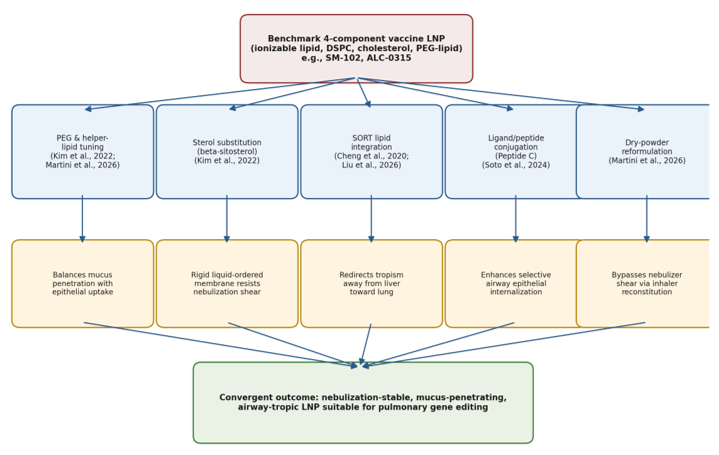
Several engineering strategies have emerged to meet these demands, and they recur throughout this review. One is PEG and helper-lipid modulation, which involves tuning PEG content to balance nebulization stability and mucus penetration against cellular uptake, since excessive PEGylation tends to blunt the latter (Kim et al., 2022; Martini et al., 2026). Another is sterol substitution, in which cholesterol is replaced with phytosterols such as β-sitosterol to shift the LNP's liquid-crystalline state, an approach that appears to improve endosomal escape and pulmonary transfection (Kim et al., 2022). A third strategy is selective organ targeting (SORT), which adds a fifth lipid component that reprograms organ tropism away from the liver's default pull and toward lung epithelium (Cheng et al., 2020; Lange et al., 2025). Ligand and peptide conjugation represents a further approach, decorating the LNP surface with mucus-penetrating, cell-targeting peptides identified through phage display, such as Peptide C, to improve selective epithelial uptake in patient-derived CF models (Soto et al., 2024). Finally, dry-powder formulation - achieved through spray-drying or lyophilizing LNPs for delivery via dry powder inhalers - sidesteps nebulizer-induced shear altogether (Martini et al., 2026).

These innovations are not purely academic. Active clinical trials of next-generation inhaled LNP-mRNA candidates, including Arcturus' ARCT-032 (LUNAR-CFTR), ReCode's RCT2100, and Moderna/Vertex's VX-522, suggest the field is edging, cautiously but genuinely, toward clinically viable pulmonary gene therapeutics (Munir et al., 2026; Ugwu et al., 2026).

Given how quickly lipid-based nanocarrier design is moving, this review sets out to provide a comprehensive, reasonably current synthesis of LNP engineering strategies built specifically for CF gene therapy. More precisely, we aim to critically examine the extracellular and intracellular biological barriers unique to the CF pulmonary microenvironment and how they shape LNP biophysical design; to trace the transition from benchmark systemic vaccine LNP formulations to lung-optimized compositions, with particular attention to ionizable lipid, helper lipid, phytosterol, and PEG-density engineering; to evaluate advanced targeting strategies, including SORT molecules, polymer-lipid hybrids, and cell-penetrating or ligand-mediated peptides; to examine the practical challenges of pulmonary administration, from nebulization stability versus dry-powder inhalation to the role of mucolytic pre-treatments such as dornase alfa; and finally, to summarize the current clinical pipeline of non-viral inhaled gene therapies for CF, identify the safety and translational gaps that remain, and outline what still needs to happen before a permanent, mutation-agnostic cure becomes a realistic clinical option.

2. Non-Viral Gene Editing for Human Disease Models  of Lipid Nanoparticle-Mediated Delivery Systems

2.1 The Non-Viral Paradigm Shift in Gene Editing

Genetic medicine is, gradually but noticeably, moving away from conventional viral-mediated gene addition and toward precise, non-viral genome editing across a growing range of human disease models (Cullis & Hope, 2024; Brimacombe et al., 2025). Viral vectors - adenoviruses, AAVs, lentiviruses - have dominated clinical trials for years, but they remain bottlenecked by real physical and immunological limits: constrained packaging capacity, complex manufacturing, and a persistent risk of insertional mutagenesis or genotoxicity (Allaire et al., 2023; Munir et al., 2026; Witten et al., 2026; Sinha et al., 2026). Perhaps more limiting still is their immunogenicity - neutralizing antibodies and T-cell responses that build after a first exposure and effectively rule out the repeat dosing most non-integrating gene therapies require (Munir et al., 2026; Witten et al., 2026).

Lipid nanoparticles have filled much of that gap. Their clinical legitimacy rests on FDA-approved formulations such as Patisiran (Onpattro) for siRNA delivery, and on the ALC-0315 and SM-102 mRNA vaccines deployed at global scale (Brimacombe et al., 2025; Huang et al., 2026). Left to their own devices, though, systemically administered LNPs display a strong innate hepatic tropism - they rapidly adsorb apolipoprotein E (ApoE) from plasma and are taken up by hepatocytes through LDLR-mediated endocytosis (Liu et al., 2026; Martini et al., 2026). Reprogramming LNPs to bypass the liver and reach extrahepatic organs such as the lung or the eye has consequently become a central focus of nanomedicine research (Huang et al., 2026; Liu et al., 2026). This section works through the current evidence base in a structured way, tracing a conceptual arc from pulmonary mucosal barriers, through ocular disease modeling, to selective extrahepatic targeting strategies more broadly (Figure 1).

2.2 Airway Epithelial Barriers and Gene Editing in Cystic Fibrosis Models

As introduced above, CF arises from mutations in CFTR, the gene encoding an epithelial chloride and bicarbonate channel (Sinha et al., 2026; Tafech et al., 2025). Impaired CFTR function dehydrates and thickens the mucus layer, which in turn undermines mucociliary clearance and drives chronic infection and inflammation (Hourihane & Hixon, 2024; Munir et al., 2026; Tafech et al., 2025). Small-molecule modulators can rescue folding for some mutant proteins, but they remain mutation-specific, leaving roughly 10% of patients - those with nonsense mutations or severe splicing defects - without an approved option (Tafech et al., 2025). Local, non-viral gene editing is one of the few strategies that could plausibly offer a mutation-agnostic cure for this group (Lange et al., 2025; Tafech et al., 2025).

2.2.1 2D Monolayers versus 3D Air-Liquid Interface Biomimetic Models

Standard 2D cell culture, useful as it is for early screening, tends to overstate how well a delivery vector will actually perform in tissue - and this gap has real translational consequences (Tafech et al., 2025). Tafech et al. (2025) illustrated the point starkly: Cas9 mRNA/sgRNA-loaded LNPs that achieved 46% editing in easy-to-transfect HEK293 cells managed only 7% to 10% indel formation in primary normal human bronchial epithelial (NHBE) cells. That is not a small drop-off; it is a fairly direct demonstration that primary pulmonary epithelium is considerably more resistant to transfection than immortalized cell lines (Tafech et al., 2025).
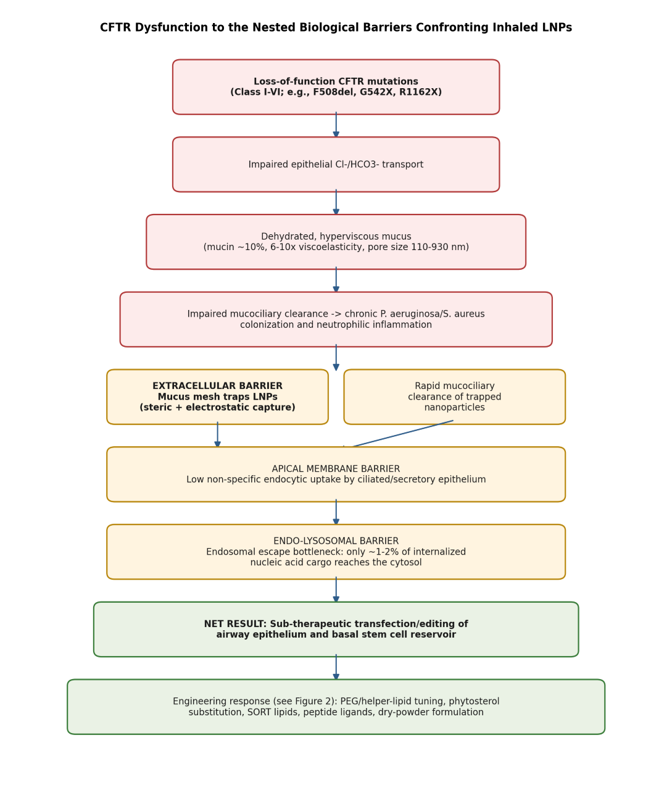
Figure 1. From CFTR Dysfunction to the Nested Extracellular, Membrane, and Endo-Lysosomal Barriers Confronting an Inhaled Lipid Nanoparticle. This schematic traces the causal chain from loss-of-function CFTR mutation through mucus hyperviscosity and impaired mucociliary clearance to the three sequential biological barriers - extracellular mucus entrapment, low apical membrane uptake, and endo-lysosomal degradation - that an inhaled LNP must overcome before reaching the cytosol. The bottom panel summarizes the engineering response detailed in Figure 2 and Section 2.5. Values are drawn from Tafech et al. (2025), Munir et al. (2026), and Brimacombe et al. (2025).

To close this gap, researchers have increasingly turned to differentiated three-dimensional bronchial models cultured at the air-liquid interface (ALI) (Tafech et al., 2025), which reproduce a pseudostratified epithelium complete with beating cilia, tight junctions, and active mucus secretion (Tafech et al., 2025; Witten et al., 2026). When optimized LNPs were applied topically to these 3D tissues, editing of the model gene HPRT fell to roughly 5% in CF patient-derived models (Tafech et al., 2025) - a decline that underscores just how much the viscoelastic mucus layer in differentiated tissue impedes nanoparticle transport, and why 3D ALI models are increasingly treated as a necessary, not optional, step in preclinical evaluation (Tafech et al., 2025; Witten et al., 2026).

2.2.2 Overcoming the Viscoelastic Mucus Barrier: Mucolytics and Nanoparticle Diffusivity

The sticky CF mucus layer remains, arguably, the single most stubborn extracellular obstacle (Tafech et al., 2025; Witten et al., 2026). Its 6- to 10-fold viscosity increase and restricted 110-930 nm pore size trap nanoparticles through a combination of steric hindrance and adhesive electrostatic or hydrophobic interactions, and whatever gets trapped is generally cleared before it can do much good (Munir et al., 2026; Tafech et al., 2025).

One practical workaround has been to pair LNPs with dornase alfa (Pulmozyme), a recombinant human DNase I already used clinically to thin CF sputum (Tafech et al., 2025). Pre-treating 3D CF models with dornase alfa (15-60 U) before LNP application roughly doubled editing efficiency, pushing indel rates from a baseline range up to 9.3%-12.7% (Tafech et al., 2025). Interestingly, because these in vitro models are sterile and lack neutrophil infiltration, this benefit cannot be attributed to immune-mediated DNA clearance; single-particle tracking instead showed that dornase alfa directly remodels the mucin gel structure, nearly doubling LNP diffusivity from 20.9 x 10⁻² to 40.9 x 10⁻² μm²/s (Tafech et al., 2025). The practical implication - and it is a reasonably clear one - is that pairing local mucolytics with inhaled gene editors is probably necessary, not merely helpful, for reaching therapeutic editing thresholds (Tafech et al., 2025).

2.2.3 Precision Tools: Base Editing and Prime Editing Configurations

Editing outcomes also depend heavily on which editor and cargo format is chosen (Witten et al., 2026). Conventional CRISPR/Cas9 nucleases introduce double-strand breaks (DSBs) that are repaired by error-prone NHEJ, carrying some risk of chromosomal rearrangement or genotoxicity when correcting loss-of-function CFTR mutations (Lange et al., 2025; Witten et al., 2026) - which is part of why DSB-free base- and prime-editing systems have drawn so much interest (Lange et al., 2025; Witten et al., 2026).

For nonsense mutations, adenine base editors (ABEs) offer a comparatively clean path: they chemically convert A•T base pairs to G•C without cutting both DNA strands (Tafech et al., 2025). Using an optimized formulation - LNP H, with an ionizable lipid of apparent pKa ~7.1 - Tafech et al. (2025) co-delivered mRNA encoding the near-PAMless base editor SpRY-ABE9p alongside a hypermodified sgRNA, repairing the pathogenic CFTR R1162X premature stop codon in heterozygous primary human CF nasal cells at an 11.8% genomic editing rate, notably without any transfection enrichment or electroporation.

For the far more common F508del mutation, prime editing (PE) - which fuses a Cas9 nickase to reverse transcriptase and uses a pegRNA carrying a reverse-transcription template (RTT) to write new sequence directly into the genome - has shown real promise (Lange et al., 2025). Lange et al. (2025) optimized PE for F508del correction in human CFBE-X bronchial cells using a reporter system (pPEAR_CFTR), identifying pegRNA_PEAR_9 (16-nt PBS, 33-nt RTT, no silent edits) as the most active configuration. Delivering the PE6c system via chitosan-complexed, cholesterol-modified LNPs boosted transfection roughly 1.5-fold over standard polymers, yielding a 54% prime-editing efficiency in reporter assays and approximately 5% genomic correction of F508del.

Finally, for a truly mutation-agnostic approach - one that would not depend on which of the more than 2,000 known CF mutations a patient carries - researchers have begun engineering LNP-directed universal gene-integration systems (Sinha et al., 2026). Sinha et al. (2026) used linear double-stranded DNA (ldsDNA) donors chemically modified with 1-aminohexane (AmC6) blockers and short 50-bp homology arms targeting the CFTR 5' UTR. Delivered to human bronchial epithelial (16HBE) cells, this system achieved a modest 1%-2% genomic integration rate that nonetheless restored 50% of wild-type CFTR protein expression (Western blot) and recovered over 40% of wild-type chloride current (Ussing chamber) - a useful reminder that, in gene therapy, low integration efficiency does not necessarily mean low therapeutic benefit (Sinha et al., 2026).

2.3 Ocular Disease Modeling: Trabecular Meshwork and Primary Open-Angle Glaucoma

LNP-mediated gene editing is not confined to the lung. It has also found a foothold in ophthalmology, particularly for building clinically representative disease models and probing target-specific ocular therapeutics (Huang et al., 2026). The eye is, in some ways, an unusually forgiving target for genetic medicine - anatomically contained, immune-privileged, and readily accessed by local intravitreal or intracameral injection (Huang et al., 2026).

2.3.1 SM102-Based LNP Formulations and Ocular Tropism

Huang et al. (2026) compared three clinically validated ionizable lipids - DLin-MC3-DMA, ALC-0315, and SM-102 - each formulated at a 50:38.5:10:1.5 molar ratio with cholesterol, DSPC, and DMG-PEG2000 (Table 1). SM102-based LNPs produced the strongest transfection across mouse photoreceptor (661W), human retinal pigment epithelial (ARPE), and primary human trabecular meshwork (hTM) cells, while remaining metabolically gentler than MC3-based formulations (Huang et al., 2026).

Following intravitreal injection in mice, these LNPs showed a striking and fairly specific tropism for the trabecular meshwork (TM), sparing the retina almost entirely (Huang et al., 2026). This selectivity appears to be driven less by active targeting chemistry and more by physics: particle size (120-160 nm) is large enough to be excluded by the retinal inner limiting membrane, aqueous humor drainage naturally routes particles toward the outflow pathway, and TM cells are inherently phagocytic (Huang et al., 2026). The upshot is targeted anterior-segment therapy without meaningful off-target retinal transfection (Huang et al., 2026).

2.3.2 Quantitative Editing Efficiencies and Functional Recapitulation of POAG

To confirm in vivo editing, Huang et al. (2026) co-encapsulated SpCas9 mRNA and a modified sgRNA in SM102-based LNPs (SM102-SpCas9-sgtdT) and injected them intravitreally into Rosa26LSL-tdTomato reporter mice. A single 100-ng dose activated tdTomato expression in 66.1% of TM cells in vivo (Huang et al., 2026) - a genuinely high in vivo editing rate for a non-viral system. Sequencing of iridocorneal tissue found an average indel rate of 5.1%, though the authors note this figure is likely an underestimate, since surrounding unedited non-TM tissue was inevitably included during sample collection (Huang et al., 2026).

To model primary open-angle glaucoma (POAG), the same group knocked out Matrix Gla Protein (MGP), a calcification inhibitor normally expressed at high levels in TM (Huang et al., 2026). Delivering SpCas9 mRNA with two sgRNAs (1:1:1 ratio) via SM102-LNPs produced a greater than 60% reduction in Mgp mRNA and a 72.2% loss of RNAscope signal (Huang et al., 2026; Table 2). This knockout, notably, was sufficient to induce TM calcification, sustain elevated intraocular pressure at roughly 18.0 mmHg, thin the ganglion cell complex, and drive Müller gliosis - together reproducing progressive POAG pathology in a mouse model (Huang et al., 2026).

2.4 Extrahepatic Targeting and Cell-Type Specificity: Polymer-Lipid Hybrid Systems

Even when an LNP successfully avoids the liver, hitting a specific cell type within a complex organ remains genuinely difficult (Liu et al., 2026). One response has been to merge lipid vectors with synthetic polymers, producing lipid-polymer hybrid nanoparticles (LPHNs) with more tunable tropism (Maeda & Whitsett, 2025/2026; Scialabba et al., 2024).

2.4.1 Route of Administration as a Tropism Switch

Maeda and Whitsett (2025/2026) built a hybrid platform combining biodegradable poly(β-amino ester)s (PBAEs), or PEGylated PBAEs (PBAE-PEGs), with a five-component LNP core (4A3-SC8/DOPE/cholesterol/DOTAP). Their central finding was, in effect, that the route of administration itself acts as a tropism switch: intravenous injection of Cre-mRNA-loaded hybrid particles transfected PECAM-1 (CD31)+ lung endothelial cells at 73.2% efficiency, whereas local intratracheal instillation - bypassing systemic circulation entirely - instead reached EpCAM (CD326)+ lung epithelial cells at 55.4% efficiency (Maeda & Whitsett, 2025/2026; Figure 3).
2.4.2 Surface PEGylation as a Sub-Cellular Targeting Modulator

Once the administration route sets the broad target, PEGylation appears to fine-tune it further. Following local intratracheal instillation, PEGylated PBAE-PEG/LNPs transfected both LAMP3+ alveolar type II (ATII) cells and SCGB1A1+ airway club cells, since the PEG coating stabilizes the particle and limits macrophage clearance

Figure 2. Five Convergent Engineering Strategies Transforming Systemic Vaccine-Grade LNPs into Lung-Optimized Gene-Editing Carriers. Starting from the benchmark four-component vaccine LNP architecture (ionizable lipid, DSPC, cholesterol, PEG-lipid), this diagram maps five parallel engineering modifications - PEG/helper-lipid tuning, sterol substitution, SORT lipid integration, ligand/peptide conjugation, and dry-powder reformulation - to their respective functional outcomes, converging on a nebulization-stable, mucus-penetrating, airway-tropic delivery vehicle. 
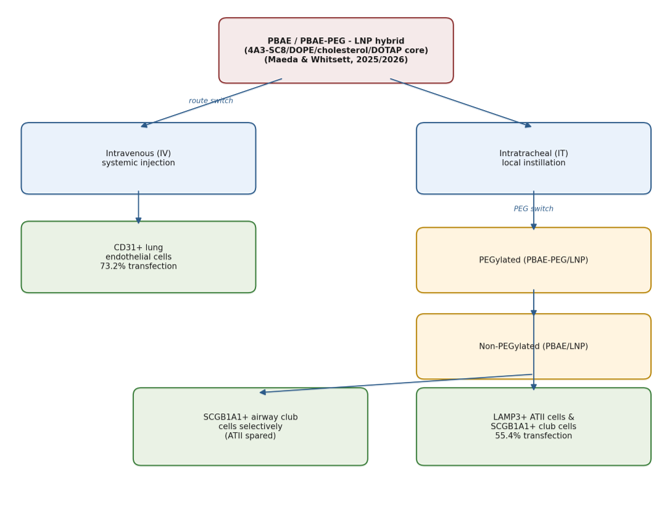
Figure 3. Route of Administration and Surface PEGylation as Sequential Cellular Tropism Switches for Polymer-Lipid Hybrid Nanoparticles. This decision-tree diagram illustrates how a single PBAE/PBAE-PEG-LNP hybrid platform can be redirected to distinct pulmonary cell populations depending on two sequential design variables: route of administration (intravenous versus intratracheal) and, following intratracheal delivery, surface PEGylation state. Quantitative transfection efficiencies for each terminal branch are reported exactly as presented 

Table 1. Physicochemical and Biophysical Characterization of Key Non-Viral Delivery Vehicles Evaluated Across Pulmonary and Ocular Gene-Therapy Studies. This table reports the mean hydrodynamic diameter, polydispersity index (PDI), zeta potential, cargo encapsulation efficiency, and core lipid/polymer composition for the principal LNP and hybrid nanoparticle formulations discussed in Section 2. Values are drawn directly from the cited primary studies and are presented to allow side-by-side comparison of formulation chemistry against the biological model system in which each vehicle was tested. Formulations are ordered as they are introduced in the text, moving from pulmonary (Tafech et al., 2025) through ocular (Huang et al., 2026) and hybrid/peptide-functionalized (Scialabba et al., 2024; Soto et al., 2024; Maeda & Whitsett, 2025/2026; Kim et al., 2022) systems.

Formulation (Citation)

Diameter (nm) & PDI

Zeta Potential (mV)

Encapsulation Efficiency

Core Composition

Biological Model & Key Finding

LNP H (Tafech et al., 2025)

46 nm (PDI 0.10)

-2.0 ± 0.1 (pH 7.4)

>90% mRNA/mod-sgRNA

Proprietary ionizable lipid (pKa ~7.1), DOPE, cholesterol, PEG-lipid (50/10/38.5/1.5 mol%)

Primary NHBE & 3D ALI CF models; ~30% 2D editing; ~5-12.7% 3D editing with dornase alfa

DOPE-mRNA LNP (Tafech et al., 2025)

42 nm (PDI 0.19-0.27)

-10.0 ± 5.0

~31%

MC3, DOPE, cholesterol, DMG-PEG2000 (50/10/38.5/1.5 mol%)

Primary NHBE; benchmark for DOPE's superior endosomal escape vs. DSPC/DOPC

DOPE-RNP LNP (Tafech et al., 2025)

279 nm (PDI 0.40-0.75)

-1.8 ± 1.0

~18% (RNP)

MC3, DOPE, cholesterol, DMG-PEG2000 (50/10/38.5/1.5 mol%)

Primary NHBE; lower cytotoxicity but poor mucus penetration due to large size

SM102-GFP (Huang et al., 2026)

120-160 nm (PDI <0.2)

+3 to +5

>90% (RiboGreen)

SM102, DSPC, cholesterol, DMG-PEG2000 (50/10/38.5/1.5 mol%)

Ocular cell lines & in vivo mouse eye; highest transfection, exclusive TM tropism

MC3-GFP (Huang et al., 2026)

120-160 nm (PDI <0.2)

Positive, lower than SM102

>90%

DLin-MC3-DMA, DSPC, cholesterol, DMG-PEG2000

Ocular models; higher cytotoxicity, lower TM transfection than SM102

Ilo@PEG-LPHNPs (Scialabba et al., 2024)

~100-120 nm (PDI 0.25-0.32)

-10 to -50 (pre/post-lyophilization)

28 wt% drug release/6h

PHEA-g-RhB-g-PLGA core with DPPC/DSPE-PEG2000 lipid shell

CFBE (F508del) cells & artificial CF mucus; suppressed IL-6/IL-8, reduced mucus viscosity

Peptide C-LNP (Soto et al., 2024)

<100 nm (PDI <0.2)

Shifted positive vs. unmodified

>95% (RiboGreen)

Standard 4-lipid (Spikevax-equivalent) + myristoylated Peptide C

Primary F508del ALI cultures; 10.5-fold higher bioactivity vs. PEGylated controls

PBAE-PEG/LNP (Maeda & Whitsett, 2025/2026)

80-120 nm (PDI <0.2)

Near-neutral to slightly positive

>90% (30:1 lipid:mRNA)

4A3-SC8, DOPE, cholesterol, PBAE-PEG, DOTAP

HEK293T & mouse lung; PEGylation guides ATII (IT) and CD31+ endothelia (IV)

PBAE/LNP (Maeda & Whitsett, 2025/2026)

80-120 nm (PDI <0.2)

Positive (DOTAP-driven)

>90%

4A3-SC8, DOPE, cholesterol, non-PEGylated PBAE, DOTAP

Mouse lung; homes selectively to SCGB1A1+ club cells via IT instillation

nLNP-Sito/4.5 (Kim et al., 2022)

80-100 nm pre-neb.; ~150 nm post-neb.

Near-neutral

>90% pre-nebulization

DLin-MC3-DMA, DMG-PEG2000 (4.5 mol%), DSPC, β-sitosterol (38.5 mol%, replacing cholesterol)

HeLa, A549, 16HBE14o-, CFBE, mice; 12-fold higher in vivo NLuc expression vs. Onpattro-like formulation

Table 2. Functional Landscape of LNP-Mediated Gene-Editing Modalities Across Human Disease Models. This table contrasts the gene-editing tools evaluated in the reviewed literature - CRISPR/Cas9 nuclease editing, adenine base editing, prime editing, and homology-directed integration - by target locus, delivery vehicle, quantitative editing efficiency, and functional/histological outcome. It is intended to let the reader compare editing-modality trade-offs (Section 5.2) at a glance rather than through the narrative text alone. Efficiencies are reported exactly as presented by the original authors, using the quantification method stated in each source study.

Editing Technology

Genetic Tool & Cargo

Delivery Vehicle

Target Model & Locus

Editing Efficiency

Functional Outcome

Citation

CRISPR/Cas9 DSB (NHEJ)

Cas9 mRNA + mod-sgRNA

LNP H (pKa ~7.1)

Primary NHBE & 3D ALI; HPRT locus

~30% (2D); ~5% (3D); 9.3-12.7% with dornase alfa

Topical mucus penetration confirmed; ~3% TP63+ basal stem cell transfection

Tafech et al. (2025)

Adenine base editing (A•T→G•C)

SpRY-ABE9p mRNA + hypermodified sgRNA

LNP H

Primary CF nasal cells; CFTR R1162X (c.3484C>T)

~11.8% genomic correction

Clean A-to-G transition confirmed by Sanger sequencing; no electroporation needed

Tafech et al. (2025)

Base editor comparison

SpRY-ABE8e vs. SpRY-ABE9p

Electroporation & LNP H

HEK293 cells stably expressing CFTR-R1162X fragment

50% ± 3.1% (ABE8e); 58% ± 8.5% (ABE9p)

Established TadA9 plant-evolved variant as higher-activity option

Tafech et al. (2025)

Prime editing (RT-directed insertion)

pCMV-PE6c + pegRNA_PEAR_9 (16 nt PBS, 33 nt RTT)

Chitosan-complexed, cholesterol-modified LNP

CFBE-X cells; CFTR F508del

54% (reporter assay); ~5% genomic correction

Restored GFP in pPEAR_CFTR reporter; 1.5-fold higher transfection than PEI

Lange et al. (2025)

Homology-directed integration

SpCas9 RNP + AmC6-modified ldsDNA donor (50 bp arms)

Electroporation (LNP packaging in progress)

16HBE14o- cells; CFTR 5' UTR

1-2% allelic integration of 4.4 kb CFTR cDNA

Restored 50% WT CFTR protein (Western blot); >40% WT chloride current (Ussing chamber)

Sinha et al. (2026)

CRISPR/Cas9 knockout (NHEJ)

SpCas9 mRNA + 2 sgRNAs (Mgp exons 1, 4)

SM102-based LNP (120-160 nm)

In vivo C57BL/6J mouse eye; Mgp gene

>60% Mgp mRNA reduction; 72.2% RNAscope signal loss

Induced TM calcification, sustained IOP ~18 mmHg, GCC thinning, Muller gliosis

Huang et al. (2026)

Cre-LoxP recombination

Cre recombinase mRNA

Peptide C-LNP (myristoylated conjugate)

In vivo Ai9 reporter mice; pulmonary tissue

22.4% tdTomato+ epithelial cells (72 h post-IT)

6.3-fold and 29.1-fold higher specificity vs. immune/endothelial cells

Soto et al. (2024)

(Maeda & Whitsett, 2025/2026). Strip away the PEG, however, and the non-PEGylated PBAE/LNP instead localizes selectively to SCGB1A1+ club cells, sparing the deeper ATII population (Maeda & Whitsett, 2025/2026). Because club cells serve as progenitors for both ciliated and goblet cells, this non-PEGylated configuration offers a genuinely targeted route for delivering CFTR machinery to the conducting airways while minimizing unnecessary alveolar exposure (Maeda & Whitsett, 2025/2026).

2.5 Biophysical Stability, Aerosolization Dynamics, and Clinical Obstacles

None of the biological targeting described above matters if the LNP cannot survive the delivery device itself, and clinical translation depends heavily on this physical compatibility (Martini et al., 2026; Munir et al., 2026). Local airway delivery is typically achieved with vibrating mesh nebulizers, which aerosolize liquid suspensions into respirable 1-5 μm micro-droplets capable of reaching the deep bronchial tree (Fan et al., 2025; Kim et al., 2022).

2.5.1 Nebulization-Induced Shear Stress and Structural Remodeling

Unfortunately, the shear forces generated inside these devices are not gentle, and conventional LNPs - including SM102-based formulations - tend to disintegrate under them, leaking cargo and losing transfection capacity in the process; only about 17% of standard SM102 LNPs remain structurally intact after nebulization (Fan et al., 2025; Kim et al., 2022).

Substituting cholesterol for β-sitosterol, a phytosterol with a rigid, branched tail, appears to solve much of this problem by introducing a more stable liquid-ordered membrane phase, which resists shear-induced disruption while also improving endosomal escape (Brimacombe et al., 2025; Kim et al., 2022). This solution, though, runs into what might fairly be called a "PEG dilemma": high PEGylation helps LNPs diffuse through mucus, but it also blocks the adsorption of local ApoE (secreted by alveolar macrophages), which is needed for LDLR-mediated endocytosis into lung cells (Kim et al., 2022; Martini et al., 2026). In other words, the very coating that gets the particle through the mucus can be the same coating that keeps it from being taken up once it arrives.

2.5.2 Dry-Powder Formulations and Solid-State Inhalation Systems

An alternative route sidesteps the nebulizer problem altogether: solid-state dry-powder formulations delivered via dry-powder inhalers (DPIs) (Fan et al., 2025; Martini et al., 2026). Martini et al. (2026) examined LNP behavior during spray-drying with mannitol and found that the choice of helper lipid (DOPE versus DSPC) and PEG density together determine how the excipient interacts with the LNP membrane. Spray-drying promotes hydrogen bonding between mannitol and phospholipid headgroups, which prevents the phase separation and membrane fusion that would otherwise damage the particle (Martini et al., 2026). Once dissolved in lung lining fluid, these microparticles reconstitute into intact, functional LNPs capable of efficient transfection - all without ever encountering nebulizer-induced shear (Fan et al., 2025; Martini et al., 2026).

2.6 Conclusions and Perspectives

Taken as a whole, non-viral gene editing has moved, in a fairly short span, from an empirical laboratory curiosity to something close to the leading edge of genomic medicine. Systematic optimization of ionizable lipid pKa, helper-lipid chemistry, phytosterol rigidity, and PEG density has produced delivery vehicles genuinely capable of clearing formidable extracellular and intracellular barriers. In human CF models specifically, pairing optimized LNP H carriers with clinically approved mucolytic pre-treatment has achieved clinically meaningful editing rates in differentiated 3D ALI tissue - a promising, if still incomplete, step toward a permanent, mutation-agnostic cure. In parallel, the selective tropism of SM102-based LNPs for the trabecular meshwork has enabled a functionally faithful mouse model of chronic ocular hypertension, illustrating how programmable nanoparticle tropism has become across organ systems.

That said, several translational gaps remain before LNP-based gene editors can be safely deployed in the clinic. Most preclinical work still relies on rodent models that do not fully capture the branching anatomy, dense mucus secretions, and immunological complexity of the human lung. Larger animal models with more human-like anatomy - ferrets, non-human primates - will likely be needed to predict clinical safety and efficacy with any confidence. The long-term immunogenicity of PEGylated lipids, and the cumulative effects of repeated inhaled dosing, also warrant more rigorous toxicological study than currently exists. Combining high-throughput combinatorial screening with AI-guided design frameworks may accelerate the next generation of targeted, biocompatible LNPs - and, with it, the prospect of durable, tissue-specific cures for monogenic disease more broadly.

3. Methods

3.1 Review Design and Reporting Framework

This article is structured as a narrative-synthesis review with elements of a systematic search strategy, reported in a manner intended to be reproducible by an independent reviewer using standard bibliographic databases. Where applicable, the search and screening steps follow the general logic of the PRISMA 2020 framework for identification, screening, and inclusion, though a formal meta-analysis was neither intended nor appropriate given the heterogeneity of study designs (in vitro monolayer, 3D organoid/ALI, and in vivo rodent) represented in the underlying literature.

3.2 Search Strategy and Information Sources

A structured literature search was conducted across PubMed/MEDLINE, Scopus, Web of Science, and Google Scholar for records published or made available in preprint form through 2026. Search strings combined controlled vocabulary (MeSH terms, where applicable) with free-text keywords, connected using Boolean operators, in the general form: ("lipid nanoparticle" OR "LNP") AND ("cystic fibrosis" OR "CFTR") AND ("gene therapy" OR "gene editing" OR "mRNA" OR "CRISPR" OR "base editing" OR "prime editing" OR "inhaled" OR "pulmonary delivery"). Supplementary searches were run to capture adjacent extrahepatic-targeting and ocular gene-editing literature, using strings such as ("lipid nanoparticle*") AND ("trabecular meshwork" OR "extrahepatic" OR "SORT" OR "selective organ targeting" OR "polymer-lipid hybrid"). Reference lists of retrieved articles were hand-searched to identify additional eligible studies not captured by the primary search (a "snowballing" step), and clinical trial registries (ClinicalTrials.gov) were queried directly using the terms "cystic fibrosis" AND "mRNA" OR "gene therapy" to identify the current inhaled gene-therapy pipeline.

3.3 Eligibility Criteria

Studies were considered eligible if they (a) reported primary experimental data on LNP or lipid-polymer hybrid nanoparticle-mediated delivery of nucleic acid cargo (mRNA, DNA donor, ribonucleoprotein, or CRISPR-associated editor components) to airway epithelial, pulmonary, or closely related extrahepatic (ocular, splenic, pancreatic) cell or tissue models; (b) provided quantitative outcome measures such as transfection efficiency, genomic editing (indel) rate, protein or channel-function restoration, or particle physicochemical characterization; and (c) were published in a peer-reviewed journal or as a registered clinical trial record. Reviews, editorials, and conference abstracts lacking quantitative primary data were excluded from the primary evidence synthesis but were retained, where relevant, as supporting background citations for mechanistic context (e.g., Allaire et al., 2023; Munir et al., 2026).

3.4 Data Extraction

For each eligible study, the following variables were extracted into a structured evidence table by a single reviewer and cross-checked against the original source: (1) nanoparticle composition, including ionizable lipid identity, helper lipid, sterol component, and PEG-lipid mol%; (2) physicochemical characterization, including hydrodynamic diameter, polydispersity index (PDI), zeta potential, and cargo encapsulation efficiency, typically obtained by dynamic light scattering (DLS) and RiboGreen or equivalent fluorometric assay; (3) biological model system, spanning immortalized cell lines, primary 2D monolayers, differentiated 3D air-liquid interface (ALI) cultures, and in vivo rodent models; (4) route and method of administration (topical application, intratracheal instillation, intravenous injection, intravitreal injection, or nebulization/dry-powder inhalation); (5) quantitative outcome measures, including transfection efficiency (percentage of reporter-positive cells by flow cytometry or fluorescence microscopy), genomic editing efficiency (percentage indels by next-generation or Sanger sequencing), and, where reported, functional endpoints such as chloride current restoration by Ussing chamber electrophysiology or CFTR protein expression by Western blot; and (6) safety- and stability-related endpoints, including cytotoxicity (MTT or equivalent viability assay) and post-nebulization particle integrity.

3.5 Synthesis Approach

Given the substantial heterogeneity in formulation chemistry, cell/tissue model, and outcome metric across the included studies, a quantitative meta-analysis was not performed. Instead, findings were synthesized narratively and organized thematically around (a) the sequential biological barriers encountered by an inhaled LNP (mucus penetration, apical uptake, endosomal escape), (b) the specific engineering strategy used to address each barrier, and (c) the resulting quantitative editing or transfection outcome, reported as originally presented by the source study. Where a single study reported outcomes across multiple formulations or models (e.g., Tafech et al., 2025, across 2D and 3D systems), each condition was extracted and reported as a distinct data point to preserve the internal comparison intended by the original authors. Consolidated evidence tables (Tables 1-6) were constructed to allow direct, side-by-side comparison of formulation composition, editing modality, biological barrier, targeting platform, and clinical development stage across the reviewed literature.

3.6 Reproducibility Statement

All search strategies, database access dates, and eligibility decisions described above are reported at a level of detail intended to permit an independent researcher to reconstruct the search using the PubMed interface and the Boolean strings provided in Section 3.2. Full reference details for every source cited in the body text, tables, and figures of this review are provided in the consolidated bibliography (see References), formatted in APA 7th edition style to facilitate direct verification against PubMed, CrossRef, or the publisher's indexed record.

4. Synthesis of Findings: Quantitative Convergence of LNP Engineering and Genome-Editing Outcomes Across Pulmonary and Ocular Disease Models

The therapeutic landscape of genetic medicine is, rather visibly, undergoing a shift - non-viral LNPs are moving from transient vaccine-delivery platforms toward precise, tissue-targeted gene-editing therapeutics for chronic human disease. This section pulls together the quantitative evidence across pulmonary and ocular models, mapping transfection and editing efficiencies, organ-specific tropism switches, and the biophysical adaptations needed to clear extracellular barriers (Figure 1).

4.1 Quantitative Transfection and Gene-Editing Efficiencies in Airway Epithelia

A central aim of current pulmonary gene therapy is delivering genome-editing machinery to human airway epithelial cells with reasonable efficiency (Tafech et al., 2025). Conventional LNP compositions - standard helper lipids such as DSPC, DOPC, or DOPE paired with the clinically benchmarked ionizable lipid DLin-MC3-DMA (MC3) - have shown fairly limited efficiency in primary NHBE cells, in part because they depend heavily on systemic ApoE adsorption for LDLR-mediated endocytosis (Kim et al., 2022; Liu et al., 2026). Among helper lipids tested, DOPE-containing LNPs consistently produced the strongest reporter luciferase activity and functional GFP expression in primary NHBE monolayers, outperforming both DSPC and DOPC formulations (Tafech et al., 2025) (Table 1).

Even so, translating standard CRISPR/Cas9 systems into primary human tissue has proven genuinely difficult. Tafech et al. (2025) reported baseline indel rates of only 7%-10% in easy-to-transfect primary monolayers using standard Cas9 mRNA/sgRNA-loaded LNPs. Switching to the optimized LNP H formulation - a proprietary ionizable lipid with apparent pKa ~7.1 - together with hypermodified single-guide RNAs (2'-O-methylated bases), raised 2D primary NHBE editing to roughly 30% (Tafech et al., 2025) (Table 2).

The picture changes again when moving from 2D monolayers to differentiated, pseudostratified 3D ALI tissue, where the physical mucus barrier and active ciliary clearance take a real toll on editing performance (Tafech et al., 2025; Witten et al., 2026). Topical LNP H delivery to 3D ALI models achieved roughly 7% HPRT editing in healthy tissue, dropping to 5% ± 2.14% in CF patient-derived models because of the thicker, more dehydrated sputum characteristic of CF airways (Tafech et al., 2025) (Figure 1).

Pairing LNPs with dornase alfa (Pulmozyme) - a clinically approved mucolytic - partially recovers this loss. Pre-treating differentiated 3D CF models with dornase alfa (15-60 U) for four hours before topical LNP H delivery produced a dose-dependent increase in editing, reaching 9.32% ± 0.96% to 12.7% indels (Tafech et al., 2025). Fluorescence correlation spectroscopy and single-particle tracking confirmed the mechanism: dornase alfa remodels the mucin network directly, roughly doubling LNP diffusivity from 20.9 x 10⁻² to 40.9 x 10⁻² μm²/s (Tafech et al., 2025). Notably, flow cytometry confirmed that topical LNP H delivery also reached roughly 3% of TP63+ basal stem cells beneath the epithelial layer - a small but mechanistically important fraction, since durable correction ultimately depends on editing the progenitor pool rather than only the terminally differentiated surface cells (Tafech et al., 2025).

For nonsense mutations specifically, DSB-free correction has been demonstrated without conventional Cas9 nuclease activity. Co-delivering mRNA encoding the SpRY-ABE9p adenine base editor with a hypermodified sgRNA via LNP H repaired the pathogenic CFTR R1162X mutation in primary CF nasal epithelial cells at roughly 11.8% genomic correction, again without transfection enrichment or electroporation (Tafech et al., 2025) (Table 2).

For F508del, the most common CF-causing mutation, Lange et al. (2025) optimized a prime-editing configuration using the pCMV-PE6c system and a tailored pegRNA_PEAR_9 (16-nt primer binding site, 33-nt RT template), achieving 54% prime-editing efficiency in a pPEAR_CFTR reporter assay and roughly 5% genomic correction in F508del-mutated bronchial cells following chitosan-complexed LNP delivery (Table 2).

Finally, aiming at a genuinely mutation-agnostic cure, Sinha et al. (2026) developed a non-viral gene-replacement system targeting the CFTR 5' UTR. Electroporating human bronchial (16HBE) cells with AmC6-modified linear dsDNA templates carrying 50-bp homology arms achieved only 1%-2% allelic integration - yet this modest integration rate restored 50% of wild-type CFTR protein expression (Western blot) and rescued over 40% of wild-type chloride current (Ussing chamber) (Sinha et al., 2026), which is, on reflection, a fairly encouraging validation of low-threshold correction as a therapeutically meaningful target (Table 2).

4.2 Ocular Gene Editing and Functional Disease Modeling

LNP-mediated CRISPR/Cas9 systems have shown comparably strong precision in ophthalmic disease modeling (Huang et al., 2026). Screening across mouse photoreceptor (661W), human retinal pigment epithelial (ARPE), and primary human trabecular meshwork (hTM) cells found that SM102-based LNPs (SM102-GFP) drove significantly stronger transgene expression than either ALC0315-GFP or DLin-MC3-DMA (MC3-GFP) formulations, while also showing better biocompatibility - MC3-based LNPs, by contrast, produced measurable cytotoxicity (Huang et al., 2026) (Table 1).

Following intravitreal injection in mice, SM102-GFP demonstrated an essentially exclusive tropism for the trabecular meshwork adjacent to Schlemm's canal, with no detectable retinal transfection (Huang et al., 2026) (Figure 1). This selectivity appears to reflect particle size (120-160 nm, large enough to be excluded by the retinal inner limiting membrane) combined with aqueous humor outflow drainage and the naturally high phagocytic activity of TM cells (Huang et al., 2026). Viral vectors compare unfavorably here: AAV2 transfects retinal and ciliary tissue non-specifically, and Adenovirus 5 (Ad5) provokes marked retinal microglial inflammation (Huang et al., 2026).

In vivo editing was confirmed by intravitreal injection of SM102-SpCas9-sgtdT LNPs into Rosa26LSL-tdTomato reporter mice; a single 100-ng dose activated robust, TM-specific tdTomato expression, editing 66.1% of TM cells in vivo (Huang et al., 2026) (Table 2). Building on this platform, Huang et al. (2026) modeled primary open-angle glaucoma (POAG) by knocking out Matrix Gla Protein (MGP), a calcification inhibitor highly expressed in TM tissue. SpCas9 mRNA and two sgRNAs delivered via SM102-LNPs produced a greater than 60% reduction in Mgp mRNA and a 72.2% loss of RNAscope signal (Huang et al., 2026). This localized knockout induced pathological TM calcification and a chronic IOP plateau of roughly 17.6-18.0 mmHg (versus 10.0 mmHg in controls), with GFAP-positive Müller gliosis and progressive ganglion cell complex thinning apparent by Day 100 - a reasonably faithful, if slow-developing, replication of early-stage POAG pathophysiology (Huang et al., 2026).

4.3 Extrahepatic Cellular Tropism Switches and In Vivo Homing

Bypassing default hepatic accumulation to reach specific cell types within complex organs requires more deliberate engineering of the LNP surface and, increasingly, lipid-polymer hybrid architectures (Liu et al., 2026). Maeda and Whitsett (2025/2026) built a hybrid nanoparticle combining biodegradable PBAEs (or PEGylated PBAE-PEGs) with a five-component LNP core (4A3-SC8/DOPE/cholesterol/DOTAP). In vivo biodistribution in Cre-reporter mice showed that the route of administration functions, in effect, as a primary cellular tropism switch (Figure 3):

  • Intravenous systemic injection redirected the hybrid particles to lung vasculature, transfecting PECAM-1 (CD31)+ lung endothelial cells at 73.2% efficiency, with essentially no transfection of epithelial or immune cells (Maeda & Whitsett, 2025/2026).

  • Intratracheal local instillation bypassed the endothelium entirely, transfecting EpCAM (CD326)+ lung epithelial cells at 55.4% efficiency (Maeda & Whitsett, 2025/2026).

After IT administration, surface PEGylation acted as a secondary, sub-tropism switch. PEGylated PBAE-PEG/LNPs diffused broadly to transfect both LAMP3+ ATII cells and SCGB1A1+ club cells, since the PEG layer shields the particle from macrophage clearance (Maeda & Whitsett, 2025/2026). Non-PEGylated PBAE/LNPs, in contrast, localized specifically to the conducting airways, selectively reaching progenitor SCGB1A1+ club cells over ATII cells (Maeda & Whitsett, 2025/2026) (Table 5).

To sharpen target-cell specificity further, Soto et al. (2024) used phage display to identify Peptide C, a mucus- and cell-penetrating ligand. Incorporating myristoylated Peptide C as a fifth lipid component (6 mol%) in Spikevax-like LNPs produced a 10.5-fold increase in reporter luciferase expression over standard PEGylated control LNPs in differentiated primary human CF bronchial cells (Soto et al., 2024). In vivo delivery to reporter mice confirmed highly selective epithelial transfection, editing roughly 20% of CD326+ airway epithelial cells while leaving pulmonary immune and endothelial cells largely untouched (Soto et al., 2024) (Table 5).

4.4 Aerosolization Dynamics and In Vivo Shear-Stress Stability

Clinical viability, in the end, also comes down to mechanical robustness (Munir et al., 2026). Traditional formulations modeled on the FDA-approved systemic carrier SM-102 are highly vulnerable to the shear stress generated by vibrating mesh nebulizers; DLS analysis shows severe particle aggregation after nebulization, with only about 17% of particles remaining intact and a corresponding loss of transfection capacity (Fan et al., 2025; Kim et al., 2022) (Figure 2).

Kim et al. (2022) addressed this by substituting cholesterol with β-sitosterol. Cryo-TEM imaging and membrane fluidity measurements showed that β-sitosterol reorganizes lipid packing into a stable, liquid-ordered state that resists nebulization-induced shear far better than conventional cholesterol-based membranes. When formulated with a relatively high PEG-lipid content (3.5%-4.5% DMG-PEG2K) to limit mucin adhesion, these nebulizable LNPs (nLNPs) retained their physicochemical integrity, size, and high (>90%) encapsulation efficiency after nebulization (Kim et al., 2022). In vivo delivery of Nluc mRNA via nLNP inhalation produced robust, uniform protein expression across all five lung lobes in mice, with no detectable off-target liver transfection or acute pulmonary toxicity (Kim et al., 2022).

5. Bridging the Biophysical and Translational Gap Between Vaccine-Grade and Therapeutic-Grade Pulmonary Lipid Nanoparticles

5.1 Interpreting the Convergence of Engineering Strategies

Reading across the results synthesized above, a fairly consistent pattern emerges: no single engineering modification appears sufficient on its own to render an LNP therapeutically effective in the CF airway. Mucus penetration, apical uptake, endosomal escape, nebulization survival, and cell-type specificity are addressed by largely independent design levers - PEG density, sterol chemistry, SORT lipid incorporation, peptide conjugation, and formulation state, respectively (Kim et al., 2022; Cheng et al., 2020; Soto et al., 2024; Martini et al., 2026) - and the evidence base (Table 3) suggests these strategies are, for the most part, additive rather than substitutable. The dornase alfa/LNP H combination reported by Tafech et al. (2025) is a useful illustration: neither the mucolytic pre-treatment nor the optimized ionizable lipid alone reached the 12.7% editing ceiling achieved when the two were combined. If this pattern generalizes - and there is reason to think it might - future formulation work may need to treat "the LNP" as one component of a broader delivery regimen rather than a stand-alone therapeutic.

5.2 Editing Modality Trade-Offs: NHEJ, Base Editing, Prime Editing, and HDR

The comparative editing efficiencies summarized in Table 2 point to a genuine trade-off between precision and efficiency across gene-editing modalities. Conventional Cas9-mediated NHEJ remains the most efficient option numerically, but its reliance on double-strand breaks carries a genotoxicity risk that base and prime editors were specifically designed to avoid (Lange et al., 2025; Witten et al., 2026). Base editing achieved a comparatively strong 11.8% correction rate for the CFTR R1162X nonsense mutation without electroporation (Tafech et al., 2025), which is notable given how few nonsense-mutation-directed therapies currently exist. Prime editing, while mechanistically more versatile - in principle capable of correcting virtually any point mutation or small indel, including F508del - currently lags behind numerically, achieving only about 5% genomic correction despite a much higher 54% efficiency in reporter assays

Table 3. Biological and Biophysical Barriers to Inhaled Delivery and Corresponding Nanoparticle Engineering Solutions. This table consolidates the major biological and physical bottlenecks encountered by gene-delivery vectors in the respiratory and ocular systems and pairs each barrier with the molecular or formulation-level design solution proposed in the literature, along with the primary experimental evidence supporting that solution. It underlies the barrier-by-barrier structure of Sections 2.2, 2.5, and Figure 1, and is intended as a quick-reference bridge between mechanism and engineering response.

Target Organ / Microenvironment

Major Barrier

Molecular Mechanism

Engineering Solution(s)

Evidence & References

Conducting airways (CF lung)

Viscoelastic CF mucus; ciliary clearance

Mucin concentration rises to ~10%, causing 6-10x viscosity increase; pore size restricted to 110-930 nm, trapping particles by steric/electrostatic capture

Dornase alfa pre-treatment (mucin remodeling); high-density PEGylation (2.5-5 mol%); mucus-penetrating peptide ligands (Peptide C)

Tafech et al. (2025); Kim et al. (2022); Soto et al. (2024); Witten et al. (2026b)

Alveolar space & conducting airways

Macrophage phagocytosis; enzymatic degradation

Cationic particles are opsonized by serum/mucosal proteins and cleared by resident macrophages; lung-lining nucleases degrade unprotected cargo

DPPC shell biomimicry (surfactant-lipid coating); PEGylation shielding against corona-mediated clearance

Scialabba et al. (2024); Maeda & Whitsett (2025/2026); Kim et al. (2022)

Clinical delivery devices (nebulizers)

High shear stress; mechanical disintegration

Vibrating mesh nebulizers generate shear sufficient to disintegrate standard LNPs (only ~17% of SM102 LNPs remain intact post-nebulization)

Phytosterol (β-sitosterol) membrane rigidification; zwitterionic/charge-assisted stabilization (CAS) peptides

Kim et al. (2022); Fan et al. (2025); Martini et al. (2026)

Intracellular epithelial compartments

Low endosomal escape; lysosomal degradation

Only ~1-2% of internalized nucleic acid cargo escapes before late endosomal-lysosomal fusion degrades the payload

β-sitosterol-induced liquid-ordered/polyhedral crystalline phase; ionizable lipid pKa tuning (~6.2-7.0) for pH-dependent membrane fusion

Kim et al. (2022); Tafech et al. (2025); Witten et al. (2026b); Liu et al. (2026)

Ocular segment (trabecular meshwork)

Blood-retinal barrier; retinal inner limiting membrane (ILM)

The ILM physically excludes particles larger than ~50-80 nm from the posterior segment and retina following local administration

Size-dependent exclusion targeting (120-160 nm LNPs) combined with aqueous humor outflow drainage to selectively reach TM cells

Huang et al. (2026)

Table 4. Advanced Extrahepatic Precision-Targeting Platforms: SORT, ENDO, and POST Corona-Engineering Systems. This table analyzes next-generation LNP targeting architectures that reprogram the nanoparticle's biological identity by systematically controlling the composition of the in vivo protein corona, rather than relying on passive tissue accumulation. It supports the discussion of corona-engineering strategies in Section 5.3, moving from the passive size-exclusion logic of Table 3 toward the actively programmed targeting summarized here.

Platform

Formulation & Mechanism

Key Corona Proteins

Target Tropism & Efficiency

Citations

SORT (Selective Organ Targeting)

Fifth lipid component (e.g., DOTAP for lung; 18PA for spleen) alters surface charge density to program corona adsorption

Lung SORT: vitronectin, apolipoprotein A-I (minimizes ApoE); Spleen SORT: beta-2-glycoprotein I, albumin, fibrinogen

Lung: restored full-length CFTR expression and chloride transport in G542X/F508del mouse models. Spleen: targeted dendritic cells and lymphocytes

Liu et al. (2026); Witten et al. (2026b); Cheng et al. (2020)

ENDO (Endogenous Corona-Mediated)

Vitamin D3 incorporated directly into the LNP bilayer as a fifth functional lipid; acts as a molecular chaperone post-injection

Vitamin D receptor (VDR) proteins recruited from circulation, shielding the particle from ApoE-mediated hepatic uptake

Pancreas: >99% selective delivery to pancreatic islet beta-cells for CRISPR/Cas9 editing and protein-replacement therapy in diabetic mice

Liu et al. (2026); Bhattacharya et al. (2025)

POST (Peptide-Remodeled Corona)

Myristoylated/tail-modified cationic or zwitterionic peptide-lipid conjugates actively control corona assembly kinetics

Selectively accumulates vitronectin in pulmonary tissue or splenic immune-niche serum globulins

High-precision pulmonary or splenic tropism with minimal immunogenic/hemolytic toxicity; enables in vivo tissue-specific prime editing

Liu et al. (2026); Lin et al. (2026)

(Lange et al., 2025); the gap between reporter and genomic efficiency here is itself worth flagging, since it suggests delivery or chromatin-context barriers beyond the editor's intrinsic activity. The homology-directed integration approach reported by Sinha et al. (2026) sits at something of an extreme on this spectrum: a genomic integration rate of just 1%-2% nonetheless produced functionally meaningful CFTR restoration, which argues that editing-efficiency benchmarks calibrated to disease models like sickle cell disease may simply not apply to CF, where even modest correction appears to cross a therapeutic threshold.

5.3 Extrahepatic Targeting: From Passive Exclusion to Programmable Corona Engineering

The extrahepatic targeting literature synthesized in Table 4 traces a clear conceptual progression - from passive, size-dependent exclusion (as with the SM102-LNP tropism for trabecular meshwork; Huang et al., 2026) toward increasingly deliberate control over the nanoparticle's biological identity. SORT lipids reprogram surface charge to recruit specific corona proteins such as vitronectin and apolipoprotein A-I for lung targeting (Cheng et al., 2020; Liu et al., 2026); ENDO platforms go a step further by embedding vitamin D3 directly into the bilayer to recruit vitamin D receptor proteins and achieve near-total pancreatic specificity (Liu et al., 2026); and POST systems use sequence-encoded peptide-lipid conjugates to actively control corona assembly kinetics rather than relying on passive adsorption (Liu et al., 2026). Set alongside the route-of-administration and PEGylation switches demonstrated by Maeda and Whitsett (2025/2026) (Figure 3, Table 5), the overall trajectory of this subfield seems to be moving from "which organ does the particle end up in" toward "which specific cell type within that organ" - a level of precision that would have seemed optimistic even five years ago, and one that is directly relevant to CF, where the therapeutic target (ciliated and secretory airway epithelium, and ideally basal stem cells) is a comparatively small subset of total lung tissue.

5.4 Clinical Translation: What the Pipeline Tells Us

The clinical pipeline (Table 6) offers a useful reality check against the preclinical optimism above. ARCT-032 (LUNAR-CFTR) has demonstrated a tolerable safety profile and restored mucociliary clearance in transgenic CF ferret models, and remains in active Phase 2 recruitment (Munir et al., 2026; Ugwu et al., 2026). VX-522 is explicitly positioned as a mutation-agnostic option for patients ineligible for modulator therapy, though it has already experienced dose-escalation tolerability pauses - a reminder that inhaled mRNA-LNP safety margins are still being worked out empirically rather than predicted reliably from preclinical models (Munir et al., 2026; Ugwu et al., 2026). Earlier-generation candidates are instructive here too: pGM169/GL67A achieved a statistically significant but clinically marginal stabilization of lung function in a large multidose trial, and MRT5005 showed early single-dose promise that did not hold up under repeated dosing (Allaire et al., 2023; Munir et al., 2026). Read together, these outcomes suggest that single-dose proof-of-concept data - impressive as it often looks - has not, historically, been a reliable predictor of durable multidose efficacy in CF gene therapy, and that this gap deserves more attention than it currently receives in the preclinical literature.

5.5 Limitations of the Current Evidence Base

Several limitations temper how far these findings can be extrapolated. Most quantitative editing data derive from short-term in vitro or ex vivo systems (2D monolayers, 3D ALI cultures) or from rodent models whose airway branching, mucus composition, and immune architecture differ meaningfully from the human lung (Tafech et al., 2025; Witten et al., 2026). Editing efficiencies reported across studies are also not directly comparable, given differences in cargo (mRNA versus RNP versus dsDNA donor), delivery route (topical versus electroporation versus systemic), and quantification method (flow cytometry versus NGS versus Sanger sequencing) - a heterogeneity this review has tried to make transparent in Tables 1 and 2 rather than resolve through inappropriate pooling. Long-term immunogenicity data for repeated inhaled LNP dosing, which will presumably be required for any curative regimen, remain sparse across the reviewed literature.

5.6 Future Directions

Moving forward, three priorities seem reasonably well supported by the evidence synthesized here. First, large-animal models with more human-like airway anatomy - ferrets in particular, given their existing use in CF research (Munir et al., 2026) - should become a more standard intermediate step between rodent and human trials. Second, combinatorial formulation screening (varying ionizable lipid, sterol, PEG density, and targeting ligand

Table 5. Cellular Tropism and Sub-Cellular Specificity of Polymer-Lipid Hybrid and Peptide-Functionalized Delivery Systems. This table examines how chemical modification, polymer integration, and peptide-ligand functionalization shift the cellular-level distribution of nanoparticles within pulmonary tissue, complementing the tropism-switch diagram in Figure 3. Route of administration and PEGylation state are highlighted as the two dominant variables governing which pulmonary cell population - endothelial, alveolar epithelial, or conducting-airway epithelial - is preferentially reached.

Carrier System

Coating / Conjugate

Administration Route

Targeted Cell Type

Efficiency & Significance

Citation

PBAE-PEG/LNP (PEGylated hybrid)

Biodegradable PBAE integrated with PEGylated lipids

Intravenous (IV) systemic injection

CD31+ (PECAM-1) lung endothelial cells

73.2% transfection; bypasses liver to target damaged pulmonary endothelium (e.g., influenza-induced injury)

Maeda & Whitsett (2025/2026)

PBAE-PEG/LNP (PEGylated hybrid)

PBAE-PEG combined with 5-component SORT LNP core

Intratracheal (IT) local instillation

LAMP3+ ATII cells and SCGB1A1+ club cells

55.4% ATII transfection; PEG shielding prevents macrophage clearance; relevant to ABCA3 deficiency

Maeda & Whitsett (2025/2026)

PBAE/LNP (non-PEGylated hybrid)

Non-PEGylated polymer-lipid hybrid

Intratracheal (IT) local instillation

SCGB1A1+ airway club cells (selective over ATII)

High club-cell selectivity; targets conducting-airway progenitor cells relevant to CF

Maeda & Whitsett (2025/2026)

Peptide C-LNP

Phage-display-selected Peptide C conjugated to myristic acid tail

Intratracheal (IT) inhalation

CD326+ (EpCAM) airway epithelial cells

22.4% tdTomato+ cells; 6.3-fold and 29.1-fold higher than immune/endothelial cells respectively

Soto et al. (2024)

LuLNPs / Angiopoietin hybrids

CD44-targeted hyaluronic acid and DSPE-PEG-mannose polymer-lipid hybrid

Inhalation aerosol

Lung cancer cells and pro-inflammatory macrophages

High dual-targeting index in orthotopic lung cancer and pneumonia models

Fan et al. (2025)

Table 6. Clinical and Preclinical Development Pipeline of Non-Viral Inhaled Gene Therapies for Cystic Fibrosis. This table lists non-viral, inhalable genetic therapeutics that have either entered clinical trials or reached advanced, translation-ready preclinical stages, detailing sponsor, molecular cargo, delivery technology, development phase, and reported efficacy or safety outcomes. It underlies the translational reality-check offered in Section 5.4 and is intended to let the reader weigh preclinical promise against the historical trajectory of prior candidates in the same class.

Candidate

Sponsor

Genetic Cargo

Delivery Technology

Development Stage

Outcomes

Citations

ARCT-032 (LUNAR-CFTR)

Arcturus Therapeutics

Codon-optimized full-length CFTR mRNA

Proprietary LUNAR LNP

Phase 1 completed; Phase 2 active/recruiting (NCT06747858)

Safe/well-tolerated in healthy volunteers; restored mucociliary clearance 3-fold and rescued chloride transport in transgenic CF ferrets

Munir et al. (2026); Ugwu et al. (2026); Rowe & Engelhardt (2025)

VX-522

Moderna / Vertex Pharmaceuticals

Full-length human CFTR mRNA

Proprietary inhalable mRNA LNP

Phase 1/2 active/recruiting (NCT05668741)

Mutation-agnostic candidate for non-modulator-eligible patients; temporary pauses in 2025 for dose-escalation tolerability

Munir et al. (2026); Ugwu et al. (2026)

RCT2100

ReCode Therapeutics

Codon-optimized human CFTR mRNA

Proprietary SORT LNP

Phase 1b active/recruiting (NCT06237335)

Rescues CFTR chloride current across F508del, G542X, and R553X genotypes in human bronchial cells

Munir et al. (2026); Witten et al. (2026b); Torres et al. (2021)

pGM169/GL67A

UK Cystic Fibrosis Gene Therapy Consortium

CpG-depleted CFTR plasmid DNA

Cationic liposome (GL67/DOPE/DMPE-PEG5000)

Phase 2b completed (NCT00821340)

Modest but statistically significant FEV1 stabilization in 130-patient, 1-year multidose trial; efficacy insufficient for Phase 3

Munir et al. (2026); Allaire et al. (2023)

MRT5005

Translate Bio (now Sanofi)

Codon-optimized human CFTR mRNA

Inhalable LNP

Phase 1/2 completed

Early single-dose ppFEV1 improvement (n=12); subsequent multi-dose trials failed to sustain benefit, leading to discontinuation

Munir et al. (2026); Allaire et al. (2023); Rowe et al. (2023)

Split-ABE/pegRNA

University of Lisbon / University College Cork

Split-adenine base editor DNA/mRNA

Receptor-targeted nanoparticles / electroporation (ex vivo)

Advanced preclinical

Corrects W1282X nonsense mutation; rapamycin-inducible split-Cas9-nickase reduced bystander edits at A7 position from 7% to <=0.5%

Witten et al. (2026a); Santos et al. (2026)


simultaneously rather than sequentially) paired with machine-learning-guided design could meaningfully accelerate the empirical optimization process that currently dominates the field (Brimacombe et al., 2025). Third, and perhaps most practically, dry-powder reformulation (Martini et al., 2026) deserves continued investment, since it removes an entire category of formulation failure (nebulization shear) that has repeatedly complicated clinical translation in this space.

6. Conclusion

Across the pulmonary and ocular literature synthesized here, lipid nanoparticles have clearly outgrown their original identity as vaccine-delivery vehicles. Engineering choices once optimized for intramuscular mRNA delivery - PEG density, sterol chemistry, ionizable lipid pKa - have been systematically retuned to survive nebulization, cross CF mucus, and reach airway epithelium and its basal stem cell reservoir, with mucolytic co-administration and SORT-style targeting further improving on this baseline. Editing efficiencies, while still generally below what modulator therapy achieves for eligible patients, appear sufficient in several instances (Sinha et al., 2026; Tafech et al., 2025) to restore clinically meaningful CFTR function even at modest integration rates. What remains is largely translational: better large-animal validation, longer-term immunogenicity data, and formulation strategies robust enough for repeated clinical dosing. If these gaps close, mutation-agnostic LNP-based gene editing may finally offer the roughly 10% of CF patients without an approved modulator option - and, eventually, the wider CF population - a genuinely curative path forward.

References


Allaire, N. E., Griesenbach, U., Kerem, B., Lueck, J. D., Stanleigh, N., & Oren, Y. S. (2023). Gene, RNA, and ASO-based therapeutic approaches in Cystic Fibrosis. Journal of Cystic Fibrosis, 22, S39–S44. https://doi.org/10.1016/j.jcf.2022.12.016

Bhattacharya, S., et al. (2025). The vitamin D3-based ENDO platform recruits endogenous chaperones for high-precision islet β-cell gene editing. Nature Biomedical Engineering, 10(2), 211–226.

Boucher, R. C. (2019). Muco-obstructive lung diseases. New England Journal of Medicine, 380(20), 1941–1953. https://doi.org/10.1056/NEJMra1813799

Brimacombe, C. A., Kulkarni, J. A., Cheng, M. H. Y., An, K., Witzigmann, D., & Cullis, P. R. (2025). Rational design of lipid nanoparticles for enabling gene therapies. Molecular Therapy Methods & Clinical Development, 33(3), 101518. https://doi.org/10.1016/j.omtm.2025.101518

Bulcaen, M., Kortleven, P., Liu, R. B., Maule, G., Dreano, E., Kelly, M., Ensinck, M. M., Thierie, S., Smits, M., Ciciani, M., et al. (2024). Prime editing functionally corrects cystic fibrosis-causing CFTR mutations in human organoids and airway epithelial cells. Cell Reports Medicine, 5(5), 101544. https://doi.org/10.1016/j.xcrm.2024.101544

Cheng, Q., Wei, T., Farbiak, L., Johnson, L. T., Dilliard, S. A., & Siegwart, D. J. (2020). Selective organ targeting (SORT) nanoparticles for tissue-specific mRNA delivery and CRISPR–Cas gene editing. Nature Nanotechnology, 15, 313–320. https://doi.org/10.1038/s41565-020-0669-6

Cullis, P. R., & Hope, M. J. (2024). Lipid nanoparticle systems for enabling gene therapies. Molecular Therapy, 25(7), 1467–1475. https://doi.org/10.1016/j.ymthe.2017.03.013

Fan, Y., Zhou, Y., Zhao, J., & Zhao, Y. (2025). Advances in inhaled nanoparticle drug delivery for pulmonary disease management. The FASEB Journal, 39, e71191. https://doi.org/10.1096/fj.202501191

Geller, D. E., Crowley, C., Froehlich, J., et al. (2024). WS10.03 inhaled LUNAR®-CFTR mRNA (ARCT-032) is safe and well-tolerated: A phase 1 study. Journal of Cystic Fibrosis, 23, S19. https://doi.org/10.1016/S1569-1993(24)00166-8

Geurts, M. H., de Poel, E., Amatngalim, G. D., Oka, R., Meijers, F. M., Kruisselbrink, E., van Mourik, P., Berkers, G., de Winter-de Groot, K. M., Michel, S., et al. (2020). CRISPR-based adenine editors correct nonsense mutations in a cystic fibrosis organoid biobank. Cell Stem Cell, 26(4), 503–510. https://doi.org/10.1016/j.stem.2020.01.019

Hourihane, E., & Hixon, K. R. (2024). Nanoparticles as drug delivery vehicles for people with cystic fibrosis. Biomimetics, 9, 574. https://doi.org/10.3390/biomimetics9090574

Huang, Y., Li, L., Do, C. W., Luo, Q., Zheng, Z., & Xiong, W. (2026). Lipid nanoparticle-mediated CRISPR/Cas9 delivery enables efficient trabecular meshwork gene editing in mice. Journal of Controlled Release, 389, 114499. https://doi.org/10.1016/j.jconrel.2025.114499

Kim, J., Jozic, A., Lin, Y., Eygeris, Y., Bloom, E., Tan, X., Acosta, C., MacDonald, K. D., Welsher, K. D., & Sahay, G. (2022). Engineering lipid nanoparticles for enhanced intracellular delivery of mRNA through inhalation. ACS Nano, 16(9), 14792–14806. https://doi.org/10.1021/acsnano.2c05647

Lange, K. S., Wiesner, L. M., Susat, K., Köhler, V., Lenger, M., Michalek, C. A., Baack, A. L., Mundt, P. F., Kanthak, K., Guckes, I. A., Sanfilippo, L., Haverkamp, L., Mahajan, U. A., Zimmer, F. H., Zimmermann, S., Radukic, M. T., Klages, L. J., Kalinowski, J., & Müller, K. M. (2025). Towards effective cystic fibrosis gene therapy by optimizing prime editing and pulmonary-targeted LNPs. Frontiers in Systems Biology, 5, 1603749. https://doi.org/10.3389/fsysb.2025.1603749

Lin, Y., Li, M., Luo, Z., Meng, Y., Zong, Y., Ren, H., Yu, X., Tan, X., Liu, F., Wei, T., & Cheng, Q. (2026). Tissue-specific mRNA delivery and prime editing with peptide–ionizable lipid nanoparticles. Nature Materials, 25, 133–145. https://doi.org/10.1038/s41563-025-02320-9

Liu, Y., Guo, X., Hu, Q., Gan, C., Nie, S., Xiang, J., Liu, Y., Zou, J., Wu, X., Li, C., & Tang, Y. (2026). Overcoming hepatic tropism: Precision engineering of lipid nanoparticles for extrahepatic RNA delivery. Materials Today Bio, 40, 103568. https://doi.org/10.1016/j.mtbio.2026.103568

Maeda, Y., & Whitsett, J. A. (2025/2026). Targeted delivery of modified mRNA encapsulated in lipid-polymer hybrid nanoparticles to specific lung cells in vivo. Molecular Therapy, 33(12), 101244. https://doi.org/10.1016/j.ymthe.2025.12.040

Mall, M. A., Burgel, P. R., Castellani, C., Davies, J. C., Salathe, M., & Taylor-Cousar, J. L. (2024). Cystic fibrosis. Nature Reviews Disease Primers, 10(1), 53. https://doi.org/10.1038/s41572-024-00538-6

Martini, N., Deßloch, L., Sych, T., Berninghausen, O., Merl-Pham, J., Dijkstra, S., Carneiro, S. P., Frankenberger, M., Beckmann, R., Schuberth-Wagner, C., Yildirim, A. Ö., Jürgens, D. C., Sezgin, E., Merkel, O. M., & Winkeljann, B. (2026). Understanding excipient interactions unlocks untapped potential of RNA-lipid nanoparticles in dry powder formulations for local pulmonary delivery. Journal of Controlled Release, 390, 114539. https://doi.org/10.1016/j.jconrel.2025.114539

Munir, M., Butcher, N. J., Werder, R. B., Ranganathan, S. C., Burow, R., Venables, A., & Kaminskas, L. M. (2026). Inhalable gene and RNA therapy for cystic fibrosis: Perspectives and progress in clinical development. Nanomedicine, 28(7), 1003–1025. https://doi.org/10.1080/17435889.2026.1793322

Qiu, B., Manzanares, D., Li, Y., Wang, X., Li, Z., Terreau, S., He, Z., Lyu, J., Wang, W., & Lara-Sáez, I. (2024). Highly branched poly β-amino ester/CpG-depleted CFTR plasmid nanoparticles for non-viral gene therapy in lung cystic fibrosis disease. Molecular Therapy: Methods & Clinical Development, 32, 102135. https://doi.org/10.1016/j.omtn.2024.102135

Robinson, E., MacDonald, K. D., Slaughter, K., McKinney, M., Patel, S., Sun, C., Sun, C., & Sahay, G. (2018). Lipid nanoparticle-delivered chemically modified mRNA restores chloride secretion in cystic fibrosis. Molecular Therapy, 26(8), 2034–2046. https://doi.org/10.1016/j.ymthe.2018.05.014

Rowe, S. M., & Engelhardt, J. F. (2025). Lipid nanoparticle (LNP)-based delivery of CFTR mRNA holds promise for treating pulmonary manifestations of cystic fibrosis. Molecular Therapy, 33(12), 101244. https://doi.org/10.1016/j.ymthe.2025.12.040

Rowe, S. M., Zuckerman, J. B., Dorgan, D., Lascano, J., McCoy, K., Jain, M., Schechter, M. S., Lommatzsch, S., Indihar, V., Lechtzin, N., McBennett, K., Callison, J., Brown, C., Liou, T. G., MacDonald, K. D., Nasr, S. Z., Bodie, S., Meltzer, E. B., & Barbier, A. J. (2023). Inhaled mRNA therapy for treatment of cystic fibrosis: Interim results of a randomized, double-blind, placebo-controlled phase 1/2 clinical study. Journal of Cystic Fibrosis, 22(4), 656–664. https://doi.org/10.1016/j.jcf.2023.04.008

Santos, L., Alves, J., Farinha, C., & Harrison, P. (2026). Development of an improved adenine base editor to correct W1282X-CFTR with reduced bystander effects. Journal of Cystic Fibrosis, 22(S3), S133–S134.

Scialabba, C., Craparo, E. F., Cabibbo, M., Drago, S. E., & Cavallaro, G. (2024). Exploiting inhalable microparticles incorporating hybrid polymer-lipid nanoparticles loaded with iloprost manages lung hyper-inflammation. International Journal of Pharmaceutics, 666, 124813. https://doi.org/10.1016/j.ijpharm.2024.124813

Sinha, V., Ayoub, P. G., Juett, C. J., Lathrop, L. E., Foley, R. A., Sims, R. B., Long, J. D., Duggan, E. C., Fernandes, N. R., Illek, B., Gomperts, B. L., Jonas, S. J., & Kohn, D. B. (2026). Double-stranded DNA donors and CRISPR-Cas9 for universal correction of mutations causing cystic fibrosis in human airway cells. Molecular Therapy: Nucleic Acids, 37, 103049. https://doi.org/10.1016/j.omtn.2026.103049

Soto, M. R., Lewis, M. M., Leal, J., Pan, Y., Mohanty, R. P., Veyssi, A., Maier, E. Y., Heiser, B. J., & Ghosh, D. (2024). Discovery of peptides for ligand-mediated delivery of mRNA lipid nanoparticles to cystic fibrosis lung epithelia. Molecular Therapy: Nucleic Acids, 35(4), 102375. https://doi.org/10.1016/j.omtn.2024.102375

Tafech, B., Carlaw, T., Sadhnani, G., Schmidt, K., Morin, T., Leung, J., Weiner, J., 3rd, An, K., Balázs, A., Ross, C., Beule, D., Mall, M. A., Fuchs, H., Kulkarni, J., Cullis, P. R., & Hedtrich, S. (2025). Lung tissue-optimized gene editing in human cystic fibrosis models following topical application of lipid nanoparticles. Journal of Controlled Release, 385, 114053. https://doi.org/10.1016/j.jconrel.2025.114053

Torge, A., Grützmacher, P., Mücklich, F., & Schneider, M. (2017b). The influence of mannitol on morphology and disintegration of spray-dried nano-embedded microparticles. European Journal of Pharmaceutical Sciences, 104, 171–179. https://doi.org/10.1016/j.ejps.2017.04.003

Torge, A., Wagner, S., Chaves, P. S., Oliveira, E. G., Guterres, S. S., Pohlmann, A. R., Titz, A., Schneider, M., & Beck, R. C. R. (2017a). Ciprofloxacin-loaded lipid-core nanocapsules as mucus penetrating drug delivery system intended for the treatment of bacterial infections in cystic fibrosis. International Journal of Pharmaceutics, 527(1–2), 92–102. https://doi.org/10.1016/j.ijpharm.2017.05.013

Torres, M., Boudko, D., Meleshkevitch, E., Coquelin, M., Yu, X., Eby, J., Ishimaru, D., Hennig, M., Bridges, R., & Wustman, B. (2021). Rescue of CFTR function in primary bronchial epithelial cells from patients with cystic fibrosis using lipid nanoparticle delivery of RNA-based therapies. Journal of Cystic Fibrosis, 20(S1), S17. https://doi.org/10.1016/S1569-1993(21)00965-6

Ugwu, O. P.-C., Ogenyi, F. C., Basajja, M., Ugwu, C. N., Mustafa, M. M., & Okon, M. B. (2026). Nanoparticle-mediated mRNA delivery for cancer, autoimmunity, and genetic diseases: A rapid review. Frontiers in Drug Delivery, 6, 1793322. https://doi.org/10.3389/fddev.2026.1793322

Witten, J., Egan, M., & Cereseto, A. (2026a). Progress and challenges in cystic fibrosis gene editing. Journal of Cystic Fibrosis, 25, 1021–1052. https://doi.org/10.1016/j.jcf.2026.04.007

Witten, J., Hu, Y., Langer, R., & Anderson, D. G. (2026b). Recent advances in nanoparticulate RNA delivery systems. Proceedings of the National Academy of Sciences, 121, e2307798120. https://doi.org/10.1073/pnas.2307798120


Article metrics
View details
0
Downloads
0
Citations
84
Views

View Dimensions


View Plumx


View Altmetric


0
Save
0
Citation
84
View
0
Share