Integrative Biomedical Research

Integrative Biomedical Research (Journal of Angiotherapy) | Online ISSN  3068-6326
463
Citations
1.8m
Views
768
Articles
Your new experience awaits. Try the new design now and help us make it even better
Switch to the new experience
Figures and Tables
REVIEWS   (Open Access)

Liquid–Liquid Phase Separation as a Unifying Biophysical Driver of Proteinopathy in ALS and Frontotemporal Dementia: Mechanisms, Molecular Grammar, and Therapeutic Vulnerabilities

Betty Fitriyasti 1* Md Abdur Rahman Biswash2, Md Abu Bakar Siddique3, Md Mostafizur Rahman3, Moushumi Afroza Mou3, Asim Debnath4

+ Author Affiliations

Integrative Biomedical Research 10 (1) 1-8 https://doi.org/10.25163/biomedical.10110919

Submitted: 20 November 2025 Revised: 12 January 2026  Published: 24 January 2026 


Abstract

Amyotrophic lateral sclerosis (ALS) and frontotemporal dementia (FTD) form a single clinicopathological spectrum united by the cytoplasmic mislocalisation and aggregation of RNA-binding proteins, most notably TDP-43 and FUS, alongside dipeptide-repeat proteins (DPRs) translated from the C9orf72 hexanucleotide expansion. A growing body of biophysical evidence indicates that these pathogenic assemblies do not arise directly from folded, native proteins but instead emerge from an intermediate, reversible state: liquid-liquid phase separation (LLPS). We conducted a narrative-structured synthesis of the primary biophysical literature on LLPS and the liquid-to-solid transition (LST) in ALS/FTD, drawing on in vitro reconstitution, coarse-grained molecular dynamics, nuclear magnetic resonance, single-molecule and cellular imaging studies of TDP-43, FUS, C9orf72-derived DPRs, TIA1, UBQLN2, and MATR3. Sequence-specific determinants-namely intrinsically disordered, low-complexity, and prion-like domains-govern the propensity of each protein to condense. TDP-43 phase separation depends on a conserved, transiently folding α-helix (residues 321-340), whose disruption by ALS mutations abolishes reversible LLPS and favours direct solid-state aggregation. FUS phase behaviour bifurcates according to mutation class, with arginine substitutions freezing static RNA contacts and glycine substitutions accelerating loss of fluidity. C9orf72 DPRs display divergent biophysical grammars: poly-GA undergoes hydrophobic homotypic demixing above a critical length of approximately fifty repeats, whereas arginine-rich poly-GR and poly-PR undergo heterotypic complex coacervation with polyanionic partners above roughly twenty-five repeats, closely matching clinical toxicity thresholds. Across systems, nucleation of amyloid fibrils is preferentially catalysed at the condensate-solvent interface, and chaperones such as Karyopherin-β2 and ubiquitin can reverse aberrant transitions. LLPS constitutes a mechanistic bridge between the genetics and neuropathology of ALS/FTD, and the biophysical rules identified here delineate concrete, druggable nodes-charge neutralisation, interface stabilisation, and chaperone enhancement-for future disease-modifying therapy.

Keywords: liquid–liquid phase separation; amyotrophic lateral sclerosis; frontotemporal dementia; TDP-43; FUS; C9orf72 dipeptide repeat proteins; liquid-to-solid transition

1. Introduction

Amyotrophic lateral sclerosis and frontotemporal dementia are, in many respects, two faces of a single disease. That is not a rhetorical flourish; it is, increasingly, how the field has come to see them-two adult-onset neurodegenerative disorders that sit along one continuous clinical, pathological, and genetic spectrum rather than occupying separate diagnostic silos (Ito & Suzuki, 2011; Mackenzie et al., 2017; de La Seiglière et al., 2026). Clinically, of course, they still look quite different. ALS manifests chiefly as a relentless loss of upper and lower motor neurons, producing weakness, muscle atrophy, fasciculations, and, eventually, fatal respiratory failure (Masrori & Van Damme, 2020). FTD, by contrast, tends to announce itself through personality change and disinhibition-the behavioural variant-or through one of the primary progressive aphasia syndromes, in which language, rather than movement, unravels first (Clark, 2024; Olney et al., 2017). And yet beneath these divergent clinical presentations lies a shared, and rather striking, neuropathological signature. In more than 97% of ALS cases and roughly half of FTD cases, affected neurons and glia accumulate cytoplasmic, ubiquitinated, and hyperphosphorylated inclusions of the 43-kDa transactive response DNA-binding protein, TDP-43 (Ling et al., 2013; Neumann et al., 2006). A smaller, but no less important, subset of cases instead features inclusions of the RNA-binding protein FUS, or arises from massive hexanucleotide repeat expansions within the C9orf72 gene (Neumann et al., 2006; Renton et al., 2011; Van Langenhove et al., 2012).

For a long time-longer, arguably, than the evidence really justified-these inclusions were treated as little more than cellular debris: static, terminal deposits left behind once protein quality-control had failed (Kanekura & Kuroda, 2022). That interpretation has not aged well. A series of biophysical discoveries, beginning with the recognition that P granules behave as liquid droplets rather than solid particles, has reframed many of the ALS/FTD-linked proteins as molecules with an intrinsic, almost paradoxical, talent for demixing (Brangwynne et al., 2009; Conicella et al., 2016; Shorter, 2019). This process, liquid-liquid phase separation (LLPS), describes the spontaneous partitioning of a homogeneous macromolecular solution into two coexisting phases: a dense, concentrated, liquid-like droplet and a dilute surrounding milieu. Under ordinary physiological circumstances this is not pathology at all-it is, if anything, cell biology working as intended. LLPS underlies the formation of membraneless organelles (MLOs) such as cytoplasmic stress granules and various nuclear bodies, structures that transiently compartmentalise metabolic and signalling pathways, tune translation, and protect vulnerable transcripts during periods of cellular stress (de La Seiglière et al., 2026; Wolozin & Ivanov, 2019).

The trouble, it seems, is one of degree and duration rather than kind. The very features that make phase-separated droplets useful-their high local concentration, their close molecular apposition-also make them biophysically risky (de La Seiglière et al., 2026; Shorter, 2019). Held in that dense, crowded state for too long, or subjected to sustained cellular stress, these normally fluid, reversible droplets can begin to "mature": they stiffen, lose their liquid character, and eventually harden into gel-like or fully solid, fibrous, amyloid-like assemblies (Ishiguro et al., 2021; Kato et al., 2012; Pérez-Berlanga et al., 2023). This liquid-to-solid transition, sometimes abbreviated LST, has been proposed-not without controversy, but with mounting support-as a unifying mechanistic thread running through aggregate nucleation across the neurodegenerative disease spectrum (Alberti & Hyman, 2021; de La Seiglière et al., 2026).

What determines whether a given protein tips from reversible droplet into irreversible solid? The answer appears to lie largely in sequence. Several of the principal ALS/FTD-linked proteins-TDP-43, FUS, the dipeptide-repeat proteins generated from the C9orf72 expansion, TIA1, and UBQLN2-share a family resemblance at the level of their disordered regions, even though their folded domains and cellular functions differ substantially. Each carries stretches of intrinsic disorder, low sequence complexity, or prion-like character that predispose them toward exactly this kind of biophysical behaviour. Understanding how these sequence features, together with post-translational modifications and the surrounding cellular environment, govern the balance between reversible condensation and irreversible solidification is not merely an academic exercise. It may, in fact, be the more tractable route toward disease-modifying therapy, since intervening upstream-at the level of phase behaviour-could in principle prevent aggregation before it ever begins, rather than attempting to clear aggregates once they have already formed.

This introduction accordingly reviews the biophysical sequence determinants, the regulatory post-translational modifications, and the environmental parameters that together govern the LLPS and LST behaviour of five disease-relevant proteins: TDP-43, FUS, the C9orf72 dipeptide-repeat proteins, TIA1, and UBQLN2. Rather than treating each protein as an isolated case study, the aim here is to build toward a shared mechanistic framework-one that can accommodate the considerable differences between, say, the hydrophobic self-association of poly-GA and the electrostatically driven coacervation of arginine-rich dipeptides, while still identifying the common thermodynamic and structural rules that connect them. Where the evidence remains genuinely unsettled-and in this field, it often does-that uncertainty is noted rather than smoothed over, because the gaps in our current understanding are, arguably, as informative as what has already been established. Taken together, the sections that follow attempt to trace a coherent path from the biophysics of a single disordered domain, through the cell biology of membraneless organelles, and ultimately to the neuropathology observed at autopsy in patients with ALS and FTD.

2. Mechanisms of Phase Separation and Aberrant Liquid-to-Solid Transitions in ALS/FTD Pathobiology

2.1 The Molecular Grammar of Phase Separation: Disordered Domains as the Common Denominator

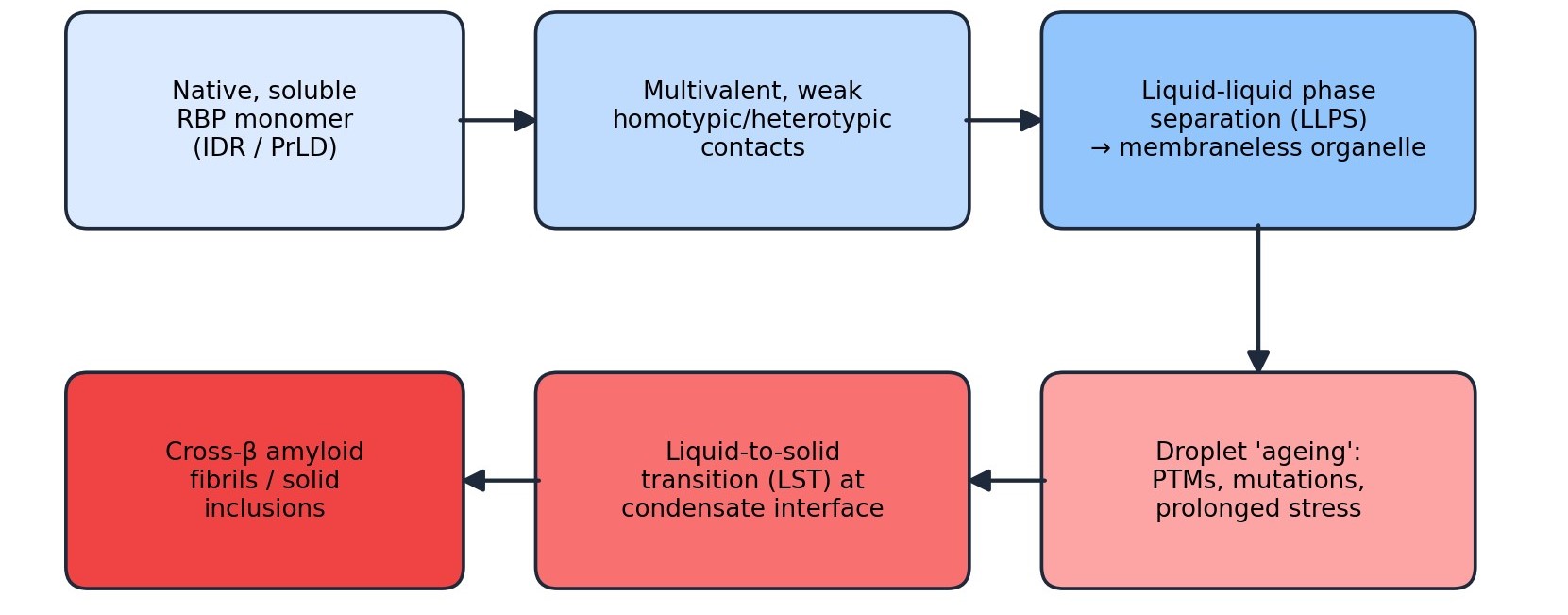
If there is a single unifying feature among the proteins implicated in ALS and FTD, it is probably this: nearly all of them carry substantial stretches of sequence that never fold into a stable tertiary structure. These intrinsically disordered regions (IDRs), sometimes further classified as low-complexity domains (LCDs) or prion-like domains (PrLDs), tend to be compositionally biased-enriched in glycine, serine, proline, and glutamine-and it is precisely this bias that allows them to engage in the kind of weak, transient, but highly multivalent interactions (hydrophobic, electrostatic, cation-π, and π-π stacking) that drive phase separation in the first place (Das et al., 2020; de La Seiglière et al., 2026; Kanekura & Kuroda, 2022; King et al., 2012; Nott et al., 2015). Figure 1 sketches the general trajectory that these domains can follow: from a soluble monomer, through weak multivalent contacts, into a liquid condensate, and-under the wrong circumstances-onward into an irreversible amyloid state. It is worth emphasising that this pathway is not obligatory; most LLPS events resolve back to the soluble state, and pathology arises only when the later, largely one-way steps are engaged (de La Seiglière et al., 2026; Shorter, 2019) (Figure 1).

2.2 TDP-43: A Transient Helix as the Fulcrum of Reversibility

TDP-43's capacity for LLPS is mediated principally by its C-terminal LCD (residues 267-414), and within that domain, a comparatively short and evolutionarily conserved stretch (residues 321-330) does a disproportionate amount of the work. NMR and simulation studies show that this segment folds, transiently and cooperatively, into a hydrophobic α-helix upon self-association, and it is this helix-together with hydrophobic and aromatic residues immediately downstream (331-340)-that forms the primary intermolecular interface stabilising the condensed phase (Conicella et al., 2016). What makes this finding clinically resonant is that several ALS-associated missense mutations-A321G, Q331K, and M337V among them-map directly onto this helical subdomain, and each one disrupts the helix-helix contacts required for reversible LLPS, tilting the equilibrium toward solid, irreversibly aggregated species instead (Conicella et al., 2016). The amyloidogenic pathway downstream of this disruption is further tuned by electrostatics: salt screens the repulsive charges that would otherwise keep the LCD soluble, thereby accelerating fibrillation (Babinchak et al., 2019; Mompeán et al., 2016). Perhaps most tellingly, the droplet environment itself appears to act as a catalyst-cross-β amyloid fibrils have been observed nucleating directly from within mature liquid droplets, rather than forming independently in bulk solution (Babinchak et al., 2019).

2.3 FUS: RNA Recognition and a Tale of Two Mutant Classes

FUS presents a somewhat more intricate picture, shaped by an extensive N-terminal prion-like domain, several arginine/glycine-rich (RGG) motifs, and a C-terminal PY-nuclear localisation signal (de La Seiglière et al., 2026; Kanekura & Kuroda, 2022). Under normal conditions, full-length FUS recognises G-quadruplex structures within specific target mRNAs (PSD-95 and CaMKIIα, for instance), and this recognition nucleates and accelerates FUS LLPS in a shape-dependent manner (Ishiguro et al., 2021). Single-molecule work has since revealed that ALS/FTD-linked FUS mutations do not behave uniformly; instead, they cluster into two biophysically distinct phenotypes (Ghanbari Niaki et al., 2020). Arginine substitutions, such as R244C, disrupt the normal dynamism of RNA binding altogether-the mutant protein essentially locks onto RNA from the moment of first contact, producing large, poorly dynamic condensates. Glycine substitutions, such as G156E, tell a different story: RNA-binding kinetics remain largely intact, yet the resulting condensates age with unusual speed, losing fluidity almost as soon as they form, which implicates glycine specifically as a flexible "spacer" residue that normally preserves condensate liquidity (Ghanbari Niaki et al., 2020). Both defects can, encouragingly, be countered pharmacologically-or at least biologically-by Karyopherin-β2 (Kapβ2), a nuclear import receptor that doubles as a molecular chaperone capable of physically dissolving aberrant FUS condensates and restoring near-wild-type RNA interactions (Ghanbari Niaki et al., 2020; Guo et al., 2018). FUS phase behaviour is additionally sensitive to oxidative modification: glutathionylation of Cys447 within the zinc-finger domain reduces FUS solubility and promotes cytoplasmic aggregation, an effect that glutathione transferase omega can, at least partially, reverse (Cha et al., 2022).

2.4 The C9orf72 Dipeptide Repeat Proteins: Two Distinct Physical Vocabularies

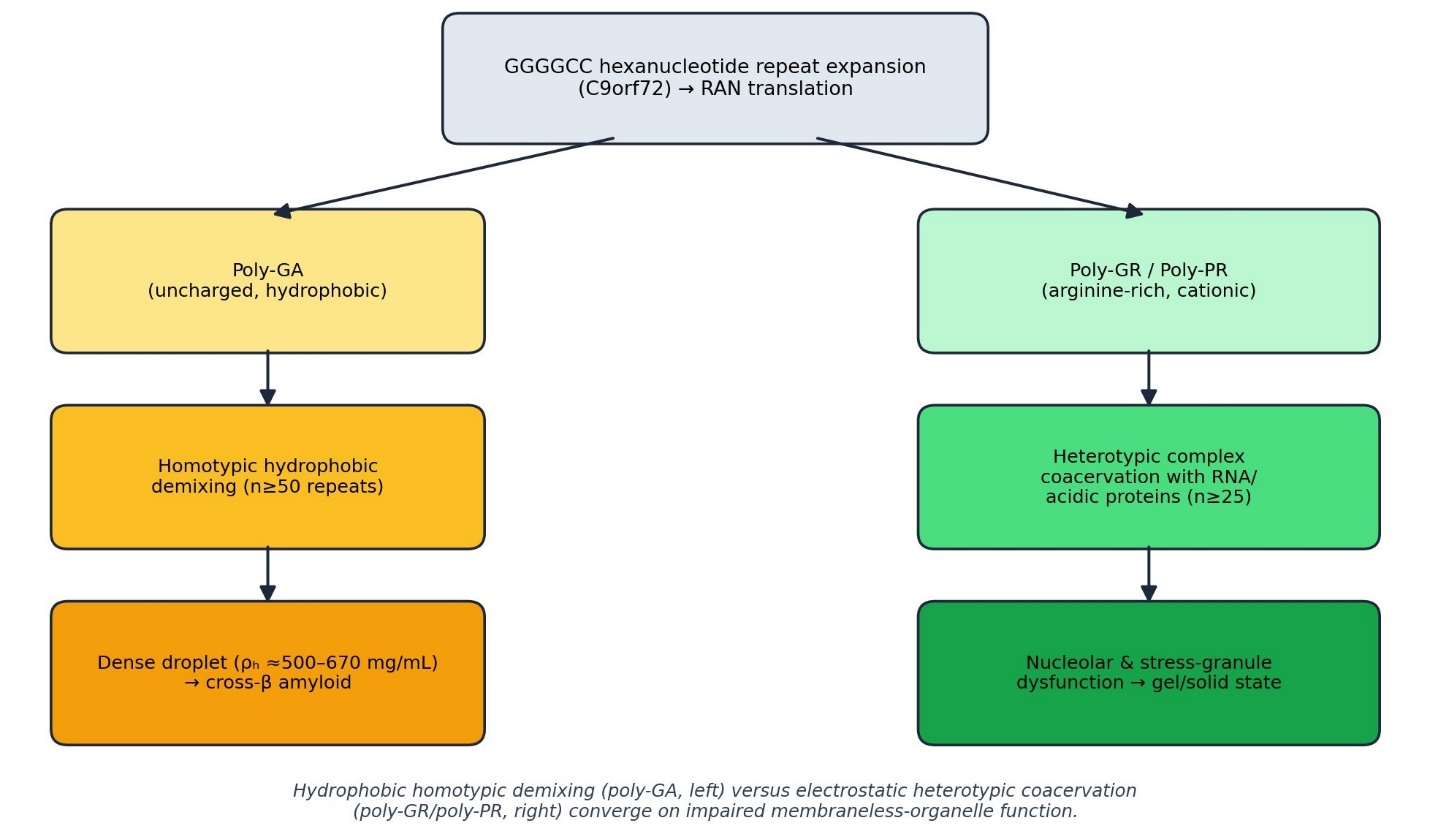
The GGGGCC hexanucleotide repeat expansion in C9orf72 is the single most common genetic cause across the ALS/FTD spectrum, and it drives toxicity through at least two parallel routes: autonomous RNA condensation, and repeat-associated non-ATG (RAN) translation into dipeptide repeat proteins (Fay et al., 2017; Jafarinia et al., 2020). On the RNA side, the expanded transcript folds into stable multimolecular G-quadruplexes that phase separate on their own, sequestering splicing factors into nuclear RNA foci (Alberti et al., 2025; Fay et al., 2017). On the protein side, RAN translation yields five dipeptide species, of which three-poly-GA, poly-GR, and poly-PR-carry substantial toxicity (Gendron et al., 2013; Jafarinia et al., 2020). Coarse-grained molecular dynamics modelling indicates that phase behaviour among these three is strictly length- and concentration-dependent, but-and this is the more interesting part-the underlying physical mechanism diverges sharply depending on amino acid composition (Jafarinia et al., 2020). Poly-GA, uncharged and hydrophobic, undergoes classical homotypic demixing: alanine-driven hydrophobic contacts bring chains close enough together to nucleate short-range hydrogen bonding and, eventually, aggregate formation (Jafarinia et al., 2020). Poly-GR and poly-PR, by contrast, are far too positively charged to phase separate with themselves; their arginine residues repel one another. Instead, they rely on complex coacervation with polyanionic partners-RNA, nucleolar proteins, other acidic tracts-binding stress granules and nucleoli and, in the process, disrupting nucleocytoplasmic transport (Boeynaems et al., 2017; Jafarinia et al., 2020). Figure 2 contrasts these two physical vocabularies side by side, tracing how a shared genetic lesion produces mechanistically distinct downstream pathologies depending simply on which dipeptide is being translated (Figure 2).

2.5 TIA1, UBQLN2, and the Wider Proteostasis Network

The phase-separation story does not end with the primary disease proteins; several quality-control factors modulate-and are themselves modulated by-these transitions. Rare mutations in TIA1 (P362L, A381T, E384K) strengthen homotypic interactions within this stress granule-associated LCD protein, shifting its coexistence curve leftward, delaying stress granule disassembly, and producing poorly dynamic granules that go on to recruit and insolubilise cytoplasmic TDP-43 (Mackenzie et al., 2017). UBQLN2, a proteasomal shuttle factor, undergoes LLPS through its proline-rich (Pxx) region, and ALS-linked mutations in this region (T487I, P497S) lower the concentration threshold required for phase separation while accelerating oligomerisation toward gel-like or solid states (Dao et al., 2019). Here again, however, there is a built-in rescue mechanism: ubiquitin itself preferentially binds the diffuse, monomeric form of UBQLN2, shifting the phase boundary and dissolving both wild-type and mutant aggregates (Dao et al., 2019). Collectively, these findings suggest that the proteostasis network is not a passive bystander to LLPS dysregulation but an active, if imperfect, counterweight to it.

2.6 From Reconstitution to the Neuron: Persistent Gaps and Interfacial Nucleation

For all the mechanistic clarity that in vitro reconstitution has provided, a genuine bottleneck remains in translating these findings to the intact, degenerating neuron. Cell-free assays typically rely on simplified, homotypic mixtures and artificial crowding agents, whereas the real intracellular environment is far messier-extreme macromolecular crowding, spatially restricted chaperone pools, and a dense web of competing heterotypic protein-RNA interactions that no reconstituted system fully captures (de La Seiglière et al., 2026; Kanekura & Kuroda, 2022). A further, more recent complication concerns where, exactly, amyloid nucleation begins. Emerging evidence suggests it

Figure 1. From physiological liquid-liquid phase separation (LLPS) to pathological liquid-to-solid transition (LST). Native, soluble RNA-binding proteins first engage in weak, multivalent contacts that nucleate a reversible liquid condensate (blue path), the physiological basis of membraneless organelles. Under sustained stress, post-translational modification, or disease-linked mutation, these condensates 'age' at the droplet-solvent interface into gel-like and ultimately solid, cross-β amyloid assemblies (red path), the neuropathological hallmark of ALS/FTD.

Figure 2. Divergent biophysical grammar of C9orf72-derived dipeptide-repeat proteins (DPRs). A single hexanucleotide (GGGGCC) repeat expansion, translated via repeat-associated non-ATG (RAN) translation, produces DPRs with two distinct physical logics. Poly-GA (left) is uncharged and hydrophobic, undergoing homotypic demixing above roughly fifty repeats to seed cross-β amyloid. Poly-GR and poly-PR (right) are cationic and instead undergo heterotypic complex coacervation with RNA and acidic nucleolar proteins above roughly twenty-five repeats, disrupting nucleolar and stress-granule function.

is not spatially uniform throughout a condensate but is instead catalytically favoured at the droplet-solvent interface, where the anisotropic, crowded environment appears to lower the energetic barrier to nucleation in ways the droplet interior does not (de La Seiglière et al., 2026; Linsenmeier et al., 2023; Visser et al., 2025). Exactly which cytoplasmic stress pathways, post-translational modifications, and RNA structures regulate this surface-catalysed transition in human motor neurons remains, honestly, an open and actively contested question (de La Seiglière et al., 2026)-one that the remainder of this review.

2.7 Toward Testable Questions: Rationale for the Present Synthesis

Taken together, the preceding sections point to three recurring, unresolved themes that this review-and the synthesis presented in the Results section-attempts to bring into sharper focus. First, how do differences in target RNA structure, particularly G-quadruplex conformation, differentially tune the kinetics of surface-catalysed nucleation for FUS versus TDP-43 under crowding conditions that better approximate the neuronal cytoplasm (de La Seiglière et al., 2026; Ishiguro et al., 2021)? Second, what specific thermodynamic and conformational features at the droplet-solvent interface actually decide whether a given phase-separated RNA-binding protein resolves back to the soluble state or commits irreversibly to the solid phase (Linsenmeier et al., 2023; Visser et al., 2025)? Third, to what extent do competing post-translational modifications-zinc-finger glutathionylation versus arginine methylation, for example-alter the efficiency with which chaperones such as Kapβ2 recognise and dissolve pre-formed condensates (Cha et al., 2022; Gittings et al., 2020; Guo et al., 2018)? These questions are not merely of academic interest. Each maps onto a plausible therapeutic axis-RNA-structure-targeted small molecules, interface-stabilising compounds, and chaperone-enhancing strategies, respectively, and each requires the kind of quantitative, cross-study synthesis that the Methods and Results sections below were designed to provide.

3. Methods

3.1 Overview and Rationale

Because the questions motivating this review span structural biophysics, computational modelling, and cell biology, no single experimental technique could have generated the evidence base required. We therefore adopted a structured, narrative-synthesis methodology-broadly informed by standard systematic-review reporting principles-rather than a single-technique experimental protocol. The intention, in choosing this approach, was to make the search-and-selection process reproducible enough that another investigator, working from the same terms and databases, would arrive at a substantially overlapping evidence set.

3.2 Search Strategy and Databases

We searched PubMed/MEDLINE as the primary bibliographic database, supplemented by Web of Science and Google Scholar for cross-verification, covering records from January 2006 (the year TDP-43 was first identified as the pathological substrate common to ALS and FTD; Neumann et al., 2006) through the most recent indexed literature. Search strings combined disease terms ("amyotrophic lateral sclerosis" OR "ALS" OR "frontotemporal dementia" OR "FTD" OR "C9orf72") with biophysical process terms ("liquid-liquid phase separation" OR "LLPS" OR "biomolecular condensate" OR "membraneless organelle" OR "liquid-to-solid transition" OR "amyloid nucleation") and, where relevant, protein-specific terms ("TDP-43" OR "FUS" OR "dipeptide repeat" OR "TIA1" OR "UBQLN2" OR "MATR3"), combined using standard Boolean operators. MeSH terms were mapped where available to maximise sensitivity.

3.3 Eligibility Criteria

Included sources were peer-reviewed primary research articles, methodologically detailed reviews, and structural or biophysical studies published in English that directly addressed the phase behaviour of ALS/FTD-associated proteins or nucleic acids, whether investigated in vitro (recombinant protein reconstitution), in silico (coarse-grained or atomistic molecular dynamics), or in cellulo (patient-derived or model cell systems). Studies were excluded if they addressed unrelated protein aggregation phenomena without a stated or reasonably inferable connection to ALS/FTD biology, if they were conference abstracts lacking sufficient methodological detail, or if full text could not be retrieved through institutional or open-access channels.

3.4 Study Selection and Data Extraction

Titles and abstracts were first screened for topical relevance, after which full texts of potentially eligible articles were retrieved and assessed against the eligibility criteria above. From each included study, we extracted, where reported: the specific protein or nucleic acid construct under study; experimental or simulation conditions (pH, ionic strength, temperature, crowding agent, and concentration); quantitative phase-behaviour parameters (saturation concentration, critical repeat length, polymer scaling exponent, persistence length, dilute- and dense-phase concentrations); kinetic parameters (fibrillation lag time, droplet fusion rate, fluorescence recovery after photobleaching half-time); and any reported chaperone, post-translational modification, or small-molecule modulator of the phase transition. Extracted data were tabulated (Tables 1-4) to allow direct, side-by-side comparison across constructs and studies, a step that also served as an internal consistency check-values that appeared discordant across sources were flagged and re-verified against the original publication.

3.5 Synthesis Approach

Given the biophysical and methodological heterogeneity across the included studies-ranging from single-molecule spectroscopy to cell-based imaging-a formal meta-analytic pooling of effect sizes was neither appropriate nor attempted. Instead, we performed a structured narrative synthesis, organised around the shared mechanistic themes identified in the Literature Review (sequence determinants, electrostatic tuning, RNA cooperativity, and chaperone-mediated reversal), with quantitative values reported descriptively and cross-referenced to their source study throughout the Results section. Where multiple independent studies reported convergent findings for the same construct (for example, the critical repeat length for poly-GA phase separation), this convergence is explicitly noted as a form of internal validation.

3.6 Reproducibility Considerations

To support reproducibility in line with PubMed-indexed reporting norms, we have specified, for every quantitative parameter reported in the Results and Tables, the originating study and, where available, the specific experimental or computational condition under which it was obtained. Readers seeking to replicate the coarse-grained molecular dynamics findings summarised here are directed to the one-bead-per-amino-acid (1BPA) simulation framework described by Jafarinia et al. (2020); readers seeking to replicate the NMR and turbidity-based reconstitution findings for TDP-43 are directed to the protocols described by Conicella et al. (2016) and Babinchak et al. (2019). No new primary experimental or simulation data were generated for this synthesis; all reported values are drawn directly from, and attributable to, the cited primary literature.

4. The Biophysical Grammar of Pathological Phase Transitions in ALS/FTD

4.1 Overview

Pulling together the quantitative parameters extracted across the included studies, a reasonably coherent picture emerges of how physiological LLPS tips into pathological, solid-state aggregation across the five protein systems considered here. What follows synthesises those parameters-condensed into Tables 1 through 4 and Figures 3 and 4-while trying not to lose sight of the biological story each number is actually telling (de La Seiglière et al., 2026; Shorter, 2019) (Table 1; Table 2; Table 3; Table 4).

4.2 Polymer Scaling Laws and Coacervation Thresholds of RAN-Translated Dipeptide Repeat Proteins

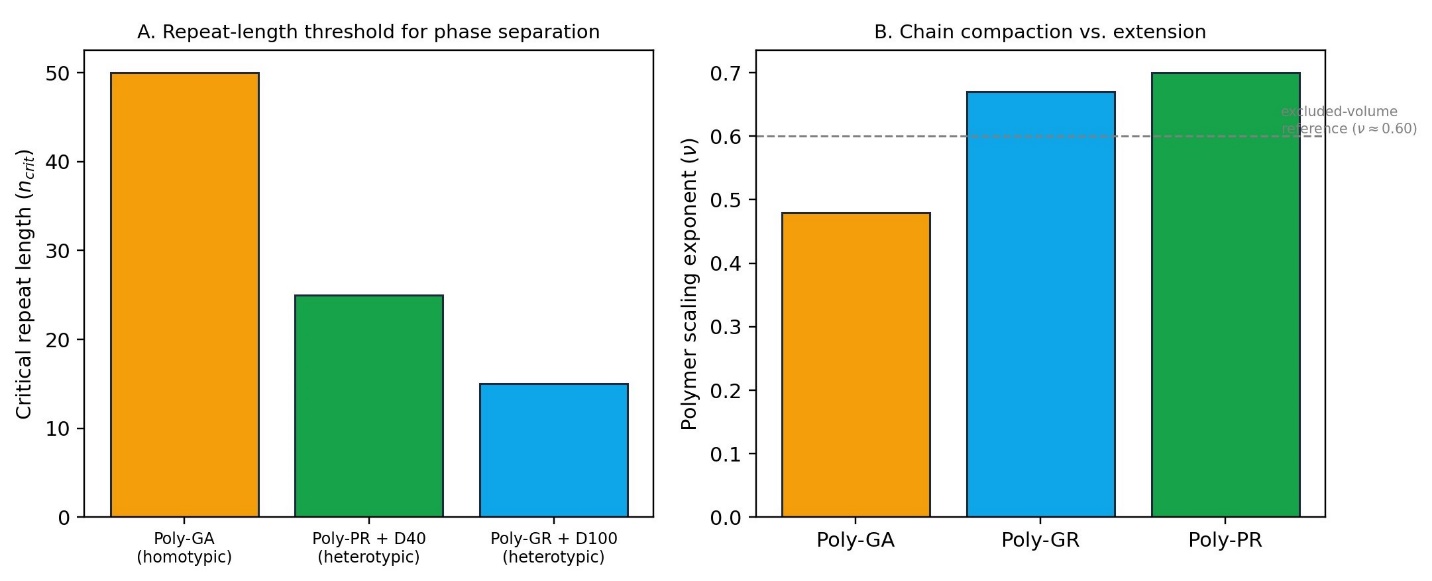
Coarse-grained molecular dynamics, calibrated against experimentally derived polymer behaviour, indicates that the single-molecule conformation of each dipeptide repeat protein (DPR) tracks quite closely with its amino acid composition (Jafarinia et al., 2020). At matched chain length, the three toxic DPRs order themselves, in terms of spatial extension, as poly-PR > poly-GR > poly-GA-a ranking driven largely by electrostatic self-repulsion in the arginine-rich species and by hydrophobic collapse in poly-GA (Jafarinia et al., 2020). Quantitatively, poly-PR displays a polymer scaling exponent of ν = 0.70 ± 0.02 and poly-GR of ν = 0.67 ± 0.02, both above the ν ≈ 0.60 expected for a standard excluded-volume chain, whereas poly-GA sits at ν = 0.48 ± 0.02, close to the theta-solvent value expected of a compact random coil (Hofmann et al., 2012; Jafarinia et al., 2020) (Figure 3; Table 1).

Notably, this dimensional difference between poly-PR and poly-GR cannot be attributed to electrostatics alone, since proline is, if anything, the more hydrophobic of the two residues being substituted. Simulations that computationally swap the hydrophobicities of glycine and proline while holding charge constant show that it is backbone stiffness, not chemistry per se, that dominates: proline's cyclic side chain imposes a persistence length of 5.04 bond lengths, versus 2.06 bond lengths for the far more flexible glycine-containing poly-GR (Jafarinia et al., 2020).

These conformational differences translate directly into distinct phase-separation thresholds. Poly-GA, being uncharged, undergoes purely homotypic LLPS driven by long-range hydrophobic attraction, but only once repeat length exceeds n = 50; below that cutoff, no amount of concentration appears sufficient to trigger demixing (Jafarinia et al., 2020). Within the 60 ≤ n ≤ 100 range, the dilute-phase concentration spans roughly 6-33 mg/mL while the dense phase reaches an extraordinary 500-670 mg/mL-densities high enough, evidently, to bring GA chains into the kind of close proximity needed to nucleate short-range hydrogen bonding and, from there, cross-β amyloid structure (Jafarinia et al., 2020) (Table 1). This n = 50 threshold sits remarkably close to the experimentally observed range of 46-61 repeats required for cytoplasmic poly-GA aggregation in Neuro2a cells, which is reassuring, in the sense that a purely computational prediction converges so tightly with cell-based data (Jafarinia et al., 2020).

Poly-GR and poly-PR, by contrast, simply cannot phase separate with themselves-their mutual electrostatic repulsion is too strong-so instead they rely on heterotypic complex coacervation with polyanionic partners such as RNA or acidic nucleolar proteins (Jafarinia et al., 2020). For poly-PR interacting with a physiologically representative polyaspartate model (D40), the minimum repeat length required to trigger coacervation is n = 25, at an optimal stoichiometry of rPR = 0.62 (Jafarinia et al., 2020). This threshold aligns closely with the roughly 30-repeat clinical toxicity boundary observed in patient-derived cells, suggesting that the acquisition of coacervation capacity is itself a meaningful step in pathogenesis, not merely a laboratory curiosity (Jafarinia et al., 2020) (Figure 3; Table 1). Because poly-GR's more flexible backbone allows it to conform more readily around anionic partners, it binds acidic targets like nucleolin and NPM1 more tightly than the stiffer poly-PR, which in turn helps explain why poly-GR appears especially effective at displacing native nucleolar proteins and driving nucleolar stress in patient cells (Jafarinia et al., 2020; Lee et al., 2016; White et al., 2019).

4.3 Structural Elements and Electrostatic Control of TDP-43 Phase Transitions

TDP-43-the protein found in cytoplasmic inclusions across the large majority of ALS cases and roughly half of FTD cases-relies for its LLPS behaviour on a short, conserved, and otherwise unremarkable-looking stretch of its C-terminal LCD (residues 319-341) that folds transiently into an α-helix populating around 50% of the monomeric structural ensemble (Babinchak et al., 2019; Conicella et al., 2016; de La Seiglière et al., 2026) (Table 2). This helix functions, in effect, as a molecular "sticker": initial contact between two helices stabilises and extends the folded structure across residues 321-340, and it is this folding-upon-assembly behaviour that underpins physiological LLPS (Conicella et al., 2016).

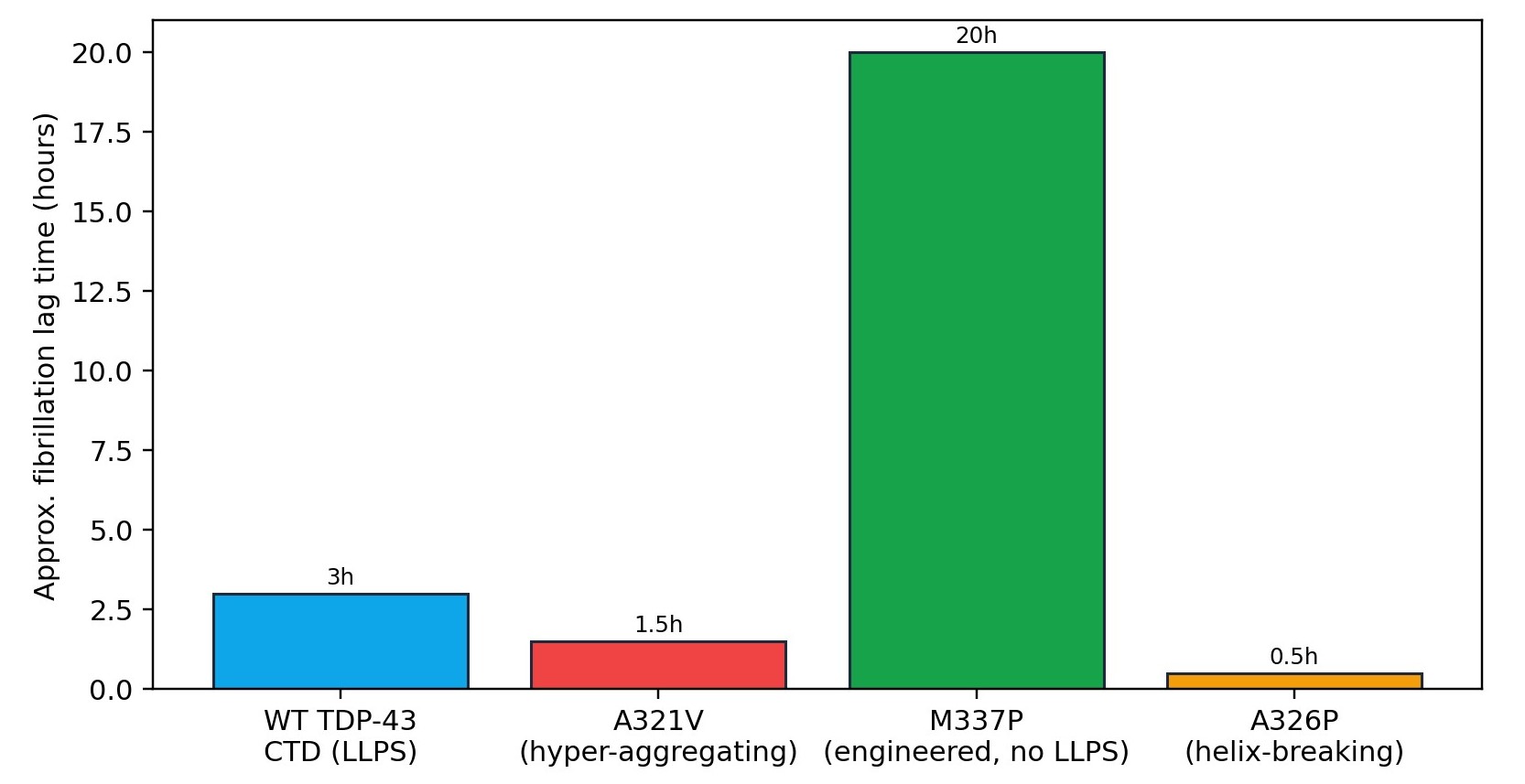
The mutational landscape mapped onto this helix is informative precisely because it segregates into distinct functional classes. Destabilising mutations-A321G and Q331K-break the cooperative helix outright and abolish LLPS entirely in vitro; M337V reduces salt-dependent turbidity by roughly half (Conicella et al., 2016). Engineered helix-breaking substitutions, A326P and M337P, likewise eliminate phase separation, even though M337P still permits monomeric helicity, which tells us that helix formation alone is not sufficient-the specific hydrophobic contact interface matters too (Conicella et al., 2016). Perhaps most instructive, though, is A321V, which increases local hydrophobicity, strengthens the initial LLPS driving force, and yet accelerates the transition toward irregular, solid-state, detergent-insoluble aggregates that fail to fuse-a reminder that more phase separation is not necessarily protective, and can in fact be actively harmful (Conicella et al., 2016) (Table 2).

Electrostatics exert a second, largely independent layer of control. At acidic pH the LCD carries substantial net positive charge and remains monomeric and soluble; as pH rises toward physiological values, or as ionic strength increases, this repulsive charge is screened, permitting the hydrophobic helices to associate and condense (Babinchak et al., 2019). Once formed, these droplets behave as thermodynamic accelerators of amyloid formation: under non-LLPS conditions the LCD fibrillates slowly, with a lag phase of 10-15 hours, but under LLPS-permissive conditions this lag collapses to roughly 1-3 hours (Babinchak et al., 2019) (Figure 4; Table 2). Consistent with the interfacial-nucleation hypothesis introduced in the Literature Review, high-resolution imaging indicates that fibrils preferentially emerge from the droplet-solvent interface rather than distributing uniformly throughout the dense phase (de La Seiglière et al., 2026).

Table 1. Comparative biophysical and polymer-scaling properties of ALS/FTD-related C9orf72 dipeptide-repeat proteins (DPRs). This table summarises the charge state, critical repeat length required for phase separation, polymer scaling exponent (ν), backbone persistence length, and primary cellular target for each dipeptide-repeat species and comparator polymer discussed in the Results (Section 4.2). Values are drawn from coarse-grained one-bead-per-amino-acid (1BPA) molecular dynamics simulations and complementary biophysical studies (Hofmann et al., 2012; Jafarinia et al., 2020; Ryan et al., 2018). Rows are grouped by mechanism: homotypic hydrophobic demixing (poly-GA), heterotypic electrostatic coacervation (poly-PR, poly-GR and their polyanion complexes), non-phase-separating comparators (poly-GP, poly-PA), and theoretical/experimental controls.

Construct

Charge / Drive

Critical length (n)

Scaling exponent (ν)

Persistence length

Primary target / mechanism

Poly-PR (monomeric)

Highly cationic; electrostatic repulsion

Cannot self phase-separate

0.70 ± 0.02

5.04 bond lengths (rigid)

Sequesters nucleolin/NPM1; blocks nuclear import

Poly-PR + poly-D40

Charge-neutralised coacervate

n≈25 (optimal r=0.62)

≈0.45–0.50 (condensed)

5.04 (restricts packing)

Coacervation mimicking nucleolar acidic tracts

Poly-PR + poly-D100

Long-range coacervation

n<20

≈0.40–0.45

5.04 (high stiffness)

Highly stable, low-exchange coacervates

Poly-GR (monomeric)

Highly cationic

Cannot self phase-separate

0.67 ± 0.02

2.06 bond lengths (flexible)

Binds stress-granule and nucleolar proteins

Poly-GR + poly-D100

Charge-neutralised coacervate

n<20 (lower than poly-PR)

≈0.38–0.42 (denser)

2.06 (flexible)

Stronger target binding; denser condensate

Poly-GA (self-association)

Uncharged; hydrophobic

n = 50 (homotypic threshold)

0.48 ± 0.02

Flexible glycine backbone

Self-assembles into cytoplasmic aggregates; impairs TDP-43 import

Poly-GP

Uncharged; rigid loops

No phase separation observed

≈0.55–0.60

Semi-rigid (proline loops)

Minimal cellular toxicity

Poly-PA

Uncharged; hydrophobic

No phase separation observed

≈0.52–0.58

Semi-rigid

Minimal cellular toxicity

hnRNPA2-LC (comparator)

Asymmetric charge; Gly/aromatic-rich

N=151; homotypic LLPS

≈0.53

Moderately flexible

Aromatic/polar sticker-mediated LLPS

Excluded-volume chain (theoretical)

Self-avoiding; no attraction

No phase separation (infinite solubility)

≈0.60 (good-solvent limit)

Standard random coil

Mathematical reference polymer

Table 2. Thermodynamic, kinetic, and structural parameters of the TDP-43 low-complexity domain (LCD) across environmental conditions and ALS-associated mutations. This table compares hydrodynamic radius/oligomeric state, phase-separation propensity, and fibrillation lag time for wild-type TDP-43 constructs across pH, salt, and crowding conditions, alongside representative ALS-associated and engineered mutants discussed in Section 4.3. Data are drawn from turbidity assays, dynamic light scattering, EPR spin-labelling, and solution NMR (Babinchak et al., 2019; Conicella et al., 2016). Shorter fibrillation lag times indicate accelerated amyloid nucleation under LLPS-permissive conditions.

Construct / condition

pH / salt

Hydrodynamic state

Phase-separation propensity

Fibrillation lag time

WT LCD, monomeric

pH 4.0; 0 mM NaCl

Rh ≈ 2.1 nm; monomeric

None

No fibrillation (>30 h)

WT LCD, oligomeric

pH 4.0; 150 mM NaCl

Bimodal (multimer + oligomer)

None (no macroscopic phase)

No fibrillation (>30 h)

WT LCD, LLPS state

pH 6.0; 150 mM NaCl

Droplet phase (light scattering)

Moderate

Reduced to ~10–15 h

WT LCD, crowded/neutral

pH 7.3; 150 mM NaCl + 10% PEG

Phase-separated liquid droplets

Robust

Rapid (~2–4 h)

WT CTD, dynamic NMR

pH 6.1; 150 mM NaCl

Reversible liquid droplets

Stable, dynamic

Hydrogel maturation by 24 h

A321G (ALS)

pH 6.1; 150 mM NaCl

Monomeric (disrupted helix)

Abolished

Direct solid aggregation

Q331K (ALS)

pH 6.1; 150 mM NaCl

Monomeric (disrupted helix)

Abolished

Direct solid aggregation

A321V (ALS)

pH 6.1; 150 mM NaCl

Increased helical content

Increased

Fast aggregation into fibrils

M337P (engineered)

pH 6.1; 150 mM NaCl

Monomeric helix retained

Abolished

Retarded fibrillation

A326P (engineered)

pH 6.1; 150 mM NaCl

Helix broken (proline)

Abolished

Severe direct solid aggregation

S48E (phosphomimetic NTD)

pH 6.0; 150 mM NaCl

Purely monomeric

Abolished

Extremely slow aggregation

4.4 RNA Cooperativity, Mutational Mechanics, and Chaperone-Mediated Disassembly

FUS-RNA interactions display a length-dependent stoichiometry, with monomeric FUS engaging single-stranded RNA through a bipartite, two-step binding mode, and FUS multimers forming small, fluid, reversible ribonucleoprotein coacervates with longer transcripts (Ghanbari Niaki et al., 2020) (Table 3). ALS-linked mutations split cleanly into two mechanistic subclasses. Arginine mutants (R216C, R244C, R514G, R521C/G) abolish the dynamic, multimer-dependent RNA-binding mode, locking the protein into static RNA contacts that seed large, poorly dynamic condensates. Glycine mutants (G156E, G187S, G225V, G230C, G399V) preserve near-normal RNA-binding kinetics but lose backbone flexibility, accelerating gelation and fluidity loss within minutes of initial phase separation (Ghanbari Niaki et al., 2020) (Table 3). G-quadruplex RNA binding further accelerates FUS's liquid-to-solid transition, generating rigid, hexanediol-resistant aggregates, and clinically relevant mutations divide again into loss-of-function (diminished G4 binding; P18S, R521C) and gain-of-toxicity (unregulated aggregation; R383C, P525L) categories (Ishiguro et al., 2021).

UBQLN2 tells a broadly parallel story through its proline-rich (Pxx) domain. ALS-linked substitutions there (T487I, P497L/H/S, P506S/T/A) shift the native monomer-oligomer equilibrium toward higher-order assemblies even at low micromolar concentrations, lowering the saturation concentration required for LLPS and producing viscoelastic, solid-like condensates with markedly reduced fusion kinetics (Dao et al., 2019) (Table 3). Encouragingly, two independent rescue mechanisms have been identified across these systems: ubiquitin, added at a simple 1:1 stoichiometry, completely disassembles both wild-type and mutant UBQLN2 condensates by disrupting UBA-Pxx multivalency (Dao et al., 2018), while Karyopherin-β2 performs an analogous role for FUS, binding the PY-NLS domain to dissolve condensates and restore near-native RNA interaction dynamics (Ghanbari Niaki et al., 2020; Guo et al., 2018). MATR3, a more recently characterised intrinsically disordered RNA-binding protein, forms distinct nanoscale spherical and wormlike assemblies whose reversibility is likewise governed by multivalent and RNA-dependent interactions, with disease mutations shifting these assemblies toward less reversible states (Sprunger et al., 2025) (Table 3).

4.5 Native Cellular Oligomers and Stress-Dependent Divergence Between FUS and TDP-43

In vitro reconstitution necessarily simplifies a considerably messier cellular reality, and single-molecule pulldown experiments performed directly in neuroblastoma cells help close that gap. Wild-type FUS exists predominantly as a monomer or dimer under resting conditions, but ALS-linked arginine and glycine mutants show elevated basal oligomerisation, with the most severe NLS mutants (R495X, P525L) forming stable four-to-six-subunit multimers that resist dissolution by high salt, hexanediol, RNase A, or even Karyopherin-β2, yielding only to harsh denaturants such as 8 M guanidine hydrochloride (Table 3). This resistance suggests these are not ordinary liquid condensates at all, but pre-formed, amyloid-like nuclei already present in the resting cytoplasm.

Hyperosmotic stress reveals a further, and arguably more clinically relevant, divergence between FUS and TDP-43. Both proteins undergo reversible nuclear LLPS in response to acute crowding, but their downstream trajectories differ sharply: FUS droplets recruit an active Hsp70/Hdj2/DnaJC7 chaperone network that maintains liquidity and permits rapid, complete disassembly once stress resolves, whereas TDP-43 droplets fail to recruit this same chaperone machinery and, under sustained stress, undergo an essentially irreversible liquid-to-solid transition (Mackenzie et al., 2017) (Table 4). This asymmetry-one protein protected by an active chaperone response, the other left comparatively exposed-may go some way toward explaining why TDP-43 nuclear depletion and cytoplasmic mislocalisation are such consistent features of ALS/FTD neuropathology, even though FUS is subject to broadly similar stress exposure in the same cells (Mackenzie et al., 2017) (Table 4).

5. Reconciling Divergent Biophysical Grammars into a Shared Therapeutic Roadmap

5.1 A Common Thermodynamic Logic Beneath Superficially Different Proteins

Stepping back from the individual protein systems, what stands out most is not their differences-considerable as those are-but the underlying logic they seem to share. TDP-43, FUS, the C9orf72 dipeptides, TIA1, and UBQLN2 each rely on weak, multivalent, low-affinity interactions to establish a reversible condensed phase, and in each case, disease-associated mutations act by tipping the balance of that same thermodynamic equilibrium, whether toward

Table 3. Biophysical profiles and phase behaviour of FUS, UBQLN2, and MATR3 wild-type and disease-linked mutant systems. This table compares mutation site, saturation concentration, condensate fluidity, and the chaperone or ligand capable of rescuing aberrant phase behaviour for FUS, UBQLN2, and MATR3 wild-type and mutant constructs discussed in Section 4.4 (Dao et al., 2019; Ghanbari Niaki et al., 2020; Sprunger et al., 2025). Rescue modulators indicate the physiological factor shown experimentally to dissolve or reverse pathological condensates for each system.

Protein / mutant

Mutation site

Saturation concentration

Condensate fluidity

Rescue modulator

Pathological consequence

Wild-type FUS

PrLD + basic C-terminus

Moderate (~1–2 µM)

Highly fluid; rapid fusion

Karyopherin-β2

Normal transcription/splicing

FUS arginine mutants

e.g., R244C, R216C

Substantially lowered

Diminished; large aberrant condensates

Partial rescue by Karyopherin-β2

Impaired splicing; cytoplasmic aggregates

FUS glycine mutants

e.g., G156E, G187S

Comparable to WT

Extremely rapid aging; loss of fluidity

Poorly rescued (resists Kapβ2)

Accelerated solid transition

FUS NLS mutants

P525L, R495X

Normal in vitro

Fluid in vitro; forms normal condensates

Fully dissolved by Kapβ2 in vitro

Severe nuclear import defect in cells

Wild-type UBQLN2

Proline-rich (Pxx) domain

~100 µM range

Reversible, dynamic droplets

Ubiquitin (1:1)

Maintains proteasomal shuttling

UBQLN2 hydrophobic Pxx mutants

T487I, P497L

Significantly decreased

Slower fusion; viscoelastic/gelled

Fully disassembled by ubiquitin

Impaired proteasomal clearance

UBQLN2 polar Pxx mutants

P506S, P509S, P525S

Minimally perturbed

Reversible, WT-like

Ubiquitin

Minimal pathological effect

Wild-type MATR3

Intrinsically disordered RRM protein

Sharp concentration-dependent transition

Highly dynamic, reversible

Reversible assembly/disassembly

Underpins nuclear RNA splicing homeostasis

MATR3 IDR/RRM mutants

F115C, P154S, T622A

Significantly increased threshold

Less fluid; slower maturation

Decreased reversibility

Promotes pathological nuclear aggregation

Table 4. Cellular dynamics, stress responsiveness, and condensation profiles of FUS, TDP-43, TIA1, and C9orf72 repeat RNA under physiological and pathological stress. This table synthesises in vivo assembly thresholds, disassembly kinetics, chaperone recruitment, and cellular-viability outcomes for endogenous FUS, TDP-43, TIA1, and repeat RNA condensates under hyperosmotic, oxidative, and repeat-expansion stress, as discussed in Section 4.5 (Fay et al., 2017; Gao et al., 2022; Mackenzie et al., 2017). Comparisons highlight the differential chaperone recruitment that distinguishes reversible FUS condensates from the comparatively chaperone-deficient and stress-vulnerable TDP-43 condensates.

Condensate model

Stressor

Assembly / disassembly kinetics

Chaperone partition

Cellular outcome

Endogenous FUS (weaker stress)

0.15 M NaCl

Rapid LLPS; fully reversible within minutes

Co-localises with Hsp40 (Hdj2/DnaJC7/Hsp70)

High viability (≥95%)

Endogenous FUS (stronger stress)

0.5 M NaCl

Rapid nuclear LLPS; fully reversible

Co-localises with Hsp40 chaperones

Moderated viability drop (~80%)

Endogenous TDP-43 (weaker stress)

0.15 M NaCl

Rapid LLPS; partially reversible, delayed disassembly

Fails to recruit Hsp40 chaperones

High viability (≥95%)

Endogenous TDP-43 (stronger stress)

0.5 M NaCl

Nuclear LLPS; severely impaired reversibility

Fails to recruit Hsp40; leads to aging

Significant viability drop (~70%)

Overexpressed TDP-43 (prolonged stress)

0.3 M NaCl, 180 min

Massive granules; reversibility <35% after washout

Blocked from chaperone recruitment

Severe cytotoxicity (~58% viability)

Wild-type TIA1 (stress granules)

Sodium arsenite / heat

Rapid, reversible LLPS; SGs disassemble on stress removal

Recruits Hsp70/Hsp40

Benign, physiological stress response

Disease-mutant TIA1

e.g., P362L, A381T

Enhanced LLPS; poorly dynamic, persistent SGs

Traps chaperones; slower FRAP recovery

Progressive TDP-43 aggregation; cell death

Hexanucleotide GGGGCC RNA

Transfection / in vitro lysate

Rapid phase transition; forms nuclear/cytoplasmic foci

Overlaps with G3BP1, eIF3b, RPL24

RNA-protein condensation; sequesters RBPs

Extended repeat RNA (75x)

Elevated transcript levels

Enhanced, highly stable foci

Recruits TIAR and Ataxin-2

Pathogenic RBP sequestration; cell death

FUS + glutathionylation

Oxidative stress

Accelerated LLPS and aggregation

Bypasses chaperone-mediated maintenance

Enhanced cytoplasmic aggregation, neurotoxicity

premature solidification (TDP-43 A321V; Conicella et al., 2016), toward static, non-dynamic binding (FUS arginine mutants; Ghanbari Niaki et al., 2020), or toward lowered saturation thresholds and accelerated oligomerisation (UBQLN2 Pxx mutants; Dao et al., 2019) (Table 2; Table 3). This convergence is, arguably, the single most therapeutically useful finding to emerge from the biophysics literature over the past decade, because it implies that interventions need not be bespoke to each protein-strategies that stabilise the liquid state, or that restore chaperone-mediated dissolution, could plausibly generalise across the ALS/FTD spectrum rather than requiring a separate drug for every genetic subtype.

5.2 The Interface as an Emerging, and Perhaps Underappreciated, Drug Target

One theme that recurred across several of the systems reviewed here-TDP-43 in particular, but plausibly FUS as well-is that amyloid nucleation does not occur uniformly throughout a condensate; it is concentrated at the droplet-solvent interface (de La Seiglière et al., 2026; Linsenmeier et al., 2023; Visser et al., 2025). If that is correct, and the evidence assembled in the Results section (Figure 4; Table 2) is reasonably consistent with it, then the interface itself becomes a distinct and somewhat underexplored pharmacological target-conceptually separable from either the soluble monomer or the mature aggregate, which are the two states most drug discovery programmes have historically focused on. Small molecules or peptides designed to alter interfacial tension, hydration, or curvature might, in principle, suppress nucleation without necessarily dissolving the condensate altogether, which could be an important distinction given that complete dissolution of physiological membraneless organelles is presumably not a therapeutically desirable outcome in its own right.

5.3 Chaperones and Post-Translational Modification as Two Sides of the Same Rescue Strategy

Across nearly every system reviewed, a rescue mechanism of some kind has been identified-ubiquitin for UBQLN2, Karyopherin-β2 for FUS, glutathione transferase omega for oxidatively modified FUS, and arginine methylation for the arginine-rich DPRs (Cha et al., 2022; Dao et al., 2019; Gittings et al., 2020; Guo et al., 2018) (Table 3; Table 4). What is striking, on reflection, is how these mechanisms cluster into really just two conceptual categories: charge neutralisation (methylation, glutathionylation reversal) and chaperone-mediated multivalency disruption (ubiquitin, Karyopherin-β2). This is encouraging from a drug-development standpoint, since it suggests that a comparatively small number of pharmacological strategies-enhancing PRMT activity in a targeted fashion, or boosting Kapβ2 expression or activity in vulnerable motor neurons-might address multiple disease-relevant proteins simultaneously, rather than requiring an entirely separate mechanism for each one.

5.4 Limitations, Persistent Uncertainties, and the Reconstitution-to-Neuron Gap

None of this should be read as more settled than it is. Much of the quantitative data synthesised here-critical repeat lengths, saturation concentrations, scaling exponents-derives from cell-free reconstitution or coarse-grained simulation, and the single-molecule pulldown data reviewed in Section 4.5 make clear that native cellular oligomers can behave quite differently from anything observed in a test tube (Table 3; Table 4). It remains genuinely unclear, for instance, whether the interfacial nucleation mechanism proposed for TDP-43 in vitro operates identically within the crowded, chaperone-rich, and spatially compartmentalised environment of an actual motor neuron, and it is entirely possible that additional, as-yet-uncharacterised cellular factors modulate this process in ways the current literature simply has not captured (de La Seiglière et al., 2026). Similarly, most of the DPR coacervation data reviewed here (Table 1) rely on simplified polyanionic model partners such as polyaspartate, which, while a reasonable approximation of acidic nucleolar tracts, is unlikely to fully recapitulate the structural specificity of genuine interactions with nucleolin or NPM1.

5.5 Toward the Next Generation of Mechanistic and Therapeutic Studies

Given these gaps, the most productive next steps probably lie in bridging exactly the divide identified above: applying the super-resolution and single-molecule imaging approaches that have already proven informative for FUS oligomer detection (Table 3) to TDP-43 and the C9orf72 dipeptides directly within iPSC-derived or patient motor neurons, ideally under conditions that combine physiological crowding with real cellular stressors rather than artificial PEG-based surrogates. Equally, testing whether Kapβ2 overexpression or PRMT-targeted methylation strategies can rescue phase behaviour

Figure 3. Length- and sequence-dependent phase behaviour of C9orf72 dipeptide-repeat proteins. (A) Critical repeat length required for phase separation is markedly lower for the heterotypically coacervating, arginine-rich species (poly-PR, poly-GR) than for the homotypically demixing poly-GA. (B) Polymer scaling exponents (ν) show that arginine-rich DPRs adopt extended chain conformations (ν > 0.60) driven by electrostatic self-repulsion, whereas poly-GA remains compact (ν ≈ 0.48), consistent with hydrophobic collapse. Values summarised from Jafarinia et al. (2020) .

Figure 4. Mutation-dependent shifts in TDP-43 low-complexity domain (LCD) fibrillation kinetics under LLPS-permissive conditions. Wild-type TDP-43 CTD fibrillates rapidly once phase-separated; the hyper-aggregating A321V and helix-breaking A326P variants further shorten the lag phase, while the engineered M337P variant, which retains monomeric helicity but cannot self-associate, markedly delays fibrillation. Values summarised qualitatively from Babinchak et al. (2019) and Conicella et al. (2016).

specifically in a neuronal, rather than purely biochemical, context would represent a meaningful and fairly direct translational step forward from the biophysical groundwork reviewed here.

6. Conclusion

Taken as a whole, the evidence synthesised in this review supports liquid-liquid phase separation as a genuinely unifying-if still incompletely understood-mechanism connecting the genetics, cell biology, and neuropathology of ALS and FTD. Rather than arising directly from folded, native proteins, the pathological inclusions that define this disease spectrum appear to pass through an intermediate, biophysically reversible condensed state before committing to solid, amyloid-like structure. What differs across proteins is not whether this general sequence occurs, but the specific molecular grammar governing it: TDP-43 depends on a transient α-helical "sticker," FUS bifurcates according to arginine- versus glycine-substitution class, and the C9orf72 dipeptides split further still into hydrophobic homotypic demixing (poly-GA) and electrostatic heterotypic coacervation (poly-GR, poly-PR). Despite this diversity, recurring themes-interfacial nucleation, chaperone-mediated reversal, and charge-dependent regulation-suggest that a relatively focused set of therapeutic strategies could, in principle, address multiple disease-relevant proteins at once. The persistent gap between cell-free reconstitution and the intact neuron remains the field's most pressing limitation, and closing it, through native-context imaging and physiologically realistic stress paradigms, represents the clearest path toward translating this biophysical framework into disease-modifying therapy for ALS and FTD.

References


Alberti, C., Beckers, L., Boevin, M., Pfister, V., Gaucherot, A., Ruffenach, F., & Sellier, C. (2025). Autophagy-lysosome dysfunction and bidirectional RAN translation in C9orf72-associated ALS/FTD. Neurobiology of Disease, 217, 107192. https://doi.org/10.1016/j.nbd.2025.107192              

Alberti, S., Gladfelter, A., & Mittag, T. (2019). Considerations and challenges in studying liquid-liquid phase separation and biomolecular condensates. Cell, 176(3), 419–434. https://doi.org/10.1016/j.cell.2018.12.035      

Alberti, S., & Hyman, A. A. (2021). Biomolecular condensates at the nexus of cellular stress, protein aggregation disease and ageing. Nature Reviews Molecular Cell Biology, 22(3), 196–213. https://doi.org/10.1038/s41580-020-00326-6      

Alshareedah, I., Kaur, T., Ngo, J., Seppala, H., Kounatse, L. D., Wang, W., Moosa, M. M., & Banerjee, P. R. (2019). Interplay between short-range attraction and long-range repulsion controls reentrant liquid condensation of ribonucleoprotein-RNA complexes. Journal of the American Chemical Society, 141(37), 14593–14602. https://doi.org/10.1021/jacs.1c14593  

Arai, T., Hasegawa, M., Akiyama, H., Ikeda, K., Nonaka, T., Mori, H., Mann, D., Tsuchiya, K., Yoshida, M., Hashizume, Y., & others. (2006). TDP-43 is a component of ubiquitin-positive tau-negative inclusions in frontotemporal lobar degeneration and amyotrophic lateral sclerosis. Biochemical and Biophysical Research Communications, 351(3), 602–611. https://doi.org/10.1016/j.bbrc.2006.02.049               

Asadi, M., Ivanov, P., & Wolozin, B. (2021). Stress granules in neurodegeneration: Core mechanisms and therapeutic targets. Frontiers in Cellular Neuroscience, 15, 664151. https://doi.org/10.3389/fncel.2021.664151           

Babazadeh, A., Rayner, S. L., Lee, A., & Chung, R. S. (2023). TDP-43 as a therapeutic target in neurodegenerative diseases: Focusing on motor neuron disease and frontotemporal dementia. Ageing Research Reviews, 92, 102085. https://doi.org/10.1016/j.arr.2023.102085

Babinchak, W. M., Haider, R., Dumm, B. K., Sarkar, P., Surewicz, K., Choi, J.-K., & Surewicz, W. K. (2019). The role of liquid–liquid phase separation in aggregation of the TDP-43 low-complexity domain. Journal of Biological Chemistry, 294(16), 6279–6289. https://doi.org/10.1074/jbc.RA118.007222

Boeynaems, S., Bogaert, E., Kovacs, D., Konijnenberg, A., Timmerman, E., Volkov, A., Guharoy, M., De Decker, M., Jaspers, T., Ryan, V. H., Janke, A. M., Baatsen, P., Vercruysse, T., Kolaitis, R. M., Daelemans, D., Taylor, J. P., Kedersha, N., Anderson, P., Impens, F., … Van Den Bosch, L. (2017). Phase separation of C9orf72 dipeptide repeats perturbs stress granule dynamics. Molecular Cell, 65(6), 1044–1055. https://doi.org/10.1016/j.molcel.2017.02.013

Brangwynne, C. P., Eckmann, C. R., Courson, D. S., Rybarska, A., Hoege, C., Gharakhani, J., Jülicher, F., & Hyman, A. A. (2009). Germline P granules are liquid droplets that localize by controlled dissolution/condensation. Science, 324(5935), 1729–1732. https://doi.org/10.1126/science.1172046  

Cha, S. J., Lee, S., Choi, H.-J., Han, Y. J., Jeon, Y.-M., Jo, M., & Kim, K. (2022). Therapeutic modulation of GSTO activity rescues FUS-associated neurotoxicity via deglutathionylation in ALS disease models. Developmental Cell, 57(6), 783–798. https://doi.org/10.1016/j.devcel.2022.02.022           

Chang, Y. J., Jeng, U. S., Chen, Y. R., & others. (2016). The glycine-alanine dipeptide repeat from C9orf72 hexanucleotide expansions forms toxic amyloids possessing cell-to-cell transmission properties. Journal of Biological Chemistry, 291(9), 4903–4911. https://doi.org/10.1074/jbc.M115.692891 

Clark, D. G. (2024). Frontotemporal dementia. Continuum (Minneapolis, Minn.), 30(6), 1642–1672. https://doi.org/10.1212/CON.0000000000001506  

Conicella, A. E., Zerze, G. H., Mittal, J., & Fawzi, N. L. (2016). ALS mutations disrupt phase separation mediated by α-helical structure in the TDP-43 low-complexity C-terminal domain. Structure, 24(9), 1537–1549. https://doi.org/10.1016/j.str.2016.07.007 

Dao, T. P., Kolaitis, R.-M., Kim, H. J., O'Donovan, K., Martyniak, B., Colicino, E., Hehnly, H., Taylor, J. P., & Castañeda, C. A. (2018). Ubiquitin modulates liquid-liquid phase separation of UBQLN2 via disruption of multivalent interactions. Molecular Cell, 69(6), 965–978. https://doi.org/10.1016/j.molcel.2018.03.012 

Dao, T. P., Martyniak, B., Colicino, E. G., Cosgrove, M. S., Hehnly, H., Castañeda, C. A., & others. (2019). ALS-linked mutations affect UBQLN2 oligomerization and phase separation in a position- and amino acid-dependent manner. Structure, 27(6), 937–951. https://doi.org/10.1016/j.str.2019.03.012  

Das, S., Lin, Y. H., Vernon, R. M., Forman-Kay, J. D., & Chan, H. S. (2020). Comparative roles of charge, π, and hydrophobic interactions in sequence-dependent phase separation of intrinsically disordered proteins. Proceedings of the National Academy of Sciences, 117(46), 28795–28805. https://doi.org/10.1073/pnas.2008712117

DeJesus-Hernandez, M., Mackenzie, I. R., Boeve, B. F., Boxer, A. L., Baker, M., Rutherford, N. J., Nicholson, A. M., Finch, N. A., Flynn, H., Adamson, J., & others. (2011). Expanded GGGGCC hexanucleotide repeat in noncoding region of C9ORF72 causes chromosome 9p-linked FTD and ALS. Neuron, 72(2), 245–256. https://doi.org/10.1016/j.neuron.2011.09.011       

de La Seiglière, H., Letourneur, Æ., Ichas, F., & De Giorgi, F. (2026). Phase separation and protein aggregation in neurodegenerative diseases. Biophysical Chemistry, 338, 107678. https://doi.org/10.1016/j.bpc.2026.107678            

Djaja, N. A., Chang, M. T., Beinart, F. R., Morris, V. M., Ganser, L. R., & Myong, S. (2023). Nucleation and dissolution mechanism underlying amyotrophic lateral sclerosis/frontotemporal lobar dementia-linked fused in sarcoma condensates. iScience, 26(4), 106537. https://doi.org/10.1016/j.isci.2023.106537

Fay, M. M., Anderson, P. J., & Ivanov, P. (2017). ALS/FTD-associated C9ORF72 repeat RNA promotes phase transitions in vitro and in cells. Cell Reports, 21(12), 3573–3584. https://doi.org/10.1016/j.celrep.2017.11.093     

Freibaum, B. D., Lu, Y., Lopez-Gonzalez, R., Kim, N. C., Almeida, S., Lee, K. H., & others. (2015). GGGGCC repeat expansion in C9orf72 compromises nucleocytoplasmic transport. Nature, 525(7567), 129–133. https://doi.org/10.1038/nature14973    

Gao, C., Gu, J., Zhang, H., Liu, C., Dai, B., & Song, J. (2022). Hyperosmotic-stress-induced liquid-liquid phase separation of ALS-related proteins in the nucleus. Cell Reports, 40(3), 111086. https://doi.org/10.1016/j.celrep.2022.111086            

Gendron, T. F., Bieniek, K. F., & Petrucelli, L. (2013). Antisense transcripts of the expanded C9ORF72 hexanucleotide                repeat form nuclear RNA foci and undergo repeat-associated non-ATG translation in c9FTD/ALS. Acta Neuropathologica, 126, 829–844. https://doi.org/10.1007/s00401-013-1174-y            

Ghanbari Niaki, A., Sarkar, J., Cai, X., Rhine, K., Vidaurre, V., Guy, B., Hurst, M., Lee, J. C., Koh, H. R., Guo, L., Fare, C. M., Shorter, J., & Myong, S. (2020). Loss of dynamic RNA interaction and aberrant phase separation induced by two distinct types of ALS/FTD-linked FUS mutations. Molecular Cell, 77(1), 82–94. https://doi.org/10.1016/j.molcel.2019.09.022          

Gittings, L. M., Smikle, R., Reid, M. J., Solomon, D. A., & Mizielinska, S. (2020). Symmetric dimethylation of poly-GR correlates with disease duration in C9orf72 FTLD and ALS and reduces poly-GR phase separation and toxicity. Acta Neuropathologica, 139(2), 407–410. https://doi.org/10.1007/s00401-019-02102-1 

Gomes, E., & Shorter, J. (2019). The molecular language of membraneless organelles. Journal of Biological Chemistry, 294(18), 7115–7127. https://doi.org/10.1074/jbc.REV119.007944 

Guo, L., Kim, H. J., Wang, H., Monaghan, J., Freyermuth, F., Sung, J. C., O'Donovan, K., Fare, C. M., Diaz, Z., Singh, N., & others. (2018). Nuclear-import receptors reverse aberrant phase transitions of RNA-binding proteins with prion-like domains. Cell, 173(3), 677–692. https://doi.org/10.1016/j.cell.2018.03.002       

Hofmann, H., Soranno, A., & Schuler, B. (2012). Polymer scaling laws of unfolded and intrinsically disordered proteins quantified with single-molecule spectroscopy. Proceedings of the National Academy of Sciences, 109(40), 16155–16160. https://doi.org/10.1073/pnas.1216155109

Ishiguro, A., Katayama, A., & Ishihama, A. (2021). Different recognition modes of G-quadruplex RNA between two ALS/FTLD-linked proteins TDP-43 and FUS. FEBS Letters, 595(3), 310–323. https://doi.org/10.1002/1873-3468.14021       

Ito, D., & Suzuki, N. (2011). Conjoint pathologic cascades mediated by ALS/FTLD-U linked RNA-binding proteins TDP-43 and FUS. Neurology, 77(17), 1636–1643. https://doi.org/10.1212/WNL.0b013e318234a5bd        

Jafarinia, H., van der Giessen, E., & Onck, P. R. (2020). Phase separation of toxic dipeptide repeat proteins related to C9orf72 ALS/FTD. Biophysical Journal, 119(4), 843–851. https://doi.org/10.1016/j.bpj.2020.07.005            

Kanekura, K., & Kuroda, M. (2022). How can we interpret the relationship between liquid-liquid phase separation and amyotrophic lateral sclerosis? Laboratory Investigation, 102(9), 912–918. https://doi.org/10.1038/s41374-022-00791-x            

Kato, M., Han, T. W., Xie, S., Shi, K., Du, X., Wu, L. C., & McKnight, S. L. (2012). Cell-free formation of RNA granules: Low complexity sequence domains form dynamic fibers within hydrogels. Cell, 149(4), 753–767. https://doi.org/10.1016/j.cell.2012.04.017

Khosravi, B., Hartmann, H., May, S., Hornburg, D., Edbauer, D., & others. (2017). Cytoplasmic poly-GA aggregates impair nuclear import of TDP-43 in C9orf72 ALS/FTLD. Human Molecular Genetics, 26(4), 790–800. https://doi.org/10.1093/hmg/ddw432

King, O. D., Gitler, A. D., & Shorter, J. (2012). The tip of the iceberg: RNA-binding proteins with prion-like domains in neurodegenerative disease. Brain Research, 1462, 61–80. https://doi.org/10.1016/j.brainres.2012.01.016

Lee, K. H., Zhang, P., Kim, H. J., Mitrea, D. M., Sarkar, M., Freibaum, B. D., & others. (2016). C9orf72 dipeptide repeats impair the assembly, dynamics, and function of membrane-less organelles. Cell, 167(3), 774–788. https://doi.org/10.1016/j.cell.2016.09.017               

Lee, S., Kim, H.-J., & Kim, K. (2022). Glutathionylation of FUS regulates its liquid-liquid phase separation and pathological aggregation under oxidative stress. Developmental Cell, 57(6), 783–798. https://doi.org/10.1016/j.devcel.2022.02.022

Ling, S.-C., Polymenidou, M., & Cleveland, D. W. (2013). Converging mechanisms in ALS and FTD: Disrupted RNA and protein homeostasis. Neuron, 79(3), 416–438. https://doi.org/10.1016/j.neuron.2013.07.030    

Linsenmeier, M., Faltova, L., Morelli, C., Capasso Palmiero, U., Seiffert, C., Küffner, A. M., & Arosio, P. (2023). The interface of condensates of the hnRNPA1 low-complexity domain promotes formation of amyloid fibrils. Nature Chemistry, 15(10), 1340–1349. https://doi.org/10.1038/s41557-023-01289-9          

Mackenzie, I. R., Nicholson, A. M., Sarkar, M., Messing, J., Purice, M. D., Pottier, C., Annu, K., Baker, M., Perkerson, R. B., Kurti, A., Matchett, B. J., Mittag, T., Temirov, J., Hsiung, G. R., Krieger, C., Murray, M. E., Kato, M., Fryer, J. D., Petrucelli, L., … Rademakers, R. (2017). TIA1 mutations in amyotrophic lateral sclerosis and frontotemporal dementia promote phase separation and alter stress granule dynamics. Neuron, 95(4), 808–816. https://doi.org/10.1016/j.neuron.2017.07.025          

Maor-Nof, M., Shipony, Z., Lopez-Gonzalez, R., Wu, L., Bastian, M. P., & others. (2021). p53 is a central regulator driving neurodegeneration caused by C9orf72 poly(PR). Cell, 184(3), 689–708. https://doi.org/10.1016/j.cell.2020.12.025

Masrori, P., & Van Damme, P. (2020). Amyotrophic lateral sclerosis: A clinical review. European Journal of Neurology, 27(10), 1918–1929. https://doi.org/10.1111/ene.14393   

Mompeán, M., Romano, V., Pantoja-Uceda, D., Stuani, C., Baralle, F. E., Buratti, E., & Laurents, D. V. (2016). The TDP-43 N-terminal domain structure at high resolution. FEBS Journal, 283(7), 1242–1260. https://doi.org/10.1111/febs.13653            

Mori, K., Weng, S. M., Arzberger, T., May, S., Rentzsch, K., Kremmer, E., Schmid, B., Kretzschmar, H. A., Cruts, M., Van Broeckhoven, C., & others. (2013). The C9orf72 GGGGCC repeat is translated into aggregating dipeptide-repeat proteins in FTLD/ALS. Science, 339(6125), 1335–1338. https://doi.org/10.1126/science.1231037      

Nanaura, H., Shinkai, Y., Tokunaga, S., & others. (2021). C9orf72-derived arginine-rich poly-dipeptides impede phase modifiers. Nature Communications, 12, 5301. https://doi.org/10.1038/s41467-021-25601-w          

Neumann, M., Sampathu, D. M., Kwong, L. K., Truax, A. C., Micsenyi, M. C., Chou, T. T., & Lee, V. M. (2006). Ubiquitinated TDP-43 in frontotemporal lobar degeneration and amyotrophic lateral sclerosis. Science, 314(5797), 130–133. https://doi.org/10.1126/science.1134108  

Nott, T. J., Petsalaki, E., Farber, P., Jervis, D., Fussner, E., Plochowietz, A., Craggs, T. D., Bazett-Jones, D. P., Pawson, T., Forman-Kay, J. D., & Baldwin, A. J. (2015). Phase transition of a disordered nuage protein generates environmentally responsive membraneless organelles. Molecular Cell, 57(5), 936–947. https://doi.org/10.1016/j.molcel.2015.01.013

Olney, N. T., Spina, S., & Miller, B. L. (2017). Frontotemporal dementia. Neurologic Clinics, 35(2), 339–374. https://doi.org/10.1016/j.ncl.2017.01.008 

Patel, A., Lee, H. O., Jawerth, L., Maharana, S., Jahnel, M., Hein, M. Y., Stoynov, S., Mahamid, J., Saha, S., Franzmann, T. M., Pozniakovski, A., Poser, I., Maghelli, N., Royer, L. A., Weigert, M., & others. (2015). A liquid-to-solid phase transition of the ALS protein FUS accelerated by disease mutation. Cell, 162(5), 1066–1077. https://doi.org/10.1016/j.cell.2015.07.047       

Pérez-Berlanga, M., Wiersma, V. I., Zbinden, A., De Vos, L., Wagner, U., Foglieni, C., & Polymenidou, M. (2023). Loss of RNA function in ALS/FTD-associated protein aggregation. Cell Reports, 42(1), 111990. https://doi.org/10.1016/j.celrep.2022.111990           

Raguseo, F., Wang, Y., Li, J., Petric Howe, M., Balendra, R., Huyghebaert, A., & Di Antonio, M. (2023). The ALS/FTD-related C9orf72 hexanucleotide repeat expansion forms RNA condensates through multimolecular G-quadruplexes. Nature Communications, 14(1), 8272. https://doi.org/10.1038/s41467-023-44111-y

Renton, A. E., Majounie, E., Waite, A., Simón-Sánchez, J., Rollinson, S., Gibbs, J. R., Schymick, J. C., Laaksovirta, H., van Swieten, J. C., Myllykangas, L., & others. (2011). A hexanucleotide repeat expansion in C9ORF72 is the cause of chromosome 9p21-linked ALS-FTD. Neuron, 72(2), 257–268. https://doi.org/10.1016/j.neuron.2011.09.010            

Ryan, V. H., Dignon, G. L., Zerze, G. H., Chabata, C. V., Silva, R., Conicella, A. E., Amaya, J., Burke, K. A., Mittal, J., & Fawzi, N. L. (2018). Mechanistic view of hnRNPA2 low-complexity domain structure, interactions, and phase separation altered by mutation and arginine methylation. Molecular Cell, 69(3), 465–479. https://doi.org/10.1016/j.molcel.2018.01.037          

Shorter, J. (2019). Phase separation of RNA-binding proteins in physiology and disease: An introduction to the JBC Reviews thematic series. Journal of Biological Chemistry, 294(18), 7115–7127. https://doi.org/10.1074/jbc.REV119.007944

Snowden, J. S., Rollinson, S., Thompson, J. C., Harris, J. M., Adams, J., Jones, M., & Pickering-Brown, S. M. (2012). Distinct clinical and pathological phenotypes in frontotemporal dementia associated with hexanucleotide repeat expansion in C9orf72: A cross-sectional study. The Lancet Neurology, 11(4), 323–330. https://doi.org/10.1016/S1474-4422(12)70043-1

Sprunger, M. L., Jackrel, M. E., & Pappu, R. V. (2025). Multivalent interactions and RNA binding modulate MATR3 nanoscale spherical and wormlike assemblies. Molecular Cell, 85(19), 3640–3660. https://doi.org/10.1016/j.molcel.2025.08.034           

Van Langenhove, T., van der Zee, J., & Van Broeckhoven, C. (2012). The molecular basis of the frontotemporal lobar degeneration-amyotrophic lateral sclerosis spectrum. Annals of Medicine, 44(8), 817–828. https://doi.org/10.3109/07853890.2012.665484               

Visser, B. S., van Haren, M. H. I., Lipinski, W. P., van Leijenhorst-Groener, K. A., Claessens, M. M. A. E., Queirós, M. V. A., & Spruijt, E. (2025). Controlling interfacial protein adsorption, desorption and aggregation in biomolecular condensates. Nature Communications, 16(1), 10172. https://doi.org/10.1038/s41467-025-65030-5

Wang, J., Choi, J. M., Holehouse, A. S., Lee, H. O., Zhang, X., Jahnel, M., Maharana, S., Lemaitre, R., Pozniakovsky, A., Drechsel, D., Poser, I., Pappu, R. V., Alberti, S., & Hyman, A. A. (2018). A molecular grammar governing the driving forces for phase separation of prion-like RNA binding proteins. Cell, 174(3), 688–699. https://doi.org/10.1016/j.cell.2018.03.004       

Wegmann, S., Eftekharzadeh, B., Tepper, K., Zoltowska, K. M., Bennett, R. E., Dujardin, S., Laskowski, P. R., MacKenzie, D., Kamath, T., Commins, C., Vanderburg, C., Roe, A. D., Fan, Z., Molliex, A. M., Hernandez-Vega, A., & others. (2018). Tau protein liquid–liquid phase separation can initiate tau aggregation. The EMBO Journal, 37(7), e98049. https://doi.org/10.15252/embj.201798049          

White, M. R., Mitrea, D. M., & Kriwacki, R. W. (2019). C9orf72 poly(PR) dipeptide repeats disturb biomolecular phase separation and disrupt nucleolar function. Molecular Cell, 74(4), 713–728. https://doi.org/10.1016/j.molcel.2019.03.018

Wolozin, B., & Ivanov, P. (2019). Stress granules and neurodegeneration. Nature Reviews Neuroscience, 20(11), 649–666. https://doi.org/10.1038/s41583-019-0222-7            

Zhang, Y. J., Gendron, T. F., Ebbert, M. T. W., O'Raw, A. D., Yue, M., Jansen-West, K., & others. (2016). C9ORF72 poly(GA) aggregates sequester and impair HR23 and nucleocytoplasmic transport proteins. Nature Neuroscience, 19(5), 668–677. https://doi.org/10.1038/nn.4272  


Article metrics
View details
0
Downloads
0
Citations
33
Views

View Dimensions


View Plumx


View Altmetric


0
Save
0
Citation
33
View
0
Share