1. Introduction
There is a particular kind of fatigue that sets in around phrases like “antimicrobial resistance” — not because the problem has become less serious, but because repetition, oddly, has a way of flattening urgency into background noise. It is worth resisting that fatigue here, if only for a moment, because the numbers underneath the phrase remain genuinely difficult to sit with. Bacterial AMR was directly responsible for an estimated 1.27 million deaths in 2019 alone, with a further 4.95 million deaths associated with resistant infections more broadly (Murray et al., 2022). Left more or less unaddressed, this toll is projected to climb toward 10 million deaths a year by 2050 (Kiazolu, 2026a) — a figure that, once set beside an economic cost running into the tens of trillions of dollars, starts to resemble less a public-health statistic and more a slow-moving structural crisis (Bhattacharya et al., 2026; Kiazolu, 2026a). Nowhere is this felt more acutely than in intensive care units and emergency departments, where a delay of even a few hours in selecting the right antibiotic can measurably shift a patient’s odds (Bilal et al., 2025).
Part of what makes this so stubborn, frankly, is procedural rather than biological. Culture-based antimicrobial susceptibility testing (AST) remains the diagnostic gold standard, and yet it takes what it takes: typically 24 to 72 hours before a definitive resistance profile comes back (Pennisi et al., 2025; Roy, 2026). In that window, clinicians have little real choice but to reach for broad-spectrum empirical therapy — a sensible decision for any one patient, but one that, repeated across millions of prescriptions, becomes a principal driver of the very multidrug-resistant organisms clinicians are trying to outrun (Boudza et al., 2026; Sanapalli et al., 2026). It is, in a sense, a closed loop: the diagnostic tool built to enable precise therapy is too slow to prevent the imprecise therapy that keeps resistance evolving.
Artificial intelligence and machine learning arrived, understandably, as a proposed way out of that loop. Over roughly the last decade, a widening range of algorithms — support vector machines and random forests, then deep neural networks, graph neural networks, and, more recently, transformer architectures — have been trained to infer resistance phenotypes directly from whole-genome sequencing (WGS) data, MALDI-TOF mass spectra, and electronic health record variables (Ahvar et al., 2025; Begum et al., 2026; Kiazolu, 2026a). And the reported numbers have, in fairness, often been impressive, with area-under-the-curve (AUROC) values regularly clearing 0.90 in laboratory benchmarks (Bilal et al., 2025; Shehata, 2025). On paper, it can look almost solved.
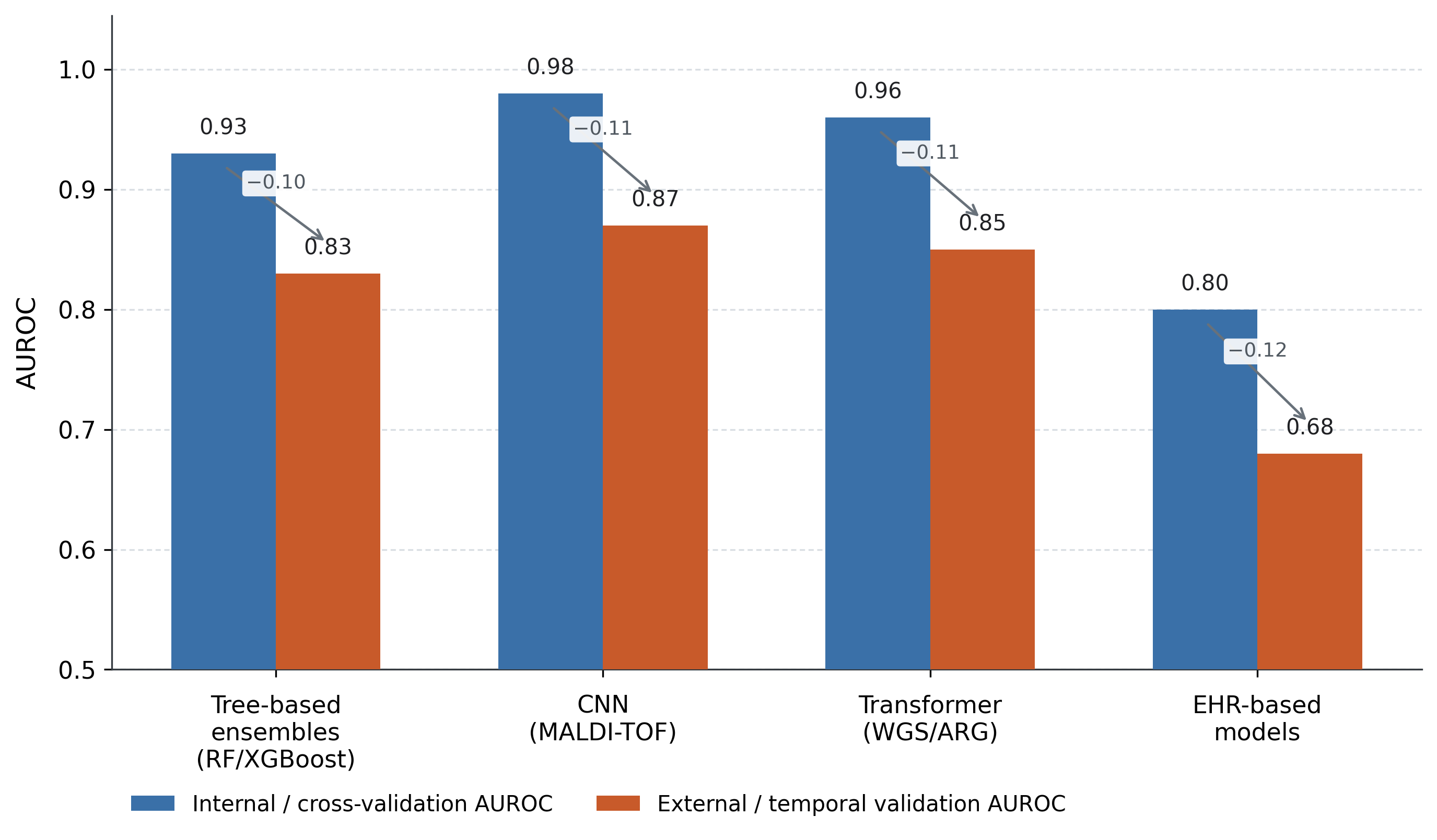
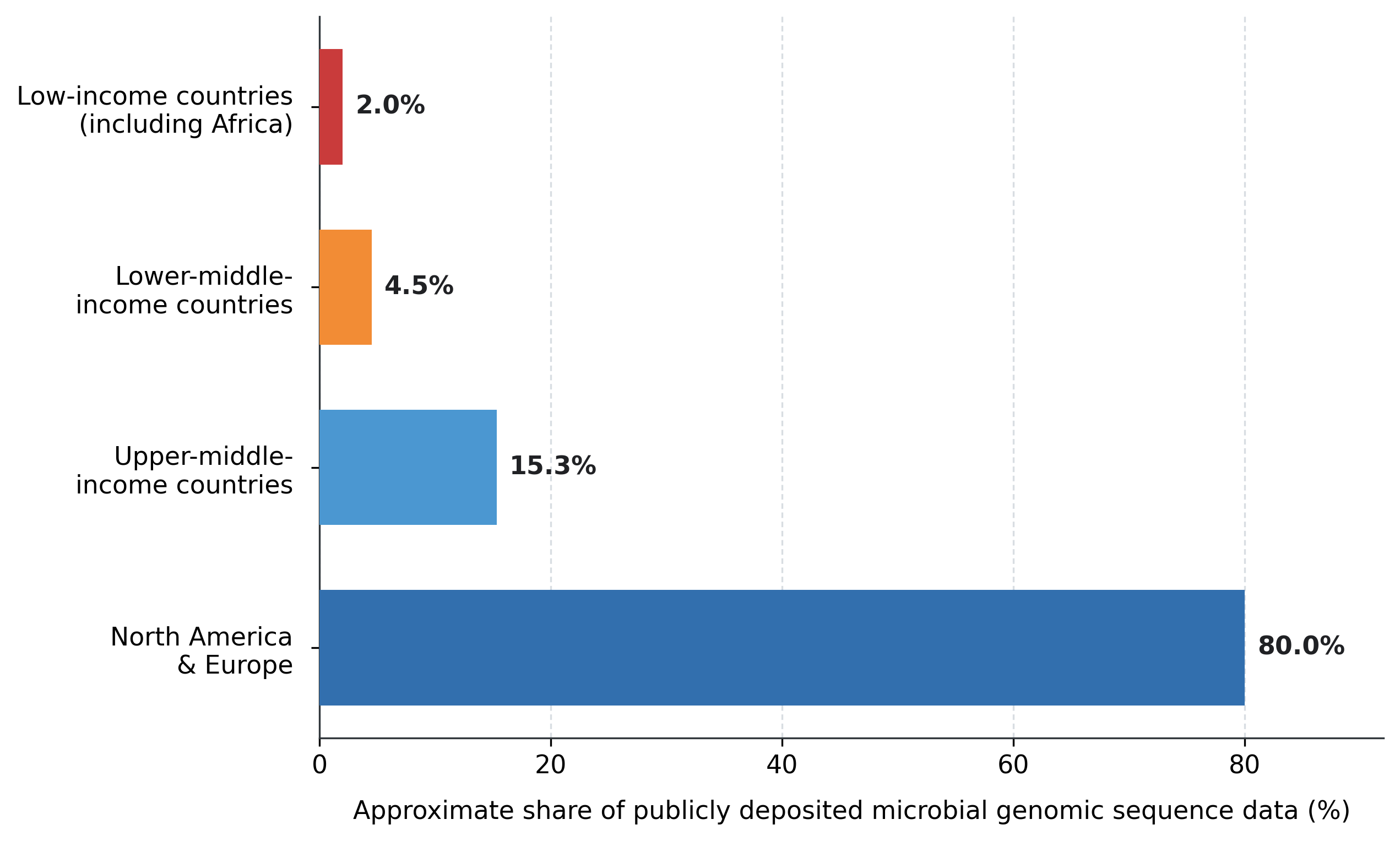
Almost is doing a lot of work in that sentence, though, and unpacking it is really the starting point for this review. A model’s performance on held-out data from the same institution that generated its training set tells us surprisingly little about how it will behave elsewhere — a different hospital, a different country, or even the same site a few years later (Kiazolu, 2026a). Kiazolu (2026a) describes this as a translational chasm, and the description seems apt: it is not one failure but a cluster of them, interacting. Training data is heterogeneous almost as a matter of definition (Kiazolu, 2026a; Mohammed et al., 2025); low- and middle-income countries, which carry the heaviest resistance burden, are barely represented in public datasets (Lyimo, 2026); external validation is rare enough that internal-only cross-validation routinely inflates apparent performance (Roy, 2026; Shehata, 2025); deep architectures remain largely opaque to the clinicians expected to trust them (Pennisi et al., 2025); and human clinical AI still sits largely isolated from the animal, food-chain, and environmental data that a genuine One Health approach would require (Kasse et al., 2025).
We treat these five axes — heterogeneity and bias, geographic imbalance, validation deficits, the black-box and calibration problem, and One Health isolation — not as separate technical footnotes but as symptoms of one underlying condition: the field has optimised heavily for accuracy within a narrow, unrepresentative slice of the world, while paying comparatively little attention to what it actually takes for a model to survive contact with a different setting. Around that observation, this review is organised around four questions — how heterogeneity and bias shape external performance decay; whether explainability and calibration can close the trust gap; whether federated learning can ease LMIC data scarcity without compromising privacy; and whether a One Health, multi-omics framework could improve outbreak forecasting — pursued through four corresponding objectives: mapping current AI/ML methodology, quantifying validation-related performance inflation, defining calibration and explainability reporting standards, and sketching a realistic, tiered implementation roadmap that does not assume every clinic has a GPU cluster.