Biosensors and Nanotheranostics

Bionanotechnology, Drug Delivery, Therapeutics | online ISSN 3064-7789
175
Citations
121.3k
Views
93
Articles
Your new experience awaits. Try the new design now and help us make it even better
Switch to the new experience
Figures and Tables
REVIEWS   (Open Access)

Regulatory Pathways for Nanotheranostics and Nanobiosensors: A Comparative Review of FDA, EMA and Emerging-Market Frameworks

Saba Zafar 1*, Pugazhandhi Bakthavatchalam 2 


+ Author Affiliations

Biosensors and Nanotheranostics 5 (1) 1-8 https://doi.org/10.25163/biosensors.5111003

Submitted: 23 August 2026 Revised: 12 October 2026  Published: 24 October 2026 


Abstract

Nanotheranostics, which fuse imaging and therapy within a single nanoscale vehicle, and nanobiosensors, which detect disease biomarkers at femtomolar-to-attomolar concentrations, sit close to the heart of precision medicine. Yet after more than two decades of preclinical promise, only a handful of these products have reached patients. This review asks why, and argues that much of the answer lies in regulation rather than in the laboratory. We compared how the United States Food and Drug Administration (FDA), the European Medicines Agency and European Commission, and regulators in emerging markets (India, China, South Korea and Brazil) classify, evaluate and authorize nanotechnology-enabled health products. Drawing on peer-reviewed literature, regulatory guidance and international standards, we synthesized evidence on premarket pathways, combination-product jurisdiction, critical quality attributes, nanotoxicology and diagnostic validation. Three patterns emerged. First, the FDA works within existing drug and device statutes and assigns multifunctional products by primary mode of action, whereas the European Union applies explicit nano-specific rules, most notably Rule 19 of the Medical Devices Regulation and the stricter In Vitro Diagnostic Regulation. Second, products acting through physical mechanisms, such as NanoTherm® and NBTXR3/Hensify®, have reached the market more easily than systemically delivered, multi-component theranostics, and highly sensitive biosensors often lag behind simpler, more reproducible electrochemical designs. Third, emerging markets still lean on legacy frameworks and foreign precedent, while high characterization and manufacturing costs widen global inequity. We conclude that convergent, risk-proportionate regulation, built on shared standards, validated nano-specific assays and mutual recognition, could narrow the translational gap without weakening patient safety.

Keywords: nanotheranostics; nanobiosensors; regulatory science; combination products; EU MDR Rule 19; IVDR; critical quality attributes; nanotoxicology; companion diagnostics; emerging markets

1. Introduction

Modern healthcare is moving away from empirical, one-size-fits-all treatment and toward precision and personalized medicine, a shift that is arguably one of the most consequential in clinical practice (Kim et al., 2013; Sharon et al., 2026). Conventional therapies typically follow standardized regimens. They often show limited target specificity, variable pharmacokinetics and off-target toxicity, and they rarely account for the considerable interpatient and intratumoral heterogeneity that characterizes complex diseases (Jahnavi et al., 2025; Sharon et al., 2026). The result, for many patients, is a sequence of trial-and-error treatment cycles that cost time, money and tolerability.

Nanotechnology offers one route out of this pattern. By engineering multifunctional architectures at the nanoscale, researchers can design carriers that cross biological barriers and reach pathological microenvironments with molecular precision (Jahnavi et al., 2025; Musa et al., 2025). The concept of theranostics, first framed as the integration of diagnosis and therapy (Funkhouser, 2002), has matured into nanotheranostics: unified nanoscale platforms that support a synchronized "see and treat" strategy (Jahnavi et al., 2025; Sharon et al., 2026). In parallel, nanobiosensors couple nanoscale transducers, such as gold nanoparticles, graphene, carbon nanotubes or quantum dots, with biorecognition elements to detect circulating disease biomarkers at femtomolar-to-attomolar sensitivity (Aarabi & Faraji Azad, 2026; Roy et al., 2024; Ulucan-Karnak et al., 2024). Together, these two technology classes promise earlier diagnosis, better patient stratification and real-time monitoring of therapeutic response (Figure 1).

The promise, however, has not translated evenly into practice. Despite more than 20 years of preclinical innovation, a persistent translational gap, often described as the "valley of death," separates laboratory breakthroughs from clinical products (Aarabi & Faraji Azad, 2026; Gidwani et al., 2025; Ulucan-Karnak et al., 2024). First-generation, monofunctional nanomedicines such as liposomal doxorubicin (Doxil®) and albumin-bound paclitaxel (Abraxane®) did achieve commercial success, but advanced multifunctional theranostic constructs and next-generation biosensors continue to stall (Breast Cancer Book, 2025; Calatayud et al., 2022; Gidwani et al., 2025). Engineering complexity explains part of this. A larger part, we suggest, lies in fragmented, slow-moving and sometimes ambiguous regulatory frameworks for nanotechnology-enabled health products (Csóka et al., 2021; Rodríguez-Gómez et al., 2025; Sharon et al., 2026).

The underlying difficulty is scientific before it is administrative. Materials in the 1–100 nm range behave physically, chemically and biologically in ways that differ from their bulk counterparts, so conventional evaluation tools do not always capture their risks or benefits (Jahnavi et al., 2025; Musa et al., 2025; Sharon et al., 2026). The U.S. Food and Drug Administration (FDA) acknowledged this problem early, launching the Critical Path Initiative to modernize the tools used to evaluate emerging technologies (Jahnavi et al., 2025; U.S. Food and Drug Administration [FDA], 2004). Rather than writing a separate statute for nanomaterials, the FDA evaluates nanotechnology-enabled products under its existing drug and device authorities, supported by risk-based guidance issued in 2018 and updated in 2024 (Breast Cancer Book, 2025; Gupta et al., 2026; FDA, 2024). Therapeutic nanoproducts generally follow New Drug Application (NDA) routes under Section 505(b)(1), 505(b)(2) or, for generics, 505(j) (Breast Cancer Book, 2025). Diagnostic nanobiosensors, by contrast, are regulated as devices or in vitro diagnostics (IVDs) through 510(k) premarket notification, De Novo classification or Premarket Approval (PMA), depending on risk (Breast Cancer Book, 2025; Pawnikar & Patel, 2025). Because nanotheranostics combine a therapeutic payload with an imaging or sensing component, they often fall to the Office of Combination Products (OCP), which assigns a lead center according to the product's primary mode of action (PMOA) and coordinates review across the Center for Drug Evaluation and Research (CDER), the Center for Biologics Evaluation and Research (CBER) and the Center for Devices and Radiological Health (CDRH) (Gupta et al., 2026; Jahnavi et al., 2025).

The European Union (EU) takes a structurally different approach, with the European Medicines Agency (EMA) and the European Commission sharing oversight (Rodríguez-Gómez et al., 2025). The Medical Devices Regulation (EU MDR 2017/745) introduced Rule 19, which places nanomaterial-containing devices into higher risk classes according to their potential for internal exposure (Sustainable PNC Review, 2026). The In Vitro Diagnostic Regulation (EU IVDR 2017/746) raised the evidentiary bar for analytical performance, clinical validity and post-market follow-up of diagnostics, including companion diagnostics (CDx) (Sharon et al., 2026). For therapeutic nanosystems, the EMA relies on centralized evaluation, reflection papers from the Committee for Medicinal Products for Human Use (CHMP), its Regulatory Science to 2025 strategy and European Pharmacopoeia monographs (Breast Cancer Book, 2025; Gupta et al., 2026). European regulators have also shown some flexibility, granting CE marks to physically acting nanotherapies such as NanoTherm® (iron oxide nanoparticles for magnetic hyperthermia in glioblastoma, 2010) and NBTXR3/Hensify® (hafnium oxide radioenhancer, 2019), and supporting the EU Nanomedicine Characterisation Laboratory (EU-NCL) to standardize physicochemical and toxicological testing (Gupta et al., 2026).

Emerging markets and low- and middle-income countries (LMICs) face a different set of problems, centered on regulatory readiness, infrastructure and access (Gidwani et al., 2025; Gupta et al., 2026). Regulators in India (Central Drugs Standard Control Organization, CDSCO), South Korea (Ministry of Food and Drug Safety, MFDS), Brazil (Agência Nacional de Vigilância Sanitária, ANVISA) and China (National Medical Products Administration, NMPA) frequently handle nanomedicines and biosensors through frameworks drafted for small molecules. This creates uncertainty, longer timelines and inconsistent manufacturing audits (Gupta et al., 2026; Kang et al., 2023; Pawnikar & Patel, 2025). High synthesis costs, demanding Good Manufacturing Practice (GMP) requirements and expensive characterization equipment, such as dynamic light scattering, nanoparticle tracking analysis and electron microscopy, further confine advanced theranostics to high-income settings (Breast Cancer Book, 2025; Musa et al., 2025; Ulucan-Karnak et al., 2024). International bodies, including ISO Technical Committee 229 (Nanotechnologies), the World Health Organization (WHO) and the International Electrotechnical Commission (IEC), are working to harmonize terminology, biological risk assessment (e.g., ISO 10993-1:2025; ISO/TR 13121:2011) and toxicity testing (Gupta et al., 2026; International Organization for Standardization [ISO], 2025; Sustainable PNC Review, 2026). Adaptive approaches such as regulatory sandboxes, piloted by the UK Medicines and Healthcare products Regulatory Agency (MHRA) and Singapore's Health Sciences Authority (HSA), add a further, more experimental layer for multifunctional and artificial intelligence (AI)-enabled platforms.

What is missing from the literature is a side-by-side account of how Western and emerging-market regulators handle the overlap between therapeutics, companion diagnostics and nanobiosensors. Most existing work concentrates on laboratory synthesis or on single clinical indications, and rarely examines the classification rules, evidentiary standards and toxicological requirements that ultimately decide whether a product is commercialized (Jahnavi et al., 2025; Rodríguez-Gómez et al., 2025). This review therefore has five objectives. First, it compares the regulatory architectures of the FDA and the EU (EMA and European Commission), covering classification criteria, premarket pathways such as NDA 505(b)(2), 510(k), PMA and EU MDR Rule 19, and evidentiary requirements (Breast Cancer Book, 2025; Gupta et al., 2026; Sustainable PNC Review, 2026). Second, it evaluates emerging-market frameworks and global harmonization initiatives against ISO/TC 229, ISO 10993-1:2025, WHO and EU-NCL standards (Gupta et al., 2026; Pawnikar & Patel, 2025; Sustainable PNC Review, 2026). Third, it identifies the main translational bottlenecks: combination-product classification, critical quality attributes (CQAs) for batch reproducibility, long-term nanotoxicology and the analytical validation of companion diagnostics (Ahmad et al., 2022; Jahnavi et al., 2025; Kang et al., 2023; Sharon et al., 2026). Fourth, it examines regulatory challenges raised by AI-driven nanodesign, closed-loop sensing and decentralized clinical trials (Breast Cancer Book, 2025; Musa et al., 2025). Fifth, it proposes a regulatory roadmap that could streamline premarket evaluation, encourage mutual recognition and support equitable, safe adoption of personalized nanomedicine (Gupta et al., 2026; Sharon et al., 2026; Ulucan-Karnak et al., 2024).

2. Regulatory, Manufacturing and Safety Barriers to Clinical Translation of Nanotheranostics and Nanobiosensors

2.1 The Promise and Architecture of Multifunctional Nanotechnology

2.1.1 Nanotheranostics as a "see and treat" platform

Personalized medicine has redirected clinical thinking from empirical regimens toward molecularly stratified, targeted intervention (Kim et al., 2013; Sharon et al., 2026). Much of this change depends on multifunctional architectures operating at 1–100 nm, a scale at which materials interact with cells and subcellular structures directly (Jahnavi et al., 2025; Musa et al., 2025). Across oncology, cardiology, neurology and infectious disease, two nanotechnology classes have come to dominate translational ambitions: nanotheranostics and nanobiosensors (Figure 1).

Nanotheranostics combine diagnosis, selective drug delivery and non-invasive monitoring of therapy within one vehicle (Gidwani et al., 2025; Hirulkar et al., 2024). Contrast components, such as superparamagnetic iron oxide nanoparticles (SPIONs) for magnetic resonance imaging (MRI), gold nanostructures for computed tomography (CT) or surface-enhanced Raman spectroscopy (SERS), and semiconductor quantum dots for near-infrared fluorescence, are paired with cytotoxic or immunomodulatory payloads (Calatayud et al., 2022; Zhu et al., 2025). The resulting platforms exploit passive accumulation through the enhanced permeability and retention (EPR) effect as well as active receptor-mediated targeting. Drug release can then be triggered endogenously, by pH, redox state or enzymes, or exogenously, by heat, light or ultrasound (Jahnavi et al., 2025; Sharon et al., 2026).

2.1.2 Nanobiosensors and ultrasensitive biomarker detection

Nanobiosensors are analytical devices that join biological recognition elements, such as antibodies, aptamers, enzymes or DNA probes, to nanoscale physicochemical transducers (Quesada-González & Merkoçi, 2018; Ulucan-Karnak et al., 2024). The large surface-area-to-volume ratio and quantum-confinement effects of graphene, carbon nanotubes and plasmonic metal nanoparticles allow detection limits in the femtomolar-to-attomolar range (Aarabi & Faraji Azad, 2026; Xia et al., 2024). In practice, this means circulating tumor cells, microRNAs and inflammatory cytokines can be measured in minimally invasive liquid biopsies, often at the point of care (D'Alton et al., 2024; Quesada-González & Merkoçi, 2018).

2.1.3 The translational "valley of death"

Preclinical publications have multiplied, but clinical products have not kept pace (Gidwani et al., 2025; Ulucan-Karnak et al., 2024). First-generation nanomedicines such as Doxil®, Abraxane® and Onivyde® gained approval mainly because they improved the solubility or pharmacokinetics of established cytotoxic drugs (Breast Cancer Book, 2025). Multifunctional platforms have fared worse. Literature surveys suggest that, across preclinical models, typically less than 1% of an administered nanoparticle dose reaches a solid tumor, and the problem is compounded in patients by tumor heterogeneity, dense desmoplastic stroma and biological clearance (Chen & Li, 2025; Viegas et al., 2023; Wang et al., 2026). Closing this gap requires attention to biological barriers, certainly, but also to the regulatory frameworks that determine market entry (Csóka et al., 2021; Rodríguez-Gómez et al., 2025).

2.2 United States FDA: Jurisdictional Assignment and Combination-Product Classification

2.2.1 Absence of a nano-specific statute

The FDA does not maintain a separate statutory category for "nanomaterials." It evaluates nanotechnology-enabled products under existing legal authorities for drugs, biologics and devices, guided by risk-based guidance published in 2018 and revised in 2024 (Gupta et al., 2026; Rodríguez-Gómez et al., 2025; FDA, 2024). The 2024 guidance asks sponsors to describe particle size, size distribution, surface properties and stability, and to consider how these attributes might affect safety and quality (FDA, 2024).

2.2.2 Combination products and the primary mode of action

The central regulatory hurdle for nanotheranostics in the United States is their dual nature. Because they contain both a therapeutic component and a diagnostic imaging or device element, they are formally combination products under 21 CFR Part 3 (Gupta et al., 2026; Jahnavi et al., 2025). The OCP assigns the lead center according to the PMOA (Figure 2). Where the main therapeutic effect is chemical, metabolic or pharmacological, CDER or CBER leads, with CDRH consulting on device-related questions (Gupta et al., 2026). Under CDER, therapeutic nanoproducts usually follow the NDA framework of Section 505 of the Federal Food, Drug, and Cosmetic Act. Novel nanostructures require the full 505(b)(1) pathway with complete safety and efficacy trials, whereas reformulations of off-patent active ingredients into nanocarriers can use the 505(b)(2) route, relying on existing safety findings for the active moiety while supplying new physicochemical and pharmacokinetic bridging data (Breast Cancer Book, 2025; Zhu et al., 2025).

2.2.3 Device and IVD routes for nanobiosensors

Diagnostic nanobiosensors are regulated mainly as devices or IVDs by CDRH, and the pathway follows risk class (Kang et al., 2023; Pawnikar & Patel, 2025). Most non-invasive or minimally invasive biosensors are Class II devices and seek 510(k) clearance by showing substantial equivalence to a legally marketed predicate in safety, analytical sensitivity and intended use. Novel, low-to-moderate-risk sensors without a predicate can request De Novo classification, which creates a new device type with special controls. High-risk Class III devices, including implantable continuous monitors and companion diagnostics that guide therapy selection, require PMA, usually supported by prospective multicenter studies of analytical sensitivity, diagnostic specificity and clinical

Table 1. Comparative regulatory architectures governing nanomedicines, nanotheranostics and nanobiosensors in the United States, the European Union, emerging markets and international standard-setting bodies The table compares four regulatory settings across seven domains: the responsible agencies, the statutory or normative instruments, premarket pathways, handling of combination products and nanotheranostics, nano-specific safety and analytical testing, expedited or adaptive mechanisms, and the main operational bottlenecks. The United States regulates nanomaterials within existing drug and device statutes, whereas the European Union applies explicit nano-specific rules (EU MDR Rule 19 and EU IVDR). Emerging markets rely on adapted legacy frameworks and foreign precedent, and international standards (ISO, WHO, EU-NCL/US-NCL) remain voluntary unless transposed nationally. Abbreviations: ANDA, Abbreviated New Drug Application; CARPA, complement-activation-related pseudoallergy; CDx, companion diagnostic; IND, Investigational New Drug; MAA, marketing authorization application; NCL, Nanotechnology/Nanomedicine Characterisation Laboratory; OCP, Office of Combination Products; PDI, polydispersity index; PMA, Premarket Approval; PMOA, primary mode of action. (.Synthesized from administrative guidance and comparative regulatory analyses (Breast Cancer Book, 2025; Chávez-Hernández et al., 2024; Gupta et al., 2026; Kang et al., 2023; Pawnikar & Patel, 2025; Rodríguez-Gómez et al., 2025; Sustainable PNC Review, 2026).)

Jurisdiction

Regulatory body

Statutory classification and key frameworks

Premarket pathways and dossier routes

Combination products and nanotheranostics

Nanosafety and analytical testing

Expedited or adaptive mechanisms

Major bottlenecks and gaps

United States

U.S. Food and Drug Administration (CDER, CDRH, CBER, OCP)

Federal Food, Drug, and Cosmetic Act

21 CFR Part 3 (combination products)

Risk-based nanomaterial guidance (2018; updated 2024)

Therapeutics: IND → NDA via 505(b)(1) (new chemical entity) or 505(b)(2) (reformulation); ANDA 505(j) (generics)

Devices/biosensors: 510(k); De Novo; PMA

Lead center assigned by OCP according to PMOA

Inter-center review (e.g., CDER lead with CDRH consult for imaging moieties)

Physicochemical characterization (hydrodynamic size, PDI, morphology, zeta potential)

In vitro/in vivo release kinetics; CARPA screening; protein corona profiling

Breakthrough Devices Program (510(k) decisions in <160 days)

Fast Track; Breakthrough Therapy; Accelerated Approval

No formal statutory definition of “nanomaterial”

Protracted cross-center review of multimodal products

Strict equivalence standards for generic nanomedicines

European Union

European Medicines Agency (CHMP) and European Commission

Regulation (EC) No 726/2004

EU MDR 2017/745 (medical devices)

EU IVDR 2017/746 (in vitro diagnostics)

EMA Regulatory Science to 2025

Therapeutics: centralized procedure via CHMP → EU-wide MAA

Devices: Notified Body conformity assessment → CE mark

IVDs: conformity assessment by IVDR Class A–D

Devices with nanomaterials classified by EU MDR Rule 19 according to internal exposure potential

Physical-mode nanotherapies (e.g., hyperthermia) approved as Class III devices/ATMPs

European Pharmacopoeia monographs (liposomes, PEGylated doxorubicin)

Nanomaterial identification under REACH/CLP

Toxicology testing via EU-NCL protocols

PRIME scheme

Accelerated assessment (150 vs. 210 days)

Conditional marketing authorization

Notified Body capacity bottleneck under MDR/IVDR

Reclassification of nano-devices into Class III under Rule 19

Ambiguous device–drug boundaries

Emerging markets (BRICS/Asia-Pacific)

India: CDSCO

China: NMPA

South Korea: MFDS

India: New Drugs and Clinical Trials Rules (2019)

China: NMPA nano guidelines (2021)

South Korea: MFDS nanomedicine and CDx guidance

Standard new drug/device registration, often with local bridging studies

NMPA expedited channels for domestic breakthrough products

MFDS dual-track CDx/drug review

Often fragmented; evaluated ad hoc by drug or device divisions

High dependence on prior FDA/EMA approvals for market entry

Indian and Chinese Pharmacopoeia requirements

Local preclinical toxicity and safety testing in domestic accredited laboratories

Fast-track approval for unmet oncology needs; priority review (NMPA, CDSCO)

Regulatory sandboxes (e.g., Singapore HSA, South Korea)

Underdeveloped nano-specific frameworks

High cost of characterization infrastructure (TEM, DLS, ICP-MS)

Limited local GMP capacity for complex nano-architectures

International standardization

ISO (TC 229)

WHO

EU-NCL/US-NCL

ISO/TR 11360 (nomenclature)

ISO/TR 13121 (risk evaluation)

ISO 10993-1:2025 (biocompatibility)

WHO guidelines

Voluntary technical standards and reference testing cascades; non-statutory but adopted by national authorities

Standardized terminology and multiparametric assay matrices supporting cross-agency combination submissions

Standardized assay cascades for hemocompatibility, endotoxin interference (LAL), immune-cell activation and biodistribution

Collaborative consensus workshops

Standardized data-sharing templates across laboratories

Non-binding status requires national transposition

Divergence between voluntary standards and mandatory regional statutes

Table 2. Regulatory classification, clinical status and translational decision criteria for representative nanotherapeutic and nanotheranostic platforms Eight representative platforms are arranged from approved monofunctional nanomedicines to investigational multifunctional systems. For each, the table lists nanomaterial architecture, imaging modality, therapeutic payload, indication, regulatory classification and lead center, furthest clinical or approval status, and the hurdles that shaped regulatory decisions. Products acting through physical mechanisms (NanoTherm®, NBTXR3/Hensify®) obtained European CE marks through device routes, whereas systemically delivered or non-biodegradable multifunctional constructs (ThermoDox®, AuroLase®, AZD0466) remain investigational or failed pivotal endpoints. ClinicalTrials.gov identifiers are given where applicable. Abbreviations: CT, computed tomography; HCC, hepatocellular carcinoma; MRI, magnetic resonance imaging; NSCLC, non-small-cell lung cancer; NSF, nephrogenic systemic fibrosis; OS, overall survival; SPIONs, superparamagnetic iron oxide nanoparticles. (Note. Compiled from clinical trial registries and translational literature (Breast Cancer Book, 2025; Calatayud et al., 2022; Gidwani et al., 2025; Gupta et al., 2026; Jahnavi et al., 2025; Sharon et al., 2026).)


Platform / trade name

Nanomaterial architecture

Diagnostic / imaging modality

Therapeutic agent / payload

Target disease / indication

Regulatory classification and lead center

Clinical / approval status

Key translational hurdles and decision criteria

Doxil®/Caelyx®

PEGylated liposome (~80–100 nm)

None (therapeutic only; surrogate imaging in research)

Doxorubicin hydrochloride

Ovarian cancer, metastatic breast cancer, Kaposi’s sarcoma

Drug (FDA CDER: NDA 505(b)(1); EMA MAA)

FDA-approved (1995); EMA-approved (1996)

Benchmark for the EPR effect; monitoring for hand–foot syndrome and infusion reactions; CMC sensitivity to manufacturing scale

Abraxane®

Albumin-bound nanoparticle (~130 nm)

None (therapeutic only)

Paclitaxel (solvent-free)

Metastatic breast cancer, NSCLC, pancreatic adenocarcinoma

Drug (FDA CDER: NDA 505(b)(2); EMA MAA)

FDA-approved (2005); EMA-approved (2008)

Avoids toxic Cremophor EL vehicle; stringent particle-size control and verification of albumin binding under GMP

NanoTherm®

Aminosilane-coated SPIONs (~15 nm)

MRI tracking

Magnetic hyperthermia (alternating magnetic field)

Recurrent glioblastoma multiforme

Medical device/ATMP (EU Notified Body; CE mark)

CE mark (2010); investigational in the United States

Physical mode of action regulated as a device in Europe; requires intratumoral instillation and dedicated magnetic-field applicators

NBTXR3 (Hensify®)

Functionalized hafnium oxide nanoparticles (~50 nm)

CT contrast enhancement

Radiotherapy enhancer (high electron density; physical absorption)

Locally advanced soft-tissue sarcoma; head and neck squamous cell carcinoma

Medical device Class III (EU MDR Rule 19); investigational in the United States

CE mark (2019); FDA Phase III (NCT04862455)

Evaluated as a device in the EU because it does not act pharmacologically; requires proof of negligible systemic leakage

ThermoDox®

Thermosensitive lysolipid liposome (~100 nm)

MRI/ultrasound monitoring

Doxorubicin (rapid release at 39.5–42 °C)

Primary HCC

Combination drug/device regimen (FDA CDER lead)

Phase III (HEAT trial) completed; primary OS endpoint not met

Complex endpoints requiring synchronized radiofrequency ablation; non-linear release kinetics under hyperthermic triggers

AuroLase®

Silica core/gold nanoshell (~150 nm)

Optical coherence tomography; near-infrared imaging

Photothermal therapy (NIR laser ablation)

Head and neck cancers; localized prostate cancer

Medical device (FDA CDRH lead)/combination product

Phase I/II completed (NCT00848042)

Long-term bio-persistence of inorganic gold; liver and spleen retention; demand for extensive clearance and toxicokinetic data

Gadopiclenol (Elucirem®/Vueway®)

High-relaxivity macrocyclic gadolinium chelate

T1-weighted MRI

Diagnostic contrast enhancement

CNS and whole-body lesion detection

Diagnostic drug (FDA CDER NDA; EMA MAA)

FDA-approved (2022); EMA-approved (2023)

High thermodynamic stability prevents free Gd³⁺ release; screening for NSF and brain gadolinium accumulation

AZD0466

Polylysine dendrimer nanocarrier (~1–10 nm)

Preclinical optical/PET imaging tags

Dual Bcl-2/Bcl-xL inhibitor (navitoclax-related)

Hematologic malignancies; small-cell lung cancer

Investigational new drug (FDA CDER IND)

Phase I/II (NCT04214093)

Precise control of dendrimer generation; high payload density; mitigation of on-target thrombocytopenia

concordance (Breast Cancer Book, 2025; Kang et al., 2023).

2.2.4 Expedited programs and residual gaps

The FDA has created expedited options, among them the Breakthrough Devices Program, which supports early pre-submission dialogue and has been associated with 510(k) decisions in under 160 days for qualifying technologies (Gupta et al., 2026). Even so, the lack of standardized testing cascades tailored to nanoscale properties still complicates combination-product submissions (Csóka et al., 2021; Souto et al., 2024).

2.3 European Union: Centralized Evaluation, EU MDR Rule 19 and EU IVDR

2.3.1 Medicinal nanoproducts and the centralized procedure

In the EU, oversight is shared between the EMA, the European Commission and national competent authorities (Rodríguez-Gómez et al., 2025). Medicinal nanoproducts are authorized through the centralized procedure, in which the CHMP performs a single scientific assessment leading to a binding Commission decision valid across all member states (Gupta et al., 2026). The EMA's Regulatory Science to 2025 strategy gives explicit priority to nanotechnology, and European Pharmacopoeia monographs set quality standards for liposomal and polymeric formulations (Breast Cancer Book, 2025). Nonetheless, Klein et al. (2024) showed that approval routes for nanomedicinal products in the EU remain heterogeneous, which complicates planning for developers, particularly for carriers aimed at difficult targets such as the blood–brain barrier.

2.3.2 Rule 19 and nanomaterial-containing devices

A defining difference from the U.S. system lies in how the EU treats devices containing nanomaterials. Rule 19 of EU MDR 2017/745 links classification directly to the potential for internal exposure: devices with high or medium potential are Class III, those with low potential are Class IIb and those with negligible potential are Class IIa (Sustainable PNC Review, 2026; Figure 2). Because most injectable nanotheranostics and nano-reagents circulate systemically or persist in tissue, Rule 19 effectively places them in Class III. That classification brings Notified Body assessment, extensive clinical investigation dossiers and demanding post-market clinical follow-up (PMCF) (Rahman, 2026; Yang et al., 2026).

2.3.3 IVDR and diagnostic nanobiosensors

For in vitro diagnostic nanobiosensors, EU IVDR 2017/746 changed the landscape considerably. Under the earlier IVD Directive (98/79/EC), more than 80% of IVDs were self-certified; the IVDR's risk-based Classes A–D now require Notified Body involvement for roughly 85% of devices (Kang et al., 2023; Sharon et al., 2026). Biosensors used for oncology staging, companion diagnostics or infectious-disease screening usually fall into Class C or D and must document analytical performance (limit of detection, specificity, interference), clinical performance and scientific validity (D'Alton et al., 2024; Pawnikar & Patel, 2025).

2.3.4 Physically acting nanotherapies and the EU-NCL

European authorities have authorized locally acting physical nanotherapies through device or Advanced Therapy Medicinal Product (ATMP) routes. NanoTherm®, an iron oxide formulation for magnetic hyperthermia in glioblastoma, received a CE mark in 2010; NBTXR3/Hensify®, functionalized hafnium oxide nanoparticles that enhance radiotherapy in soft-tissue sarcoma, followed in 2019 (Gupta et al., 2026). To support preclinical evaluation, the European Commission established the EU-NCL, which coordinates standardized physical, chemical, immunological and toxicological assay cascades to help developers assemble regulatory dossiers (Fadeel et al., 2018; Gupta et al., 2026).

2.4 Emerging Markets and Global Harmonization Frameworks

2.4.1 Fragmented national frameworks

Outside the United States and EU, emerging economies, including the BRICS nations and Southeast Asian jurisdictions, represent growing markets with a pressing need for affordable, decentralized diagnostics and therapeutics (Gupta et al., 2026). Their regulatory frameworks for nanotechnology are, however, fragmented (Chávez-Hernández et al., 2024). In India, CDSCO evaluates nanomedicines largely through guidelines adapted from those for new chemical entities, which can blur the boundaries of combination products (Pawnikar & Patel, 2025). China's NMPA has specialized evaluation centers for devices and nanotechnologies, but domestic translation is limited by batch reproducibility and demanding clinical trial requirements (Gupta et al., 2026). South Korea's MFDS has issued domestic guidance for
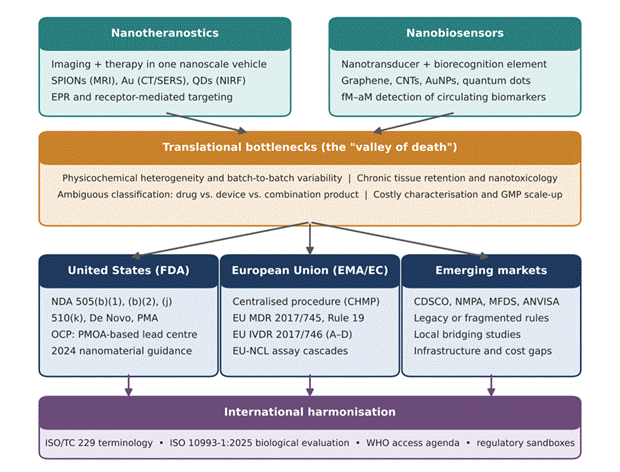
Figure 1. Conceptual framework linking multifunctional nanotechnology, translational bottlenecks and global regulatory oversight. Nanotheranostics (combined imaging and therapy) and nanobiosensors (nanotransducer-based biomarker detection) converge on a shared set of translational bottlenecks: physicochemical heterogeneity, chronic tissue retention, ambiguous drug–device–combination classification, and costly characterization and GMP scale-up. These bottlenecks are filtered through three regulatory settings: the U.S. FDA (NDA and device pathways with PMOA-based lead-center assignment), the European Union (centralized procedure, EU MDR Rule 19, EU IVDR and EU-NCL testing) and emerging markets (CDSCO, NMPA, MFDS, ANVISA). International harmonization through ISO/TC 229, ISO 10993-1:2025, WHO initiatives and regulatory sandboxes forms the common layer toward which all three converge. Abbreviations: CNTs, carbon nanotubes; EPR, enhanced permeability and retention; QDs, quantum dots; SPIONs, superparamagnetic iron oxide nanoparticles.
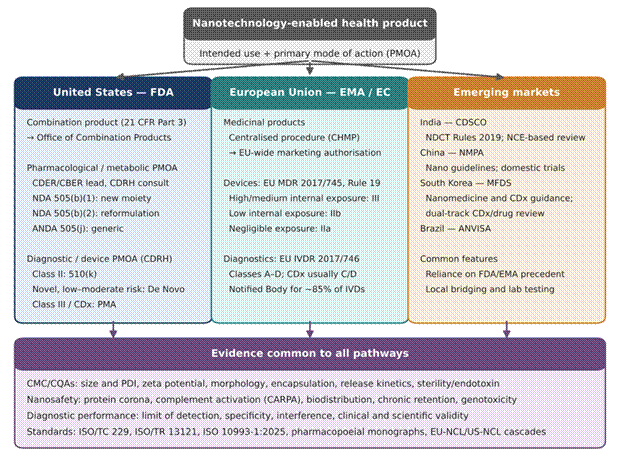
Figure 2. Comparative regulatory decision pathway for nanotechnology-enabled health products in the United States, the European Union and emerging markets. Classification begins with intended use and primary mode of action (PMOA). In the United States, combination products are routed by the Office of Combination Products to CDER/CBER (NDA 505(b)(1), 505(b)(2) or ANDA 505(j)) or to CDRH (510(k), De Novo or PMA). In the European Union, medicinal products follow the centralized CHMP procedure, nanomaterial-containing devices are classified by EU MDR Rule 19 according to internal exposure (Class III, IIb or IIa), and diagnostics follow EU IVDR Classes A–D. Emerging-market regulators rely on adapted legacy frameworks, local bridging studies and FDA/EMA precedent. The lower panel lists the CMC, nanosafety, diagnostic-performance and standards evidence that is required, in some form, across all pathways.

nanomedicines and companion diagnostics and approved formulations such as Genexol-PM, a paclitaxel polymeric micelle (Kang et al., 2023).

2.4.2 Economic and technological barriers

A recurring obstacle in LMICs is economic. Developing nanotheranostic agents requires transmission electron microscopy (TEM), dynamic light scattering (DLS), inductively coupled plasma mass spectrometry (ICP-MS) and GMP-compliant cleanrooms (Breast Cancer Book, 2025; Musa et al., 2025). When products also depend on costly active ingredients or scarce noble metals such as gold, platinum or gadolinium, access in resource-limited settings becomes severely restricted (Ulucan-Karnak et al., 2024).

2.4.3 International standards and adaptive models

Several international efforts aim to reduce these jurisdictional differences. ISO/TC 229 develops standards for nanomaterial terminology (ISO/TR 11360), risk evaluation (ISO/TR 13121) and characterization (Sustainable PNC Review, 2026). ISO 10993-1:2025 sets a revised risk-management framework for biological evaluation of medical devices, with attention to hemocompatibility, genotoxicity and systemic toxicity for materials with nanoscale features (ISO, 2025). The WHO promotes equitable access to essential nanomedicines and point-of-care biosensors through public–private partnerships, technology transfer and local production (Gupta et al., 2026). Regulatory sandboxes piloted by the MHRA and HSA offer controlled settings in which developers of multimodal and AI-driven platforms can generate real-world evidence under adaptive oversight.

2.5 Critical Quality Attributes, CMC and GMP Scale-Up

2.5.1 Why nanomedicines resist conventional quality control

Many late-stage failures of nanomedicines originate in manufacturing, specifically in the move from benchtop batches to commercial GMP production (Ahmad et al., 2022; Roy et al., 2024). Small-molecule drugs have fixed structures and uniform stoichiometry, whereas nanoscale complexes are polydisperse systems defined by three-dimensional architecture and interfacial behavior (Fadeel et al., 2018). Regulators therefore expect developers to define and validate CQAs within a Quality-by-Design framework, covering hydrodynamic size and polydispersity, zeta potential, morphology and aspect ratio, encapsulation efficiency and release kinetics, ligand density, and sterility and endotoxin control (FDA, 2024; Table 3).

2.5.2 Scale-up, microfluidics and sterilization

Traditional batch synthesis is sensitive to small changes in mixing, temperature gradients and shear stress, which produce batch-to-batch differences in size, coating density and release profile (Roy et al., 2024). Continuous microfluidic synthesis offers reproducible laminar-flow conditions that control self-assembly kinetics and keep polydispersity narrow at larger scales (Roy et al., 2024). Sterilization is a separate problem: autoclaving, gamma irradiation and filtration can denature surface antibodies, crosslink polymer shells or cause irreversible aggregation, so validated aseptic processing under GMP is often required (Ahmad et al., 2022; Breast Cancer Book, 2025).

2.6 Nanotoxicological Complexities and the Bio-Nano Interface

2.6.1 Protein corona and mononuclear phagocyte clearance

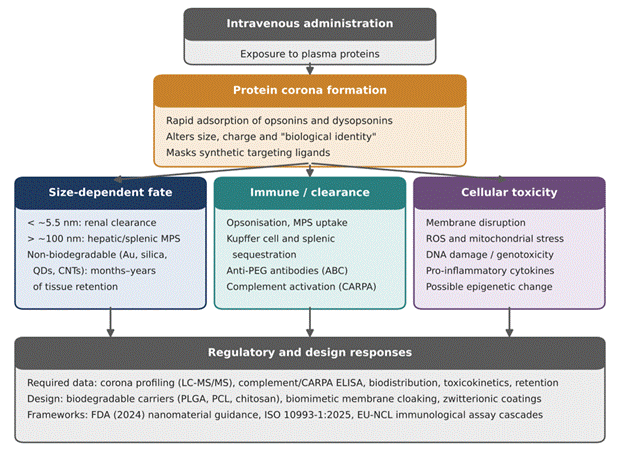
The properties that make nanomaterials useful for theranostics also give them complex, non-linear toxicological profiles (Ahmad et al., 2022; Fadeel et al., 2018). Once in the bloodstream, nanoparticles rapidly acquire a protein corona, a dynamic layer of adsorbed plasma proteins that changes their hydrodynamic size, surface charge and targeting affinity (Figure 3). Adsorbed opsonins, such as complement factors and immunoglobulins, promote recognition by macrophages of the mononuclear phagocyte system (MPS), leading to sequestration in hepatic Kupffer cells and splenic red pulp (Fadeel et al., 2018; Hirulkar et al., 2024).

2.6.2 Size-dependent clearance and chronic retention

Long-term safety depends largely on size, composition and clearance route. Particles smaller than the renal filtration threshold of about 5.5 nm are cleared quickly in urine. Larger, non-biodegradable materials, including gold nanoparticles, non-porous silica, quantum dots and carbon nanotubes, are poorly cleared by the kidney and can persist in reticuloendothelial tissues for months or years (Ahmad et al., 2022; Fadeel et al., 2018). Chronic retention of this kind may cause sustained oxidative stress, excess reactive oxygen species (ROS), mitochondrial dysfunction and possibly genotoxic or epigenetic change (Souto et al., 2024; Wang et al., 2026).

Table 3. Critical quality attributes, analytical methods, acceptance criteria and nanotoxicological release specifications for nanomedicine and nanotheranostic products mEach row defines one critical quality attribute (CQA) that regulators expect to be controlled within a Quality-by-Design framework, together with the analytical techniques used to measure it, commonly cited acceptance thresholds, the biological or pharmacokinetic rationale, and its regulatory relevance to FDA, EMA and ICH submissions. Thresholds are indicative values reported in the literature and guidance; product-specific limits must be justified by each sponsor. The table shows why polydispersity, surface charge, encapsulation, release behavior, protein corona formation, immunotoxicity and endotoxin control are treated as release-critical for nanoscale products. Abbreviations: AFM, atomic force microscopy; DLS, dynamic light scattering; ELS, electrophoretic light scattering; EU, endotoxin units; IVIVC, in vitro–in vivo correlation; LAL, Limulus amebocyte lysate; NTA, nanoparticle tracking analysis; PDI, polydispersity index. (Note. Compiled from Quality-by-Design standards, ISO biological evaluation guidance and toxicology frameworks (Ahmad et al., 2022; Breast Cancer Book, 2025; Fadeel et al., 2018; Gidwani et al., 2025; Jahnavi et al., 2025; Sustainable PNC Review, 2026; U.S. Food and Drug Administration, 2024).)

Parameter / CQA

Analytical and regulatory characterization methods

Acceptance criteria and target thresholds

Biological, pharmacokinetic and safety rationale

Regulatory impact (FDA/EMA/ICH)

Hydrodynamic diameter and size distribution

DLS; NTA; cryo-TEM

Monomodal distribution

PDI ≤ 0.2

Size stable within ±10% over shelf life

Governs extravasation through leaky tumor vasculature (EPR); particles < 5.5 nm undergo renal filtration, whereas particles > 100 nm are cleared by hepatic Kupffer cells

Critical release specification for NDA/MAA; major parameter for demonstrating generic equivalence

Surface charge and zeta potential (ζ)

ELS; phase analysis light scattering

Stable colloidal range (|ζ| ≈ 20–30 mV)

Near-neutral to slightly negative for systemic stealth

Strongly positive surfaces cause non-specific endothelial binding, membrane lysis and hemolysis; neutral or negative surfaces reduce macrophage recognition

Required in IND/IMPD filings to justify stability, prevent aggregation and demonstrate hemocompatibility

Surface morphology and aspect ratio

TEM; high-resolution SEM; AFM

Uniform spherical or defined anisotropic architecture

No uncharacterized agglomerates

High-aspect-ratio materials (e.g., carbon nanotubes) carry asbestos-like mesothelial toxicity risks; spherical shapes favor vascular flow

Expected under ISO 10993-1:2025 and FDA (2024) guidance for structural verification

Drug encapsulation efficiency (EE%) and loading

HPLC; UPLC-MS/MS; centrifugal ultrafiltration

EE% > 85–90% for liposomes/polymers

Drug-to-carrier ratio within ±5%

Low encapsulation leaves free drug, causing erratic pharmacokinetics and off-target systemic toxicity

Critical CMC specification; determines dose accuracy and therapeutic index

In vitro drug-release kinetics

Dialysis membrane method; USP dissolution apparatus IV (flow-through cell)

Biphasic or sustained release profile

< 10% burst release in first 2 h at pH 7.4

Prevents premature release in circulation; confirms triggered release in acidic or enzymatic tumor microenvironments

IVIVC data required for bioequivalence and stability verification

Protein corona and opsonization profile

LC-MS/MS; SDS-PAGE

Identification of adsorbed serum proteins

Minimal complement (C3a/C5a) and IgG opsonins

Adsorbed plasma proteins change the particle’s synthetic identity, triggering MPS clearance and CARPA

Recommended by EMA reflection papers and EU-NCL assay cascades to predict in vivo clearance

Immunotoxicity and complement activation

ELISA for SC5b-9, C3a, C4d; cytokine arrays

Negative for CARPA

Low induction of TNF-α, IL-6 and IFN-γ

Infusion reactions can cause anaphylactoid shock; anti-PEG antibodies cause accelerated blood clearance (ABC)

Required preclinical safety evaluation for all intravenously administered nanopharmaceuticals

Sterility and endotoxin contamination

Membrane-filtration sterility test; LAL; chromogenic endotoxin assay

Sterile (no microbial growth)

Endotoxin < 0.2–0.5 EU/kg/h (USP <85>)

Nanoparticles may scatter light or adsorb LAL reagents, producing false negatives; endotoxins can cause severe pyrogenic reactions

Validated non-interfering endotoxin methods required before Phase I initiation

Table 4. Transduction modalities, analytical performance, technology readiness and regulatory classification of diagnostic nanobiosensors Five nanobiosensor transduction modalities are compared by nanomaterial substrate, biorecognition element and target analyte, analytical limit of detection (LOD), clinical application, technology readiness level (TRL), applicable FDA and EU IVDR classification route, and principal translational constraints. The comparison shows an inverse relationship between analytical sensitivity and clinical maturity: electrochemical sensors (TRL 8–9) are commercialized through 510(k) clearance, whereas SERS and nanomechanical platforms with attomolar sensitivity remain at TRL 4–6 because of reproducibility and standardization gaps. TRL values are approximate ranges. Abbreviations: AuNPs, gold nanoparticles; Bio-FET, biological field-effect transistor; CGM, continuous glucose monitoring; CTC, circulating tumor cell; ctDNA, circulating tumor DNA; MWCNTs, multi-walled carbon nanotubes; QCM, quartz crystal microbalance; SERS, surface-enhanced Raman scattering; SPR, surface plasmon resonance. (Note. Synthesized from biosensing reviews and diagnostic regulatory standards (Aarabi & Faraji Azad, 2026; Breast Cancer Book, 2025; D’Alton et al., 2024; Pawnikar & Patel, 2025; Quesada-González & Merkoçi, 2018; Ulucan-Karnak et al., 2024; Xia et al., 2024).)

Transduction modality

Key nanomaterial substrates

Biorecognition element and target analyte

Analytical LOD and linear range

Clinical diagnostic application

Clinical readiness (TRL)

Applicable regulatory pathway

Primary translational bottlenecks

Electrochemical (amperometric/impedimetric)

AuNPs; MWCNTs; graphene

Glucose oxidase; anti-troponin antibodies; aptamers against CTCs

LOD 0.1–10 fM (troponin/miRNA)

Linear range 3–5 orders of magnitude

CGM; acute myocardial infarction; early oncologic screening

TRL 8–9: high (e.g., Dexcom G7, FreeStyle Libre)

FDA: Class II, 510(k) with predicate

EU IVDR: Class B/C (Notified Body)

Electrode biofouling in whole blood; surface passivation; sensor drift requiring recalibration

Optical: SPR

Continuous thin gold films (~50 nm); silver/gold nanostructures

Antibodies; synthetic peptide probes; DNA hybridization strands

LOD 1–100 pM (label-free)

Real-time binding kinetics (K_D)

Oncology biomarker quantification; antibody–antigen kinetics; viral load tracking

TRL 7–8: moderate to high (reference laboratory systems)

FDA: Class II/De Novo if no predicate

EU IVDR: Class C

High instrument cost; optical alignment; limited suitability for decentralized point-of-care use

Optical: SERS

Gold/silver nanostars; plasmonic core–shell nanotags; nanozymes

Raman reporters; multiplexed DNA aptamers; anti-HER2 antibodies

LOD 0.1–10 aM (femtomolar to single-molecule)

Liquid biopsy; ultra-trace ctDNA; multiplexed cancer phenotyping

TRL 4–6: low to moderate (preclinical/early pilot)

FDA: De Novo/PMA (high-risk oncologic CDx)

EU IVDR: Class C/D

Substrate-to-substrate reproducibility; complex laser optics; no standardized spectral reference libraries

Piezoelectric/acoustic (QCM and cantilevers)

Nanostructured piezoelectric quartz; zinc oxide nanorods

Monoclonal antibodies; protein receptors; molecularly imprinted polymers

LOD 0.1–10 ng/mL (mass-loading dependent)

Label-free detection of bacteria, viral capsids and high-molecular-weight proteins

TRL 4–5: low (academic prototypes)

FDA: 510(k) or De Novo by intended use

EU IVDR: Class B/C

Acoustic noise, temperature shifts and non-specific mass deposition from biofluids

Nanopore and Bio-FETs

Graphene; silicon nanowires; functionalized MoS₂

Single-stranded DNA probes; peptide receptors; CRISPR/Cas complexes

LOD 1–50 fM (single-molecule resolution)

Direct label-free electrical readout

Rapid pathogen sequencing; viral variant discrimination; antibiotic-resistance testing

TRL 5–7: moderate (emerging platforms)

FDA: De Novo/Breakthrough Devices designation

EU IVDR: Class C/D (high-risk infectious disease)

Cleanroom semiconductor fabrication costs; Debye screening in high-ionic-strength samples

2.6.3 Immunogenicity of "stealth" coatings

Surface coatings designed to evade the immune system have brought their own surprises. PEGylation, long the standard method for reducing opsonization, can provoke anti-PEG antibodies after repeated dosing, producing accelerated blood clearance (ABC), complement-activation-related pseudoallergy (CARPA) and reduced efficacy (Ahmad et al., 2022; Souto et al., 2024). Attention has therefore shifted to biodegradable polymers such as PLGA, polycaprolactone and modified chitosan, to biomimetic cell-membrane cloaking and to zwitterionic coatings that may preserve biocompatibility without chronic immune activation (Rahman, 2026; Sustainable PNC Review, 2026).

2.7 Next-Generation Paradigms: Digital Health, AI Convergence and Evolving Clinical Frameworks

2.7.1 AI-guided nanodesign and intelligent biosensing

Nanotechnology is increasingly combined with AI, machine learning (ML) and digital health (Musa et al., 2025). ML models and generative algorithms now explore high-dimensional design spaces to predict formulation parameters, such as core–shell ratio, ligand density and zeta potential, that maximize uptake and minimize off-target toxicity (Musa et al., 2025). In diagnostics, ML pipelines linked to SERS or electrochemical impedance spectroscopy interpret multiplexed spectral data in real time, and wearable nanosensors transmit continuous physiological data to mobile platforms (Aarabi & Faraji Azad, 2026; Pawnikar & Patel, 2025).

2.7.2 Explainability, adaptive trials and data governance

Regulatory evaluation of AI-driven, adaptive nanomedicine is still at an early stage. The FDA's Software as a Medical Device (SaMD) Action Plan and the EU Artificial Intelligence Act both emphasize explainability, transparency and data provenance (Musa et al., 2025). Post-hoc interpretability methods such as SHapley Additive exPlanations (SHAP), Local Interpretable Model-agnostic Explanations (LIME) and Gradient-weighted Class Activation Mapping (Grad-CAM) may be needed to show which nanomaterial attributes or spectral features drive a model's predictions (Musa et al., 2025). Fixed-phase clinical trials also fit poorly with personalized theranostics, so regulators are turning toward adaptive, basket and umbrella designs supplemented by real-world evidence and decentralized digital monitoring (Breast Cancer Book, 2025; Sharon et al., 2026). Finally, the transmission of genomic profiles and continuous sensor data across cloud networks raises questions of privacy and cybersecurity that must be addressed if public trust is to be maintained (Pawnikar & Patel, 2025).

3. Methods

3.1 Review Design and Rationale

This study was designed as a structured, comparative narrative review of the regulatory frameworks that govern nanotheranostics and nanobiosensors in the United States, the European Union and selected emerging markets. A narrative rather than meta-analytic design was chosen because the primary evidence consists of heterogeneous sources, namely peer-reviewed reviews, original studies, regulatory guidance and international standards, that cannot be pooled quantitatively (Csóka et al., 2021; Rodríguez-Gómez et al., 2025). The comparative structure follows earlier jurisdictional analyses of nanomedicine and companion-diagnostic regulation, which contrasted agencies across shared analytical domains (Kang et al., 2023; Klein et al., 2024; Rodríguez-Gómez et al., 2025).

3.2 Review Questions

The review addressed four questions: (1) How do the FDA, the EMA/European Commission and selected emerging-market regulators classify nanotherapeutics, nanotheranostics and nanobiosensors? (2) Which premarket pathways, evidentiary requirements and expedited mechanisms apply to each product class? (3) Which CMC, CQA and nanotoxicological requirements most often delay translation? (4) How mature are representative nanotheranostic platforms and nanobiosensor modalities in clinical and regulatory terms?

3.3 Information Sources

Bibliographic databases searched were PubMed/MEDLINE, Scopus, Web of Science Core Collection and Google Scholar (first 200 results per query, sorted by relevance). Regulatory and standards sources were searched directly: FDA guidance documents and the Critical Path Initiative (FDA, 2004, 2024); EMA scientific guidelines and reflection papers; EUR-Lex for EU MDR 2017/745 and EU IVDR 2017/746; the official websites of CDSCO (India), NMPA (China), MFDS (South Korea) and ANVISA (Brazil); the ISO catalogue for ISO/TC 229 deliverables and ISO 10993-1:2025 (ISO, 2025); and ClinicalTrials.gov for the registration status of representative platforms (Table 2). Reference lists of included reviews were hand-searched (backward citation tracking), and forward citation tracking was performed for key comparative reviews (Gupta et al., 2026; Rodríguez-Gómez et al., 2025).

3.4 Search Strategy

Searches covered January 2000 to March 2026 with one earlier conceptual source retained for historical context (Funkhouser, 2002). The core PubMed search string combined three concept blocks with Boolean operators:

("nanotheranostic*"[tiab] OR "theranostic nanoparticle*"[tiab] OR "nanomedicine*"[tiab] OR "nanobiosensor*"[tiab] OR "nanosensor*"[tiab] OR "nano-biosensor*"[tiab] OR "Nanomedicine"[MeSH] OR "Biosensing Techniques"[MeSH]) AND ("regulat*"[tiab] OR "approval"[tiab] OR "guidance"[tiab] OR "classification"[tiab] OR "premarket"[tiab] OR "Medical Device Legislation"[MeSH] OR "Drug Approval"[MeSH]) AND ("FDA"[tiab] OR "EMA"[tiab] OR "European Union"[tiab] OR "MDR"[tiab] OR "IVDR"[tiab] OR "CDSCO"[tiab] OR "NMPA"[tiab] OR "MFDS"[tiab] OR "ANVISA"[tiab] OR "emerging market*"[tiab] OR "translation*"[tiab])

The string was adapted to the syntax of each database (TITLE-ABS-KEY in Scopus; TS= in Web of Science). Supplementary targeted searches added the terms "critical quality attributes," "protein corona," "nanotoxicology," "companion diagnostic," "Rule 19," "microfluidic synthesis" and "technology readiness level." Full search strings for each database, with the number of hits per run.

3.5 Eligibility Criteria

Sources were included if they (a) were published in English; (b) addressed nanotherapeutics, nanotheranostics or nanobiosensors intended for human use; and (c) reported on at least one of the following: regulatory classification, premarket pathways, CMC or CQA requirements, nanosafety assessment, diagnostic validation or clinical translation status. Eligible types were peer-reviewed reviews and original articles, book chapters from academic publishers, official regulatory guidance, legislation and international standards. Sources were excluded if they dealt only with environmental, food or cosmetic nanomaterials without a health-product regulatory dimension; reported purely synthetic chemistry without translational or regulatory content; were conference abstracts, editorials without original analysis, or preprints not subsequently peer reviewed; or were not available in full text.

3.6 Study Selection

Records were exported to Zotero 7, and duplicates were removed automatically and then manually. Two reviewers independently screened titles and abstracts, then assessed full texts against the eligibility criteria. Disagreements were resolved by discussion or, if needed, by a third reviewer.. In total, 35 sources were retained for the final synthesis: 29 peer-reviewed journal articles, three books or book chapters (Breast Cancer Book, 2025; Hirulkar et al., 2024; Pawnikar & Patel, 2025) and three regulatory or standards documents (FDA, 2004, 2024; ISO, 2025).

3.7 Data Extraction

Data were extracted into a piloted spreadsheet by one reviewer and checked by a second. Extraction followed six predefined domains: (1) jurisdiction, regulatory body and legal instrument; (2) product classification rules and lead-center assignment; (3) premarket pathways and expedited mechanisms; (4) nano-specific CMC, CQA and analytical requirements; (5) nanosafety and toxicological endpoints; and (6) clinical or commercial status, including approval year, trial phase and ClinicalTrials.gov identifier where applicable. For nanobiosensors, transduction modality, nanomaterial substrate, biorecognition element, limit of detection, intended clinical use and technology readiness level (TRL) were also recorded, using the commercialization frameworks described by D'Alton et al. (2024) and Ulucan-Karnak et al. (2024). Regulatory statements drawn from secondary literature were, wherever possible, verified against the primary legal or guidance text (FDA, 2024; ISO, 2025).

3.8 Appraisal of Sources

Because the evidence base was heterogeneous, a formal risk-of-bias tool was not applied. Instead, each source was appraised for (a) relevance to the review questions, (b) currency of the regulatory information relative to the most recent legislative revision, (c) traceability of claims to primary regulatory documents and (d) consistency with other included sources. Where sources disagreed, for example on the share of IVDs requiring Notified Body review, the figure supported by the more recent or more primary source was adopted and the discrepancy noted.

4. Cross-Jurisdictional Regulatory Realities, Manufacturing Bottlenecks and Translation Pathways

4.1 Global Regulatory Architectures and Jurisdictional Asymmetries

4.1.1 United States: working within existing statutes

The comparison points to real structural differences in how nanotechnology-enabled products are classified and authorized (Table 1). The FDA, as noted, does not legislate for nanomaterials as such; it relies instead on its existing drug and device pathways, interpreted through guidance (Rodríguez-Gómez et al., 2025; FDA, 2024). Multifunctional nanotheranostics are sent through the OCP under 21 CFR Part 3, and the PMOA then decides whether CDER or CDRH takes the lead (Gupta et al., 2026; Jahnavi et al., 2025). On paper, this is flexible. In practice, it seems to leave sponsors of genuinely dual-purpose products uncertain, sometimes until late in development, about which center will review them and on what evidentiary basis (Figure 2).

4.1.2 European Union: explicit and stricter nano-specific rules

The EU, by contrast, writes nano-specific provisions directly into binding law (Rodríguez-Gómez et al., 2025). Rule 19 of EU MDR 2017/745 ties classification to internal exposure, so nanomaterial-containing devices with medium or high exposure potential move automatically into Class III, with full Notified Body audit, clinical investigation dossiers and PMCF (Sustainable PNC Review, 2026). The IVDR has had perhaps an even larger effect on diagnostics. By moving most biosensors and companion diagnostics out of self-certification and into Classes C and D, it has created a pronounced bottleneck in Notified Body capacity (Kang et al., 2023; Sharon et al., 2026). Whether this extra rigor improves safety enough to justify the delay is not yet clear from the available evidence; it certainly increases cost.

4.1.3 Emerging markets: fragmentation and dependence on precedent

In emerging economies, oversight remains fragmented (Chávez-Hernández et al., 2024; Gupta et al., 2026). India's CDSCO still evaluates nanomedicines mostly through legacy new-chemical-entity frameworks; China's NMPA has dedicated guidance but requires separate, often extensive, domestic clinical validation; and South Korea's MFDS has developed a dual-track review for companion diagnostics and their linked drugs (Kang et al., 2023; Pawnikar & Patel, 2025). A common thread, visible across Table 1, is reliance on prior FDA or EMA decisions as informal evidence of acceptability. The gap between mandatory national statutes and voluntary international standards, such as ISO/TC 229 terminology and ISO 10993-1:2025, continues to slow cross-border technology transfer (ISO, 2025; Sustainable PNC Review, 2026).

4.2 Clinical Pipeline Status and Translational Attrition

4.2.1 A two-speed translational landscape

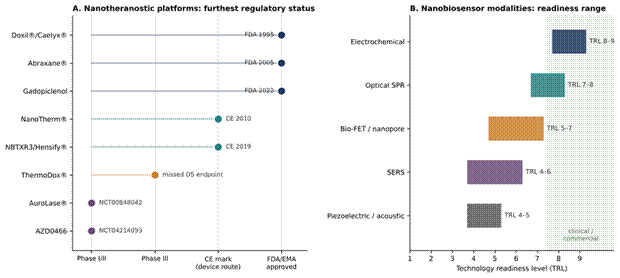
When clinical and regulatory records for representative platforms are placed side by side, the landscape looks distinctly two-speed (Table 2; Figure 4A). Monofunctional nanomedicines designed to solubilize cytotoxic drugs or alter their pharmacokinetics, such as Doxil® and Abraxane®, succeeded through ordinary NDA routes (505(b)(1) and 505(b)(2), respectively) (Breast Cancer Book, 2025). Multifunctional systems, on the other hand, have seen high attrition (Calatayud et al., 2022; Gidwani et al., 2025; Gupta et al., 2026).

4.2.2 Physical mechanisms as a faster route in Europe

Products that act through physical rather than pharmacological mechanisms appear to have entered the European market more easily (Gupta et al., 2026). NanoTherm®, aminosilane-coated iron oxide nanoparticles for magnetic hyperthermia in glioblastoma, was CE marked as a device in 2010. NBTXR3/Hensify®, hafnium oxide nanoparticles that physically amplify radiation dose in soft-tissue sarcoma, followed in 2019 (Gupta et al., 2026). It is tempting to read this as evidence that the device route is simply easier. That may be partly true, but these products were also delivered locally, which limits systemic exposure and narrows the toxicological questions regulators must answer.

4.2.3 Setbacks among systemically delivered theranostics

Systemically administered, multi-component theranostics have encountered more serious obstacles. ThermoDox®, a lysolipid-based thermosensitive liposome given with radiofrequency ablation for hepatocellular carcinoma, did not meet its primary overall-survival endpoint in Phase III, which illustrates how fragile tightly calibrated in vivo thermal triggers can be (Gupta et al., 2026; Wang et al., 2026). Inorganic core–shell constructs such as AuroLase® silica–gold nanoshells remain in early-phase studies (NCT00848042), largely because of concerns about long-term reticuloendothelial retention and the absence of biodegradation (Calatayud et al., 2022; Gidwani et al., 2025). The dendrimer conjugate AZD0466 is similarly still in Phase I/II evaluation (NCT04214093) (Table 2).

4.3 CMC Specifications, Critical Quality Attributes and Scale-Up Integrity

4.3.1 Size, polydispersity and surface charge

Analysis of CMC requirements suggests that the structural complexity of nanomedicines demands unusually tight process control under GMP (Ahmad et al., 2022; Fadeel et al., 2018; FDA, 2024). Unlike small molecules, nanomedicines are polydisperse multi-component assemblies, and the acceptance criteria reported across sources reflect this (Table 3). Regulatory filings typically expect a monomodal size distribution with a polydispersity index (PDI) of 0.2 or below, confirmed by orthogonal methods such as DLS, nanoparticle tracking analysis and cryo-TEM (Ahmad et al., 2022). Small shifts in hydrodynamic diameter can redirect clearance: particles under about 5.5 nm are excreted renally, while those above roughly 100 nm are captured by hepatic and splenic macrophages (Fadeel et al., 2018). A zeta potential of approximately ±20–30 mV, or adequate steric stabilization, is generally needed for colloidal stability, and strongly cationic surfaces are associated with membrane damage and endothelial toxicity (Ahmad et al., 2022).

4.3.2 Encapsulation, release and manufacturing technology

Encapsulation efficiencies above 85–90% and burst release below 10% in the first two hours under physiological conditions are commonly cited targets, intended to prevent premature leakage and erratic pharmacokinetics (Ahmad et al., 2022). Continuous microfluidic manufacturing has, on balance, shown advantages over batch synthesis in maintaining narrow PDI at scale (Roy et al., 2024), although the evidence for full commercial-scale equivalence is still limited.

4.3.3 Bio-nano interface and endotoxin interference

Two further issues recur. The protein corona alters surface properties in vivo and can trigger MPS uptake and CARPA (Ahmad et al., 2022; Fadeel et al., 2018; Figure 3). And the optical absorbance and light scattering of metallic and carbon-based nanomaterials can interfere with standard Limulus amebocyte lysate (LAL) endotoxin assays, so validated non-interfering methods, such as chromogenic or recombinant factor C assays, are expected before first-in-human studies (FDA, 2024).

4.4 Nanobiosensor Translation and Analytical-to-Clinical Concordance

4.4.1 A gap between analytical and clinical performance

Across transduction platforms, there is a clear gap between laboratory performance and clinical adoption (Aarabi & Faraji Azad, 2026; D'Alton et al., 2024; Ulucan-Karnak et al., 2024; Xia et al., 2024). Interestingly, the most sensitive technologies are not the most mature; if anything, the relationship runs the other way (Table 4; Figure 4B).

4.4.2 Mature platforms: electrochemical and SPR

Electrochemical biosensors based on carbon nanotubes, graphene or gold nanoparticles (TRL 8–9) are already widely commercialized, for example in continuous glucose monitors cleared as Class II 510(k) devices in the United States and classified as IVDR Class B or C in Europe (Pawnikar & Patel, 2025; Xia et al., 2024). Their success seems to rest on familiar predicates, reproducible microfabricated electrodes and simple electronic readouts. Optical surface plasmon resonance (SPR) systems (TRL 7–8) serve as reference laboratory tools for real-time affinity measurements down to picomolar levels, but bulky optics and high instrument cost limit their use at the point of care (D'Alton et al., 2024).

4.4.3 Emerging platforms: SERS and Bio-FETs

SERS platforms using plasmonic nanostars and nanozymes (TRL 4–6) can reach attomolar detection limits for circulating tumor DNA and microRNAs in liquid biopsies (Aarabi & Faraji Azad, 2026; Ulucan-Karnak et al., 2024). Yet substrate-to-substrate variability, signal drift in complex biofluids and the absence of standardized spectral reference libraries make PMA or IVDR Class D certification difficult (Ulucan-Karnak et al., 2024). Field-effect transistors based on graphene or molybdenum disulfide (MoS₂) (TRL 5–7) allow label-free, near single-molecule detection of pathogens, but Debye-length screening in high-ionic-strength samples and costly semiconductor fabrication remain significant barriers (Xia et al., 2024).

Figure 3. The bio-nano interface: protein corona formation, biological fate and nanotoxicological pathways that inform regulatory safety evaluation. After intravenous administration, nanoparticles rapidly adsorb plasma proteins, forming a protein corona that alters their size, charge and biological identity and may mask targeting ligands. Three downstream consequences follow: size-dependent fate (renal clearance below about 5.5 nm, hepatic and splenic MPS capture above about 100 nm, and prolonged retention of non-biodegradable materials), immune clearance (opsonization, anti-PEG antibody-mediated accelerated blood clearance and complement-activation-related pseudoallergy) and cellular toxicity (membrane damage, ROS, genotoxicity and inflammation). The bottom panel summarizes the corresponding regulatory data requirements and design strategies. Abbreviations: ABC, accelerated blood clearance; CARPA, complement-activation-related pseudoallergy; MPS, mononuclear phagocyte system; PCL, polycaprolactone; PLGA, poly(lactic-co-glycolic acid); ROS, reactive oxygen species


Figure 4. Translational maturity of representative nanotheranostic platforms and nanobiosensor modalities. (A) Furthest regulatory or clinical status reached by eight representative platforms listed in Table 2. Monofunctional nanomedicines and a contrast agent reached full FDA/EMA approval, physically acting nanotherapies (NanoTherm®, NBTXR3/Hensify®) obtained CE marks via device routes, ThermoDox® completed Phase III without meeting its primary overall-survival endpoint, and AuroLase® and AZD0466 remain in Phase I/II (ClinicalTrials.gov identifiers shown). (B) Approximate technology readiness level (TRL) ranges for five nanobiosensor transduction modalities listed in Table 4; the shaded area marks clinical or commercial readiness (TRL ≥ 8). The two panels together illustrate that regulatory simplicity and manufacturing reproducibility, rather than analytical sensitivity alone, predict translational progress. Abbreviations: Bio-FET, biological field-effect transistor; OS, overall survival; SERS, surface-enhanced Raman scattering; SPR, surface plasmon resonance.

5. Reconciling Innovation, Safety and Equitable Access in Nanotechnology Regulation

5.1 Regulation, Not Engineering Alone, Determines Which Nanotheranostics and Nanobiosensors Reach Patients

5.1.1 Regulation as a determinant of translation

Taken together, the findings suggest that the slow translation of nanotheranostics and nanobiosensors cannot be explained by engineering limitations alone. Regulatory architecture, it seems, shapes which products reach patients almost as much as scientific performance does (Csóka et al., 2021; Rodríguez-Gómez et al., 2025). The two-speed pattern in Table 2 and Figure 4A is telling. Products that fit neatly into an existing category, a reformulated drug or a locally acting physical device, have advanced; products that straddle categories have not (Gupta et al., 2026; Zhu et al., 2025). This is not a new observation, but the comparative view makes it harder to dismiss as coincidence.

5.1.2 Two philosophies, two sets of trade-offs

The contrast between the U.S. and EU approaches is perhaps best understood as a difference in philosophy rather than stringency (Table 1). The FDA's reliance on existing statutes and PMOA-based assignment offers flexibility but can leave sponsors unsure of their path (Jahnavi et al., 2025; FDA, 2024). The EU's explicit rules, Rule 19 and the IVDR above all, give clarity at the price of higher evidentiary and administrative burden (Klein et al., 2024; Sustainable PNC Review, 2026). Neither model is obviously superior. One could argue that predictability matters more to small developers than leniency, in which case the EU's clarity is an advantage; but Notified Body bottlenecks suggest that clarity without capacity offers limited comfort (Kang et al., 2023; Sharon et al., 2026).

5.2 Manufacturing Quality and Nanosafety as Shared Bottlenecks

5.2.1 Convergence on CQAs, divergence on methods

Regardless of jurisdiction, regulators converge on similar CQAs (Table 3; Figure 2). That convergence is encouraging. What is still lacking, though, is agreement on validated, nano-appropriate methods for measuring them (Fadeel et al., 2018; Souto et al., 2024). Endotoxin testing is a good illustration: if nanomaterials interfere with LAL assays, then a CQA that looks simple on paper becomes hard to verify in practice (FDA, 2024). Shared reference materials and inter-laboratory validated assay cascades, along the lines of the EU-NCL model, would probably do more to accelerate approvals than any single change in legislation (Gupta et al., 2026).

5.2.2 Long-term safety and the case for biodegradable design

Nanosafety raises a related, and arguably harder, problem. The bio-nano interface summarized in Figure 3 means that a particle's behavior in vivo may differ substantially from its behavior on the bench (Ahmad et al., 2022; Hirulkar et al., 2024). For non-biodegradable inorganic constructs, regulators are understandably cautious about tissue retention over months or years, and the AuroLase® experience suggests this caution translates directly into slower development (Calatayud et al., 2022; Gidwani et al., 2025). A shift toward biodegradable polymers and biomimetic coatings may ease some of these concerns (Rahman, 2026; Sustainable PNC Review, 2026), although these materials introduce their own characterization challenges, and long-term human data remain sparse. Organ-specific evidence from hepatocellular carcinoma, gastrointestinal and pancreatic applications points in the same direction: safety profiling has to be designed into development from the outset, not added at the end (Chen & Li, 2025; Viegas et al., 2023; Wang et al., 2026; Yang et al., 2026).

5.3 Nanobiosensors: Sensitivity Is Not Readiness

The biosensor findings carry a lesson that is, in a sense, counterintuitive. The platforms with the most impressive analytical sensitivity, SERS and Bio-FETs, are also among the least mature (Table 4; Figure 4B). Exceptional limits of detection matter less to regulators than reproducibility, robustness in real biofluids and demonstrated clinical validity (D'Alton et al., 2024; Ulucan-Karnak et al., 2024). Electrochemical sensors succeeded largely because they could be compared with existing predicates and manufactured reproducibly (Pawnikar & Patel, 2025; Quesada-González & Merkoçi, 2018). For developers, this suggests that investment in standardization, manufacturing consistency and early engagement with regulators may pay off more than further gains in sensitivity (Aarabi & Faraji Azad, 2026; Xia et al., 2024).

5.4 Equity and the Position of Emerging Markets

Emerging-market regulators face a double bind. Without nano-specific frameworks, they depend on foreign precedent, which delays local access and may not reflect local disease burden (Chávez-Hernández et al., 2024; Gupta et al., 2026). Yet building full domestic capacity, from TEM and ICP-MS facilities to GMP-compliant cleanrooms, is expensive (Breast Cancer Book, 2025; Musa et al., 2025). Reliance pathways, regional work-sharing and mutual recognition of characterization data generated under ISO-aligned methods could offer a middle route (ISO, 2025; Pawnikar & Patel, 2025). The MFDS experience with companion diagnostics suggests that targeted national guidance is achievable even without a comprehensive nano-statute (Kang et al., 2023).

5.5 Next-Generation Challenges: AI, Closed-Loop Systems and Adaptive Trials

AI-guided nanodesign and closed-loop theranostic–sensor systems will probably test existing frameworks further. A product whose formulation is optimized by a learning algorithm, or whose dosing responds to continuous biosensor readings, does not fit neatly into drug, device or software categories (Musa et al., 2025). Explainability requirements, data-provenance rules and cybersecurity standards will need to be integrated with traditional CMC and safety review (Pawnikar & Patel, 2025). Adaptive, basket and umbrella trial designs, together with real-world evidence, may make evaluation more feasible for small, molecularly defined populations (Breast Cancer Book, 2025; Sharon et al., 2026), though their acceptance still varies between agencies.

5.6 Toward a Regulatory Roadmap

Drawing these strands together, we propose five practical priorities. First, early and binding jurisdictional determination for combination nanotheranostics, so that sponsors know their lead center and evidentiary standard before pivotal studies begin (Gupta et al., 2026; Jahnavi et al., 2025). Second, internationally validated, nano-appropriate assay cascades and reference materials for CQAs and immunotoxicity, building on EU-NCL and ISO/TC 229 work (Fadeel et al., 2018; ISO, 2025). Third, expanded Notified Body and reviewer capacity, without which stricter EU rules risk becoming a de facto barrier (Kang et al., 2023; Sharon et al., 2026). Fourth, reliance and mutual-recognition mechanisms that allow emerging-market regulators to use high-quality foreign data while retaining local oversight (Chávez-Hernández et al., 2024; Gupta et al., 2026). Fifth, explicit guidance for AI-enabled and closed-loop nanosystems (Musa et al., 2025). None of these is simple, and some may meet resistance from agencies protective of their own procedures. Still, they would address the bottlenecks identified most consistently across the evidence (Figure 1).

5.7 Strengths and Limitations of this study

This review has several strengths: it compares three regulatory settings within one analytical frame, links regulatory requirements to concrete platforms and biosensor modalities, and draws on primary guidance and standards where possible. It also has limitations. As a narrative review, it is open to selection bias, and the evidence base mixes peer-reviewed analyses with regulatory documents of differing currency. Regulatory frameworks change quickly, so some details may already be outdated. Emerging markets other than India, China, South Korea and Brazil were covered only briefly, and English-language restriction may have excluded relevant national guidance. Finally, TRL assignments for biosensor modalities are necessarily approximate and represent ranges rather than precise values (Table 4).

6. Conclusion

Nanotheranostics and nanobiosensors have repeatedly shown their potential in the laboratory, yet few have reached the clinic. This review suggests that regulation, as much as engineering, explains the gap. The FDA's flexible but sometimes uncertain use of existing statutes, the EU's clearer but more demanding nano-specific rules, and the fragmented frameworks of emerging markets each create distinct obstacles. Products acting through physical mechanisms or simple reformulations have advanced; complex, systemically delivered multifunctional systems have struggled. Across all jurisdictions, inconsistent CQA methods, unresolved long-term nanotoxicology and limited validation of diagnostic performance remain shared barriers. Progress will likely depend on early jurisdictional clarity, validated nano-specific assays, expanded review capacity, mutual recognition and guidance for AI-enabled systems. None of these steps requires lowering safety standards. Coordinated action on these fronts could help bring safe, effective and affordable nanomedicine to patients worldwide, not only to those in high-income health systems.

References


Aarabi, M., & Faraji Azad, H. (2026). Review of advanced nanosensors in nanomedicine: Bridging biosensing innovations with therapeutic applications. IET Science, Measurement & Technology, 20(3), 112–135.

Ahmad, A., Imran, M., & Sharma, N. (2022). Precision nanotoxicology in drug development: Current trends and challenges in safety and toxicity implications of customized multifunctional nanocarriers for drug-delivery applications. Pharmaceutics, 14(11), 2463.

Breast Cancer Book. (2025). Translational nanotechnology in oncology: Bench-to-bedside paradigm shifts. Academic Press.

Calatayud, D. G., Neophytou, S., Nicodemou, E., Giuffrida, S. G., Ge, H., & Pascu, S. I. (2022). Nano-theranostics for the sensing, imaging and therapy of prostate cancer. Frontiers in Chemistry, 10, 830133.

Chávez-Hernández, J. A., Velarde-Salcedo, A. J., Navarro-Tovar, G., & Gonzalez, C. (2024). Safe nanomaterials: From their use, application, and disposal to regulations. Nanoscale Advances, 6(6), 1583–1610.

Chen, L., & Li, Q. (2025). Nanosystems for drug delivery to gastrointestinal tumors: Advances and clinical translation. Materials Today Bio, 32, 101782.

Csóka, I., Ismail, R., Jójárt-Laczkovich, O., & Pallagi, E. (2021). Regulatory considerations, challenges and risk-based approach in nanomedicine development. Current Medicinal Chemistry, 28(36), 7461–7476. https://doi.org/10.2174/0929867328666210406115529

D’Alton, L., Souto, D. E. P., Punyadeera, C., Abbey, B., Voelcker, N. H., Hogan, C., & Silva, S. M. (2024). A holistic pathway to biosensor translation. Sensors & Diagnostics, 3(8), 1234–1246.

Fadeel, B., Farcal, L., Hardy, B., Vázquez-Campos, S., Hristozov, D., Marcomini, A., Lynch, I., Valsami-Jones, E., Alenius, H., & Savolainen, K. (2018). Advanced tools for the safety assessment of nanomaterials. Nature Nanotechnology, 13(7), 537–543. https://doi.org/10.1038/s41565-018-0185-0

Funkhouser, J. (2002). Reinventing pharma: The theranostic revolution. Current Drug Discovery, 2(2), 17–19.

Gidwani, B., Sahu, V., Shah, K., Chauhan, N. S., Alomary, M. N., Ansari, M. A., & Anand, S. (2025). Nanotheranostics: Emerging nanomachines as pharmacotherapeutics. 3 Biotech, 15(11), 442. https://doi.org/10.1007/s13205-025-04589-8

Gupta, D., Kumar, S., & Sharma, R. (2026). Nanotechnology-driven cancer theranostics: Translational hurdles, regulatory landscapes, and clinical perspectives. International Journal of Nanomedicine, 21, 568254. https://doi.org/10.2147/IJN.S568254

Hirulkar, R., Chaurawal, N., Alhodieb, F. S., Barkat, H., Preet, S., & Raza, K. (2024). Nanotheranostics: Clinical status, toxicity, regulatory consideration, and future prospects. In M. A. Barkat, F. J. Ahmad, M. A. Rahman, & M. A. Ansari (Eds.), Nanotheranostics for diagnosis and therapy (pp. 215–242). Springer.

International Organization for Standardization. (2025). Biological evaluation of medical devices — Part 1: Evaluation and testing within a risk management process (ISO Standard No. 10993-1:2025). https://www.iso.org/standard/10993-1

Jahnavi, E. P., et al. (2025). Nanotheranostic agents: Engineering, applications, and translational challenges. Journal of Healthcare Engineering and Diagnostics, Article 10.69613/jh2dqe17.

Kang, S. L., Woo, J. H., Kim, N. H., Kwon, J. Y., & Kim, S. M. (2023). Necessity of strengthening the current clinical regulatory for companion diagnostics: An institutional comparison of the FDA, EMA, and MFDS. Molecular Therapy: Methods & Clinical Development, 30, 447–458.

Kim, T. H., Lee, S., & Chen, X. (2013). Nanotheranostics for personalized medicine. Expert Review of Molecular Diagnostics, 13(3), 257–269. https://doi.org/10.1586/erm.13.15

Klein, K., Langhof, H., Ehmann, F., Tzara, A., Giuliani, A., Reischl, I. G., et al. (2024). Heterogeneity of regulatory approval pathways for nanomedicinal products in the EU—but broadly applicable to nanocarriers including those targeting the BBB. The AAPS Journal, 26(5), 102.

Musa, S. S., et al. (2025). The fusion of molecular-scale engineering in nanotechnology with machine learning analytics in precision medicine. Intelligence-Based Medicine, 12, 100267. https://doi.org/10.1016/j.ibmed.2025.100267

Pawnikar, V., & Patel, M. (2025). Biosensors in wearable medical devices: Regulatory framework and compliance across US, EU, and Indian markets. In Biosensors and bioelectronics: Healthcare applications (Vol. 83, pp. 637–648). Elsevier.

Quesada-González, D., & Merkoçi, A. (2018). Nanomaterial-based devices for point-of-care diagnostic applications. Chemical Society Reviews, 47(13), 4697–4709.

Rahman, M. Z. (2026). Sustainable polymer nanocomposites for biomedical and smart applications: Translational challenges and regulatory expectations. Materials Today Communications, 42, 116193. https://doi.org/10.1016/j.mtcomm.2026.116193

Rodríguez-Gómez, F. D., Monferrer, D., Penon, O., & Rivera-Gil, P. (2025). Regulatory pathways and guidelines for nanotechnology-enabled health products: A comparative review of EU and US frameworks. Frontiers in Medicine, 12, 1544393. https://doi.org/10.3389/fmed.2025.1544393

Roy, S., Kumar, R., Acooli, A., Roy, S., Chatterjee, A., Chattaraj, S., Nayak, J., Jeon, B. H., Basu, A., Banerjee, S., & Chakrabortty, S. (2024). Transforming nanomaterial synthesis through advanced microfluidic approaches: A review on accessing unrestricted possibilities. Journal of Composites Science, 8(10), 386.

Sharon, S., Mainkar, G., & Zangi, L. (2026). Personalized nanomedicine: Integrating molecular stratification with engineered delivery systems. Journal of Nanotheranostics, 7(2), 9–22. https://doi.org/10.3390/jnt7020009

Souto, E. B., Blanco-Llamero, C., Krambeck, K., Kiran, N. S., Yashaswini, C., Postwala, H., Severino, P., Priefer, R., Prajapati, B. G., & Maheshwari, R. (2024). Regulatory insights into nanomedicine and gene vaccine innovation: Safety assessment, challenges, and regulatory perspectives. Acta Biomaterialia, 180, 1–17. https://doi.org/10.1016/j.actbio.2024.04.010

Sustainable PNC Review. (2026). Sustainable polymer nanocomposites in healthcare: Clinical translation, environmental life-cycle analysis, and regulatory policy. Materials Today Bio, 34, 101890.

U.S. Food and Drug Administration. (2004). Innovation or stagnation: Challenge and opportunity on the critical path to new medical products. U.S. Department of Health and Human Services.

U.S. Food and Drug Administration. (2024). Considerations for drug products, including biological products, that contain nanomaterials: Guidance for industry. Center for Drug Evaluation and Research.

Ulucan-Karnak, F., Kuru, C. I., & Akgöl, S. (2024). Commercial roadmap of nanobiosensor development. Frontiers in Nanotechnology, 6, 1348308.

Viegas, C., Patrício, A. B., Prata, J., Fonseca, L., Macedo, A. S., Duarte, S. O. D., et al. (2023). Advances in pancreatic cancer treatment by nano-based drug delivery systems. Pharmaceutics, 15(9), 2363.

Wang, X., et al. (2026). Nanotechnology-enabled modalities for hepatocellular carcinoma: Therapeutic advances and safety profiling. International Journal of Nanomedicine, 21, 581911. https://doi.org/10.2147/IJN.S581911

Xia, Q., Jiang, H., Liu, X., Yin, L., & Wang, X. (2024). Advances in engineered nano-biosensors for bacteria diagnosis and multidrug resistance inhibition. Biosensors, 14(2), 59. https://doi.org/10.3390/bios14020059

Yang, Z., et al. (2026). Nano-reagents in acute pancreatitis: Translational landscape and clinical challenges. International Journal of Nanomedicine, 21, 562220. https://doi.org/10.2147/IJN.S562220

Zhu, Y., et al. (2025). Multifunctional nanomaterials for cancer theranostics: Regulatory perspectives and clinical translation. International Journal of Nanomedicine, 20, 13689–13719.


Article metrics
View details
0
Downloads
0
Citations
33
Views

View Dimensions


View Plumx


View Altmetric


0
Save
0
Citation
33
View
0
Share