This section organizes the current evidence base along the logical arc of a manufacturing problem: first the microscale physics that gives microfluidics its control, then a head-to-head comparison with conventional bulk methods, the specific mechanics of theranostic co-encapsulation, the engineering of scale-up, and finally the quality and process-control architecture required for regulated production.
2.1 The Physics of Microfluidic Self-Assembly and CQA Tuning
Liposomes are self-assembled phospholipid vesicles comprising an aqueous lumen enclosed by one or more bilayers, and their amphiphilic organization permits the simultaneous entrapment of hydrophilic compounds in the core, hydrophobic drugs within the acyl-chain region, and surface-bound ligands at the lipid-water interface (Bozzuto & Molinari, 2015). In a microfluidic device, the event that governs vesicle formation is controlled mixing at the microscale, where low Reynolds numbers (Re < 2300) enforce a laminar regime dominated by viscous rather than inertial forces (Jahn et al., 2004). Within a two- or three-dimensional hydrodynamic flow focusing (HFF) geometry, phospholipids dissolved in a water-miscible organic solvent are introduced through a central channel and squeezed into a thin sheet by flanking aqueous streams (Jahn et al., 2004; Ran et al., 2016; Amrani & Tabrizian, 2018). The full sequence, from focused stream to closed vesicle, is summarized in (Figure 1).
As the miscible solvent diffuses laterally into the surrounding buffer, local polarity climbs sharply, lipid solubility collapses, and amphiphilic molecules aggregate into intermediate planar disc-like bilayer fragments (Al-Ahmady et al., 2018; Ran et al., 2016). These discs grow in a reaction-rate-limited manner until the line energy of their exposed hydrophobic edges exceeds the bending energy needed to curve the membrane, at which point they close into spherical small unilamellar vesicles (SUVs) (Han et al., 2022). The practical consequence is that vesicle diameter is not set by chance but by transport kinetics the operator can dial.
Microfluidic processing therefore offers direct command of the CQAs that matter clinically: mean hydrodynamic diameter, PDI, zeta potential, and lamellarity (Kiuchi et al., 2025; Patel et al., 2025). Diameter can be tuned across roughly 20 to 200 nm with narrow, monodisperse distributions (PDI < 0.2) by adjusting the flow rate ratio (FRR) between aqueous and organic channels and the total flow rate (TFR) (Skupin-Mrugalska et al., 2021; Ran et al., 2016; Amrani & Tabrizian, 2018). Increasing the FRR narrows the focused lipid core, shortens the diffusive path for solvent exchange, and accelerates the solubility transition (Ran et al., 2016; Han et al., 2022); because this limits the growth window of the intermediate discs before closure, the result is smaller vesicles with lower size variance (Han et al., 2022; Kastner et al., 2014). Beyond size, static mixers and controlled flow velocities let researchers regulate lamellarity itself, tuning the number of concentric bilayers through lipid concentration and fluid velocity, a degree of structural control that bulk mixing, which tends to default to multilamellar or large unilamellar vesicles, cannot offer (Kiuchi et al., 2025; Ota et al., 2023).
2.2 Microfluidic versus Conventional Bulk Manufacturing
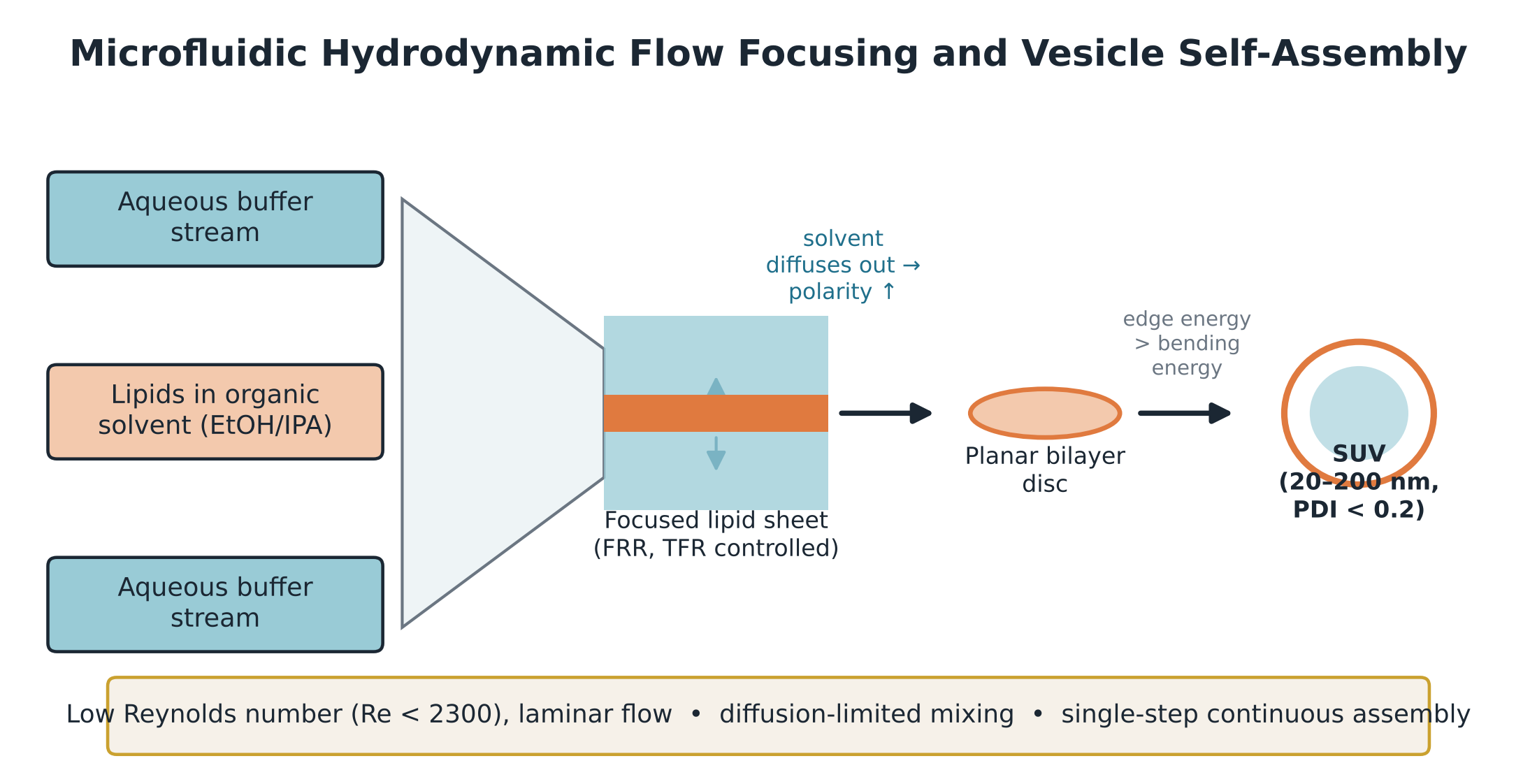
Figure 1. Microfluidic hydrodynamic flow focusing and the mechanism of vesicle self-assembly. Lipids dissolved in a water-miscible organic solvent enter through a central channel and are hydrodynamically focused into a thin sheet by flanking aqueous buffer streams. As solvent diffuses outward and local polarity rises, lipids aggregate into planar bilayer discs that close into small unilamellar vesicles once edge energy exceeds membrane bending energy. The process runs under laminar flow (Re < 2300) with diffusion-limited mixing, yielding size-tunable (20-200 nm), low-PDI vesicles in a single continuous step.
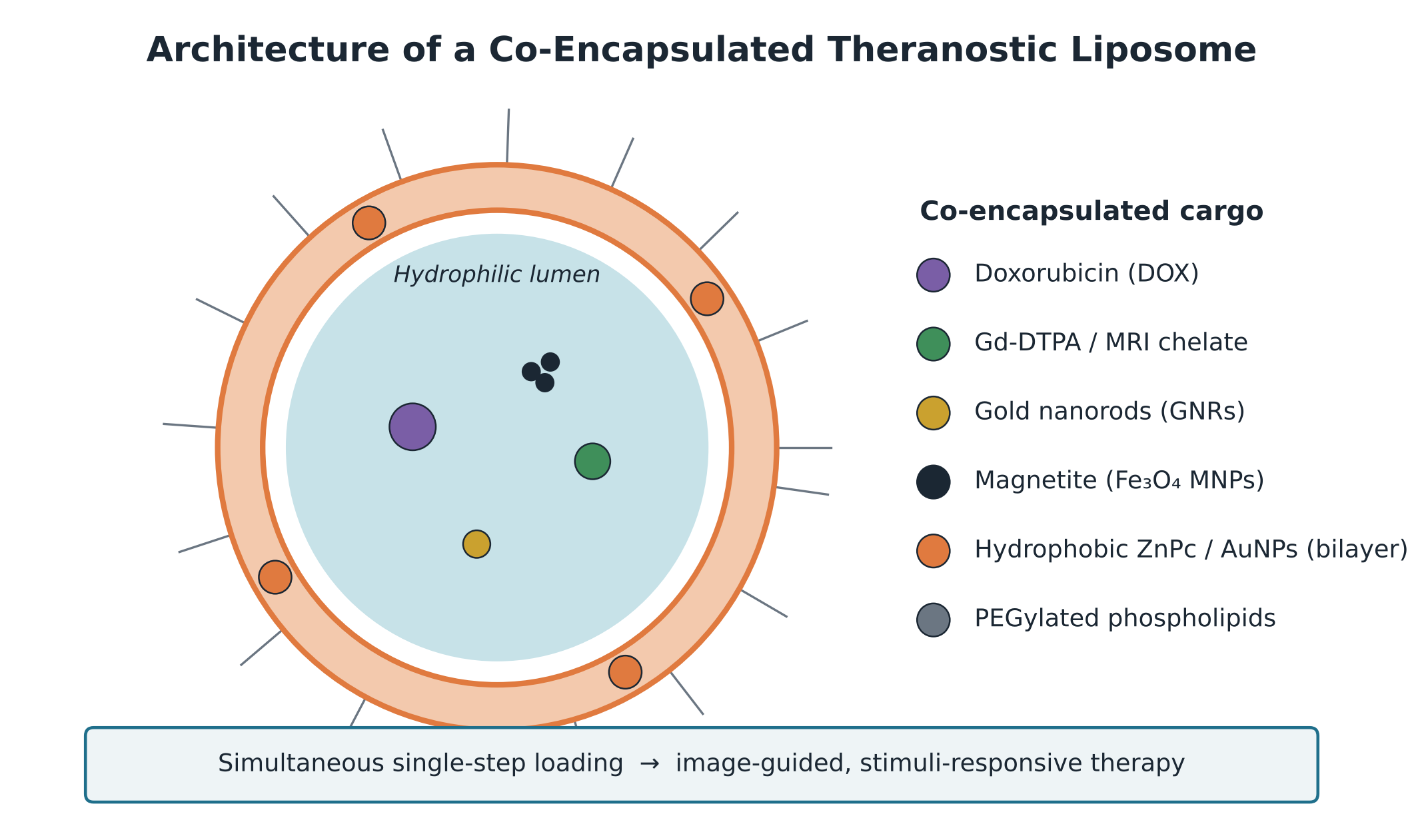
Figure 2. Architecture of a co-encapsulated theranostic liposome. Schematic of a multifunctional vesicle showing how distinct cargoes partition by physicochemistry: hydrophilic agents (doxorubicin, Gd-DTPA chelates, gold nanorods, iron oxide nanoparticles) reside in the aqueous lumen, hydrophobic agents (zinc phthalocyanine, gold nanoparticles) embed within the lipid bilayer, and PEGylated phospholipids decorate the surface. Single-step microfluidic assembly loads these components simultaneously at defined stoichiometry, enabling image-guided, stimuli-responsive therapy from one construct.
The historical barrier to liposomal translation has been the physics of macroscale batch processing itself (Amrani & Tabrizian, 2018; Lamprou et al., 2021; Ballacchino et al., 2021). Thin-film hydration, reverse-phase evaporation, ethanol injection, and detergent dialysis all rely on chaotic bulk mixing in which concentration, shear, and thermal gradients coexist throughout the vessel (Basak et al., 2025; Lamprou et al., 2021). Bulk hydration consequently yields large, polydisperse, multilamellar populations that must be downsized by repeated homogenization or extrusion (Bozzuto & Molinari, 2015; Skupin-Mrugalska et al., 2021). A point-by-point contrast of the two paradigms, spanning fluid dynamics, size control, lamellarity, payload entrapment, throughput, and GMP readiness, is given in (Table 1).
Those secondary operations are not free. High-pressure extrusion and probe sonication subject delicate ingredients, among them nucleic acids, peptides, and proteins, to shear and localized heating, with attendant degradation or leakage (Khadke et al., 2019; Amrani & Tabrizian, 2018). Ultrasonic tip erosion can seed metallic particulate contaminants, while extrusion membranes clog and cap yield (Basak et al., 2025; Ballacchino et al., 2021). Layered on top is the inter-batch inconsistency that follows from small variations in manual mixing speed, vessel geometry, and cooling rate (Basak et al., 2025).
Continuous-flow microfluidics addresses these problems at their root by consolidating hydration, particle formation, and drug loading into one automated step (Skupin-Mrugalska et al., 2021; Al-Ahmady et al., 2018; Ran et al., 2016). Because self-assembly repeats within identical channel geometries under steady-state conditions, batch-to-batch variation is largely designed out rather than corrected after the fact (Basak et al., 2025; Lamprou et al., 2021). Comparative work reports that microfluidic theranostic liposomes reach median diameters up to 2.5 times smaller (under 50 nm) with markedly lower polydispersity (PDI < 0.15) than thin-film hydration followed by extrusion (Skupin-Mrugalska et al., 2021).
2.3 Co-Encapsulation Mechanics of Theranostic Cargoes
The defining feature of a theranostic liposome is that it carries therapy and diagnosis together, enabling real-time imaging, target tracking, and non-invasive monitoring of treatment from within one vesicle (Lu et al., 2016; Skupin-Mrugalska et al., 2021). The generic architecture, hydrophilic agents in the lumen, hydrophobic agents in the bilayer, and PEGylated or targeting lipids at the surface, is depicted in (Figure 2). Assembling such constructs by bulk methods is notoriously unreliable, since multi-component payloads tend to displace one another or phase-separate, producing low yields, broad size distributions, and erratic drug-to-probe stoichiometry (Skupin-Mrugalska et al., 2021; Al-Ahmady et al., 2018).
Microfluidic continuous assembly improves incorporation of both hydrophilic and hydrophobic agents (Al-Ahmady et al., 2018; Skupin-Mrugalska et al., 2021). For hydrophobic cargoes seated in the bilayer, such as ZnPc photosensitizers for photodynamic therapy or hydrophobic gold nanoparticles, microfluidic mixing delivers a two- to three-fold increase in loading over reverse-phase evaporation or thin-film hydration (Skupin-Mrugalska et al., 2021; Al-Ahmady et al., 2018). In one illustrative case, 2-4 nm gold nanoparticles co-assembled into liposomal membranes achieved a gold-to-lipid weight ratio above 60%, roughly three-fold higher than reverse-phase evaporation, with cryo-TEM and small-angle neutron scattering confirming clean embedding within the hydrophobic domain and only a slight stiffening of the bilayer rather than aggregation or disruption (Al-Ahmady et al., 2018).
The same single-step mixing supports genuine multi-component co-encapsulation (Ran et al., 2016; Fernandes et al., 2023). Investigators have built thermosensitive liposomes that hold doxorubicin in the lumen alongside superparamagnetic iron oxide nanoparticles and gold nanorods (Lv et al., 2021; Ran et al., 2016). Operating near an FRR of 4:1 and a TFR of 25 mL/min, microfluidics produced uniform folate-targeted magnetoliposomes (around 230 nm, PDI < 0.15) with high doxorubicin entrapment and superparamagnetic behaviour (Lv et al., 2021). Near-infrared irradiation of the embedded nanorods drove local heating above the lipid phase-transition temperature and triggered controlled release, with the paired chemo-photothermal action producing synergistic cytotoxicity in tumour models (Lv et al., 2021; Ran et al., 2016). Co-loading paramagnetic MRI agents such as PE-DTPA-Gd with ZnPc likewise improved longitudinal and transverse relaxivity relative to thin-film-hydrated vesicles, an effect attributed to the smaller diameter, higher surface-area-to-volume ratio, and altered water permeability of uniformly loaded membranes (Skupin-Mrugalska et al., 2021; Skupin-Mrugalska et al., 2018). The broader family of multi-modal payload combinations and their triggered-
Table 1. Mechanistic and performance comparison of conventional bulk versus microfluidic liposome manufacturing. This table contrasts the two manufacturing paradigms across eight dimensions, spanning fluid-mixing dynamics, particle-size control, polydispersity, lamellarity, secondary processing, hydrophobic co-encapsulation, scalability, and process-analytical integration. For each dimension it states the limitation of bulk methods, the corresponding microfluidic advantage, and the downstream consequence for critical quality attributes and GMP readiness. It is intended as the high-level map against which the study-level detail in Tables 2 to 4 should be read.
|
Feature / Performance Metric
|
Conventional Bulk Methods (TLH, ethanol injection, extrusion, sonication)
|
Microfluidic Continuous Processing (2D/3D HFF, herringbone, vortex, static mixers)
|
Impact on CQAs & GMP Process Design
|
Key References (APA)
|
|
Fluid mixing dynamics & flow regimes
|
Macroscale chaotic mixing; local concentration, thermal, and shear gradients throughout the vessel.
|
Sub-millimetre laminar flow (Re < 2300) or controlled chaotic/vortical mixing; rapid, predictable diffusive transport.
|
Eliminates localized mixing gradients, giving homogeneous supersaturation during self-assembly.
|
Amrani & Tabrizian, 2018; Lamprou et al., 2021; Skupin-Mrugalska et al., 2021
|
|
Particle size control & tunability
|
Heterogeneous (50-500 nm); needs secondary mechanical downsizing (extrusion, homogenization).
|
Precisely tunable 20-200 nm in a single step via FRR and TFR modulation.
|
Enables size tuning for circulation half-life, clearance, and EPR-based tumour targeting.
|
Han et al., 2022; Skupin-Mrugalska et al., 2021; Zhigaltsev et al., 2012
|
|
Polydispersity (PDI) & monodispersity
|
Broad distributions (PDI 0.30-0.50); significant batch-to-batch variance from manual handling.
|
Highly monodisperse (PDI < 0.20, down to 0.04 in vortex focusing) with strong inter-batch reproducibility.
|
Ensures uniform pharmacokinetics and biodistribution across clinical batches.
|
Amrani & Tabrizian, 2018; Han et al., 2022; Kastner et al., 2014
|
|
Vesicle lamellarity & structure
|
Predominantly multilamellar (MLVs) or large unilamellar vesicles requiring energetic breakdown.
|
Small unilamellar vesicles; lamellarity (1-16 rings) modulated via total flow velocity in static mixers.
|
Layer control tunes drug-retention kinetics, membrane rigidity, and biosensing signal intensity.
|
Kiuchi et al., 2025; Ota et al., 2023
|
|
Downsizing & secondary processing
|
Mandatory extrusion/sonication; causes shear degradation, probe metal contamination, membrane clogging.
|
Single-step continuous self-assembly; no secondary mechanical downsizing required.
|
Reduces step loss, preserves labile biologics/nucleic acids, and shortens cycle time.
|
Bozzuto & Molinari, 2015; Khadke et al., 2019; Lamprou et al., 2021
|
|
Hydrophobic payload & co-encapsulation
|
Low efficiency for hydrophobic drugs/nanoparticles; waste, precipitation, competitive displacement.
|
Two- to three-fold higher efficiency for hydrophobic photosensitizers (ZnPc) and metallic NPs (AuNPs).
|
Enables single-step co-entrapment of complementary therapeutic and diagnostic agents at high yield.
|
Al-Ahmady et al., 2018; Ran et al., 2016; Skupin-Mrugalska et al., 2021
|
|
Process continuity & scalability
|
Discontinuous batch operations limited by vessel volume; hard to scale without altering kinetics.
|
Scalable continuous flow via numbering-up, 3D-printed multilayer chips, or vortex focusing.
|
Allows benchtop-to-commercial transition without full process re-validation.
|
Basak et al., 2025; Han et al., 2022; Shan et al., 2021
|
|
PAT integration & quality control
|
Off-line QC after batch completion; high risk of batch rejection on failure.
|
In-line/at-line PAT (DLS, NTA, UV-Vis) with automated closed-loop feedback control.
|
Continuous real-time CQA monitoring under FDA/EMA Quality by Design mandates.
|
Basak et al., 2025; Kabay et al., 2022; Patel et al., 2025
|
2. Representative microfluidic liposome studies with device, formulation, process, and outcome parameters. This matrix compiles seven representative studies, from 2D flow focusing and static mixers to 3D-printed and vortex-focusing platforms, detailing device architecture, lipid composition and molar ratio, operating flow parameters (FRR, TFR, or total fluid velocity), resulting hydrodynamic size and PDI, entrapment or loading metrics, and the intended theranostic application. Values are reported as stated in the source studies; because geometries and reporting conventions differ, entries are indicative for cross-study comparison rather than strictly commensurable.
|
Study (APA)
|
Device / Mixer Type
|
Lipid Composition & Molar Ratio
|
Operating Parameters (FRR, TFR/TFV)
|
Size (Z-avg) & PDI
|
Encapsulation Efficiency / Loading
|
Main Cargo & Theranostic Application
|
|
Skupin-Mrugalska et al. (2021)
|
Microfluidic micromixer (FRR 3:1 & 5:1)
|
POPG/POPC/PE-DTPA-Gd/ZnPc (2:8:0.75:0.05)
|
FRR 3:1-5:1; TFR 8-12 mL/min
|
20.0-35.0 nm (~2.5x smaller than TLH); PDI < 0.10
|
ZnPc EE 60.6-76.2% (2x > TLH); Gd recovery 0.31-0.75 mM
|
ZnPc + PE-DTPA-Gd for bimodal MRI & PDT of head/neck cancer
|
|
Lv et al. (2021)
|
One-step microfluidic mixer chip
|
DPPC/Cholesterol/DSPE-PEG2K/DSPE-PEG2K-FA (90:5:3.5:1.5)
|
FRR 4:1 (aqueous:methanol); TFR 25 mL/min
|
230 nm (blank 95 nm); PDI 0.11
|
DOX EE 28.6-79.0%; DOX loading 0.57 mg/mL; magnetization 20 emu/g
|
DOX + MNPs (10 nm) + GNRs (41x7 nm) for chemo-photothermal therapy of bladder cancer
|
|
Han et al. (2022)
|
SLA-DLP 3D-printed vortex focusing (MVF) hydrocyclone
|
DMPC/Cholesterol/DCP (5:4:1) or DMPC/Cholesterol/PEG2k-PE (5:4:1)
|
FRR 10:1-100:1; TFR 10-80 mL/min
|
27.0-127.0 nm (FRR-tunable); PDI 0.04
|
Complete lipid incorporation; mass throughput > 20 g/h
|
Size-tunable, ultra-monodisperse liposomes for scalable nanomedicine manufacturing
|
|
Shan et al. (2021)
|
PuSL 3D-printed three-layer integrated chip (400 um channels)
|
Phospholipids + cholesterol in isopropanol + aqueous buffer
|
FRR 14.2-48.7; ultra-high TFR 72.6-474.0 mL/min
|
64.0-154.0 nm (FRR-controlled); PDI < 0.20
|
High-volume single-step self-assembly under turbulent flow (Re > 2300)
|
Ultra-high-throughput nanoliposome production for molecular imaging & drug delivery
|
|
Amrani & Tabrizian (2018)
|
2D hydrodynamic flow focusing (HFF) planar PDMS device
|
DPPC +/- DOPG or DDAB in ethanol
|
FRR 5:1-50:1; TFR varied
|
60.0-800.0 nm (100 nm at FRR 50); PDI < 0.35
|
Particle concentration by NTA up to 1740 x 10^8 particles/mL in < 2 min
|
FITC-labelled LC-TAT peptide encapsulation for targeted HIV therapy & real-time NTA
|
|
Kiuchi et al. (2025)
|
In-line static-mixer microfluidic channel (0.6 or 1.0 mm diameter)
|
Phospholipids in ethanol + aqueous buffer
|
FRR 2:1-9:1; TFV 3.2-70.7 cm/s
|
100.0-300.0 nm; PDI < 0.20
|
Lamellarity 1-16 rings tuned via TFV & initial lipid conc. (30-120 mg/mL)
|
Size- and lamellarity-controlled liposomal probes for enhanced bioimaging/biosensing
|
|
Ballacchino et al. (2021)
|
FDM & LCD 3D-printed chips (circular Y, square Y, zigzag, half-moon)
|
DMPC/Cholesterol (2:1 molar ratio)
|
FRR 1:1 & 1:3; TFR 1-3 mL/min
|
180.0-360.0 nm; PDI ~0.20; zeta ~ -9 mV
|
High curcumin loading; stable continuous release at 37 C
|
Curcumin-loaded anticancer liposomes across novel 3D-printed channel geometries
|
release mechanisms is catalogued in (Table 3).
2.4 Advanced Micromixing Architectures and High-Throughput Scale-Up
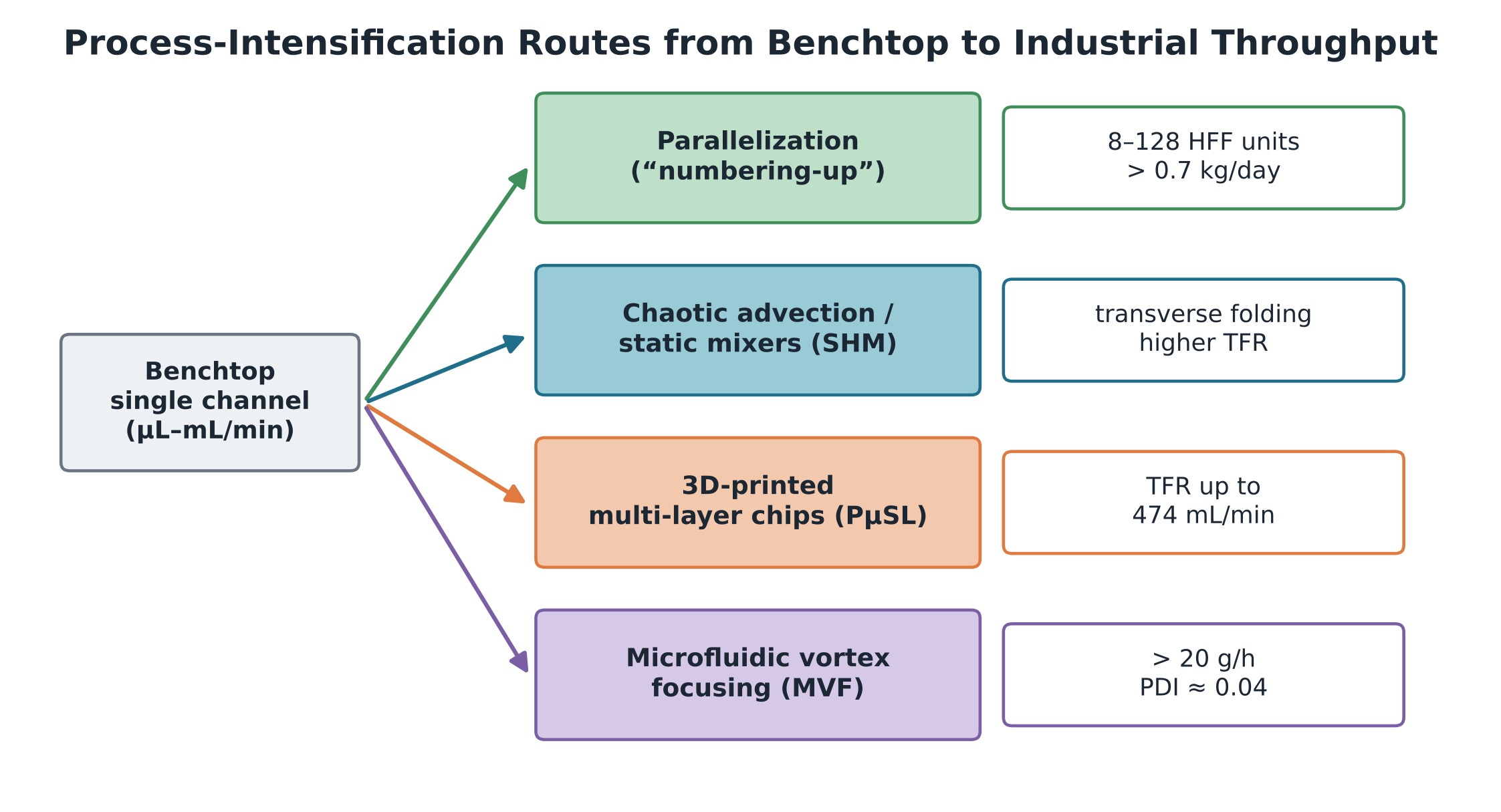
For all its analytical appeal, single-channel benchtop microfluidics produces only milligram quantities at microlitre-to-millilitre flow rates, far short of what trials or markets require (Amrani & Tabrizian, 2018; Han et al., 2022; Liu et al., 2022). Scaling by enlarging channels fails, because larger bores break the laminar regime, broaden diffusive length scales, and forfeit size control (Shan et al., 2021; Han et al., 2022). The field's answer has been process intensification that preserves the microscale physics while multiplying it, as mapped in (Figure 3) and quantified across representative devices in (Table 2) and (Table 4).
Four strategies dominate the literature:
-
Parallelization (numbering-up). Replicating dozens to hundreds of identical channels on one substrate; branched-manifold arrays of 8 to 128 HFF units have reached production rates above 0.7 kg/day while holding local mixing parameters constant across channels (Liu et al., 2022; Kabay et al., 2022).
-
Chaotic advection and static mixers. Internal microstructures such as staggered herringbone mixers, Tesla elements, or static-mixer inserts generate transverse chaotic advection that repeatedly splits, folds, and recombines the streams, shortening diffusion distances and enabling rapid mixing at higher flow rates (Kiuchi et al., 2025; Kabay et al., 2022; Ota et al., 2023).
-
Additive manufacturing of multilayer devices. High-resolution 3D printing, notably projection micro-stereolithography at roughly 10 micrometre resolution, yields stacked-channel chips that withstand high pressure without delamination and sustain total flow rates up to 474 mL/min; at such velocities the regime shifts from laminar to controlled turbulence (Re > 2300), where intense shear still produces sub-100 nm, low-PDI liposomes (Shan et al., 2021; Ballacchino et al., 2021).
-
Microfluidic vortex focusing (MVF). Miniature hydrocyclonic chambers establish a rotational field around an axial lipid core; tangential buffer injection drives rapid convective stretching near the laminar limit, supporting mass production above 20 g/h in a single device while tuning diameter from 127 nm down to 27 nm at an exceptionally low PDI (Han et al., 2022).
2.5 Batch Consistency, Quality by Design, and Process Analytical Technology
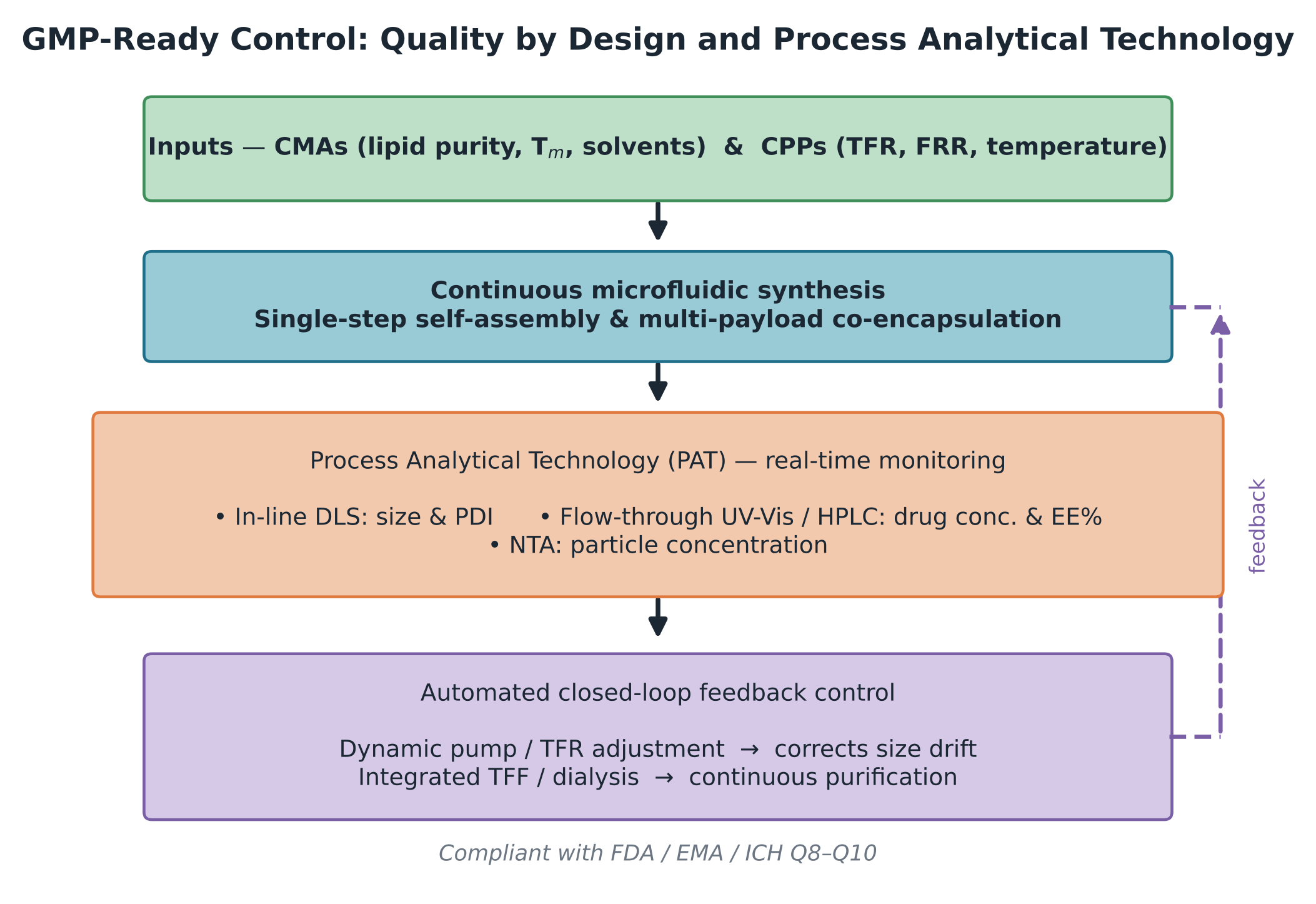
Moving a theranostic liposome from a validated formulation to a regulated product requires more than a capable mixer; it requires a control architecture (Basak et al., 2025; Patel et al., 2025; Pharmaceutics Review, 2025). Under FDA, EMA, and ICH Q8 to Q10 guidance, nanomedicines are treated as complex injectables demanding extensive physicochemical characterization and validated process stability (Basak et al., 2025; Patel et al., 2025). The integrated QbD-and-PAT control loop that satisfies these expectations is diagrammed in (Figure 4), and the device-level PAT and compliance features of leading scale-up platforms are compiled in (Table 4).
A QbD programme begins by defining the Quality Target Product Profile and then identifying CQAs, Critical Material Attributes (CMAs), and Critical Process Parameters (CPPs) (Patel et al., 2025; Pharmaceutics Review, 2025). For theranostic liposomes the CQAs typically include particle size, PDI, zeta potential, lamellarity, encapsulation efficiency, MRI relaxivity or photothermal efficiency, and residual solvent (Patel et al., 2025). Risk tools such as Failure Mode and Effects Analysis and Design-of-Experiments response-surface methods then map the multidimensional design spaces within which FRR, lipid concentration, and mixing temperature may vary without compromising product performance (Basak et al., 2025; Patel et al., 2025).
To displace destructive end-product testing, microfluidic lines increasingly carry in-line and at-line PAT (Basak et al., 2025; Kabay et al., 2022). Flow-through dynamic light scattering records hydrodynamic diameter and PDI in the outflow, nanoparticle tracking analysis reports real-time particle concentration, and in-line UV-Vis or HPLC quantifies drug concentration and unencapsulated payload (Amrani & Tabrizian, 2018; Patel et al., 2025; Basak et al., 2025). Linking these modules to automated closed-loop controllers lets the system self-correct: should an in-line sensor detect upward drift in diameter, the controller adjusts total flow rate or pump pressure to bring the product back within specification (Basak et al., 2025; Kabay et al., 2022). Coupling synthesis with continuous tangential-flow filtration or dialysis extends this into an all-in-one closed platform for purification, solvent removal, and sterile filtration, minimizing human handling and meeting global GMP mandates (Kabay et al., 2022; Basak et al., 2025; Patel et al., 2025).