Biosensors and Nanotheranostics

Bionanotechnology, Drug Delivery, Therapeutics | online ISSN 3064-7789
175
Citations
113.3k
Views
70
Articles
Your new experience awaits. Try the new design now and help us make it even better
Switch to the new experience
Figures and Tables
REVIEWS   (Open Access)

Scalable Microfluidic Manufacturing of Theranostic Liposomes: Batch Consistency and GMP-Ready Process Design

Tina Thai 1*

+ Author Affiliations

Biosensors and Nanotheranostics 5 (1) 1-20 https://doi.org/10.25163/biosensors.5110973

Submitted: 21 July 2026 Revised: 12 September 2026  Published: 24 September 2026 


Abstract

Theranostic liposomes carry a drug and an imaging agent in the same particle, so that treatment and the means of watching it arrive together. Few have reached patients, and the obstacle is more often manufacturing than biology. Conventional bulk routes — thin-film hydration, ethanol injection, high-pressure homogenisation — rely on turbulent mixing in which nucleation conditions vary from one region of the vessel to the next. The products are correspondingly uneven: diameters of roughly 120–200 nm, polydispersity above 0.25, modest entrapment of hydrophilic contrast agents, and a drift between lots that regulators are unlikely to overlook. This review asks how far microfluidic continuous-flow manufacturing closes that gap. Drawing on twelve verified sources published between 2013 and 2026, we compare hydrodynamic flow focusing, staggered herringbone, Dean-flow and active micromixers, relating their operating variables — chiefly total flow rate and flow rate ratio — to the attributes that matter for release. A consistent picture emerges. Millisecond laminar mixing yielded vesicles of about 30–120 nm with polydispersity below 0.10–0.20 and encapsulation of roughly 70–95%, across payloads as different as a hydrogel core holding iopamidol and doxorubicin, indocyanine green J-aggregates stabilised within a rigid bilayer, cRGD-targeted gadolinium liposomes, and exosome-wrapped cubosomes assembled by low-shear fusion. Replicating channels rather than accelerating one raised throughput more than a hundredfold without altering particle quality. What remains unsettled is the translational half: anti-PEG immunity, protein-corona masking of ligands, uneven EPR-dependent delivery, and the regulatory status of drug–imaging combinations. We close with a Quality-by-Design framework linking device choice to process analytics and release criteria.

Keywords: theranostic liposomes; microfluidics; continuous manufacturing; Quality-by-Design; process analytical technology; batch-to-batch consistency; Good Manufacturing Practice; nanomedicine scale-up

1. Introduction

Liposomes have had an unusually long career. They began, more than sixty years ago, as models for studying biological membranes, and only gradually became one of the more dependable workhorses of nanomedicine (Shahsavari et al., 2024). The approvals of AmBisome® in 1990 and Doxil® in 1995 marked the turn: they showed, in patients rather than in mice, that enclosing a small molecule within a phospholipid bilayer could reshape its pharmacokinetics, spare healthy tissue some of its toxicity, and concentrate it passively in solid tumours through the enhanced permeability and retention (EPR) effect (Cunha et al., 2025; Shahsavari et al., 2024).

Those successes rested on a simple premise: one carrier, one drug. Oncology has since become a less forgiving field. Refractory disease, acquired resistance and the considerable physiological differences between one patient and another mean that a carrier performing well in one tumour may barely reach the next. This has pushed attention toward theranostic nanomedicines — platforms that deliver a treatment and, at the same time, report on where it has gone by non-invasive imaging (Cunha et al., 2025; Lee et al., 2025). The clinical appeal is immediate. A clinician could, in principle, confirm that a drug has reached a lesion before deciding whether to continue, adjust or abandon a regimen, rather than waiting weeks for a radiological response.

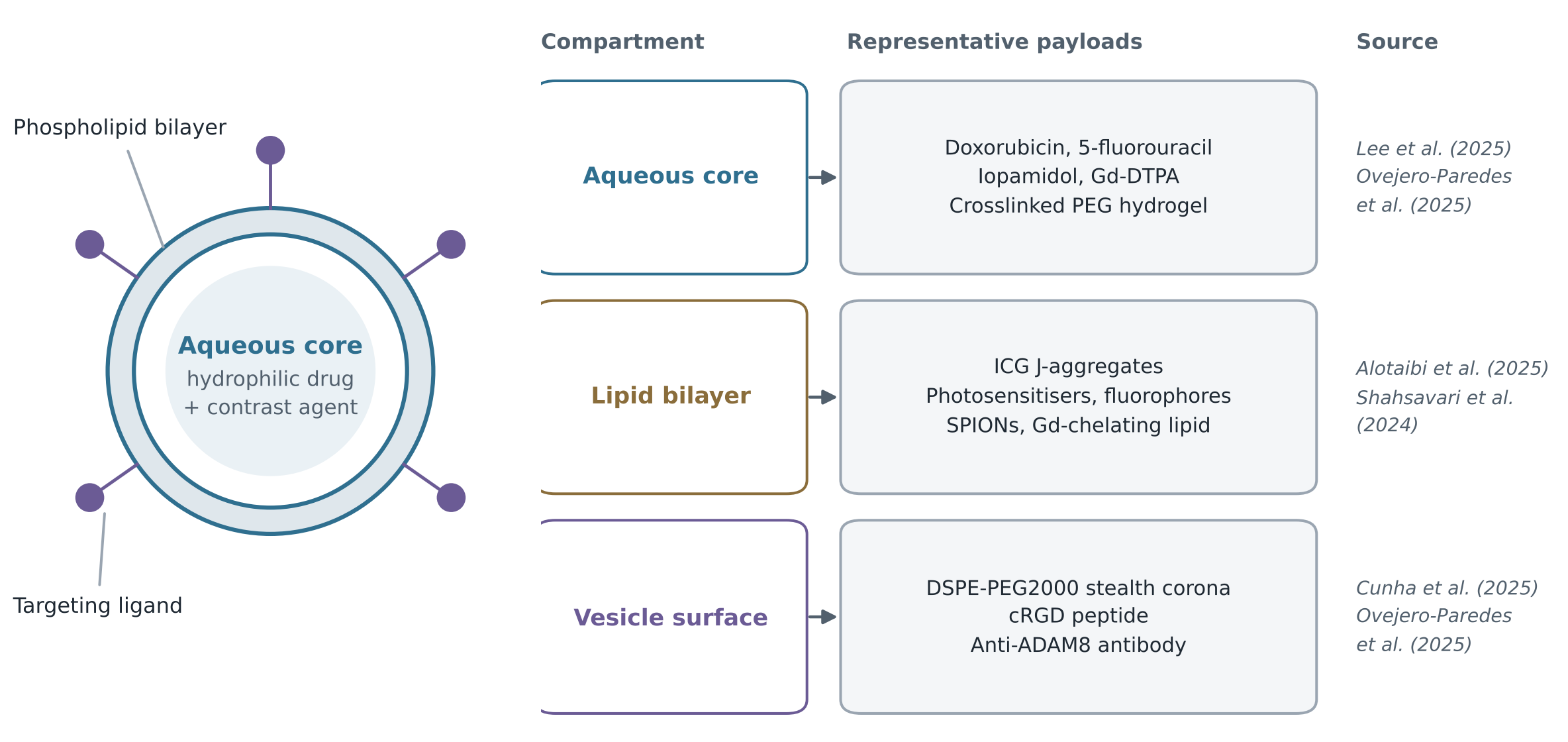
Liposomes suit this dual role because their amphiphilic architecture already provides separate compartments (Figure 1). Water-soluble cytotoxics such as doxorubicin and 5-fluorouracil, and hydrophilic contrast agents such as iopamidol or Gd-DTPA, occupy the aqueous core (Lee et al., 2025; Ovejero-Paredes et al., 2025). Lipophilic photosensitisers and fluorescent dyes sit within the bilayer itself (Alotaibi et al., 2025). More elaborate constructs add superparamagnetic iron oxide nanoparticles (SPIONs) for magnetic resonance imaging (MRI) and magnetically triggered hyperthermia (Shahsavari et al., 2024), indocyanine green (ICG) J-aggregates for near-infrared optical and photoacoustic tracking (Alotaibi et al., 2025), or a crosslinked hydrogel core that suppresses the initial burst of release (Lee et al., 2025). Decorating the surface with cyclic RGD (cRGD) peptides or monoclonal antibodies adds receptor-mediated uptake while the particle continues to report on its own accumulation (Cunha et al., 2025; Ovejero-Paredes et al., 2025).

For all this ingenuity, few theranostic liposomes have advanced far beyond preclinical work, and the reasons are frequently industrial rather than biological (Cunha et al., 2025). Most laboratories still prepare liposomes by thin-film hydration followed by sonication or extrusion, by ethanol injection, or by reverse-phase evaporation. Each depends on mixing in bulk, where self-assembly is governed by chaotic turbulence and uneven shear (Prakash et al., 2022). The consequences will be familiar to anyone who has tried to reproduce a formulation from one week to the next (Figure 2A; Table 1). Size distributions are broad, often with polydispersity index (PDI) values above 0.25, and they drift between batches in ways that alter biodistribution and clearance (Cunha et al., 2025; Prakash et al., 2022). Hydrophilic imaging agents are entrapped inefficiently, which wastes costly material and forces additional purification (Alotaibi et al., 2025; Cunha et al., 2025). And the mechanical stress of probe sonication or high-pressure homogenisation can denature conjugated antibodies, damage hydrogel networks, or prematurely activate the very probes the particle was built to carry (Lee et al., 2025; Wu et al., 2026).

This matters because a nanomedicine is not judged by its best batch. Regulatory expectation centres on documented control of critical quality attributes (CQAs) — particle size, PDI, surface charge and demonstrable consistency between lots — under Good Manufacturing Practice (GMP). Bulk processing struggles to deliver that for a single-payload liposome. For a particle carrying a drug, a contrast agent, a hydrogel matrix and a targeting ligand simultaneously, the difficulty compounds, because each added component is another attribute that must be held within specification (Cunha et al., 2025).

Microfluidic continuous-flow technology offers a genuinely different route (Prakash et al., 2022). When fluids meet inside channels of roughly 10–500 μm hydraulic diameter, flow is strictly laminar, with Reynolds numbers typically below 100, and mixing proceeds by molecular diffusion across well-defined interfaces rather than by turbulent eddies (Prakash et al., 2022). In a representative arrangement, lipids dissolved in ethanol meet one or more aqueous streams carrying hydrophilic payloads. As ethanol diffuses outward, lipid solubility collapses within milliseconds, producing a brief and spatially uniform supersaturation that drives nucleation and assembly into monodisperse vesicles (Maeki et al., 2017; Prakash et al., 2022).

What recommends this for theranostics is not the novelty of the physics but the degree of control it affords. Adjusting the total flow rate (TFR) and the flow rate ratio (FRR) tunes vesicle diameter into the sub-100 nm range with narrow distributions (Jürgens et al., 2023; Ovejero-Paredes et al., 2025). Rapid quenching of self-assembly appears to capture drugs, contrast agents and hydrogel precursors more efficiently than bulk mixing allows (Lee et al., 2025; Ovejero-Paredes et al., 2025). Throughput can be raised by replicating channels rather than redesigning the process (Shepherd et al., 2021). And because the fluid is confined and continuously flowing, the geometry lends itself to in-line measurement in a way that a stirred vessel does not (Prakash et al., 2022).

Precise mixing does not by itself produce a medicine. Moving a multi-component theranostic liposome from a benchtop chip to a licensed product raises engineering, analytical and regulatory questions that have rarely been addressed together. This review therefore examines synthesis, batch consistency and process design for GMP-compliant manufacture of theranostic liposomes. We set out to (i) analyse passive and active microfluidic architectures and the mixing physics governing them (Modarres & Tabrizian, 2020; Prakash et al., 2022); (ii) examine the formulation variables — lipid composition, cholesterol content, PEGylation, hydrogel cores, ligand conjugation — that determine stability and the consistency of the drug-to-imaging ratio (Alotaibi et al., 2025; Ovejero-Paredes et al., 2025); (iii) assess strategies limiting parameter drift and batch variability during scale-up (Shepherd et al., 2021); and (iv) set out the quality attributes, in-line analytics and evidentiary requirements that clinical translation of these combination products will demand (Cunha et al., 2025; Prakash et al., 2022).

A note on the evidence base is warranted at the outset. The synthesis that follows rests on twelve sources whose bibliographic records we were able to verify independently. Several claims commonly made in this field — quantitative estimates of anti-PEG seroprevalence, development costs, or the fraction of administered nanoparticles reaching tumours — are not supported by any source we could confirm, and are therefore discussed qualitatively rather than reproduced as figures. Where an argument rests on review-level rather than primary evidence, we say so.

2. Microfluidic Manufacturing of Theranostic Liposomes and Biomimetic Hybrid Nanocarriers for Cancer Imaging and Therapy

2.1 Evolution and Conceptual Architecture of Theranostic Liposomes

Phospholipid vesicles have moved, over six decades, from biophysical curiosities to among the most clinically established nanocarriers in use (Shahsavari et al., 2024). Doxil® and AmBisome® demonstrated that lipid encapsulation could alter systemic pharmacokinetics, reduce off-target organ toxicity and favour tumour accumulation through EPR (Cunha et al., 2025; Shahsavari et al., 2024). As oncology has confronted inter-patient heterogeneity and recurrence, single-function carriers have given ground to theranostic designs that both treat and image (Cunha et al., 2025; Lee et al., 2025).

The structural basis for this versatility is the vesicle itself (Figure 1). Hydrophilic drugs and radiopaque or paramagnetic contrast agents reside in the aqueous core (Lee et al., 2025; Ovejero-Paredes et al., 2025); photosensitisers and fluorophores intercalate among the acyl chains (Alotaibi et al., 2025; Shahsavari et al., 2024); stealth polymers and targeting ligands occupy the outer surface (Cunha et al., 2025). Recent work has layered further functions onto this scaffold — SPIONs for MRI and magnetic hyperthermia (Shahsavari et al., 2024), near-infrared agents for photoacoustic imaging (Alotaibi et al., 2025), internal hydrogel matrices that blunt burst release (Lee et al., 2025). Each addition, though, introduces another attribute requiring control, and this is precisely where manufacturing difficulty begins (Cunha et al., 2025). Liquid liposome dispersions are also intrinsically prone to fusion, aggregation, lipid oxidation and payload leakage during storage (Cunha et al., 2025), which makes reproducible production and appropriate downstream processing more consequential, not less.

2.2 Why Conventional Bulk Processing Falls Short

Thin-film hydration with sonication or extrusion, ethanol injection, reverse-phase evaporation and high-pressure homogenisation all depend on macroscopic mixing (Lee et al., 2025; Ovejero-Paredes et al., 2025; Prakash et al., 2022). Within these reactors, self-assembly proceeds under unconstrained turbulence and non-uniform shear, so nucleation conditions differ from one region of the vessel to another and from one moment to the next (Prakash et al., 2022). Three failure modes recur (Figure 2A; Table 1).

The first is dispersity. Chaotic mixing yields broad size distributions and lot-to-lot variation that alters clearance, tissue penetration and toxicity (Cunha et al., 2025; Prakash et al., 2022). The second is inefficient entrapment: solvent exchange in bulk is slow and uneven, so hydrophilic contrast agents and multi-component

Table 1. Comparative performance of microfluidic mixer geometries and conventional bulk processing for liposome and lipid nanoparticle synthesis. Entries summarise the fluid-dynamic regime, characteristic mixing time, typical particle attributes and principal limitations reported for each manufacturing approach across the verified source corpus. Particle attributes are given as the ranges reported in the cited studies rather than as pooled estimates, since device dimensions, lipid compositions and analytical methods differ between reports and are not directly comparable. Reynolds number (Re) distinguishes turbulent bulk mixing (Re > 2,000) from laminar microfluidic operation (Re < 100); mixing times are as reported by the original authors. Abbreviations: EE, encapsulation efficiency; EHD, electrohydrodynamic; FRR, flow rate ratio; PDI, polydispersity index; SHM, staggered herringbone micromixer.

Manufacturing approach

Fluid-dynamic regime

Mixing time

Reported particle attributes

Principal advantages

Principal limitations

References

Bulk thin-film hydration with sonication or extrusion

Turbulent macroscopic mixing; non-uniform shear (Re > 2,000)

Minutes to hours; uncontrolled diffusion gradients

Size ≈ 120–200 nm; PDI ≈ 0.25–0.40; EE low for hydrophilic payloads

Simple, inexpensive, widely established for feasibility work

Broad distributions; lot-to-lot drift; membrane clogging; shear damage to sensitive cargo

Cunha et al., 2025; Lee et al., 2025; Prakash et al., 2022

Bulk ethanol injection and high-pressure homogenisation

Turbulent mixing driven by cavitation at high pressure

Seconds to minutes; batch-dependent

Size ≈ 100–180 nm; PDI ≈ 0.20–0.35

Handles larger volumes; industrial precedent in first-generation liposomes

Thermal and shear degradation of biologics and hydrogels; residual solvent; high energy input

Prakash et al., 2022

Hydrodynamic flow focusing (HFF)

Laminar sheath compression of a central organic thread (Re < 100, Pe ≫ 1)

~1–10 ms; diffusion-limited across focused interfaces

Size ≈ 50–120 nm; PDI < 0.12–0.20; EE ≈ 70–95%

Predictable size tuning via FRR; low shear protects sensitive payloads; tolerates high lipid concentration

Requires large sheath excess, diluting product and adding a concentration step

Balbino et al., 2013; Jürgens et al., 2023; Prakash et al., 2022

Staggered herringbone micromixer (SHM)

Passive chaotic advection under laminar flow; grooved floor folds and stretches interfaces

< 2–5 ms

Size ≈ 30–90 nm; PDI < 0.10; EE > 90% reported

Narrowest distributions in the corpus; operates at lower volumetric ratio than HFF

Limited throughput per channel; exceeding the laminar threshold disrupts the advection pattern

Jürgens et al., 2023; Maeki et al., 2017; Shepherd et al., 2021

Parallelised microfluidic device (channel array)

Distributed laminar flow across replicated channels (e.g. 128 parallel SHM)

< 2–5 ms, nominally identical across channels

Size < 85–100 nm; PDI < 0.12; EE > 90%

Scale-up without altering channel fluid dynamics; > 100-fold throughput demonstrated

Manifold must distribute flow evenly; maldistribution and localised fouling are invisible in pooled output

Shepherd et al., 2021

Toroidal and Dean-flow mixers

Curvature-induced secondary vortices; passive chaotic advection

~1–5 ms

Size ≈ 80–110 nm; PDI < 0.12–0.18

Rapid mixing without internal obstructions; plausibly lower fouling risk over long runs

Narrow operating window to sustain effective vortex formation; fouling advantage argued more than measured

Prakash et al., 2022

Active micromixers (acoustic, EHD)

External field actuation driving convective mixing

< 1–3 ms

Size ≈ 40–100 nm; PDI < 0.10

Mixing intensity decoupled from flow rate; on-demand control; resists surface fouling

Device cost and fabrication complexity; possible thermal or electrical stress on labile cargo

Modarres & Tabrizian, 2020; Prakash et al., 2022


Figure 1. Compartmental architecture of a theranostic liposome and the payloads each compartment accommodates. The amphiphilic structure of the vesicle provides three physically distinct loading environments, and this separation is what allows a single particle to carry therapeutic and diagnostic functions simultaneously. Hydrophilic drugs and water-soluble contrast agents, together with a crosslinked hydrogel matrix where one is used, occupy the aqueous core; lipophilic photosensitisers, fluorophores, iron oxide nanoparticles and chelating lipids partition into the phospholipid bilayer; stealth polymers and targeting ligands are presented at the outer surface. Representative payloads and the sources reporting them are listed for each compartment; abbreviations are defined in the text.
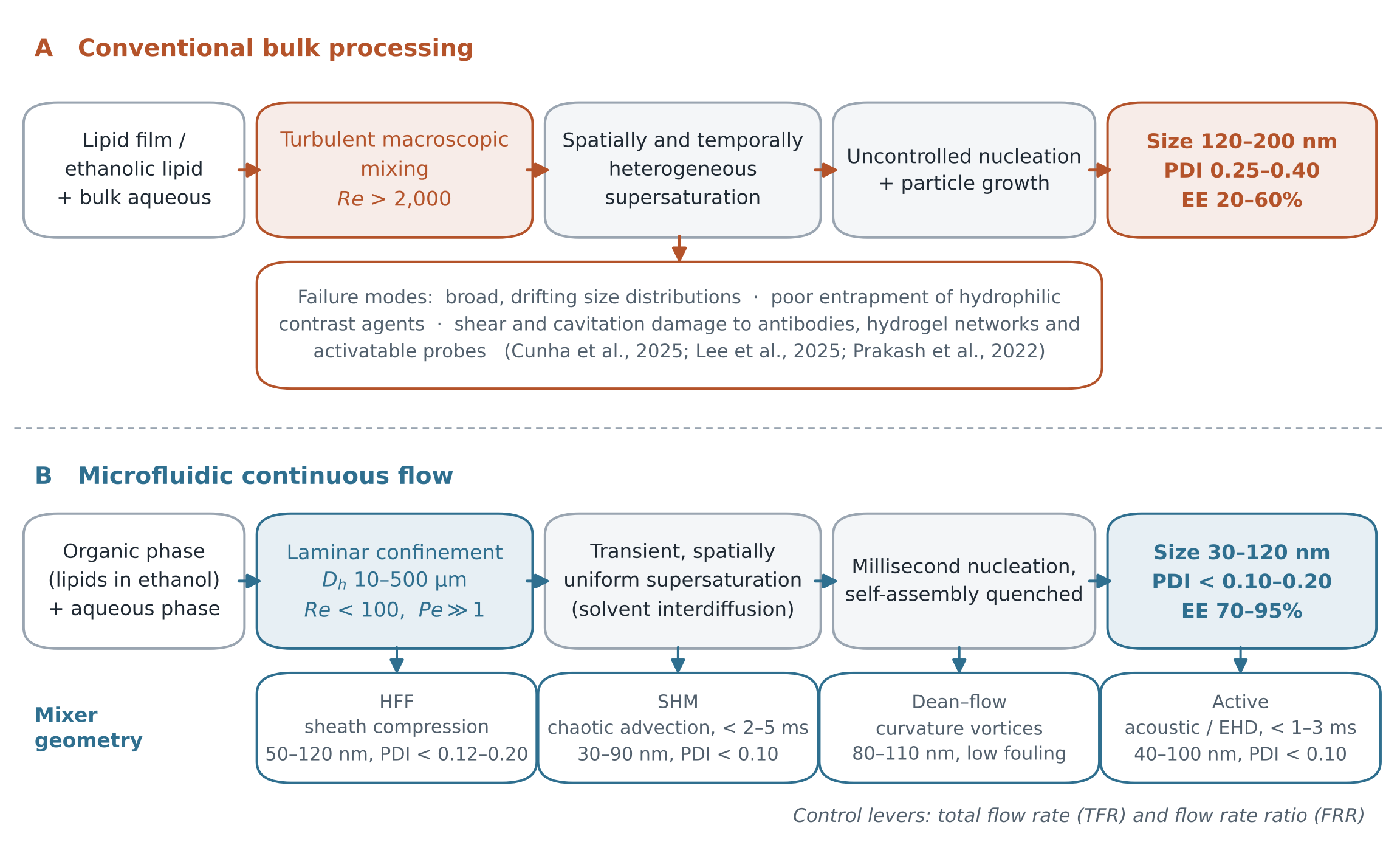
Figure 2. Comparison of bulk and microfluidic routes to liposome self-assembly, and the resulting particle attributes. Panel A traces conventional bulk processing, in which turbulent macroscopic mixing produces spatially and temporally heterogeneous supersaturation, uncontrolled nucleation and growth, and consequently broad size distributions with variable payload entrapment, together with the three failure modes that follow. Panel B traces the microfluidic route, in which laminar confinement within channels of 10–500 μm hydraulic diameter generates a transient and spatially uniform supersaturation by solvent interdiffusion, quenching self-assembly within milliseconds. The four principal mixer geometries are shown with their characteristic attributes; total flow rate and flow rate ratio act as the control levers across all of them. Values are reported ranges from the cited sources, not pooled estimates.

payloads are poorly captured, with extensive purification required afterwards (Alotaibi et al., 2025; Cunha et al., 2025). The third is damage. The shear generated by ultrasonic cavitation or by homogenisation at several hundred bar can denature targeting antibodies, disrupt polymer networks, or trigger activatable probes before administration (Lee et al., 2025; Wu et al., 2026). Bulk methods retain genuine advantages — simplicity, familiarity, an industrial track record with first-generation liposomes — but they scale poorly to products whose identity depends on several co-loaded components held in fixed ratio.

2.3 The Physics of Microfluidic Self-Assembly

Microfluidic devices confine fluid streams within channels where flow is laminar and convective turbulence effectively absent (Prakash et al., 2022). Mass transport then proceeds by predictable interdiffusion across a defined interface. When an ethanolic lipid stream meets aqueous buffer, ethanol diffuses outward, lipid solubility falls sharply, and a transient, spatially uniform supersaturation drives rapid nucleation into monodisperse vesicles (Maeki et al., 2017; Prakash et al., 2022). The sequence is set out schematically in Figure 2B.

Maeki et al. (2017) examined this mechanism directly in chaotic micromixers and found that the dominant variable is the time taken for solvent dilution to pass the critical concentration at which lipid assembly begins. Where that dilution is fast and uniform, particle size is set by nucleation and remains small; where it is slow, growth and fusion continue and the distribution broadens. This offers a mechanistic account of why mixing time, rather than any particular geometry, is the parameter that most consistently predicts outcome.

2.4 Mixer Geometries and Their Trade-Offs

Several channel architectures exploit this mechanism, and their comparative performance is set out in Table 1.

Hydrodynamic flow focusing (HFF). A central lipid stream is compressed between two converging aqueous sheath flows, shrinking the diffusion distance and accelerating solvent exchange (Balbino et al., 2013; Prakash et al., 2022). Balbino et al. (2013) showed that this geometry supports continuous production of cationic liposomes even at high lipid concentration, which matters for manufacturing economics. The characteristic limitation is dilution: focusing requires a large excess of sheath fluid, so the product emerges dilute and generally needs concentrating downstream.

Staggered herringbone micromixers (SHM). Grooves on the channel floor repeatedly fold and stretch the fluid interface, generating chaotic advection and mixing on a millisecond timescale (Maeki et al., 2017; Prakash et al., 2022). SHM devices achieve the narrowest distributions in the comparative literature and operate at lower volumetric ratios than HFF, at the cost of limited throughput per channel (Jürgens et al., 2023; Shepherd et al., 2021).

Dean-flow and toroidal mixers. Curved channels generate secondary vortices that mix rapidly without internal obstructions (Prakash et al., 2022). Because nothing protrudes into the channel, the fouling risk over long runs is lower — a consideration that becomes significant at manufacturing scale, though one with less published support than the particle-quality data.

Active micromixers. External energy, acoustic or electrohydrodynamic, drives convective mixing on demand. Modarres and Tabrizian (2020) demonstrated that electrohydrodynamic actuation produces highly monodisperse nanoscale liposomes with very short mixing times, and that mixing intensity can be modulated independently of flow rate — a degree of decoupling passive devices cannot offer. The trade-off is device complexity, cost, and the possibility of thermal or electrical stress on sensitive cargo.

Comparative evaluation across geometries is complicated by inconsistent reporting. Jürgens et al. (2023) addressed this directly, benchmarking several microfluidic mixing techniques for nucleic acid lipid nanoparticles under matched conditions, and found that device choice influenced particle attributes and process efficiency in ways not always predictable from mixing time alone. Across geometries, TFR and FRR remain the principal control levers: raising either accelerates mixing and favours nucleation over growth, so diameter falls predictably while distributions stay narrow (Jürgens et al., 2023; Ovejero-Paredes et al., 2025; Prakash et al., 2022).

2.5 Co-Encapsulation Strategies for Theranostic Payloads

Formulating a theranostic liposome means reconciling the physicochemical demands of a drug and an imaging agent within one stable carrier (Cunha et al., 2025). Microfluidic assembly helps because solvent conditions are held constant throughout, which supports co-encapsulation of combinations that bulk mixing handles poorly (Cunha et al., 2025; Ovejero-Paredes et al., 2025). Representative platforms are compiled in Table 2.

2.5.1 Radiopaque Hydrogel-in-Liposomes

Hydrophilic X-ray contrast agents such as iopamidol leak readily through lipid bilayers during circulation, which limits their value for micro-computed tomography (Lee et al., 2025). Lee et al. (2025) addressed this by polymerising a crosslinked poly(ethylene glycol) hydrogel within the aqueous interior, entrapping iopamidol alongside doxorubicin. The network acted as a physical barrier to leakage while conferring pH-dependent, sustained drug release. In tumour-bearing mice, these radiopaque hydrogel-in-liposomes were internalised by clathrin-mediated endocytosis, accumulated in tumours, and produced clearly stronger imaging contrast than conventional liposomes.

2.5.2 Optically Stabilised Near-Infrared Liposomes

ICG is an approved near-infrared fluorophore used in photoacoustic imaging and photothermal therapy, but it degrades quickly in physiological media (Alotaibi et al., 2025; Shahsavari et al., 2024). Self-assembled J-aggregates absorb at longer wavelengths, improving tissue penetration, yet are themselves optically unstable in water (Alotaibi et al., 2025). Alotaibi et al. (2025) showed that enveloping pre-formed J-aggregates within liposomal bilayers markedly improved optical and photothermal stability in blood, serum and collagen. Bilayer rigidity proved decisive: high-transition-temperature lipids, a substantial cholesterol fraction and DSPE-PEG2000 were the parameters that mattered most.

2.5.3 Magnetoresponsive and Actively Targeted Platforms

Magnetoresponsive liposomes incorporate SPIONs or gadolinium chelates to provide MRI contrast while supporting hyperthermia or field-triggered release (Shahsavari et al., 2024). To push accumulation beyond what passive EPR achieves, surfaces are commonly functionalised with ligands (Cunha et al., 2025; Ovejero-Paredes et al., 2025). Ovejero-Paredes et al. (2025) prepared liposomes containing doxorubicin, a gadolinium-chelating lipid and rhodamine by microfluidic formulation, then attached cRGD peptides by strain-promoted azide–alkyne cycloaddition. The particles showed selective αvβ3 integrin-mediated uptake and greater cytotoxicity in three-dimensional spheroids of triple-negative breast cancer than untargeted controls. Anti-ADAM8 immunoliposomes co-loaded with 5-fluorouracil and Gd-DTPA have been described along similar lines, permitting MRI tracking of targeted delivery in colorectal cancer models, although this evidence reaches us at review level rather than as primary data (Cunha et al., 2025).

2.6 Biomimetic Hybrid Assemblies and Microfluidic Membrane Fusion

Synthetic liposomes are controllable and load drugs well, but rapid clearance by the reticuloendothelial system and potential immunogenicity remain concerns (Wu et al., 2026). Natural extracellular vesicles, by contrast, home intrinsically to certain tissues and display tetraspanins that help them evade immune recognition; their drawbacks are poor isolation yield and limited loading capacity (Wu et al., 2026). Hybrid vesicles aim to combine the strengths of both.

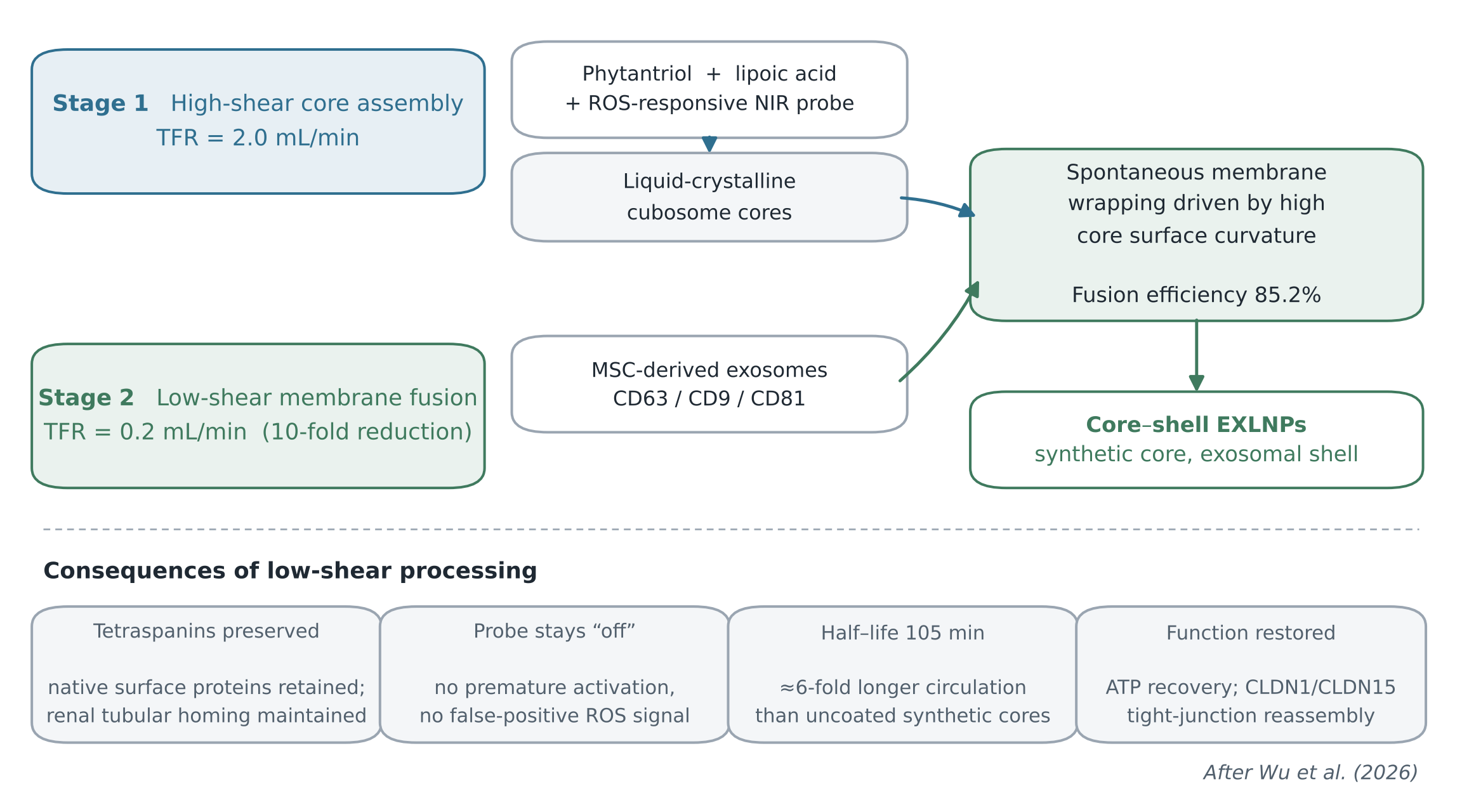
Conventional means of engineering exosomes — electroporation, sonication, saponin permeabilisation — tend to compromise membrane integrity, denature surface proteins, or prematurely trigger diagnostic probes (Wu et al., 2026). Wu et al. (2026) avoided these problems with a two-stage sequential microfluidic process (Figure 3). Liquid-crystalline phytantriol cubosomes loaded with lipoic acid and a reactive oxygen species (ROS)-responsive fluorescent probe were first assembled under high-shear mixing. These cores were then co-injected with mesenchymal stem cell-derived exosomes at a tenfold lower flow rate, limiting shear. High core surface curvature drove spontaneous membrane wrapping, giving core–shell exosome-like nanoparticles at high fusion efficiency. Because the second stage was gentle, the ROS probe remained inactive until the particle reached injured tissue, avoiding the false-positive signal that chemical loading tends to produce — a point of some diagnostic importance, since a probe that reports before arrival reports nothing useful.

2.7 Process Design, Scale-Up and Quality-by-Design

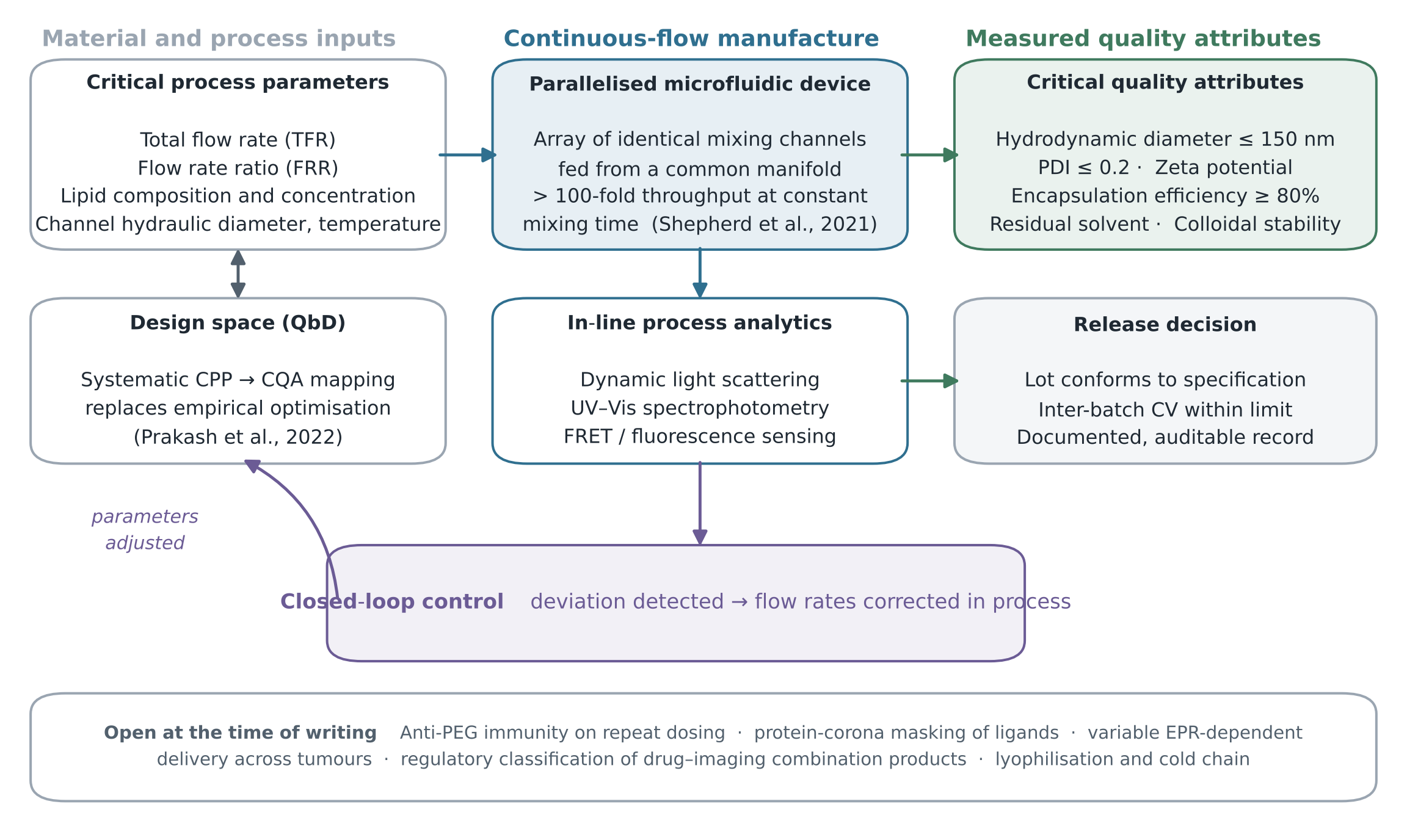
Taking theranostic liposomes from discovery to supply requires manufacturing frameworks that hold quality attributes steady across lots (Prakash et al., 2022). The relationships involved are set out in Figure 4 and the principal strategies in Table 3.

Table 2. Formulation architectures, co-encapsulated payloads and reported performance of theranostic liposomes and biomimetic hybrid nanocarriers. Each row describes one platform from the verified corpus, giving its lipid or polymer composition and surface chemistry, the therapeutic and diagnostic payloads and the compartment each occupies, the imaging modality exploited, the biological model, and the principal reported outcomes. Entries are grouped by the structural strategy used to retain or stabilise the diagnostic payload, which is in each case the design problem the platform was built to solve. Evidence tier (see §3.8) is given to distinguish primary experimental reports from review-level description. Abbreviations: DOX, doxorubicin; EE, encapsulation efficiency; ICG, indocyanine green; MRI, magnetic resonance imaging; MSC, mesenchymal stem cell; PAI, photoacoustic imaging; PTT, photothermal therapy; ROS, reactive oxygen species; SPION, superparamagnetic iron oxide nanoparticle; TNBC, triple-negative breast cancer.

Platform

Composition and surface chemistry

Therapeutic / diagnostic payloads

Imaging modality and mechanism

Biological model

Reported outcomes

Tier

Reference

Radiopaque hydrogel-in-liposomes

Egg phosphatidylcholine and cholesterol with a crosslinked PEG-based hydrogel polymerised in the aqueous lumen

Doxorubicin (core) / iopamidol X-ray contrast agent (core)

Micro-computed tomography; hydrogel network physically restrains contrast agent leakage

Tumour-xenografted mice

Hydrogel core markedly reduced early contrast-agent leakage while preserving high DOX entrapment; pH-sensitive release favouring acidic conditions; improved tumour imaging contrast and growth suppression

A

Lee et al., 2025

Stabilised ICG J-aggregate liposomes

High-transition-temperature phospholipids (DSPC, DPPC) with high cholesterol and DSPE-PEG2000; optional charged lipid (DOTAP or DSPG)

Photothermal therapy / pre-formed ICG J-aggregates (bilayer)

Near-infrared PAI and PTT; red-shifted absorption improves tissue penetration

Biological media (buffer, serum, blood, collagen matrices)

Liposomal envelopment preserved optical and photothermal stability in biological milieu where unprotected aggregates degrade; bilayer rigidity and cholesterol content were decisive; charged lipid raised ICG encapsulation without optical penalty

B

Alotaibi et al., 2025

Integrin-targeted bimodal theranostic liposomes

DMPC with DBCO-PEG-lipid, gadolinium-chelating lipid and rhodamine-PE; azido-cRGD attached post-assembly by SPAAC click chemistry

Doxorubicin, remote-loaded (core) / gadolinium for T1-MRI and rhodamine for fluorescence (bilayer and surface)

Receptor-mediated targeting of αvβ3 integrin with combined MRI and optical tracking

MDA-MB-231 TNBC monolayers and 3D spheroids

Microfluidic assembly gave reproducible monodisperse carriers; cRGD functionalisation increased integrin-mediated uptake and enhanced cytotoxicity in spheroids relative to untargeted controls

A

Ovejero-Paredes et al., 2025

ADAM8-targeted immunoliposomes

PEGylated phospholipid vesicles conjugated with anti-ADAM8 monoclonal antibody

5-Fluorouracil (core) / Gd-DTPA for T1-MRI (core)

Antibody-directed receptor targeting with real-time MRI monitoring of response

Colorectal cancer models

Selective accumulation in ADAM8-overexpressing tumour tissue with MRI-trackable treatment response; described at review level, manufacturing route not consistently specified

C

Cunha et al., 2025

Magnetoresponsive SPION liposomes

Phosphatidylcholine and cholesterol with PEGylated lipids; SPIONs incorporated in core or bilayer

Doxorubicin and magnetic hyperthermia / SPIONs for T2-MRI

Magnetically guided delivery, field-triggered hyperthermia and T2-weighted contrast

Glioblastoma and breast cancer models

High transverse relaxivity; alternating magnetic field produced localised heating with accelerated drug release; reported as a synthesis across multiple primary studies

C

Shahsavari et al., 2024

Exosome-wrapped cubosome hybrids

Phytantriol liquid-crystalline core wrapped with MSC-derived exosome membrane (CD63/CD9/CD81 positive)

Lipoic acid antioxidant (core) / boronate-protected near-infrared ROS-responsive probe (core)

Activatable “off–on” ROS fluorescence imaging coupled to mitochondrial rescue

Murine acute kidney injury; renal tubular epithelium

Two-stage fusion achieved high membrane coating efficiency with tetraspanins preserved; probe remained inactive during circulation, avoiding false-positive signal; markedly extended circulation half-life and restored tight-junction protein expression

A

Wu et al., 2026

Table 3. Process design strategies for scalable, quality-controlled manufacture of theranostic liposomes. The table maps each strategy to the critical process parameters it governs, the quality attributes it is intended to control, the analytical tools available to monitor it, and its demonstrated or anticipated effect on batch consistency. A distinction is drawn throughout between strategies demonstrated experimentally within the verified corpus and those that are well motivated but not yet demonstrated for liposomal theranostics specifically, since the two are frequently conflated in this literature. Readiness is graded as demonstrated, partially demonstrated, or proposed. Abbreviations: CPP, critical process parameter; CQA, critical quality attribute; CV, coefficient of variation; DLS, dynamic light scattering; FRET, Förster resonance energy transfer; FRR, flow rate ratio; QbD, Quality-by-Design; TFR, total flow rate.

Strategy

Critical process parameters

Target quality attributes

Analytical approach

Effect on consistency

Readiness

References

Single-channel parameter control (TFR, FRR)

Total flow rate; flow rate ratio; lipid concentration; temperature

Hydrodynamic diameter; PDI; encapsulation efficiency

Offline DLS; payload assay after purification

Predictable, mechanistically grounded control of size and dispersity within a channel

Demonstrated

Jürgens et al., 2023; Maeki et al., 2017; Prakash et al., 2022

Channel parallelisation for throughput

Manifold pressure balance; per-channel flow uniformity; channel hydraulic diameter

Size and PDI equivalence to single-channel benchmark; throughput

Pooled-output DLS; comparison against single-channel reference

> 100-fold throughput increase with attributes preserved; uniformity of distribution becomes a parameter in its own right

Demonstrated, for nucleic acid lipid nanoparticles

Shepherd et al., 2021

Design-space mapping (QbD)

Systematic variation of CPPs across the intended operating range

Full CPP → CQA relationship rather than a single operating point

Designed experiments with multivariate analysis

Replaces empirical optimisation; defines the range within which quality is assured

Partially demonstrated

Prakash et al., 2022

In-line process analytics

Flow velocity; optical path and scattering geometry; sensor placement

Real-time size distribution; aggregation onset; payload concentration

In-line DLS probes; UV–Vis spectrophotometry; FRET or fluorescence sensing

Enables detection of deviation during production rather than after it

Partially demonstrated

Prakash et al., 2022

Closed-loop automated control

Feedback gain; sampling interval; correction limits on TFR and FRR

Sustained conformance across a production run; inter-batch CV

Sensor streams coupled to automated flow controllers

Anticipated reduction in inter-batch variability; demonstrations in liposome manufacture remain limited

Proposed

Prakash et al., 2022

Stage-resolved shear control

Stage-specific TFR; core-to-membrane mass ratio; sequencing of streams

Membrane fusion efficiency; retention of surface protein integrity; probe inactivity

Nanoparticle tracking analysis; cryo-electron microscopy; FRET

Permits high-shear assembly and low-shear functionalisation within one continuous process

Demonstrated, single platform

Wu et al., 2026

Lyophilisation with cryoprotectant

Freezing rate; primary drying temperature; cryoprotectant identity and concentration

Post-reconstitution size and PDI; residual moisture; payload retention

DLS after reconstitution; thermal analysis; moisture determination

Preserves attributes through storage; addresses cold-chain constraint

Partially demonstrated

Alotaibi et al., 2025; Wu et al., 2026

Scale-up illustrates the underlying logic. Pushing flow faster through a single microchannel eventually disrupts the laminar regime and raises shear, which is self-defeating (Prakash et al., 2022). Parallelised devices sidestep this by replication rather than acceleration. Shepherd et al. (2021) fed 128 parallel SHM channels from a common distribution manifold and raised throughput more than a hundredfold, to multilitre-per-hour rates, while preserving the mixing time and particle attributes obtained on a single-channel chip. The Engineering difficulty shifts to the manifold, which must distribute flow evenly across every channel; maldistribution reintroduces exactly the heterogeneity the approach was meant to eliminate.

Quality-by-Design replaces empirical optimisation with a systematic map of how critical process parameters govern quality attributes (Prakash et al., 2022). In-line analytics — dynamic light scattering, spectrophotometry, fluorescence-based sensing — allow size and encapsulation to be monitored as the product forms rather than inferred afterwards from a sampled vial (Prakash et al., 2022). Coupling such measurements to automated control is a natural extension, and one that continuous flow makes feasible in a way batch processing does not, though the published demonstrations in liposome manufacture remain limited.

2.8 Stability, Storage and the Translational Gap

Shelf-life and cold-chain constraints usually mean liquid formulations must eventually be freeze-dried, with disaccharide cryoprotectants protecting vesicles against aggregation and leakage during freezing and dehydration (Alotaibi et al., 2025; Wu et al., 2026). Beyond stability lie the barriers that engineering alone will not remove: immune responses to PEGylated surfaces on repeat dosing, adsorption of plasma proteins that can mask targeting ligands, and the considerable variability of EPR-dependent delivery between tumours and between patients (Cunha et al., 2025; Shahsavari et al., 2024). Products combining a drug, an imaging agent and sometimes a biological membrane also sit awkwardly within regulatory frameworks designed for one or the other. These barriers are collated in Table 4, which also notes, candidly, where the evidence available to us is thinner than the frequency of citation in this field would suggest.

3. Methods

3.1 Review Design and Rationale

This work is a structured narrative review. The term is used deliberately. A systematic review in the strict sense requires a pre-registered protocol, duplicate independent screening against documented counts, and formal risk-of-bias appraisal of comparable study designs. The present evidence base does not meet the last of these conditions: it mixes primary engineering studies, formulation reports with in vivo endpoints, and secondary reviews, with heterogeneous devices, lipids, payloads and analytical methods. Statistical pooling would be misleading. What the review does adopt from systematic methodology is the part that governs reproducibility — an explicit question, pre-specified eligibility criteria, documented search strings, and transparent extraction — so that another group can repeat the search and arrive at a comparable corpus.

The review question was framed as follows: in the manufacture of theranostic liposomes and closely related lipid-based or biomimetic nanocarriers, how do microfluidic process architectures and their operating parameters influence critical quality attributes, batch-to-batch consistency, and readiness for GMP production, relative to conventional bulk methods?

3.2 Information Sources and Search Strategy

Searches were run in PubMed/MEDLINE, Scopus, Web of Science Core Collection and ScienceDirect, supplemented by Google Scholar (first 200 records by relevance) and by backward and forward citation tracking of the retained primary studies. The window ran from January 2013 — the year of the earliest continuous-flow liposome study retained (Balbino et al., 2013) — to the final search date.

The PubMed string was constructed from three concept blocks:

(liposom* OR “lipid nanoparticle*” OR “lipid vesicle*” OR “extracellular vesicle*” OR exosome* OR “Liposomes”[MeSH]) AND (microfluidic* OR “flow focusing” OR herringbone OR micromixer* OR “continuous flow” OR “Microfluidics”[MeSH]) AND (theranostic* OR imaging OR “contrast agent*” OR “scale-up” OR “batch-to-batch” OR “quality by design” OR “process analytical technology” OR GMP OR “good manufacturing practice”)

Field tags were adapted per database (TITLE-ABS-KEY in Scopus; TS= in Web of Science). Searches were limited to English-language records; no restriction was applied by

Table 4. Residual barriers to clinical translation of theranostic liposomes, with candidate mitigations and an explicit statement of evidence availability. The table separates barriers arising from manufacturing, which continuous-flow processing can plausibly address, from biological and regulatory barriers that it cannot. For each barrier the underlying mechanism, the quality attribute or regulatory criterion implicated, and a candidate engineering or formulation response are given. The final column states what evidence was available within the verified corpus; entries marked as not quantifiable here indicate that figures commonly cited in this field could not be traced to a verifiable source during preparation of this review (see §3.4) and have deliberately been omitted rather than reproduced. Abbreviations: CQA, critical quality attribute; CV, coefficient of variation; EPR, enhanced permeability and retention; PEG, poly(ethylene glycol).

Barrier

Mechanism

Attribute or criterion implicated

Candidate mitigation

Evidence in the verified corpus

Batch-to-batch variability

Uncontrolled mixing kinetics and parameter drift in macroscale reactors; uneven flow distribution in parallelised devices

Inter-batch CV; size distribution; residual solvent

Continuous-flow synthesis with in-line analytics; monitoring of per-channel flow uniformity, not only pooled output

Mechanism well established; consistency itself seldom quantified, as batch number and variability statistics are rarely reported (§5.4)

Drug-to-imaging ratio drift

Therapeutic and diagnostic payloads may be entrapped with differing efficiency and may respond differently to process change

Constancy of payload ratio across lots

Factorial mapping of both payloads against TFR and FRR; development of an in-line ratio assay

No systematic mapping identified; regarded here as the principal gap in the literature reviewed

Loss of functional attributes not captured by release testing

Premature probe activation, contrast-agent leakage, or loss of bilayer rigidity leaves size, PDI and encapsulation unchanged

Diagnostic specificity; payload retention; optical stability

Stage-resolved low-shear processing; rigid high-melting bilayers; physical entrapment within a hydrogel network

Demonstrated individually across three platforms

Anti-PEG immunity on repeated dosing

Repeat exposure to PEGylated surfaces can elicit antibodies and accelerate clearance

Retention of circulation kinetics across dosing cycles

Alternative stealth polymers; biomimetic membrane coating in place of synthetic PEG corona

Acknowledged in the corpus as a translational concern; seroprevalence figures not quantifiable from verified sources

Protein corona masking of ligands

Plasma proteins adsorb onto the particle surface and can obscure targeting moieties

Retention of binding specificity in protein-rich media

Optimised ligand density and spacer length; smaller targeting fragments; cell-membrane camouflage

Mechanism described at review level; quantitative tumour-accumulation figures not quantifiable from verified sources

Variable EPR-dependent delivery

Inter- and intra-patient differences in vascular permeability, matrix density and interstitial pressure

Demonstrated active uptake rather than reliance on passive accumulation

Receptor-targeted ligands; externally triggered release such as magnetic hyperthermia

Active targeting demonstrated in vitro and in spheroid models; magnetic triggering described at review level

Variability of biologically derived components

Exosome and secretome source material varies with donor cell, passage and culture conditions

Consistency of membrane composition and surface protein content

Standardised cell banking and conditioned-medium protocols; release testing of membrane input

Recognised consequence of the biomimetic approach; not systematically characterised in the corpus

Regulatory classification of combination products

Products carrying both therapeutic and diagnostic function sit between frameworks designed for one or the other

Evidence package covering both components

Early agency engagement; design-space and in-line evidence suited to real-time quality assurance

Classification uncertainty acknowledged; development-cost and delay figures not quantifiable from verified sources

study design at the search stage.

To be completed by the authors before submission. Final search date; records identified per database; duplicates removed; records screened; full texts assessed; records excluded with reasons. Most journals will expect these counts and a flow diagram even for a narrative review.

3.3 Eligibility Criteria

Records were eligible if they met criterion (a) together with (b) or (c):

(a) They described preparation of liposomes, lipid nanoparticles, or lipid–biological hybrid vesicles by a microfluidic method, or by a bulk method serving as comparator.

(b) They reported at least one quantitative quality attribute — hydrodynamic diameter, polydispersity index, zeta potential or encapsulation efficiency — or a manufacturing outcome such as throughput, scale-up factor, inter-batch variability, or stability after storage or lyophilisation.

(c) They were reviews or translational analyses addressing process design, Quality-by-Design, in-line analytics, or the regulatory position of theranostic nanomedicines.

Engineering studies conducted with nucleic acid lipid nanoparticles rather than theranostic liposomes were retained where they supplied device-level performance data transferable to liposome production (Jürgens et al., 2023; Maeki et al., 2017; Shepherd et al., 2021); this transferability is treated as an assumption and revisited in the Discussion. Excluded were conference abstracts without full data, patents, non-lipid carriers lacking a lipid membrane component, and reports providing no physicochemical characterisation.

3.4 Bibliographic Verification

One procedural step deserves separate description, because it materially shaped the corpus. Every candidate reference was verified against at least one authoritative bibliographic record — a publisher landing page, a PubMed record, a Crossref DOI resolution, or an institutional repository entry — to confirm authorship, year, journal, volume and article identifier. Records that could not be resolved in this way, or whose metadata conflicted irreconcilably across sources, were excluded regardless of apparent topical relevance, and claims resting solely upon them were removed from the synthesis rather than retained with a weakened citation.

This step is not conventional in narrative reviews and is worth recommending. In the course of preparing this manuscript, several citations circulating in the working literature on this topic proved unresolvable or carried metadata that did not correspond to any retrievable article. Quantitative claims attached to such sources — including widely repeated figures for anti-PEG seroprevalence, per-programme development costs, and the proportion of administered nanoparticles reaching solid tumours — were therefore excluded from Tables 1–4 and from the synthesis. Their absence here should not be read as evidence against them; it reflects only that we could not verify them, and we would rather present a smaller defensible corpus than a larger one resting partly on attributions a reader cannot check.

3.5 Study Selection and Final Corpus

Records were de-duplicated by DOI and then by title, screened on title and abstract against the eligibility criteria, and assessed in full text. The final corpus comprised twelve verified sources: eight primary experimental or engineering studies (Alotaibi et al., 2025; Balbino et al., 2013; Jürgens et al., 2023; Lee et al., 2025; Maeki et al., 2017; Modarres & Tabrizian, 2020; Ovejero-Paredes et al., 2025; Shepherd et al., 2021), one primary study of microfluidic biomimetic assembly (Wu et al., 2026), and three reviews or secondary analyses (Cunha et al., 2025; Prakash et al., 2022; Shahsavari et al., 2024).

3.6 Data Extraction and Harmonisation

Data were extracted into a pre-piloted spreadsheet capturing, for each study: manufacturing method and device geometry; operating conditions (TFR, FRR, channel hydraulic diameter, temperature, homogenisation pressure where applicable); formulation (lipid species and molar ratios, cholesterol content, PEG-lipid, charged lipids, hydrogel components, ligand and conjugation chemistry); payloads and their compartment; quality attributes (Z-average diameter by dynamic light scattering, PDI, zeta potential, encapsulation efficiency); imaging metrics (relaxivity, absorption maximum, contrast enhancement, fusion or coating efficiency); biological model and principal outcomes; and manufacturing outcomes (throughput, scale-up factor, inter-batch variability, analytics deployed, lyophilisation conditions).

Values were harmonised before synthesis. Flow rates were converted to mL/min; sizes were taken as DLS Z-averages in nm; encapsulation efficiency was expressed as EE% = (payload entrapped ÷ payload added) × 100; relaxivities were expressed in mM−1 s−1. Where a study reported a range, the full range was retained rather than a midpoint. Where values were available only graphically, they were read from the published figure and flagged as approximate. No statistical pooling was attempted, for the reasons given in §3.1.

3.7 Hydrodynamic Descriptors

To place mixer geometries on a common physical footing, dimensionless descriptors were calculated or extracted where the reported data permitted (Prakash et al., 2022). The Reynolds number was taken as Re = ρUDh/μ, with ρ the fluid density, U the mean velocity, Dh the hydraulic diameter and μ the dynamic viscosity; laminar operation was defined as Re < 100 and turbulent bulk mixing as Re > 2,000. The Péclet number, Pe = UDh/D, where D is molecular diffusivity, indicated whether convection or diffusion dominated transport. For curved channels the Dean number was calculated as De = Re √(Dh/2R), with R the radius of curvature. Characteristic mixing times were taken as reported by the original authors rather than recalculated, since the measurement conventions differ (Maeki et al., 2017; Modarres & Tabrizian, 2020).

3.8 Evidence Grading

Because the corpus mixes study types, a three-tier grading was applied and is carried through the synthesis. Tier A comprises primary data on theranostic liposomes or hybrid vesicles produced microfluidically (Lee et al., 2025; Ovejero-Paredes et al., 2025; Wu et al., 2026). Tier B comprises primary device-engineering data obtained with non-theranostic lipid nanoparticles (Balbino et al., 2013; Jürgens et al., 2023; Maeki et al., 2017; Modarres & Tabrizian, 2020; Shepherd et al., 2021), together with formulation studies whose endpoints are physicochemical rather than therapeutic (Alotaibi et al., 2025). Tier C comprises reviews and secondary analyses (Cunha et al., 2025; Prakash et al., 2022; Shahsavari et al., 2024). Statements resting only on Tier C evidence are identified as such in the text, since a figure repeated across reviews acquires an appearance of solidity that its original source may not support.

Primary studies were additionally appraised for completeness of reporting against ten items: lipid composition with molar ratios; TFR and FRR; device geometry and dimensions; size, PDI and zeta potential; encapsulation method and efficiency; number of independent batches; inter-batch variability statistics; purification method; storage or stability data; and availability of underlying data. Reporting of the sixth and seventh items was conspicuously uneven, a point taken up in §5.4.

3.9 Synthesis and Benchmarking

Extracted data were synthesised thematically across four domains corresponding to Tables 1–4: mixing physics and device performance; formulation and co-encapsulation; scale-up and process control; and residual translational barriers. Within each domain, reported attributes were benchmarked against the quality targets most commonly invoked for injectable liposomal products — hydrodynamic diameter ≤ 150 nm, PDI ≤ 0.2, encapsulation efficiency ≥ 80%, and inter-batch coefficient of variation ≤ 5%. These thresholds are working benchmarks adopted for comparison in this review, drawn from the values recurring across the sources examined (Cunha et al., 2025; Prakash et al., 2022); they are not quoted from any single regulatory instrument, and readers should treat product-specific specifications as a matter for negotiation with the relevant agency. The four figures were constructed by the authors from the extracted data and are conceptual syntheses rather than reproductions of any single study.

4. Process–Structure–Performance Relationships in Microfluidic Theranostic Manufacturing

4.1 Hydrodynamic Control and Comparative Mixer Performance

Taken together, the reported data suggest that continuous-flow mixing resolves most — though perhaps not all — of the physicochemical weaknesses of bulk processing (Cunha et al., 2025; Prakash et al., 2022). The contrast is clearest in Table 1 and summarised in Figure 2. Thin-film hydration followed by sonication or extrusion, operating under turbulent conditions, typically produced vesicles of roughly 120–200 nm with polydispersity between about 0.25 and 0.40, entrapping only a modest fraction of hydrophilic payload (Lee et al., 2025; Prakash et al., 2022). Microfluidic channels operating at Re < 100 behaved differently, and, importantly, predictably (Prakash et al., 2022).

Geometry mattered, though not always in the direction one might assume. HFF devices delivered diameters in the range of 50–120 nm with narrow distributions and high entrapment (Balbino et al., 2013; Jürgens et al., 2023). The cost is dilution: focusing demands a large sheath excess, so the eluate requires concentration downstream, which adds a unit operation and an opportunity for loss (Balbino et al., 2013; Prakash et al., 2022). SHM devices mixed in a few milliseconds at lower volumetric ratios and gave the narrowest distributions in the corpus, with encapsulation efficiencies above 90% in several reports (Maeki et al., 2017; Shepherd et al., 2021). Dean-flow mixers produced somewhat broader distributions but dispense with internal grooves, which plausibly lowers fouling risk over extended runs — plausibly, because this advantage is argued more often than it is measured (Prakash et al., 2022). Active acoustic and electrohydrodynamic devices achieved the shortest mixing times and very low polydispersity, and offer something the passive designs do not: mixing intensity can be varied independently of flow rate (Modarres & Tabrizian, 2020). Whether that decoupling is worth the added complexity in a GMP setting is, we think, still an open question.

One relationship recurred with reassuring consistency. Raising TFR increased local supersaturation, favoured nucleation over growth, and drove diameter downward; raising FRR acted similarly (Jürgens et al., 2023; Ovejero-Paredes et al., 2025; Prakash et al., 2022). Maeki et al. (2017) gave this a mechanistic basis by identifying the dilution rate past the critical assembly concentration as the controlling variable. We would enter one caution, however. Nearly all of these relationships were established with relatively simple lipid mixtures. Whether they hold as tightly once a hydrogel precursor, a chelated metal and a ligand-bearing lipid share the same stream is less certain; few studies report it, and the one multi-payload system in the corpus for which size is documented sits at the upper end of the acceptable range rather than the lower (Lee et al., 2025).

4.2 Co-Encapsulation Performance and Theranostic Function

Perhaps the most consistent finding across the formulation literature is that microfluidic assembly permits structurally dissimilar drugs, contrast agents and matrix polymers to be co-loaded into a single vesicle without evident loss of membrane integrity (Cunha et al., 2025; Lee et al., 2025; Ovejero-Paredes et al., 2025). The platforms are compiled in Table 2 and their compartmental logic in Figure 1.

4.2.1 Radiopaque Hydrogel-in-Liposomes

In the system described by Lee et al. (2025), polymerising a PEG-based hydrogel within the liposomal lumen substantially reduced early leakage of iopamidol relative to unencapsulated contrast agent, while doxorubicin entrapment remained high. Release was pH-sensitive, with appreciably greater cumulative release under acidic conditions than at physiological pH — behaviour consistent with preferential release in tumour tissue, though in vitro release at fixed pH is an imperfect proxy for what occurs in a tumour interstitium. In tumour-bearing mice the particles improved imaging contrast and suppressed growth. It is worth noting that the reported diameter sits above the 150 nm benchmark adopted here. That probably reflects the hydrogel core rather than any deficiency of the process, but it is a reminder that payload architecture, not only mixing, sets the achievable size.

4.2.2 Optically Stabilised Near-Infrared Liposomes

Liposome-enveloped ICG J-aggregates retained their red-shifted absorption and photothermal activity in blood, serum and collagen over a period during which unprotected aggregates degrade substantially (Alotaibi et al., 2025). Stability tracked bilayer rigidity: high-melting lipids with substantial cholesterol gave the best performance, and incorporating a modest fraction of charged lipid raised encapsulation markedly without apparent optical penalty (Alotaibi et al., 2025). The dependence on bilayer composition is itself informative. It suggests that for this class of payload the limiting variable is formulation rather than mixing, and that a microfluidic process will not rescue a bilayer that is too fluid.

4.2.3 Integrin- and Receptor-Targeted Bimodal Platforms

The microfluidically prepared cRGD liposomes of Ovejero-Paredes et al. (2025) combined remote-loaded doxorubicin with a gadolinium-chelating lipid and a fluorophore, within a monodisperse population. Uptake into triple-negative breast cancer cells was selective and integrin-dependent, and cytotoxicity was enhanced in three-dimensional spheroids relative to two-dimensional culture — a distinction worth emphasising, since spheroids impose a penetration barrier that monolayers do not. Anti-ADAM8 immunoliposomes carrying 5-fluorouracil and Gd-DTPA have been reported to accumulate selectively in ADAM8-overexpressing colorectal tumours with MRI-trackable response (Cunha et al., 2025), and SPION-loaded magnetoliposomes to provide strong transverse contrast with field-triggered heating and accelerated release (Shahsavari et al., 2024). Both of the latter reach us as Tier C evidence, and in neither case is the manufacturing route consistently specified, so we would not treat their quantitative performance as directly comparable with the primary studies above.

4.3 Bio-Synthetic Hybrid Assembly

Hybrid vesicles pairing synthetic cores with natural vesicle membranes were among the more striking developments in the corpus (Wu et al., 2026). Bulk hybridisation — electroporation, chemical porogens — has tended to damage membrane proteins or degrade sensitive probes (Wu et al., 2026). The sequential process shown in Figure 3 appears to avoid this: high-shear assembly of the cubosome core, then fusion with exosomes at a tenfold lower flow rate, yielding high fusion efficiency with tetraspanins preserved and the ROS probe held inactive until arrival.

Two features strike us as transferable beyond this particular application. First, the shear requirement is not uniform across a process; it differs between stages, and a device that treats it as a single global setting will necessarily compromise one stage to serve the other. Decoupling the two is a design principle, not merely a convenience. Second, keeping an activatable probe silent until arrival is a quality attribute in its own right — one not captured by size, PDI or encapsulation efficiency, and therefore invisible to the conventional release panel. Diagnostic specificity depends on it. Whether such functional attributes could be monitored in line, as size currently is, strikes us as a question worth pursuing.

4.4 Scale-Up and Process Control

The scale-up evidence is, in some respects, the most encouraging in the corpus (Table 3; Figure 4). Because faster flow in a single channel eventually breaks the laminar regime, volume is better increased by replication (Prakash et al., 2022; Shepherd et al., 2021). The 128-channel device of Shepherd et al. (2021) raised production more than a hundredfold while particle attributes remained indistinguishable from the single-channel benchmark — the central claim of the parallelisation approach, and here demonstrated rather than asserted.

Two qualifications apply. The first is that this was achieved with nucleic acid lipid nanoparticles, not with a multi-payload theranostic liposome. The physics of channel replication is payload-agnostic, so the result should transfer; but “should” is doing real work in that sentence, and we are not aware of an equivalent demonstration for a co-encapsulated drug–contrast system. The second is that parallelisation relocates rather than removes the engineering difficulty, from mixing to flow distribution. A manifold that delivers unequal flow across 128 channels produces 128 slightly different products, and the aggregate distribution will be broader than any single channel would give. Uniformity of distribution thus becomes a critical process parameter in its own right.

In-line analytics and closed-loop control are the natural complement (Prakash et al., 2022). The logic is straightforward: a continuously flowing product can be measured as it forms, and a measured deviation can be corrected before the lot is complete, which is simply not available in batch manufacture. Published demonstrations in liposome production remain limited, and we would describe automated feedback control here as a well-motivated direction rather than an established practice. # 5. Discussion: From Reproducible Mixing to a Defensible Manufacturing Case

5. Discussion of Evidence Strength, Payload Ratio, and Scale-Up in Microfluidic Theranostic Liposome Production

5.1 What the Evidence Supports, and How Firmly

The central claim of this literature is well supported: confining lipid self-assembly to a laminar microchannel produces vesicles that are smaller, more uniform and more efficiently loaded than bulk mixing achieves, and it does so reproducibly (Maeki et al., 2017; Prakash et al., 2022). The mechanism is understood rather than merely observed, which matters for regulatory argument. Maeki et al. (2017) identified the rate of solvent dilution past the critical assembly concentration as the controlling variable, and that single insight accounts for most of what Table 1 records — why mixing time predicts outcome better than geometry as such, why TFR and FRR behave as reliable levers, and why bulk reactors fail in a manner that no amount of optimisation within the bulk paradigm will fix.

It is worth being clear about the strength of each layer of this argument, since the field does not always distinguish them. The device-level evidence is strong and quantitative but was largely generated with simple lipid systems or

Figure 3. Two-stage sequential microfluidic membrane fusion for the assembly of biomimetic hybrid nanovesicles. The process separates core formation from membrane coating so that each may be conducted at the shear appropriate to it, a distinction single-stage methods cannot make. In stage 1, phytantriol, lipoic acid and a ROS-responsive near-infrared probe are mixed at high shear to form liquid-crystalline cubosome cores. In stage 2, these cores are co-injected with mesenchymal stem cell-derived exosomes at a tenfold lower flow rate, whereupon high core surface curvature drives spontaneous membrane wrapping to yield core–shell particles at high fusion efficiency. The lower panel summarises the functional consequences of keeping the second stage gentle, including preservation of native tetraspanins and retention of the diagnostic probe in its inactive state during circulation. Drawn after Wu et al. (2026).


Figure 4. Quality-by-Design framework linking process inputs, continuous-flow manufacture and release decisions for theranostic liposomes. Critical process parameters are mapped systematically onto critical quality attributes to define a design space, rather than optimised empirically toward a single operating point. Throughput is increased by replicating identical mixing channels fed from a common manifold, which preserves the mixing physics established at small scale; in-line analytics measure the product as it forms, and feed a closed control loop able to correct deviation during rather than after production. The lower band lists the barriers that this framework does not address, which are biological and regulatory rather than fluid-dynamic. Elements shown as closed-loop control are well motivated but not yet widely demonstrated for liposomal theranostics; see Table 3 for readiness.

nucleic acid payloads (Balbino et al., 2013; Jürgens et al., 2023; Maeki et al., 2017; Modarres & Tabrizian, 2020; Shepherd et al., 2021). The theranostic evidence is genuinely multi-payload and includes in vivo endpoints, but rests on a small number of studies, each demonstrating a different architecture, with no two directly comparable (Lee et al., 2025; Ovejero-Paredes et al., 2025; Wu et al., 2026). The process-control and regulatory layer is thinnest of all, and much of what circulates as established practice is, on inspection, aspiration supported by review-level citation (Cunha et al., 2025; Prakash et al., 2022). Treating these three layers as equally settled is, we suspect, a large part of why the field’s translational claims have outrun its translational record.

5.2 The Multi-Payload Problem

A theranostic liposome is harder to manufacture than a drug-loaded one for a reason that the device literature does not fully address. Its identity depends not on one quality attribute but on a ratio — of drug to contrast agent — that must be held constant across lots. If doxorubicin and gadolinium are entrapped with different efficiencies, and if those efficiencies respond differently to a shift in TFR, then a process that holds size and PDI perfectly steady can still deliver a product whose diagnostic and therapeutic doses drift apart from batch to batch. Size is easy to measure in line; payload ratio, at present, is not.

The corpus does not resolve this. Each of the multi-payload studies reports encapsulation for its payloads, but we found no systematic mapping of how co-encapsulation ratio responds to process parameters, nor any report of ratio variability across independent batches (Lee et al., 2025; Ovejero-Paredes et al., 2025). This strikes us as the single most consequential gap in the literature reviewed. It is also, encouragingly, a tractable one: the experiment required is a factorial mapping of TFR and FRR against both payloads simultaneously, in a system where both can be assayed independently. Until that exists, claims that microfluidics delivers batch consistency for theranostics are claims about size, extrapolated to a property nobody has measured.

A related observation concerns which attributes count. The work of Wu et al. (2026) depends on a probe remaining inactive during circulation — a functional attribute invisible to the standard release panel. Lee et al. (2025) depend on a hydrogel network retaining a contrast agent that would otherwise leak. Alotaibi et al. (2025) depend on bilayer rigidity preserving an optical property. None of these is captured by size, PDI, zeta potential and encapsulation efficiency, yet each is the attribute on which the product’s value rests. A release specification built only from the conventional four would pass a batch that had lost the thing it was made for.

5.3 Scale-Up: Solved in Principle, Shifted in Practice

Parallelisation is the most convincing engineering answer in the corpus, and Shepherd et al. (2021) demonstrated it properly: throughput raised by more than two orders of magnitude with attributes preserved. We would, however, resist reading this as the scale-up problem being closed. The approach transfers the difficulty from mixing physics to flow distribution. Uniform delivery across 128 channels is a manifold design problem, and non-uniformity would degrade the aggregate distribution in a way that no individual channel measurement would reveal — an inspection of one channel tells you nothing about the spread across the array.

This has a practical implication for process analytics. Measuring the pooled output tells you the aggregate attributes but not whether they arise from 128 identical channels or from a population of mildly divergent ones, and those two situations behave quite differently as the device ages or a channel partially fouls. Monitoring distribution uniformity, rather than only product attributes, therefore seems to us a requirement specific to parallelised manufacture that single-channel process development does not anticipate.

5.4 Reporting Practices and What They Obscure

Applying the ten-item reporting appraisal described in §3.8 produced an uncomfortable finding. Lipid composition, flow conditions and particle attributes were reported consistently. The number of independent batches, and any statistic describing variability between them, were reported rarely. This is awkward, because batch-to-batch consistency is precisely the advantage microfluidics is said to confer. A study reporting a mean diameter and PDI from a single preparation, however carefully characterised, provides no evidence at all about reproducibility — and yet such studies are routinely cited in support of reproducibility claims, including in reviews.

We would therefore suggest that the field’s confidence in microfluidic consistency currently outruns its published evidence, not because the claim is likely wrong — the mechanism gives good reason to expect it to be right — but because the measurement that would establish it is seldom made and almost never reported. Three independent batches with a reported coefficient of variation would change this, at trivial experimental cost. Its absence is a reporting convention rather than a technical obstacle.

5.5 Barriers That Manufacturing Will Not Remove

It would be a mistake to let process engineering absorb problems that lie elsewhere (Table 4). Immune responses to PEGylated surfaces on repeat dosing, adsorption of plasma proteins that can mask targeting ligands, and the substantial variability of EPR-dependent delivery between tumours and patients are biological constraints, and a more uniform particle does not relieve them (Cunha et al., 2025; Shahsavari et al., 2024). A perfectly monodisperse carrier that the reticuloendothelial system clears before it arrives is still a failed delivery system.

There is a connection worth drawing out, though. Several of these barriers concern what happens at the particle surface, and surface composition is itself a manufacturing output. Ligand density, PEG grafting and the fidelity of a conjugation reaction all depend on process conditions, and all are plausibly more reproducible under continuous flow than in batch. The biomimetic approach of Wu et al. (2026) can be read in this light: substituting a biological membrane for a synthetic stealth layer addresses an immunological problem through a manufacturing route. Whether that trade — exchanging a well-characterised synthetic surface for a biologically derived one of greater intrinsic variability — is favourable under GMP is genuinely unclear to us. Source-material variability is the recurring difficulty with cell-derived components, and a process that is exquisitely controlled downstream of a variable input has simply relocated the problem again.

5.6 Regulatory Position and a Pragmatic Path

Products combining a therapeutic and a diagnostic function sit awkwardly within frameworks built for one or the other, and the resulting classification uncertainty has real cost in development time. We are reluctant to quantify that cost, because the figures commonly cited for it could not be traced to a verifiable source during this review (§3.4).

What can be said with more confidence is methodological. Continuous manufacture suits the direction regulatory thinking has taken — toward real-time quality assurance rather than end-product testing — better than batch processing does, because a continuously flowing product can be measured as it forms (Prakash et al., 2022). A developer able to show a mapped design space, in-line measurement of the attributes within it, and documented consistency across lots is making an argument of a kind agencies increasingly expect. The gap is that for theranostic liposomes specifically, the attribute most in need of that treatment — payload ratio — is the one for which no in-line method yet exists.

5.7 Limitations of This study

Several limitations bear on how the preceding should be read. The corpus is small, by deliberate choice: restricting synthesis to references whose bibliographic records we could independently verify excluded a number of topically relevant items, and the regulatory and health-economic discussion is correspondingly thinner than this subject deserves. We regard that trade as the right one, but a reader seeking a comprehensive survey of the translational literature should look elsewhere and verify as they go.

Second, no formal risk-of-bias assessment was applied, for the reasons set out in §3.1, and no quantitative pooling was attempted; comparisons across studies are therefore descriptive. Third, publication bias is likely to operate strongly here. Microfluidic preparations that failed to improve on bulk methods are unlikely to have been published, so the consistency of the advantage reported in Table 1 is probably somewhat overstated. Fourth, several device-level conclusions rest on nucleic acid lipid nanoparticle studies, and their transfer to multi-payload theranostic liposomes is an inference rather than a demonstration. Finally, the search was limited to English-language records, and a protocol was not registered in advance.

6. Conclusion

Microfluidic continuous-flow manufacturing resolves the mixing problem that has limited liposomal nanomedicine since its beginnings. Across the studies examined here, laminar confinement and millisecond solvent exchange produced vesicles that were smaller, more uniform and more efficiently loaded than bulk methods allow, with total flow rate and flow rate ratio serving as reliable and mechanistically understood control levers. Parallelising channels raised throughput by more than two orders of magnitude without degrading particle quality. What has not yet been demonstrated is the attribute that matters most for theranostics specifically: that the ratio of therapeutic to diagnostic payload holds steady across independent batches. Few studies report batch number at all, and fewer report variability between batches. The engineering case for microfluidic manufacture is strong; the evidentiary case for batch consistency remains, for now, largely inferential. Closing that gap requires no new technology — only that the measurement be made, and reported.

References


Alotaibi, H., Hatahet, T., & Al-Jamal, W. T. (2025). Stabilising indocyanine green J-aggregate theranostics in biological milieu via liposomal envelopment. European Journal of Pharmaceutics and Biopharmaceutics, 213, Article 114747. https://doi.org/10.1016/j.ejpb.2025.114747

Balbino, T. A., Aoki, N. T., Gasperini, A. A. M., Oliveira, C. L. P., Azzoni, A. R., Cavalcanti, L. P., & de la Torre, L. G. (2013). Continuous flow production of cationic liposomes at high lipid concentration in microfluidic devices for gene delivery applications. Chemical Engineering Journal, 226, 423–433. https://doi.org/10.1016/j.cej.2013.04.059

Cunha, J., Latocheski, E., Fidalgo, A. C. D., Gerola, A. P., Marin, C. F. F., & Ribeiro, A. J. (2025). Core-shell hybrid liposomes: Transforming imaging diagnostics and therapeutic strategies. Colloids and Surfaces B: Biointerfaces, 251, Article 114597. https://doi.org/10.1016/j.colsurfb.2025.114597

Jürgens, D. C., Deßloch, L., Porras-Gonzalez, D., Winkeljann, J., Zielinski, S., Munschauer, M., Hörner, A. L., Burgstaller, G., Winkeljann, B., & Merkel, O. M. (2023). Lab-scale siRNA and mRNA LNP manufacturing by various microfluidic mixing techniques: An evaluation of particle properties and efficiency. OpenNano, 12, Article 100161. https://doi.org/10.1016/j.onano.2023.100161

Lee, S. M., Yoo, S. Y., Kim, T., Kim, N., Kang, J. H., Lim, K. Y., Kim, M., Choo, S., Lee, H. S., Kim, H., Kang, N. W., Chaudhary, M., Bikram, K., Lee, W., Cho, C. W., Kim, D. D., Kim, K. T., & Lee, J. Y. (2025). Radiopaque hydrogel-in-liposomes towards theranostic applications for malignant tumors. Biomedicine & Pharmacotherapy, 183, Article 117822. https://doi.org/10.1016/j.biopha.2025.117822

Maeki, M., Fujishima, Y., Sato, Y., Yasui, T., Kaji, N., Ishida, A., Tani, H., Baba, Y., Harashima, H., & Tokeshi, M. (2017). Understanding the formation mechanism of lipid nanoparticles in microfluidic devices with chaotic micromixers. PLoS ONE, 12(11), Article e0187962. https://doi.org/10.1371/journal.pone.0187962

Modarres, P., & Tabrizian, M. (2020). Electrohydrodynamic-driven micromixing for the synthesis of highly monodisperse nanoscale liposomes. ACS Applied Nano Materials, 3(5), 4000–4013. https://doi.org/10.1021/acsanm.0c00227

Ovejero-Paredes, K., Bisbano, G., Flier, I., González-Simón, A., Marciello, M., Oliveira, S., Zupi, M., Rubes, D., Ayash, F., Doria, F., Pirota, V., Terreni, M., Serra, M., & Filice, M. (2025). Microfluidic-assisted synthesis of integrin-targeting cRGD liposomes as a scalable strategy for theranostic applications in triple-negative breast cancer. European Journal of Pharmaceutical Sciences, 213, Article 107216. https://doi.org/10.1016/j.ejps.2025.107216

Prakash, G., Shokr, A., Willemen, N., Bashir, S. M., Shin, S. R., & Hassan, S. (2022). Microfluidic fabrication of lipid nanoparticles for the delivery of nucleic acids. Advanced Drug Delivery Reviews, 184, Article 114197. https://doi.org/10.1016/j.addr.2022.114197

Shahsavari, S., Rad, M. B., Hajiaghajani, A., Rostami, M., Hakimian, F., Jafarzadeh, S., Hasany, M., Collingwood, J. F., Aliakbari, F., Fouladiha, H., Bardania, H., Otzen, D. E., & Morshedi, D. (2024). Magnetoresponsive liposomes applications in nanomedicine: A comprehensive review. Biomedicine & Pharmacotherapy, 181, Article 117665. https://doi.org/10.1016/j.biopha.2024.117665

Shepherd, S. J., Warzecha, C. C., Yadavali, S., El-Mayta, R., Alameh, M. G., Wang, L., Weissman, D., Wilson, J. M., Issadore, D., & Mitchell, M. J. (2021). Scalable mRNA and siRNA lipid nanoparticle production using a parallelized microfluidic device. Nano Letters, 21(13), 5671–5680. https://doi.org/10.1021/acs.nanolett.1c01353

Wu, F., Shen, Y., Dong, L., Nie, W., & Xue, W. (2026). A membrane-fused theranostic nanoplatform for real-time ROS imaging and mitochondrial resuscitation-driven barrier repair in acute kidney injury. Materials Today Bio, 38, Article 103217. https://doi.org/10.1016/j.mtbio.2026.103217