Biosensors and Nanotheranostics

Bionanotechnology, Drug Delivery, Therapeutics | online ISSN 3064-7789
175
Citations
115.7k
Views
76
Articles
Your new experience awaits. Try the new design now and help us make it even better
Switch to the new experience
Figures and Tables
REVIEWS   (Open Access)

Engineering the Immune Interface of Targeted Nanocarriers: From Passive Stealth to Programmed Recognition

Gnanasekaran Ashok 1*, Diksha D Shroff 2  Sarah Stephenie John Sandanaraj 3

+ Author Affiliations

Biosensors and Nanotheranostics 5 (1) 1-8 https://doi.org/10.25163/biosensors.5110978

Submitted: 16 December 2025 Revised: 01 February 2026  Published: 13 February 2026 


Abstract

Nanocarriers seldom fail because their chemistry is poor. They fail because the body reads them, and reads them quickly. Within seconds of injection a biomolecular corona assembles on every synthetic surface, and the composition of that layer, rather than the engineered surface beneath it, determines whether a particle circulates or is removed by the mononuclear phagocyte system. This review follows the consequences of that single fact across four connected literatures. We first revisit corona formation and Vroman-type exchange, where the balance of opsonins and dysopsonins sets clearance. We then trace the trajectory of stealth chemistry itself, from poly(ethylene glycol) grafting, whose protective effect depends on chain conformation and whose repeated use provokes anti-PEG antibodies and accelerated blood clearance, to polysarcosine, poly(2-oxazoline)s and zwitterionic coatings that lower phagocytic uptake seven- to fifty-two-fold without comparable immunogenicity. A third strand concerns biohybrid design, in which donor cell membranes transfer authentic self-markers, most importantly CD47, whose ligation of macrophage SIRP-alpha suppresses phagocytosis by roughly half to two-thirds while homotypic adhesion molecules confer tumour tropism. The fourth strand concerns transport. Evidence that passive enhanced permeability and retention delivers a median of about 0.7 % of injected dose, and that up to 97 % of tumour entry proceeds by active transcytosis across a specialised endothelial subset, has displaced the leakage model with an Active Transport and Retention framework. We close by linking these interfaces to CRISPR-based biosensing and artificial-intelligence liquid biopsy, where sub-attomolar detection and relapse prediction months ahead of imaging appear achievable, and by naming what remains unresolved.

Keywords: protein corona; PEGylation; zwitterionic polymers; cell membrane camouflage; CD47–SIRPα axis; active transport and retention; CRISPR biosensing; liquid biopsy

1. Introduction

Nanomedicine entered oncology with a reasonable promise: dissolve what will not dissolve, protect what degrades, and deliver drug where it is needed rather than everywhere at once. On the first two counts it has largely delivered. Nanocarriers improve the solubility of poorly water-soluble cytotoxics, shield biologics from premature enzymatic attack, and reshape systemic pharmacokinetics in ways that free drug cannot match (Korram & Satapathy, 2026; Meng et al., 2026). The third count has proved far harder. Despite three decades of preclinical momentum, the number of nanocarriers that reach routine clinical use remains small, and the obstruction is not chiefly synthetic. It is biological, and it begins the moment the formulation leaves the syringe (Korram & Satapathy, 2026; Meng et al., 2026; Suk et al., 2016).

On contact with plasma or interstitial fluid, a synthetic particle adsorbs a dense and dynamic layer of host biomolecules known as the protein corona (Dąbkowska et al., 2026; Korram & Satapathy, 2026; Lins et al., 2026). The corona is not an inert film. It is the surface that cells actually encounter, and it overwrites the carefully engineered synthetic identity of the particle with an acquired biological identity (Monopoli et al., 2012). Where that corona is rich in opsonins such as immunoglobulin G and M, complement component C3b and fibrinogen, the particle is effectively labelled for removal: targeting ligands are buried, Fc and scavenger receptors are engaged, and monocytes and tissue macrophages of the mononuclear phagocyte system (MPS) take up the carrier before it reaches the lesion (Behzadi et al., 2017; Gustafson et al., 2019; Lins et al., 2026). The clinical expression of this sequence is familiar and unforgiving, namely rapid hepatic and splenic sequestration, abbreviated circulation, and off-target toxicity that limits the dose that can safely be given (Dąbkowska et al., 2026; Meng et al., 2026).

The historical response to opsonisation was steric. Grafting hydrophilic, flexible polymer chains, overwhelmingly poly(ethylene glycol), creates a hydrated boundary layer that damps the electrostatic and van der Waals interactions by which serum proteins first attach (Dąbkowska et al., 2026; Korram & Satapathy, 2026; Suk et al., 2016). PEGylation worked well enough to become the field's default, and it remains the chemistry behind several approved products. Yet its protection is conditional rather than absolute. Where grafting density is low and chains adopt a coiled mushroom conformation, proteins reach the underlying surface, the corona matures, and macrophage uptake follows (Dąbkowska et al., 2026). More awkwardly, repeated dosing elicits anti-PEG IgM and IgG, which remodel the corona, activate complement and precipitate the accelerated blood clearance (ABC) phenomenon, so that the second dose behaves quite differently from the first (Grenier et al., 2018; Meng et al., 2026).

That realisation redirected the field toward alternatives. Polysarcosine, poly(2-oxazoline)s and polyglycerol offer comparable hydration without the polyether epitope that anti-PEG antibodies recognise (Z. Liu et al., 2026; Meng et al., 2026). Zwitterionic polymers go further: by presenting equimolar positive and negative charges within each monomer, they bind water ionically rather than through hydrogen bonding alone, generating an exceptionally dense and electrostatically neutral hydration shell. Reported reductions in phagocytic uptake range from seven- to fifty-two-fold relative to charged counterparts, and, importantly, without inducing anti-polymer immunity (Z. Liu et al., 2026; Meng et al., 2026).

A different logic emerged in parallel. Rather than attempting to make a particle invisible, biohybrid design makes it legible as self. Coating a polymeric, lipid, inorganic or metal-organic framework core with an intact membrane harvested from erythrocytes, platelets, macrophages, neutrophils, stem cells or tumour cells transfers the donor's receptors, glycocalyx and regulatory proteins onto the synthetic surface (Hoffman et al., 2025; Hu et al., 2011; Korram & Satapathy, 2026; Meng et al., 2026). The decisive molecule in this transfer is CD47. Displayed on the camouflaged surface, CD47 engages signal regulatory protein alpha (SIRPα) on macrophages and dendritic cells and delivers an inhibitory “don't eat me” signal that reduces phagocytic uptake by roughly 50 % to 70 % and lengthens circulation (Hu et al., 2011; Korram & Satapathy, 2026).

Camouflage also brings targeting with it, which is what distinguishes programmed recognition from stealth. Tumour cell membranes carry homotypic adhesion molecules such as N-cadherin and integrins that direct particles to tumours of the same origin; leukocyte and platelet membranes recognise inflamed endothelium and circulating tumour cells; plant- and bacteria-derived vesicle hybrids offer tissue tropism and local immune modulation (Fang et al., 2014; Hu et al., 2015; Korram & Satapathy, 2026; Meng et al., 2026; Parodi et al., 2013). Evasion and homing, in other words, arise from the same interface rather than from two competing design layers.

While the immune interface was being rethought, so was the question of how particles enter tumours at all. For most of the field's history, delivery was attributed to the enhanced permeability and retention (EPR) effect, in which particles leak through hyperpermeable microvasculature and are retained by defective lymphatic drainage (Meng et al., 2026; Z. Liu et al., 2026). A quantitative reappraisal of the preclinical record undermined that confidence: across a large body of published work the median delivery efficiency was approximately 0.7 % of the injected dose, with dense extracellular matrix, elevated interstitial fluid pressure and irregular perfusion accounting for much of the shortfall (Wilhelm et al., 2016; Z. Liu et al., 2026).

The Active Transport and Retention (ATR) framework replaces leakage with an explicitly staged, energy-dependent process (Z. Liu et al., 2026; Meng et al., 2026). Carriers are designed to cross the endothelium by transcytosis, to be steered forward rather than recycled, for instance by restraining Rab8-dependent apical exocytosis, and then to be locked inside target cells by furin- or glutathione-triggered cleavage (Z. Liu et al., 2026). Coupled with stimuli-responsive shielding, in which pH-, redox- or matrix metalloproteinase-sensitive linkers mask targeting ligands during transit and expose them only on arrival, these adaptive carriers penetrate further, dwell longer and spill less into normal tissue (Korram & Satapathy, 2026; Z. Liu et al., 2026; Meng et al., 2026).

These design questions are most consequential where tumours are least tractable. Bone and soft tissue sarcomas are molecularly heterogeneous, stroma-rich, anatomically deep and generally devoid of recurrent actionable point mutations, and they shed biomarker at concentrations near the limit of conventional assays (El Motassime et al., 2026; Gabrielli et al., 2024). Pairing bio-engineered carriers with liquid biopsy analytes, CRISPR-Cas biosensors and artificial intelligence classifiers therefore offers something that imaging alone does not, namely a route to earlier diagnosis, minimal residual disease (MRD) surveillance and non-invasive assessment of response (El Motassime et al., 2026; Messina et al., 2026).

Accordingly, this review pursues five objectives. First, to characterise the biophysics of the nano–bio interface, including corona formation, opsonisation and MPS clearance across synthetic and biologically derived platforms. Second, to evaluate the transition from classical PEGylation to next-generation stealth chemistry, with particular attention to anti-PEG immunity and the ABC phenomenon. Third, to examine the molecular basis of programmed recognition in biohybrid carriers, centred on membrane camouflage and CD47–SIRPα signalling. Fourth, to assess the displacement of passive EPR by the ATR framework, including stimuli-responsive deshielding and active transcytosis. Fifth, to consider how these interfaces converge with CRISPR biosensing and multi-omic artificial intelligence in liquid biopsy surveillance of complex solid tumours, using sarcoma as the exemplar case.

2. Molecular Bio-Interfaces, Immune Evasion Paradigms and Biomimetic Delivery

2.1 The Nano–Bio Interface and the Biophysics of Corona Formation

Systemic administration sets off an immediate cascade at the boundary between synthetic material and physiological fluid. Within seconds to minutes, a pristine carrier acquires an ensemble of serum proteins and other macromolecules that constitutes the biomolecular corona (Lins et al., 2026; Monopoli et al., 2012). This acquired coating supersedes the engineered properties of the particle, its hydrodynamic radius, surface stoichiometry and charge, and supplies the biological identity that governs cellular interaction, organ distribution and clearance (Behzadi et al., 2017; Monopoli et al., 2012).

Corona maturation follows competitive adsorption and Vroman-type exchange (Figure 1). Abundant, highly mobile and relatively low-affinity proteins such as albumin and fibrinogen arrive first and form a loosely associated soft corona. Over minutes to hours these early occupants are displaced by scarcer, higher-affinity species, including specific immunoglobulins, complement factors and apolipoproteins, which consolidate into a stably bound hard corona (Lins et al., 2026; Monopoli et al., 2012). Composition at that point functions as a biological switch. Adsorbed opsonins such as IgG, IgM, C3b and fibrinogen mark the carrier for scavenger and Fc receptor engagement on monocytes and tissue macrophages (Gustafson et al., 2019; Lins et al., 2026).

The resulting opsonisation cascade recruits the MPS and directs sequestration chiefly to hepatic Kupffer cells and splenic macrophages (Figure 1). Hepatic capture is reinforced anatomically, since sinusoidal fenestrations of roughly 50 to 150 nm and scavenger receptor binding within the space of Disse favour retention of particles in exactly the size range most formulations occupy (Gustafson et al., 2019; Lins et al., 2026). The converse case is instructive. Where dysopsonins such as serum albumin or apolipoprotein E dominate the corona, non-specific phagocytosis is suppressed, and the carrier may even co-opt endogenous transport routes, including gp60-mediated endothelial transcytosis and low-density lipoprotein receptor uptake (Dąbkowska et al., 2026; Lins et al., 2026). For most synthetic carriers, however, corona formation remains uncontrolled, and its principal effect is to mask the antibodies, peptides or aptamers installed for active targeting, so that elaborate targeting chemistry is

Table 1. Comparative Analysis of Nanocarrier Surface Passivation and Stealth Engineering Strategies. Five classes of surface passivation chemistry are compared across the parameters that determine their behaviour in circulation. For each class the table lists representative materials and formulations, the molecular mechanism by which non-specific protein adsorption and opsonisation are suppressed, the principal pharmacokinetic and pharmacodynamic gains reported in the primary literature, and the limitations that constrain clinical use, including anti-polymer immunogenicity and the accelerated blood clearance (ABC) phenomenon. Quantitative values are reproduced as stated in the cited sources; assay conditions differ between studies, so fold changes should be compared with caution. The rightmost column gives the supporting references in APA format.

Stealth strategy / surface chemistry

Representative materials and formulations

Molecular mechanism of immune evasion and corona suppression

Key pharmacokinetic and pharmacodynamic advantages

Critical limitations, immunogenicity and ABC phenomenon

References

Classical PEGylation

Poly(ethylene glycol) 2k, 4k and 10k Da; mPEG-PLGA; PEGylated liposomal doxorubicin; PEG–BSA nanoparticles

Forms a flexible, highly hydrated steric boundary layer; damps van der Waals and electrostatic interaction with opsonins such as IgG and C3b; adsorption is suppressed only in the extended brush regime (D < Rf)

Prolongs intravascular half-life; substantially reduces hepatic and splenic MPS uptake; stabilises colloidal suspension and maintains low polydispersity in circulation

Anti-PEG IgM and IgG on repeat dosing provoke the ABC phenomenon; sparse mushroom conformation (D > Rf) permits opsonin penetration; hydration shell impedes target cell contact and endosomal escape (PEG dilemma)

Dąbkowska et al., 2026; Grenier et al., 2018; Lins et al., 2026; Meng et al., 2026; Suk et al., 2016

Alternative synthetic hydrophilic polymers

Polysarcosine (PSar); poly(2-oxazoline)s (POx); polyglycerol (PG); poly(N-vinylpyrrolidone)

Polypeptoid and polyether backbones form non-immunogenic hydration shells that mask core charge and limit complement activation without presenting the polyether epitope recognised by anti-PEG antibodies

Extends circulation half-life, with PSar reaching approximately 36.9 h; avoids anti-PEG cross-reactivity and the ABC phenomenon; supports endocytic uptake in target cells

High-molecular-weight PSar shows delayed renal excretion; hyperbranched PG requires very high grafting density to match PEG; linear PG can itself be immunogenic in some models

Z. Liu et al., 2026; Meng et al., 2026

Zwitterionic polymer coatings

Poly(carboxybetaine) (PCB); poly(sulfobetaine) (PSB); poly(2-methacryloyloxyethyl phosphorylcholine); phosphorylcholine lipids

Equimolar positive and negative charges within each monomer organise water by tight ionic association, producing an ultra-dense, electrostatically neutral hydration barrier that resists protein adsorption

Reduces non-specific macrophage uptake seven- to fifty-two-fold versus charged carriers; avoids the ABC phenomenon on repeat injection; antifouling behaviour stable across physiological pH

Demanding synthesis and purification; possible colloidal instability at high ionic strength (anti-polyelectrolyte effect); surface charge balance may be perturbed by ligand conjugation

Z. Liu et al., 2026; Meng et al., 2026

Protein and albumin passivation

Human serum albumin; bovine serum albumin cores; preformed albumin coronas

Exploits the dysopsonic character of albumin; engages endothelial gp60 to initiate caveolae-mediated transcytosis; conceals the synthetic surface behind an endogenous protein layer

Established clinical safety profile; non-immunogenic; prolongs circulation; contributes intrinsic antioxidant capacity; enhances tumour accumulation through gp60 and SPARC pathways

Protein binding is reversible; denaturation during preparation or storage exposes cryptic scavenger receptor-A epitopes and accelerates macrophage clearance

Dąbkowska et al., 2026; Lins et al., 2026

Plant and natural vesicle coatings

Plant-derived extracellular vesicles from ginger, grape, citrus, licorice and red cabbage

Native phospholipid bilayers enriched in plant polyphenols, lipids and membrane proteins form a bio-interface poorly recognised by circulating pattern recognition receptors

Low intrinsic immunogenicity; good gastrointestinal and mucosal stability; intrinsic anti-inflammatory and antioxidant activity; amenable to covalent ligand or antibody coupling

Marked batch-to-batch variability in yield; limited active homing without secondary engineering; cargo loading and scale-up remain poorly standardised

Korram & Satapathy, 2026; Meng et al., 2026

Table 2. Biomimetic Cell Membrane Camouflage Strategies and Biohybrid Design Paradigms. Donor membrane source determines both the immune-evasive and the targeting behaviour of cell-membrane-coated nanoparticles, and this table sets the two side by side. For each of five donor categories the table lists the surface biomarkers and receptors retained after coating, the molecular and immunological mechanism these confer, the resulting functional identity, the pathological targets to which the platform has been applied, and the manufacturing or safety bottlenecks that remain unresolved. Quantitative outcomes, including the 50–70 % reduction in phagocytosis attributed to CD47–SIRPα ligation and the twenty-fold homotypic accumulation reported for tumour membranes, are taken from the cited primary studies. References are given in APA format in the final column.

Donor membrane source

Key surface biomarkers and receptors

Molecular and immunological mechanism

Functional strengths and biological identity

Pathological targeting and translational applications

Major limitations and manufacturing bottlenecks

References

Red blood cell membrane

CD47; sialic acid residues; glycophorin A; CD55; CD59

Surface CD47 binds macrophage SIRPα, triggering ITIM phosphorylation and SHP-1/SHP-2 recruitment, which blocks non-muscle myosin IIA assembly at the phagocytic cup

Suppresses macrophage phagocytosis by 50–70 %; limits C3b and C5b-9 assembly; confers authentic self-identity derived from a cell with a 120-day natural lifespan

Long-circulating systemic delivery; nanosponges that sequester pore-forming toxins and pathological cytokines in sepsis

No intrinsic tumour homing, so lipid insertion or aptamer functionalisation is required; blood group mismatch risk if non-autologous

Hoffman et al., 2025; Hu et al., 2011; Korram & Satapathy, 2026; Meng et al., 2026

Platelet membrane

Integrin αIIbβ3; P-selectin; GPIb-V-IX and GPVI complexes; CD47

Integrins and selectins bind von Willebrand factor, collagen and activated endothelial adhesion molecules including ICAM-1 and VCAM-1, while native self-markers are retained

Homes selectively to damaged microvasculature, inflamed endothelium and subendothelial matrix; binds circulating tumour cells and some pathogens

Atherosclerotic plaque and arterial thrombus targeting; surgical resection margins; vascularised solid tumours; neutralisation of platelet-binding pathogens

Prothrombotic risk if coating triggers unintended platelet activation; isolation requires fresh blood product with limited shelf life

Hoffman et al., 2025; Hu et al., 2015; Korram & Satapathy, 2026

Macrophage and leukocyte membrane

CXCR4; CCR2; LFA-1 (αLβ2); Mac-1 (αMβ2); CD45; CD47

Chemokine receptors respond to CCL2 and CXCL12 gradients while integrins bind endothelial selectins and VCAM-1, driving transendothelial migration

Intrinsic inflammatory tropism; crosses blood–tissue and blood–brain barriers; acts as a decoy surface binding TNF-α and IL-1β

Delivery to acute and chronic inflammatory lesions, neuroinflammation, sepsis and the tumour microenvironment; cytokine-sequestering nanodecoys

Polarisation state (M1 versus M2) alters membrane protein composition; variability with culture and activation conditions

Hoffman et al., 2025; Korram & Satapathy, 2026; Parodi et al., 2013

Cancer cell membrane

N-cadherin; galectin-3; EpCAM; CD44; tumour-associated antigens

Homotypic adhesion molecules mediate self-recognition and aggregation between donor and recipient cells of identical origin; the native antigen repertoire is presented to immune cells

Up to twenty-fold higher intratumoral accumulation in homotypic versus heterotypic models; preserves multi-epitope antigen repertoire for dendritic cell priming

Homotypic delivery of chemotherapeutics and photosensitisers; personalised nanovaccines for cytotoxic T-lymphocyte activation

Risk of transferring oncogenic nucleic acid or protein; marked expression heterogeneity between patient tumours and donor cell lines

Fang et al., 2014; Korram & Satapathy, 2026; Meng et al., 2026

Hybrid cell membranes

Multi-source combinations: RBC–platelet, RBC–cancer, neutrophil–macrophage

Co-extrusion or microfluidic fusion integrates complementary surface proteins and glycans from two donor lineages into a single chimeric bilayer

Combines prolonged circulation with specialised targeting, inflammatory homing and cytokine or endotoxin neutralisation in one platform

Multimodal oncology therapy combining circulation support with homotypic targeting; dual vascular and inflammatory lesion targeting; systemic sepsis management

Substantially greater fabrication complexity; protein and lipid stoichiometry and orientation are difficult to control during fusion

Dehaini et al., 2017; Hoffman et al., 2025; Korram & Satapathy, 2026; Meng et al., 2026

neutralised before it can act (Behzadi et al., 2017; Korram & Satapathy, 2026).

2.2 Stealth Strategies: PEGylation, Its Limits and the Move to Zwitterionic Chemistry

To suppress opsonisation, the field turned to grafted hydrophilic polymers, a paradigm epitomised by PEGylation (Suk et al., 2016). PEG chains form a hydrated, sterically protective layer that repels approaching plasma proteins and attenuates attractive interactions with the underlying surface (Dąbkowska et al., 2026; Suk et al., 2016). Protection, however, is a function of grafting density, chain length and spatial organisation rather than of PEG as such (Table 1; Figure 2). Following Flory's treatment of grafted chains, when the inter-chain distance D exceeds the Flory radius Rf, chains remain coiled in a mushroom conformation; shielding is incomplete, opsonins penetrate to bare patches, and phagocytosis proceeds (Dąbkowska et al., 2026; Suk et al., 2016). As density rises and D falls below Rf, chains extend into a brush that masks surface charge and suppresses biomolecular contact far more effectively (Figure 2).

Clinical experience has nonetheless exposed two liabilities that density alone cannot resolve (Table 1). The first is immunological. Repeated administration of PEGylated platforms induces anti-PEG IgM and IgG, which alter corona deposition, activate complement with release of C3a and C4a, and redirect disposition toward accelerated hepatic clearance, the ABC phenomenon (Grenier et al., 2018; Meng et al., 2026). The second is pharmacological and is often termed the PEG dilemma: the same hydration shell that stabilises the carrier in circulation impedes contact with tumour cell membranes, hinders endosomal escape and lowers the bioactivity of the delivered payload (Meng et al., 2026; Suk et al., 2016).

Next-generation chemistries attempt to decouple hydration from immunogenicity (Table 1). Polysarcosine, a non-immunogenic polypeptoid, supports prolonged circulation, reported at approximately 36.9 h in comparative models, and permits cellular endocytosis without provoking anti-polymer antibodies or an ABC response (Z. Liu et al., 2026; Meng et al., 2026). Zwitterionic polymers, including poly(carboxybetaine), poly(sulfobetaine) and phosphorylcholine-based lipids, carry balanced charges within each monomer and organise water through tight ionic association. The resulting hydration layer suppresses non-specific adsorption and lowers macrophage uptake by seven- to fifty-two-fold relative to charged counterparts, while remaining stable across physiological pH and avoiding anti-polymer immunity (Z. Liu et al., 2026; Meng et al., 2026). Albumin passivation represents a third, more conservative route, exploiting the dysopsonic behaviour of endogenous protein and the gp60 transcytotic pathway, at the cost of reversible binding and sensitivity to denaturation during processing (Dąbkowska et al., 2026; Lins et al., 2026).

2.3 Programmed Recognition through Cell Membrane Camouflage and Biohybrid Systems

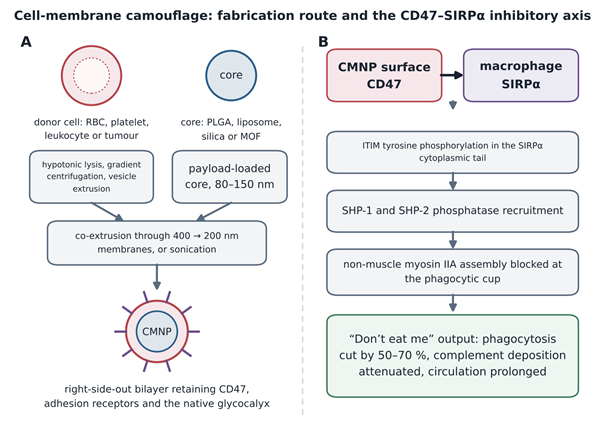
Top-down biomimetic engineering takes a different route to the same problem. Cell membrane coating technology wraps a synthetic core in an intact natural bilayer so that the particle inherits the donor's surface receptors, glycocalyx architecture and regulatory proteins rather than attempting to approximate them synthetically (Figure 3A; Table 2) (Hu et al., 2011; Korram & Satapathy, 2026). Fabrication is comparatively standardised: donor cells are lysed hypotonically, membranes are purified by gradient centrifugation and extruded into vesicles, and these are fused to preformed cores by co-extrusion or sonication, typically yielding right-side-out core–shell constructs (Hu et al., 2011; Meng et al., 2026).

The immunological centrepiece of this approach is the retention of CD47 (Figure 3B). Membrane-displayed CD47 binds SIRPα on macrophages and dendritic cells; ligation drives tyrosine phosphorylation of immunoreceptor tyrosine-based inhibitory motifs, recruits the SHP-1 and SHP-2 phosphatases, and blocks accumulation of non-muscle myosin IIA at the phagocytic cup (Hu et al., 2011; Korram & Satapathy, 2026). The functional consequence is a reduction in macrophage phagocytosis of approximately 50 % to 70 % together with attenuated complement activation (Hoffman et al., 2025; Korram & Satapathy, 2026).

What the coated particle can do beyond evasion depends on which donor cell supplied the membrane (Table 2). Erythrocyte membranes, rich in CD47, sialic acid and the complement regulators CD55 and CD59, extend circulation and reduce MPS clearance but confer no intrinsic tumour homing (Hu et al., 2011). Platelet membranes retain integrin αIIbβ3, P-selectin and the GPIb-V-IX complex, and therefore engage injured endothelium, subendothelial matrix and circulating tumour cells

Figure 1. Temporal evolution of the biomolecular corona and its consequences for mononuclear phagocyte system clearance. Within seconds of intravenous administration a pristine nanocarrier adsorbs abundant, loosely bound plasma proteins such as albumin and fibrinogen, forming a transient soft corona. Over minutes to hours these are displaced by scarcer, higher-affinity species through Vroman-type competitive exchange, consolidating a stable hard corona whose composition, rather than its quantity, determines the fate of the particle. An opsonin-dominated corona engages Fcγ and scavenger receptors and promotes complement deposition, directing uptake to hepatic Kupffer and splenic macrophages, whereas a dysopsonin-enriched corona engages gp60 and LDL receptor pathways, preserves ligand accessibility and permits prolonged circulation.

Figure 2. Grafting density determines poly(ethylene glycol) chain conformation and the accessibility of the underlying surface to opsonins. At low grafting density the inter-chain distance D exceeds the Flory radius Rf and chains remain coiled in a mushroom conformation, leaving bare surface patches through which serum opsonins penetrate; the hard corona matures, macrophage uptake rises, and repeated dosing elicits anti-PEG IgM and IgG that drive accelerated blood clearance. At high grafting density D falls below Rf, chains extend into a densely hydrated brush that masks surface charge and excludes approaching proteins. The same barrier that prolongs circulation also impedes tumour cell contact and endosomal escape, the trade-off commonly described as the PEG dilemma.

(Hu et al., 2015). Macrophage and leukocyte membranes preserve chemokine receptors such as CXCR4 and CCR2 together with LFA-1 and Mac-1, supporting inflammatory homing and transendothelial migration; macrophage-derived nanosponges additionally act as decoys that sequester inflammatory cytokines and bacterial endotoxins (Hoffman et al., 2025; Parodi et al., 2013). Cancer cell membranes display N-cadherin, galectin-3 and EpCAM, which drive homotypic self-recognition, and simultaneously present tumour-associated antigens that can be exploited for nanovaccine design (Fang et al., 2014; Korram & Satapathy, 2026). Hybrid membranes, produced by fusing two donor sources, attempt to combine circulation and targeting in one shell, at the price of considerable manufacturing complexity (Dehaini et al., 2017; Table 2).

2.4 Microenvironmental Barriers and the Shift from EPR to Active Transport and Retention

Surviving the circulation is necessary but not sufficient. Having evaded the MPS, a carrier must still negotiate the physical and biochemical barriers of the tumour microenvironment (TME) (Table 3). The classical account held that particles extravasate passively through discontinuous tumour vasculature and accumulate because lymphatic drainage is defective, the EPR effect (Wilhelm et al., 2016). Aggregated preclinical and clinical data tell a less flattering story: delivery is heterogeneous and inefficient, with a median of approximately 0.7 % of the injected dose reaching the tumour across diverse models (Figure 4A) (Wilhelm et al., 2016; Z. Liu et al., 2026). Dense matrix with aligned collagen I, fibronectin and crosslinked hyaluronan, interstitial fluid pressure that opposes convective flow, and erratic perfusion together account for much of the loss (Z. Liu et al., 2026; Meng et al., 2026).

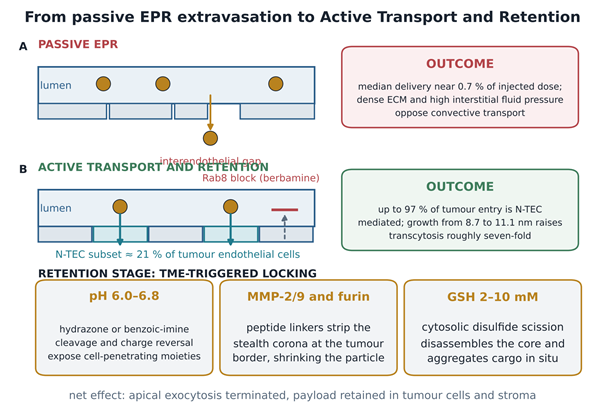
Mechanistic imaging has since reframed the entry route itself. Interendothelial gaps appear not to be the principal port of entry; instead, up to 97 % of particles enter through active trans-endothelial transport mediated by a specialised subset of nanoparticle-transporting endothelial cells, which constitute roughly 21 % of the tumour endothelium and capture particles largely by non-receptor-mediated macropinocytosis (Figure 4B) (Z. Liu et al., 2026). This is the empirical foundation of the ATR framework (Table 3).

ATR-guided carriers are consequently designed as staged systems rather than as single-function objects (Table 3; Figure 4). In the first stage, tuned surface charge or ligands such as cyclic RGD and transferrin trigger macropinocytic capture and receptor-mediated transcytosis (Z. Liu et al., 2026; Meng et al., 2026). In the second, directional control is imposed, for example by small-molecule inhibition of Rab8-dependent apical exocytosis with berbamine, which prevents recycling of internalised carriers back into the lumen and favours basolateral release into the interstitium (Z. Liu et al., 2026). In the third, TME-responsive linkers react to local triggers, acidic extracellular pH near 6.5, elevated MMP-2 and MMP-9, or cytosolic glutathione in the 2 to 10 mM range, so that cleavage or charge reversal exposes cell-penetrating moieties, induces aggregation and terminates transcytotic exit, locking cargo within malignant cells or stroma (Korram & Satapathy, 2026; Z. Liu et al., 2026; Meng et al., 2026).

2.5 Translational Convergence: Bio-Engineered Carriers, CRISPR Biosensing and Liquid Biopsy

The clinical argument for engineered interfaces is sharpest in rare, aggressive and heterogeneous malignancies. Bone and soft tissue sarcomas, including osteosarcoma, Ewing sarcoma and synovial sarcoma, arise in deep anatomical sites, rarely carry universally recurrent point mutations, and release circulating biomarker at very low concentration, so that cross-sectional imaging is effectively blind to microscopic residual disease (Gabrielli et al., 2024; Lyskjær et al., 2022; Shulman et al., 2018). Detection of circulating tumour DNA in these diseases is nonetheless prognostically meaningful, being associated with inferior outcome and with treatment response (Audinot et al., 2024; Krumbholz et al., 2021; Shulman et al., 2018).

Crossing the diagnostic threshold has required three technologies to converge (Table 4; Figure 6). The first is the analyte layer: circulating tumour DNA, translocation fusion transcripts such as EWSR1-FLI1, SS18-SSX and FUS-DDIT3, hypermethylated CpG island profiles, cell-free DNA fragmentomics and vesicle-associated non-coding RNA (Anderson et al., 2025; Ashton et al., 2025; Gabrielli et al., 2024). The second is the CRISPR-Cas molecular engine. Catalytically active and inactive Cas9 variants permit selective cleavage of wild-type sequence and enrichment of rare mutant alleles, as in CUT-PCR (Aalipour et al., 2018; Lee et al., 2017); Cas12a binds double-stranded DNA and then cleaves single-stranded

Figure 3. Cell membrane camouflage: fabrication route and the CD47–SIRPα inhibitory signalling axis. (A) Donor cells are lysed hypotonically, membranes are purified by gradient centrifugation and extruded into vesicles, and these are fused with a payload-loaded synthetic core by co-extrusion through 400 nm and then 200 nm membranes, or by sonication, yielding a right-side-out core–shell construct that retains CD47, adhesion receptors and the native glycocalyx. (B) Membrane-displayed CD47 ligates macrophage SIRPα, driving ITIM phosphorylation, recruitment of the SHP-1 and SHP-2 phosphatases and blockade of non-muscle myosin IIA assembly at the phagocytic cup. The net output is a 50–70 % reduction in phagocytosis with attenuated complement deposition.

Figure 4. From passive enhanced permeability and retention to the staged Active Transport and Retention framework. (A) The classical model attributes tumour entry to passive leakage through interendothelial gaps, a route that delivers a median of only about 0.7 % of the injected dose because dense extracellular matrix and elevated interstitial fluid pressure oppose convective transport. (B) Mechanistic studies instead attribute up to 97 % of entry to active transcytosis across nanoparticle-transporting endothelial cells, a subset comprising roughly 21 % of tumour endothelium, with apical recycling suppressed by Rab8 inhibition. The lower panel summarises the retention stage, in which acidic pH, protease cleavage and cytosolic glutathione lock the payload inside tumour cells and stroma.

reporters indiscriminately, converting one binding event into thousands of signal events (Chen et al., 2018); and Cas13a addresses single-stranded RNA, enabling amplification-free detection of fusion transcripts and exosomal microRNA (Gootenberg et al., 2017; Zhao et al., 2023). The third is signal transduction and interpretation, where functionalised nanomaterials such as Prussian blue–gold nanozymes, quantum dots and aptamer-decorated arrays amplify output, and machine learning models including the EwingSign methylomic and fragmentomic classifier separate true signal from background (Chen et al., 2025; X. Liu et al., 2026; Richardson et al., 2026; Sisca et al., 2026).

The two halves of this review meet at the point where diagnostics become therapeutic. Co-encapsulating Cas9 ribonucleoproteins or guide RNA within immune-evasive, membrane-camouflaged carriers makes it possible, at least in principle, to combine non-invasive surveillance, real-time MRD tracking and targeted molecular therapy within a single platform operated at the point of care (El Motassime et al., 2026; Korram & Satapathy, 2026; Messina et al., 2026).

3. Methods

3.1 Review Design and Reporting Framework

This work was conducted as a structured narrative review with a pre-specified, reproducible search protocol, following PRISMA 2020 principles for identification, screening and reporting while retaining a narrative synthesis appropriate to a heterogeneous, mechanistically diverse literature. A meta-analytic design was deliberately not adopted, because the included studies differ irreconcilably in model system, dosing, assay readout and reporting units, and pooling would have implied a precision the primary data do not support. The protocol specified in advance the databases, search strings, date limits, eligibility rules, extraction fields and synthesis categories described below, so that an independent investigator can repeat the search and arrive at the same corpus.

3.2 Information Sources and Search Strategy

PubMed/MEDLINE was the primary source, searched from database inception to 30 June 2026, with Scopus and Web of Science used as secondary sources to capture engineering and materials-science records indexed less completely in MEDLINE. Searches combined Medical Subject Headings with free-text terms in title and abstract fields, and were run separately for each of the four thematic strands of the review so that recall could be assessed strand by strand.

The core PubMed strategy was: (("Nanoparticles"[MeSH] OR "Drug Carriers"[MeSH] OR nanocarrier[tiab] OR nanoparticle[tiab]) AND ("Protein Corona"[MeSH] OR corona[tiab] OR opsoni[tiab] OR "Mononuclear Phagocyte System"[MeSH])) for the interface strand; ((PEG[tiab] OR "Polyethylene Glycols"[MeSH] OR zwitterion[tiab] OR polysarcosine[tiab] OR "poly(2-oxazoline)"[tiab]) AND (stealth[tiab] OR "accelerated blood clearance"[tiab] OR immunogenic[tiab])) for the stealth strand; (("Cell Membrane"[MeSH] OR biomimetic[tiab] OR camouflag[tiab] OR biohybrid[tiab]) AND (CD47[tiab] OR SIRPA[tiab] OR nanoparticle*[tiab])) for the biohybrid strand; and ((("CRISPR-Cas Systems"[MeSH] OR Cas12a[tiab] OR Cas13a[tiab]) OR ("Liquid Biopsy"[MeSH] OR "Circulating Tumor DNA"[MeSH])) AND ("Sarcoma"[MeSH] OR osteosarcoma[tiab] OR "Ewing"[tiab] OR "Artificial Intelligence"[MeSH])) for the diagnostic strand. Boolean operators, truncation and field tags were translated to the native syntax of each secondary database. Reference lists of all included articles and of pertinent reviews were hand-searched, and forward citation tracking was performed in Google Scholar to identify records published after indexing.

3.3 Eligibility Criteria

Records were eligible if they reported original experimental data, quantitative meta-analysis or authoritative mechanistic review addressing at least one of the following: biomolecular corona composition or kinetics; surface passivation chemistry and its immunological consequences; cell membrane-coated or biohybrid nanocarrier design; intratumoral transport, transcytosis or stimuli-responsive retention; or CRISPR-based nucleic acid biosensing and artificial intelligence applied to liquid biopsy. Only English-language, peer-reviewed publications were included. Records were excluded if they were conference abstracts, preprints without peer review, editorials or commentaries; if they concerned purely diagnostic imaging contrast agents without a delivery or immune-interface component; if nanomaterials were addressed solely from an environmental toxicological perspective; or if no extractable quantitative or mechanistic outcome was reported. Where the same dataset appeared in more than one publication, the most complete report was retained and companion papers were cited only for non-duplicated content.

3.4 Study Selection and Data Extraction

Records retrieved from all sources were imported into a reference manager and deduplicated by digital object identifier and then by title–author matching. Titles and abstracts were screened against the eligibility criteria, and full texts of potentially eligible records were assessed in full. Screening and extraction were performed in duplicate, with disagreements resolved by discussion and, where necessary, by a third assessor; the decision at each stage and the reason for exclusion at full-text stage were recorded.

A standardised extraction form captured, for each included study: bibliographic identifiers; study type and model system (in vitro cell line, ex vivo, murine xenograft or orthotopic model, or human cohort); carrier core material and surface chemistry; polymer molecular weight, grafting density and conformational regime where reported; donor membrane source and verified surface markers; particle hydrodynamic diameter, polydispersity and zeta potential; the specific immunological endpoint measured, such as macrophage uptake, complement activation or anti-polymer antibody titre; pharmacokinetic parameters including circulation half-life and percentage of injected dose per gram of tissue; intratumoral delivery efficiency and transport route; and, for diagnostic studies, analyte class, Cas effector, limit of detection, variant allele frequency threshold, sensitivity, specificity, cohort size and assay turnaround time.

3.5 Data Harmonisation, Synthesis and Quality Appraisal

Extracted quantitative values were harmonised before comparison. Sizes were expressed as intensity-weighted hydrodynamic diameter in nanometres, detection limits were converted to molar units where the original report used mass concentration together with a stated molecular weight, circulation parameters were expressed as terminal half-life in hours, and uptake data were expressed as fold change relative to the control stated in the source study. Values that could not be converted without assumption were retained in their original units and flagged as such. Harmonised data were then grouped into the four synthesis domains that structure Sections 2 and 4 and are tabulated in Tables 1 to 4, namely passivation chemistry, membrane camouflage, microenvironmental transport, and CRISPR–AI diagnostics.

Methodological quality was appraised narratively rather than scored, since no single instrument spans materials-science and clinical cohort designs. Preclinical reports were assessed for randomisation, blinding of outcome assessment, use of appropriate isotype or bare-core controls, sample size justification and completeness of physicochemical characterisation; clinical diagnostic studies were assessed against QUADAS-2 domains covering patient selection, index test, reference standard, and flow and timing. Figures 1 to 6 were generated de novo for this review as schematic and quantitative syntheses of the extracted data; all numerical values rendered in Figure 5 were taken directly from the cited primary sources without transformation, and no values were imputed.

4. Quantitative Hierarchies Across the Immune Interface, Tumour Transport and Molecular Diagnostics

Read together, the extracted evidence does not describe four separate fields so much as one continuum with four measurement points. A particle that survives the circulation but cannot cross the endothelium is no more useful than one that crosses readily but is cleared within minutes, and a diagnostic capable of resolving attomolar signal adds little if the therapeutic it is meant to guide never reaches the lesion. What follows is organised along that continuum.

4.1 Comparative Efficacy and Immunological Cost of Stealth Chemistries

The quantitative picture for synthetic passivation is one of diminishing confidence in PEG as a universal solution rather than outright rejection of it (Table 1). PEGylation remains the benchmark for prolonging circulation, but its protective effect turns out to be unusually sensitive to parameters that are not always reported, namely grafting density, chain length and conformation (Dąbkowska et al., 2026; Lins et al., 2026; Meng et al., 2026).

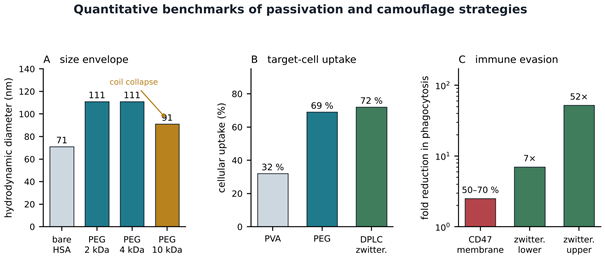
Physicochemical characterisation of albumin-based carriers makes the point concretely. Grafting 2 kDa or 4 kDa chains expanded the hydrodynamic envelope from approximately 71 nm to approximately 111 nm, whereas 10 kDa chains, counterintuitively, produced a smaller construct of approximately 91 nm, consistent with intramolecular entanglement and collapse into a folded conformation (Figure 5A) (Dąbkowska et al., 2026). Microscale thermophoresis gave a similarly non-

Figure 5. Quantitative benchmarks of surface passivation and membrane camouflage strategies extracted from the reviewed literature. (A) Hydrodynamic diameter of albumin-based carriers grafted with PEG of increasing molecular weight; 2 kDa and 4 kDa chains expand the envelope from approximately 71 nm to 111 nm, whereas 10 kDa chains collapse into a folded conformation of approximately 91 nm. (B) Target-cell internalisation for poly(vinyl alcohol), PEG and phosphorylcholine-based zwitterionic coatings, showing a modest advantage for the zwitterionic surface over PEG. (C) Fold reduction in phagocytic uptake on a logarithmic scale for CD47-bearing membrane coatings and zwitterionic chemistries. Assay conditions differ between source studies, so values should be read as indicative rather than directly comparable.

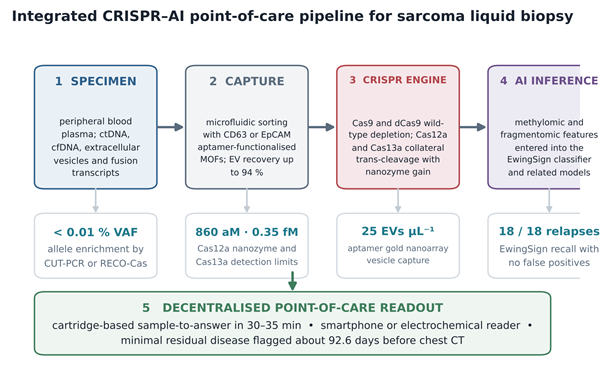
Figure 6. Integrated CRISPR–AI point-of-care pipeline for liquid biopsy surveillance in bone and soft tissue sarcoma. Peripheral blood supplies ctDNA, cell-free DNA, extracellular vesicles and fusion transcripts, which are captured by microfluidic sorting and aptamer-functionalised metal-organic frameworks. CRISPR effectors then provide analytical sensitivity: Cas9 and dCas9 deplete wild-type sequence to enrich rare alleles, while Cas12a and Cas13a convert a single binding event into thousands of reporter cleavages, amplified further by nanozyme chemistry. Machine learning classifiers integrate methylomic and fragmentomic features. The performance figures beneath each stage are drawn from the cited primary studies, and the cartridge-based readout returns a result in 30–35 minutes.

monotonic result, with shorter PEG 2k showing the highest affinity for protein surfaces (Kd = 229 ± 2.85 nM) compared with PEG 4k (881 ± 2.58 nM) and PEG 10k (368 ± 2.58 nM) (Dąbkowska et al., 2026). The practical implication is uncomfortable: sparse grafting did not merely fail to protect. In THP-1 models, surfaces in the mushroom regime were associated with a measurable increase in macrophage phagocytic activity relative to expectation, which is the opposite of the intended effect (Figure 2) (Dąbkowska et al., 2026; Lins et al., 2026). Repeated dosing then adds the immunological penalty, with anti-PEG IgM and IgG induction, complement activation and the ABC phenomenon (Grenier et al., 2018; Meng et al., 2026; Suk et al., 2016).

Against that baseline, the alternative chemistries perform well, though the comparisons are rarely head-to-head (Table 1). Zwitterionic coatings reduced non-specific macrophage uptake by seven- to fifty-two-fold relative to charged counterparts while avoiding anti-polymer antibody production and ABC-mediated clearance on repeat injection (Figure 5C) (Z. Liu et al., 2026; Meng et al., 2026). In cell-penetration models, phosphorylcholine-based zwitterionic coatings achieved 72 % cellular uptake against 69 % for PEG and 32 % for poly(vinyl alcohol), a margin over PEG that is real but modest, and considerably smaller than the margin over the non-stealth control (Figure 5B) (Meng et al., 2026). Polysarcosine extended circulation to approximately 36.9 h without evidence of immunological memory (Z. Liu et al., 2026; Meng et al., 2026). The fold ranges quoted here are wide because the underlying assays are not standardised, and the upper bound of the zwitterionic range should probably be read as a best case rather than a typical one.

4.2 Biological Performance of Biomimetic Membrane Camouflage

Membrane camouflage sidesteps the polymer question entirely by transferring an intact bilayer, its proteins and its glycocalyx onto a synthetic core (Figure 3A; Table 2). The donor cell, rather than the fabrication method, determines what the resulting construct can do (Hoffman et al., 2025; Hu et al., 2011; Korram & Satapathy, 2026).

Erythrocyte membranes supply the canonical evasion phenotype. Surface CD47 ligates macrophage SIRPα, phosphorylates ITIM motifs, recruits SHP-1 and SHP-2 and prevents non-muscle myosin IIA assembly at the phagocytic cup, suppressing phagocytosis by roughly 50 % to 70 % and reducing C3b and C5b-9 deposition (Figure 3B; Figure 5C) (Hu et al., 2011; Korram & Satapathy, 2026; Meng et al., 2026). Platelet membranes retain integrin αIIbβ3, P-selectin and CD47, and therefore add adhesion to subendothelial collagen, damaged microvasculature and circulating tumour cells without forfeiting self-recognition (Hu et al., 2015; Table 2). Macrophage and leukocyte membranes retain CXCR4, CCR2 and LFA-1 and thus support chemotactic homing; macrophage-derived nanodecoys additionally neutralise lipopolysaccharide and inflammatory cytokines, with systemic protection demonstrated in severe sepsis models (Hoffman et al., 2025; Parodi et al., 2013). Cancer cell membranes produce the largest reported targeting effect, with up to twenty-fold higher intratumoral accumulation in homotypic relative to heterotypic models, alongside retention of a tumour-associated antigen repertoire usable for dendritic cell priming (Fang et al., 2014; Meng et al., 2026).

Two caveats deserve to be stated plainly. The twenty-fold figure derives from matched donor and recipient cell lines, a condition that is straightforward in a model and considerably less so in a patient whose tumour is heterogeneous. And hybrid membranes, which on paper combine circulation with targeting, demand control over protein and lipid stoichiometry during fusion that has not yet been demonstrated at manufacturing scale (Dehaini et al., 2017; Table 2).

4.3 Intratumoral Transport: The Quantitative Case Against Passive EPR

The most consequential quantitative finding in this literature is negative. Meta-analysis of published delivery data placed median intratumoral accumulation at approximately 0.7 % of the injected dose, a figure that is difficult to reconcile with EPR as the dominant mechanism of entry (Figure 4A) (Wilhelm et al., 2016). Dense extracellular matrix and elevated interstitial fluid pressure explain part of the deficit, but not its consistency across otherwise dissimilar models (Z. Liu et al., 2026; Meng et al., 2026; Table 3).

The ATR framework supplies an alternative account with its own numbers. Up to 97 % of particles entering solid tumours appear to do so by active trans-endothelial transport through nanoparticle-transporting endothelial cells, a subset constituting roughly 21 % of tumour endothelium that captures particles through membrane

Table 3. Mechanisms and Design Strategies for Overcoming Microenvironmental Barriers to Solid Tumour Delivery. This table organises the Active Transport and Retention literature by the specific microenvironmental barrier each design strategy is intended to overcome. For six delivery paradigms and trigger mechanisms it records the barrier addressed, the molecular and structural engineering used, the transport pathway invoked, the measured or reported consequence for tumour penetration and retention, and the physiological trade-offs that limit each approach. Key quantitative anchors include the approximately 0.7 % injected-dose ceiling of passive EPR, the finding that up to 97 % of tumour entry proceeds through nanoparticle-transporting endothelial cells, and the trigger thresholds for pH, matrix metalloproteinases and glutathione. References appear in APA format in the final column.

Delivery paradigm / trigger mechanism

Primary microenvironmental barrier addressed

Molecular and structural engineering design

Mechanism of action and transport pathway

Impact on tumour retention and penetration

Critical challenges and physiological trade-offs

References

Passive extravasation versus Active Transport and Retention

Dense ECM stroma, high interstitial fluid pressure and poor passive EPR extravasation (~0.7 % injected dose)

Shift from reliance on interendothelial gaps to active transport across nanoparticle-transporting endothelial cells (N-TECs)

Trans-endothelial transcytosis initiated by non-receptor-mediated macropinocytosis, with transport directed basolaterally into the interstitium

Up to 97 % of intratumoral entry occurs by active N-TEC transport, markedly improving deep stromal penetration and retention

Highly variable across tumour types and vessel densities; particle parameters optimal for endothelial entry may conflict with those for retention

Wilhelm et al., 2016; Z. Liu et al., 2026; Meng et al., 2026

pH-responsive deshielding

Acidic extracellular tumour pH of approximately 6.0–6.8 generated by aerobic glycolysis

pH-labile hydrazone, imine or benzoic-imine linkers; histidine-rich or charge-reversible polymer shells

Stealth shielding is maintained at pH 7.4; protonation in the acidic TME cleaves linkers or reverses surface charge from negative to positive

Exposes cell-penetrating peptides or cationic surface charge selectively within the tumour, promoting rapid endocytosis and retention

Requires a sharp pKa transition near pH 6.5; premature deshielding possible in mildly acidic normal tissue or early endosomes

Korram & Satapathy, 2026; Z. Liu et al., 2026; Meng et al., 2026

Enzyme-cleavable linkers

ECM barriers and elevated tumour protease expression (MMP-2, MMP-9, furin, alkaline phosphatase)

Peptide substrates such as GPLGIAGQ for MMP-2/9 and RKKR for furin placed between the stealth shell and the core

Overexpressed stromal proteases cleave the protective polymer layer at the tumour border, stripping the stealth coating

Reduces hydrodynamic size or exposes targeting ligands, enabling interstitial diffusion and terminating transcytotic clearance

Protease expression is heterogeneous between patients; non-specific cleavage possible in liver or inflamed tissue

Korram & Satapathy, 2026; Z. Liu et al., 2026; Meng et al., 2026

Redox-responsive disulfide cleavage

Intracellular delivery bottleneck and slow cytosolic payload release

Reduction-sensitive disulfide linkages incorporated into polymer backbones, lipid shells or crosslinkers

Stable against extracellular glutathione (2–20 µM) but rapidly cleaved by cytosolic glutathione (2–10 mM) through thiol–disulfide exchange

Rapid intracellular core disassembly and burst release in the cytoplasm, bypassing endosomal entrapment

Cytosolic glutathione varies across tumour regions and resistant subclones; hepatocytes also maintain high glutathione

Korram & Satapathy, 2026; Z. Liu et al., 2026; Meng et al., 2026

Size-switchable transcytosis

Vascular basement membrane sieving (30–50 nm pore limits) and stromal interstitial sieving

Stimuli-responsive assembly and disassembly, for example 100 nm parent particles fragmenting to sub-20 nm dendrimers or quantum dots on TME cleavage

Larger particles of 80–100 nm favour circulation and macropinocytic capture by N-TECs; sub-20 nm fragments then diffuse through dense ECM

Combines the pharmacokinetics of large particles with the tissue diffusion of ultra-small structures; 8.7 to 11.1 nm shift raises transcytosis approximately seven-fold

Multi-step manufacturing complexity; premature disassembly in transit risks rapid renal filtration

Z. Liu et al., 2026; Meng et al., 2026

Immune cell hitchhiking and in situ aggregation

Poor perfusion, fibrotic stroma and apical exocytosis of internalised carriers back into circulation

Surface modification with bacterial outer membrane vesicles or chemotactic ligands promoting uptake by circulating monocytes and neutrophils

Carrier cells migrate chemotactically across the vessel wall into inflamed tumour cores; intracellular self-assembly locks cargo in place

Achieves active transport independently of EPR; aggregation prevents apical exocytosis and retains payload in hypoxic cores

Possible toxicity to the carrier immune cell; risk of entrapment at non-tumour inflammatory sites

Z. Liu et al., 2026; Meng et al., 2026

Table 4. Integration of Bio-Engineered Nanocarriers with CRISPR Biosensing, AI Multi-Omics and Liquid Biopsy for Sarcoma Detection. The proposed point-of-care diagnostic pipeline is decomposed here into six functional layers, from specimen processing to decentralised readout. For each layer the table lists the diagnostic analytes and substrates handled, the technological components and molecular engines employed, the signal amplification or interpretive mechanism, the analytical sensitivity and clinical performance metrics reported in the primary literature, and the translational barriers that currently prevent routine implementation. Reported benchmarks include variant allele frequency below 0.01 %, detection limits of 860 aM and 0.35 fM, vesicle resolution at 25 EVs/µL and a 92.6-day lead time over computed tomography. References are given in APA format in the final column.

Subsystem / functional layer

Diagnostic analytes and substrates

Technological components and molecular engines

Diagnostic function and signal amplification mechanism

Analytical sensitivity and clinical metrics

Translational barriers and implementation status

References

Liquid biopsy analyte processing

ctDNA; cell-free DNA; CpG methylation profiles; fragmentomics; fusion RNA and microRNA; extracellular vesicles

Microfluidic separation; CD63 and EpCAM aptamer-functionalised MOFs; low-pass whole-genome sequencing

Minimally invasive capture of tumour-derived nucleic acids and vesicles from plasma, preserving multi-omic sarcoma signatures

ctDNA detectable in 50–57 % of osteosarcomas; EV capture efficiency up to 94 %; tracks real-time tumour burden

Very low analyte concentration in early-stage disease and post-surgical minimal residual disease

Anderson et al., 2025; Ashton et al., 2025; Audinot et al., 2024; Gabrielli et al., 2024; Lyskjær et al., 2022

CRISPR-Cas9 variant enrichment

Rare mutant alleles and single-nucleotide variants in cell-free DNA

SpCas9; catalytically inactive dCas9; guide RNAs matched to wild-type sequence, including double-mismatch designs

Selective cleavage or blockade of wild-type sequence before amplification (CUT-PCR), enriching mutant alleles against background

Variant allele frequency sensitivity below 0.01 %, exceeding the approximately 0.1 % limit of conventional deep sequencing; 90.48 % sensitivity and 100 % specificity reported

Requires custom guide RNA per mutation; limited value in tumours lacking recurrent point mutations

Aalipour et al., 2018; Been et al., 2025; Guo et al., 2026; Lee et al., 2017

CRISPR-Cas12a and Cas13a biosensing

Double-stranded ctDNA; fusion transcripts including EWSR1-FLI1 and SS18-SSX; exosomal microRNA; extrachromosomal circular DNA

Cas12a for double-stranded DNA; Cas13a for single-stranded RNA; dual Cas13a–Cas12a cascades; nested PCR coupling

Target recognition triggers indiscriminate collateral trans-cleavage of reporter probes, converting one binding event into thousands of optical or electrochemical signals

Sub-attomolar to femtomolar sensitivity (860 aM to 0.35 fM); vesicle detection at 25 EVs/µL without thermal cycling

Collateral cleavage limits single-pot multiplexing without microfluidic compartmentalisation

Chen et al., 2018; G. Liu et al., 2025; Gootenberg et al., 2017; Krumbholz et al., 2021; Zhao et al., 2023

Nanomaterial signal enhancement

Fluorophore-labelled reporters; electrochemical current; surface-enhanced Raman scattering

Prussian blue–gold nanozymes; quantum dots; gold nanoarrays; liposomal and polymeric carriers

Nanozymes provide catalytic amplification of the CRISPR signal, quantum dots give photostable multiplexed fluorescence, and MOFs improve vesicle capture

Raises signal-to-background by orders of magnitude and enables readout within 30–35 minutes

Batch-to-batch standardisation of nanozyme synthesis; surface passivation needed to prevent matrix fouling

Chen et al., 2025; X. Liu et al., 2026; El Motassime et al., 2026

AI multi-omics and machine learning

High-dimensional mutational, methylomic, fragmentomic and biosensor signal data

EwingSign classifier; random forest models; deep convolutional neural networks

Integrates multi-modal features to infer tissue of origin, classify sarcoma subtype and separate true biosensor signal from background noise

EwingSign detected 18 of 18 confirmed relapses with no false positives; tumour-informed ctDNA tracking anticipated osteosarcoma relapse by an average of 92.6 days

Training data scarcity given sarcoma rarity; opacity of model decisions and false-positive risk in low-prevalence surveillance

Fu et al., 2024; Richardson et al., 2026; Shulman et al., 2018; Sisca et al., 2026

Point-of-care platform integration

Real-time clinical plasma samples

Microfluidic cartridges; wirelessly powered electrochemical readers; smartphone fluorescence imaging

Combines sample preparation, CRISPR reaction and AI signal processing in a compact device for outpatient use

Sample-to-answer readout within approximately 30 minutes at the point of care

Absence of prospective clinical validation; evolving regulatory frameworks for AI-CRISPR diagnostic devices

El Motassime et al., 2026; Guo et al., 2026; Messina et al., 2026

ruffling and non-receptor-mediated macropinocytosis (Figure 4B) (Z. Liu et al., 2026). Three engineering levers follow from this (Table 3). Directional control: inhibition of Rab8-dependent apical exocytosis, for example with berbamine, shifts transport basolaterally instead of returning carriers to the lumen (Z. Liu et al., 2026). Size tuning: the threshold is unexpectedly sharp, with an increase in dendritic nanostructure diameter from 8.7 nm to 11.1 nm producing an approximately seven-fold gain in transcytosis efficiency (Z. Liu et al., 2026). Triggered locking: MMP-2/9 or furin-cleavable linkers strip the outer shell on arrival, exposing penetrating moieties or inducing aggregation that terminates transcytotic exit (Figure 4) (Korram & Satapathy, 2026; Z. Liu et al., 2026; Meng et al., 2026). Whether a 2.4 nm difference will prove as decisive in human tumours as in the reported models is, for now, an open question.

4.4 Analytical Benchmarks of CRISPR–AI Biosensing in Sarcoma Liquid Biopsy

Where tumour-derived material is scarce, as it is in sarcoma, analytical sensitivity becomes the rate-limiting variable (Table 4; Figure 6) (Audinot et al., 2024; El Motassime et al., 2026; Messina et al., 2026). The reported benchmarks are impressive, and they cluster by mechanism rather than by disease.

Enrichment approaches based on Cas9 and dCas9, including CUT-PCR and RECO-Cas, selectively deplete wild-type sequence and push variant allele frequency sensitivity below 0.01 %, with 90.48 % sensitivity and 100 % specificity reported in plasma cell-free DNA, an order of magnitude beyond conventional deep sequencing (Aalipour et al., 2018; Guo et al., 2026; Lee et al., 2017). Guide RNA engineering extends the same principle: double-mismatch designs improve discrimination of low-frequency single-base variants in patient cell-free DNA (Been et al., 2025). Collateral-cleavage systems attack the problem differently. Cas12a, on binding double-stranded target, cleaves single-stranded reporters indiscriminately, and when coupled to Prussian blue–gold nanozyme electrochemistry reaches a limit of detection near 860 aM (Chen et al., 2018; X. Liu et al., 2026); nested PCR coupling has been applied similarly to extrachromosomal circular DNA (G. Liu et al., 2025). Cas13a, addressing single-stranded RNA, detects fusion transcripts and exosomal microRNA at 0.35 fM, and, combined with EpCAM-aptamer gold nanoarrays, resolves vesicles at 25 EVs/µL (Chen et al., 2025; Gootenberg et al., 2017; Zhao et al., 2023).

Interpretation is where these signals become clinically meaningful (Figure 6). The EwingSign methylomic and fragmentomic classifier identified 18 of 18 clinically confirmed Ewing sarcoma relapses with no false positives among non-cancer controls (Richardson et al., 2026). Longitudinal tumour-informed ctDNA tracking in osteosarcoma anticipated relapse by an average of 92.6 days relative to chest computed tomography (Fu et al., 2024; Messina et al., 2026). Broader systematic evaluation of artificial intelligence-enabled liquid biopsy supports the direction of travel while noting considerable heterogeneity in diagnostic performance across cancers (Sisca et al., 2026). Microfluidic integration compresses the entire cascade, from draw to interpreted readout, into 30 to 35 minutes (El Motassime et al., 2026; Messina et al., 2026). The caution worth registering is that 18 of 18 is an encouraging number drawn from a small denominator, and that performance in a surveillance population with low pre-test probability is not the same statistical problem.

4.5 Integrated Synthesis: A Four-Stage Theranostic Workflow

Taken together, the findings support a workflow in which each stage addresses the failure mode of the one before (Figure 6; Tables 1–4). Stage one, systemic evasion: zwitterionic chemistry or CD47-bearing membrane coatings suppress opsonisation, lowering macrophage uptake by 50 % to 70 % and avoiding the ABC phenomenon (Hu et al., 2011; Meng et al., 2026). Stage two, active entry and retention: carriers exploit N-TEC macropinocytosis and Rab8 inhibition, moving delivery from passive leakage at roughly 0.7 % ID toward active transendothelial penetration (Figure 4) (Z. Liu et al., 2026; Meng et al., 2026). Stage three, triggered unpacking: acidic pH, MMP cleavage or cytosolic glutathione strips the outer shell and releases payload, including Cas ribonucleoproteins, inside the target cell (Korram & Satapathy, 2026; Z. Liu et al., 2026). Stage four, surveillance: bio-functionalised carriers and nanozymes capture vesicles and ctDNA, feeding sub-femtomolar signal into multi-omic classifiers for MRD monitoring with a lead time measured in months rather than weeks (El Motassime et al., 2026; Fu et al., 2024; Messina et al., 2026). The attraction of this scheme is its internal consistency. Its weakness is that no published platform has yet executed all four stages in a single construct in vivo.

5. Stealth Design, Active Transport, and CRISPR Diagnostics for Sarcoma Nanomedicine

5.1 A Change of Objective Rather than a Change of Material

The most useful way to read this literature is as a shift in the design objective itself. For two decades the goal was invisibility, and the metric was how little protein adsorbed. The corona work makes that goal look slightly misconceived, because adsorption is not avoidable, only steerable (Lins et al., 2026; Monopoli et al., 2012). What distinguishes an albumin-dominated corona from an IgG-dominated one is not quantity but identity, and identity is something a surface can be designed to select for (Figure 1; Table 1) (Dąbkowska et al., 2026; Lins et al., 2026). Framed that way, zwitterionic chemistry and membrane camouflage are not rival solutions to the same problem; they are two answers to the question of what the host should be allowed to read.

This reframing also explains why the PEG story has been so persistent. PEG was never the wrong material. It was an incomplete specification, since the parameter that matters, conformational regime, is often neither measured nor reported (Figure 2; Table 1) (Suk et al., 2016). Much of the published variance in PEG performance may be variance in grafting density that was never characterised.

5.2 The Immunological Ledger of Repeat Dosing

Anti-PEG immunity deserves more weight than a single-dose pharmacokinetic study can give it, because oncology is a repeat-dosing discipline (Grenier et al., 2018; Meng et al., 2026). A carrier that circulates for 20 h on first administration and is cleared within minutes on the third has not really solved the clearance problem; it has deferred it. The ABC phenomenon is therefore less a technical nuisance than a design constraint, and the principal argument for polysarcosine, poly(2-oxazoline)s and zwitterionic alternatives rests on it rather than on marginal gains in half-life (Table 1; Figure 5) (Z. Liu et al., 2026; Meng et al., 2026).

Biohybrid platforms appear to escape the problem altogether, since a human erythrocyte membrane presents nothing novel for an immune system to learn (Hu et al., 2011; Korram & Satapathy, 2026). That advantage is real, but it is purchased with a different kind of risk, including donor variability, blood group compatibility, the activation state of harvested macrophages, and the possibility of transferring oncogenic material when the donor is a tumour cell line (Table 2) (Fang et al., 2014; Hoffman et al., 2025).

5.3 What the Transport Data Do and Do Not Establish

The displacement of EPR by ATR is, in our reading, the better-supported of the field's recent revisions, but it should not be overstated (Figure 4; Table 3). The 0.7 % median is robust as a description of what has been achieved; it is not a statement about what is achievable, and the distribution behind that median is wide (Wilhelm et al., 2016). Similarly, the finding that up to 97 % of entry is transcytotic rests on a comparatively small number of mechanistic studies in selected models (Z. Liu et al., 2026). The direction of the evidence is clear; its generality across tumour types, vessel densities and particle chemistries is not yet established.

If the mechanism holds, however, the design consequences are considerable. Sharp size thresholds around 10 nm, the dependence on macropinocytic capture, and the importance of suppressing apical recycling all imply that optimisation targets differ from those inherited from the EPR era (Z. Liu et al., 2026). There is also a genuine tension here that the literature tends to pass over: the particle parameters that favour endothelial entry are not necessarily those that favour interstitial diffusion or intracellular retention, and size-switchable designs exist precisely because that conflict has no single-parameter solution (Table 3).

5.4 Diagnostic Convergence and the Problem of the Small Denominator

The CRISPR–AI results are, taken at face value, the most striking numbers in this review (Table 4; Figure 6). Sub-attomolar detection, variant allele frequencies below 0.01 %, 18 of 18 relapses identified and a 92.6-day lead time over imaging would, if reproduced prospectively, change surveillance practice in sarcoma (Fu et al., 2024; Guo et al., 2026; Richardson et al., 2026). Reproduced prospectively is the operative phrase. Sarcoma cohorts are small by necessity, analytical sensitivity has been established largely in contrived matrices, and the transition from a retrospective cohort enriched for events to an unselected surveillance population reliably degrades positive predictive value (Sisca et al., 2026).

There is an additional, subtler issue. Collateral trans-cleavage, the property that gives Cas12a and Cas13a their sensitivity, is indiscriminate by design, which complicates multiplexing in a single reaction vessel without microfluidic compartmentalisation (Chen et al., 2018; Gootenberg et al., 2017; Table 4). For a disease family defined by several distinct fusion transcripts, that is not a trivial engineering detail. Nor is the regulatory position of an AI-interpreted diagnostic settled (El Motassime et al., 2026).

5.5 Translational Barriers Common to All Four Strands

Across the four domains the obstacles rhyme. Manufacturing reproducibility is the first: membrane fusion stoichiometry, nanozyme batch consistency and zwitterionic polymer purification are all processes that behave differently at scale (Tables 1, 2 and 4) (Dehaini et al., 2017; Hoffman et al., 2025). Characterisation standards are the second, since corona composition, grafting density and membrane orientation are reported inconsistently, which is precisely why cross-study comparison in Section 4 had to be hedged. Biological heterogeneity is the third: protease expression, glutathione concentration and endothelial phenotype vary between patients and within a single tumour, so a trigger calibrated to a model system may mis-fire in a patient (Table 3) (Z. Liu et al., 2026). Finally, almost all of the immunological evidence derives from rodent models whose phagocyte biology differs from the human system in ways that are known but not fully quantified (Gustafson et al., 2019).

5.6 Limitations of this study

Three limitations bear on how much weight these conclusions can carry. The search was restricted to English-language, peer-reviewed literature, which plausibly under-represents materials research published regionally. The synthesis is narrative, so the quantitative comparisons in Section 4 and Figure 5 are descriptive rather than pooled, and no formal assessment of publication bias was possible given the heterogeneity of endpoints; negative delivery results in particular are systematically under-published, which probably flatters every fold-change cited here. And because several included sources are themselves reviews, some quantitative values are reported at one remove from the primary measurement, which we have indicated by citing the mechanistic primary study wherever it could be identified.

5.7 Priorities for the Next Phase

Four priorities follow. Standardised reporting of corona composition and grafting conformation would eliminate a large and avoidable source of between-study variance. Head-to-head comparison of zwitterionic, polypeptoid and membrane-camouflaged carriers under repeat dosing, with anti-carrier antibody titres as a declared endpoint, would settle questions that single-platform studies cannot. Verification of N-TEC-mediated transport in human tumour tissue, rather than in murine models alone, would establish whether ATR is a general principle or a model-specific observation (Z. Liu et al., 2026). And prospective, adequately powered evaluation of CRISPR–AI surveillance in unselected sarcoma cohorts would test whether the reported lead time survives contact with clinical practice (Messina et al., 2026; Sisca et al., 2026). None of these is conceptually difficult. All of them are slower than publishing another platform.

6. Conclusion

The immune interface, not the core chemistry, now sets the ceiling on what targeted nanocarriers can achieve. Corona composition rather than corona quantity determines clearance; grafting conformation rather than PEG itself determines stealth; and anti-PEG immunity makes repeat dosing, not first dose, the honest test of a passivating chemistry. Zwitterionic coatings and membrane-camouflaged biohybrids address that ceiling from opposite directions, one by refusing recognition, the other by supplying the markers of self, with CD47–SIRPα signalling as the best-characterised mechanism. In parallel, evidence that most tumour entry is transcytotic rather than paracellular has replaced passive EPR with a staged Active Transport and Retention logic. Coupling these carriers to CRISPR biosensing and multi-omic artificial intelligence points toward theranostic surveillance with a clinically useful lead time. What remains missing is a single construct that performs all four functions in vivo, and prospective data to confirm that the reported margins survive clinical translation.

References


Aalipour, A., Dudley, J. C., Park, S.-M., Murty, S., Chabon, J. J., Boyle, E. A., Diehn, M., & Gambhir, S. S. (2018). Deactivated CRISPR associated protein 9 for minor-allele enrichment in cell-free DNA. Clinical Chemistry, 64(2), 307–316. https://doi.org/10.1373/clinchem.2017.281436

Anderson, C. J., Yang, H., Parsons, J., Ahrens, W. A., Jagosky, M. H., Hsu, J. H., Patt, J. C., Kneisl, J. S., & Steuerwald, N. M. (2025). Can a liquid biopsy detect circulating tumor DNA with low-passage whole-genome sequencing in patients with a sarcoma? A pilot evaluation. Clinical Orthopaedics and Related Research, 483(1), 39–48. https://doi.org/10.1097/CORR.0000000000003182

Ashton, E., Taly, V., Tlemsani, C., Boudou-Rouquette, P., de Percin, S., Noel, J., Gaudet-Chardonnet, A., Sullo, F., Parfait, B., & Abdelli, J. (2025). Droplet digital PCR assay for detection and monitoring of universally methylated ctDNA in patients with sarcoma. Clinical Cancer Research, 31(18), 3944–3955. https://doi.org/10.1158/1078-0432.CCR-24-3891

Audinot, B., Drubay, D., Gaspar, N., Mohr, A., Cordero, C., Marec-Berard, P., Lervat, C., Piperno-Neumann, S., Jimenez, M., & Mansuy, L. (2024). ctDNA quantification improves estimation of outcomes in patients with high-grade osteosarcoma: A translational study from the OS2006 trial. Annals of Oncology, 35(6), 559–568. https://doi.org/10.1016/j.annonc.2024.03.004

Been, K. W., Kang, S., Bae, T., Hong, S., Kim, G., Hur, J. K., Hwang, W., & Chang, B. (2025). CRISPR with a double mismatch guide RNA enhances detection sensitivity for low-frequency single-base EGFR mutation in circulating cell-free DNA of lung cancer patients. Cancers, 17(19), 3343. https://doi.org/10.3390/cancers17193343

Behzadi, S., Serpooshan, V., Tao, W., Hamaly, M. A., Alkhatib, M. Y., Ou, W. Y., Pacheco, M., Liu, M. Y., Chang, M. J., & Farokhzad, O. C. (2017). Cellular uptake of nanoparticles: Journey inside the cell. Chemical Society Reviews, 46(14), 4218–4244. https://doi.org/10.1039/C6CS00636A

Chen, J. S., Ma, E., Harrington, L. B., Da Costa, M., Tian, X., Palefsky, J. M., & Doudna, J. A. (2018). CRISPR-Cas12a target binding unleashes indiscriminate single-stranded DNase activity. Science, 360(6387), 436–439. https://doi.org/10.1126/science.aar6245

Chen, M., Choi, H. K., Goldston, L. L., Hou, Y., Jiang, C., & Lee, K. B. (2025). Advanced cancer liquid biopsy platform for miRNA detection in extracellular vesicles using CRISPR/Cas13a and gold nanoarrays. ACS Nano, 19(11), 31438–31456. https://doi.org/10.1021/acsnano.5c08912

Dabkowska, M., Kosiorowska-Kraj, A., Szatanik, A., Filip, K., Martínez-Orts, M., Pujals, S., Olszewska, M., & Pukacka, K. (2026). Tunable PEGylated albumin nanocarriers enhance 5-FU cytotoxic selectivity and modulate oxidative and immune stress in colorectal cancer model. Biomedicine & Pharmacotherapy, 196, 118958. https://doi.org/10.1016/j.biopha.2025.118958

Dehaini, D., Wei, X., Fang, R. H., Masson, S., Angsantikul, P., Luk, B. T., Zhang, Y., Ying, M., Jiang, Y., Kroll, A. V., & Zhang, L. (2017). Erythrocyte–platelet hybrid membrane coating for enhanced nanoparticle functionalization. Advanced Materials, 29(18), 1606209. https://doi.org/10.1002/adma.201606209

El Motassime, A., Gabrielli, E., Bocchi, M. B., Giuli, C., Farine, F., Di Costa, D., Maccauro, G., & Vitiello, R. (2026). Integrated CRISPR–AI point-of-care framework for sarcoma liquid biopsy and monitoring. Applied Sciences, 16(20), 10309. https://doi.org/10.3390/app162010309

Fang, R. H., Hu, C.-M. J., Luk, B. T., Gao, W., Copp, J. A., Tai, Y., O'Connor, D. E., & Zhang, L. (2014). Cancer cell membrane-coated nanoparticles for anticancer vaccination and drug delivery. Nano Letters, 14(4), 2181–2188. https://doi.org/10.1021/nl500618u

Fu, Y., Xu, Y., Liu, W., Zhang, J., Wang, F., Jian, Q., Huang, G., Zou, C., Xie, X., & Kim, A. H. (2024). Tumor-informed deep sequencing of ctDNA detects minimal residual disease and predicts relapse in osteosarcoma. EClinicalMedicine, 73, 102697. https://doi.org/10.1016/j.eclinm.2024.102697

Gabrielli, E., Bocchi, M. B., Giuli, C., Farine, F., Di Costa, D., Maccauro, G., & Vitiello, R. (2024). Roles and applications of circulating tumor-derived RNAs in sarcoma patients: A systematic review. International Journal of Molecular Sciences, 25(21), 11715. https://doi.org/10.3390/ijms252111715

Gootenberg, J. S., Abudayyeh, O. O., Lee, J. W., Essletzbichler, P., Dy, A. J., Joung, J., Verdine, V., Donghia, N., Daringer, N. M., & Frejie, C. A. (2017). Nucleic acid detection with CRISPR-Cas13a/C2c2. Science, 356(6336), 438–442. https://doi.org/10.1126/science.aam9321

Grenier, P., Viana, I. M. O., Lima, E. M., & Bertrand, N. (2018). Anti-polyethylene glycol antibodies alter the protein corona deposited on nanoparticles and the physiological pathways regulating their fate in vivo. Journal of Controlled Release, 287, 121–131. https://doi.org/10.1016/j.jconrel.2018.08.021

Guo, C., Zhang, S., Yerramsetti, R., Zhang, J., Guan, X., Yang, R., Hou, C., Pei, M., Schalper, K. T., & Liu, X. (2026). Single-nucleotide variant profiling in liquid biopsy with RECO-Cas. Science Advances, 12(8), eaed1757. https://doi.org/10.1126/sciadv.aed1757

Gustafson, H. H., Holt-Casper, D., Grainger, D. W., & Ghandehari, H. (2019). Nanoparticle uptake: The phagocyte problem. International Journal of Molecular Sciences, 20(23), 6056. https://doi.org/10.3390/ijms20236056

Hoffman, A., Bjånes, E., Zhou, Z., Onanuga, A., Ngo, A. T. P., Hannah, S., Chavarria, N., Dahesh, S., Tran, B. T., Meier, A., & Nizet, V. (2025). Natural macrophage membrane-coated nanoparticles as a multifaceted sepsis therapeutic to sequester inflammatory and toxic mediators. Pharmaceutics, 18(5), 534. https://doi.org/10.3390/pharmaceutics18050534

Hu, C.-M. J., Fang, R. H., Wang, K.-C., Luk, B. T., Thamphiwatana, S., Dehaini, D., Nguyen, P., Angsantikul, P., Wen, C. H., Kroll, A. V., & Zhang, L. (2015). Nanoparticle biointerfacing by platelet membrane cloaking. Nature, 526(7571), 118–121. https://doi.org/10.1038/nature15373

Hu, C.-M. J., Zhang, L., Aryal, S., Cheung, C., Fang, R. H., & Zhang, L. (2011). Erythrocyte membrane-camouflaged polymeric nanoparticles as a biomimetic delivery platform. Proceedings of the National Academy of Sciences of the United States of America, 108(27), 10980–10985. https://doi.org/10.1073/pnas.1106634108

Korram, P., & Satapathy, T. (2026). Biohybrid nanocarriers for precision drug delivery: Integrating biological interfaces with synthetic nanotechnology for targeted and responsive therapeutics. Letters in Drug Design & Discovery, 23, 100403. https://doi.org/10.1016/j.lddd.2026.100403

Krumbholz, M., Eiblwieser, J., Ranft, A., Zierk, J., Schmidkonz, C., Stutz, A. M., Peneder, P., Tomazou, E. M., Agaimy, A., & Bauerle, T. (2021). Quantification of translocation-specific ctDNA provides an integrating parameter for early assessment of treatment response and risk stratification in Ewing sarcoma. Clinical Cancer Research, 27(21), 5922–5930. https://doi.org/10.1158/1078-0432.CCR-21-0811

Lee, S. H., Yu, J., Hwang, G. H., Kim, S., Ye, S., Kim, Y., Park, J., Park, D. Y., Cho, Y.-K., & Kim, J.-S. (2017). CUT-PCR: CRISPR-mediated, ultrasensitive detection of target DNA using PCR. Oncogene, 36(48), 6823–6829. https://doi.org/10.1038/onc.2017.281

Lins, A., Fortmann, M., Mulac-Hahnen, D., Humpf, H.-U., & Langer, K. (2026). The nanoparticle protein corona impacts interactions with monocytes and macrophages. Current Issues in Molecular Biology, 48, 1037. https://doi.org/10.3390/cimb4801037

Liu, G., Wu, J., Yang, B., Kong, J., Li, Y., Chen, C., Hu, J., Sun, Z., Hou, Y., & Sun, R. (2025). Ultrasensitive eccDNA detection for tumor diagnostics by using CRISPR/Cas12a-coupled nested PCR. Analytical Chemistry, 97(42), 18527–18536. https://doi.org/10.1021/acs.analchem.5c03211

Liu, X., Shi, F., Luo, G., Wang, Q., Deng, F., Luo, X., Huo, D., & Hou, C. (2026). A disposable CRISPR-nanozyme electrochemical biosensor for rapid and sensitive detection of breast cancer circulating tumor DNA. Analytical Chemistry, 98(26), 12802–12810. https://doi.org/10.1021/acs.analchem.6c01021

Liu, Z., Ban, M., Zhang, S., & Zhao, L. (2026). Stage-by-stage nanoparticle design strategies for overcoming tumor microenvironment barriers based on the active transport and retention (ATR) framework. Pharmaceutics, 18(12), 1273. https://doi.org/10.3390/pharmaceutics18121273

Lyskjær, I., Kara, N., De Noon, S., Davies, C., Rocha, A. M., Strobl, A.-C., Usher, I., Gerrand, C., Strauss, S. J., & Schrimpf, D. (2022). Osteosarcoma: Novel prognostic biomarkers using circulating and cell-free tumour DNA. European Journal of Cancer, 168, 1–11. https://doi.org/10.1016/j.ejca.2022.02.019

Meng, F., Sharifi, M., Vagena, I.-A., Chaurawal, N., Boegh, M., Reuten, R., & Zhang, Y.-N. (2026). Adaptive nanocarriers to overcome biological barriers in cancer therapy: From systemic intelligence to adaptive intelligence. Biomedicine & Pharmacotherapy, 202, 119739. https://doi.org/10.1016/j.biopha.2026.119739

Messina, D., El Motassime, A., Maccauro, G., Santoro, A., Brancaccio, V., Oliva, M. S., Ziranu, A., & Vitiello, R. (2026). CRISPR-powered liquid biopsy meets artificial intelligence: An integrated framework for next-generation point-of-care sarcoma detection. Applied Sciences, 16(20), 10309. https://doi.org/10.3390/app162010309

Monopoli, M. P., Åberg, C., Salvati, A., & Dawson, K. A. (2012). Biomolecular coronas provide the biological identity of nanosized materials. Nature Nanotechnology, 7(12), 779–786. https://doi.org/10.1038/nnano.2012.207

Parodi, A., Quattrocchi, N., van de Ven, A. L., Chiappini, C., Evangelopoulos, M., Martinez, J. O., Brown, B. S., Khaled, S. Z., Yazdi, I. K., & Enzo, M. V. (2013). Synthetic nanoparticles functionalized with biomimetic leukocyte membranes possess cell-like functions. Nature Nanotechnology, 8(1), 61–68. https://doi.org/10.1038/nnano.2012.212

Richardson, S. A., Safrastyan, A., Karimpour, M., Gulati, G., Harker, P. J. B., Redfern, A., Pearce, S. P., Makeev, V. J., Brennan, B., & Lee, A. T. J. (2026). Cell-free DNA methylome and fragmentome analysis for relapse monitoring of Ewing sarcoma. EMBO Molecular Medicine, 18(7), 1342–1357. https://doi.org/10.15252/emmm.202518421

Shulman, D. S., Klega, K., Imamovic-Tuco, A., Clapp, A., Nag, A., Thorner, A. R., Van Allen, E., Ha, G., Lessnick, S. L., & Gorlick, R. (2018). Detection of circulating tumour DNA is associated with inferior outcomes in Ewing sarcoma and osteosarcoma: A report from the Children's Oncology Group. British Journal of Cancer, 119(5), 615–621. https://doi.org/10.1038/s41416-018-0225-0

Sisca, L., Polito, M. G., Sisca, E., Iuliani, M., Cortellini, A., Vincenzi, B., Tonini, G., & Pantano, F. (2026). Artificial intelligence-enabled liquid biopsy in cancer: A systematic review and meta-analysis of diagnostic performance and biological implications. Frontiers in Oncology, 16, 1850705. https://doi.org/10.3389/fonc.2026.1850705

Suk, J. S., Xu, Q., Kim, N., Hanes, J., & Ensign, L. M. (2016). PEGylation as a strategy for improving nanoparticle-based drug and gene delivery. Advanced Drug Delivery Reviews, 99, 28–51. https://doi.org/10.1016/j.addr.2015.09.012

Wilhelm, S., Tavares, A. J., Dai, Q., Ohta, S., Audet, J., Dvorak, H. F., & Chan, W. C. W. (2016). Analysis of nanoparticle delivery to tumours. Nature Reviews Materials, 1(5), 16014. https://doi.org/10.1038/natrevmats.2016.14

Zhao, D., Tang, J., Tan, Q., Xie, X., Zhao, X., & Xing, D. (2023). CRISPR/Cas13a-triggered Cas12a biosensing method for ultrasensitive and specific miRNA detection. Talanta, 260, 124582. https://doi.org/10.1016/j.talanta.2023.124582

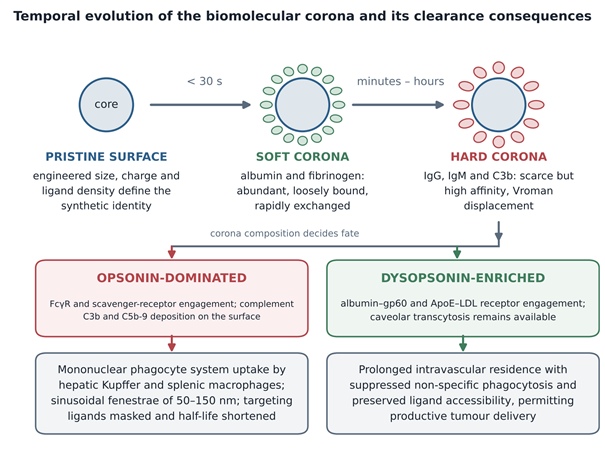
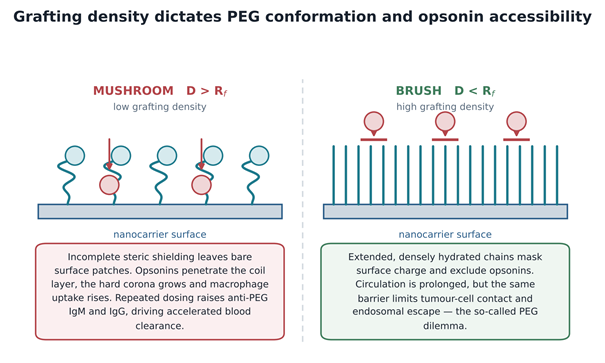
Article metrics
View details
0
Downloads
0
Citations
12
Views

View Dimensions


View Plumx


View Altmetric


0
Save
0
Citation
12
View
0
Share