1. Introduction
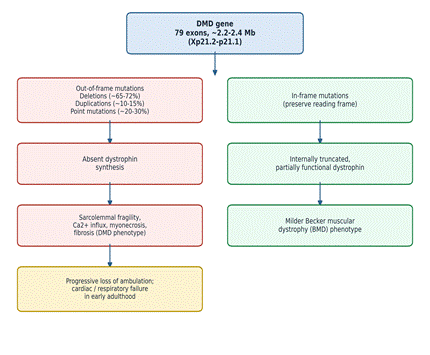
There is something quietly devastating about watching a disease unfold on a schedule. Duchenne muscular dystrophy (DMD) does exactly that. It is an X-linked recessive neuromuscular disorder, and it affects roughly 1 in 3,500 to 1 in 5,000 boys born worldwide - not a rare curiosity, but a recurring tragedy that clinicians and families have learned, painfully, to anticipate (Ali et al., 2024; Choi & Koo, 2021; Lim et al., 2020; Siddika et al., 2026). At the root of it lies a single gene. The DMD gene sits on chromosome Xp21.2-p21.1, and at roughly 2.2 to 2.4 megabases across 79 exons, it happens to be the largest gene in the human genome - a fact that is almost ironic, given how much can go wrong across that much genomic real estate (Chen et al., 2022; Łoboda et al., 2025; Saad et al., 2023). When everything works, that gene produces a 14-kilobase transcript encoding dystrophin, a 427-kDa rod-shaped protein tucked beneath the muscle cell membrane (Pickar-Oliver et al., 2021; Saad et al., 2023). Dystrophin is not glamorous. It does not catalyze anything. What it does, instead, is hold things together - linking the actin cytoskeleton inside the cell to the extracellular matrix outside it, through the dystrophin-associated protein complex, so that muscle fibers can absorb the mechanical stress of contraction without tearing themselves apart (Chen et al., 2022; Pickar-Oliver et al., 2021; Siddika et al., 2026).
Take dystrophin away, and that shock-absorbing function disappears with it. The sarcolemma becomes fragile and abnormally permeable, calcium floods into the cell, and a slow cascade begins: myocyte necrosis, chronic inflammation, and - over years - progressive fibrosis and fatty replacement of what used to be functional muscle (Brescia et al., 2020; Chen et al., 2022; Siddika et al., 2026). Clinically, this plays out with an almost cruel predictability. Boys typically show early motor delays between two and five years of age; independent walking is usually lost by ten to twelve; and death from cardiac or respiratory failure tends to arrive in the twenties or thirties, sometimes earlier (Laurent et al., 2024; Siddika et al., 2026).
Not every DMD mutation behaves the same way, and this distinction matters more than it might first appear. Large exonic deletions account for roughly 65-72% of cases, duplications for another 10-15%, and point mutations for the remainder, with two mutational hotspots - exons 45-55 and exons 3-9 - doing an outsized share of the damage (Chen et al., 2022; Erkut & Yokota, 2022; Siddika et al., 2026). The critical variable, though, is not simply where the mutation sits but whether it disrupts the reading frame. Out-of-frame mutations abolish dystrophin production almost entirely, producing the severe DMD phenotype; in-frame mutations, by contrast, still permit translation of an internally shortened but partly functional protein, yielding the comparatively milder Becker muscular dystrophy (BMD) (Mollanoori et al., 2020; Siddika et al., 2026). This single observation - that reading-frame restoration, rather than perfect sequence correction, can convert a severe disease into a mild one - has quietly shaped almost every therapeutic strategy discussed in this review.
For a long time, treatment for DMD meant corticosteroids - prednisone, deflazacort - which slow the rate of motor decline without touching the underlying genetic lesion, and which carry their own long-term costs in bone fragility, stunted growth, and metabolic disturbance (Ali et al., 2024; Chen et al., 2022; Łoboda et al., 2025). More recently, antisense oligonucleotide (ASO) drugs such as eteplirsen, golodirsen, viltolarsen, and casimersen have offered a genuinely new mechanism: they induce exon skipping at the RNA level, coaxing the splicing machinery to bypass problematic exons and restore the reading frame (Erkut & Yokota, 2022; Kuroda & Yokota, 2026; Łoboda et al., 2025). The trouble is that this correction is transient by design - it has to be re-administered weekly, for life, by intravenous infusion - and even then, dystrophin restoration in skeletal and especially cardiac muscle tends to remain modest, often under 5% of normal levels (Chen et al., 2022; Erkut & Yokota, 2022; Siddika et al., 2026). AAV-delivered micro-dystrophin gene replacement, exemplified by delandistrogene moxeparvovec, sidesteps the mutation-specific problem entirely by supplying a synthetic, heavily truncated dystrophin construct - but truncation means the protein necessarily lacks several structural repeats present in the wild-type molecule, and long-term durability data are still accumulating (Chen et al., 2022; Łoboda et al., 2025; Montagna et al., 2025).
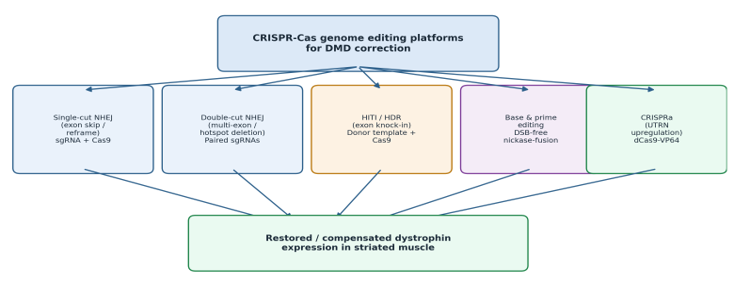
CRISPR-Cas genome editing changes the terms of the problem. Rather than intervening downstream, at the level of RNA or protein, it acts directly on genomic DNA - which means, at least in principle, a single treatment could produce a permanent, endogenously regulated correction rather than a therapy that has to be repeated indefinitely (Choi & Koo, 2021; Erkut & Yokota, 2022; Laurent et al., 2024). A single-guide RNA (sgRNA) directs a Cas endonuclease - most often Streptococcus pyogenes Cas9 (SpCas9) or the smaller Staphylococcus aureus Cas9 (SaCas9) - to a specific genomic site adjacent to a protospacer adjacent motif (PAM), where it introduces a targeted double-strand break (Chen et al., 2022; Erkut & Yokota, 2022). Because skeletal and cardiac myocytes are postmitotic, they repair these breaks predominantly through non-homologous end joining (NHEJ) rather than homology-directed repair, and this constraint has, somewhat unexpectedly, become an opportunity: NHEJ can be harnessed for single-cut exon skipping, double-cut deletion of entire mutational hotspots, or homology-independent targeted integration (HITI) of missing exons (Choi & Koo, 2021; Pickar-Oliver et al., 2021; Siddika et al., 2026). Newer, double-strand-break-free platforms - adenine and cytosine base editors, prime editing, and dCas9-based CRISPR activation of the autosomal paralog utrophin (UTRN) - extend this toolkit further still, offering ways to correct point mutations or compensate for dystrophin loss altogether without cutting the genome at all (Chen et al., 2022; Erkut & Yokota, 2022; Laurent et al., 2024).
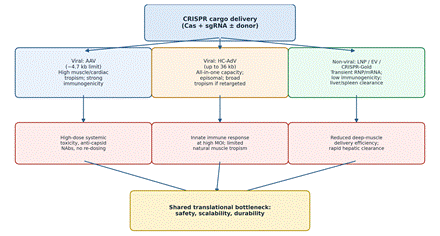
It would be convenient if the story ended there - a permanent molecular fix, ready for the clinic. It does not. Proof-of-concept has been demonstrated repeatedly, across cell culture, rodent, canine, and porcine models of DMD, yet translating any of these strategies into humans runs into a set of stubborn, interconnected barriers around delivery, safety, and manufacturing scale (Ali et al., 2024; Chen et al., 2022; Laurent et al., 2024). Striated muscle is not a small target; it makes up well over 40% of total body mass, which means an effective in vivo therapy has to reach muscle tissue essentially everywhere in the body, not just at a local injection site (Chen et al., 2022; Łoboda et al., 2025). Recombinant AAV vectors - AAV8, AAV9, AAVrh74, and engineered myotropic variants such as MyoAAV - dominate this space because of their natural affinity for muscle, but they carry a hard physical packaging ceiling of roughly 4.7 kilobases, and SpCas9 alone already occupies about 4.1 kb before a guide RNA or promoter is even added (Chen et al., 2022; Happi Mbakam et al., 2022; Łoboda et al., 2025). Dual-vector systems, split-intein trans-splicing, and smaller Cas orthologs such as SaCas9 or Campylobacter jejuni Cas9 have all been proposed as workarounds, yet each still requires systemic vector doses in the range of 1 x 10^14 to 1.8 x 10^15 vector genomes per kilogram to achieve adequate body-wide transduction (Chen et al., 2022; Erkut & Yokota, 2022; Zhang et al., 2021).
Doses of that magnitude are not without consequence. High-dose systemic AAV administration has been associated with acute hepatotoxicity, dorsal root ganglion sensory neuron toxicity, complement activation, thrombotic microangiopathy, acute respiratory distress syndrome, and - in a small number of tragic clinical cases - fatal multi-organ failure (Ali et al., 2024; Łoboda et al., 2025; Laurent et al., 2024). Pre-existing neutralizing antibodies against AAV capsids, already present in a substantial fraction of the human population, block transduction outright and rule out re-dosing (Chen et al., 2022; Łoboda et al., 2025; Montagna et al., 2025). Persistent expression of bacterial-derived Cas proteins invites its own immune response, with cytotoxic T-cells capable of clearing the very myofibers that were just corrected (Chen et al., 2022; Choi & Koo, 2021; Happi Mbakam et al., 2022). And at the genomic level, prolonged nuclease activity raises the risk of off-target cleavage and of unintended capture of viral vector fragments at Cas9-induced break sites (Brescia et al., 2020; Chen et al., 2022; Choi & Koo, 2021). Non-viral alternatives - lipid nanoparticles, extracellular vesicles, and inorganic gold nanoparticles - sidestep much of this immunogenicity by delivering transient Cas ribonucleoprotein or mRNA rather than a persistent viral genome, though at the cost of comparatively poor delivery efficiency to deep skeletal muscle and rapid clearance by the liver and spleen (Farzi et al., 2026; Kuroda & Yokota, 2026).
Given how tightly these problems are linked - a molecular strategy is only as good as the vector that can deliver it, and a vector is only useful if it can be given safely at scale - this review sets out four connected objectives.
First, it evaluates the major CRISPR-Cas editing modalities available for DMD correction, comparing their molecular mechanisms, targeting efficiencies, and structural outcomes across single-cut and double-cut NHEJ, HITI/HDR knock-in, base editing, prime editing, and CRISPR activation (Chen et al., 2022; Erkut & Yokota, 2022; Siddika et al., 2026). Second, it critically examines viral and non-viral delivery vector platforms - AAVs, high-capacity adenoviral vectors, lipid nanoparticles, and extracellular vesicles - with attention to their transduction efficiency, tissue tropism, and packaging capacity for postmitotic skeletal, cardiac, and muscle stem cell populations (Brescia et al., 2020; Farzi et al., 2026; Łoboda et al., 2025; Siddika et al., 2026). Third, it investigates the safety, immunological, and genotoxic liabilities associated with systemic delivery, including dose-dependent organ toxicity, anti-AAV and anti-Cas immunity, off-target mutagenesis, and vector DNA capture at cleavage sites (Ali et al., 2024; Brescia et al., 2020; Chen et al., 2022; Łoboda et al., 2025). Finally, it identifies emerging scalability solutions and translational roadmaps - hyper-myotropic capsids, self-complementary AAV designs, transient non-viral platforms, targeted immunosuppression, and scalable manufacturing pipelines - that may help move CRISPR therapeutics from preclinical promise toward safe, accessible, and durable clinical treatment for patients with DMD (Ali et al., 2024; Chen et al., 2022; Farzi et al., 2026; Laurent et al., 2024; Siddika et al., 2026).