Integrative Biomedical Research

Integrative Biomedical Research (Journal of Angiotherapy) | Online ISSN  3068-6326
463
Citations
1.9m
Views
775
Articles
Your new experience awaits. Try the new design now and help us make it even better
Switch to the new experience
Figures and Tables
REVIEWS   (Open Access)

Targeted Nanomedicine for Triple-Negative Breast Cancer Closing the Delivery Efficiency Gap

Pugazhandhi Bakthavatchalam 1*, Mohammed Shahjahan Kabir 2, Mst Murshida Mahbub 3,  Yoghinni Manogaran 4

+ Author Affiliations

Integrative Biomedical Research 10 (2) 1-8 https://doi.org/10.25163/biomedical.10210938

Submitted: 14 August 2026 Revised: 05 October 2026  Published: 15 October 2026 


Abstract

Triple-negative breast cancer (TNBC) continues to resist the therapeutic gains achieved in other breast cancer subtypes, and much of that resistance, it turns out, is less about the drugs themselves than about where they end up in the body. Passively targeted nanocarriers were meant to solve this, yet a substantial body of preclinical work now shows that only a median of roughly 0.7% of an intravenously administered nanoparticle dose ever reaches tumor tissue — a figure that helps explain why so much laboratory promise has struggled to survive contact with the clinic. This review draws together evidence on the biological barriers responsible for that shortfall, including mononuclear phagocyte clearance, desmoplastic stroma, elevated interstitial fluid pressure, and an immunosuppressive tumor microenvironment, before turning to the engineering strategies designed to work around them. We examine organic, inorganic, and biomimetic nanocarrier platforms; ligand-based active targeting of biomarkers such as MUC1, CD44, EGFR, and Trop-2; and stimuli-responsive systems that exploit tumor acidosis, redox imbalance, hypoxia, or externally applied triggers to release payload precisely where it is needed. Multimodal strategies — chemo-immunotherapy, phototherapy, radiosensitization — are considered alongside the practical obstacles, GMP scalability, immunogenicity, and preclinical model fidelity chief among them, that continue to slow clinical translation. Rather than treating these as separate literatures, we attempt to place barrier biology, carrier engineering, and translational hurdles into a single, coherent narrative, one that we hope clarifies where the field has made genuine progress and where the delivery efficiency gap remains stubbornly, and instructively, open. Keywords: Triple-negative breast cancer; Targeted nanomedicine; Drug delivery efficiency; Active targeting ligands; Stimuli-responsive nanocarriers; Tumor microenvironment; Nanoparticle translational barriers.

1. Introduction

Breast cancer is, by most counts, still the malignancy most frequently diagnosed among women worldwide, and it remains one of the leading causes of cancer death, with an estimated 2.3 million new cases and more than 665,000 deaths recorded annually (Bray et al., 2024). Within that broad and clinically diverse category sits triple-negative breast cancer (TNBC) — arguably its most difficult subtype, accounting for roughly 10–20% of all breast cancer diagnoses but a disproportionate share of the mortality (Zagami & Carey, 2022). The name itself describes an absence: TNBC lacks meaningful expression of estrogen receptors, progesterone receptors, and HER2, which forecloses the hormonal and HER2-directed therapies that have transformed outcomes elsewhere in breast oncology (Raj et al., 2026). The clinical consequences follow directly. TNBC is responsible for close to 40% of overall breast-cancer deaths despite its smaller share of diagnoses, and five-year survival hovers around 75%, well below the ~95% seen in hormone-receptor-positive disease. Its natural history is also unusually aggressive — high histological grade, rapid proliferation, early relapse within three to five years of diagnosis, and a marked tendency toward visceral and central nervous system spread (Raj et al., 2026; St-Denis-Bissonnette et al., 2022). Molecular profiling has, if anything, complicated the picture further, revealing TNBC not as one disease but as a family of intrinsic subtypes — basal-like 1 and 2, immunomodulatory, luminal androgen receptor, mesenchymal, and mesenchymal stem-like/claudin-low — each with its own oncogenic drivers and microenvironmental character (Catalano et al., 2022).

Because no single actionable receptor defines the disease, cytotoxic chemotherapy — taxanes, anthracyclines, platinum agents — remains, somewhat reluctantly, the backbone of systemic treatment (Raj et al., 2026). It is not a generous therapeutic window. Non-specific toxicity is common, and median overall survival in metastatic disease still sits at only 12 to 18 months (Catalano et al., 2022). Part of the problem is resistance: overexpression of ABC efflux transporters such as P-glycoprotein, BCRP, and MRP1, together with enhanced DNA-repair capacity and epithelial–mesenchymal transition, allows tumors to blunt or evade cytotoxic drugs fairly quickly (Nedeljković & Damjanović, 2019). And because conventional chemotherapy tends to eliminate rapidly dividing bulk tumor cells while sparing the more indolent, self-renewing cancer stem cell population, it can inadvertently select for exactly the cells responsible for relapse and metastasis (Mediratta et al., 2020). Layered on top of this is the tumor microenvironment itself, which in TNBC is unusually hostile to drug penetration: dense desmoplastic stroma built up by hyperactivated cancer-associated fibroblasts, excess extracellular matrix, elevated solid stress, and high interstitial fluid pressure all work together to physically exclude therapeutic agents (Luo et al., 2026). An abundance of immunosuppressive infiltrate — M2-like macrophages, myeloid-derived suppressor cells, regulatory T cells — further dampens any endogenous antitumor immunity and limits how well checkpoint inhibitors can work. And for the roughly one-third of advanced TNBC patients who go on to develop brain metastases, the blood–brain barrier blocks well over 98% of systemic therapeutics from ever reaching the lesion (St-Denis-Bissonnette et al., 2022).

Nanomedicine was, understandably, greeted as a way around much of this. Liposomes, polymeric nanoparticles, solid lipid nanoparticles, micelles, dendrimers, inorganic nanostructures, and biomimetic carriers can all encapsulate poorly soluble drugs, shield them from degradation, extend circulation time, and reshape pharmacokinetics in ways that reduce off-target toxicity (Fraguas-Sánchez & Torres-Suárez, 2020). Early clinical successes — PEGylated liposomal doxorubicin (Doxil®) and albumin-bound paclitaxel (Abraxane®) among them — offered genuine proof of concept, showing that nanoencapsulation could raise maximum tolerated doses and soften vehicle-related toxicity (Gote et al., 2021). Most of this accumulation strategy has historically relied on passive targeting via the Enhanced Permeability and Retention (EPR) effect, in which nanocarriers leak through fenestrated tumor vasculature and linger there because tumors drain poorly through the lymphatics (Wilhelm et al., 2016).

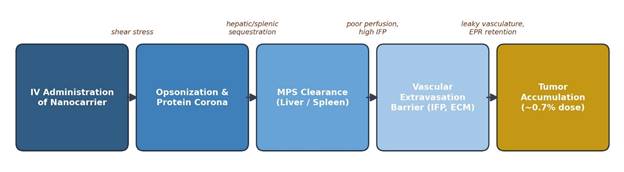
And yet, despite decades of enthusiasm, the clinical payoff has been modest, constrained by what is now widely described as the “delivery efficiency gap” (Saifullah et al., 2026). A landmark meta-analysis of nanoparticle delivery across solid tumors found that a median of only about 0.7% of an administered dose ever reaches and stays within the tumor (Navarro-Real et al., 2026) — a strikingly small figure given how much preclinical optimism the EPR effect has generated. The reasons are sequential and cumulative. On entering the bloodstream, nanocarriers face shear stress and rapid opsonization by plasma proteins, which builds a protein corona that flags them for clearance by the mononuclear phagocyte system in liver and spleen (Raj et al., 2026). Whatever survives that first pass then has to extravasate into tumor tissue against heterogeneous perfusion, dense collagen-rich stroma, and interstitial fluid pressure that actively resists convective transport (Luo et al., 2026).

Bridging this gap, we would argue, requires moving past passive accumulation altogether and toward nanoplatforms that are engineered, deliberately, to navigate biological barriers and respond to local disease cues. Physicochemical tuning is the first line of defense — keeping hydrodynamic diameter within roughly 10–100 nm avoids both rapid renal clearance below that range and mononuclear phagocyte uptake above it, while a neutral-to-slightly-negative surface charge helps prolong circulation (Llaguno-Munive et al., 2024). Beyond that, active targeting ligands — antibodies, peptides, aptamers — can be conjugated to nanocarriers to bind overexpressed TNBC biomarkers such as MUC1, EGFR, CD44, Trop-2, ICAM-1, and integrins, sharpening specificity considerably. And because the TNBC microenvironment carries its own distinctive biochemical fingerprint — extracellular acidosis around pH 6.2–6.9, pronounced hypoxia, elevated intracellular glutathione, and accumulated reactive oxygen species — it offers built-in triggers for “smart,” stimuli-responsive carriers that release their payload only once inside the tumor (Bhayo et al., 2026). Biomimetic strategies, cloaking synthetic cores in erythrocyte, macrophage, or cancer-cell membranes, or using cell-derived extracellular vesicles, represent a further and increasingly promising layer, offering prolonged immune evasion, deeper stromal penetration, and, notably, the ability to cross intact barriers such as the blood–brain barrier (St-Denis-Bissonnette et al., 2022).This review sets out to give a reasonably comprehensive, state-of-the-art account of targeted nanomedicine strategies aimed at closing the delivery efficiency gap in TNBC. Four objectives structure the discussion that follows: Deconstruct biological and microenvironmental barriers — to map the physiological, anatomical, and stromal obstacles, mononuclear phagocyte clearance, interstitial fluid pressure, desmoplasia, and immune suppression among them, that restrict nanoparticle accumulation in TNBC. Review advanced nanocarrier platforms and engineering strategies — to synthesize progress across organic, inorganic, and biomimetic nanomanufacturing approaches tailored to TNBC drug delivery. Examine targeted and stimuli-responsive mechanisms — to critically assess active receptor-targeting approaches and TME-responsive triggers enabling spatiotemporally controlled release and combination therapy. Identify translational hurdles and a forward roadmap — to evaluate scalable GMP manufacturing, reproducibility, toxicology, and regulatory frameworks that stand between benchtop nanomedicines and TNBC clinical trials.

2. Advanced Targeted Nanomedicine and Microenvironmental Interventions in TNBC

2.1 Clinical Landscape and the Rationale for Nanoscale Intervention

TNBC's heterogeneity is, in a sense, the whole problem in miniature. As already noted, it comprises multiple molecularly distinct intrinsic subtypes (Raj et al., 2026; Saifullah et al., 2026), and its lack of a single dominant receptor target leaves systemic chemotherapy as the default option across primary, adjuvant, and metastatic settings (Catalano et al., 2022). Intrinsic and acquired multidrug resistance, mediated by ABC efflux transporters, enhanced DNA repair, and epithelial-to-mesenchymal transition, erodes the durability of that chemotherapy fairly reliably (Gote et al., 2021; Nedeljković & Damjanović, 2019), and the selective survival of chemoresistant cancer stem cells under cytotoxic pressure helps explain why relapse remains common even after apparent initial response (Gote et al., 2021; Mediratta et al., 2020; St-Denis-Bissonnette et al., 2022).

2.2 Biological Microenvironmental Barriers and the Delivery Efficiency Gap

The physical architecture of the TNBC tumor microenvironment does much of the damage before a drug ever reaches its target (Figure 1). Dense desmoplastic stroma, built by hyperactivated cancer-associated fibroblasts and excess collagen deposition, raises solid stress, compresses microvasculature, and elevates interstitial fluid pressure — conditions that, together, actively resist convective drug transport (Luo et al., 2026; Saifullah et al., 2026). An immune-excluded microenvironment, rich in M2-like tumor-associated macrophages, myeloid-derived suppressor cells, and regulatory T cells, compounds this by blunting cytotoxic T-cell infiltration and limiting the efficacy of checkpoint inhibition (Luo et al., 2026; Saifullah et al., 2026). For the substantial minority of patients who develop brain metastases, the blood–brain barrier adds yet another layer, excluding more than 98% of systemic small-molecule therapeutics from intracranial lesions (St-Denis-Bissonnette et al., 2022).

Nanomedicine emerged, in this context, as a way of engineering around rather than through these obstacles (Arshad et al., 2022; Gote et al., 2021; Saifullah et al., 2026), and the EPR effect long served as its conceptual foundation, with nanocarriers extravasating through leaky tumor vasculature and accumulating passively due to poor lymphatic clearance (Navarro-Real et al., 2026). But the numbers tell an uncomfortable story: systematic

Table 1. Architectural Classification and Physicochemical Properties of Advanced Nanocarrier Platforms in TNBC Therapy. This table organizes the principal organic, inorganic, and biomimetic nanocarrier platforms investigated in TNBC research by composition, key biological advantage, representative payload/outcome, and supporting reference. It complements the classification shown in Figure 2 and is cited throughout Sections 2.3 and 4.1.

Platform

Composition & Key Advantage

Representative Payload / Outcome

Reference

Polymeric NPs & micelles

PLGA, PCL, chitosan, PEG-PLGA; controlled degradation, high loading

PTX/DOX + siRNA co-delivery; suppresses efflux, reverses MDR

Bhayo et al., 2026; Gote et al., 2021

Solid lipid NPs / NLCs

Solid lipids (Precirol, GMS) + surfactants; solvent-free, PEGylatable

Docetaxel, erlotinib encapsulation; overcomes P-gp efflux

Llaguno-Munive et al., 2024

Liposomes / nanoemulsions

PEGylated phospholipid bilayers; stealth circulation

Doxil®, liposomal paclitaxel; improved tumor accumulation

Fraguas-Sánchez & Torres-Suárez, 2020; Gote et al., 2021

Inorganic / metallic NPs

AuNPs, AgNPs, SPIONs, quantum dots; optoelectronic/magnetic

AgNPs induce selective lipid peroxidation; AuNPs/SPIONs enable PTT & MRI

Lunca et al., 2026; Snyder et al., 2024

Biomimetic carriers & EVs

Erythrocyte/M1-macrophage/TNBC membrane cloaks; exosomes

Immune evasion, homotypic targeting; BBB crossing

Luo et al., 2026; Shao et al., 2026; St-Denis-Bissonnette et al., 2022

Dendrimers

PAMAM; highly branched, multivalent surface

siRNA complexation (TWIST, MUC1-C); gene silencing

Gote et al., 2021; Saifullah et al., 2026

Carbon-based nanostructures

CNTs, nanodiamonds, oxidized mesoporous carbon

Resveratrol/DOX/PTX delivery; reverses MDR, targets CSCs

Arshad et al., 2022; Gadag et al., 2020

Table 2. Active Receptor-Targeting Biomarkers and Ligand Functionalization Strategies. This table summarizes the principal overexpressed TNBC biomarkers exploited for active targeting, the corresponding ligand or functional moiety, and the biological effect achieved upon receptor engagement, complementing the mechanism illustrated in Figure 3.

Biomarker

Targeting Ligand

Cellular/Antitumor Effect

Reference

MUC1 (90–94% of cases)

Aptamer 5TR1, anti-MUC1 antibody

Receptor-mediated endocytosis; depletes CSCs, downregulates PD-L1

Raj et al., 2026

CD44

Hyaluronic acid, anti-CD44 antibody

Reverses BCSC-mediated MDR; enhanced internalization

Gote et al., 2021; Llaguno-Munive et al., 2024

EGFR (~60–89%)

Cetuximab, anti-EGFR aptamer

Inhibits RAS/RAF/MEK, PI3K/AKT; nuclear payload delivery

Medina et al., 2020; Singh & Yadav, 2021

Trop-2

Anti-Trop-2 antibody/fragment

High-affinity binding; ADC-based genotoxic payload delivery

Saifullah et al., 2026; Yang et al., 2026

αvβ3/αvβ6 integrins

RGD/cRGD peptides

Receptor-mediated transcytosis; suppresses pulmonary metastasis

Gote et al., 2021; Llaguno-Munive et al., 2024

CXCR4

AMD3100 (Plerixafor)

Localizes to CXCR4+ metastatic lesions; inhibits dissemination

Gote et al., 2021; Lunca et al., 2026

Table 3. Stimuli-Responsive (“Smart”) Drug Delivery Systems. This table  details endogenous and exogenous triggers exploited by stimuli-responsive TNBC nanocarriers, the associated chemical/physical mechanism, and the resulting drug-release outcome, corresponding to the schematic in Figure 3.

Trigger

Mechanism / Linker

Release Outcome

Reference

pH (6.2–6.9 / 4.5–5.5)

Acid-labile bonds; protonatable PBAE/PDPA

Proton sponge effect, endosomal escape

Bhayo et al., 2026

Redox (GSH gradient)

Disulfide/diselenide linkages

Cytosolic disassembly, reversal of P-gp efflux

Bhayo et al., 2026; Gote et al., 2021

ROS / hypoxia

Thioketal, boronic ester, azobenzene linkers

ROS-amplified apoptosis; HIF-1α downregulation

Bhayo et al., 2026

Enzyme (MMP-2/9, FAP-α)

Enzyme-cleavable peptide substrates

Size-shrinkage for deep stromal penetration

Saifullah et al., 2026

Ultrasound / NIR light

Microbubble cavitation; photosensitizer activation

Sonoporation; PDT/PTT cytotoxic ROS generation

Edwards et al., 2023; Shao et al., 2026

Magnetic field / heat

PNIPAM LCST transition; SPION heating

Phase transition, AMF-guided localized hyperthermia

de la Fuente-Jiménez et al., 2023; Llaguno-Munive et al., 2024

meta-analysis puts median tumor accumulation at only ~0.7% of the injected dose (Navarro-Real et al., 2026), a figure driven by the sequential losses illustrated in Figure 1 — opsonization and protein-corona formation, mononuclear phagocyte system clearance in liver and spleen, and, for whatever survives that, poor extravasation through heterogeneous, high-pressure tumor tissue (Raj et al., 2026; Saifullah et al., 2026).

As shown in Table 1, closing this gap has pushed the field toward far more rationally engineered platforms. Controlling hydrodynamic diameter within roughly 10–100 nm limits both renal filtration and mononuclear phagocyte uptake, and maintaining a near-neutral or slightly negative surface charge helps prolong systemic circulation (Llaguno-Munive et al., 2024; Raj et al., 2026).

2.3 Architectural Spectrum of Advanced Nanocarrier Platforms

Researchers have, over roughly the last decade, developed a genuinely broad spectrum of organic, inorganic, and biomimetic nanostructures for TNBC therapy (Figure 2; Table 1; Saifullah et al., 2026). Polymeric nanoparticles and micelles built from biodegradable materials such as PLGA, PCL, chitosan, or amphiphilic block copolymers (e.g., PEG-PLGA) offer high payload capacity, tunable degradation, and controlled intracellular release (Bhayo et al., 2026; Saifullah et al., 2026); when these micelles co-encapsulate a hydrophobic chemotherapeutic alongside an siRNA, paclitaxel with a Bcl-2- or survivin-targeting sequence, for instance, they can suppress efflux transporters and resistance pathways more or less simultaneously (Gote et al., 2021). Dendrimers, PAMAM structures especially, bring a highly branched, well-defined architecture that supports dense surface functionalization for multidrug or gene delivery (Gote et al., 2021; Saifullah et al., 2026).

Solid lipid nanoparticles and nanostructured lipid carriers offer a solvent-free alternative, built from biocompatible lipids stabilized by surfactants (Llaguno-Munive et al., 2024). They protect both lipophilic and hydrophilic agents from degradation and sustain release without the organic-solvent burden that polymeric systems sometimes carry; PEGylation further minimizes opsonization, while cationic variants can electrostatically complex nucleic acids such as miR-200c for combined chemo-gene delivery (Llaguno-Munive et al., 2024).

Inorganic and hybrid nanostructures add capabilities that organic carriers largely cannot (Arshad et al., 2022; Lunca et al., 2026). Gold nanoparticles, nanostars and nanocages included, support photothermal therapy, radiosensitization, and CT contrast owing to strong plasmon resonance and high atomic number. Silver nanoparticles exploit what appears to be a genuine biological vulnerability in mesenchymal and claudin-low TNBC subtypes, inducing lipid peroxidation and proteotoxic stress at concentrations far lower than those toxic to normal mammary epithelium (Snyder et al., 2024; Swanner et al., 2015). Superparamagnetic iron oxide nanoparticles and zinc ferrite hybrids, meanwhile, double as MRI contrast agents and as thermal mediators under an alternating magnetic field (de la Fuente-Jiménez et al., 2023).

Biomimetic carriers, cloaked in erythrocyte, M1-macrophage, or cancer-cell membranes, extend circulation time, reduce immunogenicity, and enable homotypic tumor targeting with unusually deep stromal penetration (Luo et al., 2026; Shao et al., 2026). Cell-derived extracellular vesicles push this further still, functioning as natural delivery vehicles capable of crossing intact biological boundaries, including, notably, the blood–brain barrier, which makes them a particularly promising option for intracranial metastases (St-Denis-Bissonnette et al., 2022).

2.4 Active Ligand Targeting of TNBC Biomarkers

Overcoming the low efficiency of passive accumulation (again, ~0.7%) has pushed much of the field toward ligand-based active targeting (Table 2; Navarro-Real et al., 2026; Raj et al., 2026; Saifullah et al., 2026). Tumor-associated Mucin 1, overexpressed and abnormally underglycosylated in roughly 90–94% of TNBC cases, is probably the most extensively studied target; conjugating MUC1-specific aptamers such as 5TR1, or monoclonal antibodies, to nanocarrier surfaces drives receptor-mediated endocytosis and concentrates cytotoxic payload in malignant tissue while sparing normal cells (Raj et al., 2026). Hyaluronic acid functionalization, aimed at CD44, works similarly, targeting a receptor that is enriched on both bulk tumor cells and breast cancer stem cells and thereby helping to reverse stemness-associated resistance (Gote et al., 2021; Llaguno-Munive et al., 2024). EGFR, overexpressed in an estimated 60–89% of TNBC tumors, offers another route, with anti-EGFR antibodies or aptamers guiding nanocarriers toward downstream RAS/RAF/MEK and PI3K/AKT survival

Table 4. Multimodal Combination Therapies and Translational Bottlenecks. This table synthesizes multimodal nanomedicine strategies integrating chemotherapy with immunotherapy, phototherapy, or radiosensitization, alongside the principal translational hurdles limiting each approach's progression toward clinical trials, as discussed in Sections 4.4 and 5.

Strategy

Mechanism / Outcome

Translational Hurdle

Reference

Biomimetic nano-chemo-immunotherapy

M2→M1 repolarization; 71.4% tumor inhibition, 88.2% metastasis suppression

Risk of immune-related adverse events; early-phase trials only

Luo et al., 2026

Photo-immunotherapy / chemo-PDT

Immunogenic cell death; DAMP release, systemic immune memory

Limited light penetration in deep-seated lesions

Shao et al., 2026; Vellingiri, 2021

Nanoparticle radiosensitization / X-PDT

High-Z dose amplification; ROS generation under low-dose X-rays

Discrepancy between preclinical and fractionated clinical protocols

Lunca et al., 2026; Zhang et al., 2026

Gene-chemo combination

Efflux transporter silencing; 4-fold drug retention, 8-fold tumor reduction

Rapid nucleic acid degradation in circulation

Gote et al., 2021

Theranostic platforms

Simultaneous imaging (MRI/CT) and therapy tracking

Complex synthesis; batch variability under GMP

Arshad et al., 2022; Saifullah et al., 2026

Figure 1. The systemic delivery efficiency gap in TNBC nanomedicine. Schematic cascade from intravenous nanocarrier administration through opsonization, mononuclear phagocyte system clearance, and vascular extravasation barriers, culminating in a median tumor accumulation of only ~0.7% of the injected dose. Each transition represents a distinct physiological loss mechanism identified across preclinical pharmacokinetic studies (Navarro-Real et al., 2026; Raj et al., 2026; Saifullah et al., 2026).
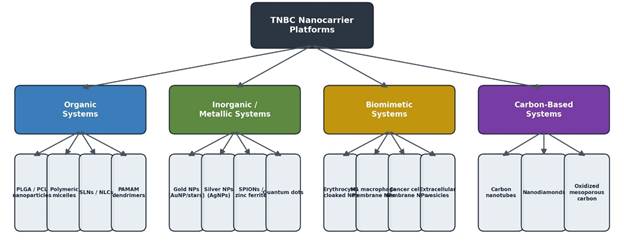
Figure 2. Structural classification of nanocarrier platforms evaluated for TNBC drug delivery. Organic, inorganic/metallic, biomimetic, and carbon-based nanostructures are grouped by composition, each offering distinct physicochemical properties and biological advantages summarized in Table 1 (Arshad et al., 2022; Bhayo et al., 2026; Llaguno-Munive et al., 2024; Saifullah et al., 2026).

signaling (Medina et al., 2020; Singh & Yadav, 2021). Trop-2, ICAM-1, CXCR4, and αvβ3 integrins round out the panel of biomarkers currently exploited for active targeting, each carrying its own particular advantages for antibody–drug conjugate design, receptor-mediated transcytosis, or organ-specific metastasis control (Arshad et al., 2022; Gote et al., 2021; Lunca et al., 2026; Yang et al., 2026).

2.5 Stimuli-Responsive (“Smart”) Release and Multimodal Combination Therapy

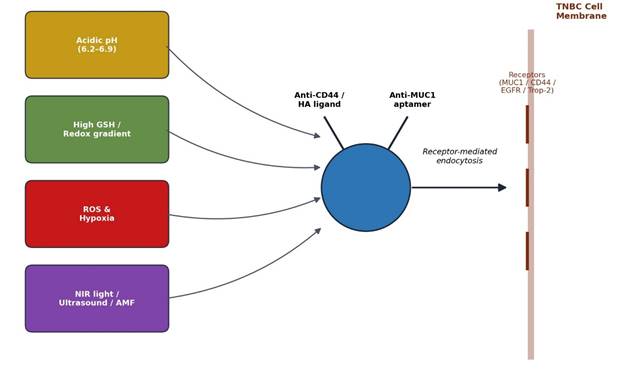
Beyond targeting where a carrier goes, considerable effort has gone into controlling when it releases its payload (Figure 3; Table 3). Endogenous triggers exploit the TNBC microenvironment's own biochemical abnormalities: extracellular acidosis (pH 6.2–6.9) and endo-lysosomal acidity cleave acid-labile linkages or protonate charge-reversing polymers, triggering the so-called proton sponge effect and endosomal escape (Bhayo et al., 2026); the sharp gradient between intracellular (~10 mM) and extracellular (~2 μM) glutathione allows disulfide- or diselenide-linked carriers to remain stable in circulation yet disassemble rapidly once inside a cell (Bhayo et al., 2026; Gote et al., 2021); and elevated reactive oxygen species or hypoxic conditions can cleave thioketal, boronic ester, or azobenzene linkages to release cargo selectively within pathological tissue. External physical triggers, ultrasound-induced cavitation, near-infrared light for photothermal or photodynamic activation, and alternating magnetic fields for localized hyperthermia, add a further, operator-controlled layer of spatiotemporal precision (Bhayo et al., 2026; Edwards et al., 2023; Llaguno-Munive et al., 2024).

These mechanisms rarely operate in isolation in the more advanced platforms now emerging (Table 4). Nano-chemo-immunotherapy, combining cytotoxic payload with checkpoint inhibitors, STING agonists, or TLR7/8 agonists, can repolarize immunosuppressive M2 macrophages toward an anti-tumor M1 phenotype, deactivate cancer-associated fibroblasts, and increase CD8+ T-cell infiltration (Cao et al., 2021; Luo et al., 2026; Zhang et al., 2026). Phototherapy and radiosensitization strategies, pairing nanocarriers with near-infrared light or ionizing radiation, induce immunogenic cell death, releasing damage-associated molecular patterns that can generate a degree of systemic antitumor immune memory (Lunca et al., 2026; Shao et al., 2026; Vellingiri, 2021).

2.6 Translational Bottlenecks: From Bench to Bedside

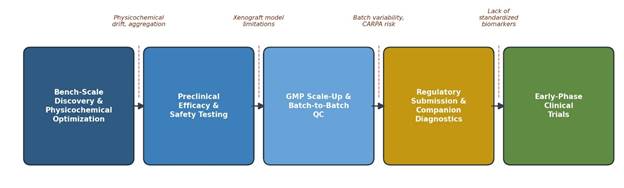
None of this preclinical progress translates automatically into clinical benefit, and Figure 4 outlines where the process tends to stall. Complex, multi-component, or aptamer-functionalized nanostructures are often genuinely difficult to manufacture reproducibly under Good Manufacturing Practice conditions, and batch-to-batch variability can meaningfully alter pharmacokinetics (Raj et al., 2026; Saifullah et al., 2026). Systemic administration carries its own safety considerations, including complement activation-related pseudoallergy and the potential for long-term hepatic or renal accumulation (Saifullah et al., 2026). Standard subcutaneous rodent xenografts, meanwhile, tend to underrepresent human TNBC stromal density, vascular architecture, and immune complexity, which tends to inflate preclinical efficacy estimates relative to what is later observed in patients (Arshad et al., 2022; Lunca et al., 2026). And regulatory frameworks still lack standardized quality metrics and widely adopted companion diagnostics, tMUC1, CD44, or PD-L1 expression among the candidates, that would allow clinicians to identify which patients are most likely to benefit from a given targeted nanotherapy (Raj et al., 2026; Saifullah et al., 2026).
3. Methods

This article follows a narrative, though methodologically structured, review format, and the search and selection process below is reported with enough detail that another investigator working from PubMed could reasonably reproduce it.

3.1 Search Strategy

A structured literature search was conducted across PubMed/MEDLINE, Scopus, and Web of Science for records published through mid-2026, supplemented by manual screening of reference lists from key retrieved articles (a form of backward citation chaining) to capture additional relevant sources not indexed under the primary search terms. Search strings combined the following controlled and free-text terms using Boolean operators: (“triple-negative breast cancer” OR “TNBC”) AND (“nanomedicine” OR “nanoparticle” OR “nanocarrier” OR “liposome” OR “polymeric micelle” OR “solid lipid nanoparticle” OR “dendrimer” OR “extracellular vesicle”) AND (“targeted drug delivery” OR “active targeting” OR “stimuli-responsive” OR “tumor microenvironment” OR “EPR effect” OR “delivery efficiency”). Filters were applied for English-language, peer-reviewed publications, with no lower date restriction imposed given the historical relevance of foundational EPR- and pharmacokinetics-focused work (e.g., Wilhelm et al., 2016).

3.2 Eligibility Criteria

Records were included if they reported (a) primary preclinical (in vitro or in vivo) or clinical data on nanocarrier-based drug delivery specifically in TNBC models or patients, (b) mechanistic or biomarker studies characterizing TNBC tumor microenvironmental barriers relevant to nanoparticle delivery, or (c) systematic reviews or meta-analyses quantifying nanoparticle tumor accumulation or translational outcomes across solid tumors inclusive of TNBC. Records were excluded if they addressed hormone receptor-positive or HER2-positive breast cancer exclusively without a TNBC-specific subgroup, if they were conference abstracts without accompanying peer-reviewed data (with the noted exception of a small number of abstracts retained for illustrative multimodal-strategy discussion, flagged explicitly as such in the text), or if full text could not be obtained.

3.3 Data Extraction and Synthesis

For each included study, we extracted, where reported: nanocarrier composition and physicochemical characteristics (hydrodynamic diameter, zeta potential, polydispersity), targeting ligand or stimuli-responsive mechanism, in vitro cytotoxicity or in vivo efficacy endpoints, and any translational or safety data. Extracted data were organized thematically rather than through formal quantitative meta-analysis, given the heterogeneity of nanocarrier designs, outcome measures, and TNBC preclinical models across the included literature; this thematic, narrative-synthesis approach is consistent with current guidance for reviews addressing mechanistically diverse interventions where pooled effect estimation would not be meaningful. Four synthesis tables (Tables 1–4) were constructed to organize nanocarrier platforms, active-targeting biomarkers, stimuli-responsive release mechanisms, and multimodal/translational considerations, respectively, and four original schematic figures (Figures 1–4) were generated to visually represent the delivery efficiency cascade, nanocarrier classification, targeting/release mechanisms, and translational pathway described in the text.

4. Cross-Platform Synthesis of TNBC Nanomedicine Delivery Strategies

4.1 Physicochemical and Architectural Performance Across Platforms

Taken together, the included literature reveals a genuinely diverse spectrum of nanomanufacturing platforms engineered specifically to overcome TNBC's physiological delivery constraints (Table 1). Polymeric nanoparticles and micelles, built from PLGA, PCL, or amphiphilic block copolymers, recur most frequently, offering high drug loading and controlled intracellular release (Bhayo et al., 2026; Saifullah et al., 2026). Compositionally tuned random copolyester nanoparticles (DS11CL89), for example, achieve hydrodynamic diameters of roughly 100–150 nm with stable irinotecan encapsulation, sustained pH-dependent release (~50% at 24 hours), and dose-dependent cytotoxicity against MDA-MB-231 cells without notable toxicity toward normal mammary epithelium (Cillari et al., 2026).
Lipid-based systems — solid lipid nanoparticles and nanostructured lipid carriers — avoid organic solvents altogether and demonstrate favorable physical stability (Llaguno-Munive et al., 2024). PEGylation reduces opsonization and mononuclear phagocyte uptake, extending circulation half-life, while cationic variants enable electrostatic complexation with nucleic acids such as miR-200c for combined chemo-gene silencing of resistant cancer stem cells (Llaguno-Munive et al., 2024).

Inorganic and metallic nanostructures extend functionality into imaging and physical-energy-based therapy (Arshad et al., 2022; Lunca et al., 2026). Gold nanoparticles support photothermal therapy and radio-enhancement owing to their high atomic number and plasmonic properties. Unfunctionalized silver nanoparticles show a fairly striking selectivity for mesenchymal and claudin-low TNBC subtypes, inducing tumor cell death at concentrations 5- to 500-fold lower than those toxic to non-malignant cells (Snyder et al., 2024; Swanner et al., 2015), a differential that appears to reflect an inherent metabolic vulnerability rather than active targeting per se. Superparamagnetic iron oxide and zinc ferrite nanostructures serve a dual role as MRI contrast agents and thermal mediators under an alternating magnetic field (de la Fuente-Jiménez et al., 2023).

Biomimetic carriers, cloaked with erythrocyte, M1-macrophage, or TNBC cell membranes, extend circulation time and enable homotypic tumor targeting (Luo et al., 2026; Shao et al., 2026), while extracellular vesicles function as endogenous nanoscale delivery systems capable of transporting chemotherapeutics or nucleic acids across dense stroma and, notably, the intact blood–brain barrier, positioning them as a plausible strategy for intracranial TNBC metastases (St-Denis-Bissonnette et al., 2022).

4.2 Biomarker Landscape and Active-Targeting Efficacy

Given the low efficiency of passive EPR-based accumulation (~0.7% of injected dose), functionalizing nanocarriers with high-affinity targeting ligands (Table 2) substantially improves specific binding and intracellular delivery (Navarro-Real et al., 2026; Raj et al., 2026; Saifullah et al., 2026). MUC1, overexpressed and underglycosylated in 90–94% of TNBC cases, exposes tumor-restricted neoepitopes not present on normal breast epithelium, and conjugating MUC1-specific aptamers or antibodies to mesoporous silica, PLGA, or lipid nanoparticles reliably enhances receptor-mediated endocytosis and payload delivery (Raj et al., 2026). Blocking the intracellular MUC1-C subunit with peptide inhibitors such as GO-203 additionally disrupts NF-κB, STAT3, and β-catenin signaling, downregulates PD-L1, and depletes drug-resistant stem-like cells (Raj et al., 2026).

Hyaluronic acid functionalization targeting CD44 similarly drives rapid receptor-mediated internalization in HA-modified lipid and mesoporous silica nanoparticles, with a demonstrated capacity to reverse cancer-stem-cell-mediated multidrug resistance (Gote et al., 2021; Llaguno-Munive et al., 2024; Saifullah et al., 2026). EGFR-targeted nanocarriers, functionalized with anti-EGFR antibodies or aptamers, inhibit downstream RAS/RAF/MEK and PI3K/AKT survival signaling and facilitate nuclear payload deposition (Medina et al., 2020; Singh & Yadav, 2021). RGD peptide-modified carriers dock onto αvβ3 integrins on tumor endothelium and invasive epithelial cells, inhibiting adhesion and suppressing pulmonary metastatic spread in preclinical models (Gote et al., 2021; Llaguno-Munive et al., 2024).

4.3 Microenvironment-Driven Stimuli-Responsive Release Dynamics

Across the reviewed literature, stimuli-responsive designs (Table 3) exploit TNBC's characteristic biochemical abnormalities to achieve spatiotemporally controlled release (Bhayo et al., 2026; Saifullah et al., 2026). pH-responsive systems cleave acid-labile bonds or protonate ionizable amine-containing polymers under extracellular tumor acidosis (pH 6.2–6.9) or endo-lysosomal acidity (pH 4.5–5.5), inducing the proton sponge effect and endosomal escape (Bhayo et al., 2026). Redox-responsive carriers, disulfide-linked HA-ss-PLGA micelles among them, remain stable in circulation but disassemble rapidly upon exposure to the roughly 5,000-fold intracellular-to-extracellular glutathione gradient (Bhayo et al., 2026; Gote et al., 2021). ROS- and hypoxia-responsive systems, using thioketal, boronic ester, or azobenzene linkers, cleave selectively in oxidatively stressed or hypoxic niches, in some cases suppressing HIF-1α signaling and depleting stem-cell populations (Bhayo et al., 2026).

External physical triggers add operator-directed control: ultrasound induces acoustic cavitation and transient sonoporation to enhance localized delivery (Edwards et al., 2023); near-infrared light activates photosensitizers for photothermal or photodynamic effect (Shao et al., 2026); and alternating magnetic fields applied to iron oxide or zinc ferrite carriers generate localized hyperthermia (37–45°C) that promotes drug extravasation (de la Fuente-Jiménez et al., 2023).

4.4 Multimodal Combination Strategies and Translational Metrics

Combination approaches (Table 4) address TNBC's intratumoral heterogeneity by attacking resistant subclones through more than one mechanism simultaneously (Cao et al., 2021; Lunca et al., 2026; Saifullah et al., 2026). Biomimetic nano-chemo-immunotherapy platforms co-delivering Hedgehog pathway inhibitors and PD-1/PD-L1 antagonists in membrane-camouflaged carriers achieved, in one representative orthotopic model, a 71.4% primary tumor inhibition rate and 88.2% suppression of pulmonary metastases, apparently through CAF deactivation and M2-to-M1 macrophage repolarization (Luo et al., 2026). Photo-immunotherapy and radiosensitization approaches integrating photosensitizers or high-Z radiosensitizing nanostructures with immunoadjuvants induce immunogenic cell death and release of damage-associated molecular patterns, generating a degree of systemic antitumor immune memory in preclinical models (Lunca et al., 2026; Shao et al., 2026; Zhang et al., 2026). Gene-chemo theranostic constructs co-encapsulating chemotherapeutics with siRNA against MRP-1 or Bcl-2 increased intracellular drug accumulation roughly four-fold and reduced tumor volume approximately eight-fold in reported models (Gote et al., 2021).

5. Reconciling Preclinical Promise with the Realities of Clinical Translation

5.1 What the Evidence Consistently Shows

Read across the body of work summarized here, a fairly consistent picture emerges: passive accumulation alone is simply not enough. The ~0.7% median tumor-delivery figure (Navarro-Real et al., 2026) is not an outlier estimate so much as a fairly sobering baseline against which every engineering strategy discussed above, active ligand targeting, stimuli-responsiveness, biomimetic cloaking, has to be judged. Where active targeting has been directly compared against passive controls, the improvement in cellular uptake and, to a lesser extent, in vivo accumulation is generally real, if modest in absolute terms (Raj et al., 2026; Table 2). Stimuli-responsive designs appear to add genuine value less by improving where a nanocarrier ends up and more by improving what happens once it gets there, concentrating drug release within, rather than around, the tumor and thereby narrowing the therapeutic window's downside risk (Bhayo et al., 2026; Table 3).

5.2 Convergence Toward Multimodal and Biomimetic Design

Perhaps the clearest trend across the recent literature (2024–2026 publications especially) is convergence toward multimodal, often biomimetic, platforms rather than single-mechanism carriers (Table 4; Luo et al., 2026; Shao et al., 2026; Zhang et al., 2026). This makes a certain intuitive sense given TNBC's molecular heterogeneity: a nanoplatform that simultaneously delivers cytotoxic payload, remodels the immunosuppressive stroma, and triggers immunogenic cell death is, at least in principle, harder for a heterogeneous tumor population to escape than any single-mechanism intervention. The reported efficacy figures for biomimetic co-delivery systems (71.4% primary tumor inhibition, 88.2% suppression of pulmonary metastases; Luo et al., 2026) are genuinely striking, though it is worth being candid that such figures come from a small number of orthotopic mouse models and have not yet been corroborated across independent laboratories or, more importantly, in human tissue.

5.3 Where Translation Continues to Stall

The translational bottlenecks synthesized in Figure 4 are not new observations, precisely, but their persistence across nearly every platform reviewed here is, we think, worth underscoring. GMP scalability and batch-to-batch reproducibility remain a particular concern for multi-component or biomimetic carriers, whose membrane-cloaking or aptamer-functionalization steps introduce variability that is considerably harder to control than for simpler liposomal or polymeric systems (Raj et al., 2026; Saifullah et al., 2026). Immunogenicity, specifically complement activation-related pseudoallergy, is an underappreciated risk given how much of the field's attention has focused on efficacy rather than systemic safety (Saifullah et al., 2026). And perhaps most fundamentally, the standard subcutaneous xenograft models used to generate much of the preclinical efficacy data reviewed here do not well replicate human TNBC stromal density, vascular geometry, or immune cell composition (Lunca et al., 2026) — which may explain at least part of the gap between preclinical enthusiasm and the comparatively modest record of nanomedicine success in TNBC clinical trials to date.

5.4 Limitations of This Review

This synthesis has the limitations inherent to any narrative review: it is not a formal systematic review with dual independent screening, and no quantitative meta-analysis of pooled effect sizes was attempted, given the genuine heterogeneity of nanocarrier designs, outcome measures, and preclinical models across the included studies. Publication bias toward positive preclinical findings likely inflates the apparent efficacy of several platforms discussed here relative to what will ultimately be observed in later-phase clinical evaluation, and the reader should weigh the preclinical figures cited throughout with that caveat in mind.

5.5 A Forward Roadmap

Closing the delivery efficiency gap will likely require progress on several fronts simultaneously rather than a single breakthrough platform: standardized, more clinically representative preclinical models; early integration of companion diagnostic biomarkers (tMUC1, CD44, PD-L1) to enable patient stratification (Raj et al., 2026; Saifullah et al., 2026); and manufacturing processes designed for GMP scalability from the earliest stages of platform development rather than retrofitted later. Multimodal, biomimetic platforms currently appear to offer the most compelling preclinical rationale, but their translational path,

Figure 3. Active ligand targeting and microenvironment-triggered drug release. Surface-conjugated ligands direct receptor-mediated endocytosis into TNBC cells, while endogenous and exogenous stimuli trigger spatiotemporally controlled payload release, detailed in Table 3 (Bhayo et al., 2026; Gote et al., 2021; Raj et al., 2026).

Figure 4. Translational roadmap and bottlenecks for TNBC nanomedicines. Progression from bench-scale discovery through preclinical testing, GMP scale-up, regulatory submission, and early-phase clinical trials, with major bottlenecks indicated at each transition (Arshad et al., 2022; Lunca et al., 2026; Saifullah et al., 2026).

as Figure 4 makes clear, is also the most structurally complex, and this tension between mechanistic sophistication and manufacturability is, in our view, the central design challenge the field now faces.

6. Conclusion

Despite genuine engineering progress, most nanomedicines still reach TNBC tumors at strikingly low efficiency, with passive accumulation alone rarely exceeding a fraction of one percent of the administered dose. Active ligand targeting of biomarkers such as MUC1, CD44, and EGFR, combined with stimuli-responsive release triggered by tumor acidity, redox imbalance, or external energy sources, meaningfully improves specificity and controlled payload delivery. Biomimetic and multimodal platforms integrating immunotherapy, phototherapy, or radiosensitization show the strongest preclinical efficacy signals, yet GMP scalability, immunogenicity, and unrepresentative animal models continue to constrain clinical translation. Future progress will depend on aligning nanocarrier design with reproducible manufacturing, clinically representative preclinical models, and biomarker-guided patient selection from the earliest stages of development, rather than treating translation as an afterthought.

References


Arshad, R., Kiani, M. H., Rahdar, A., Sargazi, S., Barani, M., Shojaei, S., Bilal, M., Kumar, D., & Pandey, S. (2022). Nano-based theranostic platforms for breast cancer: A review of latest advancements. Bioengineering, 9(7), 320. https://doi.org/10.3390/bioengineering9070320

Bhayo, A. M., Li, Y., Aboushanab, A. R., Lin, J., Hassankhanirad, A., Li, W., & Sun, J. (2026). Tumor microenvironment-responsive polymeric nanocarriers for the treatment of triple-negative breast cancer. Pharmaceutics, 18(8), 1083. https://doi.org/10.3390/pharmaceutics18081083

Bray, F., Laversanne, M., Sung, H., Ferlay, J., Siegel, R. L., Soerjomataram, I., & Jemal, A. (2024). Global cancer statistics 2022: GLOBOCAN estimates of incidence and mortality worldwide for 36 cancers in 185 countries. CA: A Cancer Journal for Clinicians, 74(3), 229–263.

Cao, Y., Chen, C., Tao, Y., Lin, W., & Wang, P. (2021). Immunotherapy for triple-negative breast cancer. Pharmaceutics, 13(12), 2003. https://doi.org/10.3390/pharmaceutics13122003

Catalano, A., Iacopetta, D., Ceramella, J., Mariconda, A., Rosano, C., Scumaci, D., Saturnino, C., Longo, P., & Sinicropi, M. S. (2022). New achievements for the treatment of triple-negative breast cancer. Applied Sciences, 12(11), 5554.

Cillari, R., Torres-Rodríguez, J., Scirè, S., Pérez-Camargo, R., Roscigno, G., Müller, A. J., & Mauro, N. (2026). Biodegradable poly(dodecane succinate-ran-caprolactone) nanoparticles with isodimorphic behavior for sustained release of CPT-11 in triple negative breast cancer. European Polymer Journal, 252, 114747. https://doi.org/10.1016/j.eurpolymj.2026.114747

de la Fuente-Jiménez, J. L., Rodríguez-Rivas, C. I., Mitre-Aguilar, I. B., Torres-Copado, A., García-López, E. A., Herrera-Celis, J., Arvizu-Espinosa, M. G., Garza-Navarro, M. A., Arriaga, L. G., Ledesma García, J., García-Gutiérrez, D. I., Zentella Dehesa, A., Sharma, A., & Oza, G. (2023). A comparative and critical analysis for in vitro cytotoxic evaluation of magneto-crystalline zinc ferrite nanoparticles using MTT, crystal violet, LDH, and apoptosis assay. International Journal of Molecular Sciences, 24(16), 12860. https://doi.org/10.3390/ijms241612860

Edwards, I. A., De Carlo, F., Sitta, J., Varner, W., Howard, C. M., & Claudio, P. P. (2023). Enhancing targeted therapy in breast cancer by ultrasound-responsive nanocarriers. International Journal of Molecular Sciences, 24(6), 5474. https://doi.org/10.3390/ijms24065474

Fraguas-Sánchez, A. I., & Torres-Suárez, A. I. (2020). Development of innovative formulations for breast cancer chemotherapy. Cancers, 12(11), 3281.

Gadag, S., Sinha, S., Nayak, Y., Garg, S., & Nayak, U. Y. (2020). Combination therapy and nanoparticulate systems: Smart approaches for the effective treatment of breast cancer. Pharmaceutics, 12(6), 524. https://doi.org/10.3390/pharmaceutics12060524

Gote, V., Nookala, A. R., Bolla, P. K., & Pal, D. (2021). Drug resistance in metastatic breast cancer: Tumor targeted nanomedicine to the rescue. International Journal of Molecular Sciences, 22(9), 4673. https://doi.org/10.3390/ijms22094673

Llaguno-Munive, M., Vazquez-Lopez, M. I., & Garcia-Lopez, P. (2024). Solid lipid nanoparticles, an alternative for the treatment of triple-negative breast cancer. International Journal of Molecular Sciences, 25(19), 10712. https://doi.org/10.3390/ijms251910712

Lunca, S., Morarasu, S., & Dimofte, G. M. (2026). Nanoparticle-mediated radiosensitization in breast cancer: A systematic review of preclinical evidence and translational challenges. International Journal of Molecular Sciences, 27(14), 6522. https://doi.org/10.3390/ijms27146522

Luo, H., Cao, D., Ma, M., Lu, X., & Wang, J. (2026). Biomimetic co-delivery nanoplatform overcomes CAF- and TAM-induced immunosuppression to augment therapeutic efficacy against triple-negative breast cancer. International Journal of Pharmaceutics: X, 12, 100597. https://doi.org/10.1016/j.ijpx.2026.100597

Mediratta, K., El-Sahli, S., D’Costa, V., & Wang, L. (2020). Current progresses and challenges of immunotherapy in triple-negative breast cancer. Cancers, 12(12), 3529.

Medina, M. A., Oza, G., Sharma, A., Arriaga, L. G., Hernández Hernández, J. M., Rotello, V. M., & Ramirez, J. T. (2020). Triple-negative breast cancer: A review of conventional and advanced therapeutic strategies. International Journal of Environmental Research and Public Health, 17(6), 2078. https://doi.org/10.3390/ijerph17062078

Navarro-Real, M., Zavala-López, J. O., Juárez, J., Pardo, A., Barbosa, S., Taboada, P., Topete, A., & Daneri-Navarro, A. (2026). Polyelectrolyte complexed alginate–oligochitosan nanoparticles for co-delivery of doxorubicin and indocyanine green in triple negative breast cancer therapy. Biomedicine & Pharmacotherapy, 195, 119067. https://doi.org/10.1016/j.biopha.2026.119067

Nedeljkovic, M., & Damjanovic, A. (2019). Mechanisms of chemotherapy resistance in triple-negative breast cancer—how we can rise to the challenge. Cells, 8(9), 957.

Raj, A., Chattopadhyay, S., Alex, A. T., Mutalik, S., Kundoolithodi, R., Ellyan, N. S., & Chandran C, S. (2026). Innovative approaches and challenges of MUC1 as a therapeutic target in triple-negative breast cancer. Journal of Drug Delivery Science and Technology, 124, 108630. https://doi.org/10.1016/j.jddst.2026.108630

Saifullah, Q., Mondal, S., Nandi, A., Madhuri, Y., Das, S., & Roy, P. (2026). Nanotechnology in triple-negative breast cancer: A review of nanocarrier systems for enhanced efficacy and reduced toxicity. Nanoscale Advances, 8(11), 3073–3100. https://doi.org/10.1039/D5NA00907C

Shao, Z., Fan, J., Xiao, C., Tao, W., Liu, L., Tong, A., Tang, D., Liu, B., & Tong, C. (2026). Biomimetic M1 macrophage membrane-camouflaged nanoparticles for enhanced photodynamic therapy in triple-negative breast cancer. Materials & Design, 268, 116475. https://doi.org/10.1016/j.matdes.2026.116475

Singh, D. D., & Yadav, D. K. (2021). TNBC: Potential targeting of multiple receptors for a therapeutic breakthrough, nanomedicine, and immunotherapy. Biomedicines, 9(8), 876.

Snyder, C. M., Mateo, B., Patel, K., Fahrenholtz, C. D., Rohde, M. M., Carpenter, R., & Singh, R. N. (2024). Enhancement of triple-negative breast cancer-specific induction of cell death by silver nanoparticles by combined treatment with proteotoxic stress response inhibitors. Nanomaterials, 14(19), 1564. https://doi.org/10.3390/nano14191564

St-Denis-Bissonnette, F., Khoury, R., Mediratta, K., El-Sahli, S., Wang, L., & Lavoie, J. R. (2022). Applications of extracellular vesicles in triple-negative breast cancer. Cancers, 14(2), 451. https://doi.org/10.3390/cancers14020451

Swanner, J., Mims, J., Carroll, D. L., Akman, S. A., Furdui, C. M., Torti, S. V., & Singh, R. N. (2015). Differential cytotoxic and radiosensitizing effects of silver nanoparticles on triple-negative breast cancer and non-triple-negative breast cells. International Journal of Nanomedicine, 10, 3937–3953. https://doi.org/10.2147/IJN.S80283

Vellingiri, Y. (2021). Smart biocompatible photothermal immunotherapy nanoplatforms against triple-negative breast cancer. Annals of Oncology, 32(Suppl 5), S1–S2.

Wilhelm, S., Tavares, A. J., Dai, Q., Ohta, S., Audet, J., Dvorak, H. F., & Chan, W. C. W. (2016). Analysis of nanoparticle delivery to tumours. Nature Reviews Materials, 1(5), 16014.

Yang, Z., Shao, B., Wang, D., Chen, H., Zhao, X., Zeng, M., Liu, Y., Li, Q., & Bi, Z. (2026). A TNBC-targeting nano-radiosensitizer reverses radioresistance by synergizing GSH scavenging with dual inhibition of Trop2 and lncRNA MNX1-AS1. Biomaterials, 327, 123787.

Zagami, P., & Carey, L. A. (2022). Triple negative breast cancer: Pitfalls and progress. npj Breast Cancer, 8, 95.

Zhang, H., Hu, W., Reheman, B., Zhang, N., Wang, J., Zhang, Z., & Sun, C. (2026). Polyphosphoester-based nanocarriers for combined X-ray-induced photodynamic therapy and immunotherapy. Pharmaceutics, 18(4), 399. https://doi.org/10.3390/pharmaceutics18040399


Article metrics
View details
0
Downloads
0
Citations
22
Views

View Dimensions


View Plumx


View Altmetric


0
Save
0
Citation
22
View
0
Share