Integrative Biomedical Research

Integrative Biomedical Research (Journal of Angiotherapy) | Online ISSN  3068-6326
463
Citations
1.8m
Views
757
Articles
Your new experience awaits. Try the new design now and help us make it even better
Switch to the new experience
Figures and Tables
REVIEWS   (Open Access)

Integrating Genomics, Transcriptomics, and Organoid-Based Drug Testing for Precision Cancer Care

Yoghinni Manogaran 1*, Ahmed Ahmed Al-Akwaa 2

+ Author Affiliations

Integrative Biomedical Research 10 (1) 1-8 https://doi.org/10.25163/biomedical.10110907

Submitted: 14 January 2026 Revised: 01 March 2026  Published: 11 March 2026 


Abstract

Genomic profiling has reshaped oncology, yet only a minority of sequenced patients ever receive a molecularly matched therapy, and identical driver mutations often yield inconsistent clinical outcomes. This gap suggests that static DNA-level data alone cannot capture the dynamic, evolving biology of tumors. We synthesized real-world implementation cohorts, diagnostic-platform comparisons, biomarker-pathobiology data, and workforce-competency evidence drawn from recently published precision oncology literature, and we outline a prospective multi-omic pipeline — combining targeted DNA panels, transcriptomics, methylation and copy-number signatures, and patient-derived organoid drug screening — layered onto machine-learning fusion models. Across programs such as KOSMOS and the pediatric integrative-genomics cohort, actionable alterations were identified in 55–100% of patients, yet molecularly matched treatment was ultimately delivered to only 38–51% of cases. Transcriptomic and functional assays improved concordance between predicted and observed drug sensitivity, while copy-number and methylation signatures added prognostic information beyond single-nucleotide variants. Diagnostic-platform trade-offs (depth versus breadth), clonal hematopoiesis confounding in liquid biopsy, and demographic underrepresentation in reference databases emerged as recurring, largely unresolved barriers. A closed-loop framework that pairs multi-omic profiling with functional validation and tiered workforce competencies offers a plausible route toward durable, equitable precision oncology, though prospective, adequately powered trials are still needed to confirm its clinical benefit.

Keywords: precision oncology; multi-omics; functional precision oncology; patient-derived organoids; liquid biopsy; molecular tumor board; machine learning

1. Introduction

Ask an oncologist, ten years ago, what it meant to treat cancer “precisely,” and the answer would almost certainly have started and ended with a gene name — EGFR, ALK, BRAF — as though a single mutation were the whole story. In many respects, that instinct was earned. The arrival of next-generation sequencing (NGS) and comprehensive genomic profiling (CGP) genuinely did move oncology away from a purely histopathological discipline and toward something that could, at last, be called molecularly guided (Kanavos et al., 2025; Rescigno & Greystoke, 2026). Whole-exome sequencing and targeted gene panels identified actionable somatic alterations — EGFR exon 19 deletions and ALK rearrangements in lung adenocarcinoma, BRAF V600E in colorectal cancer — and these discoveries were not academic curiosities; they led directly to regulatory approvals of tyrosine kinase inhibitors that changed how specific patients were treated (Basety et al., 2026; Macrea et al., 2026). It is worth pausing on that achievement before complicating it, because it really did demonstrate, for the first time at scale, that a tumor’s molecular fingerprint could be matched to a specific drug (Adedokun et al., 2026; Bulić et al., 2026).

And yet. Anyone who has looked closely at real-world implementation data will have noticed an uncomfortable pattern: sequencing a tumor and actually treating a patient according to what that sequencing reveals turn out to be two very different things. Across community practice and formal clinical trials alike, only a modest fraction of sequenced patients end up receiving a genuinely matched targeted therapy (T.-Y. Kim et al., 2024; Pokorna et al., 2024). Something is clearly getting lost between the diagnostic report and the treatment plan. Part of the explanation, we think, is almost definitional — somatic DNA sequencing captures a static blueprint, a photograph, of a tumor at one moment, while the tumor itself is anything but static; it is evolving continuously under the selective pressures that treatment itself imposes (Acebedo et al., 2025; Chetta et al., 2026). Tumors are not homogeneous lumps of identical cells; they are mosaics, riddled with intratumoral heterogeneity and subclonal complexity (Knebel et al., 2026; Lee et al., 2026). Subclones that were vanishingly rare at diagnosis — present at variant allele frequencies below 5%, easy to miss, easy to dismiss as noise — can expand under therapeutic pressure and drive recurrence, adaptive lineage plasticity, and metastatic spread (Chetta et al., 2026; Knebel et al., 2026).

There is a second, perhaps more humbling, limitation. Genotype-centric models simply do not, and cannot, account for transcriptional plasticity, metabolic adaptation, epigenetic rewiring, or the host’s own pharmacology (Fadiel et al., 2026; Rusciano, 2026). Clinicians will recognize the paradox this creates at the bedside: two patients with the identical driver mutation, given the identical drug, can travel down entirely different clinical paths (Fadiel et al., 2026; Rusciano, 2026). Occasionally the reverse happens too — a tumor responds beautifully to treatment despite lacking any canonical driver mutation at all (Fadiel et al., 2026). Findings like these are hard to reconcile with a purely DNA-centric worldview, and they push the field, almost by necessity, toward an integrated multi-omics systems-biology framework (Adedokun et al., 2026; Macrea et al., 2026).

What does “beyond genomics” actually require, in practice? At minimum, it means layering in complementary biological readouts that capture what the tumor is doing right now, not merely what it is capable of doing in principle (Adedokun et al., 2026; H. Wang et al., 2025). Tumor transcriptomics is arguably the most immediately useful of these layers: RNA-seq offers a functional window onto active signaling pathways, DNA-repair proficiency, and cellular stress states, and has repeatedly outperformed genomics-only approaches in predicting chemotherapeutic response, particularly in aggressive subtypes such as triple-negative breast cancer and non-clear cell renal cell carcinoma (H. Wang et al., 2025; Kotsifaki et al., 2025). Circulating RNA — cfRNA and extracellular-vesicle-associated RNA — extends this idea into the bloodstream, functioning as a kind of “liquid transcriptome” that captures hypoxia, proliferation, and epithelial–mesenchymal transition signals without another needle biopsy (K. Kim & Yoo, 2026).

Epigenetic and epitranscriptomic layers add still more texture. DNA methylation patterns and non-coding RNA networks shape chromatin accessibility and gene silencing in ways that genomics alone cannot see (Kaštelan et al., 2026; Tinland & de Montgolfier, 2026), and methylation profiling of circulating tumor DNA can reveal tissue of origin and detect cancer early even when mutation counts are sparse (Chetta et al., 2026; K. Kim & Yoo, 2026). Aggregated copy-number alteration signatures — the consensus CON1–CON5 patterns, for instance — capture a history of chromosomal instability that single-nucleotide-variant metrics simply cannot, and predict resistance to chemotherapy, hormonal therapy, and immunotherapy in ways SNV panels miss entirely (Yaacov, 2026).

The field is, in fact, widening further still, toward what some have begun calling “ambiomic” oncology — an acknowledgment that tumors do not arise in a vacuum but are shaped by a lifetime of environmental exposure interacting with germline predisposition (Ortega-García et al., 2025; Tinland & de Montgolfier, 2026). Exposomic and toxicogenomic methods now attempt to link chemical, physical, and social exposures to specific mutational and epigenetic signatures, recalibrating individual risk trajectories and merging environmental epidemiology with personalized prevention (Ortega-García et al., 2025).

Even so, correlation is not causation, and multi-omic models — however detailed — remain fundamentally probabilistic. To close that particular gap, functional precision oncology (FPO) has emerged as a complementary strategy: patient-derived organoids (PDOs) and conditional reprogramming (CR) cultures allow direct, empirical testing of drug sensitivity on living tumor material (Fadiel et al., 2026; Rusciano, 2026; Lee et al., 2026). These platforms preserve much of the genomic fidelity and clonal complexity of the parental tumor and can be established within roughly seven to ten days of biopsy, fast enough to inform real-time decisions (Fadiel et al., 2026; Tutar-Torun et al., 2026). In this integrated loop, multi-omics generates a hypothesis about vulnerability, and FPO functions as the phenotypic gate that confirms — or refutes — it (Rusciano, 2026).

None of this is analytically tractable by hand. The sheer dimensionality of combined multi-omic and functional datasets exceeds ordinary human capacity, which is why artificial intelligence, machine learning, and deep learning have become less of a luxury and more of a necessity in this space (Basety et al., 2026; Bulić et al., 2026). Classifiers such as Random Forest, support vector machines, and XGBoost can fuse mutational, copy-number, transcriptomic, and environmental variables into a single predictive model (Bulić et al., 2026; Qiu et al., 2026), while physics-informed digital twins — combining known constraints like Gompertzian growth kinetics with neural-network components — attempt to simulate a patient’s individual treatment trajectory (Fadiel et al., 2026). Conversational AI agents are even being trialed as an analytical layer for cohort construction and pathway-centric profiling (Diaz et al., 2026), feeding ultimately into multidisciplinary molecular tumor boards that remain the final, human arbiters of treatment recommendations (T.-Y. Kim et al., 2024; Drury et al., 2026).

Still, the barriers to routine implementation are real and, frankly, unglamorous. Pre-analytical variability in blood collection, plasma handling, and organoid culture undermines reproducibility (Chetta et al., 2026; Kaštelan et al., 2026); clonal hematopoiesis of indeterminate potential (CHIP) confounds liquid biopsy interpretation unless matched leukocyte sequencing is performed (Chetta et al., 2026); reference databases remain skewed toward European and East Asian ancestries, leaving African and Middle Eastern populations largely invisible (Chanhih et al., 2025; Tinland & de Montgolfier, 2026); and workforce genomics literacy, alongside outdated health-technology-assessment frameworks, continues to slow adoption at the health-system level (Drury et al., 2026; Kanavos et al., 2025).

It is against this backdrop — real promise, real gaps — that we frame the present work around four guiding questions: (1) how does an integrated multi-omic pipeline compare with DNA-only testing for progression-free survival and toxicity; (2) how well do organoid and conditional-reprogramming assays confirm transcriptomically inferred vulnerabilities; (3) how do machine-learning fusion models and digital twins perform against static risk stratification; and (4) how effectively can matched-normal sequencing and standardized workflows suppress CHIP-related noise. Correspondingly, our objectives are to evaluate clinical efficacy and safety of integrated versus DNA-only profiling, to validate a functional precision oncology platform against real-world response, to develop and externally test machine-learning and digital-twin models, to standardize pre-analytical liquid-biopsy protocols, and — not least — to ensure these advances are validated in demographically diverse cohorts rather than a narrow genomic slice of humanity.

2. Implementing Precision Oncology: Real-World Clinical Outcomes, Systemic Gaps, and the Future of Integrated Cancer Care

2.1 Real-World Efficacy and Clinical Matching Outcomes

It would be convenient if “actionable” and “treatable” meant the same thing in oncology. They do not, and the literature is unambiguous on this point. Prospective implementation programs have shown, again and again, that molecularly guided therapy (MGT) can outperform unmatched, conventional regimens — but only for the subset of patients who actually receive it (T.-Y. Kim et al., 2024). Real-world estimates suggest that somewhere between 15% and 67% of sequenced patients ultimately receive a matched targeted therapy, a range wide enough to suggest that logistics, not biology, are often the limiting factor: restricted drug access, regulatory constraints on off-label prescribing, and the simple fact that heavily pretreated patients sometimes deteriorate faster than a molecular tumor board can convene (T.-Y. Kim et al., 2024; Rusciano, 2026).

The Korean KOSMOS study offers perhaps the most granular illustration of this gap in adult oncology. Of 193 heavily pretreated patients with advanced solid tumors, 75.1% harbored an actionable alteration, yet only 51.3% ultimately received a central-molecular-tumor-board-recommended, molecularly matched treatment — 46.1% through investigational medicinal products and a further 5.2% through matched clinical trials (T.-Y. Kim et al., 2024). Among the 89 patients who did receive investigational agents, despite a median of three prior treatment lines, the objective response rate reached 10.1% and the disease control rate 72.5%; one patient with an ALK-fusion-positive tumor of unknown primary achieved complete remission on alectinib (T.-Y. Kim et al., 2024). Median overall survival in this group was 6.9 months, with treatment duration of 3.5 months, and — notably — patients receiving ERBB2-directed therapy or checkpoint inhibition tended to do disproportionately well (T.-Y. Kim et al., 2024).

Pediatric oncology tells a related, though not identical, story. Pokorna et al. (2024) integrated genomic and transcriptomic profiling across 230 children and young adults with malignant solid tumors and a smaller secondary cohort of 18 patients with difficult-to-treat nonmalignant conditions. Clinically significant variants or fusion genes emerged in 55% of the primary cohort and a striking 89% of the secondary cohort, translating into molecularly informed recommendations for 38% and 47% of patients, respectively — figures broadly comparable to international registries such as INFORM (43%) and Pediatric MATCH (31.5%) (Pokorna et al., 2024). Perhaps the least appreciated finding, though, is that integrative profiling changed or refined the original histopathological diagnosis in 4% of cases — a modest number, but one with outsized clinical consequence for those individual children (Pokorna et al., 2024). Subtype-specific data reinforce the same theme: in non-clear cell renal cell carcinoma, combinations such as pembrolizumab plus axitinib (NEMESIA trial) and pembrolizumab plus lenvatinib (KEYNOTE-B61) achieved response rates of 43.7% and 49%, respectively, with median progression-free survival extending to 10.8 and 18 months (H. Wang et al., 2025).

2.2 Technical, Bioinformatic, and Biological Hurdles

Biology, unfortunately, does not sit still long enough to be captured by a single assay. Intratumoral heterogeneity means that any one biopsy is, at best, a spatial snapshot that may simply miss the resistant subclone lurking elsewhere in the tumor (Fadiel et al., 2026; Lee et al., 2026). This becomes particularly consequential for low-variant-allele-frequency mutations — subclonal populations under 5% VAF that can expand under selective pressure and drive resistance to EGFR, ESR1, or KRAS-targeted therapy (Chetta et al., 2026; Knebel et al., 2026). Detecting these rare variants is not trivial: whole-genome sequencing, despite its comprehensiveness, typically operates at only 30–60× depth, which is simply not deep enough to reliably distinguish a true low-VAF variant from sequencing noise, particularly in FFPE tissue (Knebel et al., 2026; Rescigno & Greystoke, 2026). Targeted panels, by concentrating depth on fewer loci (often 500× to beyond 2,000×), do better here, though at the cost of genomic breadth — a trade-off that, in our view, is underappreciated in clinical decision-making (Knebel et al., 2026). Clinical-grade validation of these low-VAF calls generally still requires duplex-consensus error correction or droplet digital PCR (Knebel et al., 2026).

Liquid biopsy introduces its own, distinct complication. Circulating tumor DNA enables minimally invasive, longitudinal tracking of clonal evolution and minimal residual disease (Chetta et al., 2026; Kaštelan et al., 2026), but it is persistently confounded by clonal hematopoiesis of indeterminate potential (CHIP) — age-related somatic mutations in genes such as DNMT3A, TET2, ASXL1, TP53, and PPM1D that arise in blood stem cells and shed cell-free DNA indistinguishable, at a glance, from tumor-derived material (Chetta et al., 2026). Mistake a CHIP variant for a tumor mutation and a clinician risks prescribing a targeted agent against a target that was never really there; the only reliable safeguard is paired sequencing of leukocyte DNA, which adds cost and complexity that many centers are not yet equipped to absorb (Chetta et al., 2026).

2.3 Socio-Economic, Regulatory, and Health-Technology-Assessment Gaps

Even where the biology and the bioinformatics cooperate, policy sometimes does not. Comprehensive biomarker testing remains geographically and economically uneven: despite formal ESMO endorsement, fewer than 10% of tumor specimens requiring molecular testing undergo NGS across much of Europe, and some regions test under 2% because of fragmented reimbursement and infrastructure (Kanavos et al., 2025). Part of the problem is structural. Traditional health-technology-assessment frameworks were built around the incremental cost-effectiveness ratio of single-marker companion diagnostics, and they are, frankly, ill-suited to evaluating a comprehensive genomic-profiling panel that simultaneously screens hundreds of genes, clarifies hereditary risk, and rules out ineffective, toxic therapies all at once (Kanavos et al., 2025; Rescigno & Greystoke, 2026). What is needed — and what remains largely absent — is a holistic Value Assessment Framework that credits the diagnostic pipeline for the totality of its downstream clinical value, not just the single therapy it happens to unlock (Kanavos et al., 2025).

A parallel, arguably more troubling, gap concerns demographic representation. The genomic and multi-omic reference databases that underlie machine-learning risk models and polygenic risk scores remain overwhelmingly derived from European and East Asian populations, with African, Middle Eastern, and Hispanic/Latino cohorts profoundly underrepresented (Chanhih et al., 2025; Tinland & de Montgolfier, 2026). This is not a trivial oversight; it introduces algorithmic bias directly into clinical decision tools and limits their generalizability precisely where global cancer burden is rising fastest (Chanhih et al., 2025; Tinland & de Montgolfier, 2026; Fadiel et al., 2026). Correcting it will require deliberate, prospective enrollment of underrepresented populations rather than passive hope that existing datasets will somehow diversify on their own (Tinland & de Montgolfier, 2026; Fadiel et al., 2026).

2.4 Structuring the Genomics-Capable Workforce

As precision oncology migrates from a handful of academic centers into everyday community practice, the demands on the workforce multiply almost exponentially (Drury et al., 2026). Clinicians, pathologists, pharmacists, nurses, and bioinformaticians must now coordinate across a pathway spanning specimen acquisition, laboratory processing, variant annotation, tumor-board discussion, and longitudinal toxicity monitoring — and confidence in interpreting complex multi-omic reports lags well behind the pace of technological change (Rescigno & Greystoke, 2026; Drury et al., 2026). Drury and colleagues (2026) responded to exactly this problem with a Core Competency Framework built around a tiered workforce model: Level 1 (precision-informed care) applies to essentially all clinicians and covers basic genomic literacy and appropriate escalation; Level 2 (enhanced precision care) applies to mainstream oncology clinicians who apply structured genomic risk assessment and coordinate referral pathways; and Level 3 (specialist precision care) is reserved for those who interpret complex variants, lead molecular tumor boards, and oversee laboratory quality assurance (Drury et al., 2026). Molecular tumor boards themselves do double duty here — functioning simultaneously as clinical decision bodies and as informal, practice-embedded classrooms that raise the genomic fluency of everyone who sits at the table (Rescigno & Greystoke, 2026; Drury et al., 2026).

2.5 Next-Generation Solutions: Multi-Omics, Functional Precision, and Artificial Intelligence

Given all of the above, it is perhaps unsurprising that the field is converging on integration rather than any single silver-bullet assay (Rusciano, 2026; Lee et al., 2026). Tumor transcriptomics continues to demonstrate predictive power beyond genomics alone, especially in triple-negative breast cancer and non-clear cell renal cell carcinoma (H. Wang et al., 2025; Kotsifaki et al., 2025), while circulating cfRNA extends this dynamic readout into the bloodstream (K. Kim & Yoo, 2026). Yaacov (2026) took this further at scale, extracting five reproducible consensus copy-number signatures (CON1–CON5) from clinical panel data across nearly 25,000 tumors — signatures that map onto known mutational processes such as homologous recombination deficiency (CON3) and mitotic checkpoint failure (CON4), and that independently predict survival and resistance, including CON1’s association with broad resistance to platinum chemotherapy and checkpoint inhibition (Yaacov, 2026).

Functional precision oncology supplies the empirical counterweight to these probabilistic models. Conditional reprogramming permits rapid, high-fidelity expansion of primary tumor cells without genetic manipulation, and patient-derived organoids preserve the three-dimensional architecture and clonal structure of the parental tumor closely enough to serve as reasonable “avatars” for drug screening (Rusciano, 2026; Lee et al., 2026; Fadiel et al., 2026). A case report from Tutar-Torun et al. (2026) makes the logic concrete: a patient with rectal cancer liver metastasis harboring a KRAS p.A146T mutation underwent an integrated genomic-and-organoid drug-sensitivity screen that ranked bevacizumab as the top candidate — and the patient subsequently achieved radiological disease stabilization, a small but persuasive validation of the organoid-derived prediction (Tutar-Torun et al., 2026).

Finally, none of this integration is humanly tractable without computational assistance. Kar et al. (2026) combined random forests, support vector machines, and deep-learning components into a unified model fusing mutations, demographics, lifestyle, and environmental exposure, reporting an overall risk-prediction accuracy of 90.5% (Kar et al., 2026). Physics-informed digital twins go a step further, embedding Gompertzian growth dynamics and oxygen-diffusion constraints alongside neural networks to anticipate resistance trajectories from serial biomarkers such as ctDNA or PSA kinetics (Fadiel et al., 2026), and conversational AI platforms such as AI-HOPE-RTK-RAS and AI-HOPE-MAPK are beginning to serve as natural-language “analytical co-pilots” for cohort construction and survival modeling (Diaz et al., 2026). Taken together, these next-generation solutions do not replace the molecular tumor board so much as arm it — turning a static genomic report into a living, continuously updated hypothesis about how best to treat the patient in front of it.

3. Methods

3.1 Study Design and Rationale

We conducted a structured synthesis, organized as a prospective analytical framework, of published evidence on multi-omic and functional precision oncology, drawing exclusively on the primary studies, trial reports, and methodological studies identified within the source literature underlying this manuscript. The intent was not merely descriptive; rather, we set out to reconstruct, insofar as the underlying reports allow it, a reproducible pipeline architecture — spanning specimen acquisition through computational modeling — against which future prospective cohorts could be benchmarked. Reporting follows, where applicable, elements of the PRISMA framework for evidence synthesis and the STROBE guidance for observational study description, adapted here for a multi-source narrative-synthesis design rather than a single primary study.

3.2 Evidence Sources and Eligibility

Eligible sources comprised peer-reviewed clinical trials, prospective implementation cohorts, and methodological reports published in 2024–2026 that addressed at least one of the following domains: (a) real-world molecularly guided therapy outcomes (e.g., T.-Y. Kim et al., 2024; Pokorna et al., 2024); (b) diagnostic-platform performance characteristics across DNA, RNA, epigenetic, and liquid-biopsy modalities (Rescigno & Greystoke, 2026; Knebel et al., 2026; Chetta et al., 2026; K. Kim & Yoo, 2026); (c) biomarker pathobiology and therapeutic matching in solid and ocular malignancies (Macrea et al., 2026; Kaštelan et al., 2026; Palizban et al., 2026); (d) functional precision oncology platforms, including patient-derived organoids and conditional reprogramming (Rusciano, 2026; Lee et al., 2026; Tutar-Torun et al., 2026; Fadiel et al., 2026); (e) computational and machine-learning integration strategies (Bulić et al., 2026; Qiu et al., 2026; Diaz et al., 2026); and (f) workforce, health-economic, and equity considerations (Drury et al., 2026; Kanavos et al., 2025; Chanhih et al., 2025). Reports without extractable quantitative outcomes, or addressing hematologic malignancies exclusively, were not included in the quantitative synthesis tables, though several are referenced narratively for methodological context.

3.3 Proposed Clinical Pipeline (Prospective Framework)

For the prospective component of this framework — intended as a reproducible protocol rather than a completed trial — patients with advanced or metastatic solid tumors would be eligible following progression on at least one prior line of standard therapy, consistent with enrollment criteria used in KOSMOS-type implementation studies (T.-Y. Kim et al., 2024). At baseline, tissue would be obtained via core-needle or excisional biopsy of an accessible lesion, divided for (i) targeted DNA panel sequencing (300–500+ gene capture-based panel, minimum 500× depth), (ii) bulk RNA-sequencing for pathway-level transcriptomic profiling, and (iii) establishment of patient-derived organoid or conditional-reprogramming cultures within 7–10 days, mirroring published turnaround benchmarks (Fadiel et al., 2026; Tutar-Torun et al., 2026). Paired peripheral blood would be collected concurrently for (iv) germline pharmacogenetic testing and (v) matched leukocyte sequencing to enable CHIP filtering of any subsequent liquid-biopsy data (Chetta et al., 2026).

Pre-analytical handling would follow standardized, time-stamped protocols for blood collection tubes (cell-stabilizing preservative tubes for cfRNA and ctDNA fractions), plasma separation within a fixed window of venipuncture, and RNA stabilization reagents at the point of tissue acquisition, addressing the batch-dependent artifacts previously described in transcriptomic and liquid-biopsy workflows (Chetta et al., 2026; Kaštelan et al., 2026). Bioinformatic variant calling would apply duplex-consensus or molecular-barcoding error suppression for low-VAF detection, with confirmatory droplet digital PCR for variants below 5% VAF (Knebel et al., 2026), and would incorporate consensus copy-number-signature extraction (CON1–CON5) alongside standard SNV/indel and fusion calling (Yaacov, 2026).

3.4 Functional Precision Oncology Assay

Patient-derived organoids and conditional-reprogramming cultures would undergo high-throughput ex vivo drug-sensitivity screening across a therapeutic panel selected on the basis of transcriptomically inferred pathway vulnerabilities, generating dose-response (IC50) curves for each candidate agent, following the weighted-scoring methodology previously demonstrated in a rectal-cancer liver-metastasis case (Tutar-Torun et al., 2026). Concordance between the top-ranked ex vivo candidate and subsequent real-world clinical response (radiological or biochemical) would be recorded as the primary functional-validation endpoint, with turnaround time from biopsy to actionable result tracked as a feasibility metric.

3.5 Computational Modeling

Multi-modal data — somatic variants, copy-number signatures, transcriptomic pathway scores, germline pharmacogenetic variants, and, where available, digital-pathology-derived features from whole-slide imaging — would be integrated using ensemble machine-learning classifiers (Random Forest, support vector machine, and gradient-boosted architectures such as XGBoost), consistent with fusion strategies described by Bulić et al. (2026) and Qiu et al. (2026). A physics-informed digital-twin module would additionally be layered onto serial biomarker trajectories (e.g., longitudinal ctDNA or tumor-marker kinetics) using Gompertzian growth constraints, following the architecture outlined by Fadiel et al. (2026), to generate individualized resistance-trajectory forecasts. Model performance would be assessed on calibration (observed versus predicted event rates), discrimination (area under the receiver operating characteristic curve), and subgroup fairness across ancestry strata, given documented concerns about database representativeness (Chanhih et al., 2025).

3.6 Clinical Endpoints and Governance

The primary clinical endpoint would be 120-day progression-free survival, compared between multi-omic-guided and DNA-only-guided treatment arms; secondary endpoints would include overall survival, objective response rate, disease control rate, and incidence of Grade 3/4 adverse events, mirroring outcome definitions used in the KOSMOS and Wang et al. (2025) nccRCC trial datasets. All molecular and functional findings would be reviewed by a multidisciplinary molecular tumor board prior to any treatment recommendation, consistent with governance structures described by Drury et al. (2026) and T.-Y. Kim et al. (2024). To support external reproducibility, we describe assay parameters (panel size, sequencing depth, RNA-seq read depth, organoid culture duration) explicitly in Table 2, in keeping with recommendations for methodological transparency in precision-oncology reporting.

3.7 Equity and Workforce Integration

Recruitment would be stratified to ensure proportional representation from historically underrepresented ancestries, addressing the demographic skew documented in existing reference databases (Chanhih et al., 2025; Tinland & de Montgolfier, 2026), and all participating sites would apply the tiered competency framework of Drury et al. (2026) to standardize role-specific genomic training across clinicians, pathologists, pharmacists, and bioinformaticians involved in the pipeline.

4. Synthesizing Efficacy, Technology, Biomarkers, and the Human Infrastructure of Precision Oncology

The clinical translation of precision oncology sits at the intersection of four things, really: how well matched therapies perform once patients actually receive them, what the diagnostic platforms can and cannot detect, which biological signatures carry genuine therapeutic weight, and whether the workforce delivering all of this is equipped to do so. Pulled together, the evidence paints a picture that is encouraging in places and stubbornly unresolved in others.

4.1 Real-World Efficacy and Therapeutic Actionability

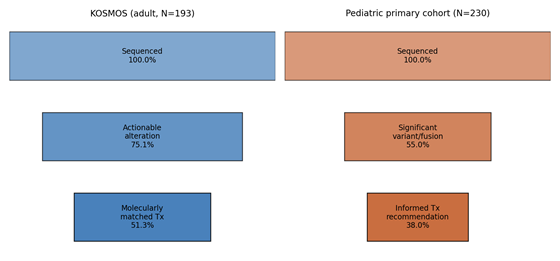
Large-scale implementation programs consistently show that molecular profiling identifies actionable alterations at high rates, even as the proportion of patients who go on to receive matched treatment lags well behind (Table 1). In the KOSMOS cohort, 75.1% of 193 heavily pretreated patients harbored an actionable genomic alteration, yet only 51.3% ultimately received central-molecular-tumor-board-recommended, molecularly matched treatment (T.-Y. Kim et al., 2024). Among those who did — a group with

Table 1. Study characteristics and clinical outcomes of precision oncology implementation programs. This table summarizes cohort size, profiling technology, actionable-alteration rate, clinical matching rate, objective response rate, and survival/treatment-duration outcomes across pediatric, adult, and cancer-subtype-specific precision oncology programs, including KOSMOS, the pediatric integrative-genomics cohorts, and nccRCC/collecting-duct-carcinoma trials. Rates are reported as originally published by the source studies and are not adjusted for cross-study heterogeneity in design or endpoint definition.

Study Reference

Population

N

Profiling Technology

Actionable Alteration Rate

Clinical Matching Rate

ORR

Survival/Treatment Duration

Pokorna et al. (2024) — Primary cohort

Pediatric/young adult, relapsed/refractory solid tumors

230

WES, RNA-seq, CNV analysis

55.0% SNVs/indels

38.0% received informed treatment recommendation

Not reported

Median TMB 0.62 mut/Mb

Pokorna et al. (2024) — Secondary cohort

Pediatric, nonmalignant difficult-to-treat conditions

18

WES, RNA-seq, CNV analysis

89.0% driving alterations

47.0% therapeutic implications

Not reported

Diagnosis refined in 4.0% (both cohorts)

T.-Y. Kim et al. (2024) — KOSMOS overall

Heavily pretreated advanced/metastatic solid tumors

193

Local NGS (accredited labs)

75.1% actionable

51.3% matched therapy

10.1% (IMP cohort)

Median OS 6.9 mo; TD 3.5 mo

T.-Y. Kim et al. (2024) — Atezolizumab subgroup

High TMB/MSI-H

20

Local NGS

100% targeted cohort

70.0% dosed

21.4%

TD 1.9 mo; OS 6.3 mo

T.-Y. Kim et al. (2024) — T-DM1 subgroup

ERBB2-altered

30

Local NGS

100% targeted cohort

80.0% dosed

8.3%

TD 4.2 mo; OS 7.3 mo

T.-Y. Kim et al. (2024) — Trastuzumab/pertuzumab

ERBB2-altered

14

Local NGS

100% targeted cohort

85.7% dosed

0.0% (DCR 100%)

TD 4.6 mo; OS 12.5 mo

H. Wang et al. (2025) — NEMESIA

nccRCC

Clinical panel

100% targeted cohort

100%

43.7%

mPFS 10.8 mo

H. Wang et al. (2025) — KEYNOTE-B61

nccRCC

Clinical panel

100% targeted cohort

100%

49.0%

mPFS 18 mo

Table 2. Comparative performance characteristics of sequencing and diagnostic modalities used in precision oncology. Platforms are compared across genomic breadth, sequencing depth, turnaround time, cost-effectiveness, primary clinical utility, and major technical limitations, illustrating the inherent depth-versus-breadth trade-off that shapes assay selection for low-VAF variant detection versus comprehensive structural profiling.

Platform

Genomic Coverage

Depth

Turnaround Time

Primary Utility

Key Limitation

Whole-Genome Sequencing (WGS)

Entire genome

30–60×

4–6 weeks

Structural variants, fusions, CNA signatures

Low sensitivity for low-VAF (<5%) subclones

Whole-Exome Sequencing (WES)

~1.5–2.0% (coding exome)

100–200×

3–4 weeks

SNVs, indels, germline signatures

Misses intergenic structural rearrangements

Targeted Gene Panels (amplicon)

Hundreds of loci

500–>2,000×

5–10 days

Low-VAF hotspot variants (down to 1–3%)

Poor CNA/fusion detection; primer bias

Targeted Gene Panels (capture)

300–500+ genes

500–1,000×

10–14 days

CNA signatures, structural fusions

Requires higher input DNA quantity/quality

Bulk RNA-seq

Global transcriptome

10–50M reads

14–21 days

Pathway activity, chemo-response prediction

Diluted by stromal/immune contamination

ctDNA Liquid Biopsy

Targeted to shallow WGS

10,000–>30,000×

7–10 days

MRD, clonal evolution tracking

Confounded by CHIP; false negatives in low shedders

Circulating cfRNA

Targeted/low-pass transcriptome

Variable

14–18 days

Liquid transcriptome, cell-state monitoring

RNase degradation; specialized preservation needed

Digital Pathology/WSI

Whole-slide pixel data

N/A

Seconds–minutes

Non-invasive genotype/PD-L1 prediction

Purely correlative; needs confirmatory sequencing

a median of three prior lines of therapy — the objective response rate reached 10.1%, the disease control rate 72.5%, median overall survival 6.9 months, and median treatment duration 3.5 months, with the most durable benefit concentrated among patients receiving ERBB2-targeted agents or checkpoint inhibition (T.-Y. Kim et al., 2024).

The pediatric data (Pokorna et al., 2024) echo this pattern while adding a diagnostic dimension rarely captured in adult cohorts. Among 230 primary-cohort pediatric and young-adult patients, clinically significant variants or fusions were identified in 55% of cases, translating into molecularly informed recommendations for 38% — figures that sit comfortably alongside international registries such as INFORM (43%) and Pediatric MATCH (31.5%). In a secondary cohort of 18 patients with difficult-to-treat nonmalignant conditions, driving alterations were detected in 89% of cases, with therapeutic implications for 47%. Across both cohorts, integrative sequencing changed or refined the original histopathological diagnosis in 4% of patients (Pokorna et al., 2024) — a small percentage, admittedly, but one that matters enormously to the individual children involved.

Subtype-specific trial data reinforce these efficacy signals. In non-clear cell renal cell carcinoma, the NEMESIA (pembrolizumab plus axitinib) and KEYNOTE-B61 (pembrolizumab plus lenvatinib) regimens achieved objective response rates of 43.7% and 49%, with median progression-free survival of 10.8 and 18 months, respectively (H. Wang et al., 2025), while additional nccRCC and collecting-duct-carcinoma trials summarized in Table 1 illustrate a wide range of matching rates, response rates, and survival outcomes depending on histologic subtype and regimen (Wang et al., 2025). Figure 1 presents this diagnostic-to-therapeutic funnel across the KOSMOS and pediatric cohorts, illustrating visually how the proportion of patients narrows at each successive stage — from sequencing, to actionable-alteration detection, to actual molecularly matched treatment.

4.2 Resolution and Limits of Diagnostic Modalities

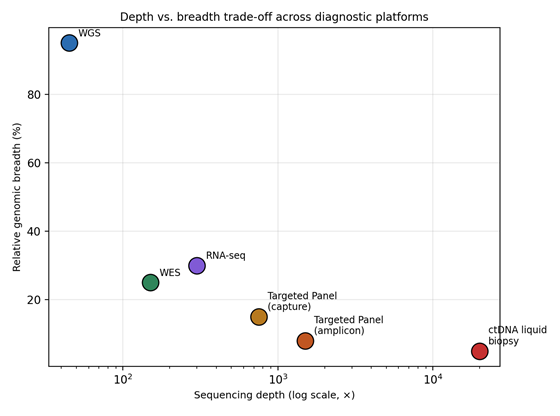
Every diagnostic platform trades something for something else, and the evidence makes this trade-off explicit (Table 2). Whole-genome sequencing offers the broadest genomic coverage but typically operates at only 30–60× depth, which limits its sensitivity for low-VAF (<5%) subclonal mutations (Rescigno & Greystoke, 2026; Knebel et al., 2026). Targeted gene panels invert this trade-off, concentrating depth (500× to beyond 2,000×) on a narrower set of loci and thereby improving detection of rare, clinically relevant resistance variants, though at the cost of missing structural rearrangements and deep intronic fusions that only whole-genome approaches reliably capture (Knebel et al., 2026; Rescigno & Greystoke, 2026). Whole-exome sequencing occupies a cost-effective middle ground, covering roughly 1.5–2.0% of the genome at 100–200× depth (Rescigno & Greystoke, 2026).

Transcriptomic and liquid-biopsy layers extend this diagnostic picture into dynamic biology. RNA-sequencing captures pathway-level activity that outperforms DNA-only prediction of chemotherapeutic response (Rusciano, 2026; H. Wang et al., 2025), and circulating tumor DNA enables non-invasive, longitudinal tracking of clonal evolution and minimal residual disease (Chetta et al., 2026) — though, as discussed above, this comes bundled with the persistent confounding risk of clonal hematopoiesis unless matched leukocyte sequencing is performed (Chetta et al., 2026). Circulating cell-free RNA and digital pathology round out the picture as complementary, largely non-invasive layers, the former serving as a “liquid transcriptome” of cell-state signals (K. Kim & Yoo, 2026) and the latter enabling near-instantaneous, algorithm-driven prediction of tumor genotype and PD-L1 status directly from routine histopathology slides (Basety et al., 2026; Bulić et al., 2026). Figure 2 schematizes this platform landscape along two axes — sequencing depth and genomic breadth — visually reinforcing why no single modality currently serves every diagnostic purpose simultaneously.

4.3 Biological Signatures and Actionable Biomarker Horizons

The molecular signatures dictating prognosis and therapeutic vulnerability differ substantially by tumor type (Table 3). In colorectal cancer, MSI-H/dMMR status — present in 10–15% of overall cases — predicts durable responses to checkpoint inhibition, with the KEYNOTE-177 trial establishing pembrolizumab as first-line standard of care for metastatic dMMR disease (median PFS 16.5 versus 8.2 months with chemotherapy) (Macrea et al., 2026). Conversely, KRAS (40–55%) and NRAS (3–8%) mutations mark resistance to anti-EGFR antibodies (Macrea et al., 2026), while BRAF V600E (8–15%) identifies candidates for combined BRAF/EGFR blockade

Table 3. Molecular and biological characteristics of core precision oncology biomarkers. Biomarkers are described according to associated cancer subtype, estimated prevalence, primary detection method, pathophysiological role, prognostic significance, and actionable therapeutic matching, spanning colorectal, ocular, and pediatric germline contexts.

Biomarker

Associated Cancer(s)

Prevalence

Prognostic Significance

Actionable Matching

MSI-H/dMMR

Colorectal, gastric, endometrial

10–15% (overall CRC)

Favorable early-stage; adverse if metastatic untreated

Pembrolizumab, dostarlimab, nivolumab + ipilimumab

BRAF V600E

Colorectal, melanoma, thyroid

8–15% (mCRC); 30–50% (conjunctival melanoma)

Poor prognosis in mCRC

Encorafenib + cetuximab; BRAF/MEK inhibitors

KRAS mutations

Colorectal, pancreatic, lung

40–55% (CRC); ~90% (pancreatic)

Adverse; shorter PFS

Negative anti-EGFR predictor; G12C matched to sotorasib

NRAS mutations

Colorectal, melanoma, thyroid

3–8% (CRC); 10–20% (conjunctival melanoma)

Shorter PFS/OS

Negative anti-EGFR predictor; MEK-inhibitor sensitive

HER2 (ERBB2) amplification

Breast, colorectal, gastric, NSCLC

15–20% (breast); 2–6% (mCRC)

Adverse if untreated

Trastuzumab-pertuzumab, T-DM1, tucatinib

GNAQ/GNA11

Uveal melanoma

80–90% combined

Early tumorigenic driver

PKC/G-alpha inhibitors (trial stage)

BAP1 loss

Uveal melanoma

40–45%

Strongest predictor of hepatic metastasis

Intensive surveillance; epigenetic trials

GMS1 (germline)

Pediatric solid tumors/leukemias

Rare, pan-diagnostic

Multi-system predisposition

PARP inhibitors, checkpoint blockade

Table 4. Role-specific competencies across the precision oncology care pathway. This table summarizes foundational, intermediate, and advanced-level knowledge and skill expectations for each professional group involved in precision oncology delivery, based on the tiered workforce competency framework of Drury et al. (2026), spanning clinical, laboratory, genetic-counseling, nursing, pharmacy, primary-care, research, bioinformatics, policy, and bioethics roles.

Professional Group

Foundational (Level 1)

Intermediate (Level 2)

Advanced (Level 3)

Oncologists

Somatic vs. germline testing; biomarker types

Resistance mechanisms; VUS concepts

MTB leadership; trial matching

Pathologists/Lab specialists

NGS/liquid biopsy principles

Variant classification systems

Multi-omic assay validation

Genetic counselors

Germline-somatic distinction

Hereditary risk models

Genomic ethics; policy leadership

Oncology nurses/APPs

Testing purpose and implications

Treatment expectation management

Survivorship genomics

Pharmacists

Pharmacogenomic principles

PGx database curation

Formulary/institutional PGx policy

Primary care clinicians

Hereditary risk pattern recognition

Genomic report interpretation

Preventive genomics integration

Research/trial staff

Research ethics; GCP basics

Biomarker-driven trial design

Genomic data governance

Data scientists/Bioinformaticians

Clinical genomic data handling

AI-assisted diagnostic pipelines

AI governance; bias mitigation

Health system leaders/policy makers

Genomic service models

Workforce/economic planning

National genomic policy

Bioethicists/legal experts

Core ethical/legal principles

Applied consent/data-use guidance

Genomic governance leadership

(Macrea et al., 2026).

Ocular oncology tells a genetically distinct story. Uveal melanoma is driven early by GNAQ/GNA11 mutations (80–90% combined) with BAP1 loss serving as the single strongest predictor of hepatic metastasis and poor survival, whereas conjunctival melanoma more closely resembles cutaneous melanoma, harboring frequent BRAF V600E mutations amenable to BRAF/MEK inhibition (Kaštelan et al., 2026). At the germline level, systems-level profiling has identified 13 reproducible mutation signatures across pediatric malignancies, among which GMS1 — a constitutional DNA-repair-deficiency signature spanning genes such as BRCA2, MLH1, and MSH2 — predicts sensitivity to PARP inhibition and checkpoint blockade (Palizban et al., 2026).

4.4 Human Infrastructure: Tiered Competency and Workforce Frameworks

None of the preceding technical or biological advances translate into patient benefit without a workforce capable of interpreting them (Table 4). The Core Competency Framework for Precision Oncology (Drury et al., 2026) organizes this responsibility through a tiered model spanning routine cancer-care providers (Level 1), mainstream oncology clinicians applying structured genomic assessment (Level 2), and specialist molecular leaders directing tumor boards and laboratory quality assurance (Level 3). Multidisciplinary molecular tumor boards remain the central decision-making mechanism across this structure, simultaneously integrating multi-omic data into treatment recommendations and functioning as an informal, practice-embedded training ground that raises genomic fluency across the broader oncology workforce (T.-Y. Kim et al., 2024; Drury et al., 2026).

5. Discussion

Stepping back from the individual findings, what stands out most is not any single technology but the shape of the gap itself. Time and again, across adult and pediatric cohorts alike, actionable alterations were identified in the majority of patients, and yet only about half — sometimes fewer — ever received a genuinely matched therapy (Table 1) (T.-Y. Kim et al., 2024; Pokorna et al., 2024). If this were purely a biological limitation, one might expect it to be intractable. But much of the evidence reviewed here suggests otherwise: the gap is at least partly logistical, partly regulatory, and partly a matter of which diagnostic layer we happen to be looking at.

Consider the diagnostic trade-off documented in Table 2 and depicted schematically in Figure 2. Whole-genome sequencing sees everything but sees it shallowly; targeted panels see less but see it deeply enough to catch the low-VAF subclones that actually drive resistance (Knebel et al., 2026; Rescigno & Greystoke, 2026). No current single assay resolves this tension, which is precisely why we — echoing Rusciano (2026) and Lee et al. (2026) — think the field’s near-term future belongs to combinations rather than to any one “best” test. Adding transcriptomics captures what the tumor is functionally doing (H. Wang et al., 2025; Kotsifaki et al., 2025); adding copy-number signatures captures a mutational history that SNV calling alone cannot see (Yaacov, 2026); and adding patient-derived organoid screening supplies something the purely computational layers cannot — direct, empirical confirmation, as illustrated by the KRAS p.A146T rectal-cancer case in which organoid-predicted bevacizumab sensitivity translated into actual disease stabilization (Tutar-Torun et al., 2026).

It is tempting to treat artificial intelligence as the mechanism that simply resolves all of this integration for us, and the numbers are genuinely impressive — 90.5% risk-prediction accuracy in one fusion model (Kar et al., 2026), and increasingly capable digital twins for anticipating resistance trajectories (Fadiel et al., 2026). But we would gently push back on over-reading these figures. Most of the underlying data feeding these models still derives from cohorts skewed toward European and East Asian ancestry (Chanhih et al., 2025; Tinland & de Montgolfier, 2026), and a model that performs beautifully in the population it was trained on is not automatically a model that performs well everywhere else. If precision oncology is to live up to its name, “precision” cannot quietly mean “precision for some.”

The clonal hematopoiesis problem deserves a similar note of caution. Liquid biopsy is, in many respects, the most patient-friendly diagnostic advance discussed in this review — no repeat surgical biopsy, real-time tracking of resistance — but its Achilles’ heel, CHIP, is not a rare edge case; it is a structural feature of aging blood (Chetta et al., 2026). Any program planning to lean heavily on ctDNA without budgeting for matched leukocyte sequencing is, in our view, building on a foundation it cannot fully trust.

Finally, none of the preceding technical progress matters if the people delivering it are not equipped to interpret it.

Figure 1. Diagnostic-to-therapeutic funnel across real-world precision oncology cohorts. A stepped funnel diagram depicting the proportion of patients at each sequential stage — from tumor sequencing, to detection of an actionable alteration, to receipt of a molecularly matched treatment — separately for the adult KOSMOS cohort and the pediatric integrative-genomics cohort, visually highlighting where the largest proportional drop-off occurs between molecular diagnosis and actual treatment delivery.

Figure 2. Trade-off landscape of precision oncology diagnostic platforms. A two-axis schematic plotting sequencing depth against genomic breadth for whole-genome sequencing, whole-exome sequencing, targeted gene panels, RNA-seq, and liquid-biopsy platforms, illustrating why low-depth, broad-coverage assays under-detect low-variant-allele-frequency subclones while high-depth, narrow-coverage panels sacrifice structural and intergenic resolution.

The tiered competency framework summarized in Table 4 (Drury et al., 2026) strikes us as a genuinely useful, if still nascent, answer to this concern — not because tiering itself is novel, but because it explicitly ties genomic responsibility to scope of practice rather than assuming every clinician needs, or wants, to become a bioinformatician. Molecular tumor boards remain the connective tissue here, simultaneously making decisions and training the next generation of decision-makers (T.-Y. Kim et al., 2024; Drury et al., 2026).

Limitations of this synthesis are worth stating plainly. The evidence base spans heterogeneous tumor types, study designs, and outcome definitions, which limits any attempt at formal meta-analytic pooling; several of the “results” summarized here originate from single-arm or registry-style studies rather than randomized comparisons; and the prospective multi-omic pipeline we outline in the Methods remains, at this stage, a framework rather than a completed trial. Prospective, adequately powered, and — critically — demographically representative trials will be needed before any of the efficacy signals described here can be considered confirmatory rather than suggestive.

6. Limitations

This manuscript is a narrative synthesis rather than a systematic review or primary clinical trial, so formal meta-analytic pooling was not possible given heterogeneous tumor types, study designs, and outcome definitions across the source literature. Several outcomes summarized here originate from single-arm, registry-based, or retrospective cohorts rather than randomized comparisons, limiting causal inference about the true benefit of multi-omic versus DNA-only profiling. The proposed multi-omic and functional-precision-oncology pipeline described in the Methods remains a prospective framework rather than a completed, validated trial, and its feasibility, cost, and turnaround times require empirical confirmation. Much of the underlying evidence, including machine-learning models, derives from cohorts skewed toward European and East Asian ancestry, constraining generalizability to underrepresented populations. Finally, reliance on previously published summary statistics precluded independent verification of raw data, and publication bias toward positive findings may have inflated the apparent efficacy of integrated diagnostic approaches.

7. Conclusion

Precision oncology has moved a long way from matching histology to empirical chemotherapy, yet genomic testing alone still leaves too many patients without a matched treatment. The evidence assembled here suggests that transcriptomic, epigenetic, copy-number, and functional organoid data each contribute something genomics cannot supply on its own, and that machine-learning fusion models and digital twins can help integrate these layers — provided they are trained on genuinely representative populations. Closing the diagnostic-to-therapeutic gap will likely depend less on any single breakthrough assay than on standardized pre-analytical workflows, tiered workforce competency, equitable data governance, and a willingness to treat functional validation as a routine step rather than a research luxury. Realizing this vision remains an aspiration more than an achievement, but the components required to build it already exist.

Author Contributions

Y.M. contributed to the conception and design of the review, literature search, analysis and synthesis of the relevant evidence, development of the proposed multi-omic precision oncology framework, and drafting of the manuscript. A.A.A. contributed to the literature search, interpretation of genomic, transcriptomic, epigenetic, and organoid-based evidence, and critical revision of the manuscript. Both authors reviewed and approved the final version of the manuscript and agreed to be accountable for all aspects of the work.

Acknowledgements

The authors would like to acknowledge the Faculty of Pharmacy, Universiti Sultan Zainal Abidin, Besut Campus, Malaysia, and the Department of Pharmacy, Faculty of Medicine and Health Sciences, Al-Razi University, Sana'a, Yemen, for their academic and institutional support. The authors also acknowledge the researchers whose published studies contributed to the scientific foundation of this review.

References


Acebedo, A., Bedard, P. L., Brown, S., Ceca, E., Fiandalo, M., Fuchs, H., Guo, X., Hoppe, J. N., Kehl, K. L., Kundra, R., Lavery, J. A., LeNoue-Newton, M. L., Lepisto, E., Mastrogiacomo, B., Micheel, C. M., Nayan, C., Newcomb, A., Nichols, C., Panageas, K. S., . . . Yu, C. (2025). Collaborating across sectors in service of open science, precision oncology, and patients: An overview of the AACR Project GENIE Biopharma Collaborative (BPC). ESMO Real World Data and Digital Oncology, 1, 100075.

Adedokun, K. A., Fayemo, T. H., Oyeniyi, G. M., Bello, A., Orugun, O. A., Imodoye, S. O., Ogunlakin, A. D., Eziagu, U. B., Dewan, S. M. R., Khan, S. A., Oladejo, M. K., & Adewole, P. D. (2026). Integrative drug discovery through molecular, cellular, genomic, and immunological approaches: From gene editing to precision antibody engineering. Next Materials, 12, 102232. https://doi.org/10.1016/j.nxmate.2026.102232

Basety, S., Gudepu, R., & Velidandi, A. (2026). Artificial intelligence in lung cancer: A narrative review of recent advances in diagnosis, biomarker discovery, and drug development. Pharmaceutics, 18, 00201.

Bulic, L., Brlek, P., Hrvatin, N., Brenner, E., Škaro, V., Projic, P., Rogan, S. A., Bebek, M., Shah, P., & Primorac, D. (2026). AI-driven advances in precision oncology: Toward optimizing cancer diagnostics and personalized treatment. AI, 7, 00011.

Chanhih, N., Laraqui, A., Hassine, S., Ameur, A., Hamedoun, L., El Annaz, H., Abi, R., Tagajdid, M. R., Amine, I. L., Ennibi, K., Benjouad, A., & Belayachi, L. (2025). Circulating tumor DNA as a biomarker for precision medicine in prostate cancer: A systematic review. International Journal of Molecular Sciences, 26, 11049.

Chetta, M., Bukvic, N., & Rosati, A. (2026). The ctDNA paradigm: Dynamic observation, quantitative analysis, and interpretive limits in precision oncology. Genes, 17, 00754.

Diaz, F. C., Waldrup, B., Carranza, F. G., Manjarrez, S., & Velazquez-Villarreal, E. (2026). Deciphering RTK-RAS and MAPK pathway dependencies in gemcitabine-treated pancreatic ductal adenocarcinoma through conversational artificial intelligence. International Journal of Molecular Sciences, 27, 03011.

Drury, A., Hamdi, Y., Mulder, N., Rueter, J., Kelley, L., Blazer, K., Casolino, R., & Gray, S. W. (2026). Building a genomics-capable cancer workforce: A competency-based framework for education and training in precision oncology. eClinicalMedicine, 99, 104142. https://doi.org/10.1016/j.eclinm.2026.104142

Fadiel, A., Malpani, P., Eichenbaum, K. D., Naftolin, F., Hassouneh, A., Chong, G., & Odunsi, K. (2026). Integrative computational approaches to prostate cancer with conditional reprogramming and AI-driven precision medicine. Cells, 15, 00700.

Kanavos, K. P., Alcaraz, A., Argento, F., Colaci, C., Alfie, V., Pichon-Riviere, A., Augustovski, F., & Mills, M. (2025). Value assessment framework for next-generation sequencing and comprehensive genomic profiling in European oncology. eBioMedicine, 121, 105947. https://doi.org/10.1016/j.ebiom.2025.105947

Kar, P., Qiu, Z., & Maulik, U. (2026). A genomic data analysis-based technique for personalized and precision medicine. Array, 30, 100965.

Kaštelan, S., Gilevska, F., Tomic, Z., Živko, J., & Nikuševa-Martic, T. (2026). Precision oncology in ocular melanoma: Integrating molecular and liquid biopsy biomarkers. Current Issues in Molecular Biology, 48(1), 00131. https://doi.org/10.3390/cimb480100131

Kim, K. H., & Yoo, B. C. (2026). Circulating RNA as a functional component of liquid biopsy in cancer: Concepts, classification, and clinical applications. International Journal of Molecular Sciences, 27, 02403.

Kim, T. Y., Kim, S. Y., Kim, J. H., Jung, H. A., Choi, Y. J., Hwang, I. G., Cha, Y., Lee, G.-W., Lee, Y.-G., Kim, T. M., Lee, S.-H., Lee, S., Yun, H., Choi, Y. L., Yoon, S., Han, S. W., Kim, T.-Y., Kim, T. W., Zang, D. Y., & Kang, J. H. (2024). Nationwide precision oncology pilot study: KOrean Precision Medicine Networking Group Study of MOlecular profiling-guided therapy based on genomic alterations in advanced solid tumors (KOSMOS) KCSG AL-20-05. ESMO Open, 9(10), 103709. https://doi.org/10.1016/j.esmoop.2024.103709

Knebel, P., Harris, J., Steveson, I., Kearns, B., Todeschini, A. S., Perrett, L., Anderson, D., Beltran, E., Leary, B., Settle, J., Carlson, I., Christensen, H., Trujano, A., Alton, A. B., Dixon, K., & Barrott, J. J. (2026). Hidden in the noise: Low-variant allele frequency mutations and their impact on precision oncology. Journal of Genome Biotechnology and Genetics, 1(1), 00004.

Kotsifaki, A., Kalouda, G., Karalexis, E., Stathaki, M., Metaxas, G., & Armakolas, A. (2025). Emerging breast cancer subpopulations: Functional heterogeneity beyond the classical subtypes. International Journal of Molecular Sciences, 26, 11599.

Lee, S., Kim, A., Kim, R. H., You, Y. S., Kim, H. S., Chung, S., Lee, S. H., Yahng, S. A., Kim, I. K., & Kim, H. J. (2026). Precision oncology at a crossroads: How organoid platforms are reshaping the field. Organoids, 5, 00016.

Macrea, C. M., Ilias, T., Costea, A., Trif, P., Murvai, V. R., & Fratila, O. C. (2026). The genetic landscape of colorectal cancer: From molecular alterations to therapeutic decision pathways. Cancers, 18(25), 02526. https://doi.org/10.3390/cancers182502526

Ortega-García, J. A., Shakeel, O., Wood, N. M., Pérez-Martínez, A., Fuster-Soler, J. L., & Miller, M. D. (2025). Beyond precision: Ambiomic survivorship in childhood and AYA cancer. Cancers, 18, 00007.

Palizban, F., March, M. E., Wang, X., Snyder, J., Wang, F., Mentch, F., Mahesh, Y., Thomas, A., Watson, D. J., Qu, H., Connolly, J., Saeidian, A. H., Vahidnezhad, H., Glessner, J., & Hakonarson, H. (2026). Unsupervised deep representation learning and probabilistic clustering for the systems-level discovery of germline mutation signatures in pediatric cancers. Biomedicines, 14(7), 01438. https://doi.org/10.3390/biomedicines140701438

Pokorna, P., Palova, H., Adamcova, S., Jugas, R., Al Tukmachi, D., Kyr, M., Knoflickova, D., Kozelkova, K., Bystry, V., Mejstrikova, S., Merta, T., Trachtova, K., Podlipna, E., Mudry, P., Pavelka, Z., Bajciova, V., Tinka, P., Jarosova, M., Ivkovic, T. C., . . . Slaby, O. (2024). Real-world performance of integrative clinical genomics in pediatric precision oncology. Laboratory Investigation, 104(12), 102161. https://doi.org/10.1016/j.labinv.2024.102161

Qiu, Z., Kar, P., & Maulik, U. (2026). A genomic data analysis-based technique for personalized and precision medicine. Array, 30, 100965.

Rescigno, P., & Greystoke, A. (2026). Illuminating the spectrum of genomic sequencing approaches in the precision oncology era: A UK perspective. Cancer Treatment and Research Communications, 46, 101054. https://doi.org/10.1016/j.ctrc.2026.101054

Rusciano, D. (2026). Molecular oncodiagnostics in precision oncology: Integrating tumor transcriptomics, patient pharmacogenetics, and ex vivo chemoresistance testing to improve individual chemotherapy response. Journal of Personalized Medicine, 16(1), 00176.

Tinland, J., & de Montgolfier, S. (2026). Genomic stratification of risks in oncology: Narrative literature review of epistemological, operational, and ethical challenges. SSM - Qualitative Research in Health, 10, 100822.

Tutar-Torun, E., Kurt, B., Sener-Akcora, D., Yilmaz, A. M., Sahin, A., Arga, K. Y., Cakir, M. O., Bahsi, T., & Ozdogan, M. (2026). Functional precision oncology in rectal cancer liver metastasis: Integrated genomic and organoid-based drug sensitivity profiling. Organoids, 5, 00014.

Wang, H., Chang, Y., Wang, K., & Liu, R. (2025). Recent advances in nccRCC classification and therapeutic approaches. Cells, 14(22), 1781. https://doi.org/10.3390/cells14221781

Yaacov, A. (2026). Consensus copy-number alteration signatures from clinical panels enable pan-cancer risk stratification and therapy response association. International Journal of Molecular Sciences, 27(4), 1764. https://doi.org/10.3390/ijms27041764
Article metrics
View details
0
Downloads
0
Citations
13
Views

View Dimensions


View Plumx


View Altmetric


0
Save
0
Citation
13
View
0
Share