Applied Agriculture Sciences

Agriculture and food sciences | Online ISSN: 3066-3407
23
Citations
94k
Views
40
Articles
Your new experience awaits. Try the new design now and help us make it even better
Switch to the new experience
Figures and Tables
REVIEWS   (Open Access)

Nano-Fertilizers and Bio-Fertilizers for Sustainable Agriculture: Bridging Nutrient Efficiency, Stress Resilience, and Unresolved Safety Questions

Mamar Laeeq Zia2, Raja Ahmad Ali 3,  Qudrat Ullah4, Muhammad Shahid Mumtaz, Abdul Fatah A Samad6, Muhammad Sajad1*

+ Author Affiliations

Applied Agriculture Sciences 3 (1) 1-13 https://doi.org/10.25163/agriculture.3110393

Submitted: 30 September 2025 Revised: 09 December 2025  Published: 14 December 2025 


Abstract

Global agriculture, it seems fair to say, is running up against limits that the twentieth century's chemical-input model was never built to handle. Feeding a population approaching 9.6–10 billion by mid-century without further degrading soil and water resources has pushed researchers toward nanotechnology as a plausible, if not entirely settled, alternative. This narrative review draws together evidence on nano- and bio-fertilizers, tracing how nutrient carriers engineered at the 1–100 nm scale alter plant physiology from germination onward. Conventional fertilizers, notoriously, lose 40–90% of applied nitrogen, phosphorus, and potassium to leaching, runoff, and volatilization; nano-formulations appear to narrow that gap through controlled release and enhanced tissue penetration. The review moves through several interlocking themes—germination triggering via seed-coat penetration, nutrient-use-efficiency gains relative to bulk fertilizers, photosynthetic and metabolic fortification, and resilience against salinity, heat, and flooding stress—before turning to bio-fertilizers and their hybrid nano-biofertilizer counterparts, which combine microbial nitrogen fixation with nanoscale protective encapsulation. Commercial formulations already on the market are also surveyed, revealing a industry that has, in places, outpaced the safety literature. Concerns around phytotoxicity, bioaccumulation, and disrupted soil microbiomes are treated not as footnotes but as central, still-unresolved questions. Taken as a whole, the evidence suggests genuine promise tempered by real uncertainty, and the review closes by outlining where standardized characterization and long-term field validation remain most urgently needed.

Keywords: Nano-fertilizers; bio-fertilizers; nutrient use efficiency; abiotic stress tolerance; sustainable agriculture; nanotoxicity; precision nutrition

1. Introduction

Global agriculture, somewhere in the middle of this century, will have to do something it has never quite managed before: feed nearly 9.6 billion people without further eroding the ecological base it depends on (Verma et al., 2022). That tension—between yield and sustainability—is not new, exactly, but it has sharpened. For decades, the Green Revolution's answer was more input: more nitrogen, more phosphorus, more potassium, applied liberally and often uncritically. It worked, for a while. Yields climbed. But that model appears to be running out of road. Farmers today are contending with water scarcity, land lost to sprawling cities, and a climate that no longer behaves the way agronomic textbooks assumed it would (Zahra et al., 2022). And underneath all of this sits a fairly stubborn, almost embarrassing, problem: conventional fertilizers are just not very efficient.

How inefficient? More than people might expect. Estimates suggest that somewhere between 40% and 70% of applied nitrogen, 80–90% of phosphorus, and 50–90% of potassium never actually reach the plant (Dubey & Mailapalli, 2016). Instead, these nutrients leach away, run off into waterways, volatilize into the atmosphere, or simply become chemically locked up in forms the plant cannot use. Phosphorus is a particularly frustrating case—often scarce to begin with, and prone to fixation in the soil almost as soon as it is applied (Basavegowda & Baek, 2021). The costs of this inefficiency are not only economic, though they certainly are that; they are ecological too, contributing to eutrophication downstream and to greenhouse gas emissions upstream (El-Ghamry et al., 2018). So the question that has occupied researchers in this space for the past decade or so is not really "how do we grow more food," but something narrower and, in some ways, more tractable: how do we make the nutrients we already apply actually count?

Nanotechnology has offered one answer, and arguably the most promising one so far. Nano-fertilizers—nutrient carriers engineered at the 1–100 nanometer scale—behave rather differently from their bulk counterparts (Chaitra et al., 2021). At that size, surface-area-to-volume ratios increase dramatically, reactivity changes, and the particles can move through plant tissue in ways ordinary fertilizer granules simply cannot (Meena et al., 2017). The practical upshot, at least in principle, is that smaller doses can achieve comparable or superior effects, with the added benefit that many of these formulations can be engineered for slow or controlled release—delivering nutrients more or less in step with the plant's actual physiological needs across a growing season, rather than dumping everything at once and hoping some of it sticks (Kumar et al., 2021). It is a more patient kind of fertilization, one might say, and patience tends to be efficient.

The category itself is not monolithic, and it is worth pausing on that, because the term "nano-fertilizer" gets used rather loosely in casual conversation. Nutrient-based formulations—nano-nitrogen, nano-phosphorus, nano-zinc, and similar—deliver essential elements directly (Mahil & Kumar, 2019). Polymer-based variants take a different approach, encapsulating nutrients inside biodegradable carriers such as chitosan, alginate, or zeolites, which function almost like tiny, slow-leaking reservoirs (Nongbet et al., 2022). Then there are the carbon-based materials—nanotubes, graphene, and the like—valued less for nutrient delivery per se and more for their apparent ability to stimulate germination and root growth (Bratovcic et al., 2021). Synthesis, too, splits along two broad paths: top-down methods that physically break bulk material down (mechanical milling being the standard example), and bottom-up methods that build particles up from atoms or molecules through chemical or biological routes. Of these, green synthesis—using microorganisms or plant extracts rather than harsh chemical reagents—has gained particular traction, largely because it is cheaper and, frankly, easier to defend on environmental grounds (Shrivastava & Shrivastava, 2022).

What is perhaps less widely appreciated, outside of specialist circles, is that nano-fertilizers do more than just deliver nutrients efficiently. They also appear to help plants cope with stress—salinity, drought, temperature extremes—the kinds of abiotic pressures that climate change is making more frequent and less predictable (Verma et al., 2022). Nano-silicon, for instance, has been linked to improved membrane stability and better water retention in plants under salt stress. Nano-zinc, somewhat differently, seems to work by activating antioxidant defenses, helping cells manage the buildup of reactive oxygen species that stress typically induces (Zulfiqar et al., 2019). These are not marginal effects, either; several studies report measurable improvements in the nutritional composition of staple crops—wheat, rice, maize—following nano-fertilizer application, including gains in protein and mineral content (Nongbet et al., 2022).

None of this, however, should be read as an unqualified endorsement. It would be irresponsible to present nano-fertilizers as a solution without caveats, because the caveats are real and, in some cases, still poorly understood. Phytotoxicity and genotoxicity have both been reported at higher application concentrations (Zahra et al., 2022), and there are legitimate open questions about bioaccumulation—whether these materials might work their way up the food chain in ways that are difficult to detect early on. Soil microbial communities, which quietly do most of the work of nutrient cycling, may also be affected, though the long-term consequences of that disruption remain unclear (Dubey & Mailapalli, 2016). Part of the difficulty is that nanoparticle behavior depends heavily on soil chemistry—pH, organic matter, texture—so results from one study, one soil type, one region, do not necessarily generalize elsewhere. Standardized characterization protocols and rigorous, long-horizon safety assessments are still, in many respects, a work in progress rather than a settled matter (Zulfiqar et al., 2019).

Taken together, then, nano-fertilizers occupy an interesting and somewhat unresolved position: genuinely promising, empirically supported in many respects, but not yet fully vetted for the kind of large-scale, long-term deployment that global food security would eventually demand. This review attempts to hold both of those truths at once—cataloguing the demonstrated benefits in nutrient use efficiency, crop performance, and stress tolerance, while also taking seriously the environmental and biosafety questions that remain, for now, only partially answered.
2. Methodology

2.1 Review Design and Rationale

This paper is constructed as a narrative review rather than a systematic one, and that distinction is worth stating plainly at the outset rather than leaving it implicit. A systematic review, with its pre-registered protocol and rigid inclusion algorithm, would arguably strain against the breadth of what this paper attempts to cover—spanning nutrient-delivery mechanics, germination physiology, abiotic stress mitigation, and commercial product landscapes all at once. A narrative approach allows the discussion to move between these registers, drawing connections across mechanistic, agronomic, and market-level evidence that a more rigid protocol might have kept artificially separated. That said, "narrative" should not be mistaken for "unsystematic"; the literature search and selection process described below followed a consistent, if less formally codified, set of criteria throughout.

2.2 Literature Search Strategy

Relevant literature was identified through targeted searches of major scientific databases, principally Scopus, Web of Science, PubMed, and Google Scholar, supplemented by manual screening of reference lists within key review articles (e.g., Basavegowda & Baek, 2021; Dubey & Mailapalli, 2016; Zulfiqar et al., 2019). Search terms combined core concept clusters—"nano-fertilizer," "nanoparticle," "nutrient use efficiency," "abiotic stress," "biofortification," "green synthesis"—with crop-specific and material-specific qualifiers (e.g., "nano-zinc AND maize," "nano-silicon AND salinity"). Boolean operators (AND, OR) were used to broaden or narrow results depending on whether a given search stage was intended to survey the field broadly or to isolate mechanism-specific findings. No rigid date cutoff was imposed, though searches skewed toward the past decade, since this is where the bulk of nano-fertilizer-specific work has concentrated; a handful of earlier foundational studies (e.g., Lu et al., 2002; Lin & Xing, 2007; Nouraein, 2019) were retained where they established mechanisms still referenced in more recent work.

2.3 Inclusion and Exclusion Criteria

Studies were included if they reported empirical or field-level data on nanomaterial application to crop plants—covering, at minimum, one of the following domains: nutrient use efficiency relative to conventional fertilizers, germination or early seedling response, photosynthetic or enzymatic activity, abiotic stress tolerance, biofortification outcomes, or environmental/toxicological impact. Review articles and meta-analyses were included selectively, primarily to frame the broader conceptual landscape (e.g., Verma et al., 2022; Zahra et al., 2022; Nongbet et al., 2022), rather than as substitutes for primary data. Studies were excluded where the nanomaterial in question was applied purely for pest or pathogen control (nanopesticides, in other words, fell outside the intended scope, except where a source explicitly bridged both categories, as in Bratovcic et al., 2021) or where the reported outcomes concerned non-agricultural applications of nanotechnology entirely. Commercial product information, gathered for Table 4, was treated somewhat differently—sourced not from peer-reviewed trials but from manufacturer disclosures and secondary compilations (Basavegowda, 2021; Elemike et al., 2019), and flagged accordingly as a distinct evidentiary category rather than blended indiscriminately with experimental findings.

2.4 Data Extraction and Organization

Once a working set of sources had been assembled, data extraction proceeded thematically rather than chronologically. For each study retained, the following elements were recorded, where reported: nanomaterial identity and particle size, target crop species, application mode (foliar, soil, seed priming, hydroponic), the specific growth or physiological parameter measured, and the direction and approximate magnitude of the reported effect. This extraction process underpins the four summary tables presented in the Results section—Table 1 organizing raw physiological responses by nanomaterial and crop, Table 2 structuring direct comparisons between nano-formulations and conventional bulk or salt equivalents, Table 3 isolating abiotic-stress-specific outcomes, and Table 4 compiling commercially available products alongside their compositional and manufacturing details. Admittedly, this extraction was not always straightforward; several source studies reported effects using different units, baselines, or statistical thresholds, and reconciling these into a single comparative framework required a degree of interpretive judgment rather than mechanical transcription.

Table 1: Impact of Diverse Nanomaterials on Plant Growth and Developmental Parameters. This table summarizes ten nanomaterials—ranging from metallic particles (Ag, Au, CuO, Fe₂O₃) to metal oxides and silica-based compounds—applied across various crops via seed priming, foliar spray, root exposure, or hydroponic delivery. For each material, the table reports particle size, target species, the specific growth parameter measured (biomass, root length, photosynthesis, germination), and both the primary and secondary benefits observed, allowing direct comparison of how particle identity and application mode jointly shape physiological outcomes. Sources are cited individually in the final column following APA style.

Nanomaterial

Size (nm)

Target Plant

Application Mode

Growth Parameter Affected

Primary Benefit

Secondary Benefit

Reference (APA)

Silver (Ag)

21

Fenugreek

Seed Priming

Biomass

Enhanced plant growth

Increased diosgenin

Jasim et al. (2017)

Gold (Au)

10

Cucumber

Seedling

Roots

Root elongation

Higher biomass

Lin and Xing (2007)

CeO2

25

Radish

Root Exposure

Fresh Weight

Increased biomass

Chlorophyll content

Gui et al. (2017)

CuO

20–30

Tomato

Root/Soil

Root Length

Upregulated sugar content

Better chlorophyll

Singh et al. (2017)

Fe2O3

50

Spinach

Hydroponic

Growth Rate

Enhanced biomass

Higher productivity

Jeyasubramanian et al. (2016)

FeS

82

Mustard

Foliar

Seed Yield

Improved yield

Vegetative growth

Rawat et al. (2017)

MgO

10

Clusterbean

Foliar

Photosynthesis

Higher chlorophyll

Fresh biomass

Pradhan et al. (2014)

MnO

20

Mungbean

Seed Priming

N-Metabolism

Improved N uptake

Better germination

Saharan et al. (2016)

SiO2

12

Tomato

Seed

Germination

Faster emergence

Early seedling vigor

Siddiqui and Al-Whaibi (2014)

TiO2

12–15

Mungbean

Foliar

Root Length

Higher chlorophyll

Physiological vigor

Raliya et al. (2015)


Table 2: Comparative Efficacy of Nano-Fertilizers versus Conventional Chemical Fertilizers. This table sets ten nano-formulations—spanning macronutrients (N, P, K) and micronutrients (Zn, B, Fe, Mg, Cu)—directly against their traditional bulk or salt counterparts (e.g., urea, TSP/DAP, KCl, zinc sulfate) across a range of experimental crops. Reported outcomes include yield response, photosynthetic or enzymatic impact, and environmental consequences such as reduced leaching or lower nitrous oxide emissions, together illustrating where nanoscale precision most clearly outperforms conventional saturation-based fertilization. Each comparison is traced to its originating study.


Nano-fertilizer

Bulk/Salt Comparison

Experimental Crop

Mode of Application

Yield Response

Photosynthetic/Enzyme Impact

Environmental Impact

Reference (APA)

Nano-Nitrogen

Conventional N

Pearl Millet

Soil

Increased biomass

Enhanced N-microbes

Reduced N leaching

Thomas et al. (2016)

Urea-HAP

Traditional Urea

Rice

Soil

Higher grain yield

Slow-release mechanism

Lower N2O emissions

Kottegoda et al. (2017)

Nano-Phosphorus

TSP / DAP

Soybean

Soil

20% higher yield

Increased P nutrition

Reduced P fixation

Liu and Lal (2014)

Nano-Potassium

KCl / KNO3

Wheat

Foliar

Higher grain weight

Improved spike length

Lower K leaching

Taran et al. (2014)

Nano-Zinc

Zinc Sulfate

Maize

Soil/Foliar

Improved grain yield

Enhanced IAA levels

Higher Zn acquisition

Dimkpa et al. (2018)

Nano-Boron

Bulk Boron

Pomegranate

Foliar

Improved fruit yield

Enhanced fruit quality

Efficient B delivery

Davarpanah et al. (2016)

Nano-Iron

Fe-EDTA

Peanut

Soil

Increased growth

Enhanced Zn uptake

Corrected chlorosis

Rui et al. (2016)

Nano-Magnesium

MgO Salt

Black-eyed Pea

Foliar

Higher seed mass

Photosynthesis promotion

Balanced nutrition

Delfani et al. (2014)

Nano-Copper

CuSO4

Wheat

Foliar

Significant yield hike

Higher enzymatic activity

Reduced disease spread

Hafeez et al. (2015)

NPK-Chitosan

Conventional NPK

Wheat

Foliar/Soil

Reduced cycle time

Higher yield index

Sustained release

Abdel-Aziz et al. (2016)


2.5 Synthesis Approach

The synthesis itself followed what might loosely be called a thematic-mechanistic structure: findings were grouped not by publication date or crop type alone, but by the underlying physiological or agronomic mechanism they illustrated—germination enhancement, nutrient-use efficiency, photosynthetic modulation, stress mitigation, and so on. Where multiple studies reported convergent findings (for instance, the recurring dose-dependency observed across silver and gold nanoparticle applications; Lin & Xing, 2007), this convergence was treated as an indication of a generalizable principle. Where findings diverged or where a single study's results could not be corroborated elsewhere, this was noted explicitly rather than smoothed into false consensus—a choice that reflects the genuinely uneven state of evidence in parts of this field, particularly around long-term soil microbiome effects (Du et al., 2011; Roh et al., 2009, 2010) and cross-regional soil chemistry interactions.

2.6 Limitations of the Approach

It would be misleading to present this methodology as free of limitations, and a few are worth acknowledging directly. First, because this is a narrative rather than systematic review, formal risk-of-bias assessment and quantitative meta-analytic pooling were not undertaken; conclusions here are qualitative and interpretive rather than statistically aggregated. Second, publication bias almost certainly affects the underlying literature itself—studies reporting positive or striking effects (such as the 90–99% germination increases reported by Khodakovskaya et al., 2009) are, in all likelihood, overrepresented relative to null or negative findings, a pattern common across much of experimental agronomy and one this review cannot fully correct for, only flag. Third, the commercial product data in Table 4 rests on manufacturer-disclosed information rather than independently verified efficacy trials, and should be read with that caveat firmly in mind. These limitations do not undermine the review's central purpose, but they do bound the strength of the claims that follow.

3. Revolutionizing the Field: Nano and Bio-fertilizers as the Future of Sustainable Agriculture

3.1 A Race Against a Shrinking Margin

There is something almost paradoxical about modern agriculture's predicament. The world is projected to carry somewhere between 9.6 and 10 billion people by mid-century, and yet the resources available to feed them—arable land, fresh water, stable growing seasons—are, if anything, contracting. The Green Revolution of the twentieth century solved a version of this problem once already, averting famine on a scale that still seems remarkable in retrospect. But it did so by leaning hard on chemical inputs, and that approach has left behind a kind of debt that is only now coming due. Farmers today are asked to produce more, with less water, on less land, under a climate that no longer cooperates the way it once did. What follows is an attempt to trace how the field is moving—tentatively, unevenly, but with real momentum—from what might be called a "bulk saturation" model of fertilization toward something closer to precision nutrition, powered jointly by nanotechnology and biological science.

3.2 The Inefficiency of Conventional Fertilizers

It is worth pausing, before discussing anything new, on just how poorly the old system performs. Conventional mineral fertilizers are, by most accounts, strikingly inefficient: estimates put nitrogen losses at 40–70%, phosphorus losses at 80–90%, and potassium losses at 50–90% of what is actually applied (Dubey & Mailapalli, 2016). That is to say, a majority of what farmers pay for and spread across their fields never reaches the plant at all. Instead it leaches into groundwater, runs off into rivers and lakes—triggering eutrophication events that can devastate aquatic ecosystems—or volatilizes into the atmosphere as greenhouse gas. The consequences ripple outward: soil acidification, disrupted microbial communities, and a persistent economic drain on the very farmers the system is meant to serve (El-Ghamry et al., 2018). It is, in a sense, a system built for a world with fewer constraints than the one we currently occupy.

3.3 Nano-Fertilizers: Precision at a Molecular Scale

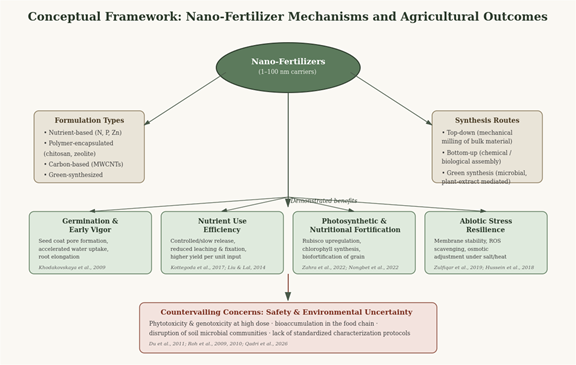
Nano-fertilizers (NFs) attempt to address this inefficiency directly, and they do so by exploiting something that sounds almost too simple to matter: scale. Engineered at the 1–100 nanometer range, these materials exhibit physical and chemical behaviors that bulk minerals simply do not have access to—chief among them, an extraordinarily high surface-area-to-volume ratio, which in turn drives enhanced reactivity and tissue penetration (Basavegowda & Baek, 2021). Where conventional urea or superphosphate dissolves more or less instantly on contact with moisture, nano-formulations can be engineered for slow or controlled release, whether through encapsulation in biodegradable polymers such as chitosan, loading into porous zeolite structures (Bansiwal et al., 2006), or dispersion as nano-emulsions. The effect, several studies suggest, is a closer synchronization between nutrient availability and the plant's actual physiological demand across the growing season—and, notably, total fertilizer requirements have been reported to drop by 20–50% while yields rise by roughly 15–30% (Kumar et al., 2021). Whether those figures hold consistently across crop systems and soil types is a separate question, and one the field has not fully settled. Conceptual framework of  linking nano-fertilizer formulation types and synthesis routes to their demonstrated agronomic benefits are present in Figure 1.

Figure 1. Conceptual Framework: Nano-Fertilizer Mechanisms and Agricultural Outcomes.. This schematic traces the pathway from nano-fertilizer formulation types and synthesis routes (top) through four demonstrated agronomic benefit domains—germination enhancement, nutrient use efficiency, photosynthetic and nutritional fortification, and abiotic stress resilience (middle)—down to the countervailing safety and environmental concerns that temper these benefits (bottom). The figure is intended to orient readers to the review's overall argument before the detailed table-by-table discussion that follows.

3.4 Germination and Early Growth: A Biological Trigger

The earliest point of intervention, perhaps unsurprisingly, is the seed itself. Conventional fertilizers tend to struggle against the rigidity of the seed coat, but certain nanoparticles appear to act almost like biological triggers, accelerating the metabolic processes that bring a dormant embryo to life. Multi-walled carbon nanotubes (MWCNTs), for instance, have been shown to physically create microscopic pores in seed coats, which enhances water uptake substantially (Khodakovskaya et al., 2009). In tomato and mustard, this translates—somewhat startlingly—into germination rate increases of 90–99% in some trials (Khodakovskaya et al., 2009). Metallic nanoparticles tell a related but distinct story: nano-silver and nano-gold, applied at carefully calibrated sublethal concentrations, have been associated with marked root elongation in crops like cucumber and fenugreek (Almutairi, 2016). The logic here is cumulative rather than singular—a more robust root system early on seems to set the stage for better resilience against whatever stresses arrive later in the season.

3.5 Optimizing the Photosynthetic Engine

Beyond germination, nano-fertilizers appear to intervene at a deeper physiological level, tuning the plant's internal machinery in ways that are still being mapped out. Nano-titanium dioxide (TiO2) offers perhaps the most striking example: applied to spinach and tomato, it has been linked to photosynthesis rates nearly triple those of untreated controls, an effect attributed to improved light absorbance, more efficient electron transport, and upregulated activity of Rubisco—the enzyme responsible for carbon fixation (Zahra et al., 2022). Micronutrient formulations tell a quieter but no less important story. Nano-zinc and nano-iron oxide, for example, contribute to chlorophyll synthesis and enzymatic function; in maize and soybean, these have been associated with greater leaf area, higher chlorophyll content, and, downstream, improved biomass and grain yield (Nongbet et al., 2022). What distinguishes these nano-formulations from their bulk equivalents is largely a matter of bioavailability—bulk micronutrients tend to become locked into insoluble soil complexes, whereas the nano-scale versions apparently resist that fate more effectively.

3.6 The Climate Shield: Mitigating Abiotic Stress

Climate change complicates all of this, of course, by making drought, salinity, and temperature extremes more frequent and less predictable. Here, nano-fertilizers seem to function less as nutrient delivery vehicles and more as priming agents—preparing a plant's defensive systems in advance of stress rather than responding after the fact. Nano-silicon and nano-silica have received particular attention in this regard: under salt stress, they appear to stabilize cell membranes and improve water balance, with effects documented in cherry tomato and sweet pepper (Almutairi, 2016), while also upregulating antioxidant enzymes such as superoxide dismutase and catalase, which help neutralize the reactive oxygen species that accumulate under environmental duress. Nano-selenium, somewhat differently, has been associated with improved relative water content and chlorophyll stability under temperature extremes (Verma et al., 2022). And in flood-prone contexts, nano-silver applications have reportedly prevented root cell death in crops like saffron—allowing survival through waterlogging events that would otherwise mean total crop failure. These findings, taken together, suggest a genuinely broad protective role, though it is fair to say the underlying mechanisms are not uniformly well characterized across species.

3.7 Bio-Fertilizers: The Living Engine of the Soil

Nano-fertilizers are not the whole story, and it would be a mistake to treat them as such. Bio-fertilizers—formulations built around living or dormant beneficial microorganisms such as Rhizobium, Azotobacter, and Pseudomonas—work through an entirely different mechanism, colonizing the rhizosphere and improving nutrient availability from within the soil ecosystem itself. These organisms function, in effect, as biological factories: fixing atmospheric nitrogen, solubilizing phosphorus that would otherwise remain chemically locked, and secreting growth-promoting hormones like auxins and gibberellins. Because they are renewable and comparatively inexpensive, bio-fertilizers have become a central pillar of Integrated Nutrient Management strategies, and their capacity to restore soil structure and water-holding capacity offers a kind of ecological repair that nano-formulations, on their own, cannot provide (El-Ghamry et al., 2018).

3.8 The Synergy: Nano-Biofertilizers

Perhaps the more interesting development, at least from a research standpoint, is the emergence of hybrid nano-biofertilizers—formulations that use nanotechnology to compensate for the historical fragility of biological products, namely their short shelf life and sensitivity to UV exposure and heat. Nanoparticles can encapsulate microorganisms, functioning as a kind of protective shell that preserves viability until the microbes reach the target soil zone. Green synthesis routes, which use the microorganisms or plant extracts themselves to build nanoparticles, add a further layer of ecological coherence to the process (Bratovcic et al., 2021). Combined applications of beneficial microbes with silicon-zinc nanocomposites, for instance, have shown promise in reducing the negative effects of water deficit and salinity stress in soybean and wheat—an early but encouraging sign that these two technologies may be more complementary than competitive.

3.9 Harvest Quality and Biofortification

It is worth remembering, too, that agriculture's goal has never been quantity alone. Nano-fertilizers have demonstrated a capacity to improve the nutritional density of harvested crops—a process generally referred to as biofortification—by delivering micronutrients such as zinc and iron directly into plant tissue, thereby increasing protein, mineral, and carbohydrate content in staple grains (Nongbet et al., 2022). In potato, NPK nano-fertilizers have been linked to higher starch content alongside reduced nitrate accumulation in the tuber (Jithendar et al., 2024)—a combination that benefits both yield and food safety simultaneously.

3.10 Navigating the Risks: Toxicity and Environmental Safety

None of this can be presented uncritically, however. The same reactivity that makes nanoparticles agriculturally useful also raises the possibility of phytotoxicity and genotoxicity when concentrations are not carefully controlled. Excess application of metallic oxides such as ZnO or CuO has been associated with inhibited root growth, cell wall damage, and interference with DNA replication (Adhikari et al., 2012). Bioaccumulation is a further concern—nanoparticles, by virtue of their size, are capable of moving through the food chain in ways that are not yet fully understood, and their long-term effects on the soil microbiome remain genuinely contested. Some studies report stimulation of microbial activity; others warn that silver and copper nanoparticles may be toxic to the very bacteria responsible for nutrient cycling (Qadri et al., 2026). This tension in the literature is not a flaw so much as a reflection of how young the field still is—standardized characterization protocols and clear regulatory frameworks remain, for now, works in progress.

3.11 Shifting the Agricultural Paradigm

Global agriculture stands, then, at something of a crossroads. The shift toward nano and bio-fertilizers is not simply an incremental technological upgrade—it looks more like a necessary evolution toward a food system capable of withstanding climate volatility while reducing its own ecological footprint. Controlled nutrient delivery, enhanced photosynthetic performance, and stress resilience together address inefficiencies that have quietly undermined conventional farming for decades. Caution remains warranted, certainly, particularly around long-term safety and ecological impact. But if chemical precision and biological ingenuity can be reconciled—and the early evidence suggests they can, at least partially—there is a reasonable path toward feeding a growing population without further depleting the planet that sustains it.


4. Results and Discussion

4.1 An Overview: What the Tables Reveal

Taken together, the four tables assembled here tell a story that is more layered than a simple "nano is better" narrative might suggest. Table 1 catalogues the raw physiological responses of individual nanomaterials across a range of species; Table 2 sets nano-formulations directly against their conventional bulk or salt counterparts; Table 3 turns to the question of abiotic stress, cataloguing how specific nanoparticles help plants cope with salinity, heat, and flooding; and Table 4 shifts registers entirely, moving from the laboratory to the marketplace, listing commercial nano-fertilizer products currently in circulation. Reading across all four, a pattern does emerge—cautiously—suggesting that nanoscale intervention offers real, measurable advantages, though the magnitude and mechanism of those advantages vary considerably by material, crop, and application method.

Table 3: Role of Nano-Fertilizers in Mitigating Abiotic Stresses in Major Crops. This table compiles ten nanoparticle-based interventions tested against specific environmental stressors—salinity, heat, flooding, and cadmium contamination—across crops including tomato, cotton, saffron, and bok choy. For each entry, the applied dose, physiological response, antioxidant or enzymatic activity, and net mitigation effect are reported, offering a comparative view of how different nanomaterials confer stress resilience through overlapping but mechanistically distinct pathways. All entries are referenced to their source studies.

Nanoparticle

Dose/Conc.

Abiotic Stress Type

Target Crop

Physiological Response

Antioxidant/Enzyme Response

Mitigation Effect

Reference (APA)

Nano-Silicon

10 mg/L

Salinity

Hollyhock

Membrane stability

Osmotic adjustment

Higher water content

Zahra et al. (2022)

Nano-SiO2

2.5 g/L

Salinity

Pumpkin

Enhanced germination

Higher SOD/CAT activity

Reduced MDA levels

Zulfiqar et al. (2019)

Nano-Zinc

120 mg/L

Salinity

Cotton

Salt tolerance

Reduced oxidative stress

Yield protection

Hussein et al. (2018)

Nano-Titanium

0.2 g/L

Heat Stress

Tomato

Stomatal regulation

Photosystem protection

Cooling of leaves

Qi et al. (2013)

MWCNTs

60 mg/L

Salinity

Cabbage

Water uptake

Lipid membrane alteration

Net CO2 assimilation

Zulfiqar et al. (2019)

Nano-Selenium

12 μM

Temperature

Ajwain

Improved RWC

Chlorophyll stability

Growth improvement

Zulfiqar et al. (2019)

Nano-Ag

120 mg/L

Flooding

Saffron

Root growth

Reduced cell death

Dry leaf weight

Rezvani et al. (2012)

HAP

20 g/kg

Cd Stress

Bok Choy

Reduced metal uptake

Higher Vit-C & Chlorophyll

Biomass recovery

Zulfiqar et al. (2019)

Nano-Silicon

2 mM

Salinity

Tomato

Water Balance

Proline accumulation

Fresh weight gain

Almutairi (2016)

Nano-ZnO

16 mg/L

Salt Stress

Tomato

Growth recovery

Increased proline

Photosynthetic efficiency

Faizan et al. (2018)


Table 4: Commercially Used Nano-Fertilizers, Compositions, and Manufacturers.. This table catalogues ten approved nano-fertilizer products currently marketed across India, Thailand, Germany, Myanmar, and Malaysia, detailing their primary nutrient content, organic or chelating carrier agents, physical form (powder, liquid, solid), and intended crop applications. Presented alongside manufacturer and country of origin, the table illustrates the extent to which laboratory-derived formulation principles have already been translated into commercial agricultural products.

Product Name

Primary Nutrients

Organic/Chelating Agents

Form

Intended Crops

Manufacturer

Country

Reference (APA)

Nano max NPK

N, P, K

Amino acids, Vitamins

Powder

General

JU Agri Sciences

India

Basavegowda (2021)

Eco Star

N, K

Organic matter, Carbon

Liquid

Cereals/Pulses

Shan Maw Myae

India

Basavegowda (2021)

Nano ultra

N, P, K, Mg

Organic matter

Solid

Vegetables

SMTET Eco-tech

Taiwan

Basavegowda (2021)

Green Nano

N, P, K, Zn

S, Fe, Cu, Mn

Powder

Horticulture

Green Organic World

Thailand

Elemike et al. (2019)

Magic Green

Ca, Mg, Si, K

Na, P, Fe, Al, S

Powder

General

AC International

Germany

Elemike et al. (2019)

Hero Super Nano

N, P, K, Ca

Mg, S

Solid

Grains

World Connect Plus

Myanmar

Basavegowda (2021)

Nano Green

Natural Extracts

Corn, Soybean, Potato

Liquid

Fruits/Vines

Nano Green Sciences

India

Elemike et al. (2019)

The Best Nano

N, P, K, Ca

Mg, S, Fe, Cu, Zn

Powder

General

The Best Int.

Thailand

Basavegowda (2021)

PPC Nano

N, P, K

M protein, Diluent

Liquid

Plantation

WAI International

Malaysia

Elemike et al. (2019)

TAG NANO

Micronutrients

Seaweed, Humic acid

Liquid

High-value crops

Tropical Agrosystem

India

Basavegowda (2021)


4.2 The Nano-Trigger: Germination and Early Seedling Vigor

One of the more consistent findings, and perhaps the most intuitively satisfying, concerns the earliest stage of plant life. As Table 1 indicates, silver nanoparticles applied via seed priming enhanced biomass and diosgenin content in fenugreek (Jasim et al., 2017), while gold nanoparticles at the seedling stage promoted root elongation and higher biomass in cucumber (Lin & Xing, 2007). The mechanism, at least as far as the literature has worked it out, seems to hinge on the physical scale of these particles rather than any singular biochemical pathway. Conventional fertilizers, and conventional seed treatments generally, tend to struggle against the rigidity of the seed coat; nanoparticles, by contrast, appear to breach that barrier almost incidentally, simply by virtue of being small enough to fit through it.

Carbon-based nanomaterials illustrate this most dramatically. Khodakovskaya et al. (2009) found that multi-walled carbon nanotubes physically created new microscopic pores within tomato seed coats, and the resulting increase in water uptake pushed germination rates up by something close to 90%—a figure that, frankly, still seems somewhat startling on repeated reading. Whether this effect generalizes cleanly across species is less certain; Lu et al. (2002) reported comparable acceleration of metabolic processes in soybean, but the underlying mechanism there may differ from the pore-formation model proposed for MWCNTs. What does seem to hold, at least provisionally, is a dose-dependency: Lin and Xing (2007) cautioned that while low concentrations of gold and silver nanoparticles stimulated root elongation, higher concentrations tipped the same materials into phytotoxic territory. This dose-response relationship recurs often enough across the literature that it probably deserves to be treated as a general principle rather than a species-specific quirk.

4.3 Precision versus Saturation: Comparative Nutrient Efficiency

Table 2 speaks most directly to the central claim of this review—that nano-formulations outperform conventional bulk fertilizers, and not merely by a small margin. The comparison is not uniform across nutrients, though, and it is worth being honest about that variability rather than smoothing it over. Nano-nitrogen applications in pearl millet, for instance, enhanced nitrogen-fixing microbial populations and reduced nitrogen leaching relative to conventional nitrogen sources (Thomas et al., 2016), which is a somewhat different kind of benefit than the yield gains reported elsewhere—it is as much an environmental improvement as an agronomic one.

The urea-hydroxyapatite (HAP) nanohybrid developed by Kottegoda et al. (2017) offers perhaps the clearest demonstration of the slow-release principle in action. Conventional urea dissolves almost immediately upon contact with soil moisture, which is precisely why nitrogen losses run so high; the HAP-encapsulated version, by contrast, released nitrogen gradually enough to produce higher grain yields in rice while measurably lowering nitrous oxide emissions—a greenhouse gas whose reduction matters well beyond the individual field. Phosphorus tells a related story. Because phosphorus becomes so readily fixed in insoluble soil complexes, nano-phosphorus formulations that resist this fixation produced roughly 20% higher soybean yields than triple superphosphate or diammonium phosphate (Liu & Lal, 2014). Potassium, zinc, boron, iron, magnesium, and copper nano-formulations each showed comparable improvements over their conventional counterparts—higher grain weight in wheat (Taran et al., 2014), improved zinc acquisition in maize (Dimkpa et al., 2018), better fruit quality in pomegranate (Davarpanah et al., 2016)—though it must be said that the magnitude of improvement in these later cases tends to be more modest than the striking figures reported for nitrogen and phosphorus.

4.4 Physiological Fortification: Photosynthesis and Nutritional Quality

Beyond nutrient delivery in the narrow sense, several of the materials cataloged in Table 1 appear to intervene at a deeper level—altering the plant's internal machinery rather than simply supplying raw material. Magnesium oxide nanoparticles, applied foliar to clusterbean, raised chlorophyll content and improved fresh biomass (Pradhan et al., 2014), while titanium dioxide nanoparticles enhanced root length and chlorophyll concentration in mungbean, with clear downstream effects on physiological vigor (Raliya et al., 2015). Manganese oxide applied through seed priming, meanwhile, appeared to improve nitrogen metabolism directly, alongside better germination outcomes in mungbean (Saharan et al., 2016).

These effects are not confined to growth metrics narrowly construed; they extend into what the harvest actually contains. CuO nanoparticles applied to tomato roots and soil, for example, upregulated sugar content alongside improved chlorophyll levels (Singh et al., 2017)—a combination that speaks to quality rather than yield alone. It is tempting, reading across these results, to think of nano-fertilizers as doing something subtly different from what conventional fertilizers do: not simply feeding the plant more efficiently, but nudging its existing metabolic pathways toward a more favorable equilibrium.

4.5 Climate Resilience: Nanoparticles as Priming Agents Against Abiotic Stress

Table 3 turns toward what is, in some respects, the most agriculturally urgent question of all: whether these materials can help crops withstand the kind of environmental volatility that climate change is making increasingly routine. The evidence here is fairly extensive, and reasonably consistent, though the specific physiological mechanism differs depending on the stressor involved.

Under salinity stress, nano-silicon applied to hollyhock improved membrane stability and supported osmotic adjustment, resulting in higher tissue water content (Zahra et al., 2022). A related formulation, nano-SiO2, enhanced germination in pumpkin under saline conditions by elevating superoxide dismutase and catalase activity while reducing malondialdehyde accumulation—a fairly direct marker of oxidative membrane damage (Zulfiqar et al., 2019). Nano-zinc, applied to cotton at 120 mg/L, similarly conferred salt tolerance by reducing oxidative stress and protecting yield outright (Hussein et al., 2018). Tomato, treated separately with nano-silicon and nano-ZnO, showed water balance improvements and proline accumulation in one case (Almutairi, 2016) and enhanced photosynthetic efficiency alongside elevated proline in the other (Faizan et al., 2018)—two formulations, broadly overlapping outcomes, which suggests a certain convergence in how these materials operate against salt stress regardless of the specific element involved.

Heat and flooding present rather different challenges, and the nanomaterials deployed against them differ accordingly. Nano-titanium applied to tomato under heat stress regulated stomatal behavior and protected the photosystem, effectively cooling the leaf surface through modified transpiration (Qi et al., 2013). Multi-walled carbon nanotubes, interestingly, showed a stress-mitigating role beyond germination as well—enhancing water uptake and net CO2 assimilation in cabbage under salinity (Zulfiqar et al., 2019). In flooding conditions, nano-silver protected saffron root systems from cell death, allowing the plant's dry leaf weight to recover even after waterlogging events that would ordinarily prove fatal (Rezvani et al., 2012). And in the specific case of cadmium contamination—an abiotic stress of a different character altogether—hydroxyapatite nanoparticles reduced metal uptake in bok choy while simultaneously boosting vitamin C and chlorophyll content, supporting biomass recovery under what is otherwise a fairly punishing toxic condition (Zulfiqar et al., 2019).

4.6 From Laboratory to Field: The Commercial Landscape

Table 4 shifts the discussion onto slightly different footing, moving away from controlled experimental outcomes and toward what is actually being sold and applied at scale. It is worth noting, if only briefly, how geographically distributed this market already is—products such as Nano max NPK and TAG NANO originate from Indian manufacturers (Basavegowda, 2021), while Green Nano and Magic Green trace back to operations in Thailand and Germany respectively (Elemike et al., 2019). Most of these commercial formulations combine core macronutrients with organic chelating agents—amino acids, humic acid, seaweed extract—suggesting that industry practice has, to some extent, already absorbed the research findings on controlled release and enhanced bioavailability discussed above. Whether commercial efficacy matches the more tightly controlled results reported in Tables 1 through 3 is, admittedly, a separate and less thoroughly answered question; field-scale variability tends to complicate outcomes that appear clean under greenhouse conditions.

4.7 Mechanisms of Entry and the Question of Environmental Safety

Understanding why these materials work at all requires attention to how they physically move through the plant. Two pathways dominate the literature: entry through stomatal openings for foliar applications, and uptake through root pores for soil-applied formulations. Eichert et al. (2008) clarified that particles below a certain size threshold can bypass the leaf cuticle entirely by entering through stomata, after which they travel either symplastically, cell to cell, or apoplastically, through the intercellular spaces.

This same permeability, however, is a double-edged property, and the literature is not shy about saying so. Du et al. (2011) reported that excessive concentrations of TiO2 and ZnO nanoparticles suppressed the activity of soil dehydrogenase and urease—enzymes that are, in a fairly direct sense, load-bearing for nutrient cycling. Roh et al. (2009, 2010) extended this concern to soil fauna, demonstrating in ecotoxicological trials on Caenorhabditis elegans that smaller nanoparticles tended to be more toxic than larger ones of the same material—an inverse relationship between the very property that makes these materials agriculturally effective and the property that makes them potentially hazardous. This tension is not easily resolved, and it probably should not be resolved prematurely; it points instead toward the need for dose calibration that is considerably more precise than what current field practice typically allows.

4.8 Synthesis

Read together, Tables 1 through 4 suggest that nano-fertilizers occupy a genuinely useful, if still incompletely mapped, place in the agricultural toolkit. They accelerate germination, improve nutrient use efficiency relative to conventional bulk fertilizers, enhance photosynthetic and metabolic function, and confer measurable resilience against several major abiotic stressors—salinity, heat, flooding, and heavy metal contamination among them. At the same time, the same properties responsible for these benefits—small size, high reactivity, ease of biological penetration—carry a corresponding capacity for harm when concentrations exceed what a given plant or soil system can safely absorb. The commercial products already on the market (Table 4) indicate that industry has moved ahead of some of these open safety questions, which is perhaps understandable given commercial pressures, but it does mean that standardized dosing guidance and long-term ecological monitoring remain, for now, more aspiration than settled practice.

5. Limitations

This review carries the limitations inherent to any narrative synthesis. No formal risk-of-bias assessment or quantitative meta-analysis was performed, meaning conclusions here remain interpretive rather than statistically pooled. Publication bias almost certainly shapes the underlying literature itself—studies reporting dramatic effects, such as near-complete increases in germination, are plausibly overrepresented relative to null or modest findings, a pattern that this review can flag but not correct. The commercial product data, drawn from manufacturer disclosures rather than independently verified trials, should be read with corresponding caution. Cross-study comparability is also imperfect: differing units, baselines, and soil conditions across primary studies required interpretive judgment during synthesis rather than straightforward tabulation. Finally, long-term ecological and food-chain safety data remain sparse across the field generally, meaning several risk-related conclusions rest on a thinner and more provisional evidence base than the agronomic-benefit findings do.

6. Conclusion

Nano- and bio-fertilizers represent a genuinely promising, if not fully resolved, shift in how crops might be nourished under mounting ecological and demographic pressure. The evidence gathered here points toward real gains in nutrient efficiency, stress resilience, and nutritional quality, alongside legitimate and still partially unanswered questions about toxicity and long-term soil health. Rather than treating these as competing narratives, this review has tried to hold both together. Moving forward, standardized dosing protocols, longer-horizon field trials, and clearer regulatory frameworks will likely determine whether this technology's considerable promise translates into safe, durable agricultural practice.

References


Abdel-Aziz, H. M. M., Hasaneen, M. N. A., & Omer, A. M. (2016). Nano chitosan-NPK fertilizer enhances the growth and productivity of wheat plants grown in sandy soil. Spanish Journal of Agricultural Research, 14(1), e0902.

Adhikari, T., Kundu, S., Biswas, A. K., Tarafdar, J. C., & Rao, A. S. (2012). Effect of copper oxide nano particle on seed germination of selected crops. Journal of Agriculture, Science and Technology, 2, 815–823.

Almutairi, Z. M. (2016). Influence of silver nano-particles on the salt resistance of tomato (Solanum lycopersicum) during germination. International Journal of Agriculture and Biology, 18(2), 449-457.

Bansiwal, A. K., Rayalu, S. S., Labhasetwar, N. K., Juwarkar, A. A., & Devotta, S. (2006). Surfactant-modified zeolite as a slow-release fertilizer for phosphorus. Journal of Agricultural and Food Chemistry, 54(13), 4773–4779.

Basavegowda, N., & Baek, K. H. (2021). Current and future perspectives on the use of nanofertilizers for sustainable agriculture: The case of phosphorus nanofertilizer. 3 Biotech, 11(7), 357.

Bratovcic, A., Hikal, W. M., Said-Al Ahl, H. A. H., Tkachenko, K. G., Baeshen, R. S., Sabra, A. S., & Sany, H. (2021). Nanopesticides and nanofertilizers and agricultural development: Scopes, advances and applications. Open Journal of Ecology, 11, 301–316.

Chaitra, P., Kalia, A., Ahuja, R., Sidhu, S. P. K., & Sikka, R. (2021). Importance of nano fertilizers in sustainable agriculture. Environmental Sciences and Ecology: Current Research, 2, 1029.

Davarpanah, S., Tehranifar, A., Davarynejad, G., Abadía, J., & Khorasani, R. (2016). Effects of foliar applications of zinc and boron nano-fertilizers on pomegranate (Punica granatum cv. Ardestani) fruit yield and quality. Scientia Horticulturae, 210, 57–64.

Delfani, M., Baradarn Firouzabadi, M., Farrokhi, N., & Makarian, H. (2014). Some physiological responses of black-eyed pea to iron and magnesium nanofertilizers. Communications in Soil Science and Plant Analysis, 45(4), 530-540.

Dimkpa, C. O., Singh, U., Bindraban, P. S., Elmer, W. H., Gardea-Torresdey, J. L., & White, J. C. (2018). Exposure to weathered and fresh nanoparticle and ionic Zn in soil promotes grain yield and modulates nutrient acquisition in wheat (Triticum aestivum L.). Journal of Agricultural and Food Chemistry, 66(37), 9645–9656.

Du, W., Sun, Y., Ji, R., Zhu, J., Wu, J., & Guo, H. (2011). TiO2 and ZnO nanoparticles negatively affect wheat growth and soil enzyme activities in agricultural soil. Journal of Environmental Monitoring, 13(4), 822–828.

Dubey, A., & Mailapalli, D. R. (2016). Nanofertilisers, nanopesticides, nanosensors of pest and nanotoxicity in agriculture. In E. Lichtfouse (Ed.), Sustainable agriculture reviews (Vol. 19, pp. 307–330). Springer.

Eichert, T., Kurtz, A., Steiner, U., & Goldbach, H. E. (2008). Size exclusion limits and lateral heterogeneity of the stomatal foliar uptake pathway for aqueous solutes and water-suspended nanoparticles. Physiologia Plantarum, 134(1), 151–160.

Elemike, E. E., Uzoh, I. M., Onwudiwe, D. C., & Babalola, O. O. (2019). The role of nanotechnology in the fortification of plant nutrients and improvement of crop production. Applied Sciences, 9(3), 499.

El-Ghamry, A. M., Mosa, A. A., Alshaal, T. A., & El-Ramady, H. R. (2018). Nanofertilizers vs. biofertilizers: New insights. Environment, Biodiversity and Soil Security, 2, 51–72.

Faizan, M., Faraz, A., Yusuf, M., Khan, S., & Hayat, S. (2018). Zinc oxide nanoparticle-mediated changes in photosynthetic efficiency and antioxidant system of tomato plants. Photosynthetica, 56(2), 678–686.

Gui, X., Rui, M., Song, Y., Ma, C., Hao, Y., Rui, Y., ... & Li, X. (2017). Phytotoxicity of CeO2 nanoparticles on radish plant (Raphanus sativus). Environmental Science and Pollution Research, 24, 13775-13781.

Hafeez, A., Razzaq, A., Mahmood, T., & Jhanzab, H. M. (2015). Potential of copper nanoparticles to increase growth and yield of wheat. Journal of Nanoscience with Advanced Technology, 1(1), 6-11.

Hussein, M. M., & Abou-Baker, N. H. (2018). The contribution of nano-zinc to alleviate salinity stress on cotton plants. Royal Society Open Science, 5(8), 171809.

Jasim, B., Thomas, R., Mathew, J., & Radhakrishnan, E. K. (2017). Plant growth and diosgenin enhancement effect of silver nanoparticles in fenugreek (Trigonella foenum-graecum L.). Saudi Pharmaceutical Journal, 25(3), 443–447.

Jeyasubramanian, K., Gopalakrishnan Thoppey, U. U., Hikku, G. S., Selvakumar, N., & Subramanian, A. (2016). Enhancement in growth rate and productivity of spinach grown in hydroponics with iron oxide nanoparticles. RSC Advances, 6(18), 15451-15459.

Jithendar, B., Kumar, R., & Rana, N. (2024). Revolutionizing crop nutrition: Exploring nano fertilizers in agriculture. International Journal of Plant & Soil Science, 36(6), 327–339.

Khodakovskaya, M., Dervishi, E., Mahmood, M., Xu, Y., Li, Z., Watanabe, F., & Biris, A. S. (2009). Carbon nanotubes are able to penetrate plant seed coat and dramatically affect seed germination and plant growth. ACS Nano, 3(10), 3221–3227.

Kottegoda, N., Sandaruwan, C., Priyadarshana, G., Siriwardhana, A., Rathnayake, U. A., Berugoda Arachchige, D. M., Kumarasinghe, A. R., Dahanayake, D., Karunaratne, V., & Amaratunga, G. A. J. (2017). Urea-hydroxyapatite nanohybrids for slow release of nitrogen. ACS Nano, 11(2), 1214–1221.

Kumar, Y., Tiwari, K. N., Singh, T., & Raliya, R. (2021). Nanofertilizers and their role in sustainable agriculture. Annals of Plant and Soil Research, 23(3), 238–255.

Lin, D., & Xing, B. (2007). Phytotoxicity of nanoparticles: Inhibition of seed germination and root growth. Environmental Pollution, 150(2), 243–250.

Liu, R., & Lal, R. (2014). Synthetic apatite nanoparticles as a phosphorus fertilizer for soybean (Glycine max). Scientific Reports, 4, 5686.

Lu, C. M., Zhang, C. Y., Wen, J. Q., Wu, G. R., & Tao, M. X. (2002). Research of the effect of nanometer materials on germination and growth enhancement of Glycine max and its mechanism. Soybean Science, 21(3), 168–171.

Mahil, E. I. T., & Kumar, B. N. A. (2019). Foliar application of nanofertilizers in agricultural crops – A review. Journal of Farm Sciences, 32(3), 239–249.

Meena, D. S., Gautam, C., Patidar, O. P., Meena, H. M., Prakasha, G., & Vishwajith. (2017). Nano fertilizers is a new way to increase nutrients use efficiency in crop production. International Journal of Agriculture Sciences, 9(7), 3831–3833.

Nongbet, A., Mishra, A. K., Mohanta, Y. K., Mahanta, S., Ray, M. K., Khan, M., Baek, K. H., & Chakrabartty, I. (2022). Nanofertilizers: A smart and sustainable attribute to modern agriculture. Plants, 11(19), 2587.

Nouraein, M. (2019). Effect of nanofertilizers and biofertilizers on yield of maize: Biplot analysis. Botanica, 25(2), 121-130.

Pradhan, S., Patra, P., Das, S., Chandra, S., Mitra, S., Dey, K. K., Akbar, S., Palit, P., & Goswami, A. (2014). Photochemical modulation of biosafe manganese nanoparticles on Vigna radiata: A detailed molecular, biochemical, and biophysical study. Environmental Science & Technology, 47(24), 13122–13131.

Qadri, T. A., Khan, A., Khan, R. A., Maaza, M., Batool, R., Nazir, R., & Abbas, S. (2026). Nanofertilizers for sustainable agriculture: Mechanisms, benefits, and environmental challenges. BioNanoScience, 16, 164.

Qi, M., Liu, Y., & Li, T. (2013). Nano-TiO2 improve the photosynthesis of tomato leaves under mild heat stress. Biological Trace Element Research, 156(1), 323-328.

Raliya, R., Biswas, P., & Tarafdar, J. C. (2015). TiO2 nanoparticle biosynthesis and its physiological effect on mung bean (Vigna radiata L.). Biotechnology Reports, 5, 22-26.

Rawat, M., Nayan, R., Negi, B., Zaidi, M. G. H., & Arora, S. (2017). Physio-biochemical basis of iron-sulfide nanoparticle induced growth and seed yield enhancement in B. juncea. Plant Physiology and Biochemistry, 118, 274-284.

Rezvani, N., Sorooshzadeh, A., & Farhadi, N. (2012). Effect of nano-silver on growth of saffron in flooding stress. World Academy of Science, Engineering and Technology, 6, 517–522.

Roh, J. Y., Park, Y. K., Park, K., & Choi, J. (2009, 2010). Ecotoxicological investigation of CeO2 and TiO2 nanoparticles on the soil nematode Caenorhabditis elegans using gene expression, growth, fertility, and survival as endpoints. Environmental Toxicology and Pharmacology, 29(2), 167–172.

Rui, M., Ma, C., Hao, Y., Guo, J., Rui, Y., Tang, X., ... & Zhu, S. (2016). Iron oxide nanoparticles as a potential iron fertilizer for peanut (Arachis hypogaea). Frontiers in Plant Science, 7, 815.

Saharan, V., Kumaraswamy, R. V., Choudhary, R. C., Kumari, S., Pal, A., Raliya, R., & Biswas, P. (2016). Cu-chitosan nanoparticle mediated sustainable approach to enhance seedling growth in maize by mobilizing reserved food. Journal of Agricultural and Food Chemistry, 64(31), 6148-6155.

Shrivastava, D., & Shrivastava, S. (2022). Nanofertilizers: A revolutionary idea for sustainable agriculture. Communications in Soil Science and Plant Analysis.

Siddiqui, M. H., & Al-Whaibi, M. H. (2014). Role of nano-SiO2 in germination of tomato (Lycopersicum esculentum seeds Mill.). Saudi Journal of Biological Sciences, 21(1), 13-17.

Singh, A., Singh, N. B., Afzal, S., Singh, T., & Hussain, I. (2017). Zinc oxide nanoparticles: A review of their biological synthesis, antimicrobial activity, uptake, translocation and biotransformation in plants. Journal of Materials Science, 52(4), 1953–1974.

Taran, N., Storozhenko, V., Svietlova, N., Batsmanova, L., Shvartau, V., & Kovalenko, M. (2014). Effect of zinc and copper nanoparticles on drought resistance of wheat seedlings. Nanoscale Research Letters, 12, 60.

Thomas, E., Rathore, I., & Tarafdar, J. C. (2016). Bio-inspired synthesis of nitrogen nanoparticles and its application on pearl millet (Pennisetum americanum L.) cv. HHB 67. Journal of Bionanoscience, 10(4), 300–306.

Verma, K. K., Song, X. P., Joshi, A., Tian, D. D., Rajput, V. D., Singh, M., Arora, J., Minkina, T., & Li, Y. R. (2022). Recent trends in nano-fertilizers for sustainable agriculture under climate change for global food security. Nanomaterials, 12(1), 173.

Zahra, Z., Habib, Z., Hyun, H., & Shahzad, H. M. A. (2022). Overview on recent developments in the design, application, and impacts of nanofertilizers in agriculture. Sustainability, 14(15), 9397.

Zulfiqar, F., Navarro, M., Ashraf, M., Akram, N. A., & Munné-Bosch, S. (2019). Nanofertilizer use for sustainable agriculture: Advantages and limitations. Plant Science, 289, 110270.


Article metrics
View details
16
Downloads
0
Citations
1532
Views
📖 Cite article

View Dimensions


View Plumx


View Altmetric


16
Save
0
Citation
1532
View
0
Share