Business and Social Sciences

Business and social sciences | Online ISSN 3067-8919
410
Citations
162k
Views
54
Articles
Your new experience awaits. Try the new design now and help us make it even better
Switch to the new experience
Figures and Tables
REVIEWS   (Open Access)

Migration, Housing Insecurity and Social Inclusion in Australia: The Intersections of Visa Status, Employment and Access to Social Services among Temporary Migrants

Md Sharif Hossain 1*

+ Author Affiliations

Business and Social Sciences 4 (1) 1-13 https://doi.org/10.25163/business.4110995

Submitted: 08 September 2026 Revised: 23 October 2026  Published: 01 November 2026 


Abstract

Australia relies heavily on temporary migration, yet evidence on how temporary visas shape housing security and social inclusion is widely scattered across housing, labour and welfare scholarship. This narrative review draws on a structured search of five academic databases and three Australian institutional sources, run in October and November 2025, and synthesises 58 peer-reviewed and institutional sources published between 2000 and 2025. Using social inclusion and structural vulnerability perspectives, the review examines four linked domains: visa conditions, employment, housing and access to social services. Across the sources, visa status governs access to income support and public services, while visa-linked or insecure work leaves little buffer against high rents. Private rental, shared accommodation and overcrowding recur as responses, and informal networks and community organisations partly fill service gaps. However, only 12 of the 58 sources concern temporary visa holders directly, and just one centres on their housing. Much of the remaining evidence comes from refugee research, general Australian housing studies or international work. Because the corpus is mixed in design and scope, the review therefore cannot quantify how housing insecurity varies between visa categories, and it treats its findings as well-supported pathways rather than measured effects, with the strength of each claim graded by how directly the sources address temporary visa holders. It proposes three research priorities, namely linked administrative data, longitudinal designs by visa category, and studies of landlord and employer behaviour, and it also outlines policy implications for tenancy protection, service-eligibility information and visa transition points for temporary migrants.

Keywords: temporary migrants; housing insecurity; social inclusion; visa status; precarious work; social services; Australia

1. Introduction

Australia has built much of its recent population, labour-force and education growth on temporary migration. International students, temporary skilled workers, working holiday makers, bridging visa holders and others now make up a large and varied group, and each visa class carries its own rights, limits and routes to permanent residence (Castles, 2000, 2010; Triandafyllidou, 2022). For many of these people the future is uncertain, and that uncertainty runs through every plan they make about work, study and where to live (Robertson, 2014; Azeredo, 2025).

Housing is where that uncertainty becomes concrete. A secure home is a precondition for work, health and community life, yet Australia's housing system has been under sustained affordability pressure for years (Beer et al., 2007; Yates, 2016; Morris et al., 2020). Temporary migrants meet this market with fewer cushions than most. They are more likely to rely on private renting, they may have no access to income support, and they often depend on work that is casual, low-paid or tied to a sponsor (Faulkner et al., 2025; Robertson, 2016; Tan & Lester, 2012).

Work and visa status are closely entwined. When a visa ties a person to one employer, or when losing a job threatens lawful stay, workers have less room to refuse poor conditions or to report exploitation (Boucher & Wright, 2023; Clibborn & Wright, 2022). Income shocks then pass straight through to rent. Housing insecurity among temporary migrants is therefore better read as an outcome of labour-market and migration design than as a purely housing problem (Robertson, 2017; Beer et al., 2016).

Access to public support adds a third layer. Social protection for migrants is shaped by status, residence and eligibility rules, and these rules differ sharply from those for citizens and permanent residents (Avato et al., 2010; Sabates-Wheeler & Koettl, 2010). The COVID-19 period made this visible, when many temporary visa holders were excluded from emergency income support (Farbenblum & Berg, 2020; Symington, 2020). Where state support is limited, savings, family ties, employers and community organisations carry more of the load (Ryan, 2011; Sime & Fox, 2015).

Social inclusion offers a way to hold these threads together. It refers to meaningful participation in economic, social and civic life, including secure housing, decent work, services and a sense of belonging (Saunders, 2015; Silver, 2010). Studies of migrant integration stress that inclusion is built through such connected conditions, not through any single one (Murad & Versey, 2021; Soto Saavedra et al., 2023).

Despite this, most research examines visas, work, housing or services separately. Studies of temporary migration in Australia usually concentrate on labour regulation and visa policy (Clibborn & Wright, 2022; Howe & Nikoloudakis, 2023), and studies of housing and health among migrants concentrate heavily on refugees and people seeking asylum (Ziersch et al., 2017, 2024; Martino et al., 2022). Few connect all four domains for temporary visa holders, and the recent AHURI investigation by Faulkner et al. (2025) is a rare exception.

This review asks three questions. How do visa conditions shape access to work, welfare and housing for temporary migrants in Australia? Through which pathways do employment and housing-market conditions produce housing insecurity? What does the evidence say about service access and social inclusion, and how strong is that evidence? Beyond synthesis, the review audits the evidence base itself, because the answer to the third question affects how far any of the others can be pressed.

2. Methods

2.1 Review design

This is a narrative review with a structured search. It was designed to map and interpret a dispersed literature, not to pool effects, so it follows the logic of narrative synthesis rather than the full protocol of a systematic review. It does not claim exhaustive coverage. Where a choice had to be made between breadth and precision, the search favoured Australian sources and sources that connect at least two of the four domains.

2.2 Search strategy and sources

Searches were run between October and November 2025 in Scopus, Web of Science, Google Scholar, Informit and PubMed, and in the publication pages of the Australian Bureau of Statistics, the Australian Housing and Urban Research Institute (AHURI) and the Department of Home Affairs. Searches covered 2000 to 2025. Terms for temporary migration and visa status were combined with terms for housing insecurity, employment, welfare and social services, and social inclusion, using Boolean operators and adapting syntax to each source. Table 1 reports representative strings for each source. Database-specific variants are not reproduced, so the search is transparent in design but cannot be repeated exactly from the table alone. Reference lists of key sources were also checked.

2.3 Eligibility and selection

Table 1. Databases and search strategy used for the literature review. Databases and institutional sources searched between October and November 2025, with the focus of each and representative search strings. Strings were combined with Boolean operators and adapted to each database's syntax. Database-specific variants are not reproduced, so the table supports transparency of design but not exact replication. Searches covered 2000 to 2025 and were limited to English.

Database/Source

Search Focus

Examples of Keywords Used

Scopus

Migration, housing, and social policy research

“temporary migrants” AND “Australia” AND “housing insecurity”

Web of Science

Interdisciplinary academic literature

“migration status” AND “social inclusion” AND “employment”

Google Scholar

Additional scholarly and policy sources

“temporary visa holders Australia” AND “housing affordability”

Informit

Australian social science research

“migrant housing” AND “social services access”

PubMed

Health and wellbeing impacts of housing insecurity

“migrant health” AND “housing stress” AND Australia

Australian Bureau of Statistics (ABS)

Migration, employment, and demographic data

“temporary migrants” AND “population statistics”

AHURI

Housing policy and homelessness research

“migrant housing insecurity” AND “rental affordability”

Department of Home Affairs

Migration policy and visa information

“temporary visa conditions” AND “migration policy Australia”

Table 2. Evidence base by scope and role in the synthesis. Classification of the 58 sources by scope, with the role each group plays in the synthesis. Classification relied on titles and stated aims, and no formal quality scoring was applied. Direct evidence on temporary visa holders is a minority of the corpus, and just one source centres on their housing. Adjacent evidence is used to support or qualify claims and not to establish them.

Scope of source

Sources (n)

Share of corpus (%)

Role in the synthesis

Temporary migration and visa conditions in Australia

12

21

Direct evidence on visa rights, work conditions and housing

Refugee, asylum and humanitarian migrants in Australia

12

21

Adjacent evidence on housing, mental health and belonging

Other Australian migrant, health and service evidence

5

9

Adjacent evidence on service access and barriers

Australian housing, welfare and social-inclusion context

13

22

Structural context for rental, poverty and inclusion

International and conceptual work

16

28

Comparative evidence and theoretical framing

Total

58

100


Sources were included if they were in English; concerned migrants in Australia, or offered conceptual or comparative evidence directly relevant to one of the four domains; and reported empirical findings, policy analysis or a conceptual framework. Studies of permanent migrants only, studies unrelated to housing or social outcomes, and studies with no relevant outcome were excluded. Peer-reviewed articles, government and institutional reports and academic books were all eligible. The final corpus contains 58 sources. Counts of records screened at each stage were not kept, so no flow diagram is offered.

2.4 Evidence classification, appraisal and synthesis

Each source was classified by scope on the basis of its title and stated aims into five groups: temporary migration and visa conditions in Australia; refugee, asylum and humanitarian migrants in Australia; other Australian migrant, health and service evidence; Australian housing, welfare and social-inclusion context; and international or conceptual work (Table 2). No formal quality tool was applied, because the corpus mixes designs that no single tool fits. Instead, sources were weighted by directness of fit, with direct evidence on temporary visa holders carrying the most weight and adjacent evidence used to support or qualify, not to establish, a claim. For each source the visa group, design, domain and main finding were extracted and organised into themes, which were interpreted through the social inclusion and structural vulnerability frameworks described below. Tables 3 to 5 summarise the synthesis.

3. Conceptual framework

3.1 Social inclusion

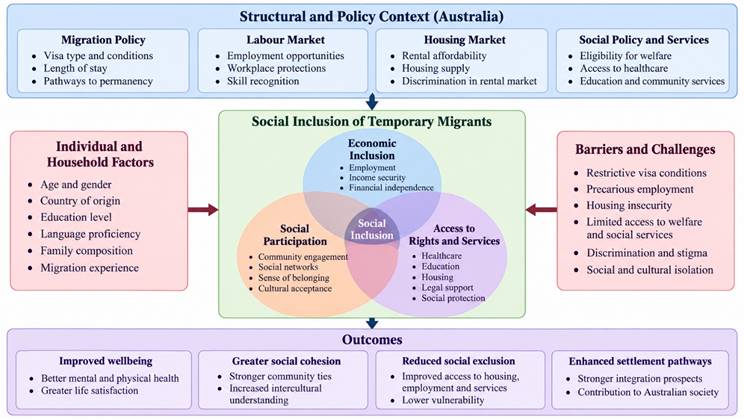
Social inclusion is treated here as a multidimensional condition spanning employment, housing, services, social networks and belonging (Saunders, 2015; Silver, 2010). Exclusion in one dimension tends to spill into others. A person who cannot find stable housing may struggle to keep work, and a person without access to services may carry housing stress alone (Figure 1). The framework is useful because it keeps attention on outcomes that matter to migrants themselves, such as safety, participation and belonging, and not only on eligibility rules (McAreavey & Argent, 2018; Ziersch et al., 2020).

3.2 Structural vulnerability

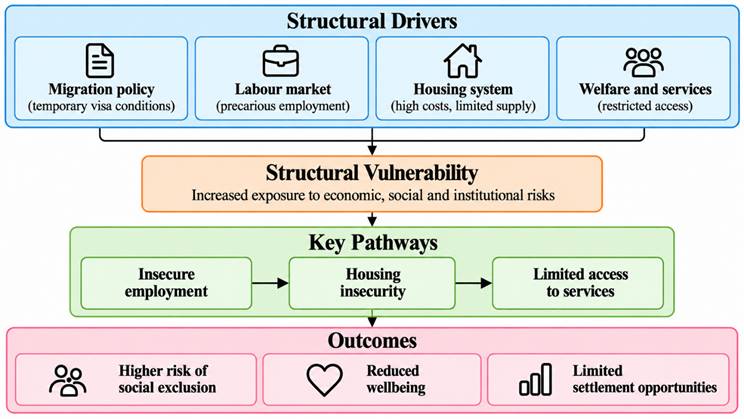
The second lens locates vulnerability in institutions and not in individuals. Visa design, labour regulation, the rental market and welfare rules together create conditions that expose some groups to more risk than others (Innes, 2023; Martino et al., 2022). Figure 2 shows how these systems interact. This view does not claim that all temporary migrants are vulnerable. Skilled workers on higher incomes, people with strong networks and those with a clear path to permanent residence face very different circumstances, and the framework is meant to explain that variation, not to flatten it (Newnham et al., 2019).

4. Visa status, welfare access and settlement

4.1 Visa conditions and access restrictions

Temporary visas are not one category. They differ in purpose, work rights, access to Medicare and access to income support, and these differences shape exposure to housing risk (Table 3). Student visa holders must finance study and living costs, often with limited work hours, and many rely on private rental (Robertson, 2016). Temporary graduates sit in a period of transition where time is short and plans are provisional (Robertson, 2014). Employer-sponsored workers, including those on the Skills in Demand visa (subclass 482), depend on one employer for both income and lawful stay, which reduces bargaining power (Boucher & Wright, 2023; Clibborn & Wright, 2022; Howe & Nikoloudakis, 2023). Bridging visa holders face conditions that vary with circumstances and processing times (Innes, 2023; Mackey et al., 2022).

Visa status can also shape the household. Dependants often rely on the primary visa holder's income and rights, and a shock to one person's work or status becomes a shock to the whole household (Faulkner et al., 2025). Table 3 should be read as a map of general patterns and not as legal advice. Eligibility rules change often and differ by subclass and circumstance.

4.2 Welfare exclusion

Most temporary visa holders have little or no access to income support, and the eligibility rules behind this are a central policy feature, not an oversight (Avato et al., 2010; Sabates-Wheeler & Koettl, 2010). Table 4 sets out the main pathways. The effect is clearest in crises. During COVID-19, many temporary migrants lost work with no safety net and turned to savings, charity or return travel (Farbenblum & Berg, 2020; Symington, 2020). Ongoing exclusion from income support means that rent, which is the largest regular cost, must be met almost entirely from

Table 3. Temporary visa conditions, access restrictions and indicators of social vulnerability among temporary migrants in Australia. Selected temporary visa categories, their main purposes and general patterns of work rights, access to social security and Medicare, and associated housing and inclusion risks. The table reports general patterns from the cited sources. Eligibility varies by subclass and individual circumstances and changes with policy, so current Department of Home Affairs and Services Australia information should be consulted.

Visa category (subclass)

Main purpose

Work rights

Access to social security

Access to Medicare

Housing vulnerability indicators

Social inclusion risks

References

Student visa (500)

Education and training

Limited work conditions

Generally restricted

Limited/depends on arrangements

Rental stress, shared accommodation, financial pressure

Social isolation, limited community participation

(Robertson, 2016)

Temporary Graduate visa (485)

Post-study employment

Full-time work rights

Generally restricted

Limited/depends on eligibility

Transition-related housing uncertainty

Settlement uncertainty

(Robertson, 2014)

Skills in Demand visa (subclass 482; replaced the Temporary Skill Shortage visa)

Employer-sponsored employment

Employer-linked work rights

Limited eligibility

Limited/depends on arrangements

Dependence on employment stability for housing

Reduced bargaining power

(Clibborn & Wright, 2022)

Partner Temporary visa (820)

Family reunification

Generally allowed

Limited/varies

Available under eligibility rules

Dependence on household resources

Social dependency risks

(Faulkner et al., 2025)

Bridging visas (subclasses 010, 020 and 030)

Maintain lawful status during visa processing

Conditions vary

Limited/varies

Depends on circumstances

Uncertainty affecting housing decisions

Increased insecurity

(Mackey et al., 2022)

Temporary Protection visa (785)

Humanitarian protection

Work rights with conditions

Limited access

Available under eligibility

Long-term housing uncertainty

Barriers to full inclusion

(Failla, 2024)

Dependent Temporary visa (457/482 dependent)

Accompany primary visa holder

Conditions vary

Generally restricted

Limited/varies

Reliance on primary visa holder income

Reduced independence

(Faulkner et al., 2025)

Temporary Activity visa (subclass 408)

Specific temporary purposes

Conditions vary

Generally restricted

Limited/varies

Short-term housing challenges

Reduced social participation

(Azeredo, 2025)

Table 4. Migration status and welfare exclusion pathways among temporary migrants in Australia. Welfare access and exclusion pathways by migration status, including key eligibility restrictions, sources of vulnerability and potential social outcomes. The table summarises general patterns from Australian migration and welfare research and official sources. It does not report statistical estimates, and welfare rules change over time and differ by individual circumstances.

Migration Status/Visa Category

Welfare Access Status

Key Eligibility Restrictions

Main Sources of Vulnerability

Potential Social Outcomes

References

Temporary Visa Holders (General)

Limited access to government welfare programs

Subject to visa conditions and residence requirements

Limited financial protection during hardship

Increased reliance on employment and informal support networks

(Symington, 2020)

International Students (Subclass 500)

Generally, not eligible for most income support payments

Limited welfare eligibility and dependence on personal resources

Financial pressure, high living costs, and rental stress

Reduced participation and increased settlement challenges

(Farbenblum & Berg, 2020)

Skills in Demand visa holders (subclass 482)

Restricted access to many welfare benefits

Employer sponsorship and visa-linked conditions

Dependence on employment continuity and employer relationship

(Howe & Nikoloudakis, 2023)


Temporary Graduate Visa Holders (Subclass 485)

Limited access to income support

Temporary residence status and eligibility requirements

Transition uncertainty after study completion

(Robertson, 2014)


Bridging Visa Holders

Access varies according to visa conditions

Different conditions across Bridging Visa categories

Uncertainty during visa processing periods

(Innes, 2023)


Temporary Protection Visa Holders (Subclass 785)

Conditional access to selected services

Support availability depends on policy arrangements

Long-term uncertainty and limited settlement pathways

(Newnham et al., 2019)


Dependent Temporary Visa Holders

Limited independent welfare access

Reliance on primary visa holder’s status

Reduced financial independence

(Faulkner et al., 2025)


Table 5. Thematic synthesis of factors shaping housing insecurity among temporary migrants in Australia. Thematic synthesis of the factors shaping housing insecurity among temporary migrants in Australia, with key dimensions and potential implications for housing security. The factors are pathways described in the literature and are not statistically estimated associations or established causal effects. Experiences vary by visa category, employment, location and personal resources.


Thematic factor

Key dimensions

Potential implications for housing security

References

Employment conditions

Employment stability, income security, and working conditions

Uncertain income and insecure employment may constrain the ability to maintain stable accommodation.

(Beer et al., 2016)

Housing affordability

Rental costs, availability of suitable housing, and housing-market pressures

(Amar & Armitage, 2025)


Visa status and security

Visa conditions, work rights, and uncertainty about future residence

(Faulkner et al., 2025)


Access to social services

Eligibility requirements, social protection, and availability of support services

(Khatri & Assefa, 2022)


Social support networks

Family connections, community relationships, and informal assistance

(Ziersch et al., 2023)


earnings (Adonteng-Kissi et al., 2025; Azeredo, 2025).

4.3 Visa insecurity and settlement

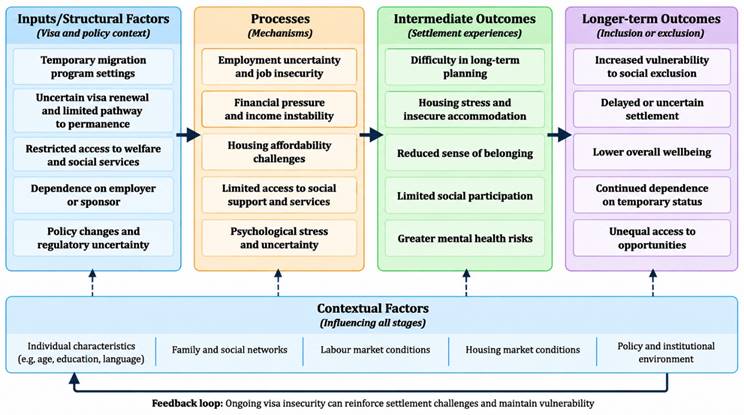
Insecurity about visa outcomes affects settlement as well as finances. Azeredo (2025) describes a condition of permanent temporariness, in which people are stuck in repeated temporary statuses and cannot plan long term. Evidence from refugee populations shows that prolonged visa insecurity is linked with poorer mental health (Newnham et al., 2019), and the history of the temporary protection visa shows how policy design can prolong that insecurity (Failla, 2024; Mansouri & Leach, 2009). These findings come from humanitarian groups and should not be transferred automatically to students or skilled workers, but they show the mechanism by which uncertainty can affect wellbeing and the willingness to invest in housing, networks and community (Figure 3; Innes, 2023).

5. Employment and housing insecurity

5.1 Precarious work as a pathway

The employment pathway to housing insecurity is well described. Casual, seasonal or sponsor-linked work produces income that is irregular or dependent on a single relationship, and landlords and agents often treat such income as a risk (Beer et al., 2016; Robertson, 2016; Tan & Lester, 2012). Where employers hold power over visa outcomes, workers may accept poor pay or conditions to protect their status (Boucher & Wright, 2023; Clibborn & Wright, 2022). International comparisons suggest the problem is not unique to Australia, as temporary labour schemes elsewhere also tie rights to employment (Hugo, 2009), and work in other economies confirms that housing and labour markets respond to each other, so a job shock tends to become a housing shock (Zabel, 2012).

5.2 Housing access and the visa system

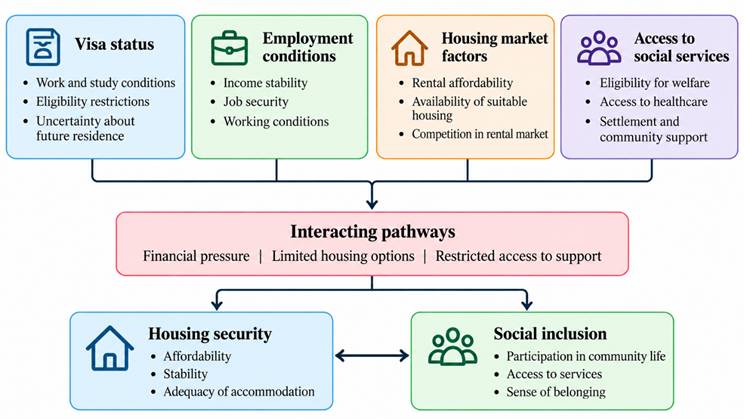
Visa rules also shape housing directly. Robertson (2017) shows how housing and language testing combine into infrastructures of insecurity for migrants moving between Asia and Australia, with housing arrangements entangled in visa and settlement strategies. Figure 4 draws these links together. Employment, visa status, housing-market conditions and service access feed into financial pressure, limited housing options and restricted support, and these in turn shape housing security and inclusion. The figure is conceptual. It does not show pooled estimates, and it should not be read as showing established causal effects. Table 5 summarises the thematic synthesis.

6. Housing experiences

6.1 Private rental, shared accommodation and overcrowding

Temporary migrants are heavily dependent on private rental, which is the least regulated and least affordable part of the system for people on low or irregular incomes (Faulkner et al., 2025; Yates, 2016). Students in particular have been described as relying on the private market with limited housing support (Robertson, 2016). Shared and overcrowded accommodation, informal subletting and short-term arrangements recur as ways of coping with high rents, particularly in expensive metropolitan areas, though the strongest evidence for these conditions comes from refugee and asylum-seeker studies (Martino et al., 2022; Smith et al., 2020; Ziersch et al., 2017). These studies link precarious housing to poorer mental health and to difficulty building community. Their findings are suggestive for temporary visa holders but cannot stand in for direct evidence.

6.2 Structural features of the housing system

General Australian housing research explains why the pressure falls where it does. High housing costs push low-income households into poverty and inequality (Saunders, 2017), and homelessness among disadvantaged families reflects the interaction of resources, housing and welfare (Hastings, 2024). Planning and affordability policies have struggled to deliver enough low-cost housing (Beer et al., 2007; Morris et al., 2020), and schemes designed to expand supply, such as the National Rental Affordability Scheme, have met practical barriers (Amar & Armitage, 2025). Social housing finance has also been the subject of long policy debate (Fotheringham et al., 2021). Temporary migrants are mostly outside these supports, because eligibility for social and affordable housing generally depends on status, which leaves the unsubsidised market as their main option. This is an inference from the combined literature, and Faulkner et al. (2025) remains the best direct source.

7. Access to services and support

7.1 Health, welfare and legal services

Service access depends on visa type, insurance arrangements, language and awareness. Studies of culturally and linguistically diverse populations in Australia describe barriers of cost, communication and unfamiliarity with the system (Khatri & Assefa, 2022), and a review of

Figure 1. Conceptual framework of migration policy, employment, housing, services and social inclusion. Conceptual framework linking migration policy, employment conditions, housing security, access to social services and social inclusion among temporary migrants in Australia. The arrows show the pathways described in the reviewed literature, and the boxes show the domains examined in this review. The figure is a synthesis of the literature and is not an empirical model. It does not show estimated effects or establish causal relationships.

Figure 2. Structural vulnerability framework. Structural vulnerability framework showing how migration policy, labour-market conditions, housing systems and access to services interact to produce insecurity and shape social outcomes among temporary migrants. Vulnerability is located in institutional arrangements and not in individual characteristics. The framework is a conceptual synthesis and explains variation across visa groups, but it does not rank them.

Figure 3. Logical model of visa insecurity and settlement experiences. Logical model of the pathways through which visa insecurity affects settlement experiences among temporary migrants in Australia. Structural factors lead to intermediate challenges, which are shaped by contextual influences and lead to longer-term social outcomes. Evidence for some links comes from refugee research and should be applied to other visa groups with care. The model is conceptual.

Figure 4. Integrated pathways linking visa status, employment, housing and services with housing security and social inclusion. Integrated pathways linking visa status, employment conditions, housing-market factors and access to social services with housing security and social inclusion. Four domains feed into financial pressure, limited housing options and restricted support, which in turn shape housing security and inclusion. The relationship between the two outcomes is shown as reciprocal. The figure is a thematic synthesis, not a statistical result.

social service inclusion shows that rights-based access for immigrants remains uneven (Adonteng-Kissi et al., 2025). Evidence from other groups points the same way. Disability services show how structural determinants limit access even for people with clear entitlements (Bobo et al., 2025), and a scoping review of support for migrant, refugee and asylum-seeking women who experience family violence documents barriers tied to status and fear of consequences (Robinson et al., 2025). Studies from the United Kingdom and from help-seeking research with young African migrants indicate that fear and lack of information deter people even when services exist (Asif & Kienzler, 2022; McCann et al., 2016). These sources do not describe temporary visa holders specifically, but they identify barriers that are plausible for them.

7.2 Informal networks and community organisations

Where formal support is limited, informal networks matter. Weak ties can open access to information and resources (Ryan, 2011), and social capital helps people from refugee backgrounds find their way in a new setting (Sime & Fox, 2015; Ziersch et al., 2023). Resources and security, such as length of stay and status, shape socio-economic integration (Bakker et al., 2014). Volunteering and community programmes can support belonging (Russo et al., 2023), and rural and new destination settings depend especially on local institutions (McAreavey & Argent, 2018). Studies of older migrants elsewhere also show that social support and economic conditions interact (Ahamad et al., 2024). Studies of refugee resettlement and of digital and community networks similarly stress that belonging is built through relationships as well as rights (Boyle, 2025; Fozdar & Hartley, 2013). Community organisations therefore perform a compensatory role, but their reach varies by place and group, and reliance on them is not a substitute for entitlement.

8. Discussion

8.1 Principal findings

Three findings stand out. First, the pathways linking visa status, work, housing and services are consistent across the sources. Visa design determines what protection is available. Work conditions determine how much risk a household can absorb. The rental market determines how much that risk costs. Services and networks determine what help exists when things go wrong. No single factor explains housing insecurity, and the combination matters more than any one element, as Figure 4 summarises.

Second, the effects are not uniform. Students, graduates, employer-sponsored workers, bridging visa holders and dependants have different rights and different exposures (Table 3). The literature rarely compares them with one another, so claims about which group is worst off are not currently supported. Where authors identify differences, they mostly do so by argument and not by measurement.

Third, and most important, the evidence base is narrower than the topic suggests. Of the 58 sources, 12 concern temporary migration and visa conditions in Australia, and only one, Faulkner et al. (2025), is built around temporary visa holders and housing (Table 2). Twelve concern refugees and people seeking asylum, a group with different entitlements, and 16 are international or conceptual. The review therefore leans on adjacent evidence for several claims, and it has marked these places in the text. The strong consistency of the pathways partly reflects consistency in the framing of the literature, so confidence in the direction of effects should be higher than confidence in their size.

8.2 Implications for policy and practice

The synthesis supports several practical directions, each framed as an implication of the pathways and not as a tested intervention. Tenancy protections and enforcement matter more for people who cannot easily complain or relocate, so tenancy rights information should be translated and delivered through universities, employers and migrant services. Information on service eligibility should be clear and consistent across agencies, since uncertainty about entitlement can deter people who are eligible (Khatri & Assefa, 2022). Visa transition points, such as the end of study or the end of sponsorship, are moments of acute housing risk and could be met with advance guidance and flexible timelines (Robertson, 2014). Employer-linked visas could be reviewed for the extent to which they restrict mobility and complaint (Boucher & Wright, 2023). Finally, because policy debate often centres on the fiscal contribution of permanent migration (Varela et al., 2021), settlement outcomes for temporary groups deserve comparable analytical attention.

8.3 Limitations and research priorities

The review has limits. It is a narrative review, so it does not claim to be exhaustive, and the absence of screening counts and a flow diagram means the selection cannot be audited. Classification of sources relied on titles and stated aims, and quality was not scored, so weaker studies may carry weight that stronger ones deserve. Government sources are not peer reviewed. Visa and welfare rules change frequently, and Tables 3 and 4 describe general patterns that should be checked against current Home Affairs and Services Australia information. The review did not examine the grey literature from migrant advocacy bodies in depth, which may hold relevant case evidence.

Three research priorities follow. Linked administrative data, which Australian research infrastructure is increasingly able to support (Sinnott et al., 2015), could connect visa records with tenancy, employment and service data and permit comparison across visa categories. Longitudinal designs that follow people through visa transitions would show how housing and inclusion change over time. Studies of landlord, agent and employer behaviour would reveal the mechanisms behind discrimination and exploitation that tenant surveys cannot see. Housing researchers also have a part to play in framing these questions for policy, as Marston (2008) argued in a broader context.

9. Conclusion

Housing insecurity among temporary migrants in Australia is best understood as the product of connected systems, namely visa design, precarious work, a pressured rental market and restricted services, with informal networks filling some gaps. Informal networks and community organisations help, but they cannot replace entitlement or secure tenure. The literature supports this account consistently, but it is thin where it matters most, because few studies address temporary visa holders' housing directly and none compares visa categories in a way that allows firm conclusions. Policy should attend to tenancy protection, clear eligibility information and visa transition points, because these are where risk concentrates and where intervention is most practical. Research should build linked, longitudinal and comparative evidence that separates visa groups. Until that evidence exists, claims about the scale and distribution of housing insecurity among temporary migrants should be made with care, and policy should be tested as it is introduced.

Author contributions

Md Sharif Hossain was solely responsible for the work. Using CRediT terms: conceptualisation, methodology, investigation, formal analysis, data curation, writing (original draft), writing (review and editing), visualisation, and project administration.

Conflict of interest

The author, Md Sharif Hossain declares no competing financial interests or personal relationships that could have influenced the work reported in this paper.

References


Adonteng-Kissi, O., Mabefam, M., Meribe, N., Baffour, F. D., & Archibong, E. (2025). Social service inclusion of immigrants through the lens of human rights in Australia. Development Policy Review, 43(4). https://doi.org/10.1111/dpr.70021

Ahamad, V., Bhagat, R. B., Manisha, & Pal, S. K. (2024). Social support and economic conditions among older migrants in India: do distance, duration, and streams of migration play a role in later life? BMC Public Health, 24(1), 1843. https://doi.org/10.1186/s12889-024-19165-7

Amar, J. H. N., & Armitage, L. A. (2025). Understanding Barriers and Pathways for the Sustainable Implementation of Affordable Housing in Australia: The Case of the National Rental Affordability Scheme (NRAS). Buildings, 15(3), 454. https://doi.org/10.3390/buildings15030454

Asif, Z., & Kienzler, H. (2022). Structural barriers to refugee, asylum seeker and undocumented migrant healthcare access. Perceptions of Doctors of the World caseworkers in the UK. SSM - Mental Health, 2, 100088. https://doi.org/10.1016/j.ssmmh.2022.100088

Avato, J., Koettl, J., & Sabates-Wheeler, R. (2010). Social Security Regimes, Global Estimates, and Good Practices: The Status of Social Protection for International Migrants. World Development, 38(4), 455--466. https://doi.org/10.1016/j.worlddev.2009.10.003

Azeredo, R. (2025). Visa journeys and permanent temporariness: navigating welfare state borders and precarious status in Australia. Journal of Ethnic and Migration Studies, 51(17), 4251--4271. https://doi.org/10.1080/1369183X.2025.2492824

Bakker, L., Dagevos, J., & Engbersen, G. (2014). The Importance of Resources and Security in the Socio-Economic Integration of Refugees. A Study on the Impact of Length of Stay in Asylum Accommodation and Residence Status on Socio-Economic Integration for the Four Largest Refugee Groups in the Netherlands. Journal of International Migration and Integration, 15(3), 431--448. https://doi.org/10.1007/s12134-013-0296-2

Beer, A., Bentley, R., Baker, E., Mason, K., Mallett, S., Kavanagh, A., & LaMontagne, T. (2016). Neoliberalism, economic restructuring and policy change: Precarious housing and precarious employment in Australia. Urban Studies, 53(8), 1542--1558. https://doi.org/10.1177/0042098015596922

Beer, A., Kearins, B., & Pieters, H. (2007). Housing Affordability and Planning in Australia: The Challenge of Policy Under Neo-liberalism. Housing Studies, 22(1), 11--24. https://doi.org/10.1080/02673030601024572

Bobo, F. T., Hollier, J., Yen, I., Chang, K.-Y. J., & Smith-Merry, J. (2025). Disparities in access to health and support services for people with disability in Australia: a scoping review of the structural social determinants. BMC Health Services Research, 26(1), 72. https://doi.org/10.1186/s12913-025-13904-1

Boucher, A. K., & Wright, C. F. (2023). Hard Exterior, Soft Interior: Skill Regulation and Employer Control over Migrant Worker Selection Policy in Australia. Industrial Law Journal, 52(4), 899--929. https://doi.org/10.1093/indlaw/dwad007

Boyle, E. (2025). Networks of Belonging: Refugee and Migrant Inclusion in Australia, and Digital Communication. Taylor & Francis.

Castles, S. (2000). International Migration at the Beginning of the Twenty-First Century: Global Trends and Issues. International Social Science Journal, 52(165), 269--281. https://doi.org/10.1111/1468-2451.00258

Castles, S. (2010). Understanding Global Migration: A Social Transformation Perspective. Journal of Ethnic and Migration Studies, 36(10), 1565--1586. https://doi.org/10.1080/1369183X.2010.489381

Clibborn, S., & Wright, C. F. (2022). The Efficiencies and Inequities of Australia's Temporary Labour Migration Regime. Australian Economic Review, 55(2), 254--262. https://doi.org/10.1111/1467-8462.12466

Failla, M. (2024). Providing permanent protection to refugees in Australia: Real change or window dressing? Alternative Law Journal, 49(1), 47--54. https://doi.org/10.1177/1037969X231218016

Farbenblum, B., & Berg, L. (2020). "We might not be citizens but we are still people": Australia's disregard for the human rights of international students during COVID-19. Australian Journal of Human Rights, 26(3), 486--506. https://doi.org/10.1080/1323238X.2021.1901645

Faulkner, D., Wasserman, R., Nasreen, Z., Vincent, K., Levin, I., Dekker, K., Arthur, N., Barrie, H., & Baltra-Ulloa, A. J. (2025). Temporary visa holders and housing: findings from an Investigative Panel. AHURI Final Report, (FR 449). https://doi.org/10.18408/ahuri3231501

Fotheringham, M., Gorter, T., & Badenhorst, A. (2021). Charting the policy development process of social housing bonds in Australia through an impact narrative approach. Australian Journal of Public Administration, 80(3), 590--601. https://doi.org/10.1111/1467-8500.12485

Fozdar, F., & Hartley, L. (2013). Refugee Resettlement in Australia: What We Know and Need to Know. Refugee Survey Quarterly, 32(3), 23--51. https://doi.org/10.1093/rsq/hdt009

Hastings, C. (2024). Why do some disadvantaged Australian families become homeless? Resources, disadvantage, housing and welfare. Housing Studies, 39(10), 2479--2503. https://doi.org/10.1080/02673037.2023.2194248

Howe, J., & Nikoloudakis, I. (2023). The evolution of Australia's dedicated temporary skilled migration program: a bipartisan political journey from agreement to disagreement. Griffith Law Review, 32(3), 357--385. https://doi.org/10.1080/10383441.2024.2313937

Hugo, G. (2009). Best Practice in Temporary Labour Migration for Development: A Perspective from Asia and the Pacific. International Migration, 47(5), 23--74. https://doi.org/10.1111/j.1468-2435.2009.00576.x

Innes, A. (2023). Migration, Vulnerability, and Experiences of Insecurity: Conceptualising Insecure Migration Status. Social Sciences, 12(10), 540. https://doi.org/10.3390/socsci12100540

Khatri, R. B., & Assefa, Y. (2022). Access to health services among culturally and linguistically diverse populations in the Australian universal health care system: issues and challenges. BMC Public Health, 22(1), 880. https://doi.org/10.1186/s12889-022-13256-z

Mackey, W., Coates, B., & Sherrell, H. (2022). Migrants in the Australian workforce: a guidebook for policy makers. Grattan Institute.

Mansouri, F., & Leach, M. (2009). The Evolution of the Temporary Protection Visa Regime in Australia. International Migration, 47(2), 101--126. https://doi.org/10.1111/j.1468-2435.2008.00483.x

Marston, G. (2008). Technocrats or Intellectuals? Reflections on the Role of Housing Researchers as Social Scientists. Housing, Theory and Society, 25(3), 177--190. https://doi.org/10.1080/14036090802117630

Martino, E., Li, Y., Kali-Opio, J., & Bentley, R. (2022). Between liminality and a new life in Australia: What is the effect of precarious housing on the mental health of humanitarian migrants? Cities, 131, 103900. https://doi.org/10.1016/j.cities.2022.103900

McAreavey, R., & Argent, N. (2018). Migrant integration in rural New Immigration Destinations: An institutional and triangular perspective. Journal of Rural Studies, 64, 267--275. https://doi.org/10.1016/j.jrurstud.2018.08.001

McCann, T. V., Mugavin, J., Renzaho, A., & Lubman, D. I. (2016). Sub-Saharan African migrant youths' help-seeking barriers and facilitators for mental health and substance use problems: a qualitative study. BMC Psychiatry, 16(1), 275. https://doi.org/10.1186/s12888-016-0984-5

Morris, A., Beer, A., Martin, J., Horne, S., Davis, C., Budge, T., & Paris, C. (2020). Australian local governments and affordable housing: Challenges and possibilities. The Economic and Labour Relations Review, 31(1), 14--33. https://doi.org/10.1177/1035304619880135

Murad, S., & Versey, H. S. (2021). Barriers to leisure-time social participation and community integration among Syrian and Iraqi refugees. Leisure Studies, 40(3), 378--391. https://doi.org/10.1080/02614367.2020.1862281

Newnham, E. A., Pearman, A., Olinga-Shannon, S., & Nickerson, A. (2019). The mental health effects of visa insecurity for refugees and people seeking asylum: a latent class analysis. International Journal of Public Health, 64(5), 763--772. https://doi.org/10.1007/s00038-019-01249-6

Robertson, S. (2014). Time and Temporary Migration: The Case of Temporary Graduate Workers and Working Holiday Makers in Australia. Journal of Ethnic and Migration Studies, 40(12), 1915--1933. https://doi.org/10.1080/1369183X.2013.876896

Robertson, S. (2016). Student-workers and tourist-workers as urban labour: temporalities and identities in the Australian cosmopolitan city. Journal of Ethnic and Migration Studies, 42(14), 2272--2288. https://doi.org/10.1080/1369183X.2016.1205808

Robertson, S. (2017). Infrastructures of insecurity: Housing and language testing in Asia-Australia migration. Geoforum, 82, 13--20. https://doi.org/10.1016/j.geoforum.2017.03.013

Robinson, K., Afrouz, R., & Dunwoodie, K. (2025). Domestic and Family Violence Among Migrant, Refugee, and Asylum-Seeking Women in Australia: A Scoping Review of Experiences and Support. Journal of Family Violence. https://doi.org/10.1007/s10896-025-00823-2

Russo, A., Koch, R., & McBride, J. (2023). Promoting social inclusion among asylum seekers and refugees living in the south east region of Melbourne, Australia, through volunteering. Health Promotion Journal of Australia, 34(4), 932--942. https://doi.org/10.1002/hpja.685

Ryan, L. (2011). Migrants' Social Networks and Weak Ties: Accessing Resources and Constructing Relationships Post-Migration. The Sociological Review, 59(4), 707--724. https://doi.org/10.1111/j.1467-954X.2011.02030.x

Sabates-Wheeler, R., & Koettl, J. (2010). Social protection for migrants: The challenges of delivery in the context of changing migration flows. International Social Security Review, 63(3--4), 115--144. https://doi.org/10.1111/j.1468-246X.2010.01372.x

Saunders, P. (2015). Social inclusion, exclusion, and well-being in Australia: meaning and measurement. Australian Journal of Social Issues, 50(2), 139--157. https://doi.org/10.1002/j.1839-4655.2015.tb00341.x

Saunders, P. (2017). Housing costs, poverty and inequality in Australia. Housing Studies, 32(6), 742--757. https://doi.org/10.1080/02673037.2016.1229757

Silver, H. (2010). Understanding Social Inclusion and Its Meaning for Australia. Australian Journal of Social Issues, 45(2), 183--211. https://doi.org/10.1002/j.1839-4655.2010.tb00174.x

Sime, D., & Fox, R. (2015). Migrant Children, Social Capital and Access to Services Post-Migration: Transitions, Negotiations and Complex Agencies. Children & Society, 29(6), 524--534. https://doi.org/10.1111/chso.12092

Sinnott, R. O., Bayliss, C., Bromage, A., Galang, G., Grazioli, G., Greenwood, P., Macaulay, A., Morandini, L., Nogoorani, G., Nino-Ruiz, M., Tomko, M., Pettit, C., Sarwar, M., Stimson, R., Voorsluys, W., & Widjaja, I. (2015). The Australia urban research gateway. Concurrency and Computation: Practice and Experience, 27(2), 358--375. https://doi.org/10.1002/cpe.3282

Smith, D., McKay, F. H., & Lippi, K. (2020). Experiences of homelessness by people seeking asylum in Australia: A review of published and "grey" literature. Social Policy & Administration, 54(3), 441--459. https://doi.org/10.1111/spol.12570

Soto Saavedra, C., Lopez, J. L., Shaw, S. A., & Gibbs, B. G. (2023). "It Happened When I Was Connecting to the Community...": Multiple Pathways to Migrant (Non)Belonging in a New Destination Setting. International Journal of Environmental Research and Public Health, 20(3), 2172. https://doi.org/10.3390/ijerph20032172

Symington, A. (2020). Migrant workers and the COVID-19 crisis in Australia: an overview of governmental responses. Australian Journal of Human Rights, 26(3), 507--519. https://doi.org/10.1080/1323238X.2021.1882045

Tan, Y., & Lester, L. H. (2012). Labour Market and Economic Impacts of International Working Holiday Temporary Migrants to Australia. Population, Space and Place, 18(3), 359--383. https://doi.org/10.1002/psp.674

Triandafyllidou, A. (2022). Temporary migration: category of analysis or category of practice? Journal of Ethnic and Migration Studies, 48(16), 3847--3859. https://doi.org/10.1080/1369183X.2022.2028350

Varela, P., Husek, N., Williams, T., Maher, R., & Kennedy, D. (2021). The lifetime fiscal impact of the Australian permanent migration program. Treasury Working Paper.

Yates, J. (2016). Why Does Australia Have an Affordable Housing Problem and What Can Be Done About It? Australian Economic Review, 49(3), 328--339. https://doi.org/10.1111/1467-8462.12174

Zabel, J. E. (2012). Migration, housing market, and labor market responses to employment shocks. Journal of Urban Economics, 72(2--3), 267--284. https://doi.org/10.1016/j.jue.2012.05.006

Ziersch, A., Miller, E., Baak, M., & Mwanri, L. (2020). Integration and social determinants of health and wellbeing for people from refugee backgrounds resettled in a rural town in South Australia: a qualitative study. BMC Public Health, 20(1), 1700. https://doi.org/10.1186/s12889-020-09724-z

Ziersch, A., Walsh, M., & Due, C. (2023). ' Having a good friend, a good neighbour, can help you find yourself ': social capital and integration for people from refugee and asylum-seeking backgrounds in Australia. Journal of Ethnic and Migration Studies, 49(15), 3877--3899. https://doi.org/10.1080/1369183X.2023.2177628

Ziersch, A., Walsh, M., & Due, C. (2024). Housing and health for people from refugee and asylum-seeking backgrounds: findings from an Australian qualitative longitudinal study. BMC Public Health, 24(1), 1138. https://doi.org/10.1186/s12889-024-18616-5

Ziersch, A., Walsh, M., Due, C., & Duivesteyn, E. (2017). Exploring the Relationship between Housing and Health for Refugees and Asylum Seekers in South Australia: A Qualitative Study. International Journal of Environmental Research and Public Health, 14(9), 1036. https://doi.org/10.3390/ijerph14091036

Article metrics
View details
0
Downloads
0
Citations
61
Views
📖 Cite article

View Dimensions


View Plumx


View Altmetric


0
Save
0
Citation
61
View
0
Share