2.1 Historical Evolution: From Seed-Mediated Chemistry to Photoinduced Synthesis
2.1.1 The seed-mediated paradigm and its limits
The rational synthesis of anisotropic metal nanostructures has long been a central concern of nanomaterials research, largely because their optical, catalytic and surface-enhanced spectroscopic properties depend so strongly on geometry (Langille et al., 2013; Zhai et al., 2016). For decades, seed-mediated growth was the method of choice for controlling size, aspect ratio and exposed facets (Xia et al., 2017). In a typical protocol, small isotropic seeds are introduced into a growth solution containing a metal precursor, a mild reductant and a shape-directing surfactant such as cetyltrimethylammonium bromide (CTAB) or polyvinylpyrrolidone (PVP) (Nikoobakht & El-Sayed, 2003; Zhai et al., 2016). The approach gives excellent yields of rods and cubes, but it works within the bounds of thermodynamic control or surfactant-guided kinetic stabilization (Langille et al., 2013). Lower-symmetry shapes, and particles grown site-specifically on solid supports, have proved much harder to obtain by thermal routes alone (Golze et al., 2019; Vinnacombe-Willson et al., 2023).
2.1.2 Light enters the flask
The turning point, as most accounts agree, was the report by R. Jin et al. (2001) that spherical silver particles convert into uniform triangular nanoprisms under room-light illumination. The finding mattered less for the prisms themselves than for what it implied: light could drive an anisotropic transformation rather than merely report on one. Later studies extended photoinduced growth to other metals and shapes, including silver nanorods and cubes with unusual twinning, gold nanoprisms and branched nanostars (Langille et al., 2013; Personick et al., 2013; Zhai et al., 2016). Linearly polarized and phase-structured light was also shown to imprint its own symmetry on photoelectrodeposited films and on laser-reorganized nanoparticle layers (Carim et al., 2016; Li et al., 2021).
2.1.3 From field-shaping to carrier chemistry
Early explanations leaned on the idea that anisotropic near fields simply created favoured growth zones. Current thinking is more specific: the transformations are driven by non-radiative plasmon decay, which produces energetic hot carriers and localized heat (Besteiro et al., 2021; Dahi et al., 2024; Tan et al., 2017). By loosening the grip of crystallographic symmetry and thermal equilibrium, light-directed synthesis offers spatial addressability, spectral selectivity and reconfigurability that conventional chemistry struggles to match (X. Jin et al., 2026; Long et al., 2020). The milestones of this conceptual shift are summarized in Figure 1.
2.2 Microscopic Mechanisms: Hot Charge Carriers versus Photothermal Effects
2.2.1 The plasmon decay cascade
Everything in plasmon-directed synthesis begins with the LSPR (Baffou & Quidant, 2013; Besteiro et al., 2021). After excitation, plasmons decay non-radiatively by Landau damping within about 1–10 fs, generating strongly non-equilibrium electron–hole pairs, the so-called hot carriers (Brongersma et al., 2015; Wang et al., 2018). These relax through carrier–carrier scattering on the 100 fs–1 ps scale and through electron–phonon coupling over roughly 1–10 ps, eventually handing their energy to the surrounding medium as heat (Baffou & Quidant, 2013; Dahi et al., 2024). The full cascade, and the chemistry that branches off at each stage, is sketched in Figure 2. Telling the non-thermal and thermal branches apart is, arguably, still the most stubborn conceptual problem in plasmon-driven chemistry (Kamarudheen et al., 2018; Zhan et al., 2019).
2.2.2 Hot electrons, hot holes and spatial selectivity
Hot electrons with enough energy to cross interfacial Schottky barriers, or to reach unoccupied molecular orbitals, can transfer into solution and reduce adsorbed ions such as AuCl4− or Ag+ (Besteiro et al., 2021; Long et al., 2020). Because the local generation rate scales with the square of the local field, |E(r)|2, reduction concentrates at sharp corners, apexes and gaps (Besteiro et al., 2021; Wang et al., 2018). Hot holes, meanwhile, can oxidize and dissolve surface atoms, so deposition and dissolution compete with one another on the same particle (Dahi et al., 2024; Feferman et al., 2026). The main pathways are compared in Table 2.
2.2.3 Direct spatial evidence
Some of the most persuasive evidence for carrier-driven chemistry comes, perhaps unexpectedly, from polymers. Wang et al. (2018) showed that low-power laser excitation of single gold particles initiates radical polymerization of acrylate monomers along the incident polarization axis, without any molecular photoinitiator. Since the temperature rise was too small to drive thermal polymerization, the site-selective polymer lobes were taken as a map of hot-electron injection that matched the calculated near field.
2.2.4 The non-local character of heat
Heat behaves differently. The high thermal conductivity of noble metals equilibrates temperature across a particle within picoseconds (Baffou & Quidant, 2013; Kamarudheen et al., 2018). Local heating can anneal, melt or strip ligands, but it is poorly suited to producing directional growth; regioselective modification seems to require the directionality of carrier transfer or of near-field gradients (Besteiro et al., 2021; Dahi et al., 2024; X. Jin et al., 2026).
2.3 Non-Classical Growth Modes and Reaction Kinetics
2.3.1 Beyond monomer addition
Classical models assume that anisotropic crystals grow atom by atom or through Ostwald ripening, in which small, high-energy particles dissolve to feed larger ones (Xia et al., 2017). Single-particle studies now suggest that plasmon-driven synthesis frequently follows other routes,
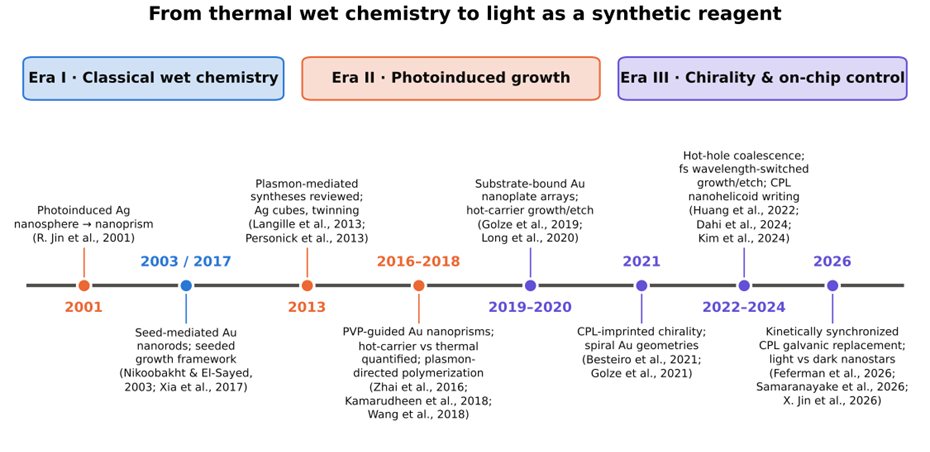
Figure 1. Conceptual evolution of anisotropic metal nanocrystal synthesis, from classical seed-mediated chemistry to light-directed, chirality-encoded growth. The timeline groups milestone studies into three eras. Era I (blue) represents thermodynamically and surfactant-controlled wet chemistry; Era II (orange) begins with the photoinduced conversion of silver nanospheres into nanoprisms and includes the mechanistic recognition of hot-carrier and photothermal contributions; Era III (violet) covers substrate-bound growth, circularly polarized light (CPL)-imprinted chirality and kinetic control of nucleation and galvanic replacement. Citations beneath each milestone identify the primary sources discussed in Section 2.1.
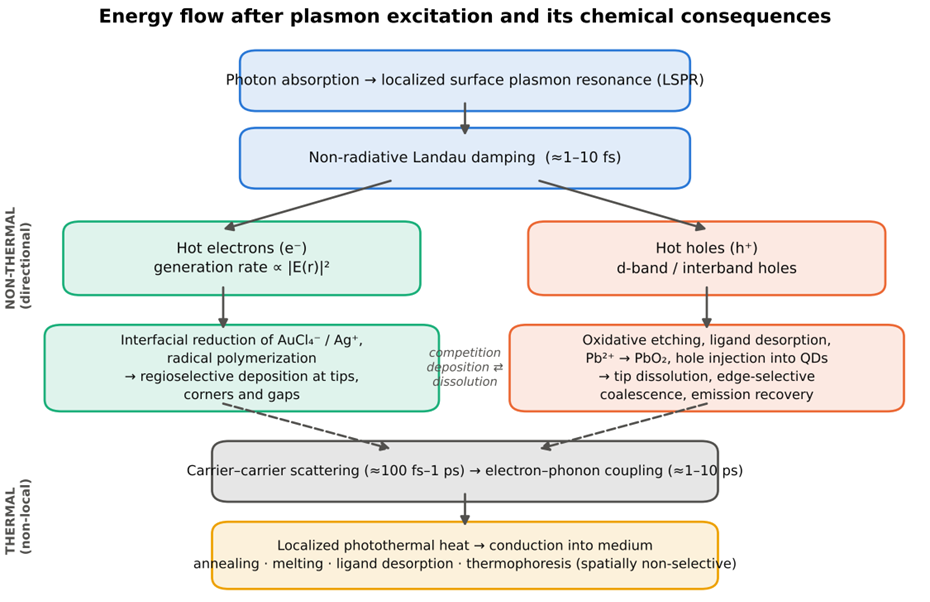
Figure 2. Energy-flow cascade following plasmon excitation and the chemical pathways that branch from it. Photon absorption excites the localized surface plasmon resonance (LSPR), which decays by Landau damping within about 1–10 fs into hot electrons (green) and hot holes (orange). Hot electrons reduce adsorbed precursors at field hotspots, with a generation rate proportional to |E(r)|2, whereas hot holes etch, strip ligands, oxidize Pb2+ or inject into quantum dots. Carriers that are not captured relax by carrier–carrier and electron–phonon scattering into localized heat (yellow), which acts non-selectively. The figure summarizes Section 2.2 and the mechanisms compiled in Table 2.
including hot-hole-regulated coalescence and competing light and dark kinetics (Dahi et al., 2024; Huang et al., 2022; Samaranayake et al., 2026).
2.3.2 Hot-hole-regulated coalescence
Huang et al. (2022) provided a clear example while studying the light-driven conversion of gold nanospheres into triangular nanoplates in the presence of iodide. Combining nanopore sensing with time-resolved electron microscopy, they identified an edge-selective coalescence pathway: hot holes destabilize capping ligands at particle edges, and small spheres attach in an oriented fashion to form planar, twinned plates. Controlled coalescence, in other words, can still deliver crystalline and uniform anisotropic products.
2.3.3 Wavelength as a switch between growth and etching
Dahi et al. (2024) examined the interplay between wavelength and redox chemistry during femtosecond-laser reshaping of gold nanorods. Irradiation at 400 nm, within the interband absorption of gold, generated carriers fairly uniformly and drove overgrowth along both sides and tips. Tuning to 800 nm, in resonance with the longitudinal LSPR, instead concentrated hot holes at the tips, where free AuCl4− etched them and steadily lowered the aspect ratio.
2.3.4 Ambient light as a hidden variable
Illumination during early nucleation can matter just as much. In the seedless, surfactant-free synthesis of gold nanostars with NMGA as a green reductant, room light during mixing accelerated Au3+ reduction, producing many small nuclei that grew into stars with short branches and small cores (Samaranayake et al., 2026). Running the same reaction in darkness suppressed this nucleation burst and allowed the remaining precursor to feed tip elongation, giving larger, sharper stars with markedly better NIR photothermal performance. The lesson, one suspects, extends well beyond this particular system.
2.4 Light-Imprinted Chirality and Structural Symmetry Breaking
2.4.1 Why chirality, and why light
Chiral nanostructures lack mirror symmetry in three dimensions and can show intense circular dichroism (CD) and large dissymmetry factors (g) (Besteiro et al., 2021; X. Jin et al., 2026). Conventional routes depend heavily on chiral templates, such as amino acids, peptides or DNA origami (Kuzyk et al., 2017; Lv et al., 2022). Light-directed synthesis offers a ligand-free alternative in which handedness is written directly onto achiral precursors using CPL or structured vector beams (Besteiro et al., 2021; Feferman et al., 2026; X. Jin et al., 2026).
2.4.2 Physical origin of CPL-imprinted chirality
The mechanism rests on symmetry breaking in the near field (Besteiro et al., 2021). When a low-symmetry achiral particle, such as a cuboid, nanobar or triangular prism, is illuminated with CPL, orthogonal field components interfere to produce a phase-shifted, asymmetric intensity at opposite corners (Besteiro et al., 2021; Feferman et al., 2026). That asymmetry drives localized PICS and carrier transfer, so that deposition or galvanic dissolution reproduces the handedness of the light in the 3D structure (Besteiro et al., 2021; X. Jin et al., 2026). Representative chiral architectures are compiled in Table 3, and the general sequence is illustrated in Figure 3.
2.4.3 A two-step kinetic pathway
Feferman et al. (2026) investigated CPL-controlled galvanic replacement in colloidal Au@Ag nanobars exposed to Au3+, Pt4+ and Pd4+ complexes. Chirality developed in two stages. A fast step, lasting only seconds, combined regioselective hot-electron reduction at specific apexes with hot-hole dissolution of silver from the lateral faces and accounted for roughly half of the final CD. A slower step over several minutes, plasmon-guided redeposition of silver onto the newly asymmetric template, supplied the rest. Timing proved critical: delaying CPL exposure by only a few seconds after precursor addition caused a sharp loss of CD, and the choice of halide counterion and pH strongly modulated both reaction rate and final dissymmetry.
2.4.4 Structured light and direct writing
Uniform CPL is not the only option. Beams carrying spatial polarization gradients or orbital angular momentum (OAM), such as optical vortices, add further spatial control (X. Jin et al., 2026). Kim et al. (2024) used CPL-driven direct writing to print plasmonic silver nanohelicoids, and related approaches have produced spiral metasurfaces and chiral needle arrays over large areas without chiral reagents (X. Jin et al., 2026).
2.5 Substrate-Bound Synthesis versus Solution-Phase Photogrowth
Table 1. Light-directed synthetic methodologies, irradiation parameters and morphological outcomes for representative anisotropic gold nanostructures. The table compares five representative light-directed routes, listing for each the precursor chemistry (including capping, reducing and hole-scavenging agents), the irradiation conditions (source, wavelength, power or colour temperature), the dominant growth or reshaping mode and the resulting morphology and optical signature. Dimensions are reported as in the original studies (mean ± SD where given). The comparison illustrates that wavelength, ambient light and seed immobilization can each change the product as decisively as chemical composition. Abbreviations: AuNS, gold nanostar; NR, nanorod; NMGA, N-methyl-D-glucamine; CTAB, cetyltrimethylammonium bromide; PVP, polyvinylpyrrolidone; DVB, divinylbenzene; MMA, methyl methacrylate; LSPR, localized surface plasmon resonance; NIR, near-infrared.
|
Nanostructure & composition
|
Precursors and capping/reducing agents
|
Light irradiation parameters
|
Growth / reshaping mode
|
Morphological outcome & optical signature
|
Reference
|
|
Gold nanostars (AuNSs)
|
HAuCl4 (0.20–0.50 mM); NMGA (RNMGA = 8–14); water/ethanol
|
LED illumination (2300–6800 K colour temperature) vs. total darkness
|
Seedless, surfactant-free reduction; photon-accelerated nucleation (light) vs. sustained tip elongation (dark)
|
Light: cores 61.0 nm, tips 23.2 nm, blue-shifted LSPR. Dark: cores 94.1 nm, tips 54.2 nm, enhanced NIR extinction
|
Samaranayake et al. (2026)
|
|
Reshaped gold nanorods
|
Pre-formed CTAB-capped Au NRs (LSPR ≈800 nm) + free HAuCl4
|
Femtosecond laser: 400 nm (interband) vs. 800 nm (longitudinal LSPR)
|
Hot-carrier isotropic overgrowth (400 nm) vs. LSPR-activated oxidative tip etching (800 nm)
|
400 nm: growth in length and width. 800 nm: selective tip etching, lower aspect ratio, LSPR blue-shift >130 nm
|
Dahi et al. (2024)
|
|
Single-crystal gold nanoplates (substrate-bound)
|
Substrate-bound Au seeds with planar defects; HAuCl4; PVP; CH3OH (hole scavenger)
|
Continuous visible/broadband irradiation
|
Hot-electron reduction at defect boundaries with hot-hole scavenging by methanol
|
Atomically flat, periodic hexagonal and triangular nanoplates bound to the substrate
|
Golze et al. (2019); Golze (2022)
|
|
Coalesced gold triangular nanoplates
|
Au nanospheres; PVP; I−; CH3OH
|
500 nm irradiation (52 mW cm−2)
|
Edge-selective hot-hole removal of capping ligands driving oriented particle coalescence
|
High-yield conversion of spheres into single-crystalline triangular plates by non-classical attachment
|
Huang et al. (2022)
|
|
Plasmonic polymer shells on Au nanoparticles
|
Au spheres, dimers, prisms; acrylate monomers (DVB, styrene, MMA)
|
Low-power 640 nm laser (0.5–2.0 mW)
|
Hot-electron injection into monomer double bonds at field hotspots
|
Site-selective, polarization-aligned polymer shells matching near-field profiles
|
Wang et al. (2018)
|
Table 2. Fundamental physical and chemical mechanisms underlying plasmon-driven transformations of metal nanocrystals. Five mechanisms are distinguished by their excitation and environmental requirements, the energetic species involved, the spatial pattern of the resulting reaction and a representative material system. Hot-electron and hot-hole pathways are spatially selective because carrier generation follows the local near field, whereas photothermal heating is distributed across the particle by rapid thermal conduction. Interband hot-hole injection into quantum dots is included as a non-classical, non-synthetic counterpart that illustrates the same carrier physics. Abbreviations: QD, quantum dot; PEL, plasmon-enhanced photoluminescence; LSPR, localized surface plasmon resonance.
|
Mechanism
|
Excitation and environmental requirements
|
Primary carrier / energy species
|
Local spatial reaction pattern
|
Representative system and key impact
|
Reference
|
|
Hot-electron-mediated reduction
|
Interband (<500 nm) or LSPR excitation; electron acceptors or monomers at the interface
|
High-energy hot electrons (e−) crossing Schottky/interfacial barriers
|
Confined to high near-field hotspots (tips, corners, gaps)
|
Au/Ag/Pt: regioselective precursor reduction or radical polymerization along the polarization axis
|
Besteiro et al. (2021); Wang et al. (2018)
|
|
Hot-hole oxidative etching and dissolution
|
Resonant LSPR excitation; halide ions (Cl−, I−) or metal salts present
|
Energetic d-band hot holes (h+) from Landau damping
|
High-curvature regions or defect-rich edges with low atomic coordination
|
Au nanorod tips: site-specific dissolution by AuCl4−, continuous LSPR tuning
|
Dahi et al. (2024)
|
|
Hot-hole-regulated coalescence
|
Continuous visible illumination with I− as hole-stabilizing inducer
|
Surface-accumulated hot holes reacting with adsorbed surfactant
|
Edge-selective ligand detachment along perimeters and twin boundaries
|
Au sphere-to-plate conversion by oriented attachment, bypassing monomer addition
|
Huang et al. (2022)
|
|
Plasmonic photothermal heating
|
High-fluence pulsed or continuous-wave excitation at LSPR wavelengths
|
Thermalized phonons from electron–phonon relaxation (1–10 ps)
|
Isotropic heat distribution across the particle
|
Thermal annealing, melting, local thermophoresis; photothermal reshaping
|
Baffou & Quidant (2013); Dahi et al. (2024)
|
|
Hot-hole injection (non-classical PEL)
|
Non-resonant interband excitation (~400 nm); metal–emitter gap <1.5 nm
|
Interband d-band holes transferred from Au to semiconductor QDs
|
Interfacial charge exchange at the metal–QD junction
|
Au NP–CdSe/ZnS QDs: neutralizes trapped charge, restores emission without Purcell effect
|
Trotsiuk et al. (2026)
|
2.5.1 The problem of tumbling
A basic distinction runs between colloidal photogrowth and substrate-bound, on-chip fabrication (Besteiro et al., 2021; Golze et al., 2019). In suspension, particles rotate randomly, which averages out the directional information carried by linear polarization or CPL; structural anisotropy is preserved only when local reaction rates outpace rotational relaxation (Besteiro et al., 2021; Feferman et al., 2026). Figure 4 contrasts the two platforms.
2.5.2 Orientation-locked seeds
Immobilizing seeds on a substrate fixes their orientation relative to the light field and breaks planar symmetry (Golze et al., 2019; Neal et al., 2022). Heteroepitaxial strain, planar defects and dielectric boundaries then stabilize two-dimensional or vertically oriented growth (Golze, 2022; Golze et al., 2019). Golze et al. (2019) used seeds lined with planar stacking faults to grow periodic arrays of gold nanoplates on sapphire from aqueous HAuCl4, PVP and methanol over square-centimetre areas. Adding a photoactive carbon nitride ligand introduced bending strain during growth, lifting one edge of each plate off the support and producing spiral nanohelicoid arrays (Golze, 2022; Golze et al., 2021). Neal et al. (2022) similarly reported large-area arrays of atomically flat single-crystal gold nanotriangles formed directly on substrates.
2.5.3 Flow, scale and integration
Vinnacombe-Willson et al. (2023) placed substrate-bound seeds inside microfluidic reactors, continuously refreshing precursors to control aspect ratio and facet development while suppressing homogeneous nucleation. Substrate-bound photogrowth thus links colloidal chemistry with device integration and points toward lithography-free optical chips, chiral sensors and photocatalysts (Golze, 2022; X. Jin et al., 2026; Neal et al., 2022). Hybrid compositions extend the palette further; plasmon-mediated growth of silver–platinum structures, for example, couples optical activity with catalytic function (Habib & Sadtler, 2020).
2.6 Synthesis of the Literature and Remaining Gaps
2.6.1 What the literature agrees on
Read together, these studies converge on a few points. Light acts through carriers whose spatial distribution follows the near field; wavelength determines whether those carriers are spread evenly or concentrated; and kinetics, not thermodynamics, increasingly decide the outcome (Besteiro et al., 2021; Dahi et al., 2024; Tan et al., 2017). The synthetic methods and their outcomes are collected in Table 1.
2.6.2 Where it remains unsettled
Less agreement exists on how to quantify the relative weight of thermal and non-thermal contributions in any given synthesis (Kamarudheen et al., 2018; Zhan et al., 2019), on how general the light–dark kinetic effects are (Samaranayake et al., 2026), and on how far colloidal chirality can be pushed before rotational averaging wins (Feferman et al., 2026). These gaps shaped the questions addressed in the remainder of this review.

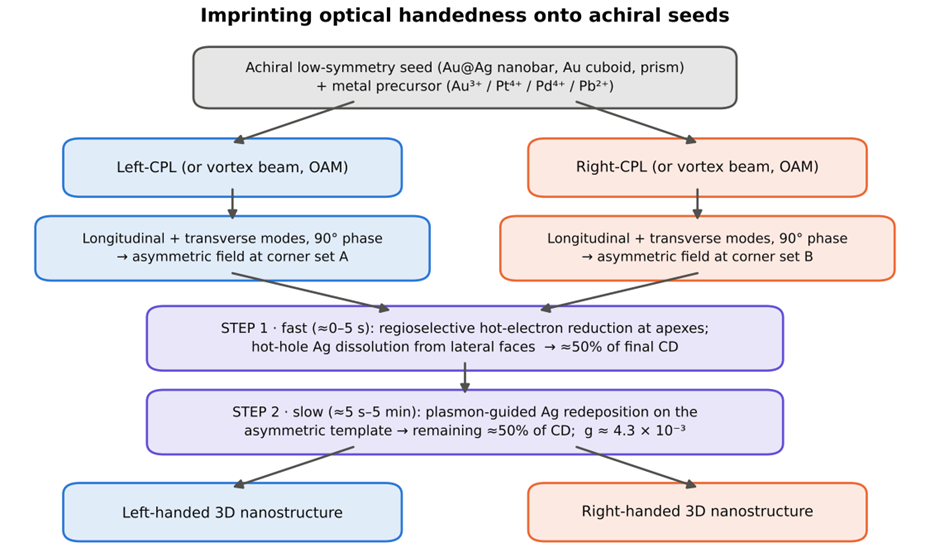
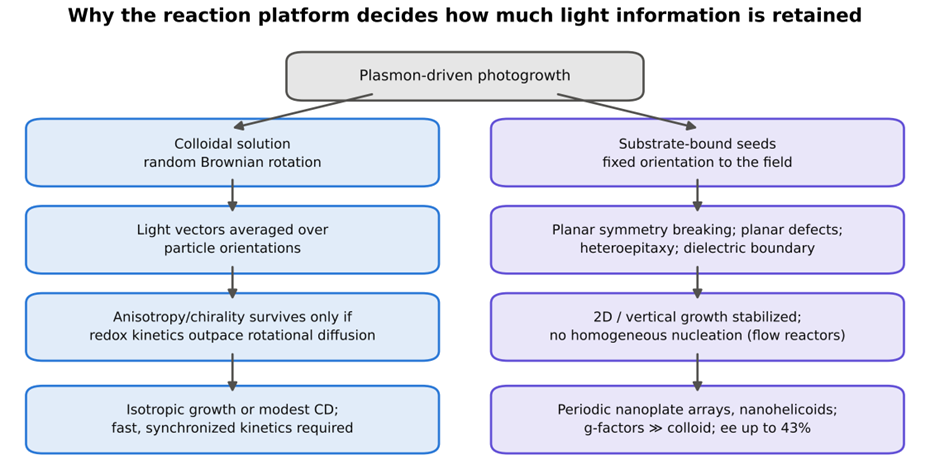
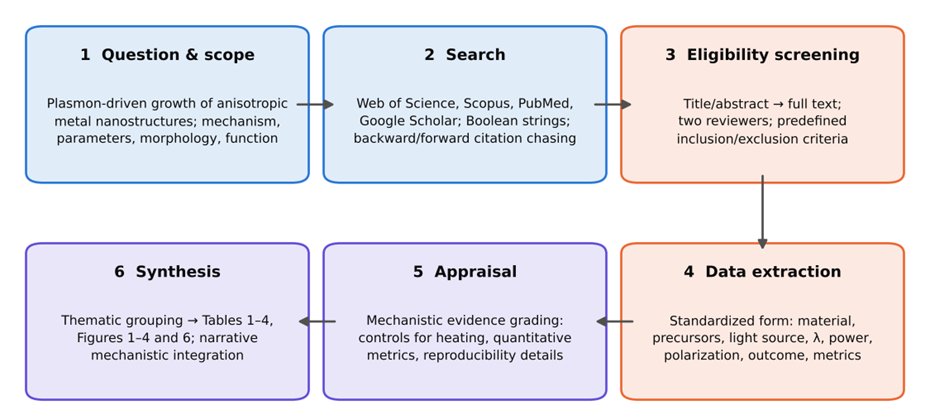 Figure 5. Workflow used to identify, screen, extract, appraise and synthesize the literature included in this review. The six stages proceed from definition of the review questions (1) through database searching and citation chasing (2), eligibility screening against predefined criteria (3), standardized data extraction of optical, chemical and outcome variables (4), appraisal of mechanistic evidence and reporting completeness (5), and thematic synthesis into Tables 1–4 and Figures 1–4 and 6 (6). Blue, orange and violet boxes denote identification, selection/extraction and analysis phases, respectively. The final evidence base comprised 31 sources published between 2001 and 2026.