1. Introduction
Security remains one of the primary barriers to broader cloud adoption, sitting alongside the more mundane, if equally consequential, problem of simply managing a data center well (Al-Shqeerat et al., 2017; Ahmad, 2017). These concerns are not, on closer inspection, all that separable. Virtualization sits underneath almost every cloud service running in production today, which means that whatever weaknesses exist at the virtualization layer tend to surface, sooner or later, as cloud-wide vulnerabilities rather than isolated incidents.
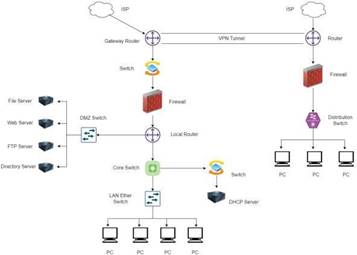
It helps, perhaps, to start with what a data center actually is, if only because the term gets thrown around loosely enough to lose its meaning. At its core, a data center is a concentration of specialized equipment, power conversion and backup systems, environmental controls, and the IT hardware itself, organized to process, store, and transmit digital information reliably (Shehabi et al., 2016). Network security, in that context, is not really an add-on; it is close to the whole point. Misconfigured hardware, a poorly planned network topology, unpatched software, or, frankly, an end user clicking the wrong link, can each independently open the door to compromise (Ali et al., 2014; Daya, 2013). Broader surveys of campus and institutional networks reach much the same conclusion from a different angle, cataloguing how architectural oversights compound across interconnected systems (V. Nandgaonkar & Raut, 2014; Kadhum & Hasan, 2017). Multiply any one of these weaknesses across a data center's worth of interconnected systems, and the resulting attack surface becomes genuinely difficult to reason about without a deliberate, end-to-end architectural approach.
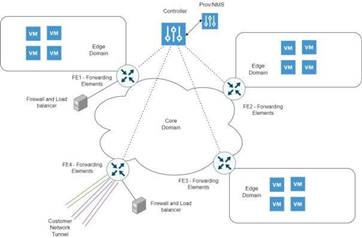
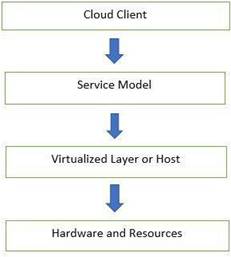
Virtualization is what makes modern cloud computing economically viable in the first place. It lets a provider offer, in effect, on-demand computing capacity that customers can scale up or down as needed, without committing to physical infrastructure of their own (Al-Shqeerat et al., 2017; Sareen, 2013). A virtual machine, in the simplest terms, is an isolated software clone of a physical system, and the hypervisor is the layer that makes this isolation possible, separating guest operating systems from the underlying hardware they ultimately share, processors, memory, network bandwidth (Almutairy et al., 2019). That sharing is efficient, but it is also, almost inevitably, where a great deal of the security literature's attention has concentrated, since a flaw in the hypervisor or in inter-VM isolation can undermine the isolation guarantee the whole model depends on. Several studies have documented this concern from slightly different vantage points, from virtualization-specific threat taxonomies (Luo et al., 2011) to platform-level analyses built around intrusion detection and security visualization tooling (Freet & Agrawal, 2017), and, more domain-specifically, secure visualization of sensitive medical data hosted on virtualized infrastructure (Mohanty et al., 2012).
End users, meanwhile, mostly just want things to work, which is a reasonable thing to want and a surprisingly hard thing to guarantee. The ideal, as Gross and Rosson (2007) put it now nearly two decades ago, is a world where spam gets filtered, phishing sites get flagged before anyone clicks them, and malware never reaches the machine at all. Reality falls short of that ideal often enough that end-user protection has to be treated as a first-class design requirement rather than an afterthought bolted onto a network diagram after the fact. Alongside it sits a second, less glamorous requirement: storage scalability, meaning the ability of a system to keep delivering acceptable capacity, performance, and fault tolerance as demand grows (Nyamtiga et al., 2019; Rao, 2015), and a third, load balancing, which distributes traffic across servers so that no single node becomes a bottleneck or a single point of failure (Rao & Kumar, 2020). None of these three problems is new in isolation. What is comparatively rare, at least in the literature we reviewed, is a design that treats them as facets of one integrated problem rather than three separate ones, each with its own dedicated body of work and, too often, its own dedicated blind spot to the other two.
Microservice architecture and containerization add a further layer worth mentioning here, since they shape how the rest of the design has to be built. Rather than one large application, a system is decomposed into discrete services that communicate over lightweight interfaces, typically HTTP-based APIs (Pachghare, 2016), an approach organizations increasingly favor because it scales more predictably and lets them provision only what they actually use. Docker has become something close to the default vehicle for this: an open platform that packages an application together with its dependencies into a portable container, isolated at the kernel level, fast to spin up, and convenient for moving code from a developer's laptop into production (Rad et al., 2017). None of this comes free of cost, the added abstraction layer can affect performance, and prior architectural work on secure networking (Islam et al., 2018) and scalable, customer-isolated network virtualization (Hao et al., 2010) suggests that containerized workloads need the same layered scrutiny as any other network-facing service, not a lighter one just because they are new.
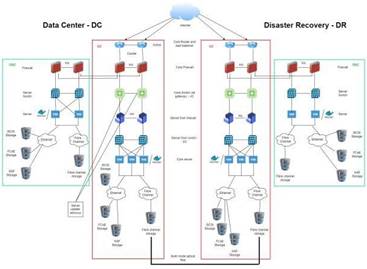
Why does any of this matter beyond academic interest? Because when data center management goes wrong, it tends to go wrong publicly, and expensively. When Facebook and its associated applications went dark for several hours in 2021, the outage was traced to server-side infrastructure problems, and the incident became a fairly vivid public demonstration of just how much day-to-day life now depends on data centers functioning correctly (Satariano & Zhong, 2021). Add to that the steady drumbeat of data center breaches described across the broader security literature (Wen & Xiang, 2011; Ahmad, 2017) and the everyday difficulty of managing finite compute and storage resources efficiently, and the case for a genuinely integrated design, one that treats security, availability, and resource management together rather than as separate checklists, becomes hard to dismiss. That, in the end, is the gap this paper tries to address: a secured data center design, built around a zero-trust security model, that folds in user-end protection, load balancing, microservice containerization, and scalable storage management into a single coherent architecture, rather than leaving practitioners to stitch together solutions drawn from separate, only loosely related bodies of work.