1. Introduction
Healthcare, whether we like it or not, keeps getting more complicated to manage. Hospitals now juggle unpredictable patient volumes, tightening budgets, and workforce shortages that seem to deepen year after year — and somewhere near the center of all this sits an unglamorous but consequential function: staff scheduling. It is easy to underestimate how much scheduling shapes everything else. Get it wrong, and burnout tends to follow, along with slower response times and, frankly, worse patient outcomes (Zhai et al., 2022). Get it right, and the whole operation seems to breathe a little easier.
Workforce efficiency has, for good reason, become something of a proxy metric for hospital performance more broadly (Ala & Chen, 2022). When clinicians are working at or near capacity — not overextended, not idle — care tends to move faster, and patients tend to fare better (Klumpp et al., 2021). That much is fairly intuitive. What is less settled in the literature is how organizations actually get there. Rising patient loads collide with limited staff availability and organizational complexity that resists easy fixes (Ala et al., 2021), and nowhere is that tension more visible than in the everyday work of building shift schedules (Oueida et al., 2018).
Traditional scheduling approaches — the manual spreadsheets, the ad hoc adjustments, the systems held together more by institutional memory than by software — were never really built for this level of complexity. They tend to produce uneven workloads, they struggle to absorb last-minute changes, and they often leave units short-staffed precisely when demand spikes (Oueida, Aloqaily, et al., 2018). The downstream effects are not subtle: stress accumulates, burnout sets in, and the broader work climate suffers as a result (Tursunbayeva, 2019). Administrators, meanwhile, end up spending a disproportionate share of their time resolving scheduling conflicts rather than attending to higher-order priorities — a quiet but persistent drain on organizational performance (Foresti et al., 2020).
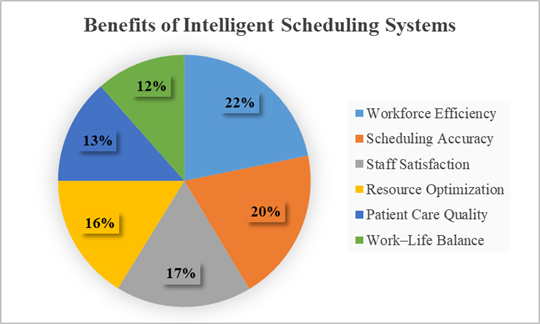
Into this gap, intelligent scheduling systems have emerged — not as a silver bullet, exactly, but as a genuinely different way of approaching an old problem. These systems draw on algorithmic and data-driven methods to coordinate shift assignments and allocate resources in ways manual processes simply cannot replicate (Subrahmanya et al., 2021). Rather than applying a fixed template, they attempt to weigh staff availability, individual skill sets, and real-time departmental demand simultaneously (Devaraj et al., 2013), adjusting as conditions change rather than waiting for the next scheduling cycle to catch up (Kaluarachchi, 2020). Within the U.S. context specifically — where patient volumes and operating costs continue to climb while expectations for care quality hold steady or rise — this kind of adaptive capacity has started to look less like a luxury and more like a practical necessity (Albahri et al., 2018).
There is also a human dimension here that is easy to lose sight of amid the technical framing. Unpredictable hours do not just affect productivity metrics; they spill into people’s personal lives, their sleep, their relationships, their sense of control over their own time (Tursunbayeva, 2019). Systems that distribute workload more evenly and operate with greater transparency appear to address this directly, and available evidence suggests they can meaningfully improve how satisfied staff feel in their roles while still preserving continuity of patient care (Dogru & Keskin, 2020).
And yet, despite this promise, something of a gap persists. Much of what is known about intelligent scheduling systems remains conceptual or descriptive in nature — useful, but not quite empirical (Fragapane et al., 2020). Comparatively few studies have attempted to determine, using actual respondent data, how the individual components of these systems — their accuracy, how satisfied users feel with them, how easy they are to use, how reliably they perform — come together to shape workforce efficiency as a single, integrated outcome. That is, broadly, the space this study tries to occupy.
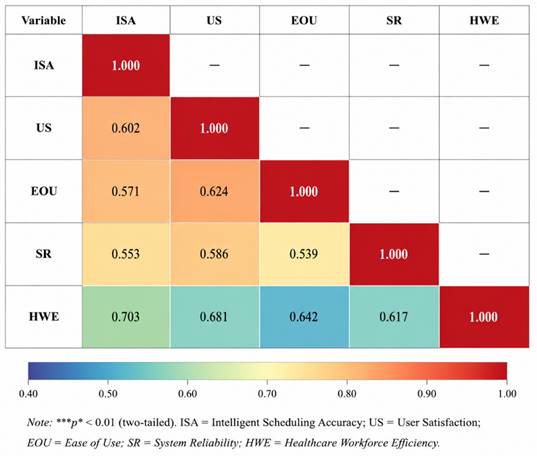
Accordingly, this paper investigates how four interrelated dimensions of intelligent scheduling systems — Intelligent Scheduling Accuracy, User Satisfaction, Ease of Use, and System Reliability — relate to Healthcare Workforce Efficiency among a sample of U.S. healthcare professionals, using a quantitative, survey-based design. The intent is not to advance a definitive causal claim, which a cross-sectional design cannot support, but to offer grounded empirical evidence that can inform how healthcare organizations evaluate, and invest in, the scheduling technologies they adopt.