1. Introduction
There is, perhaps, no loss more disorienting than the death of a child — and few forms of that loss are as physiologically unrelenting as the death of an infant in the earliest days of life. Parents describe the loss as reshaping the very architecture of who they believed themselves to be, a wound that does not fully close so much as it is carried, differently, for decades (Hurt et al., 2023). Within the neonatal period — conventionally defined as the first 28 days after birth — the compression of birth and death into the same narrow window leaves many parents in a kind of suspended shock, unable, at least at first, to locate themselves within either role: mother of a living child, or mother who has lost one (Kartaginer et al., 2026).
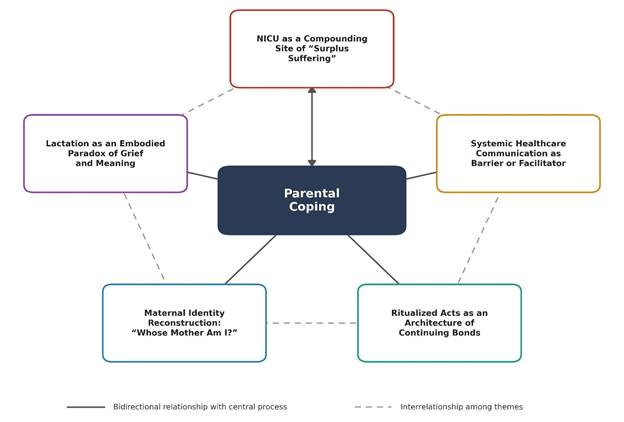
For mothers specifically, this rupture arrives with an added, almost cruel, biological insistence. The infant may be gone, but the body does not seem to know this. Lactation begins, or continues, on its own physiological schedule, indifferent to the fact that there is no longer an infant to receive it (Oreg et al., 2026). It is worth pausing on how strange this is, clinically and existentially: a body preparing, daily, to nourish a child who will never again be held to it. Some scholars have described this as a "representational vacuum" — a mismatch between the body's continuing readiness and the psyche's slower attempt to catch up with an irreversible fact (Kartaginer et al., 2026). Others frame it more plainly as an embodied paradox: milk as evidence of a motherhood that is, in the same breath, denied its ordinary expression (Aderibigbe, 2026).
Historically — and this is perhaps where clinical practice has been least generous — the response to lactation after infant death has been narrowly pharmacological. Suppress the milk, the reasoning goes, and at least one axis of daily reminder and distress is removed (Oreg et al., 2026). This is not an unreasonable instinct. But it is also, arguably, an incomplete one. A growing body of qualitative work suggests that for at least some parents, abrupt suppression forecloses something that might otherwise have been useful: a chance, however painful, to go on mothering in the only remaining form still available to them (Værland et al., 2021). The theoretical language most often invoked here is continuing bonds, a framework advanced by Klass, Silverman, and Nickman (1996) that reframes healthy grief not as a gradual detachment from the deceased but as an ongoing, symbolically sustained relationship with them. Expressing milk, donating it, or simply continuing to pump without any clear practical purpose can, within this frame, function as a bond-sustaining act rather than a stalled or pathological refusal to "move on" (Værland et al., 2021).
At the same time, this embodied experience does not occur in a vacuum, clinical or otherwise. Much of the literature on neonatal and perinatal loss converges on a related, if distinct, observation: that hospital environments — the Neonatal Intensive Care Unit (NICU) in particular — often compound rather than soften parental distress. Parents describe being treated as visitors in their own child's care, sidelined by a culture of high acuity that necessarily prioritizes clinical survival over relational bonding (Porter, 2018; Adcock et al., 2021). Researchers have termed this surplus suffering: pain that is not intrinsic to the loss itself but added on top of it by systems that were never quite designed with bereaved parents' psychological needs in mind (Porter, 2018). For families already navigating structural marginalization alongside grief — Black mothers facing disproportionately high rates of infant mortality (Saufley, 2024), or Māori whānau moving through a healthcare system inattentive to cultural safety (Adcock et al., 2021) — this compounding of harms appears, unsurprisingly, still more pronounced.
It is against this backdrop that identity, rather than symptom or stage, becomes perhaps the more useful lens through which to read the literature. Bereaved mothers repeatedly describe a kind of liminality: neither the mother of a living child, nor, in their own eyes, fully a non-mother (Kartaginer et al., 2026). The question that recurs — "Whose mother am I?" — captures something that conventional, stage-based grief models do not quite hold. Identity reconstruction, across this body of work, looks less like recovery and more like renegotiation: a slow, non-linear movement from what has been described as a split identity, in which grief is held apart from daily functioning, toward something closer to integration (Kartaginer et al., 2026; De Vincenzo et al., 2024).
Despite the richness of this qualitative record — spanning phenomenological, hermeneutic, and reflexive thematic traditions across settings as varied as Ghana, Norway, New Zealand, and Israel — a gap remains that, to our reading, has not yet been adequately closed. The literatures on lactation as embodied experience, on NICU-related trauma, and on identity reconstruction after infant death have tended to develop somewhat separately, each rich in its own terms but rarely brought into sustained conversation with one another. Reviews of perinatal bereavement care already exist (Hurt et al., 2023; Redshaw et al., 2021), as do studies of ritualized memory-making (Værland et al., 2021) and of lactation-specific grief more narrowly defined (Aderibigbe, 2026; Dion, 2025). What appears to be missing is a synthesis that treats the physiological fact of milk not as an incidental detail of postpartum care but as a central, symbolically loaded site where biology, identity, and clinical practice meet — sometimes uneasily.
This review attempts that synthesis. Rather than beginning from diagnostic categories or suppression protocols, we start, deliberately, from the body — from the small, recurring "micro-moments" of embodied experience that surface, in one form or another, across a dozen qualitative studies — and ask what these moments can tell us about how parents come to make sense of, and rebuild identity around, a loss that their own bodies seem, for a time, unwilling to accept.
To make this synthesis tractable, we organized our inquiry around three linked questions: how bereaved mothers perceive and assign meaning to the physiological experience of lactation following infant death; how embodied care practices — milk expression, donation, or ritualized retention — participate in reconstructing maternal identity within this liminal space; and how healthcare communication and institutional protocol shape the difference between suppression as reflexive clinical routine and suppression as one option among several, offered through informed choice. These questions are, admittedly, more exploratory than confirmatory; this is not a review built to test a hypothesis so much as one built to notice a pattern that has, so far, gone under-examined. If nothing else, we hope it makes a modest case: that milk, in this particular context, is never merely biological.