Journal of Ai ML DL

Journal of Ai ML DL | Online ISSN 3070-2143
0
Citations
24.5k
Views
16
Articles
Your new experience awaits. Try the new design now and help us make it even better
Switch to the new experience
Figures and Tables
RESEARCH ARTICLE   (Open Access)

Perceptions of AI-Enabled Public Health Among Healthcare Professionals: A Cross-Sectional Survey on Telemedicine Access, Disease Surveillance, and Operational Efficiency

Md Shihab Rahman1*, Safiul Islam1, Md Jahidul Islam Ridoy2

+ Author Affiliations

Journal of Ai ML DL 2 (1) 1-11 https://doi.org/10.25163/ai.2110797

Submitted: 04 January 2026 Revised: 16 March 2026  Published: 24 March 2026 


Abstract

Background: Artificial intelligence (AI) is reshaping how healthcare systems function — from how patients access services to how diseases are tracked and how hospitals manage their day-to-day operations. Yet despite growing enthusiasm, empirical evidence on how frontline professionals actually perceive these changes remains limited, particularly in settings where digital health infrastructure is still maturing.Methods: This cross-sectional survey enrolled 185 participants drawn purposively from healthcare, research, hospital administration, and technology sectors. A structured, pilot-tested questionnaire captured perceptions across four domains: healthcare accessibility, disease prediction efficiency, operational efficiency, and future AI priorities. Descriptive statistics summarized response distributions, and Pearson correlation analysis examined inter-domain relationships.Results: Telemedicine-based rural access garnered the strongest agreement (81.4%), followed by general healthcare accessibility improvement (78.2%). Epidemiological monitoring (73.0%) and outbreak prediction (71.9%) were the most endorsed disease surveillance functions. Operationally, reducing administrative burden was cited most frequently (17.3%). Correlation analysis revealed strong positive associations between healthcare accessibility and operational efficiency (r = 0.724), and between disease prediction efficiency and operational efficiency (r = 0.695). Data privacy (76.2%), ethical governance (76.8%), and the need for digital infrastructure investment (78.4%) emerged as the leading concerns and future priorities.Conclusion: Healthcare professionals broadly view AI as a meaningful tool for extending service reach, improving surveillance capacity, and streamlining clinical workflows. However, concerns around data governance, infrastructure gaps, and training deficits suggest that optimism alone will not drive adoption — structured investment and policy attention are equally essential.Keywords: Artificial intelligence, public health, healthcare accessibility, disease prediction, operational efficiency

1. Introduction

The relationship between technology and healthcare has never been straightforward. Innovation tends to arrive with considerable promise, and AI is no different — except perhaps in the scale of what it is being asked to accomplish. Over the past decade, AI-driven tools have moved from experimental settings into clinical and public health practice in ways that would have seemed ambitious only a few years ago. Machine learning models now assist with diagnostic imaging, natural language processing supports clinical documentation, and predictive algorithms help epidemiologists anticipate disease spread before outbreaks fully materialize (Olawade et al., 2024). Whether these developments translate into equitable, measurable improvements in population health is a question the field is still working through.

Part of what makes this moment consequential is context. Healthcare systems globally are under strain — patient volumes are rising, chronic disease burden is accelerating, and the workforce required to meet demand is not keeping pace (Rehman et al., 2021). In resource-constrained settings, including many parts of South and Southeast Asia, these pressures are more acute. Rural populations frequently lack reliable access to specialist care, diagnostic infrastructure is inconsistent, and administrative inefficiencies compound the problem (Varnosfaderani & Forouzanfar, 2024). Against this backdrop, AI-based tools — telemedicine platforms, remote monitoring devices, intelligent triage systems — are being positioned not as luxury additions but as potential equalizers (Alowais et al., 2023).

The evidence behind this optimism is, at least in certain areas, reasonably compelling. Studies in radiology and pathology have reported diagnostic accuracy improvements in the range of 20–30% when AI-assisted tools are used alongside clinicians, primarily because these systems can process imaging data at a scale and speed that human review cannot match (Da Silva, 2024). Machine learning algorithms applied to population-level datasets have demonstrated the capacity to identify patterns preceding disease outbreaks, giving public health authorities a degree of early warning that traditional surveillance methods struggle to provide (Prosperi et al., 2018). During recent health emergencies, AI-based epidemiological platforms supported faster, more granular decision-making than many conventional systems could offer (Syrowatka et al., 2021).

Beyond clinical decision support, AI is generating interest for its potential to reduce the operational friction that consumes a disproportionate share of healthcare resources. Administrative tasks — scheduling, documentation, billing — account for a significant portion of clinician time in many health systems (Johnson et al., 2020). Automating or augmenting these processes could, in principle, redirect professional capacity toward direct patient care. AI-driven resource allocation tools have also shown promise in improving bed management, staffing, and equipment utilization, particularly in hospital settings operating near or above capacity (Khalifa et al., 2024; Bekbolatova et al., 2024).

That said, it would be misleading to present this picture without its complications. The same systems that offer efficiency gains also introduce risks that are not trivial. Algorithmic bias — the tendency of models trained on non-representative data to perform unequally across demographic groups — remains a persistent concern in health AI (Mhasawade et al., 2021). Data privacy is another unresolved tension: the value of AI depends on access to large, detailed health datasets, yet the collection and use of such data raise legitimate questions about consent, security, and governance (Williamson & Prybutok, 2024). Implementation costs are prohibitive for many health systems, and the human infrastructure needed to support these technologies — trained staff, interoperable systems, regulatory frameworks — is often absent precisely where the need is greatest (Mandal & Ghosh, 2023).

Much of the existing research on AI in healthcare focuses on technical performance — sensitivity, specificity, model accuracy. Fewer studies examine how the professionals who would actually use these tools perceive their potential, or what barriers they anticipate in practice. This matters, because adoption ultimately depends on institutional willingness and workforce readiness, not just technical capability (Morgenstern et al., 2021). Understanding how healthcare practitioners, administrators, researchers, and technology specialists view AI's role in public health — what they find credible, what they remain skeptical about, and what they see as the most pressing obstacles — offers a ground-level view that technical benchmarks alone cannot provide.

This study was designed to gather precisely that kind of evidence. Through a structured cross-sectional survey of 185 professionals working across health and technology sectors, we examined perceptions of AI across four domains: healthcare accessibility, disease prediction, operational efficiency, and future implementation priorities. The goal was not to adjudicate AI's potential in the abstract, but to understand how those closest to its deployment are thinking about it — and where the real work of integration still lies ahead.
2. Materials and Methods

2.1 Study Design

This study used a quantitative cross-sectional survey design to assess professional perceptions of AI in public health service delivery. The cross-sectional approach was selected because it allows simultaneous measurement of multiple variables within a defined population at a single point in time — a design well-suited to perception and attitude research where longitudinal tracking is neither feasible nor necessary (Giuffrè & Shung, 2023). A structured questionnaire served as the primary data collection instrument, chosen for its capacity to generate standardized, comparable responses across a professionally heterogeneous sample (Berger et al., 2014). The study was conducted in accordance with the ethical principles of the Declaration of Helsinki. All participants provided informed consent prior to enrollment, and no personally identifiable information was retained in the dataset.

2.2 Study Population and Eligibility Criteria

The target population comprised professionals actively engaged in healthcare delivery, health research, hospital administration, or health technology development. Participants were eligible if they: (a) were currently employed in one of these four professional categories, (b) had at least one year of relevant professional experience, and (c) provided voluntary informed consent. Individuals with no direct involvement in healthcare or health technology operations were excluded.

A total of 185 participants were enrolled using purposive sampling — a non-probability approach appropriate when the research objective requires participants with specific knowledge or experience relevant to the study constructs (Shuaib, 2024). Purposive sampling was preferred over random sampling here because the questions being asked about AI implementation require experiential familiarity; a general population sample would not yield informative responses. The research team worked to achieve proportional representation across all four professional categories to reduce the risk of perspective bias in aggregate findings (Marques et al., 2024).

2.3 Sample Size Justification

A sample of 185 was determined to be sufficient for the planned correlation analyses. For Pearson correlation with a two-tailed alpha of 0.05 and power of 0.80, detecting a moderate effect size (r = 0.20) requires approximately 153 participants; this sample exceeds that threshold (Hirani et al., 2024). No formal a priori power calculation software output is reported, but the adequacy of the sample relative to the planned analyses was considered during the design phase.

2.4 Survey Instrument

The questionnaire was developed specifically for this study and organized into two sections. The first section collected demographic and professional information, including age group, gender, and professional category. The second section assessed perceptions across four thematic constructs: (1) AI-based healthcare accessibility, (2) disease prediction and epidemiological surveillance, (3) operational efficiency of AI-enabled systems, and (4) challenges and future priorities for AI implementation in public health.

Items within the perception constructs used a five-point Likert scale (1 = strongly disagree to 5 = strongly agree) for attitudinal items, and multiple-select format for items assessing operational benefits and implementation challenges — allowing participants to identify all applicable responses from a predefined list. Response percentages for multiple-select items were therefore calculated as a proportion of total selections rather than total respondents, and this distinction is explicitly noted in the relevant results tables.

Before full deployment, the instrument underwent a pilot test with 20 professionals drawn from the same eligible population but excluded from the main analysis. Pilot testing assessed item clarity, estimated completion time, and initial internal consistency. Items rated as ambiguous by more than 25% of pilot participants were revised. The final instrument demonstrated acceptable internal consistency across constructs, with Cronbach's alpha values ranging from 0.74 to 0.81, consistent with thresholds recommended for social science survey instruments (Allen et al., 2019).

2.5 Data Collection Procedure

Data were collected over an eight-week period through two parallel channels. Online surveys were distributed via professional networks and institutional contacts in healthcare and technology sectors; paper-based questionnaires were administered at selected healthcare facilities where digital access was limited. Both formats used identical item wording and response options to ensure equivalence. Participation was entirely voluntary, anonymous, and confidential. No compensation was offered. Completed responses were reviewed for missing data; questionnaires with more than 20% item non-response were excluded from analysis. Eighteen incomplete responses were excluded, yielding a final analytic sample of 185.

2.6 Statistical Analysis

All data were analyzed using SPSS Version 26.0 (IBM Corp., Armonk, NY). Descriptive statistics — frequencies, percentages, and means — were used to characterize the demographic profile of respondents and summarize item-level response distributions. For multiple-select items (operational benefits, challenges), frequencies and percentages were reported relative to total selections.

Internal consistency of each construct was assessed using Cronbach's alpha. Pearson product-moment correlation coefficients were computed to examine bivariate associations among the four primary study variables: healthcare accessibility, disease prediction efficiency, operational efficiency, and future AI priorities. The Pearson coefficient r is defined as:

r = Σ[(xᵢ − x̄)(yᵢ − ȳ)] / √[Σ(xᵢ − x̄)² · Σ(yᵢ − ȳ)²]

where xᵢ and yᵢ are individual construct scores, and and ȳ are their respective means. Construct scores were computed as the mean of all valid Likert-scale items within each domain. Statistical significance was set at p < 0.05 (two-tailed), and all reported correlation coefficients are accompanied by their associated p-values. No corrections for multiple comparisons were applied given the exploratory nature of the analysis, though this limitation is acknowledged (Badidi, 2023; Stasevych & Zvarych, 2023).

3. Results

3.1 Demographic and Professional Characteristics of Respondents

The final sample comprised 185 participants spanning four professional categories (Table 1). The majority of respondents — 36.2% — fell within the 30–39 age bracket, followed by those aged 20–29 (25.9%), 40–49 (24.3%), and 50 years or older (13.5%). The professional distribution reflected a deliberate effort at balance: healthcare professionals formed the largest subgroup (37.3%, n = 69), followed by technology experts (25.4%, n = 47), researchers (20.5%, n = 38), and hospital administrators (16.8%, n = 31). Across all groups, 58.4% of participants identified as male and 41.6% as female.

3.2 Perceptions of AI-Based Healthcare Accessibility

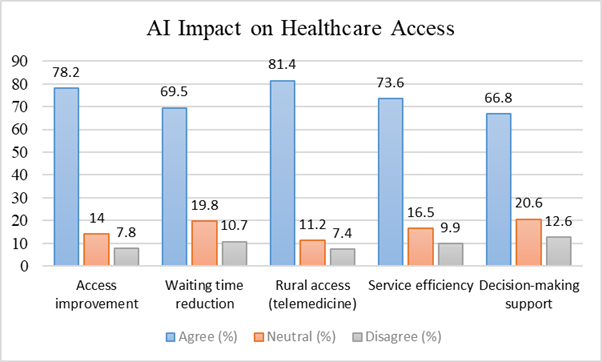
Perceptions of AI's contribution to healthcare access were generally favorable across all items, though the degree of agreement varied in ways that are worth examining (Figure 1). Telemedicine as a vehicle for reaching rural populations attracted the strongest consensus: 81.4% of participants agreed or strongly agreed that AI-enabled telemedicine meaningfully extends healthcare access in underserved geographic areas. General healthcare accessibility improvement followed closely at 78.2%, suggesting that most respondents view AI not as a narrow tool but as something with broad service delivery implications.

More nuanced was the response to AI-assisted clinical decision-making. Only 66.8% agreed that AI can reliably support complex clinical decisions — the lowest agreement rate in this domain. This is perhaps unsurprising; clinicians and administrators tend to be more cautious about delegating judgment to automated systems, particularly when the decisions carry significant patient safety implications (Varnosfaderani & Forouzanfar, 2024). Reducing patient wait times (69.5%) and improving service delivery efficiency (73.6%) received intermediate levels of support, indicating that while operational benefits are recognized, they are not taken as given.

3.3 AI and Disease Prediction Efficiency

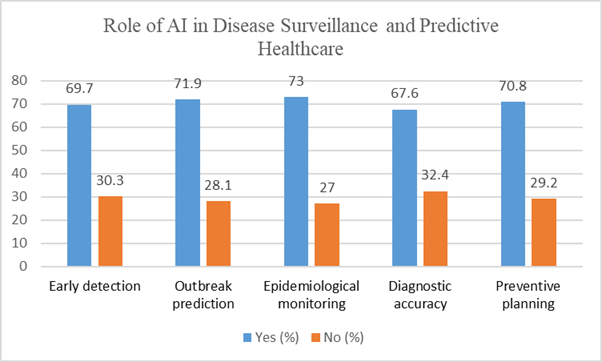
Disease surveillance functions attracted consistent, if measured, endorsement across all five items examined (Figure 2). Epidemiological monitoring registered the highest agreement level in this domain at 73.0%, reflecting a widely shared view that AI systems are particularly well-suited to population-scale tracking tasks — analyzing streams of clinical, environmental, and behavioral data in ways that manual surveillance cannot match. Outbreak prediction was close behind at 71.9%, and preventive healthcare planning at 70.8%.

Early disease detection drew agreement from 69.7% of respondents — a finding that aligns with the broader literature on AI's utility in screening and triage contexts

Table 1. Demographic and Professional Profile of Respondents. Distribution of 185 survey participants by age group, gender, and professional category. Percentages are calculated from the total analytic sample (n = 185).

Variables

Categories

Frequency

Percentage (%)

Age

20–29 years

48

25.9

30–39 years

67

36.2

40–49 years

45

24.3

≥50 years

25

13.5

Gender

Male

108

58.4

Female

77

41.6

Profession

Healthcare Professionals

69

37.3

Researchers

38

20.5

Hospital Administrators

31

16.8

Technology Experts

47

25.4

Figure 1. Perceptions of AI-Based Healthcare Accessibility. Bar chart showing the percentage of respondents who agreed or strongly agreed with each accessibility-related statement. Items are ranked by agreement level (highest to lowest).

Figure 2. Role of AI in Disease Surveillance and Predictive Healthcare. Bar chart depicting the distribution of agreement across five disease prediction and epidemiological surveillance items. Data represent the proportion of respondents selecting "agree" or "strongly agree."

Table 2. Operational Advantages of AI-Based Healthcare Systems as Perceived by Respondents. Frequencies and percentage distributions of responses to a multiple-select item assessing perceived operational benefits of AI in healthcare. Percentages are calculated from total selections (n = 763) rather than total respondents (n = 185), as participants could select all applicable responses.

Benefits

Frequency

Percentage (%)

Reduced administrative burden

132

17.3

Faster patient management

127

16.6

Better diagnostic support

124

16.2

Enhanced patient monitoring

121

15.8

Improved resource allocation

118

15.4

Reduced clinical errors

116

15.2

(Prosperi et al., 2018). The lowest item in this category, however, was diagnostic accuracy support at 67.6%. The gap between population-level surveillance (where AI performs consistently) and individual-level diagnosis (where variability and edge cases are harder to manage algorithmically) may explain the slightly lower confidence here. This distinction matters: respondents appear to trust AI more for monitoring large patterns than for making case-level clinical determinations.

3.4 Operational Advantages of AI-Based Healthcare Systems

Operational benefits were assessed using a multiple-select item format, with 763 total selections recorded across 185 respondents (Table 2). The most frequently endorsed advantage was reduction of administrative burden (17.3% of all selections, n = 132), which is consistent with evidence that documentation and scheduling tasks consume a disproportionate share of clinical time (Johnson et al., 2020). Faster patient management (16.6%) and better diagnostic support (16.2%) followed, suggesting that respondents see AI's operational contributions as extending meaningfully into clinical workflow — not just back-office functions.

Enhanced patient monitoring (15.8%), improved resource allocation (15.4%), and reduced clinical errors (15.2%) completed the profile. The relative evenness of this distribution is itself informative: rather than concentrating value in one operational area, respondents saw AI as contributing broadly across the healthcare system. That said, the margins between items were narrow, and no single benefit was seen as dramatically more transformative than the others.

3.5 Correlation Analysis Between Study Variables

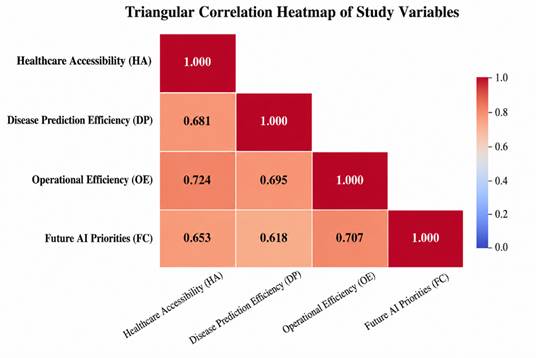
Bivariate Pearson correlations among the four primary constructs revealed consistently positive and statistically significant associations across all pairs (Figure 3). The strongest relationship observed was between healthcare accessibility and operational efficiency (r = 0.724, p < 0.001), suggesting that perceptions of smoother system operations tend to co-occur with perceptions of broader patient reach — plausibly because efficient systems are better positioned to extend services without proportional increases in cost or effort (Bekbolatova et al., 2024).

Disease prediction efficiency and operational efficiency were also strongly correlated (r = 0.695, p < 0.001), pointing to a perception that predictive capacity and organizational performance are mutually reinforcing. Future AI priorities correlated meaningfully with both operational efficiency (r = 0.707, p < 0.001) and healthcare accessibility (r = 0.653, p < 0.001), indicating that respondents who prioritize future AI investment also tend to rate current AI performance more positively — a coherent pattern, though one that could partly reflect optimism bias. The correlation between disease prediction efficiency and healthcare accessibility was moderate and significant (r = 0.681, p < 0.001).

3.6 Challenges and Future Priorities for AI Implementation

Despite the broadly favorable perceptions documented above, respondents identified a range of meaningful barriers to AI deployment in public health practice (Table 3). Ethical governance emerged as the most frequently prioritized concern, with 76.8% of participants selecting it — a finding that suggests healthcare professionals are not simply optimistic about AI's potential but are also attentive to how it needs to be governed. Data privacy followed at 76.2%, consistent with broader patterns in the health AI literature (Williamson & Prybutok, 2024).

Digital infrastructure investment attracted the highest endorsement as a future priority at 78.4%, underscoring a practical reality: the tools are of limited value in settings where the underlying connectivity, computing capacity, and interoperability standards are absent. Telemedicine expansion was prioritized by 72.4% of respondents. On the barrier side, limited infrastructure was identified by 58.4% as a current obstacle, followed by insufficient AI training (54.6%) and high implementation costs (51.9%). Taken together, these figures sketch a workforce that sees the potential clearly but remains sober about what sustained implementation actually requires.

4. Discussion

4.1 Overview

The findings from this survey offer a snapshot — imperfect but informative — of how professionals embedded in healthcare systems perceive AI's current and prospective role in public health. Across accessibility, surveillance, and operations, the overall tone was affirmative. But affirmative is not the same as uncritical, and several of the more granular findings reveal the kinds of nuance that aggregate enthusiasm tends to obscure.

Figure 3. Pearson Correlation Matrix Among Primary Study Variables. Heatmap or matrix figure illustrating bivariate Pearson correlation coefficients (r) among the four main constructs: healthcare accessibility, disease prediction efficiency, operational efficiency, and future AI priorities. All reported correlations are statistically significant at p < 0.001.

Table 3. Perceived Challenges and Future Priorities for AI Implementation in Public Health. Frequencies and percentages of responses to a multiple-select item assessing barriers to AI adoption and future investment priorities. Percentages are calculated relative to total respondents (n = 185).

Variables

Frequency

Percentage (%)

Data privacy

141

76.2

Limited infrastructure

108

58.4

AI training gap

101

54.6

High implementation cost

96

51.9

Ethical governance need

142

76.8

Digital investment

145

78.4

Telemedicine expansion

134

72.4

4.2 Healthcare Accessibility and Telemedicine

The high endorsement of telemedicine-based rural access (81.4%) may be the study's most practically significant finding. Healthcare access in geographically dispersed or infrastructurally disadvantaged settings has been one of the persistent unsolved problems of health systems globally, and AI-enabled telemedicine is increasingly positioned as a structural solution rather than a supplement (Varnosfaderani & Forouzanfar, 2024). The fact that this item attracted the strongest consensus in the entire survey — across professional categories that otherwise differ considerably — suggests a degree of cross-sector agreement that is not always present in health technology discussions.

That said, the more modest support for AI-assisted clinical decision-making (66.8%) introduces an important counterweight. Respondents appear willing to trust AI with logistics and access — getting the patient to the system — but remain somewhat more hesitant about AI's role in what happens once the patient is there. This tension between AI as infrastructure and AI as decision-maker is well-documented in the literature (Prosperi et al., 2018), and it has practical implications for how AI tools should be framed, communicated, and deployed in clinical contexts.

4.3 Disease Surveillance and Prediction

Epidemiological monitoring (73.0%) and outbreak prediction (71.9%) attracted strong support, which is consistent with a body of evidence showing that population-scale data analysis is among AI's more reliable applications in public health (Syrowatka et al., 2021). The gap between surveillance confidence and diagnostic confidence (67.6%) observed in this study echoes findings elsewhere: AI systems trained on large, representative datasets perform more consistently at the population level than at the level of individual case assessment, where heterogeneity, comorbidity, and contextual judgment are harder to encode (Olawade et al., 2024).

What this suggests for practice is not that AI should be excluded from diagnostic support, but that it should probably be positioned as augmenting clinical judgment rather than replacing it — a framing that may also help close the confidence gap among skeptical practitioners (Jungwirth & Haluza, 2023).

4.4 Operational Efficiency

The relatively even distribution of endorsements across operational benefit items — with margins of roughly 1–2 percentage points separating the top and bottom responses — suggests that respondents do not see AI's operational contribution as concentrated in any single area. This is broadly consistent with evidence that AI's efficiency gains in healthcare tend to be systemic rather than localized: improvements in administrative processing, for example, free up time that translates into faster patient throughput, which in turn reduces wait times (Johnson et al., 2020). The interconnectedness of these effects may also explain the strong correlation between operational efficiency and accessibility observed in the correlation analysis.

4.5 Governance, Infrastructure, and Barriers

The prominence of data privacy (76.2%) and ethical governance (76.8%) among respondents' concerns deserves careful interpretation. It would be tempting to read high concern ratings as evidence of resistance to AI, but the data do not support that reading — the same respondents who flagged governance concerns also expressed strong support for telemedicine expansion and AI investment. A more plausible interpretation is that healthcare professionals have a calibrated view: they want the benefits, and they understand that realizing those benefits requires getting the governance right first (Mhasawade et al., 2021; Williamson & Prybutok, 2024).

The emphasis on digital infrastructure (78.4%) as a future priority is perhaps the most grounding finding in the dataset. AI systems, regardless of their sophistication, are only as functional as the infrastructure they run on. In settings where broadband connectivity is unreliable, electronic health records are fragmented, or interoperability standards are absent, even well-designed AI tools will underperform (Bekbolatova et al., 2024). The workforce recognizes this, and it is a signal that policy discussions about AI in health cannot be confined to the technology itself.

5. Conclusion

This study set out to understand how healthcare professionals perceive AI's role in public health — and the answer, in short, is cautiously optimistic. Strong endorsement of telemedicine, epidemiological monitoring, and administrative efficiency benefits suggests that professionals across sectors see genuine value in what these tools can offer. At the same time, the more tempered response to AI in clinical decision-making, alongside prominent concerns about data privacy, ethical governance, and infrastructure readiness, points to a workforce that is thinking carefully rather than simply following enthusiasm.

What these findings ultimately suggest is that the conversation about AI in public health needs to move beyond capability demonstrations toward implementation science — understanding how to deploy these tools equitably, responsibly, and sustainably in real-world health systems. Technical potential alone will not close access gaps or improve disease surveillance. What will is sustained investment, clear policy frameworks, and a workforce that is trained, supported, and trusted to lead the integration.

Author Contributions

M.S.R.: Conceptualization, methodology, data curation, formal analysis, writing – original draft, writing – review and editing, project administration. S.I.: Data curation, formal analysis, visualization, writing – review and editing. M.J.I.R.: Software, validation, visualization, writing – review and editing. All authors have read and approved the final version of the manuscript.

Competing Financial Interests

The authors declare no competing financial interests. This research received no specific grant from any funding agency in the public, commercial, or not-for-profit sectors. No honoraria, grants, or other forms of payment were received that could have influenced the design, conduct, reporting, or interpretation of this study.

Acknowledgements

The authors wish to thank all healthcare professionals, researchers, hospital administrators, and technology specialists who generously gave their time to participate in this survey. Their willingness to share professional perspectives on a subject that is still evolving in practice made this work possible. The authors also acknowledge the institutional support provided by the College of Graduate and Professional Studies at Trine University, Angola, United States, and the Department of Computer Science at St. Francis College, New York, United States. No external funding was received for this research. Any opinions expressed in this manuscript are those of the authors alone and do not represent the positions of their affiliated institutions.

References


Allen, B., Seltzer, S. E., Langlotz, C. P., Dreyer, K. P., Summers, R. M., Petrick, N., Marinac-Dabic, D., Cruz, M., Alkasab, T. K., Hanisch, R. J., Nilsen, W. J., Burleson, J., Lyman, K., & Kandarpa, K. (2019). A road map for translational research on artificial intelligence in medical imaging: From the 2018 National Institutes of Health/RSNA/ACR/The Academy Workshop. Journal of the American College of Radiology, 16(9), 1179–1189. https://doi.org/10.1016/j.jacr.2019.04.014

Alowais, S. A., Alghamdi, S. S., Alsuhebany, N., Alqahtani, T., Alshaya, A. I., Almohareb, S. N., Aldairem, A., Alrashed, M., Saleh, K. B., Badreldin, H. A., Yami, M. S. A., Harbi, S. A., & Albekairy, A. M. (2023). Revolutionizing healthcare: The role of artificial intelligence in clinical practice. BMC Medical Education, 23(1), 689. https://doi.org/10.1186/s12909-023-04698-z

Badidi, E. (2023). Edge AI for early detection of chronic diseases and the spread of infectious diseases: Opportunities, challenges, and future directions. Future Internet, 15(11), 370. https://doi.org/10.3390/fi15110370

Bekbolatova, M., Mayer, J., Ong, C. W., & Toma, M. (2024). Transformative potential of AI in healthcare: Definitions, applications, and navigating the ethical landscape and public perspectives. Healthcare, 12(2), 125. https://doi.org/10.3390/healthcare12020125

Berger, M. L., Lipset, C., Gutteridge, A., Axelsen, K., Subedi, P., & Madigan, D. (2014). Optimizing the leveraging of real-world data to improve the development and use of medicines. Value in Health, 18(1), 127–130. https://doi.org/10.1016/j.jval.2014.10.009

Da Silva, R. G. L. (2024). The advancement of artificial intelligence in biomedical research and health innovation: Challenges and opportunities in emerging economies. Globalization and Health, 20(1), 44. https://doi.org/10.1186/s12992-024-01049-5

Giuffrè, M., & Shung, D. L. (2023). Harnessing the power of synthetic data in healthcare: Innovation, application, and privacy. npj Digital Medicine, 6(1), 186. https://doi.org/10.1038/s41746-023-00927-3

Hirani, R., Noruzi, K., Khuram, H., Hussaini, A. S., Aifuwa, E. I., Ely, K. E., Lewis, J. M., Gabr, A. E., Smiley, A., Tiwari, R. K., & Etienne, M. (2024). Artificial intelligence and healthcare: A journey through history, present innovations, and future possibilities. Life, 14(5), 557. https://doi.org/10.3390/life14050557

Johnson, K. B., Wei, W., Weeraratne, D., Frisse, M. E., Misulis, K., Rhee, K., Zhao, J., & Snowdon, J. L. (2020). Precision medicine, AI, and the future of personalized health care. Clinical and Translational Science, 14(1), 86–93. https://doi.org/10.1111/cts.12884

Jungwirth, D., & Haluza, D. (2023). Artificial intelligence and public health: An exploratory study. International Journal of Environmental Research and Public Health, 20(5), 4541. https://doi.org/10.3390/ijerph20054541

Kong, J. D., Akpudo, U. E., Effoduh, J. O., & Bragazzi, N. L. (2023). Leveraging responsible, explainable, and local artificial intelligence solutions for clinical public health in the global South. Healthcare, 11(4), 457. https://doi.org/10.3390/healthcare11040457

Lee, D., & Yoon, S. N. (2021). Application of artificial intelligence-based technologies in the healthcare industry: Opportunities and challenges. International Journal of Environmental Research and Public Health, 18(1), 271. https://doi.org/10.3390/ijerph18010271

Mandal, A., & Ghosh, A. R. (2023). Role of artificial intelligence (AI) in fish growth and health status monitoring: A review on sustainable aquaculture. Aquaculture International, 32(3), 2791–2820. https://doi.org/10.1007/s10499-023-01297-z

Marques, L., Costa, B., Pereira, M., Silva, A., Santos, J., Saldanha, L., Silva, I., Magalhães, P., Schmidt, S., & Vale, N. (2024). Advancing precision medicine: A review of innovative in silico approaches for drug development, clinical pharmacology and personalized healthcare. Pharmaceutics, 16(3), 332. https://doi.org/10.3390/pharmaceutics16030332

Mhasawade, V., Zhao, Y., & Chunara, R. (2021). Machine learning and algorithmic fairness in public and population health. Nature Machine Intelligence, 3(8), 659–666. https://doi.org/10.1038/s42256-021-00373-4

Morgenstern, J. D., Rosella, L. C., Daley, M. J., Goel, V., Schünemann, H. J., & Piggott, T. (2021). "AI's gonna have an impact on everything in society, so it has to have an impact on public health": A fundamental qualitative descriptive study of the implications of artificial intelligence for public health. BMC Public Health, 21(1), 40. https://doi.org/10.1186/s12889-020-10030-x

Olawade, D. B., David-Olawade, A. C., Wada, O. Z., Asaolu, A. J., Adereni, T., & Ling, J. (2024). Artificial intelligence in healthcare delivery: Prospects and pitfalls. Journal of Medicine, Surgery, and Public Health, 3, 100108. https://doi.org/10.1016/j.glmedi.2024.100108

Prosperi, M., Min, J. S., Bian, J., & Modave, F. (2018). Big data hurdles in precision medicine and precision public health. BMC Medical Informatics and Decision Making, 18(1), 139. https://doi.org/10.1186/s12911-018-0719-2

Rehman, A., Naz, S., & Razzak, I. (2021). Leveraging big data analytics in healthcare enhancement: Trends, challenges and opportunities. Multimedia Systems, 28(4), 1339–1371. https://doi.org/10.1007/s00530-020-00736-8

Shuaib, A. (2024). Transforming healthcare with AI: Promises, pitfalls, and pathways forward. International Journal of General Medicine, 17, 1765–1771. https://doi.org/10.2147/IJGM.S449598

Stasevych, M., & Zvarych, V. (2023). Innovative robotic technologies and artificial intelligence in pharmacy and medicine: Paving the way for the future of health care — A review. Big Data and Cognitive Computing, 7(3), 147. https://doi.org/10.3390/bdcc7030147

Syrowatka, A., Kuznetsova, M., Alsubai, A., Beckman, A. L., Bain, P. A., Craig, K. J. T., Hu, J., Jackson, G. P., Rhee, K., & Bates, D. W. (2021). Leveraging artificial intelligence for pandemic preparedness and response: A scoping review to identify key use cases. npj Digital Medicine, 4(1), 96. https://doi.org/10.1038/s41746-021-00459-8

Varnosfaderani, S. M., & Forouzanfar, M. (2024). The role of AI in hospitals and clinics: Transforming healthcare in the 21st century. Bioengineering, 11(4), 337. https://doi.org/10.3390/bioengineering11040337

Williamson, S. M., & Prybutok, V. (2024). Balancing privacy and progress: A review of privacy challenges, systemic oversight, and patient perceptions in AI-driven healthcare. Applied Sciences, 14(2), 675. https://doi.org/10.3390/app14020675