1. Introduction
Personality, in one form or another, has always shaped who gets hired, who gets promoted, and who ends up quietly miserable in a job that never fit them to begin with. The Myers-Briggs Type Indicator (MBTI) is one of the more enduring attempts to put some structure around that messy reality. It sorts people into sixteen personality types, each built from four preference pairs — Extraversion or Introversion, Sensing or iNtuition, Thinking or Feeling, and Judging or Perceiving — and in doing so, it tries to say something meaningful about how a person actually processes the world around them: how they take in information, how they decide, how they recharge. The instrument traces back to Isabel Briggs Myers and her mother, Katharine Cook Briggs, who spent decades adapting the psychological type theory first proposed by the Swiss psychiatrist Carl Jung (Jung, 1988) into something practical enough for ordinary use. That lineage matters, because it explains why MBTI reads less like a rigid diagnostic tool and more like a framework for noticing patterns — patterns in communication, in decision-making, in the way two people can look at the same problem and arrive at entirely different solutions.
It would be easy to dismiss MBTI as a workplace fad, the kind of thing HR departments roll out once and then forget. The numbers suggest otherwise. Roughly 80% of Fortune 500 companies, and 89 of the Fortune 100 specifically, still use the instrument in some capacity to understand employee personalities and, ideally, match people to roles where they're more likely to thrive (Business Insider, 2014). That's a striking figure for a tool that's often criticized in academic circles for lacking strong psychometric validity — and yet organizations keep reaching for it, presumably because even an imperfect lens is better than guessing. Beyond the corporate world, MBTI has found a comfortable home in career counseling, personal development, team-building workshops, and even relationship counseling, largely because it gives people a shared vocabulary for talking about differences that are otherwise hard to name (Tieger et al., 2014).
None of this happens in a vacuum, of course. Recruitment itself is a notoriously difficult problem, and not just because resumes are unreliable and interviews are biased. Breaugh, Macan, and Grambow (2008) point out that the recruitment process involves a tangle of decisions — where to source candidates, how to attract the right ones, how to evaluate fit — each of which carries its own set of assumptions about what "fit" even means. Traditional hiring pipelines tend to lean heavily on technical skills and credentials, which makes sense on the surface, but skill alone rarely predicts whether someone will function well inside a team. Papla, Balnur, and Pak (2022) go further, arguing that contemporary recruitment and selection practice hasn't kept pace with what organizations actually need.
This gap becomes especially visible once you zoom in on technical teams, the kind found in software engineering and product development. Team effectiveness researchers have been circling this problem for decades. Sundstrom, De Meuse, and Futrell (1990) laid out foundational thinking on what makes work teams effective, and Campion, Medsker, and Higgs (1993) tied specific group characteristics to measurable outcomes. Chen and Lin (2004) took this further into engineering contexts specifically, modeling how individual team member characteristics could be matched to form better multifunctional teams for concurrent engineering work.
Software development, in particular, seems to attract this kind of scrutiny. Constantine (1995) wrote at length about the sociology of peopleware, and Hohmann (1997) made a similar case, framing software development as fundamentally a social activity dressed up in technical clothing. Communication breakdowns across cross-functional teams have been documented by Smart and Barnum (2000), while Klein and Jiang (2001) explored how consonance among team members and stakeholders tends to predict whether projects go smoothly. Project management style itself needs to be matched to the type of project at hand, according to Shenhar and Wideman (2000). Reel (1999) identified critical success factors for software projects, and, further back, both Gallagher (1998) and Stinson (1990) were already writing about how much friction in engineering work comes down to interpersonal mismatch rather than technical shortfall. MacDonald, Krendl, Deichman, and Miller (1986) made a comparable observation in interdisciplinary research settings, and Prince, Brannick, Prince, and Salas (1992) pushed the conversation toward measurement. Allen's (1986) work on organizational structure and R&D productivity, alongside Amabile, Conti, Coon, Lazenby, and Herron's (1996) study of the conditions that foster workplace creativity, both suggest the environment surrounding a team matters as much as the individuals inside it.
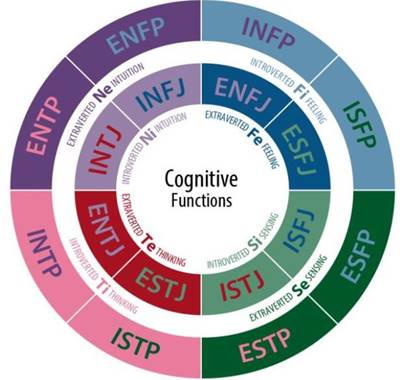
So where does MBTI fit into all this? Perhaps as a bridge. Otto Kroeger Associates (1985) formalized much of the practical guidance around applying MBTI in organizational settings, and platforms like 16Personalities have since made type-based self-assessment accessible to millions (16Personalities, 2024). More recently, Amirhosseini and Kazemian (2020) explored whether personality types could be predicted computationally from text data, an approach whose relevance is easy to see given datasets like the one compiled by Die9origephit on Kaggle (Die9origephit, 2024). Figure 1 illustrates how each of the sixteen MBTI types maps onto a distinct configuration of cognitive functions, with background color denoting each type's dominant function and text color marking its auxiliary function (Amirhosseini & Kazemian, 2020).
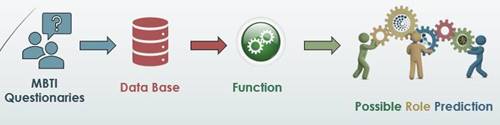
Taken together, this body of work points toward a clear, if underexplored, opportunity: using MBTI not just as a diagnostic curiosity handed out at onboarding, but as an active input into how technical teams are built. That's the gap this research tries to address — building a recruitment approach that uses MBTI upfront to identify which candidates are likely to occupy which team roles effectively. Given the practical constraints of this study, the scope has been narrowed: what follows is primarily an analysis of existing resources rather than a full-scale deployment across a live hiring pipeline.