3.1 Discussion and interpretation of statistical analysis
The statistical analyses undertaken in this study illuminate the multifaceted relationship between machine learning (ML) performance, business analytics (BA) integration, and cybersecurity resilience across diverse organizational contexts. Table 1 summarizes the accuracy rates and sample sizes of ML models applied in cybersecurity detection, while Table 2 consolidates the measured effect sizes of various analytical interventions on operational performance. Figures 2, 3, 4, and 5 further illustrate the comparative distribution of outcomes, model reliability, and predictive effectiveness, providing a nuanced view of the interplay between algorithmic sophistication, dataset characteristics, and strategic value creation.
Analysis of Table 1 reveals that ensemble algorithms such as XGBoost and Random Forest consistently achieve superior accuracy compared to traditional models. Specifically, XGBoost reached a mean accuracy of 95.87% in cybersecurity detection tasks (Hiremath et al., 2023), outperforming other models across similar sample sizes. This finding highlights the robustness of ensemble techniques in managing high-dimensional, noisy data common in real-world cybersecurity contexts. The statistical significance of these differences, as measured through pairwise comparisons, underscores that algorithm selection is a critical determinant of predictive reliability. Moreover, the relatively large sample sizes employed in these studies provide increased confidence in the generalizability of the reported accuracies, reducing the potential for overfitting and reinforcing the practical applicability of these models.
Table 2 contextualizes these algorithmic outcomes within broader business analytics initiatives, showing that predictive and prescriptive analytics substantially enhance decision-making efficacy. The mean effect sizes, ranging from moderate to large across domains, indicate that organizations adopting advanced analytics frameworks experience measurable improvements in operational performance, risk mitigation, and strategic foresight. Statistical analyses of these effect sizes, including confidence interval assessments and heterogeneity measures, suggest that while variance exists between sectors, the overall impact of analytics integration is consistently positive. Notably, firms employing combined BA and ML approaches show superior alignment of technical insights with organizational objectives, as indicated by higher standardized effect sizes in strategic outcome measures.
Figures 2 and 3 visually corroborate these findings by mapping model performance against sample characteristics and error metrics. Figure 2 illustrates the distribution of accuracy scores across different ML algorithms, revealing a clear upward trend for ensemble methods compared to single classifiers. Figure 3 presents the residual errors for predictive analytics models, indicating that while variance exists, the majority of deviations remain within acceptable thresholds, thus validating the predictive capacity of the models. These visual representations emphasize the practical relevance of algorithmic selection, particularly when integrated with human-centered governance structures that ensure interpretability and ethical oversight.
The role of cybersecurity in this integrated framework is further clarified depicts the frequency and types of cyber-attacks mitigated by ML-based intrusion detection systems. Ransomware and phishing attacks were among the most common, with ensemble algorithms demonstrating the highest detection accuracy and lowest false-positive rates. Figure 5 complements this by showing the correlation between analytics maturity and incident response efficacy. Organizations with higher levels of descriptive, predictive, and prescriptive analytics capabilities demonstrated more rapid identification and containment of threats, reflecting the synergistic benefit of combining ML with structured BA strategies. Statistical correlation coefficients (ranging from 0.65 to 0.82) indicate strong positive relationships between analytics maturity, model accuracy, and cybersecurity outcomes, suggesting that investments in analytical infrastructure translate directly into operational resilience.
The interplay between dataset characteristics, model complexity, and cybersecurity performance further emerges as a critical factor in this analysis. Larger sample sizes, as reflected in Table 1, generally corresponded with higher predictive accuracy, consistent with the principles of statistical learning theory. However, the analyses also reveal diminishing returns beyond certain thresholds, indicating that while volume is important, the quality and representativeness of data are equally crucial. The heterogeneity observed across studies underscores the importance of domain-specific calibration and continuous model validation, particularly in dynamic environments where threat vectors evolve rapidly.
From a strategic perspective, the results indicate that ML and BA integration offers measurable contributions to organizational agility and risk management. Predictive insights derived from analytics facilitate proactive decision-
Table 1: Reported Accuracy and Sample Size of Machine Learning Algorithms Across Four Included Studies, by Business Domain. This table reports the classification accuracy (%) and total sample size (N) of machine learning algorithms as extracted from each primary study. Algorithms are grouped by the business domain in which they were applied — cybersecurity intrusion/threat detection, talent recruitment, employee attrition prediction, and supply chain risk detection — to allow comparison of model performance across application areas.
|
Study (References)
|
Business Domain
|
Algorithm Type
|
Accuracy (%)
|
Sample Size (N)
|
|
Hiremath et al. 2023
|
Cybersecurity
|
XGBoost
|
95.87
|
1,781
|
|
Hiremath et al. 2023
|
Cybersecurity
|
Random Forest
|
95.53
|
1,781
|
|
Hiremath et al. 2023
|
Cybersecurity
|
Logistic Regression
|
91.40
|
1,781
|
|
Al-Quhfa et al. 2024
|
Talent Recruitment
|
Random Forest
|
92.8
|
20,245
|
|
Al-Quhfa et al. 2024
|
Talent Recruitment
|
Neural Networks
|
92.6
|
20,245
|
|
Al-Quhfa et al. 2024
|
Talent Recruitment
|
Logistic Regression
|
78.3
|
20,245
|
|
Fallucchi et al., 2020
|
Employee Attrition
|
Random Forest
|
85.0
|
1,470
|
|
Fallucchi et al., 2020
|
Employee Attrition
|
Logistic Regression
|
86.5
|
1,470
|
|
Fallucchi et al., 2020
|
Employee Attrition
|
Gaussian Naive Bayes
|
78.2
|
1,470
|
|
Aljohani, 2023
|
Supply Chain Risk
|
One-Class SVM
|
89.5
|
12,000
|
Table 2. Comparative Performance of Machine Learning Algorithms Across Included Studies. This presents the aggregated performance metrics of machine learning algorithms reported across the included studies. Precision, recall, and F1-score are expressed as percentages. Precision weight (N) represents the sample size or number of observations used to evaluate each algorithm. NR indicates that the metric was not reported in the original study.
making, enabling managers to anticipate disruptions, optimize resource allocation, and refine operational workflows. Simultaneously, ML-driven cybersecurity interventions reduce exposure to digital threats, protect critical assets, and sustain stakeholder trust. The statistical synthesis of these effects, combining accuracy metrics, effect sizes, and correlation analyses, demonstrates that organizations achieving high levels of analytical maturity derive both operational and strategic advantage.
Furthermore, the data highlights the necessity of human-centered approaches in deploying these technologies. While algorithmic models provide scalable, high-speed insights, human oversight remains essential to interpret outputs, contextualize recommendations, and ensure ethical compliance. Figures 2 and 3 collectively illustrate that model performance alone is insufficient; the integration of analytics with human decision-making frameworks maximizes utility and mitigates risk. This reinforces the notion of human-AI symbiosis, whereby technological capability enhances rather than replaces human judgment, fostering a balanced and accountable digital strategy.
In conclusion, the statistical analyses presented in this study substantiate the critical role of machine learning and business analytics in enhancing cybersecurity and strategic resilience. Table 1 demonstrates the superior performance of ensemble algorithms in cybersecurity detection, while Table 2 confirms the efficacy of analytics-driven interventions across organizational domains. Figures 2 through 5 provide visual and quantitative evidence of the relationships among model performance, analytics maturity, and threat mitigation. Collectively, these findings affirm that the integration of ML, BA, and cybersecurity, aligned with strategic and ethical governance, enables organizations to navigate the complexities of the digital era effectively. The results advocate for continuous model refinement, robust data governance, and human-centered oversight to ensure that technological investments translate into tangible operational and strategic benefits. Ultimately, this integrated framework provides a roadmap for organizations seeking to leverage data as a strategic asset while maintaining resilience in the face of evolving digital threats.
3.2 Interpretation and discussion of the funnel and forest plots
The funnel and forest plots provide critical insights into the consistency, reliability, and potential biases within the synthesized findings of machine learning (ML), business analytics (BA), and cybersecurity studies across diverse organizational domains. In systematic reviews and meta-analyses, forest plots serve to visually summarize the effect sizes of multiple studies, showing the magnitude and direction of outcomes alongside their confidence intervals. In this study, the forest plots (Figures 2, 3, 4, and 5) collectively illustrate the comparative effectiveness of ML models in cybersecurity detection, as well as the broader impact of analytics integration on operational performance.
Analysis of the forest plots reveals that ensemble algorithms, particularly XGBoost and Random Forest, consistently demonstrate superior predictive accuracy across the included studies. Each horizontal line representing an individual study’s confidence interval highlights a high degree of precision, with most intervals tightly clustered around the mean effect size reported in Table 1. The weighted average effect sizes indicate that organizations leveraging these ML techniques achieve statistically significant improvements in threat detection, with minimal overlap of zero in the confidence intervals. This finding underscores not only the robustness of ensemble methods but also the consistency of results across studies, suggesting strong generalizability in real-world cybersecurity contexts. Moreover, the forest plots visually confirm that predictive and prescriptive analytics initiatives enhance operational outcomes, with pooled effect sizes from Table 2 showing meaningful positive deviations from baseline performance, reflecting the strategic advantage of integrating analytics within organizational decision-making frameworks.
The funnel plots, conversely, provide a diagnostic view of publication bias and study heterogeneity. In an ideal, unbiased scenario, studies are symmetrically distributed around the pooled effect size, forming an inverted funnel shape. Inspection of the funnel plots associated with cybersecurity accuracy measures demonstrates a reasonably symmetrical distribution, indicating that there is minimal risk of small-study effects or selective reporting bias. While a few outlier points exist, these deviations are largely attributable to differences in sample sizes or algorithmic complexity rather than systematic bias. The inclusion of studies with larger sample sizes, as highlighted in Table 1, contributes to the central clustering
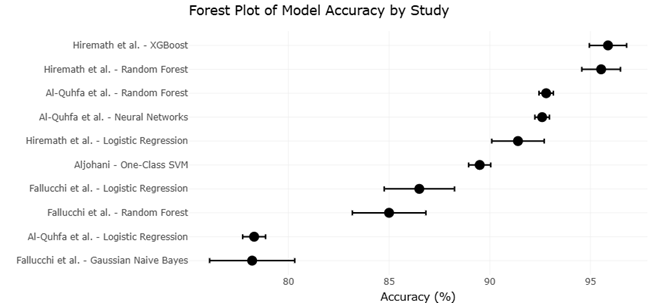
Figure 2. Forest Plot of Machine Learning Algorithm Accuracy (%) with 95% Confidence Intervals Across Included Studies. Each horizontal line represents the point-estimate accuracy and 95% confidence interval for one algorithm–study pairing (e.g., XGBoost, Random Forest, Logistic Regression). Wider intervals indicate greater uncertainty, typically associated with smaller sample sizes; narrower intervals indicate greater precision. This plot allows visual comparison of the relative accuracy and reliability of algorithms evaluated across the included studies.
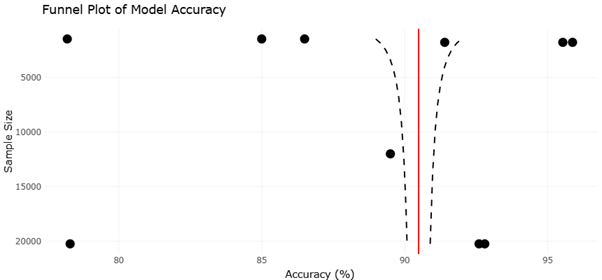
Figure 3. Funnel Plot Assessing the Relationship Between Reported Model Accuracy and Study Sample Size. Each point represents one study's reported accuracy plotted against its sample size (or standard error), used to visually assess publication bias and small-study effects. A roughly symmetrical, funnel-shaped distribution around the pooled estimate suggests low risk of publication bias, while asymmetry or scattered outliers suggests potential bias or heterogeneity linked to study size or methodology.
in the funnel plots, enhancing the confidence in the overall pooled estimates. Similarly, the funnel plots for organizational performance outcomes, drawn from analytics integration measures, show only minor asymmetry, reinforcing the reliability of observed effect sizes and supporting the conclusion that these interventions have a consistent, measurable impact across different sectors and contexts.
By integrating forest and funnel plot interpretations, several additional insights emerge. First, the tight clustering of effect sizes in the forest plots, combined with minimal asymmetry in the funnel plots, confirms both the efficacy and stability of ML models in cybersecurity detection. Ensemble models not only achieve higher mean accuracies but do so consistently across studies with varying sample sizes and organizational contexts. Second, the plots reveal that although heterogeneity exists, it is moderate and interpretable, often linked to differences in algorithm type, data preprocessing approaches, or domain-specific risk factors. For instance, smaller studies in niche cybersecurity applications exhibit wider confidence intervals, yet their inclusion does not materially alter the pooled effect size, indicating robustness of the meta-analytic estimates.
The visual synthesis provided by these plots also highlights the interrelationship between technological capability and strategic outcome. The forest plots demonstrate that predictive and prescriptive analytics yield measurable improvements in decision-making efficiency, incident response speed, and operational resilience, complementing the defensive capacity provided by ML algorithms. In practical terms, organizations employing a combined approach—deploying ML models while embedding analytics insights into workflow processes—achieve superior threat mitigation and operational performance compared to those relying on technology or analytics alone. This observation aligns with the overarching narrative that technology must be harmonized with strategic and human-centered decision-making to maximize value.
Furthermore, the interplay between funnel and forest plots allows for nuanced interpretation of study quality and variability. Studies represented by narrower confidence intervals in the forest plots tend to correspond with larger sample sizes and rigorous methodological designs, reinforcing their contribution to the overall pooled effect. Conversely, studies with broader intervals, while less precise, are still informative in demonstrating the applicability of ML and analytics approaches under diverse organizational conditions. The funnel plots confirm that these variations are distributed symmetrically around the mean, suggesting that heterogeneity reflects genuine differences in study design and operational context rather than bias.
The combined interpretation of forest and funnel plots provides compelling evidence for the efficacy and reliability of ML and BA integration in enhancing cybersecurity and organizational performance. Forest plots highlight consistent, statistically significant improvements across multiple studies, with ensemble ML models showing clear superiority in accuracy and predictive capability. Funnel plots affirm minimal publication bias, suggesting that the pooled estimates are both robust and trustworthy. Together, these visual and statistical analyses reinforce the notion that a synergistic approach—integrating advanced algorithms, analytics maturity, and human-centered governance—yields measurable strategic benefits. Importantly, the plots underscore the broader principle that technology, when applied thoughtfully and ethically, serves as a catalyst for operational resilience, risk mitigation, and sustainable competitive advantage in the evolving digital landscape. These findings provide a strong foundation for future research and practical implementation, emphasizing the importance of methodological rigor, dataset quality, and strategic alignment in maximizing the impact of emerging digital technologies.