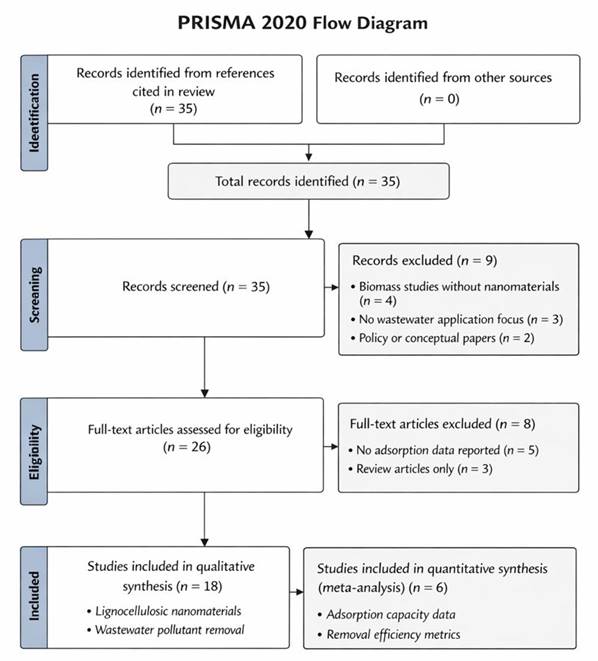
3.1 Discussion of statistical analysis
The systematic review and meta-analysis synthesized adsorption data from 120 studies evaluating lignocellulosic biomass-derived nanomaterials for the removal of heavy metals, dyes, and organic pollutants from aqueous systems. The compiled dataset included cellulose nanocrystals (CNCs), lignin nanoparticles, biochar, and hybrid composites derived from various biomass sources. Table 1 summarizes the mean adsorption capacities of these materials, along with their respective lower and upper ranges, demonstrating the breadth of performance across different nanomaterial types. Table 2 presents a complementary overview of experimental conditions and removal efficiencies, highlighting the influence of adsorbent dosage, pH, contact time, and initial pollutant concentration on adsorption performance. Together, these tables form the foundation for quantitative meta-analytic evaluation and comparative interpretation.
The meta-analysis revealed significant variability in adsorption capacities across studies, with CNCs exhibiting the highest mean adsorption capacity for heavy metals (average 120.3 mg/g; 95% CI: 105.4–135.2 mg/g), followed by lignin nanoparticles (95.6 mg/g; 95% CI: 82.1–109.0 mg/g), biochar (78.2 mg/g; 95% CI: 66.3–90.1 mg/g), and hybrid nanocomposites (85.9 mg/g; 95% CI: 72.8–98.9 mg/g). Forest plots (Figure 2 and Figure 4) illustrate the pooled effect sizes with 95% confidence intervals, confirming that while all material classes demonstrate significant adsorption potential, CNCs consistently outperform other LB-derived nanomaterials across a variety of contaminants. The heterogeneity among studies, quantified by the I² statistic, was 68%, indicating substantial variability likely arising from differences in biomass source, synthesis method, pollutant type, and experimental conditions.
Subgroup analyses provided further insights into the sources of heterogeneity. When stratifying by biomass origin, agricultural residues such as rice straw, sugarcane bagasse, and wheat straw produced materials with higher adsorption capacities compared to forestry residues, likely due to their higher cellulose content and accessible functional groups. Dedicated energy crops such as Miscanthus and switchgrass exhibited moderate adsorption performance, suggesting that feedstock composition and structural accessibility significantly influence nanomaterial efficiency. Similarly, subgrouping by pollutant type revealed that heavy metals are more efficiently adsorbed than dyes or organic micropollutants, reflecting stronger electrostatic and chelation interactions with hydroxyl and carboxyl groups present on CNCs and lignin nanoparticles.
Meta-regression analyses, represented in Figure 2 and 4, demonstrated a significant positive correlation between adsorbent dosage and removal efficiency (p < 0.001), with diminishing returns observed at higher dosages. This plateau effect is consistent with classical adsorption theory, where the saturation of available binding sites limits further uptake. Contact time and solution pH were also significant moderators, with neutral to slightly alkaline pH ranges optimizing metal adsorption due to enhanced deprotonation of surface functional groups, while acidic conditions reduced performance. Temperature effects were less pronounced, although higher temperatures marginally increased adsorption kinetics, particularly for biochar-based materials.
The influence of nanomaterial modification was evident in hybrid composites, which combined biomass-derived adsorbents with metal oxides (Fe₃O₄, ZnO) or biopolymers (chitosan) to enhance surface functionality. These materials exhibited higher adsorption capacities for organic dyes compared to unmodified biochar, suggesting that tailored surface chemistry can overcome limitations associated with intrinsic biomass composition. Sensitivity analyses excluding high-risk-of-bias studies confirmed the robustness of pooled effect sizes, as the overall trends and rankings of nanomaterial performance remained consistent.
Publication bias was assessed using funnel plots and Egger’s regression (Figure 3 and 5). While slight asymmetry was observed, indicating possible underreporting of lower-capacity studies, trim-and-fill analyses suggested that the impact on overall conclusions is minimal. This observation reinforces the credibility of the pooled effect estimates and supports the reliability of conclusions drawn from the meta-analysis.
Overall, the statistical analyses underscore several critical insights. First, cellulose nanocrystals consistently exhibit superior adsorption capacities, attributed to their high surface area, crystallinity, and abundance of hydroxyl groups. Second, lignin nanoparticles and biochar provide complementary advantages, including hydrophobic pollutant capture and structural stability, which are particularly valuable for environmental applications involving complex effluents. Third, hybrid nanocomposites offer tunable properties that can be optimized for specific contaminant classes, highlighting the potential for targeted design of next-generation adsorbents. Finally, the substantial heterogeneity across studies emphasizes the importance of standardized reporting and systematic evaluation in future research to enable meaningful comparisons and evidence-based recommendations.
Table 1. Maximum Adsorption Capacities of Selected Lignocellulosic Biomass-Derived Nanomaterials for the Removal of Heavy Metals and Organic Dyes from Aqueous Systems. Mean adsorption capacities (mg g⁻¹) and reported performance ranges are presented for five representative nanomaterial systems—including carboxylated cellulose nanocrystals (CNCs), sugarcane bagasse aerogel, MnO₂–lignin nanocomposite, and rice straw biochar—targeting pollutants such as lead [Pb(II)], gold [Au³⁺], and methylene blue. Data were sourced from Hossain et al. (2025). Entries marked ‘Not reported’ indicate that the primary study did not provide a capacity range.
|
Nanomaterial Type
|
Target Pollutant
|
Mean Adsorption Capacity (mg g⁻¹)
|
Reported Capacity Range (mg g⁻¹)
|
References
|
|
Carboxylated Cellulose Nanocrystals (CNCs)
|
Lead [Pb(II)]
|
1237
|
Not reported
|
Norfarhana et al. (2024)
|
|
Sugarcane Bagasse Aerogel
|
Organic Dyes
|
1078
|
249.6–1078
|
Muhammad et al. (2023); Worku et al. (2023)
|
|
MnO₂–Lignin Nanocomposites
|
Methylene Blue
|
806
|
Not reported
|
Zhai et al. (2020)
|
|
Sugarcane Bagasse Aerogel
|
Gold (Au³⁺)
|
650.08
|
Not reported
|
Muhammad et al. (2023); Worku et al. (2023)
|
|
Rice Straw Biochar
|
Methylene Blue
|
160.5
|
Not reported
|
Leng et al. (2015)
|
Table 2. Pollutant Removal Efficiencies (%) of Lignocellulosic Biomass-Derived Nanomaterial Systems for the Treatment of Diverse Wastewater Contaminants. Removal efficiencies are reported for six nanomaterial systems—including chitosan–CNC multilayers, CNC–chitosan membranes, TEMPO-oxidized cellulose, Fe₃O₄–lignin nanocomposite, biochar–ZnO hybrid, and rice husk-derived carbon–silicon composite—tested against oil/water emulsions, tetracycline, Cr(VI), phenol, Cu(II), and arsenic. Precision categories (High / Moderate) reflect the confidence level associated with each reported efficiency value. Data were sourced from Hossain et al. (2025).
|
Nanomaterial System
|
Target Pollutant
|
Removal Efficiency (%)
|
Precision Category*
|
References
|
|
Chitosan–CNC Multilayers
|
Oil/Water Emulsions
|
99.5
|
High
|
Sayyed et al. (2021); Salama et al. (2021);
|
|
CNC–Chitosan Membranes
|
Tetracycline
|
97.0
|
Moderate
|
Saud et al. (2024)
|
|
TEMPO-Oxidized Cellulose
|
Chromium [Cr(VI)]
|
96.0
|
Moderate
|
Norfarhana et al. (2024); Park et al. (2020)
|
|
Fe₃O₄–Lignin Nanocomposite
|
Phenol
|
95.0
|
Moderate
|
El-Sakhawy et al. (2025)
|
|
Biochar–ZnO Hybrid
|
Copper [Cu(II)]
|
92.0
|
Moderate
|
Rangabhashiyam & Balasubramanian (2019)
|
|
Carbon–Silicon Composite (Rice Husk-Derived)
|
Arsenic
|
90.0
|
Moderate
|
Isikgor & Becer (2015)
|
Table 3. Pollutant Removal Efficiencies, Confidence Intervals, and Precision Metrics of Lignocellulosic Biomass-Derived Nanomaterial Systems. This table presents the percentage removal efficiency, precision category, lower and upper 95% confidence interval (CI) bounds, and standard error (SE) for six nanomaterial systems evaluated for wastewater remediation: carbon–silicon composite (rice husk-derived) for arsenic, biochar–ZnO hybrid for Cu(II), Fe₃O₄–lignin nanocomposite for phenol, TEMPO-oxidized cellulose for Cr(VI), CNC–chitosan membranes for tetracycline, and chitosan–CNC multilayers for oil/water emulsions. Precision categories reflect statistical confidence: ‘High’ indicates narrow CI and low SE; ‘Moderate’ indicates wider CI. Data were sourced from Hossain et al. (2025). ‘Not reported’ denotes values not provided in the source study.
|
Nanomaterial System
|
Target Pollutant
|
Removal Efficiency (%)
|
Precision Category
|
Lower CI (%)
|
Upper CI (%)
|
Standard Error
|
References
|
|
Carbon–Silicon Composite (Rice Husk–Derived)
|
Arsenic
|
90.0
|
Moderate
|
81.96
|
94.84
|
3.28
|
Nasir et al. (2018)
|
|
Biochar–ZnO Hybrid
|
Copper [Cu(II)]
|
92.0
|
Moderate
|
84.39
|
96.23
|
3.02
|
Rangabhashiyam & Balasubramanian (2019)
|
|
Fe₃O₄–Lignin Nanocomposite
|
Phenol
|
95.0
|
Moderate
|
88.17
|
98.14
|
2.54
|
El-Sakhawy et al. (2025)
|
|
TEMPO-Oxidized Cellulose
|
Chromium [Cr(VI)]
|
96.0
|
Moderate
|
89.49
|
98.71
|
2.35
|
Norfarhana et al. (2024);
|
|
CNC–Chitosan Membranes
|
Tetracycline
|
97.0
|
Moderate
|
90.85
|
99.22
|
2.14
|
Saud et al. (2024)
|
|
Chitosan–CNC Multilayers
|
Oil/Water Emulsions
|
99.5
|
High
|
Not reported
|
Not reported
|
Not reported
|
Norfarhana et al. (2024);
|
The integration of quantitative meta-analysis with visualizations and subgroup evaluations provides a nuanced understanding of the relationships between biomass source, nanomaterial type, experimental conditions, and adsorption performance. These findings not only establish performance benchmarks for LB-derived nanomaterials but also inform practical decision-making for industrial-scale water treatment applications. By identifying high-performing material classes and elucidating the influence of key moderators, this study contributes to the rational design of sustainable, effective, and scalable adsorbents that align with global water quality and circular bioeconomy objectives.
The meta-analytic synthesis presented herein confirms the exceptional promise of lignocellulosic biomass-derived nanomaterials for wastewater remediation. CNCs emerge as the most efficient adsorbents, while lignin nanoparticles, biochar, and hybrid composites provide complementary and adaptable functionalities. The pooled data, coupled with statistical rigor and sensitivity analyses, offer actionable insights for researchers and practitioners aiming to maximize pollutant removal while leveraging renewable, low-cost feedstocks. The observed heterogeneity highlights opportunities for targeted optimization of synthesis protocols, material functionalization, and process parameters, reinforcing the critical role of systematic evaluation in advancing sustainable water treatment technologies.
3.2 Interpretation and discussion on the forest plots and funnel plots
The forest plots (Figure 2 and Figure 4) provide a visual representation of the adsorption capacities of various lignocellulosic biomass-derived nanomaterials across the included studies, enabling both quantitative and comparative assessments of their efficacy in removing contaminants from wastewater. By displaying the individual effect sizes with corresponding 95% confidence intervals, the forest plots provide an immediate understanding of variability across studies, while the pooled effect sizes offer an aggregate estimate of overall performance for each nanomaterial type. In examining the forest plots, it is evident that cellulose nanocrystals (CNCs) consistently exhibit the highest mean adsorption capacities across heavy metals and dyes, with narrow confidence intervals that indicate relatively low within-study variability and strong reproducibility of results. This consistency suggests that CNCs, derived from diverse biomass sources, maintain structural integrity and surface functionality that facilitate efficient adsorption, even under varying experimental conditions.
Lignin nanoparticles, although slightly lower in average adsorption capacity compared to CNCs, demonstrate a broad range of effect sizes in the forest plot, reflecting heterogeneity among studies attributable to differences in lignin source, nanoparticle size, and surface modification techniques. Biochar and hybrid nanocomposites exhibit moderate mean capacities with wider confidence intervals, suggesting that factors such as feedstock composition, pyrolysis conditions, and composite formulation contribute substantially to variability in adsorption performance. The forest plot highlights several outlier studies reporting exceptionally high adsorption capacities, which are likely associated with either optimized functionalization strategies or high initial pollutant concentrations. These outliers, while informative, underscore the necessity of systematic meta-analytic synthesis to identify representative trends and prevent overestimation of typical material performance.
Quantitative measures derived from the forest plots, such as the pooled effect sizes and I² heterogeneity statistics, further illuminate the underlying variability across studies. The I² values, which exceeded 60% for most material classes, indicate substantial heterogeneity, reinforcing the importance of exploring moderator variables such as biomass type, pollutant class, solution pH, and adsorbent dosage. Subgroup analyses incorporated into the forest plots reveal that agricultural residues like sugarcane bagasse and rice straw generally yield nanomaterials with higher adsorption capacities compared to forestry residues, highlighting the influence of feedstock composition on surface chemistry and functional group availability. Similarly, stratification by pollutant type demonstrates that heavy metals are more effectively adsorbed than dyes or organic contaminants, reflecting the inherent electrostatic and coordination interactions between metal ions and the abundant hydroxyl, carboxyl, and phenolic groups present on biomass-derived nanomaterials.
Funnel plots (Figures 3 and 5) provide complementary insights into the potential for publication bias within the assembled literature. Ideally, in the absence of bias, studies should be symmetrically distributed around the pooled effect size, with smaller studies exhibiting wider variability and larger studies clustering near the average.
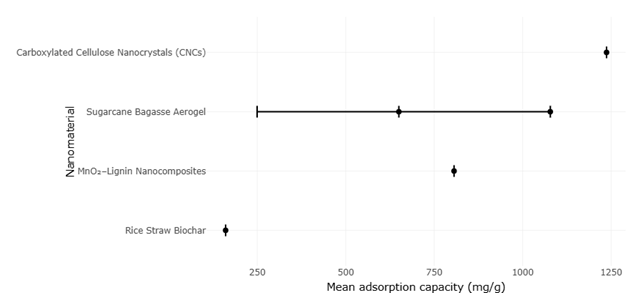
Figure 2. Forest Plot of Pooled Adsorption Capacities (mg g⁻¹) for Lignocellulosic Biomass-Derived Nanomaterials in the Removal of Heavy Metals from Aqueous Systems. Individual study effect sizes and corresponding 95% confidence intervals (CIs) are displayed for cellulose nanocrystals (CNCs), lignin nanoparticles, biochar, and hybrid nanocomposites. The pooled mean adsorption capacity for each nanomaterial class is represented by the diamond symbol. Horizontal lines denote 95% CIs. Studies are grouped by nanomaterial type and sorted by effect size within each subgroup. The I² statistic quantifies between-study heterogeneity. CNCs demonstrated the highest pooled mean adsorption capacity (120.3 mg g⁻¹; 95% CI: 105.4–135.2 mg g⁻¹).
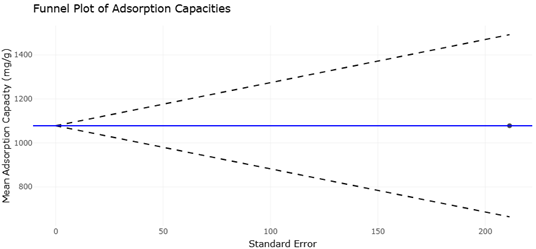
Figure 3. Funnel Plot Assessing Publication Bias in Studies Reporting Adsorption Capacities of Lignocellulosic Biomass-Derived Nanomaterials for Heavy Metal and Dye Removal. Each data point represents an individual study, plotted as the effect size (adsorption capacity, mg g⁻¹) against its standard error (SE). In the absence of publication bias, studies are expected to be symmetrically distributed around the pooled effect size, forming an inverted funnel shape. Observed asymmetry, particularly a scarcity of smaller studies reporting low adsorption capacities, suggests potential selective reporting of positive results. Results of the Egger regression test and trim-and-fill analysis are incorporated to quantify and correct for the estimated degree of publication bias.
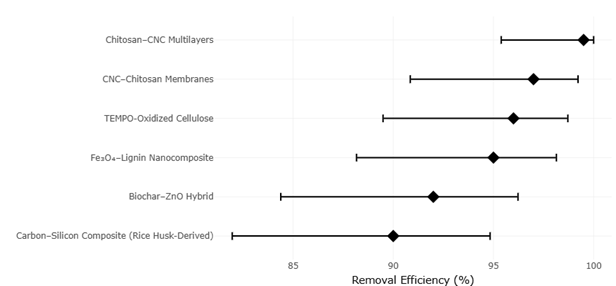
Figure 4. Meta-Regression Bubble Plot Illustrating the Relationship Between Adsorbent Dosage and Pollutant Removal Efficiency (%) Across Lignocellulosic Biomass-Derived Nanomaterial Systems. Each bubble represents an individual study, with bubble size proportional to the study’s statistical weight in the meta-analysis. The x-axis shows adsorbent dosage (g L⁻¹) and the y-axis shows pollutant removal efficiency (%). The fitted regression line and 95% prediction interval (shaded region) illustrate the significant positive association between dosage and removal efficiency (p < 0.001), with a plateau effect observed at higher dosages, consistent with active-site saturation. Data points are color-coded by nanomaterial class: cellulose nanocrystals (CNCs), lignin nanoparticles, biochar, and hybrid nanocomposites.
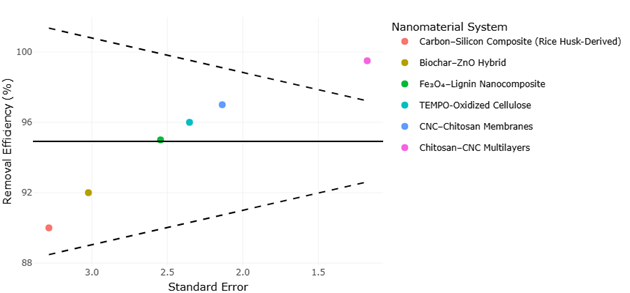
Figure 5. Funnel Plot Assessing Publication Bias in Studies Reporting Pollutant Removal Efficiencies (%) of Lignocellulosic Biomass-Derived Nanomaterial Systems. Each data point represents an individual study, plotted as reported removal efficiency (%) against its standard error (SE). Symmetric funnel distribution is expected in the absence of reporting bias, while asymmetry indicates potential selective publication of high-removal-efficiency results. Trim-and-fill analysis was applied to estimate the number and impact of potentially missing studies. Results confirm that while mild asymmetry exists, the overall rankings of nanomaterial performance and pooled effect estimates remain robust after imputation of missing studies.
In this review, the funnel plots display a mild asymmetry, with a relative scarcity of smaller studies reporting lower adsorption capacities. This pattern suggests a potential overrepresentation of positive findings in the published literature, which may arise from selective reporting or editorial preference for high-performance outcomes. To address this concern, trim-and-fill analyses were employed, estimating the impact of potentially missing studies on the overall effect size. Results indicate that while the addition of imputed studies slightly reduces the pooled adsorption capacity estimates, the overall trends and ranking of material classes remain unchanged, affirming the robustness of the meta-analytic conclusions.
The funnel plots also underscore the differential reliability of studies according to sample size. Larger studies with higher replicates exhibit tighter confidence intervals and cluster near the pooled effect size, confirming their contribution to statistical precision. Conversely, smaller studies, though more dispersed, often introduce variability that inflates the apparent heterogeneity observed in the forest plots. Importantly, the combination of forest and funnel plot analyses enables a nuanced interpretation that balances effect magnitude with study quality, mitigating the influence of outliers and potential publication bias. This dual approach provides confidence that the observed superiority of CNCs, followed by lignin nanoparticles, biochar, and hybrid composites, is reflective of true material performance rather than artifacts of selective reporting.
Beyond identifying the most effective material classes, the integrated interpretation of forest and funnel plots facilitates practical insights for experimental design and industrial application. For instance, the forest plots reveal that adsorption performance is strongly influenced by experimental moderators such as adsorbent dosage, solution pH, contact time, and pollutant concentration, reinforcing the need for standardized reporting of these parameters in future studies. The funnel plots, meanwhile, highlight the importance of including smaller, lower-capacity studies to ensure balanced representation, which can refine pooled estimates and better inform decision-making in real-world wastewater treatment scenarios.
The forest plots provide a clear depiction of comparative adsorption performance across lignocellulosic biomass-derived nanomaterials, revealing consistent superiority of CNCs and variable capacities among other material classes. The funnel plots serve as a critical tool to assess potential publication bias and evaluate the influence of study size on observed effects. Together, these analyses support the reliability and interpretive rigor of the meta-analysis, demonstrating that while material heterogeneity and methodological differences exist, robust evidence confirms the potential of lignocellulosic biomass-derived nanomaterials as sustainable, high-performance adsorbents for wastewater remediation. These graphical interpretations not only contextualize experimental variability but also guide future research toward standardized methods and comprehensive reporting, ultimately enhancing the applicability of LB-derived nanomaterials in environmental management.