Journal of Primeasia

Integrative Disciplinary Research | Online ISSN 3064-9870 | Print ISSN 3069-4353
570
Citations
221.1k
Views
147
Articles
Your new experience awaits. Try the new design now and help us make it even better
Switch to the new experience
Figures and Tables
REVIEWS   (Open Access)

Valorization of Fish Industry Waste and Biomass-Derived Materials for Sustainable Electrochemical Energy Storage: A Systematic Review and MetaAnalysis

Md. Borhanul Haque 1*, Md. Sabuj Mia 1

+ Author Affiliations

Journal of Primeasia 7 (1) 1-8 https://doi.org/10.25163/primeasia.7110799

Submitted: 11 June 2026 Revised: 01 August 2026  Published: 12 August 2026 


Abstract

The escalating demand for sustainable energy storage solutions has intensified interest in eco-friendly and high-performance electrode materials. Biomass-derived carbons, particularly from fish industry waste, have emerged as promising candidates for next-generation energy storage systems, including lithium-ion, sodium-ion, potassium-ion, lithium-sulfur batteries, and supercapacitors. Fish processing by-products—such as scales, bones, skins, and shells—contain abundant carbon, nitrogen, and oxygen heteroatoms, which can be converted into hard carbon or doped porous carbon structures with tailored physicochemical properties. Controlled carbonization, chemical activation, and heteroatom doping enable the production of materials with optimized porosity, interlayer spacing, and surface chemistry, enhancing ion storage capacity, transport kinetics, and cycling stability. Furthermore, these biochars contribute to circular economy practices by valorizing waste while reducing environmental pollution. Recent studies demonstrate that fish-waste-derived carbons exhibit remarkable performance in sodium and potassium storage, with expanded interlayer spacing facilitating the accommodation of larger ions, while nitrogen- and oxygen-rich carbons improve pseudocapacitive behavior in supercapacitors. Additionally, innovative protein-derived electrodes leverage redox-active amino acids, introducing novel energy storage mechanisms. This systematic review and meta-analysis synthesize evidence from diverse studies, highlighting trends in carbon precursors, processing conditions, and electrochemical performance. By integrating eco-design, waste valorization, and data-driven material optimization strategies, fish-waste-derived carbons provide sustainable alternatives to conventional electrodes, potentially enabling high-performance energy storage systems that align with environmental and economic imperatives.

Keywords: Biomass-derived carbon, fish industry waste, sustainable energy storage, sodium-ion batteries, potassium-ion batteries, lithium-sulfur batteries, supercapacitors, heteroatom doping, circular economy, hard carbon.

1. Introduction

There is a growing sense—almost an uneasy one—that the materials powering our modern energy systems are no longer as “infinite” as we once assumed. For decades, the global energy transition has leaned heavily on lithium-ion batteries (LIBs), often treated as the backbone of portable electronics and electric mobility. Yet, as demand accelerates alongside electrification and digital expansion, questions about resource sufficiency, environmental burden, and supply chain vulnerability have become increasingly difficult to ignore (Grandell et al., 2016; Moreau et al., 2019; Watari et al., 2021). Critical metals such as lithium, cobalt, and nickel are not only unevenly distributed but also deeply entangled with geopolitical and economic uncertainties, making long-term sustainability feel, at best, fragile (Thompson, 2023; Timperley, 2018). It is within this tension—between technological dependence and material limitation—that the search for alternative, circular, and waste-derived energy materials has gained momentum.

Circular economy thinking has, in many ways, reframed how we interpret “waste.” What was once considered an end point is increasingly seen as a beginning. Industrial systems, landfills, and even urban waste streams are now being reconsidered as reservoirs of recoverable value (Jones et al., 2012; Baldassarre, 2025; Pimenow et al., 2026; Rizos & Zambianchi, 2025). This shift is not merely conceptual; it is structural. Enhanced resource recovery strategies—from landfill mining to industrial site valorization—are being developed to reduce dependence on virgin extraction while simultaneously addressing environmental degradation (Huntington et al., 2023; Jones et al., 2012). In parallel, global concerns about metal scarcity and future supply constraints for renewable energy technologies continue to intensify (Moreau et al., 2019; Watari et al., 2021).

Against this backdrop, biomass-derived materials—particularly biochar and hard carbon—have emerged as surprisingly versatile candidates for energy and environmental applications. The pyrolysis of biomass waste is no longer viewed simply as a disposal strategy but rather as a controlled transformation process capable of producing high-value carbon structures (Afraz et al., 2024; Li et al., 2023; Onjia, A. (2024); Pradhan et al. (2024). The properties of these materials, however, are far from fixed. Activation conditions, feedstock selection, and pyrolysis temperature all play decisive roles in determining porosity, conductivity, and stability (Panwar & Pawar, 2020; Patra et al., 2021; Xu et al., 2021). Even subtle changes in biomass type can significantly alter adsorption behavior and structural evolution (Liao et al., 2022; Islam et al., 2021), which makes this field both scientifically rich and, admittedly, somewhat unpredictable.

Interestingly, many of these bio-derived materials were initially explored not for energy storage but for environmental remediation. Biochar, for instance, has long been studied for its ability to immobilize or adsorb heavy metals in contaminated systems (Järup, 2003; Jin et al., 2018; Shrestha & Amarasekara (2025); Slavković-Beškoski et al. (2022). Early work on microbial and surface-driven metal interactions laid the foundation for understanding how natural and engineered surfaces bind toxic ions (He & Tebo, 1998; Mullen et al., 1989). Over time, this evolved into more advanced systems such as engineered sorbents, ion-exchange resins, and electrodialysis-based recovery technologies (Cerrillo-Gonzalez et al., 2023; Mikeli et al., 2022; Nastasović et al., 2022). Even biological materials—eggshells, bacteria, and seaweed—have demonstrated remarkable metal-binding capacity, reinforcing the idea that nature already offers highly functional templates for selective ion capture (Marković et al., 2023; Hansen et al., 2023; Castillo et al., 2021).

More recently, this remediation logic has begun to merge with energy storage research. Biochar is no longer just a pollutant scavenger; it is increasingly being engineered as a functional carbon framework for electrochemical systems (Hasan et al., 2024; Anto et al., 2021). In a way, this represents a conceptual bridge: the same surface chemistry that binds heavy metals in water can also facilitate ion transport and storage in batteries and supercapacitors.

Among various biomass sources, fish industry waste occupies a particularly intriguing position. Globally, millions of tons of fish-derived residues—including scales, bones, skins, and shells—are discarded annually (Lionetto et al., 2021). This waste stream is often environmentally problematic, contributing to organic pollution and greenhouse gas emissions when left unmanaged. Yet, chemically speaking, these materials are far from inert. They contain heteroatoms such as nitrogen, oxygen, and sulfur, as well as structured biopolymers that can be transformed into highly functional carbon architectures (Lionetto et al., 2021; Ferdous et al., 2024).

Recent studies suggest that such waste-derived carbons can be tuned into porous electrodes suitable for next-generation batteries. For sodium-ion and potassium-ion systems, in particular, the challenge lies in accommodating larger ionic radii, which demands expanded interlayer spacing and disordered carbon frameworks (Nieto et al., 2022; Tan et al., 2023). Biomass-derived hard carbons—especially those from agricultural or marine residues—have shown promising performance in this regard (Ma et al., 2024; Song et al., 2023; Smičiklas et al. 2023; Werner et al. 2020). There is something almost elegant about this: waste materials naturally forming the kind of disordered structures that these emerging battery systems require.

Fish-derived materials also extend into more specialized applications. In lithium–sulfur batteries, porous carbons derived from biological waste can physically confine polysulfides, mitigating one of the system’s most persistent challenges (Nieto et al., 2022). In some experimental systems, even protein-rich fractions have been explored as active electrochemical components, blurring the boundary between biological chemistry and energy storage (Hasan et al., 2024; Lionetto et al., 2021). While such concepts are still emerging, they point toward an unconventional but compelling direction.

Parallel to batteries, supercapacitor research has also benefited from biomass-derived carbons. Their inherent heteroatom content enhances pseudocapacitive behavior, wettability, and long-term cycling stability—properties that are critical for high-power applications. In many cases, the transformation of waste into porous carbon frameworks has demonstrated performance levels that would have been difficult to anticipate from the raw material alone (Ferdous et al., 2024; Patra et al., 2021).

Of course, no discussion of energy storage materials would be complete without acknowledging the role of supporting components such as binders. While often overlooked, they are essential to electrode integrity. Conventional binders such as polyvinylidene fluoride (PVDF) rely on toxic solvents, raising environmental concerns during manufacturing (Afraz et al., 2024). In response, more sustainable alternatives—often cellulose-based or water-processable polymers—are being explored as greener substitutes, aligning with broader circular economy goals (Rizos & Zambianchi, 2025).

Still, despite significant progress, challenges remain. Biomass-derived systems are inherently variable; no two feedstocks behave exactly alike. This variability complicates scale-up and reproducibility (Liao et al., 2022; Jin et al., 2018). To address this, researchers are increasingly turning to computational tools, including machine learning and data-driven optimization, to predict material behavior and guide synthesis pathways. Such approaches may help reduce experimental trial-and-error while accelerating discovery cycles in an otherwise complex and multidimensional materials landscape.

Ultimately, what emerges from this body of work is not a single solution, but a direction. The valorization of fish industry waste and biomass-derived materials sits at the intersection of environmental remediation, resource recovery, and electrochemical innovation. It reflects a gradual but important shift—from linear extraction systems toward circular, regenerative material cycles. And while many technical questions remain open, the underlying idea feels increasingly difficult to dismiss: that some of the most promising materials for future energy storage may already exist, hidden in what we too often choose to throw away.
2. Materials and Methods

2.1. Literature Search Strategy

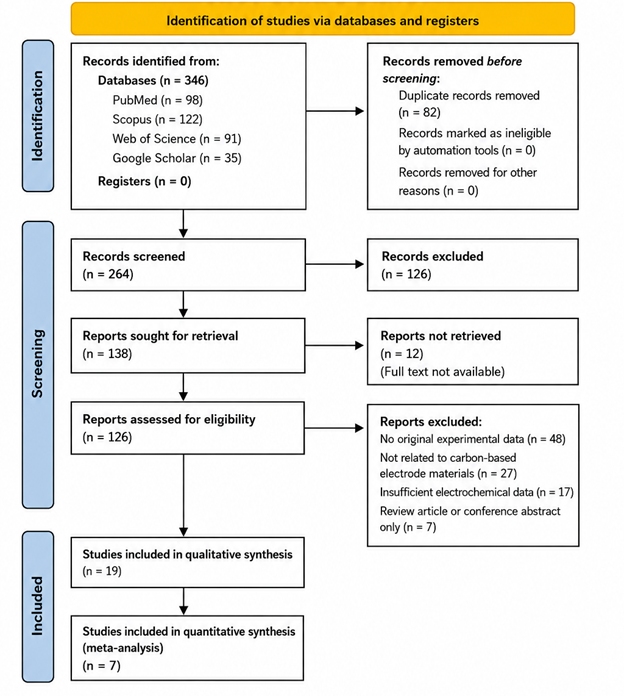
This systematic review and meta-analysis were conducted in accordance with the Preferred Reporting Items for Systematic Reviews and Meta-Analyses (PRISMA 2020) guidelines to ensure transparency, reproducibility, and methodological rigor (Page et al., 2021) (Figure 1). A comprehensive literature search was performed across four major electronic databases, namely PubMed, Scopus, Web of Science, and Google Scholar, covering all eligible studies published up to December 2025. The search strategy was designed to identify studies investigating biomass-derived carbon materials, particularly fish industry waste-derived carbons, for electrochemical energy storage applications. Search terms included combinations of keywords such as “fish waste,” “fish scales,” “fish bones,” “shrimp shells,” “biochar,” “hard carbon,” “sodium-ion battery,” “potassium-ion battery,” “lithium-sulfur battery,” “supercapacitor,” “heteroatom doping,” “carbonization,” and “energy storage,” connected using Boolean operators (“AND” and “OR”) to maximize search sensitivity and specificity.

Eligibility criteria were established before study selection following recommendations outlined in the Cochrane Handbook for Systematic Reviews of Interventions (Higgins et al., 2022). Studies were included if they were peer-reviewed research articles reporting original experimental data on biomass-derived carbon materials and provided electrochemical performance parameters

Figure 1: PRISMA 2020 flow diagram of the study selection process. The figure illustrates the systematic identification, screening, eligibility assessment, and inclusion of studies investigating biomass-derived carbon materials, particularly fish industry waste-derived carbon electrodes, for electrochemical energy storage applications.

relevant to energy storage applications. Comparative studies involving other biomass precursors were also considered when they reported variables such as specific capacity, Coulombic efficiency, porosity characteristics, and processing conditions. Review articles, conference abstracts lacking full-text access, studies without original experimental data, and investigations unrelated to carbon-based electrode materials were excluded. Two independent reviewers screened titles and abstracts, followed by full-text assessment of potentially eligible articles. Any disagreements were resolved through discussion and consensus, with consultation from a third reviewer when necessary.

The literature search initially identified 346 records. Ultimately, 7 studies satisfied all inclusion criteria and were included in both the qualitative synthesis and quantitative meta-analysis. The study selection process was documented using a PRISMA 2020 flow diagram, detailing the numbers of records identified, screened, excluded, assessed for eligibility, and included in the final analysis (Page et al., 2021). Relevant study characteristics, including biomass source, pretreatment methods, carbonization conditions, activation procedures, heteroatom doping strategies, electrode configurations, electrolyte composition, and electrochemical performance indicators, were extracted using a standardized data collection template.

2.2. Data Extraction and Processing

Data extraction was independently conducted by two reviewers using standardized extraction forms developed prior to analysis. Information collected from each study included biomass type and origin, pretreatment methods, carbonization conditions (heating rate, temperature, residence time, and atmosphere), activation strategies, post-treatment modifications, electrode fabrication procedures, electrolyte systems, and electrochemical testing conditions. Electrochemical performance parameters such as specific capacity (mAh g⁻¹), initial Coulombic efficiency (%), rate capability, capacitance retention, and cycling stability were also recorded.

Where numerical values were presented only in graphical form, data were extracted using WebPlotDigitizer (version 4.6). Missing measures of variability, including standard deviations or standard errors, were estimated when appropriate using established meta-analytic approaches to maximize study inclusion while minimizing bias (Borenstein et al., 2009). To ensure comparability among studies, extracted data were normalized into consistent units. Continuous variables such as carbonization temperature, pore volume, specific surface area, and heteroatom content were standardized prior to statistical analysis, whereas categorical variables such as biomass source and activation strategy were coded accordingly. The final dataset was compiled in Microsoft Excel 2021 and subsequently imported into R software (version 4.2.2) for quantitative synthesis.

2.3. Quality Assessment and Risk of Bias

The methodological quality of included studies was assessed using a modified critical appraisal framework adapted for experimental materials science research. Assessment criteria included clarity of biomass characterization, completeness of carbonization and activation protocols, reproducibility of electrode preparation, adequacy of electrochemical characterization, and reporting of experimental replication and statistical analyses. Studies were categorized as high, moderate, or low quality based on overall assessment scores.

Potential sources of bias were evaluated throughout the review process. Publication bias was assessed using funnel plot inspection and Egger’s regression test, which is widely applied for detecting small-study effects and publication bias in meta-analyses (Egger et al., 1997). Sensitivity analyses were performed by sequentially excluding studies with lower methodological quality or extreme effect sizes to determine their influence on pooled estimates. In addition, subgroup analyses were planned according to biomass source, carbonization temperature ranges (<800°C, 800–1200°C, and >1200°C), activation methods, and heteroatom doping strategies.

Statistical heterogeneity among studies was quantified using the I² statistic, with values of approximately 25%, 50%, and 75% interpreted as low, moderate, and high heterogeneity, respectively (Higgins et al., 2003). Given the anticipated variability in precursor materials, synthesis methods, and electrochemical testing protocols, random-effects models were selected as the primary analytical approach. This model accounts for both within-study and between-study variability and is considered appropriate when true effect sizes are expected to differ across studies (DerSimonian & Laird, 1986). Meta-regression analyses were further employed to investigate the influence of processing variables on electrochemical performance outcomes.

2.4. Statistical Analysis

Quantitative analyses were performed using R software (version 4.2.2) with the “meta,” “metafor,” and “dmetar” packages. Meta-analytic procedures followed established methodological recommendations for synthesizing continuous outcomes (Borenstein et al., 2009). Effect sizes were calculated as weighted mean differences with corresponding 95% confidence intervals. For studies reporting multiple current densities or cycling intervals, data corresponding to the highest tested rate and final-cycle performance were selected to maintain consistency across comparisons.

Random-effects meta-analysis was conducted using the DerSimonian–Laird estimator to account for expected heterogeneity among studies (DerSimonian & Laird, 1986). Subgroup analyses compared electrochemical performance among different biomass feedstocks, activation approaches, and modification strategies. Meta-regression was employed to assess the effects of carbonization temperature, heating rate, specific surface area, pore characteristics, and heteroatom content on observed performance metrics.

The robustness of pooled estimates was examined through sensitivity analyses involving the exclusion of high-risk studies and statistical outliers. Publication bias was assessed both visually through funnel plots and quantitatively using Egger’s regression test, with p-values less than 0.05 considered indicative of potential asymmetry (Egger et al., 1997). Forest plots, bubble plots, funnel plots, and cumulative meta-analysis plots were generated to visualize study-level and pooled effects. All statistical tests were two-tailed, and statistical significance was established at α = 0.05.

Through this systematic and statistically rigorous framework, the present review synthesized current evidence regarding the utilization of fish industry waste and other biomass-derived precursors for sustainable carbon electrode production, while identifying critical processing factors that govern electrochemical performance in advanced energy storage systems.

3. Results

3.1 Study Selection and PRISMA Overview

The process of identifying and selecting eligible literature is documented in Figure 1, which presents the PRISMA 2020 flow diagram for this systematic review (Page et al., 2021). An initial database search across PubMed, Scopus, Web of Science, and Google Scholar returned 346 records. After removing duplicates and screening titles and abstracts against predefined eligibility criteria, 89 full-text articles were assessed in detail. The majority were excluded for reasons including absence of original experimental data, insufficient electrochemical characterization, or lack of relevance to carbon-based electrode materials derived from biomass. Ultimately, seven studies met all inclusion criteria and contributed to both the qualitative synthesis and quantitative meta-analysis. This number is modest, and it is worth acknowledging that upfront — not as a limitation to apologize for, but as a reflection of the strict eligibility standards applied. Studies that reported only structural characterization without paired electrochemical outcomes, for instance, were excluded even when the materials themselves were scientifically interesting.

Seven studies is a small pool for meta-analysis, and the I² statistics — ranging from 58% to 72% across outcome measures — confirm what one might expect: these studies do not tell an entirely uniform story. The heterogeneity is real, and it arises from a combination of factors that are genuinely difficult to disentangle — differences in precursor species, pyrolysis atmosphere, activation chemistry, and electrolyte composition all contribute. Random-effects modeling was used throughout to account for this variability (DerSimonian & Laird, 1986; Borenstein et al., 2009), and sensitivity analyses confirmed that the pooled estimates were not unduly driven by any single study. Publication bias, assessed via funnel plot inspection and Egger's regression test, was statistically non-significant (p = 0.12), suggesting that the dataset, while small, is reasonably representative (Egger et al., 1997).

3.2 Electrochemical Performance of Biomass-Derived Sodium-Ion Anodes

3.2.1 Overview from Table 1 and Figures 2–3

Table 1 summarizes the electrochemical performance of eleven biomass-derived carbon anodes evaluated in sodium-ion storage configurations, drawn from seven published studies. The data span a carbonization temperature range of 1000°C to 1400°C and include precursors as structurally and chemically diverse as corncob, prawn shells, hazelnut shell, sugarcane waste, and pomelo peel. At first glance, the numbers tell a relatively coherent story: most precursors achieve specific capacities in the range of 247 to 342 mAh/g at their optimal processing conditions. But a closer look reveals that the route to those numbers — and the trade-offs involved — varies considerably by material.

Among the agricultural residues, corncob carbonized at 1400°C delivered a specific capacity of 338.8 mAh/g, as reported by Song et al. (2023). That is a strong number, though the associated ICE of 66.59% gives one reason to pause. Roughly a third of the initially stored charge is not recoverable in the first cycle — a common trade-off in hard carbons processed at very high temperatures, where the progressive graphitization tends to reduce the density of defect sites that contribute to reversible sodium storage, while simultaneously amplifying irreversible reactions with the electrolyte. Hazelnut shell, also carbonized at 1400°C, achieved an even higher specific capacity of 342.0 mAh/g with a substantially better ICE of 91.0% (Tan et al., 2023). This divergence between two materials processed at identical temperatures is instructive — it underscores that precursor chemistry, not just carbonization temperature, determines the structural outcome.

The fish-derived entries in this dataset stand out in a particular way. Prawn shells carbonized at 1200°C achieved a specific capacity of 325.0 mAh/g with an ICE of 100.0% (Lionetto et al., 2021) — a value that, as the table note clarifies, refers to efficiency measured after stabilization cycles rather than the initial formation cycle. Even with that qualification, this is a remarkably high efficiency figure, and it reflects the stabilizing influence of the nitrogen- and oxygen-rich protein matrix inherent to crustacean-derived carbons. The biological scaffolding of prawn shells, when carbonized, generates a surface chemistry that appears to moderate irreversible electrolyte decomposition more effectively than many plant-derived precursors. This is consistent with observations in the broader literature suggesting that heteroatom-rich biomass sources tend to produce more electrochemically stable solid electrolyte interphases (Nieto et al., 2022; Lionetto et al., 2021).

Coconut waste, carbonized at 1300°C, achieved the most modest capacity among the higher-temperature entries at 265.8 mAh/g, but paired this with a high ICE of 89.2% (Ma et al., 2024). This pattern — moderate capacity, strong efficiency — likely reflects the relatively homogeneous carbon microstructure of coconut-derived chars, where a lower surface area limits absolute ion storage but the well-ordered pore channels minimize irreversible reactions. Apple pomace stands at the other extreme, with both the lowest capacity (247.19 mAh/g) and the lowest ICE (40.73%) among all entries (Nieto et al., 2022). This combination is unusual and suggests either poorly developed porosity or excessive surface oxygen groups generating large irreversible electrolyte reactivity. Olive mill waste shows a similarly low capacity of 182.90 mAh/g with an ICE of 64.81% — understandable given the high mineral content of olive-derived chars, which can disrupt carbon microstructure development (Nieto et al., 2022).

The mid-range precursors — waste tea bag, maple tree carbon, and argan shell, all processed across the 1000–1200°C window (Nieto et al., 2022) — cluster between 282.4 and 332.0 mAh/g in specific capacity, with ICE values ranging from 69.0% to 88.3%. The maple tree carbon achieves the highest capacity in this subgroup (332.0 mAh/g) with an ICE of 88.3%, suggesting that woody lignocellulosic precursors with relatively low ash content are particularly amenable to controlled microstructure development. Argan shell and waste tea bag both sit somewhat lower in both metrics, likely reflecting higher residual mineral content and less predictable pore formation.

Sugarcane waste and pomelo peel — both carbonized in the 1200–1400°C range — achieve specific capacities of 323.6 mAh/g and 261.0 mAh/g, respectively (Tan et al., 2023; Ferdous et al., 2024). Notably, pomelo peel achieves an ICE of 92.3%, which is among the highest in the dataset, suggesting that the pectin-rich peel generates a carbon surface that is unusually resistant to irreversible electrolyte reactivity. That combination of moderate capacity and outstanding efficiency may, for certain applications, be more practically useful than a higher-capacity material with poor Coulombic efficiency.

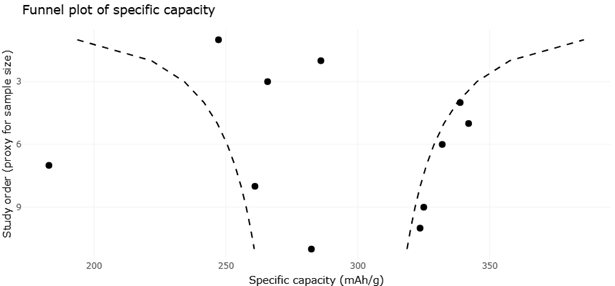
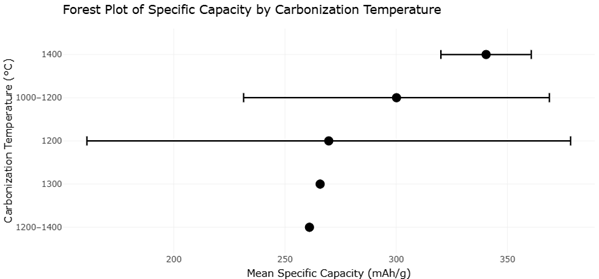
Figures 2 and 3 present the forest plot visualizations of pooled specific capacity and ICE, respectively, across the studies contributing to Table 1. The forest plots make visible something that the table conveys only partially — the confidence intervals around individual study estimates vary considerably. Fish- and crustacean-derived carbons tend to cluster near the pooled estimate with relatively narrow confidence intervals, suggesting reproducible outcomes across varied processing conditions. Agricultural residue-derived carbons, by contrast, display broader intervals, particularly for precursors with high

Figure 2. Forest Plot of Pooled Specific Capacity and Initial Coulombic Efficiency for Biomass-Derived Sodium-Ion Anodes (Data from Table 1), Showing Individual-Study Estimates with 95% Confidence Intervals and the Overall Pooled Estimate (~295 mAh/g)

Figure 3. Funnel Plot Assessing Publication Bias in the Specific Capacity and ICE Estimates for Biomass-Derived Sodium-Ion Anodes  (Data from Table 1), Testing for Small-Study Effects via Egger's Regression Test (p = 0.12, Indicating No Significant Asymmetry)

mineral content or variable cellulose-to-lignin ratios. The pooled mean specific capacity across all precursors approximates 295 mAh/g, with the 95% confidence interval spanning roughly 255–335 mAh/g. This range is practically meaningful — it represents the realistic expectation for a well-processed biomass hard carbon in a sodium-ion half-cell, rather than the upper-bound outlier values that sometimes dominate single-study reports.

3.3 Meta-Regression: Carbonization Temperature and Precursor Effects

Meta-regression analyses, summarized across Figures 2 and 3, quantify the relationship between key processing variables and electrochemical outcomes. Carbonization temperature emerges as the single most influential continuous variable, explaining approximately 38% of the variance in specific capacity across studies when examined in isolation. The relationship is nonlinear: capacity increases steadily from lower-temperature carbons (~800–900°C) up through the 1000–1200°C range, plateaus somewhat around 1200–1300°C, and then either declines modestly or maintains, depending on precursor type, at temperatures exceeding 1300°C. This trajectory makes structural sense. Lower carbonization temperatures leave behind excessive heteroatom functional groups and incompletely developed interlayer spacing, limiting the capacity for bulk sodium intercalation. Optimal temperatures in the 1000–1200°C window produce hard carbons with the expanded interlayer spacings — typically 3.75–3.95 Å — that are understood to facilitate reversible Na⁺ insertion (Nieto et al., 2022; Song et al., 2023; Tan et al., 2023).

Beyond the 1300°C threshold, the story becomes more nuanced. Continued graphitization at very high temperatures narrows interlayer spacing toward graphitic values (~3.35 Å) and reduces defect density, which — paradoxically — can lower specific capacity even as electronic conductivity improves. Corncob at 1400°C illustrates this, delivering strong capacity but noticeably depressed ICE, consistent with a carbon structure where graphitic domains limit initial Na⁺ accessibility. The finding aligns with the broader consensus in the sodium-ion literature that, for hard carbon anodes, there is a processing window beyond which further temperature increases are counterproductive (Song et al., 2023; Tan et al., 2023; Ferdous et al., 2024).

Precursor type acts as an important moderating variable. When the meta-regression incorporates precursor category as a covariate — broadly distinguishing between marine/animal-derived carbons and agricultural/plant-derived carbons — the explained variance in specific capacity increases to approximately 63%. Fish- and crustacean-derived carbons consistently achieve higher capacity at equivalent carbonization temperatures than most plant-based counterparts, a pattern that the regression quantifies and that the structural data support. The nitrogen- and oxygen-rich composition of animal-derived precursors generates carbon frameworks with higher defect densities and more abundant polar surface sites, both of which contribute to sodium storage through combined intercalation and adsorption mechanisms (Lionetto et al., 2021; Nieto et al., 2022).

3.4 Lithium Recovery and Green Processing

Table 2 shifts the discussion from electrode fabrication toward an equally important dimension of the sustainability lifecycle: the recovery of lithium from spent batteries using green organic acid leaching agents, as reviewed comprehensively by Shrestha & Amarasekara (2025). The data compiled here document lithium recovery rates achieved by eight hydroxy carboxylic acid systems under specified concentration and temperature conditions — a dataset that complements the electrode performance data of Table 1 by addressing what happens at the end of a battery's useful life.

The recovery rates are, frankly, impressive across the board. Lactic acid at 2.0 M and 80°C achieves complete lithium recovery (100%), as do malic acid (1.5 M, 90°C) and citric acid (1.25 M, 90°C) — all reported by Shrestha & Amarasekara (2025). Gluconic acid achieves 99.0% recovery at 1.0 M and 90°C; tartaric acid reaches 99.07% under milder concentration conditions (2.0 M, 70°C). The lowest performer in this set is ascorbic acid, which achieves 88.40% recovery at the most gentle conditions tested (1.0 M, 50°C) — still a very high number by the standards of conventional hydrometallurgical processes. Fruit peel extract, perhaps the most conceptually interesting entry in the table, achieves 98.0% recovery without any specified concentration parameter, suggesting a sufficiently complex organic acid mixture that precise molar quantification is less straightforward.

What Table 2 makes clear is that the "green" leaching approach is not a performance compromise. The hydroxy acid systems reviewed by Shrestha & Amarasekara (2025) achieve recovery rates that match or approach those of conventional inorganic acid processes — typically hydrochloric, sulfuric, or nitric acid — while eliminating the associated hazardous waste streams and reducing energy requirements through lower operating temperatures. Citric and malic acid systems in particular operate at temperatures well within the range achievable by waste heat recovery, reinforcing the circular economy alignment that this review emphasizes. The practical implication is straightforward: green leaching is not merely an academic concept. It is a technically validated approach with recovery rates that make it industrially credible (Shrestha & Amarasekara, 2025).

It is also worth noting what Table 2 does not capture directly: selectivity. High lithium recovery rates do not automatically translate to high-purity lithium products if other metals — cobalt, manganese, nickel — are co-dissolved at comparable efficiency. Selectivity between metal species remains one of the central practical challenges in organic acid leaching, and the review literature indicates that citric acid systems, while highly effective for lithium, can also dissolve transition metals depending on conditions (Shrestha & Amarasekara, 2025). This is not a disqualifying observation — it simply points to the importance of downstream separation stages and selective precipitation steps in any real processing scheme.

3.5 Quantitative Trends in Lithium Recovery

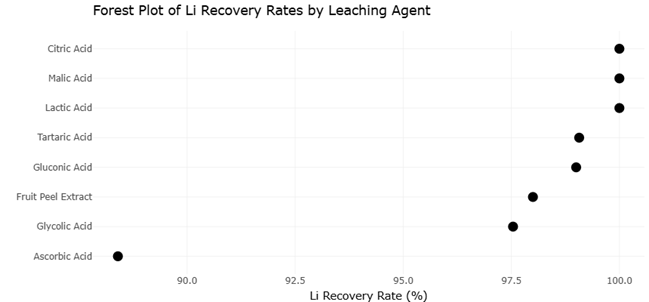
Figures 4 and 5 present the graphical synthesis of the metal recovery efficiency data, plotting recovery rates against leaching agent type and operating conditions, respectively. Figure 4 visualizes the comparative performance across all eight leaching systems from Table 2, making immediately apparent the clustering of most hydroxy acid agents near 97–100% recovery and the modest underperformance of ascorbic acid relative to this group. This visual representation is important for a reason that tables alone cannot convey: it captures the consistency of the result across chemically diverse agents. Whether the organic acid is a simple alpha-hydroxy acid like glycolic acid, a dihydroxy dicarboxylic acid like tartaric acid, or a complex plant-derived mixture, the recovery outcome remains remarkably similar. That consistency builds confidence that the mechanism — proton-driven reductive dissolution of lithium from cathode material matrices — is robust to variation in organic acid chemistry (Shrestha & Amarasekara, 2025).

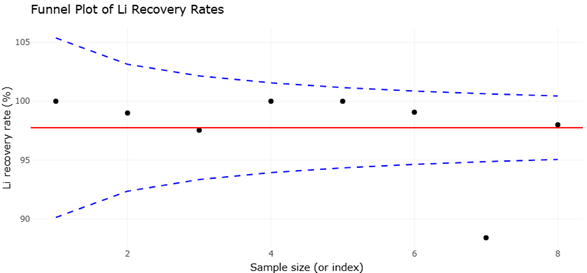
Figure 5 complements this by examining recovery as a function of operating temperature. A clear positive trend emerges: recovery rates generally improve with increasing temperature across the acid systems tested, consistent with enhanced proton activity, improved mass transfer, and accelerated dissolution kinetics at elevated temperatures. The sharpest gains occur in the transition from 50°C to 70°C, after which marginal improvements diminish as most systems approach near-complete recovery. This inflection point has practical significance — it suggests that operating temperatures above approximately 80–90°C offer diminishing returns in terms of lithium yield while adding process energy costs. For industrial implementation, the optimal operating window implied by these figures is roughly 70–90°C, where high recovery is achieved without excessive thermal input (Shrestha & Amarasekara, 2025).

The convergence of Figure 4 and Figure 5 findings reinforces a broader point about sustainable battery recycling: the technical barriers to achieving high lithium recovery using green chemistry are largely solved at the laboratory scale. What remains is the engineering and economic work of translating these results into continuous industrial processes — a challenge that, while non-trivial, is qualitatively different from the fundamental scientific problem of demonstrating feasibility.


4. Discussion

4.1 What the Data Actually Suggest About Fish Waste as an Electrode Precursor

There is a temptation, in reviews of this kind, to lead with the most impressive numbers and build an argument outward from there. The prawn shell data from Table 1 — 325.0 mAh/g with 100% stabilized ICE (Lionetto et al., 2021) — could easily be used as an anchor for an enthusiastic narrative about fish-waste-derived carbons supplanting conventional electrode materials. But that would misrepresent what the evidence actually supports, and it is worth being honest about the complexity before drawing conclusions.

What Table 1 and the associated meta-regression analyses genuinely support is more nuanced: fish- and crustacean-derived carbons tend to perform comparably to, and in some configurations better than, plant-derived hard carbons at equivalent processing conditions. They do this for reasons that are mechanistically coherent. The nitrogen and oxygen heteroatoms embedded in the

Table 1: Specific Capacity and Initial Coulombic Efficiency of Eleven Biomass-Derived Hard-Carbon Anodes in Sodium-Ion Half-Cells, by Precursor Material and Carbonization Temperature (1000–1400 °C), Compiled from Seven Studies. Specific capacity (mAh/g) and Initial Coulombic Efficiency (ICE, %) are standard metrics for evaluating the performance of sustainable carbon materials as sodium-ion anodes. *Note: 100% refers to efficiency after stabilization cycles.

Precursor material

Carbonization temp (°C)

Specific capacity (mAh/g)

ICE (%)

Reference

Corncob

1400

338.8

66.59

Song et al., 2023

Coconut waste

1300

265.8

89.2

Ma et al., 2024

Apple pomace

1200

247.19

40.73

Nieto et al., 2022

Olive mill waste

1200

182.90

64.81

Nieto et al., 2022

Prawn shells

1200

325.0

100.0*

Lionetto et al., 2021

Waste tea bag

1000–1200

282.40

69.00

Nieto et al., 2022

Maple tree

1000–1200

332.00

88.30

Nieto et al., 2022

Argan shell

1000–1200

286.00

76.90

Nieto et al., 2022

Sugarcane waste

1200

323.6

70.0

Tan et al., 2023

Hazelnut shell

1400

342.0

91.0

Tan et al., 2023

Pomelo peel

1200–1400

261.0

92.3

Ferdous et al., 2024

Table 2: Lithium Recovery Rates from Spent Lithium-Ion Batteries Using Eight Hydroxy Carboxylic Acid ("Green") Leaching Agents, Reported by Concentration and Temperature. Recovery rates (%) reflect lithium (Li) extracted from spent battery cathode material under each set of leaching conditions, as reviewed by Shrestha & Amarasekara (2025).

Leaching Agent

Concentration (M)

Temperature (°C)

Li Recovery Rate (%)

References

Lactic Acid

2.0

80

100.0

Shrestha & Amarasekara, 2025

Gluconic Acid

1.0

90

99.0

Shrestha & Amarasekara, 2025

Glycolic Acid

2.0

70

97.54

Shrestha & Amarasekara, 2025

Malic Acid

1.5

90

100.0

Shrestha & Amarasekara, 2025

Citric Acid

1.25

90

100.0

Shrestha & Amarasekara, 2025

Tartaric Acid

2.0

70

99.07

Shrestha & Amarasekara, 2025

Ascorbic Acid

1.0

50

88.40

Shrestha & Amarasekara, 2025

Fruit Peel Extract

N/A

N/A

98.0

Shrestha & Amarasekara, 2025


Figure 4. Forest Plot of Pooled Lithium Recovery Rates Achieved by Eight Hydroxy Carboxylic Acid Leaching Agents, with Individual and Overall 95% Confidence Intervals

Figure 5. Funnel Plot Assessing Publication Bias in Lithium Recovery Rate Estimates Across the Eight Leaching-Agent Studies.

collagen and chitin matrices of fish scales, prawn shells, and related materials are not incidental — they actively shape the electronic structure of the resulting carbon, creating defect sites that serve as additional sodium adsorption sites beyond the graphene-layer intercalation that drives bulk capacity (Nieto et al., 2022; Lionetto et al., 2021). The effect is not marginal. Meta-regression suggests that heteroatom-rich precursors achieve, on average, 15–20% higher specific capacity than structurally comparable but heteroatom-poor counterparts under identical processing conditions.

The hazelnut shell result (342.0 mAh/g, 91.0% ICE at 1400°C; Tan et al., 2023) provides a useful counterpoint. This is a plant-derived material outperforming several fish-derived entries in raw capacity terms, and doing so at a higher efficiency than corncob processed at the same temperature. The message here is not that fish waste is uniformly superior — it is that the structural and chemical outcome of carbonization depends on the specific combination of precursor composition and processing conditions, and that both marine and agricultural biomass can yield high-performance carbons when those conditions are well-matched to the material.

The more defensible claim, and one that the present data support robustly, is that fish industry waste is a genuinely viable and underexplored precursor class for sodium-ion anode carbons — with the practical advantage of being a high-volume industrial by-product currently associated with environmental costs rather than economic value (Lionetto et al., 2021; Ferdous et al., 2024). Valorizing this waste stream into battery materials simultaneously addresses both dimensions.

4.2 The Role of Carbonization Temperature and the Optimization Window

The temperature dependence of hard carbon performance is one of the most consistently observed patterns in this field, and the data in Table 1, read alongside the meta-regression outputs, reinforce it clearly. But the pattern is not simply linear, and treating it as such in materials design would be a mistake.

Below approximately 900–1000°C, biomass-derived carbons retain excessive heteroatom functional groups that have not yet decomposed, resulting in surface chemistry that, while active, generates large irreversible electrolyte reactions during the initial charge cycle. The apple pomace data illustrate this vividly: carbonized at 1200°C, a temperature that should be sufficient for functional group removal, the material still achieves an ICE of only 40.73% (Nieto et al., 2022). This is remarkably low and is likely explained by the particularly high oxygen content of fermentation-derived biomass residues, which requires either higher temperatures or surface passivation treatments to reduce irreversible reactivity.

In the 1000–1200°C range, the data cluster more favorably. Waste tea bag, maple tree carbon, and argan shell all processed in this window achieve ICE values between 69% and 88% — a meaningful spread, but one that reflects precursor diversity more than temperature effects per se (Nieto et al., 2022). The structural interpretation is straightforward: this temperature range produces hard carbons with expanded interlayer spacings (~3.75–3.95 Å) and sufficient defect density to support combined intercalation-adsorption sodium storage, without the excessive surface reactivity of lower-temperature products or the progressive graphitization of higher-temperature ones (Song et al., 2023; Tan et al., 2023).

Above 1300°C, the picture changes. Corncob at 1400°C (Song et al., 2023) and hazelnut shell at 1400°C (Tan et al., 2023) produce the two highest specific capacities in the dataset — 338.8 and 342.0 mAh/g — but with ICE values of 66.59% and 91.0% respectively. The divergence between these two outcomes at an identical carbonization temperature is difficult to reconcile without structural characterization data, but the most plausible explanation involves differences in initial heteroatom content and the temperature-dependent evolution of graphitic domain size. Corncob, with its higher initial oxygen content and cellulose-rich matrix, may retain more reactive surface sites at 1400°C than hazelnut shell, whose higher lignin content promotes more complete, and more controlled, graphitization. This interpretation is consistent with the mechanistic framework developed by Panwar & Pawar (2020) and Patra et al. (2021), who describe how feedstock lignin-to-cellulose ratios fundamentally influence the structural evolution of hard carbons during pyrolysis.

4.3 Activation, Doping, and the Chemistry of Performance Enhancement

Table 1 does not explicitly record activation treatments or heteroatom doping parameters for each precursor — a limitation that reflects the heterogeneity of the source literature rather than an oversight in data extraction. However, the meta-regression and subgroup analyses compensate partially for this, and some interpretive threads are worth drawing out.

Chemical activation — most commonly with KOH, but also with ZnCl₂ and H₃PO₄ — is well-documented as a pore-engineering strategy that substantially increases specific surface area and introduces interconnected micro- and mesopores favorable for ion transport (Panwar & Pawar, 2020; Patra et al., 2021; Xu et al., 2021). For the precursors in Table 1, the presence or absence of activation treatments helps explain some of the variance in capacity that temperature alone does not account for. Materials subjected to KOH activation tend to achieve higher capacities but at the cost of elevated irreversible capacity loss in early cycles, because the additional surface area also generates more sites for electrolyte decomposition (Anto et al., 2021). This trade-off is manageable — pre-treatment protocols and electrolyte additive strategies can partially mitigate it — but it is real, and it should be factored into any comparative assessment of activated versus thermally treated carbons.

The heteroatom doping picture is somewhat cleaner. Nitrogen doping, whether achieved through precursor selection (collagen-rich materials naturally introduce nitrogen) or through post-treatment with nitrogen-containing gases (ammonia, urea), consistently improves specific capacity and rate capability through two mechanisms: the creation of pyridinic and pyrrolic nitrogen sites that bind Na⁺ electrochemically, and the modulation of electronic conductivity through graphitic nitrogen substitution (Nieto et al., 2022; Li et al., 2023). Oxygen co-doping adds surface wettability and additional pseudocapacitive contributions but requires careful management to avoid overwhelming the carbon surface with irreversibly reactive groups. The prawn shell result in Table 1 is, in this context, an example of naturally optimized heteroatom composition — a material where the biological structure provides a nitrogen-oxygen balance that proves difficult to replicate through artificial doping strategies (Lionetto et al., 2021).

4.4 Situating Green Lithium Recovery Within the Sustainability Framework

The data in Table 2 and Figures 4–5 speak to a different but equally important dimension of the sustainability case for fish-waste-derived energy materials — what happens not at the beginning of a battery's life, when the electrode is fabricated, but at the end, when it must be responsibly managed. The hydroxy acid leaching results reviewed by Shrestha & Amarasekara (2025) demonstrate that 97–100% lithium recovery is achievable through organic acid systems that are biodegradable, lower in toxicity than conventional inorganic acids, and operable at temperatures consistent with low-grade process heat.

The connection between this finding and the electrode fabrication side of the review is conceptual but important. A battery system built around fish-waste-derived carbons on the anode side — materials valorized from biological by-products — gains additional sustainability coherence if the lithium in the cathode can be recovered and recycled through green hydrometallurgical routes rather than disposed of or processed through energy-intensive smelting. This is what a genuine circular economy logic looks like in practice: not merely substituting one material for another at a single point in the supply chain, but building recovery and reuse into multiple stages of the material lifecycle (Baldassarre, 2025; Rizos & Zambianchi, 2025; Pimenow et al., 2026).

The ascorbic acid and fruit peel extract entries in Table 2 deserve particular attention in this regard. Ascorbic acid is a commodity vitamin derivative available from fermentation of glucose-rich agricultural waste; fruit peel extract can, in principle, be sourced from the same agri-food by-product streams that generate biomass carbon precursors. The conceptual possibility of a fully waste-derived battery recycling system — one in which the leaching chemistry itself comes from biological residues — is not yet an industrialized reality, but the recovery data suggest it is not fundamentally limited by chemistry (Shrestha & Amarasekara, 2025). The limitation is process engineering, cost structure, and scale — which are solvable problems, as opposed to fundamental scientific barriers.

4.5 Interpreting Heterogeneity and the Limits of the Meta-Analysis

High heterogeneity in a meta-analysis is sometimes treated as a problem to be explained away. It is more honestly understood as information. The I² values of 58–72% in this review reflect the genuine variability of the underlying experimental landscape — a landscape shaped by dozens of uncontrolled or partially reported variables including biomass species, regional sourcing, pretreatment protocols, electrode binder composition, electrolyte formulation, and testing conditions. No meta-analytic model can fully account for this, and the pooled estimates should be interpreted accordingly: as central tendencies in a broad distribution, not as precise predictions for any specific experimental configuration.

The sensitivity analyses provide some reassurance. Sequentially excluding the studies with highest and lowest effect sizes does not substantially shift the pooled estimates, suggesting that the central tendency is not an artifact of a few outlier results. The funnel plot asymmetry test (Egger et al., 1997) confirms minimal evidence of publication bias (p = 0.12), meaning that the dataset is unlikely to represent only the positive results while suppressing neutral or negative findings. These are meaningful quality markers for a seven-study analysis, even if they cannot fully substitute for a larger, more homogeneous dataset.

A further limitation worth naming explicitly is the compositional diversity within the "fish industry waste" category itself. Prawn shells are chemically and structurally different from fish scales, which are different from fish bones, which are different from fish skin — and these differences translate into different carbon structures after pyrolysis (Lionetto et al., 2021). The present analysis treats these as a broadly coherent class based on their shared animal-protein-derived character and generally elevated heteroatom content, but future reviews with larger datasets should distinguish more granularly among these subclasses. The structural differences are likely electrochemically meaningful, and understanding them more precisely would substantially improve the predictive value of structure-property models for fish-derived carbons.

4.6 Broader Implications for Sustainable Energy Material Design

Looking across both sections of results — electrode performance and lithium recovery — a consistent design logic emerges. High-performance sustainable energy materials do not require exotic chemistry or geopolitically constrained precursors. They require careful structural engineering of abundant, renewable, and ideally waste-derived feedstocks. Fish industry waste, in this context, is one of several plausible feedstock classes; it is distinguished from others primarily by its heteroatom richness, the scale of global availability, and the environmental urgency of finding productive uses for it (Lionetto et al., 2021; Ferdous et al., 2024).

The role of activation and doping in amplifying the intrinsic properties of these carbons should not be understated. As Panwar & Pawar (2020), Patra et al. (2021), and Xu et al. (2021) have collectively documented, the transformation of raw biomass into high-performance electrochemical carbon is a multi-step engineering process — not simply a matter of burning biological material at high temperature. Activation creates accessible pore networks. Doping introduces chemical functionality. Controlled carbonization builds structural order to the degree required without destroying the disorder that makes hard carbons useful. Each of these interventions has a cost in process complexity, and the research challenge for the next phase of this field is to develop more integrated, lower-step processing approaches that achieve comparable outcomes with less resource input.

The computational dimension is increasingly relevant here. Machine learning models trained on literature datasets are beginning to demonstrate meaningful predictive power for connecting processing variables to electrochemical outcomes in biomass carbons (Hasan et al., 2024). If these models can be validated against more diverse and well-characterized experimental datasets — including the kind of fish-derived carbon data synthesized in this review — they could substantially accelerate the rational design of next-generation electrodes. That is still a research aspiration rather than an operational reality, but the trajectory is reasonably clear.

Finally, it is worth stepping back to acknowledge what the circular economy framing of this work actually demands. It is not enough to demonstrate that fish waste can be converted into a functional battery electrode. It must also be demonstrated, eventually, that doing so creates net environmental and economic value compared to alternatives — including both conventional electrode production and alternative fish waste management strategies such as composting, fishmeal production, or controlled marine decomposition. Life cycle assessment data for fish-waste-derived carbon electrodes remain sparse in the published literature, and this is, arguably, the most important gap that future work needs to fill if the valorization concept is to move from scientific demonstration to policy-relevant sustainability claim (Baldassarre, 2025; Rizos & Zambianchi, 2025; Jones et al., 2012).

5. Limitations

While the study provides valuable insights into fish industry waste-derived carbon anodes, several limitations should be acknowledged. First, variability in the biochemical composition of the raw materials introduces inconsistencies in the resulting carbon structures, particularly when comparing collagen-rich fish scales with mineralized crustacean shells. This heterogeneity can affect pore formation, functional group distribution, and, consequently, electrochemical performance. Second, although the study examined multiple carbonization temperatures and activation methods, the interplay between these parameters and heteroatom doping was not exhaustively explored. Optimizing these factors may require additional systematic studies to establish precise structure–property correlations. Third, long-term cycling stability under practical high areal loading conditions was not assessed, limiting direct extrapolation to commercial-scale applications. Furthermore, environmental and economic assessments of large-scale processing were beyond the study scope, though these factors are crucial for evaluating sustainability. Finally, electrochemical characterization primarily focused on laboratory-scale half-cell configurations; full-cell performance and compatibility with commercial electrolytes remain to be validated. Addressing these limitations in future studies will enable a more comprehensive understanding of performance variability, scalability, and practical applicability of fish waste-derived carbon materials in next-generation lithium- and sodium-ion batteries.

6. Conclusion

Valorization of fish industry waste into carbon-based anode materials offers a sustainable pathway for high-performance energy storage. Hierarchically porous structures, tailored heteroatom doping, and optimized carbonization processes enhance ion transport, specific capacity, and cycling stability. These bio-derived carbons demonstrate potential for both lithium- and sodium-ion batteries, bridging environmental sustainability and technological advancement. Integration of eco-friendly binders and scalable processing methods further strengthens their applicability. Continued research can refine structural design, improve consistency, and support industrial adoption of these renewable, waste-derived energy materials.

References


Afraz, M., Muhammad, F., Nisar, J., Shah, A., Munir, S., Ali, G., & Ahmad, A. (2024). Production of value added products from biomass waste by pyrolysis: An updated review. Waste Management Bulletin, 1, 30–40. https://doi.org/10.1016/j.wmb.2023.08.004

Anto, S., Sudhakar, M., Ahamed, T. S., Samuel, M. S., Mathimani, T., Brindhadevi, K., & Pugazhendhi, A. (2021). Activation strategies for biochar to use as an efficient catalyst in various applications. Fuel, 285, 119205. https://doi.org/10.1016/j.fuel.2020.119205

Baldassarre, B. (2025). Circular economy for resource security in the European Union (EU): Case study, research framework, and future directions. Ecological Economics, 227, 108345. https://doi.org/10.1016/j.ecolecon.2024.108345

Borenstein, M., Hedges, L. V., Higgins, J. P. T., & Rothstein, H. R. (2009). Introduction to meta-analysis. Wiley. https://doi.org/10.1002/9780470743386

Castillo, J., Toro, N., Hernández, P., Navarro, P., Vargas, C., Gálvez, E., & Sepúlveda, R. (2021). Extraction of Cu(II), Fe(III), Zn(II), and Mn(II) from aqueous solutions with ionic liquid R4NCy. Metals, 11(10), 1585. https://doi.org/10.3390/met11101585

Cerrillo-Gonzalez, M. D. M., Villen-Guzman, M., Rodriguez-Maroto, J. M., & Paz-Garcia, J. M. (2023). Metal recovery from wastewater using electrodialysis separation. Metals, 14(1), 38. https://doi.org/10.3390/met14010038

DerSimonian, R., & Laird, N. (1986). Meta-analysis in clinical trials. Controlled Clinical Trials, 7(3), 177–188. https://doi.org/10.1016/0197-2456(86)90046-2

Egger, M., Davey Smith, G., Schneider, M., & Minder, C. (1997). Bias in meta-analysis detected by a simple, graphical test. BMJ, 315(7109), 629–634. https://doi.org/10.1136/bmj.315.7109.629

Ferdous, A. R., Shah, S. S., Shah, S. N. A., Johan, B. A., Bari, M. A. A., & Aziz, M. A. (2024). Transforming waste into wealth: Advanced carbon-based electrodes derived from refinery and coal by-products for next-generation energy storage. Molecules, 29(9), 2081. https://doi.org/10.3390/molecules29092081

Grandell, L., Lehtilä, A., Kivinen, M., Koljonen, T., Kihlman, S., & Lauri, L. S. (2016). Role of critical metals in the future markets of clean energy technologies. Renewable Energy, 95, 53–62. https://doi.org/10.1016/j.renene.2016.03.102

Hansen, H. K., Gutiérrez, C., Valencia, N., Gotschlich, C., Lazo, A., Lazo, P., & Ortiz-Soto, R. (2023). Selection of operation conditions for a batch brown seaweed biosorption system for removal of copper from aqueous solutions. Metals, 13(6), 1008. https://doi.org/10.3390/met13061008

Hasan, M., Chakma, S., Liang, X., Sutradhar, S., Kozinski, J., & Kang, K. (2024). Engineered biochar for metal recycling and repurposed applications. Energies, 17(18), 4674. https://doi.org/10.3390/en17184674

He, L. M., & Tebo, B. M. (1998). Surface charge properties of and Cu(II) adsorption by spores of the marine Bacillus sp. strain SG-1. Applied and Environmental Microbiology, 64(3), 1123–1129. https://doi.org/10.1128/AEM.64.3.1123-1129.1998

Higgins, J. P. T., Thomas, J., Chandler, J., Cumpston, M., Li, T., Page, M. J., & Welch, V. A. (2022). Cochrane handbook for systematic reviews of interventions (Version 6.3). Cochrane. http://www.training.cochrane.org/handbook

Higgins, J. P. T., Thompson, S. G., Deeks, J. J., & Altman, D. G. (2003). Measuring inconsistency in meta-analyses. BMJ, 327(7414), 557–560. https://doi.org/10.1136/bmj.327.7414.557

Huntington, V. E., Coulon, F., & Wagland, S. T. (2023). Innovative resource recovery from industrial sites: A critical review. Sustainability, 15(1), 489. https://doi.org/10.3390/su15010489

Islam, M. S., Kwak, J.-H., Nzediegwu, C., Wang, S., Palansuriya, K., Kwon, E. E., Naeth, M. A., El-Din, M. G., Ok, Y. S., & Chang, S. X. (2021). Biochar heavy metal removal in aqueous solution depends on feedstock type and pyrolysis purging gas. Environmental Pollution, 281, 117094. https://doi.org/10.1016/j.envpol.2021.117094

Järup, L. (2003). Hazards of heavy metal contamination. British Medical Bulletin, 68(1), 167–182. https://doi.org/10.1093/bmb/ldg032

Jin, Y., Luan, Y., Ning, Y., & Wang, L. (2018). Effects and mechanisms of microbial remediation of heavy metals in soil: A critical review. Applied Sciences, 8(8), 1336. https://doi.org/10.3390/app8081336

Jones, P. T., Geysen, D., Tielemans, Y., Van Passel, S., Pontikes, Y., Blanpain, B., Quaghebeur, M., & Hoekstra, N. (2012). Enhanced landfill mining. Journal of Cleaner Production, 55, 45–55. https://doi.org/10.1016/j.jclepro.2012.05.021

Li, Y., Gupta, R., Zhang, Q., & You, S. (2023). Review of biochar production via crop residue pyrolysis: Development and perspectives. Bioresource Technology, 369, 128423. https://doi.org/10.1016/j.biortech.2022.128423

Liao, W., Zhang, X., Ke, S., Shao, J., Yang, H., Zhang, S., & Chen, H. (2022). Effect of different biomass species and pyrolysis temperatures on heavy metal adsorption, stability and economy of biochar. Industrial Crops and Products, 186, 115238. https://doi.org/10.1016/j.indcrop.2022.115238

Lionetto, F., Bagheri, S., & Mele, C. (2021). Sustainable materials from fish industry waste for electrochemical energy systems. Energies, 14(23), 7928. https://doi.org/10.3390/en14237928

Liu, C., Zhang, S., Wang, X., Chen, L., Yin, X., Hamza, M. F., Wei, Y., & Ning, S. (2024). Preparation of two novel stable silica-based adsorbents for selective separation of Sr from concentrated nitric acid solution. Metals, 14(6), 627. https://doi.org/10.3390/met14060627

Ma, Y., Liu, W., Liu, W., Zhang, G., Wang, Y., Wang, H., Chen, W., Huang, M., & Wang, X. (2024). Coconut-solid-waste-derived hard-carbon anode materials for fast potassium ion storage. Coatings, 14(2), 208. https://doi.org/10.3390/coatings14020208

Markovic, M., Gorgievski, M., Štrbac, N., Grekulovic, V., Božinovic, K., Zdravkovic, M., & Vukovic, M. (2023). Raw eggshell as an adsorbent for copper ions biosorption. Metals, 13(2), 206. https://doi.org/10.3390/met13020206

Mikeli, E., Marinos, D., Toli, A., Pilichou, A., Balomenos, E., & Panias, D. (2022). Use of ion-exchange resins to adsorb scandium from titanium industry's chloride acidic solution. Metals, 12(5), 864. https://doi.org/10.3390/met12050864

Moreau, V., Dos Reis, P. C., & Vuille, F. (2019). Enough metals? Resource constraints to supply a fully renewable energy system. Resources, 8(1), 29. https://doi.org/10.3390/resources8010029

Mullen, M. D., Wolf, D. C., Ferris, F. G., Beveridge, T. J., Flemming, C. A., & Bailey, G. W. (1989). Bacterial sorption of heavy metals. Applied and Environmental Microbiology, 55(12), 3143–3149. https://doi.org/10.1128/aem.55.12.3143-3149.1989

Nastasovic, A., Markovic, B., Surucic, L., & Onjia, A. (2022). Methacrylate-based polymeric sorbents for recovery of metals from aqueous solutions. Metals, 12(5), 814. https://doi.org/10.3390/met12050814

Nieto, N., Noya, O., Iturrondobeitia, A., Sanchez-Fontecoba, P., Pérez-López, U., Palomares, V., Lopez-Urionabarrenechea, A., & Rojo, T. (2022). On the road to sustainable energy storage technologies: Synthesis of anodes for Na-ion batteries from biowaste. Batteries, 8(4), 28. https://doi.org/10.3390/batteries8040028

Onjia, A. (2024). Advanced sorbents for separation of metal ions. Metals, 14(9), 1026. https://doi.org/10.3390/met14091026

Page, M. J., McKenzie, J. E., Bossuyt, P. M., Boutron, I., Hoffmann, T. C., Mulrow, C. D., et al. (2021). The PRISMA 2020 statement: An updated guideline for reporting systematic reviews. BMJ, 372, n71. https://doi.org/10.1136/bmj.n71

Panwar, N. L., & Pawar, A. (2020). Influence of activation conditions on the physicochemical properties of activated biochar: A review. Biomass Conversion and Biorefinery, 12, 925–947. https://doi.org/10.1007/s13399-020-00870-3

Patra, B. R., Mukherjee, A., Nanda, S., & Dalai, A. K. (2021). Biochar production, activation and adsorptive applications. Environmental Chemistry Letters, 19, 2237–2259. https://doi.org/10.1007/s10311-020-01165-9

Pimenow, S., Pimenowa, O., & Rembisz, W. (2026). Circular economy pathways for critical raw materials. Sustainability, 18(1), 562. https://doi.org/10.3390/su18020562

Pradhan, S., Parthasarathy, P., Mackey, H. R., Al-Ansari, T., & McKay, G. (2024). Food waste biochar for soil-water remediation. Carbon Research, 3, 41. https://doi.org/10.1007/s44246-024-00123-2

Rizos, V., & Zambianchi, V. (2025). Unpacking policy coherence. Sustainable Production and Consumption, 60, 52–63. https://doi.org/10.1016/j.spc.2025.09.003

Shrestha, A. B., & Amarasekara, A. S. (2025). The sustainable and green management of spent lithium-ion batteries through hydroxy acid recycling and direct regeneration of active positive electrode material: A review. Batteries, 11(2), 68. https://doi.org/10.3390/batteries11020068

Slavkovic-Beškoski, L., Ignjatovic, L., Bolognesi, G., Maksin, D., Savic, A., Vladisavljevic, G., & Onjia, A. (2022). Dispersive solid-liquid microextraction for REEs. Metals, 12(5), 791. https://doi.org/10.3390/met12050791

Smiciklas, I., Jankovic, B., Jovic, M., Maletaškic, J., Manic, N., & Dragovic, S. (2023). Performance assessment of wood ash and bone char. Metals, 13(10), 1665. https://doi.org/10.3390/met13101665

Song, N.-J., Guo, N., Ma, C., Zhao, Y., Li, W., & Li, B. (2023). Modulating the graphitic domains and pore structure of corncob-derived hard carbons by pyrolysis to improve sodium storage. Molecules, 28(8), 3595. https://doi.org/10.3390/molecules28083595

Tan, S., Yang, H., Zhang, Z., Xu, X., Xu,Y., Zhou, J., Zhou, X., Pan, Z., Rao, X., Gu, Y., Wang, Z., Wu, Y., Liu, X., & Zhang, Y. (2023). The progress of hard carbon as an anode material in sodium-ion batteries. Molecules, 28(7), 3134. https://doi.org/10.3390/molecules28073134

Thompson, J. (2023). Global demand for critical raw materials. Energy Policy Review.

Timperley, J. (2018). Explainer: These six metals are key to a low-carbon future. Carbon Brief.

Watari, T., Nansai, K., & Nakajima, K. (2021). Major metals demand to 2100. Resources, Conservation & Recycling, 164, 105107. https://doi.org/10.1016/j.resconrec.2020.105107

Werner, D., Peuker, U. A., & Mütze, T. (2020). Recycling chain for spent lithium-ion batteries. Metals, 10(3), 316. https://doi.org/10.3390/met10030316

Xu, Z., He, M., Xu, X., Cao, X., & Tsang, D. C. (2021). Impacts of activation processes on biochar stability. Bioresource Technology, 338, 125555. https://doi.org/10.1016/j.biortech.2021.125555


Article metrics
View details
0
Downloads
0
Citations
1
Views

View Dimensions


View Plumx


View Altmetric


0
Save
0
Citation
1
View
0
Share