
Business and Social Sciences

Business and social sciences | Online ISSN 3067-8919
89
Citations
127.2k
Views
48
Articles
Your new experience awaits. Try the new design now and help us make it even better
Switch to the new experience
Figures and Tables
RESEARCH ARTICLE   (Open Access)

Blockchain and Distributed Ledger Technology for Supply Chain Authenticity, Accountability, and Resilience: A Literature-Based Framework

Md. Fazle Alahi Bhuiyan 1*, Md. Nazmul Haque 2

+ Author Affiliations

Business and Social Sciences 1 (1) 1-10 https://doi.org/10.25163/business.1110841

Submitted: 30 January 2023 Revised: 05 April 2023  Published: 13 April 2023 


Abstract

Background: Modern supply chains stretch across borders, institutions, and information systems, and this fragmentation makes it genuinely hard for any single stakeholder to verify where a product came from, who touched it, and why a disruption happened. Distributed Ledger Technology (DLT) is often proposed as a fix, though the enthusiasm surrounding it has, at times, outpaced the evidence.

Methods: This paper undertakes a structured narrative synthesis of peer-reviewed literature (2017–2022) on DLT-enabled supply chains, organizing findings around three interlocking outcomes — authenticity, accountability, and operational resilience — and examining how blockchain, IoT, smart contracts, and governance mechanisms interact within them.

Results: DLT strengthens traceability and auditability by giving participants a shared, tamper-evident record, and its pairing with IoT and smart contracts can meaningfully cut coordination delays. Yet these gains are conditional: they depend on data quality at the point of entry, on governance arrangements that were agreed before deployment, and on how convincingly the physical world is bound to its digital record. Interoperability gaps, scalability ceilings, privacy trade-offs, and the absence of shared performance metrics remain unresolved.

Conclusion: DLT is best understood not as a self-sufficient technical fix but as one component of a socio-technical system — its value depends on the standards, incentives, and institutional discipline built around it.

Keywords: Distributed Ledger Technology; Blockchain; Supply Chain Traceability; Smart Contracts; Operational Resilience

1. Introduction

Supply chains no longer sit inside a single company, or even a single country. A garment might pass through a cotton grower, a spinner, a dye house, a cut-and-sew factory, a freight forwarder, a customs office, and three or four retailers before it reaches a shelf — and each of those actors typically keeps its own records, in its own format, on its own system. This is not a design flaw so much as a natural consequence of specialization: dispersing tasks across firms lets each one focus on what it does best, and that division of labor is part of why global trade works at all (Papadopoulos et al., 2022). But it comes at a cost. When information about a single shipment lives in six different databases, verifying where a product actually originated, or figuring out who is responsible when something goes wrong, becomes a slow and often unreliable process. In sectors where provenance and safety genuinely matter — food, pharmaceuticals, electronics, aerospace — that slowness is not merely inconvenient; it can be dangerous (Rana et al., 2021).

Distributed Ledger Technology has emerged, over roughly the past decade, as one candidate response to this problem. The basic idea is not complicated: instead of every organization maintaining its own private version of events, permitted participants keep, or at least validate, a shared record together. Blockchain is the best-known variant, in which data is grouped into blocks and chained together cryptographically so that altering an earlier entry would be immediately detectable (Hellwig & Huchzermeier, 2022). What is appealing here, at least in principle, is the shift away from unilateral trust — no single company’s database is the arbiter of truth; the ledger itself, distributed across many nodes, plays that role. A reasonably substantial body of work now links blockchain-enabled supply chains to gains in traceability, transparency, and process automation (AL-Ashmori et al., 2022; Hellani et al., 2021).

That said, it would be a mistake to take these claims entirely at face value, and this is where the literature — to its credit — starts to get more careful. A ledger, however tamper-evident, can only record what it is told. If a sensor is faulty, or a supplier misreports a harvest date, the blockchain will faithfully preserve that error forever; immutability guarantees consistency, not correctness (Irannezhad, 2020; A. Kumar et al., 2020). Transparency, too, is not simply switched on. Commercially sensitive data — pricing, volumes, supplier identities — often needs to stay hidden from competitors even while remaining visible to auditors or regulators, which is precisely why most enterprise deployments favor permissioned networks with selective disclosure rather than fully open ledgers. And whether any of this succeeds seems to depend at least as much on organizational incentives, data-exchange standards, contractual arrangements, and cybersecurity practice as it does on the underlying cryptography (Hellwig & Huchzermeier, 2022; Liu et al., 2022).

Given this mixed picture — real promise, but real and under-discussed limitations — the present paper attempts something fairly specific. Rather than adding another isolated case study or another purely technical description of blockchain architecture, we propose an integrated framework, built from the existing literature, for evaluating DLT-based supply chain oversight along three outcomes that we think are too often discussed separately. The first is authenticity: the ability to verify a product’s origin and history. The second is accountability: the capacity to assign responsibility, support audits, and enforce agreed rules. The third is operational resilience: the ability to anticipate, absorb, respond to, and recover from disruption. We also examine how smart contracts, Internet of Things (IoT) sensing, artificial intelligence, and big-data analytics augment — and sometimes complicate — what a distributed ledger can do on its own. The sections that follow work through each of these outcomes in turn, before turning to the barriers that still stand between conceptual promise and dependable, everyday deployment.

1.2 Research Objectives

The principal objective of this study is to examine how Distributed Ledger Technology can improve transparency, traceability, and end-to-end visibility in contemporary, multi-tier supply chains. More specifically, the paper considers how blockchain-based mechanisms support product authentication and counterfeit reduction; how an immutable transaction record can strengthen accountability and audit readiness among stakeholders who do not fully trust one another (Figure 1); and how shared, real-time information exchange contributes to operational resilience — that is, to faster detection of disruption and more coordinated recovery. A further objective is to consider how smart contracts and IoT integration extend automation and real-time decision-making within these systems, and — perhaps most usefully for readers approaching this literature for the first time — to lay out the technical, organizational, and regulatory obstacles (scalability, interoperability, privacy, cost) that continue to constrain adoption, before closing with directions for future research.

1.3 Research Questions

How can Distributed Ledger Technology enhance transparency and end-to-end traceability across complex, multi-tier supply chain networks?

How can blockchain systems increase product authenticity and reduce counterfeiting in global supply chains?

What do immutable ledger records contribute to accountability and trust between supply chain stakeholders?

How can smart contracts automate supply chain processes to improve efficiency and coordination?

What opportunities arise from connecting IoT devices with blockchain systems for real-time monitoring and decision-making?

How does DLT contribute to operational resilience — specifically, faster response and recovery — during supply chain disruptions?

What technical, organizational, and regulatory obstacles constrain blockchain-based supply chain solutions?

How might scalability, interoperability, privacy, and cost barriers to global DLT adoption be addressed?
2. Methodology

2.1 Review design

This study adopts a structured narrative (critical) literature synthesis rather than a fully quantitative systematic review or meta-analysis. That choice reflects the state of the underlying evidence: empirical, comparable, quantitative studies of DLT performance in real supply chain deployments remain scarce, and much of what exists is conceptual, case-based, or simulation-driven. A structured narrative approach lets us draw connections across a heterogeneous evidence base while still applying an explicit, reportable protocol — search strategy, eligibility criteria, and a documented screening process — so that another researcher could, in principle, retrace our steps and arrive at a similar set of included sources.

2.2 Search strategy

Literature was identified through systematic searches of [Scopus, Web of Science, and Google Scholar] conducted between [insert start date] and [insert end date]. Search strings combined core concepts using Boolean operators, for example: (“distributed ledger technology” OR “blockchain”) AND (“supply chain” OR “logistics”) AND (“traceability” OR “transparency” OR “accountability” OR “resilience”). Reference lists of retrieved articles were also hand-searched (a “snowball” step) to capture relevant work not surfaced by the database queries.

2.3 Eligibility criteria

Studies were included if they (a) were published in a peer-reviewed journal or an edited academic volume between 2017 and 2022; (b) addressed DLT or blockchain application within a supply chain, logistics, or provenance-tracking context; and (c) were available in English with full-text access. Studies were excluded if they addressed blockchain purely in a financial-trading or cryptocurrency-speculation context unconnected to physical supply chains, or if they were non-peer-reviewed opinion pieces, preprints without subsequent publication, or duplicate reports of the same dataset.

2.4 Screening and selection

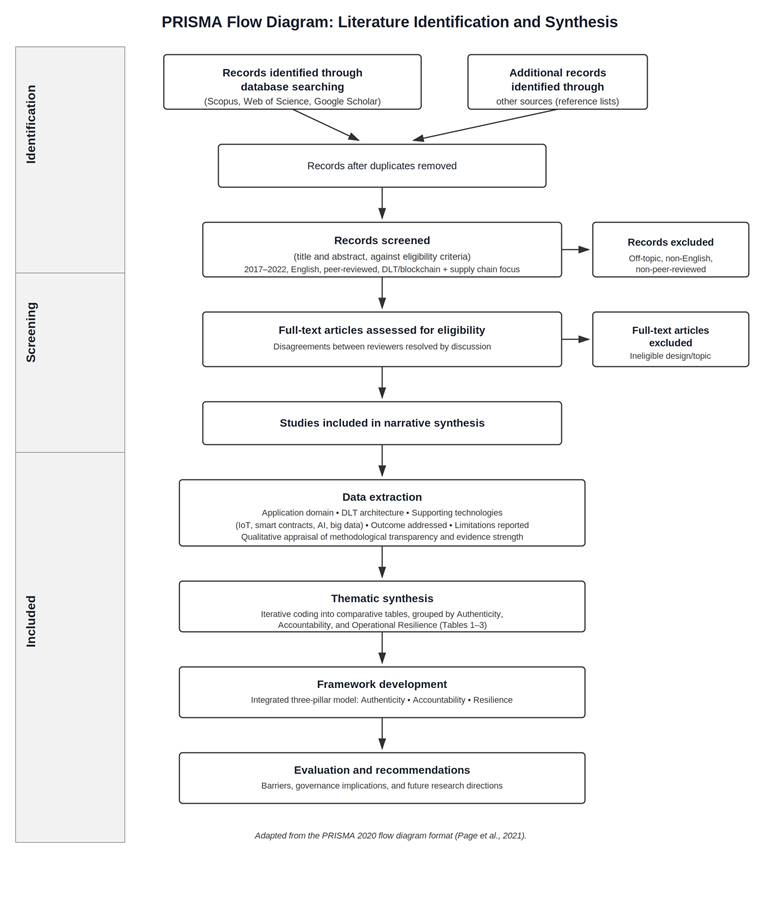
Records were screened in two stages: an initial title/abstract screen against the eligibility criteria above, followed by full-text review of the remaining articles. A PRISMA-style flow diagram summarizing this process is provided in Figure 1.

2.5 Data extraction and synthesis

For each included study, we extracted the application domain (e.g., food, pharmaceuticals, electronics), the DLT architecture described (public, permissioned, hybrid), the supporting technologies discussed (IoT, smart contracts, AI, big data), the outcome(s) addressed (authenticity, accountability, resilience), and the principal limitations or barriers reported. These extractions were then thematically grouped into the comparative tables presented in Sections 5–8 (Tables 1–3), following an iterative coding process in which categories were refined as new studies were added, rather than fixed in advance.

2.6 Quality appraisal

Because the included literature spans conceptual papers, case studies, and empirical evaluations, a single standardized quality-appraisal instrument (e.g., a Cochrane-style risk-of-bias tool) was not applicable. Instead, each study was assessed qualitatively for methodological transparency (whether the DLT architecture and evaluation context were clearly described) and for the strength of the underlying evidence (empirical deployment versus conceptual proposal versus simulation), and this distinction is reflected in how confidently claims are stated throughout the Results and Discussion.

3. Results and Discussion

3.1 DLT Architecture and the Traceability Framework

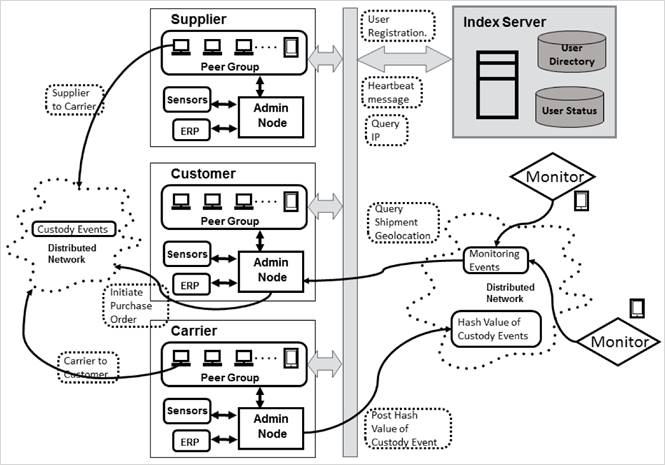
The proposed framework treats suppliers, carriers, and customers as peer nodes within a decentralized architecture, with no single central server mediating exchange (Figure 2). Custody events — a shipment changing hands, a temperature reading, a customs clearance — are hashed and written to the shared ledger,

Figure 1. PRISMA-informed flow of the literature identification, screening, eligibility assessment, and thematic synthesis process used to develop the authenticity–accountability–resilience framework. Bracketed values indicate counts to be completed by the authors from their actual search records.

which lets goods movement be tracked more or less in real time (Wu et al., 2017). Consensus mechanisms, in turn, are what keep these custody events trustworthy: no single node can unilaterally insert or alter a record, since the surrounding network must first validate it. It is worth pausing on why this matters practically, rather than just architecturally — it means a dispute over “who said the shipment left on Tuesday” no longer collapses into one party’s word against another’s, but can instead be checked against a jointly validated history.

3.2 Blockchain as a Subtype of DLT

Blockchain, specifically, tends to outperform more general DLT designs on structural robustness and auditability, largely because its data is chained sequentially and cryptographically linked (Table 1). Where a generic distributed ledger might use flexible structures — hash tables, directed acyclic graphs, and the like — blockchain’s linear chaining makes tampering with historical entries computationally expensive, which in turn strengthens both immutability and the accountability that depends on it (Kaur et al., 2022; Ramachandran et al., 2022). This is not a purely academic distinction: it is precisely this immutability property that underpins the authenticity claims discussed next.

3.3 Authenticity and Traceability

Where product authenticity is concerned, the evidence is fairly consistent: recording origin data — raw material source, production details — into a tamper-evident ledger at the point of creation gives downstream actors a considerably stronger basis for verifying legitimacy than paper trails or siloed databases allow (Khanna et al., 2022; Table 2). Continuous, time-stamped transaction records extend this into end-to-end traceability, while consensus validation means only verified events are appended to the chain in the first place (Yiu, 2021). Pairing the ledger with IoT sensing pushes this further still, enabling near-real-time shipment monitoring (Helo & Shamsuzzoha, 2020), and the resulting audit trail supports both compliance reporting and, more broadly, the kind of stakeholder trust that repeated, verifiable transactions tend to build over time (Joo & Han, 2021). None of this eliminates counterfeiting risk outright — a determined actor can still falsify data before it ever reaches a sensor — but it does raise the cost and difficulty of doing so considerably.

3.4 Accountability and Smart Contracts

Accountability, at its core, is really a question with four parts: who did something, under what authority, when, and on what evidence. Digital signatures and role-based identities let ledger events be tied to a specific organization or authorized individual, which means disputes over delivery timing or inspection results can be settled against one shared history rather than several conflicting ones (Cornelius, 2021) — a small operational detail, perhaps, but one that saves considerable reconciliation effort in practice.

Smart contracts extend this further by automating rule-based actions: releasing payment once delivery is verified, flagging a regulator when a recall condition is met, or rejecting a shipment where a temperature threshold has been breached (Hassanein et al., 2022). The efficiency gains here are real, but so is the risk — poorly written contract logic executes its errors just as faithfully and just as fast as it executes its successes. Robust governance, then, has to include verified identity, separation of duties, independent code review, and clearly assigned liability (Elverum & Whitman, 2020; Gurzawska, 2020), along with a working distinction between technical finality (the network has accepted the transaction) and legal finality (the transaction may still be contested under contract, consumer-protection, or data-protection law). Consortium members would do well to settle questions of onboarding, voting rights, and dispute resolution before deployment, rather than after — a ledger introduced without this groundwork risks surfacing conflicts rather than resolving them.

3.5 Operational Resilience

Operational resilience — maintaining essential functions through disruption and recovering quickly afterward — appears to benefit from DLT chiefly through shared visibility: when multiple firms draw on the same validated event history, disruptions tend to surface earlier and responses tend to be better coordinated (Al-Farsi et al., 2021; Bekrar et al., 2021; Tanwar, 2022). Smart contracts can trigger contingency actions automatically — rerouting shipments, prioritizing scarce stock, releasing contingency payments — while IoT feeds supply real-time evidence of location and condition, and AI models attempt to anticipate delays before they fully materialize (N. M. Kumar et al., 2020; Mandaroux et al., 2021; Sedhom et al., 2021).

It would be misleading, though, to present this as risk-free. A consortium platform can fail; keys can be compromised;

Figure 2. Distributed ledger-based supply chain architecture showing suppliers, customers, and carriers as peer nodes enabling decentralized data sharing, secure custody event recording, real-time monitoring, and consensus-driven validation for traceability, transparency, and operational integrity (Wu et al., 2017).

Table 1. The comparative analysis shows that blockchain, as a subset of Distributed Ledger Technology (DLT).

Feature

Distributed Ledger Technology (DLT)

Blockchain Implementation

Impact on Supply Chain Management

References

Core Concept

Shared digital ledger across multiple nodes without central authority

A sequential chain of blocks containing verified transactions

Enables decentralized data management across supply chain actors

(A. Kumar et al., 2020)

Data Storage

Flexible structures (database, hash tables, DAG, etc.)

Data grouped into cryptographically linked blocks

Improves structured and traceable record keeping

(Epiphaniou et al., 2020)

Security Mechanism

Consensus-based validation across nodes

Cryptographic hashing + consensus protocols (PoW, PoS, etc.)

Reduces fraud, tampering, and unauthorized access

(Kaur et al., 2022)

Transparency Level

Shared visibility among permissioned users

Fully traceable transaction history across all blocks

Enhances trust and visibility in multi-stakeholder supply chains

(Ramachandran et al., 2022)

Immutability

Depends on system design and governance rules

High immutability due to linked hash structure

Ensures reliable audit trails for accountability

(Cornelius, 2021)

Smart Contract Support

Optional depending on platform

Strong support (e.g., Ethereum-based systems)

Automates processes like payments and verification

(Palaiokrassas et al., 2021)

Traceability Function

Supports general tracking of data flow

Provides end-to-end product lifecycle tracking

Helps in product authentication and origin verification

(Palaiokrassas et al., 2021)

Supply Chain Use Case

Broad applications across industries

Widely used in food, pharma, logistics, and manufacturing

Improves authenticity, efficiency, and operational resilience

(Haji et al., 2022)

Table 2. Product origin information is recorded at the source and stored in a tamper-proof ledger, ensuring accurate identification of raw materials and production details.

Dimension

Description

Role of Blockchain

Impact on Supply Chain

References

Product Origin

Identification of raw material and source of production

Records origin data in immutable ledger

Ensures verification of product source

(Khanna et al., 2022)

Traceability Flow

Tracking product movement across supply chain stages

Stores each transaction as time-stamped block

Enables end-to-end visibility

(Henninger & Mashatan, 2021)

Data Integrity

Protection against data modification or tampering

Uses cryptographic hashing and distributed storage

Ensures reliable and tamper-proof records

(Wei et al., 2020)

Authentication

Verification of product legitimacy

Validates each stage through consensus mechanism

Reduces counterfeit products

(Yiu, 2021)

Real-Time Tracking

Continuous monitoring of goods in transit

Integrates IoT with blockchain records

Improves shipment visibility

(Helo & Shamsuzzoha, 2020)

Audit Trail

Historical record of all supply chain activities

Provides permanent and transparent ledger history

Enhances accountability and compliance

(Saeed et al., 2022)

Stakeholder Trust

Confidence among supply chain participants

Shared distributed ledger access

Strengthens collaboration and trust

(Joo & Han, 2021)

Table 3. Major adoption challenges and practical responses.

Challenge

Risk

Practical Response

Scalability and latency

High transaction volume, storage growth, slow confirmation

Permissioned consensus, batching, off-chain storage, event prioritization

Interoperability

Incompatible platforms, identifiers, and data models

Open standards, APIs, canonical event schemas, middleware

Privacy and confidentiality

Exposure of prices, volumes, partners, or personal data

Role-based access, channels, encryption, selective disclosure, off-chain data

Data quality and oracle risk

False or manipulated physical-world inputs

Secure devices, calibration, redundancy, attestation, anomaly detection, audits

Governance

Disputes over control, upgrades, liability, and costs

Consortium charter, voting rules, service levels, dispute and exit procedures

Smart-contract risk

Coding flaws or rigid automation

Formal review, testing, staged deployment, upgrade and pause mechanisms

Legal and regulatory uncertainty

Unclear status of records, signatures, tokens, and cross-border data

Legal mapping, regulatory engagement, jurisdiction-specific controls

Implementation cost and skills

High integration cost and limited expertise

Phased pilots, shared infrastructure, training, measurable business case

Adoption incentives

Partners may resist sharing data or changing processes

Benefit-sharing model, minimal viable data, neutral governance

Sustainability

Energy or hardware footprint may conflict with ESG goals

Efficient permissioned protocols, lifecycle assessment, right-sized architecture

a software bug can propagate across every member simultaneously. Resilience design therefore has to build in redundancy — failover procedures, geographically distributed hosting, secure key-recovery mechanisms — not to eliminate central points of control altogether, but to prevent any single one of them from becoming a single point of failure (Abdelmaboud et al., 2022; Ahamed Ahanger et al., 2022; Madaan et al., 2021). And resilience claims should be measured, not simply assumed: metrics such as time-to-exception-detection, recall accuracy, and cost per traced unit, benchmarked against a pre-implementation baseline, offer a more defensible basis for evaluating pilot outcomes than anecdote does.

3.6 Challenges and Limitations

The barriers to adoption are best understood as interdependent rather than isolated (Table 3): solving scalability without addressing privacy, for instance, or building interoperable standards without resolving the underlying incentive problem, tends to produce technically elegant solutions that organizations still decline to trust or use. Interoperability across platforms and identifier schemes, oracle risk (the possibility that a flawed physical-world input is faithfully recorded but simply wrong), regulatory ambiguity around tokens and cross-border data, and the practical costs of integration and skills training all recur across the literature we reviewed, and none of them yields to a purely technical fix.

3.7. Future Research Directions

Two broad trajectories seem worth prioritizing. The first is comparative, empirical evaluation — studies that place DLT-based and conventional centralized systems side by side, under matched operational conditions, so that efficiency and cost claims move beyond conceptual assertion (Dasaklis et al., 2022; Malik & Kushwah, 2022). The current absence of shared metrics across studies makes cross-study comparison, and therefore generalizable guidance, genuinely difficult. The second is infrastructural: more work on physical-to-digital binding methods resistant to tag cloning or substitution, on privacy-preserving traceability models that still satisfy regulatory disclosure requirements (Tozanlı et al., 2020; Turner et al., 2022), and on long-term field studies of multi-stakeholder governance in practice, rather than in simulation alone.

4. Conclusion

Distributed Ledger Technology can meaningfully strengthen supply chain oversight by giving participants a shared, tamper-evident, time-stamped record of transactions — and when paired with reliable digital identity, IoT-based data capture, and carefully designed smart contracts, it appears to genuinely improve provenance verification, auditability, and coordinated disruption response, particularly where no single actor is fully trusted to hold the system of record. That said, DLT is not a substitute for trustworthy data or sound governance: immutability preserves whatever is written, but it does not validate whether that entry was true to begin with. Realizing the technology’s benefits, in practice, seems to depend less on cryptographic sophistication than on the surrounding socio-technical scaffolding — standards, incentives, and institutional discipline — built deliberately around it.

Acknowledgements

The authors M.F.A.B. thank their respective institutions for their support during the preparation of this manuscript. No external funding was received for this work.

Author Contributions

M.F.A.B. conceived the study, conducted the literature review, and drafted the manuscript. M.N.H. contributed to conceptual framework development, critically revised the manuscript, and supervised the project. Both authors read and approved the final manuscript.

Competing Financial Interests

The authors M.F.A.B. declare no competing financial interests related to this work.

References


Abdelmaboud, A., Ahmed, A. I. A., Abaker, M., Eisa, T. A. E., Albasheer, H., Ghorashi, S. A., & Karim, F. K. (2022). Blockchain for IoT applications: Taxonomy, platforms, recent advances, challenges and future research directions. Electronics, 11(4), 630. https://doi.org/10.3390/electronics11040630

Ahamed Ahanger, T., Aldaej, A., Atiquzzaman, M., Ullah, I., & Yousufudin, M. (2022). Distributed blockchain-based platform for unmanned aerial vehicles. Computational Intelligence and Neuroscience, 2022, 1–16. https://doi.org/10.1155/2022/4723124

AL-Ashmori, A., Basri, S. Bin, Dominic, P. D. D., Capretz, L. F., Muneer, A., Balogun, A. O., Gilal, A. R., & Ali, R. F. (2022). Classifications of sustainable factors in blockchain adoption: A literature review and bibliometric analysis. Sustainability, 14(9), 5176. https://doi.org/10.3390/su14095176

Al-Farsi, S., Rathore, M. M., & Bakiras, S. (2021). Security of blockchain-based supply chain management systems: Challenges and opportunities. Applied Sciences, 11(12), 5585. https://doi.org/10.3390/app11125585

Bekrar, A., Ait El Cadi, A., Todosijevic, R., & Sarkis, J. (2021). Digitalizing the closing-of-the-loop for supply chains: A transportation and blockchain perspective. Sustainability, 13(5), 2895. https://doi.org/10.3390/su13052895

Cornelius, K. (2021). Betraying blockchain: Accountability, transparency and document standards for non-fungible tokens (NFTs). Information, 12(9), 358. https://doi.org/10.3390/info12090358

Dasaklis, T. K., Voutsinas, T. G., Tsoulfas, G. T., & Casino, F. (2022). A systematic literature review of blockchain-enabled supply chain traceability implementations. Sustainability, 14(4), 2439. https://doi.org/10.3390/su14042439

Elverum, K., & Whitman, M. (2020). Delivering cellular and gene therapies to patients: Solutions for realizing the potential of the next generation of medicine. Gene Therapy, 27(12), 537–544. https://doi.org/10.1038/s41434-019-0074-7

Epiphaniou, G., Bottarelli, M., Al-Khateeb, H., Ersotelos, N. Th., Kanyaru, J., & Nahar, V. (2020). Smart distributed ledger technologies in Industry 4.0: Challenges and opportunities in supply chain management (pp. 319–345). Springer. https://doi.org/10.1007/978-3-030-35746-7_15

Gurzawska, A. (2020). Towards responsible and sustainable supply chains: Innovation, multi-stakeholder approach and governance. Philosophy of Management, 19(3), 267–295. https://doi.org/10.1007/s40926-019-00114-z

Haji, M., Kerbache, L., & Al-Ansari, T. (2022). Food quality, drug safety, and increasing public health measures in supply chain management. Processes, 10(9), 1715. https://doi.org/10.3390/pr10091715

Hassanein, A. A., El-Tazi, N., & Mohy, N. N. (2022). Blockchain, smart contracts, and decentralized applications: An introduction (pp. 97–114). Springer. https://doi.org/10.1007/978-981-16-3412-3_6

Hellani, H., Sliman, L., Samhat, A. E., & Exposito, E. (2021). On blockchain integration with supply chain: Overview on data transparency. Logistics, 5(3), 46. https://doi.org/10.3390/logistics5030046

Hellwig, D. P., & Huchzermeier, A. (2022). Distributed ledger technology and fully homomorphic encryption: Next-generation information-sharing for supply chain efficiency (pp. 31–49). Springer. https://doi.org/10.1007/978-3-030-81945-3_2

Helo, P., & Shamsuzzoha, A. H. M. (2020). Real-time supply chain: A blockchain architecture for project deliveries. Robotics and Computer-Integrated Manufacturing, 63, 101909. https://doi.org/10.1016/j.rcim.2019.101909

Henninger, A., & Mashatan, A. (2021). Distributed interoperable records: The key to better supply chain management. Computers, 10(7), 89. https://doi.org/10.3390/computers10070089

Irannezhad, E. (2020). The architectural design requirements of a blockchain-based port community system. Logistics, 4(4), 30. https://doi.org/10.3390/logistics4040030

Joo, J., & Han, Y. (2021). An evidence of distributed trust in blockchain-based sustainable food supply chain. Sustainability, 13(19), 10980. https://doi.org/10.3390/su131910980

Kaur, M., Gupta, S., Kumar, D., Verma, C., Neagu, B.-C., & Raboaca, M. S. (2022). Delegated proof of accessibility (DPoAC): A novel consensus protocol for blockchain systems. Mathematics, 10(13), 2336. https://doi.org/10.3390/math10132336

Khanna, A., Jain, S., Burgio, A., Bolshev, V., & Panchenko, V. (2022). Blockchain-enabled supply chain platform for Indian dairy industry: Safety and traceability. Foods, 11(17), 2716. https://doi.org/10.3390/foods11172716

Kumar, A., Liu, R., & Shan, Z. (2020). Is blockchain a silver bullet for supply chain management? Technical challenges and research opportunities. Decision Sciences, 51(1), 8–37. https://doi.org/10.1111/deci.12396

Kumar, N. M., Chand, A. A., Malvoni, M., Prasad, K. A., Mamun, K. A., Islam, F. R., & Chopra, S. S. (2020). Distributed energy resources and the application of AI, IoT, and blockchain in smart grids. Energies, 13(21), 5739. https://doi.org/10.3390/en13215739

Liu, S.-F., Fan, Y.-J., Luh, D.-B., & Teng, P.-S. (2022). Organizational culture: The key to improving service management in Industry 4.0. Applied Sciences, 12(1), 437. https://doi.org/10.3390/app12010437

Madaan, G., Bhushan, B., & Kumar, R. (2021). Blockchain-based cyberthreat mitigation systems for smart vehicles and industrial automation (pp. 13–32). Springer. https://doi.org/10.1007/978-981-15-7965-3_2

Malik, A., & Kushwah, R. (2022). A survey on next generation IoT networks from green IoT perspective. International Journal of Wireless Information Networks, 29(1), 36–57. https://doi.org/10.1007/s10776-021-00549-0

Mandaroux, R., Dong, C., & Li, G. (2021). A European emissions trading system powered by distributed ledger technology: An evaluation framework. Sustainability, 13(4), 2106. https://doi.org/10.3390/su13042106

Palaiokrassas, G., Skoufis, P., Voutyras, O., Kawasaki, T., Gallissot, M., Azzabi, R., Tsuge, A., Litke, A., Okoshi, T., Nakazawa, J., & Varvarigou, T. (2021). Combining blockchains, smart contracts, and complex sensors management platform for hyper-connected smart cities: An IoT data marketplace use case. Computers, 10(10), 133. https://doi.org/10.3390/computers10100133

Papadopoulos, T., Singh, S. P., Spanaki, K., Gunasekaran, A., & Dubey, R. (2022). Towards the next generation of manufacturing: Implications of big data and digitalization in the context of Industry 4.0. Production Planning & Control, 33(2–3), 101–104. https://doi.org/10.1080/09537287.2020.1810767

Ramachandran, G. S., Malik, S., Pal, S., Dorri, A., Dedeoglu, V., Kanhere, S., & Jurdak, R. (2022). Blockchain in supply chain: Opportunities and design considerations (pp. 541–576). Springer. https://doi.org/10.1007/978-3-031-07535-3_17

Rana, S. K., Kim, H.-C., Pani, S. K., Rana, S. K., Joo, M.-I., Rana, A. K., & Aich, S. (2021). Blockchain-based model to improve the performance of the next-generation digital supply chain. Sustainability, 13(18), 10008. https://doi.org/10.3390/su131810008

Saeed, G., Kohler, J. C., Cuomo, R. E., & Mackey, T. K. (2022). A systematic review of digital technology and innovation and its potential to address anti-corruption, transparency, and accountability in the pharmaceutical supply chain. Expert Opinion on Drug Safety, 21(8), 1061–1088. https://doi.org/10.1080/14740338.2022.2091543

Sedhom, B. E., El-Saadawi, M. M., El Moursi, M. S., Hassan, M. A., & Eladl, A. A. (2021). IoT-based optimal demand side management and control scheme for smart microgrid. International Journal of Electrical Power & Energy Systems, 127, 106674. https://doi.org/10.1016/j.ijepes.2020.106674

Tanwar, S. (2022). Blockchain for supply chain management (pp. 321–353). Springer. https://doi.org/10.1007/978-981-19-1488-1_12

Tozanli, Ö., Kongar, E., & Gupta, S. M. (2020). Evaluation of waste electronic product trade-in strategies in predictive twin disassembly systems in the era of blockchain. Sustainability, 12(13), 5416. https://doi.org/10.3390/su12135416

Turner, C., Oyekan, J., Garn, W., Duggan, C., & Abdou, K. (2022). Industry 5.0 and the circular economy: Utilizing LCA with intelligent products. Sustainability, 14(22), 14847. https://doi.org/10.3390/su142214847

Wei, P., Wang, D., Zhao, Y., Tyagi, S. K. S., & Kumar, N. (2020). Blockchain data-based cloud data integrity protection mechanism. Future Generation Computer Systems, 102, 902–911. https://doi.org/10.1016/j.future.2019.09.028

Wu, H., Li, Z., King, B., Ben Miled, Z., Wassick, J., & Tazelaar, J. (2017). A distributed ledger for supply chain physical distribution visibility. Information, 8(4), 137. https://doi.org/10.3390/info8040137

Yiu, N. C. K. (2021). Decentralizing supply chain anti-counterfeiting and traceability systems using blockchain technology. Future Internet, 13(4), 84. https://doi.org/10.3390/fi13040084


Article metrics
View details
0
Downloads
0
Citations
14
Views
📖 Cite article

View Dimensions


View Plumx


View Altmetric


0
Save
0
Citation
14
View
0
Share