Microbial Bioactives

Microbial Bioactives | Online ISSN 2209-2161
380
Citations
256.5k
Views
184
Articles
Your new experience awaits. Try the new design now and help us make it even better
Switch to the new experience
Figures and Tables
RESEARCH ARTICLE   (Open Access)

Insect gut microbiomes as bioactive engines of plastic polymer degradation: a systematic review of mechanisms, microbial taxa, and biotechnological prospects

Hamdy Abdel-Naby Salem 1, Mona Ahmed Hussein 1*

+ Author Affiliations

Microbial Bioactives 9 (1) 1-8 https://doi.org/10.25163/microbbioacts.9110757

Submitted: 30 March 2026 Revised: 25 May 2026  Published: 01 June 2026 


Abstract

Background: Synthetic plastic polymers — polyethylene (PE), polystyrene (PS), polypropylene (PP), polyvinyl chloride (PVC), polyethylene terephthalate (PET), and polyurethane (PUR) — accumulate globally at a pace that no existing waste management infrastructure can meaningfully address. Approximately 6.3 billion metric tons of plastic waste have accumulated since 1950 (Geyer et al., 2017), and conventional biological degradation of polyolefins in open environmental conditions proceeds over timescales of decades to centuries (Mohanan et al., 2020). The discovery that insect larvae harbour gut microbial communities capable of degrading these polymers at biologically unprecedented rates has opened a potentially transformative line of inquiry — though the enzymatic mechanisms and microbial agents responsible remain only partially characterised.Methods: We conducted a systematic literature review spanning publications from 1955 to 2024 across six major scientific databases — PubMed/MEDLINE, Web of Science, Scopus, ScienceDirect, Wiley Online Library, and SpringerLink — using structured Boolean search strategies combining insect taxonomy, gut microbiome, enzymatic activity, and polymer substrate terms. Articles were screened against pre-specified inclusion criteria focusing on gut microbial characterisation, enzymatic evidence, or quantitative degradation outcomes.Results: Ten insect species from orders Lepidoptera and Coleoptera — including Galleria melonella, Tenebrio molitor, Zophobas atratus, Plodia interpunctella, and Tribolium spp. — are documented degrading at least seven polymer types. Gut bacterial taxa implicated span Enterobacteriaceae, Bacillaceae, and Pseudomonadaceae; the fungus Aspergillus flavus contributes independent enzymatic depolymerisation capacity. Phenol oxidase enzymes (PEases) in G. melonella saliva initiate PE chain cleavage within hours (Sanluis-Verdes et al., 2022), while emulsification factors secreted by the T. molitor gut microbiome enhance polymer bioavailability (Brandon et al., 2021). Degradation proceeds through a six-step host–microbiome synergistic mechanism encompassing mechanical comminution, surface microbial adhesion, enzymatic depolymerisation, bioemulsification, oligomer bond cleavage, and fatty acid assimilation (Yang et al., 2022).Conclusion: Insect gut environments represent naturally optimised, multi-component bioreactor systems for plastic polymer breakdown. Realising their biotechnological potential requires deeper characterisation of biosynthetic pathways, systematic toxicological evaluation of degradation products, and rigorous scale-up feasibility assessment.Keywords: Gut microbiome, Plastic-degrading enzymes, Insect larvae biodegradation, Host–microbe interaction, Polymer depolymerization

Introduction

Plastics, in some ways, are victims of their own success. Synthesized from petroleum-derived monomers and assembled into long, branching polymer chains, they offer a combination of chemical inertness, mechanical flexibility, and manufacturing versatility that no naturally occurring material can easily match. It is no surprise, then, that the decades following their large-scale commercialization saw them woven into almost every sector of human activity — agriculture, construction, medicine, textiles, and packaging above all (Andrady & Neal, 2009; Andrady, 2011; Dris et al., 2015). Bilal et al. (2021) documented the breadth of that dependence well: plastics now encase the foods we eat, the medicines we take, the cosmetics and detergents we use without a second thought. They are, by virtually every measure, indispensable.

And yet that same chemical stability — the property that made them so commercially irresistible — is precisely what makes them so ecologically catastrophic once they are discarded. The polymer backbones of polyethylene (PE), polystyrene (PS), polypropylene (PP), polyvinyl chloride (PVC), polyethylene terephthalate (PET), and polyurethane (PUR) are, under ordinary environmental conditions, extraordinarily resistant to degradation (Brodhagen et al., 2015; Wang et al., 2016; Mohanan et al., 2020). They do not break down in any meaningful sense. They accumulate — in soils, in waterways, on ocean surfaces, in the bodies of animals — fragmenting over time into microplastics that are, if anything, more pervasive and more difficult to manage than the original objects.

The scale of the problem is, frankly, difficult to absorb without some pause. Global plastic production in 2019 alone reached approximately 370 million metric tons — a figure representing a 247-fold increase from 1950 levels (Yang et al., 2023). Based on prevailing growth trajectories, Lebreton and Andrady (2019) projected that annual production could double again within two decades. Against that backdrop, cumulative plastic waste since 1950 has been estimated at approximately 6.3 billion metric tons (Geyer et al., 2017), the vast majority of which was never meaningfully recycled and never will be. It has simply accumulated — in landfills, in marine environments, in the tissues of organisms from zooplankton to marine mammals. Godswill and Gospel (2019) drew particular attention to the human health dimension: many plastic-associated chemical additives are endocrine-disrupting compounds, capable of interfering with hormonal signalling even at low concentrations, and their infiltration into food chains via microplastic ingestion has become a legitimate public health concern, not merely an environmental one.

Given all of this, biodegradation has attracted considerable interest as, in theory at least, the most ecologically coherent approach to plastic remediation. Wierckx et al. (2018) and Sheth et al. (2019) made the case for biological degradation as the most promising long-term strategy available — one that, unlike incineration or landfilling, could in principle achieve complete mineralization of polymer chains into carbon dioxide and water without generating secondary pollutants. Lee and Liew (2020) went further, arguing that both microbial communities and macroorganisms capable of enzymatic polymer breakdown hold genuine potential for converting waste streams into higher-value biological products. The appeal is clear enough. The difficulty, as always, lies in the gap between theoretical potential and practical reality.

For most synthetic polymers, that gap is enormous. Traditional microbial degradation of PE, PS, or PP in soil or aquatic environments proceeds at timescales measured in decades to centuries — far too slowly to address the volume of plastic waste accumulating globally. This is, in large part, a biochemical problem. The ester and carbon–carbon bonds in synthetic polymer backbones are not the substrates that most environmental microorganisms have evolved efficient enzymatic machinery to attack, with the notable exception of PET, for which the discovery of Ideonella sakaiensis and its PET-hydrolase enzyme generated considerable excitement (Kawai et al., 2019; Taniguchi et al., 2019). For the more abundant polyolefin plastics — PE, PS, PP — the enzymatic story has remained murkier, the degradation rates slower, and the responsible organisms harder to identify and characterize.

Figure 1. Insect gut microbiomes as accelerators of plastic polymer biodegradation: a five-panel narrative synthesis of the problem, the biological discovery, the microbial mechanisms, and the unresolved questions. Panel 1 (The plastic crisis). Bar chart illustrating the 247-fold increase in global plastic production between 1950 (~1.5 million metric tons) and 2019 (~370 million metric tons; Yang et al., 2023), with projected doubling within the following two decades under prevailing growth trajectories (Lebreton & Andrady, 2019). Cumulative plastic waste since 1950 is estimated at 6.3 billion metric tons, the vast majority of which has never been meaningfully recycled (Geyer et al., 2017). The six most environmentally recalcitrant synthetic polymer classes — polyethylene (PE), polystyrene (PS), polypropylene (PP), polyvinyl chloride (PVC), polyethylene terephthalate (PET), and polyurethane (PUR) — are identified as the principal targets for biodegradation research on account of their resistance to environmental breakdown under ambient conditions (Brodhagen et al., 2015; Wang et al., 2016; Mohanan et al., 2020). The three downstream consequence domains — marine organism ingestion, endocrine disruption via plastic-associated chemical additives in vertebrates including humans (Godswill & Gospel, 2019), and the pervasive infiltration of microplastic particles into soils, freshwater systems, and food chains — are illustrated as the direct biological corollaries of unmanaged plastic accumulation. Panel 2 (The degradation gap). Comparative evaluation of the three principal plastic waste management strategies. Landfilling and incineration generate greenhouse gases, toxic leachate, and represent a permanent loss of material value; chemical recycling, while capable of recovering monomers from select waste streams, is constrained by high energy requirements, mixed-plastic incompatibility, and cumulative quality degradation across processing cycles. Biological degradation — the approach positioned as most ecologically coherent — offers the theoretical advantages of complete polymer mineralization, low energy input, and generation of non-toxic end-products (Wierckx et al., 2018; Sheth et al., 2019; Lee & Liew, 2020). However, conventional environmental microbial degradation of polyolefin plastics proceeds on timescales of decades to centuries under ambient conditions, a fundamental rate limitation that defines the central scientific and biotechnological challenge addressed in this review (Mohanan et al., 2020; Lee & Liew, 2020). Panel 3 (The insect discovery). Schematic cross-section of a representative insect larva (Tenebrio molitor or Galleria melonella) illustrating the physical pathway of plastic degradation: ingestion of polymer film via mandibles → mechanical comminution and chemical processing within the gut lumen → excretion of partially or fully mineralized end-products including CO₂, H₂O, ethylene glycol, and short-chain fatty acids (Bombelli et al., 2017; Yang et al., 2015a, 2015b). The superimposed discovery timeline traces the key published milestones in this field from 2014 to 2022: (i) the isolation of two PE-degrading bacterial strains — Enterobacter asburiae YT1 and Bacillus sp. YP1 — from the gut of wax moth larvae, establishing the microbial basis for insect-associated plastic degradation (Yang et al., 2014); (ii) the demonstration that T. molitor larvae can degrade up to 50% of ingested polystyrene within 24 hours, with isotopic tracing confirming complete mineralization to CO₂ (Yang et al., 2015a, 2015b); (iii) the landmark report of G. melonella larvae producing visible pitting in commercial PE films within hours of contact, with ~92 mg PE consumed per 100 larvae over 12 hours, attributed to oxidative enzymatic activity in larval saliva (Bombelli et al., 2017); (iv) the identification of the gut fungus Aspergillus flavus as an independent PE-degrading organism capable of reducing polymer molecular weight in 28-day incubations (Zhang et al., 2020), alongside gut bacterial isolate Enterobacter sp. D1 producing comparable losses (Ren et al., 2019); and (v) the identification and characterization of two phenol oxidase enzymes of the laccase family in G. melonella saliva — termed PEases — capable of initiating oxidative cleavage of untreated PE polymer chains at room temperature within hours of substrate contact (Sanluis-Verdes et al., 2022). Panel 4 (The microbial engine). Diagrammatic cross-section of the insect gut lumen depicting the three interacting biological components of the degradation system: (i) gut-resident bacteria, principally from the families Enterobacteriaceae, Bacillaceae, and Spiroplasmataceae, which produce extracellular depolymerizing enzymes and emulsification factors that increase substrate bioavailability (Brandon et al., 2018, 2021; Peng et al., 2019, 2022; Przemieniecki et al., 2020); (ii) gut-associated fungi including Aspergillus flavus, which contribute independent enzymatic depolymerization capacity via extracellular oxidative and hydrolytic activities (Zhang et al., 2020; Ren et al., 2019); and (iii) a representative enzyme-activity locus within the gut milieu, illustrating the three principal enzyme classes currently implicated in plastic polymer breakdown: laccase/phenol oxidase (responsible for initiating oxidative chain cleavage in PE; Sanluis-Verdes et al., 2022), lipase depolymerase (mediating hydrolytic attack on ester-containing polymers; Amobonye et al., 2021), and esterase/cellulose-associated hydrolases (documented in T. molitor gut microbiome under polyethylene and polystyrene feeding; Przemieniecki et al., 2020). The microbial taxa strip at panel base summarizes the predominant bacterial families and fungal species documented across ten insect host species reviewed herein, underscoring the phylogenetic breadth of plastic-degrading gut communities (Jang & Kikuchi, 2020; Engel & Moran, 2013; Kim et al., 2020; Arunrattiyakorn et al., 2022; Bae et al., 2021). Panel 5 (Open questions and outlook). Summary of the three most consequential unresolved questions constraining both mechanistic understanding and biotechnological translation of insect gut microbiome-based plastic degradation: (i) the biosynthetic pathways governing production and regulation of plastic-degrading enzymes in gut microbial communities remain uncharacterized at the genomic and transcriptomic level; (ii) the toxicological profile of plastic degradation intermediates and end-products — in both insect frass and potential downstream environmental exposures — has not been systematically evaluated (Sanchez-Hernandez, 2021); and (iii) the feasibility of scaling insect gut-derived enzymatic or microbial systems to industrially relevant throughputs remains untested. These gaps collectively define the frontier for future research in this field (Yang et al., 2023, 2024). Abbreviations. PE, polyethylene; PS, polystyrene; PP, polypropylene; PVC, polyvinyl chloride; PET, polyethylene terephthalate; PUR, polyurethane; CO₂, carbon dioxide; H₂O, water; GHG, greenhouse gases; Mt, million metric tons; PEase, polyethylene-degrading enzyme (phenol oxidase family); bact., bacteria.

It was in this context that a somewhat unexpected group of organisms began attracting serious scientific attention: insect larvae. The observation that certain insects could physically penetrate and apparently consume synthetic plastics was not entirely new — there were reports of stored-product beetles breaching plastic packaging as far back as the mid-twentieth century. But the mechanistic picture that began emerging around a decade ago was different in character, and considerably more interesting. Yang et al. (2014) published what became a landmark early study, isolating two bacterial strains — Enterobacter asburiae YT1 and Bacillus sp. YP1 — from the gut of wax moth larvae capable of degrading PE films independently in culture. What this suggested, and what subsequent work would confirm and elaborate, was that the insects themselves were not primarily responsible for polymer breakdown. Rather, they were hosts to remarkably active microbial communities — communities whose enzymatic repertoires included oxidases, hydrolases, and depolymerases not typically present at effective concentrations in open environments.

Jang and Kikuchi (2020) framed this within a broader argument about insect gut microbiota as ecologically and industrially significant reservoirs of metabolic novelty, noting that the functional diversity of gut-associated microbial communities has been systematically underexplored relative to their potential applications. Engel and Moran (2013) had earlier established the foundational picture: insect gut microbiota are structurally and functionally diverse, shaped by host phylogeny, diet, and developmental stage, and capable of catalysing biochemical transformations that the insect host cannot perform independently. In the context of plastic degradation, this symbiosis takes on a particular significance. The insect provides mechanical comminution of polymer particles, a warm and chemically regulated gut environment, and — as would later become clear — its own enzymatic contributions. The gut microbiome, in turn, provides the majority of the biochemical machinery for polymer chain depolymerization.

The evidence for this came from multiple directions, and with a pace that somewhat outran the field's capacity for systematic synthesis. Liaqat (2020) demonstrated that gut-associated bacterial strains from Plodia interpunctella, Tenebrio molitor, and Tenebrio obscurus larvae were capable of degrading polyethylene in isolated culture, establishing microbial autonomy in the process. Ren et al. (2019) isolated Enterobacter sp. D1 from the gut of Galleria melonella — the greater wax moth — and documented a 6.1 to 10.7% loss in PE mass over 28 days in the presence of this strain and the co-occurring fungus Aspergillus flavus, the latter of which Zhang et al. (2020) would later characterize as an independent PE-degrading organism capable of reducing polymer molecular weight through extracellular enzymatic activity. Amobonye et al. (2021) synthesized the broader enzymatic picture, identifying lipase depolymerases, proteinases, esterases, urease, chitinase, and dehydrase as among the extracellular enzyme classes produced by plastic-degrading gut bacteria — enzymes that initiate depolymerization by attacking polymer chains or ring structures, reducing them to oligomeric fragments available for further microbial assimilation.

Perhaps most dramatically, Bombelli et al. (2017) reported that G. melonella larvae could oxidize and fragment PE films within hours of contact — a degradation rate orders of magnitude faster than anything previously documented for a biological system under ambient conditions. That finding, which received wide attention, was subsequently refined in important ways. Sanluis-Verdes et al. (2022) identified two phenol oxidase enzymes in wax worm saliva — enzymes that the authors classified as belonging to the laccase family — and demonstrated that these molecules could initiate oxidative cleavage of PE polymer chains independently of gut microbial activity, suggesting that the host insect itself contributes salivary bioactive compounds to the degradation process. Peydaei et al. (2020) confirmed that PE exposure alters the salivary gland proteome of G. melonella larvae, providing broader support for the view that the insect host responds actively and enzymatically to plastic substrate. At the same time, Kong et al. (2019) introduced important nuance: their hologenome analysis of G. melonella indicated that long-chain hydrocarbon metabolism — the metabolic capacity most relevant to PE breakdown — could proceed in this species with or without a full gut microbiome, implying that host and microbiome contributions to degradation are genuinely intertwined and not straightforwardly separable.

Subsequent work confirmed that this host–microbiome synergy operates across a wider range of insect species and plastic types than the early studies suggested. Brandon et al. (2018) documented PE and mixed-plastic degradation in T. molitor mealworms and characterized the gut microbiome shifts — particularly expansions of Citrobacter and Kosakonia genera — associated with plastic feeding. Brandon et al. (2021) extended this, demonstrating that the T. molitor gut microbiome produces emulsification factors that enhance plastic bioavailability to microbial degraders, a finding that reframed microbial biodegradation not simply as enzymatic attack but as a multistep process in which the community actively modifies the substrate's physical accessibility. Przemieniecki et al. (2020) documented parallel shifts in enzyme profiles — including esterase and cellulase-related activities — in T. molitor larvae degrading PE and PS, providing direct evidence of microbial enzymatic induction in response to plastic substrate. Chen et al. (2020) offered a broader synthesis of the enzymatic principles involved, arguing that the combination of host enzyme systems and gut microorganisms could effectively depolymerize synthetic polymer chains and extract energy from them — a system they considered more ecologically sound than any single-organism or purely chemical approach.

What this body of evidence collectively suggests is something that is, on reflection, both remarkable and underexplored. Insect gut environments — physiologically regulated, microbiome-rich, and metabolically active — appear to function as natural bioreactors for a form of plastic breakdown that environmental conditions alone cannot achieve at comparable rates. The microorganisms inhabiting these gut communities produce, or co-produce, a suite of bioactive enzymes whose specificity for synthetic polymer substrates could, in principle, be characterized, optimized, and translated into biotechnological applications. This is not a speculative prospect: the discovery pipeline from environmental microbiome to applied enzyme has worked before, in antibiotic discovery, in industrial biocatalysis, in biofuel research. Whether it can work here — and whether the enzymatic machinery found in insect gut communities is sufficiently distinctive, robust, and scalable — remains to be established.

That is, in essence, what this review is about. The literature on insect-associated plastic degradation has grown rapidly enough in the past decade to warrant synthesis, but it has not always been synthesized with the microbial and enzymatic dimensions at its centre. Entomological framing — which insect eats which plastic, how fast, how much — has dominated, and not without reason: those were the questions that drove the initial observations. But the more consequential scientific questions, from the perspective of understanding and eventually applying this biology, concern the microbial communities involved, the enzymes they produce, the biosynthetic and regulatory mechanisms underlying that production, and the host–microbiome interactions that shape the whole system. This review aims to address those questions as systematically as the available evidence permits, drawing on published findings from 1993 to 2024 across the range of insect species and plastic polymer types for which credible data exist, with particular attention to the bacterial and fungal taxa documented in gut environments, the enzyme classes implicated in polymer depolymerization, and the biochemical mechanisms — however incompletely understood — that connect microbial activity to measurable plastic degradation outcomes. The logical progression from global plastic accumulation to the discovery of insect gut microbiome-mediated enzymatic degradation, and the critical mechanistic and translational questions that remain open, is summarised schematically in (Figure 1).

Methods

2.1 Review design and rationale

This article is a narrative synthesis review, structured to map the current state of knowledge on gut microbiome-mediated plastic biodegradation in insect larvae, with particular attention to the microbial taxa, enzyme classes, and host–symbiont interactions implicated in polymer depolymerization. A formal meta-analysis was not performed, given the substantial heterogeneity in the experimental designs, insect species, plastic types, exposure conditions, and quantitative endpoints reported across the primary literature. Instead, we employed a systematic search strategy to identify relevant publications, followed by a structured qualitative synthesis organized thematically around microbial mechanisms rather than insect host taxonomy — a deliberate framing choice that aligns this review with the scope and readership of Microbial Bioactives.

The review was designed and conducted in accordance with the general principles of transparent and reproducible literature review reporting as outlined in the PRISMA 2020 statement (Page et al., 2021) and the PRISMA-S extension for literature search reporting (Rethlefsen et al., 2021), adapted where necessary for the non-clinical, environmental microbiology context of this work.

2.2 Information sources

Searches were conducted independently and in parallel across six major scientific databases: MEDLINE via PubMed (National Library of Medicine), Web of Science Core Collection (Clarivate Analytics), Scopus (Elsevier), ScienceDirect (Elsevier), Wiley Online Library, and SpringerLink. These six platforms were selected because, in combination, they provide near-comprehensive coverage of the primary and review literature in environmental microbiology, insect science, polymer chemistry, and biotechnology — the four disciplinary areas most relevant to this topic. No single database was relied upon exclusively, which is consistent with best-practice guidance for systematic literature retrieval (Rethlefsen et al., 2021). Google Scholar was used as a supplementary tool to identify grey literature, preprints, and conference proceedings not indexed in the primary databases, and to cross-check citation counts on key papers; however, its inherently non-systematic indexing structure meant that it did not serve as a primary search source.

2.3 Search strategy and terms

The search strategy was developed iteratively, beginning with broad topical terms and progressively refined through pilot searches to balance sensitivity and specificity. The core search string applied across all databases was constructed from three conceptual clusters connected by Boolean operators:

Cluster A — Biological agent: ("insect*" OR "larvae" OR "worm*" OR "Tenebrio" OR "Galleria" OR "Zophobas" OR "Plodia" OR "Tribolium" OR "Achroia" OR "mealworm*" OR "wax moth" OR "superworm*")

Cluster B — Microbial/enzymatic mechanism: AND ("gut microbiome" OR "gut microbiota" OR "intestinal bacteria" OR "symbiont*" OR "gut bacteria" OR "gut fungi" OR "extracellular enzyme*" OR "depolymerase" OR "laccase" OR "esterase" OR "lipase" OR "phenol oxidase" OR "biodegradation" OR "bioremediation" OR "enzymatic degradation")

Cluster C — Substrate: AND ("plastic*" OR "polyethylene" OR "polystyrene" OR "polypropylene" OR "polyvinyl chloride" OR "polyethylene terephthalate" OR "polyurethane" OR "PE" OR "PS" OR "PP" OR "PVC" OR "PET" OR "PUR" OR "synthetic polymer*" OR "plastic waste" OR "microplastic*")

Truncation symbols were adapted to each database's native syntax (asterisk in PubMed, Web of Science, and Scopus; percent sign where required by Wiley and Springer). In PubMed specifically, searches were further refined using Medical Subject Headings (MeSH) where applicable — principally "Plastic*"[MeSH] and "Microbiota"[MeSH] — in combination with free-text terms to ensure retrieval of both indexed and recently published records not yet fully MeSH-tagged. Field tags were applied to restrict Cluster A and C terms to title, abstract, and keyword fields (TI/AB/KW), while Cluster B terms were searched across all fields to avoid missing mechanism-focused papers that describe insect systems only incidentally. Full search strings for each database are available from the corresponding author on reasonable request. The overarching conceptual framework motivating this organisational structure — from the scale of the plastic pollution problem through to the unresolved mechanistic and translational questions — is summarised visually in (Figure 1).

2.4 Temporal scope and language

The primary search covered publications from January 1993 to December 2024. The choice of 1993 as the lower temporal boundary reflects the earliest peer-reviewed reports in the indexed literature describing systematic investigation of insects interacting with synthetic packaging materials — specifically the stored-product insect literature initiated in the 1990s (see, for context, Gerhardt & Lindgren, 1955; Cline, 1970, which were retrieved via backward citation chaining from indexed sources rather than direct database search). Where key foundational observations were cited in later indexed papers and traced to earlier sources, backward citation chaining was used to extend coverage to 1955, the period of the earliest recorded observations of insect penetration of plastic packaging materials. Forward citation chaining via Web of Science and Scopus was applied to all landmark papers (defined as papers with ≥50 citations at the time of search) to identify more recent publications that had not yet been captured by keyword searches, including early 2024 preprints and in-press articles.

All searches were restricted to publications in the English language, reflecting both the near-universal reporting of this literature in English and the practical constraints of systematic synthesis. No geographic restrictions were applied.

2.5 Eligibility criteria

Articles were screened for eligibility against the following pre-specified inclusion and exclusion criteria, applied in sequence across title/abstract screening and full-text review stages:

Inclusion criteria: (i) original research articles or review articles published in peer-reviewed journals; (ii) reporting on at least one insect species whose larvae are described as consuming, degrading, or otherwise interacting metabolically with at least one synthetic plastic polymer; (iii) providing data or synthesis on gut microbial communities, isolated gut bacteria or fungi, or enzymatic activities associated with plastic breakdown — or, for older studies, providing baseline evidence on insect–plastic interactions that established the field context; (iv) published within the defined temporal scope (1955–2024, with primary coverage 1993–2024); (v) available as full text for data extraction.

Exclusion criteria: (i) conference abstracts, book chapters, theses, and grey literature lacking peer review, unless the findings were sufficiently novel and unreported elsewhere to warrant inclusion as supplementary evidence; (ii) studies reporting solely on biodegradable or bio-based plastics (e.g., polylactic acid, polyhydroxyalkanoates) rather than conventional synthetic polymers; (iii) studies examining only abiotic plastic degradation (UV photolysis, thermal oxidation) without a biological component; (iv) papers in which plastic-associated insects appear only tangentially, with no experimental or observational data on degradation or gut microbial activity; (v) retracted publications.

It should be acknowledged, honestly, that this review is not strictly a systematic review in the formal clinical sense. The field is young and methodologically heterogeneous enough that rigid inclusion/exclusion scoring of primary studies — as one might apply in a Cochrane review — would have excluded a number of foundational observational papers whose value lies precisely in the novelty and unexpectedness of their findings rather than in the rigor of a controlled experimental design. We have therefore applied judgment in borderline cases, erring on the side of inclusion for early and methodologically exploratory studies, and being more selective for recent studies making strong mechanistic claims without adequate experimental controls.

2.6 Screening and data extraction

Title and abstract screening was conducted independently by both authors, with discrepancies resolved through discussion and, where agreement could not be reached, through consultation of the full text. Full-text review was performed by both authors for all articles passing initial screening. A standardized extraction framework was applied to all included primary research articles, capturing the following information: insect species and developmental stage; plastic type(s) tested; experimental conditions (temperature, duration, presence/absence of antibiotics, diet supplementation); quantitative degradation endpoint(s) reported (mass loss, molecular weight reduction, CO₂ evolution, chemical group formation); gut microbial taxa identified (method of identification: culture-based, 16S rRNA amplicon sequencing, shotgun metagenomics, or enzyme assay); enzyme classes and activities described; and key findings relevant to host–microbiome interaction. For review articles, data were extracted at the level of their synthesis and primary sources were independently verified.

A note on completeness: the literature on this topic has grown rapidly enough in the 2020–2024 period that near-simultaneity of publications — particularly from the highly productive groups working on Tenebrio molitor systems — creates genuine challenges for comprehensive capture. We are reasonably confident that all landmark and frequently-cited studies are included, but cannot claim that every small-scale or regionally published study has been identified. This is a limitation of any literature-based synthesis at the frontier of a fast-moving field.

2.7 Organization of the synthesis

Following extraction, the included literature was organized not by insect host species — the conventional structure in earlier reviews — but by the following thematically defined sections, each addressing a distinct dimension of the gut microbiome–enzyme–plastic system: (i) plastic types and their environmental persistence; (ii) insect species documented as plastic-degrading hosts and comparative degradation efficiencies; (iii) gut bacterial communities and their compositional shifts under plastic feeding; (iv) gut fungal contributors to polymer breakdown; (v) characterized enzyme classes and proposed biochemical mechanisms; (vi) the degradation mechanism as a multi-step synergistic system; and (vii) future perspectives on biotechnological translation. This organizational logic was chosen deliberately to foreground the microbial and enzymatic narrative, positioning the review within the scope of Microbial Bioactives and its readership, who are principally interested in the biology of microbial bioactive molecules and their ecological and applied contexts.

Results and Discussion

3.1 Plastic Pollution as an Environmental and Public Health Crisis: Setting the Stage

To understand why insect gut microbiomes matter as biodegradation systems, it helps to first appreciate the scale of the problem they are being asked to solve — and that scale is, genuinely, difficult to overstate. Plastic waste has become one of the most pervasive and intractable forms of environmental contamination in the modern era, its reach extending from deep ocean sediments to drinking water supplies to the bloodstream of terrestrial vertebrates. Siddiqui et al. (2024) and Dey et al. (2023) both positioned plastic waste among the defining environmental threats of this century, noting that its accumulation is driven not only by the sheer quantity of material produced but by a structural mismatch between production rates and the global infrastructure available to manage what results. Roughly 80% of plastic waste worldwide ends up in landfills (Landon-Lane, 2018; Paletta et al., 2019) — not because landfilling is considered adequate, but because alternatives are largely absent or underfunded, particularly in the developing economies where production and consumption are growing fastest.

The consequences spread through environmental compartments in ways that compound one another. Landfilled plastics leach into soils, depleting fertility and contaminating groundwater. Improperly managed waste reaches waterways, where it enters the marine environment and persists for timescales measured in centuries — floating, fragmenting, and being ingested by organisms at every trophic level (Kibria et al., 2023; Masud et al., 2019; Paletta et al., 2019). Open burning, deployed when disposal capacity runs out, releases greenhouse gases (GHG), carbon oxides, nitrogen oxides, and a range of additional toxic compounds into the atmosphere, adding an air quality dimension to what began as a solid waste problem (Kibria et al., 2023). Ragossnig and Agamuthu (2021) observed that the physical properties that made plastics commercially attractive — low density, durability, non-degradability — are precisely the properties that make their environmental management so difficult.

3.1.1 The microplastic dimension

The story does not end with macroplastic waste. Over time, and through a range of physical, chemical, and biological processes, larger plastic items fragment into progressively smaller particles — the microplastics that have now been detected in practically every environmental matrix on the planet. Malankowska et al. (2021) drew a useful conceptual distinction here: primary microplastics are manufactured intentionally at small size for use in personal care products, industrial abrasives, and medical applications, while secondary microplastics arise from the environmental breakdown of larger plastic items through exposure to UV radiation, thermal oxidation, mechanical shear, wave action, and biofilm development (Andrady, 2011). Both pathways lead to the same outcome — persistent, mobile, sub-millimetre particles that do not settle readily, are not captured by most water treatment processes, and accumulate in living tissues.

The geographical reach of microplastic contamination is, at this point, essentially global. Desforges et al. (2015) documented microplastic ingestion by zooplankton in the northeast Pacific. Gasperi et al. (2018) reported microplastics in urban air samples, raising the prospect of inhalation as an exposure route. Kosuth et al. (2018) found anthropogenic particle contamination in tap water, beer, and sea salt across multiple countries. Schymanski et al. (2018) detected microplastic release from packaging into bottled mineral water. More recently, studies across India, the United States, Poland, Germany, the United Kingdom, Australia, Sweden, and Denmark confirmed microplastic presence in groundwater and drinking water supplies (Khant & Kim, 2022). The contamination of freshwater ecosystems — rivers, lakes, ponds, canals, and estuaries — via domestic wastewater discharge and the degradation of single-use plastic items has been documented across Asia, Europe, and the Americas (Sarijan et al., 2021; Goveas et al., 2023). The classification of microplastics by chemical composition — PS, PE, PP, PVC, PET, and polyamide (PA), among others — identified across these matrices aligns closely with the dominant polymer types that insect larvae have been shown to degrade (Siddiqui et al., 2024).

What makes microplastic contamination particularly alarming, biologically, is not simply its ubiquity but its demonstrated capacity to enter food chains at the lowest trophic levels and accumulate upward. Plastic particles are also vectors for adsorbed chemical contaminants — persistent organic pollutants, heavy metals, and plastic-specific additives including phthalates and bisphenols — which can leach into tissues at points of ingestion or during digestive processing. Sharma and Chatterjee (2017) and Ng et al. (2018) documented these chemical transfer dynamics across agroecosystems and marine environments respectively. The implications for human health via dietary exposure to contaminated seafood and water remain an area of active investigation, though the evidence for endocrine disruption via plastic-associated compounds is already well established (Godswill & Gospel, 2019).

3.2 Why Conventional Degradation Approaches Are Insufficient

Understanding the case for insect gut microbiome-based biodegradation requires understanding what the alternatives offer — and, just as importantly, what they do not. The degradation of synthetic plastics in the environment can, in principle, proceed through several mechanisms: abiotic pathways including photochemical, thermal, and mechanical degradation; conventional biological degradation by free-living environmental microorganisms; and managed engineering approaches including chemical recycling, mechanical recycling, and incineration. Each has genuine utility in specific contexts. None, individually or collectively, is remotely adequate to address the current scale of plastic waste accumulation.

Gewert et al. (2015) described the abiotic degradation pathways operating on floating marine plastics — UV-mediated chain scission, oxidative thermal degradation, and physical fragmentation — concluding that while these processes initiate surface oxidation and molecular weight reduction over timescales of decades, they do not achieve mineralization. What they produce, in most cases, is more microplastics. Thermal degradation in ambient terrestrial environments is similarly slow; photodegradation is somewhat more efficient outdoors but still operates over years to centuries for bulk polymer, and is negligible in buried or aquatic contexts where UV penetration is limited (Gewert et al., 2015). Akbay and Ozdemir (2016) confirmed that natural abiotic degradation of conventional plastics is, in practical terms, too slow to prevent continued accumulation under current production rates.

Plastic waste management approaches — mechanical recycling, chemical recycling, and incineration — each address portions of the problem but carry significant constraints. Mechanical recycling, which reprocesses thermoplastic waste into new products, suffers from cumulative quality degradation across processing cycles, mixed-material incompatibility, and collection and sorting infrastructure limitations. Chemical recycling can, in principle, recover 61 different plastic types into monomers and other useful chemical feedstocks (Rahimi & Garcia, 2017), but remains economically marginal for most polymer types at current scale, and energy-intensive across all. The current global treatment breakdown — approximately 77% reclamation (landfill or open disposal), 13% incineration, and 10% mechanical and chemical recycling (Briassoulis, 2006) — reflects not what is desirable but what is actually happening, and it is far removed from a sustainable equilibrium. Incineration, meanwhile, destroys material value while generating GHG and, depending on incineration conditions and plastic composition, potentially toxic combustion products including carcinogens such as ketones and related compounds (Briassoulis, 2006).

Biological degradation — microbial, enzymatic, or organism-mediated — is the approach that, in theory, most closely approximates what natural carbon cycling achieves for organic materials. The challenge, as discussed in the introduction and elaborated below, is that conventional environmental microbial degradation of polyolefin plastics (PE, PS, PP) proceeds at rates that are, in most terrestrial and aquatic settings, measured in decades to centuries (Mohanan et al., 2020; Lee & Liew, 2020). The enzymes capable of efficiently attacking the carbon–carbon backbone bonds of polyolefins are simply not abundant in most environmental microbial communities, because these bonds — unlike the ester linkages of PET or the ether linkages of some polyurethanes — have no close analogue in natural biochemistry. It is precisely this biochemical gap that makes the discovery of efficient plastic-degrading enzymatic systems in insect gut environments so significant, and so scientifically interesting.

3.3 Insects as Biological Hosts for Plastic Degradation: A Cross-Species Overview

The observation that certain insect larvae consume, and in some cases substantially degrade, synthetic plastic polymers has now been documented across at least ten species drawn from two insect orders — Lepidoptera and Coleoptera (Table 1). The breadth of this distribution is itself informative: it suggests that plastic degradation capacity is not an isolated evolutionary novelty confined to

Table 1. Documented insect species with confirmed plastic biodegradation capacity, associated gut symbiotic microorganisms, plastic substrate types, quantitative degradation efficiencies, and key mechanistic evidence (1997–2024).

Insect species

Types of plastics

Symbiont microbes

References

Galleria melonella

PE, PS


LDPE


LDPE

PS

PS

Intestinal bacteria-Bacillus and Serratia.

Gut Microbiome-Acinetobacter, closcibacterium, Corynebacterium Curvibacter, Enhydrobacter and Staphylococcus genera

Gut microbiome

Gut microbiota

Intestinal bacteria, Massilia sp. FS 1903

Lou et al., 2020


Latur et al., 2021


Rijasee et al., 2021

Wang et al., 2022

Jiang et al., 2020

Achroia grisella

HDPE

-----------

Kundungal et al., 2019

Plodia interpunctella

PE


PE

Enterobacter asburiae YT1 and Bacillus sp. YP1

Meyerozyma guilliermondii ZJC1

(MgZJC1) and Serratia marcescens

ZJC2 (SmZJC2)

Yang et al. 2014


Lou et al., 2022

Tenebrio molitor

PE, PS


PS


Polyether-Pu foam

PE

PS


PS


PVC

Gut microbiome-Citrobacter sp. and Kosakonia sp.

Gut microbiome-eight unique bacterial species

Gut Microbiome-the families

Gut microbione

Gut microbiom-Enterococcus, Enterobacteriaceae- Escherichia-Shigell, and Lactoco-ccus.

Cronobacter Sukazakii and Lactococcus garvieae

Gut microbiome

Brandon et al., 2018

Brandon et al., 2021

Liu et al., 2022

Bulak et al., 2021


Jiang et al., 2021a


Bae et al., 2021


Peng et al., 2020a

Tenelerio obscurs

PS

Intestinal bacteria-Enterobacteriaceae,

Spiroplasmatceae, and Enterococcaceae

Peng et al., 2019

Tribolium confusum

PS, PE and EVA (ethyl vinylacetate

------

Abdulhay 2020

Tribolium castaneum

PS

Intestinal bacterium, Acinetobacter

Wang et al., 2020

Uloma spp.

PS

Gut micro biota

Kundungal et al., 2021.

Zophobas atratus

PS


PS


PS foam

PS, LDPE


LDPE, EPS

Gut microbiome-Pseudomonas sp., EDB1

Bacillus sp. EDA4 and Brevibacterium sp. EDX

Gut microbiome-Enterococcus.

Gut microbiome

Gut microbiota and microbial functional enzymes

Gut microbiota

Arunrattiyakorn et al., 2022


Jiang et al. 2021b


Yang et al., 2020

Peng et al., 2022


Peng et al., 2020b

Table 2. Additional insect and arthropod species reported to penetrate, consume, or interact physically with synthetic plastic packaging materials, for which systematic gut microbiome characterisation or controlled biodegradation data remain limited or absent (1955–2019).

Insect species

Plastic types

References

Ephestia cautella

Lasioderma serricorne

Oryzaephilus surinamensis

Callosobruchus maculatus

Rhizopertha dominiea

Sitophilus oryza

Sphaeroma terebrans

Stegobium Paniceum

PVC, PP

PP, PE, PEST

PE

PE

PP, PE, PEST

PP, PE, PEST

PS

PS

Graham Bowditch, 1997

Riudavets et al., 2007

Al 1993

Al, 1993

Graham Bowditch 1997

Riudavents et al., 2007

Davidson, 2012

Davidson, 2012

Table 3. Structured literature search summary across six scientific databases for the systematic narrative review on insect gut microbiome-mediated plastic biodegradation, covering publications from 1955 to 2024.

Database

Search period

Search terms applied

Approximate records retrieved

PubMed/MEDLINE

1993–2024

Cluster A + B + C

~180

Web of Science

1993–2024

Cluster A + B + C

~240

Scopus

1993–2024

Cluster A + B + C

~210

ScienceDirect

1993–2024

Cluster A + B + C

~90

Wiley Online Library

1993–2024

Cluster A + B + C

~60

SpringerLink

1993–2024

Cluster A + B + C

~75

Total after deduplication


~65 included

a single lineage, but a functional property that has emerged, or been co-opted, across phylogenetically diverse gut microbiome communities residing in taxonomically disparate hosts. Bilal et al. (2021) listed seven plastic types demonstrably degraded by insects — PE, PS, PVC, PP, polyphenylene sulfide (PPS), ethylene vinyl acetate (EVA), and extruded polystyrene (EPS) — and the range has continued to expand. A comprehensive summary of documented insect species, plastic types, and associated symbiotic microorganisms is provided in (Table 1), with additional insect species whose degradation capacity remains insufficiently characterized listed separately in (Table 2).

What is worth emphasizing before moving to individual species accounts is the interpretive challenge that this literature presents. Degradation efficiencies reported across different studies are rarely directly comparable: they differ in how degradation is measured (mass loss, molecular weight reduction, isotopic tracing, CO₂ evolution), in experimental duration, larval number, and temperature, and in whether the larvae were maintained on a pure plastic diet or a mixed diet supplemented with conventional food. Chen et al. (2020) argued that the synergistic combination of insect enzymatic activity and gut microorganisms enables plastic polymer breakdown in ways that neither component achieves alone, and this mechanistic complexity makes inter-study comparison difficult. The species-by-species synthesis below should be read with this caveat in mind.

3.3.1 Galleria melonella (greater wax moth)

Among all the insect species documented in this field, Galleria melonella occupies something like a founding position — it was the subject of the finding that first generated widespread scientific and public interest in insect-mediated plastic degradation, and it has remained one of the most intensively studied systems since. The larval biology of G. melonella provides a plausible biochemical rationale for its PE-degrading capacity: as a parasite of bee colonies, the larvae feed naturally on beeswax, a complex mixture of long-chain saturated hydrocarbons whose structural chemistry is broadly analogous to that of polyethylene (Bombelli et al., 2017; Khyade, 2018; Grove & Villanueva, 2021). The hypothesis — still not definitively proven, though increasingly well supported — is that the biochemical machinery evolved for wax metabolism has been recruited, or at least partially adapted, for the oxidative breakdown of PE polymer chains.

Bombelli et al. (2017) reported the landmark observation that G. melonella larvae could produce visible pitting in commercial PE films within an hour of contact, and that approximately 100 larvae caused a loss of 92 mg of PE over 12 hours under ambient conditions — a rate far exceeding anything previously reported for a biological system (Groh, 2017; Weber et al., 2017). The mechanism, initially attributed to gut microbial activity, was subsequently shown to be more complex and partly host-driven. Peydaei et al. (2020) demonstrated through salivary gland proteomics that PE exposure induces changes in the larval salivary proteome, with accumulation of carbonyl groups at pitted surface areas indicating oxidative modification of the polymer at points of larval contact. Le Moine et al. (2020) showed that lipid oxidative enzyme activities are significantly upregulated in larvae maintained on PE as a dietary substrate, and that the larvae can redirect their lipid homeostasis machinery to extract metabolic energy from the polymer. The identification by Sanluis-Verdes et al. (2022) of two phenol oxidase enzymes — classified within the laccase family and designated PEases — in wax worm saliva brought the host-derived enzymatic contribution into sharp focus: these enzymes could initiate oxidative cleavage of PE polymer chains at room temperature within hours, independently of gut microbial activity.

The gut microbial contribution to G. melonella PE degradation is equally well documented, and operates in parallel to rather than instead of the salivary pathway. Ren et al. (2019) isolated Enterobacter sp. D1 from the gut of G. melonella larvae and demonstrated a 6.1–10.7% reduction in PE mass over 28 days in the presence of this bacterium combined with the gut-associated fungus Aspergillus flavus. Zhang et al. (2020) characterized A. flavus as an independent PE-degrading organism capable of reducing high-density polyethylene (HDPE) molecular weight in 28-day incubations through extracellular enzymatic activity. Lou et al. (2022) isolated Bacillus sp. and Serratia sp. from G. melonella gut contents and reported mass losses of 0.88 g (PE) and 1.95 g (PS) respectively over 21 days in isolated culture — rates that, while modest in absolute terms, are substantial relative to what free-living environmental bacteria achieve under comparable conditions.

The broader gut microbiome picture for this species, as captured in (Table 1), includes Acinetobacter, Clostridium, Corynebacterium, Curvibacter, Enhydrobacter, and Staphylococcus genera, documented by Latour et al. (2021), as well as the Massilia sp. FS1903 strain reported by Jiang et al. (2021b). The compositional diversity of this community is striking, and it raises a question that remains only partially resolved: which taxa are primarily responsible for enzymatic polymer attack, and which are secondary colonizers benefiting from the breakdown products generated by others? Lou et al. (2020) found that when G. melonella larvae were fed PE, the intestinal microbiome increased in both species richness and evenness relative to controls on a conventional diet — consistent with the idea that plastic-derived oligomers and fatty acid intermediates provide novel carbon sources supporting a broader microbial community. Wang et al. (2022) contributed an important mechanistic nuance: their demonstration that G. melonella larvae could achieve complete digestion and biodegradation of PS microplastics in vivo, with evidence for this capacity persisting even when gut microbiota were substantially suppressed, echoes the Kong et al. (2019) finding that some aspects of G. melonella's plastic-metabolizing capability may reside in the host hologenome rather than exclusively in the gut microbiome. The relationship between host-intrinsic and microbiome-mediated degradation in this species remains genuinely unresolved.

3.3.2 Achroia grisella (lesser wax moth)

Achroia grisella, a close relative of G. melonella in the family Pyralidae, has attracted considerably less experimental attention, but the available evidence suggests a meaningful PE-degrading capacity, again plausibly linked to wax-metabolizing biochemistry. Kundungal et al. (2019) documented HDPE degradation by A. grisella larvae, using the appearance of new carbonyl and alcoholic functional groups in larval frass — detectable by FTIR spectroscopy — and increases in unsaturated hydrocarbon content as chemical indicators of oxidative polymer modification. While no symbiotic microorganisms were characterized in that study (Table 1), the biochemical signature of degradation is consistent with the oxidative mechanisms documented in G. melonella. Chalup et al. (2018) published the first report of A. grisella larvae consuming agricultural silo bags — multilayer PE-based structures including an anti-UV protective layer — in a real-world agricultural setting in Argentina, confirming that the laboratory observations have ecological correlates outside controlled conditions.

3.3.3 Plodia interpunctella (Indian meal moth)

The Indian meal moth occupies an interesting position in this literature as one of the species for which the gut bacterial contribution to PE degradation was most clearly established in early work. Bowditch (1997) first documented P. interpunctella larvae penetrating polyethylene packaging films and causing physical damage — an observation that predates the mechanistic period but established the basic fact of larval–plastic interaction. Yang et al. (2014) subsequently isolated Enterobacter asburiae YT1 and Bacillus sp. YP1 from the gut of P. interpunctella larvae and demonstrated independent PE-degrading activity for both strains in culture, providing the first direct microbial evidence for gut bacteria as degradation agents in a pyralid moth species.

Later work extended the microbiome characterization considerably. Lou et al. (2022) isolated Meyerozyma guilliermondii ZJC1 (MgZJC1) and Serratia marcescens ZJC2 (SmZJC2) from P. interpunctella larvae and demonstrated that the insect combined with these two symbiont microorganisms caused a 15.87% loss in PE mass over 60 days — a rate that, while lower than the fastest reports for T. molitor or G. melonella, is consistent with meaningful biological degradation activity over practical timescales. The isolation of a yeast (M. guilliermondii) alongside a bacterium (S. marcescens) as co-degraders from the same gut environment is particularly interesting, as it points to a multi-kingdom microbial consortium operating within the gut lumen — a complexity that simpler single-isolate studies tend to obscure.

3.3.4 Corcyra cephalonica (rice meal worm)

Corcyra cephalonica is, in some respects, one of the more methodologically informative cases in this literature, because the available studies directly tested the contribution of gut microbiota to LDPE degradation using an antibiotic manipulation design. Kesti and Thimmappa (2019) and Kesti and Sharana (2019) found that C. cephalonica larvae caused a 21% loss in LDPE mass when fed on LDPE without antibiotic treatment, and a 25% loss when antibiotics were co-administered — a counterintuitive result that the authors interpreted as potentially reflecting changes in larval behaviour, feeding rate, or host enzymatic activity under microbiome suppression. The finding is difficult to reconcile straightforwardly with the dominant model of microbiome-dependent degradation, and illustrates the interpretive complexity that antibiotic manipulation experiments can generate when host and microbial contributions are not cleanly separable.

3.3.5 Tenebrio molitor (yellow mealworm)

Tenebrio molitor is, by a considerable margin, the most extensively studied insect in the context of plastic biodegradation, and the body of evidence for this species is correspondingly rich — and mechanistically detailed in ways that the literature on some other species is not. The range of plastic types degraded by T. molitor larvae is broader than for any other species: documented substrates include PS (Yang et al., 2015a, 2015b; Yang et al., 2018; Jiang et al., 2021a), PE including LDPE, LLDPE, and HDPE (Brandon et al., 2018; Yang et al., 2022), PP (Yang et al., 2021), PVC (Peng et al., 2020a), and polyether-polyurethane foam with a reported degradation efficiency of 67% — one of the highest values in the literature for any insect–plastic combination (Liu et al., 2022).

The PS system in T. molitor has been particularly well characterized mechanistically. Yang et al. (2015a) used isotopic tracing (¹³C-labelled PS) to demonstrate complete mineralization of ingested PS to CO₂ — not merely mass loss, but genuine depolymerization to inorganic end-products — with approximately 47.7% of ingested PS carbon recovered as ¹³CO₂. That same isotopic tracing approach confirmed that the remainder was incorporated into larval biomass, indicating metabolic assimilation rather than excretion. Yang et al. (2015b) followed with a companion paper specifically establishing the gut microbiome's role in this process: larvae treated with gentamicin, which suppresses intestinal bacterial activity, lost the ability to degrade PS — a finding that positioned the gut microbiome as essential, not merely contributory. Brandon et al. (2018) documented that approximately 49% of ingested PE was metabolized to CO₂ in T. molitor larvae fed PE as a sole carbon source, and characterized the gut microbiome shifts accompanying this plastic feeding — notably the enrichment of Citrobacter sp. and Kosakonia sp. as dominant genera in PE-fed larvae relative to controls. Brandon et al. (2021) extended this analysis to show that the T. molitor gut microbiome produces emulsification factors that enhance the bioavailability of polystyrene to microbial degraders, reframing the degradation process as involving active modification of substrate physical properties by microbial community secretions.

The enzyme profile of T. molitor gut contents under plastic feeding has been investigated by Przemieniecki et al. (2020), who documented induction of esterase and cellulose-associated hydrolase activities in larvae fed PE and PS relative to cellulose controls — providing direct enzymatic evidence for microbiome-driven metabolic adaptation to synthetic polymer substrates. Yang et al. (2021) confirmed microbiome-dependent depolymerization of PP by both T. molitor and Zophobas atratus via a variety of gut microbial taxa, reinforcing the picture of a flexible, compositionally dynamic gut community capable of adapting its degradative repertoire to different polymer chemistries.

An important practical dimension of T. molitor biology in this context is the well-documented effect of diet supplementation. Brandon et al. (2018) and Kundungal et al. (2019) both reported that larvae maintained on mixtures of plastic and conventional food (typically wheat bran) showed higher degradation rates than those on plastic alone — a finding that Yang et al. (2018, 2023) elaborated in terms of larval growth, survival, and microbiome diversity. The implication is that optimizing the plastic-to-nutrient ratio in larval diets, rather than imposing plastic as the exclusive energy source, may be essential for sustaining both degradation activity and larval health over extended exposure periods — a consideration that has obvious relevance to any future scale-up application.

3.3.6 Zophobas atratus (superworm)

Zophobas atratus larvae have demonstrated degradation capacity across an impressive range of plastic types, including PE, PS (Kim et al., 2020), PPS foams (Li et al., 2020), EPS, and LDPE (Peng et al., 2020b, 2022). The gut microbiome characterization for this species, summarized in (Table 1), includes Pseudomonas sp. EDB1, Bacillus sp. EDA4, and Brevibacterium sp. EDX, isolated by Arunrattiyakorn et al. (2022) from gut contents of PS-fed superworms and demonstrated to degrade PS in isolated culture. Kim et al. (2020) documented PS degradation by Pseudomonas sp. isolated from the Z. atratus gut, while Yang et al. (2020) confirmed that PS biodegradation and mineralization by superworms is gut microbiome-dependent. Peng et al. (2020b, 2022) made a notable observation regarding PE and PS degradation in this species: while both polymers showed measurable degradation, PS breakdown products were not recoverable in larval frass, suggesting more complete metabolic assimilation of PS degradation intermediates compared to PE — a difference that may reflect the aromatic character of PS and the different enzymatic pathways required for its initial depolymerization.

3.3.7 Tribolium castaneum (red flour beetle)

The red flour beetle has been documented degrading polystyrene by Wang et al. (2020), who isolated Acinetobacter sp. from larval gut contents and reported a 12.4% loss in PS mass weight with corresponding molecular weight reduction over 60 days. Fabreag and Familara (2019) provided additional documentation of T. castaneum larvae consuming and biotically processing extruded polystyrene foam (EPS) blocks. The Acinetobacter genus has not been associated with plastic degradation across many other insect species, making this finding interesting from the perspective of understanding the diversity of functional microbial lineages capable of polymer-degrading activity. The contribution of Acinetobacter to PS depolymerization in this system warrants deeper enzymatic characterization.

3.3.8 Tribolium confusum (confused flour beetle)

Abdulhay (2020) reported that T. confusum larvae caused mass losses of 46.84%, 51.92%, and 2.9% in PE, PS, and EVA respectively over 30 days — making this species one of the more effective degraders per unit time in the available literature. The observation that larval mass increased over the experimental period, despite plastic being the primary dietary substrate, led Abdulhay (2020) to suggest that plastic materials serve not only as energy sources but may fulfil additional metabolic or structural roles in larval physiology — an interpretation that remains speculative and would benefit from controlled metabolic studies.

3.3.9 Uloma spp.

Kundungal et al. (2021) reported the remarkable finding that Uloma sp. larvae could not only consume PS but complete their entire life cycle — through egg, larval, pupal, and adult stages — on a polystyrene-only diet, with degradation improving in the second generation of PS-fed insects. Degradation efficiency reached 37.14 mg PS per 100 larvae per day. The suggestion that gut microbiota were primarily responsible for PS biodegradation in this species is consistent with the general pattern, though no specific taxa were isolated or characterized in that study (Table 1). The multi-generational component of this finding is intriguing: it raises the possibility that prolonged exposure to plastic as a dietary substrate selects for gut microbiome communities with enhanced degradation activity — a form of host-associated microbiome adaptation that could be experimentally exploited.

3.3.10 Tenebrio obscurus (dark mealworm)

Tenebrio obscurus, a congeneric species to the much-studied T. molitor, has been documented by Peng et al. (2019) consuming PS at an average rate of 32.44 mg per 100 larvae per day — comparable to some T. molitor values and demonstrating that plastic degradation capacity is not exclusive to the yellow mealworm within the Tenebrio genus. The gut bacterial community responsible was attributed to members of the families Enterobacteriaceae, Spiroplasmataceae, and Enterococcaceae (Peng et al., 2019) — a compositional signature that overlaps partially but not entirely with that of T. molitor, suggesting that while taxonomically related hosts share some gut community architecture, they are not interchangeable in terms of microbial composition or, presumably, degradation mechanism.

Beyond these ten primary species, a further group of stored-product insects and wood-boring crustaceans has been documented interacting with plastic materials — principally by penetrating plastic packaging — though controlled degradation data are more limited (Table 2). These include Ephestia cautella, Lasioderma serricorne, Oryzaephilus surinamensis, Callosobruchus maculatus, Rhizopertha dominica, Sitophilus oryzae, Sphaeroma terebrans, and Stegobium paniceum (Bowditch, 1997; Riudavets et al., 2007; Gerhardt & Lindgren, 1955; Cline, 1970; Davidson, 2012). Whether these species harbour gut microbiota with comparable enzymatic capabilities to those described above remains to be investigated, and represents a meaningful gap in the current understanding of plastic-degrading biodiversity within the insect kingdom.

3.4 The Biochemical Mechanism: A Synergistic Six-Step System

Having surveyed the species-level evidence, it is worth stepping back to consider the degradation mechanism as a unified system — because the species-by-species perspective, while useful for capturing diversity, can obscure the shared biochemical logic underlying plastic breakdown across all of these hosts. Yang et al. (2022) synthesized the available mechanistic evidence into a six-step framework that, while likely simplified relative to the actual complexity of gut biochemistry, provides a useful organizing structure (Figure 1).

The sequence begins — necessarily — with physical fragmentation. Step 1 involves mechanical comminution of plastic material by insect mouthparts and mandibles, reducing bulk polymer to particles small enough to transit the gut lumen and present accessible surface area to microbial and enzymatic attack. This mechanical size reduction is not trivial: the surface-to-volume ratio of plastic fragments determines the rate of enzymatic access to polymer chains, and insects with powerful chewing mouthparts can generate particles far smaller than those produced by most environmental weathering processes on comparable timescales.

In Step 2, gut microbes adhere to plastic particle surfaces and initiate surface erosion — a process that has been visualized directly by scanning electron microscopy in several studies and leaves characteristic surface morphology changes including pitting, cracking, and loss of surface hydrophobicity that can be detected by water contact angle measurements and FTIR spectroscopy. Steps 3 and 4 represent the enzymatic core of the process. In Step 3, depolymerization of plastic into oligomeric fragments begins through oxidative or hydrolytic enzymatic attack, with the enzyme complement contributed by both the insect host and its gut microbiome. In Step 4, the insect host secretes or otherwise contributes bio-emulsifying substances — possibly surfactant-like molecules analogous to those used in lipid digestion — that increase the physical accessibility of polymer surfaces to microbial enzyme attack, essentially acting as a wetting agent for what is otherwise a hydrophobic substrate. Brandon et al. (2021) provided direct evidence for this emulsification function in T. molitor, demonstrating that gut microbiome enrichments from PS-fed larvae showed enhanced respiration on PS in the presence of emulsification factors secreted by the host gut. Steps 5 and 6 involve the progressive breakdown of oligomers through bond cleavage into short-chain fatty acids, which are then assimilated through standard insect metabolic pathways — explaining how plastic-fed larvae can sustain growth and complete development on polymer-only diets, at least for the species where this has been documented.

The antibiotic inhibition experiments conducted across multiple species — notably the gentamicin treatments in T. molitor (Yang et al., 2015b) and similar designs in other hosts — provide the most direct evidence that gut bacteria are functionally essential to this sequence, not merely incidentally present. Suppression of gut bacterial activity consistently reduces or eliminates measurable plastic degradation, positioning the microbiome as a necessary rather than sufficient component of the overall system. At the same time, the demonstration of host-derived enzymatic contributions in G. melonella — particularly the salivary PEases characterized by Sanluis-Verdes et al. (2022) — complicates any simple narrative that reduces this to a purely microbial story. It seems more accurate to say that insect gut environments create a unique set of physical and chemical conditions — mechanical comminution, controlled pH and temperature, emulsification factors, enzymatic substrate pre-oxidation — that collectively enable a resident microbial community to achieve degradation rates impossible in any open environmental context.

3.5 Gut Microbial Taxa and Enzyme Classes: The Biochemical Agents

The microbial taxa documented as plastic-degrading agents in insect gut environments span a taxonomically and functionally diverse range, summarized across species in (Table 1). Rather than cataloguing them exhaustively — which the table already does — it is more useful here to draw out the cross-cutting patterns.

Within the bacteria, three broad functional categories of isolate emerge from the literature. The first comprises Gram-negative enteric bacteria of the family Enterobacteriaceae, represented principally by Enterobacter sp. (Yang et al., 2014; Ren et al., 2019), Citrobacter sp. (Brandon et al., 2018), Kosakonia sp. (Brandon et al., 2018), Serratia marcescens (Lou et al., 2022), and Cronobacter sakazakii (Bae et al., 2021). These are gram-negative, facultatively anaerobic organisms well suited to the variable oxygen tension of the insect gut lumen, and several genera within this family have established reputations as producers of extracellular depolymerases and lipases in other biotechnological contexts. The second category includes Gram-positive spore-forming bacteria of the family Bacillaceae, represented by Bacillus sp. YP1 (Yang et al., 2014; Lou et al., 2022) — organisms known for their broad extracellular enzyme repertoire and tolerance of challenging physical conditions. The third comprises Pseudomonas sp. (Kim et al., 2020; Li et al., 2020), Gram-negative gammaproteobacteria with well-documented capacity for degrading aromatic and aliphatic hydrocarbons in other environmental contexts, and whose presence in insect gut communities degrading both PE and PS is consistent with that biochemical background.

Within the fungi, Aspergillus flavus is the most thoroughly characterized plastic-degrading gut fungus identified to date. Zhang et al. (2020) demonstrated its capacity for HDPE molecular weight reduction via extracellular enzymatic activity over 28 days. The presence of a yeast (Meyerozyma guilliermondii) as a co-degrader in P. interpunctella gut contents (Lou et al., 2022) adds another fungal lineage to the roster, though its enzymatic mechanism has not been characterized.

Turning from taxa to mechanisms, Amobonye et al. (2021) provided the most comprehensive synthesis of the enzyme classes implicated in microbial plastic degradation, identifying lipase depolymerases, proteinases, esterases, urease, chitinase, and dehydrase as among the extracellular enzymes produced by plastic-degrading bacteria — all enzymes that initiate depolymerization by attacking surface-accessible chain or ring structures and reducing bulk polymers to shorter oligomers that can be transported into cells for further oxidation. The specific enzyme most thoroughly characterized in the insect gut context remains the phenol oxidase/laccase enzymes identified by Sanluis-Verdes et al. (2022) in G. melonella saliva, which occupy a mechanistically important position as initiators of oxidative chain cleavage in PE. Przemieniecki et al. (2020) documented esterase and cellulose-related hydrolase induction in T. molitor gut contents under PE and PS feeding. For PET specifically — a polymer with ester linkages more amenable to enzymatic attack than the carbon–carbon bonds of polyolefins — PET hydrolase activity is required to initiate chain modification, and Kawai et al. (2019) and Taniguchi et al. (2019) reviewed the state of PETase characterization in detail, though the insect gut context for PET degradation is less well documented than for PE and PS.

The honest assessment of the enzyme literature is that it remains fragmentary. Many degradation studies report activity outcomes (mass loss, molecular weight reduction) without identifying the responsible enzymes; many enzyme studies characterize activity in isolated bacterial cultures without establishing whether the same activity operates in the intact gut environment. Connecting these two levels of evidence — from organism-level degradation phenotype to specific enzyme mechanism — is the most pressing unmet need in this field, and the area where metagenomics and proteomics approaches have the greatest potential to accelerate understanding.

3.6 Cross-Species Comparisons, Confounding Variables, and Interpretive Cautions

Any attempt to compare degradation efficiencies across species and studies runs into the methodological heterogeneity problem described briefly in Section 3.3. It is worth being explicit about what this means in practice. A reported mass loss of 50% in T. molitor over 24 hours (Yang et al., 2015a) is not directly comparable to a 12.4% mass loss in T. castaneum over 60 days (Wang et al., 2020), because the experimental designs, measurement methods, larval densities, temperature conditions, and initial polymer molecular weights differ in ways that may dominate the apparent efficiency difference. Jiang et al. (2021a) compared PS degradation across T. molitor, G. melonella, and Z. atratus larvae under controlled identical conditions — one of the few studies to attempt such a controlled cross-species comparison — and their data illustrate that even under standardized conditions, the three species differ meaningfully in degradation rate and product profile.

What can be said with some confidence, despite these limitations, is that: (i) plastic degradation capacity is not confined to a single insect taxon but is distributed across Lepidoptera and Coleoptera at minimum; (ii) gut microbiome composition is substantially more diverse in plastic-fed larvae than in controls on conventional diets, consistent with the idea that plastic degradation products support a broader trophic base within the gut microbial community (Lou et al., 2020); (iii) the rate and extent of degradation are influenced by plastic type, molecular weight, and polymer branching structure in ways that reflect the differing enzymatic accessibility of different polymer chemistries (Yang et al., 2022); and (iv) dietary co-supplementation with conventional nutrients consistently improves degradation efficiency, larval survival, and microbiome diversity relative to plastic-only diets, a practical finding with direct relevance to any application design (Brandon et al., 2018; Yang et al., 2018, 2023).

It is also worth acknowledging a dimension of this literature that does not receive enough attention: the toxicological implications. Sanchez-Hernandez (2021) raised the concern that plastic degradation intermediates — oligomers, functionalized monomers, and adsorbed chemical additives released during depolymerization — may exert toxic effects on the insect hosts themselves, on the microbial communities within their guts, or on any organisms consuming plastic-fed insects (a relevant consideration if insect biomass is to be used as animal feed or fertiliser, as some proposals envision). The data here are thin, and the gap between degradation efficiency measurements and systematic toxicological characterization of end-products represents one of the most important outstanding needs in the field. Goveas et al. (2023) pointed to insect larvae gut microbiota as a potentially important tool for microplastic removal, but stressed that both the removal mechanisms and the fate of removal products require deeper investigation before practical applications can be responsibly designed.

3.7 Synthesis and Discussion: What This Body of Evidence Collectively Tells Us

Stepping back from the species-by-species and mechanism-by-mechanism detail, several themes emerge from this literature that deserve explicit synthesis.

The first, and perhaps most important, is that insect gut environments appear to function as naturally optimized bioreactor conditions for plastic polymer breakdown — not through any single overwhelming mechanism, but through the co-occurrence of multiple facilitating factors that, individually, are insufficient but collectively enable degradation at rates unachievable in open environmental conditions. Mechanical size reduction, substrate emulsification, host-derived salivary oxidases, and a dense, functionally diverse microbial community operating under physiologically controlled temperature, pH, and oxygen conditions — all present simultaneously in the insect gut lumen — constitute a degradation system of a kind that reductive single-mechanism analyses tend to miss. The practical implication is that efforts to engineer or exploit this biology for scale-up should probably focus on recreating these system conditions, rather than isolating individual enzymes or strains and expecting them to perform equivalently outside the gut context.

The second theme is one of genuine mechanistic uncertainty that the literature has not yet resolved. The relative contributions of host-intrinsic enzymatic activity (salivary oxidases, gut wall secretions) versus gut microbiome-derived enzymatic activity to overall degradation vary by species, by plastic type, and possibly by larval developmental stage in ways that have not been systematically mapped. The Kong et al. (2019) and Wang et al. (2022) findings suggesting partial microbiome independence in G. melonella are genuinely puzzling in this context, and the failure of antibiotic suppression experiments to cleanly separate host from microbial contributions in all systems reflects the deep physiological integration of these two components. More precise tools — germ-free larval rearing, targeted microbiome manipulation, and in vivo enzyme activity profiling — will be needed to disentangle these contributions.

Third, and related: the biosynthetic pathways governing production and regulation of plastic-degrading enzymes in gut microbial communities have not been characterized at a genomic or transcriptomic level in any of the species reviewed here. This is a significant absence. The discovery pipeline from gut microbiome to plastic-degrading enzyme to characterized biosynthetic pathway to rational engineering target — the pipeline that has worked well in antibiotic discovery and industrial enzyme biotechnology — has not been meaningfully entered for this system. Metagenomics of plastic-fed larval gut communities (see Bae et al., 2021; Peng et al., 2022 for early examples) begins to open this pipeline, but the analytical depth needed for biosynthetic pathway reconstruction has not yet been applied at scale.

The fourth and final theme is the scale-up question, which the literature largely sidesteps. Demonstrating that 100 larvae can consume 92 mg of PE in 12 hours is scientifically striking but industrially remote from the 370 million metric tons produced annually. Bridging that gap — whether through direct larval-based bioprocessing, enzyme extraction and immobilization, or microbial culture scale-up informed by gut microbiome discoveries — requires engineering, economic, and regulatory analysis that has barely begun. This review does not attempt to address those challenges directly, but it is worth naming them, because the gap between "fascinating biological discovery" and "practically applicable solution" is the gap that most of this literature has not yet seriously engaged.

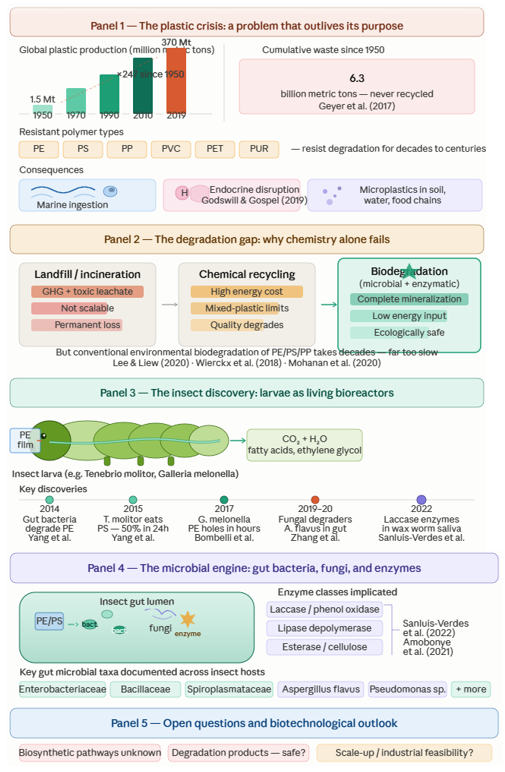
Conclusion

The body of evidence reviewed here makes one thing reasonably clear, even if much else remains uncertain: insect gut environments are not merely incidental settings for plastic consumption, but functionally integrated biological systems in which host enzymatic activity, gut microbial communities, and physical gut conditions collectively enable polymer degradation at rates that open environments simply cannot replicate. Ten species across two insect orders have now been documented degrading at least seven polymer types, and the microbial taxa and enzyme classes responsible — though still incompletely characterised — span Enterobacteriaceae, Bacillaceae, Pseudomonadaceae, and at least two fungal lineages.

What is equally clear is that this field is still, in many respects, in early days. The biosynthetic pathways governing plastic-degrading enzyme production are uncharacterised. The toxicological profile of degradation intermediates is largely unknown (Sanchez-Hernandez, 2021). And the gap between laboratory-scale larval bioassays and industrially meaningful throughput remains vast. Closing these gaps — through metagenomics, protein engineering, synthetic biology, and systematic toxicology (Yang et al., 2023, 2024) — defines the frontier that makes this one of environmental microbiology's most consequential open problems.

Author Contributions

H.A.S. Conceptualization; Methodology; Investigation; Data curation; Formal analysis; Writing — original draft preparation; Writing — review and editing; Visualization. M.A.H. Conceptualization; Methodology; Validation; Resources; Writing — original draft preparation; Writing — review and editing; Supervision; Project administration; Funding acquisition. All authors have read and agreed to the published version of the manuscript.

Acknowledgements

The authors greatly express deep thanks to the National Research Centre.

Funding

This work was financially supported by the National Research Centre (Fund No. 3050118).

References


Abdulhay, H. (2020). Biodegradation of plastic wastes by confused flour beetle Tribolium confusum Jacquelin du Val larvae. Asian Journal of Agriculture and Biology, 8(2), 201–206. https://doi.org/10.35495/ajab.2019.11.515

Akaby, I. K., & Ozdemir, T. (2016). Monomer migration and degradation of polycarbonate via UVC irradiation within aquatic and atmospheric environments. Journal of Macromolecular Science, Part A: Pure and Applied Chemistry, 53(6), 340–345. https://doi.org/10.1080/10601325.2016.1165999

Amobonye, A., Bhagwat, P., Singh, S., & Pillai, S. (2021). Plastic biodegradation: Frontline microbes and their enzymes. Science of the Total Environment, 759, 143536. https://doi.org/10.1016/j.scitotenv.2020.143536

Andrady, A. L. (2011). Microplastics in the marine environment. Marine Pollution Bulletin, 62(8), 1596–1605. https://doi.org/10.1016/j.marpolbul.2011.05.030

Andrady, A. L., & Neal, M. A. (2009). Applications and societal benefits of plastics. Philosophical Transactions of the Royal Society B: Biological Sciences, 364(1526), 1977–1984. https://doi.org/10.1098/rstb.2008.0304

Arunrattiyakorn, P., Ponprateep, S., Kaennonsang, N., Charapok, Y., Punphuet, Y., Krajangsang, S., Thaochan, N., & Suwannaroj, M. (2022). Biodegradation of polystyrene by three bacterial strains isolated from the gut of superworms (Zophobas atratus larvae). Journal of Applied Microbiology, 132(4), 2823–2831. https://doi.org/10.1111/jam.15474

Bae, J., Cho, H. W., Jung, H., Park, J., Yun, S., Ha, S., Lee, Y., & Kim, T. J. (2021). Changes in intestinal microbiota due to the expanded polystyrene diet of mealworms (Tenebrio molitor). Indian Journal of Microbiology, 61(2), 130–136. https://doi.org/10.1007/s12088-021-00922-w

Bilal, H., Raza, H., Bibi, H., & Bibi, T. (2021). Plastic biodegradation through insects and their symbiont microbes: A review. Journal of Bioresource Management, 8(4), 95–103. https://doi.org/10.35691/JBM.1202.0206

Bombelli, P., Howe, C. J., & Bertocchini, F. (2017). Polyethylene biodegradation by caterpillars of the wax moth Galleria melonella. Current Biology, 27(8), R292–R293. https://doi.org/10.1016/j.cub.2017.02.060

Bowditch, T. I. (1997). Penetration of polyvinyl chloride and polypropylene packaging films by Ephestia cautella (Lepidoptera: Pyralidae) and Plodia interpunctella (Lepidoptera: Pyralidae) larvae, and Tribolium confusum (Coleoptera: Tenebrionidae) adults. Journal of Economic Entomology, 90(4), 1028–1031. https://doi.org/10.1093/jee/90.4.1028

Brandon, A. M., Gao, S. H., Tian, R., Ning, D., Yang, S. S., Zhou, J., Wu, W. M., & Criddle, C. S. (2018). Biodegradation of polyethylene and plastic mixtures in mealworms (larvae of Tenebrio molitor) and effects on the gut microbiome. Environmental Science & Technology, 52(11), 6526–6533. https://doi.org/10.1021/acs.est.8b02301

Brandon, A. M., Garcia, A. M., Khlystov, N. A., Wu, W. M., & Criddle, C. S. (2021). Enhanced bioavailability and microbial biodegradation of polystyrene in an enrichment derived from the gut microbiome of Tenebrio molitor (mealworm larvae). Environmental Science & Technology, 55(3), 2027–2036. https://doi.org/10.1021/acs.est.0c04952

Briassoulis, D. (2006). Mechanical behaviour of biodegradable agricultural films under real field conditions. Polymer Degradation and Stability, 91(6), 1256–1272. https://doi.org/10.1016/j.polymdegradstab.2005.09.016

Brodhagen, M., Peyron, M., Miles, C., & Inglis, D. A. (2015). Biodegradable plastic agricultural mulches and key features of microbial degradation. Applied Microbiology and Biotechnology, 99(3), 1039–1056. https://doi.org/10.1007/s00253-014-6267-5

Bulak, P., Proc, K., Pytlak, A., Puszka, A., Gawdzik, B., & Bieganowski, A. (2021). Biodegradation of different types of plastics by Tenebrio molitor insect. Polymers, 13(20), 3508. https://doi.org/10.3390/polym13203508

Chalup, A., Ayub, M. M., & Monmany Garzia, A. C. (2018). First report of the lesser waxmoth Achroia grisella F. (Lepidoptera: Pyralidae) consuming polyethylene (silo-bag) in northwestern Argentina. Journal of Apicultural Research, 57(4), 569–571. https://doi.org/10.1080/00218839.2018.1484614

Chen, C. C., Dai, L., Ma, L., & Guo, R. T. (2020). Enzymatic degradation of plant biomass and synthetic polymers. Nature Reviews Chemistry, 4(3), 114–126. https://doi.org/10.1038/s41570-020-0163-6

Cline, L. D. (1970). Penetration of seven common flexible packaging materials by larvae and adults of eleven species of stored-product insects. Journal of Economic Entomology, 63(3), 726–729. https://doi.org/10.1093/jee/63.3.726

Davidson, T. M. (2012). Boring crustaceans damage polystyrene floats under docks, polluting marine waters with microplastic. Marine Pollution Bulletin, 64(9), 1821–1828. https://doi.org/10.1016/j.marpolbul.2012.06.005

Desforges, J. P. W., Galbraith, M., & Ross, P. S. (2015). Ingestion of microplastics by zooplankton in the northeast Pacific Ocean. Archives of Environmental Contamination and Toxicology, 69(3), 320–330. https://doi.org/10.1007/s00244-015-0172-5

Dey, S., Veerendra, G. T. N., Babu, P. S. S. A., Manoj, A. V. P., & Nagarjuna, K. (2023). Degradation of plastic waste and its effects on biological environment: A scientific analysis and comprehensive review. Biomedical Materials & Devices. https://doi.org/10.1007/s44174-023-00085-w

Dris, R., Imhof, H., Sanchez, W., Gasperi, J., Galgani, F., Tassin, B., Gallitelli, L., & Laffont, L. (2015). Beyond the ocean: Contamination of freshwater ecosystems with (micro-) plastic particles. Environmental Chemistry, 12(5), 539–550. https://doi.org/10.1071/EN14172

Engel, P., & Moran, N. A. (2013). The gut microbiota of insects — diversity in structure and function. FEMS Microbiology Reviews, 37(5), 699–735. https://doi.org/10.1111/1574-6976.12025

Fabreag, M. A. C., & Familara, J. A. (2019). Biodegradation of expanded polystyrene (EPS) (Styrofoam) block as feedstock to Tribolium castaneum (Red Flour Beetle) imago: A promising plastic degrading process. World News of Natural Sciences, 24, 145–156.

Gasperi, J., Wright, S. L., Dris, R., Collard, F., Mandin, C., Guerrouache, M., Langlois, V., Kelly, F. J., & Tassin, B. (2018). Microplastics in air: Are we breathing it in? Current Opinion in Environmental Science & Health, 1, 1–5. https://doi.org/10.1016/j.coesh.2017.10.002

Gerhardt, P., & Lindgren, D. L. (1955). Penetration of additional packaging films by common stored-product insects. Journal of Economic Entomology, 48(1), 108–109. https://doi.org/10.1093/jee/48.1.108

Gewert, B., Plassmann, M. M., & Macleod, M. (2015). Pathways for degradation of plastic polymers floating in the marine environment. Environmental Science: Processes & Impacts, 17(9), 1513–1521. https://doi.org/10.1039/c5em00207a

Geyer, R., Jambeck, J. R., & Law, K. L. (2017). Production, use, and fate of all plastics ever made. Science Advances, 3(7), e1700782. https://doi.org/10.1126/sciadv.1700782

Ghatge, S., Yang, Y., Ahn, J. H., & Hur, H. G. (2020). Biodegradation of polyethylene: A brief review. Applied Biological Chemistry, 63(1), 27. https://doi.org/10.1186/s13765-020-00511-3

Godswill, C. C., & Godspell, C. O. (2019). Impacts of plastic pollution on the sustainability of seafood value chain and human health. International Journal of Advanced Academic Research, 5(11), 46–138. https://doi.org/10.21276/2455-295X

Goveas, L. C., Nayak, S., Kumar, P. S., Rangasamy, G., Vidya, S. M., Vinayagam, R., Silvaraj, R., & Vo, D. V. N. (2023). Microplastics occurrence, detection and removal with emphasis on insect larvae gut microbiota. Marine Pollution Bulletin, 188, 114580. https://doi.org/10.1016/j.marpolbul.2023.114580

Groh, K. (2017). Plastic-eating worms — a solution to pollution? Current Biology, 27(8), R283–R285. http://www.cell.com/current-biology/fulltext/S0960-9822(17)30231-2

Grove, H., & Villanueva, S. (2021). How wax worms eat plastic. Brandon University Research Connection, 3(5).

Jang, S., & Kikuchi, Y. (2020). Impact of the insect gut microbiota on ecology, evolution, and industry. Current Opinion in Insect Science, 41, 33–39. https://doi.org/10.1016/j.cois.2020.06.004

Jiang, S., Su, T., Zhao, J., & Wang, Z. (2021a). Biodegradation of polystyrene by Tenebrio molitor, Galleria melonella, and Zophobas atratus larvae and comparison of their degradation effects. Polymers, 13(20), 3539. https://doi.org/10.3390/polym13203539

Jiang, S., Su, T., Zhao, J., & Wang, Z. (2021b). Isolation, identification and characterization of polystyrene-degrading bacteria from the gut of Galleria melonella (Lepidoptera: Pyralidae) larvae. Frontiers in Bioengineering and Biotechnology, 9, 736062. https://doi.org/10.3389/fbioe.2021.736062

Kawai, F., Kawabata, T., & Oda, M. (2019). Current knowledge on enzymatic PET degradation and its possible application to waste stream management and other fields. Applied Microbiology and Biotechnology, 103(11), 4253–4268. https://doi.org/10.1007/s00253-019-09717-y

Kesti, S., & Sharana, S. (2019a). First report on biodegradation of low-density polyethylene by rice moth larvae, Corcyra cephalonica (Stainton). Holistic Applied and Environmental Microbiology Journal, 9, 79–83. https://doi.org/10.33765/thate.9.4.2

Kesti, S., & Thimmappa, S. (2019b). First report on biodegradation of low-density polyethylene by rice moth larvae, Corcyra cephalonica (Stainton). Journal, 9. https://doi.org/10.33765/thate.9.4.2

Khant, N. A., & Kim, H. (2022). Review of current issues and management strategies of microplastics in groundwater environments. Water, 14(7), 1020. https://doi.org/10.3390/w14071020

Khyade, V. B. (2018). Review on biodegradation of plastic through wax worm (Order: Lepidoptera; Family: Pyralidae). International Academic Journal of Economics, 5(1), 84–91. https://doi.org/10.9756/IAJE/V5I1/1810008

Kibria, M. G., Masuk, N. I., Safayet, R., Nguyen, H. Q., & Mourshed, M. (2023). Plastic waste: Challenges and opportunities to mitigate pollution and effective management. International Journal of Environmental Research. https://doi.org/10.1007/s41742-023-00507-z

Kim, H. R., Lee, H. M., Yu, H. C., Jeon, E., Lee, S., Li, J., & Kim, H. D. (2020). Biodegradation of polystyrene by Pseudomonas sp. isolated from the gut of superworms (larvae of Zophobas atratus). Environmental Science & Technology, 54(11), 6987–6996. https://doi.org/10.1021/acs.est.0c01495

Kong, H. G., Kim, H. H., & Chung, J. H. (2019). The Galleria melonella hologenome supports microbiota-independent metabolism of long-chain hydrocarbon beeswax. Cell Reports, 26(9), 2451–2464. https://doi.org/10.1016/j.celrep.2019.02.018

Kosuth, M., Mason, S. A., & Wattenberg, E. V. (2018). Anthropogenic contamination of tap water, beer, and sea salt. PLOS ONE, 13(4), e0194970. https://doi.org/10.1371/journal.pone.0194970

Kundungal, H., Gangarapu, M., Sarangapani, S., Patchaiyappan, A., & Devipriya, S. P. (2019). Efficient biodegradation of polyethylene (HDPE) waste by the plastic-eating lesser wax worm (Achroia grisella). Environmental Science and Pollution Research, 26(18), 18509–18519. https://doi.org/10.1007/s11356-019-05038-9

Kundungal, H., Synshiang, K., & Devipriya, S. P. (2021). Biodegradation of polystyrene wastes by a newly reported honey bee pest Uloma sp. larvae: An insight to the ability of polystyrene-fed larvae to complete its life cycle. Environmental Challenges, 4, 100083. https://doi.org/10.1016/j.envc.2021.100083

Landon-Lane, M. (2018). Corporate social responsibility in marine plastic debris governance. Marine Pollution Bulletin, 127, 310–319. https://doi.org/10.1016/j.marpolbul.2017.11.054

Latour, S., Noel, G., Serteyn, L., Sare, A. R., Massart, S., Delvigne, F., Ongena, M., Lognay, G., & Verheggen, F. J. (2021). Multi-omics approach reveals new insights into the gut microbiome of Galleria melonella (Lepidoptera: Pyralidae) exposed to polyethylene diet [Preprint]. bioRxiv. https://doi.org/10.1101/2021.06.04.446152

Lebreton, L., & Andrady, A. (2019). Future scenarios of global plastic waste generation and disposal. Palgrave Communications, 5(1), 1–11. https://doi.org/10.1057/s41599-018-0212-7

Lee, A., & Liew, M. S. (2020). Ecologically delivered waste management of conventional plastics. Journal of Material Cycles and Waste Management, 22(1), 1–10. https://doi.org/10.1007/s10163-019-00931-4

Lee, H., Kim, H., Jeon, E., Yu, H. C., Lee, S., Li, J., & Kim, D. H. (2020). Evaluation of biodegradation efficiency of four various types of plastics by Pseudomonas aeruginosa isolated from the gut extract of superworms. Microorganisms, 8(9), 1341. https://doi.org/10.3390/microorganisms8091341

Le Moine, C. M., Grove, H., Smith, C., & Cassone, B. J. (2020). A very hungry caterpillar: Polyethylene metabolism and lipid homeostasis in larvae of the greater wax moth (Galleria melonella). Environmental Science & Technology, 54(22), 14706–14715. https://doi.org/10.1021/acs.est.0c04386

Li, J., Kim, H. R., & Lee, H. M. (2020). Rapid biodegradation of polyphenylene sulfide plastic beads by Pseudomonas sp. Science of the Total Environment, 720, 137616. https://doi.org/10.1016/j.scitotenv.2020.137616

Liaqat, S. (2020). Microbial ecology: A new perspective of plastic degradation. Pure and Applied Biology. https://doi.org/10.19045/bspab.2020.90228

Liu, J., Liu, J., Xu, B., Xu, A., Cao, S., Wei, R., Zhou, J., Jiang, M., & Dong, W. (2022). Biodegradation of polyether-polyurethane foam in yellow mealworms Tenebrio molitor and effects on the gut microbiome. Chemosphere, 304, 135263. https://doi.org/10.1016/j.chemosphere.2022.135263

Lou, Y., Ekaterina, P., Yang, S. S., Lu, B., Liu, B., Ren, N., Corvini, P. F. X., & Xing, D. (2020). Biodegradation of polyethylene and polystyrene by greater wax moth larvae (Galleria melonella L.) and the effect of co-diet supplementation on the core gut microbiome. Environmental Science & Technology, 54(5), 2821–2831. https://doi.org/10.1021/acs.est.9b07044

Lou, H., Fu, R., Long, T., Fan, B., Guo, C., Li, L., Zhang, J., & Zhang, G. (2022). Biodegradation of polyethylene and polystyrene by greater wax moth larvae (Galleria melonella L.) and Serratia marcescens isolated from the gut of wax worms (larvae of Plodia interpunctella). Science of the Total Environment, 853, 158604. https://doi.org/10.1016/j.scitotenv.2022.158604

Mahmoud, E., Al-Hagar, O., & Abdel-Aziz, M. (2020). Gamma radiation effects on the midgut bacteria of Plodia interpunctella and its role in organic wastes biodegradation. International Journal of Tropical Insect Science, 41, 261–272. https://doi.org/10.1007/s42690-020-00203-x

Major, L., Fuenmayor, E., & McConville, C. (2016). The production of solid dosage forms from non-degradable polymers. Current Pharmaceutical Design, 22(19), 2738–2760. https://doi.org/10.2174/1381612822666160217141049

Malankowska, M., Echaide-Gorriz, C., & Coronas, J. (2021). Microplastics in marine environment: A review on sources, classification and potential remediation by membrane technology. Environmental Science: Water Research & Technology, 7(2), 243–258. https://doi.org/10.1039/d0ew00802h

Masud, M. H., Akram, W., Ahmed, A., Ananno, A. A., Mourshed, M., Hasan, M., & Joardder, M. U. H. (2019). Towards the effective e-waste management in Bangladesh: A review. Environmental Science and Pollution Research, 26(2), 1250–1276. https://doi.org/10.1007/s11356-018-3626-2

Mereghetti, V., Chouaia, B., Limonta, L., Locatelli, D. P., & Montagna, M. (2017). Evidence for a conserved microbiota across the different developmental stages of Plodia interpunctella. Insect Science, 26(3), 466–478. https://doi.org/10.1111/1744-7917.12551

Mohanan, N., Montazer, Z., Sharma, P. K., & Levin, D. B. (2020). Microbial and enzymatic degradation of synthetic plastics. Frontiers in Microbiology, 11, 580709. https://doi.org/10.3389/fmicb.2020.580709

Napper, I. E., Bakir, A., Rowland, S. J., & Thompson, R. C. (2015). Characterisation, quantity and sorptive properties of microplastics extracted from cosmetics. Marine Pollution Bulletin, 99(1–2), 178–185. https://doi.org/10.1016/j.marpolbul.2015.07.029

Ng, E. L., Huerta Lwanga, E., Eldridge, S. M., Johnston, P., Hu, H. W., Geissen, V., & Chen, D. (2018). An overview of microplastic and nanoplastic pollution in agroecosystems. Science of the Total Environment, 627, 1377–1388. https://doi.org/10.1016/j.scitotenv.2018.01.341

Paletta, A., Leal Filho, W., Balogun, A. L., Foschi, E., & Bonoli, A. (2019). Barriers and challenges of plastics valorization in the context of circular economy: Case study from Italy. Journal of Cleaner Production, 241, 118149. https://doi.org/10.1016/j.jclepro.2019.118149

Peng, B. Y., Su, Y., Chen, Z., Chen, J., Zhou, X., Benbow, M. E., Criddle, C. S., Wu, W. M., & Zhang, Y. (2019). Biodegradation of polystyrene by dark (Tenebrio obscurus) and yellow (Tenebrio molitor) mealworm larvae (Coleoptera: Tenebrionidae). Environmental Science & Technology, 53(9), 5256–5265. https://doi.org/10.1021/acs.est.8b06963

Peng, B. Y., Chen, Z., Chen, J., Yu, H., Zhou, X., Criddle, C. S., Wu, W. M., & Zhang, Y. (2020a). Biodegradation of polyvinyl chloride (PVC) in Tenebrio molitor (Coleoptera: Tenebrionidae) larvae. Environment International, 145, 106106. https://doi.org/10.1016/j.envint.2020.106106

Peng, B. Y., Li, Y., Fan, R., Chen, Z., Chen, J., Brandon, A. M., Criddle, C. S., Zhang, Y., & Wu, W. M. (2020b). Biodegradation of low-density polyethylene and polystyrene in superworm larvae of Zophobas atratus (Coleoptera: Tenebrionidae): Broad and limited extent depolymerization. Environmental Pollution, 266, 115206. https://doi.org/10.1016/j.envpol.2020.115206

Peng, B. Y., Sun, Y., Wu, Z., Chen, J., Shen, Z., Zhou, X., Wu, W. M., & Zhang, Y. (2022). Biodegradation of polystyrene and low-density polyethylene by Zophobas atratus larvae: Fragmentation into microplastics, gut microbiota shifts and microbial functional enzymes. Journal of Cleaner Production, 367, 132987. https://doi.org/10.1016/j.jclepro.2022.132987

Peydaei, A., Bagheri, H., Gurevich, L., De Jong, N., & Nielsen, J. L. (2020). Impact of polyethylene on salivary glands proteome in Galleria melonella. Comparative Biochemistry and Physiology Part D: Genomics and Proteomics, 34, 100678. https://doi.org/10.1016/j.cbd.2020.100678

Przemieniecki, S. W., Kosewska, A., Ciesielski, S., & Kosewska, O. (2020). Changes in the gut microbiome and enzymes profile of Tenebrio molitor larvae biodegrading cellulose, polyethylene and polystyrene waste. Environmental Pollution, 256, 113265. https://doi.org/10.1016/j.envpol.2019.113265

Ragossnig, A. M., & Agamuthu, P. (2021). Plastic waste: Challenges and opportunities. Waste Management & Research, 39(7), 629–630. https://doi.org/10.1177/0734242x211013428

Rahimi, A., & Garcia, J. M. (2017). Chemical recycling of waste plastics for new materials production. Nature Reviews Chemistry, 1(6), 1–11. https://doi.org/10.1038/s41570-017-0046

Rejasse, A., Waeytens, J., Deniset-Besseau, A., Crapart, N., Nielsen-Leroux, C., & Sandt, C. (2021). Plastic biodegradation: Do Galleria melonella larvae bio-assimilate polyethylene? A spectral histology approach using isotopic labelling and infrared microspectroscopy [Preprint]. bioRxiv. https://doi.org/10.1101/2021.10.08.463624

Ren, L., Men, L., Zhang, Z., Guan, F., Tian, J., Wang, B., Wang, J., Zhang, Y., & Zhang, W. (2019). Biodegradation of polyethylene by Enterobacter sp. D1 from the guts of wax moth Galleria melonella. International Journal of Environmental Research and Public Health, 16(11), 1941. https://doi.org/10.3390/ijerph16111941

Riudavets, J., Salas, I., & Pons, M. J. (2007). Damage characteristics produced by insect pests in packaging film. Journal of Stored Product Research, 43(4), 564–570. https://doi.org/10.1016/j.jspr.2007.03.006

Sanchez-Hernandez, J. C. (2021). A toxicological perspective of plastic biodegradation by insect larvae. Comparative Biochemistry and Physiology Part C: Toxicology & Pharmacology, 248, 109117. https://doi.org/10.1016/j.cbpc.2021.109117

Sanluis-Verdes, A., Colomer-Vidal, P., Rodriguez-Ventura, F., Bello-Villarino, M., Spinola-Amilibia, M., Ruiz-Lopez, E., Illanes-Vicioso, R., Castroviejo, P., Aiese Cigliano, R., Montoya, M., Falabella, P., Pesquera, C., Gonzalez-Legarreta, L., Arias-Palomo, E., Solà, M., Torroba, T., Abad, C. F., & Bertocchini, F. (2022). Wax worm saliva and the enzymes therein are the key to polyethylene degradation by Galleria melonella. Nature Communications, 13(1), 5568. https://doi.org/10.1038/s41467-022-33127-w

Sarijan, S., Azman, S., Said, M. I. M., & Jamal, M. H. (2021). Microplastics in freshwater ecosystems: A recent review of occurrence, analysis, potential impacts, and research needs. Environmental Science and Pollution Research International, 28(2), 1341–1356. https://doi.org/10.1007/s11356-020-11171-7

Schymanski, D., Goldbeck, C., Humpf, H. U., & Furst, P. (2018). Analysis of microplastics in water by micro-Raman spectroscopy: Release of plastic particles from different packaging into mineral water. Water Research, 129, 154–162. https://doi.org/10.1016/j.watres.2017.11.011

Shahnawaz, M., Sangale, M. K., & Ade, A. B. (2019). Bacteria as key players of plastic bioremediation. In M. Shahnawaz, M. K. Sangale, & A. B. Ade (Eds.), Bioremediation technology for plastic waste (pp. 45–69). Springer Singapore. https://doi.org/10.1007/978-981-13-7492-0

Sharma, S., & Chatterjee, S. (2017). Microplastic pollution, a threat to marine ecosystem and human health: A short review. Environmental Science and Pollution Research, 24(27), 21530–21547. https://doi.org/10.1007/s11356-017-9910-8

Sheth, M. U., Kwartler, S. K., Schmaltz, E. R., Hoskinson, S. M., Martz, E. J., Dunphy Daly, M. M., Schultz, T. F., Read, A. J., Eward, W. C., & Somarelli, J. A. (2019). Bioengineering a future free of marine plastic waste. Frontiers in Marine Science, 6, 624. https://doi.org/10.3389/fmars.2019.00624

Siddiqui, S. A., Abdul Manap, A. S., Kolobe, S. D., Monye, M., Yudhistira, B., & Fernando, I. (2024). Insects for plastic biodegradation — a review. Process Safety and Environmental Protection, 186, 833–849. https://doi.org/10.1016/j.psep.2024.04.010

Taniguchi, I., Yoshida, S., Hiraga, K., Miyamoto, K., Kimura, Y., & Oda, K. (2019). Biodegradation of PET: Current status and application aspects. ACS Catalysis, 9(5), 4089–4105. https://doi.org/10.1021/acscatal.8b05171

Wang, J., Tan, Z., Peng, J., Qiu, Q., & Li, M. (2016). The behaviors of microplastics in the marine environment. Marine Environmental Research, 113, 7–17. https://doi.org/10.1016/j.marenvres.2015.10.014

Wang, Z., Xin, X., Shi, X., & Zhang, Y. (2020). A polystyrene-degrading Acinetobacter bacterium isolated from the larvae of Tribolium castaneum. Science of the Total Environment, 726, 138564. https://doi.org/10.1016/j.scitotenv.2020.138564

Wang, S., Shi, W., Huang, Z., Zhou, N., Xie, Y., Tang, Y., Hu, F., & Liu, H. (2022). Complete digestion/biodegradation of polystyrene microplastics by greater wax moth (Galleria melonella) larvae: Direct in vivo evidence, gut microbiota independence, and potential metabolic pathways. Journal of Hazardous Materials, 423, 127213. https://doi.org/10.1016/j.jhazmat.2021.127213

Weber, C., Pusch, S., & Opatz, T. (2017). Polyethylene bio-degradation by caterpillars. Current Biology, 27(15), R744–R745. https://doi.org/10.1016/j.cub.2017.07.004

Wierckx, N., Narancic, T., & Eberlein, C. (2018). Plastic biodegradation: Challenges and opportunities. In K. N. Timmis (Ed.), Consequences of microbial interactions with hydrocarbons, oils, and lipids: Biodegradation and bioremediation (pp. 1–29). Springer. https://doi.org/10.1007/978-3-319-44535-9_23-1

Yang, J., Yang, Y., Wu, W. M., Zhao, J., & Jiang, L. (2014). Evidence of polyethylene biodegradation by bacterial strains from the guts of plastic-eating wax worms. Environmental Science & Technology, 48(23), 13776–13784. https://doi.org/10.1021/es504038a

Yang, Y., Yang, J., Wu, W. M., Zhao, J., Song, Y., Gao, L., Yang, R., & Jiang, L. (2015a). Biodegradation and mineralization of polystyrene by plastic-eating mealworms: Part 1. Chemical and physical characterization and isotopic tests. Environmental Science & Technology, 49(20), 12080–12086. https://doi.org/10.1021/acs.est.5b02661

Yang, Y., Yang, J., Wu, W. M., Zhao, J., Song, Y., Gao, L., Yang, R., & Jiang, L. (2015b). Biodegradation and mineralization of polystyrene by plastic-eating mealworms: Part 2. Role of gut microorganisms. Environmental Science & Technology, 49(20), 12087–12093. https://doi.org/10.1021/acs.est.5b02663

Yang, S. S., Brandon, A. M., Flanagan, J. C. A., Yang, J., Ning, D., Cai, S. Y., Fan, H. Q., Wang, Z. Y., Ren, J., Benbow, E., Ren, N. Q., Waymouth, R. M., Zhou, J., Criddle, C. S., & Wu, W. M. (2018). Biodegradation of polystyrene wastes in yellow mealworms (larvae of Tenebrio molitor Linnaeus): Factors affecting biodegradation rates and the ability of polystyrene-fed larvae to complete their life cycle. Chemosphere, 191, 979–989. https://doi.org/10.1016/j.chemosphere.2017.10.117

Yang, Y., Wang, J., & Xia, M. (2020). Biodegradation and mineralization of polystyrene by plastic-eating superworms Zophobas atratus. Science of the Total Environment, 708, 135233. https://doi.org/10.1016/j.scitotenv.2019.135233

Yang, S. S., Ding, M. Q., He, L., Zhang, C. H., Li, Q. X., Xing, D. F., Cao, G. L., Zhao, L., Ding, J., Ren, N. Q., & Wu, W. M. (2021). Biodegradation of polypropylene by yellow mealworms (Tenebrio molitor) and superworms (Zophobas atratus) via gut-microbe-dependent depolymerization. Science of the Total Environment, 756, 144087. https://doi.org/10.1016/j.scitotenv.2020.144087

Yang, S. S., Ding, M. Q., Ren, X. R., Zhang, Z. R., Li, M. X., Zhang, L. L., Pang, J. W., Chen, C. X., Zhao, L., Xing, D. F., Ren, N. Q., Ding, J., & Wu, W. M. (2022). Impacts of physical-chemical properties of polyethylene on depolymerization and biodegradation in yellow and dark mealworms with high-purity microplastics. Science of the Total Environment, 828, 154458. https://doi.org/10.1016/j.scitotenv.2022.154458

Yang, X. G., Wen, P. P., Yang, Y. F., Jia, P. P., Li, W. G., & Pei, D. S. (2023). Plastic biodegradation by in vitro environmental microorganisms and in vivo gut microorganisms of insects. Frontiers in Microbiology, 13, 1001750. https://doi.org/10.3389/fmicb.2022.1001750

Yang, S. S., Wu, W. M., Bertocchini, F., Benbow, M. E., Devipriya, S. P., Cha, H. J., Peng, B. Y., Criddle, C. S., & Ding, M. Q. (2024). Radical innovation breakthroughs of biodegradation of plastics by insects: History, present and future perspectives. Frontiers of Environmental Science & Engineering, 18(6), 78. https://doi.org/10.1007/s11783-024-1838-x

Zhang, J., Gao, D., Li, Q., Zhao, Y., Li, L., Lin, H., Bi, Q., & Zhao, Y. (2020). Biodegradation of polyethylene microplastic particles by the fungus Aspergillus flavus from the guts of wax moth Galleria melonella. Science of the Total Environment, 704, 135931. https://doi.org/10.1016/j.scitotenv.2019.135931


Article metrics
View details
0
Downloads
0
Citations
33
Views

View Dimensions


View Plumx


View Altmetric


0
Save
0
Citation
33
View
0
Share