Bioinfo Chem

System biology and Infochemistry
1
Citations
7.6k
Views
9
Articles
Your new experience awaits. Try the new design now and help us make it even better
Switch to the new experience
Figures and Tables
RESEARCH ARTICLE   (Open Access)

Virtual Screening and Computational Analysis of Natural Compound Targeting CDK4/6 for Pan-Cancer Therapeutic Potential

Shahadat Hossain1*, Farhana Ferdushi Aion2, Badhan Mojumder2

+ Author Affiliations

Bioinfo Chem 7 (1) 1-10 https://doi.org/10.25163/bioinformatics.7110529

Submitted: 05 July 2025 Revised: 18 September 2025  Published: 25 September 2025 


Abstract

Background: The CDK4 and CDK6 regulate the transition from G1 phase to the S phase in the cell cycle. Overexpression of CDK4, or CDK6 leads to uncontrolled proliferation and is seen in many cancers. Palbociclib is effective but limited through toxicity and resistance developed to it. Besides, very few comparative studies have evaluated natural compound Luteolin against CDK4/6. Consequently, the study intends to assess the inhibitory potential, binding affinity, and structural stability of Luteolin and Palbociclib through molecular docking and computational interactions studies.

Methods: This study used an in silico comparative study of Luteolin and Palbociclib. The 3D structures of CDK4 (2W9Z) and CDK6 (2EUF) were obtained using PyMOL followed by docking using PyRx. Analysis of protein target classification, pathway enrichment, and interaction networks were carried out using Swiss Target Prediction, ShinyGO, and STRING database. Graph Pad Prism was used to analyze and visualize of the docking scores and RMSD stability profiles.

Results: The docking outcomes revealed that the binding affinities of Luteolin with CDK6 (-9.7 kcal/mol) and CDK4 (-8.7 kcal/mol) was high. The compound was found to target several receptors, enzymes and kinases. This shows that the pathways PI3K-AKT, MAPK and hormones were heavily involved According to RMSD profiling, the Luteolin-bound complexes were more stable than Palbociclib.

Conclusion: Luteolin appears a low-toxicity, multi-target CDK4/6 inhibitor with therapeutic potential across cancers. Because it can hit different signaling pathways at the same time, the drug can overcome limitations of palbociclib type drugs.

Keywords: CDK4/6 Inhibition, Luteolin, Molecular Docking, Palbociclib, Cell Cycle Regulation

1. Introduction

Cancer remains a major cause of global health burden with more than 10 million deaths annually and affecting more than 20 million people worldwide. Using chemotherapy, radiotherapy, and targeted therapies has been available for some time, but they do not work as well as they should due to therapeutic resistance, off-target toxicity and tumor heterogeneity. The cell cycle control dysregulation that involves CDK4/6 is central to the challenges posed by a variety of cancers (Bizuayehu et al., 2024; Goel et al., 2022).

The G1-S phase transition is regulated by CDK4 and CDK6 via Cyclin D to phosphorylate the Retinoblastoma (Rb) protein. As a result, E2F transcription factors are activated, which leads to the transcription of genes involved in DNA replication. The excessive activation or production of CDK4/6 can help skip the checkpoints in the cell cycle allowing continuous cellular division which is one of the features of cancerous cells and malignancy (Roufayel et al., 2021). The overexpression of CDK6 has been observed in various cancers, which includes bladder urothelial carcinoma, glioblastoma and triple-negative breast cancer. CDK4 denotes frequent upregulation in hepatocellular carcinoma and esophageal squamous cell (Sager et al., 2022; Tadesse et al., 2015).

This disappointing annual registration trend cannot be ignored. Palbociclib is a kind of drug that inhibits the activity of genes called CDK4 and CDK6. This drug has been approved by the FDA for the treatment of hormone receptor-positive (HR+), HER2-negative breast cancer. The drug has shown good results in clinical trials (Ran et al., 2022). Although it does show initial activity, it works effectively in a limited range of cancer types only. Also, acquired resistance, blood toxicity, and limited bioavailability limit its usefulness for a long time (Lopez-Tarruella et al., 2022).

Recently, scientists are showing more interest in natural products as drug alternatives.  Compounds that target multiple receptors may show more effectiveness, safety, and diversity and can be used for selective drug design. Luteolin is a compound that refers to the flavonoid that is found in fruits. Luteolin is a polyphenol that exhibits a variety of properties. The molecule possesses anti-cancer, anti-inflammatory and antioxidant properties (Hauser et al., 2017; Thomford et al., 2018).

Luteolin has promise in cancer therapy beyond CDK inhibition. According to a number of studies, Luteolin is capable of modulating PI3K-AKT, MAPK, NF-?B, and the ESR1-CYP19A1 hormonal axis-pathways which drives survival, angiogenesis, and drug resistance in various cancers. The strategy of interfering with many pathways at once is now seen as having benefits in cancer therapy as the cancer networks are adaptive and redundant in nature (Merecz-Sadowska et al., 2025; Singh Tuli et al., 2022).

The therapeutic potential of Luteolin has not been assessed comparatively against standard of care CDK4/6 inhibitors, despite its established anti-proliferative and pro-apoptotic properties. Diverse malignancies lack targets for selective response, commonly used in cancer treatment. There’s little mechanistic understanding of the interaction of Luteolin and CDK4/6 as well as sufficient stability and specificity for a targeted inhibitor (X. Li et al., 2024).

This study will address the above knowledge gap by a computational framework to investigate the binding interactions, molecular stability and target spectrum of Luteolin and clinically used CDK4/6 inhibitors. By utilizing systems pharmacology and structural docking approaches, the study is expected to assess the potential of Luteolin as a viable candidate for pan-cancer therapy with enhanced multi-target ability and less toxicity potential.

2. Materials and Methods

2.1 Study Design

This study employed a computational drug discovery framework to evaluate the inhibitory potential of the natural compound Luteolin against CDK4 and CDK6. A reference inhibitor, Palbociclib, was used for comparative analysis. The design included target overexpression profiling across cancer types, molecular docking to assess binding affinities, 2D/3D interaction mapping, and RMSD-based stability analysis. Additionally, protein classification and pathway enrichment analyses were conducted to explore Luteolin’s multi-target effects. All computational tasks were performed using validated bioinformatics and cheminformatics tools, ensuring reproducibility and relevance to pan-cancer therapeutic evaluation.

2.2 Preparation of Selected Protein

The three-dimensional structures of CDK4 (PDB ID: 2W9Z) and CDK6 (PDB ID: 2EUF) were downloaded in PDB format from RCSB Protein Data Bank. Protein preparation was carried out with the help of PyMOL 2.x. When the structures were loaded, all the non-important molecules like the crystallographic water (HOH), co-crystallized ligands and heteroatoms (HETATM) were removed with the help of standard commands. Protein chains that were relevant were selected, and structures were visually inspected for completeness correctness. Next, using the command "H-add" polar hydrogen atoms were added for proper hydrogen bonding analysis. the structures were re-oriented using “orient” so can dock properly Ultimately, PDB formats were used to save the cleaned and hydrogen optimized models for docking studies.

2.3 Ligand Selection and Preparation for Molecular Docking

The ligands chosen in this study were Luteolin; a natural flavonoid with an alleged anticancer activity and Palbociclib; a CDK4/6 inhibitor that is FDA approved and the reference ligand. The PubChem database in SDF format (CID 5280445 for Luteolin and CID 5330286 for Palbociclib) was used to acquire the 2D structures of both compounds. The provided structures were transferred into Open Babel for format conversion, and subsequent geometry optimization. The ligands were converted to 3D conformers and saved in MOL2 format. MMFF94 force field was used to minimize energy to get conformational stability before docking. Hydrogen atoms were added, and rotatable bonds were adjusted to retain flexibility for docking purposes. The finalized ligand structures then used as input for docking simulations.

2.4 Molecular Docking Protocol

Molecular docking was done with PyRx (v0.8), which is an integrated virtual screening tool that uses AutoDock Vina as its docking engine. The two protein structures (CDK4: PDB ID 2W9Z and CDK6: PDB ID 2EUF) prepared were imported into PyRx after converting from PDB using AutoDockTools interface. Ligands Luteolin and Palbociclib were previously energy minimized, converted to MOL2 format and converted to PDBQT in PyRx. The binding pocket based on co–crystallized ligand coordinates was used to define a grid box around the active site of each protein. The docking parameters were set at default exhaustiveness (value: 8), and several binding poses were generated of every ligand. The pose with minimum binding energy was selected for interaction study. The last docking results were shown and interpreted using PyMOL and Discovery studio visualizer. The binding orientations were checked to find essential hydrogen bonds and hydrophobic contacts.

2.5 Functional Pathway and Protein Interaction

In order to assess the functional pathways and potential therapeutic targetability of Luteolin, biological function and protein-protein interaction mapping (PPI) were performed. Luteolin's probable human protein targets were identified with the help of SwissTargetPrediction, based on the molecular structure and similarity-based prediction models. The predicted targets functionally classified into enzyme, kinase, membrane receptor, and cytosolic protein. Biological signaling was explored using ShinyGO for enrichment analysis of the KEGG pathway. Focused on cancer-related networks, the pathways investigated included PI3K-AKT, MAPK and estrogen signaling.  Moreover, protein-protein interaction networks were constructed from the STRING database by limiting high-confidence interactions (score >0.7) for visualization. The data on signaling combined with regulation were used to discover the possible cross-talk between Cdk4/6 and other regulatory pathways subjected to the influence of Luteolin.

2.6 Statistical Analysis, Software and Tools

All the computational analyses and statistical analyses were carried out using validated bioinformatics and visualization tools. The PyRx (version 0.8) embedded AutoDock Vina molecular docking was performed on the ligand and the structure of the protein. The PyMOL and Discovery Studio Visualizer were used to plot the interactions. Target classification and pathway enrichment analysis were performed using SwissTargetPrediction and ShinyGO, respectively, while STRING was utilized to construct the protein–protein interaction (PPI) network. Statistical validation of docking scores, overexpression percentage and RMSD profiles were done using GraphPad Prism (v9.0). Mean, standard deviation, and comparative plots were utilized as applicable. The tools employed were open-access, academic licensed, and compatible with reproducible research standards.

3. Results

3.1 Overexpression Profile of CDK4/6 Across Multiple Cancer Types

To investigate the rationale for targeting CDK4 and CDK6 in pan-cancer, we analyzed the gene expression of CDK4 and CDK6 across cancer types based on publicly available data. The frequency of overexpression of CDK4 and CDK6 is summarized in Table 1. In triple-negative breast cancer (TNBC), an aggressive breast carcinoma, CDK6 was overexpressed in about 30% of the cases (n = 250/1100 BRCA) in a cohort of 1100 analyzed samples.

Table 1. Overexpression of CDK4 and CDK6 Across Different Cancer Types.

Cancer Type

Gene

Overexpression (%)

Sample Size

Breast Cancer (TNBC subset)

CDK6

30%

250 (TNBC of ~1100 BRCA)

Glioblastoma Multiforme (GBM)

CDK4

15%

528

Liver Hepatocellular Carcinoma (LIHC)

CDK4

35%

374 tumors, 50 normal

Bladder Urothelial Carcinoma (BLCA)

CDK6

40%

412

Lung Adenocarcinoma (LUAD)

CDK6

22%

515

Esophageal Carcinoma (ESCA)

CDK4

28%

185

Melanoma (Skin Cutaneous Melanoma - SKCM)

CDK4

26%

470

Colorectal Adenocarcinoma (COAD)

CDK6

19%

457


Table 2. Statistical Summary of CDK4 and CDK6 Overexpression Across Selected Cancer Types.

Feature

CDK4

CDK6

Cancer Types Covered

4

4

Mean Overexpression

26.00%

27.75%

Standard Deviation (SD)

8.06%

8.15%

Minimum %

15% (GBM)

19% (COAD)

Maximum %

35% (LIHC)

40% (BLCA)

Glioblastoma Multiforme (GBM), Liver Hepatocellular Carcinoma (LIHC), Colorectal Adenocarcinoma (COAD), Bladder Urothelial Carcinoma (BLCA).

Overexpression of CDK4 and CDK6 In the case of liver hepatocellular carcinoma (LIHC), CDK4 showed a substantial overexpression rate of 35% when analyzing 374 tumor samples against 50 normal samples. Among all cancers examined, the overexpression of CDK6 in bladder urothelial carcinoma (BLCA) was most pronounced, with 40% (n=412) of tumors showing upregulation. In a survey of 528 tumor samples of glioblastoma multiforme (GBM), an aggressive brain cancer, CDK4 was overexpressed in 15% of the samples, indicating it might have a role in the neural tumor. Another interesting study finding included overexpression of CDK6 in lung adenocarcinoma (LUAD) at 22%, CDK4 overexpression in esophageal carcinoma (ESCA) at 28%, and overexpression of CDK4 in skin cutaneous melanoma (SKCM) at 26%. In cases of colorectal adenocarcinoma (COAD) the CDK6 showed overexpression in 19% of the cases.

3.2 Summary of CDK4 and CDK6 Overexpression

The expression dynamics of CDK4 and CDK6 across tumors were further quantitatively evaluated by computing essential descriptive statistics based on expression rates in any four cancer types. As can be seen from Table 2, the mean overexpression of CDK6 (27.75%) is slightly more than CDK4 (26.00%). The standard deviation of expression of the two proteins was comparable; that is CDK4 had a SD of 8.06% and CDK6 showed 8.15%. This shows consistent variability in expression across the chosen tumors.

The lowest CDK4 expression was in glioblastoma multiforme GBM in which only 15% of the cases displayed high level. Colorectal adenocarcinoma (COAD) had the lowest expression rate of CDK6 at 19%. The highest overexpression of CDK4 was found in liver hepatocellular carcinoma (LIHC), which was 35%. Further, highest overexpression for CDK6 was seen in bladder urothelial carcinoma (BLCA), which was 40%. Oncogenic significance of CDK4 and CDK6 is further supported by the amassed data from varied tumors. The low variation range and high maximum expression values justify targeting these cyclin-dependent kinases simultaneously in pan-cancer therapies. This numerical evidence also underpinned the selection of Luteolin as a potential inhibitor that is relevant to most tumors with CDK dysregulation.

3.3 Classification of Potential Target Proteins

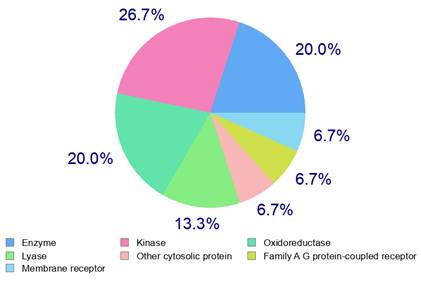
Luteolin predicted target proteins were under classification analysis, which revealed the molecule potential interaction with different cancer-related protein classes. Most of the predicted targets were kinases (26.7%) as shown in Figure 1. As CDK4 and CDK6-central to cell cycle regulation-all belong to the kinase family is a characteristic relatively close to the study’s premise. The enrichment of kinase targets strongly suggests that Luteolin could be a good inhibitor of this class.


Figure 1. Functional classification of predicted protein targets of Luteolin based on target class distribution. The pie chart shows the distribution of Luteolin’s predicted protein targets across key functional classes. Kinases (26.7%) were the most prominent, followed by enzymes and oxidoreductases (20% each), indicating potential roles in cell cycle and metabolic regulation.

The next two key categories were enzymes and oxidoreductases (both responsible for 20% of the targets). Consequently, Luteolin is expected to have a greater range of biological activities. Also, there are other cytosolic proteins (13.3%), membrane receptor, Family A G protein-coupled receptor and lyase (each 6.7%). Thus, the target range is diverse and includes the signaling, redox regulation and molecular transport. The findings suggest that Luteolin might hit on multiple molecules especially kinases to exert its effect. As the kinase targets seem to be over-dominating, it has a great potential to act as a pan-cancer agent. In addition, it can tackle cancers that have been mostly caused by dysregulated cyclin-dependent kinases. A multi-class target profile, in other words, reflects the drug-likeness and therapeutic versatility of natural products.

3.4 Pathway Analysis of CDK4/6-Associated Signaling

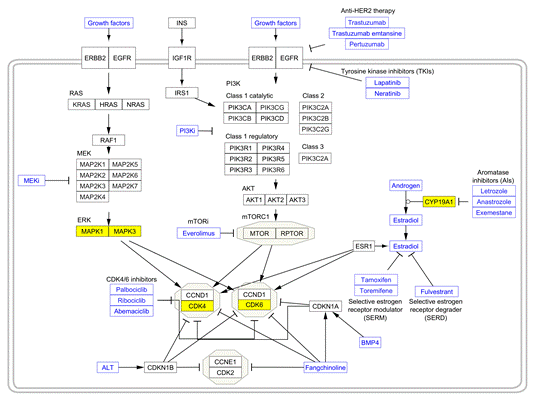
As shown in Figure 2, CDK4 and CDK6 play essential roles in the G1/S phase transition of the cell cycle. It shows the pathway of conversion of cells from G1 to S phase. Both of these proteins work on Cyclin D (CCND1). They further phosphorylate the retinoblastoma protein (Rb) which leads to the subsequent release of E2F transcription factors which promote uncontrolledly progression of the cell cycle. This is one of the hallmarks of cancer.

Figure 2. CDK4/6-centered signaling network involving mitogenic and hormonal pathways Key nodes include PI3K, MAPK, ESR1/2, and known therapeutic targets relevant to cancer progression.

The most important signaling pathways upstream of CDK4/6 are the RAS-RAF-MEK-ERK (more commonly known as the MAPK pathway) and the PI3K-AKT-mTOR pathways, which activate these kinases in response to mitogenic and survival signals. Furthermore, hormone-regulated factors such as estrogen (ESR1/ESR2) and androgens can activate CDK4/6. Treatments such as aromatase inhibitors (Letrozole, Anastrozole), and SERMs (Tamoxifen, Fulvestrant) block these hormone activators.

Figure 2 also shows clinically approved CDK4/6 inhibitors such as Ribociclib, Abemaciclib, and Palbociclib, effective in some tumor types. The image also illustrates other possible target nodes like MAPK1/3 and CYP19A1 where natural compounds like Luteolin may exert inhibitory effects. Luteolin is a polyphenolic compound that is widely found in different kinds of vegetables, fruits, herbs and medicinal plants. Luteolin possesses multiple drug targets and predicted interactions with several kinase pathways supports that it has potential as an anti-cancer agent with a broad scope of action. Luteolin affects multiple signaling pathways making it more therapeutically attractive than similar looking single target drugs in cancers with CDK4/6 dysregulation.

3.5 Comparative Molecular Docking Analysis

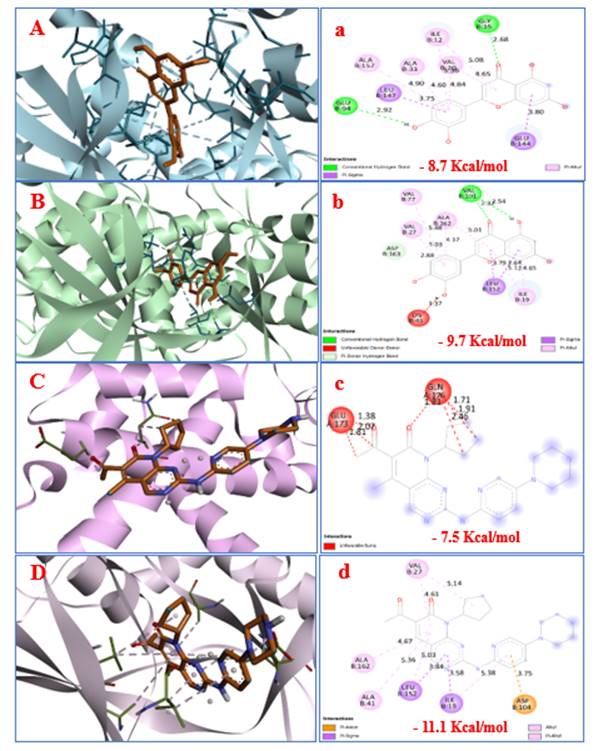
The molecular docking interactions of Luteolin and Palbociclib with target proteins CDK4 and CDK6 are shown in Figure 3. Each ligand-protein complex is displayed with 3D and 2D interaction profiles, indicating the key interacting residues and relative binding affinities (kcal/mol). This comparison reveals valuable information on how strong and stable Luteolin binds compared to the established inhibitor Palbociclib.


Figure 3. The 3D docking structure of CDK4 with Luteolin is shown in image A, while image B displays the 3D structure of CDK6 with Luteolin. Similarly, image C represents the docking of Palbociclib with CDK4, and image D illustrates its interaction with CDK6. The corresponding 2D interaction diagrams are labeled as a, b, c, and d, representing the same complexes respectively. These 2D maps highlight key amino acid interactions, hydrogen bonds, hydrophobic contacts, and binding affinity values for each protein-ligand complex.

CDK4 showed a stable interaction with luteolin having a binding affinity of -8.7 kcal/mol. The compound interacted with GLU94, ALA157, LEU147, and GLY15 through hydrogen bonds and p-alkyl interactions, and was stably located in the ATP-binding pocket. This indicates that Luteolin may interact with the catalytic region of CDK4. On the other hand, Luteolin and CDK6 are much more tightly bound to each other (-9.7 kcal/mol). In this complex, Luteolin formed multiple strong hydrogen bonds with VAL101, ASP163 and LYS43 along with some other hydrophobic contacts contributing to better stability and affinity. These findings suggest that Luteolin may be a better inhibitor of CDK6 than CDK4.

On the other hand, CDK4 binding with Palbociclib displayed relatively weaker binding with a binding energy of -7.5 kcal/mol. The docking pose showed that there were important contacts with GLU173 and GLN176. However, as there were some unfavorable bumps, it indicates a less favorable geometry. Most importantly, it indicates lesser stability of the binding site. CDK6 had the highest affinity for Palbociclib, with a binding energy of -11.1 kcal/mol. Powerful p-p stacking and hydrophobic interactions were observed in the residues: ALA162, LEU152, ILE19, and ASP104. This is consistent with the clinical efficacy of Palbociclib as a CDK6 inhibitor.

The docking observations of the study indicate that Luteolin has a good binding capacity for both CDK4 and CDK6, especially CDK6. Though Palbociclib bonded more tightly with CDK6 than luteolin, luteolin is a good candidate for development into a multi-target anti-cancer agent because luteolin is natural, competitive and perhaps less toxic.

3.6 Docking Pose Stability of CDK4 and CDK6 (RMSD Analysis)

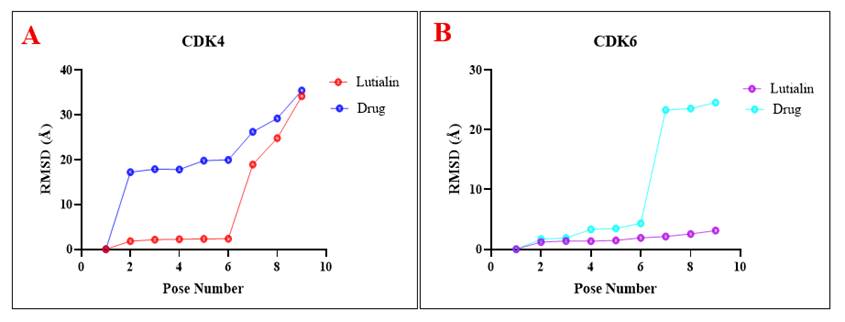
The analysis of RMSD of several docking poses of Luteolin with CDK4 and CDK6 and the reference drug with CDK4 and CDK6 is shown. The reference drug presumably is Palbociclib (Figure 4).


Figure 4. RMSD (Root Mean Square Deviation) profile comparing the docking pose stability of Luteolin and a reference drug (Palbociclib) with CDK4 (A) and CDK6 (B). The plot displays RMSD values across ten predicted binding poses for each complex. Lower RMSD values indicate more consistent and stable binding orientations, while higher RMSD reflects structural variability. Luteolin exhibited greater pose stability with both CDK4 and CDK6 compared to the reference drug, particularly with CDK6.

The first six poses within the CDK4-Luteolin complex experienced consistently low RMSD values (around 0-2 Å), proving that the structure was stable and reproducibly bound. Conversely, from pose 2 onwards, the drug displayed a sharp increase in RMSD, with values ranging from 15 to 35 Å, indicating high conformational variations and low pose stability. The stability was more pronounced for the CDK6-Luteolin complex. All the docking poses exhibited a value of RMSD less than 5 Å. The pose or conformation was nearly stable until pose 6, after which a sharp rise in RMSD is observed and is above 20 Å.

The results show Luteolin to have a good binding affinity and a better pose stability in multiple poses especially for CDK6. The RMSD values maintain at a low level, suggests that Luteolin is highly predictable, and binding in a structurally stable manner further advocates its multi-target\, CDK4/6 inhibitor drug-like agents for cancer.

4. Discussion

The goal of this study was to evaluate luteolin a naturally occurring flavonoid as a dual CDK4 and CDK6 inhibitor. Through this process, the performance of the compound was compared to that of Palbociclib. The transition in the cell cycle between the G1 and S phase of CDK4 and CDK6 plays a regulatory role. Research shows commonly overexpressed or dysregulated in certain cancers. Although therapies like Palbociclib have had some clinical success, toxicity, drug resistance, and cost often limit their use in the long-term. Consequently, finding effective natural alternatives is of great therapeutic interest. Luteolin is valuable for its low toxicity levels, affordability, and multi-targeting ability (Nardone et al., 2021; Singh Tuli et al., 2022; Amin et al., 2025). It extracts its effectiveness through selective disruption of oncogenic signaling pathways. Within this context, luteolin was studied for its favourable binding properties and multi-target ability.

The current study found a significant overexpression of CDK4 and CDK6 in a wide variety of cancers. Overexpression of CDK6 was recorded at 40% of the total bladder cancer samples. CDK4 shows 35% overexpression in liver cancer (LIHC) and nearly 30% in the TNBC subset of breast cancer. The patterns highlight how critical CDK4/6 is in the regulation of unconstrained cell cycle progression and malignant proliferation in many tumor contexts (Zhao et al., 2024; Tufael et al 2024).

Recent studies are there to back this up. According to Sun et al (2024), CDK6 overexpression correlates with poor prognosis in glioblastoma (Sun et al., 2024). Zhang et al (2024) did a pan-cancer study which found CDK4 overexpression to be significant in liver and lung adenocarcinomas, both of which correlate with aggressiveness. According to these findings, using CDK4/6 as a target for multi-cancer therapeutic strategies has a strong biological rationale for use; moreover, these findings are in line with current observations (Q. Li et al., 2020).

The results after classification of protein targets suggested that Luteolin is a broad-spectrum multi-targeting molecule that binds to CDK4/6 along with other kinases, enzymes, membrane-bound receptors and cytoplasmic proteins required for cancer progression. This ability to target multiple cancer pathways means that Luteolin could potentially affect a variety of oncogenic pathways. Therefore, it might be appropriate for pan-cancer rather than just one (Hu et al., 2021; Manica et al., 2024).

Moreover, Tufael et al. (2024) and X. Wang et al. (2021) mentioned that the presence of Luteolin can interfere with not only CDK-related signals but also ESR1 and CYP19A1 hormonal pathways as well as MAPK and EGFR growth signals (Tufael et al., 2024). In a like manner, Moradifar et al. (2025) confirmed that bioactive flavonoid luteolin is a multi-functional agent with therapeutic scope in cancer due to its modulation of multiple pathways like kinase inhibition, anti-inflammation and antioxidant activity (Moradifar et al., 2025). Luteolin is not only impacting CDK4/6 axie, but it is also having an impact on other cancer-relevant signaling pathways such as PI3K-AKT, MAPK and CYP19A1-ESR1 (hormonal) signaling. The routes are key drivers of tumor progression, cell survival, resistance and proliferation in both hormonal and non-hormonal cancers (Guo et al., 2021).

The PI3K-AKT pathway is an important factor in cancer cell survival and metabolism, while MAPK signaling influences tumor growth and invasion. The ESR1-CYP19A1 axis is particularly important in hormone-sensitive cancers including breast and endometrial cancer. Luteolin's network pharmacology profile can target the interconnected pathways at the same time, which can overcome tumor redundancy, adaptive resistance, and compensatory survival signals (Huang et al., 2019; Manica et al., 2024).

Gao et al. (2023) demonstrated that the intake of multi-target nutraceuticals can impede the action of PI3K, MAPKs, and hormones receptors to stop cancer progression, as noted in this observation (Gao et al., 2023). X. Wang et al. (2021) also stressed that CDK inhibitors with potential for hormonal and PI3K cross-talk could benefit endocrine-resistant cancers (X. Wang et al., 2021). EL Omri et al (2023) similarly, show by means of systems pharmacology that flavonoid-rich compounds are able to interfere with the PI3K-AKT as well as ERK1/2 signaling in esophageal carcinoma. Findings of this study are strengthened through this paper (EL Omri et al., 2012).

Molecular docking analysis showed that Luteolin had good binding affinity with CDK6 having -9.7 kcal/mol and CDK4 with -8.7 kcal/mol. Palbociclib has a higher binding score of -11.1 kcal/mol at CDK6 in comparison to the lower score of -7.5 at CDK4. It is worth noting that the binding orientation and interaction profile of Luteolin go beyond affinity values, which significantly suggest strong molecular complementarity (Rahman et al., 2025; Akter et al., 2022; Yan et al., 2014).

Such binding profiles suggest the compound has dual-target inhibition potential. This finding is consistent with the results of W. Wang et al. (2023) (W. Wang et al., 2023). They conducted an in-silico study which showed Luteolin possessing multiple non-covalent interactions with known cell cycle kinases. Tufael et al. (2025) also found that Asp163 provides stability to the ligands in CDK6. They also performed multiple virtual screening campaigns (Tufael et al., 2025).

The Root Mean Square Deviation (RMSD) profiling for the docked complexes indicates that Luteolin exhibited highly stable binding pose with CDK6 (1-5 Å) The low fluctuation range observed suggests that there is a reliable and structurally conserved binding orientation across predicted poses. On the contrary, significant changes in the RMSD values of Palbociclib were observed constantly. Several poses of Palbociclib displayed the RMSD values between 20 Å to more than 30 Å with CDK4 subsequently indicating that Palbociclib may not bind stably with the target afterwards (Manica et al., 2023; Akter et al., 2025).

The binding site of CDK6 demonstrates a better conformational stability for Luteolin. Similar to X. Wang et al. (2021) and Tufael et al. (2023), lower variable of (RMSD) results in a more faithful binding and functional stability of our optimum kinase inhibitor (X. Wang et al., 2021; Tufael et al., 2023). Furthermore, RMSD fluctuations were employed as a key descriptor to predict robustness of ligand-protein complexes, most important descriptor for screening of flavonoid-based therapeutics (Islam et al., 2023).

This research introduces Luteolin as a potential pan-cancer natural therapeutic candidate, interacting with key regulatory targets in different cancer types. In contrast to the use of Palbociclib which is more so recommended in the case of HR-positive/HER2-negative breast cancer, Luteolin can bind and engage in a multi-pathway manner in both hormonal and non-hormonal cancers.

By targeting CDK4/6 and critical signaling pathways (PI3K-AKT, MAPK, and ESR1-CYP19A1), Luteolin can be a potentially wider therapeutic alternative. This was supported by Manica et al. (2022) study on multi-component nutraceuticals in cancer therapy, which was able to simultaneously target diverse oncogenic pathways (Manica et al., 2022). Luteolin offers therapeutic versatility with lower toxicity, thereby making natural products attractive candidates in next-generation, pan-cancer drug discovery frameworks.

5. Limitations

This study is mainly on in silico analyses which though predictive may not be representative of the biological complexities. Although docking, pathway mapping and RMSD evaluations provide significant information, the lack of in vitro and in vivo validations prohibits the confirmation of therapeutic efficacy and safety. Also, the study was limited to a single natural molecule, namely, Luteolin and a reference inhibitor, Palbociclib. This calls for a wider comparison to reinforce therapeutic claims and understand compound-specific variability against different cancer types.


6. Conclusion

According to the study, it was found that Luteolin can inhibit CDK4 and CDK6, which are two cancer-promoting agents. The results of comparative molecular docking, pathway interaction analysis, and RMSD-based stability profiling indicated that Luteolin demonstrated strong binding affinity and stable pose retention and engagement with multiple pathways, particularly in CDK6-dominant cancers. Luteolin can be relevant in various cancers as compared to palbociclib, which has limited clinical applications. Even though simulation results are promising, the product should be validated experimentally for efficacy and safety. This study suggests that Luteolin is a multi-target, low-toxicity agent that can be repositioned for a future anti-cancer drug for various cancers.


Author Contributions

S.H. conceptualized and designed the study. S.H. and F.F.A. performed the molecular docking, target prediction, and pathway enrichment analyses. B.M. contributed to data interpretation, visualization, and validation of computational results. F.F.A. and B.M. assisted in literature review and preparation of figures. S.H. drafted the initial manuscript. F.F.A. and B.M. critically revised and edited the manuscript. All authors reviewed and approved the final version of the manuscript.

References


Akter, M. F., Islam, M. R., Manica, A. K., Siddique, M. A. B., Tufael (2022). "Structural and Pharmacological Insights into Withaferin a Binding to Mutant p53 (R248Q): Multi-Faceted Inhibitor in Cancer Treatment", Journal of Angiotherapy, 6(2),1-8,10432. https://doi.org/10.25163/angiotherapy.6210432  

Akter, M. F., Manica, A. K., Siddique, M. A. B., Tufael, Islam, M. R., Nusrat, S. (2025). "Structural Insights into TEM-1 β-Lactamase-Mediated Ceftriaxone Resistance in Escherichia coli: A Molecular Docking and Toxicity Analysis", Microbial Bioactives, 8(1), 1-11, 10447 https://doi.org/10.25163/microbbioacts.8110447   

Amin, M. S., Rashid, M. J., Tufael, Rahman, A. (2025). "Probiotics as Emerging Neurotherapeutics in Spinal Cord Injury: Modulating Inflammation, Infection, and Regeneration", Microbial Bioactives, 8(1), 1-11, 10290 https://doi.org/10.25163/microbbioacts.8110290

Bizuayehu, H. M., Ahmed, K. Y., Kibret, G. D., Dadi, A. F., Belachew, S. A., Bagade, T., Tegegne, T. K., Venchiarutti, R. L., Kibret, K. T., Hailegebireal, A. H., Assefa, Y., Khan, M. N., Abajobir, A., Alene, K. A., Mengesha, Z., Erku, D., Enquobahrie, D. A., Minas, T. Z., Misgan, E., & Ross, A. G. (2024). Global Disparities of Cancer and Its Projected Burden in 2050. JAMA Network Open, 7(11), e2443198. https://doi.org/10.1001/jamanetworkopen.2024.43198

EL Omri, A., Han, J., Kawada, K., Ben Abdrabbah, M., & Isoda, H. (2012). Luteolin enhances cholinergic activities in PC12 cells through ERK1/2 and PI3K/Akt pathways. Brain Research, 1437, 16–25. https://doi.org/10.1016/j.brainres.2011.12.019

Gao, H.-L., Yu, X.-J., Feng, Y.-Q., Yang, Y., Hu, H.-B., Zhao, Y.-Y., Zhang, J.-H., Liu, K.-L., Zhang, Y., Fu, L.-Y., Li, Y., Qi, J., Qiao, J.-A., & Kang, Y.-M. (2023). Luteolin Attenuates Hypertension via Inhibiting NF-κB-Mediated Inflammation and PI3K/Akt Signaling Pathway in the Hypothalamic Paraventricular Nucleus. Nutrients, 15(3), 502. https://doi.org/10.3390/nu15030502

Goel, S., Bergholz, J. S., & Zhao, J. J. (2022). Targeting CDK4 and CDK6 in cancer. Nature Reviews Cancer, 22(6), 356–372. https://doi.org/10.1038/s41568-022-00456-3

Guo, X., Yu, X., Zheng, B., Zhang, L., Zhang, F., Zhang, Y., Li, J., Pu, G., Zhang, L., & Wu, H. (2021). Network Pharmacology-Based Identification of Potential Targets of Lonicerae japonicae Flos Acting on Anti-Inflammatory Effects. BioMed Research International, 2021(1). https://doi.org/10.1155/2021/5507003

Hauser, A. S., Attwood, M. M., Rask-Andersen, M., Schiöth, H. B., & Gloriam, D. E. (2017). Trends in GPCR drug discovery: new agents, targets and indications. Nature Reviews Drug Discovery, 16(12), 829–842. https://doi.org/10.1038/nrd.2017.178

Hu, Y., Gao, J., Wang, M., & Li, M. (2021). Potential Prospect of CDK4/6 Inhibitors in Triple-Negative Breast Cancer. Cancer Management and Research, Volume 13, 5223–5237. https://doi.org/10.2147/CMAR.S310649

Huang, A., Fang, G., Pang, Y., & Pang, Z. (2019). A Network Pharmacology Approach to Explore Mechanism of Action of Longzuan Tongbi Formula on Rheumatoid Arthritis. Evidence-Based Complementary and Alternative Medicine, 2019, 1–13. https://doi.org/10.1155/2019/5191362   

Islam, M. R., Manica, A. K., Akter, M. F., Siddique, M. A. B., Tufael (2023). "In Silico Drug-Likeness and Safety Profiling of Tinosporaside: A Natural Alternative to Celecoxib for COX-2 Inhibition", Journal of Primeasia, 4(1),1-8,10434. https://doi.org/10.25163/primeasia.4110434 

Li, Q., Wang, S., Wu, Z., & Liu, Y. (2020). DDX11-AS1exacerbates bladder cancer progression by enhancing CDK6 expression via suppressing miR-499b-5p. Biomedicine & Pharmacotherapy, 127, 110164. https://doi.org/10.1016/j.biopha.2020.110164

Li, X., Niu, C., Yi, G., Zhang, Y., Jin, W., Zhang, Z., Zhang, W., & Li, B. (2024). Quercetin inhibits the epithelial-mesenchymal transition and reverses CDK4/6 inhibitor resistance in breast cancer by regulating circHIAT1/miR-19a-3p/CADM2 axis. PLOS ONE, 19(7), e0305612. https://doi.org/10.1371/journal.pone.0305612

Lopez-Tarruella, S., Echavarria, I., Jerez, Y., Herrero, B., Gamez, S., & Martin, M. (2022). How we Treat HR-Positive, HER2-Negative Early Breast Cancer. Future Oncology, 18(8), 1003–1022. https://doi.org/10.2217/fon-2021-0668

Merecz-Sadowska, A., Sadowski, A., Zielinska-Blizniewska, H., Zajdel, K., & Zajdel, R. (2025). Network Pharmacology as a Tool to Investigate the Antioxidant and Anti-Inflammatory Potential of Plant Secondary Metabolites—A Review and Perspectives. International Journal of Molecular Sciences, 26(14), 6678. https://doi.org/10.3390/ijms26146678  

Manica, A. K., Akter, M. F., Islam, M. R., Tufael, Siddique, M. A. B. (2022). "Computational Exploration of Xanthohumol as a Safer Natural Substitute for Tamoxifen in Estrogen Receptor-Positive Breast Cancer", Journal of Angiotherapy, 6(2),1-8,10431. https://doi.org/10.25163/angiotherapy.6210431  

Manica, A. K., Tufael, Siddique, M. A. B., Akter, M. F., Islam, M. R. (2023). "In Silico Repurposing of FDA-approved Drugs Targeting Keap1-NRF2 Axis in Hepatocellular Carcinoma for Precision Therapy", Journal of Precision Biosciences, 5(1),1-8,10436. https://doi.org/10.25163/biosciences.5110436     

Manica, A. K., Siddique, M. A. B., Tufael, Akter, M. F., Islam, M. R. (2024). "Targeted Drug Repurposing in Precision Oncology Reveals Celecoxib as a GSK-3β Inhibitor in Hepatocellular Carcinoma", Journal of Precision Biosciences, 6(1),1-8,10440. https://doi.org/10.25163/biosciences.6110440   

Manica, A. K., Islam, M. R., Siddique, M. A. B., Akter, M. F., Tufael (2024). "Tanshinone IIA as a Promising Natural Inhibitor of the STING Pathway: A Computational Exploration Toward Neuroinflammatory Therapy", Australian Herbal Insight, 7(1),1-8,10441. https://doi.org/10.25163/herbal.7110441  

Moradifar, F., Sepahdoost, N., Tavakoli, P., & Mirzapoor, A. (2025). Multi-functional dressings for recovery and screenable treatment of wounds: A review. Heliyon, 11(1), e41465. https://doi.org/10.1016/j.heliyon.2024.e41465

Nardone, V., Barbarino, M., Angrisani, A., Correale, P., Pastina, P., Cappabianca, S., Reginelli, A., Mutti, L., Miracco, C., Giannicola, R., Giordano, A., & Pirtoli, L. (2021). CDK4, CDK6/cyclin-D1 Complex Inhibition and Radiotherapy for Cancer Control: A Role for Autophagy. International Journal of Molecular Sciences, 22(16), 8391. https://doi.org/10.3390/ijms22168391

Rahman, S. S., Klamrak, A., Mahat, N. C., Rahat, R. H., Nopkuesuk, N., Kamruzzaman, M., Janpan, P., Saengkun, Y., Nabnueangsap, J., Soonkum, T., Sangkudruea, P., Jangpromma, N., Kulchat, S., Patramanon, R., Chaveerach, A., Daduang, J., & Daduang, S. (2025). Thyroid Stimulatory Activity of Houttuynia cordata Thunb. Ethanolic Extract in 6-Propyl-Thiouracil-Induced Hypothyroid and STZ Induced Diabetes Rats: In Vivo and In Silico Studies. Nutrients, 17(3), 594. https://doi.org/10.3390/nu17030594

Ran, R., Ma, Y., Wang, H., Yang, J., & Yang, J. (2022). Treatment strategies for hormone receptor-positive, human epidermal growth factor receptor 2-positive (HR+/HER2+) metastatic breast cancer: A review. Frontiers in Oncology, 12. https://doi.org/10.3389/fonc.2022.975463

Roufayel, R., Mezher, R., & Storey, K. B. (2021). The Role of Retinoblastoma Protein in Cell Cycle Regulation: An Updated Review. Current Molecular Medicine, 21(8), 620–629. https://doi.org/10.2174/1566524020666210104113003

Sager, R. A., Backe, S. J., Ahanin, E., Smith, G., Nsouli, I., Woodford, M. R., Bratslavsky, G., Bourboulia, D., & Mollapour, M. (2022). Therapeutic potential of CDK4/6 inhibitors in renal cell carcinoma. Nature Reviews Urology, 19(5), 305–320. https://doi.org/10.1038/s41585-022-00571-8

Singh Tuli, H., Rath, P., Chauhan, A., Sak, K., Aggarwal, D., Choudhary, R., Sharma, U., Vashishth, K., Sharma, S., Kumar, M., Yadav, V., Singh, T., Yerer, M. B., & Haque, S. (2022). Luteolin, a Potent Anticancer Compound: From Chemistry to Cellular Interactions and Synergetic Perspectives. Cancers, 14(21), 5373. https://doi.org/10.3390/cancers14215373 

Siddique, M. A. B., Debnath, A., Ullah, M. S., Amin, M. S., Rahman, A., Mou, M. A., Biswash, M. A. R., Tamim, M. S. B. N., Akter, M. S., Ahmed, B., Numan, A. A., Shabuj, M. M. H. (2025). "Targeting p38 MAPK: Molecular Docking and Therapeutic Insights for Alzheimer’s Disease Management", Journal of Primeasia, 6(1),1-11,10116. https://doi.org/10.25163/primeasia.6110116 

Sun, C., Jiang, C., Wang, X., Ma, S., Zhang, D., & Jia, W. (2024). MR-based radiomics predicts CDK6 expression and prognostic value in high-grade glioma. Academic Radiology, 31(12), 5141-5153. https://doi.org/10.1016/j.acra.2024.06.006  

Tadesse, S., Yu, M., Kumarasiri, M., Le, B. T., & Wang, S. (2015). Targeting CDK6 in cancer: State of the art and new insights. Cell Cycle, 14(20), 3220–3230. https://doi.org/10.1080/15384101.2015.1084445

Thomford, N. E., Senthebane, D. A., Rowe, A., Munro, D., Seele, P., Maroyi, A., & Dzobo, K. (2018). Natural Products for Drug Discovery in the 21st Century: Innovations for Novel Drug Discovery. International Journal of Molecular Sciences, 19(6), 1578. https://doi.org/10.3390/ijms19061578  

Tufael, Debnath, A., Siddique, M. A. B., Nath, N. D. (2023). "Microbial Therapeutics in Cancer Treatment - Challenges and Opportunities in Breast Cancer Management", Clinical Epidemiology & Public Health, 1(1),1-7,10277. https://doi.org/10.25163/health.1110277 

Tufael, Md Mostafizur Rahman et al. (2024). Combined Biomarkers for Early Diagnosis of Hepatocellular Carcinoma, Journal of Angiotherapy, 8(5), 1-12, 9665. https://doi.org/10.25163/angiotherapy.859665

Tufael, Kar, A., Rashid, M. H. O., Sunny, A. R., Raposo, A., Islam, M. S., Hussain, M. A., Hussen, M. A., Han, H., Coutinho, H. D. M., Ullah, M. S., & Rahman, M. M. (2024). Diagnostic efficacy of tumor biomarkers AFP, CA19-9, and CEA in Hepatocellular carcinoma patients. Journal of Angiotherapy, 8(4), Article 9513. https://doi.org/10.25163/angiotherapy.849513

Tufael, Akter, M. F., Islam, M. R., Siddique, M. A. B., Hassan, N., Numan, A. A., Naher, A. A., Shabuj, M. M. H., Manica, A. K., Shaikat, B., Rabbani, T. B. (2025). "Encoded Resistance: Structural Disruption and Signaling Crosstalk Undermine Sorafenib Binding in Mutant VEGFR2-Driven HCC", Paradise, 1(1),1-9,10427. https://doi.org/10.25163/paradise.1110427

Wang, W., Yang, C., Xia, J., Li, N., & Xiong, W. (2023). Luteolin is a potential inhibitor of COVID-19: An in silico analysis. Medicine, 102(38), e35029. https://doi.org/10.1097/MD.0000000000035029

Wang, X., Zhang, L., Dai, Q., Si, H., Zhang, L., Eltom, S. E., & Si, H. (2021). Combined Luteolin and Indole-3-Carbinol Synergistically Constrains ERα-Positive Breast Cancer by Dual Inhibiting Estrogen Receptor Alpha and Cyclin-Dependent Kinase 4/6 Pathway in Cultured Cells and Xenograft Mice. Cancers, 13(9), 2116. https://doi.org/10.3390/cancers13092116

Yan, J., Zhang, G., Pan, J., & Wang, Y. (2014). α-Glucosidase inhibition by luteolin: Kinetics, interaction and molecular docking. International Journal of Biological Macromolecules, 64, 213–223. https://doi.org/10.1016/j.ijbiomac.2013.12.007

Zhao, X., Yu, X., Li, W., Chen, Z., Niu, T., Weng, X., Wang, L., & Liu, X. (2024). CDK6 as a Biomarker for Immunotherapy, Drug Sensitivity, and Prognosis in Bladder Cancer: Bioinformatics and Immunohistochemical Analysis. International Journal of Medical Sciences, 21(12), 2414–2429. https://doi.org/10.7150/ijms.101043
Article metrics
View details
8
Downloads
0
Citations
190
Views
📖 Cite article

View Dimensions


View Plumx


View Altmetric


8
Save
0
Citation
190
View
0
Share