1. Introduction
Financial systems have changed faster in the last decade than perhaps any other era of business history, and not always for the better. Digital transformation has undeniably sharpened operational performance, quickened transaction processing, and reshaped how customers interact with financial institutions (Ogunmokun et al., 2021). Yet this same transformation has opened doors that fraud has been quick to walk through. Cyber fraud, identity theft, transaction manipulation, and financial statement fraud no longer operate as isolated threats — they increasingly intertwine, exploiting the same digital rails that make modern finance efficient (Ogunsola & Balogun, 2021). The costs are not merely financial. Organizations that fall victim to sophisticated fraud schemes often find their reputations, stakeholder trust, and regulatory standing damaged in ways that outlast the immediate monetary loss (Chukwu, 2025).
It is worth pausing here on why traditional fraud detection has struggled to keep pace. Rule-based systems, however well-designed, are inherently reactive — they catch what they were built to catch, and fraud, almost by definition, evolves to avoid detection. Human analysts, for their part, are constrained by volume: they simply cannot review the sheer scale of transactions that modern financial systems generate in real time. This mismatch has pushed organizations, sometimes reluctantly, toward artificial intelligence as an alternative — not because AI is a silver bullet, but because it can process both structured and unstructured data at a scale and speed that static rule sets cannot match (Alghofaili et al., 2020).
What makes AI-based fraud detection genuinely useful is its capacity to learn. Machine learning and deep learning models can surface latent patterns in transactional data that would otherwise go unnoticed, and — perhaps more importantly for practitioners — they can reduce the false-positive burden that plagues many legacy systems (Polak et al., 2019). Predictive analytics, layered on top of anomaly detection, allows organizations to move from a purely reactive posture to one that anticipates emerging fraud typologies before they fully materialize (Forradellas & Gallastegui, 2021). This adaptability matters: AI systems that continue to learn from new data can, in principle, keep pace with fraud tactics that are themselves evolving, something static systems were never designed to do (Akyüz & Mavnacıoğlu, 2021).
But detection capability alone does not tell the whole story. There is a broader organizational dimension here that is easy to overlook. AI-based monitoring, when implemented well, can strengthen internal controls, improve visibility across business units, and support the kind of regulatory compliance that boards and auditors increasingly demand (Noreen et al., 2023; Fedyk et al., 2022). Risk management, too, stands to benefit — not just from faster detection, but from the ongoing risk assessments, forecasting, and early-warning capabilities that AI tools can enable (Waqas et al., 2022). Taken together, these capabilities suggest that AI's contribution to organizational integrity is not incidental; it may be foundational to how forward-looking organizations build resilience in an increasingly complex operating environment (Nuhiu & Aliu, 2023).
And yet, for all the conceptual and industry-level attention this topic has received, empirical research grounded in the actual experiences of professionals working inside U.S. organizations remains surprisingly thin — a gap that feels somewhat at odds with how extensively American firms have adopted AI in financial operations and governance (Johnson et al., 2021). Much of the existing literature leans conceptual or draws on international samples where regulatory and technological contexts differ meaningfully from the U.S. setting. This is not a minor omission. Without empirical grounding specific to this context, claims about AI's organizational benefits risk remaining aspirational rather than evidence-based (Castillo & Taherdoost, 2023).
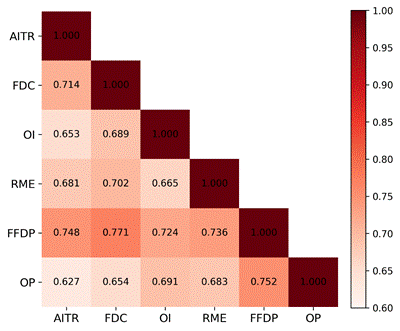
This study attempts to address that gap directly. We examine how AI Technology Readiness (AITR), Fraud Detection Capability (FDC), Organizational Integrity (OI), and Risk Management Effectiveness (RME) relate to Financial Fraud Detection Performance (FFDP), drawing on survey data from 145 professionals across a range of U.S. organizations. Using descriptive statistics, correlation analysis, and multiple regression, we test the proposed relationships among these constructs. In doing so, we hope to offer not just another conceptual argument for AI adoption, but a modest, empirically grounded contribution — one that speaks to managers and policymakers who are trying to translate the promise of AI-driven fraud detection into practical governance and risk management strategies.