
Data Modeling

Mathematical and Computational Data Modeling | Online ISSN 3143-9217
2
Citations
14.5k
Views
48
Articles
Your new experience awaits. Try the new design now and help us make it even better
Switch to the new experience
Figures and Tables
RESEARCH ARTICLE   (Open Access)

Interoperability in Mobile Financial Services: Regulatory Challenges and Prospects in Bangladesh

Mohammad Reza Rezaee 1*, Kamruzzaman Mithu 2*

+ Author Affiliations

Data Modeling 5 (1) 1-8 https://doi.org/10.25163/data.5110936

Submitted: 21 September 2024 Revised: 13 November 2024  Published: 26 November 2024 


Abstract

Background: Mobile financial services (MFS) have grown into one of the principal channels of digital and financial inclusion in Bangladesh, yet the sector's regulatory architecture — spread across a sector regulator, several co-regulators, and competing commercial interests — has struggled to keep pace with the platform's rapid expansion, leaving interoperability across providers only partially realized. Methods: This study adopts a qualitative, secondary-source content-analysis design, drawing on Bangladesh Bank's regulatory instruments (orders, guidelines, and circulars issued between 1972 and 2022), relevant national legislation, an institutional working paper on digital-finance interoperability, and contemporaneous business-press reporting, in order to map the regulatory actor landscape and characterize the sector's interoperability challenges and prospects. Results: The regulatory arrangement for MFS in Bangladesh involves a sector-specific regulator (Bangladesh Bank), elected political oversight bodies, three co-regulators spanning telecommunications, consumer protection, and competition, and three organized interest groups representing telecom operators, banks, and consumers. Recent regulatory action — including the 2022 MFS Regulations, revised transaction ceilings, and the launch of the Interoperable Digital Transaction Platform (IDTP) — has begun to establish cross-platform fund transfer, though full interoperability, a level competitive playing field, and consistently high service quality remain incompletely achieved, with market concentration around a single dominant operator persisting. Conclusion: Bangladesh's MFS sector stands at a genuine inflection point: the regulatory and technical groundwork for interoperability is now largely in place, but converting that groundwork into affordable, high-quality, and genuinely competitive services will require sustained coordination among regulators, tighter fraud enforcement, and a deliberate reduction in transaction costs for lower-income users.

Keywords: Mobile financial services; Interoperability; Financial inclusion; Bangladesh Bank; Regulatory governance; Digital payments; Fintech policy.

1. Introduction

It is easy, looking back only a decade or so, to forget how recently most people in Bangladesh had no practical way to move money safely from one place to another. Anyone needing to send funds to a relative in another district was, more often than not, left choosing between a slow and none-too-reliable postal money order or a network of informal middlemen — arrangements that worked, more or less, but rarely inspired much confidence. That picture has changed rather dramatically since mobile financial services (MFS) were formally introduced under Bangladesh Bank's guidelines on 22 September 2011 (Bangladesh Bank, 2011). By August 2022, the sector had grown to encompass more than 185 million operative mobile accounts, with roughly 57 million of those actively registered — numbers that, whatever one's views on the sector's remaining problems, represent a genuinely significant achievement in financial inclusion for a country where formal banking penetration had long lagged behind.

Bangladesh Bank (BB), functioning in the sense described by Majone (1999) as a 'non-majoritarian' independent regulatory agency, carries formal responsibility for regulating this market in a manner that serves both commercial development and the broader public interest. Under BB's own definition, MFS refers to e-money services tied to a specific mobile number — a Mobile Account — whose fund balances are recorded on an electronic general ledger and drawn down through mobile-issued payment instructions or an equivalent authenticated digital process; distinctively, and unlike ordinary e-money products, MFS accounts are additionally permitted to conduct cash-in and cash-out transactions through physical agent locations (Bangladesh Bank, 2018). This hybrid character — digital at its core, but still anchored to a physical agent network — is, in many ways, what has allowed MFS to reach unbanked and rural populations in a way that purely app-based digital banking has not managed to do elsewhere.

The practical footprint of this growth is now considerable. Mobile financial transactions in Bangladesh today span an unusually broad range of everyday needs: sending and receiving money, paying tuition and utility bills, settling retail purchases, covering transport costs, and transacting with government services (Bangladesh Bank, 2017). Overseeing all of this, at least nominally, falls to Bangladesh Bank, though as this paper argues, effective oversight in practice depends on considerably more than a single regulator's mandate. Ensuring that MFS products remain diverse and genuinely high-quality, rather than merely widespread, requires at minimum three things: a competitive market that new entrants can plausibly join, continued development of innovative product offerings, and services that deliver real value for the fees charged. Behind each of these sits a cluster of thorny policy questions — channel access, pricing transparency, interoperability between competing platforms, coordination across regulatory bodies, and data-sharing arrangements — all of which matter more, not less, as the ecosystem diversifies to include an expanding mix of banks, mobile network operators (MNOs), and independent fintech providers, each of whom regulators must treat with something resembling an even hand.

The broader technological backdrop here is not unique to Bangladesh, of course. Since roughly the mid-1990s, e-commerce, e-business, and what is sometimes termed m-business (mobile business) have expanded at a pace that would have been difficult to predict at the outset, and m-business in particular has proven capable of reshaping not just how people conduct transactions but how they organize daily life more broadly — a shift made possible, in no small part, by how thoroughly mobile devices have become woven into ordinary consumer behavior (Lee et al., 2012). Within that global trajectory, MFS has emerged as arguably the single most consequential driver of financial inclusion specific to the Bangladeshi context, precisely because it sidesteps many of the infrastructure and documentation barriers that have historically kept lower-income and rural populations outside the formal banking system (Mujeri & Azam, 2018).

Mobile banking adoption itself has drawn its own strand of research attention, separate from the interoperability questions this paper is centrally concerned with. Al Amin et al. (2021), for instance, traced how evolving mobile network capabilities and increasingly sophisticated device features have shaped a client-driven model of m-banking adoption, examining both the structural factors underlying diffusion and, notably, the specific reasons behind adoption failures alongside the corresponding opportunities for improvement — a useful reminder that growth statistics alone can obscure meaningful pockets of friction and dissatisfaction within the user base.

Interoperability — the capacity for a customer on one MFS platform to transact seamlessly with a customer or merchant on another — has, for its part, become an increasingly central preoccupation among Bangladeshi policymakers, and for good reason: the evidence broadly suggests that interoperable systems generate durable, sector-wide benefits once established. Whether a given market actually achieves those benefits, however, depends on a fairly demanding combination of factors: how mature the sector already is, prevailing market conditions, the surrounding politico-economic environment, the sophistication of regulatory institutions, and the pace of underlying technological innovation. None of this happens automatically; it requires deliberate, sustained coordination among a genuinely crowded field of regulatory actors — Bangladesh Bank itself, the Ministry of Finance, the Microcredit Regulatory Authority (MRA), and the Insurance Development and Regulatory Authority (IDRA) on the financial-sector side, together with the Bangladesh Telecommunication Regulatory Commission (BTRC) and the Ministry of Posts, Telecommunications and Information Technology on the telecom side, not to mention the consumer-protection and competition authorities that sit somewhat apart from both (Mujeri & Azam, 2018).

Bangladesh Bank has, to its credit, taken concrete steps in this direction. The launch of the National Unified USSD Platform (NUUP), which brought together banks and telecom providers under a common access channel, represented an early and meaningful step toward interoperability, even if it fell short of full cross-platform fund transfer. Realizing the fuller potential benefits of interoperability, though, will require Bangladesh to work through a still-substantial list of unresolved issues, particularly given how closely interoperability and financial inclusion are intertwined in practice — progress on one front tends to either reinforce or constrain progress on the other (Mujeri & Azam, 2018).

Against this backdrop, the present study sets out to accomplish three related aims: first, to map the constellation of regulatory actors currently governing mobile banking services in Bangladesh; second, to identify the principal problems and prospects bearing on the quality of mobile banking regulation; and third, to characterize the specific interoperability challenges facing the sector and the approaches available for addressing them. The remainder of this paper proceeds as follows: the Methods section describes the qualitative, document-based approach used to conduct this analysis; the Results section presents the regulatory actor landscape, recent regulatory developments, and the sector's principal prospects; the Discussion section considers the policy implications of these findings, situates them within the broader interoperability literature, and offers concrete recommendations; and the Conclusion summarizes the study's central contribution.
2. Methods

This study was designed as a qualitative, document-based (secondary-source) analysis, an approach well suited to characterizing a regulatory landscape whose relevant evidence resides primarily in official instruments, institutional reports, and contemporaneous press coverage rather than in data amenable to quantitative sampling. The approach and inclusion criteria described below are intended to allow an independent researcher to reconstruct the same evidentiary base.

2.2 Case Selection and Research Design

Sound methodological grounding for a study of this kind rests on two related considerations. First, the case under study — Bangladesh's mobile financial services sector — was selected from a theoretically relevant population of developing-country digital-finance markets, on the grounds that Bangladesh's combination of rapid MFS user growth, a dominant single operator, and an actively evolving regulatory apparatus makes it a particularly instructive case for examining interoperability dynamics under real-world constraints. Second, the case satisfies practical feasibility requirements: Bangladesh Bank and associated government bodies maintain a reasonably accessible public record of regulatory instruments, market statistics, and policy announcements, which made a document-based analysis both tractable and verifiable.

2.3 Data Sources

Data were drawn exclusively from secondary sources, following content analysis as the qualitative method of choice. Primary categories of source material included: (a) Bangladesh Bank's regulatory instruments, spanning the Bangladesh Bank Order of 1972 through the Bangladesh Mobile Financial Services (MFS) Regulations of 2018 and their 2022 revision, along with associated guidelines and circulars (Bangladesh Bank, 1972, 2011, 2017, 2018, 2022); (b) relevant national legislation governing telecommunications, consumer protection, and market competition (Government of the People's Republic of Bangladesh, 2001, 2009, 2012); (c) institutional research on digital-finance interoperability in Bangladesh, most notably the Institute for Inclusive Finance and Development working paper by Mujeri and Azam (2018); and (d) contemporaneous business-press reporting on regulatory and market developments, drawn from The Business Standard and The Daily Star (The Business Standard, 2022; The Daily Star, 2022a, 2023).

2.4 Analytical Approach

The regulatory framework and its major constraints were analyzed by closely tracing the applicable laws, rules, and regulatory documents alongside market-performance data on mobile financial services, with particular attention to Bangladesh Bank's regulatory framework and its observed compliance in service delivery. Data extracted from these sources were organized around the study's three specific objectives — mapping the regulatory actor constellation, identifying problems and prospects in service regulation, and characterizing interoperability challenges and approaches — and analyzed qualitatively rather than through statistical inference. This reliance on secondary, document-based data, rather than primary interviews or survey instruments, is a limitation of the study that is discussed further below, since it necessarily reflects what regulators and the press have chosen to report rather than a fully independent audit of sector practice.

3. Results

3.1 Sector Scale and Market Performance

As of September 2022, the mobile financial services sector in Bangladesh comprised 13 banks providing MFS, supported by over 1.5 million agents and roughly 1,850.6 lakh registered clients, of whom approximately 575.27 lakh accounts were classified as active (Table 1). The sector processed more than 408 million transactions in that period, worth a combined BDT 87,635.17 crore, translating to a daily average of roughly 13.6 million transactions and BDT 2,921.17 crore in daily transaction value (Table 1). Broken down by product category, cash-in and cash-out transactions together accounted for the largest share of value (BDT 26,687.22 crore and BDT 23,782.59 crore, respectively), followed by peer-to-peer (P2P) transfers at BDT 25,153.31 crore, with salary disbursement, utility bill payment, merchant payment, government payment, and inward remittance comprising smaller but still meaningful shares of overall activity (Table 1).

3.2 Regulatory Actor Constellation

Consistent with its status as the sector-specific regulator, Bangladesh Bank holds primary responsibility for regulating and monitoring mobile financial services under the Bangladesh Bank Order of 1972 and the MFS Regulations (Bangladesh Bank, 1972, 2011, 2018). Beyond BB itself, the regulatory arrangement encompasses political authorities — the Finance Division of the Ministry of Finance and the Parliamentary Standing Committee on the Ministry of Finance — together with three co-regulators operating alongside BB: the Bangladesh Telecommunication Regulatory Commission (BTRC), responsible for telecom access, affordability, and service quality; the Directorate of National Consumer Rights Protection (DNCRP), tasked with cross-sector consumer protection; and the Bangladesh Competition Commission (BCC), which works to maintain a level competitive playing field and prevent monopolistic conduct (Government of the People's Republic of Bangladesh, 2001, 2009, 2012). Three organized interest groups round out the constellation: the Association of Mobile Telecom Operators of Bangladesh (AMTOB), representing telecom providers; the Association of Bankers, Bangladesh Limited (ABB), representing the banking industry; and the Consumers Association of Bangladesh (CAB), a nationwide consumer-advocacy body. A full summary of these actors and their respective responsibilities is provided in (Table 2).

3.3 Recent Regulatory Developments

Bangladesh Bank has issued a series of regulatory updates in step with the sector's growth. Cash-in limits through bank accounts and cards have been raised to a maximum of Tk 50,000 daily and Tk 3 lakh monthly, up from a previous cap of five daily and 25 monthly cash-in transactions (and five daily, 20 monthly cash-out transactions); agent-based cash-in, by contrast, remains capped at Tk 30,000 daily and Tk 2 lakh monthly. The overall monthly ceiling for sending and receiving funds has similarly increased, from Tk 75,000 to Tk 2 lakh — though, notably, regulators continue to face practical difficulty monitoring potential abuse of these transaction ceilings (The Business Standard, 2022). Providers have also been permitted to operate an inter-distributor cash management system enabling e-money and cash-fund transfers over weekends and public holidays, per a Bangladesh Bank circular to that effect (The Daily Star, 2022a).

More substantively, Bangladesh Bank issued the Bangladesh Mobile Financial Services (MFS) Regulations, 2022 — grounded in Section 7A(e) and Section 82 of the Bangladesh Bank Order, 1972, and Section 26(cha) of the Bank Companies Act, 1991 — superseding the 2018 regulations with immediate effect (Bangladesh Bank, 2022). These revised regulations pursue three central purposes: establishing a regulatory framework conducive to a competitive, cost-efficient, and prompt MFS market; promoting affordable, convenient access to formal financial services, particularly for poor and previously unbanked segments of the population; and ensuring compliance with Anti-Money Laundering and Combating the Financing of Terrorism (AML/CFT) standards set by 

Table 1. Mobile Financial Services (MFS) industry- and product-wise summary statement for Bangladesh, September 2022 (source: Bangladesh Bank). Panel A reports industry-level figures — participating banks, agents, registered and active clients, transaction counts, and transaction values. Panel B breaks total transaction value down by product category, including remittance, cash-in/cash-out, peer-to-peer transfer, salary disbursement, bill payment, merchant payment, and government payment.

Category

No.

Description

Amount

Industry-wise information

1

No. of banks currently providing the services

13


2

No. of agents

1,505,321


3

No. of registered clients (in Lac)

1,850.6


4

No. of active accounts (in Lac)*

575.27


5

No. of total transactions

408,379,707


6

Total transaction value (crore BDT)

87,635.17


7

No. of daily average transactions

13,612,657


8

Average daily transaction value (crore BDT)

2,921.17

Product-wise transaction information

9

Inward remittance

330.11 crore BDT


10

Cash-in transactions

26,687.22 crore BDT


11

Cash-out transactions

23,782.59 crore BDT


12

P2P transactions

25,153.31 crore BDT


13

Salary disbursement (B2P)

2,752.49 crore BDT


14

Utility bill payment (P2B)

2,178.06 crore BDT


15

Merchant payment

3,123.85 crore BDT


16

Government payment

20.85 crore BDT


17

Others

3,606.69 crore BDT

Table 2. Actors' constellation in the regulatory arrangement governing mobile financial services in Bangladesh. The table lists each actor by institutional type — sector regulator, elected political bodies, co-regulators, and interest groups — together with its specific statutory or organizational responsibility within the MFS regulatory ecosystem, illustrating the multi-actor coordination required for effective sector governance.

Actor Type

Actor

Responsibilities

Sector regulator

Bangladesh Bank (BB)

Regulation of mobile financial services in Bangladesh under the Bangladesh Bank Order, 1972 (P.O. No. 127 of 1972) and the Bangladesh Mobile Financial Services (MFS) Regulations, 2018.

Elected politicians

Finance Division, Ministry of Finance

Making policy and programs on financial matters, including digital money transactions in Bangladesh.

Elected politicians

Parliamentary Standing Committee on the Ministry of Finance

Overseeing the functions of the Ministry of Finance as well as the departments and agencies under the finance ministry.

Co-regulators

Bangladesh Telecommunication Regulatory Commission (BTRC)

Responsible for regulating the telecommunication industry with regard to access, affordability, and the quality of telecom services.

Co-regulators

Directorate of National Consumer Rights Protection (DNCRP)

Works to protect the rights of consumers across sectors.

Co-regulators

Bangladesh Competition Commission (BCC)

Functions to create a level playing field in business ventures with sound competition across sectors and to prevent monopoly in the business environment.

Interest groups

Association of Mobile Telecom Operators of Bangladesh (AMTOB)

An interest group of mobile telecommunications service providers in Bangladesh.

Interest groups

Association of Bankers, Bangladesh Limited (ABB)

Works to build an acceptable platform for exchanging views with regulatory authorities and other related associations in the banking industry.

Interest groups

Consumers Association of Bangladesh (CAB)

A social group working to protect consumers from commodity adulteration and artificial price hikes, and to safeguard consumers' rights and interests in the country.

The Bangladesh Financial Intelligence Unit (BFIU). Alongside this regulatory update, the Interoperable Digital Transaction Platform (IDTP) launched with an initial cohort of three MFS operators (bKash, Rocket, and mCash), one digital wallet (Tallykhata), and ten participating banks — including Sonali Bank, Islami Bank, Pubali Bank, Brac Bank, City Bank, Mutual Trust Bank, Eastern Bank, UCB, Al-Arafah Islami Bank, and Midland Bank — with additional providers expected to join over time (The Daily Star, 2023).

3.4 Prospects for the Sector

Three prospects stand out from the analysis. First, on user and market expansion, the sector continues to grow rapidly along both the user and transaction dimensions, suggesting continued headroom for further adoption beyond current levels (Table 1). Second, on competitive fairness, a genuinely level playing field among operators remains an open regulatory task; the current market structure leaves meaningful scope for the regulatory authority to act against operators holding disproportionate market share in order to preserve market effectiveness. Third, and most centrally for this study, full interoperability across providers is not yet realized within the existing MFS landscape, even though such interoperability could plausibly unlock considerable additional business potential through broader transaction flows across users, providers, and national borders. Bangladesh Bank's recent introduction of Binimoy represents a concrete step toward that goal, and the regulatory authority may also find value in introducing a Regulatory Sandbox specifically to test the impact, safety, and technical robustness of interoperable mobile financial services before broader rollout (Mujeri & Azam, 2018).

4. Discussion

4.1 Principal Findings

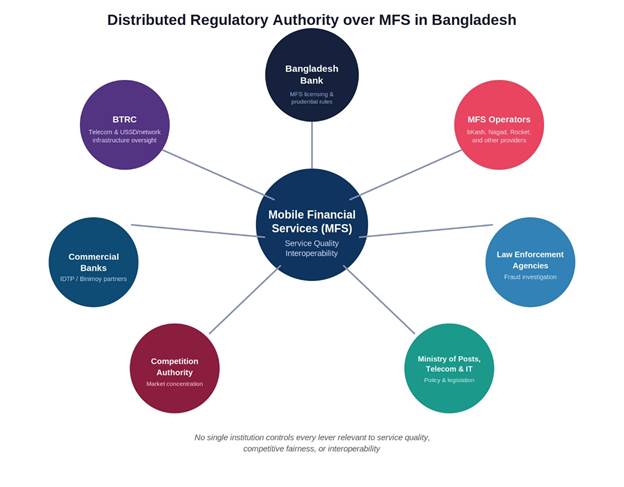
Taken together, these results depict a sector in the middle of a genuine, if incomplete, regulatory transition. The scale of activity documented in (Table 1) — more than 408 million transactions and roughly BDT 87,635 crore in value over a single month — confirms that MFS has moved well past the stage of a promising pilot and become genuine financial infrastructure for a substantial share of the population. At the same time, the actor map summarized in (Table 2) makes clear just how distributed regulatory authority over this infrastructure actually is: no single institution, Bangladesh Bank included, controls every lever relevant to service quality, competitive fairness, or interoperability, and the practical success of any given reform therefore hinges on coordination across at least six distinct institutional actors with, at times, only partially overlapping incentives (Figure 1).

4.2 Interoperability as the Central Unresolved Challenge

Of the various threads examined here, interoperability is arguably the one where the gap between stated ambition and achieved outcome remains widest. The evolution from NUUP to the Interoperable Digital Transaction Platform and, more recently, Binimoy demonstrates real regulatory intent and technical progress, and the participation of major banks and MFS operators in the IDTP launch is a meaningfully positive signal (The Daily Star, 2023). And yet, consistent with the broader interoperability literature, achieving the full benefits of an interoperable system evidently depends on factors well beyond the existence of a shared technical platform — sectoral maturity, market structure, regulatory coordination capacity, and the surrounding politico-economic environment all continue to shape how completely interoperability translates into practice (Mujeri & Azam, 2018). A Regulatory Sandbox approach, allowing interoperability's safety and robustness to be tested incrementally rather than rolled out all at once, seems a reasonable next step precisely because it acknowledges this complexity rather than assuming a single platform launch will resolve it.

4.3 Persistent Problems: Cost, Fraud, Service Quality, and Market Concentration

Four persistent problems emerge clearly from this analysis, and it is worth being direct about each rather than folding them into vaguer language about “challenges.” First, service fees for MFS transactions in Bangladesh remain comparatively high relative to similar services in other developing economies, a cost burden that falls disproportionately on the lower-income and previously unbanked users the sector was largely built to serve. Second, transaction ceilings continue to require frequent regulatory revision — the shift from Tk 75,000 to Tk 2 lakh in monthly send/receive limits being only the most recent example — and regulators still report difficulty monitoring potential abuse of these ceilings even after adjustment. Third, fraudulent use of mobile money channels poses an ongoing threat to the industry's credibility, even though the volume of reported fraud has not, to date, reached alarming proportions. Fourth, and

Figure 1: Distributed Regulatory Authority over Mobile Financial Services (MFS) in Bangladesh. This figure maps the institutional actors with regulatory or operational authority over Bangladesh's MFS sector. The central node represents MFS as the shared infrastructure whose service quality and interoperability outcomes depend on coordinated action. Each surrounding node denotes a distinct actor and its primary sphere of influence: Bangladesh Bank (MFS licensing and prudential regulation), BTRC (telecom and USSD/network infrastructure oversight), MFS Operators (service delivery, e.g., bKash, Nagad, Rocket), Commercial Banks (IDTP/Binimoy interoperability partners), Law Enforcement Agencies (fraud investigation), the Competition Authority (market concentration), and the Ministry of Posts, Telecommunications and IT (policy and legislation). Connecting lines indicate a direct regulatory or operational relationship with the MFS ecosystem, not a formal reporting hierarchy. The figure illustrates the paper's central finding that authority over the sector is distributed across at least six institutional actors, none of which independently controls every lever relevant to service quality, competitive fairness, or interoperability.


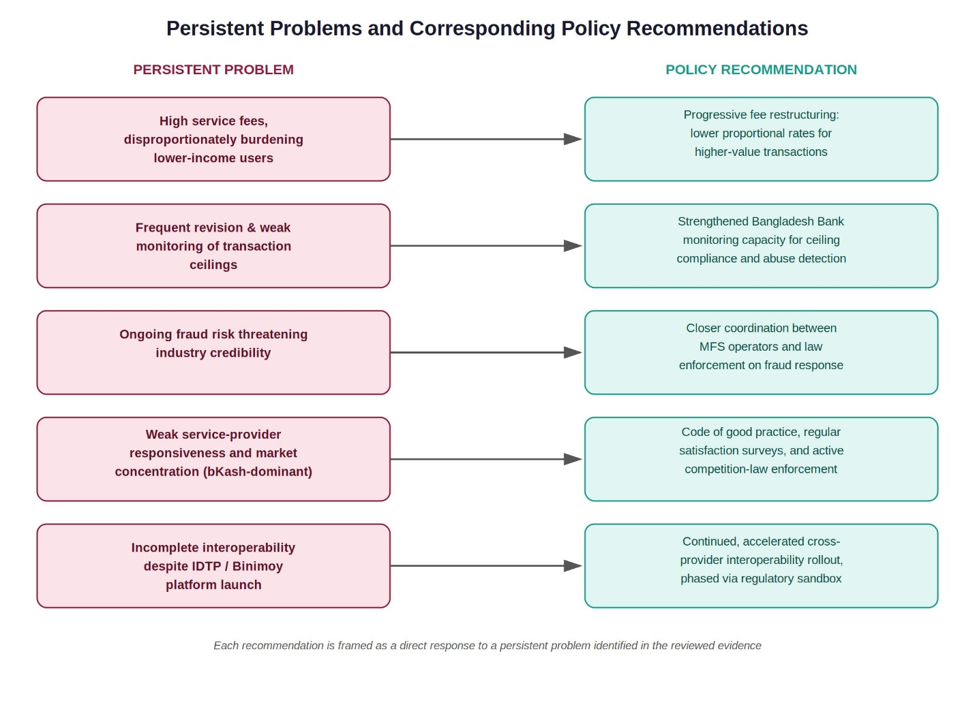
Figure 2: Persistent Problems in Bangladesh's MFS Sector and Corresponding Policy Recommendations. This figure presents a paired mapping between the four persistent problems identified in the Discussion (Section 4.3) and the specific policy recommendations proposed to address them (Section 4.4). Pink boxes (left column) denote each persistent problem as documented in the analysis; teal boxes (right column) denote the corresponding recommendation, connected by an arrow to indicate the problem–response relationship. The five rows cover, in order: (1) high and regressive service fees, (2) weakly monitored transaction ceilings, (3) ongoing fraud risk, (4) weak service-provider responsiveness and market concentration around a dominant operator, and (5) incomplete interoperability despite the IDTP/Binimoy platform launch. The figure is intended to show that each recommendation follows directly from an empirically identified problem rather than being offered as a general policy aspiration.

perhaps most consequential for long-term sector health, service-provider responsiveness remains relatively weak, and market concentration around a single dominant operator, bKash, raises genuine competitive-fairness concerns that a level-playing-field regulatory posture would need to address directly.

4.4 Policy Implications and Recommendations

Building on the problems identified above, several concrete policy directions follow reasonably naturally (Figure 2). Ensuring a level playing field for all operators, through active application of general competition law by Bangladesh Bank, would help counterbalance the market concentration observed around the dominant operator. Reducing and restructuring service fees along more progressive lines — lower proportional rates for higher-value transactions — would directly address the affordability concerns raised above, particularly for lower-income users who are disproportionately fee-sensitive. Strengthening coordination between MFS operators and law enforcement agencies on fraud response would help preserve user trust as transaction volumes continue to grow. Expanding the service catalog to include savings facilities, health insurance products, and worker salary payments would extend the sector's financial-inclusion value beyond simple transfers and bill payment. Improving service-provider responsiveness through an established code of good practice, paired with regular regulator-administered customer satisfaction surveys, would supply the kind of ongoing quality feedback loop that appears currently underdeveloped. And, finally, continued and accelerated implementation of cross-provider, cross-territory interoperability — building on the IDTP and Binimoy initiatives already underway — remains the single most consequential lever available for meeting both sectoral growth needs and the country's broader financial-inclusion goals.

4.5 Limitations

This study's reliance on secondary, document-based sources — regulatory instruments, an institutional working paper, and business-press reporting — rather than primary interviews with regulators, operators, or users represents its principal limitation, and means the analysis reflects what has been publicly reported and documented rather than an independent audit of regulatory practice or ground-level service delivery. Business-press sources, while useful for tracking recent regulatory developments, are also secondary in nature and may not capture the full complexity of internal regulatory deliberation. Future research incorporating primary stakeholder interviews, transaction-level data analysis, or direct comparison with interoperability outcomes in comparable developing-country markets would meaningfully extend the findings presented here.

5. Conclusion

Mobile financial services have become a genuinely transformative feature of Bangladesh's financial landscape, and Bangladesh Bank's evolving regulatory framework, together with recent developments such as the 2022 MFS Regulations and the launch of the Interoperable Digital Transaction Platform, reflects meaningful institutional progress. Even so, this review identifies persistent structural problems — comparatively high service fees, recurring difficulty enforcing transaction ceilings, ongoing fraud exposure, uneven service quality, and market concentration around a single dominant operator — that continue to limit how fully the sector's potential is realized. Achieving genuine interoperability, alongside a more level competitive playing field and improved service responsiveness, will require sustained coordination among Bangladesh Bank, co-regulators, and industry associations alike. With deliberate policy attention to cost, fraud enforcement, and service quality, mobile financial services could move from being merely widespread to being both affordable and genuinely inclusive across Bangladesh's population.


References


Al Amin, M., Sultana, N., Saha, T., Islam, S. M. N., & Kashem, M. A. (2021). Customer's attitude toward mobile banking usage: A case study in Bangladesh. Journal of Asian Finance, Economics, and Business, 8(2), 419–426. https://doi.org/10.13106/jafeb.2021.vol8.no2.0419

Bangladesh Bank. (1972). Bangladesh Bank Order, 1972 (P.O. No. 127 of 1972). Government of the People's Republic of Bangladesh.

Bangladesh Bank. (2011). Guidelines on mobile financial services (MFS) for the banks. Bangladesh Bank.

Bangladesh Bank. (2017). Annual report 2016–17. Bangladesh Bank.

Bangladesh Bank. (2018). Bangladesh Mobile Financial Services (MFS) Regulations, 2018. Bangladesh Bank.

Bangladesh Bank. (2022). Bangladesh Mobile Financial Services (MFS) Regulations, 2022. Bangladesh Bank.

Government of the People's Republic of Bangladesh. (2001). Bangladesh Telecommunication Regulation Act, 2001. Ministry of Posts, Telecommunications and Information Technology.

Government of the People's Republic of Bangladesh. (2009). Consumers Rights Protection Act, 2009. Ministry of Commerce.

Government of the People's Republic of Bangladesh. (2012). Competition Act, 2012. Ministry of Commerce.

Lee, Y.-K., Park, J.-H., Chung, N., & Blakeney, A. (2012). A unified perspective on the factors influencing usage intention toward mobile financial services. Journal of Business Research, 65(11), 1590–1599. https://doi.org/10.1016/j.jbusres.2011.02.044

Majone, G. (1999). The regulatory state and its legitimacy problems. West European Politics, 22(1), 1–24. https://doi.org/10.1080/01402389908425284

Mujeri, M. K., & Azam, S. E. (2018). Interoperability of digital finance in Bangladesh: Challenges and taking-off options (InM Working Paper No. 54). Institute for Inclusive Finance and Development.

The Business Standard. (2022, April 25). MFS transaction limit increased. https://www.tbsnews.net/economy/banking/bb-re-fixes-mfs-money-transaction-limit-ease-payment-during-eid-409306

The Daily Star. (2022a, September 4). Fund transfer among MFS distributors to become easy. https://www.thedailystar.net/tags/mobile-financial-services-mfs

The Daily Star. (2023, January 6). Money transfer across MFS platforms finally a reality. https://www.thedailystar.net/business/economy/news/money-transfer-across-mfs-platforms-finally-reality-316860


Article metrics
View details
0
Downloads
0
Citations
63
Views

View Dimensions


View Plumx


View Altmetric


0
Save
0
Citation
63
View
0
Share