1. Introduction
There is something faintly absurd about trying to summarize John Milton in a single sentence, and yet scholars keep attempting it — poet, polemicist, defender of regicide, heretic, all at once, sometimes within the same paragraph. Perhaps the difficulty is the point. The seventeenth century that produced him was itself a century unwilling to hold still: a civil war that split a kingdom, the execution of an anointed king in 1649, a decade of republican experiment under Cromwell, and then, in 1660, the awkward return of the very monarchy that had just been abolished (Witte, 2008; Pugh, 2021). Underneath these political convulsions ran a deeper and, in some ways, stranger current — Puritan reform, the gentler latitudinarian impulse that followed it, and a recurring, almost feverish millenarian expectation that history itself was accelerating toward some final reckoning (Asiatidou, 2021; Wilson, 1963). Milton (1608–1674) did not merely live through this; he wrote from inside it, and that distinction — subtle as it sounds — turns out to matter more than criticism has always allowed (Namozova, 2024; Mahmudzade, 2021).
It would be convenient, certainly, to separate the poet from the pamphleteer — to admire Paradise Lost as timeless verse while quietly setting aside the anti-prelatical tracts, the divorce writings, and the defense of a king's execution as period curiosities better left to historians. Convenient, but wrong, or at least badly incomplete. Milton served not only as a visionary poet but also as a political theorist and Secretary for Foreign Languages under Cromwell, and across both roles he pursued something closer to a single, sustained argument for human liberty than two separate careers (Skinner, 2000; Pugh, 2021; Witte, 2008). His anti-prelatical tracts of 1641–1642 — furious attacks on the Church of England's episcopacy — were not a detour from his poetic ambitions; by his own account, they were preparation for them, an attempt to liberate individual conscience from what he called the "tyranny of idle ceremonies" (Pugh, 2021; Witte, 2008; Serjeantson, D. 2011; Sonoi, C. (2009). Even while immersed in pamphlet warfare, he imagined a future in which his poetic genius would serve the same end: celebrating a nation he believed God had singled out to lead a "further Reformation" (Pugh, 2021). Politics, in other words, was never quite secular for Milton. Nor, for that matter, was poetry ever quite separable from either.
This entanglement only sharpens in the later work. When Milton justified the killing of Charles I in The Tenure of Kings and Magistrates and Eikonoklastes (both 1649), he reached for Calvinist covenant theology as readily as for classical Roman law (Skinner, 2000; Witte, 2008). All men, he argued, are born free in the image of God; legitimate authority rests on a fiduciary covenant between ruler and people, and a ruler who breaks that trust forfeits his claim to rule — deposition, even execution, becomes not merely permissible but a moral duty of the free-born conscience (Skinner, 2000; Witte, 2008). Political servitude, on this account, was never simply a civic failure. It was, Milton insisted, a form of spiritual degradation, breeding slavishness and eroding the very capacity for moral virtue (Skinner, 2000; Tournu, C. 2001).
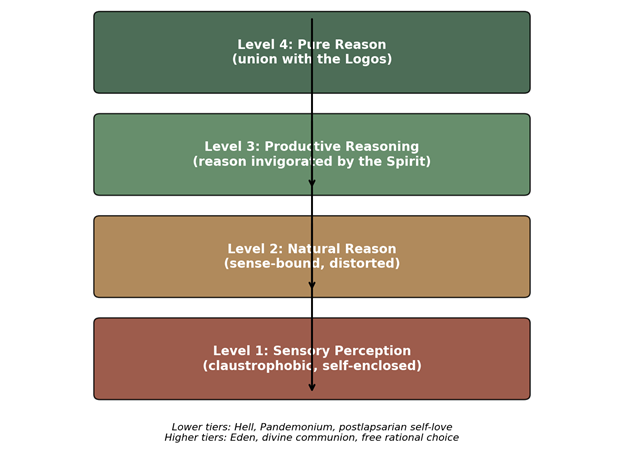
It is not a large step — though criticism has been slower to take it than one might expect — from this political theology to the cosmic drama of Paradise Lost, where the legitimacy of authority, divine and otherwise, gets interrogated through Satan's rebellion and humanity's fall (Masuwd, 2025; Konin & Khan, 2024). Milton's God governs by reasoned justice rather than raw power; obedience means nothing, the poem insists, unless it is freely chosen, since forced submission carries no moral weight at all (Konin & Khan, 2024; Masuwd, 2025). Satan's rhetoric of self-rule, by contrast, is exposed as a hollow and ultimately self-destructive illusion — his defiance traps him in a hell built from his own pride (Konin & Khan, 2024).
The Continental dimension of Milton's thought deserves more weight here than it often receives. His 1638–1639 travels through Italy brought him into direct contact with Italian academies, language, and music, and left a visible mark on both his literary style and his anti-papal outlook, filtered through Dante, Petrarch, and Paolo Sarpi (Martin, 2017). His understanding of the ius gentium — the law of nations, conceived as a postlapsarian order meant to mitigate human vulnerability — underwrites his radical case for divorce as a compassionate remedy for incompatible marriage (Warren, 2013). Milton's writing, in short, keeps moving between the intimate scale of domestic relations and the global scale of political and theological order, refusing to stay put in either (Warren, 2013).
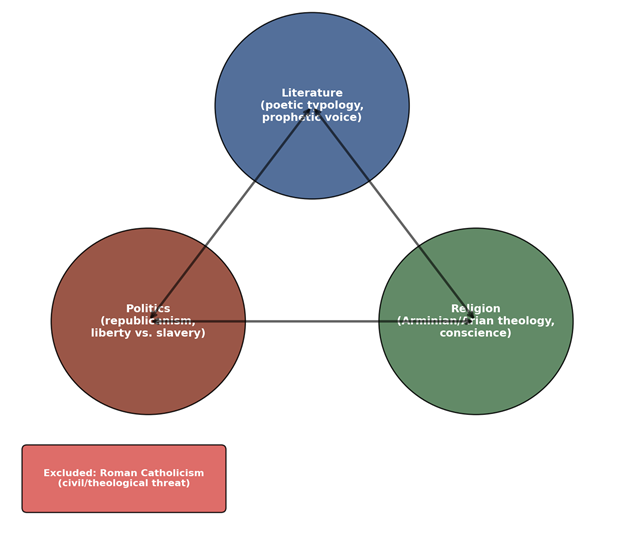
And then there is toleration, which is where Milton stops being convenient for anyone hoping to claim him. Areopagitica (1644) remains, deservedly, a founding text of the free-press tradition, arguing that pre-publication licensing functioned as an inquisitorial tool borrowed straight from Rome, one that stifled a genuinely progressive search for truth (Pugh, 2021; Witte, 2008). Truth itself, for Milton, was never a settled possession — it was fragmented, dynamic, something that had to be continually reconstructed through open debate (Pugh, 2021; Witte, 2008). He went so far as to redefine heresy not as false doctrine but as passive belief — conviction accepted on authority alone, without the considered assent of one's own reason (Gregory, 2012; Witte, 2008). But this tolerance had a hard edge, and it is worth sitting with rather than explaining away: shaped by the anti-Catholic anxieties of his moment, Milton drew a rigid line at Roman Catholicism, arguing it should be civilly and religiously suppressed as an existential threat to both state and true religion (Pepperney, 2009; Wilson, 1963; Pugh, 2021). He would extend real toleration to Lutherans, Calvinists, Anabaptists, even Socinians — but always within the bounds of "regenerate" Protestant Christians reasoning from Scripture alone (Wilson, 1963; Pugh, 2021).
This theological posture connects, in ways not always made explicit, to Milton's genuinely heretical Christology. Drawing on his systematic De Doctrina Christiana, he adopted an Arian view of Christ, rejecting the Son's traditional co-equality with the Father and presenting him instead as a subordinate, created being (Gregory, 2012; Wade, 2015). In Paradise Regained and Samson Agonistes (both 1671), this heterodoxy does real dramatic work: because the Son is not co-equal with God, his resistance to Satan's temptations becomes a genuine moment of moral choice rather than a foregone conclusion, and Samson's destruction of Dagon's temple reads as voluntary sacrifice rather than Calvinist inevitability (Konin & Khan, 2024; Wade, 2015).
A further complication — one that has only recently drawn sustained scholarly attention — concerns gender. Milton's relationship to the English women prophets of the Civil War and Interregnum, figures like Mary Pope and Elizabeth Avery who claimed direct divine inspiration to enter public political debate, has been largely overlooked, though he shared their anti-clerical insistence on individual conscience even where he would have rejected their specific doctrines (Curbet, 2024). More striking still, his own poetic self-representation quietly subverts the gender binaries his public prose otherwise upholds: the invocation that opens Paradise Lost casts the poet in a metaphorically feminine, receptive posture, asking the Holy Spirit to "instruct" and "raise" him, his mind figured as fertile ground awaiting impregnation by the epic itself (Curbet, 2024). That same pattern resurfaces, transformed, in Paradise Regained, where the Virgin Mary is elevated to something like a private prophetess, her quiet, retired contemplation enabling Christ's own understanding of his mission (Curbet, 2024).
Despite the volume of scholarship Milton has generated, criticism keeps splitting into two camps that, on closer inspection, share the same underlying flaw. Traditionalist and nationalist readings tend to soften his radicalism, recasting him as a broadly orthodox Protestant thinker (Wade, 2015). Secularist readings run the opposite direction, celebrating him as a forerunner of liberal secularism by lifting his civil liberties clean out of their theological scaffolding (Witte, 2008; Pugh, 2021). Both, this article argues, get something important wrong: Milton's civil and domestic liberties were never free-standing. They were always subordinate to, and derived from, his theological conception of liberty of conscience (Pugh, 2021; Gregory, 2012).
With that in mind, this study is organized around three research questions. First, to what extent do the typological and theological structures of Paradise Lost, Paradise Regained, and Samson Agonistes actively produce Milton's heterodox Arian and Arminian commitments, rather than simply reflecting beliefs he already held? Second, how did his engagement with Continental humanism, Grotian legal theory, and the alternative religious voice of seventeenth-century women prophets shape his distinctive, gender-subversive model of prophetic authority? And third, in what sense do the limits of his toleration — his exclusion of Roman Catholicism above all — reflect a pragmatic early modern logic of "reason of state," rather than simple prejudice dressed up as theology?
Correspondingly, this article pursues four objectives: to trace the cross-currents between Milton's political pamphlets and his major epics, showing the underlying unity of his civil, domestic, and ecclesiastical liberty; to examine how his heretical Christology and Arminian free will are woven structurally into his poetry through an unconventional reworking of biblical typology; to place his prophetic self-fashioning within the broader landscape of seventeenth-century female prophecy, attending to his complex, androgynous model of inspiration; and to historicize the contradictions in his tolerationist program, particularly his exclusion of Catholics, as a political-theological diagnostic rather than an incidental blind spot.