1. Introduction
Governance is one of those words that gets invoked so often, in so many different contexts, that it risks losing precision — and yet, when we look closely at how public institutions actually function, or fail to, the concept still does real analytical work. Over the past several decades the conversation has shifted away from a narrow preoccupation with formal government structures toward something broader: how responsively institutions treat citizens, how transparently they operate, and how willing they are to be held accountable (Rhodes, 1996). This shift did not happen in a vacuum. The World Bank and the United Nations Development Programme have both argued, at various points, that weak governance quietly erodes public trust and service delivery, particularly in countries where administration remains centralized and institutions are, in some sense, still finding their footing (UNDP, 2016; World Bank, 2017).
It is within this wider discourse that “good governance” emerged as something like a normative checklist — transparency, accountability, participation, equity, and rule of law, bundled together as markers of institutional quality (Kaufmann et al., 2011; Grindle, 2007). Whether such a checklist can ever be fully realistic is a fair question, but there is reasonably strong evidence that governance quality shapes economic growth, poverty outcomes, and democratic stability in ways that are difficult to dismiss (Fukuyama, 2013; Leftwich, 1994). The inclusion of Sustainable Development Goal 16 — peace, justice, and strong institutions — within the global development agenda only reinforced this point (United Nations, 2015). Governance, for better or worse, is no longer treated as a purely technical or administrative matter.
Local governance occupies a particularly interesting place in this story, mostly because local institutions are where citizens actually encounter the state — through sanitation, schools, roads, and the small, unglamorous machinery of everyday administration. Decentralization theory has long argued, sometimes rather optimistically, that moving authority closer to citizens should make institutions more responsive and accountable (Rondinelli et al., 1989; Oates, 1972). Scholars typically distinguish among political, administrative, and fiscal decentralization (Cole, 2008), and the underlying logic — that local governments simply know local needs better than distant central ministries — carries genuine intuitive appeal (Smoke, 2003; Ostrom, 2010). Yet the literature is not naive about this. Decentralization does not automatically produce better governance; weak institutional capacity, elite capture, and thin accountability mechanisms can just as easily reproduce old inequalities under a new administrative label (Crook & Manor, 1998).
The empirical record, perhaps unsurprisingly, is mixed. Some studies find that decentralization reforms, when paired with political commitment and adequate resources, genuinely improve service delivery and participation (Gadenne & Singhal, 2014; Faguet, 2014). Others document more or less the opposite — persistent bureaucratic inefficiency, corruption, and limited citizen oversight (Andrews, 2010; Brinkerhoff & Goldsmith, 2002). Across South Asia in particular, local governments often remain financially and administratively tethered to central authorities, which raises an uncomfortable question about how “local” local governance really is in practice (Robinson, 2007; Smoke & Lewis, 2005). And participatory mechanisms, even where they exist formally, do not always translate into substantive influence over planning or budgeting decisions (Cornwall, 2008; Gaventa & Barrett, 2012).
Bangladesh offers a particularly telling case in this respect. Its Constitution formally commits to decentralized, participatory local governance through Articles 59 and 60 (Government of Bangladesh, 1972), and the country's local government architecture — Union Parishads at the rural level, Pourashavas in municipalities, City Corporations in major urban centers — is reasonably well developed, at least on paper (Ahmed, 2013; Siddiqui, 2005). And yet successive reforms have not closed the gap between formal design and everyday practice. Political interference from Members of Parliament and party elites continues to shape local decision-making in ways that formal statutes do not really anticipate (Panday & Jamil, 2011), while accountability mechanisms — audits, financial disclosure, monitoring systems — remain patchy at best (Sarker, 2014; Transparency International Bangladesh, 2020). Citizen participation, meanwhile, often looks more procedural than substantive: ward meetings happen, but they tend to be dominated by local elites, leaving ordinary citizens, and especially women and marginalized groups, with limited real influence over outcomes (Rahman & Siddiquee, 2016; Hossain, 2018).
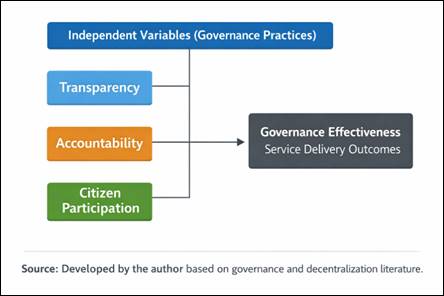
What seems to be missing from this literature — or at least underrepresented in it — is empirical work that combines measurable governance indicators with the lived, qualitative texture of how citizens and officials actually experience these institutions. Much existing scholarship leans heavily on macro-level or descriptive policy analysis; comparatively few studies integrate quantitative governance measurement with qualitative accounts of institutional and political dynamics. Given that governance is inherently multidimensional and context-dependent, this gap matters more than it might first appear. The present study attempts to address it by examining how transparency, accountability, and citizen participation jointly shape governance effectiveness within Bangladesh's local government institutions, drawing on both survey and interview data to build a fuller, and hopefully more grounded, picture of how governance actually works on the ground (Figure 1).
1.1 Theoretical Framework and Conceptual Foundation
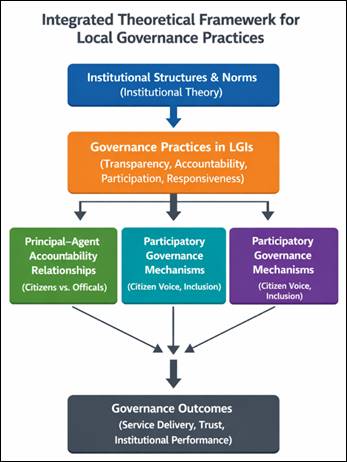
Three theoretical strands underpin this study — institutional theory, principal-agent theory, and participatory governance theory — which together offer a reasonably complete lens for examining how governance practices shape institutional effectiveness in Bangladesh (see Table 1). Institutional theory helps explain how formal and informal rules constrain or enable administrative behavior; principal-agent theory clarifies why accountability so often breaks down between citizens and the officials meant to serve them; and participatory governance theory speaks to the question of whether citizen engagement is substantive or merely symbolic. None of these theories, on its own, fully captures the complexity of local governance in Bangladesh, which is precisely why they are combined here rather than treated separately , as illustrated in the integrated framework below (Figure 2).
Transparency, accountability, and citizen participation are treated as the three explanatory dimensions of governance effectiveness, the outcome variable of interest. Transparency refers to openness in institutional processes; accountability concerns the mechanisms through which officials are held responsible for their decisions; and participation reflects the extent to which citizens genuinely influence planning, budgeting, and monitoring. The framework assumes — and this is worth stating plainly — that these three dimensions are not independent of one another; transparency and participation are expected to reinforce accountability, and together to shape institutional effectiveness.
1.2 Research Hypotheses
Building on this framework, three hypotheses guided the empirical analysis:
H1: Transparency positively and significantly influences governance effectiveness in local government institutions in Bangladesh.
H2: Accountability positively and significantly influences governance effectiveness in local government institutions in Bangladesh.
H3: Citizen participation positively and significantly influences governance effectiveness in local government institutions in Bangladesh.