
Journal of Primeasia

Integrative Disciplinary Research | Online ISSN 3064-9870 | Print ISSN 3069-4353
570
Citations
219.8k
Views
139
Articles
Your new experience awaits. Try the new design now and help us make it even better
Switch to the new experience
Figures and Tables
RESEARCH ARTICLE   (Open Access)

E-Governance and Public Service Delivery in Rural Bangladesh: Adoption, Barriers, and Outcomes in Union Parishads

Md. Motaher Hossain 1*

+ Author Affiliations

Journal of Primeasia 7 (1) 1-8 https://doi.org/10.25163/primeasia.7110793

Submitted: 12 May 2026 Revised: 30 June 2026  Published: 08 July 2026 


Abstract

Local governments are often where citizens actually meet the state, and in Bangladesh that meeting happens at the Union Parishad — the union-level office where a birth certificate, a tax receipt, or a grievance either moves quickly or does not move at all. This study asks a fairly simple question with a less simple answer: is digital governance actually changing that experience, or is it mostly a promise on paper? Using a mixed-methods design, we surveyed 200 citizens, interviewed 20 key informants (chairpersons, IT staff, and service users), and reviewed administrative service records across 10 Union Parishads selected to reflect regional variation. Descriptive and comparative statistics summarized adoption patterns and pre/post-digitalization service times, while thematic analysis of interviews surfaced institutional barriers. Six of the ten Union Parishads had adopted at least one digital service; birth and death registration was the most common (50%), while online grievance submission (20%) and digital social safety net records (10%) lagged well behind. Processing times fell markedly — birth/death certificates from roughly seven days to three, tax payments from about six days to two — and citizen satisfaction rose accordingly, though unevenly across service types. The persistent obstacles were not exotic: patchy internet and electricity, officials with little digital training, and, notably, not a single sampled Union Parishad with a dedicated e-governance budget line. We conclude that digital governance at the grassroots level is real but partial, administrative more than participatory, and that its future depends less on new software than on infrastructure, training, and sustained institutional commitment.

Keywords: e-governance; Union Parishad; local government; digital public service delivery; rural Bangladesh

1. Introduction

Anyone who has stood in line at a Union Parishad office in rural Bangladesh — waiting, perhaps for the third time that month, for a birth certificate that was promised "next week" — understands something that policy documents rarely capture well: local government is where the abstract idea of "the state" becomes a very concrete, very personal experience. Union Parishads (UPs), the lowest tier of Bangladesh's local government system, are legally responsible for a long list of everyday functions — birth and death registration, tax collection, social safety net administration, dispute resolution, and general access to public services (Government of Bangladesh, 2016). Because so much of the country's population still lives outside urban centers, it is really at this level, and not in national ministries, that citizens form their impressions of whether government works for them or against them (Julfiker, 2025). So strengthening Union Parishads is not merely a bureaucratic housekeeping matter; it is, arguably, one of the more consequential governance questions Bangladesh faces.

Over the last two decades or so, e-governance has been offered as one answer to this question — though "offered" perhaps undersells how forcefully it has been promoted. In its fuller sense, e-governance is not just scanning paper forms into a computer; it involves redesigning how services flow, how information is shared, and how citizens and officials actually interact (Bhat & Ratnakar, 2026; Chachane, 2024; Charley, 2025). Done well, it can shorten the distance between a citizen's request and a government's response, narrow the space for discretionary — sometimes corrupt — decision-making, and make information more readily available (Rapaya & Sasan, 2026). These are not small promises, particularly for institutions where citizens and officials interact face-to-face, repeatedly, and often on unequal terms.

The international record, though, is more cautious than the rhetoric suggests. Digital land registries, e-procurement platforms, and rural service kiosks have delivered real gains in several countries (Abdillahi, 2026; Abisado, 2025; Latip et al., 2025; Latupeirissa et al., 2024; Omweri, 2024; Sinoimeri, 2025; World Bank, 2002), yet the same literature is equally clear that technology by itself rarely does the work. Success tends to depend on whether institutions are ready, whether budgets and legal frameworks support the shift, and whether citizens have the literacy and access to actually use what has been built. Absent those conditions, digitalization can just as easily reproduce — or even sharpen — existing inequalities, particularly where broadband, electricity, and technical support are already scarce (Dzulkifli et al., 2023).

Bangladesh's own trajectory illustrates this tension well. The "Digital Bangladesh" vision (A2I, 2021; Government of Bangladesh, 2009) set an ambitious tone, and national-level services — online tax filing, digital land records, e-health platforms, Union Digital Centres — have genuinely expanded. And yet, somewhat predictably, the gains have not trickled down evenly. Central ministries and city-based services have moved faster; Union Parishads, closer to the ground and further from the policy spotlight, have moved more slowly, still leaning heavily on paper files and manual registers for many core functions (Transparency International Bangladesh, 2019).

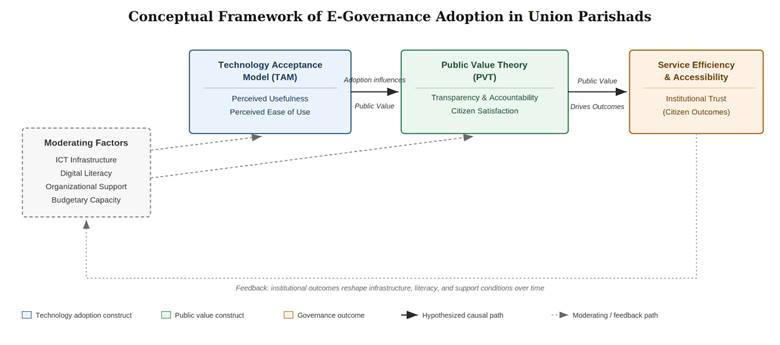
What, then, actually blocks progress at this level? The barriers reported in the literature are not mysterious — weak ICT infrastructure, undertrained staff, limited citizen digital literacy, thin budgets — but they are rarely examined together, empirically, at the Union Parishad level specifically. This study tries to fill that gap. Guided by the Technology Acceptance Model (Davis, 1989) and Public Value Theory (Moore, 1995), it asks: how are existing digital initiatives shaping the efficiency and accessibility of services; what institutional and technical barriers persist; and what interventions might realistically strengthen practice going forward. The aim is not to romanticize digital tools, nor to dismiss them, but to describe, as carefully as the data allow, what is actually happening on the ground.
2. Methodology

2.1 Study Design

This study used a convergent mixed-methods design (Creswell & Plano Clark, 2018), combining a structured citizen survey, semi-structured key-informant interviews, and a review of administrative service records. The rationale for combining these three strands was straightforward: no single data source could, on its own, capture both the measurable patterns of service change (turnaround times, adoption rates) and the lived institutional experience behind them (why an official avoids a digital tool, what a chairperson prioritizes when a server goes down). Quantitative and qualitative strands were collected concurrently and integrated at the interpretation stage through methodological triangulation.

2.2 Setting and Sampling

The study was conducted across 10 Union Parishads purposively selected to represent variation in geographic region, population density, and reported level of digital infrastructure, drawing on administrative directories maintained by the Ministry of Local Government, Rural Development and Co-operatives. We note this explicitly because, on reflection, the sampling was not strictly random in the probabilistic sense our earlier draft implied — Union Parishads were selected to maximize regional and infrastructural diversity rather than through a formal random-number procedure, and this is treated as a limitation below rather than glossed over.

Within each selected Union Parishad, citizens who had accessed at least one public service (registration, tax payment, grievance submission, or safety-net enrollment) within the preceding 12 months were eligible for the survey. A convenience sampling approach, stratified loosely by service type to avoid over-representing any single function, yielded 200 completed citizen surveys (20 per Union Parishad). Key informants — the Union Parishad chairperson, one administrative or IT-responsible staff member, and additional service-facing personnel — were purposively recruited for interviews, yielding 20 informants across the 10 sites.

2.3 Data Collection Instruments

Three instruments were used.

1. Structured citizen questionnaire. A researcher-administered survey captured demographic information, service-use history, five-point Likert-scale items on perceived usefulness, ease of use, accessibility, and satisfaction (adapted from Davis, 1989, and Venkatesh & Bala, 2008), and open-ended items on service experience. The instrument was piloted with 15 respondents (not included in the final sample) to check comprehension and item clarity, and minor wording adjustments were made accordingly.

2. Semi-structured key-informant interview guide. Interviews (approximately 30–45 minutes each, conducted in Bangla and later translated) explored institutional capacity, infrastructure, training, budget arrangements, and perceived barriers and enablers. Interviews were audio-recorded with consent and transcribed verbatim.

3. Administrative record review. For each Union Parishad, service registers and processing logs for the four focal services (birth/death registration, tax payment, grievance handling, mobile notification use) were reviewed for a 12-month window, comparing the most recent fully digitized period against the preceding manual/paper-based period, to derive average processing times.

2.4 Procedure

Data collection took place over a defined field period; enumerators received a half-day training on instrument administration and research ethics before fieldwork began. Citizen surveys were administered in person at or near Union Parishad premises following service completion, to reduce recall bias. Key-informant interviews were scheduled separately, at the informant's office, at a time that did not disrupt service delivery.

2.5 Data Analysis

Quantitative survey and administrative data were entered into a structured spreadsheet and analyzed using descriptive statistics (frequencies, percentages, means, standard deviations) and simple pre/post comparisons of processing time. Given the modest cell sizes involved, these comparisons are reported descriptively rather than as tests of statistical significance, and should be read as indicative trends rather than generalizable estimates. Interview transcripts were analyzed using reflexive thematic analysis following Braun and Clarke (2006): initial codes were generated inductively, grouped into candidate themes, and reviewed against the full dataset before being finalized. A second coder independently reviewed a 20% subsample of transcripts to check for coding consistency; discrepancies were resolved through discussion. Quantitative and qualitative findings were then integrated in a joint display to identify convergence and divergence across data sources.

2.6 Ethical Considerations

The study followed standard social-science ethical principles. Participation was voluntary and preceded by verbal informed consent; no personally identifying information was retained beyond the study period. Ethical clearance was obtained through the researcher's institutional review process prior to fieldwork.

2.7 Limitations of the Method

It should be said plainly: with 10 Union Parishads and 200 citizens, this is not a study designed to produce nationally representative estimates, and readers should treat the percentages reported here as descriptive of the sampled sites rather than as population parameters. Self-reported processing times may also be subject to recall or social-desirability bias, which the administrative record review was intended to partially offset.

3. Results

3.1 Current Status of E-Governance Adoption

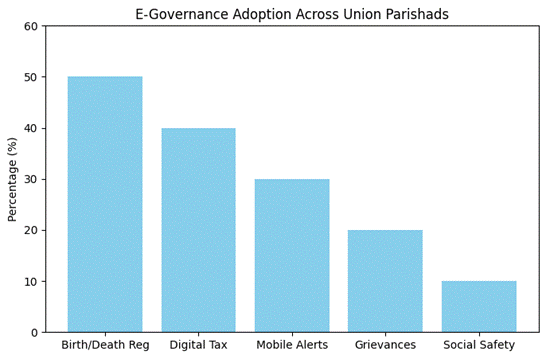
Adoption across the sample was, in a word, uneven. Six of the ten sampled Union Parishads had implemented at least one form of digital service delivery, though which service varied considerably by site. Online birth and death registration was the most widely adopted function, present in half of the sampled Union Parishads, followed by digital tax payment (40%) and mobile-based notification systems (30%) (Table 1). More citizen-facing, accountability-oriented functions lagged well behind: only 20% of sites offered online grievance submission, and just 10% had digitized social safety net records (Table 1; Figure 1). Put simply, the services that were easiest to centralize and standardize digitized first; the services that required more sustained citizen interaction and institutional coordination digitized last, or not at all.

Interview data helped explain this pattern rather than merely describe it. Several officials pointed, sometimes with visible frustration, to unreliable internet connectivity and the absence of anyone locally who could troubleshoot a malfunctioning system. As one IT-responsible staff member put it, digital tools were only as good as the weakest link in the chain — and that weakest link was, more often than not, the connection itself.

3.2 Citizen Experience and Service Efficiency

Sixty-five percent of surveyed citizens reported moderate to high satisfaction with digital services overall, and the reasons given were fairly consistent: fewer repeat visits, shorter waits, and a greater sense that outcomes were predictable rather than arbitrary. Administrative records supported this impression. Average turnaround for birth and death certificates fell from approximately seven days to three; tax payment processing fell from roughly six days to two; grievance resolution improved more modestly, from about ten days to five (Table 2). Mobile notification services, while not reducing a processing time per se, were credited by respondents with making meetings, welfare distributions, and emergency announcements far more immediate.

It is worth noting, though, that satisfaction was not uniform. Grievance-related services, despite improving, still lagged behind registration and payment services in reported satisfaction (60% versus 65–70%) (Table 2) — a pattern that recurs later in the Discussion, since it turns out to matter quite a bit for how we interpret the overall story.

3.3 Barriers to Implementation

Three barriers dominated the data, and they were remarkably consistent across sites. Roughly half of sampled Union Parishads lacked reliable computer equipment, stable electricity, or consistent internet access (Table 3). Around 60% of officials described their own ICT literacy as insufficient for confident, independent use of digital systems. And, perhaps most tellingly, not one of the ten sampled Union Parishads had a dedicated budget line for e-governance maintenance or development (Table 3) — digital initiatives instead survived, where they survived at all, on the goodwill of temporary projects or external donor support.

3.4 Success Stories and Positive Deviance

Not everything was constrained, however. Union Parishads in Sylhet had introduced digital appointment scheduling for tax services, cutting reported delays by close to half. In Comilla, digital payment systems for taxes and fines reduced cash-handling errors and improved transparency in financial records. And in Khulna, SMS-based notification systems for vaccination drives, welfare distribution, and public meetings appeared to meaningfully improve citizen awareness, particularly among residents who rarely visited Union Parishad offices in person. These cases suggest — cautiously, since they are a small handful of examples rather than a representative subsample — that local leadership and institutional motivation can partially offset resource constraints that might otherwise seem prohibitive.

4. Discussion

4.1 E-Governance as a Driver of Administrative Efficiency

The clearest finding here, and probably the least surprising, is that digitalization improved administrative efficiency where it was implemented (Table 2). This echoes a fairly well-established line of research arguing that ICT-based governance reduces bureaucratic delay and increases the accessibility of information (Heeks, 2006; Ndou, 2004). What is perhaps more interesting is that citizen satisfaction tracked these efficiency gains fairly closely, particularly for registration and payment services — services, notably, that required little behavioral change from the citizen and simply removed friction that had always been an annoyance rather than a necessity.

4.2 The Limits of Administrative Digitalization: A Participatory Gap

Yet the more citizen-empowering functions — grievance handling, safety net record management — told a rather different story (Table 1; Table 3). This is, in some ways, the paper's more important finding, if a less flattering one.

Figure 1. Conceptual framework of e-governance adoption in Union Parishads. Schematic representation of the theoretical model guiding this study, integrating the Technology Acceptance Model (TAM; Davis, 1989) and Public Value Theory (PVT; Moore, 1995). The framework depicts perceived usefulness and perceived ease of use among Union Parishad officials as proximal determinants of digital system adoption, which in turn is hypothesized to shape public value outcomes — service efficiency, transparency, accountability, and citizen satisfaction — moderated by contextual factors including ICT infrastructure, digital literacy, institutional support, and budgetary capacity. Arrows indicate hypothesized directional relationships; the framework was developed a priori from the literature and used to structure both instrument design and thematic analysis.

Table 1. E-governance adoption across sampled Union Parishads (N = 10). Number and percentage of sampled Union Parishads (UPs) that had implemented each digital service at the time of data collection, based on administrative record review and key-informant confirmation. Percentages are calculated relative to the total sampled UPs (N = 10) and are not mutually exclusive, as individual UPs could implement more than one service concurrently.

Service Type

Number of UPs Implemented

Percentage (%)

Online Birth/Death Registration

5

50

Digital Tax Payment

4

40

Mobile Notifications

3

30

Online Grievance Submission

2

20

Electronic Social Safety Records

1

10

Figure 2. Current e-governance adoption in Union Parishads. Bar chart depicting the proportion of sampled Union Parishads (N = 10) that had implemented each of five digital service categories, corresponding to the data reported in Table 1. Services are ordered from highest to lowest adoption to illustrate the declining implementation gradient from centrally administered, low-complexity services (e.g., birth/death registration) toward citizen-centered, accountability-oriented services (e.g., electronic social safety records).

Table 2. Citizen satisfaction and service efficiency before and after digitalization (N = 200 citizen respondents; 10 Union Parishads). Mean service processing times (in days) before ("Pre-Digital") and after ("Post-Digital") the introduction of digital systems, derived from administrative service records, alongside the corresponding percentage of surveyed citizens reporting moderate-to-high satisfaction (5-point Likert scale, collapsed to "satisfied" vs. "not satisfied") for each service indicator. Mobile Alert Service Feedback reflects citizen-reported satisfaction with notification immediacy rather than a discrete processing interval, and pre-digital values are therefore not applicable (N/A).

Indicator

Pre-Digital (Days)

Post-Digital (Days)

Satisfaction (%)

Birth/Death Certificate

7

3

70

Tax Payment Processing

6

2

65

Grievance Resolution

10

5

60

Mobile Alert Service Feedback

N/A

Immediate

68

Table 3. Key barriers to e-governance implementation across sampled Union Parishads (N = 10). Number and percentage of sampled Union Parishads reporting each barrier as a significant constraint to e-governance implementation, based on triangulated evidence from key-informant interviews (n = 20) and administrative/infrastructure assessment. Barriers are not mutually exclusive; individual UPs could report multiple concurrent constraints.

Barrier

Number of UPs Affected

Percentage (%)

Lack of computers & stable electricity

5

50

Low ICT literacy among officials

6

60

No dedicated e-governance budget

10

100

It suggests that digitalization in Union Parishads has so far been mostly administrative rather than participatory: it has made existing processes faster without necessarily making institutions more responsive or accountable to citizen voice. This finding sits somewhat uneasily against more optimistic accounts of e-governance as an automatic route to inclusive, participatory governance (Kneuer et al., 2025); our data suggest the relationship is considerably more conditional than that. Mobile notification systems did appear to strengthen citizen engagement and information access (Linje, 2025; United Nations, 2020), but one-way information flow is not quite the same thing as two-way accountability, and it would be a stretch to claim otherwise.

4.3 Structural, Technical, and Human Barriers

The barriers identified — infrastructure, ICT literacy, and, above all, the complete absence of dedicated budgets (Table 3) — are not new to the literature (Ndou, 2004; Omweri, 2024), but their persistence at the Union Parishad level, despite years of national digital policy commitment, is notable. It suggests that policy ambition at the national level has simply not yet been matched by institutionalized funding and support structures at the grassroots level, a disconnect that mirrors concerns raised in comparable developing-country contexts (Dzulkifli et al., 2023). Resistance to change among some officials — understandable, perhaps, when new systems are perceived as adding workload without adding support — echoes findings from technology-acceptance research more broadly (Venkatesh & Bala, 2008).

4.4 Linking Findings to Theory

These results support, with some qualification, both theoretical lenses guiding this study. Consistent with the Technology Acceptance Model, officials who perceived digital tools as useful and easy to operate engaged with them more readily (Davis, 1989) — though perceived usefulness alone, as our data show, was not sufficient when infrastructure or budget simply were not there. And consistent with Public Value Theory (Moore, 1995; Bryson et al., 2014), citizens valued digital services chiefly to the extent that those services delivered tangible improvements — shorter waits, more predictable outcomes — rather than valuing digitalization as an end in itself. Where public value was more difficult to generate, unsurprisingly, was in exactly those domains requiring deeper institutional reform rather than a faster front-end interface.

4.5 Positive Deviance and the Role of Local Leadership

The Sylhet, Comilla, and Khulna cases complicate a purely resource-deterministic reading of these results. If infrastructure and budget were the whole story, one would expect uniformly poor outcomes across resource-constrained sites; instead, some Union Parishads clearly found ways to adapt. This points, we think, to institutional leadership and administrative culture as variables at least as important as infrastructure — a nuance that a simpler, purely technical account of e-governance adoption would likely miss.

5. Conclusion

Taken together, these findings suggest that e-governance in Bangladesh's Union Parishads is neither the transformative success some national narratives imply, nor a failed experiment — it sits, rather, somewhere in between: real, measurable, but partial. Basic administrative services have digitized meaningfully and citizens have noticed the difference, while more participatory, accountability-oriented functions remain underdeveloped. Weak infrastructure, limited official ICT literacy, and the near-total absence of dedicated budgets remain the binding constraints, though examples from Sylhet, Comilla, and Khulna show that committed local leadership can partially offset these gaps. Strengthening e-governance sustainably will likely require less emphasis on introducing new tools and more emphasis on institutionalizing the funding, training, and citizen-feedback mechanisms that make existing tools durable.

Acknowledgements

The author M.H. gratefully acknowledges the Union Parishad chairpersons, officials, and citizen respondents across the ten study sites who generously gave their time to this research, and the field enumerators who supported data collection.

Author Contributions

M.H. conceived the study, designed the methodology, collected and analyzed the data, and drafted and revised the manuscript.

Competing Financial Interests

The author M.H. declares no competing financial interests related to this manuscript.

References


A2I. (2021). Digital Bangladesh: ICT for development. Aspire to Innovate Programme, Government of Bangladesh.

Abdillahi, M. M. (2026). E-government and digital service delivery: Investigating the adoption of digital platforms for the purpose of citizens' service access, transparency increase, and administrative efficiency promotion. Moccasin Journal De Public Perspective, 3(1), 13–33. https://doi.org/10.37899/mjdpp.v3i1.324

Abisado, M. (2025). Technology and trust in governance: Transforming public service for the digital era. Preprints.org. https://doi.org/10.20944/preprints202508.1251.v1

Bhat, V. V., & Ratnakar, B. M. (2026). E-governance initiatives in India: An overview. Zenodo (CERN European Organization for Nuclear Research). https://doi.org/10.5281/zenodo.18844984

Braun, V., & Clarke, V. (2006). Using thematic analysis in psychology. Qualitative Research in Psychology, 3(2), 77–101. https://doi.org/10.1191/1478088706qp063oa

Bryson, J. M., Crosby, B. C., & Bloomberg, L. (2014). Public value governance: Moving beyond traditional public administration and the New Public Management. Public Administration Review, 74(4), 445–456. https://doi.org/10.1111/puar.12238

Chachane, H. (2024). E-governance and citizen participation: A new paradigm for transparent administration. International Journal of Engineering Technologies and Management Research, 12(7). https://doi.org/10.29121/ijetmr.v12.i7.2025.1689

Charley, D. (2025). E-governance: Leveraging digital technology to improve public service delivery and citizens' engagement. International Journal of Research in Social Sciences and Humanities, 15(5), 85–90. https://doi.org/10.37648/ijrssh.v15i05.016

Creswell, J. W., & Plano Clark, V. L. (2018). Designing and conducting mixed methods research (3rd ed.). SAGE Publications.

Davis, F. D. (1989). Perceived usefulness, perceived ease of use, and user acceptance of information technology. MIS Quarterly, 13(3), 319–340. https://doi.org/10.2307/249008

Dzulkifli, D., Nurdin, N. H., & Purna, Z. A. (2023). Unleashing the power of capacity building: Transforming governance and policy implementation in the digital era. KnE Social Sciences. https://doi.org/10.18502/kss.v8i17.14121

Government of Bangladesh. (2009). Achieving Digital Bangladesh by 2021 and beyond. Government of the People's Republic of Bangladesh.

Government of Bangladesh. (2016). Local Government (Union Parishad) Act, 2009. Ministry of Local Government, Rural Development and Co-operatives.

Heeks, R. (2006). Implementing and managing e-government: An international text. SAGE Publications.

Julfiker, F. (2025). Strengthening local governance in Bangladesh: A critical analysis of challenges, opportunities, and policy interventions. Research in Economics and Management, 10(2). https://doi.org/10.22158/rem.v10n2p36

Kneuer, M., Wimmer, M. A., & Bahms, G. (2025). Digital democratic participation in local governance from an urban-rural perspective. In Local and urban governance (pp. 227–242). Springer International Publishing. https://doi.org/10.1007/978-3-031-99824-9_14

Latip, Mirza, D., Lastri, N., & Aditiya, V. (2025). Optimizing digital public services for enhanced citizen satisfaction and transparent governance. Jurnal Ilmiah Manajemen Kesatuan, 13(6), 4563–4574. https://doi.org/10.37641/jimkes.v13i6.4100

Latupeirissa, J. J. P., Dewi, N. L. Y., Prayana, I. K. R., Srikandi, M. B., Ramadiansyah, S. A., & Pramana, I. B. G. A. Y. (2024). Transforming public service delivery: A comprehensive review of digitization initiatives. Sustainability, 16(7), 2818. https://doi.org/10.3390/su16072818

Linje, A. P. (2025). Leveraging digital technologies to strengthen local democratic governance: Opportunities, best practices, and experiences from Shinyanga Municipal and Nzega District Councils. Eastern African Journal of Humanities and Social Sciences, 4(2), 238–249. https://doi.org/10.58721/eajhss.v4i2.1416

Moore, M. H. (1995). Creating public value: Strategic management in government. Harvard University Press.

Ndou, V. (2004). E-government for developing countries: Opportunities and challenges. The Electronic Journal of Information Systems in Developing Countries, 18(1), 1–24. https://doi.org/10.1002/j.1681-4835.2004.tb00117.x

Omweri, F. S. (2024). A systematic literature review of e-government implementation in developing countries: Examining urban-rural disparities, institutional capacity, and socio-cultural factors in the context of local governance and progress towards SDG 16.6. International Journal of Research and Innovation in Social Science, 1173–1199. https://doi.org/10.47772/ijriss.2024.808088

Rapaya, T. B., & Sasan, N. L. (2026). Streamlining governance: Digital documentation and e-government for efficient public service delivery. International Journal for Multidisciplinary Research, 8(2). https://doi.org/10.36948/ijfmr.2026.v08i02.72109

Sinoimeri, D. (2025). The impact of e-governance technologies on public service delivery: Insights from e-Albania. Journal of Information Systems Engineering & Management, 10, 653–672. https://doi.org/10.52783/jisem.v10i32s.5399

Transparency International Bangladesh. (2019). Local governance and corruption: Union Parishad perspectives. Transparency International Bangladesh.

United Nations. (2020). United Nations e-government survey 2020: Digital government in the decade of action. United Nations Department of Economic and Social Affairs.

Venkatesh, V., & Bala, H. (2008). Technology Acceptance Model 3 and a research agenda on interventions. Decision Sciences, 39(2), 273–315. https://doi.org/10.1111/j.1540-5915.2008.00192.x

World Bank. (2002). E-government handbook for developing countries. World Bank.


Article metrics
View details
0
Downloads
0
Citations
16
Views
📖 Cite article

View Dimensions


View Plumx


View Altmetric


0
Save
0
Citation
16
View
0
Share