Journal of Primeasia

Integrative Disciplinary Research | Online ISSN 3064-9870 | Print ISSN 3069-4353
570
Citations
214.3k
Views
136
Articles
Your new experience awaits. Try the new design now and help us make it even better
Switch to the new experience
Figures and Tables
RESEARCH ARTICLE   (Open Access)

Mechanical Aeration Shifts the Optimal Stocking Density and Enhances Growth, Production, and Profitability of Nile Tilapia (Oreochromis niloticus) in Semi-Intensive Pond Culture

Hasanuzzaman 1*, Md Delwer Hossain1, Sk. Ahmad Al Nahid2, Saifuddin Rana2, Mohammad Shakil Khan2, Md Nazmul Haque3, Aung Tun Aye4, Md. Hemayatul Islam5

+ Author Affiliations

Journal of Primeasia 7 (1) 1-8 https://doi.org/10.25163/primeasia.7110822

Submitted: 06 April 2026 Revised: 17 June 2026  Published: 26 June 2026 


Abstract

Background: Feeding a growing world through pond aquaculture demands smarter intensification — not simply crowding more fish into the same water. In Bangladesh, semi-intensive Nile tilapia (Oreochromis niloticus) farming has expanded rapidly, yet the interaction between mechanical aeration and stocking density under commercial pond conditions remains poorly understood. This study investigated whether supplemental aeration could genuinely offset the biological penalties that accompany higher stocking densities, or whether its benefits plateau well before they become economically meaningful.

Method: A completely randomized factorial design was employed across 24 commercial earthen ponds over a 243-day production cycle, testing two aeration conditions (aerated and non-aerated) against four stocking densities: 200, 230, 260, and 300 fish decimal?¹, each replicated three times. Growth performance, survival, biomass production, and economic return were assessed and analyzed using two-way ANOVA with Tukey's HSD post hoc comparisons.

Results: The results told a compelling story. Under non-aerated conditions, growth and survival declined progressively and sharply as density increased, suggesting the ponds' natural carrying capacity was easily overwhelmed. Aeration changed this dynamic fundamentally — maintaining stable growth and survival up to 260 fish decimal?¹, where peak production reached 173.79 ± 4.40 kg decimal?¹ alongside the highest benefit-cost ratio. The interaction effect between aeration and stocking density was highly significant (p < 0.001) across all major parameters.

Conclusion: These findings suggest that aeration does not merely improve fish performance — it restructures the density-productivity relationship itself, offering Bangladeshi tilapia farmers a practical, evidence-based pathway toward more intensive yet economically viable pond culture.

Keywords: Nile tilapia; mechanical aeration; stocking density; semi-intensive aquaculture; growth performance; production yield; economic analysis.

1. Introduction

Aquaculture is one of the fastest-growing food production sectors globally and plays an increasingly important role in food security, nutrition, and rural livelihoods (Garlock et al., 2022; Golden et al., 2021). Among cultured finfish species, Nile tilapia (Oreochromis niloticus) has emerged as one of the most economically important freshwater fish because of its rapid growth, efficient feed utilization, tolerance to diverse environmental conditions, and strong market acceptance (Abd El-Hack et al., 2022; Rahman et al., 2021). These favorable biological and economic characteristics have contributed to the rapid expansion of tilapia farming across tropical and subtropical regions, particularly in developing countries where low-cost protein production is critically important.

In Bangladesh, pond-based tilapia farming has expanded considerably over the past two decades due to increasing domestic demand, favorable climatic conditions, and the widespread availability of freshwater ponds (Siddique et al., 2024). The sector contributes substantially to rural employment, household income generation, and nutritional security (Samaddar, 2022). To meet growing market demand, many farmers have shifted from traditional low-input culture systems toward semi-intensive production practices characterized by higher stocking densities and increased use of formulated feed. However, increasing production intensity also elevates biological oxygen demand, accelerates nutrient accumulation, and increases the risk of water quality deterioration within pond ecosystems (Varga et al., 2020; Roy et al., 2025).

Among the environmental variables influencing pond aquaculture performance, dissolved oxygen (DO) is considered one of the most critical factors regulating fish metabolism, growth, feed utilization, and survival (Bosma & Verdegem, 2011; Yu et al., 2025). In earthen pond systems, DO concentrations fluctuate continuously due to interactions among photosynthesis, respiration, decomposition, and atmospheric diffusion. Oxygen depletion is particularly common during night-time and early morning hours when respiratory oxygen consumption exceeds photosynthetic oxygen production (Xie et al., 2025). Under low DO conditions, fish experience metabolic stress, reduced feeding activity, impaired growth, poor feed conversion efficiency, and increased susceptibility to disease and mortality (Li et al., 2018; Li et al., 2020).

Stocking density is another major management factor influencing biological performance and environmental stability in pond aquaculture systems. Increased stocking density elevates fish biomass, oxygen consumption, feed demand, and organic waste accumulation, thereby intensifying competition for space and environmental resources (Seo & Park, 2022). Although higher densities may initially increase total biomass production, excessive stocking pressure often suppresses individual growth performance and survival because the environmental carrying capacity of the pond becomes progressively constrained (Mengistu et al., 2020; Sundh et al., 2019). These effects are particularly pronounced in semi-intensive and non-aerated pond systems where natural oxygen replenishment may not adequately support elevated biomass loads.

Mechanical aeration has therefore become an important management intervention in intensified pond aquaculture. Aeration enhances oxygen transfer into the water column, improves water circulation, promotes aerobic decomposition of organic matter, and stabilizes pond water quality (Mohan et al., 2022; Puri et al., 2023; Zhao et al., 2023). Previous studies have demonstrated that aeration can improve fish growth, feed utilization, survival, and overall production performance under intensive culture conditions (Sultana et al., 2017; Xiao et al., 2020; El-Sayed et al., 2023). By increasing environmental carrying capacity, aeration may also reduce the severity of density-related stress and allow producers to maintain higher stocking densities without proportional declines in biological performance (Pryce et al., 2022).

Despite these advantages, aeration also introduces additional operational costs associated with equipment, maintenance, and electricity consumption. Consequently, improvements in biological performance do not always translate directly into increased economic efficiency (Burad-Méndez et al., 2023; Mohan et al., 2022). Moreover, although stocking density and aeration have individually received considerable research attention, relatively few studies have examined their combined biological and economic effects under commercial semi-intensive pond conditions in Bangladesh. Understanding the interaction between these management variables is important because aeration may modify the relationship between stocking density, fish performance, and production efficiency.

The present study hypothesized that mechanical aeration would mitigate density-induced stress, improve growth and survival, and enhance production and economic return under higher stocking densities in semi-intensive pond culture. Therefore, this study was conducted to evaluate the effects of aeration on growth performance, survival, production yield, and economic return of Nile tilapia cultured at different stocking densities in semi-intensive ponds of Bangladesh. The findings are expected to contribute to the development of more productive, economically viable, and environmentally sustainable tilapia farming strategies under commercial pond conditions.


2. Materials and Methods

2.1 Study area and experimental period

The experiment was conducted in earthen ponds at Meridian Hatchery and Grower Farms located in the Mirsarai region of Chattogram district, Bangladesh (22.8451° N, 91.4613° E), under commercial semi-intensive pond culture conditions. The study was carried out over a 243-day production cycle from August 2023 to March 2024. The ponds had an average surface area of 138.33 ± 63.22 decimals and an average water depth of approximately 1.6 ± 0.2 m throughout the culture period. Although pond sizes were not identical because the experiment was conducted under commercial farming conditions, all ponds were located within the same farming unit and managed under similar environmental and husbandry conditions. The study area experiences a subtropical climate with seasonal air temperatures ranging from approximately 20°C to 32°C during the experimental period.

2.2 Experimental design and stocking density

A completely randomized factorial design was employed to evaluate the combined effects of aeration and stocking density on the performance of Nile tilapia (Oreochromis niloticus) cultured in semi-intensive ponds. The experiment consisted of two aeration conditions: non-aerated and aerated systems. Within each aeration condition, four stocking density treatments were established on an area basis (fish decimal⁻¹): T0 = 200 fish decimal⁻¹, T1 = 230 fish decimal⁻¹, T2 = 260 fish decimal⁻¹, and T3 = 300 fish decimal⁻¹. Each treatment was replicated three times, resulting in a total of 24 experimental ponds.

Stocking density was standardized relative to pond surface area to ensure comparability among ponds of varying sizes. All ponds were managed under similar feeding, water management, and husbandry conditions throughout the experimental period. The principal experimental factor distinguishing treatments was the presence or absence of mechanical aeration.

2.3 Aeration system and management

Mechanical aeration was applied only in the aerated treatment groups throughout the culture period. Each aerated pond was equipped with a 1 HP paddle-wheel aerator positioned to maximize water circulation and oxygen distribution within the pond. Aerators were operated daily during night-time hours, generally from 08:00 pm to 06:00 am, when dissolved oxygen concentrations are most likely to decline due to the absence of photosynthetic oxygen production. Aeration duration was extended during periods of overcast weather, elevated biomass accumulation, or reduced dissolved oxygen concentration to prevent hypoxic stress. The aeration regime was designed to stabilize dissolved oxygen dynamics, improve water circulation, and enhance environmental carrying capacity under semi-intensive culture conditions. Non-aerated ponds were maintained without mechanical oxygen supplementation and relied on natural pond productivity and routine water exchange for oxygen replenishment.

2.4 Pond preparation, fish stocking, and acclimatization

Prior to stocking, ponds were prepared following standard aquaculture management procedures, including pond drying, liming, and stabilization to improve pond bottom conditions and natural productivity. Healthy and uniform-sized Nile tilapia fingerlings were collected from a commercial hatchery located within the same farming region. Fish were transported carefully in water-filled containers to minimize handling stress. Before stocking, fingerlings were acclimatized in hapas for approximately 2 h to adjust to pond environmental conditions. Dead or visibly stressed fish were removed during acclimatization. The initial mean body weight of stocked fingerlings ranged from approximately 8 to 10 g, with an average total length of about 6 cm. Stocking was conducted during early morning hours to minimize thermal and handling stress.

2.5 Feeding and management practices

Fish were fed commercial floating pelleted feed throughout the culture period. A starter diet containing approximately 30% crude protein was supplied during the early growth phase, followed by a grow-out diet containing approximately 28% crude protein during later production stages. Feeding was initiated at approximately 8% of total body weight per day during the first month and gradually reduced to approximately 4% as fish biomass increased. Feed was administered twice daily, in the morning (08:00-09:00 h) and afternoon (16:00-17:00 h). Feeding rates were adjusted fortnightly based on mean body weight estimated from periodic sampling. Routine pond management practices, including maintenance of water level, pond dyke inspection, and fish health observation, were conducted uniformly across all treatments.

2.6 Sampling and growth assessment

Fish sampling was conducted monthly to evaluate growth performance and health condition throughout the experimental period. During each sampling event, approximately 100 fish were randomly collected from each pond using a hand net or cast net. Individual body weight was measured using a digital balance, and total length was recorded using a measuring board. Handling time was minimized to reduce stress, and sampled fish were immediately returned to their respective ponds following measurement. At the end of the culture period, all ponds were completely harvested, and total fish number and harvested biomass were recorded for each experimental unit. Sampled fish represented subsamples within each pond and were used to estimate pond-level mean growth performance for feeding adjustment and statistical analysis.

2.7 Growth performance, survival, and production parameters

Growth performance and production were evaluated using standard aquaculture indices, including:

  • Weight gain (g) = Final weight (g) – initial weight (g)                             (1)
  • Survival rate %= Number of fish harvestedInitial number of fish stocked ×100                             (2)
  • Gross yield = Number of fish caught × average final weight                    (3)
  • Net yield = Number of fish caught × average weight gain                        (4)
  • SGR % per day= ln (Final weight)-ln (Initial weight)Culture period ×100                     (5)

Survival rate was calculated as the percentage of harvested fish relative to the number stocked. Production parameters were determined based on total biomass harvested from each pond.

2.8 Water quality monitoring

Key water quality parameters were monitored regularly throughout the experimental period to ensure suitable conditions for tilapia culture. Water temperature, dissolved oxygen (DO), and pH were measured weekly using portable water quality meters. Additional parameters, including water transparency and total dissolved solids (TDS), were also recorded periodically. Measurements were generally conducted during morning hours prior to daily aerator shutdown in aerated ponds to evaluate minimum dissolved oxygen conditions. Water quality management practices were maintained uniformly across all ponds throughout the study.

2.9 Economic analysis

A partial budget analysis was conducted to evaluate the economic performance of each treatment under commercial pond farming conditions. Major cost components included fingerling cost, feed cost, pond management expenditure, and aeration-related operational costs, including electricity consumption and aerator operation. Gross revenue was estimated based on total harvested fish biomass and prevailing local market prices during the study period. Net revenue was calculated by subtracting total production costs from gross revenue. Benefit-cost ratio (BCR) was determined using the following equation:

BCR=Gross revenueTotal production cost

2.10 Statistical analysis

The pond was considered the experimental unit for all statistical analyses. Data were analyzed using two-way analysis of variance (ANOVA) to evaluate the main effects of aeration and stocking density, as well as their interaction effects on growth performance, survival, production yield, water quality, and economic indicators. Before analysis, data were tested for normality and homogeneity of variance. When significant differences among treatments were detected (p < 0.05), means were separated using Tukey’s honestly significant difference (HSD) post hoc test. All statistical analyses were performed using appropriate statistical software.

3. Results

3.1 Water quality parameters

Mean values of the physicochemical parameters recorded during the experimental period are presented in Table 1. Water quality remained within acceptable ranges for Nile tilapia culture throughout the study period. Mean water temperature, dissolved oxygen (DO), total dissolved solids (TDS), pH, transparency, and water depth were 27.8 ± 2.5°C, 5.3 ± 1.1 mg L⁻¹, 92.5 ± 12.1 ppm, 7.4 ± 0.3, 31.2 ± 6.7 cm, and 1.6 ± 0.2 m, respectively. No major fluctuations in water quality were observed during the culture period, indicating stable pond environmental conditions suitable for fish growth and survival. Aerated ponds were managed to maintain improved oxygen availability throughout the culture period. Overall, water quality conditions remained within suitable ranges for semi-intensive tilapia culture throughout the experiment.

3.2 Growth performance

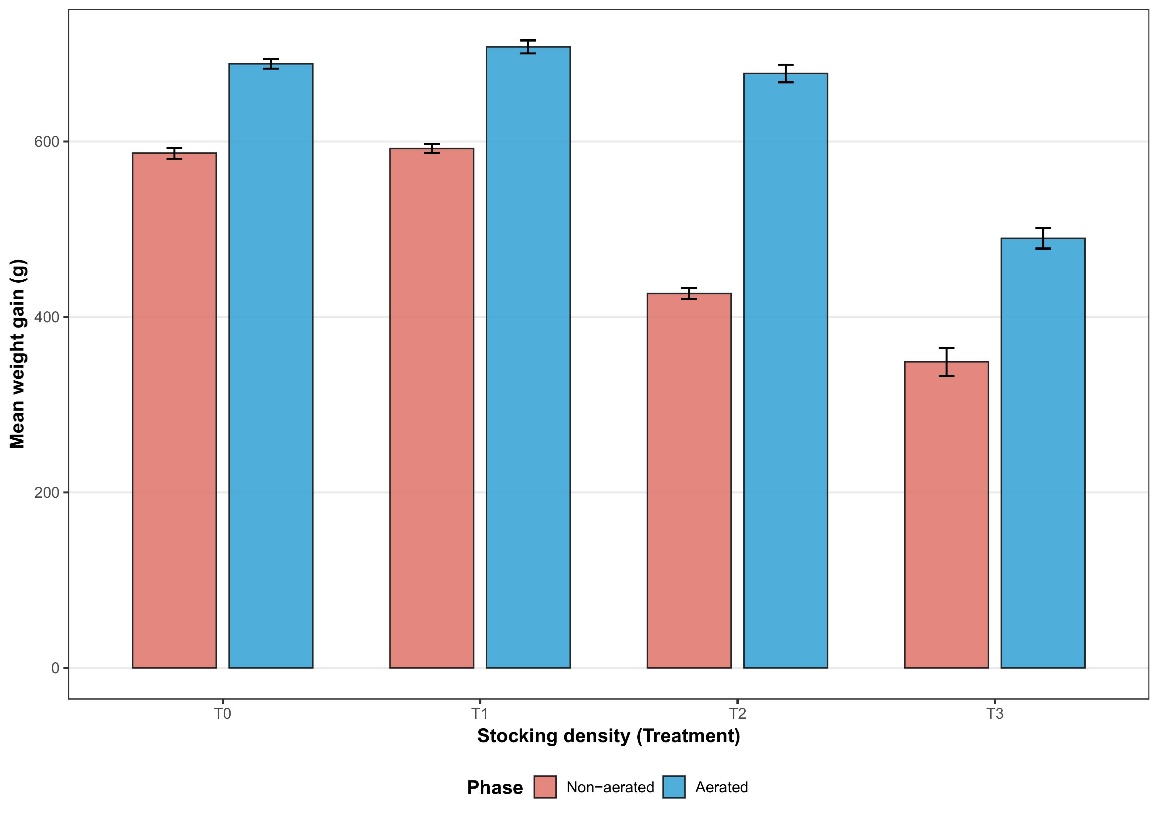
Growth performance of Nile tilapia was significantly influenced by aeration, stocking density, and their interaction (two-way ANOVA, p < 0.001; Table 2). Final body weight, weight gain, and specific growth rate (SGR) generally declined with increasing stocking density under non-aerated conditions, whereas aerated ponds maintained comparatively stable growth performance up to Treatment-2 (260 fish decimal⁻¹) (Figure 1).

Under non-aerated conditions, fish stocked at lower densities (T0 and T1) achieved significantly higher final weight and weight gain compared to higher density treatments. Final body weight declined markedly at T2 and T3, indicating density-related growth suppression in the absence of supplemental oxygen. In contrast, aerated ponds produced significantly higher final body weight and weight gain across all stocking densities. Aerated T0, T1, and T2 treatments maintained statistically similar growth performance, whereas a significant reduction was observed only in T3.

Specific growth rate exhibited a similar trend. In non-aerated ponds, SGR decreased progressively with increasing stocking density, falling from approximately 1.77% day⁻¹ in T0-T1 to 1.56% day⁻¹ in T3. Aerated treatments maintained significantly higher and more stable SGR values up to T2, with a decline observed only at the highest stocking density. Two-way ANOVA revealed highly significant effects of aeration (F = 71.69), stocking density (F = 206.81), and their interaction (F = 24.39) on SGR (p < 0.001).

The interaction between aeration and stocking density demonstrated that the beneficial effect of aeration became more pronounced as stocking density increased. Aeration substantially mitigated the growth depression observed under high-density non-aerated culture conditions.

3.3 Survival and mortality

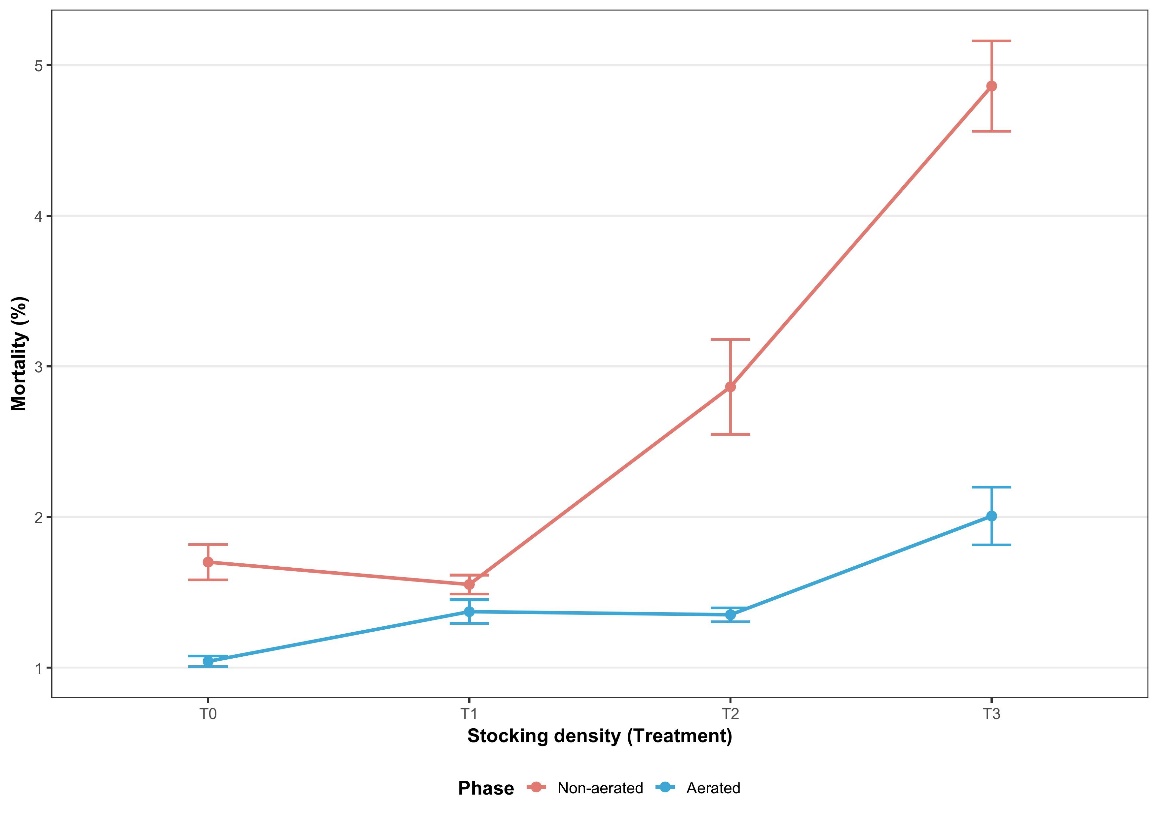
Mortality was significantly affected by aeration, stocking density, and their interaction (two-way ANOVA, p < 0.001). Mortality increased progressively with increasing stocking density in both culture systems; however, aerated ponds consistently maintained lower mortality than corresponding non-aerated treatments.

Under non-aerated conditions, mortality increased from approximately 1.5-1.7% in T0 and T1 to nearly 4.9% in T3. In contrast, aerated ponds maintained substantially lower mortality rates across all stocking densities, ranging from approximately 1.0% to 2.0%. The greatest difference between aerated and non-aerated systems was observed at the highest stocking density (T3), where aeration reduced mortality by more than half relative to the non-aerated treatment (Figure 2).

Two-way ANOVA indicated highly significant effects of aeration (F = 107.05), stocking density (F = 57.22), and aeration × stocking density interaction (F = 21.72) on mortality (p < 0.001). These findings indicate that aeration effectively alleviated density-induced stress and improved fish survival under semi-intensive pond culture conditions.

3.4 Production performance

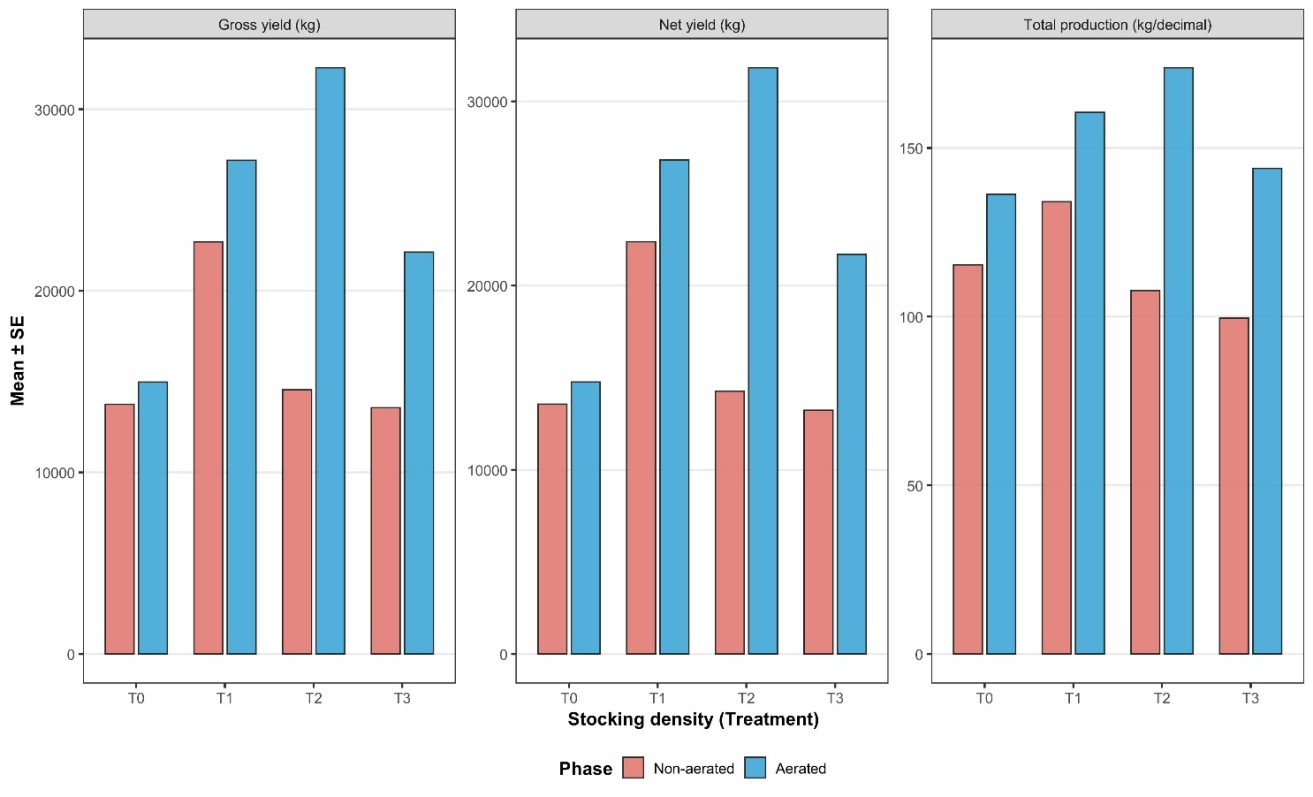
Production performance was significantly influenced by aeration, stocking density, and their interaction (two-way ANOVA, p < 0.001). Gross yield, net yield, and total production per decimal were consistently higher in aerated ponds than in corresponding non-aerated treatments.

Under non-aerated conditions, production initially increased from T0 to T1 but declined sharply at higher stocking densities. In contrast, aerated ponds exhibited progressively higher production up to T2, where the maximum production (173.79 ± 4.40 kg decimal⁻¹) was recorded. Although production declined slightly in T3, aerated treatments still maintained substantially higher production than non-aerated ponds at equivalent stocking densities.

Gross yield and net yield followed similar trends. The highest gross yield and net yield were recorded in aerated T2, whereas comparatively lower yields were observed in non-aerated treatments, particularly at higher stocking densities. Two-way ANOVA demonstrated highly significant effects of aeration (F = 518.31), stocking density (F = 49.81), and their interaction (F = 35.40) on production performance (p < 0.001) (Figure 3).

The interaction effect indicated that the positive influence of aeration became increasingly important at moderate and high stocking densities, where oxygen limitation was more severe. These results demonstrate that mechanical aeration enhanced carrying capacity and improved biomass production under semi-intensive pond conditions.

To further evaluate the independent and combined effects of aeration and stocking density on biological performance, a two-way ANOVA was conducted for major growth and production parameters (Table 3). The analysis revealed significant main effects of aeration and stocking density, as well as significant interaction effects between the two factors for weight gain, specific growth rate (SGR), mortality, and production performance (p < 0.001).

3.5 Economic performance

Economic performance varied considerably among treatments and was strongly influenced by biological production performance. Total operational expenditure increased progressively with stocking density in both aerated and non-aerated systems, primarily because of increased feed and fingerling costs. Feed expenditure represented the largest component of total production cost across all treatments.

Despite higher operational costs associated with aeration, aerated ponds generated substantially greater total revenue and net revenue than non-aerated ponds at equivalent stocking densities. Among all treatments, aerated T2 achieved the highest economic return, producing the maximum total revenue, net revenue, and benefit-cost ratio (BCR).

Under non-aerated conditions, BCR values ranged from 1.30 to 1.34, whereas aerated treatments achieved comparatively higher BCR values ranging from 1.45 to 1.55. The highest economic efficiency was observed in aerated T2, indicating that the additional production achieved through aeration more than compensated for the increased operational expenditure associated with aerator use.

Overall, the economic analysis demonstrated that mechanical aeration improved profitability by enhancing growth, survival, and biomass production, particularly under moderate-to-high stocking densities. The combined biological and economic results suggest that aeration shifted the optimal stocking density upward and improved overall production efficiency in semi-intensive Nile tilapia culture systems.

Overall, the results demonstrated that mechanical aeration substantially improved growth performance, survival, production yield, and economic return of Nile tilapia under semi-intensive pond conditions. Aeration effectively mitigated density-related stress and allowed higher stocking densities to be maintained with improved biological and economic efficiency.

4. Discussion

The present study demonstrates that mechanical aeration substantially improves the biological and economic performance of Nile tilapia cultured under semi-intensive pond conditions, particularly under moderate-to-high stocking densities. The findings clearly indicate that aeration mitigated density-induced environmental stress, improved growth and survival, enhanced biomass production, and increased economic return. More importantly, the study demonstrates that aeration effectively shifted the optimal stocking density upward, allowing greater production intensity without proportional deterioration in fish performance. This interaction between aeration and stocking density represents a key management implication for commercial tilapia farming under semi-intensive pond conditions.

Water quality parameters remained within acceptable ranges for Nile tilapia culture throughout the experimental period, indicating that the ponds provided environmentally suitable conditions for fish growth and survival. Mean temperature, dissolved oxygen, and pH values were consistent with optimal ranges previously reported for tilapia aquaculture (Makori et al., 2017). Maintaining stable environmental conditions is critically important because fluctuations in temperature, oxygen availability, and pH directly influence metabolic activity, appetite, feed conversion efficiency, and physiological stress responses in cultured fish (Abd El-Hack et al., 2022).

Among these variables, dissolved oxygen is widely recognized as one of the primary limiting factors in semi-intensive pond aquaculture systems (Bosma & Verdegem, 2011). In non-aerated ponds, oxygen depletion commonly occurs during night-time and early morning periods when respiratory oxygen consumption exceeds photosynthetic oxygen production (Xie et al., 2025). Under such conditions, fish may experience reduced aerobic scope, impaired nutrient assimilation, suppressed feeding activity, and increased physiological stress (Li et al., 2018; Li et al., 2020). The improved performance observed in aerated ponds in the present study strongly suggests that supplemental aeration stabilized oxygen availability and reduced the severity of hypoxic stress under elevated biomass conditions.

Stocking density exerted a strong negative influence on individual fish growth under non-aerated conditions. Final weight, weight gain, and specific growth rate declined progressively as stocking density increased, particularly beyond 230 fish decimal⁻¹. These findings are consistent with previous reports demonstrating that excessive stocking density intensifies competition for oxygen, feed, and spatial resources, thereby suppressing fish growth and welfare (Seo & Park, 2022; Wu et al., 2018).

The reduction in growth performance observed at higher stocking densities likely reflects a combination of physiological and environmental constraints. Elevated biomass increases total oxygen demand and accelerates the accumulation of metabolic wastes and suspended organic matter, ultimately reducing environmental carrying capacity. Under oxygen-limited conditions, fish redirect metabolic energy away from somatic growth toward maintenance metabolism and stress adaptation, resulting in reduced protein synthesis and slower growth rates (Sundh et al., 2019). Chronic crowding stress may also elevate cortisol secretion, impair feed utilization efficiency, and reduce appetite, collectively contributing to lower growth performance under intensive culture conditions (Watson et al., 2022).

Interestingly, the present study demonstrated that growth suppression became particularly severe at the highest stocking density (300 fish decimal⁻¹) under non-aerated conditions, suggesting that the carrying capacity of the pond ecosystem had been exceeded. Similar density-dependent reductions in tilapia growth have been documented by Mengistu et al. (2020), who reported that excessive stocking intensity significantly reduced growth performance because environmental demand exceeded natural pond oxygen replenishment capacity.

Mechanical aeration significantly improved growth performance across all stocking densities and substantially reduced the negative effects of density-dependent stress. Aerated ponds maintained comparatively stable weight gain and SGR up to Treatment-2 (260 fish decimal⁻¹), whereas equivalent non-aerated treatments exhibited pronounced growth depression. These findings support previous studies demonstrating that aeration enhances oxygen transfer, improves water circulation, and promotes better feed utilization efficiency in semi-intensive aquaculture systems (Xiao et al., 2020; El-Sayed et al., 2023).

The beneficial effects of aeration are closely linked to improved aerobic metabolism. Adequate dissolved oxygen availability enhances oxidative phosphorylation and ATP production, thereby improving nutrient assimilation, metabolic efficiency, and tissue growth (Thorarensen et al., 2010). Under aerated conditions, fish are therefore able to allocate more metabolic energy toward somatic growth rather than stress adaptation and anaerobic maintenance pathways. This likely explains the consistently higher SGR and weight gain observed in aerated treatments throughout the study.

The interaction effect between aeration and stocking density is particularly important from a management perspective. The positive influence of aeration became progressively stronger at moderate and high stocking densities, indicating that oxygen limitation was the principal constraint suppressing production under crowded conditions. Similar findings were reported by Sultana et al. (2017), who observed that supplemental aeration significantly improved tilapia growth performance under intensive culture conditions by stabilizing dissolved oxygen concentrations.

Although aeration substantially improved growth, performance declined slightly at the highest stocking density even under aerated conditions. This suggests that while aeration effectively alleviates oxygen limitation, it cannot entirely eliminate other crowding-related stressors such as behavioral competition, social interactions, and localized waste accumulation. Similar threshold responses have been reported by El-Sayed et al. (2023), indicating that excessively high biomass may eventually exceed the biological carrying capacity of the culture environment despite oxygen supplementation.

Mortality increased progressively with stocking density under non-aerated conditions, whereas aerated ponds maintained substantially lower mortality rates throughout the experiment. These findings emphasize the critical role of dissolved oxygen in regulating fish survival under semi-intensive pond culture conditions. Hypoxic stress is known to impair respiration, reduce immune competence, increase oxidative stress, and disrupt physiological homeostasis in cultured fish (Wu et al., 2024). Consequently, oxygen-deficient environments often lead to elevated mortality, particularly under intensive stocking conditions.

The highest mortality observed in non-aerated T3 likely resulted from severe oxygen competition associated with excessive biomass accumulation. Similar mortality responses have been documented in intensive tilapia culture systems where increasing stocking density elevated oxygen demand beyond the natural assimilative capacity of the pond ecosystem (M’balaka et al., 2012). Under such conditions, fish experience prolonged physiological stress that compromises immune defense and increases susceptibility to opportunistic disease and metabolic failure.

Aeration reduced mortality by more than half at the highest stocking density, clearly demonstrating its buffering effect against oxygen depletion and environmental instability. Improved oxygen availability likely enhanced respiratory efficiency, reduced physiological stress, and stabilized metabolic processes, thereby improving survival. Comparable observations were reported by Islam et al. (2025), who emphasized that dissolved oxygen management is fundamental for maintaining fish welfare and production stability under intensified aquaculture systems.

The strong interaction effect observed between aeration and stocking density further confirms that oxygen supplementation becomes increasingly important as biomass load increases. This finding highlights the importance of integrating aeration technology into semi-intensive pond management strategies when targeting higher production intensities.

Production performance was strongly influenced by the interaction between stocking density and aeration. Under non-aerated conditions, production increased initially at moderate density but declined sharply at higher densities because reduced individual growth and elevated mortality offset the benefits of increased stocking. In contrast, aerated ponds maintained progressively higher production up to Treatment-2, where maximum biomass yield was achieved.

These findings suggest that aeration substantially enhanced the carrying capacity of the pond ecosystem by alleviating oxygen limitation and supporting greater biomass accumulation. Similar improvements in production performance under aerated conditions have been reported in previous studies involving intensive pond and recirculating aquaculture systems (Mohan et al., 2022; Pryce et al., 2022). However, the magnitude of improvement observed in the present study was particularly notable because the experiment was conducted under commercial pond conditions over a long production cycle, thereby providing practical evidence directly relevant to field-scale aquaculture operations.

The superior production achieved in aerated T2 indicates that the optimal balance between stocking density and environmental carrying capacity occurred at approximately 260 fish decimal⁻¹ when supplemental aeration was provided. This finding is especially important because it demonstrates that aeration not only improves fish performance but also modifies the density-productivity relationship itself. In practical terms, aeration shifted the production threshold upward, enabling farmers to maintain higher stocking densities without proportional reductions in biological efficiency.

Nevertheless, production declined slightly in aerated T3, indicating diminishing returns beyond the optimal density threshold. This pattern supports classical density-dependent production theory, which predicts that biomass output eventually plateaus or declines when ecological carrying capacity becomes saturated (Majhi et al., 2023). Therefore, although aeration substantially improves production potential, excessive crowding may still impose biological limitations that cannot be fully compensated by oxygen supplementation alone.

The economic analysis demonstrated that aeration substantially improved profitability despite increasing operational expenditure associated with aerator operation and energy consumption. Feed cost remained the dominant production expense across all treatments, reflecting the well-established relationship between stocking density, biomass accumulation, and feed demand in semi-intensive aquaculture systems (Suarez-Puerto et al., 2021).

Although aeration increased total production cost, the resulting improvements in growth, survival, and biomass yield generated substantially greater total revenue and net profit. Aerated Treatment-2 produced the highest economic return and benefit-cost ratio, indicating that intermediate-high stocking density combined with oxygen supplementation provided the most economically efficient production strategy.

The stabilization of BCR values at the highest stocking density suggests diminishing marginal economic returns under excessive crowding conditions. While biomass production remained relatively high, additional increases in stocking density did not proportionally improve profitability because operational costs increased more rapidly than marketable yield. Similar observations were reported by Burad-Méndez et al. (2023), who concluded that optimal economic performance in intensive aquaculture systems is generally achieved at moderate-to-high rather than maximum stocking densities.

Importantly, the present study integrated both biological and economic analyses under commercial farming conditions, which remains relatively uncommon in South Asian pond aquaculture research. Many previous studies have evaluated aeration primarily under experimental tank or small-scale pond systems, limiting direct applicability to commercial farming environments. Therefore, the current findings provide valuable field-scale evidence supporting the economic feasibility of aeration-based intensification strategies for tilapia farming in Bangladesh and similar subtropical production regions.

Although the study generated important findings regarding aeration and stocking density interactions, several limitations should be acknowledged. The experiment was conducted within a single farming region and production season, which may limit direct extrapolation to different climatic conditions or farming systems. In addition, pond sizes were not completely uniform because the experiment was performed under commercial farming conditions, although management practices were standardized across treatments. The study also focused primarily on growth, survival, yield, and economic performance without evaluating physiological stress biomarkers, nutrient dynamics, or feed conversion efficiency in detail. Future research should therefore investigate the physiological mechanisms underlying aeration-mediated stress reduction, including endocrine responses, oxidative stress indicators, and metabolic adaptation under high-density culture conditions.

Collectively, the findings demonstrate that dissolved oxygen availability is a major factor regulating biological performance and carrying capacity in semi-intensive Nile tilapia pond culture. Mechanical aeration effectively mitigated density-related stress, improved growth and survival, and enhanced biomass production under elevated stocking densities. However, the decline in performance observed at the highest density indicates that aeration can alleviate, but not completely eliminate, the biological constraints associated with excessive crowding.

5. Conclusion

This study demonstrates that mechanical aeration is an effective intensification strategy for semi-intensive Nile tilapia pond culture, capable of substantially improving growth performance, survival, biomass production, and economic return. Critically, aeration did not merely augment performance at a fixed optimal density — it restructured the relationship between stocking density and productivity itself, shifting the biological and economic optimum upward from lower densities to 260 fish decimal⁻¹. At this density, aerated ponds achieved the highest production (173.79 ± 4.40 kg decimal⁻¹) and the greatest benefit-cost ratio, demonstrating that oxygen supplementation expands pond carrying capacity under commercial conditions.

The pronounced interaction between aeration and stocking density is the central finding of this work. Under non-aerated conditions, density-dependent growth suppression and elevated mortality progressively eroded the productivity gains expected from increased stocking. Aeration largely neutralized these constraints at moderate-to-high densities, maintaining stable growth and survival up to Treatment-2 before diminishing returns emerged at 300 fish decimal⁻¹ — indicating that biological crowding limits persist beyond what oxygen supplementation alone can resolve.

From a practical standpoint, the economic analysis confirms that the additional cost of aeration is more than recovered through improved biomass yield and net revenue, providing commercially grounded evidence for aeration adoption among semi-intensive tilapia producers in Bangladesh and comparable subtropical farming systems. Future research should address the physiological mechanisms mediating these responses — including stress biomarker profiles, feed conversion efficiency, and nitrogen dynamics — and evaluate whether further intensification beyond 300 fish decimal⁻¹ is biologically or economically feasible when aeration is combined with complementary water quality interventions such as biofloc technology or recirculating elements.

Author contributions

H. Conceptualization, Methodology, Formal Analysis, Visualization, Writing – Original Draft.
M.D.H. Conceptualization, Methodology, Visualization, Writing – Original Draft, Supervision, Resources. S.A.A.N.  ethodology, Visualization, Writing – Review and Editing. S.R. Methodology, Formal Analysis, Writing – Original Draft, Writing – Review and Editing. M.S.K. Methodology, Formal Analysis, Writing – Original Draft, Writing – Review and Editing. M.N.H. Data Curation, Validation. A.T.A. Data Curation, Validation. M.H.I. Writing – Review and Editing, Supervision.

Acknowledgements

The authors sincerely thank the management and staff of Meridian Hatchery and Grower Farms, Mirsarai, Chattogram, for permitting access to their commercial pond facilities and for their cooperation throughout the study period. The authors also acknowledge the logistical and technical support provided by colleagues and laboratory staff at the Department of Fisheries, University of Rajshahi, and the Faculty of Fisheries, Chattogram Veterinary and Animal Sciences University. No external funding was received for this research; all support was institutional and in-kind.

Competing Financial Interests

The authors declare no competing financial interests. This research was conducted without financial support from commercial aquaculture equipment manufacturers, feed companies, or any organization with a direct economic interest in the outcomes reported. The findings reflect independent academic inquiry conducted under standard institutional research conditions.

References


Abd El-Hack, M. E., El-Saadony, M. T., Nader, M. M., Salem, H. M., El-Tahan, A. M., Soliman, S. M., & Khafaga, A. F. (2022). Effect of environmental factors on growth performance of Nile tilapia (Oreochromis niloticus). International journal of biometeorology, 66(11), 2183-2194. https://doi.org/10.1007/s00484-022-02347-6

Bosma, R. H., & Verdegem, M. C. (2011). Sustainable aquaculture in ponds: Principles, practices and limits. Livestock science, 139(1-2), 58-68.

Burad-Méndez, A., Domínguez-May, R., Olvera-Novoa, M. A., Robledo, D., & Salas, S. (2023). Economic analysis of Nile tilapia (Oreochromis niloticus) production based on farm size and number of rearing tanks. Latin American Journal of Aquatic Research, 51(5), 747-759. https://doi.org/10.3856/vol51-issue5-fulltext-3071

El-Sayed, N., Hasanen, G. D., & Ahmed, M. S. (2023). Effect of aeration systems under desert conditions on growth, survival and yield of Nile tilapia Oreochromis niloticus. Journal of Egyptian Academic Society for Environmental Development. D, Environmental Studies, 24(1), 33-44. https://doi.org/10.21608/jades.2023.298946

Garlock, T., Asche, F., Anderson, J., Ceballos-Concha, A., Love, D. C., Osmundsen, T. C., & Pincinato, R. B. M. (2022). Aquaculture: The missing contributor in the food security agenda. Global Food Security, 32, 100620. https://doi.org/10.1016/j.gfs.2022.100620

Golden, C. D., Koehn, J. Z., Shepon, A., Passarelli, S., Free, C. M., Viana, D. F., ... & Thilsted, S. H. (2021). Aquatic foods to nourish nations. Nature, 598(7880), 315-320. https://doi.org/10.1038/s41586-021-03917-1

Islam, M. A., Kunda, M., Harun-Al-Rashid, A., Sunny, A. R., Mithun, M. H., Sazzad, S. A., & Bhuiyan, M. K. A. (2025). Can Climate-Resilient Tilapia Cage Culture Support Sustainable Livelihoods in Flood-Prone Bangladesh?. Water, 17(4), 585. https://doi.org/10.3390/w17040585

Li, J., Huang, K., Huang, L., Hua, Y., Yu, K., & Liu, T. (2020). Effects of dissolved oxygen on the growth performance, haematological parameters, antioxidant responses and apoptosis of juvenile GIFT (Oreochromis niloticus). Aquaculture Research, 51(8), 3079-3090. https://doi.org/10. 1111/are.14684

Li, M., Wang, X., Qi, C., Li, E., Du, Z., Qin, J. G., & Chen, L. (2018). Metabolic response of Nile tilapia (Oreochromis niloticus) to acute and chronic hypoxia stress. Aquaculture, 495, 187-195. https://doi.org/10.1016/j.aquaculture. 2018.05.031

M’balaka, M., Kassam, D., & Rusuwa, B. (2012). The effect of stocking density on the growth and survival of improved and unimproved strains of Oreochromis shiranus. Egyptian Journal of Aquatic Research, 38(3), 205-211. https://doi.org/10.1016/j.ejar.2012.12.013

Majhi, S. S., Singh, S. K., Biswas, P., Debbarma, R., Parhi, J., Ngasotter, S., ... & Patel, A. B. (2023). Effect of stocking density on growth, water quality changes and cost efficiency of butter catfish (Ompok bimaculatus) during seed rearing in a biofloc system. Fishes, 8(2), 61. https://doi.org/10. 3390/fishes8020061

Makori, A. J., Abuom, P. O., Kapiyo, R., Anyona, D. N., & Dida, G. O. (2017). Effects of water physico-chemical parameters on tilapia (Oreochromis niloticus) growth in earthen ponds in Teso North Sub-County, Busia County. Fisheries and aquatic sciences, 20(1), 30. https://doi.org/10.1186/ s41240-017-0075-7

Mengistu, S. B., Mulder, H. A., Benzie, J. A., & Komen, H. (2020). A systematic literature review of the major factors causing yield gap by affecting growth, feed conversion ratio and survival in Nile tilapia (Oreochromis niloticus). Reviews in Aquaculture, 12(2), 524-541.

Mohan, M., Ch, B. P., Prasad, G. S., Srinu, R., Konduri, A., Goud, P. M. K., & Kumar, M. K. (2022). Application and importance of aeration system in aquaculture pond: A review. Asian J. Microbiol. Biotechnol. Environ. Sci, 24, 370-376.

Pryce, D., Kapelan, Z., & Memon, F. A. (2022). A comparative evaluation of the sustainability of alternative aeration strategies in biological wastewater treatment to support net-zero future. Journal of Cleaner Production, 374, 134005. https://doi.org/10.1016/j.jclepro.2022.134005

Puri, D., Sihag, P., & Thakur, M. S. (2023). A review: Aeration efficiency of hydraulic structures in diffusing DO in water. MethodsX, 10, 102092. https://doi.org/10.1016/j.mex.2023.102092

Rahman, M. L., Shahjahan, M., & Ahmed, N. (2021). Tilapia farming in Bangladesh: Adaptation to climate change. Sustainability, 13(14), 7657.

Roy, P., Lee, D. H., Choi, S. M., An, Y. K., & Choi, S. D. (2025). Sustainable Development of Water Quality, Growth, and Production Efficiency of the Giant Mottled Eel (Anguilla marmorata) at Different Stocking Densities in the Indoor Media-Based Aquaponics System. Animals, 15(18), 2705. https://doi.org/10.3390/ani15182705

Samaddar, A. (2022). Recent trends on Tilapia cultivation and its major socioeconomic impact among some developing nations: A Review. Asian J. Fish. Aquat. Res, 8, 1-10. https://doi.org/10.9734/AJFAR/2022/v 16i4303766

Seo, J., & Park, J. (2022). Does stocking density affect growth performance and hematological parameters of juvenile olive flounder Paralichthys olivaceus in a recirculating aquaculture system?. Animals, 13(1), 44.

Siddique, M. A. B., Mahalder, B., Haque, M. M., Shohan, M. H., Biswas, J. C., Akhtar, S., & Ahammad, A. S. (2024). Forecasting of tilapia (Oreochromis niloticus) production in Bangladesh using ARIMA model. Heliyon, 10(5). https://doi.org/10.1016/j.heliyon.2024.e27111

Suarez-Puerto, B., Delgadillo-Díaz, M., Sánchez-Solís, M. J., & Gullian-Klanian, M. (2021). Analysis of the cost-effectiveness and growth of Nile tilapia (Oreochromis niloticus) in biofloc and green water technologies during two seasons. Aquaculture, 538, 736534. https://doi.org/10.1016/j.aquaculture. 2021.736534

Sultana, T., Haque, M. M., Salam, M. A., & Alam, M. M. (2017). Effect of aeration on growth and production of fish in intensive aquaculture system in earthen ponds. Journal of the Bangladesh Agricultural University, 15(1), 113-122. https://doi.org/10.3329/jbau.v15i1.33536

Sundh, H., Finne-Fridell, F., Ellis, T., Taranger, G. L., Niklasson, L., Pettersen, E. F., ... & Sundell, K. (2019). Reduced water quality associated with higher stocking density disturbs the intestinal barrier functions of Atlantic salmon (Salmo salar L.). Aquaculture, 512, 734356.

Thorarensen, H., Gústavsson, A., Mallya, Y., Gunnarsson, S., Árnason, J., Arnarson, I., ... & Imsland, A. K. (2010). The effect of oxygen saturation on the growth and feed conversion of Atlantic halibut (Hippoglossus hippoglossus L.). Aquaculture, 309(1-4), 96-102. https://doi.org/10.1016/j.aquaculture.2010.08.019

Varga, M., Berzi-Nagy, L., Csukas, B., & Gyalog, G. (2020). Long-term dynamic simulation of environmental impacts on ecosystem-based pond aquaculture. Environmental Modelling & Software, 134, 104755. https://doi.org/10.1016/j.envsoft.2020.104755

Watson, A. S., Hickford, M. J., & Schiel, D. R. (2022). Interacting effects of density and temperature on fish growth rates in freshwater protected populations. Proceedings of the Royal Society B, 289(1967), 20211982. https://doi.org/10.1098/rspb.2021.1982

Wu, F., Wen, H., Tian, J., Jiang, M., Liu, W., Yang, C., ... & Lu, X. (2018). Effect of stocking density on growth performance, serum biochemical parameters, and muscle texture properties of genetically improved farm tilapia, Oreochromis niloticus. Aquaculture International, 26, 1247-1259.

Wu, Y., Lin, Y., Lin, B., Huang, Y., Yu, Z., Ma, Y., ... & Shu, H. (2024). Effects of hypoxia and reoxygenation on energy metabolism, immune response, and apoptosis in orange-spotted grouper (Epinephelus coioides). Frontiers in Marine Science, 11, 1495068. https://doi.org/10.3389/fmars.2024. 1495068

Xiao, G., Cheng, X., Xie, J., & Zhu, D. (2020). Assessment of aeration plug-flow devices used with recirculating aquaculture systems on the growth of tilapia Oreochromis niloticus. Aquacultural engineering, 91, 102116.

Xie, D., Chen, X., Qian, Y., & Feng, Y. (2025). Prolonged Summer Daytime Dissolved Oxygen Recovery in a Eutrophic Lake: High-Frequency Monitoring Diel Evidence from Taihu Lake, China. Water, 17(22), 3221. https://doi.org/10.3390/w17223221

Yu, M., Feng, Y., Ouyang, B., Wills, P. S., & Tang, Y. (2025). Dissolved oxygen in aquaculture ponds: Causal factors, predictive modeling, and intelligent monitoring. Aquacultural Engineering, 102634. https://doi.org/10.1016/j. aquaeng.2025.102634

Zhao, L., Fu, G., Zeng, A., Cheng, B., Song, Z., & Hu, Z. (2023). Effects of different aeration strategies and ammonia-nitrogen loads on nitrification performance and microbial community succession of mangrove constructed wetlands for saline wastewater treatment. Chemosphere, 339, 139685. https://doi.org/10.1016/j.chemosphere.2023.139685


Article metrics
View details
0
Downloads
0
Citations
5
Views

View Dimensions


View Plumx


View Altmetric


0
Save
0
Citation
5
View
0
Share