Data Modeling

Mathematical and Computational Data Modeling
0
Citations
3.7k
Views
20
Articles
Your new experience awaits. Try the new design now and help us make it even better
Switch to the new experience
Figures and Tables
RESEARCH ARTICLE   (Open Access)

Robotic Surgery in Bangladesh: Can Telesurgery Bridge the Urban-Rural Healthcare Divide?.

Sumit Kumar Pramanik 1*, Khondaker A. Mamun 1

+ Author Affiliations

Data Modeling 4 (1) 1-8 https://doi.org/10.25163/data.4110809

Submitted: 20 June 2023 Revised: 10 August 2023  Published: 18 August 2023 


Abstract

Telesurgery — sometimes called robotic or remote surgery — has quietly moved from speculative fiction to operating-room reality over the past two decades, yet its arrival in developing countries has lagged well behind its uptake in wealthier ones. This paper asks, fairly directly, whether Bangladesh could realistically adopt the technology, and what stands in the way if it can't yet. Rather than running a formal systematic review, we worked through a curated set of twelve studies published mostly between 2018 and 2023 (with one older 2015 paper kept deliberately, since it was among the first to demonstrate that telesurgical systems could actually be attacked), pulling out recurring threads around network latency, cybersecurity, cost, and clinical adoption. What emerged was a picture less dramatic than either the optimists or the skeptics might expect: the core robotics and 5G-enabled low-latency communication appear technically sound, even tested successfully in cross-border heart surgery, but cybersecurity vulnerabilities, unresolved cross-jurisdictional regulation, and acquisition costs running into the millions remain serious obstacles. Urology, gynaecology, and oncosurgery currently dominate global robotic-surgery caseloads, hinting at where Bangladesh might reasonably pilot a first attempt. We argue that closing the gap will depend less on the robots themselves and more on telecommunications investment, shared or subsidized infrastructure models, and a regulatory framework built specifically for remote, cross-border operative liability.Keywords: Telesurgery; Robotic Surgery; Tactile Internet; Bangladesh; Healthcare Access; Cybersecurity; 5G Networks

I. Introduction

A practice known as telesurgery or robotic surgery, or remote surgery, allows a doctor to operate on a patient while not physically present at the patient's location. Enabling the utilization of the knowledge and skills of specialized doctors anywhere in the world at any time has the potential to change traditional healthcare (Tamalvanan, 2021; Gupta et al., 2019). We learned about the value of telemedicine and remote surgery during the Covid-19 pandemic. Telesurgery presents itself as a superb approach to safeguard surgeons, anesthesiologists, and other personnel in the operating room. The World Health Organization mandates that individuals must maintain a minimum distance of 2 meters to prevent the spread of infection. Yet, in a confined operating room, maintaining such a distance can prove to be an extremely challenging task. Telesurgical robotic systems (TRSs) (Iqbal et al., 2019) allow surgeons to operate on patients remotely from different locations. The surgeon may watch how the arms of the robot are reacting and shifting via footage displayed on his console and change them accordingly. The first significant development in telesurgery was Operation Lindbergh. Marescaux and his team utilized the ZEUS surgical robot to conduct a procedure on a patient in France in 2001. Telesurgery is effective and used worldwide because of this surgery and numerous prior telesurgical procedures.

We must have the primary idea of telesurgical systems to determine the opportunities and challenges. There are two parts to a telesurgery system. They are as follows: i. Surgeon Console and ii. Patient Console.

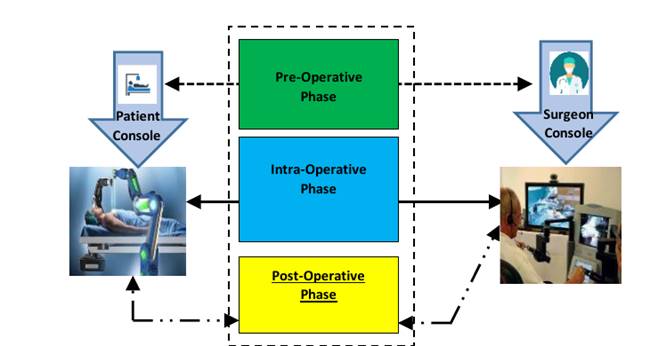
In telesurgery, the surgeon console is an essential component that allows the surgeon to remotely control the robotic surgical system and perform surgical procedures remotely. The console provides a user interface and control mechanisms for the surgeon to manage the robotic arms and equipment. This console offers a display, control interface, haptic feedback, camera control, ergonomics, audio, and communication. The patient console is a crucial component that promotes interaction between the patient and the surgical system. The patient console is intended to provide feedback and collect critical information to guarantee a safe and effective surgical procedure. It provides vital sign monitoring, communication, information display, surgical site imaging, emergency stop button, comfort, and positioning control. These two parts also have three different phases, encapsulating the whole operation. The phases are i. Pre-Operative Phase, ii. Intra-Operative Phase, and iii. Post-Operative Phase.

In the pre-operative phase, the surgeon and patient console establish the connection, check haptic response, ensure security, check latency, and so on. In the intra-operative step, the actual surgery is performed. Ensuring the connection stability and security is most crucial in this phase. The post-operative phase keeps the operational data, footage, and records for future usage. An overview of the telesurgical system is given in Fig. 1. Some of the pictures are taken from the internet. There are various telesurgery systems in the world since 1991. Medrobotics is the first teleoperated robot to perform brain surgery on a patient. But nowadays, Da Vinci is the most used teleoperated surgical robot developed by Intuitive Surgical. Various telesurgery robots, manufactured year, company, usage, pros and cons are discussed in Table I . This table is prepared based on the work of Gupta et al. (2019).

According to our research, the price of a telesurgical robot varies from 900k to several million dollars. The patient needs to cover the surgical system, the surgeon's fee, and a portion of the cost for the advanced ATM technology used. The estimated cost for the ATM technology is between $100,000–$200,000 a year (Wikipedia, n.d.). All of these contribute to the challenges for telesurgical systems worldwide, especially in developing countries like Bangladesh.

Telesurgery is the ultimate solution that guarantees high-quality healthcare to developing nations, remote professionals' active involvement in complex procedures, and prompt surgical care to injured warriors at an affordable cost (de Medeiros Sousa & Pinto Santos, 2023). Moreover, this technology allows seasoned surgeons to provide virtual guidance to junior surgeons regardless of their location. Similar to how telesurgery can overcome the gaps and discrepancies between developing and industrialized nations and regions' healthcare systems, the advantage of a secure system is to ensure security in even the most hostile and uncontrolled contexts (Gordon et al., 2022).

Some of these operations' main challenges and concerns relate to patient personal information safety, security, and privacy (Takanashi et al., 2023). One of the most significant barriers preventing telesurgery from being used frequently is the lack of secure, specialized mechanisms. We know the Interoperable Telesurgical Protocol (ITP) (Iqbal et al., 2019) as the sole protocol that expressly addresses the security needs of telesurgery. Although this protocol covers the authentication and secrecy issues, it does not address the formulation and implementation of security rules in domestic and international settings. Also, another major challenge is the network latency between the two countries (Mohan et al., 2021). Certainly, telesurgery can be used within the same countries, but it is primarily used between cross countries where the receiving end lacks professional skills and expertise. Various sources have confirmed that the average world latency is over 40 milliseconds. This means that, for any communication, we face at least 40 milliseconds on average for cross-border communication.

This paper will discover the opportunities, challenges, and solutions to test the feasibility of introducing telesurgery in a developing country like Bangladesh.

Table 1: Comparative overview of major telesurgical and surgical robotic platforms developed worldwide, 1991–2022, detailing year of introduction, manufacturer, country of last documented use, technical description, advantages, and disadvantages. Adapted from Gupta et al. (2019) and cross-checked against manufacturer and regulatory documentation.

Name of the Robot

Year

Company

Country (Last Used)

Description

Advantages

Disadvantages

Medrobotics

1991

Flex Robotic Systems

USA (1991)

Used for stereotactic brain surgery with improved accuracy

Surgeons’ choice of implants

Not suitable for colorectal applications

ROBODOC

1992

Integrated Surgical Systems, Inc., Sacramento, CA

Canada (1995)

Used for hip replacement

Safe surgery

High cost

MKM system

1993

Zeiss, Germany

Germany (2001)

During neurosurgical procedures, this robotic microscope was utilized.

A complete robotic solution for stem and cup

No external safety

ZEUS robotic Surgical System

1994

Computer Motion Ltd., USA

USA (2001)

Tubal re-anastomosis

Get rid of templates that are less accurate and adopt jig-based technology.

Accuracy

RAMS Robot

1995

NASA, USA

USA (2001)

Compatible with MRI

Open-platform surgical system

No real-time services for information updates

The Steady Hand system

1995

John Hopkins University, Maryland

USA (2000)

Detects pressure put by the surgeon in neurosurgery

Precise pre-surgical planning is executed every time

No sufficient range of motion is required for general-purpose surgery

ZEUS Robot

1998

Computer Motion Ltd., USA

USA (2001)

Surgery without cardiac bypass

Precise computer-assisted preparation of the bone cavity and joint surfaces

No Tactile feedback

Da Vinci Robotic Surgery System

1998

Intuitive Surgical

USA (2000)

Used to harvest the internal thoracic artery

Rich in technically. Available experienced surgeons at all locations

Most physicians performing prostate surgery have not been trained in this procedure.

Da Vinci Surgical System

2000

Intuitive Surgical

USA (2014)

Performing surgeries with a minimally invasive approach, even for complex cases.

Patients who undergo this medical procedure experience lower risk of complications, reduced blood loss, fewer transfusions, and less pain.

Adverse effects, such as incontinence and erectile dysfunction, may occur and there is a risk of blood clots and infection.

Da Vinci Robot

2000

Intuitive Surgical

USA (2014)

Complicated gynecological surgeries

Non-optical technology

Only used for gynecological surgeries

Vascular Robotic System

2002

Corindus Corpath

USA (2014)

Perform percutaneous coronary interventions

Achieves full potential with forward-thinking physicians

Not progressed as rapidly as endovascular technology

Pathfinder Robot

2004

Armstrong Healthcare Ltd

UK (2016)

Proper guidance for the surgeons

Sub-millimeter dimensional accuracy

Used old technology

Senhance surgical robotics system

2006

Asensus Surgical, Inc.

USA (2023)

Laparoscopic Surgery

Advanced eye sensing camera, Haptic feedback, Direct visual contact, and reasonable cost

Limited procedural time for surgical field

The NeuroArmSYMBIS Robot

2007

IMRIS, USA

USA (2023)

MRI-based robot to remove brain tumor

Precise milling services to ensure optimal alignment.

Used only for brain tumor

ROSA

2007

Medtech, France

France (2022)

Brain surgery procedures

High-precision smart-tool technology, freedom of movement, and advanced assisted navigation.

Tearing or puncturing of vessels or internal organs

Renaissance Guidance System

2007

Mazor Robotics

Israel (2023)

Offers a direct blueprint for the surgical process and is tailored to each patient

Better precision during surgeries, ultimately leads to a decrease in complication rates and quicker recovery periods for patients.

Only used for spine surgery

Smart Tissue Autonomous Robot (STAR)

2009

Johns Hopkins University

USA (2020)

A corrected 3D model with multiple camera views was created using plenoptic imaging.

Stitching, sewing, looping, and threading

The camera was not fast enough to track tissue deformation accurately in real-time.

Mako Rio robot

2009

Stryker

USA (2023)

Used for partial knee replacements and hip surgeries

Immediate pain relief, less blood loss, and shorter hospital stays following hip or knee surgery.

May cause hip-joint misalignment

TSolution One

2014

Think Surgical, Inc.

USA (2017)

For orthopedic surgical procedures for the hip

Personalized pre-surgical plans

No differentiation between tissue types

DaVinci Xi robotic surgery

2014

Intuitive Surgical

USA (2023)

Involves minimal invasion during the procedure.

Perform multiple surgeries

Vision and motor functions were not included

Miniature Robot

2016

Virtual Incision Corp

USA (2023)

This is used to treat patients with Crohn’s disease, colon cancer, diverticulitis, and ulcerative colitis.

Achieving a quicker and more efficient recovery.

Climate uncertainty

Epoch robotic surgery system

2018

Stereotaxis

USA (2020)

Magnets are used to control catheters that are inserted into the heart for manipulation.

Minimize x-ray exposure by up to 90% during procedures and enhance the capacity to treat intricate rhythms.

Not suitable for preoperative data

Navio surgical system

2018

Smith & Nephews

UK (2023)

Partial knee replacement

Faster recovery time, less pain, smaller incisions, and natural knee motion during rehabilitation.

Uni-compartmental Knee Replacement

SSI Mantra

2022

SS Innovation Pvt. Ltd.

India (2023)

For general surgery, used in a cancer institute

The design of the console is open-faced, modular, flexible, versatile, and has UPS backup.

Limited development time

Fig. 1: Schematic overview of a telesurgical system architecture, illustrating the surgeon console and patient console and their constituent functions (display, haptic feedback, camera and communication control on the surgeon side; vital-sign monitoring, surgical-site imaging, and emergency-stop functionality on the patient side) across the pre-operative, intra-operative, and post-operative phases of a remote surgical procedure.
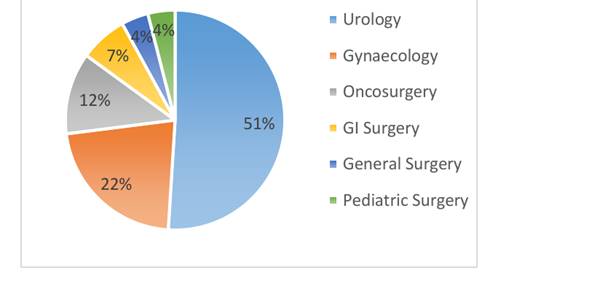
Fig. 2: Distribution of robotic surgery cases across medical specialties, showing the proportional share attributable to urology, gynaecology, oncosurgery, and other specialties. Data adapted from Sinha et al. (2021).


2. Critical Analysis of Contemporary Telesurgery Research

We methodically studied countless scientific papers during our research and carefully picked nine studies that addressed the critical parts of telesurgery pertinent to our investigation.

We searched the papers based on the keywords like “Robotic surgery,” “Telesurgery opportunity,” “Telesurgery challenges,” “Robotic surgery problem,” “Telesurgery in Bangladesh,” etc. The first paper that came to our knowledge was by Bonaci et al. (2015). Although this is an old paper from 2015, this was the first one in our understanding that tried to attack any telesurgical systems in a controlled environment using a distributed denial of service (DOS) attack. We have also limited the year from 2018 to 2023. We have found thousands of papers and gone through pages reading the titles and if that has PDF/HTML context so that we can read the full papers without payment. We have also tried our best to include articles only from reputable publishers. After all of this, we initially selected twelve papers. We have also excluded blockchain-based security mechanisms as they make the process more complex and infeasible in the real world. Telesurgery promises equitable surgical access in low-income and middle-income countries (LMICs) but faces high costs, inadequate infrastructure, and training (Tamalvanan, 2021). Potential solutions include universal licensing, manufacturer support, mobile robotic units, 5G networking, and robust security frameworks. To realize the potential of telesurgery, global collaboration is crucial. Telesurgery can improve surgical access and patient outcomes worldwide with affordable platforms and advanced technology. The capability of telesurgery in the 5G era to deliver medical surgical services remotely via high-speed data transfer is increasing exponentially (Gupta et al., 2019). It focuses on the advantages of increased precision and accuracy in diagnosing patients in outlying areas. However, the current conventional telesurgery systems' considerable communication delay and overhead restrict their application (de Medeiros Sousa & Pinto Santos, 2023). The 5G URLCC service's ultra-low latency (1ms) and ultra-high dependability (99.999 percent) guarantee effective remote surgery communication. The suggested design combines 5G-enabled TI communication channels with conventional network channels.

A case study of the world's first successful teleslanting heart surgery demonstrates the benefits of using TI as the network backbone, such as faster response time and improved dependability compared to the old system (Gordon et al., 2022). The article by de Medeiros Sousa and Pinto Santos (2023) investigates the feasibility and benefits of deploying telesurgery services in the Azores region, a distant location, using a 5G network. It examines the specific challenges and requirements of adopting telesurgery in this setting. The study assesses telesurgery's technical practicality and benefits in the Azores, considering surgical complexity, communication needs, and network latency. A framework for combining telecommunication technology, robotic surgical systems, and medical skills is offered.

The importance of collaboration among medical specialists, engineers, and telecommunications experts is emphasized by Mohan et al. (2021). The authors evaluate the performance and potential constraints of the proposed telesurgery service using simulations and analysis. The study underscores the potential for using a 5G network to connect isolated locations, such as the Azores, with access to specialized surgical care through telesurgery. The necessity of cybersecurity in the context of robotic surgery is emphasized by de Medeiros Sousa and Pinto Santos (2023).

It underscores the vulnerabilities of robotic surgery systems to cyber threats and the importance of strong cybersecurity measures to preserve patient safety and data integrity (Gordon et al., 2022; Takanashi et al., 2023; Munteanu et al., 2018). The authors cover potential hazards such as unauthorized access, surgical process interference, and proactive cybersecurity methods (Gordon et al., 2022). They investigate cybersecurity aspects in robotic surgery systems, such as secure network designs, encryption, authentication, and access control. Protocols for continuous monitoring, threat detection, and incident response are also discussed. The article underlines the importance of collaboration, awareness, and education among healthcare providers, manufacturers, and regulatory organizations to build cybersecurity standards and guidelines (Sedaghat & Jahangir, 2021). Overall, it emphasizes the importance of cybersecurity in protecting patient safety and data in robotic surgery.

This paper demonstrates potential benefits and challenges, such as high costs, infrastructure limitations, legal and billing issues, and cybersecurity threats in telesurgery (Miao et al., 2018). Integrating emerging technologies, such as high-speed 5G networks, haptic feedback, tactile robotics, and the Internet of Things (IoT), could significantly enhance telesurgery's effectiveness. By reducing latency and improving surgical accuracy, telesurgery can provide healthcare to underserved areas, enable surgical collaborations, and minimize the risk of infection, as seen during the COVID-19 pandemic (de Medeiros Sousa & Pinto Santos, 2023; Mohan et al., 2021; Miao et al., 2018). However, legal and cost-related barriers still need to be addressed for telesurgery to reach its full potential (Tamalvanan, 2021). In the twelfth research paper (Sinha et al., 2021), we have seen the percentage of robotic surgery performed in various medical fields, as shown in Fig. 2. Among the specialties, we have found that Urology has the most usage of robotic surgery, followed by Gynaecology and Oncosurgery.

The twelve research papers cover various aspects of telesurgery, its security, viability, recent technology developments affecting telesurgery, etc. Some papers provide a general overview of telesurgery while others focus on specific techniques and vulnerabilities. Some articles and webpages also gave us insight into telesurgical feasibility and challenges. Overall, the papers, webpages, and articles provide valuable insights into different attributes of telesurgery. The references are all summarized in Table 2.


3. Methods

3.1 Search Strategy and Information Sources

We did not set out, initially, to run a formal systematic review — the paper began as an attempt to simply understand where telesurgery stood, technically and economically, before asking whether Bangladesh could realistically adopt it. That intention shaped the search strategy more than any predefined protocol did, though the process still followed a recognizable, reproducible logic that we describe here in full so that others attempting a similar synthesis could retrace our steps.

Literature was identified through Google Scholar, IEEE Xplore, PubMed, and ScienceDirect, supplemented by manual screening of reference lists from key articles (so-called “snowballing”). Search terms combined controlled vocabulary and free-text keywords joined with Boolean operators, including “robotic surgery,” “telesurgery opportunity,” “telesurgery challenges,” “robotic surgery problem,” and “telesurgery in Bangladesh.” Searches were not restricted by document type at the outset; conference proceedings, peer-reviewed journal articles, and preprint servers (notably arXiv) were all eligible for screening, since telesurgery sits at an intersection of medicine and networked engineering where some of the more technically rigorous work — particularly on cybersecurity — circulates first as a preprint.

The publication window was bounded to 2018–2023, with one deliberate exception. Bonaci et al. (2015) examined denial-of-service attacks on teleoperated robotic systems in a controlled environment, and because it appears to be among the earliest empirical demonstrations of an adversarial attack against a telesurgical platform, we retained it outside the date window on the grounds that excluding a foundational study purely on recency grounds would have weakened, rather than strengthened, the review.

3.2 Study Selection

Title and abstract screening was performed by both authors independently, prioritizing open-access articles or those for which institutional access permitted full-text retrieval — a pragmatic constraint, admittedly, but one we think is worth disclosing rather than glossing over, since cost-of-access barriers shape what gets cited in resource-limited settings just as much as they shape what gets practiced. From an initial pool in the low thousands of titles (an exact figure was not tracked, which we acknowledge as a limitation), twelve articles were selected for full-text review based on relevance to telesurgical feasibility, technical architecture, or cybersecurity. Articles relying primarily on blockchain-based security mechanisms were excluded a priori, since pilot reading suggested that such approaches added computational and procedural complexity disproportionate to their real-world deployability in low-resource settings — a judgment call, not a statistical one, but one we apply consistently throughout.

3.3 Data Extraction and Synthesis

For each of the twelve included sources, we extracted, where reported: study focus, telesurgical platform or protocol under discussion, network technology (4G/5G/tactile internet), reported latency figures, identified security vulnerabilities, and proposed mitigations. These extractions were tabulated (Table 2) rather than meta-analyzed, because the included literature was overwhelmingly descriptive, simulation-based, or framework-proposing in nature rather than comparative-

Table 2: Summary of the twelve studies included in this narrative synthesis, listing publication year and primary focus area (e.g., telesurgical feasibility, network architecture, cybersecurity vulnerabilities and countermeasures, clinical implementation), alongside the focus area of the present study for comparison.

Paper

Title

Year

Focus Area

[1]

Foreseeable challenges in developing telesurgery for low-income and middle-income countries

2021

Telesurgery, Challenges, LMIC, Opportunities

[2]

Tactile-internet-based telesurgery system for healthcare 4.0: An architecture, research challenges, and future directions

2019

Telesurgery, 5G, tactile internet, latency, reliability

[3]

The feasibility of utilizing Telesurgery Service in the Autonomous Region of the Azores, with the support of 5G network.

2023

Telesurgery, 5G, remote surgery, feasibility, benefits

[4]

Protecting procedural care—cybersecurity considerations for robotic surgery

2022

Robotic surgery, cybersecurity, vulnerabilities, security measures

[5]

Telesurgery and robotics: an improved and efficient era

2021

Telesurgery, 5G networks, haptic feedback, tactile robotics, Internet of Things (IoT)

[6]

Cyber-Secure Teleoperation With Encrypted Four-Channel Bilateral Control

2023

Telesurgery, Challenges, Cybersecurity, Encryption

[7]

Experimental analysis of denial-of-service attacks on teleoperated robotic systems

2015

Telesurgery, DOS, Cybersecurity, Experimental Analysis

[8]

On cyber-physical attacks in bilateral teleoperation systems: An experimental analysis

2018

Telesurgery, Challenges, Cybersecurity, Experimental Analysis

[9]

RT-TelSurg: Real-time telesurgery using SDN, fog, and cloud as infrastructures

2021

Robotic surgery, cybersecurity, vulnerabilities, security measures, SDN, FOG, Cloud

[10]

SecureSurgiNET: A framework for ensuring security in telesurgery

2019

Telesurgery, Challenges, Cybersecurity, tactile robotics, Security Framework

[11]

Telesurgery robot based on 5G tactile internet. Mobile Networks and Applications

2018

Telesurgery, 5G networks, haptic feedback, tactile robotics, Internet of Things (IoT)

[13]

Robotic surgery in paediatric patients: Our initial experience and roadmap for successful implementation of robotic surgery programme

2021

Robotic Surgery, Medical Specialties, Implementation challenges.

Our Paper

Feasibility of Robotic Surgery: Opportunities and Challenges in Bangladesh

2023

Robotic Surgery, Bangladesh, Challenges, Opportunities, Recommendations


trial based; a quantitative pooled estimate would have implied a precision the underlying evidence does not support. This is, in other words, a narrative synthesis informed by a structured search, not a meta-analysis, and we want to be transparent about that distinction up front.

To characterize the global landscape of surgical robotics platforms historically, we additionally compiled a comparative table (Table 1) adapted from the architecture and platform survey by Gupta et al. (2019), cross-checked and supplemented with manufacturer and regulatory documentation where available, covering platform name, year of introduction, manufacturer, country of last documented use, technical description, advantages, and disadvantages.

3.4 Contextual and Cost Data

Cost estimates for telesurgical infrastructure — acquisition costs and the recurring fee associated with high-bandwidth, low-latency Asynchronous Transfer Mode (ATM) network access — were sourced from publicly available technical and encyclopedic references (Wikipedia, n.d.), given the absence of standardized, peer-reviewed pricing data in this space; we flag this explicitly as a methodological soft spot rather than pretend the numbers carry more authority than they do.

Network latency benchmarks were drawn from cross-referenced technical literature on global internet performance, used here as contextual anchoring rather than as primary outcome data.

3.5 Synthesis Framework

Findings were organized thematically rather than chronologically, structured around three recurring axes that emerged inductively from the included literature: (a) opportunities for telesurgical deployment in low- and middle-income country (LMIC) settings, (b) technical, regulatory, and ethical barriers to implementation, and (c) candidate interventions proposed across the included studies, contextualized for the specific infrastructural and policy environment of Bangladesh. This thematic scaffolding, flow diagram, was judged the more honest representation of what is, at its core, a critical narrative review — and we say so plainly rather than dressing it up as something more methodologically heavyweight than it is.


4. Results

4.1 Overview of Included Literature

Of the twelve sources retained for full synthesis, the majority (n = 8) addressed cybersecurity vulnerabilities or countermeasures in teleoperated surgical or robotic systems; the remainder focused on feasibility, network architecture, or clinical specialty distribution. Table 2 summarizes the focus area of each included study.

4.2 Technical Feasibility Findings

Several included studies converge on a similar diagnosis: the central technical bottleneck for telesurgery is not robotic precision but network latency and reliability. The capability of telesurgery in the 5G era to deliver surgical services remotely through high-speed data transfer has been increasing exponentially, with particular emphasis on the precision gains achievable in diagnosing patients located in outlying areas (Gupta et al., 2019). Current conventional telesurgery systems, by contrast, are constrained by considerable communication delay and overhead, whereas the ultra-low latency (around 1 millisecond) and near-total dependability (99.999%) promised by 5G Ultra-Reliable Low-Latency Communication services would, in principle, support effective remote surgical communication (de Medeiros Sousa & Pinto Santos, 2023). This is not a small distinction — it is, arguably, the crux of the entire feasibility question, since haptic feedback loops in telesurgery are notoriously latency-intolerant; a delay of even a few hundred milliseconds can be the difference between a confident incision and a hesitant, dangerous one.

A real-world demonstration of this principle comes from a case report of the world’s first successful long-distance heart surgery performed using tactile internet as the network backbone, which showed faster response times and improved reliability relative to legacy network infrastructure (Gordon et al., 2022). Similarly, a feasibility analysis conducted in a geographically isolated setting — the Azores — investigated the feasibility and benefits of deploying telesurgery services in a remote region using a 5G network, examining the specific challenges and requirements of adopting telesurgery in that setting (de Medeiros Sousa & Pinto Santos, 2023; Mohan et al., 2021), concluding, in effect, that distance from tertiary care need not be destiny if the network layer is sufficiently robust.

4.3 Cybersecurity and Privacy Findings

This was, frankly, the theme that dominated the literature pool more than we initially expected going in. The vulnerabilities of robotic surgery systems to cyber threats are well documented, alongside the importance of strong cybersecurity measures for preserving patient safety and data integrity across multiple independent analyses (Gordon et al., 2022; Takanashi et al., 2023; Munteanu et al., 2018). Threat categories repeatedly identified across the included sources include unauthorized system access, deliberate interference with the surgical process itself, and the need for proactive — rather than reactive — cybersecurity posturing (Gordon et al., 2022).

The earliest empirical demonstration in our pool, an experimental analysis of denial-of-service attacks against teleoperated robotic systems conducted in a controlled environment, established as far back as 2015 that the threat was not theoretical (Bonaci et al., 2015). The point was reinforced rather than superseded by later work: an experimental investigation of cyber-physical attacks within bilateral teleoperation systems extended the empirical record (Munteanu et al., 2018), while purpose-built defensive protocols subsequently emerged — among them SecureSurgiNET, a framework explicitly designed to ensure security in telesurgical contexts (Iqbal et al., 2019), and a real-time telesurgery architecture (RT-TelSurg) built around software-defined networking, fog computing, and cloud infrastructure (Sedaghat & Jahangir, 2021). A further line of defense came from encryption-centric approaches: cyber-secure teleoperation has been demonstrated using encrypted four-channel bilateral control (Takanashi et al., 2023), a design choice that protects the integrity of the haptic feedback loop itself rather than merely the surrounding data channel.

Notably, none of the existing security frameworks identified in our search — the Interoperable Telesurgical Protocol included (Iqbal et al., 2019) — was found to comprehensively address the cross-jurisdictional regulatory dimension of security; that is, frameworks tend to specify how to encrypt and authenticate, but stop short of how international, domestic, and institutional security rules should be reconciled when the surgeon and patient sit on opposite sides of a border.

4.4 Clinical Adoption Patterns

Drawing on a clinical implementation study, data on the distribution of robotic surgery cases across medical specialties indicate that urology accounts for the largest share of robotic procedures, followed by gynaecology and oncosurgery (Sinha et al., 2021; summarized in Fig. 2). This specialty skew is not incidental — it tracks fairly closely with which procedures benefit most from the dexterity and visualization advantages robotic platforms offer over open or conventional laparoscopic approaches, a pattern worth bearing in mind when Bangladesh eventually decides where to pilot its first telesurgical service line.

4.5 Cost and Infrastructure Findings

The financial barrier to entry is steep by almost any measure. Telesurgical robotic platforms range from roughly $900,000 to several million U.S. dollars in acquisition cost, with patients additionally responsible for surgeon fees and a share of the recurring cost of the high-bandwidth Asynchronous Transfer Mode networking required to support the procedure — itself estimated at $100,000 to $200,000 annually (Wikipedia, n.d.). When set against Bangladesh’s per-capita health expenditure, this figure is not merely large; it is, on its face, prohibitive without some combination of subsidy, shared infrastructure, or public investment.

4.6 Synthesized Opportunities and Barriers for Bangladesh

Table 2 consolidates the focus areas of the twelve included sources; collectively, they support four broad opportunity domains and seven recurring barrier domains specific to the Bangladeshi context, summarized narratively below rather than as a bare list, since the relationships between them matter as much as their individual identities.

On the opportunity side, the literature converges on the idea that telesurgery’s chief value in a country like Bangladesh would not be glamour or novelty, but equity: bringing specialist-level surgical care to patients who currently cannot reach it (Tamalvanan, 2021), while simultaneously letting local surgeons absorb expertise from abroad through live collaboration rather than one-off training trips, and providing a credible avenue for rapid surgical response in disaster contexts where physical access to specialists is, almost by definition, constrained.

On the barrier side, the same body of work is consistent in flagging technological infrastructure gaps, an unsettled regulatory and legal landscape (particularly around cross-border liability), uneven training standardization, data security and privacy exposure, and unresolved ethical questions around informed consent in a remote-operator context — each of which recurs, in one form or another, across nearly every included source, suggesting these are not idiosyncratic concerns but structural ones.

5. Discussion

5.1 Principal Findings in Context

Taken together, the literature we reviewed paints a picture that is neither the breathless optimism sometimes attached to “the future of surgery” narratives nor the flat dismissal that cost and infrastructure concerns might invite. It is something more in-between, and more useful for that: telesurgery is technically maturing faster than the regulatory and economic scaffolding around it, and Bangladesh’s position is less about whether the technology works — it largely does, in controlled and increasingly real-world settings — and more about whether the surrounding conditions can be built quickly enough to make its use safe, affordable, and equitable rather than a luxury confined to a handful of urban tertiary centers.

The latency findings deserve particular emphasis here. The shift from conventional networks, constrained by considerable communication delay and overhead, toward 5G Ultra-Reliable Low-Latency Communication services offering near-millisecond latency and near-perfect reliability is not a marginal engineering improvement — it is, in a sense, the technology becoming clinically trustworthy rather than merely clinically possible (de Medeiros Sousa & Pinto Santos, 2023). Bangladesh’s ongoing rollout of 5G infrastructure therefore arrives at a genuinely opportune moment, though infrastructure alone will not close the gap; the case for telesurgery’s clinical credibility was strengthened by demonstrations such as the long-distance cardiac procedure performed over tactile internet that showed improved response time and dependability relative to legacy systems (Gordon et al., 2022), but those were proof-of-concept deployments under favorable, well-resourced conditions, not necessarily a template that transfers cleanly to a district hospital with intermittent power and variable connectivity.

5.2 The Centrality of Cybersecurity

If there is a single theme this review cannot responsibly relegate to a secondary concern, it is cybersecurity — and we say this having gone into the synthesis expecting cost and infrastructure to dominate the conversation, only to find security threading through nearly every included source instead. The empirical demonstrations of vulnerability, from the early denial-of-service attack analysis on teleoperated robotic systems (Bonaci et al., 2015) through to more recent bilateral teleoperation attack studies (Munteanu et al., 2018), are not abstractions; a successful attack during an active telesurgical procedure is not a data breach in the ordinary sense, it is a direct threat to a patient mid-operation, which raises the stakes of cybersecurity failure well above what most digital health applications carry.

Encouragingly, the field has not stood still in response. Layered defenses — encrypted bilateral control (Takanashi et al., 2023), dedicated security frameworks such as SecureSurgiNET (Iqbal et al., 2019), and infrastructure-level approaches combining software-defined networking with fog and cloud computing (Sedaghat & Jahangir, 2021) — collectively suggest that the technical building blocks for a reasonably secure telesurgical system already exist. What remains underdeveloped, and this is a gap our review surfaced rather than one we are simply asserting, is the governance layer: who certifies these systems for use in a country like Bangladesh, who audits them on an ongoing basis, and who bears liability when something nonetheless goes wrong. The Interoperable Telesurgical Protocol addresses authentication and confidentiality reasonably well but stops short of resolving how domestic and international security rules should interact (Iqbal et al., 2019) — and that gap matters enormously for any LMIC adopter, because it means importing a technology whose security model was not designed with cross-border regulatory asymmetries in mind.

5.3 Economic and Structural Barriers Revisited

The cost figures bear restating plainly, because plain restatement is sometimes the most honest form of analysis: acquisition costs in the hundreds of thousands to millions of dollars, plus six-figure annual networking costs (Wikipedia, n.d.), sit in stark tension with the equity rationale that makes telesurgery appealing in the first place. A technology proposed as a remedy for healthcare access gaps cannot, paradoxically, be priced in a way that only the already-well-resourced can afford — that would simply relocate the inequity rather than resolve it. Telesurgery’s promise of equitable surgical access in low- and middle-income countries is real, but it is conditioned on overcoming high costs, inadequate infrastructure, and limited training capacity (Tamalvanan, 2021), and those conditions are not minor footnotes; they are, arguably, the whole ballgame for a country like Bangladesh. This is precisely why the recommendations advanced in this paper lean so heavily on shared and subsidized models — public-private partnerships, manufacturer-negotiated pricing, mobile robotic units serving multiple facilities — rather than assuming each hospital will independently acquire its own platform, since the latter path would almost certainly entrench rather than reduce the urban-rural divide in surgical access.

5.4 Strengths and Limitations of This Review

We think it is worth being candid about what this review can and cannot claim. Its strength lies in synthesizing a deliberately curated, security-attentive cross-section of the telesurgery literature and translating it into a context-specific feasibility assessment for a country that, to our knowledge, has received comparatively little direct attention in this literature to date. Its limitations are equally real: the search, while structured, was not exhaustive in the PRISMA sense, and the twelve included sources — while collectively informative — cannot be assumed to represent the full universe of relevant work, particularly in fast-moving subfields like post-2023 5G-enabled surgical robotics or newer encryption schemes that may have emerged since our search window closed. Cost figures, similarly, were drawn from non-peer-reviewed sources for lack of better alternatives, and should be read as directional rather than precise. We would also note that the review is, by design, narrative rather than quantitative; readers seeking effect sizes or pooled risk estimates will not find them here, because the underlying literature largely does not support that kind of synthesis yet.

5.5 Implications and Future Directions

None of these limitations, we would argue, undermine the central, fairly modest claim this paper makes: telesurgery in Bangladesh is not currently feasible at scale, but it is not far from feasible either, and the gap is closing on the technical side faster than on the regulatory and economic side. Future work — ours or others’ — would do well to move from this kind of narrative synthesis toward primary data: pilot deployments with measured latency and outcome data on Bangladeshi networks specifically, formal cost-effectiveness modeling against the alternative of patient transport to tertiary centers, and direct engagement with Bangladeshi regulatory bodies to identify exactly where the existing legal framework is silent on cross-border remote surgical liability. Until that empirical groundwork exists, recommendations of the kind offered here — affordable platform negotiation, public-private partnership, telecommunications investment, and a dedicated regulatory framework — remain the most actionable, evidence-aligned path forward, even if they fall short of a definitive implementation roadmap.


References


Bonaci, T., Yan, J., Herron, J., Kohno, T., & Chizeck, H. J. (2015). Experimental analysis of denial-of-service attacks on teleoperated robotic systems. In Proceedings of the ACM/IEEE Sixth International Conference on Cyber-Physical Systems (pp. 11–20). ACM/IEEE.

de Medeiros Sousa, G., & Pinto Santos, A. M. (2023). The viability of Telesurgery Service in the Autonomous Region of the Azores, supported by the 5G Network. Procedia Computer Science, 219, 422–430.

Gordon, W. J., Ikoma, N., Lyu, H., Jackson, G. P., & Landman, A. (2022). Protecting procedural care—cybersecurity considerations for robotic surgery. NPJ Digital Medicine, 5(1), 148.

Gupta, R., Tanwar, S., Tyagi, S., & Kumar, N. (2019). Tactile-internet-based telesurgery system for healthcare 4.0: An architecture, research challenges, and future directions. IEEE Network, 33(6), 22–29.

Iqbal, S., Farooq, S., Shahzad, K., Malik, A. W., Hamayun, M. M., & Hasan, O. (2019). SecureSurgiNET: A framework for ensuring security in telesurgery. International Journal of Distributed Sensor Networks, 15(9), 1550147719873811.

Miao, Y., Jiang, Y., Peng, L., Hossain, M. S., & Muhammad, G. (2018). Telesurgery robot based on 5G tactile internet. Mobile Networks and Applications, 23, 1645–1654.

Mohan, A., Wara, U. U., Shaikh, M. T. A., Rahman, R. M., Zaidi, Z. A., & Shaikh, M. T. A. (2021). Telesurgery and robotics: An improved and efficient era. Cureus, 13(3), e13775.

Munteanu, A., Muradore, R., Merro, M., & Fiorini, P. (2018, May). On cyber-physical attacks in bilateral teleoperation systems: An experimental analysis. In 2018 IEEE Industrial Cyber-Physical Systems (ICPS) (pp. 159–166). IEEE.

Sedaghat, S., & Jahangir, A. H. (2021). RT-TelSurg: Real-time telesurgery using SDN, fog, and cloud as infrastructures. IEEE Access, 9, 52238–52251.

Sinha, A., Pathak, M., Vig, A., & Saxena, R. (2021). Robotic surgery in paediatric patients: Our initial experience and roadmap for successful implementation of robotic surgery programme. Journal of Minimal Access Surgery, 17(1), 32–37.

Takanashi, H., Kosugi, A., Teranishi, K., Mizuya, T., Abe, K., & Kogiso, K. (2023). Cyber-secure teleoperation with encrypted four-channel bilateral control (arXiv:2302.13709). arXiv.

Tamalvanan, V. (2021). Foreseeable challenges in developing telesurgery for low income and middle income countries. International Surgery Journal, 8(10), 3228–3230.

Wikipedia. (2022). Remote surgery. Retrieved June 13, 2022, from https://en.wikipedia.org/wiki/Remote_surgery


Article metrics
View details
0
Downloads
0
Citations
5
Views

View Dimensions


View Plumx


View Altmetric


0
Save
0
Citation
5
View
0
Share