
Journal of Primeasia

Integrative Disciplinary Research | Online ISSN 3064-9870 | Print ISSN 3069-4353
570
Citations
212.1k
Views
135
Articles
Your new experience awaits. Try the new design now and help us make it even better
Switch to the new experience
Figures and Tables
RESEARCH ARTICLE   (Open Access)

Evaluation of Low-Rise Reinforced Concrete Structures for Seismic Damage Based on Performance for Earthquake Resilience

Nipa Akter1*, Erfanur-Bin-Alam1

+ Author Affiliations

Journal of Primeasia 2 (1) 1-10 https://doi.org/10.25163/primeasia.2110766

Submitted: 31 January 2021 Revised: 08 April 2021  Published: 16 April 2021 


Abstract

Background: Earthquakes generate major risks which threaten buildings to the extent that they endanger the structural health of reinforced concrete buildings with low-rise designs which form the majority of urban building stock. Seismic engineering has not solved the problem because buildings still fail to perform well during earthquakes because of construction flaws and weak building code enforcement and deteriorating building materials. The research studies performance-based seismic damage assessment which determines how structures respond to earthquakes and their ability to endure damage.

Methods: Distributed 195 structured surveys to experts who worked as structural engineers and civil engineers and urban planners and researchers. Descriptive statistics together with percentage analysis and Pearson correlation to study the connections between Damage Index (DI) and structural integrity and code compliance and soil stability and retrofitting level.

Results: The results show that 31.3% of buildings experienced moderate damage and 27.7% suffered extensive damage, while only 7.2% remained undamaged. The evaluation process revealed that 37.4% of buildings required Life Safety measures and 33.8% needed Collapse Prevention protection. The analysis shows that Damage Index values decrease when retrofitting levels increase (r = - 0.73) because retrofitting work strengthens buildings to resist earthquakes.

Conclusion: The study shows that low-rise RC buildings face moderate to high risk of earthquake damage. Construction quality needs improvement together with seismic design standards enforcement and expanded retrofitting programs to create earthquake-resistant structures which will reduce their potential for damage.

Keywords: Seismic damage, RC buildings, vulnerability, performance-based assessment, retrofitting

1. Introduction

Earthquakes generate destructive natural disasters produce extensive damage to physical structures and result in financial losses and harm to human life throughout the entire globe (Shen et al., 2018). The growing urban development together with expanding building areas have created a more dangerous situation for structures which face earthquake risks (Jackson, 2006). Structural engineering and disaster risk management now face a critical issue because scientists need to identify earthquakes affect reinforced concrete (RC) buildings which include low-rise structures (Surana et al., 2017). Buildings have become safer through modern design codes yet many structures fail to withstand earthquakes because of poor construction practices and restricted design capabilities and deteriorating building materials (Otani, 2004).

Low-rise RC buildings form the main residential and small commercial build structures which dominate most residential neighborhoods. Scientists believe these structures should withstand earthquakes because of their low-rise construction and their massive weight distribution but actual earthquake events demonstrate otherwise (Carrillo & Alcocer, 2012). Research indicates that around 19.5% of buildings experience only minor damage but most buildings sustain moderate to severe damage when earthquakes occur (Travush et al., 2016). The results demonstrate that seismic forces create problems for buildings which stand at low heights. Multiple factors create additional risks for this building because its construction quality remains poor and its reinforcement details are not sufficient and its structure appears to be irregular and its foundation rests on weak soil (Booth, 2018). The failure to follow seismic design codes during construction projects creates higher chances for buildings to collapse catastrophically.

Performance-based seismic assessment (PBSA) has emerged as an effective approach to evaluate building behavior under earthquake conditions. Performance-based seismic assessment (PBSA) selects this method to predict how buildings will respond during seismic events (Esmaili et al., 2015). The design process for PBSA systems differs from traditional force-based methods because it predicts building performance under earthquakes and calculates potential structural damage (Su & Lee, 2013). The Federal Emergency Management Agency created frameworks which divide structural performance into three main categories: Immediate Occupancy, Life Safety, and Collapse Prevention (Kunnath et al., 2004). The method enables engineers to evaluate both structural endurance during earthquakes and the complete loss of building functions which requires extensive restoration work (Ay & Akkar, 2013). The classification process serves as a vital step to build earthquake-resistant infrastructure systems which minimize recovery time after seismic events (Negro & Mola, 2015). Seismic research has reached new heights because scientists now understand that they must combine numerical damage metrics with correlation-based analysis to study how buildings respond to seismic activities (Allahvirdizadeh et al., 2017). The methods transform complicated building reactions into simple numerical values which allow scientists to compare different building systems through their evaluation results. The connection between professional field assessments and basic performance indicators for low-rise RC buildings remains unestablished because most buildings lack sufficient structural monitoring information.

The study identifies essential elements which affect seismic performance by examining structural components together with material properties and environmental conditions. The research findings offer essential information which will help developers create better seismic designs and build code enforcement programs and implement building retrofitting methods. This project works to boost earthquake resistance of buildings while decreasing damage to buildings which occur during future earthquakes.
2. Materials and Methods

3.1 Study Area and Data Collection

The study analyzes low-rise reinforced concrete buildings perform during earthquakes which occur in specific seismic areas of the United States. Included 195 participants worked as structural engineers and civil engineers and urban planners and researchers who specialized in seismic design and assessment. Their primary data through a structured questionnaire which people used to report building details and their earthquake damage and structural stability during seismic events (Bursi et al., 2015). Secondary data which included seismic zoning maps and building regulations and past earthquake documentation from dependable institutional and engineering organizations. The study reaches better levels of validity and reliability because it merges expert-based survey information with existing secondary data sources.

3.2 Building Classification and Structural Parameters

The chosen buildings received their classification through essential structural features which included their elevation range from one to four floors and their construction timeline before 2000 and between 2000 and 2020 and after 2020 and their adherence to earthquake protection standards. The evaluation process included assessment of construction quality and material strength and reinforcement detailing and foundation conditions. Assessment of structural irregularities which includes soft-story effects and plan asymmetry becomes essential because these elements create major impacts on how structures react to earthquakes (Hsieh et al., 2013). Buildings received two types of performance assessment indicators which included both categorical data and numerical values to enable comparative analysis (Dadashi & Nasserasadi, 2015). The buildings which predate modern seismic standards face higher risk of structural damage when earthquakes strike (Park et al., 2008; Gokmen et al., 2019). The classification system enables researchers to evaluate seismic damage sensitivity and structural strength through its established analytical approach for building features.

3.3 Performance-Based Seismic Assessment Framework

The assessment evaluated building performance during earthquakes through a seismic evaluation system which bases its analysis on actual building performance. Performance levels include Immediate Occupancy (IO), Life Safety (LS), Collapse Prevention (CP), and Global Collapse (GC). The observed damage received classification through four damage states which included minor damage and intermediate damage and severe damage and total structural failure (Benavent-Climent et al., 2018). A simplified damage index (DI) was used to quantify structural degradation:

DI=Maximum Possible Damage Score/Observed Damage Score​

DI ranges from 0 (no damage) to 1 (complete damage), allowing consistent comparison across buildings. This approach converts qualitative observations into measurable performance indicators.

3.4 Statistical Analysis

The research team applied descriptive statistical methods together with inferential statistical methods to analyze the gathered data. The research team summarized building features together with damage severity through the application of percentage analysis and frequency distribution methods (Halder & Paul, 2016). The percentage of each category was calculated using:

%=Nf​×100

The variable f shows frequency values while N=195 represents the entire set of recorded observations. Pearson correlation analysis to identify relationships between essential variables which included damage index and structural integrity and code compliance and soil stability and retrofitting level. (Lee & Shin, 2013).

3. Results

3.1 Demographic Profile of Respondents

Demographic characteristics of the 195 respondents provide a clear overview of the expert composition involved in this study. The research data shows that most participants belong to the 35–44 age group which includes 31.8% of respondents. In Table 1 shows that 26.2% of respondents belong to the 45–54 age group while 24.6% belong to 25–34 years and 17.4% belong to 55 years and older. The data shows that most participants work at the middle level of their careers while they possess strong knowledge about structural assessment and seismic evaluation techniques. The professional distribution shows structural engineers make up the largest percentage at 36.9% followed by civil engineers who represent 29.7% and urban planners at 17.4% and researchers/academics at 15.9%. Engineering team members dominate the group produce answers which demonstrate their technical skills when they discuss seismic damage and performance-based assessment.

3.2 Building Characteristics of Assessed Low-Rise RC Structures

Assessed low-rise reinforced concrete buildings show structural attributes which help determine their resistance level against seismic forces. Most buildings in the area stand at three to four stories because 59.5 percent of them reach this height level. The area contains mostly low-rise buildings which reach three to four stories according to the height distribution data. Most buildings (42.1%) were built during the period from 2000 to 2020 while 34.4% of structures existed before 2000 and only 23.6% of buildings appeared after 2020 according to Table 2. The evidence shows that most buildings in the area lack sufficient implementation of modern seismic design standards. The building stock shows that 45.6 percent of structures achieve partial code compliance but 26.2 percent fail to meet requirements and 28.2 percent achieve full seismic standard compliance.

3.3 Observed Seismic Damage Levels

The seismic damage pattern revealed different levels of

Table 1. Demographic profile of the 195 expert respondents included in the structured survey. The table presents the distribution of participants across age groups and professional categories. The largest age cohort was 35–44 years (n = 62; 31.8%), followed by 45–54 years (n = 51; 26.2%), 25–34 years (n = 48; 24.6%), and ≥55 years (n = 34; 17.4%). By profession, structural engineers constituted the largest group (n = 72; 36.9%), followed by civil engineers (n = 58; 29.7%), urban planners (n = 34; 17.4%), and researchers/academics (n = 31; 15.9%). Values are expressed as absolute frequency (n) and percentage (%) of the total sample (N = 195).

Variable

Category

Frequency (n)

Percentage (%)

Age Group

25–34 years

48

24.6

35–44 years

62

31.8

45–54 years

51

26.2

≥55 years

34

17.4

Profession

Structural Engineers

72

36.9

Civil Engineers

58

29.7

Urban Planners

34

17.4

Researchers/Academics

31

15.9

Table 2. Structural and construction characteristics of the 195 low-rise reinforced concrete (RC) buildings assessed in the study. Buildings are classified by height, construction period, and adherence to seismic design codes. The majority of structures comprised 3–4 stories (n = 116; 59.5%). Most buildings were constructed between 2000 and 2020 (n = 82; 42.1%), followed by pre-2000 structures (n = 67; 34.4%) and post-2020 constructions (n = 46; 23.6%). Regarding code compliance, 45.6% of buildings were partially compliant, 28.2% were fully compliant, and 26.2% were non-compliant with current seismic design standards. Values are expressed as absolute frequency (n) and percentage (%) of the total sample (N = 195).

Parameter

Category

Frequency (n)

Percentage (%)

Building Height

1–2 stories

79

40.5

3–4 stories

116

59.5

Construction Period

Pre-2000

67

34.4

2000–2020

82

42.1

Post-2020

46

23.6

Structural Design Code

Non-compliant

51

26.2

Partially compliant

89

45.6

Fully compliant

55

28.2

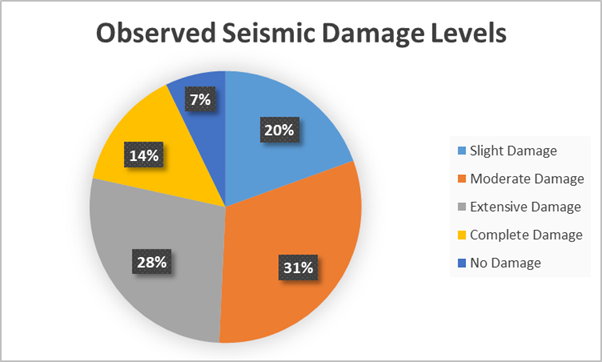
structural weakness which affected various low-rise reinforced concrete buildings. Seismic data shows that 31.3 % of buildings experienced moderate damage while 27.7 % suffered extensive damage which proves that many structures face severe structural damage during earthquakes. The data shows that 19.5 % of buildings experience only minor damage which involves small cracks and surface deterioration in Figure 1. The sample shows that 14.4 % of buildings suffered total destruction through either collapse or near-collapse which indicates severe structural breakdown during powerful earthquakes. The assessment revealed that 7.2 % of buildings survived without damage which showed the assessed structures had limited ability to withstand damage.

3.4 Performance Levels Based on FEMA Framework

The distribution of performance levels in low-rise reinforced concrete buildings reveals their current state of seismic safety. Life Safety (LS) level contains the most buildings at 37.4% which shows that most structures will experience major damage but remain standing during earthquakes according to Figure 2. Data shows that 33.8% of buildings require Collapse Prevention (CP) because they have reached a stage where their structural stability becomes extremely weak. The Immediate Occupancy (IO) category represents 14.9% of buildings which shows that most structures become non-functional after earthquakes because they sustain severe damage. The Global Collapse (GC) classification shows up in 13.8% of buildings which means these structures have a high possibility of complete failure when strong earthquakes occur.

3.5 Factors Influencing Seismic Damage

Seismic damage factors show that poor construction quality stands as the most vital factor because it received the highest average rating of 4.52 out of 5 which places it at the top of the impact scale shown in Table 3. The data shows that construction methods have a major impact on how low-rise reinforced concrete structures perform during earthquakes. The results demonstrate that following seismic design standards remains a critical practice because this aspect obtained a 4.31 average rating which stands as the second most important factor. The soil condition factor which has an average rating of 4.18 demonstrates that the local ground characteristics strongly affect how structures respond to earthquakes. Material degradation (mean = 3.87) is ranked fourth, indicating moderate but important influence due to aging and environmental exposure. The structural configuration of buildings receives an average assessment of 3.65 which places it in fifth position for vulnerability assessment.

3.6 Correlation Matrix

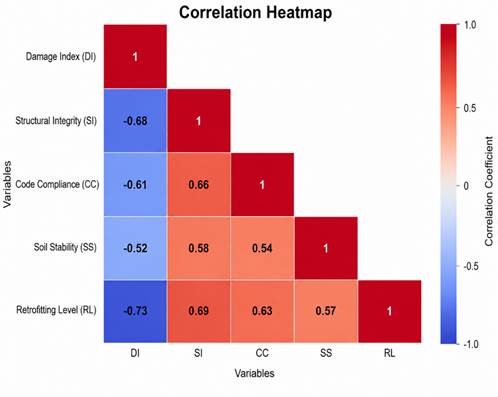
Correlation analysis reveals strong and meaningful relationships among key structural variables influencing seismic performance. Damage Index (DI) shows a strong negative correlation with Retrofitting Level (r = -0.73), Structural Integrity (r = -0.68), Code Compliance (r = -0.61), and Soil Stability (r = -0.52) in Figure 3. Demonstrates that rising values in these elements lead to a major drop in earthquake destruction. The data shows that engineering improvements lead to better building performance through their positive impact on Structural Integrity and Code Compliance and Retrofitting Level and Soil Stability. Code Compliance values grow together with Retrofitting Level values at r = 0.63 and Soil Stability values at r = 0.54 which shows how these elements work together to build resilience. The research shows that Soil Stability connects at a moderate level with Retrofitting Level through a correlation value of r = 0.57. Low-rise reinforced concrete buildings need structural safety measures and retrofitting techniques to protect themselves from earthquake damage.

4. Discussion

The research findings reveal low-rise reinforced concrete (RC) buildings behave during earthquakes through expert assessments and performance-based evaluation methods. Demographic data shows that most participants work in their middle career stage as structural and civil engineers which makes their technical knowledge in the dataset more reliable. Their engineering skills to assess seismic damage and structural performance because they base their work on actual engineering principles instead of personal opinions (Carrillo et al., 2017). Majority of buildings stand between three and four stories high which makes them more prone to earthquake damage because their weight and side-to-side movement need to be controlled (Maeda & Kang, 2009; Uebayashi et al., 2015). Construction of buildings reached its peak between 2000 and 2020 but numerous structures continue to violate seismic design standards either partially or not at all. The construction of modern buildings shows that code enforcement and implementation gaps continue to exist. Previous research studies have shown that buildings

Figure 1. Distribution of observed seismic damage levels across the 195 assessed low-rise reinforced concrete buildings. Damage states were classified into five categories: no damage, minor damage (superficial cracking and surface deterioration), moderate damage (significant structural cracking with partial loss of load-bearing capacity), extensive damage (severe structural compromise), and collapse or near-collapse (total or near-total structural failure). Moderate damage was the most frequently observed state (31.3%), followed by extensive damage (27.7%) and minor damage (19.5%). A total of 14.4% of buildings experienced collapse or near-collapse conditions, while only 7.2% sustained no structural damage. Values are expressed as percentages of the total sample (N = 195).

Table 3. Expert-rated factors influencing seismic damage severity in low-rise reinforced concrete buildings. Five structural and geotechnical variables were ranked by their perceived influence on earthquake-induced damage based on a five-point Likert scale administered to 195 expert respondents. Poor construction quality was rated as the most influential factor (mean score = 4.52; rank 1), followed by non-compliance with seismic design codes (mean = 4.31; rank 2) and adverse soil conditions (mean = 4.18; rank 3). Material degradation (mean = 3.87; rank 4) and irregular building configuration (mean = 3.65; rank 5) were identified as moderately influential contributors. Impact levels are categorized as Very High (>4.5), High (4.0–4.49), and Moderate (3.5–3.99) based on mean score thresholds.

Factor

Impact Level

Mean Score (1–5)

Rank

Poor Construction Quality

Very High

4.52

1

Code Non-Compliance

High

4.31

2

Soil Condition

High

4.18

3

Material Degradation

Moderate

3.87

4

Irregular Building Design

Moderate

3.65

5

Figure 3. Pearson correlation matrix illustrating the relationships among key structural and geotechnical variables influencing seismic performance in low-rise reinforced concrete buildings. Correlation coefficients (r) were computed for five variables: Damage Index (DI), Structural Integrity, Code Compliance, Soil Stability, and Retrofitting Level (N = 195). The Damage Index exhibited strong negative correlations with Retrofitting Level (r = −0.73), Structural Integrity (r = −0.68), Code Compliance (r = −0.61), and Soil Stability (r = −0.52), indicating that improvements in each of these parameters are associated with reduced seismic damage. Positive intercorrelations were observed among the protective variables: Code Compliance correlated with Retrofitting Level (r = 0.63) and Soil Stability (r = 0.54), while Soil Stability correlated with Retrofitting Level (r = 0.57). Color intensity reflects the magnitude of correlation, with deeper shading indicating stronger associations. All reported correlations are statistically significant at p < 0.05.

become vulnerable because they fail to follow seismic rules properly (Bessason et al., 2014).

The observed seismic damage distribution further confirms the limited resilience of the studied building stock. Dataset shows that most buildings experience either moderate damage at 31.3% or extensive damage at 27.7% which indicates that many structures suffer major structural problems during earthquakes. Data shows that only 7.2% of buildings survived without damage which proves that low-rise RC structures face major risk for structural damage. Results match performance-based seismic studies which show that low-rise buildings become vulnerable to major damage when builders fail to follow proper construction standards and detailing requirements. FEMA framework analysis of performance levels provides additional evidence which supports these findings (Li & Lim, 2010; Zhang et al., 2019). Majority of building designs and performance focus on preventing structural failure because Life Safety (37.4%) and Collapse Prevention (33.8%) standards dominate the industry. The 13.8% occurrence of Global Collapse cases creates a dangerous situation because these failures endanger lives and damage all kinds of built structures. The small number of buildings which reached Immediate Occupancy status (14.9%) indicates that earthquakes made most buildings unfit for immediate use which creates major problems for emergency response and recovery efforts.

The factor analysis reveals that poor construction quality stands as the most influential factor which causes seismic damage with an average score of 4.52. The study reveals that seismic damage results primarily from two main factors which include poor construction quality and non-compliance with building codes and soil conditions. The research shows that seismic performance depends on two vital elements which consist of structural components and geotechnical elements. Material degradation and irregular building design also contribute, but to a lesser extent (Özhendekci & Özhendekci, 2012). Correlation analysis reveals detailed information about how essential variables establish connections between themselves. The data shows a strong negative link between Damage Index and Retrofitting Level (r = -0.73) which proves that retrofitting methods effectively decrease seismic damage. The three elements of structural integrity and code compliance and soil stability work together to create better building resistance against damage (Hansapinyo et al., 2018; Sani et al., 2017). The variables show positive interdependence because seismic performance exists as an integrated system which improves total structural safety through its individual components.

5. Conclusion

The assessment shows that most buildings need Life Safety and Collapse Prevention protection because they have moderate to severe seismic vulnerability. Analysis of damage reveals that most buildings sustain major structural damage although few buildings remain without any damage. The research identifies three main factors which affect construction projects through their combination of poor building quality and code violations and soil problems. Pearson correlation results prove that retrofitting together with structural integrity work reduces the amount of damage that occurs.

Author Contributions

N.A. conceived and designed the study, developed the research framework for performance-based seismic damage assessment, led the survey design and data collection from structural engineers, civil engineers, urban planners, and researchers, and drafted the original manuscript. E.B.A. contributed to the statistical analysis including descriptive statistics, percentage analysis, and Pearson correlation, assisted with data interpretation and results validation, and participated in the critical review and editing of the final manuscript. All authors read and approved the final version of the manuscript.

Acknowledgements

The authors sincerely thank all the structural engineers, civil engineers, urban planners, and researchers who generously participated in the structured survey and contributed their professional expertise to this study. Their practical insights into seismic damage assessment and retrofitting practices were invaluable to the findings presented herein. The authors also extend their gratitude to their respective institutional affiliations for providing the academic support and resources necessary to carry out this research. The authors further acknowledge the anonymous reviewers for their constructive feedback, which greatly improved the clarity and rigor of this manuscript. No external funding agency or sponsored grant supported this research. The opinions, findings, and conclusions expressed in this paper are solely those of the authors and do not represent the views of any organization or institution.

Competing financial interests

The authors N.A. et al. have no conflict of interest.

References


Allahvirdizadeh, R., Khanmohammadi, M., & Marefat. (2017). Probabilistic comparative investigation on introduced performance-based seismic design and assessment criteria. Engineering Structures, 151, 206–220. https://doi.org/10.1016/j.engstruct.2017.08.029

Ay, B. Ö., & Akkar, S. (2013). Evaluation of a recently proposed record selection and scaling procedure for low-rise to mid-rise reinforced concrete buildings and its use for probabilistic risk assessment studies. Earthquake Engineering & Structural Dynamics, 43(6), 889–908. https://doi.org/10.1002/eqe.2378

Benavent-Climent, A., Ramírez-Márquez, A., & Pujol, S. (2018). Seismic strengthening of low-rise reinforced concrete frame structures with masonry infill walls: Shaking-table test. Engineering Structures, 165, 142–151. https://doi.org/10.1016/j.engstruct.2018.03.026

Bessason, B., Bjarnason, J. Ö., Guðmundsson, A., Sólnes, J., & Steedman, S. (2014). Analysis of damage data of low-rise buildings subjected to a shallow Mw6.3 earthquake. Soil Dynamics and Earthquake Engineering, 66, 89–101. https://doi.org/10.1016/j.soildyn.2014.06.025

Booth, E. (2018). Dealing with earthquakes: the practice of seismic engineering ‘as if people mattered.’ Bulletin of Earthquake Engineering, 16(4), 1661–1724. https://doi.org/10.1007/s10518-017-0302-8

Bursi, O. S., Paolacci, F., Reza, M. S., Alessandri, S., & Tondini, N. (2015). Seismic Assessment of petrochemical piping systems using a Performance-Based Approach. Journal of Pressure Vessel Technology, 138(3). https://doi.org/10.1115/1.4032111

Carrillo, J., & Alcocer, S. M. (2012). Experimental investigation on dynamic and quasi-static behavior of low-rise reinforced concrete walls. Earthquake Engineering & Structural Dynamics, 42(5), 635–652. https://doi.org/10.1002/eqe.2234

Carrillo, J., Pincheira, J. A., & Alcocer, S. M. (2017). Behavior of low-rise, steel fiber-reinforced concrete thin walls under shake table excitations. Engineering Structures, 138, 146–158. https://doi.org/10.1016/j.engstruct.2017.02.017

Dadashi, R., & Nasserasadi, K. (2015). Seismic damages comparison of low-rise moderate reinforced concrete moment frames in the near- and far-field earthquakes by a probabilistic approach. International Journal of Advanced Structural Engineering, 7(2), 171–180. https://doi.org/10.1007/s40091-015-0090-9

Esmaili, O., Ludwig, L. G., & Zareian, F. (2015). Improved performance-based seismic assessment of buildings by utilizing Bayesian statistics. Earthquake Engineering & Structural Dynamics, 45(4), 581–597. https://doi.org/10.1002/eqe.2672

Gokmen, F., Binici, B., Aldemir, A., Taghipour, A., & Canbay, E. (2019). Seismic behavior of autoclaved aerated concrete low rise buildings with reinforced wall panels. Bulletin of Earthquake Engineering, 17(7), 3933–3957. https://doi.org/10.1007/s10518-019-00630-3

Halder, L., & Paul, S. (2016). Seismic Damage Evaluation of gravity load designed low rise RC building using non-linear static method. Procedia Engineering, 144, 1373–1380. https://doi.org/10.1016/j.proeng.2016.05.167

Hansapinyo, C., Wongmatar, P., Vimonsatit, V., & Chen, W. (2018). Pounding of seismically designed low-rise reinforced concrete frames. Proceedings of the Institution of Civil Engineers - Structures and Buildings, 172(11), 819–835. https://doi.org/10.1680/jstbu.17.00138

Hsieh, M., Lee, B., Lei, T., & Lin, J. (2013). Development of medium- and low-rise reinforced concrete building fragility curves based on Chi-Chi Earthquake data. Natural Hazards, 69(1), 695–728. https://doi.org/10.1007/s11069-013-0733-8

Jackson, J. (2006). Fatal attraction: living with earthquakes, the growth of villages into megacities, and earthquake vulnerability in the modern world. Philosophical Transactions of the Royal Society a Mathematical Physical and Engineering Sciences, 364(1845), 1911–1925. https://doi.org/10.1098/rsta.2006.1805

Kunnath, S. K., Nghiem, Q., & El-Tawil, S. (2004). Modeling and response prediction in Performance-Based Seismic Evaluation: case studies of instrumented Steel Moment-Frame buildings. Earthquake Spectra, 20(3), 883–915. https://doi.org/10.1193/1.1774181

Lee, K. S., & Shin, S. W. (2013). A new methodology for performance-based seismic evaluation of low-rise reinforced concrete buildings using nonlinear required strengths. Journal of Advanced Concrete Technology, 11(4), 151–166. https://doi.org/10.3151/jact.11.151

Li, B., & Lim, C. L. (2010). Tests on seismically damaged reinforced concrete structural walls repaired using Fiber-Reinforced polymers. Journal of Composites for Construction, 14(5), 597–608. https://doi.org/10.1061/(asce)cc.1943-5614.0000110

Maeda, M., & Kang, D. E. (2009). Post-Earthquake damage evaluation of reinforced concrete buildings. Journal of Advanced Concrete Technology, 7(3), 327–335. https://doi.org/10.3151/jact.7.327

Negro, P., & Mola, E. (2015). A performance based approach for the seismic assessment and rehabilitation of existing RC buildings. Bulletin of Earthquake Engineering, 15(8), 3349–3364. https://doi.org/10.1007/s10518-015-9845-8

Otani, S. (2004). Earthquake resistant design of reinforced concrete buildings. Journal of Advanced Concrete Technology, 2(1), 3–24. https://doi.org/10.3151/jact.2.3

Özhendekci, N., & Özhendekci, D. (2012). Rapid seismic vulnerability assessment of Low- to Mid-Rise reinforced concrete buildings using Bingöl’s regional data. Earthquake Spectra, 28(3), 1165–1187. https://doi.org/10.1193/1.4000065

Park, J., Towashiraporn, P., Craig, J. I., & Goodno, B. J. (2008). Seismic fragility analysis of low-rise unreinforced masonry structures. Engineering Structures, 31(1), 125–137. https://doi.org/10.1016/j.engstruct.2008.07.021

Sani, H. P., Gholhaki, M., & Banazadeh, M. (2017). Seismic Performance assessment of isolated Low-Rise steel structures based on loss estimation. Journal of Performance of Constructed Facilities, 31(4). https://doi.org/10.1061/(asce)cf.1943-5509.0001028

Shen, G., Zhou, L., Wu, Y., & Cai, Z. (2018). A global expected risk analysis of fatalities, injuries, and damages by natural disasters. Sustainability, 10(7), 2573. https://doi.org/10.3390/su10072573

Su, R. K. L., & Lee, C. (2013). Development of seismic fragility curves for low-rise masonry infilled reinforced concrete buildings by a coefficient-based method. Earthquake Engineering and Engineering Vibration, 12(2), 319–332. https://doi.org/10.1007/s11803-013-0174-0

Surana, M., Singh, Y., & Lang, D. H. (2017). Seismic characterization and vulnerability of building stock in hilly regions. Natural Hazards Review, 19(1). https://doi.org/10.1061/(asce)nh.1527-6996.0000275

Travush, V., Emelianov, S., Kolchunov, V., & Bulgakov, A. (2016). Mechanical Safety and Survivability of Buildings and Building Structures under Different Loading Types and Impacts. Procedia Engineering, 164, 416–424. https://doi.org/10.1016/j.proeng.2016.11.639

Uebayashi, H., Nagano, M., Hida, T., Tanuma, T., Yasui, M., & Sakai, S. (2015). Evaluation of the structural damage of high-rise reinforced concrete buildings using ambient vibrations recorded before and after damage. Earthquake Engineering & Structural Dynamics, 45(2), 213–228. https://doi.org/10.1002/eqe.2624

Zhang, J., Zheng, W., Cao, W., Dong, H., & Li, W. (2019). Seismic Behavior of Low-rise Concrete Shear Wall with Single Layer of Web Reinforcement and Inclined Rebars: Restoring Force Model. KSCE Journal of Civil Engineering, 23(3), 1302–1319. https://doi.org/10.1007/s12205-019-1264-y


Article metrics
View details
0
Downloads
0
Citations
257
Views
📖 Cite article

View Dimensions


View Plumx


View Altmetric


0
Save
0
Citation
257
View
0
Share