Journal of Primeasia

Integrative Disciplinary Research | Online ISSN 3064-9870 | Print ISSN 3069-4353
570
Citations
176k
Views
119
Articles
Your new experience awaits. Try the new design now and help us make it even better
Switch to the new experience
Figures and Tables
REVIEWS   (Open Access)

Climate-Adaptive Sustainable Apparel Supply Chains: Integrating Machine Learning, Digitalization, and Circular Economy

Nadira Kulsum Papri 1*, Mahmud Kamal Anamul Haque 2, Zannatul Mouwa 2

+ Author Affiliations

Journal of Primeasia 3 (1) 1-8 https://doi.org/10.25163/primeasia.3110730

Submitted: 26 April 2022 Revised: 04 July 2022  Published: 12 July 2022 


Abstract

The apparel industry is increasingly confronted by a difficult convergence of environmental degradation, resource inefficiency, supply chain opacity, and growing climate vulnerability. While sustainable supply chain management and circular economy strategies have gained substantial attention, much of the existing literature remains fragmented across disciplinary boundaries and often stops short of addressing how supply chains can become genuinely adaptive under conditions of environmental uncertainty. This narrative review examines the evolving intersections among sustainability, circular economy practices, digitalization, and machine learning within apparel supply chains. A structured literature search was conducted across major academic databases, and the retrieved studies were synthesized thematically to identify dominant research patterns, conceptual blind spots, and emerging opportunities. The review reveals that sustainability and circularity are relatively well established in apparel supply chain research, whereas digital technologies such as blockchain and the Internet of Things are discussed primarily in relation to traceability and transparency. In contrast, machine learning remains only marginally represented, and climate adaptation is almost entirely absent as an explicit analytical focus. In response to these gaps, this study proposes a conceptual framework for machine learning-enabled climate-adaptive sustainable apparel supply chains. The framework integrates sustainability practices, circular economy principles, digital infrastructure, and machine learning intelligence into a unified system capable of supporting predictive, adaptive, and resilience-oriented decision-making. By bringing these traditionally disconnected domains into closer dialogue, this review offers a foundation for future empirical research and provides practical direction for developing more intelligent and environmentally responsive apparel supply chains.

Keywords: Sustainable apparel supply chains, Machine learning, Climate adaptation, Circular economy, Digitalization

1. Introduction

The global apparel industry sits at an uneasy intersection of creativity, commerce, and environmental strain. On one hand, it is an industry built on innovation, identity, and rapid responsiveness to consumer demand. On the other, it has become one of the most resource-intensive and environmentally burdensome sectors in the global economy. The accelerated rise of fast fashion has intensified this tension, shortening product life cycles, increasing production volumes, and encouraging patterns of overconsumption that place extraordinary pressure on natural resources and waste systems (Niinimäki et al., 2020). As garments are produced, transported, consumed, and discarded at ever-faster rates, the environmental costs—carbon emissions, water use, chemical pollution, and textile waste—have become increasingly difficult to ignore.

At the same time, sustainability concerns in the apparel sector are not limited to environmental damage alone. Questions of labor exploitation, supplier transparency, workplace safety, and ethical sourcing continue to shape both public scrutiny and regulatory expectations. In response, sustainable supply chain management (SSCM) has gained prominence as a framework for embedding environmental, social, and economic responsibility into supply chain operations. Within apparel systems, SSCM has been positioned as a way to improve resource efficiency, reduce waste, strengthen ethical procurement, and create more accountable global production networks (Köksal et al., 2017). Yet, despite this progress, much of the industry still operates through fragmented, multi-tiered supply chains that remain largely reactive, compliance-driven, and difficult to coordinate across geographies and stakeholders.

This challenge becomes even more pronounced when viewed through the lens of climate change. Apparel supply chains are deeply dependent on climate-sensitive inputs, especially natural fibers such as cotton, as well as on globally distributed logistics and manufacturing systems that are increasingly exposed to environmental disruption. Extreme weather events, heat stress, drought, water scarcity, and shifts in agricultural productivity are no longer abstract risks; they are emerging operational realities that can destabilize sourcing, delay production, and increase supply uncertainty. In this context, sustainability alone is no longer sufficient. What is increasingly required is climate adaptability—that is, the ability of supply chains to anticipate, absorb, and respond dynamically to environmental variability and climate-related shocks.

Alongside these sustainability pressures, the apparel industry has also undergone a significant digital transformation. Technologies such as blockchain, the Internet of Things (IoT), and big data systems have expanded the industry’s ability to capture and share information across supply chain stages. These tools have improved traceability, visibility, and transparency, helping firms monitor sourcing practices, track product movement, and document sustainability claims more effectively (Agrawal et al., 2021; Pournader et al., 2021). Still, there is an important limitation here: digitalization has often strengthened visibility more than intelligence. In many cases, organizations now have more data than ever before, but far less capacity to convert that data into timely, adaptive, and strategic decision-making.

This is where machine learning (ML) becomes especially relevant. ML offers the potential to move supply chain management beyond observation and toward prediction, optimization, and adaptation. Across broader supply chain contexts, ML has already shown promise in improving demand forecasting, inventory planning, disruption management, and operational resilience (Baryannis et al., 2019). Yet within the apparel sustainability literature, its application remains relatively underdeveloped—particularly in relation to climate adaptation. Likewise, circular economy (CE) strategies such as recycling, reuse, remanufacturing, and closed-loop production have been widely proposed as pathways toward more sustainable apparel systems, but they too often remain operationally static and weakly supported by predictive analytics (Jia et al., 2020). As a result, sustainability, digitalization, circularity, and machine learning are still too often discussed as adjacent ideas rather than as parts of an integrated adaptive system.

This fragmentation reveals an important gap in the literature. There is growing recognition that future apparel supply chains must be not only sustainable and digitally enabled, but also data-driven, predictive, and climate-responsive. However, the scholarship connecting these dimensions remains dispersed and conceptually incomplete. In light of this gap, the present study conducts a systematic literature review to examine how sustainability, digitalization, and machine learning have been addressed within apparel supply chain research. By synthesizing these streams, the study seeks to identify key knowledge gaps and to propose a conceptual framework for machine learning-enabled climate-adaptive sustainable apparel supply chains. In doing so, it aims to offer both a clearer academic foundation and a more actionable direction for the next generation of resilient and environmentally responsible apparel systems.

Against this backdrop, the present study seeks to systematically examine how sustainability, digitalization, and machine learning have been conceptualized and applied within apparel supply chain research, with particular attention to their relevance for climate adaptation. Specifically, the review synthesizes existing scholarship on sustainable apparel supply chains and circular economy practices, evaluates the role of digital technologies in enabling sustainability-oriented supply chain transformation, and assesses the current scope of machine learning applications in supply chain decision-making. In doing so, the study also identifies the major conceptual and methodological gaps that continue to limit the development of climate-responsive, data-driven apparel systems.

This study contributes to the literature in several important respects. First, it advances a more integrated theoretical understanding by bringing together three research streams—sustainable supply chain management, digital transformation, and machine learning—that have largely evolved in parallel rather than in conversation with one another. Second, by employing a systematic literature review approach, the study provides a structured synthesis of fragmented interdisciplinary knowledge and highlights the areas in which current scholarship remains underdeveloped. Third, and most importantly, it proposes a conceptual framework for machine learning-enabled climate-adaptive sustainable apparel supply chains, thereby offering a foundation for future empirical inquiry as well as practical guidance for organizations seeking to build more resilient, intelligent, and environmentally responsible supply chain systems.

2. Methodology

2.1 Review Design

This study was conducted as a narrative review with a structured literature search strategy to examine the emerging intersection of sustainability, digitalization, circular economy, and machine learning within apparel supply chains. A narrative review design was considered appropriate because the topic spans several overlapping but methodologically diverse research domains, including supply chain management, environmental sustainability, digital transformation, operations analytics, and climate adaptation. In areas such as this—where the literature is still evolving, conceptually fragmented, and not yet sufficiently standardized for formal evidence pooling—a narrative review can provide a more flexible and interpretive synthesis than a strictly protocol-bound review approach (Baethge et al., 2019; Green et al., 2006).

Rather than attempting to statistically aggregate findings, the purpose of this review was to identify major conceptual developments, recurring themes, emerging patterns, and unresolved research gaps across the existing literature. This approach was particularly suitable because the included studies varied considerably in their aims, methods, disciplinary backgrounds, and analytical depth. Some studies were conceptual, others empirical, and several were themselves review-based. As such, the present review was designed to synthesize and critically interpret the literature in a way that would support theory building and framework development rather than quantitative comparison.

To improve transparency and reproducibility, the review was nonetheless guided by a clearly defined search process, eligibility logic, and thematic synthesis strategy. In this sense, the study occupies a middle ground between a purely unsystematic narrative overview and a formal systematic review: it remains interpretive in nature, but it was conducted through a deliberate and traceable literature identification process.

2.2 Literature Search Strategy

The literature search was designed to capture scholarly work relevant to the central question of how sustainable and climate-responsive apparel supply chains are being shaped by digitalization and machine learning. To achieve this, a structured keyword-based search was conducted across four major academic databases: Scopus, Web of Science, ScienceDirect, and SpringerLink. These sources were selected because they collectively index a broad range of peer-reviewed literature across management, sustainability, engineering, operations, and technology-related fields.

The search focused on literature published between 2015 and 2021. This period was chosen intentionally because it reflects a particularly important phase in the development of the field. During these years, sustainability and circular economy discourse became more deeply embedded in supply chain research, while digital technologies such as blockchain, Internet of Things (IoT), and data-driven decision systems gained increasing attention in industrial and academic discussions. At the same time, machine learning began to emerge more visibly in operations and logistics research, making this timeframe especially relevant for capturing the early convergence of these themes.

The search strategy was developed around several core conceptual areas central to the review topic. These included:

  • sustainable supply chains
  • apparel, fashion, and textile systems
  • circular economy
  • digital technologies and digital supply chains
  • machine learning and intelligent analytics
  • climate adaptation and resilience

Searches were conducted using combinations of structured keywords and Boolean operators. Representative search terms included the following:

  • “sustainable supply chain” AND “apparel”
  • “sustainable supply chain” AND “fashion”
  • “circular economy” AND “textile industry”
  • “machine learning” AND “supply chain”
  • “digital supply chain” AND “blockchain”
  • “digital supply chain” AND “IoT”
  • “climate adaptation” AND “supply chain”
  • “climate resilience” AND “apparel supply chain”

Where appropriate, keyword combinations were broadened or narrowed during the search process in order to improve conceptual coverage without compromising relevance. For example, because some relevant studies used the term fashion while others used textile or apparel, search terms were adjusted accordingly to avoid excluding literature due to differences in disciplinary vocabulary. Similarly, the search process remained attentive to adjacent terms such as predictive analytics, smart supply chains, and digital transformation where these were clearly relevant to the broader research focus.

In addition to database searching, the reference lists of selected high-relevance articles were manually reviewed to identify potentially important studies that may not have been retrieved directly through the initial keyword search. This supplementary backward search helped improve conceptual completeness and reduce the risk of missing influential studies due to indexing or terminology variation.

2.3 Study Selection and Scope of the Review

The literature identified through the search process was screened in stages to ensure relevance to the review objective. The selection process was not intended to function as a rigid exclusion protocol, but rather as a structured filtering process to retain studies that could meaningfully contribute to the conceptual synthesis.

In the first stage, titles and abstracts were reviewed to remove clearly irrelevant records. Articles were excluded at this stage if they focused on unrelated sectors, did not address supply chains or sustainability in any meaningful way, or dealt with digital technologies or machine learning in contexts entirely disconnected from apparel, textiles, or sustainability transitions.

In the second stage, full texts of potentially relevant articles were read in detail. Inclusion was guided by conceptual relevance rather than narrow methodological uniformity. Studies were retained if they contributed substantively to one or more of the following areas:

  • sustainable apparel or fashion supply chains
  • circular economy or environmental sustainability in textile systems
  • digitalization and technological transformation in supply chains
  • machine learning or predictive analytics in supply chain management
  • climate adaptation, resilience, or environmental risk in supply chains

The review prioritized peer-reviewed journal articles written in English and published within the selected timeframe. Conference papers, trade reports, editorials, and unpublished grey literature were not included in the main synthesis, primarily to maintain consistency in scholarly quality and source comparability. However, the authors acknowledge that some emerging industrial practices may appear earlier in professional or technical reports than in peer-reviewed publications.

Because this review was narrative rather than systematic, the goal was not to achieve exhaustive retrieval of every potentially relevant paper. Instead, the objective was to develop a conceptually robust and sufficiently representative body of literature from which meaningful patterns, gaps, and integrative insights could be derived.

2.4 Data Organization and Analytical Approach

Following article selection, the included studies were organized using a structured review matrix to support comparison and synthesis across diverse types of evidence. For each article, key descriptive and analytical information was recorded, including:

  • author(s) and publication year
  • study focus and research objective
  • sectoral or supply chain context
  • methodological approach
  • sustainability dimension addressed
  • circular economy relevance
  • digital technologies discussed
  • machine learning or analytical components
  • principal findings
  • stated limitations or research gaps

The purpose of this matrix was not merely to summarize the literature, but to support a more deliberate analytical reading of how different strands of scholarship relate to one another. Through repeated comparison across the included studies, the review sought to identify where the literature was converging, where it remained fragmented, and where notable absences or underdeveloped areas persisted.

The analytical process was guided by thematic narrative synthesis, an approach commonly used when the literature is conceptually rich but methodologically heterogeneous (Popay et al., 2006). In practice, this involved reading across studies iteratively, grouping them by dominant topic and analytical orientation, and then refining broader themes through comparison and interpretive synthesis.

2.5 Thematic Development

As the review progressed, four major thematic domains emerged consistently across the literature:

  • Sustainable apparel supply chains
  • Circular economy and environmental impact
  • Digitalization in supply chains
  • Machine learning and climate adaptation

These themes were not predetermined as fixed analytical boxes, but rather developed through repeated engagement with the literature. In some cases, studies fit clearly within one dominant theme; in others, they intersected multiple domains. For example, some articles focused on sustainability but also touched on digital traceability, while others addressed digital technologies without fully engaging with environmental or climate implications. This thematic overlap was analytically important, because one of the central observations of the review was precisely that these areas are often discussed in parallel rather than in an integrated way.

The thematic structure ultimately served two purposes. First, it allowed the literature to be synthesized in a way that remained readable and conceptually coherent. Second, it provided the intellectual foundation for the development of the conceptual framework proposed later in the paper. In that sense, the framework was not introduced independently of the literature; rather, it emerged from the recurring relationships, tensions, and gaps identified through the review process.

2.6 Rigor, Credibility, and Limitations of the Review Approach

Although this study was conducted as a narrative review rather than a formal systematic review, several steps were taken to enhance its rigor and credibility. First, the literature search was based on clearly defined conceptual keywords applied across multiple major databases, which improved transparency and reduced reliance on ad hoc article selection. Second, article inclusion was guided by explicit relevance criteria, helping to maintain consistency in scope. Third, the use of a structured review matrix supported organized comparison across studies and reduced the risk of purely impressionistic synthesis. Finally, thematic development was conducted iteratively and comparatively, allowing the analysis to be grounded in recurring patterns rather than isolated impressions.

At the same time, the limitations of the review design should be acknowledged. As with most narrative reviews, the synthesis inevitably involves a degree of interpretive judgment in how themes are defined and how conceptual relationships are emphasized. In addition, the review was restricted to English-language peer-reviewed journal articles and to the 2015–2021 publication period, which may have excluded some relevant literature outside this scope. The search was structured but not exhaustive in the formal systematic-review sense, meaning that the findings should be interpreted as a conceptually grounded synthesis of the field, rather than a definitive census of all available evidence.

Even so, this review provides a sufficiently rigorous and transparent methodological basis for identifying the major trajectories and blind spots in the literature. More importantly, it offers a defensible foundation for the conceptual argument advanced in this study: that the future of sustainable apparel supply chains may depend not only on better sustainability practices or better digital tools in isolation, but on their integration through more adaptive and intelligent decision systems.

3. Thematic Synthesis of the Reviewed Literature

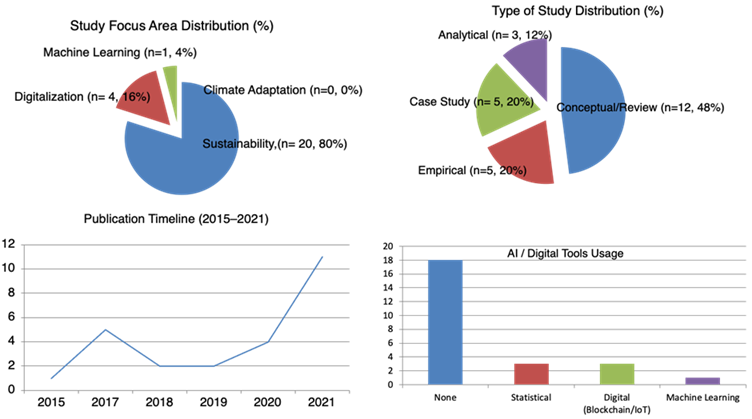
A cross-reading of the included studies revealed a literature landscape that is intellectually promising, yet still notably fragmented. Although the apparel supply chain field has made meaningful progress in addressing sustainability and, to a lesser extent, digital transformation, the integration of machine learning (ML) and climate adaptation remains strikingly underdeveloped. As summarized in (Table 1), the majority of reviewed studies concentrate on sustainability practices, governance issues, and environmental or social performance, while a smaller subset engages with digital technologies such as blockchain, traceability systems, or Industry 4.0 tools. By contrast, only a limited number of studies explicitly discuss machine learning, and virtually none examine its application within the specific context of climate-adaptive apparel supply chains. This imbalance becomes even more visible in the graphical mapping of the literature, where sustainability-oriented scholarship clearly dominates, empirical analytics remain relatively sparse, and climate adaptation appears more as a peripheral concern than a central research priority (Figure 1). These patterns suggest that the field is not lacking in awareness, but rather in integration, analytical depth, and adaptive operational thinking.

3.1 Sustainable Apparel Supply Chains: Strong in Principle, Limited in Operational Depth

Sustainable supply chain management (SSCM) has become one of the most established and visible research domains within apparel studies, and for understandable reasons. The apparel industry is structurally dependent on multi-tiered, globally dispersed production systems that often stretch across regions with differing environmental regulations, labor protections, and industrial capacities. This makes sustainability not simply an ethical preference, but a deeply operational concern. Much of the literature rightly frames apparel SSCM as an attempt to embed environmental, social, and economic responsibility into sourcing, production, logistics, and retail decision-making (Touboulic & Walker, 2015; Köksal et al., 2017).

At a conceptual level, this body of research has been quite productive. It has clarified the importance of stakeholder pressure, institutional governance, supplier compliance, and organizational learning in shaping sustainability transitions. In particular, social sustainability—especially labor rights, worker safety, and ethical sourcing—has received sustained scholarly attention, reflecting the sector’s long-standing association with outsourcing, low-cost labor, and uneven supplier accountability (Köksal et al., 2017). In that sense, SSCM scholarship has been instrumental in showing that sustainability in apparel cannot be reduced to eco-efficiency alone; it must also account for the social and ethical architecture of global production.

And yet, despite this strong conceptual foundation, much of the literature remains somewhat normative and structurally static. A recurring issue is that sustainability is often framed as something organizations should pursue, but less often as something they are operationally equipped to adaptively manage. Many reviewed studies rely on conceptual discussions, case-based insights, or broad sustainability frameworks, all of which are valuable in their own right, but often insufficient for understanding how apparel supply chains behave under dynamic and uncertain real-world conditions. This matters because apparel systems are not stable environments. They are shaped by fluctuating demand, compressed production timelines, supplier variability, geopolitical shifts, and increasingly, environmental disruption.

Another noticeable imbalance in this literature is the relative emphasis on social compliance over environmental system performance. While labor issues, sourcing ethics, and compliance pressures are well represented, environmental dimensions such as carbon intensity, water dependency, waste generation, and material efficiency are often treated more selectively and less systematically. In practice, however, these dimensions are inseparable. A supply chain that is ethically audited but environmentally brittle cannot meaningfully be called sustainable.

Perhaps more importantly, most SSCM studies in the apparel domain still stop short of addressing adaptation. They describe sustainability initiatives, governance structures, and implementation barriers, but they rarely ask whether these systems can anticipate disruption, absorb shocks, or adjust intelligently in response to changing environmental and operational conditions. This is where the literature begins to reveal a deeper limitation: it has developed sustainability as a governance problem more convincingly than it has developed sustainability as a decision intelligence problem. That gap becomes especially important when considering climate risk, resource volatility, and the need for real-time operational responsiveness.

In short, the literature on sustainable apparel supply chains has done important groundwork, but it still leans heavily toward descriptive and compliance-oriented models. What remains underdeveloped is a more adaptive, predictive, and analytically enabled understanding of how sustainability can be operationalized under uncertainty.

3.2 Circular Economy and Environmental Impact: Conceptually Attractive, Operationally Underdeveloped

If SSCM has become the moral and managerial language of apparel sustainability, then the circular economy (CE) has emerged as one of its most compelling strategic extensions. The appeal is obvious. In an industry characterized by short product life cycles, overproduction, waste accumulation, and material inefficiency, circularity offers a way to rethink the system itself—not merely by making production cleaner, but by reducing dependence on linear “take–make–dispose” models. Across the reviewed literature, CE is consistently presented as a promising pathway toward lower environmental impact, longer product life, and more regenerative material flows (Jia et al., 2020; Niinimäki et al., 2020).

This emphasis is justified. The environmental footprint of apparel is difficult to overstate. Fast fashion, in particular, has accelerated both throughput and disposability, intensifying resource extraction, water use, chemical burden, and post-consumer textile waste (Niinimäki et al., 2020). Within this context, circular strategies such as recycling, remanufacturing, reuse, repair, and closed-loop production have gained considerable traction in both scholarship and industry discourse. Several reviewed studies identify these approaches as essential for reducing waste and improving material efficiency, especially in textile-intensive systems where fiber recovery and post-consumer garment management are increasingly relevant (Jia et al., 2020).

Still, the literature also suggests that circularity in apparel remains easier to articulate than to operationalize. Many CE discussions are persuasive at the conceptual level, but they often leave unanswered the more difficult questions of feasibility, coordination, and system optimization. Reverse logistics, for example, is central to circular apparel systems, yet in practice it is highly complex. Collecting, sorting, grading, and processing used garments at scale requires infrastructure, traceability, economic viability, and often a level of supply chain coordination that current systems do not yet consistently possess.

A further challenge lies in the quality and usability of recovered materials. Recycled fibers are not always equivalent in performance or value to virgin materials, and this can limit their application in higher-value or technically demanding products. As a result, circularity can sometimes drift into symbolic sustainability rather than becoming a robust operational alternative.

What is especially striking in the reviewed literature is that circular economy research in apparel tends to remain largely descriptive and design-oriented, rather than analytically predictive. Many studies identify what circular strategies are available or desirable, but relatively few model how these strategies perform under demand uncertainty, supply volatility, or environmental stress. That absence is not trivial. Circular systems are inherently more complex than linear ones, and without stronger analytical tools, their implementation risks becoming inefficient, poorly timed, or economically fragile.

This becomes even more consequential when climate variability is considered. Circular economy models often assume relatively stable resource and logistics conditions, yet climate change may directly influence the viability of these systems—for example, through disruptions in natural fiber supply, regional water stress, or transportation instability. In other words, circularity without adaptability may still leave apparel systems exposed.

Taken together, the literature positions CE as an essential sustainability strategy, but one that remains under-instrumented. It offers vision, but not yet enough operational intelligence. To move from principle to performance, circular economy systems in apparel will likely require stronger integration with digital data infrastructure and predictive analytical tools capable of handling uncertainty, trade-offs, and system-level complexity.

3.3 Digitalization in Apparel Supply Chains: Visibility Has Advanced Faster Than Intelligence

Among the reviewed themes, digitalization appears as the area where the apparel supply chain literature begins to move most visibly toward operational modernization. Technologies such as blockchain, Internet of Things (IoT), big data systems, and Industry 4.0 tools are increasingly discussed as enablers of transparency, traceability, responsiveness, and process efficiency. In many ways, this shift reflects a broader industrial realization: sustainability claims are difficult to manage—or verify—without more robust information systems.

Within apparel contexts, blockchain has attracted particular attention because of its potential to create immutable records across complex supplier networks. Studies suggest that blockchain can strengthen traceability, support provenance verification, and improve confidence in sustainability-related disclosures, especially in textile and clothing supply chains where supplier opacity has historically been a major challenge (Agrawal et al., 2021; Pournader et al., 2021). Likewise, IoT technologies enable real-time data capture from production environments, warehouses, logistics networks, and environmental sensors, opening new possibilities for monitoring operational conditions, inventory flows, and equipment performance.

These developments matter. They represent a genuine shift from retrospective documentation toward more continuous information visibility. In principle, such tools could help firms move beyond periodic audits and static reporting toward more dynamic, evidence-based supply chain oversight. In practice, however, the reviewed literature suggests that digitalization in apparel remains unevenly developed and strategically incomplete.

A recurring pattern across studies is that digital technologies are frequently adopted for visibility and compliance, but much less often for intelligent adaptation. Blockchain, for instance, may tell firms where a product came from or whether a process was recorded, but it does not by itself indicate what should happen next under changing conditions. IoT systems may generate vast amounts of data, but unless that data is translated into predictive or prescriptive insight, it risks becoming informational abundance without operational transformation.

This distinction is crucial. Much of the digitalization literature in apparel implicitly assumes that better data will naturally produce better decisions. Yet data and decision intelligence are not the same thing. The real bottleneck, increasingly, is not data acquisition but data interpretation and actionability.

The literature also points to several practical constraints. Adoption costs remain substantial, particularly for small and medium-sized enterprises (SMEs), which make up a large share of apparel production networks. Technical expertise is unevenly distributed, interoperability across platforms is often limited, and organizational resistance to digital change remains a nontrivial barrier. Moreover, digital technologies are too often discussed in isolation. Blockchain, IoT, analytics platforms, and automation systems may each offer partial benefits, but without integration they can produce fragmented digital ecosystems rather than coherent decision architectures.

In this sense, digitalization has moved the field forward—but only to a point. It has made apparel supply chains more visible, more measurable, and in some cases more accountable. What it has not yet consistently achieved is the transition from digital traceability to adaptive intelligence. That missing layer, as the literature increasingly suggests, may be where machine learning becomes most consequential.

3.4 Machine Learning and Climate-Adaptive Supply Chains: The Most Promising Yet Least Developed Frontier

If sustainability research has built the normative case and digitalization has expanded the informational infrastructure, then machine learning represents the still-emerging possibility of making apparel supply chains genuinely predictive, adaptive, and climate-responsive. Across broader supply chain scholarship, ML has already shown considerable value in areas such as demand forecasting, inventory optimization, anomaly detection, routing, risk assessment, and disruption management (Baryannis et al., 2019). These applications matter because they shift decision-making from retrospective reaction toward anticipatory coordination.
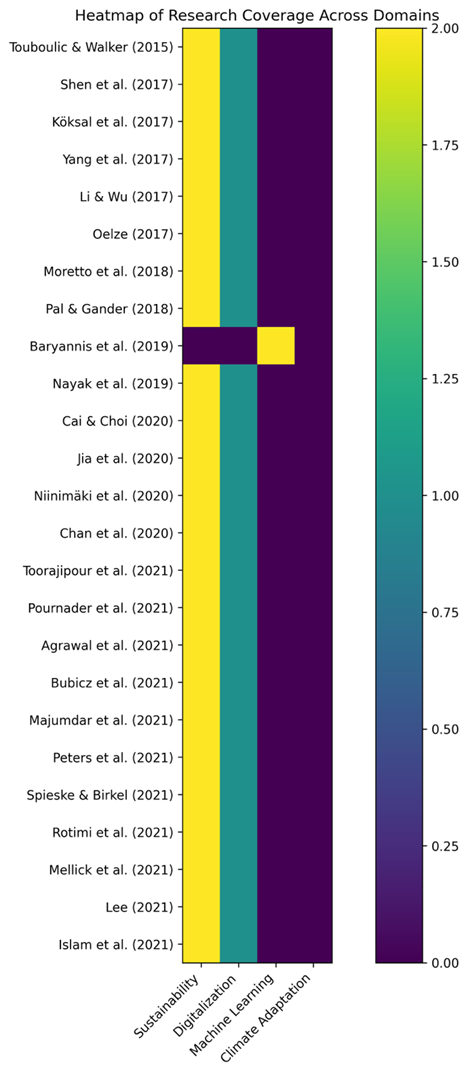
And yet, when the lens is narrowed specifically to sustainable apparel supply chains, the literature becomes unexpectedly thin. As illustrated in (Figure 2), machine learning appears only sporadically across the reviewed body of work, and when it does appear, it is often discussed in generalized supply chain terms rather than in apparel-specific or sustainability-centered contexts. Even more notably, climate adaptation is almost entirely absent as an explicit analytical category.

This absence is striking, perhaps even a little surprising, given how exposed apparel systems are to climate-sensitive vulnerabilities. Cotton and other natural fibers depend on ecological stability; production hubs are often located in regions vulnerable to flooding, heat stress, or water scarcity; and globalized logistics networks are increasingly sensitive to environmental disruption. Climate change, in other words, is not external to apparel supply chains—it is becoming structurally embedded within them.

This is precisely where machine learning appears to offer its greatest unrealized value. In principle, ML could support:

  • predictive modeling of climate-related disruptions,
  • adaptive sourcing and procurement decisions,
  • dynamic resource allocation,
  • inventory and demand balancing under uncertainty,
  • and intelligent sustainability trade-off analysis.

These are not peripheral benefits. They point toward a different model of sustainable supply chain management altogether—one that is less static, less compliance-bound, and more capable of responding to uncertainty as a normal operating condition rather than an exceptional crisis.

At the same time, the literature remains cautious, and rightly so. ML is not a universal solution. Its effectiveness depends on data quality, system integration, governance maturity, and interpretability. In fragmented apparel systems where supplier visibility is incomplete and digital maturity varies widely, deploying ML meaningfully is not a trivial step. There are also deeper concerns—bias, over-optimization, model opacity, and the risk of treating sustainability as a purely technical problem. These tensions are still only lightly addressed in the reviewed literature, suggesting that the field has not yet fully reckoned with the governance implications of AI-enabled sustainability systems.

Even so, the pattern is clear. The gap is not merely that machine learning has been underused; it is that the field has not yet fully conceptualized how sustainability, digitalization, and climate adaptation might converge through intelligent analytics. That, ultimately, is the central insight emerging from this review.

3.5 Synthesis of the Literature and Emerging Knowledge Gap

Taken together, the reviewed literature suggests that the field is evolving along three strong but insufficiently connected trajectories. The first is a mature and ethically grounded sustainability literature that has clarified why apparel supply chains must change. The second is a growing digitalization literature that has expanded the technological infrastructure for traceability and monitoring. The third, still much thinner trajectory, concerns machine learning and adaptive analytics—arguably the area with the greatest transformative potential, but also the least developed in apparel-specific sustainability research.

What remains missing is not simply more studies, but a more integrated research agenda. Sustainability without predictive capability risks remaining reactive. Digitalization without analytical intelligence risks becoming informational rather than transformative. And machine learning without environmental and climate grounding risks optimizing efficiency while missing the deeper sustainability challenge.

It is within this unresolved space that the need for a more integrated conceptual framework becomes clear. The literature does not yet provide a sufficiently coherent model for understanding how apparel supply chains can become not only more sustainable and digitally enabled, but also adaptive under climate uncertainty. The next section builds on this thematic synthesis to address that gap by proposing a conceptual framework for machine learning-enabled climate-adaptive sustainable apparel supply chains.

4. Conceptual Framework: Machine Learning-Enabled Climate-Adaptive Sustainable Apparel Supply Chains

The preceding analysis suggests that the literature on apparel supply chains, while rich in its individual domains, remains structurally fragmented. Sustainability practices, circular economy strategies, digital technologies, and machine learning applications have each developed along largely parallel trajectories, rarely converging into a unified operational logic. It is within this gap—perhaps not immediately obvious at first glance, but increasingly consequential—that the present study proposes a conceptual framework for machine learning-enabled climate-adaptive sustainable apparel supply chains.

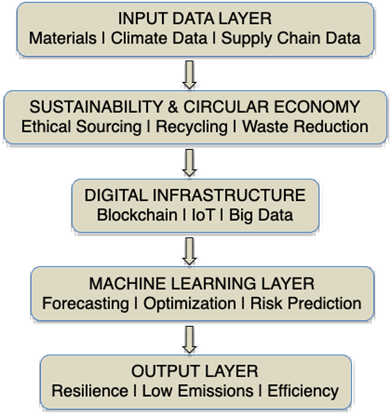
Rather than introducing an entirely new paradigm, the framework attempts something slightly more restrained yet arguably more necessary: it brings together existing strands of knowledge into a more coherent system, one that acknowledges their interdependence. As illustrated in (Figure 3), the framework conceptualizes apparel supply chains as a multi-layered, data-driven, and adaptive system, in which sustainability objectives, digital infrastructures, and machine learning capabilities are not treated as isolated components, but as mutually reinforcing elements of a broader decision architecture.

4.1 Framework Overview: From Fragmentation to Integration

At its core, the framework is structured around five interconnected layers:

(1) input data foundations,

(2) sustainability and circular economy practices,

(3) digital infrastructure,

(4) machine learning intelligence, and

(5) adaptive supply chain outcomes.

This layered structure reflects a gradual transformation—from data acquisition to intelligent action—rather than a static representation of supply chain components. Each layer plays a distinct role, yet none operates in isolation. Instead, the framework assumes a continuous flow of information and influence across layers, where improvements in one domain can enable, or at times constrain, performance in another.

What is perhaps most important here is the shift in perspective. Traditional supply chain models often emphasize efficiency, cost optimization, or compliance. By contrast, this framework is oriented toward adaptability under uncertainty, particularly in the context of climate-related disruptions and environmental variability.

4.2 Input Layer: Establishing the Data Foundations

The framework begins, quite deliberately, with data—not because data alone is transformative, but because without it, transformation is unlikely to occur. The input layer represents the diverse streams of information that underpin supply chain decision-making. These include material data (e.g., fiber types, sourcing locations), environmental data (e.g., emissions, water use, climate indicators), and operational supply chain data (e.g., inventory levels, logistics flows, demand patterns).

At first glance, this may appear straightforward. Yet the literature repeatedly suggests that data fragmentation remains one of the most persistent barriers to effective supply chain management in the apparel sector. Information is often dispersed across suppliers, regions, and systems, with limited interoperability or standardization. As a result, even well-intentioned sustainability initiatives can struggle to move beyond partial visibility.

This layer therefore underscores a foundational insight: adaptive supply chains require not just data, but integrated, reliable, and contextually meaningful data. Without this, downstream analytical processes—no matter how sophisticated—are likely to remain constrained.

4.3 Sustainability and Circular Economy Layer: Defining System Objectives

Building upon this data foundation, the second layer embeds sustainability and circular economy principles into supply chain operations. This includes ethical sourcing, supplier compliance, waste reduction, recycling systems, and closed-loop production strategies. Conceptually, this layer reflects the transition away from linear production models toward more circular and regenerative systems, as widely advocated in the literature (Jia et al., 2020).

However, the review also suggests that many of these practices remain operationally static. They are often implemented as policies, standards, or isolated initiatives rather than as dynamically managed systems. In practice, sustainability decisions are frequently made without real-time feedback, predictive insight, or adaptive adjustment mechanisms.

Within the framework, this layer serves as the normative and operational anchor. It defines what the supply chain is trying to achieve—reduced environmental impact, improved social outcomes, and resource efficiency. Yet it also implicitly highlights a limitation: without integration with digital and analytical layers, these objectives risk remaining aspirational rather than operationally embedded.

4.4 Digital Infrastructure Layer: Enabling Visibility and Connectivity

The third layer introduces the digital backbone necessary to operationalize sustainability objectives. Technologies such as blockchain, IoT, and big data platforms play a critical role here by enabling data collection, traceability, and connectivity across supply chain stages (Agrawal et al., 2021; Pournader et al., 2021).

Blockchain, for instance, can enhance transparency and trust by providing verifiable records of transactions and material flows. IoT systems enable real-time monitoring of production environments and logistics networks, while big data platforms facilitate the integration and storage of large, heterogeneous datasets.

And yet, as the literature consistently points out, digitalization alone is not enough. Much of the current application of these technologies remains focused on visibility rather than intelligence. Data is collected, but not always analyzed in ways that support predictive or adaptive decision-making.

This layer, therefore, represents both progress and limitation. It creates the necessary conditions for intelligent systems to emerge, but does not by itself ensure that they will. In that sense, it acts as a bridge—essential, but incomplete—between data availability and actionable insight.

4.5 Machine Learning Intelligence Layer: From Data to Decision

At the center of the framework lies the machine learning layer, which arguably represents its most transformative element. If the earlier layers provide data and define objectives, this layer is where decision intelligence begins to take shape.

Machine learning enables supply chains to move beyond reactive management toward more predictive, adaptive, and context-aware operations. Applications include demand forecasting, climate risk modeling, inventory optimization, sourcing decisions, and real-time decision support (Baryannis et al., 2019). In the context of apparel supply chains—where variability, uncertainty, and time pressure are inherent—such capabilities are not merely advantageous; they may become essential.

What distinguishes this layer from traditional analytical approaches is its ability to learn from patterns, update in response to new data, and operate under uncertainty. This is particularly relevant for climate adaptation, where historical stability can no longer be assumed and where decision-making must increasingly account for variability, disruption, and incomplete information.

At the same time, the framework does not assume that machine learning is a universal solution. Its effectiveness depends on data quality, system integration, and governance structures. Nevertheless, it represents a critical step toward bridging the gap between information and action, aligning sustainability goals with operational intelligence.

4.6 Output Layer: Toward Climate-Adaptive Sustainable Outcomes

The final layer captures the outcomes generated by the integrated system. These include reduced environmental impact, improved resource efficiency, enhanced supply chain resilience, and, importantly, proactive climate adaptation.

What is notable here is not just the outcomes themselves, but the manner in which they are achieved. Rather than relying on reactive adjustments or post hoc interventions, the framework emphasizes anticipatory and adaptive processes. Supply chains are not simply responding to disruptions—they are, ideally, learning from them and adjusting in real time.

This shift—from static to adaptive sustainability—is perhaps the most significant conceptual contribution of the framework. It suggests that sustainability in apparel supply chains can no longer be understood as a fixed set of practices, but must instead be seen as an evolving capability shaped by data, technology, and decision intelligence.

4.7 Conceptual Contribution and Future Direction

Taken together, the proposed framework contributes to the literature by offering a more integrated view of how apparel supply chains might evolve under increasing environmental and operational uncertainty. It brings together sustainability, digitalization, and machine learning into a single analytical structure, while also explicitly incorporating climate adaptation—an area that remains notably underrepresented in existing research.

More broadly, the framework points toward a shift in how supply chains are conceptualized. It suggests that the future of apparel systems may depend less on isolated improvements in sustainability practices or digital tools, and more on the integration of these elements into adaptive, intelligent systems capable of responding to a rapidly changing world.

5. Conclusion

This review highlights a central tension within apparel supply chain research: although sustainability has become a well-established priority, the systems designed to support it remain largely static, fragmented, and insufficiently adaptive. Existing scholarship has made valuable contributions in areas such as sustainable sourcing, circular economy strategies, and digital traceability; however, these domains are still too often treated separately. The review shows that machine learning—despite its growing relevance for predictive and adaptive decision-making—remains only marginally integrated into apparel sustainability research, while climate adaptation is notably underexplored. In response, this study proposes a conceptual framework that brings together sustainability practices, digital infrastructure, and machine learning capabilities to support more resilient and environmentally responsive supply chains. Ultimately, achieving truly sustainable apparel systems may depend not only on better policies or technologies in isolation, but on their thoughtful integration into adaptive, data-informed decision architectures capable of responding to a changing environmental future.

References


Agrawal, T. K., Kumar, V., Pal, R., Wang, L., & Chen, Y. (2021). Blockchain-based framework for supply chain traceability: A case example of textile and clothing industry. Computers & Industrial Engineering, 154, Article 107130. https://doi.org/10.1016/j.cie.2021.107130

Bubicz, M. E., Barbosa-Póvoa, A. P. F. D., & Carvalho, A. (2021). Social sustainability management in the apparel supply chains. Journal of Cleaner Production, 280, Article 124214. https://doi.org/10.1016/j.jclepro.2020.124214

Cai, Y.-J., & Choi, T.-M. (2020). A United Nations’ Sustainable Development Goals perspective for sustainable textile and apparel supply chain management. Transportation Research Part E: Logistics and Transportation Review, 141, Article 102010. https://doi.org/10.1016/j.tre.2020.102010

Chan, H. L., Wei, X., Guo, S., & Leung, W. H. (2020). Corporate social responsibility (CSR) in fashion supply chains: A multi-methodological study. Transportation Research Part E: Logistics and Transportation Review, 142, Article 102063. https://doi.org/10.1016/j.tre.2020.102063

Fung, Y.-N., Chan, H.-L., Choi, T.-M., & Liu, R. (2021). Sustainable product development processes in fashion: Supply chains structures and classifications. International Journal of Production Economics, 231, Article 107911. https://doi.org/10.1016/j.ijpe.2020.107911

Islam, M. M., Grilec Kauric, A., & Gill, S. (2021). Mapping environmentally sustainable practices in textiles, apparel and fashion industries: A systematic literature review. Journal of Fashion Marketing and Management, 25(2), 331–353. https://doi.org/10.1108/JFMM-07-2020-0130

Jia, F., Yin, S., Chen, L., & Chen, X. (2020). The circular economy in the textile and apparel industry: A systematic literature review. Journal of Cleaner Production, 259, Article 120728. https://doi.org/10.1016/j.jclepro.2020.120728

Köksal, D., & Strähle, J. (2021). Social sustainability in fashion supply chains—Understanding social standard implementation failures in Vietnam and Indonesia using agency theory. Sustainability, 13(4), Article 2159. https://doi.org/10.3390/su13042159

Köksal, D., Strähle, J., & Müller, M. (2018). Social sustainability in apparel supply chains—The role of the sourcing intermediary in a developing country. Sustainability, 10(4), Article 1039. https://doi.org/10.3390/su10041039

Köksal, D., Strähle, J., Müller, M., & Freise, M. (2017). Social sustainable supply chain management in the textile and apparel industry—A literature review. Sustainability, 9(1), Article 100. https://doi.org/10.3390/su9010100

Lee, Y. K. (2021). Transformation of the innovative and sustainable supply chain with upcoming real-time fashion systems. Sustainability, 13(3), Article 1081. https://doi.org/10.3390/su13031081

Li, B., & Wu, K. (2017). Environmental management system adoption and the operational performance of firm in the textile and apparel industry of China. Sustainability, 9(6), Article 992. https://doi.org/10.3390/su9060992  Le, T.-N., & Wang, C.-N. (2017). The integrated approach for sustainable performance evaluation in value chain of Vietnam textile and apparel industry. Sustainability, 9(3), Article 477. https://doi.org/10.3390/su9030477

Majumdar, A., Sinha, S. K., & Govindan, K. (2021). Prioritising risk mitigation strategies for environmentally sustainable clothing supply chains: Insights from selected organisational theories. Sustainable Production and Consumption, 28, 543–555. https://doi.org/10.1016/j.spc.2021.06.021

Mellick, Z., Payne, A., & Buys, L. (2021). From fibre to fashion: Understanding the value of sustainability in global cotton textile and apparel value chains. Sustainability, 13(22), Article 12681. https://doi.org/10.3390/su132212681

Menke, C., Hüsemann, M., & Siems, E. (2021). Stakeholder influence on sustainable supply chain management: A case study of a German apparel frontrunner. Frontiers in Sustainability, 2, Article 735123. https://doi.org/10.3389/frsus.2021.735123

Moretto, A., Macchion, L., Lion, A., Caniato, F., Danese, P., & Vinelli, A. (2018). Designing a roadmap towards a sustainable supply chain: A focus on the fashion industry. Journal of Cleaner Production, 193, 169–184. https://doi.org/10.1016/j.jclepro.2018.04.273

Nayak, R., Akbari, M., & Maleki Far, S. (2019). Recent sustainable trends in Vietnam’s fashion supply chain. Journal of Cleaner Production, 225, 291–303. https://doi.org/10.1016/j.jclepro.2019.03.239

Niinimäki, K., Peters, G., Dahlbo, H., Perry, P., Rissanen, T., & Gwilt, A. (2020). The environmental price of fast fashion. Nature Reviews Earth & Environment, 1, 189–200. https://doi.org/10.1038/s43017-020-0039-9

Oelze, N. (2017). Sustainable supply chain management implementation—Enablers and barriers in the textile industry. Sustainability, 9(8), Article 1435. https://doi.org/10.3390/su9081435

Pal, R., & Gander, J. (2018). Modelling environmental value: An examination of sustainable business models within the fashion industry. Journal of Cleaner Production, 184, 251–263. https://doi.org/10.1016/j.jclepro.2018.02.001

Peters, G., Li, M., & Lenzen, M. (2021). The need to decelerate fast fashion in a hot climate: A global sustainability perspective on the garment industry. Journal of Cleaner Production, 295, Article 126390. https://doi.org/10.1016/j.jclepro.2021.126390

Rotimi, E. O. O., Topple, C., & Hopkins, J. (2021). Towards a conceptual framework of sustainable practices of post-consumer textile waste at garment end of lifecycle: A systematic literature review approach. Sustainability, 13(5), Article 2965. https://doi.org/10.3390/su13052965

Yang, S., Song, Y., & Tong, S. (2017). Sustainable retailing in the fashion industry: A systematic literature review. Sustainability, 9(7), Article 1266. https://doi.org/10.3390/su9071266 

Yang, Y., Han, H., & Lee, P. K. C. (2017). An exploratory study of the mechanism of sustainable value creation in the luxury fashion industry. Sustainability, 9(4), Article 483. https://doi.org/10.3390/su9040483


Article metrics
View details
0
Downloads
0
Citations
36
Views

View Dimensions


View Plumx


View Altmetric


0
Save
0
Citation
36
View
0
Share