Clinical Epidemiology & Public Health

Public health | Online ISSN 3068-4587
1
Citations
8.5k
Views
16
Articles
Your new experience awaits. Try the new design now and help us make it even better
Switch to the new experience
Figures and Tables
RESEARCH ARTICLE   (Open Access)

Demographic Patterns in Thyroid Dysfunction: Age and Gender Associations from a 7-Year Clinical Cohort in Ibb, Yemen

Mohammed A.M.Y. Al-Hetar 1,2,3* , Norasiykin A. Wahab1,4, Malak Mohammed Al-Hetar2, Nabil Al-joma’ai5, Abdullah Ahmed Faleh2, Adnan Taha Al-jaberi6, Abdullah Almatary3, Mohammad Ebraheem Alezzy2, Eshtiak Mohammed2, Ahd Hamoud Haidar2Mamoon Al-namer 5, Mohammed Alkhela 3

+ Author Affiliations

Clinical Epidemiology & Public Health 3 (1) 1-9 https://doi.org/10.25163/health.3110535

Submitted: 15 October 2025 Revised: 14 December 2025  Published: 21 December 2025 


Abstract

Background: Thyroid disorders, including overt and subclinical forms, are a major public health concern. Accurate biochemical classification is essential for early detection and effective management, particularly in population-based screening.

Objective: To estimate the prevalence and distribution of thyroid dysfunction and examine age and sex associations using comprehensive hormone profiling.

Methods: We conducted a retrospective cross-sectional study of 4,081 individuals evaluated at a tertiary endocrine center in Ibb, Yemen (August 2018–July 2025). Thyroid status was classified using FT3, FT4, and TSH. Subclinical hypothyroidism was defined as elevated TSH with normal FT3/FT4; subclinical hyperthyroidism as suppressed TSH with normal FT3/FT4. Abnormal TSH defined overt hypo and hyperthyroidism with concordant FT3/FT4 changes. Analyses used SPSS v26 and Pearson’s chi-square tests. The cohort comprised 92.4% females, with the majority aged 30–49 years.

Results: Normal thyroid function was observed in 89.3% of participants. Subclinical hypothyroidism was present in 10.7%, subclinical hyperthyroidism in 2.7%, overt hypothyroidism in 0.8%, and overt hyperthyroidism in 1.7%. Females were disproportionately represented (92.4%), and the 30–49year age group was most affected. Age showed a significant association with TSH in females (χ² = 10.303, df = 4, p = 0.036) and borderline significance in the total population (χ² = 9.418, df = 4, p = 0.051). FT3 and FT4 showed no consistent age associations. Sex did not consistently influence hormone profiles.

Conclusion: Approximately 13.4% of the population exhibited subclinical thyroid dysfunction. Age was a significant determinant of TSH variation, particularly among women, underscoring the importance of agestratified screening and integrated FT3–FT4–TSH classification in endocrine surveillance.

Keywords: Thyroid dysfunction, subclinical hypothyroidism, subclinical hyperthyroidism, overt hypothyroidism, age association, gender, epidemiology, Ibb-Yemen.

1. Introduction

Thyroid disorders represent a diverse group of endocrine conditions arising from disturbances in hormone synthesis, secretion, or peripheral activity. This spectrum includes overt hypothyroidism and hyperthyroidism, their subclinical 

counterparts, and autoimmune diseases such as Hashimoto’s thyroiditis and Graves’ disease. (Garber et al., 2012); (Pearce et al., 2014). The thyroid gland plays a central role in regulating basal metabolic rate, cardiovascular function, thermogenesis, and neurodevelopment, particularly during fetal growth and early childhood. (Wessam Mansour Filfilan, 2023). Disruption of thyroid hormone balance can therefore lead to a wide range of clinical manifestations, including fatigue, weight changes, menstrual irregularities, cognitive decline, and cardiovascular complications. (Manso, 2025).

Globally, thyroid dysfunction is increasingly recognized as a major public health issue. Epidemiological studies estimate that 4–10% of adults are affected, with hypothyroidism generally more common than hyperthyroidism. (Taylor et al., 2018). In Europe, (Ane Garmendia Madariaga (2014) reported overt hypothyroidism in 3.8% and hyperthyroidism in 0.8% of the population, while (Mark P. J. Vanderpump (2011) Highlighted the rising incidence with age and the predominance among women. In South Asia, Unnikrishnan & Menon, 2011) Found thyroid disorders in approximately 11% of the Indian population, with subclinical hypothyroidism particularly prevalent among females.

In Middle Eastern populations, prevalence rates of thyroid dysfunction show marked variability. A recent systematic review and meta-analysis by (Kargar et al., 2024a) Reported subclinical hypothyroidism rates range from 8–12%, with higher prevalence observed in iodine-deficient regions. Such heterogeneity underscores the urgent need for standardized screening and reporting frameworks across the region. In the United States, thyroid dysfunction continues to pose a significant public health burden. Using NHANES data, (Siying Liu, 2024) Demonstrated associations between micronutrient intake and thyroid dysfunction prevalence, confirming hypothyroidism rates around 4–5%. Complementary evidence from (Chen et al., 2024) Highlighted sex- and race-specific differences in thyroid dysfunction among U.S. adolescents, reinforcing the importance of population-specific surveillance. Globally, age- and sex-related variations in thyroid hormone levels have been further clarified by (Taylor et al., 2023), who emphasized the need for tailored reference ranges to improve diagnostic accuracy.

Subclinical thyroid dysfunction, defined by abnormal TSH with normal FT3 and FT4, remains diagnostically challenging and therapeutically controversial. It has been linked to cardiovascular disease, lipid abnormalities, and neuropsychiatric symptoms (Baretella et al., 2025). Guidelines from the American Thyroid Association (Garber et al., 2012) and the European Thyroid Association (Pearce et al., 2014) recommend individualized management strategies based on age, symptoms, and comorbidities. Similarly, the Malaysian Endocrine & Metabolic Society (2019 advocates stratified approaches, particularly in resource-limited settings.

Gender disparities are well-documented, with autoimmune thyroid disorders disproportionately affecting women. This pattern is attributed to complex interactions between estrogen and immune mechanisms that increase susceptibility to autoimmunity. (Baretella et al., 2025); (Vargas-Uricoechea, 2023). Age also plays a critical role in thyroid physiology; serum TSH levels tend to rise with advancing age, prompting calls for age-specific reference intervals to avoid misdiagnosis and overtreatment in older adults. (Taylor et al., 2023). Adequate iodine intake remains fundamental to thyroid health, as both deficiency and excess can precipitate dysfunction. (Sohn et al., 2024) Demonstrated that insufficient iodine contributes to hypothyroidism and endemic goiter, whereas excessive intake may trigger autoimmune thyroiditis or hyperthyroidism.

The American Thyroid Association (Alexander et al., 2017) Emphasizes the importance of iodine sufficiency during pregnancy and lactation, underscoring its critical role in fetal brain development. More recent global reviews confirm that inadequate iodine intake remains a significant public health concern, while excessive intake may precipitate thyroid autoimmunity or hyperthyroidism. (Zimmermann & Andersson, 2021); (Sohn et al., 2024).

Against this backdrop, the present study investigates thyroid dysfunction patterns in a tertiary endocrine clinic in Yemen using integrated FT3, FT4, and TSH profiling. By employing a hierarchical biochemical classification, the study captures conventional categories (euthyroid, subclinical, and overt hypo/hyperthyroidism) as well as atypical profiles (FT3-dominant and FT4-dominant hyperthyroidism, isolated FT4 hypothyroidism, and mixed/discordant patterns). The objectives are to: (1) estimate the prevalence and distribution of thyroid dysfunction; (2) assess associations with age and sex; and (3) demonstrate the diagnostic value of integrated FT3–FT4–TSH profiling in identifying atypical presentations. Findings are interpreted alongside international data to inform regional screening strategies, improve diagnostic precision, and contribute to global thyroid epidemiology.

2. Materials and Methods

This retrospective cross-sectional study was conducted at the Specialized Clinic of Endocrinology and Diabetes within the Medical City Complex, Ibb, Yemen, a regional referral center serving a diverse population across central Yemen. The clinic maintains a standardized electronic medical record (EMR) system supporting consistent diagnostic workflows and longitudinal data capture. All individuals who underwent thyroid function testing between August 2018 and July 2025 were eligible; the final sample comprised 4,081 cases across all ages, including patients, outpatient 

visitors, participants in routine biochemical screening, and antenatal thyroid surveillance programs. Data were extracted from anonymized EMRs. Records with missing thyroid analytes (TSH, FT4, or FT3) were excluded from classification analyses.

Thyroid function was assessed using serum free triiodothyronine (FT3), free thyroxine (FT4), and thyroid-stimulating hormone (TSH), measured via enzyme-linked immunosorbent assay (ELISA) kits (Monobind Inc., Lake Forest, California, USA) according to manufacturer protocols. Reference intervals applied for categorization were: FT3, 1.4–4.2 pg/mL; FT4, 0.8–1.8 ng/dL; and TSH, 0.28–5.6 mIU/L. Internal quality control procedures were followed in accordance with laboratory standards.

Diagnostic classification was based on a hierarchical biochemical algorithm integrating TSH, FT4, and FT3. The algorithm proceeds stepwise: (1) initial assignment using TSH (suppressed, elevated, or normal); (2) refinement using FT4 to distinguish overt from subclinical states; and (3) evaluation of FT3 to identify FT3-predominant patterns and atypical profiles. Subclinical hypothyroidism was defined as elevated TSH with normal FT4 and FT3; overt hypothyroidism required elevated TSH with reduced FT4. Subclinical hyperthyroidism was defined as suppressed TSH with normal FT4 and FT3; overt hyperthyroidism required suppressed TSH with elevated FT4 and/or FT3. Additional classifications included FT3-predominant hyperthyroidism (suppressed TSH with elevated FT3 and normal FT4), FT4-predominant hyperthyroidism (suppressed TSH with elevated FT4 and normal FT3), isolated FT4 hypothyroidism (normal TSH with reduced FT4), and mixed/discordant profiles. Mixed/discordant profiles were designated when TSH, FT4, and FT3 did not align with conventional categories (e.g., normal TSH with isolated FT4 abnormality, or opposing FT3/FT4 trends).

Euthyroid status required simultaneous normal values for TSH, FT4, and FT3.

Statistical analyses were performed using IBM SPSS Statistics version 26. We applied descriptive statistics, cross-tabulations, and Pearson’s chi-square tests to evaluate associations between thyroid categories and demographic variables (age groups and sex). Two-sided p-values < 0.05 were considered statistically significant. Figures and tables were generated to summarize prevalence across categories and age-sex strata.

3. Result

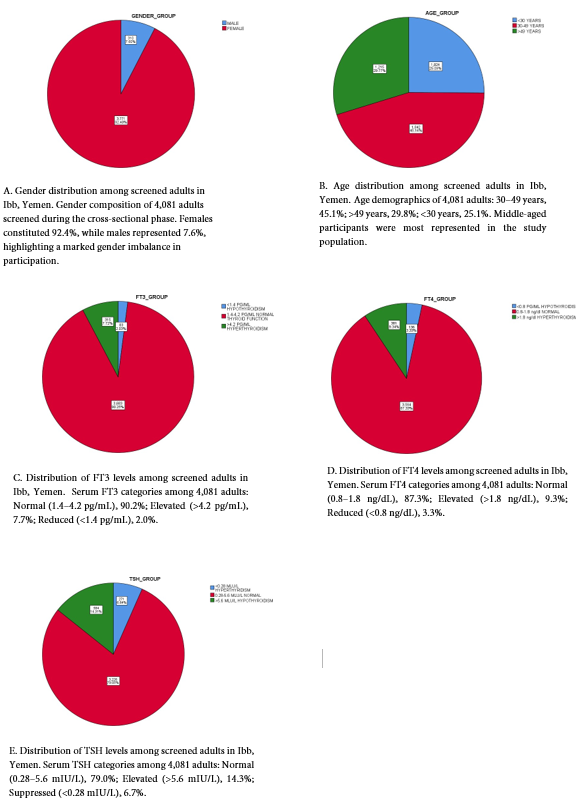
The study population consisted of 4,081 individuals, of whom 3,771 (92.4%) were female, and 310 (7.6%) were male, reflecting a marked predominance of women in the sample (Figure?1A). Age distribution revealed that 1,024 participants (25.1%) were younger than 30 years, 1,842 (45.1%) were between 30 and 49 years, and 1,215 (29.8%) were older than 49 years, indicating that middle-aged adults formed the largest subgroup (Figure?1B, Table?1). Hormonal analysis demonstrated parameter-specific variability: FT3 levels were normal in 90.2% of cases, elevated in 7.7%, and reduced in 2.0% (Figure?1C); FT4 was normal in 87.3%, elevated in 9.3%, and reduced in 3.3% (Figure?1D); and TSH was normal in 79.0% of participants, elevated in 14.3%, and suppressed in 6.7% (Figure?1E). These distributions reflect biochemical variability and should not be interpreted as definitive clinical diagnoses.

Table 1. Demographic Characteristics of the Study Population (N = 4,081). summarizes the age and gender distribution of the study population (N = 4,081), highlighting a predominance of females (92.4%) and a majority within the 30–49-year age group.

Characteristic

Category

Frequency (n)

Percentage (%)

Age Group

<30 years

1,024

25.1


30–49 years

1,842

45.1


>49 years

1,215

29.8

Gender

Male

310

7.6


Female

3,771

92.4


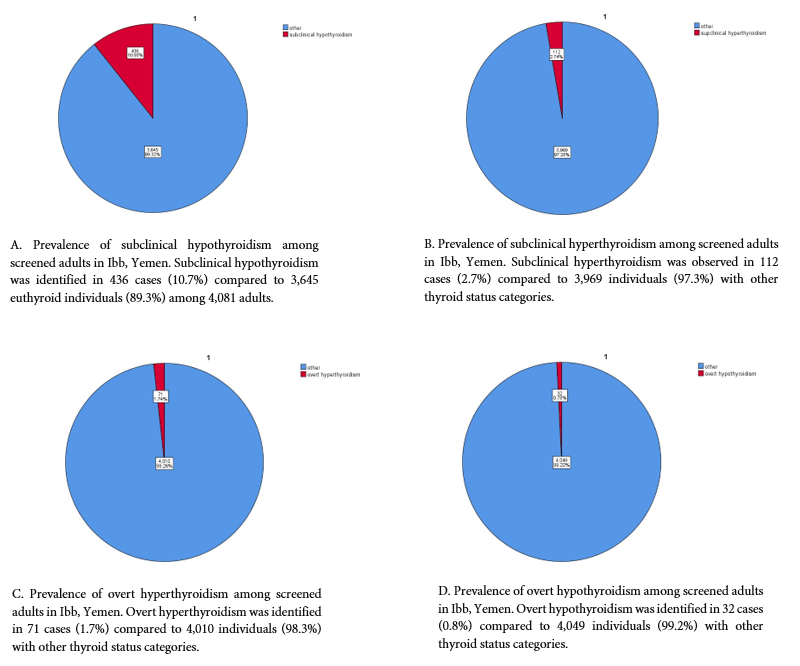
When integrated classification was applied, 3,645 individuals (89.3%) were euthyroid, whereas 436 (10.7%) had subclinical hypothyroidism (Figure?2A), 32 (0.8%) had overt hypothyroidism (Figure 2D), 112 (2.7%) had subclinical hyperthyroidism (Figure?2B), and 71 (1.7%) had overt hyperthyroidism (Figure?2C). Additional atypical patterns included FT3-predominant 

hyperthyroidism in 315 cases (7.7%), FT4-predominant hyperthyroidism in 381 (9.3%), isolated FT4 hypothyroidism in 23 (0.6%), and mixed or discordant profiles in 52 (1.3%). Gender-specific analysis demonstrated broadly similar trends: among males, 278 (89.7%) were euthyroid, and 32 (10.3%) had subclinical hypothyroidism, while among females, 3,367 (89.3%) were euthyroid and 404 (10.7%) had subclinical hypothyroidism, with other dysfunctions distributed proportionally. These distributions are illustrated in Figures?6 through 9, which detail the breakdown of subclinical and overt thyroid dysfunction by category.

Age stratification revealed that subclinical and overt hypothyroidism were most prevalent in individuals older than 49 years, whereas subclinical hyperthyroidism was more frequent in those younger than 30 years. Notably, atypical dysfunctions showed a higher male proportion in the >49 age group, where males accounted for 40% of cases (Table?2). Statistical analysis confirmed a significant association between age group and TSH category in females, ?² (4) = 10.303, p = 0.036, while associations with FT4 (p = 0.089) and FT3 (p = 0.157) were borderline or non-significant. No significant associations were observed between gender and any hormone category (all p > 0.2), underscoring that thyroid dysfunction patterns were largely independent of sex but modestly influenced by age (Table?3).

Table 2. Prevalence of Thyroid Dysfunction by Gender (N = 4,081). Gender-specific prevalence of thyroid dysfunction among 4,081 individuals. Despite female predominance, proportional distributions across categories were similar, with euthyroid status observed in 89.3% overall.

Thyroid Category

Male (n, %)

Female (n, %)

Total (n, %)

Subclinical Hypothyroidism

32 (10.3)

404 (10.7)

436 (10.7)

Subclinical

Hyperthyroidism


5 (1.6)


107 (2.8)


112 (2.7)

Overt Hyperthyroidism

3 (1.0)

68 (1.8)

71 (1.7)

Overt Hypothyroidism

5 (1.6)

27 (0.7)

32 (0.8)

Euthyroid

278 (89.7)

3,367 (89.3)

3,645 (89.3)

Total

310 (100.0)

3,771 (100.0)

4,081 (100.0)


Table 3. Association Between Thyroid Markers and Age Group by Gender (Chi-Square Test Results)

Marker/diagnosis

Group

?² (df)

p-value

FT3 Group × Age

Male

4.370 (4)

0.358


Female

4.836 (4)

0.305


Total

6.619 (4)

0.157

FT4 Group × Age

Male

2.707 (4)

0.608


Female

8.068 (4)

0.089


Total

8.550 (4)

0.073

TSH Group × Age

Male

4.456 (4)

0.348


Female

10.303 (4)

0.036


Total

9.418 (4)

0.051


Total

6.179 (2)

0.046

Subclinical Hypothyroidism

Total

2.118 (2)

0.347

Overt Hyperthyroidism

Total

2.642 (2)

0.267

Overt Hypothyroidism

Total

2.642 (2)

0.267

Results of chi-square tests examining associations between thyroid hormone categories and age group, stratified by gender. A significant association was observed between TSH and age in females (p = 0.036) and in the overall TSH group × age analysis (p = 0.046). All other markers, including FT3, FT4, subclinical hypothyroidism, overt hyperthyroidism, and overt hypothyroidism, showed no significant age-related differences. No gender-specific associations were detected for subclinical or overt thyroid dysfunction.

Figure 1. Demographic characteristics and thyroid hormone profiles of adults screened in Ibb, Yemen. The figures collectively summarize the gender and age distribution of 4,081 screened adults (A, B) and the distribution of serum thyroid function markers, including free triiodothyronine (FT3), free thyroxine (FT4), and thyroid-stimulating hormone (TSH) (Figures C, D, E). Together, these data provide an overview of participant demographics and thyroid hormonal status within the study population.

Figure 2. Prevalence of thyroid dysfunction among screened adults in Ibb, Yemen. These figures illustrate the distribution of subclinical and overt thyroid disorders in a population of 4,081 adults, including subclinical hypothyroidism (A), subclinical hyperthyroidism (B), overt hyperthyroidism (C), and overt hypothyroidism (D). Collectively, the data highlight the relative burden and patterns of thyroid dysfunction within the study population.


4. Discussion

This retrospective analysis spanning seven years offers a comprehensive epidemiological overview of thyroid dysfunction within a tertiary endocrine facility in Yemen. The predominance of the disproportionate impact of thyroid disorders on women. Such gender differences are largely explained by hormonal influences, particularly estrogen, and increased autoimmune susceptibility among females. (Fiammetta Battheu, 2025); (Vargas-Uricoechea, 2023).

Comparable trends have been documented across diverse populations worldwide. In Europe, Ane Garmendia Madariaga (2014) reported significantly higher rates of thyroid dysfunction among women in a large Spanish cohort. Similarly, data from NHANES III in the United States (Dillon et al., 2025a) confirmed female predominance in both overt and subclinical thyroid disease. South Asian studies reinforce this pattern, with Unnikrishnan & Menon (2011) noting a higher incidence of hypothyroidism among Indian women, particularly in urban settings. Collectively, these observations underscore the global relevance of gender-based thyroid epidemiology and justify targeted screening and management strategies, especially in resource-constrained regions such as Yemen.

The prevalence of subclinical hypothyroidism (SCH) in this Yemeni cohort (10.7%) surpasses global averages, which typically range between 4% and 8% in large epidemiological reviews. (Yoo & Chung, 2021), and among Saudi people, the prevalence was 10.3% (Al Eidan et al., 2018) Several regional factors may explain this elevation, including inconsistent iodine intake, limited access to early diagnostic services, and delayed clinical presentation issues common in low-resource settings. Iodine nutrition remains a cornerstone of thyroid health. (Peter Laurberg, 2010) Demonstrated that both deficiency and excess can destabilize thyroid function, leading to hypothyroidism, hyperthyroidism, or autoimmune thyroiditis. Yemen’s fluctuating iodine sufficiency, 

compounded by socioeconomic instability and irregular salt iodization, likely contributes to the elevated SCH burden. Similar prevalence rates have been reported in neighboring countries. A systematic review of Saudi populations ((Alhajri A M, 2025) Confirmed comparable rates of subclinical and overt hypothyroidism and identified age, gender, and iodine status as major risk factors. Likewise, (Unnikrishnan & Menon, 2011).

Documented high hypothyroidism prevalence in Indian cohorts, particularly among women. These findings highlight the urgent need for public health interventions, including iodine supplementation, routine biochemical screening, and community education to reduce thyroid-related morbidity.

The prevalence of overt hypothyroidism (0.8%) and overt hyperthyroidism (1.7%) in this Yemeni cohort is consistent with 

international ranges. Recent French data reported treated hypothyroidism and hyperthyroidism rates in line with these figures, reflecting stable epidemiological patterns across high- and middle-income populations. (Coste et al., 2025). U.S. population-based analyses similarly confirm overt thyroid dysfunction in approximately 1–2% of adults (Dillon et al., 2025b). However, the notably high rates of FT3-dominant hyperthyroidism (7.7%) and FT4-dominant hyperthyroidism (9.3%) observed here highlight diagnostic complexities that may be overlooked in conventional algorithms relying solely on TSH. These discordant patterns emphasize the need for more nuanced biochemical evaluation, particularly in regions with variable iodine exposure and delayed clinical presentation.

Recent clinical reviews and endocrine guidelines advocate integrated hormone profiling to improve diagnostic accuracy. (Sun Y. Lee, 2023) Stress the importance of measuring FT3, FT4, and TSH simultaneously to detect atypical thyrotoxic states. (Moran et al., 2024) Similarly, highlight the pitfalls of isolated hormone testing, especially in cases where TSH is not suppressed despite

elevated FT3 or FT4.  (NICE GUIDELINE, 2019) Recommends concurrent testing in suspected thyroid dysfunction to ensure comprehensive evaluation and appropriate management. The diagnostic framework employed in this study, combining FT4–TSH pairing with FT3 stratification, facilitates recognition of non-classical thyroid dysfunction and aligns with internationally endorsed best practices. Accurate diagnosis also depends on validated biochemical reference intervals and adherence to evidence-based guidelines.

Sensitive thyrotropin assays continue to refine diagnostic thresholds, with (Razvi, 2024) and (Carla Moran, 2024), underscoring the importance of comprehensive biochemical evaluation to detect atypical thyroid states. The metabolic consequences of thyroid dysfunction, particularly its association with insulin resistance, have been reaffirmed in recent studies. (Yang et al., 2023) (Krishnamurthy et al., 2025). Consensus guidelines further strengthen clinical practice, with the American Thyroid Association emphasizing comprehensive testing strategies in populations with high subclinical burden. (Siying Liu, 2024),

And the European Thyroid Association (2025) is updating standardized management approaches for hyperthyroidism and thyrotoxicosis (Coste et al., 2025).

Statistical analysis in this study revealed a significant association between age group and TSH category (?² = 10.303, df = 4, p = .036), underscoring the influence of age on thyroid physiology. This finding is consistent with (Taylor et al., 2023), who advocate age-specific reference intervals to account for physiological shifts in TSH secretion across the lifespan. In contrast, no significant associations were observed between gender and FT3, FT4, or TSH levels (all p > .2), consistent with Yoo and Chung (2021), who noted that while subclinical hypothyroidism is more common in females, thyroid hormone levels among euthyroid individuals show minimal gender-related biochemical variation. (Fiammetta Battheu, 2025).

Regional comparisons further confirm the elevated burden of thyroid dysfunction in the Middle East and South Asia. (Kargar et al., 2024b) Documented high prevalence rates across adult populations in these regions, reinforcing the need for targeted screening strategies. Subclinical thyroid dysfunction, particularly in older adults, remains a diagnostic challenge due to its subtle presentation and potential cardiovascular consequences. (Yamamoto et al., 2025).

5. Conclusion

In conclusion, this seven-year retrospective study provides robust regional data that enriches the global literature on thyroid dysfunction. It emphasizes the importance of age-stratified, gender-sensitive, and biochemically integrated screening approaches, while supporting refinement of diagnostic algorithms in endocrine practice. The elevated burden of subclinical hypothyroidism and atypical FT3/FT4-dominant patterns underscores the need for improved iodine monitoring, routine biochemical screening, and public health interventions in Yemen. Future investigations should incorporate autoimmune markers, assess long-term outcomes, and evaluate the impact of iodine supplementation programs to strengthen thyroid disease prevention and management in resource-limited settings.

Author contributions

M.A.M.Y.A.H. Conceptualization, study design, supervision, statistical analysis, manuscript drafting, and revision. N.A.W. Methodology guidance, critical review, supervision. M.M.A.H. Data collection, patient recruitment. N.A.J. Statistical support, data validation. A.A.F. Clinical data collection, laboratory coordination. A.T.A.J. Data analysis. A.A. Literature review, manuscript editing. M.E.A. Laboratory assays, biochemical data handling. E.M.P. follow-up, demographic data collection. A.H.H. Data management, figure preparation. All authors read and approved the final manuscript.

Acknowledgment

The authors express their sincere appreciation to the clinical and administrative staff of the Specialized Clinic of Endocrinology and Diabetes at the Medical City Complex in Ibb, Yemen, for their invaluable support in retrieving data and managing patient records. Special thanks are extended to the laboratory personnel for maintaining consistent biochemical documentation, which ensured the integrity of this retrospective analysis. The authors also gratefully acknowledge the institutional leadership for facilitating access to anonymized records and endorsing the research framework.

References


Al Eidan, E., Ur Rahman, S., Al Qahtani, S., Al Farhan, A. I., & Abdulmajeed, I. (2018). Prevalence of subclinical hypothyroidism in adults visiting primary healthcare settings in Riyadh. Journal of Community Hospital Internal Medicine Perspectives, 8(1), 11–15. https://doi.org/10.1080/20009666.2017.1422672

Alexander, E. K., Pearce, E. N., Brent, G. A., Brown, R. S., Chen, H., Dosiou, C., Grobman, W. A., Laurberg, P., Lazarus, J. H., Mandel, S. J., Peeters, R. P., & Sullivan, S. (2017). 2017 Guidelines of the American Thyroid Association for the Diagnosis and Management of Thyroid Disease during Pregnancy and the Postpartum. Thyroid, 27(3), 315–389. https://doi.org/10.1089/thy.2016.0457

Alhajri A M, S. A. S. A. I. H. et al. (2025). Prevalence and Risk Factors of Subclinical and Overt Hypothyroidism in Saudi Arabia: A Systematic Review. Cureus, 17(6).

Ane Garmendia Madariaga, S. S. P. F.-G. J. C. G. (2014). The Incidence and Prevalence of Thyroid Dysfunction in Europe: A Meta-Analysis. JCEM, 99(3).

Baretella, O., Blum, M. R., Abolhassani, N., Alwan, H., Wildisen, L., Giovane, C. Del, Tal, K., Moutzouri, E., Åsvold, B. O., Cappola, A. R., Gussekloo, J., Iacoviello, M., Iervasi, G., Imaizumi, M., Weiler, S., Razvi, S., Sgarbi, J. A., Völzke, H., Brown, S. J., … Rodondi, N. (2025). Associations Between Subclinical Thyroid Dysfunction and Cardiovascular Risk Factors According to Age and Sex. Journal of Clinical Endocrinology and Metabolism, 110(5), e1315– e1322. https://doi.org/10.1210/clinem/dgae860

Carla Moran, N. S. D. H. S. O. (2024). Approach to the Patient with Raised Thyroid Hormones and Nonsuppressed TSH. The Journal of Clinical Endocrinology & Metabolism, 109(4), 1094–1108.

Chen, J., Zhang, L., & Zhang, X. (2024). Overall, sex-and race/ethnicity-specific prevalence of thyroid dysfunction in US adolescents aged 12–18 years. Frontiers in Public Health, 12. https://doi.org/10.3389/fpubh.2024.1366485

Coste, J., Mandereau-Bruno, L., Bertagna, X., & Wémeau, J.-L. (2025). Prevalence of treated hyper- and hypo-thyroidism and sociodemographic and geographic disparities in France in 2020. European Thyroid Journal, 14(3). https://doi.org/10.1530/etj-25-0041

Dillon, C. F., Weisman, M. H., Leung, A. M., Brent, G. A., & Miller, F. W. (2025a). Autoimmune Thyroid Disease in the United States: Population Prevalence, Diagnosis Rates, and Trends. Journal of the Endocrine Society, 9(10). https://doi.org/10.1210/jendso/bvaf120

Dillon, C. F., Weisman, M. H., Leung, A. M., Brent, G. A., & Miller, F. W. (2025b). Autoimmune Thyroid Disease in the United States: Population Prevalence, Diagnosis Rates, and Trends. Journal of the Endocrine Society, 9(10). https://doi.org/10.1210/jendso/bvaf120

Fiammetta Battheu, C. C. S. C. & C. M. (2025). Differences in autoimmune thyroid diseases between females and males: the result of a complex interconnection of factors. Endocrine, 29, 665–679.

Garber, J. R., Cobin, R. H., Gharib, H., Hennessey, J. V., Klein, I., Mechanick, J. I., Pessah-Pollack, R., Singer, P. A., & Woeber, K. A. (2012). Clinical practice guidelines for hypothyroidism in adults: Cosponsored by the American Association of Clinical Endocrinologists and the American Thyroid Association. In Endocrine Practice (Vol. 18, Issue 6). American Association of Clinical Endocrinologists. https://doi.org/10.4158/ep12280.gl

Kargar, S., Tabatabaei, S. M., Okati-Aliabad, H., & Rad, H. I. (2024a). Prevalence of Thyroid Dysfunction Disorders among Adult Populations in the Middle East: A Systematic Review and Meta-analysis. The Open Public Health Journal, 17(1). https://doi.org/10.2174/0118749445317174240827052511

Kargar, S., Tabatabaei, S. M., Okati-Aliabad, H., & Rad, H. I. (2024b). Prevalence of Thyroid Dysfunction Disorders among Adult Populations in the Middle East: A Systematic Review and Meta-analysis. The Open Public Health Journal, 17(1). https://doi.org/10.2174/0118749445317174240827052511

Krishnamurthy, H., Suresh, C., Siriwardhane, T., Krishna, K., Song, Q., Jayaraman, V., Wang, T., Bei, K., & Rajasekaran, J. J. (2025). Association between thyroid dysfunction and insulin resistance: a retrospective cohort study. BMJ Open, 15(1). https://doi.org/10.1136/bmjopen-2023-076397

Malaysian Endocrine & Metabolic Society. (2019). CLINICAL PRACTICE GUIDELINES MANAGEMENT OF THYROID DISORDERS. http://www.moh.gov.my

Manso, J. (2025). Special Issue “Thyroid Dysfunctions: Molecular Mechanisms Underlying Clinical Consequences.” International Journal of Molecular Sciences, 26(24), 11967. https://doi.org/10.3390/ijms262411967

Mark P. J. Vanderpump. (2011). The epidemiology of thyroid disease. British Medical Bulletin, 99(1).

Moran, C., Schoenmakers, N., Halsall, D., Oddy, S., Lyons, G., van den Berg, S., Gurnell, M., & Chatterjee, K. (2024). Approach to the Patient with Raised Thyroid Hormones and Nonsuppressed TSH. Journal of Clinical Endocrinology and Metabolism, 109(4), 1094–1108. https://doi.org/10.1210/clinem/dgad681

NICE GUIDELINE. (2019). Thyroid disease: assessment and management NICE guideline. www.nice.org.uk/guidance/ng145

Pearce, S. H. S., Brabant, G., Duntas, L. H., Monzani, F., Peeters, R. P., Razvi, S., & Wemeau, J.-L. (2014). 2013 ETA Guideline: Management of Subclinical Hypothyroidism. European Thyroid Journal, 2(4), 215–228. https://doi.org/10.1159/000356507

Peter Laurberg, C. C. (2010). Iodine intake as a determinant of thyroid disorders in populations. Science Direct, 24(1), 13–27.

Razvi, S. (2024). Thyroid-function reference ranges in the diagnosis of thyroid dysfunction in adults. Nat Rev Endocrinol, 20, 253–254. https://doi.org/https://doi.org/10.1038/s41574-024-00972-2

Siying Liu, C. L. L. H. Z. S. W. T. Y. L. and T. L. (2024). Thyroid®: Vitamin E Intake and Prevalence Rates of Thyroid Dysfunction and Autoimmune Thyroiditis: A Cross-Sectional Analysis of NHANES Data. Thyroid® (Official Journal of the American Thyroid Association, 34(5), 789– 798.

Sohn, S. Y., Inoue, K., Rhee, C. M., & Leung, A. M. (2024). Risks of Iodine Excess. In Endocrine Reviews (Vol. 45, Issue 6, pp. 858–879). Endocrine Society. https://doi.org/10.1210/endrev/bnae019

Sun Y. Lee, M. Ms. E. N. P. M. Ms. (2023). Hyperthyroidism: A Review. JAMA, 330(15), 1472-1483.

Taylor, P. N., Albrecht, D., Scholz, A., Gutierrez-Buey, G., Lazarus, J. H., Dayan, C. M., & Okosieme, O. E. (2018). Global epidemiology of hyperthyroidism and hypothyroidism. In Nature Reviews Endocrinology (Vol. 14, Issue 5, pp. 301–316). Nature Publishing Group. https://doi.org/10.1038/nrendo.2018.18

Taylor, P. N., Lansdown, A., Witczak, J., Khan, R., Rees, A., Dayan, C. M., & Okosieme, O. (2023). Age-related variation in thyroid function – a narrative review highlighting important implications for research and clinical practice. In Thyroid Research (Vol. 16, Issue 1). BioMed Central Ltd. https://doi.org/10.1186/s13044-023-00149-5

Unnikrishnan, A., & Menon, U. (2011). Thyroid disorders in India: An epidemiological perspective. Indian Journal of Endocrinology and Metabolism, 15(6), 78. https://doi.org/10.4103/2230- 8210.83329

Vargas-Uricoechea, H. (2023). Molecular Mechanisms in Autoimmune Thyroid Disease. In Cells(Vol. 12, Issue 6). MDPI. https://doi.org/10.3390/cells12060918

Wessam Mansour Filfilan. (2023). Thyroid Hormones Regulate the Thermoregulatory Mechanisms of the Body: Review. Pakistan Journal of Biological Sciences, 26(9), 453–457.

Yamamoto, K., Nakano, Y., Soejima, Y., Suyama, A., Oguni, K., Hasegawa, K., & Otsuka, F. (2025). Is subclinical hypothyroidism associated with cardiovascular disease in the elderly? In Endocrine Connections (Vol. 14, Issue 5). BioScientifica Ltd. https://doi.org/10.1530/EC-24-0601

Yang, W., Jin, C., Wang, H., Lai, Y., Li, J., & Shan, Z. (2023). Subclinical hypothyroidism increases insulin resistance in normoglycemic people. Frontiers in Endocrinology, 14. https://doi.org/10.3389/fendo.2023.1106968

Yoo, W. S., & Chung, H. K. (2021). Subclinical hypothyroidism: Prevalence, health impact, and treatment landscape. Endocrinology and Metabolism, 36(3), 500–513. https://doi.org/10.3803/ENM.2021.1066

Zimmermann, M. B., & Andersson, M. (2021). Global perspectives in endocrinology: Coverage of iodized salt programs and iodine status in 2020. In European Journal of Endocrinology (Vol. 185, Issue 1, pp. R13–R21). BioScientifica Ltd. https://doi.org/10.1530/EJE-21-0171



Article metrics
View details
5
Downloads
0
Citations
165
Views
📖 Cite article

View Dimensions


View Plumx


View Altmetric


5
Save
0
Citation
165
View
2
Share