Energy Environment and Economy

Energy, Environment and Sustainable Sciences | online ISSN 3069-0935
2
Citations
30.9k
Views
26
Articles
Your new experience awaits. Try the new design now and help us make it even better
Switch to the new experience
Figures and Tables
REVIEWS   (Open Access)

Environmental & Ecological Protection in Philosophical Pathways: A Critical Review of Ethics-Led Environmentalism

Md. Anwar Hossain 1*, Partho Protim Bhattacharya 1

+ Author Affiliations

Energy Environment and Economy 4 (1) 1-8 https://doi.org/10.25163/energy.4110781

Submitted: 10 June 2026 Revised: 13 August 2026  Published: 14 August 2026 


Abstract

Environmental degradation is often discussed as a technical challenge—one that can be solved through better technologies, stricter regulations, or more efficient resource management. Yet despite decades of scientific advances and policy interventions, ecological decline continues to accelerate. This persistent gap raises an uncomfortable but increasingly unavoidable question: are environmental crises fundamentally ethical problems as much as technical ones? This review explores the philosophical foundations of ethics-led environmentalism and examines how moral reasoning can contribute to more durable forms of ecological governance. Drawing upon scholarship in environmental ethics, environmental justice, ecological philosophy, sustainability studies, and environmental law, the review synthesizes diverse perspectives including ecocentrism, biocentrism, stewardship ethics, intergenerational justice, Earth Jurisprudence, and culturally grounded traditions such as Dharma, Ubuntu, and the Chinese philosophy of human–nature harmony. The analysis further evaluates distributive, procedural, and recognition-based dimensions of environmental justice and investigates illustrative cases from Europe, North America, India, and China. Across these contexts, a recurring pattern emerges: environmental initiatives tend to achieve greater legitimacy and longevity when ethical commitments are translated into institutional practice. The review also considers economic, political, and cultural barriers that complicate the implementation of ethics-led approaches. Ultimately, it argues that environmental protection cannot rely solely on technical expertise and regulatory containment. A genuinely sustainable future requires ecological governance grounded in moral responsibility, social justice, and a renewed understanding of humanity’s relationship with the natural world.

Keywords: Environmental Ethics, Ecological Governance, Environmental Justice, Ecocentrism, Intergenerational Justice, Sustainability, Earth Jurisprudence

1. Introduction

The contemporary ecological crisis is unfolding at a pace that exceeds anything experienced over the last ten millennia, and its scale increasingly suggests a problem that is not simply technical but civilizational. Climate disruption, biodiversity collapse, and resource depletion stem from a long legacy of unregulated extraction and a management culture oriented around commodity production rather than ecological integrity. Scientific forecasting now warns of irreversible damage to the planet's life-sustaining capacity within this century, and this warning has prompted growing recognition that scientific and regulatory tools alone cannot resolve the crisis (Tan, 2022; Wallace et al., 1996). Addressing it instead requires what several scholars describe as a second enlightenment: a shift away from an epistemology of mastery, in which nature is treated as an object of human control, toward a posture of respectful coexistence with the natural world (Tan, 2022; Wang, 2017).

Western resource management has historically developed under the influence of Enlightenment rationalism, which prioritized human dominance over nature through a narrow, calculative conception of reason (Wallace et al., 1996). Under this instrumental rationality, the natural world is reduced to a set of calculable and predictable relationships, and is treated as an external resource base separate from the human sphere rather than as a living system that humans inhabit (Wallace et al., 1996; Wang, 2017). Critical theorists have argued that this universalizing, quantifying logic is itself a precondition for domination, since only what can be measured can be efficiently extracted (Wallace et al., 1996).

An alternative ecological worldview instead foregrounds the deep interdependence of living and non-living systems. The shift from anthropocentrism toward ecocentrism, and in some formulations toward biocentrism, repositions humans as members of a biotic community rather than as its proprietors (Mathews, 2014; Okereke & Charlesworth, 2014). This is not merely an academic reframing; it carries direct implications for how legal systems, economic institutions, and social relations are structured. Wallace et al. (1996) argue that a genuine shift in resource management philosophy requires confronting the ends being pursued, not merely refining the efficiency of existing means.

A second pathway toward ecological protection lies in the integration of long-standing philosophical and cultural traditions into environmental governance. Indian philosophical traditions offer the concepts of Dharma (righteous duty) and Rta (cosmic order), which frame ecological care as a moral and sacred responsibility rather than a discretionary policy stance (Pratihar & Roy, 2025). The principle of Ahimsa (non-violence) extends this moral consideration to other species and ecosystems, supporting a disposition of voluntary restraint that stands in direct tension with the continuous expansion that Mohai et al. (2009) describe as the treadmill of production. Traditional Chinese agricultural philosophy offers a parallel logic through its emphasis on the unity of humanity and nature and on conformity to natural limits, treating the ecosystem as the foundation of human survival and casting humans as participants with an attendant obligation to protect it (Cui, 2024). This logic is visible in China's contemporary pursuit of an ecological civilization, which seeks to reconcile industrial growth with ecological preservation through what has been termed a triple synergy of production, livelihood, and ecology (Zhang et al., 2025).

Environmental law is undergoing a related transformation. Conventional environmental law remains largely reactive and fragmented, but it is increasingly challenged by Earth Jurisprudence, a legal philosophy that holds that existing legal systems are structurally premised on the othering of nature and should instead recognize nature as a plurality of legal subjects bearing rights (De Lucia, 2013). This reframing replaces a property-based conception of land with the concept of patrimonium, or shared heritage, enabling a more holistic account of human–nature interdependence (De Lucia, 2013; Cryer et al., 2024). Alongside this legal shift, environmental and climate justice movements have reframed environmentalism as inseparable from social equality, insisting that the environment cannot be abstracted from the cultural and social contexts in which people live, work, and find meaning (Mohai et al., 2009). This movement has documented the disproportionate environmental risks borne by low-income communities and communities of color, and has called for sustainability efforts to take on an explicitly redistributive function (Schlosberg & Collins, 2014; Walker, 2012).

A further pathway concerns education and moral formation. Tan (2022) argues that knowledge alone, absent the wisdom to apply it altruistically, is insufficient to resolve the wicked problems posed by ecological collapse, and calls for an educational model that couples the liberal arts with the natural sciences to translate scientific understanding into wise action. This requires cultivating what Tan (2022) terms a strong inner world, built on empathy and a sense of responsibility extending beyond the self. Moral education plays a comparable bridging role: environmental knowledge alone does not reliably translate into environmental behavior, but when knowledge is coupled with moral commitment and what Kretz (2013) calls a practiced sense of hope, it can support sustained, constructive action even amid daunting ecological forecasts. For Kretz (2013), hope in this context is not a passive wish but an active and courageous engagement with an uncertain future.

Taken together, these strands motivate the central argument of this review: that purely technocratic and regulatory approaches to environmental protection, while necessary, are not sufficient, and that durable ecological protection requires an explicit ethical foundation. This review accordingly asks three guiding questions. First, to what extent can long-standing philosophical traditions, including Eastern and Indigenous conceptions of human–nature unity, provide a workable alternative or complement to Western utilitarian governance in addressing the Anthropocene? Second, how does the integration of Earth Jurisprudence and climate justice principles reshape the legal and economic viability of corporate and state environmental governance? Third, can the cultivation of pragmatic wisdom through interdisciplinary education meaningfully reduce the psychological and motivational barriers that separate ethical judgment from pro-environmental behavior?

Correspondingly, this review pursues three objectives: to evaluate the synergy between long-standing philosophical traditions and contemporary environmental policy; to analyze the shift in legal paradigms from anthropocentric property rights toward the rights of nature and intergenerational justice; and to propose a culturally grounded, ethically coherent model for sustainable development that integrates legal, economic, and moral instruments.

2. Methodology

2.1 Review Design

This study employed a narrative review methodology to critically examine the philosophical, ethical, legal, and social dimensions of environmental protection. A narrative review was considered appropriate because the objective was not to quantify empirical outcomes but rather to synthesize diverse theoretical perspectives and develop an integrated understanding of ethics-led environmentalism. Narrative reviews are particularly valuable when addressing complex interdisciplinary topics that extend across philosophy, environmental governance, law, sustainability science, and social justice (Suter et al., 2010).

2.2 Literature Identification and Selection

The review drew upon peer-reviewed journal articles, scholarly books, policy-oriented analyses, and foundational theoretical works related to environmental ethics and ecological governance. The literature was selected through purposive sampling to ensure broad representation of influential concepts and debates within the field. Particular attention was given to four interconnected areas of scholarship: critiques of technocratic and regulatory environmentalism; theoretical foundations of ecocentrism, biocentrism, stewardship ethics, and intergenerational justice; environmental and climate justice literature; and studies documenting ethically informed environmental practices. Priority was given to publications that have contributed substantially to contemporary discussions on sustainability, environmental philosophy, ecological law, and environmental justice. Key works addressing instrumental rationality, ecological civilization, Earth Jurisprudence, environmental justice, and culturally rooted environmental ethics were included to ensure conceptual depth and interdisciplinary coverage (Wallace et al., 1996; De Lucia, 2013; Tan, 2022; Cui, 2024).

2.3 Conceptual and Thematic Analysis

After the literature selection process, a thematic synthesis approach was employed to identify recurring concepts, philosophical assumptions, and governance implications across the reviewed studies. The analysis focused on understanding how ethical frameworks challenge dominant anthropocentric models and contribute to alternative visions of environmental governance. Themes were organized into several major categories, including the limitations of technocratic environmentalism, ecocentric and biocentric ethics, stewardship-based approaches, intergenerational responsibility, environmental justice, and culturally grounded ecological philosophies. Relationships among these themes were examined to identify areas of convergence and divergence. This process facilitated the development of a coherent conceptual framework linking ethical principles to practical environmental governance outcomes.

2.4 Case Study Integration

To complement the theoretical analysis, illustrative case studies were incorporated from diverse geographic and institutional contexts. Cases from Europe, North America, India, and China were purposively selected to reflect variation in cultural traditions, governance structures, and environmental challenges. Examples included industrial symbiosis initiatives, collaborative land stewardship programs, culturally rooted conservation practices, and contested climate adaptation projects. Rather than serving as statistically representative evidence, these cases functioned as analytical illustrations demonstrating how ethical principles can influence environmental decision-making and institutional design. Each case was examined according to three criteria: the ethical foundation guiding action, the mechanism through which ethical commitments were translated into practice, and the resulting ecological or governance outcomes (Stojanovic, 2019; Pratihar & Roy, 2025; Alba et al., 2020).

2.5 Synthesis and Framework Development

The final stage involved integrating insights from philosophical theory, environmental justice scholarship, and case-study evidence to construct a comprehensive ethics-led environmental governance framework. This synthesis emphasized the interaction between ecocentric values, justice-based principles, and institutional mechanisms capable of transforming ethical commitments into durable environmental practice. The resulting framework provides a conceptual basis for understanding how ethical considerations can complement technological and regulatory approaches in addressing contemporary ecological challenges.

3. The Limits of Technocratic and Regulatory Environmentalism

For decades, the dominant global response to ecological decline has relied heavily on technological correction and reactive legal regulation. These instruments have produced real, if partial, successes, yet the overall trajectory of degradation has continued largely unabated; metaphorically, these approaches have saved many individual trees while losing sight of the forest. This is not simply a matter of insufficient data or weak enforcement. It reflects a deeper technocratic worldview in which the natural world is treated as a stock of resources to be managed rather than as a living community to which human beings belong (Wallace et al., 1996).

This limitation is rooted in instrumental rationality, an Enlightenment-derived orientation that reduces the natural world to a set of calculable and predictable relationships (Wallace et al., 1996). This orientation privileges the scientific calculation of material benefit and treats nature as a passive object of human mastery. Regulatory systems shaped by this logic tend to function as what De Lucia (2013) calls a strategy of containment: rather than interrogating the underlying drivers of degradation, such as the continuous expansion that Mohai et al. (2009) term the treadmill of production, regulation typically aims only to mitigate the most visible disruptions, and only to the extent compatible with continued industrial expansion. One consequence is the fragmentation of environmental law into discrete sub-fields, such as air, water, and soil regulation, that lose the holistic complexity needed to sustain ecological systems as integrated wholes (De Lucia, 2013; Stojanovic, 2019).

The technocratic model also tends to rely heavily on expert authority, which can inadvertently marginalize the perspectives of communities most directly affected by environmental harm. Industry and government actors often follow what environmental justice scholars describe as a path of least resistance, siting polluting infrastructure in communities with comparatively limited political capital to resist (Mohai et al., 2009). This reveals a structural gap in technocratic environmentalism: race- and class-based inequities are frequently elided rather than addressed. When climate policy is reduced to market mechanisms such as carbon trading, the resulting costs often fall disproportionately on lower-income populations even as wealthier actors retain greater capacity to absorb or avoid them (Resnik, 2022; Schlosberg & Collins, 2014). As the environmental justice movement emphasizes, the environment is not an abstract scientific category; it is the set of places where people live, work, and sustain their communities (Mohai et al., 2009).

A further limitation concerns what might be called the neglect of the inner world: the beliefs, identities, and felt connections to place and nature that shape behavior but resist quantification. Tan (2022) and Stojanovic (2019) both argue that knowledge alone, without the wisdom to apply it for collective benefit, cannot close the persistent gap between ethical judgment and actual behavior. Technological advancement has materially improved human welfare, but this advancement carries diminished value if it cannot preserve the planetary systems on which human and non-human life depend (Tan, 2022). Treating green technology as a sufficient remedy for a fundamentally exploitative orientation toward nature risks reinforcing, rather than correcting, that orientation.

In sum, ecological degradation cannot be regulated out of existence through indicator-driven constraints alone (Zhang et al., 2025). A genuinely effective environmentalism requires what Tan (2022) calls civilizational self-awareness, extending beyond the procedural and technical limits of conventional regulation. This points toward the need for an explicitly ethical foundation for environmental governance, the subject of the following section.

4. Theoretical Foundations of Ethics-Led Environmentalism

4.1 From Instrumental Rationality to Ecocentrism

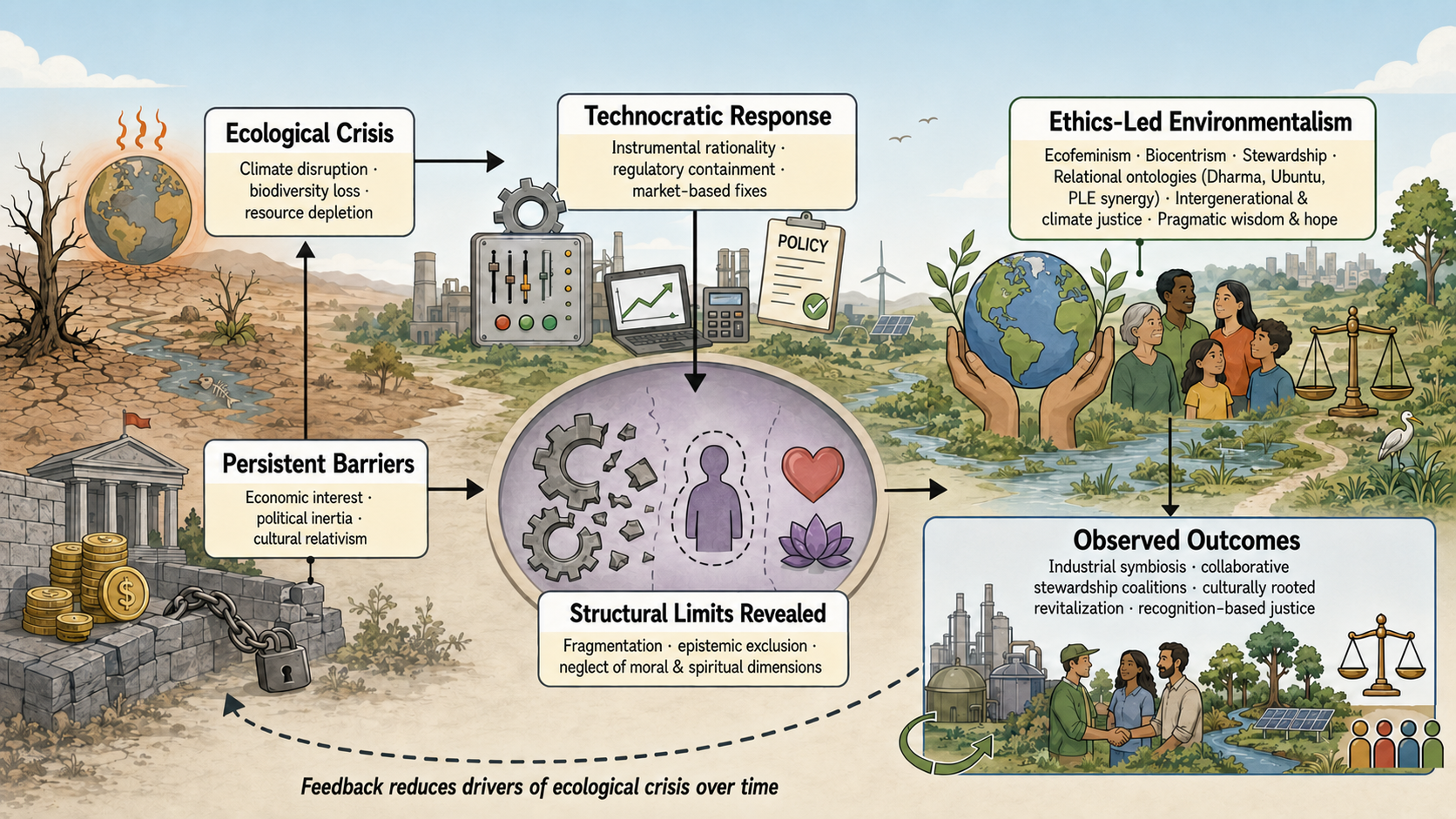
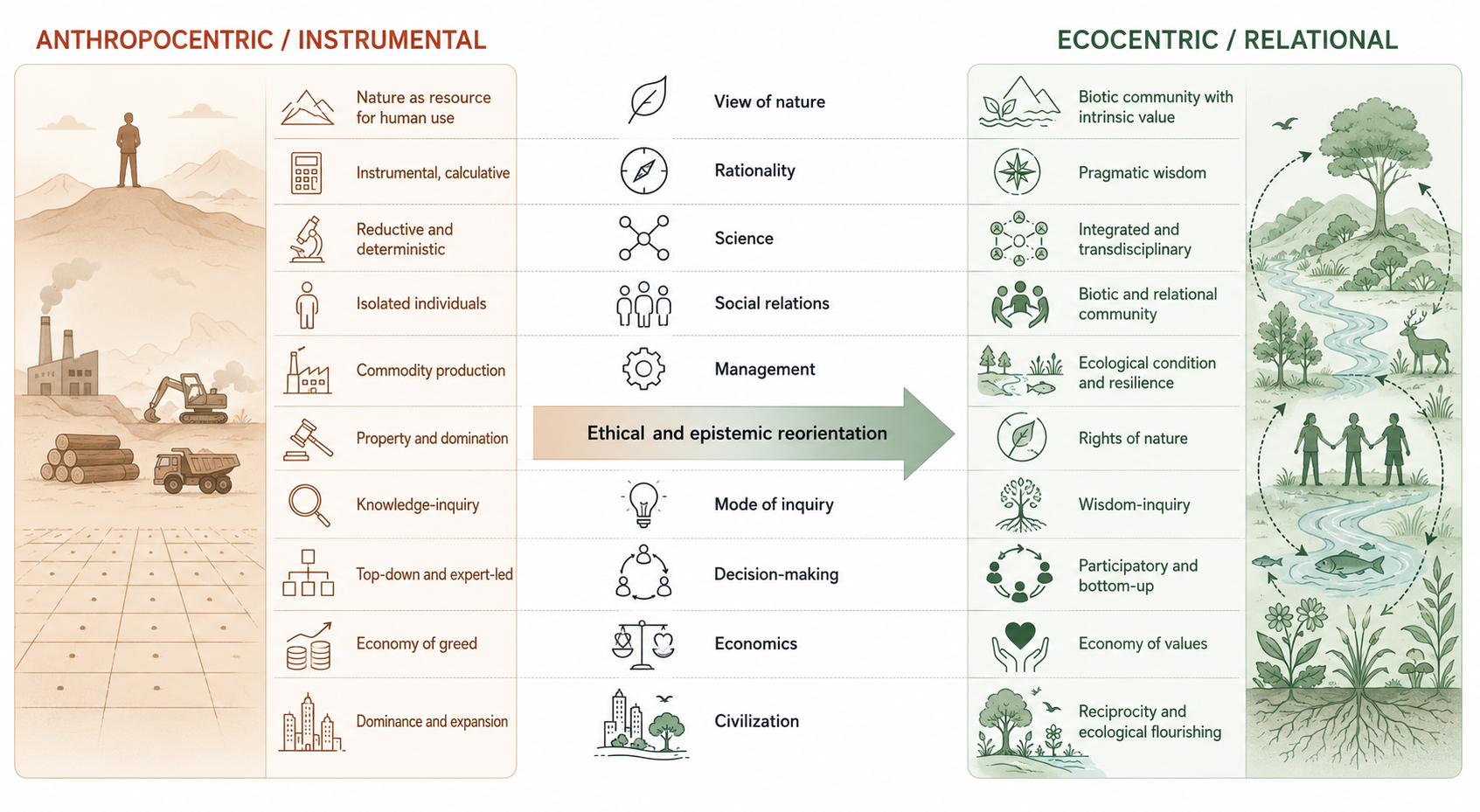
The ecological crisis is increasingly understood not merely as a failure of technology or regulation but as what several authors describe as a crisis of spirit and reason (Tan, 2022; Wang, 2017). Figure 1 summarizes this conceptual pathway from ecological crisis to ethics-led environmentalism. The dominant trajectory of environmental governance has been shaped by instrumental rationality, an orientation that treats the natural world as a passive resource available for human use. Moving beyond what Tan (2022) terms an epistemology of mastery requires an ethics-led environmentalism: an approach that recognizes humans not as proprietors of the earth but as its custodians. This reframing is closely tied to the broader shift from anthropocentrism toward ecocentrism, in which the environment is understood as a biotic community of morally considerable subjects rather than a warehouse of objects available for extraction (Mathews, 2014; Wallace et al., 1996). Figure 2 summarizes this paradigmatic shift across the ten comparative dimensions detailed in Table 1.

4.2 Biocentrism and Relational Ontologies

Biocentrism extends moral standing beyond human beings to all living organisms, on the grounds that living systems possess interests and a good of their own independent of their usefulness to humans (Mathews, 2014). Several non-Western philosophical traditions offer complementary, and in some respects more thoroughly developed, articulations of this relational orientation. Indian philosophy contributes the concepts of Dharma and Rta, framing ecological responsibility as a sacred duty bound up with the maintenance of cosmic order, while Ahimsa extends moral consideration to all living beings, transforming ecological restraint from a matter of political preference into what Pratihar and Roy (2025) describe as a holy duty. The African philosophical concept of Ubuntu offers a parallel relational ontology, holding that personhood is constituted through relationship with others, a web of interbeing that extends to the land and its non-human inhabitants (Barga, 2021; Begum et al., 2022). These traditions converge on the claim that harm to nature is not external to human well-being but constitutive of it.

4.3 Stewardship Ethics

Stewardship offers a third theoretical foundation, one that retains a more central role for human agency than either biocentrism or deep ecological self-realization. Under a stewardship model, humans bear a fiduciary-like responsibility to care for natural systems on behalf of both present and future generations, a responsibility sometimes framed in explicitly sacred terms and sometimes in secular, managerial terms emphasizing sustained yield (Tyburski, 2008; Wallace et al., 1996). Stewardship has the practical advantage of greater compatibility with existing institutional structures, since it can be incorporated into conventional resource management without requiring a wholesale rejection of human management authority (Okereke & Charlesworth, 2014). This same compatibility, however, exposes stewardship to the risk of dilution, since a managerial framing can be adopted symbolically without altering the underlying treadmill of production, an issue examined further in Section 7.

4.4 Intergenerational Justice

A fourth foundation, intergenerational justice, addresses the temporal dimension of ecological ethics: the obligations that current generations owe to those not yet born. Tyburski (2008) traces this principle through the development of sustainable development discourse, where it functions as a normative constraint on present consumption and resource depletion. Okereke and Charlesworth (2014) extend this principle into the domain of climate governance, arguing that the disproportionate exposure of future generations to risks generated by present emissions constitutes a distinct form of injustice, independent of and additional to the injustices distributed across existing populations. Operationalizing intergenerational justice remains conceptually difficult, since future persons cannot participate in present decision-making, but its normative force has nonetheless shaped emerging legal doctrines, including aspects of Earth Jurisprudence discussed above (De Lucia, 2013).

4.5 Synthesis: Pragmatic Wisdom and the Practice of Hope

Table 1. Paradigmatic shifts from Enlightenment rationality to ecological civilization, compared across ten dimensions. For each dimension (nature, rationality, science, social relations, management, legal focus, inquiry mode, decision-making, economics, civilization), the table contrasts the traditional Enlightenment position with the new ecological/civilizational position, states the methodological basis for the shift, and cites supporting references (e.g., Wallace et al., 1996; Wang, 2017).

Dimension

Enlightenment (Traditional)

Ecological/Civilizational (New)

Methodological Basis

References

Nature

Domination and mastery

Harmony and synthesis

Holistic/Interconnected

Wallace et al. (1996); Wang (2017)

Rationality

Instrumental rationality

Expanded/direct ends

Relational inquiry

Wallace et al. (1996); Tan (2022)

Science

Reductive/deterministic

Integrated/holistic

Transdisciplinary

Wallace et al. (1996); Suter et al. (2010)

Social relations

Isolated individuals

Biotic community

Communitarian

Wallace et al. (1996); Barga (2021)

Management

Commodity production

Ecological condition

Ecosystem-based

Wallace et al. (1996); Stojanovic (2019)

Legal focus

Property rights/dominion

Rights of nature

Earth Jurisprudence

De Lucia (2013); Cryer et al. (2024)

Inquiry mode

Knowledge-inquiry

Wisdom-inquiry

Academic revolution

Tan (2022)

Decision-making

Top-down/expert-led

Participative/bottom-up

Local knowledge

Wallace et al. (1996); Alba et al. (2020)

Economics

Economy of greed

Economy of values

Symbiosis/synergy

Stojanovic (2019); Li (2025)

Civilization

Industrial civilization

Ecological civilization

Process-oriented

Wang (2017); Cui (2024)

Table 2. Core ecological principles drawn from Indian, African, Chinese, Western/legal, Deep Ecology, and global/spiritual traditions. For each tradition, the table lists its core principle (e.g., Dharma, Ubuntu, Unity of humanity/nature), how that principle is applied ecologically, the counter-paradigm it opposes (e.g., utilitarianism, individualism, over-exploitation), and the relevant references, illustrating convergent philosophical routes to ecological protection.

Tradition

Core Principle

Ecological Application

Counter-Paradigm

References

Indian

Dharma (righteous duty)

Ecological care as responsibility

Utilitarianism

Pratihar & Roy (2025)

Indian

Rta (cosmic order)

Maintaining natural cycles

Chaos/excess

Pratihar & Roy (2025)

Indian

Ahimsa (non-violence)

Protecting all species/ecosystems

Exploitation

Pratihar & Roy (2025)

African

Ubuntu (humanness through others)

Personhood through the earth

Individualism

Begum et al. (2022); Barga (2021)

African

Ukama (relational ethics)

Relatedness to the whole cosmos

Othering

Begum et al. (2022); Barga (2021)

Chinese

Unity of humanity/nature

Aligning with natural laws

Industrial mastery

Cui (2024); Zhang et al. (2025)

Chinese

Conformity to nature (Wu Wei)

Respecting environmental limits

Over-exploitation

Cui (2024)

Western/Legal

Earth Jurisprudence

Nature as a legal subject

Property-based law

De Lucia (2013); Cryer et al. (2024)

Deep Ecology

Self-realization

Intrinsic value of all life

Shallow ecology

Mathews (2014); Okereke & Charlesworth (2014)

Global/Spiritual

Stewardship

Caring for the sanctuary

Consumption

Wallace et al. (1996); Tyburski (2008)


These four foundations- ecocentrism, biocentrism and relational ontology, stewardship, and intergenerational justice- do not converge on a single, fully unified ethical theory. Stewardship and deep ecological or biocentric approaches in particular differ in how much continuing managerial authority they grant to humans. What unites them, however, is a shared rejection of purely instrumental rationality and a shared insistence that ecological protection requires moral reasoning, not only technical calculation. In Table the comparative summary of these principles across traditions is represented. Operationalizing any of these foundations further requires what Tan (2022) terms pragmatic wisdom: the capacity to apply scientific knowledge altruistically rather than merely accurately. This requires a shift from knowledge-inquiry to wisdom-inquiry, integrating the liberal arts with the natural sciences to cultivate empathy and a sense of responsibility extending beyond the self. Finally, this ethical apparatus depends on what Kretz (2013) calls a practiced, active form of hope: not a passive wish for better outcomes, but a sustained engagement with the possibility of a more sustainable future, without which moral knowledge is unlikely to translate into sustained behavioral change.

5. Environmental Justice and Equity Dimensions

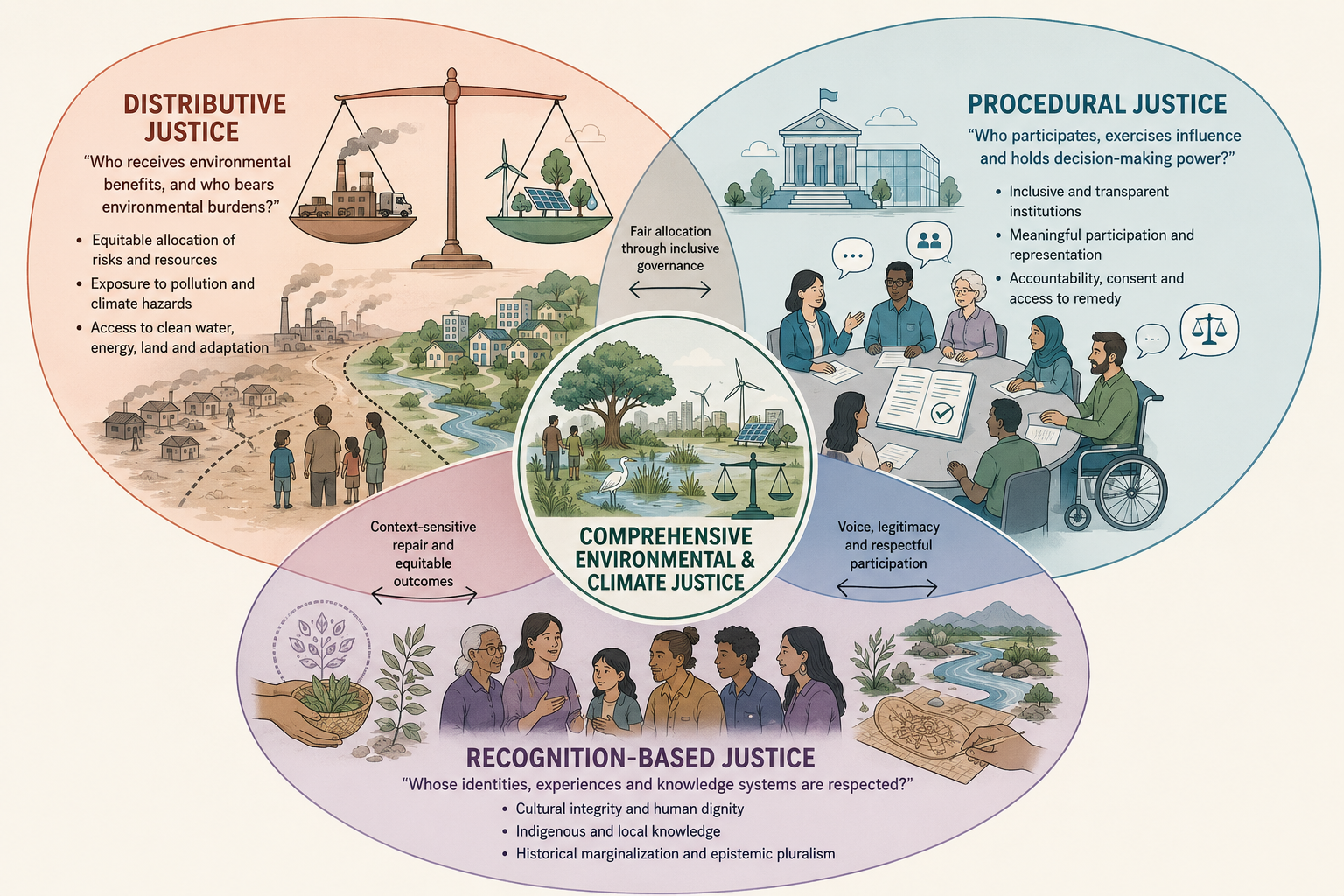
Environmental justice extends ethics-led environmentalism into the domain of social equity, beginning from the premise that the environment is not a distant abstraction but the concrete set of places where people live, work, and sustain their communities (Mohai et al., 2009). This humanized framing supports what is often described as a trivalent model of justice, encompassing distributive, procedural, and recognition-based dimensions (Schlosberg & Collins, 2014; Walker, 2012), illustrated in Figure 3.

Distributive justice concerns the fair allocation of environmental benefits and burdens. Since the 1982 protests against a PCB-contaminated waste site in Warren County, North Carolina, a substantial body of research has documented a consistent pattern in which race and socioeconomic status predict proximity to industrial pollution sources (Mohai et al., 2009). This pattern is frequently driven by what Mohai et al. (2009) describe as a growth machine: an alliance of business and government interests that prioritizes economic expansion and tends to site noxious facilities where political opposition is weakest. In response, the Just Sustainability Paradigm calls for sustainability efforts to take on an explicitly redistributive function, correcting rather than reproducing historical inequities (Schlosberg & Collins, 2014).

Procedural justice addresses the meaningful inclusion of affected communities in environmental decision-making and enforcement. Technocratic governance frequently defaults to expert-led engineering solutions, exemplified by the Mo.S.E. flood barrier system in Venice, that can sideline the lived experience and situated knowledge of local communities (Alba et al., 2020). This exclusion constitutes a form of epistemic injustice, in which knowledge systems such as traditional fishing practice or Indigenous land stewardship are discounted relative to formal engineering expertise. Justice as recognition, the third dimension, addresses this directly by requiring that the cultural integrity of affected communities be acknowledged rather than dismissed (Walker, 2012).

The convergence of environmental justice with global climate governance has given rise to the climate justice movement. Hurricane Katrina is frequently cited as a stark illustration of how climate-related disasters intensify pre-existing racial and economic vulnerabilities, leaving already disadvantaged populations disproportionately exposed (Resnik, 2022). At a global scale, these dynamic manifests as ecological debt, in which industrialized nations responsible for the bulk of historical emissions impose disproportionate climate risk on developing nations that have contributed comparatively little to the problem (Okereke & Charlesworth, 2014). Table 3 summarizes these dimensions alongside their key empirical contexts and theoretical foundations.

Integrating these equity dimensions into ethics-led environmentalism requires moving beyond a singular universal ethic toward what several scholars describe as a more decolonial model of planetary justice, incorporating concepts such as Dharma and Ubuntu as forms of collective, sacred responsibility (Begum et al., 2022; Pratihar & Roy, 2025). These reframing positions environmental justice not as an end state to be achieved once, but as an ongoing process in which sustainability and social equity are pursued jointly rather than sequentially.


6. Case Studies: Ethics-Led Approaches in Practice

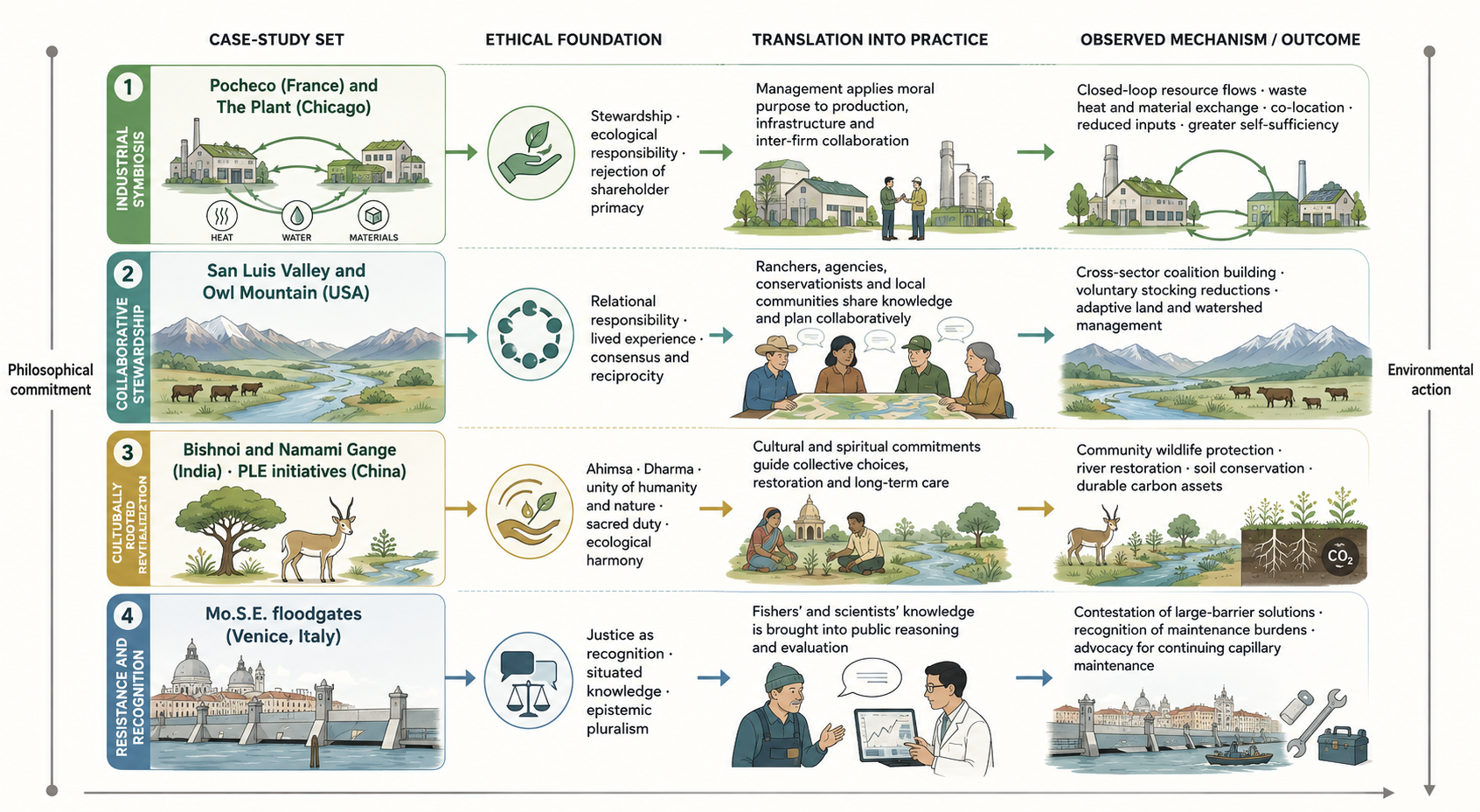
The transition from ethical theory to ecological practice is most visible in initiatives that have moved beyond a purely managerial orientation toward relational stewardship. Four sets of cases, summarized comparatively in Figure 4,

Figure 1. Conceptual pathway from ecological crisis to ethics-led environmentalism. The diagram traces how drivers of ecological crisis prompt a technocratic response, whose structural limits then push toward an ethics-led alternative. A feedback loop links ethics-led outcomes back to the original crisis drivers, showing that value-based reform, not technical fixes alone, is needed to interrupt the cycle.

Figure 2. Paradigmatic shift from anthropocentric/instrumental to ecocentric/relational environmentalism. The figure compares the two worldviews across ten dimensions — including views of nature, rationality, science, social relations, management, law, inquiry, decision-making, economics, and civilization — corresponding to the pairs detailed in Table 1. It visually summarizes the transition from domination-based to harmony-based paradigms.

illustrate this transition across different institutional scales and cultural settings.

6.1 Industrial Symbiosis and Circular Production

In the industrial sector, ethics-led management has begun to displace the conventional treadmill-of-production model with practices of industrial symbiosis that prioritize both ecological resilience and social benefit. The Pocheco envelope manufacturing plant in France illustrates this shift: by reinvesting earnings into the firm rather than distributing them as dividends, management pursued full heat self-sufficiency through a bamboo grove fueled by recycled wastewater, treating firm management as a form of applied moral philosophy (Stojanovic, 2019). A comparable model operates at The Plant, a repurposed meat-packing facility in Chicago, where sixteen co-located food and education enterprises have linked their resource flows so that waste from mushroom cultivation and brewing becomes feedstock for anaerobic digesters producing energy (Stojanovic, 2019). Both cases suggest that profitability and ecological responsibility can be mutually reinforcing when firms treat environmental commitments as constitutive of their purpose rather than as constraints on it.

6.2 Collaborative Stewardship and Cross-Sectoral Coalitions

In the American West, a shift from top-down regulation toward collaborative ecosystem management has produced coalitions among historically opposed actors. In Colorado's San Luis Valley, federal agencies, private landowners, and environmental organizations have organized around the shared objective of sustaining the valley's ecological and economic viability, employing consensus-based planning that treats local lived experience as evidence on a par with scientific data (Wallace et al., 1996). A related transformation occurred through the Owl Mountain Partnership, where ranchers voluntarily reduced grazing intensity, at meaningful personal cost, to enable riparian ecosystem recovery (Wallace et al., 1996). These cases illustrate how ecosystem management can function as a practical reconstruction of governance from the ground up, grounded in mutual obligation rather than regulatory compulsion.

6.3 Culturally Rooted Revitalization in India and China

Outside the Western institutional context, environmental protection is often grounded in long-standing philosophical traditions that frame ecological care as a sacred duty rather than a discretionary policy choice. The Bishnoi communities of Rajasthan, India, have for centuries practiced forms of environmental protection rooted in Ahimsa, safeguarding trees and wildlife well before the emergence of formal conservation law (Pratihar & Roy, 2025). Contemporary initiatives such as the Namami Gange river restoration project attempt to combine technical pollution control with the river's enduring cultural and spiritual significance (Pratihar & Roy, 2025). A parallel dynamic operates in China's pursuit of an ecological civilization through the Triple Synergy of Production, Livelihood, and Ecology framework, which seeks to reconcile rural industrial growth with environmental conservation, in some cases converting soil conservation areas into tradable carbon-sink assets (Zhang et al., 2025; Cui, 2024).Table 4 summarizes the indicators used to evaluate this Production–Livelihood–Ecology integration.

6.4 Resistance and Recognition: The Mo.S.E. Floodgates

The Mo.S.E. flood barrier system in Venice illustrates the limitations of expert-driven solutions that bypass local ecological knowledge. Local fishers and scientists argued that the lagoon required ongoing, fine-grained maintenance responsive to its hydrological complexity, rather than a single large-scale engineering intervention, and that the chosen solution sidelined this situated understanding of the lagoon's ecology (Alba et al., 2020). Securing genuine justice in this context required a form of recognition that takes seriously the cultural and epistemic standing of affected communities, incorporating their knowledge systems directly into adaptation planning rather than treating them as inputs to be consulted after the fact (Alba et al., 2020).

6.5 Cross-Case Synthesis

Across these four sets of cases, spanning industrial production, collaborative land management, culturally rooted conservation, and contested infrastructure planning, a consistent pattern emerges: successful ethics-led interventions couple an explicit normative commitment, whether framed as applied moral philosophy, consensus governance, sacred duty, or recognition-based justice, with a concrete institutional mechanism that translates that commitment into action. Where this coupling is absent, as in the Mo.S.E. case, technically sophisticated interventions can still fail to achieve legitimacy or full ecological

Table 3. Dimensions and critical contexts of environmental and climate justice. The table organizes nine justice dimensions — distributive, procedural, recognition, intergenerational, climate, and decolonial — each with its primary concern (e.g., waste siting, transparency, cultural integrity), a real-world context or case (e.g., Warren County, Hurricane Katrina, Venice MOSE floodgates), its historical/theoretical basis, and supporting citations.

Justice Dimension

Primary Concern

Key Context

Historical/Theoretical Basis

References

Distributive

Waste siting

Toxic waste and race

Warren County pattern (1982)

Mohai et al. (2009); Walker (2012)

Distributive

Air quality

Pollution and poverty

Triple jeopardy of health

Walker (2012); Mohai et al. (2009)

Distributive

Flooding

Impact on marginalized groups

Disaster inequality (Katrina)

Walker (2012); Resnik (2022)

Procedural

Meaningful involvement

Inclusion of local voices

Political equality

Mohai et al. (2009); Walker (2012)

Procedural

Transparency

Access to information

Informed consent

Walker (2012)

Recognition

Cultural integrity

Venice Mo.S.E. floodgates

Epistemic justice

Alba et al. (2020)

Intergenerational

Future generations

Long-term resource use

Responsibility to posterity

Tyburski (2008); Okereke & Charlesworth (2014)

Climate justice

Ecological debt

North-South divide

Historical responsibility

Okereke & Charlesworth (2014)

Decolonial

Indigenous agency

Global South

Epistemic pluralism

Pratihar & Roy (2025); Cryer et al. (2024)

Just sustainability

Quality of life

Access to green space

Living within ecological limits

Walker (2012); Schlosberg & Collins (2014)

Table 4. Evaluation indicators for rural industrial integration under the Production–Livelihood–Ecology philosophy. Ten secondary indicators are grouped into three subsystems — Production, Livelihood, and Ecology — each with its measurement unit (e.g., billion CNY, tons, km²) and its expected directional attribute (positive or negative), providing a measurable framework for assessing integrated rural development performance (Zhang et al., 2025).

Subsystem

Secondary Indicator

Measurement Unit

Attribute

References

Production

New-product projects

Number of items

Positive (+)

Zhang et al. (2025)

Production

Agro-processing revenue

Billion CNY

Positive (+)

Zhang et al. (2025)

Production

GDP of primary sector

Billion CNY

Positive (+)

Zhang et al. (2025)

Livelihood

Agricultural insurance coverage

Percentage (%)

Positive (+)

Zhang et al. (2025)

Livelihood

Broadband subscribers

10,000 households

Positive (+)

Zhang et al. (2025)

Livelihood

Revitalization spending

Billion CNY

Positive (+)

Zhang et al. (2025)

Ecology

Chemical fertilizer use

Ton

Negative (−)

Zhang et al. (2025)

Ecology

Pesticide use

Ton

Negative (−)

Zhang et al. (2025)

Ecology

Plastic film use

Ton

Negative (−)

Zhang et al. (2025)

Ecology

Afforestation area

km²

Positive (+)

Zhang et al. (2025)

Figure 3. Trivalent framework of environmental and climate justice. The figure maps three interlocking dimensions of justice — distributive (who bears environmental burdens), procedural (who is included in decision-making), and recognition-based (whose identities and knowledge are respected) — showing how they jointly define a comprehensive justice framework rather than operating in isolation.

Figure 4. Mechanisms linking ethical frameworks to practice across four case-study sets. The figure shows how abstract ethical principles (e.g., Indigenous, African, Chinese, and Western/legal traditions) are translated into concrete practices and outcomes, illustrating the pathway from philosophical commitment to real-world environmental action in each case.

fectiveness.

7. Barriers to Implementation: From Ethical Frameworks to Policy

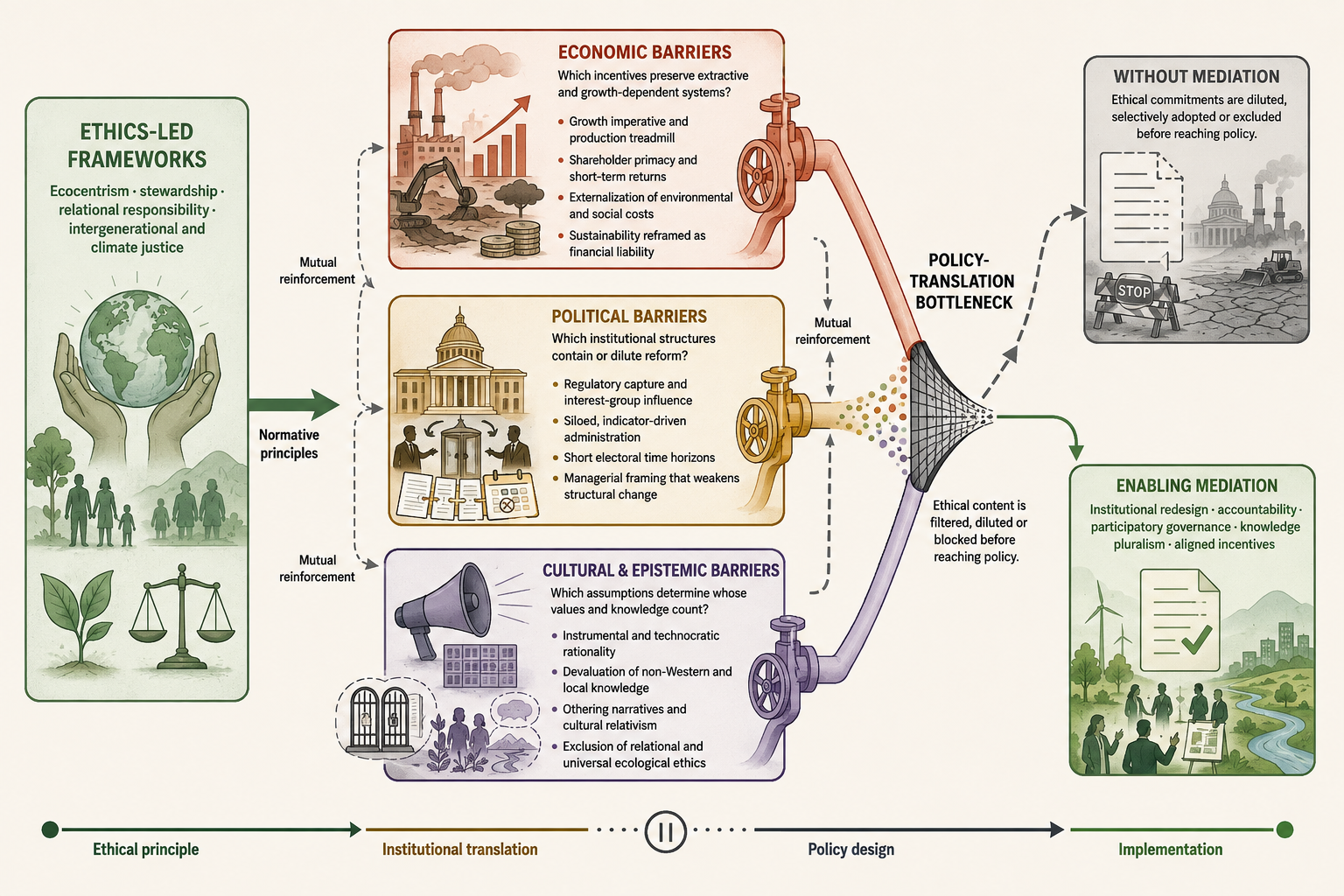
While the theoretical foundations and cases discussed above demonstrate that ethics-led approaches are practically viable, the translation of ethical principle into durable policy remains obstructed by identifiable structural barriers, summarized in Figure 5.

7.1 The Economic Mechanism

The most immediate barrier is economic. The growth machine that Mohai et al. (2009) identify, an alliance of business and governmental interests favoring continuous economic expansion, sustains the treadmill of production that compels firms to continuously extract resources to preserve profit margins (Walker, 2012). When ethical frameworks such as Dharma-based restraint or biocentric egalitarianism call for limiting extraction, they directly conflict with the norm of shareholder primacy in corporate governance, under which internalizing environmental costs is often treated as commercially unacceptable because it may depress share price and invite investor pressure to externalize those costs once again (Li, 2025). This dynamic effectively subordinates ethical commitments to short-term financial logic (Zębek et al., 2021).

7.2 The Political Mechanism

A second barrier is political. Even where ethical considerations enter the legal and regulatory arena, they are frequently neutralized through what De Lucia (2013) calls a strategy of containment, in which environmental law functions to mitigate the most visible disruptions only to the extent compatible with continued industrial expansion. Regulatory systems oriented around narrow, indicator-based compliance metrics, rather than broader civilizational reassessment, can produce a managerialist framing of environmental justice, in which regulatory agencies adopt the language of equity without addressing the underlying structural drivers of inequity (Resnik, 2022; Walker, 2012). This pattern reduces complex, interconnected ecological problems to discrete technical sub-fields, reproducing the same fragmentation discussed in Section 3 (De Lucia, 2013; Stojanovic, 2019).

7.3 The Cultural and Epistemic Mechanism

A third barrier operates at the level of culture and epistemology. Instrumental rationality, as discussed in Section 4, devalues non-Western and non-engineering knowledge systems by treating only calculable, quantifiable relationships as legitimate evidence (Wallace et al., 1996). This produces a persistent gap between ethical judgment and behavior (Stojanovic, 2019; Tan, 2022) and can interact with geopolitical narratives, such as media framings that cast environmental degradation as a feature of a particular national or cultural other, which repurpose environmental discourse as a tool of geopolitical competition rather than a basis for cooperative global action (Ziser & Sze, 2007).

7.4 Differential Vulnerability of Ethical Theories

These three mechanisms do not affect all ethical theories equally. Stewardship and reform-oriented environmentalism, precisely because they are more compatible with existing institutional structures, are correspondingly more exposed to the risk of dilution: they can be adopted symbolically, through mechanisms such as voluntary corporate disclosure or market-based carbon trading, without requiring substantive change to the treadmill of production (Li, 2025; Schlosberg & Collins, 2014). Deep ecology and strongly biocentric approaches face the opposite risk, that of marginalization, since their demands for reduced consumption and a fundamental reordering of human–nature relations are often dismissed by political elites as impractical or insufficiently attentive to the immediate developmental needs of lower-income populations (Mathews, 2014; Okereke & Charlesworth, 2014). Stewardship therefore risks being too readily absorbed to drive structural change, while deep ecology risks being too disruptive to gain political traction; this tension is addressed directly in the integrated framework proposed in Section 8.

8. Toward an Integrated Ethics-Led Framework

The preceding sections suggest that no single ethical theory, on its own, is likely to overcome the economic, political, and cultural barriers identified in Section 7. Stewardship's institutional compatibility makes it vulnerable to dilution; deep ecology's normative ambition makes it vulnerable to marginalization; and purely justice-based framings, absent a positive ecological ontology, risk neglecting non-human interests altogether. This suggests the need for a framework that deliberately combines elements from each, rather than treating them as competing alternatives.

Such an integrated framework would rest on three

Figure 5. Economic, political, and cultural barriers obstructing policy translation. The figure diagrams the mechanisms — spanning economic incentives, political structures, and cultural norms — that prevent ethics-led environmental frameworks from being adopted into actual policy, highlighting where implementation stalls between principle and practice.

coordinated components. The first is an ecocentric or biocentric baseline, providing the normative claim that ecological systems possess standing independent of their usefulness to humans, which guards against the risk that justice-based or stewardship-based reforms quietly default back into a purely anthropocentric calculus. The second is a justice-based operational layer, incorporating the distributive, procedural, and recognition-based dimensions discussed in Section 5, which ensures that ecocentric commitments do not inadvertently reproduce or ignore existing social inequities, a risk that purely ecocentric framings have historically faced when applied without attention to distributive consequences (Okereke & Charlesworth, 2014). The third is an institutional translation mechanism, of the kind observed in the case studies in Section 6, such as reinvestment-based corporate governance, consensus-based land management, or legally recognized rights of nature, that converts normative commitment into binding or quasi-binding practice rather than aspirational language.

Critically, this framework treats the apparent tension between stewardship's institutional compatibility and deep ecology's normative ambition not as a flaw to be resolved in favor of one side, but as a productive division of labor: stewardship-compatible mechanisms can secure incremental institutional footholds, such as fiduciary reform in corporate law (Li, 2025), while ecocentric and culturally rooted commitments supply the normative ambition needed to prevent those footholds from being limited to symbolic compliance. Embedding intergenerational justice as a binding design constraint across all three components, rather than as an aspirational add-on, further guards against the temporal discounting that has historically allowed present-generation interests to dominate environmental decision-making (Tyburski, 2008).

9. Discussion

A critical review of these philosophical pathways would be incomplete without engaging directly with the strongest objections to an ethics-led approach. Three such objections merit sustained attention: that ethical and cultural transformation is too slow relative to the pace of ecological breakdown; that ethical frameworks are too culturally specific to support coordinated global action; and that ethical language is too easily co-opted symbolically without altering underlying material practices.

9.1 The Temporal Critique

The most pressing objection concerns scale and speed. Cultivating pragmatic wisdom and shifting educational paradigms are long-term projects, yet scientific projections suggest that some forms of ecological damage could become irreversible within this century (Tan, 2022). Critics might reasonably argue that humanity lacks the decades that a genuine shift from knowledge-inquiry to wisdom-inquiry would require, and that focusing on philosophical transformation risks diverting attention from more immediately actionable interventions. This concern should be taken seriously rather than dismissed.

At the same time, the alternative of continued reliance on technocratic regulation is itself a strategy of containment that has not arrested ecological decline despite decades of implementation (De Lucia, 2013). The claim advanced in this review is not that ethics-led approaches are faster than regulatory approaches, but that they address a root cause, instrumental rationality's treatment of nature as a resource base, that purely technical interventions leave intact. Absent this shift, technological interventions risk producing the same unintended consequences observed in cases such as the Mo.S.E. floodgates, where an engineering-led solution displaced more adaptive, locally calibrated alternatives (Alba et al., 2020). The practical implication is not that ethical transformation should substitute for near-term regulatory action, but that the two should proceed in parallel, with the integrated framework proposed in Section 8 offering one route to combining institutional speed with normative depth.

9.2 The Operational Critique: Cultural Specificity Versus Global Coordination

A second objection concerns whether culturally specific ethical concepts, such as Dharma, Ubuntu, or the Triple Synergy framework, can scale into a coordinated global response. When environmental justice claims fragment into competing accounts of “whose justice,” this can complicate international cooperation, as developed and developing nations dispute the allocation of historical responsibility (Okereke & Charlesworth, 2014; Ziser & Sze, 2007).

A plausible response, consistent with the case evidence reviewed in Section 6, is to pursue epistemic pluralism rather than a single universal ethical doctrine (Pratihar & Roy, 2025). This involves treating diverse ethical and cultural traditions as legitimate, coequal sources of environmental obligation rather than imposing a single normative framework from outside. Deep ecology, for instance, is frequently dismissed in policy circles as impractical, yet it can be pragmatically combined with stewardship-based models that are more readily compatible with existing legal and institutional structures (Okereke & Charlesworth, 2014). The objective under this view is not a single global monoculture of environmental ethics, but coordinated, mutually reinforcing diversity, in which distinct traditions converge on overlapping practical commitments even while differing in their underlying justifications.

9.3 The Materialist Critique: Symbolic Co-optation

The most consequential objection concerns the risk that ethical language is adopted symbolically while substantive practice continues unchanged. Corporate and political actors can deploy ethical and ecological rhetoric, such as references to ecological civilization or corporate social responsibility, while continuing carbon-intensive operations, using such language to project legitimacy rather than to constrain behavior (Li, 2025). Concepts adopted in this way risk functioning as soft law, providing reputational benefit without enforceable obligation (Walker, 2012).

The case evidence reviewed in Section 6 suggests a partial response to this risk: ethical commitments are least susceptible to symbolic co-optation when they are embedded in concrete institutional mechanisms, such as reinvestment-based governance structures, consensus-based land management agreements, or legal rights of nature, that impose binding rather than purely rhetorical constraints (Stojanovic, 2019; Zhang et al., 2025). Reframing directors' environmental obligations as a component of fiduciary duty, for example, would alter the legal incentive structure underlying shareholder primacy rather than relying solely on voluntary disclosure (Li, 2025). This reinforces the case, for treating institutional translation mechanisms as a necessary, non-optional component of any ethics-led framework, rather than treating ethical commitment as sufficient on its own.

9.4 Limitations

Several limitations should be considered when interpreting the findings of this review. First, the study adopts a narrative rather than a systematic review approach, which inevitably introduces a degree of subjectivity in literature selection and interpretation. Although efforts were made to include influential and diverse sources, relevant studies may have been overlooked. Second, the review relies primarily on conceptual and theoretical scholarship, limiting its ability to provide quantitative comparisons between ethics-led and technocratic environmental interventions. Third, the case studies were purposively selected to illustrate key themes rather than represent the full spectrum of environmental governance experiences. Consequently, unsuccessful or contradictory examples may be underrepresented. Additionally, the review focuses on selected philosophical traditions, including ecocentrism, stewardship, Dharma, Ubuntu, and ecological civilization, while many Indigenous and region-specific environmental worldviews remain outside its scope. Future research employing systematic review methods and empirical evaluation would help validate and extend the conceptual framework proposed in this study.

10. Conclusion

The environmental crisis is increasingly revealing itself as not only a scientific or technological challenge but also an ethical one. This review demonstrates that approaches grounded solely in regulation and technological innovation often fail to address the deeper values and assumptions that drive ecological degradation. Ethics-led environmentalism offers an alternative pathway by integrating ecocentrism, stewardship, intergenerational responsibility, environmental justice, and culturally rooted ecological philosophies into governance processes. While significant economic, political, and cultural barriers remain, the evidence reviewed suggests that ethically grounded environmental frameworks can enhance both legitimacy and long-term sustainability, supporting more resilient and equitable ecological futures.


Author Contributions

M.A.H. conceptualized the study, developed the review framework, and conducted the literature search, study selection, critical appraisal, and evidence synthesis. M.A.H. prepared the original manuscript and interpreted the philosophical, ethical, and environmental perspectives. P.P.B. contributed to the literature analysis, interpretation of environmental ethics and justice frameworks, and critical revision of the manuscript. Both authors reviewed and approved the final manuscript and agreed to be accountable for all aspects of the work.

Acknowledgements

The authors sincerely acknowledge the Department of Philosophy, University of Rajshahi, for providing academic support and access to relevant scholarly resources used in preparing this critical review. The authors also express their gratitude to the scholars whose published works contributed to the development of the ethical and philosophical perspectives synthesized in this study. No specific funding was received for this study.

References


Alba, R., Klepp, S., & Bruns, A. (2020). Environmental justice and the politics of climate change adaptation – the case of Venice. Geographica Helvetica, 75, 363–368. https://doi.org/10.5194/gh-75-363-2020

Barga, T. (2021). African ecological theology: Pedagogical pathways to environmental protection. AKU: An African Journal of Contemporary Research, 2(1), 3–19.

Begum, A., Liu, J., Qayum, H., & Mamdouh, A. (2022). Environmental and moral education for effective environmentalism: An ideological and philosophical approach. International Journal of Environmental Research and Public Health, 19(23), 15549. https://doi.org/10.3390/ijerph192315549         

Cryer, P., Proches, S., & Druce, D. J. (2024). The shifting philosophy behind the protected area concept and its applicability in the South African context. Frontiers in Conservation Science, 5, 1497920. https://doi.org/10.3389/fcosc.2024.1497920 

Cui, S. (2024). Evaluation on the ecological philosophy of traditional Chinese agriculture and rural sustainable development. TRANS/FORM/AÇÃO: Revista de Filosofia da Unesp, 47(5), e02400253.      

De Lucia, V. (2013). Towards an ecological philosophy of law: A comparative discussion. Journal of Human Rights and the Environment, 4(2), 167–190.

Kretz, L. (2013). Hope in environmental philosophy. Journal of Agricultural and Environmental Ethics, 26, 925–944. https://doi.org/10.1007/s10806-012-9425-8    

Li, X. (2025). Pathways to achieving sustainable development and green governance in Chinese corporate law. Sustainable Development, 33(5).

Mathews, F. (2014). Environmental philosophy. In N. N. Trakakis & G. Oppy (Eds.), A history of Australasian philosophy (pp. 543–591). Springer.

Mohai, P., Pellow, D., & Roberts, J. T. (2009). Environmental justice. Annual Review of Environment and Resources, 34, 405–430.

Okereke, C., & Charlesworth, M. (2014). Environmental and ecological justice. In M. M. Betsill, K. Hochstetler, & D. Stevis (Eds.), Advances in international environmental politics (2nd ed., pp. 123–147). Palgrave Macmillan.

Pratihar, A. R., & Roy, A. (2025). Indian philosophical pathways to eco wisdom and sustainable development. International Journal of Social Science Research (IJSSR), 2(4), 544–555.

Resnik, D. B. (2022). Environmental justice and climate change policies. Bioethics, 36(7), 735–741. https://doi.org/10.1111/bioe.13042

Schlosberg, D., & Collins, L. B. (2014). From environmental to climate justice: Climate change and the discourse of environmental justice. WIREs Climate Change, 5(3), 359–374. https://doi.org/10.1002/wcc.275   

Stojanovic, M. (2019). Conceptualization of ecological management: Practice, frameworks and philosophy. Journal of Agricultural and Environmental Ethics, 32(3), 431–446. https://doi.org/10.1007/s10806-019-09783-2           

Suter, G. W., II, Norton, S. B., & Cormier, S. M. (2010). The science and philosophy of a method for assessing environmental causes. Human and Ecological Risk Assessment: An International Journal, 16(1), 19–34. https://doi.org/10.1080/10807030903459254               

Tan, W. K. (2022). Pathway to sustainability through pragmatic wisdom. Philosophies, 7(6), 131. https://doi.org/10.3390/philosophies7060131

Tyburski, W. (2008). Origin and development of ecological philosophy and environmental ethics and their impact on the idea of sustainable development. Sustainable Development, 16, 100–108. https://doi.org/10.1002/sd.342     

Walker, G. (2012). Environmental justice: Concepts, evidence and politics. Routledge.

Wallace, M. G., Cortner, H. J., Moote, M. A., & Burke, S. (1996). Moving toward ecosystem management: Examining a change in philosophy for resource management. Journal of Political Ecology, 3, 1–36.

Wang, H. (2017). Philosophical connotations, generating logic and construction paths of ecological civilization in a global view. Advances in Economics, Business and Management Research, 29, 592–599.

Zebek, E., Augustyniak, M., & Kowalczyk, M. (2021). An interdisciplinary approach to environmental protection: Legal, economic, technological, and philosophical considerations. Journal of Modern Science, 2(47), 497–520. https://doi.org/10.13166/jms/142750

Zhang, J., Ma, M., Qian, J., & Ma, L. (2025). China’s rural industrial integration under the “Triple Synergy of Production, Livelihood and Ecology” philosophy: Internal mechanisms, level measurement, and sustainable development paths. Sustainability, 17, 8972. https://doi.org/10.3390/su17208972  

Ziser, M., & Sze, J. (2007). Climate change, environmental aesthetics, and global environmental justice cultural studies. Discourse, 29(2), 384–410.


Article metrics
View details
0
Downloads
0
Citations
1
Views

View Dimensions


View Plumx


View Altmetric


0
Save
0
Citation
1
View
0
Share