1. Introduction
Walk through any of Dhaka's older slum clusters at dusk and you'll see it plainly: pharmacies doing brisk business, informal drug sellers doling out tablets by the strip, and a steady trickle of people ducking into whatever clinic happens to be nearby and open. What you won't see, most of the time, is a doctor. This isn't a failure of individual choice so much as a structural one — and it's the starting point for this paper.
Primary health care (PHC) is often described, almost reflexively, as the backbone of a functioning health system. That description holds up reasonably well in theory. In practice, especially across much of Bangladesh, the backbone has gaps you could drive a rickshaw through. Some of these gaps trace back to the country's epidemiological transition — the messy, uneven shift from infectious to chronic disease burden — while others stem from disease outbreaks, periods of instability, and governance shortfalls that have accumulated over years rather than emerged all at once (Dodd et al., 2019). There is reasonably good evidence, too, that where communities are genuinely engaged and mobilized around health service delivery, outcomes tend to improve (Dodd et al., 2019). That finding matters a great deal for slum settings, where trust in formal institutions is often thin and where community-level relationships frequently do more work than official channels.
So what does this paper actually try to do? Three things, roughly in sequence. First, it pulls together existing literature on PHC systems as they relate to chronic and contagious illness care — not exhaustively, but with enough breadth to establish a pattern. Second, it narrows in on the particular difficulties facing slum-dwelling populations in Bangladesh, a group whose health needs are frequently mentioned in passing but rarely examined with the specificity they deserve. Third, building on both of those threads, it proposes a patient care management model meant to address at least some of the gaps identified along the way.
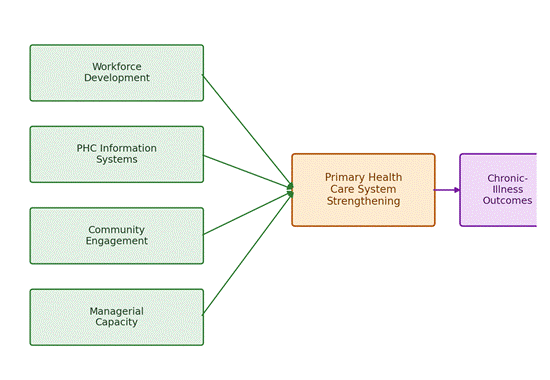
Ten studies inform the analysis that follows, and it's worth sketching the shape of that literature before diving into any one of them, because the diversity itself is instructive. Dodd et al. examined PHC systems across low- and middle-income countries in the Asia-Pacific region and, after that comparison, converged on five priorities for strengthening service delivery: building up the non-physician workforce, folding non-communicable disease prevention into basic care packages, developing managerial capacity, institutionalizing — not just encouraging — community engagement, and modernizing information systems (Dodd et al., 2019). None of these are glamorous fixes. They're the unglamorous, infrastructural kind of change that rarely makes headlines but tends to matter more than the headline-grabbing kind.
Elsewhere in the literature, the picture gets more granular, sometimes uncomfortably so. Hjern and colleagues, looking at health examinations for child migrants across Europe, found the practice to be inconsistent at best — some countries running PPD testing, others fecal occult blood testing, still others cholesterol screening, with little coherence across the set (Hjern et al., 2019). It's a fair question, and one the authors raise directly, whether these procedures amount to genuine health assessment or something closer to a screening exercise performed for its own sake (Hjern et al., 2019). That distinction — assessment versus performance — echoes uncomfortably well when you think about how chronic illness screening sometimes functions in resource-constrained urban settings.
On the intervention side, Russell et al. described IMPACT, a five-year program built across Australia and Canada on a network of Local Innovation Partnerships, bringing decision-makers, researchers, clinicians, and members of vulnerable communities into the same room to work on access problems together (Russell et al., 2019). Baum et al., working from a five-year longitudinal realist case study in South Australia, drew out the distinction between comprehensive and selective primary health care — a distinction with real bite given the Sustainable Development Goals framing so much current health policy discourse (Baum et al., 2017). Satherley et al. took a mixed-methods approach, grounded in the RE-AIM framework, to evaluate the Children and Young People's Health Partnership Evelina London Model of Care, offering a template for how integrated pediatric care programs might scale (Satherley et al., 2019). Saif-Ur-Rahman and colleagues went a different route entirely, proposing an evidence gap map protocol — modeled on the methodology of the International Initiative for Impact Evaluation — specifically to surface where primary health care policy and governance research is thin across low- and middle-income countries (Saif-Ur-Rahman et al., 2019).
Not everything here is squarely about PHC delivery mechanics, and that's deliberate. Greer's analysis of European Union health services policy treats the field as a "critical juncture," arguing that rulings from the European Court of Justice have, over time, produced a fragmented landscape of competing models and bureaucratic sponsors rather than one coherent system (Greer, 2008). It's a reminder that fragmentation isn't unique to low-income settings — it just tends to look different, and get less attention, in wealthier ones. Squire et al. described the UK's Expert Patients Programme, a formalized peer-led support model for people managing long-term conditions (Squire et al., 2006), an approach whose intellectual roots go back to Stanford, where Lorig and colleagues first tested lay-led self-management support among arthritis patients (Lorig et al., 1986). That early work was later generalized into the Chronic Disease Self-Management Course, which — somewhat surprisingly, given how much weight is typically placed on professional-led care — produced outcomes comparable to programs run by health professionals (Lorig et al., 1999). Gemaque and colleagues, working in a very different register, examined oral lesions among hospitalized infectious-disease patients in northern Brazil and found tuberculosis and HIV to be the most prevalent underlying conditions, with oral candidiasis and periodontal disease serving as visible markers of immunosuppression — a finding that argues, fairly persuasively, for folding dental care into infectious disease management rather than treating it as a separate concern (Gemaque et al., 2014).
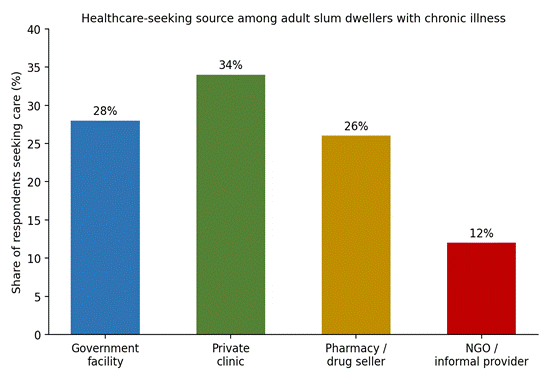
The empirical anchor for this review, though, is Adams et al.'s cross-sectional study of healthcare-seeking behavior among adult slum dwellers in two Bangladeshi urban settings. What that study found — and what shapes much of the analysis that follows — is that slum populations are far less homogeneous, socioeconomically, than they're often assumed to be, and that people seek care in whatever form happens to be accessible given the constraints they face: proximity, time, perceived effectiveness, and cost (Adams et al., 2020). That's a modest-sounding finding on its face, but it carries real implications for how care management frameworks ought to be designed — not around an idealized patient with unconstrained choice, but around the actual, constrained decisions people are making every day. The remainder of this paper builds outward from that premise.